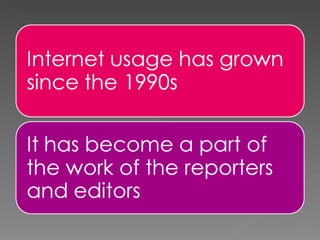
Before press releases are produced on computer and delivered via email, PR practitioners manually typed on a paper and sent via mail or fax. On March 8, 1954, the first electronically transmitted press release had been sent by PR Newswire. Media have evolved technically because of the strategy and tactics of public relations rely on use of the media.
These strategic and intentional adaptations are designed to improve the effectiveness, efficiency or efficacy of various tactics and techniques. In other cases, the changes might be subtle and unintentional, lead to bad PR practices.


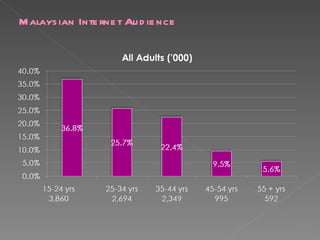
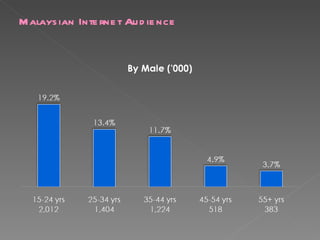
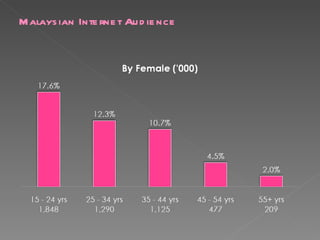
Malaysian Internet Audience


Video link:
Video link:
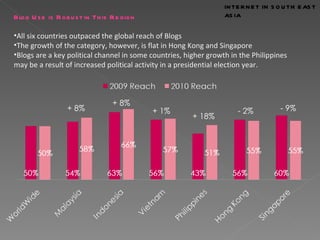
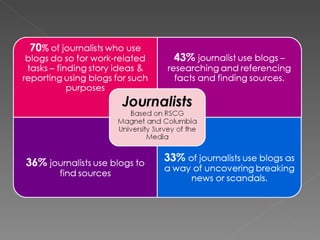
Blog Use is Robust in This Region All six countries outpaced the global reach of Blogs The growth of the category, however, is flat in Hong Kong and Singapore Blogs are a key political channel in some countries, higher growth in the Philippines may be a result of increased political activity in a presidential election year.  + 8% + 8% + 1% + 18% - 2% - 9% INTERNET IN SOUTH EAST ASIA
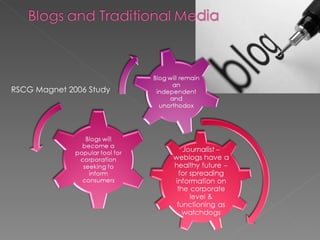
RSCG Magnet 2006 Study
 
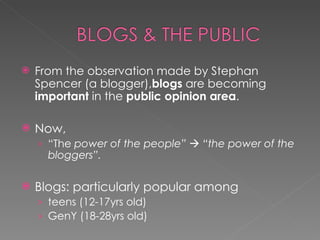
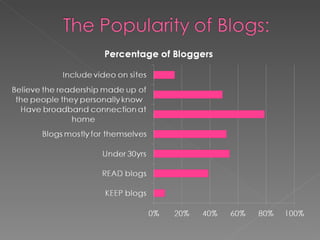
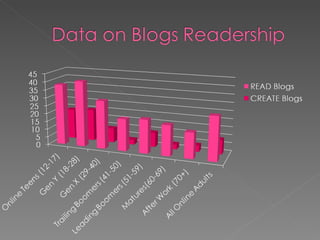
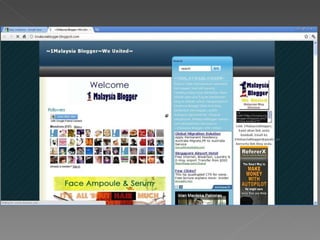
From the observation made by Stephan Spencer (a blogger), blogs  are becoming  important  in the  public opinion area .  Now,  “ The  power of the people”    “the power of the bloggers”. Blogs: particularly popular among  teens (12-17yrs old)  GenY (18-28yrs old)
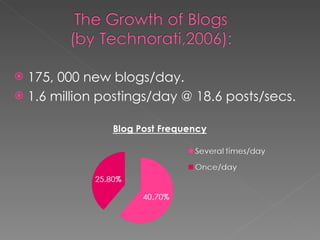
175, 000 new blogs/day. 1.6 million postings/day @ 18.6 posts/secs.
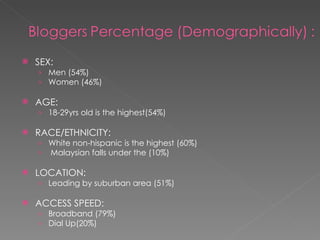
SEX: Men (54%) Women (46%) AGE: 18-29yrs old is the highest(54%) RACE/ETHNICITY: White non-hispanic is the highest (60%) Malaysian falls under the (10%) LOCATION:  Leading by suburban area (51%) ACCESS SPEED: Broadband (79%) Dial Up(20%)
 
 
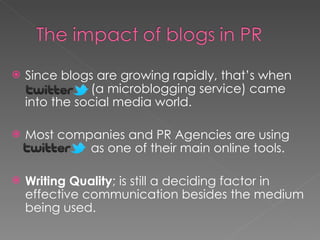
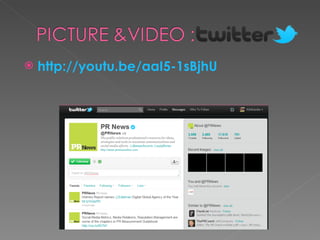
Since blogs are growing rapidly, that’s when    (a microblogging service) came into the social media world. Most companies and PR Agencies are using    as one of their main online tools. Writing Quality ; is still a deciding factor in effective communication besides the medium being used.
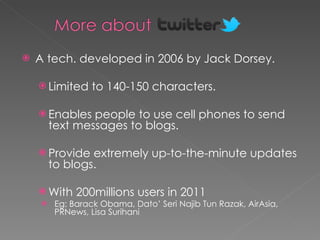
A tech. developed in 2006 by Jack Dorsey. Limited to 140-150 characters. Enables people to use cell phones to send text messages to blogs. Provide extremely up-to-the-minute updates to blogs. With 200millions users in 2011 Eg: Barack Obama, Dato’ Seri Najib Tun Razak, AirAsia, PRNews, Lisa Surihani
http://youtu.be/aaI5-1sBjhU
Their usefulness as : Research tools (information gathering & environmental scanning) Message/issue framing Persuasion tools http://www.changements.com.ulaval.ca/module10/RP_blog.pdf
Communicative risks involved in blogging Exaggerated significance attached to blogging Blogger credibility and status http://www.changements.com.ulaval.ca/module10/RP_blog.pdf


THANK  YOU..
PREPARED BY: NAME MATRIX NUM. TATINORHAJAR BT MOHD JAKERE 2010485776 NOR AZZURA BT MOHD DARUS 2010420236 MUHAMMAD LUTHFI AZZAMUDDIN BIN MOHD MUNIM 2010414444 INTAN BAIRUHA BT ABDUL MALEK 2010423214 NUR FARAHAIN BT BINJAMIN 2010857976 KHAIRULDIN BIN MOHD IZZUDDIN 2010203192 BASHIRA BT KHUSAINI 2010482478
INTRODUCTION Technologies such as blogs, podcasts, and websites generally help PR practitioner to deliver their messages widely specifically to their targeted audiences. The style of contents also changes- expanded use of audio and video files- makes the content more attractive. The messages also can be adapted to mobile media formats.
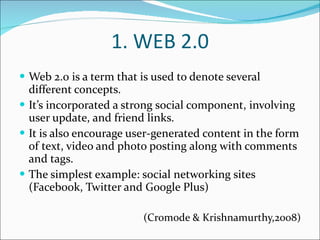
1. WEB 2.0 Web 2.0 is a term that is used to denote several different concepts.  It’s incorporated a strong social component, involving user update, and friend links.  It is also encourage user-generated content in the form of text, video and photo posting along with comments and tags.  The simplest example: social networking sites (Facebook, Twitter and Google Plus)  (Cromode & Krishnamurthy,2008)
Interesting features of Web 2.0: Users as first class entities in the system, with prominent profile pages including such features (age, sex, location and comments about the user by other users). Ability to communicate or interact between users via links to other users who are friends, membership in groups or RSS feeds (subscription) of updates. Ability to post content in many forms like photos, videos, blogs, and comments. It also allow user to tagging of own or others’ content and ability to control privacy and sharing. (Cromode & Krishnamurthy,2008)
Web 2.0 is associated with the publishing site, syndicated to other sites, aggregated to RSS readers and email, and short content or alerts directed to cell phones.  Web 2.0 makes thing easier like video sharing, voice calling, and updating contents. Web 2.0 encourage people to communicate without boundaries (eg: Twitter, Facebook, Skype)
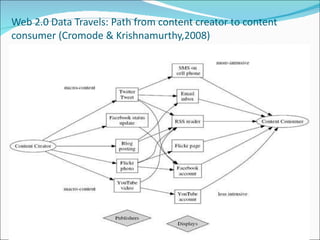
Web 2.0 Data Travels: Path from content creator to content consumer (Cromode & Krishnamurthy,2008)
WEB 1.0 Called as the “read only web”. Invented by Berners’ Lee : Vision “The dream behind the Web is of a common information space in which we communicate by sharing information.”  (Berners-Lee, 1998) There was very little in the way of user interaction or content contribution.
Characteristics of Web 1.0 1 ) General attributes: Fairly static information Updated infrequently Typified as ‘brochureware’ 2) Elements of web page: Images, navigation icons, text, menu 3) Writing style: Impersonal, professional, descriptive, statements of fact 4) Linking structure: Minimal, unchanging, little interaction between sites (Evans, 2006)
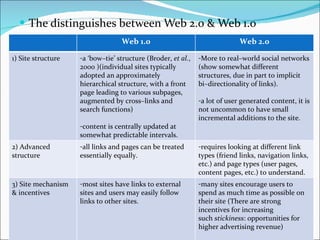
The distinguishes between Web 2.0 & Web 1.0 Web 1.0 Web 2.0 1) Site structure a  ‘bow–tie’ structure (Broder,  et al. , 2000 )( individual sites typically adopted an approximately hierarchical structure, with a front page leading to various subpages, augmented by cross–links and search functions) content is centrally updated at somewhat predictable intervals. More to real–world social networks (show somewhat different structures, due in part to implicit bi–directionality of links). a lot of user generated content, it is not uncommon to have small incremental additions to the site. 2) Advanced structure all links and pages can be treated essentially equally. requires looking at different link types (friend links, navigation links, etc.) and page types (user pages, content pages, etc.) to understand. 3) Site mechanism & incentives most sites have links to external sites and users may easily follow links to other sites. many sites encourage users to spend as much time as possible on their site (There are strong incentives for increasing such  stickiness : opportunities for higher advertising revenue)
Play video:  http://youtu.be/YXFYkbQRgY4
2. VIDEO NEWS RELEASE (VNR) Definition: the television version of the printed press release, translating the printed word into the language of moving pictures (US Consumer Product Safety Commission,2011) It is similar to documentary but it is more to introducing a product ( not advertisement) or informing people about an issue by PR practitioner especially.
Advantages: VNRs can be view or download through online by journalists anytime that they want to use it. VNR also may contains an interview with a person that was unavailable to a mass media event. VNR includes video of the product which is edited to make it easy for TV news producers to air the video on newscasts and slates which are easy-to-read full-screen graphics that provide the details of the recall.
Disadvantages: VNR is being used to be manipulated for propaganda.  The contain of VNR may from fake reporters.
Play video: 1) New adidas Soccer Shoes for 2011/2012 http://youtu.be/turZfHDelQY
3. EMERGING MESSAGE TECHNIQUES This is the emergence form of two/ more sets of data, called “mash-up” media. In Web development, a mash-up is a Web page or application that uses and combines data, presentation or functionality from two or more sources to create new services (Wikipedia Definition) The term implies easy, fast integration, frequently using open APIs and data sources to produce enriched results that were not necessarily the original reason for producing the raw source data.
Advantages: It provides users a detailed, interactive, and useful outlook of information. It helps PR practitioner to find relevant scholarly research in a timely, cost-effective fashion  in conducting research.(eg: Google scholar, CrossRef) It minimized application data management: By leveraging third party data providers, you can ensure reduced costs related to maintaining and updating your own data repositories. It reduced development effort: Involves taking advantage of business logic which has been thoroughly tested and designed to solve a particular domain problem, and is maintained by a specialized service provider. Unlimited data sources based on standards: swapping between the growing number of data sources available on the web can create an exponential number of possibilities for all your developments.
Play video: Example: Google Developer Day - Mashup Showcase http://youtu.be/-GeU3Rp7wnY
CONCLUSION The rise of multimedia PR gives public relations professionals new ways to reach target audiences in non-traditional settings.  To be sure, the rich media revolution is shaking up public relations contents and messages. While the fundamentals of PR remain intact, the rules of engagement are changing. Press releases are becoming video news releases, for example, and corporate events are broadcast over the Internet.  Competing for mind share in a multimedia landscape requires a thoughtful strategy and the tools to execute it.
As far as our concern, the world we are living now has evolved into tremendous form of new era. Technologies we have nowadays are far greater excellent from the past. We could possibly do anything on what we want at our fingertips. Technologies we have right now bring impact on how we perceive our life and the way we conducting it. It also give impact to most area, including Public Relations (PR) field. PR has being affected from many aspects due to the new technologies created. The evolution is still going on today.
REFERENCES Berners-Lee, T. (1998), “The World Wide Web – a very short personal history” http://www.w3.org/People/Berners-Lee/ShortHistory Cormode, K. (2008, June 2).  Volume 13 Number 6: Key Differences Between Web 1.0 and Web 2.0.  Retrieved September 2011, from First Monday:  http://www.uic.edu/htbin/cgiwrap/bin/ojs/index.php/fm/article/view/2125/1972 Evans, D. M. (2006, November 8).  The Evolution of the Web- From Web 1.0 to Web 4.0.  Retrieved September 30, 2011, from Centre for Security, Communications and Network Research:  www.cscan.org/presentations/08-11-06-MikeEvans-Web.pdf
THE CONSEQUENCES OF TECHNOLOGY FAKHRIAH BINTIAHMAD RADZUAN KHAIRUL ANNUAR BIN MD YUSOF MOHD HAZIQ BIN SHUKRI NUR SYAFINAZ BINTI HASNAN
THE CONSEQUENCES OF TECHNOLOGY
The  framework , typically  hierarchical , within which an organization arranges its  lines  of  authority  and  communications , and  allocates   rights  and  duties . An  organizational chart  illustrates the organizational structure.
Organizational  structure   determines  the manner and extent to which  roles ,  power , and  responsibilities  are delegated, controlled, and coordinated, and how  information flows  between  levels of  management Organizational structure is also becoming virtual and the virtual is becoming real.
POSITIVE EFFECTS: Rapid communication Easy to send any information  More customized Temporary Greater in volume More formal More relationship-based Straightforward
NEGATIVE EFFECTS: The security is unguaranteed  More risky Create misunderstanding if there are too much information  Lack the social context cues of face-to-face interaction Encourage communicator aggressiveness or inappropriate communication
Communication is fundamental to any form of organizing but is preeminent in virtual organizations. Virtual organizations  are  characterized  by: (a)  highly dynamic processes (b)  contractual relationships among entities (c)  edgeless, permeable boundaries (d)  reconfigurable structures.
The study of such a virtual team is especially useful for extending our understanding of the adaptation process as virtual teams have more malleable structures than typical organizational units and controlled group experiments. Firms  benefit  from virtual teams through: (1)  access to previously unavailable expertise (2)  enhanced cross-functional interaction (3)  improve the quality of the virtual team's work.
(1)  communication volume and efficiency (2)  message understanding (3)  virtual tasks (4)  lateral communication (5)  norms of technology use (6)  evolutionary effects (7)  more reconfigurable (8)  their boundaries are considerably more blurred (9)  their relationships are more likely to contractual  than traditional forms
THE CONSEQUENCES OF TECHNOLOGY
New technologies are being developed and updated continuously and pose challenges for PR professionals to keep up with what is being planned for release in the future.  The implications for PR practitioners of needing to prepare material faster than before include being able to produce what is required almost instantaneously and with the required level of accuracy.
The rapid movement of technology may put pressure on the PR practitioners to produce instant content and updates to consumers.  It  may also put pressure on the PR practitioner and the team with which they work and the relationships they have with colleagues or more senior staff, in particular the CEO, and his or her minders.
Another area of practice that new media has changed in the past decade is that of events.  Practitioners working on events may need to manage expectations from: (1)  employing organisations  (2)  consumers  (3)  stakeholders (4)  sponsors
With new media, PR  practitioners will need more technical skills in areas such as:  (1)  web publishing  (2)  new software operation (3)  online security (4)  search engine optimisation (5)  web analytics (6)  web trend analysis software operation. The past several years has seen an increased use of multimedia and interactive content in news releases and leading newswire services (Nowland, 2006).
Taylor and Kent (2007) state that the use of the internet in crisis communications is a logical one in that websites are one controlled channel through which organisations can communicate directly with the media and the public.  Through website an organisation can tell its ‘side of the story, reduce the uncertainty of consumers, address multiple stakeholder needs, and work with government agencies that specialise in public safety.
Research has shown that PR practitioners who embrace new technologies such as blogging are perceived within organisations as having more power, in that they are willing to be leaders in the industry and use new tools to better reach target publics (Porter, Sweetser Trammell, Chung, & Kim, 2007).
 
Corporate culture can be described in the following way, "Culture is the sum total of values, virtues, accepted behaviors (both good and not so good), and the political environment of an organization" (Bliss, 1999).
E.g 1: Monitoring software The impacts:  (1)  Can cause negative reactions from employees (2)  Portraying the idea of “We don’t trust our  employees”  (3)  People do not want to work for a company  that instils a sense of mistrust.
E.g 2:  Groupware packages and Intranets The impacts:  (1)  increase employee productivity and better time management   (2)  the one downfall to these applications is the reduction in actual employee contact and social interaction.
 
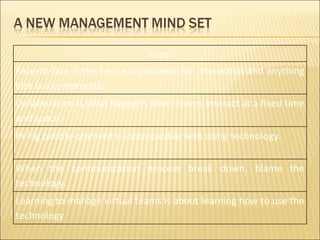
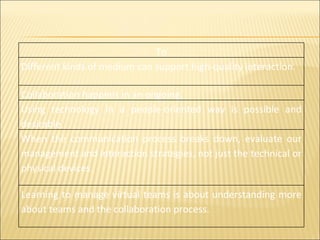
Managing virtual teams is about expanding our available tools to create new dynamics aligned with the best thinking about supporting collaborative work.  FROM: 1.  Face-to-face is the best environment for interaction  -  Different kinds of environments that can  support high quality interaction.
2.  Collaboration is what happens when teams interact at a fixed time and space  - collaboration happens in an ongoing,  boundary less way. 3.  Being people-oriented is incompatible with using technology - using technology in a people-oriented way  is possible and desirable.
4.  When the communication process breaks down, blame the technology  - when the communication process breaks  down, evaluate our management and  interaction strategies, not just the technical  tool. 5.  Learning to manage virtual teams is about learning how to use the technology  - learning to manage virtual teams is about  understanding more about teams and the  collaboration process.
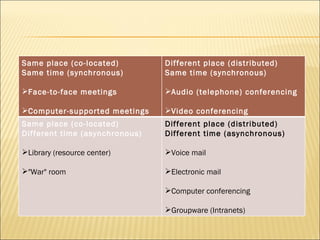
The terms "virtual conference", "virtual group", and "online group” refer to many technologies.  They may be real-time activities, like video teleconferencing or audio conferencing, where people are in different places participating at the same time; or, they may enable participants to join in from different places at different times.
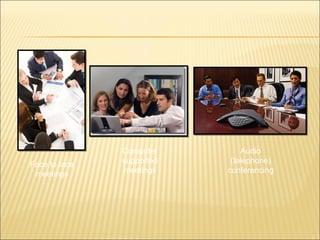
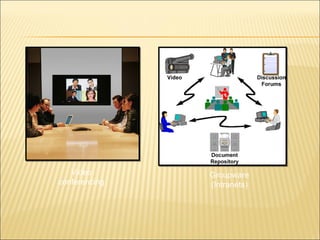
Same place (co-located)  Same time (synchronous)  Face-to-face meetings  Computer-supported meetings Different place (distributed)  Same time (synchronous)  Audio (telephone) conferencing  Video conferencing Same place (co-located)  Different time (asynchronous) Library (resource center)  "War" room Different place (distributed)  Different time (asynchronous) Voice mail  Electronic mail  Computer conferencing  Groupware (Intranets)
Face to face meetings Computer supported meetings Audio (telephone) conferencing
Video conferencing Groupware (Intranets)
THE CONSEQUENCES OF TECHNOLOGY
Organizational management is the process of planning, organizing, leading and controlling of organization members and resources to achieve stated organizational goals.
Information capture : gathering, monitoring, detecting and measuring strategic communications and relationship internally and externally. Information storage : the technology converts numerical and textual information into binary (computerized and digital form of documents) Information manipulation : manipulation means organizing and analyzing especially where repetitive calculations are necessary. Information distribution : modern IT (web based applications) can transmit and display information electronically to broad audiences.
Effective introduction of IT in an organization requires not only technical expertise but also managers who appreciate these changes and support them.
Successful IT implementation requires changes to the way in which work is organized and in workers’ jobs which may resulting:
New product and services : innovation generate new product and services like PC, lap tops, smart phones and recent invention- tablets. Lower cost increase demand : higher productivity indicates producing the same output with the same or fewer resources – taking twitter to promote product for example. Time tag : it is always hard to adopt a new technology into existing systems and organizations. Risks : most organizations adopt new technologies slowly to reduce or avoid the risks.
Expectation of demand : organizations may need to employ more people to handle the increase in business or new people who have skills that require using these new technologies. Technical limitations : existing job, skills and machinery may be required to work alongside the new devices and technology.
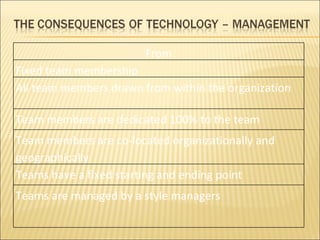
From Fixed team membership All team members drawn from within the organization Team members are dedicated 100% to the team Team members are co-located organizationally and geographically Teams have a fixed starting and ending point Teams are managed by a style managers
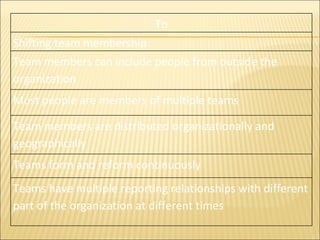
To Shifting team membership Team members can include people from outside the organization Most people are members of multiple teams Team members are distributed organizationally and geographically Teams form and reform continuously Teams have multiple reporting relationships with different part of the organization at different times
Technology allows organizations to adopt ‘virtual’ teams to operate in multiple modes including face-to-face meeting when possible.
Managing a virtual team means managing the whole spectrum of communication strategies and project management techniques as well as human and social processes in ways that support the team.
Developing  and  spreading  better practices faster Connecting  ‘island of knowledge ’ into self-organizing , knowledge sharing networks of professional communities.  Fostering  cross-functional and cross-divisional collaboration Increasing ability  to initiate and contribute to project across organizational boundaries.
From Face-to-face is the best environment for interaction and anything else is a compromise Collaboration is what happens when teams interact at a fixed time and space. Being people-oriented is incompatible with using technology. When the communication process break down, blame the technology. Learning to manage virtual teams is about learning how to use the technology
To Different kinds of medium can support high-quality interaction.  Collaboration happens in an ongoing. Using technology in a people-oriented way is possible and desirable. When the communication process breaks down, evaluate our management and interaction strategies, not just the technical or physical devices. Learning to manage virtual teams is about understanding more about teams and the collaboration process.
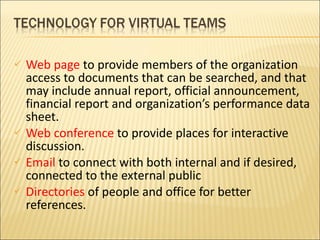
Web page  to provide members of the organization access to documents that can be searched, and that may include annual report, official announcement, financial report and organization’s performance data sheet. Web conference  to provide places for interactive discussion. Email  to connect with both internal and if desired, connected to the external public Directories  of people and office for better references.
Information A web-based sharing meeting calendar helps team members schedule meeting. An email list allows members of change project team to check facts quickly by seeking input from other team members so they can move on the next step in their project. A website which includes project update and organization-wide directories provides information about who is working on different aspects of the change initiative.
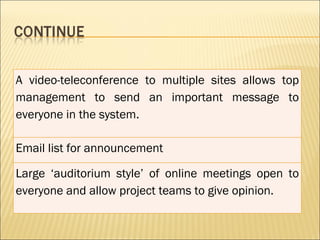
A video-teleconference to multiple sites allows top management to send an important message to everyone in the system. Email list for announcement Large ‘auditorium style’ of online meetings open to everyone and allow project teams to give opinion.
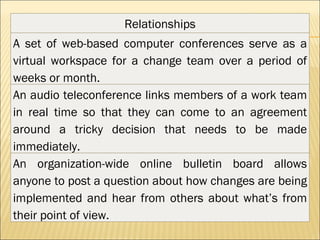
Relationships A set of web-based computer conferences serve as a virtual workspace for a change team over a period of weeks or month. An audio teleconference links members of a work team in real time so that they can come to an agreement around a tricky decision that needs to be made immediately. An organization-wide online bulletin board allows anyone to post a question about how changes are being implemented and hear from others about what’s from their point of view.
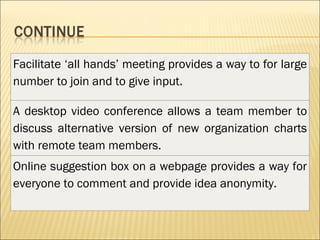
Facilitate ‘all hands’ meeting provides a way to for large number to join and to give input. A desktop video conference allows a team member to discuss alternative version of new organization charts with remote team members. Online suggestion box on a webpage provides a way for everyone to comment and provide idea anonymity.
IMPACT ON RELATIONSHIPS BETWEEN ORGANIZATION AND THEIR PUBLICS ABDUL MANAP BIN JAINI 2010277524 AHMAD FIRDAUS BIN DAMANHURI 2010 684976 BRYAN ALDRIDGE SAMUEL 2010293636 FATHIAH BINTI KAMALUDIN 2010 86 1376 NIK KHAIRUNNISA BINTI AHMED LOKMAN  2010819944 NURUL AFIFAH BINTI BASIR 2010874525 NUR AQILAH BINTI ABDUL RASHID 2010849374 SYED AZRAAI BIN SYED HASHIM 2010449054
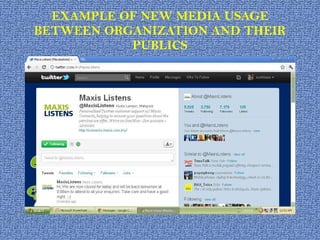
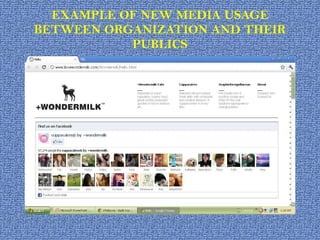
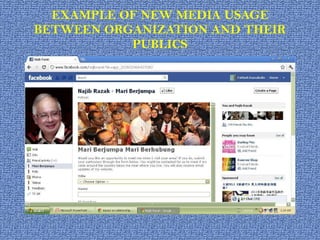
EXAMPLE OF NEW MEDIA USAGE BETWEEN ORGANIZATION AND THEIR PUBLICS
DEFINITION Technology: The scientific knowledge and/ or      equipment that is needed for a    particular industry. (New Oxford    Dictionary) New media:  Developing usually electronic forms      of media regarded as being experimental.    (Dictionary.com)
IMPACT ON RELATIONSHIPS BETWEEN ORGANIZATIONS AND THEIR PUBLICS New media is very important especially in this globalization era. Most of organization in the worldwide use new media as their communication tool. Using technology as the medium, it would help maintain the relationship between the organizations and their publics .
ISSUES
Electronic forms of communication cannot transmit all the required information.  (face-to-face communication is perceived as richer because the information being received reduces uncertainty) Has limited capacity. Unsatisfactory performance in supporting the group work, such as in collaborative research work.  (collaboration between two firms requires frequent face-to-face communication among all involved parties)
Cultural factors between different groups and those within the same groups have also shown to play an important role in the pre-deposition and selection of electronic communications media . (US companies exploit the advantages of IT, such as electronic-mail while the Japanese firms do not.) Many organizations flattened, eliminating many middle management positions.
New media has arise as important of change in organization indicate changing technology that enables an organization to gain a competitive advantage on a relationship between organization and their public. Focusing o the issue in the aviation business, there are few as important as the airline industry for the smooth and efficient working of a modern society. Air transport has come to play an irreplaceable role in service to commerce and to the travel needs of the millions of people who fly every day. It is a global,  technologically advanced and dynamic growth industry ( Lazar, 2003).
PR practice is the discipline, which looks after reputation with the aims of earning understanding and support, and influence opinion and behavior.  Meaning, public relations activities is to build a reputation that earns the understanding, goodwill and support as well as influence opinion and behavior that benefits the company concerned. This  involves a planned and sustained effort with an integrated and dialogic communication plus an interactive approach to establish the desire effect without compromising public interest  (Adnan, 2004).
Analyzing the case for this issue occurs when the company in focus: Malaysia Airlines (MAS), dealing with bankruptcy crisis in 2006 and had some issue with their public and media on the transparency of blueprint and information on the exact crisis that surfaced their company. Often during this time, MAS’ customers were moving ahead to choose Air Asia as their option to travel instead of MAS since they were dealing with bankruptcy crisis.
The shrink period of MAS on 2004 stretch the big impact on its relationship with the public. In fact, the relationship between MAS and its internal publics were at jeopardy when MAS had to do the retrenchment of their workers and maintains only critical and important position in the company.  Accordingly, MAS financial period was recorded to a lost over RM1.3 billion which is the biggest lost in the company financial history and was expectantly to hit an even bigger amount. What worst is that the financial position is precarious since MAS had only a few months until April 2006 before it runs out of liquidity on its assets.
Based from the PR perspectives, also in understanding both the importance of BTP 1 and BTP 2 during MAS’s financial crisis in year 2005 and 2006 and how these two plans manages MAS to overturned its losses into profits.  Besides the BTP 1 and BTP 2, this research also studied the MH campaign that was launch under BTP 2. In detail, the researchers wanted to understand the significance of the MH campaign and how this single-well-planned campaign has been MAS’s answer to maintain its profitability.
Online Advertising and MAS PR Roles in Airlines Rebranding. Advertising can be employed to perform at least four functions for an airline. It can be used to project the carrier’s preferred corporate image. It can be used to sell specific products. It also can be used as a method of attempting to influence policymakers, and as a possible way of motivating staff (Stephen Shaw, 1985).
Online Advertising correlates with reposition of the brand, any corporate brand affects a wide range of audience segments, both internal and external.  The internal audiences, of course, include employees, directors, shareholders, vendors, and partners.  The external audiences include the customer markets, the media, investors, regulators, and politicians, even the people in the towns or cities where the company do business. All of these people will have expectations and experiences, based on their contact with the brand. And the results of those experiences are important to the company (Gregory, 2004). Dervin believes that the  new communication technologies will indeed soon significantly reduce the cost of maintaining mutual interaction between sources and audiences .
MAS PR practice has been on the public information model which the approach can be seen clearly on the dissemination on the information to introduce their MH Campaign in order to gain and overcome consumer trust on MAS product / services as basically as telling the truth through one-way and two-way communication.  Hence, MAS’ representing the Malaysian Government Company as it shows the important of Government media relations as well as the largest and longest  mass media user and as well use wisely the reimbursements of new media to the fullest.
Publishing and advertise helped them build a winning coalition not only with the government but also with other stakeholders, like the unions, the staff, and the public.  Being upfront about the P&L and making it all transparent were very important to bringing the coalition together. Here when  the effective PR approach through new media also reveal its works  where explaining to people the conflict faces and all the dilemmas and the BTP 1 gain the customers trust.  MAS applied 4 method using advancement of new media audience awareness of campaign  targeting messages at specific audience segments most receptive or susceptible to those messages cultivating images and impressions of people, products, or services  inducing desired decision making or positioning
All this four (4) methods is the observation that indicates to value MAS campaign on the success of MH campaign not only externally but also internally. MAS motivate their staffs and cabin crews internally and the result were seen externally when people believe and trust MAS.  Now, MAS became strong and their reputation as it spreads its massive wings back into the sky. MAS point to phenomenon such as the campaign and independently maintained presence on sites such as YouTube, and Facebook during the 2007-2008 primary on MH campaign as evidence of the social marketing possibilities inherent in unfettered interactive new communication technology.
IMPACT TOWARDS MALAYSIA
In Malaysia, public relations practitioners today find themselves in new Internet world which is the new media Publics develop expectations about organisations and measure an organization’s performance based upon delicate sign found within the online environment.  However, this relationship can be damaged when expectations are not met or when organizations behave badly online  The technology helps improve processes and workflow, and finally an organisation’s overall operations.
Imaging technology can also improve services from the organizations to customers either  in businesses or citizens Web sites were used to disseminate information and to post publications and news releases for pr practitioner in any organization Social media are being used to disseminate marketing messages through such techniques as viral marketing in organization to publics The communication facilities which are on offer have rapidly become integrated as core business tools in Malaysia
Organizations use it to facilitate communication between employees and offices, and to communicate with customers and suppliers.  Organizations also used e-mail in replacement to snail mail, due to its speed and flexibility so then the connection between organization and public become simple Publics also can connect to organization regarding their demands or complain about any issue
New media were used by Public Relations practitioners in every organisation  to publicize  and  to promote  their products or services to the public. The rapid growth of internet in Malaysia also  contribute to the development of the country . Government websites have been upgraded  to help publics to know more about services provided .
Prime Minister of Malaysia, Datuk Seri Mohd Najib Bin Tun Abdul Razak also  used new media as an approach to be close with the citizen . Malaysian can update themselves with the new developments that have been planned from them in order to improve country’s productivity.
Public Relations practitioner can  make use of the social networking  sites such as Facebook or twitter to communicate with the public to get their feedback. CEO of Air Asia, Datuk Seri Tony Fernandes used new  media to get close with Air Asia users. New media helps Public Relations practitioner to  perform news monitoring  effectively and also saves a lot of time instead of reading tons of newspapers everyday.
For those who are interested to buy  shares , they can get all  the information  needed through internet and  perform studies  about the company they wanted to invest. It helps the investor to get more  accurate information  and it  saves a lot of time  by doing internet research.
Other than that,  the investor can monitor the market shares  through internet that can be access by using  computer  and also  smart  phones. When shares in Malaysia increases day by day, it  contribute to the country’s socio economic that can help to enhance our company development.
Last August, the entire world especially Malaysian was shocked by a  video downloaded in the Youtube  that shown Malaysian Student in London,  Muhd Asyraf that were robbed and assaulted during raid in London . Due to this incident and  Youtube , the world knows more about Malaysia and  indirectly promotes Malaysia to the world.
New media can reach large scale of audience  than other traditional media can do.  Unlimited access to the internet  throughout the word  helps publics to know what is happening around the world.
CASE STUDY
DIGI TELECOMMUNICATIONS AND AIRASIA
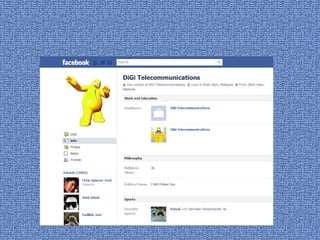
WHAT IS DIGI TELECOMMUNICATIONS? A mobile services company in Malaysia but also provides internet services. The mobile market is led by three big players - Maxis, Celcom & Digi. It is a highly competitive market and companies do not hesitate to spend money on marketing and advertising to fuel growth.
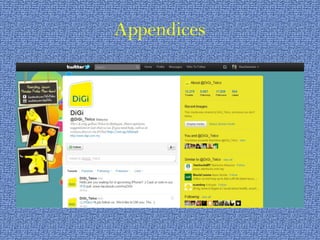
Implementation Diversified its marketing into social media in order to create a brand presence online that would help to build rapport and to connect directly with its customers.  The head of Digi's head of marketing services, Lau Sulin believes that it would help the company to compete with it's rivals.
Twitter Company interacts with the customers on a one to one basis with most of the interaction consisting of questions pertaining to Digi Telco's products.  It handles troubleshooting issues and even contacts the individual on their mobile phone should the question be unanswerable in a single tweet.
Facebook Utilizes the variety of multimedia offered by Facebook to notify fans of any upcoming or current deals. Allows fans to provide their details so they can contacted about Digi Telco's internet services. - Discussion boards which acts as a forum that allows also fans to create topics for discussion.
The persona of the Digi Telco fanpage communicates on a personal level who comments on current local festivities and events unrelated to the company.
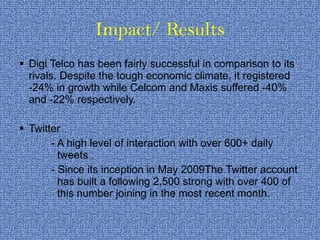
Impact/ Results Digi Telco has been fairly successful in comparison to its rivals. Despite the tough economic climate, it registered -24% in growth while Celcom and Maxis suffered -40% and -22% respectively. Twitter - A high level of interaction with over 600+ daily    tweets .  - Since its inception in May 2009The Twitter account    has built a following 2,500 strong with over 400 of    this number joining in the most recent month.
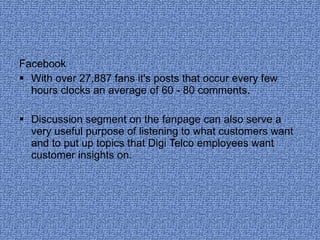
Facebook With over 27,887 fans it's posts that occur every few hours clocks an average of 60 - 80 comments.  Discussion segment on the fanpage can also serve a very useful purpose of listening to what customers want and to put up topics that Digi Telco employees want customer insights on.
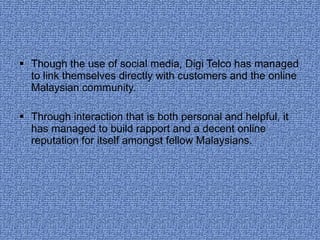
Though the use of social media, Digi Telco has managed to link themselves directly with customers and the online Malaysian community.  Through interaction that is both personal and helpful, it has managed to build rapport and a decent online reputation for itself amongst fellow Malaysians.
Appendices
 
What Is Air ASIA ? A Malaysian-based low-cost airline. Air Asia is Asia's largest low-fare, no-frills airline and a pioneer of low-cost travel in Asia.   Air Asia group operates scheduled domestic and international flights to over 400 destinations spanning 25 countries. Its main hub is the Low-Cost Carrier Terminal (LCCT) at Kuala Lumpur International Airport (KLIA). 
Implementation Social media platforms have been an important marketing tool for AirAsia. AirAsia understands that social media is cost-effective and allows them to their target customers effectively.
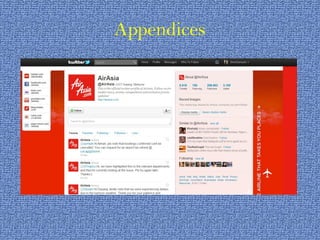
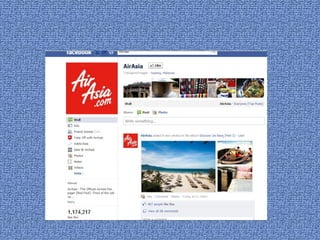
Twitter Invites its fans to follow the company on Twitter for latest news and deal updates. Currently, AirAsia's Twitter account has more than 200,000 followers.
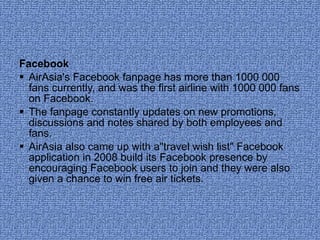
Facebook AirAsia's Facebook fanpage has more than 1000 000 fans currently, and was the first airline with 1000 000 fans on Facebook.  The fanpage constantly updates on new promotions, discussions and notes shared by both employees and fans.  AirAsia also came up with a"travel wish list" Facebook application in 2008 build its Facebook presence by encouraging Facebook users to join and they were also given a chance to win free air tickets.
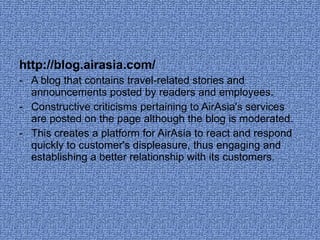
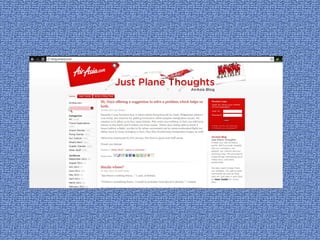
http://blog.airasia.com/ A blog that contains travel-related stories and announcements posted by readers and employees.  Constructive criticisms pertaining to AirAsia's services are posted on the page although the blog is moderated. This creates a platform for AirAsia to react and respond quickly to customer's displeasure, thus engaging and establishing a better relationship with its customers.
IMPACT/ RESULTS Able to engage and interact with more people.  Social media tools are definitely effective in reaching target audiences at low cost and little time. Air Asia broke world record and sold 1 million tickets in 2 days.  The power of social media had much to do with the record breaking sales. One of the great examples of Malaysian companies who leveraged on social media successfully.
Appendices
 
 
Foldees and Tiger Beer Case Study
Foldees Case Study
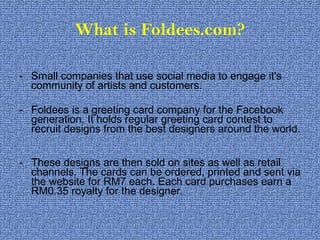
What is Foldees.com? Small companies that use social media to engage it's community of artists and customers.  Foldees is a greeting card company for the Facebook generation. It holds regular greeting card contest to recruit designs from the best designers around the world.  These designs are then sold on sites as well as retail channels. The cards can be ordered, printed and sent via the website for RM7 each. Each card purchases earn a RM0.35 royalty for the designer.
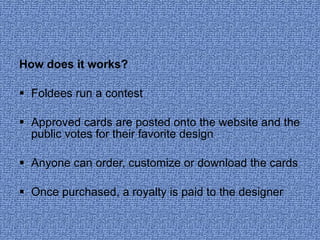
How does it works? Foldees run a contest  Approved cards are posted onto the website and the public votes for their favorite design  Anyone can order, customize or download the cards  Once purchased, a royalty is paid to the designer
How do they use Social Media? According to  Lau Chak Onn  who is the CEO of Foldees, the following are the takeaways when using Social Media: It's an economy - incentivize everything  Momentum matters - don't lose it  Casual beats formal  Transparency is important  Think long term
It's an economy - incentivize everything  In the case of Foldees, designers get royalties and RM2500 in cash if they win the contest. Voters on the other hand are rewarded with a free card and commenter's get their comments featured so they get to be on the front page of the website. b. Momentum matters - don't lose it  There was a point of time when Foldees held the second contest about 3 months after the first one. The return rate as a result was horrible because very few returned. However after realizing their mistake, Foldees began shortening the time between contests and consequently, the return rate improved greatly.
Casual beats formal  Transparency is important Think long term  Some marketers adopt a campaign model through their social media programs. This ultimately leads to wasted engagement and shallow relationships
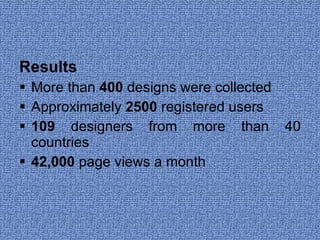
Results More than  400  designs were collected  Approximately  2500  registered users  109  designers from more than 40 countries  42,000  page views a month
Appendices
Tiger Beer Case Study
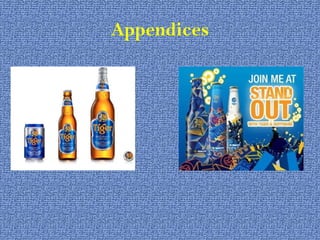
Introduction Tiger Beer is an example of how the blogosphere can build a brand. They not only used consumer insight to repackage its product but also generate excitement among influential endorsers in the online space.  The Malaysia beer market is crowded, with an array of seemingly generic brands jostling for attention and share. Tiger needed to remain relevant among its young target audience of 21- to 30-year-olds, strengthen brand positioning and increase loyalty, and ultimately increase share of the market.  Tiger set out to position itself as a unique, cool and contemporary beer that young people would want to associate with.
The target audience wanted to be associated with cool and trendy brands and products that offered them a ‘differentiator’ image. Focus groups showed that opinion leaders and social influencers demonstrating these traits served to reinforce the credibility of a brand. Tiger needed to excite target consumers by injecting an element of surprise through its packaging and presentation. Three different designer bottle sleeves were developed, based on music and artistic themes. The shrink-wrapped bottles featured Tiger’s branding in a stylized manner and stood out from the competition.
The initiative focused on the online social space, with endorsements from key opinion leaders and social influencers, alongside above-the-line advertising and PR. It was executed in four phases. Online endorsements by key influencers served to promote Tiger to its critical audience. To generate interest around its brand and the repackaged product, Tiger made use of Malaysia’s top blog aggregator, with 55,000 blogs including work by the country’s best-known bloggers, and organized a ‘Stand out’ blogger party. The party was Malaysia’s first by an alcohol brand for bloggers.
Post-campaign publicity was amplified with content distributed across a range of social media platforms. Directly after the party, the media covered the event in the national dailies and ‘Stand out’ bloggers flooded the web with footage of the party on their blogs, Facebook profiles and Twitter accounts. Thousands of party pictures were posted on Flickr and Twitter, while videos were uploaded on YouTube.
Impact/ Results According to Synovate (Malaysia Custom Market Research), perception of Tiger as ‘a beer for good times and fun' increased by 14 per cent; an additional 12 per cent of consumers described the beer as one 'my friends approved of'; and consumption among young adults increased by six per cent.
Appendices
CONCLUSION
In conclusion, in pertaining organization’s good reputation has its own root which is to maintain good relationship with your publics. This is very crucial for any organization as the publics will determine their marketplace. As we have involved in this mass globalization, this developing technology growth will take us to a higher level in expending our organizations credibility in many ways. As in more brief, the relationship between your organizations and your publics can be managed by getting involved in this latest technology advancement especially in the born of new media technology. It involves of internet, websites, blogs, social networking such Facebook, Twitter, Tumblr and so many more to be named.
By using these new media technologies, any organizations can reach their publics easier as the process is more credible, faster, reliable and useful to the publics. These new media strategies will always be helping the organizations in many ways such as company’s information, company’s product and many more without involved any communication such as one-to-one or face to face or two ways communications. The publics can always use the internet to get the information via websites, Facebook and many more. Through these strategies also help any organizations in obtaining the positive publicity to get attention or to enhance the reputations.  However, challenges might occur in this process because sometimes, in this digital world, privacy is the main threat to the information. It can be easily copied, changed, and tracked by the publics or competitors. This is when the some private and confidential information of the company is violated or the security level is very low.
These technology advancements will always benefit the organizations that make use in the right ways. To be known, to be well-published and to have great reputations are every organizations dream and by practicing the technologies, it can be achieved as the digital world is more to be explored as it grows every second and every bit. Thank You For Listening… 

Mapping The Consequences Of Technology On Public Relations

  • 1.
  • 2.
    Before press releasesare produced on computer and delivered via email, PR practitioners manually typed on a paper and sent via mail or fax. On March 8, 1954, the first electronically transmitted press release had been sent by PR Newswire. Media have evolved technically because of the strategy and tactics of public relations rely on use of the media.
  • 3.
    These strategic andintentional adaptations are designed to improve the effectiveness, efficiency or efficacy of various tactics and techniques. In other cases, the changes might be subtle and unintentional, lead to bad PR practices.
  • 4.
  • 5.
  • 6.
  • 7.
  • 8.
  • 9.
  • 10.
  • 11.
  • 12.
  • 13.
  • 14.
  • 15.
  • 16.
    Blog Use isRobust in This Region All six countries outpaced the global reach of Blogs The growth of the category, however, is flat in Hong Kong and Singapore Blogs are a key political channel in some countries, higher growth in the Philippines may be a result of increased political activity in a presidential election year. + 8% + 8% + 1% + 18% - 2% - 9% INTERNET IN SOUTH EAST ASIA
  • 17.
  • 18.
  • 19.
    From the observationmade by Stephan Spencer (a blogger), blogs are becoming important in the public opinion area . Now, “ The power of the people”  “the power of the bloggers”. Blogs: particularly popular among teens (12-17yrs old) GenY (18-28yrs old)
  • 20.
    175, 000 newblogs/day. 1.6 million postings/day @ 18.6 posts/secs.
  • 21.
    SEX: Men (54%)Women (46%) AGE: 18-29yrs old is the highest(54%) RACE/ETHNICITY: White non-hispanic is the highest (60%) Malaysian falls under the (10%) LOCATION: Leading by suburban area (51%) ACCESS SPEED: Broadband (79%) Dial Up(20%)
  • 22.
  • 23.
  • 24.
    Since blogs aregrowing rapidly, that’s when (a microblogging service) came into the social media world. Most companies and PR Agencies are using as one of their main online tools. Writing Quality ; is still a deciding factor in effective communication besides the medium being used.
  • 25.
    A tech. developedin 2006 by Jack Dorsey. Limited to 140-150 characters. Enables people to use cell phones to send text messages to blogs. Provide extremely up-to-the-minute updates to blogs. With 200millions users in 2011 Eg: Barack Obama, Dato’ Seri Najib Tun Razak, AirAsia, PRNews, Lisa Surihani
  • 26.
  • 27.
    Their usefulness as: Research tools (information gathering & environmental scanning) Message/issue framing Persuasion tools http://www.changements.com.ulaval.ca/module10/RP_blog.pdf
  • 28.
    Communicative risks involvedin blogging Exaggerated significance attached to blogging Blogger credibility and status http://www.changements.com.ulaval.ca/module10/RP_blog.pdf
  • 29.
  • 30.
  • 31.
  • 32.
  • 33.
  • 34.
  • 35.
  • 36.
    PREPARED BY: NAMEMATRIX NUM. TATINORHAJAR BT MOHD JAKERE 2010485776 NOR AZZURA BT MOHD DARUS 2010420236 MUHAMMAD LUTHFI AZZAMUDDIN BIN MOHD MUNIM 2010414444 INTAN BAIRUHA BT ABDUL MALEK 2010423214 NUR FARAHAIN BT BINJAMIN 2010857976 KHAIRULDIN BIN MOHD IZZUDDIN 2010203192 BASHIRA BT KHUSAINI 2010482478
  • 37.
    INTRODUCTION Technologies suchas blogs, podcasts, and websites generally help PR practitioner to deliver their messages widely specifically to their targeted audiences. The style of contents also changes- expanded use of audio and video files- makes the content more attractive. The messages also can be adapted to mobile media formats.
  • 38.
    1. WEB 2.0Web 2.0 is a term that is used to denote several different concepts. It’s incorporated a strong social component, involving user update, and friend links. It is also encourage user-generated content in the form of text, video and photo posting along with comments and tags. The simplest example: social networking sites (Facebook, Twitter and Google Plus) (Cromode & Krishnamurthy,2008)
  • 39.
    Interesting features ofWeb 2.0: Users as first class entities in the system, with prominent profile pages including such features (age, sex, location and comments about the user by other users). Ability to communicate or interact between users via links to other users who are friends, membership in groups or RSS feeds (subscription) of updates. Ability to post content in many forms like photos, videos, blogs, and comments. It also allow user to tagging of own or others’ content and ability to control privacy and sharing. (Cromode & Krishnamurthy,2008)
  • 40.
    Web 2.0 isassociated with the publishing site, syndicated to other sites, aggregated to RSS readers and email, and short content or alerts directed to cell phones. Web 2.0 makes thing easier like video sharing, voice calling, and updating contents. Web 2.0 encourage people to communicate without boundaries (eg: Twitter, Facebook, Skype)
  • 41.
    Web 2.0 DataTravels: Path from content creator to content consumer (Cromode & Krishnamurthy,2008)
  • 42.
    WEB 1.0 Calledas the “read only web”. Invented by Berners’ Lee : Vision “The dream behind the Web is of a common information space in which we communicate by sharing information.” (Berners-Lee, 1998) There was very little in the way of user interaction or content contribution.
  • 43.
    Characteristics of Web1.0 1 ) General attributes: Fairly static information Updated infrequently Typified as ‘brochureware’ 2) Elements of web page: Images, navigation icons, text, menu 3) Writing style: Impersonal, professional, descriptive, statements of fact 4) Linking structure: Minimal, unchanging, little interaction between sites (Evans, 2006)
  • 44.
    The distinguishes betweenWeb 2.0 & Web 1.0 Web 1.0 Web 2.0 1) Site structure a  ‘bow–tie’ structure (Broder,  et al. , 2000 )( individual sites typically adopted an approximately hierarchical structure, with a front page leading to various subpages, augmented by cross–links and search functions) content is centrally updated at somewhat predictable intervals. More to real–world social networks (show somewhat different structures, due in part to implicit bi–directionality of links). a lot of user generated content, it is not uncommon to have small incremental additions to the site. 2) Advanced structure all links and pages can be treated essentially equally. requires looking at different link types (friend links, navigation links, etc.) and page types (user pages, content pages, etc.) to understand. 3) Site mechanism & incentives most sites have links to external sites and users may easily follow links to other sites. many sites encourage users to spend as much time as possible on their site (There are strong incentives for increasing such  stickiness : opportunities for higher advertising revenue)
  • 45.
    Play video: http://youtu.be/YXFYkbQRgY4
  • 46.
    2. VIDEO NEWSRELEASE (VNR) Definition: the television version of the printed press release, translating the printed word into the language of moving pictures (US Consumer Product Safety Commission,2011) It is similar to documentary but it is more to introducing a product ( not advertisement) or informing people about an issue by PR practitioner especially.
  • 47.
    Advantages: VNRs canbe view or download through online by journalists anytime that they want to use it. VNR also may contains an interview with a person that was unavailable to a mass media event. VNR includes video of the product which is edited to make it easy for TV news producers to air the video on newscasts and slates which are easy-to-read full-screen graphics that provide the details of the recall.
  • 48.
    Disadvantages: VNR isbeing used to be manipulated for propaganda. The contain of VNR may from fake reporters.
  • 49.
    Play video: 1)New adidas Soccer Shoes for 2011/2012 http://youtu.be/turZfHDelQY
  • 50.
    3. EMERGING MESSAGETECHNIQUES This is the emergence form of two/ more sets of data, called “mash-up” media. In Web development, a mash-up is a Web page or application that uses and combines data, presentation or functionality from two or more sources to create new services (Wikipedia Definition) The term implies easy, fast integration, frequently using open APIs and data sources to produce enriched results that were not necessarily the original reason for producing the raw source data.
  • 51.
    Advantages: It providesusers a detailed, interactive, and useful outlook of information. It helps PR practitioner to find relevant scholarly research in a timely, cost-effective fashion in conducting research.(eg: Google scholar, CrossRef) It minimized application data management: By leveraging third party data providers, you can ensure reduced costs related to maintaining and updating your own data repositories. It reduced development effort: Involves taking advantage of business logic which has been thoroughly tested and designed to solve a particular domain problem, and is maintained by a specialized service provider. Unlimited data sources based on standards: swapping between the growing number of data sources available on the web can create an exponential number of possibilities for all your developments.
  • 52.
    Play video: Example:Google Developer Day - Mashup Showcase http://youtu.be/-GeU3Rp7wnY
  • 53.
    CONCLUSION The riseof multimedia PR gives public relations professionals new ways to reach target audiences in non-traditional settings. To be sure, the rich media revolution is shaking up public relations contents and messages. While the fundamentals of PR remain intact, the rules of engagement are changing. Press releases are becoming video news releases, for example, and corporate events are broadcast over the Internet. Competing for mind share in a multimedia landscape requires a thoughtful strategy and the tools to execute it.
  • 54.
    As far asour concern, the world we are living now has evolved into tremendous form of new era. Technologies we have nowadays are far greater excellent from the past. We could possibly do anything on what we want at our fingertips. Technologies we have right now bring impact on how we perceive our life and the way we conducting it. It also give impact to most area, including Public Relations (PR) field. PR has being affected from many aspects due to the new technologies created. The evolution is still going on today.
  • 55.
    REFERENCES Berners-Lee, T.(1998), “The World Wide Web – a very short personal history” http://www.w3.org/People/Berners-Lee/ShortHistory Cormode, K. (2008, June 2). Volume 13 Number 6: Key Differences Between Web 1.0 and Web 2.0. Retrieved September 2011, from First Monday: http://www.uic.edu/htbin/cgiwrap/bin/ojs/index.php/fm/article/view/2125/1972 Evans, D. M. (2006, November 8). The Evolution of the Web- From Web 1.0 to Web 4.0. Retrieved September 30, 2011, from Centre for Security, Communications and Network Research: www.cscan.org/presentations/08-11-06-MikeEvans-Web.pdf
  • 56.
    THE CONSEQUENCES OFTECHNOLOGY FAKHRIAH BINTIAHMAD RADZUAN KHAIRUL ANNUAR BIN MD YUSOF MOHD HAZIQ BIN SHUKRI NUR SYAFINAZ BINTI HASNAN
  • 57.
  • 58.
    The framework, typically hierarchical , within which an organization arranges its lines of authority and communications , and allocates rights and duties . An organizational chart illustrates the organizational structure.
  • 59.
    Organizational structure determines the manner and extent to which roles , power , and responsibilities are delegated, controlled, and coordinated, and how information flows between levels of management Organizational structure is also becoming virtual and the virtual is becoming real.
  • 60.
    POSITIVE EFFECTS: Rapidcommunication Easy to send any information More customized Temporary Greater in volume More formal More relationship-based Straightforward
  • 61.
    NEGATIVE EFFECTS: Thesecurity is unguaranteed More risky Create misunderstanding if there are too much information Lack the social context cues of face-to-face interaction Encourage communicator aggressiveness or inappropriate communication
  • 62.
    Communication is fundamentalto any form of organizing but is preeminent in virtual organizations. Virtual organizations are characterized by: (a) highly dynamic processes (b) contractual relationships among entities (c) edgeless, permeable boundaries (d) reconfigurable structures.
  • 63.
    The study ofsuch a virtual team is especially useful for extending our understanding of the adaptation process as virtual teams have more malleable structures than typical organizational units and controlled group experiments. Firms benefit from virtual teams through: (1) access to previously unavailable expertise (2) enhanced cross-functional interaction (3) improve the quality of the virtual team's work.
  • 64.
    (1) communicationvolume and efficiency (2) message understanding (3) virtual tasks (4) lateral communication (5) norms of technology use (6) evolutionary effects (7) more reconfigurable (8) their boundaries are considerably more blurred (9) their relationships are more likely to contractual than traditional forms
  • 65.
  • 66.
    New technologies arebeing developed and updated continuously and pose challenges for PR professionals to keep up with what is being planned for release in the future. The implications for PR practitioners of needing to prepare material faster than before include being able to produce what is required almost instantaneously and with the required level of accuracy.
  • 67.
    The rapid movementof technology may put pressure on the PR practitioners to produce instant content and updates to consumers. It may also put pressure on the PR practitioner and the team with which they work and the relationships they have with colleagues or more senior staff, in particular the CEO, and his or her minders.
  • 68.
    Another area ofpractice that new media has changed in the past decade is that of events. Practitioners working on events may need to manage expectations from: (1) employing organisations (2) consumers (3) stakeholders (4) sponsors
  • 69.
    With new media,PR practitioners will need more technical skills in areas such as: (1) web publishing (2) new software operation (3) online security (4) search engine optimisation (5) web analytics (6) web trend analysis software operation. The past several years has seen an increased use of multimedia and interactive content in news releases and leading newswire services (Nowland, 2006).
  • 70.
    Taylor and Kent(2007) state that the use of the internet in crisis communications is a logical one in that websites are one controlled channel through which organisations can communicate directly with the media and the public. Through website an organisation can tell its ‘side of the story, reduce the uncertainty of consumers, address multiple stakeholder needs, and work with government agencies that specialise in public safety.
  • 71.
    Research has shownthat PR practitioners who embrace new technologies such as blogging are perceived within organisations as having more power, in that they are willing to be leaders in the industry and use new tools to better reach target publics (Porter, Sweetser Trammell, Chung, & Kim, 2007).
  • 72.
  • 73.
    Corporate culture canbe described in the following way, "Culture is the sum total of values, virtues, accepted behaviors (both good and not so good), and the political environment of an organization" (Bliss, 1999).
  • 74.
    E.g 1: Monitoringsoftware The impacts: (1) Can cause negative reactions from employees (2) Portraying the idea of “We don’t trust our employees” (3) People do not want to work for a company that instils a sense of mistrust.
  • 75.
    E.g 2: Groupware packages and Intranets The impacts: (1) increase employee productivity and better time management (2) the one downfall to these applications is the reduction in actual employee contact and social interaction.
  • 76.
  • 77.
    Managing virtual teamsis about expanding our available tools to create new dynamics aligned with the best thinking about supporting collaborative work. FROM: 1. Face-to-face is the best environment for interaction - Different kinds of environments that can support high quality interaction.
  • 78.
    2. Collaborationis what happens when teams interact at a fixed time and space - collaboration happens in an ongoing, boundary less way. 3. Being people-oriented is incompatible with using technology - using technology in a people-oriented way is possible and desirable.
  • 79.
    4. Whenthe communication process breaks down, blame the technology - when the communication process breaks down, evaluate our management and interaction strategies, not just the technical tool. 5. Learning to manage virtual teams is about learning how to use the technology - learning to manage virtual teams is about understanding more about teams and the collaboration process.
  • 80.
    The terms "virtualconference", "virtual group", and "online group” refer to many technologies. They may be real-time activities, like video teleconferencing or audio conferencing, where people are in different places participating at the same time; or, they may enable participants to join in from different places at different times.
  • 81.
    Same place (co-located) Same time (synchronous) Face-to-face meetings Computer-supported meetings Different place (distributed) Same time (synchronous) Audio (telephone) conferencing Video conferencing Same place (co-located) Different time (asynchronous) Library (resource center) "War" room Different place (distributed) Different time (asynchronous) Voice mail Electronic mail Computer conferencing Groupware (Intranets)
  • 82.
    Face to facemeetings Computer supported meetings Audio (telephone) conferencing
  • 83.
  • 84.
  • 85.
    Organizational management isthe process of planning, organizing, leading and controlling of organization members and resources to achieve stated organizational goals.
  • 86.
    Information capture :gathering, monitoring, detecting and measuring strategic communications and relationship internally and externally. Information storage : the technology converts numerical and textual information into binary (computerized and digital form of documents) Information manipulation : manipulation means organizing and analyzing especially where repetitive calculations are necessary. Information distribution : modern IT (web based applications) can transmit and display information electronically to broad audiences.
  • 87.
    Effective introduction ofIT in an organization requires not only technical expertise but also managers who appreciate these changes and support them.
  • 88.
    Successful IT implementationrequires changes to the way in which work is organized and in workers’ jobs which may resulting:
  • 89.
    New product andservices : innovation generate new product and services like PC, lap tops, smart phones and recent invention- tablets. Lower cost increase demand : higher productivity indicates producing the same output with the same or fewer resources – taking twitter to promote product for example. Time tag : it is always hard to adopt a new technology into existing systems and organizations. Risks : most organizations adopt new technologies slowly to reduce or avoid the risks.
  • 90.
    Expectation of demand: organizations may need to employ more people to handle the increase in business or new people who have skills that require using these new technologies. Technical limitations : existing job, skills and machinery may be required to work alongside the new devices and technology.
  • 91.
    From Fixed teammembership All team members drawn from within the organization Team members are dedicated 100% to the team Team members are co-located organizationally and geographically Teams have a fixed starting and ending point Teams are managed by a style managers
  • 92.
    To Shifting teammembership Team members can include people from outside the organization Most people are members of multiple teams Team members are distributed organizationally and geographically Teams form and reform continuously Teams have multiple reporting relationships with different part of the organization at different times
  • 93.
    Technology allows organizationsto adopt ‘virtual’ teams to operate in multiple modes including face-to-face meeting when possible.
  • 94.
    Managing a virtualteam means managing the whole spectrum of communication strategies and project management techniques as well as human and social processes in ways that support the team.
  • 95.
    Developing and spreading better practices faster Connecting ‘island of knowledge ’ into self-organizing , knowledge sharing networks of professional communities. Fostering cross-functional and cross-divisional collaboration Increasing ability to initiate and contribute to project across organizational boundaries.
  • 96.
    From Face-to-face isthe best environment for interaction and anything else is a compromise Collaboration is what happens when teams interact at a fixed time and space. Being people-oriented is incompatible with using technology. When the communication process break down, blame the technology. Learning to manage virtual teams is about learning how to use the technology
  • 97.
    To Different kindsof medium can support high-quality interaction. Collaboration happens in an ongoing. Using technology in a people-oriented way is possible and desirable. When the communication process breaks down, evaluate our management and interaction strategies, not just the technical or physical devices. Learning to manage virtual teams is about understanding more about teams and the collaboration process.
  • 98.
    Web page to provide members of the organization access to documents that can be searched, and that may include annual report, official announcement, financial report and organization’s performance data sheet. Web conference to provide places for interactive discussion. Email to connect with both internal and if desired, connected to the external public Directories of people and office for better references.
  • 99.
    Information A web-basedsharing meeting calendar helps team members schedule meeting. An email list allows members of change project team to check facts quickly by seeking input from other team members so they can move on the next step in their project. A website which includes project update and organization-wide directories provides information about who is working on different aspects of the change initiative.
  • 100.
    A video-teleconference tomultiple sites allows top management to send an important message to everyone in the system. Email list for announcement Large ‘auditorium style’ of online meetings open to everyone and allow project teams to give opinion.
  • 101.
    Relationships A setof web-based computer conferences serve as a virtual workspace for a change team over a period of weeks or month. An audio teleconference links members of a work team in real time so that they can come to an agreement around a tricky decision that needs to be made immediately. An organization-wide online bulletin board allows anyone to post a question about how changes are being implemented and hear from others about what’s from their point of view.
  • 102.
    Facilitate ‘all hands’meeting provides a way to for large number to join and to give input. A desktop video conference allows a team member to discuss alternative version of new organization charts with remote team members. Online suggestion box on a webpage provides a way for everyone to comment and provide idea anonymity.
  • 103.
    IMPACT ON RELATIONSHIPSBETWEEN ORGANIZATION AND THEIR PUBLICS ABDUL MANAP BIN JAINI 2010277524 AHMAD FIRDAUS BIN DAMANHURI 2010 684976 BRYAN ALDRIDGE SAMUEL 2010293636 FATHIAH BINTI KAMALUDIN 2010 86 1376 NIK KHAIRUNNISA BINTI AHMED LOKMAN 2010819944 NURUL AFIFAH BINTI BASIR 2010874525 NUR AQILAH BINTI ABDUL RASHID 2010849374 SYED AZRAAI BIN SYED HASHIM 2010449054
  • 104.
    EXAMPLE OF NEWMEDIA USAGE BETWEEN ORGANIZATION AND THEIR PUBLICS
  • 105.
    EXAMPLE OF NEWMEDIA USAGE BETWEEN ORGANIZATION AND THEIR PUBLICS
  • 106.
    EXAMPLE OF NEWMEDIA USAGE BETWEEN ORGANIZATION AND THEIR PUBLICS
  • 107.
    DEFINITION Technology: Thescientific knowledge and/ or equipment that is needed for a particular industry. (New Oxford Dictionary) New media: Developing usually electronic forms of media regarded as being experimental. (Dictionary.com)
  • 108.
    IMPACT ON RELATIONSHIPSBETWEEN ORGANIZATIONS AND THEIR PUBLICS New media is very important especially in this globalization era. Most of organization in the worldwide use new media as their communication tool. Using technology as the medium, it would help maintain the relationship between the organizations and their publics .
  • 109.
  • 110.
    Electronic forms ofcommunication cannot transmit all the required information. (face-to-face communication is perceived as richer because the information being received reduces uncertainty) Has limited capacity. Unsatisfactory performance in supporting the group work, such as in collaborative research work. (collaboration between two firms requires frequent face-to-face communication among all involved parties)
  • 111.
    Cultural factors betweendifferent groups and those within the same groups have also shown to play an important role in the pre-deposition and selection of electronic communications media . (US companies exploit the advantages of IT, such as electronic-mail while the Japanese firms do not.) Many organizations flattened, eliminating many middle management positions.
  • 112.
    New media hasarise as important of change in organization indicate changing technology that enables an organization to gain a competitive advantage on a relationship between organization and their public. Focusing o the issue in the aviation business, there are few as important as the airline industry for the smooth and efficient working of a modern society. Air transport has come to play an irreplaceable role in service to commerce and to the travel needs of the millions of people who fly every day. It is a global, technologically advanced and dynamic growth industry ( Lazar, 2003).
  • 113.
    PR practice isthe discipline, which looks after reputation with the aims of earning understanding and support, and influence opinion and behavior. Meaning, public relations activities is to build a reputation that earns the understanding, goodwill and support as well as influence opinion and behavior that benefits the company concerned. This involves a planned and sustained effort with an integrated and dialogic communication plus an interactive approach to establish the desire effect without compromising public interest (Adnan, 2004).
  • 114.
    Analyzing the casefor this issue occurs when the company in focus: Malaysia Airlines (MAS), dealing with bankruptcy crisis in 2006 and had some issue with their public and media on the transparency of blueprint and information on the exact crisis that surfaced their company. Often during this time, MAS’ customers were moving ahead to choose Air Asia as their option to travel instead of MAS since they were dealing with bankruptcy crisis.
  • 115.
    The shrink periodof MAS on 2004 stretch the big impact on its relationship with the public. In fact, the relationship between MAS and its internal publics were at jeopardy when MAS had to do the retrenchment of their workers and maintains only critical and important position in the company. Accordingly, MAS financial period was recorded to a lost over RM1.3 billion which is the biggest lost in the company financial history and was expectantly to hit an even bigger amount. What worst is that the financial position is precarious since MAS had only a few months until April 2006 before it runs out of liquidity on its assets.
  • 116.
    Based from thePR perspectives, also in understanding both the importance of BTP 1 and BTP 2 during MAS’s financial crisis in year 2005 and 2006 and how these two plans manages MAS to overturned its losses into profits. Besides the BTP 1 and BTP 2, this research also studied the MH campaign that was launch under BTP 2. In detail, the researchers wanted to understand the significance of the MH campaign and how this single-well-planned campaign has been MAS’s answer to maintain its profitability.
  • 117.
    Online Advertising andMAS PR Roles in Airlines Rebranding. Advertising can be employed to perform at least four functions for an airline. It can be used to project the carrier’s preferred corporate image. It can be used to sell specific products. It also can be used as a method of attempting to influence policymakers, and as a possible way of motivating staff (Stephen Shaw, 1985).
  • 118.
    Online Advertising correlateswith reposition of the brand, any corporate brand affects a wide range of audience segments, both internal and external. The internal audiences, of course, include employees, directors, shareholders, vendors, and partners. The external audiences include the customer markets, the media, investors, regulators, and politicians, even the people in the towns or cities where the company do business. All of these people will have expectations and experiences, based on their contact with the brand. And the results of those experiences are important to the company (Gregory, 2004). Dervin believes that the new communication technologies will indeed soon significantly reduce the cost of maintaining mutual interaction between sources and audiences .
  • 119.
    MAS PR practicehas been on the public information model which the approach can be seen clearly on the dissemination on the information to introduce their MH Campaign in order to gain and overcome consumer trust on MAS product / services as basically as telling the truth through one-way and two-way communication. Hence, MAS’ representing the Malaysian Government Company as it shows the important of Government media relations as well as the largest and longest mass media user and as well use wisely the reimbursements of new media to the fullest.
  • 120.
    Publishing and advertisehelped them build a winning coalition not only with the government but also with other stakeholders, like the unions, the staff, and the public. Being upfront about the P&L and making it all transparent were very important to bringing the coalition together. Here when the effective PR approach through new media also reveal its works where explaining to people the conflict faces and all the dilemmas and the BTP 1 gain the customers trust. MAS applied 4 method using advancement of new media audience awareness of campaign targeting messages at specific audience segments most receptive or susceptible to those messages cultivating images and impressions of people, products, or services inducing desired decision making or positioning
  • 121.
    All this four(4) methods is the observation that indicates to value MAS campaign on the success of MH campaign not only externally but also internally. MAS motivate their staffs and cabin crews internally and the result were seen externally when people believe and trust MAS. Now, MAS became strong and their reputation as it spreads its massive wings back into the sky. MAS point to phenomenon such as the campaign and independently maintained presence on sites such as YouTube, and Facebook during the 2007-2008 primary on MH campaign as evidence of the social marketing possibilities inherent in unfettered interactive new communication technology.
  • 122.
  • 123.
    In Malaysia, publicrelations practitioners today find themselves in new Internet world which is the new media Publics develop expectations about organisations and measure an organization’s performance based upon delicate sign found within the online environment. However, this relationship can be damaged when expectations are not met or when organizations behave badly online The technology helps improve processes and workflow, and finally an organisation’s overall operations.
  • 124.
    Imaging technology canalso improve services from the organizations to customers either in businesses or citizens Web sites were used to disseminate information and to post publications and news releases for pr practitioner in any organization Social media are being used to disseminate marketing messages through such techniques as viral marketing in organization to publics The communication facilities which are on offer have rapidly become integrated as core business tools in Malaysia
  • 125.
    Organizations use itto facilitate communication between employees and offices, and to communicate with customers and suppliers. Organizations also used e-mail in replacement to snail mail, due to its speed and flexibility so then the connection between organization and public become simple Publics also can connect to organization regarding their demands or complain about any issue
  • 126.
    New media wereused by Public Relations practitioners in every organisation to publicize and to promote their products or services to the public. The rapid growth of internet in Malaysia also contribute to the development of the country . Government websites have been upgraded to help publics to know more about services provided .
  • 127.
    Prime Minister ofMalaysia, Datuk Seri Mohd Najib Bin Tun Abdul Razak also used new media as an approach to be close with the citizen . Malaysian can update themselves with the new developments that have been planned from them in order to improve country’s productivity.
  • 128.
    Public Relations practitionercan make use of the social networking sites such as Facebook or twitter to communicate with the public to get their feedback. CEO of Air Asia, Datuk Seri Tony Fernandes used new media to get close with Air Asia users. New media helps Public Relations practitioner to perform news monitoring effectively and also saves a lot of time instead of reading tons of newspapers everyday.
  • 129.
    For those whoare interested to buy shares , they can get all the information needed through internet and perform studies about the company they wanted to invest. It helps the investor to get more accurate information and it saves a lot of time by doing internet research.
  • 130.
    Other than that, the investor can monitor the market shares through internet that can be access by using computer and also smart phones. When shares in Malaysia increases day by day, it contribute to the country’s socio economic that can help to enhance our company development.
  • 131.
    Last August, theentire world especially Malaysian was shocked by a video downloaded in the Youtube that shown Malaysian Student in London, Muhd Asyraf that were robbed and assaulted during raid in London . Due to this incident and Youtube , the world knows more about Malaysia and indirectly promotes Malaysia to the world.
  • 132.
    New media canreach large scale of audience than other traditional media can do. Unlimited access to the internet throughout the word helps publics to know what is happening around the world.
  • 133.
  • 134.
  • 135.
    WHAT IS DIGITELECOMMUNICATIONS? A mobile services company in Malaysia but also provides internet services. The mobile market is led by three big players - Maxis, Celcom & Digi. It is a highly competitive market and companies do not hesitate to spend money on marketing and advertising to fuel growth.
  • 136.
    Implementation Diversified itsmarketing into social media in order to create a brand presence online that would help to build rapport and to connect directly with its customers. The head of Digi's head of marketing services, Lau Sulin believes that it would help the company to compete with it's rivals.
  • 137.
    Twitter Company interactswith the customers on a one to one basis with most of the interaction consisting of questions pertaining to Digi Telco's products. It handles troubleshooting issues and even contacts the individual on their mobile phone should the question be unanswerable in a single tweet.
  • 138.
    Facebook Utilizes thevariety of multimedia offered by Facebook to notify fans of any upcoming or current deals. Allows fans to provide their details so they can contacted about Digi Telco's internet services. - Discussion boards which acts as a forum that allows also fans to create topics for discussion.
  • 139.
    The persona ofthe Digi Telco fanpage communicates on a personal level who comments on current local festivities and events unrelated to the company.
  • 140.
    Impact/ Results DigiTelco has been fairly successful in comparison to its rivals. Despite the tough economic climate, it registered -24% in growth while Celcom and Maxis suffered -40% and -22% respectively. Twitter - A high level of interaction with over 600+ daily tweets . - Since its inception in May 2009The Twitter account has built a following 2,500 strong with over 400 of this number joining in the most recent month.
  • 141.
    Facebook With over27,887 fans it's posts that occur every few hours clocks an average of 60 - 80 comments. Discussion segment on the fanpage can also serve a very useful purpose of listening to what customers want and to put up topics that Digi Telco employees want customer insights on.
  • 142.
    Though the useof social media, Digi Telco has managed to link themselves directly with customers and the online Malaysian community. Through interaction that is both personal and helpful, it has managed to build rapport and a decent online reputation for itself amongst fellow Malaysians.
  • 143.
  • 144.
  • 145.
    What Is AirASIA ? A Malaysian-based low-cost airline. Air Asia is Asia's largest low-fare, no-frills airline and a pioneer of low-cost travel in Asia.   Air Asia group operates scheduled domestic and international flights to over 400 destinations spanning 25 countries. Its main hub is the Low-Cost Carrier Terminal (LCCT) at Kuala Lumpur International Airport (KLIA). 
  • 146.
    Implementation Social mediaplatforms have been an important marketing tool for AirAsia. AirAsia understands that social media is cost-effective and allows them to their target customers effectively.
  • 147.
    Twitter Invites itsfans to follow the company on Twitter for latest news and deal updates. Currently, AirAsia's Twitter account has more than 200,000 followers.
  • 148.
    Facebook AirAsia's Facebookfanpage has more than 1000 000 fans currently, and was the first airline with 1000 000 fans on Facebook. The fanpage constantly updates on new promotions, discussions and notes shared by both employees and fans. AirAsia also came up with a"travel wish list" Facebook application in 2008 build its Facebook presence by encouraging Facebook users to join and they were also given a chance to win free air tickets.
  • 149.
    http://blog.airasia.com/ A blogthat contains travel-related stories and announcements posted by readers and employees. Constructive criticisms pertaining to AirAsia's services are posted on the page although the blog is moderated. This creates a platform for AirAsia to react and respond quickly to customer's displeasure, thus engaging and establishing a better relationship with its customers.
  • 150.
    IMPACT/ RESULTS Ableto engage and interact with more people. Social media tools are definitely effective in reaching target audiences at low cost and little time. Air Asia broke world record and sold 1 million tickets in 2 days. The power of social media had much to do with the record breaking sales. One of the great examples of Malaysian companies who leveraged on social media successfully.
  • 151.
  • 152.
  • 153.
  • 154.
    Foldees and TigerBeer Case Study
  • 155.
  • 156.
    What is Foldees.com?Small companies that use social media to engage it's community of artists and customers. Foldees is a greeting card company for the Facebook generation. It holds regular greeting card contest to recruit designs from the best designers around the world. These designs are then sold on sites as well as retail channels. The cards can be ordered, printed and sent via the website for RM7 each. Each card purchases earn a RM0.35 royalty for the designer.
  • 157.
    How does itworks? Foldees run a contest Approved cards are posted onto the website and the public votes for their favorite design Anyone can order, customize or download the cards Once purchased, a royalty is paid to the designer
  • 158.
    How do theyuse Social Media? According to Lau Chak Onn who is the CEO of Foldees, the following are the takeaways when using Social Media: It's an economy - incentivize everything Momentum matters - don't lose it Casual beats formal Transparency is important Think long term
  • 159.
    It's an economy- incentivize everything In the case of Foldees, designers get royalties and RM2500 in cash if they win the contest. Voters on the other hand are rewarded with a free card and commenter's get their comments featured so they get to be on the front page of the website. b. Momentum matters - don't lose it There was a point of time when Foldees held the second contest about 3 months after the first one. The return rate as a result was horrible because very few returned. However after realizing their mistake, Foldees began shortening the time between contests and consequently, the return rate improved greatly.
  • 160.
    Casual beats formal Transparency is important Think long term Some marketers adopt a campaign model through their social media programs. This ultimately leads to wasted engagement and shallow relationships
  • 161.
    Results More than 400 designs were collected Approximately 2500 registered users 109 designers from more than 40 countries 42,000 page views a month
  • 162.
  • 163.
  • 164.
    Introduction Tiger Beeris an example of how the blogosphere can build a brand. They not only used consumer insight to repackage its product but also generate excitement among influential endorsers in the online space. The Malaysia beer market is crowded, with an array of seemingly generic brands jostling for attention and share. Tiger needed to remain relevant among its young target audience of 21- to 30-year-olds, strengthen brand positioning and increase loyalty, and ultimately increase share of the market. Tiger set out to position itself as a unique, cool and contemporary beer that young people would want to associate with.
  • 165.
    The target audiencewanted to be associated with cool and trendy brands and products that offered them a ‘differentiator’ image. Focus groups showed that opinion leaders and social influencers demonstrating these traits served to reinforce the credibility of a brand. Tiger needed to excite target consumers by injecting an element of surprise through its packaging and presentation. Three different designer bottle sleeves were developed, based on music and artistic themes. The shrink-wrapped bottles featured Tiger’s branding in a stylized manner and stood out from the competition.
  • 166.
    The initiative focusedon the online social space, with endorsements from key opinion leaders and social influencers, alongside above-the-line advertising and PR. It was executed in four phases. Online endorsements by key influencers served to promote Tiger to its critical audience. To generate interest around its brand and the repackaged product, Tiger made use of Malaysia’s top blog aggregator, with 55,000 blogs including work by the country’s best-known bloggers, and organized a ‘Stand out’ blogger party. The party was Malaysia’s first by an alcohol brand for bloggers.
  • 167.
    Post-campaign publicity wasamplified with content distributed across a range of social media platforms. Directly after the party, the media covered the event in the national dailies and ‘Stand out’ bloggers flooded the web with footage of the party on their blogs, Facebook profiles and Twitter accounts. Thousands of party pictures were posted on Flickr and Twitter, while videos were uploaded on YouTube.
  • 168.
    Impact/ Results Accordingto Synovate (Malaysia Custom Market Research), perception of Tiger as ‘a beer for good times and fun' increased by 14 per cent; an additional 12 per cent of consumers described the beer as one 'my friends approved of'; and consumption among young adults increased by six per cent.
  • 169.
  • 170.
  • 171.
    In conclusion, inpertaining organization’s good reputation has its own root which is to maintain good relationship with your publics. This is very crucial for any organization as the publics will determine their marketplace. As we have involved in this mass globalization, this developing technology growth will take us to a higher level in expending our organizations credibility in many ways. As in more brief, the relationship between your organizations and your publics can be managed by getting involved in this latest technology advancement especially in the born of new media technology. It involves of internet, websites, blogs, social networking such Facebook, Twitter, Tumblr and so many more to be named.
  • 172.
    By using thesenew media technologies, any organizations can reach their publics easier as the process is more credible, faster, reliable and useful to the publics. These new media strategies will always be helping the organizations in many ways such as company’s information, company’s product and many more without involved any communication such as one-to-one or face to face or two ways communications. The publics can always use the internet to get the information via websites, Facebook and many more. Through these strategies also help any organizations in obtaining the positive publicity to get attention or to enhance the reputations. However, challenges might occur in this process because sometimes, in this digital world, privacy is the main threat to the information. It can be easily copied, changed, and tracked by the publics or competitors. This is when the some private and confidential information of the company is violated or the security level is very low.
  • 173.
    These technology advancementswill always benefit the organizations that make use in the right ways. To be known, to be well-published and to have great reputations are every organizations dream and by practicing the technologies, it can be achieved as the digital world is more to be explored as it grows every second and every bit. Thank You For Listening… 