Blockchain Development for
Fintech(POC)
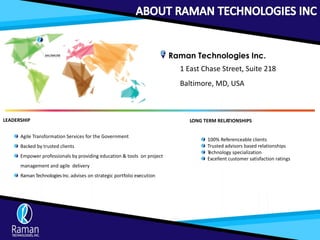
Raman Technologies Inc.
1 East Chase Street, Suite 218
Baltimore, MD, USA
LEADERSHIP
Agile Transformation Services for the Government
Backed by trusted clients
Empower professionals by providing education & tools on project
management and agile delivery
RamanTechnologiesInc.advises on strategic portfolio execution
LONG TERM RELATIONSHIPS
100% Referenceable clients
Trusted advisors based relationships
Technology specialization
Excellent customer satisfaction ratings
Raman Technologies Inc.
About Us
We help organizations become Agile, develop their system and products leveraging Agile methods, and leverage
Blockchain technology to innovate their business. We bring together solutions to help companies adopt, transform
and scale their businesses with strong agile development methodologies; staffing and consulting services; coaching
and training; and most importantly, a full transformation support. Our focus is always on your business delivered
through agility, flexibility and uncompromising quality.
Our Vision
Nothing less than realizing the full potential of our clients and helping them unlock their greatest asset for
maximum success, we call knowledge, in this complex world we live in.
Our Mission
Raman Technologies mission is to empower organizations and people to be more effective, efficient, and successful
in delivering their products to the marketplace. To leverage technology to help organizations be more transparent
and improve operational efficiency. In essence – to be the catalyst and model for setting the standards for product
development and creating a transparent and collaborative environment, where people are motivated to take
ownership of their work and reach their potential.
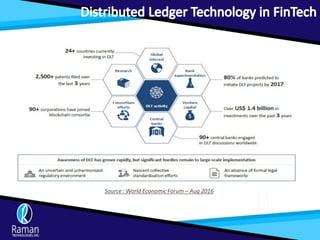
Source : World Economic Forum – Aug 2016
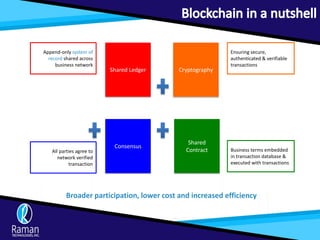
Shared
Contract
CryptographyShared Ledger
Consensus
Ensuring secure,
authenticated & verifiable
transactions
Business terms embedded
in transaction database &
executed with transactions
All parties agree to
network verified
transaction
Append-only system of
record shared across
business network
Broader participation, lower cost and increased efficiency
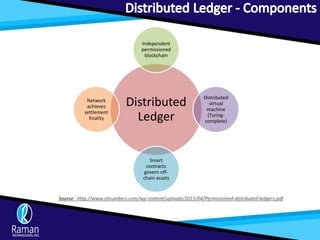
Distributed
Ledger
Independent
permissioned
blockchain
Distributed
virtual
machine
(Turing-
complete)
Smart
contracts
govern off-
chain assets
Network
achieves
settlement
finality
Source : http://www.ofnumbers.com/wp-content/uploads/2015/04/Permissioned-distributed-ledgers.pdf
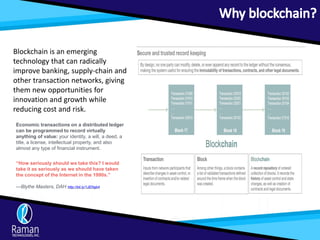
Blockchain is an emerging
technology that can radically
improve banking, supply-chain and
other transaction networks, giving
them new opportunities for
innovation and growth while
reducing cost and risk.
Economic transactions on a distributed ledger
can be programmed to record virtually
anything of value: your identity, a will, a deed, a
title, a license, intellectual property, and also
almost any type of financial instrument.
“How seriously should we take this? I would
take it as seriously as we should have taken
the concept of the Internet in the 1990s.”
—Blythe Masters, DAH http://bit.ly/1JENgb4
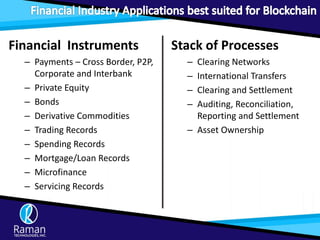
Stack of Processes
– Clearing Networks
– International Transfers
– Clearing and Settlement
– Auditing, Reconciliation,
Reporting and Settlement
– Asset Ownership
Financial Instruments
– Payments – Cross Border, P2P,
Corporate and Interbank
– Private Equity
– Bonds
– Derivative Commodities
– Trading Records
– Spending Records
– Mortgage/Loan Records
– Microfinance
– Servicing Records
Derivative
Contract 1
Derivative
Contract 19
Securities
Contract
Oracles
…..
…..
…..….…….
……...
…..….…….
……...
Integration Bus
Clearing/Settlement
On-chain Off-chain
…..….…….
……...
…..….…….
……...
Market
Trading
Application
Off-chain
/On-chain
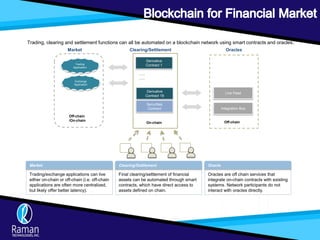
Oracles are off chain services that
integrate on-chain contracts with existing
systems. Network participants do not
interact with oracles directly.
Oracle
Trading/exchange applications can live
either on-chain or off-chain (i.e. off-chain
applications are often more centralized,
but likely offer better latency).
Market
Final clearing/settlement of financial
assets can be automated through smart
contracts, which have direct access to
assets defined on chain.
Clearing/Settlement
Live Feed
Exchange
Application
Trading, clearing and settlement functions can all be automated on a blockchain network using smart contracts and oracles.
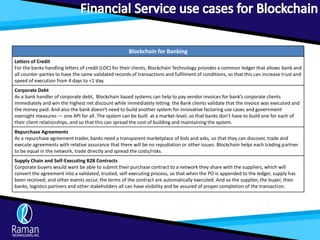
Blockchain for Banking
Letters of Credit
For the banks handling letters of credit (LOC) for their clients, Blockchain Technology provides a common ledger that allows bank and
all counter-parties to have the same validated records of transactions and fulfilment of conditions, so that this can increase trust and
speed of execution from 4 days to <1 day.
Corporate Debt
As a bank handler of corporate debt, Blockchain based systems can help to pay vendor invoices for bank’s corporate clients
immediately and win the highest net discount while immediately letting the Bank clients validate that the invoice was executed and
the money paid. And also the bank doesn't need to build another system for innovative factoring use cases and government
oversight measures — one API for all. The system can be built at a market-level, so that banks don’t have to build one for each of
their client relationships, and so that this can spread the cost of building and maintaining the system.
Repurchase Agreements
As a repurchase agreement trader, banks need a transparent marketplace of bids and asks, so that they can discover, trade and
execute agreements with relative assurance that there will be no repudiation or other issues. Blockchain helps each trading partner
to be equal in the network, trade directly and spread the costs/risks.
Supply Chain and Self-Executing B2B Contracts
Corporate buyers would want be able to submit their purchase contract to a network they share with the suppliers, which will
convert the agreement into a validated, trusted, self-executing process, so that when the PO is appended to the ledger, supply has
been received, and other events occur, the terms of the contract are automatically executed. And so the supplier, the buyer, their
banks, logistics partners and other stakeholders all can have visibility and be assured of proper completion of the transaction.
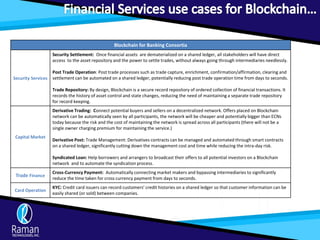
Blockchain for Banking Consortia
Security Services
Security Settlement: Once financial assets are dematerialized on a shared ledger, all stakeholders will have direct
access to the asset repository and the power to settle trades, without always going through intermediaries needlessly.
Post Trade Operation: Post trade processes such as trade capture, enrichment, confirmation/affirmation, clearing and
settlement can be automated on a shared ledger, potentially reducing post trade operation time from days to seconds.
Trade Repository: By design, Blockchain is a secure record repository of ordered collection of financial transactions. It
records the history of asset control and state changes, reducing the need of maintaining a separate trade repository
for record keeping.
Capital Market
Derivative Trading: Connect potential buyers and sellers on a decentralized network. Offers placed on Blockchain
network can be automatically seen by all participants, the network will be cheaper and potentially bigger than ECNs
today because the risk and the cost of maintaining the network is spread across all participants (there will not be a
single owner charging premium for maintaining the service.)
Derivative Post: Trade Management: Derivatives contracts can be managed and automated through smart contracts
on a shared ledger, significantly cutting down the management cost and time while reducing the intra-day risk.
Syndicated Loan: Help borrowers and arrangers to broadcast their offers to all potential investors on a Blockchain
network and to automate the syndication process.
Trade Finance
Cross-Currency Payment: Automatically connecting market makers and bypassing intermediaries to significantly
reduce the time taken for cross currency payment from days to seconds.
Card Operation
KYC: Credit card issuers can record customers’ credit histories on a shared ledger so that customer information can be
easily shared (or sold) between companies.
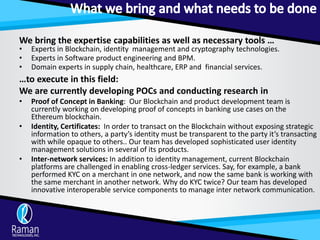
We bring the expertise capabilities as well as necessary tools …
• Experts in Blockchain, identity management and cryptography technologies.
• Experts in Software product engineering and BPM.
• Domain experts in supply chain, healthcare, ERP and financial services.
…to execute in this field:
We are currently developing POCs and conducting research in
• Proof of Concept in Banking: Our Blockchain and product development team is
currently working on developing proof of concepts in banking use cases on the
Ethereum blockchain.
• Identity, Certificates: In order to transact on the Blockchain without exposing strategic
information to others, a party’s identity must be transparent to the party it’s transacting
with while opaque to others.. Our team has developed sophisticated user identity
management solutions in several of its products.
• Inter-network services: In addition to identity management, current Blockchain
platforms are challenged in enabling cross-ledger services. Say, for example, a bank
performed KYC on a merchant in one network, and now the same bank is working with
the same merchant in another network. Why do KYC twice? Our team has developed
innovative interoperable service components to manage inter network communication.
Loyalty Reward Program
using Blockchain
(Implementation of proof
of concept)
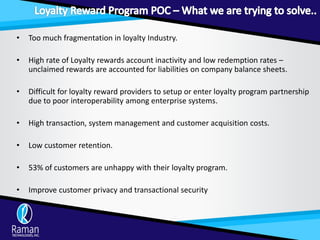
• Too much fragmentation in loyalty Industry.
• High rate of Loyalty rewards account inactivity and low redemption rates –
unclaimed rewards are accounted for liabilities on company balance sheets.
• Difficult for loyalty reward providers to setup or enter loyalty program partnership
due to poor interoperability among enterprise systems.
• High transaction, system management and customer acquisition costs.
• Low customer retention.
• 53% of customers are unhappy with their loyalty program.
• Improve customer privacy and transactional security
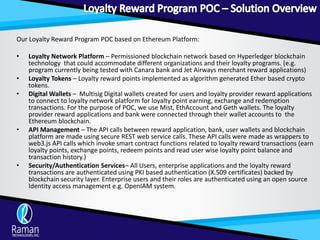
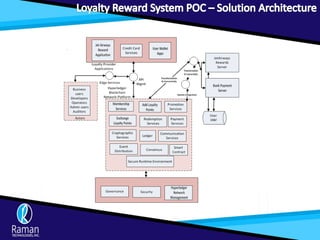
Our Loyalty Reward Program POC based on Ethereum Platform:
• Loyalty Network Platform – Permissioned blockchain network based on Hyperledger blockchain
technology that could accommodate different organizations and their loyalty programs. (e.g.
program currently being tested with Canara bank and Jet Airways merchant reward applications)
• Loyalty Tokens – Loyalty reward points implemented as algorithm generated Ether based crypto
tokens.
• Digital Wallets – Multisig Digital wallets created for users and loyalty provider reward applications
to connect to loyalty network platform for loyalty point earning, exchange and redemption
transactions. For the purpose of POC, we use Mist, EthAccount and Geth wallets. The loyalty
provider reward applications and bank were connected through their wallet accounts to the
Ethereum blockchain.
• API Management – The API calls between reward application, bank, user wallets and blockchain
platform are made using secure REST web service calls. These API calls were made as wrappers to
web3.js API calls which invoke smart contract functions related to loyalty reward transactions (earn
loyalty points, exchange points, redeem points and read user wise loyalty point balance and
transaction history.)
• Security/Authentication Services– All Users, enterprise applications and the loyalty reward
transactions are authenticated using PKI based authentication (X.509 certificates) backed by
blockchain security layer. Enterprise users and their roles are authenticated using an open source
Identity access management e.g. OpenIAM system.
Our Loyalty and Reward Program is designed to be:
• Secure in Access, Transmission and Storage of data.
• Based on Modular components.
• Smart contracts with fine grained ownership checking rules to secure transactions.
• Smart transactions. Example:
– when a member earns loyalty points – it updates transactions and balances, statements and
transaction receipts
– when a member redeems , it refers/updates comprehensive catalog options and fulfilment tracking.
• Promotion manager with configurations e.g. SKU, Loyalty promotion, Earn x jet air
miles per $ spent, first time purchase reward etc.
• Hyperledger Blockchain distributed transaction ledger to provide information on
members identity and profiles, promotions and transaction history (loyalty points
earnings, redemptions and transfers)
• User identity access management to control permissioned access to the blockchain.
As a result of successful POC , our team was able to
• Setup a Permissioned Blockchain loyalty reward network based framework between merchant, bank
and customer.
• Near Real time transaction updates across various stakeholder systems.(e.g. users, merchant, bank) For
example - transactions updated in near real time in merchant and bank distributed ledger nodes.
• Developed user wallets to interact with loyalty program smart contracts deployed in blockchain.
• Identified further Scope of work to extend POC use cases e.g.
o User wallets to be developed as android and iOS mobile apps to interact with loyalty blockchain
system.
o Development of real time notifications to update fulfilment tracking and customer service updates
post redemption of loyalty points.
o Updating banking and merchant statements to clear off liabilities on redemption of loyalty points
with real time updates.
o Promotional management of loyalty rewards.
o Promotion and Integration of loyalty reward system on social media.
Blockchain FinTech PoC

Blockchain FinTech PoC

  • 1.
  • 2.
    Raman Technologies Inc. 1East Chase Street, Suite 218 Baltimore, MD, USA LEADERSHIP Agile Transformation Services for the Government Backed by trusted clients Empower professionals by providing education & tools on project management and agile delivery RamanTechnologiesInc.advises on strategic portfolio execution LONG TERM RELATIONSHIPS 100% Referenceable clients Trusted advisors based relationships Technology specialization Excellent customer satisfaction ratings
  • 3.
    Raman Technologies Inc. AboutUs We help organizations become Agile, develop their system and products leveraging Agile methods, and leverage Blockchain technology to innovate their business. We bring together solutions to help companies adopt, transform and scale their businesses with strong agile development methodologies; staffing and consulting services; coaching and training; and most importantly, a full transformation support. Our focus is always on your business delivered through agility, flexibility and uncompromising quality. Our Vision Nothing less than realizing the full potential of our clients and helping them unlock their greatest asset for maximum success, we call knowledge, in this complex world we live in. Our Mission Raman Technologies mission is to empower organizations and people to be more effective, efficient, and successful in delivering their products to the marketplace. To leverage technology to help organizations be more transparent and improve operational efficiency. In essence – to be the catalyst and model for setting the standards for product development and creating a transparent and collaborative environment, where people are motivated to take ownership of their work and reach their potential.
  • 4.
    Source : WorldEconomic Forum – Aug 2016
  • 5.
    Shared Contract CryptographyShared Ledger Consensus Ensuring secure, authenticated& verifiable transactions Business terms embedded in transaction database & executed with transactions All parties agree to network verified transaction Append-only system of record shared across business network Broader participation, lower cost and increased efficiency
  • 6.
  • 7.
    Blockchain is anemerging technology that can radically improve banking, supply-chain and other transaction networks, giving them new opportunities for innovation and growth while reducing cost and risk. Economic transactions on a distributed ledger can be programmed to record virtually anything of value: your identity, a will, a deed, a title, a license, intellectual property, and also almost any type of financial instrument. “How seriously should we take this? I would take it as seriously as we should have taken the concept of the Internet in the 1990s.” —Blythe Masters, DAH http://bit.ly/1JENgb4
  • 8.
    Stack of Processes –Clearing Networks – International Transfers – Clearing and Settlement – Auditing, Reconciliation, Reporting and Settlement – Asset Ownership Financial Instruments – Payments – Cross Border, P2P, Corporate and Interbank – Private Equity – Bonds – Derivative Commodities – Trading Records – Spending Records – Mortgage/Loan Records – Microfinance – Servicing Records
  • 9.
    Derivative Contract 1 Derivative Contract 19 Securities Contract Oracles ….. ….. …..….……. ……... …..….……. ……... IntegrationBus Clearing/Settlement On-chain Off-chain …..….……. ……... …..….……. ……... Market Trading Application Off-chain /On-chain Oracles are off chain services that integrate on-chain contracts with existing systems. Network participants do not interact with oracles directly. Oracle Trading/exchange applications can live either on-chain or off-chain (i.e. off-chain applications are often more centralized, but likely offer better latency). Market Final clearing/settlement of financial assets can be automated through smart contracts, which have direct access to assets defined on chain. Clearing/Settlement Live Feed Exchange Application Trading, clearing and settlement functions can all be automated on a blockchain network using smart contracts and oracles.
  • 10.
    Blockchain for Banking Lettersof Credit For the banks handling letters of credit (LOC) for their clients, Blockchain Technology provides a common ledger that allows bank and all counter-parties to have the same validated records of transactions and fulfilment of conditions, so that this can increase trust and speed of execution from 4 days to <1 day. Corporate Debt As a bank handler of corporate debt, Blockchain based systems can help to pay vendor invoices for bank’s corporate clients immediately and win the highest net discount while immediately letting the Bank clients validate that the invoice was executed and the money paid. And also the bank doesn't need to build another system for innovative factoring use cases and government oversight measures — one API for all. The system can be built at a market-level, so that banks don’t have to build one for each of their client relationships, and so that this can spread the cost of building and maintaining the system. Repurchase Agreements As a repurchase agreement trader, banks need a transparent marketplace of bids and asks, so that they can discover, trade and execute agreements with relative assurance that there will be no repudiation or other issues. Blockchain helps each trading partner to be equal in the network, trade directly and spread the costs/risks. Supply Chain and Self-Executing B2B Contracts Corporate buyers would want be able to submit their purchase contract to a network they share with the suppliers, which will convert the agreement into a validated, trusted, self-executing process, so that when the PO is appended to the ledger, supply has been received, and other events occur, the terms of the contract are automatically executed. And so the supplier, the buyer, their banks, logistics partners and other stakeholders all can have visibility and be assured of proper completion of the transaction.
  • 11.
    Blockchain for BankingConsortia Security Services Security Settlement: Once financial assets are dematerialized on a shared ledger, all stakeholders will have direct access to the asset repository and the power to settle trades, without always going through intermediaries needlessly. Post Trade Operation: Post trade processes such as trade capture, enrichment, confirmation/affirmation, clearing and settlement can be automated on a shared ledger, potentially reducing post trade operation time from days to seconds. Trade Repository: By design, Blockchain is a secure record repository of ordered collection of financial transactions. It records the history of asset control and state changes, reducing the need of maintaining a separate trade repository for record keeping. Capital Market Derivative Trading: Connect potential buyers and sellers on a decentralized network. Offers placed on Blockchain network can be automatically seen by all participants, the network will be cheaper and potentially bigger than ECNs today because the risk and the cost of maintaining the network is spread across all participants (there will not be a single owner charging premium for maintaining the service.) Derivative Post: Trade Management: Derivatives contracts can be managed and automated through smart contracts on a shared ledger, significantly cutting down the management cost and time while reducing the intra-day risk. Syndicated Loan: Help borrowers and arrangers to broadcast their offers to all potential investors on a Blockchain network and to automate the syndication process. Trade Finance Cross-Currency Payment: Automatically connecting market makers and bypassing intermediaries to significantly reduce the time taken for cross currency payment from days to seconds. Card Operation KYC: Credit card issuers can record customers’ credit histories on a shared ledger so that customer information can be easily shared (or sold) between companies.
  • 12.
    We bring theexpertise capabilities as well as necessary tools … • Experts in Blockchain, identity management and cryptography technologies. • Experts in Software product engineering and BPM. • Domain experts in supply chain, healthcare, ERP and financial services. …to execute in this field: We are currently developing POCs and conducting research in • Proof of Concept in Banking: Our Blockchain and product development team is currently working on developing proof of concepts in banking use cases on the Ethereum blockchain. • Identity, Certificates: In order to transact on the Blockchain without exposing strategic information to others, a party’s identity must be transparent to the party it’s transacting with while opaque to others.. Our team has developed sophisticated user identity management solutions in several of its products. • Inter-network services: In addition to identity management, current Blockchain platforms are challenged in enabling cross-ledger services. Say, for example, a bank performed KYC on a merchant in one network, and now the same bank is working with the same merchant in another network. Why do KYC twice? Our team has developed innovative interoperable service components to manage inter network communication.
  • 13.
    Loyalty Reward Program usingBlockchain (Implementation of proof of concept)
  • 14.
    • Too muchfragmentation in loyalty Industry. • High rate of Loyalty rewards account inactivity and low redemption rates – unclaimed rewards are accounted for liabilities on company balance sheets. • Difficult for loyalty reward providers to setup or enter loyalty program partnership due to poor interoperability among enterprise systems. • High transaction, system management and customer acquisition costs. • Low customer retention. • 53% of customers are unhappy with their loyalty program. • Improve customer privacy and transactional security
  • 15.
    Our Loyalty RewardProgram POC based on Ethereum Platform: • Loyalty Network Platform – Permissioned blockchain network based on Hyperledger blockchain technology that could accommodate different organizations and their loyalty programs. (e.g. program currently being tested with Canara bank and Jet Airways merchant reward applications) • Loyalty Tokens – Loyalty reward points implemented as algorithm generated Ether based crypto tokens. • Digital Wallets – Multisig Digital wallets created for users and loyalty provider reward applications to connect to loyalty network platform for loyalty point earning, exchange and redemption transactions. For the purpose of POC, we use Mist, EthAccount and Geth wallets. The loyalty provider reward applications and bank were connected through their wallet accounts to the Ethereum blockchain. • API Management – The API calls between reward application, bank, user wallets and blockchain platform are made using secure REST web service calls. These API calls were made as wrappers to web3.js API calls which invoke smart contract functions related to loyalty reward transactions (earn loyalty points, exchange points, redeem points and read user wise loyalty point balance and transaction history.) • Security/Authentication Services– All Users, enterprise applications and the loyalty reward transactions are authenticated using PKI based authentication (X.509 certificates) backed by blockchain security layer. Enterprise users and their roles are authenticated using an open source Identity access management e.g. OpenIAM system.
  • 17.
    Our Loyalty andReward Program is designed to be: • Secure in Access, Transmission and Storage of data. • Based on Modular components. • Smart contracts with fine grained ownership checking rules to secure transactions. • Smart transactions. Example: – when a member earns loyalty points – it updates transactions and balances, statements and transaction receipts – when a member redeems , it refers/updates comprehensive catalog options and fulfilment tracking. • Promotion manager with configurations e.g. SKU, Loyalty promotion, Earn x jet air miles per $ spent, first time purchase reward etc. • Hyperledger Blockchain distributed transaction ledger to provide information on members identity and profiles, promotions and transaction history (loyalty points earnings, redemptions and transfers) • User identity access management to control permissioned access to the blockchain.
  • 18.
    As a resultof successful POC , our team was able to • Setup a Permissioned Blockchain loyalty reward network based framework between merchant, bank and customer. • Near Real time transaction updates across various stakeholder systems.(e.g. users, merchant, bank) For example - transactions updated in near real time in merchant and bank distributed ledger nodes. • Developed user wallets to interact with loyalty program smart contracts deployed in blockchain. • Identified further Scope of work to extend POC use cases e.g. o User wallets to be developed as android and iOS mobile apps to interact with loyalty blockchain system. o Development of real time notifications to update fulfilment tracking and customer service updates post redemption of loyalty points. o Updating banking and merchant statements to clear off liabilities on redemption of loyalty points with real time updates. o Promotional management of loyalty rewards. o Promotion and Integration of loyalty reward system on social media.