Class Overview
October 2018
Marian F. Cook
Head Facilitator
This online program draws on the work of leading MIT faculty and cryptoeconomics expert, Professor Christian
Catalini, to examine blockchain technology from an economic perspective. You’ll be offered a foundational
overview of how blockchain technology works, in order to demystify the technology and to understand its
possibilities and limitations.
Over the course of six weeks, you’ll be guided to understand blockchain technology beyond the fundamentals,
and to appreciate its application and promise in the context of your own organization.
• Approximately 6-8 hours/week
Brochure
•
•
•
•
•
•
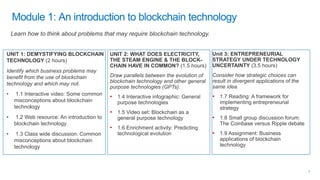
Learn how to think about problems that may require blockchain technology.
Learning outcomes:
• Identify common misconceptions about blockchain technology.
• Articulate the challenges of predicting technological evolution and its impact on the economy.
• Compare the emergence of blockchain technology to that of other general purpose technologies.
• Discern the role of entrepreneurial strategy in a time of technological uncertainty.
• Evaluate a business application of blockchain through the lens of a strategic framework.
Learn how to think about problems that may require blockchain technology.
UNIT 1: DEMYSTIFYING BLOCKCHAIN
TECHNOLOGY (2 hours)
Identify which business problems may
benefit from the use of blockchain
technology and which may not.
• 1.1 Interactive video: Some common
misconceptions about blockchain
technology
• 1.2 Web resource: An introduction to
blockchain technology
• 1.3 Class wide discussion: Common
misconceptions about blockchain
technology
•
•
•
•
•
•
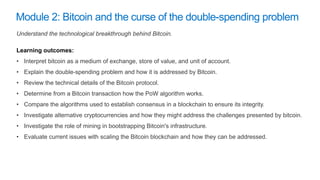
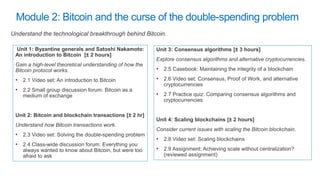
Understand the technological breakthrough behind Bitcoin.
Learning outcomes:
• Interpret bitcoin as a medium of exchange, store of value, and unit of account.
• Explain the double-spending problem and how it is addressed by Bitcoin.
• Review the technical details of the Bitcoin protocol.
• Determine from a Bitcoin transaction how the PoW algorithm works.
• Compare the algorithms used to establish consensus in a blockchain to ensure its integrity.
• Investigate alternative cryptocurrencies and how they might address the challenges presented by bitcoin.
• Investigate the role of mining in bootstrapping Bitcoin's infrastructure.
• Evaluate current issues with scaling the Bitcoin blockchain and how they can be addressed.
Understand the technological breakthrough behind Bitcoin.
•
•
•
•
•
•
•
•
•
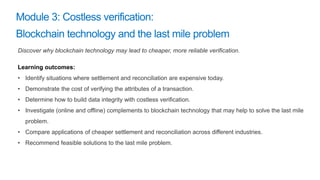
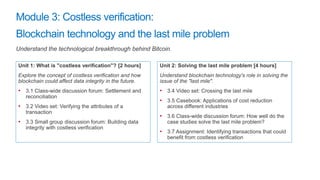
Discover why blockchain technology may lead to cheaper, more reliable verification.
Learning outcomes:
• Identify situations where settlement and reconciliation are expensive today.
• Demonstrate the cost of verifying the attributes of a transaction.
• Determine how to build data integrity with costless verification.
• Investigate (online and offline) complements to blockchain technology that may help to solve the last mile
problem.
• Compare applications of cheaper settlement and reconciliation across different industries.
• Recommend feasible solutions to the last mile problem.
Understand the technological breakthrough behind Bitcoin.
•
•
•
•
•
•
•
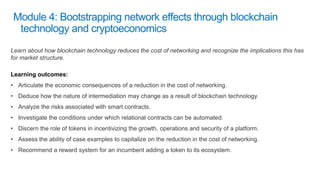
Learn about how blockchain technology reduces the cost of networking and recognize the implications this has
for market structure.
Learning outcomes:
• Articulate the economic consequences of a reduction in the cost of networking.
• Deduce how the nature of intermediation may change as a result of blockchain technology.
• Analyze the risks associated with smart contracts.
• Investigate the conditions under which relational contracts can be automated.
• Discern the role of tokens in incentivizing the growth, operations and security of a platform.
• Assess the ability of case examples to capitalize on the reduction in the cost of networking.
• Recommend a reward system for an incumbent adding a token to its ecosystem.
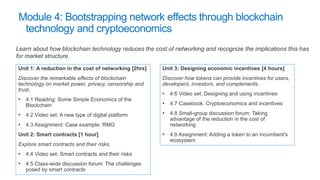
Learn about how blockchain technology reduces the cost of networking and recognize the implications this has
for market structure.
•
•
•
•
•
•
•
•
•
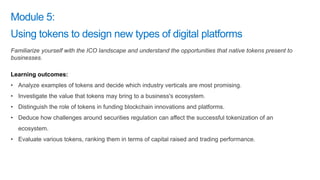
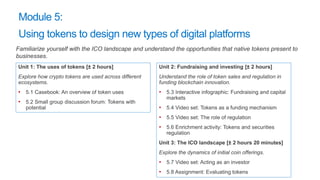
Familiarize yourself with the ICO landscape and understand the opportunities that native tokens present to
businesses.
Learning outcomes:
• Analyze examples of tokens and decide which industry verticals are most promising.
• Investigate the value that tokens may bring to a business's ecosystem.
• Distinguish the role of tokens in funding blockchain innovations and platforms.
• Deduce how challenges around securities regulation can affect the successful tokenization of an
ecosystem.
• Evaluate various tokens, ranking them in terms of capital raised and trading performance.
Familiarize yourself with the ICO landscape and understand the opportunities that native tokens present to
businesses.
•
•
•
•
•
•
•
•
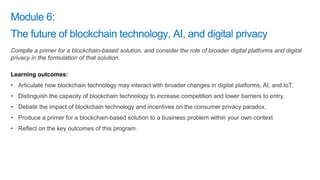
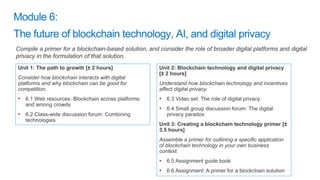
Compile a primer for a blockchain-based solution, and consider the role of broader digital platforms and digital
privacy in the formulation of that solution.
Learning outcomes:
• Articulate how blockchain technology may interact with broader changes in digital platforms, AI, and IoT.
• Distinguish the capacity of blockchain technology to increase competition and lower barriers to entry.
• Debate the impact of blockchain technology and incentives on the consumer privacy paradox.
• Produce a primer for a blockchain-based solution to a business problem within your own context
• Reflect on the key outcomes of this program.
Compile a primer for a blockchain-based solution, and consider the role of broader digital platforms and digital
privacy in the formulation of that solution.
•
•
•
•
•
•
Class Overview
October 2018
Marian F. Cook
Head Facilitator

MIT Blockchain Class - Intro and Overview

  • 1.
    Class Overview October 2018 MarianF. Cook Head Facilitator
  • 2.
    This online programdraws on the work of leading MIT faculty and cryptoeconomics expert, Professor Christian Catalini, to examine blockchain technology from an economic perspective. You’ll be offered a foundational overview of how blockchain technology works, in order to demystify the technology and to understand its possibilities and limitations. Over the course of six weeks, you’ll be guided to understand blockchain technology beyond the fundamentals, and to appreciate its application and promise in the context of your own organization. • Approximately 6-8 hours/week Brochure
  • 3.
  • 4.
    Learn how tothink about problems that may require blockchain technology. Learning outcomes: • Identify common misconceptions about blockchain technology. • Articulate the challenges of predicting technological evolution and its impact on the economy. • Compare the emergence of blockchain technology to that of other general purpose technologies. • Discern the role of entrepreneurial strategy in a time of technological uncertainty. • Evaluate a business application of blockchain through the lens of a strategic framework.
  • 5.
    Learn how tothink about problems that may require blockchain technology. UNIT 1: DEMYSTIFYING BLOCKCHAIN TECHNOLOGY (2 hours) Identify which business problems may benefit from the use of blockchain technology and which may not. • 1.1 Interactive video: Some common misconceptions about blockchain technology • 1.2 Web resource: An introduction to blockchain technology • 1.3 Class wide discussion: Common misconceptions about blockchain technology • • • • • •
  • 6.
    Understand the technologicalbreakthrough behind Bitcoin. Learning outcomes: • Interpret bitcoin as a medium of exchange, store of value, and unit of account. • Explain the double-spending problem and how it is addressed by Bitcoin. • Review the technical details of the Bitcoin protocol. • Determine from a Bitcoin transaction how the PoW algorithm works. • Compare the algorithms used to establish consensus in a blockchain to ensure its integrity. • Investigate alternative cryptocurrencies and how they might address the challenges presented by bitcoin. • Investigate the role of mining in bootstrapping Bitcoin's infrastructure. • Evaluate current issues with scaling the Bitcoin blockchain and how they can be addressed.
  • 7.
    Understand the technologicalbreakthrough behind Bitcoin. • • • • • • • • •
  • 8.
    Discover why blockchaintechnology may lead to cheaper, more reliable verification. Learning outcomes: • Identify situations where settlement and reconciliation are expensive today. • Demonstrate the cost of verifying the attributes of a transaction. • Determine how to build data integrity with costless verification. • Investigate (online and offline) complements to blockchain technology that may help to solve the last mile problem. • Compare applications of cheaper settlement and reconciliation across different industries. • Recommend feasible solutions to the last mile problem.
  • 9.
    Understand the technologicalbreakthrough behind Bitcoin. • • • • • • •
  • 10.
    Learn about howblockchain technology reduces the cost of networking and recognize the implications this has for market structure. Learning outcomes: • Articulate the economic consequences of a reduction in the cost of networking. • Deduce how the nature of intermediation may change as a result of blockchain technology. • Analyze the risks associated with smart contracts. • Investigate the conditions under which relational contracts can be automated. • Discern the role of tokens in incentivizing the growth, operations and security of a platform. • Assess the ability of case examples to capitalize on the reduction in the cost of networking. • Recommend a reward system for an incumbent adding a token to its ecosystem.
  • 11.
    Learn about howblockchain technology reduces the cost of networking and recognize the implications this has for market structure. • • • • • • • • •
  • 12.
    Familiarize yourself withthe ICO landscape and understand the opportunities that native tokens present to businesses. Learning outcomes: • Analyze examples of tokens and decide which industry verticals are most promising. • Investigate the value that tokens may bring to a business's ecosystem. • Distinguish the role of tokens in funding blockchain innovations and platforms. • Deduce how challenges around securities regulation can affect the successful tokenization of an ecosystem. • Evaluate various tokens, ranking them in terms of capital raised and trading performance.
  • 13.
    Familiarize yourself withthe ICO landscape and understand the opportunities that native tokens present to businesses. • • • • • • • •
  • 14.
    Compile a primerfor a blockchain-based solution, and consider the role of broader digital platforms and digital privacy in the formulation of that solution. Learning outcomes: • Articulate how blockchain technology may interact with broader changes in digital platforms, AI, and IoT. • Distinguish the capacity of blockchain technology to increase competition and lower barriers to entry. • Debate the impact of blockchain technology and incentives on the consumer privacy paradox. • Produce a primer for a blockchain-based solution to a business problem within your own context • Reflect on the key outcomes of this program.
  • 15.
    Compile a primerfor a blockchain-based solution, and consider the role of broader digital platforms and digital privacy in the formulation of that solution. • • • • • •
  • 16.
    Class Overview October 2018 MarianF. Cook Head Facilitator