

BLOCKCHAIN TECHNOLOGY:
ADOPTION CHALLENGES,
PLATFORM & APPLICATIONS
SANJEEV VERMA
TECHNICAL CHALLENGES
BLOCKCHAIN TECHNOLOGY
• Blockchain Technology
• Does not refer to a specific technology or system.
• It is a nebulous marketing concept to describe a set of solutions based
on the distributed trust.
• Refers to a set of solutions based on public ledger and consensus
algorithms to establish a distributed trusted system of assets.
• Main Characteristics: Provenance, Immutability, Consensus.
BLOCKCHAIN TECHNOLOGY LANDSCAPE
• Open (Permission Less) or Closed (Permissioned) Ledger?
• Data Structure & Protection mechanisms of the Ledger Entries.
• Consensus Algorithms
• Proof of Work (PoW), Proof of Stake (PoS), Byzantine Fault-Tolerant etc.
• Degree of Anonymity
• Full Anonymity, No Anonymity or Partial Anonymity.
(See Appendix for discussions on consensus algorithms.)
PERFORMANCE METRICS OF BLOCKCHAIN
BASED SOLUTIONS
• Scalability
• Size of the Blockchain over time.
• Number of Nodes.
• Speed
• Block Latency: Time to add a Block to ledger.
• Consensus Latency: Time to reach consensus on a new Block.
• Throughput: Peak Number of Transactions per second.
• Processing
• Computational requirements of the solution to add blocks to the ledger.
• Computational requirements and processing cost of a node.
POLICY & SYSTEM CHALLENGES
• Cultural Adoption
• Integration Concerns & Initial Cost
• Uncertain Regulatory and Compliance Status
• Identity, Security and Privacy
• Standardization
CULTURAL ADOPTION
• Blockchain is a disruptive Technology: Moves Trust & Authority
from a centralized authority to a distributed network:
• Impact on business processes, organizational structure, governance
model.
• Acceptability or Resistance to the new approach from the users and
operators in an organization or ecosystem.
INTEGRATION CONCERNS & INITIAL COST
• Transition to a disruptive technology means significant changes
or complete replacement of existing system.
• Heavy initial cost for organizations to transition from
centralized trusted framework to distributed trusted
framework:
• Organizations need to strategize and do cost-benefit analysis before
adopting new trust model.
UNCERTAIN REGULATORY AND COMPLIANCE
STATUS
• Uncertain regulatory and compliance status has been the
biggest concerns especially for cryptocurrencies like Bitcoin.
• Blockchain applications in an ecosystem need to work within its
existing well-defined regulatory framework:
• Ecosystems adopting Blockchain technology needs to understand the
implications. For instance in case of breach-should the accountability be
shared?
• Compliance needs to move from the reporting system to a
consensus model.
IDENTITY, SECURITY AND PRIVACY
• Anonymity & Security need differ across applications/ecosystems:
• Cryptocurrencies like Bitcoin offered limited anonymity-transactions are tied
to wallet rather than to individuals.
• Smart Contract applications may require contacts and transactions to be
linked to known identities.
• Health industry requires HIPAA standard compliance for protecting sensitive
patient data.
• Financial industry needs support for PCI-DSS standard.
• Ecosystems need confidence that its security and privacy needs are
being met by new technology replacing its existing solutions.
STANDARDIZATION
• Lack of generally accepted definitions and standards
• Every market and organization has a ledger-too many solutions within the same
ecosystem.
• Every ecosystem needs to standardize a common approach to meet its
specific needs:
• Use Case Identification.
• Block Data Format & Structure.
• Security and Privacy requirements of dataset:
• For instance anonymity needs of health industry is going to be different than say financial
industry.
• Consensus Algorithm.
• Governance of Smart Contracts.
• Regulatory and compliance requirements etc.
PLATFORM CHOICES
POPULAR PLATFORMS
• With A Crypto Currency
• Ethereum
• Without A Crypto Currency
• Hyper-ledger(Fabric)
ETHEREUM ALLIANCE
• Ethereum is an open source Block-chain based distributed
computing platform
• Ethereum Wallet allows users to hold and secure ether ( crypto currency)
and other crypto-assets built on the Ethereum Blockchain platform, as
well as write, deploy and use smart contracts.
• Users can also design and issue their own cryptocurrency/traceable
token.
• More Information: www.ethereum.org.
HYPERLEDGER
• Hyperledger is an open source global collaboration hosted by
The Linux Foundation to advance cross-industry Blockchain
technologies.
• Some business Blockchain frameworks hosted with
Hyperledger:
• Hyperledger Fabric: Blockchain technology implementation intended to
facilitate development of Blockchain applications or solutions.
• Hyperledger Iroha: distributed ledger for simple and easy incorporation
into infrastructural projects.
• More information: www.hyperledger.org
APPLICATIONS
APPLICATIONS: FINANCIAL
• Financial Applications
• Transactions
• Mortgage Services
• Commodity Exchange
• Remittances
APPLICATIONS: NON-FINANCIAL
• Non-Financial Applications:
• Government Service Applications
• Land Transfers & Property Title Registrations
• Identity Management
• Vehicle registrations
• Management Of Health Records
• Citizen Engagement Services
• Intellectual Property
• Audit Trail (Govt Information)
• Supply Chain Management Applications
• Technology Applications:
• IoT, Distributed Cloud etc.
APPENDIX
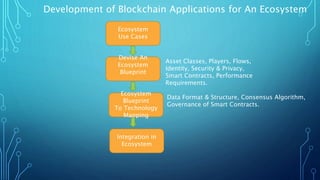
Integration in
Ecosystem
Ecosystem
Use Cases
Devise An
Ecosystem
Blueprint
Ecosystem
Blueprint
To Technology
Mapping
Asset Classes, Players, Flows,
Identity, Security & Privacy,
Smart Contracts, Performance
Requirements.
Data Format & Structure, Consensus Algorithm,
Governance of Smart Contracts.
Development of Blockchain Applications for An Ecosystem
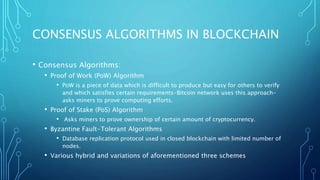
CONSENSUS ALGORITHMS IN BLOCKCHAIN
• Consensus Algorithms:
• Proof of Work (PoW) Algorithm
• PoW is a piece of data which is difficult to produce but easy for others to verify
and which satisfies certain requirements-Bitcoin network uses this approach-
asks miners to prove computing efforts.
• Proof of Stake (PoS) Algorithm
• Asks miners to prove ownership of certain amount of cryptocurrency.
• Byzantine Fault-Tolerant Algorithms
• Database replication protocol used in closed blockchain with limited number of
nodes.
• Various hybrid and variations of aforementioned three schemes
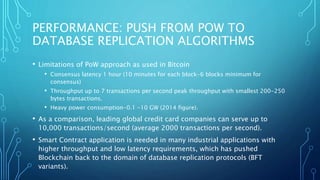
PERFORMANCE: PUSH FROM POW TO
DATABASE REPLICATION ALGORITHMS
• Limitations of PoW approach as used in Bitcoin
• Consensus latency 1 hour (10 minutes for each block-6 blocks minimum for
consensus)
• Throughput up to 7 transactions per second peak throughput with smallest 200-250
bytes transactions.
• Heavy power consumption-0.1 -10 GW (2014 figure).
• As a comparison, leading global credit card companies can serve up to
10,000 transactions/second (average 2000 transactions per second).
• Smart Contract application is needed in many industrial applications with
higher throughput and low latency requirements, which has pushed
Blockchain back to the domain of database replication protocols (BFT
variants).
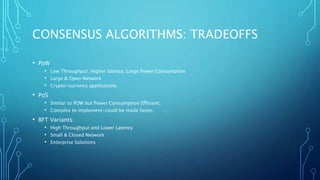
CONSENSUS ALGORITHMS: TRADEOFFS
• PoW
• Low Throughput, Higher latency, Large Power Consumption
• Large & Open Network
• Crypto-currency applications
• PoS
• Similar to POW but Power Consumption Efficient.
• Complex to implement-could be made faster.
• BFT Variants:
• High Throughput and Lower Latency
• Small & Closed Network
• Enterprise Solutions
“The Quest for Scalable Blockchain Fabric: Proof-of-Work vs. BFT
Replication”, Marko Vukolic, IBM Research-Zurich
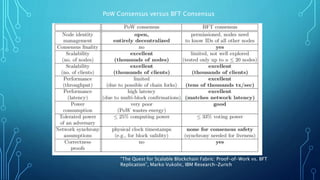
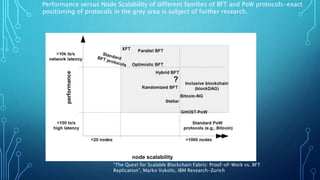
PoW Consensus versus BFT Consensus
Performance versus Node Scalability of different families of BFT and PoW protocols-exact
positioning of protocols in the grey area is subject of further research.
“The Quest for Scalable Blockchain Fabric: Proof-of-Work vs. BFT
Replication”, Marko Vukolic, IBM Research-Zurich
REFERENCES
• “The Quest for Scalable Blockchain Fabric: Proof-of-Work vs. BFT
Replication”, Marko Vukolic, IBM Research-Zurich
• http://vukolic.com/iNetSec_2015.pdf.
• Deloitte Technical Reports:
• Bitcoin, Blockchain & Distributed Ledgers: Caught between promise and
reality.
• Blockchain: Key Challenges.
• IBM Director Nitin Gaur Provides Mini-roadmap to Global
Governments Exploring Blockchain.
• http://www.huffingtonpost.com/entry/5976ed72e4b01cf1c4bb7315

Blockchain Technology: Adoption Challenges, Platform and Applications

  • 1.
  • 2.
  • 3.
    BLOCKCHAIN TECHNOLOGY • BlockchainTechnology • Does not refer to a specific technology or system. • It is a nebulous marketing concept to describe a set of solutions based on the distributed trust. • Refers to a set of solutions based on public ledger and consensus algorithms to establish a distributed trusted system of assets. • Main Characteristics: Provenance, Immutability, Consensus.
  • 4.
    BLOCKCHAIN TECHNOLOGY LANDSCAPE •Open (Permission Less) or Closed (Permissioned) Ledger? • Data Structure & Protection mechanisms of the Ledger Entries. • Consensus Algorithms • Proof of Work (PoW), Proof of Stake (PoS), Byzantine Fault-Tolerant etc. • Degree of Anonymity • Full Anonymity, No Anonymity or Partial Anonymity. (See Appendix for discussions on consensus algorithms.)
  • 5.
    PERFORMANCE METRICS OFBLOCKCHAIN BASED SOLUTIONS • Scalability • Size of the Blockchain over time. • Number of Nodes. • Speed • Block Latency: Time to add a Block to ledger. • Consensus Latency: Time to reach consensus on a new Block. • Throughput: Peak Number of Transactions per second. • Processing • Computational requirements of the solution to add blocks to the ledger. • Computational requirements and processing cost of a node.
  • 6.
    POLICY & SYSTEMCHALLENGES
  • 7.
    POLICY & SYSTEMCHALLENGES • Cultural Adoption • Integration Concerns & Initial Cost • Uncertain Regulatory and Compliance Status • Identity, Security and Privacy • Standardization
  • 8.
    CULTURAL ADOPTION • Blockchainis a disruptive Technology: Moves Trust & Authority from a centralized authority to a distributed network: • Impact on business processes, organizational structure, governance model. • Acceptability or Resistance to the new approach from the users and operators in an organization or ecosystem.
  • 9.
    INTEGRATION CONCERNS &INITIAL COST • Transition to a disruptive technology means significant changes or complete replacement of existing system. • Heavy initial cost for organizations to transition from centralized trusted framework to distributed trusted framework: • Organizations need to strategize and do cost-benefit analysis before adopting new trust model.
  • 10.
    UNCERTAIN REGULATORY ANDCOMPLIANCE STATUS • Uncertain regulatory and compliance status has been the biggest concerns especially for cryptocurrencies like Bitcoin. • Blockchain applications in an ecosystem need to work within its existing well-defined regulatory framework: • Ecosystems adopting Blockchain technology needs to understand the implications. For instance in case of breach-should the accountability be shared? • Compliance needs to move from the reporting system to a consensus model.
  • 11.
    IDENTITY, SECURITY ANDPRIVACY • Anonymity & Security need differ across applications/ecosystems: • Cryptocurrencies like Bitcoin offered limited anonymity-transactions are tied to wallet rather than to individuals. • Smart Contract applications may require contacts and transactions to be linked to known identities. • Health industry requires HIPAA standard compliance for protecting sensitive patient data. • Financial industry needs support for PCI-DSS standard. • Ecosystems need confidence that its security and privacy needs are being met by new technology replacing its existing solutions.
  • 12.
    STANDARDIZATION • Lack ofgenerally accepted definitions and standards • Every market and organization has a ledger-too many solutions within the same ecosystem. • Every ecosystem needs to standardize a common approach to meet its specific needs: • Use Case Identification. • Block Data Format & Structure. • Security and Privacy requirements of dataset: • For instance anonymity needs of health industry is going to be different than say financial industry. • Consensus Algorithm. • Governance of Smart Contracts. • Regulatory and compliance requirements etc.
  • 13.
  • 14.
    POPULAR PLATFORMS • WithA Crypto Currency • Ethereum • Without A Crypto Currency • Hyper-ledger(Fabric)
  • 15.
    ETHEREUM ALLIANCE • Ethereumis an open source Block-chain based distributed computing platform • Ethereum Wallet allows users to hold and secure ether ( crypto currency) and other crypto-assets built on the Ethereum Blockchain platform, as well as write, deploy and use smart contracts. • Users can also design and issue their own cryptocurrency/traceable token. • More Information: www.ethereum.org.
  • 16.
    HYPERLEDGER • Hyperledger isan open source global collaboration hosted by The Linux Foundation to advance cross-industry Blockchain technologies. • Some business Blockchain frameworks hosted with Hyperledger: • Hyperledger Fabric: Blockchain technology implementation intended to facilitate development of Blockchain applications or solutions. • Hyperledger Iroha: distributed ledger for simple and easy incorporation into infrastructural projects. • More information: www.hyperledger.org
  • 17.
  • 18.
    APPLICATIONS: FINANCIAL • FinancialApplications • Transactions • Mortgage Services • Commodity Exchange • Remittances
  • 19.
    APPLICATIONS: NON-FINANCIAL • Non-FinancialApplications: • Government Service Applications • Land Transfers & Property Title Registrations • Identity Management • Vehicle registrations • Management Of Health Records • Citizen Engagement Services • Intellectual Property • Audit Trail (Govt Information) • Supply Chain Management Applications • Technology Applications: • IoT, Distributed Cloud etc.
  • 20.
  • 21.
    Integration in Ecosystem Ecosystem Use Cases DeviseAn Ecosystem Blueprint Ecosystem Blueprint To Technology Mapping Asset Classes, Players, Flows, Identity, Security & Privacy, Smart Contracts, Performance Requirements. Data Format & Structure, Consensus Algorithm, Governance of Smart Contracts. Development of Blockchain Applications for An Ecosystem
  • 22.
    CONSENSUS ALGORITHMS INBLOCKCHAIN • Consensus Algorithms: • Proof of Work (PoW) Algorithm • PoW is a piece of data which is difficult to produce but easy for others to verify and which satisfies certain requirements-Bitcoin network uses this approach- asks miners to prove computing efforts. • Proof of Stake (PoS) Algorithm • Asks miners to prove ownership of certain amount of cryptocurrency. • Byzantine Fault-Tolerant Algorithms • Database replication protocol used in closed blockchain with limited number of nodes. • Various hybrid and variations of aforementioned three schemes
  • 23.
    PERFORMANCE: PUSH FROMPOW TO DATABASE REPLICATION ALGORITHMS • Limitations of PoW approach as used in Bitcoin • Consensus latency 1 hour (10 minutes for each block-6 blocks minimum for consensus) • Throughput up to 7 transactions per second peak throughput with smallest 200-250 bytes transactions. • Heavy power consumption-0.1 -10 GW (2014 figure). • As a comparison, leading global credit card companies can serve up to 10,000 transactions/second (average 2000 transactions per second). • Smart Contract application is needed in many industrial applications with higher throughput and low latency requirements, which has pushed Blockchain back to the domain of database replication protocols (BFT variants).
  • 24.
    CONSENSUS ALGORITHMS: TRADEOFFS •PoW • Low Throughput, Higher latency, Large Power Consumption • Large & Open Network • Crypto-currency applications • PoS • Similar to POW but Power Consumption Efficient. • Complex to implement-could be made faster. • BFT Variants: • High Throughput and Lower Latency • Small & Closed Network • Enterprise Solutions
  • 25.
    “The Quest forScalable Blockchain Fabric: Proof-of-Work vs. BFT Replication”, Marko Vukolic, IBM Research-Zurich PoW Consensus versus BFT Consensus
  • 26.
    Performance versus NodeScalability of different families of BFT and PoW protocols-exact positioning of protocols in the grey area is subject of further research. “The Quest for Scalable Blockchain Fabric: Proof-of-Work vs. BFT Replication”, Marko Vukolic, IBM Research-Zurich
  • 27.
    REFERENCES • “The Questfor Scalable Blockchain Fabric: Proof-of-Work vs. BFT Replication”, Marko Vukolic, IBM Research-Zurich • http://vukolic.com/iNetSec_2015.pdf. • Deloitte Technical Reports: • Bitcoin, Blockchain & Distributed Ledgers: Caught between promise and reality. • Blockchain: Key Challenges. • IBM Director Nitin Gaur Provides Mini-roadmap to Global Governments Exploring Blockchain. • http://www.huffingtonpost.com/entry/5976ed72e4b01cf1c4bb7315