
Gaurav Mishra
<gmishx@gmail.com>
Block Chain
Introduction to blockchain
27-05-2018
Unrestricted
Gaurav Mishra <gmishx@gmail.com>
The bank way of transactions
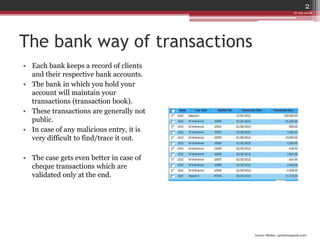
• Each bank keeps a record of clients
and their respective bank accounts.
• The bank in which you hold your
account will maintain your
transactions (transaction book).
• These transactions are generally not
public.
• In case of any malicious entry, it is
very difficult to find/trace it out.
• The case gets even better in case of
cheque transactions which are
validated only at the end.
27-05-2018
2
Gaurav Mishra <gmishx@gmail.com>
Shortcoming of the bank way
•
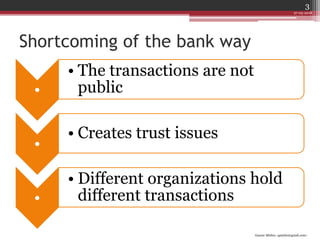
• The transactions are not
public
•
• Creates trust issues
•
• Different organizations hold
different transactions
27-05-2018
3
Gaurav Mishra <gmishx@gmail.com>
Replacement of this method
27-05-2018
4
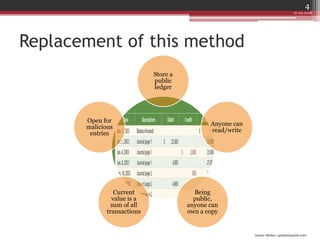
Store a
public
ledger
Anyone can
read/write
Being
public,
anyone can
own a copy
Current
value is a
sum of all
transactions
Open for
malicious
entries
Gaurav Mishra <gmishx@gmail.com>
Securing the ledger
• Any person can hold a copy of the ledger for keeping track of transactions.
• This also opens a way for modification in the ledger.
• The best way of preventing modifications is by using hash.
• Hash is calculated using a sting and applying certain mathematical operations on it
which creates a new digest (fixed length) of the given input.
• A slight modification in the input creates a great change in the digest (avalanche
effect).
• Hashing input are generally combined with another input called salt or nonce to
modify the hash output for a desired result.
• After a certain number of entries, a hash is calculated on the ledger.
• This can prevent modifications in existing ledger.
• https://anders.com/blockchain/hash.html
• Since calculating the digest is a costly operation, the digest is calculated after a
certain entries in the ledger and those entries are called as a block.
• The size of a block is fixed for any operation on the ledger.
• https://anders.com/blockchain/block.html
27-05-2018
5
Gaurav Mishra <gmishx@gmail.com>
Securing the entries
• Calculating hash on the ledger only prevents the modification of it.
• We still need a way to prevent malicious entries in it.
• The public-private keys are popularly used around and can be used to provide
authenticity of a message using digital signatures.
• https://anders.com/blockchain/public-private-keys/keys.html
• Each entry in the ledger is backed with a signature calculated using the private key of
person making the transaction.
• https://anders.com/blockchain/public-private-keys/signatures.html
• This provides the authenticity of the entries in the ledger.
• Thus the final ledger is secured by authenticating the entries and preventing
modifications in the previous entries.
• https://anders.com/blockchain/public-private-keys/blockchain.html
27-05-2018
6
Gaurav Mishra <gmishx@gmail.com>
The blockchain
• The blockchain is a continuous chain of validated blocks.
• Each block holds its block number, its nonce, its data, hash of previous block and its
own hash.
• https://blockchain.info/block/0000000000000000001cca8a0f8925e6b6d542e314
54a3e16bfe1fd7f571b1d0
• Each participant have to provide their public key.
• https://anders.com/blockchain/public-private-keys/blockchain.html
• The digest of the block have some constrain like the first 4 digits of it should be zero
to increase the computational cost of the digest and making it even more difficult to
change.
• The act of calculation of digest of a block is called mining and the person performing
it is called as miner.
• Since the ledger is distributed among several computers, anyone who mine the block
first broadcast the result to others.
• Any ledger having modifications can be matched with others and discarded.
• If a chain is bifurcated, the chain with most work done is retained and the other one
is discarded.
27-05-2018
7
Gaurav Mishra <gmishx@gmail.com>
Strengths of blockchain
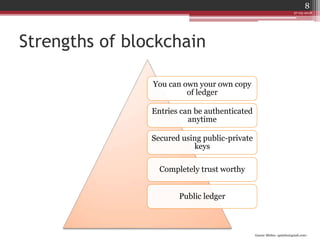
You can own your own copy
of ledger
Entries can be authenticated
anytime
Secured using public-private
keys
Completely trust worthy
Public ledger
27-05-2018
8
Gaurav Mishra <gmishx@gmail.com>
27-05-2018
9

Block Chain - Introduction

  • 1.
    Gaurav Mishra <gmishx@gmail.com> Block Chain Introductionto blockchain 27-05-2018 Unrestricted
  • 2.
    Gaurav Mishra <gmishx@gmail.com> Thebank way of transactions • Each bank keeps a record of clients and their respective bank accounts. • The bank in which you hold your account will maintain your transactions (transaction book). • These transactions are generally not public. • In case of any malicious entry, it is very difficult to find/trace it out. • The case gets even better in case of cheque transactions which are validated only at the end. 27-05-2018 2
  • 3.
    Gaurav Mishra <gmishx@gmail.com> Shortcomingof the bank way • • The transactions are not public • • Creates trust issues • • Different organizations hold different transactions 27-05-2018 3
  • 4.
    Gaurav Mishra <gmishx@gmail.com> Replacementof this method 27-05-2018 4 Store a public ledger Anyone can read/write Being public, anyone can own a copy Current value is a sum of all transactions Open for malicious entries
  • 5.
    Gaurav Mishra <gmishx@gmail.com> Securingthe ledger • Any person can hold a copy of the ledger for keeping track of transactions. • This also opens a way for modification in the ledger. • The best way of preventing modifications is by using hash. • Hash is calculated using a sting and applying certain mathematical operations on it which creates a new digest (fixed length) of the given input. • A slight modification in the input creates a great change in the digest (avalanche effect). • Hashing input are generally combined with another input called salt or nonce to modify the hash output for a desired result. • After a certain number of entries, a hash is calculated on the ledger. • This can prevent modifications in existing ledger. • https://anders.com/blockchain/hash.html • Since calculating the digest is a costly operation, the digest is calculated after a certain entries in the ledger and those entries are called as a block. • The size of a block is fixed for any operation on the ledger. • https://anders.com/blockchain/block.html 27-05-2018 5
  • 6.
    Gaurav Mishra <gmishx@gmail.com> Securingthe entries • Calculating hash on the ledger only prevents the modification of it. • We still need a way to prevent malicious entries in it. • The public-private keys are popularly used around and can be used to provide authenticity of a message using digital signatures. • https://anders.com/blockchain/public-private-keys/keys.html • Each entry in the ledger is backed with a signature calculated using the private key of person making the transaction. • https://anders.com/blockchain/public-private-keys/signatures.html • This provides the authenticity of the entries in the ledger. • Thus the final ledger is secured by authenticating the entries and preventing modifications in the previous entries. • https://anders.com/blockchain/public-private-keys/blockchain.html 27-05-2018 6
  • 7.
    Gaurav Mishra <gmishx@gmail.com> Theblockchain • The blockchain is a continuous chain of validated blocks. • Each block holds its block number, its nonce, its data, hash of previous block and its own hash. • https://blockchain.info/block/0000000000000000001cca8a0f8925e6b6d542e314 54a3e16bfe1fd7f571b1d0 • Each participant have to provide their public key. • https://anders.com/blockchain/public-private-keys/blockchain.html • The digest of the block have some constrain like the first 4 digits of it should be zero to increase the computational cost of the digest and making it even more difficult to change. • The act of calculation of digest of a block is called mining and the person performing it is called as miner. • Since the ledger is distributed among several computers, anyone who mine the block first broadcast the result to others. • Any ledger having modifications can be matched with others and discarded. • If a chain is bifurcated, the chain with most work done is retained and the other one is discarded. 27-05-2018 7
  • 8.
    Gaurav Mishra <gmishx@gmail.com> Strengthsof blockchain You can own your own copy of ledger Entries can be authenticated anytime Secured using public-private keys Completely trust worthy Public ledger 27-05-2018 8
  • 9.