Community Oriented and Community
Based Education
Under supervision
Dr Esraa Mohamed Soltan
By
Ahmed Gamal Fahmy
Wifaq Ali
Outline
 Introduction
 Community Oriented Education
 Community Based Education
 Goal Of Community Bases Education
 Historical Perspective of CBE
 Principals of Community Based Education
 Types of Community Based Education
 Changes of Community Based Education
 Benefits of Community Based Education
Introduction
 A community is defined as a social unit
consisting of individuals who share common
characteristics, interests, or goals. These shared
traits can be based on geographical location,
cultural norms, values, or social ties.
Definition of Community Oriented Education
 Refers to "care providers' knowledge of community needs and
involvement in the community“
 It involves:
 Understanding the health needs and issues affecting the whole community,
not just individual patients
 Reaching out to and engaging with the broader community
 Assessing community health needs systematically
 Developing programs and services to address identified community needs
 Monitoring and evaluating the effectiveness of community-oriented
initiatives
 Community Based Education (CBE) is a form of
instruction where students learn professional competencies
in a community setting to help students build a sense of
connection with their communities. CBE is a popular
approach for all forms of education and for all age groups
especially at higher education level .
 The primary purpose is to foster interdependence
between education and communities for enhancing the
capacity of individuals and groups for improving their
quality of life
Community Based Education
Cont.,
 The definition developed by Working Group at Johns
Hopkins University states that “it is a pedagogical model
that connects classroom-based work with meaningful
community involvement and exchange”. Within the context
of equitable partnership, community organizations and
students mutually benefit from the CBE by meeting course
objectives and addressing community identified goals.
CBE goes beyond cognitive capacities and encompasses the
social and emotional aspects of learning’; the emotional and
social development of students comes from the collaborative
efforts of parents, schools, and communities.
Furthermore, CBE expands the definition of “intelligence” to
include the learner’s ability to gain understanding, use
knowledge, and solve problems, while developing a sense of
self. Success is not based solely on learning core academic
subjects, but couples academics with creativity and personal
willpower through an emphasis on interpersonal relationships
and intrapersonal development.
Goal Of Community Bases Education
The overall goal of CBE is to improve the universal
accessibility of basic health care; it aims at training of
undergraduate health professional students in the diagnosis,
management and, if possible, solution of community health
problems.
The general objective of CBE programs is to expand
students’ notion of community health problems through their
learning, service and research in the community and thereby to
improve the health of the community in which the program is
carried out, in particular to achieve:
 Universal access to and quality of health care including in
remote and hard to reach populations.
 Holistic and comprehensive health care comprising of
preventive, curative and rehabilitative services.
 Promote healthy behaviors and lifestyles.
 Reconcile individual and community health requirements,
ensuring a balance.
 Team work within the health sector and with other
socioeconomic sectors that influence health.
Historical Perspective of CBE
In 1978, in a meeting of world health leaders in Alma Atta,
Kazakhstan, Primary Health Care (PHC) was considered as
the vehicle for improving health care of populations and
health care for all to be achieved by the year 2000 was set as
a target. To ensure achievement of this goal, one of the
strategies was to foster the type of educational program for
health care providers that could make them responsive to the
needs of populations they serve.
 Hence, one year later, a number of medical schools which
were already into reforming their curriculum towards
community needs and were trying to be more socially
relevant, created a network - Towards Unity for Health
(TUFH). In its founding meeting in Kingston, Jamaica,
the terms Community Based Medical Education (CBME)
and Community Oriented Medical Education (COME)
were officiated.
Principals of Community Based Education
 The student activities should relate to planned
educational goals and objectives.
 The activities should be introduced very early in
the educational experience.
 They must continue throughout the educational
program.
Cont
,.
 They must be viewed not as peripheral or casual
experiences but as standard, integral, and continuing part
of the educational process.
 The students' work during training must be "real work"
that is related to their educational needs.
 There is a marked difference between the objectives of the
community-based educational program and those of
traditional field work.
Types of Community Based Education
 Civic action or advocacy – In this students only address the
community problems or social issue and what is the cause of that
problem. This is basically informational community-based
learning.
 Direct service – In this method Students directly work with the
community and collectively work toward solutions to that
problems
 Indirect Service – In this method students provide goods &
products for the needy cause of the community.
Challenges for Community Based Education
 Community-based education is not as same as
classroom-based Learning as that can be managed
easily but community-based education is quite
challenging and its workload is much higher for the
teachers and the students.
 Students and Teachers will be working directly with the
community for solving a real-world problem but it is not
easy as it sounds as it can be confusing and chaotic for the
students. Students can get annoyed with the higher
workload and they can be unsure of their learning goals in
community-based education some of the
boarding schools in India use best practices for students to
reduce the higher workload that arrived due to community-
based learning methods.
 Teachers or instructors will have a hard time managing the
project as they have to manage the project as well as manage
the students and on top of that, they have to evaluate the
performance of each student and check if they have done
their part in the project.
 Community-Based Education can be time-consuming as it
will be difficult for instructors and students to finish the task
in time.
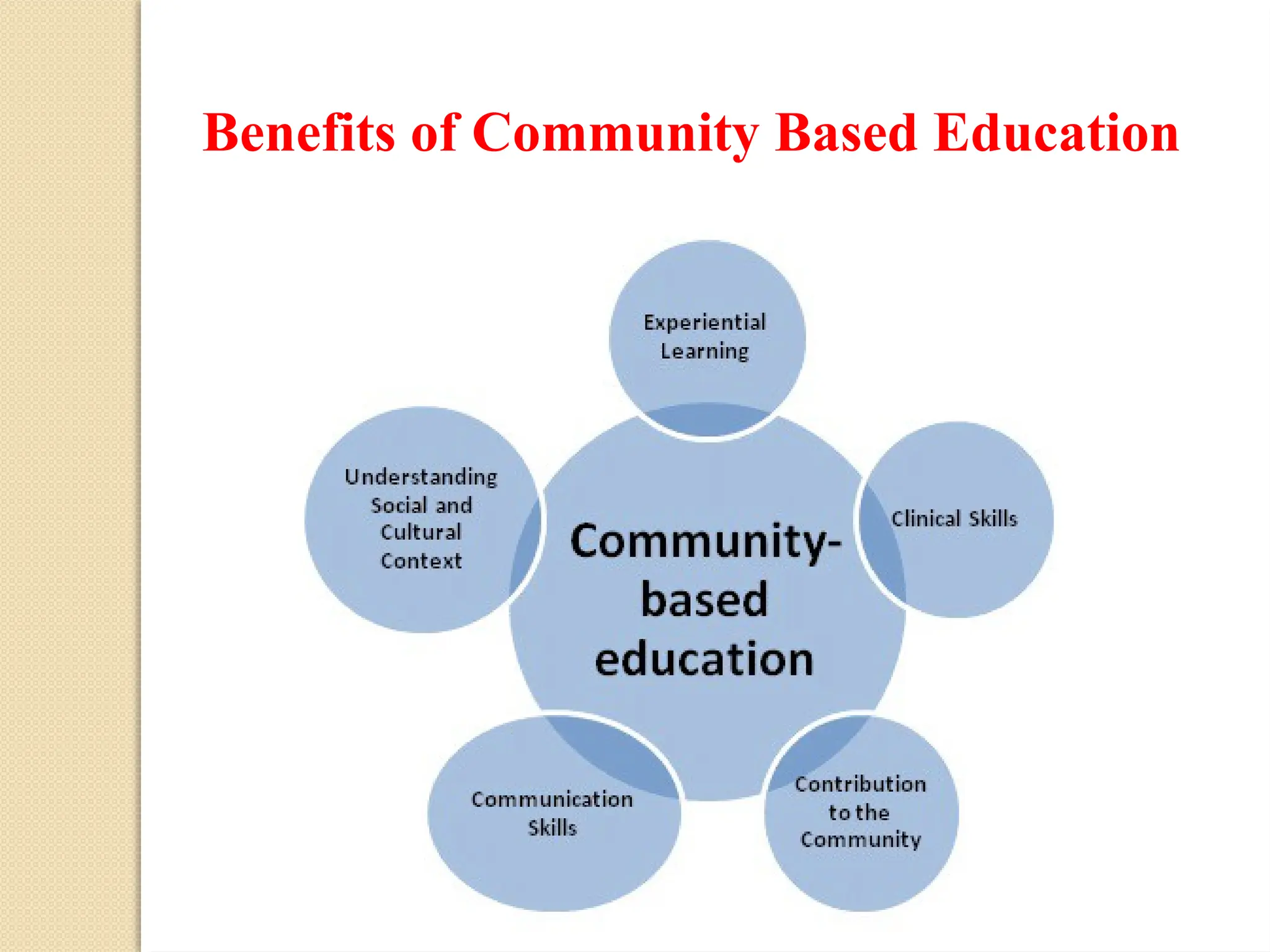
Benefits of Community Based Education
This type of learning strategy is very engaging for the
students as they move out of the classroom
environment and get in direct contact with the
community and work toward a social cause in order to
provide help to the community, this will make
students’ engagement level go up and they will be able
to learn, understand the information and quickly grasp
the new knowledge.
 Community-Based Education can help students develop
creativity, critical thinking, and problems solving skills as
they directly working toward solving real-world problems
so in order to achieve that they have to think critically and
out of the box and this process will enhance their skills
which will be helpful for them as the there is a lot of
demand for these skill in Marketplace.
 Community-Based Education enhances the social
responsibility of the students as they dig deeper in
understanding the social issue it causes. It helps them
become a better citizen as they will take the responsibility to
help other people and solve community problems.
 In Community Based Learning Students receive practical
knowledge as they already get theoretical knowledge in
classroom-based learning so they can utilize that knowledge
to gain practical experience.
 It also enhances students’ leadership skills,
communications skills, and team working skills as they do
a collaborative task that requires teamwork and good
communication so community-based education enhances
these key skills in students which they will carry lifelong.
 It will change the student’s attitude toward social
problems as now instead of ignoring the problems they will
try to solve the problem.
 Develop empathy in students, when students work with
the locals, understand their problems, and work toward
helping them without any judgment.
 It makes students more confident about themselves and
they can take risks and accept new challenges as
community-based education offers new experiences to them
which makes them ready to take new tasks or challenges in
hand.
References:
http://oxforddictionaries.com/ (last accessed on July 10th ,2013).
Johns Hopkins working Group definition of Community Based Education; (last
accessed on July 10th ,2013) . http://www.jhu.edu/csc/cbl/documents/
FinalCBLDefinition.pdf
Villani C J. & Atkins D (2000). Community-Based Education, School Community
Journal, Vol. 10, No. 1, Spring/Summer 2000.
Alausa O.K. Bhattacharaya A. Chowdry Z. Durana I. Ermakov V. Manyeneng
W.G. et al (1987). Community-Based Education of health personnel, Nov. 1987;
Report no. 746, sponsored by World Health Organization Study Group,
Geneva.
Hamad B (1991). Community Oriented Medical Education, What it is? Medical
Education 1991, 25: 16-22
Bor D (2003). Position Paper on Community-Based Education for Health
Professionals. Education for Health 2003, 16(3) 400 – 404.
Hays, R. (2007). Community-Oriented Medical Education. Teaching and
Teacher Education 2007, 23, 286–293.
Kreitzer M.J. Kligler B. Meeker W.C. (2009). Health professions’
education and Integrative health care Commissioned for the IOM Summit
on Integrative, Medicine and the Health of the Public. February, 2009.
Boon, H., V. Verhoef, D. O’Hara, and B. Findlay (2004). From parallel
practice to integrative health care: A conceptual framework. BioMed Central
Health Services Research 2004; 4:15.
Thank you

Community Based Education Final. Community Based pptx

  • 1.
    Community Oriented andCommunity Based Education Under supervision Dr Esraa Mohamed Soltan By Ahmed Gamal Fahmy Wifaq Ali
  • 2.
    Outline  Introduction  CommunityOriented Education  Community Based Education  Goal Of Community Bases Education  Historical Perspective of CBE  Principals of Community Based Education  Types of Community Based Education  Changes of Community Based Education  Benefits of Community Based Education
  • 3.
    Introduction  A communityis defined as a social unit consisting of individuals who share common characteristics, interests, or goals. These shared traits can be based on geographical location, cultural norms, values, or social ties.
  • 4.
    Definition of CommunityOriented Education  Refers to "care providers' knowledge of community needs and involvement in the community“  It involves:  Understanding the health needs and issues affecting the whole community, not just individual patients  Reaching out to and engaging with the broader community  Assessing community health needs systematically  Developing programs and services to address identified community needs  Monitoring and evaluating the effectiveness of community-oriented initiatives
  • 5.
     Community BasedEducation (CBE) is a form of instruction where students learn professional competencies in a community setting to help students build a sense of connection with their communities. CBE is a popular approach for all forms of education and for all age groups especially at higher education level .  The primary purpose is to foster interdependence between education and communities for enhancing the capacity of individuals and groups for improving their quality of life Community Based Education
  • 6.
    Cont.,  The definitiondeveloped by Working Group at Johns Hopkins University states that “it is a pedagogical model that connects classroom-based work with meaningful community involvement and exchange”. Within the context of equitable partnership, community organizations and students mutually benefit from the CBE by meeting course objectives and addressing community identified goals.
  • 7.
    CBE goes beyondcognitive capacities and encompasses the social and emotional aspects of learning’; the emotional and social development of students comes from the collaborative efforts of parents, schools, and communities. Furthermore, CBE expands the definition of “intelligence” to include the learner’s ability to gain understanding, use knowledge, and solve problems, while developing a sense of self. Success is not based solely on learning core academic subjects, but couples academics with creativity and personal willpower through an emphasis on interpersonal relationships and intrapersonal development.
  • 8.
    Goal Of CommunityBases Education The overall goal of CBE is to improve the universal accessibility of basic health care; it aims at training of undergraduate health professional students in the diagnosis, management and, if possible, solution of community health problems. The general objective of CBE programs is to expand students’ notion of community health problems through their learning, service and research in the community and thereby to improve the health of the community in which the program is carried out, in particular to achieve:
  • 9.
     Universal accessto and quality of health care including in remote and hard to reach populations.  Holistic and comprehensive health care comprising of preventive, curative and rehabilitative services.  Promote healthy behaviors and lifestyles.  Reconcile individual and community health requirements, ensuring a balance.  Team work within the health sector and with other socioeconomic sectors that influence health.
  • 10.
    Historical Perspective ofCBE In 1978, in a meeting of world health leaders in Alma Atta, Kazakhstan, Primary Health Care (PHC) was considered as the vehicle for improving health care of populations and health care for all to be achieved by the year 2000 was set as a target. To ensure achievement of this goal, one of the strategies was to foster the type of educational program for health care providers that could make them responsive to the needs of populations they serve.
  • 11.
     Hence, oneyear later, a number of medical schools which were already into reforming their curriculum towards community needs and were trying to be more socially relevant, created a network - Towards Unity for Health (TUFH). In its founding meeting in Kingston, Jamaica, the terms Community Based Medical Education (CBME) and Community Oriented Medical Education (COME) were officiated.
  • 12.
    Principals of CommunityBased Education  The student activities should relate to planned educational goals and objectives.  The activities should be introduced very early in the educational experience.  They must continue throughout the educational program.
  • 13.
    Cont ,.  They mustbe viewed not as peripheral or casual experiences but as standard, integral, and continuing part of the educational process.  The students' work during training must be "real work" that is related to their educational needs.  There is a marked difference between the objectives of the community-based educational program and those of traditional field work.
  • 14.
    Types of CommunityBased Education  Civic action or advocacy – In this students only address the community problems or social issue and what is the cause of that problem. This is basically informational community-based learning.  Direct service – In this method Students directly work with the community and collectively work toward solutions to that problems  Indirect Service – In this method students provide goods & products for the needy cause of the community.
  • 15.
    Challenges for CommunityBased Education  Community-based education is not as same as classroom-based Learning as that can be managed easily but community-based education is quite challenging and its workload is much higher for the teachers and the students.
  • 16.
     Students andTeachers will be working directly with the community for solving a real-world problem but it is not easy as it sounds as it can be confusing and chaotic for the students. Students can get annoyed with the higher workload and they can be unsure of their learning goals in community-based education some of the boarding schools in India use best practices for students to reduce the higher workload that arrived due to community- based learning methods.
  • 17.
     Teachers orinstructors will have a hard time managing the project as they have to manage the project as well as manage the students and on top of that, they have to evaluate the performance of each student and check if they have done their part in the project.  Community-Based Education can be time-consuming as it will be difficult for instructors and students to finish the task in time.
  • 18.
    Benefits of CommunityBased Education
  • 19.
    This type oflearning strategy is very engaging for the students as they move out of the classroom environment and get in direct contact with the community and work toward a social cause in order to provide help to the community, this will make students’ engagement level go up and they will be able to learn, understand the information and quickly grasp the new knowledge.
  • 20.
     Community-Based Educationcan help students develop creativity, critical thinking, and problems solving skills as they directly working toward solving real-world problems so in order to achieve that they have to think critically and out of the box and this process will enhance their skills which will be helpful for them as the there is a lot of demand for these skill in Marketplace.
  • 21.
     Community-Based Educationenhances the social responsibility of the students as they dig deeper in understanding the social issue it causes. It helps them become a better citizen as they will take the responsibility to help other people and solve community problems.  In Community Based Learning Students receive practical knowledge as they already get theoretical knowledge in classroom-based learning so they can utilize that knowledge to gain practical experience.
  • 22.
     It alsoenhances students’ leadership skills, communications skills, and team working skills as they do a collaborative task that requires teamwork and good communication so community-based education enhances these key skills in students which they will carry lifelong.  It will change the student’s attitude toward social problems as now instead of ignoring the problems they will try to solve the problem.
  • 23.
     Develop empathyin students, when students work with the locals, understand their problems, and work toward helping them without any judgment.  It makes students more confident about themselves and they can take risks and accept new challenges as community-based education offers new experiences to them which makes them ready to take new tasks or challenges in hand.
  • 24.
    References: http://oxforddictionaries.com/ (last accessedon July 10th ,2013). Johns Hopkins working Group definition of Community Based Education; (last accessed on July 10th ,2013) . http://www.jhu.edu/csc/cbl/documents/ FinalCBLDefinition.pdf Villani C J. & Atkins D (2000). Community-Based Education, School Community Journal, Vol. 10, No. 1, Spring/Summer 2000. Alausa O.K. Bhattacharaya A. Chowdry Z. Durana I. Ermakov V. Manyeneng W.G. et al (1987). Community-Based Education of health personnel, Nov. 1987; Report no. 746, sponsored by World Health Organization Study Group, Geneva. Hamad B (1991). Community Oriented Medical Education, What it is? Medical Education 1991, 25: 16-22
  • 25.
    Bor D (2003).Position Paper on Community-Based Education for Health Professionals. Education for Health 2003, 16(3) 400 – 404. Hays, R. (2007). Community-Oriented Medical Education. Teaching and Teacher Education 2007, 23, 286–293. Kreitzer M.J. Kligler B. Meeker W.C. (2009). Health professions’ education and Integrative health care Commissioned for the IOM Summit on Integrative, Medicine and the Health of the Public. February, 2009. Boon, H., V. Verhoef, D. O’Hara, and B. Findlay (2004). From parallel practice to integrative health care: A conceptual framework. BioMed Central Health Services Research 2004; 4:15.
  • 26.