




www.inacol.org
Planning, Implementing
and Sustaining a
Blended Learning Program
Dr. Allison Powell
Vice President, State and District Services
Dr. Rob Darrow
President, Online Learning Visions
June 2014
Contact Information and
Workshop Documents
• Allison – apowell@inacol.org
• Rob – rob@onlinelearningvisions.com
• Documents (Friday) - http://bit.ly/fridaybl
• Documents (Sat) - http://bit.ly/saturdaybl
– Virtual parking lot – any other questions, comments,
etc.
– Handout
– Resources
– Presentation Slides
Introductions
• Around the room
– Position, location
– Stage of blended learning implementation
– What you hope to gain from this workshop
http://youtu.be/_LyuLJSByvI
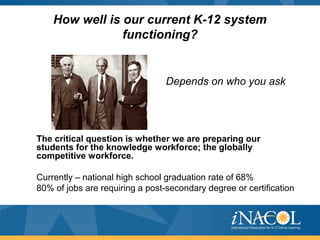
How well is our current K-12 system
functioning?
The critical question is whether we are preparing our
students for the knowledge workforce; the globally
competitive workforce.
Currently – national high school graduation rate of 68%
80% of jobs are requiring a post-secondary degree or certification
Depends on who you ask
Online and Blended Learning as a
catalyst for change
Blended Learning
The Definition
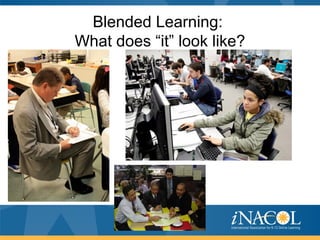
Blended Learning:
What does “it” look like?
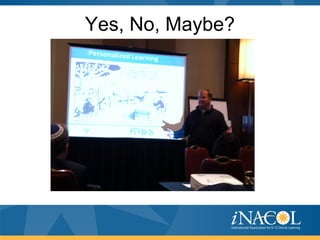
Yes, No, Maybe?
Yes, No, Maybe?
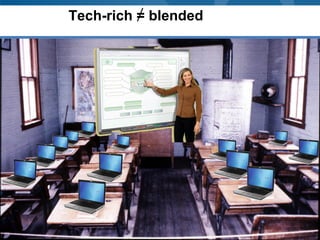
Tech-rich = blended
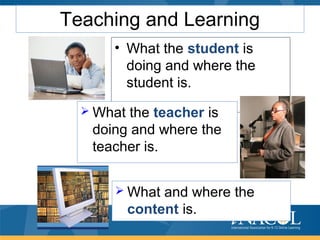
Teaching and Learning
• What the student is
doing and where the
student is.
 What the teacher is
doing and where the
teacher is.
 What and where the
content is.
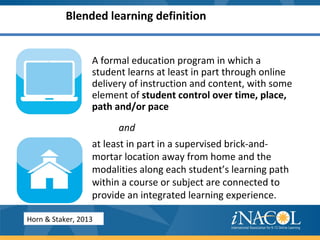
Blended learning definition
A formal education program in which a
student learns at least in part through online
delivery of instruction and content, with some
element of student control over time, place,
path and/or pace
and
at least in part in a supervised brick-and-
mortar location away from home and the
modalities along each student’s learning path
within a course or subject are connected to
provide an integrated learning experience.
Horn & Staker, 2013
Defining Terms
• What makes something:
– Blended Learning
– Online Learning
– Competency-based Learning
– Personalized Learning
• How do these work together?
There are blended learning
Models
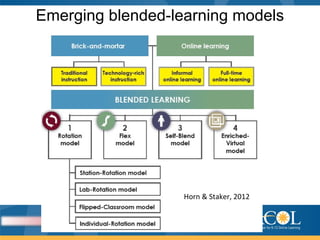
Emerging blended-learning models
Horn & Staker, 2012
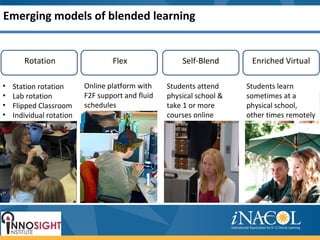
Rotation Flex Self-Blend Enriched Virtual
• Station rotation
• Lab rotation
• Flipped Classroom
• Individual rotation
Online platform with
F2F support and fluid
schedules
Students attend
physical school &
take 1 or more
courses online
Students learn
sometimes at a
physical school,
other times remotely
Emerging models of blended learning
The models are good,
but…
@MichaelbHorn Tweet
“If you cannot identify
the front of the room,
you are probably in a
disruptive / blended classroom”
– #inacol13, Oct. 2013
There is some blended learning
Research
Research Perspective:
Can’t study it if it doesn’t exist
• 1994 – First K-12 online schools
• 2001 – First K-12 online schools report
• 2004 – First report about “blended learning” –
college
• K-12 Online Learning: About 20 years old
• K-12 Blended Learning: About 15 years old
What does the research say?
• Very little because:
–Takes time to study an innovation
–Case Studies – always begins
the research
Implementing blended learning
(or any innovation)
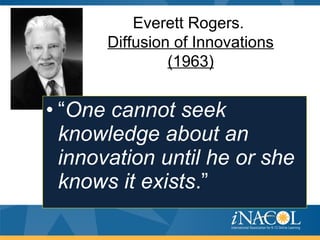
Everett Rogers.
Diffusion of Innovations
(1963)
• “One cannot seek
knowledge about an
innovation until he or she
knows it exists.”
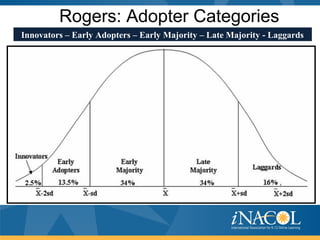
Rogers: Adopter Categories
Innovators – Early Adopters – Early Majority – Late Majority - Laggards
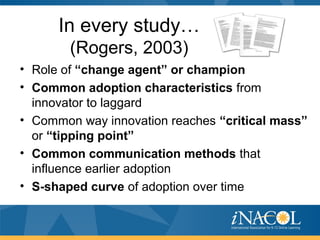
In every study…
(Rogers, 2003)
• Role of “change agent” or champion
• Common adoption characteristics from
innovator to laggard
• Common way innovation reaches “critical mass”
or “tipping point”
• Common communication methods that
influence earlier adoption
• S-shaped curve of adoption over time
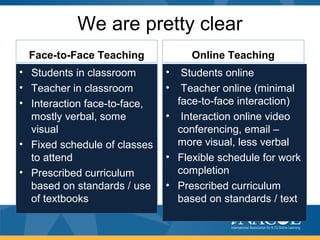
We are pretty clear
Face-to-Face Teaching
• Students in classroom
• Teacher in classroom
• Interaction face-to-face,
mostly verbal, some
visual
• Fixed schedule of classes
to attend
• Prescribed curriculum
based on standards / use
of textbooks
Online Teaching
• Students online
• Teacher online (minimal
face-to-face interaction)
• Interaction online video
conferencing, email –
more visual, less verbal
• Flexible schedule for work
completion
• Prescribed curriculum
based on standards / text
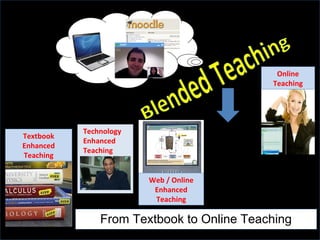
From Textbook to Online Teaching
Online
Teaching
Textbook
Enhanced
Teaching
Technology
Enhanced
Teaching
Web / Online
Enhanced
Teaching
…And pedagogical shifts take time
Not About the Technology
• Change in teaching
• Change in learning
• Change in pedagogy
• Change in class organization
• Things should look different in a blended
learning environment, more student
centric, more personalized learning
Blended Learning is About…
• Rethinking how class is structured
• How time is used
• How resources are allocated
• Personalizing the learning for all students –
better learning engagement
• Student centric learning
• Teachers using data daily to customize
learning for students
Group Work
(30 Minutes)
• Documents (Friday) - http://bit.ly/fridaybl
• Documents (Sat) - http://bit.ly/saturdaybl
• Introductions (position, etc. stage of blended learning)
• 20 Minutes Group Work by Case Study
– Learn about School (reading, videos, etc.)
– How has teaching/learning changed?
– What is different about this school? (class, time, resources,
students, teachers)
– How are teachers using data on a daily basis to customize
learning?
– How is learning more student centric?
Discuss with table
• 10 Minutes Report Out
Implementation:
iNACOL’s
Blended Learning
Roadmap
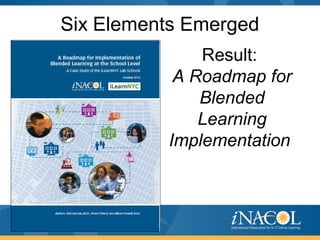
Six Elements Emerged
Result:
A Roadmap for
Blended
Learning
Implementation
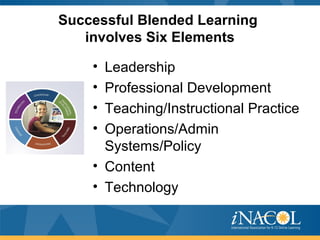
Successful Blended Learning
involves Six Elements
• Leadership
• Professional Development
• Teaching/Instructional Practice
• Operations/Admin
Systems/Policy
• Content
• Technology
Components within each of the
six elements
• Evaluation
• Quality
• Funding
Key Learning
• Clear Goals need to be established, written
and discussed in ongoing way
• Leadership determines sustainability and
success (Administrators and Teachers)
• Collaborative leadership style is essential
• School culture of support, innovation
(it is ok to try and fail)
• Ongoing professional development
(formal and informal)
Leadership
School Implementation
•Identified administrator/leader and teachers at each school
•Ongoing interactions (one-on-one, formal and informal) and
meetings of those involved in iLearn
•Administrators, teachers and administrators work together
towards the blended learning goals established in each school
Promising Practices
•School culture of innovation and empowerment
•Start small and build
•Communication is strong and occurs between involved people in
a variety of ways (one-to-one, phone, email, chat, etc.)
Professional Development
School Implementation
•Both formal and informal (Schedule trainings to one-on-one
customized PD)
•Modeling, webinars, small conferences, workshops, cohort
meetings
•Implementation Managers are key
Promising Practices
•Scheduled Time
•Teacher Resources
•Professional Sharing
•School Support
Teaching/Instructional Practices
School Implementation
•Created Resources
– Blended Learning Continuum, Interactive Applet, Blended Learning Rubric
•Support for new blended learning teachers – modeling and mentoring
•Analyzing real-time data to personalize learning for each student
Promising Practices
•Classroom Setup
•Data Analysis
•Individualized Instruction
•Student Engagement
•Digital Content
Operations/Management Systems/Policy
School Implementation
•Restructuring of the traditional school class / school day
•Emphasis on using real-time student performance data
•Change in instructional delivery model
Promising Practices
•Operational support
•Policy development examples
•Data-driven instruction
Content
School Implementation
•Common platform
•Content providers to choose from
•Professional development and teacher sharing about content
provider and platform use
Promising Practices
•Content Decision Making (purchase or build your own)
•Customizable platform – many teachers using base curriculum
and supplemental based on student needs
•Customizable for individual student needs
Technology
School Implementation
•School leadership ensures that technology needs of students
and teachers are addressed, and proper training provided.
•Dedicated technical support for the blended learning programs.
•School leadership is visible in their own use of technology;
modeling expectations.
Promising Practices
•Technology Training
•Technology Support
•Hardware and Software Needs
Implementation Plan for Roadmap
• Introduce to administrators and teacher
leaders in day long visioning meeting
• 3-5 year implementation plan
• Ongoing meetings of implementation
teams to share what is working / promising
practices
Group Work
(30 Minutes Each Round)
• 20 Minutes Group Work by Element
– Designate facilitator and note taker
– Key questions and some solutions
– How are you going ensure quality?
– What metrics to measure progress?
• Report Information on Google Doc
• Documents (Friday) - http://bit.ly/fridaybl
• Documents (Sat) - http://bit.ly/saturdaybl
• 10 Minutes Report Out
Round 1
• Technology
• Teaching Practices
• Leadership
Round 2
• Technology
• Teaching Practices
• Professional Development
• Leadership
• Operations, Systems, Policies
• Content
Join iNACOL
• iNACOL is the premier K-12 nonprofit in online learning
• Provides leadership, advocacy, research, training, and networking with experts in K-12 online
learning.
– 4000+ members in K-12 online and blended learning in over 50 countries
– Annual conference – iNACOL Blended and Online Learning Symposium: Palm Springs, CA on
November 2 - 4, 2014
• “Ensure every student has access a world class education” regardless of geography, income or
background.
• Next Generation Learning Challenges – Gates Foundation
• CompetencyWorks – Nellie Mae Education Foundation
• Our strategic areas of focus in online and blended learning:
1. Policy
2. Quality
3. New Learning Models
www.blendedteachernetwork.org
Join Today – It’s Free!
Whip Around
• One thought, comment, key point
shared by everyone in the room.
Contact Information and
Workshop Documents
• Allison – apowell@inacol.org
• Rob – rob@onlinelearningvisions.com
• Documents (Friday) - http://bit.ly/fridaybl
• Documents (Sat) - http://bit.ly/saturdaybl
– Virtual parking lot
– Handout
– Resources
– Presentation Ppt
Case Studies, See Resource Page
Documents (Friday) - http://bit.ly/fridaybl
Documents (Sat) - http://bit.ly/saturdaybl
•Christensen Institute Blended Learning Universe:
http://www.christenseninstitute.org/blended-learning-
universe/
•Donnell-Kay Foundation: http://dkfoundation.org/our-
work/blended-learning-resources
•Dell Foundation: http://www.msdf.org/programs/urban-
education/initiatives/united-states/blended-learning/

Blended learning implementation

  • 1.
    www.inacol.org Planning, Implementing and Sustaininga Blended Learning Program Dr. Allison Powell Vice President, State and District Services Dr. Rob Darrow President, Online Learning Visions June 2014
  • 2.
    Contact Information and WorkshopDocuments • Allison – apowell@inacol.org • Rob – rob@onlinelearningvisions.com • Documents (Friday) - http://bit.ly/fridaybl • Documents (Sat) - http://bit.ly/saturdaybl – Virtual parking lot – any other questions, comments, etc. – Handout – Resources – Presentation Slides
  • 3.
    Introductions • Around theroom – Position, location – Stage of blended learning implementation – What you hope to gain from this workshop
  • 4.
  • 5.
    How well isour current K-12 system functioning? The critical question is whether we are preparing our students for the knowledge workforce; the globally competitive workforce. Currently – national high school graduation rate of 68% 80% of jobs are requiring a post-secondary degree or certification Depends on who you ask
  • 6.
    Online and BlendedLearning as a catalyst for change
  • 7.
  • 8.
    Blended Learning: What does“it” look like?
  • 9.
  • 10.
  • 11.
  • 12.
    Teaching and Learning •What the student is doing and where the student is.  What the teacher is doing and where the teacher is.  What and where the content is.
  • 13.
    Blended learning definition Aformal education program in which a student learns at least in part through online delivery of instruction and content, with some element of student control over time, place, path and/or pace and at least in part in a supervised brick-and- mortar location away from home and the modalities along each student’s learning path within a course or subject are connected to provide an integrated learning experience. Horn & Staker, 2013
  • 14.
    Defining Terms • Whatmakes something: – Blended Learning – Online Learning – Competency-based Learning – Personalized Learning • How do these work together?
  • 15.
    There are blendedlearning Models
  • 16.
  • 17.
    Rotation Flex Self-BlendEnriched Virtual • Station rotation • Lab rotation • Flipped Classroom • Individual rotation Online platform with F2F support and fluid schedules Students attend physical school & take 1 or more courses online Students learn sometimes at a physical school, other times remotely Emerging models of blended learning
  • 18.
    The models aregood, but…
  • 19.
    @MichaelbHorn Tweet “If youcannot identify the front of the room, you are probably in a disruptive / blended classroom” – #inacol13, Oct. 2013
  • 20.
    There is someblended learning Research
  • 21.
    Research Perspective: Can’t studyit if it doesn’t exist • 1994 – First K-12 online schools • 2001 – First K-12 online schools report • 2004 – First report about “blended learning” – college • K-12 Online Learning: About 20 years old • K-12 Blended Learning: About 15 years old
  • 22.
    What does theresearch say? • Very little because: –Takes time to study an innovation –Case Studies – always begins the research
  • 23.
  • 24.
    Everett Rogers. Diffusion ofInnovations (1963) • “One cannot seek knowledge about an innovation until he or she knows it exists.”
  • 25.
    Rogers: Adopter Categories Innovators– Early Adopters – Early Majority – Late Majority - Laggards
  • 26.
    In every study… (Rogers,2003) • Role of “change agent” or champion • Common adoption characteristics from innovator to laggard • Common way innovation reaches “critical mass” or “tipping point” • Common communication methods that influence earlier adoption • S-shaped curve of adoption over time
  • 27.
    We are prettyclear Face-to-Face Teaching • Students in classroom • Teacher in classroom • Interaction face-to-face, mostly verbal, some visual • Fixed schedule of classes to attend • Prescribed curriculum based on standards / use of textbooks Online Teaching • Students online • Teacher online (minimal face-to-face interaction) • Interaction online video conferencing, email – more visual, less verbal • Flexible schedule for work completion • Prescribed curriculum based on standards / text
  • 28.
    From Textbook toOnline Teaching Online Teaching Textbook Enhanced Teaching Technology Enhanced Teaching Web / Online Enhanced Teaching
  • 29.
  • 30.
    Not About theTechnology • Change in teaching • Change in learning • Change in pedagogy • Change in class organization • Things should look different in a blended learning environment, more student centric, more personalized learning
  • 31.
    Blended Learning isAbout… • Rethinking how class is structured • How time is used • How resources are allocated • Personalizing the learning for all students – better learning engagement • Student centric learning • Teachers using data daily to customize learning for students
  • 32.
    Group Work (30 Minutes) •Documents (Friday) - http://bit.ly/fridaybl • Documents (Sat) - http://bit.ly/saturdaybl • Introductions (position, etc. stage of blended learning) • 20 Minutes Group Work by Case Study – Learn about School (reading, videos, etc.) – How has teaching/learning changed? – What is different about this school? (class, time, resources, students, teachers) – How are teachers using data on a daily basis to customize learning? – How is learning more student centric? Discuss with table • 10 Minutes Report Out
  • 34.
  • 35.
    Six Elements Emerged Result: ARoadmap for Blended Learning Implementation
  • 36.
    Successful Blended Learning involvesSix Elements • Leadership • Professional Development • Teaching/Instructional Practice • Operations/Admin Systems/Policy • Content • Technology
  • 37.
    Components within eachof the six elements • Evaluation • Quality • Funding
  • 38.
    Key Learning • ClearGoals need to be established, written and discussed in ongoing way • Leadership determines sustainability and success (Administrators and Teachers) • Collaborative leadership style is essential • School culture of support, innovation (it is ok to try and fail) • Ongoing professional development (formal and informal)
  • 39.
    Leadership School Implementation •Identified administrator/leaderand teachers at each school •Ongoing interactions (one-on-one, formal and informal) and meetings of those involved in iLearn •Administrators, teachers and administrators work together towards the blended learning goals established in each school Promising Practices •School culture of innovation and empowerment •Start small and build •Communication is strong and occurs between involved people in a variety of ways (one-to-one, phone, email, chat, etc.)
  • 40.
    Professional Development School Implementation •Bothformal and informal (Schedule trainings to one-on-one customized PD) •Modeling, webinars, small conferences, workshops, cohort meetings •Implementation Managers are key Promising Practices •Scheduled Time •Teacher Resources •Professional Sharing •School Support
  • 41.
    Teaching/Instructional Practices School Implementation •CreatedResources – Blended Learning Continuum, Interactive Applet, Blended Learning Rubric •Support for new blended learning teachers – modeling and mentoring •Analyzing real-time data to personalize learning for each student Promising Practices •Classroom Setup •Data Analysis •Individualized Instruction •Student Engagement •Digital Content
  • 42.
    Operations/Management Systems/Policy School Implementation •Restructuringof the traditional school class / school day •Emphasis on using real-time student performance data •Change in instructional delivery model Promising Practices •Operational support •Policy development examples •Data-driven instruction
  • 43.
    Content School Implementation •Common platform •Contentproviders to choose from •Professional development and teacher sharing about content provider and platform use Promising Practices •Content Decision Making (purchase or build your own) •Customizable platform – many teachers using base curriculum and supplemental based on student needs •Customizable for individual student needs
  • 44.
    Technology School Implementation •School leadershipensures that technology needs of students and teachers are addressed, and proper training provided. •Dedicated technical support for the blended learning programs. •School leadership is visible in their own use of technology; modeling expectations. Promising Practices •Technology Training •Technology Support •Hardware and Software Needs
  • 45.
    Implementation Plan forRoadmap • Introduce to administrators and teacher leaders in day long visioning meeting • 3-5 year implementation plan • Ongoing meetings of implementation teams to share what is working / promising practices
  • 46.
    Group Work (30 MinutesEach Round) • 20 Minutes Group Work by Element – Designate facilitator and note taker – Key questions and some solutions – How are you going ensure quality? – What metrics to measure progress? • Report Information on Google Doc • Documents (Friday) - http://bit.ly/fridaybl • Documents (Sat) - http://bit.ly/saturdaybl • 10 Minutes Report Out
  • 47.
    Round 1 • Technology •Teaching Practices • Leadership
  • 48.
    Round 2 • Technology •Teaching Practices • Professional Development • Leadership • Operations, Systems, Policies • Content
  • 49.
    Join iNACOL • iNACOLis the premier K-12 nonprofit in online learning • Provides leadership, advocacy, research, training, and networking with experts in K-12 online learning. – 4000+ members in K-12 online and blended learning in over 50 countries – Annual conference – iNACOL Blended and Online Learning Symposium: Palm Springs, CA on November 2 - 4, 2014 • “Ensure every student has access a world class education” regardless of geography, income or background. • Next Generation Learning Challenges – Gates Foundation • CompetencyWorks – Nellie Mae Education Foundation • Our strategic areas of focus in online and blended learning: 1. Policy 2. Quality 3. New Learning Models
  • 50.
  • 51.
    Whip Around • Onethought, comment, key point shared by everyone in the room.
  • 52.
    Contact Information and WorkshopDocuments • Allison – apowell@inacol.org • Rob – rob@onlinelearningvisions.com • Documents (Friday) - http://bit.ly/fridaybl • Documents (Sat) - http://bit.ly/saturdaybl – Virtual parking lot – Handout – Resources – Presentation Ppt
  • 53.
    Case Studies, SeeResource Page Documents (Friday) - http://bit.ly/fridaybl Documents (Sat) - http://bit.ly/saturdaybl •Christensen Institute Blended Learning Universe: http://www.christenseninstitute.org/blended-learning- universe/ •Donnell-Kay Foundation: http://dkfoundation.org/our- work/blended-learning-resources •Dell Foundation: http://www.msdf.org/programs/urban- education/initiatives/united-states/blended-learning/

Editor's Notes