Intro To Black Death Unleashed a rampage of death across Europe Lasted three years 25 to 50 percent of Europe’s population had fallen victim to pestilence www.eyewitnesstohistory.com By: Michelle
Forms of Black Death Bubonic Plague (infection of the lymph glands) Septicemia Plague (infection of the blood) Pneumonic Plague ( infection of the lungs) Pneumonic Plague can spread from person to person www.dhpe.org/infect/plague.html By:Michelle
Causes of Black Death Bites from infected fleas By direct contact with the tissue or body fluids of plague infected animals By inhaling infectious airborne droplets from persons or animals with the plague  Chapple, Mike."Could we survive Plague? The Black Death Decimated Europe in the Middle Ages and a New Epidemic Is Closer Than We Think." Daily Post 1 Sept. 2004.[Liverpool, England].Print. By: Michelle
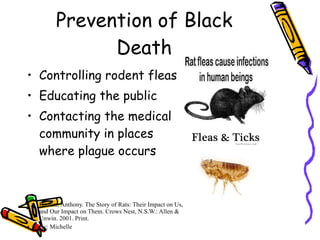
Prevention of Black Death Controlling rodent fleas Educating the public Contacting the medical community in places where plague occurs Barnett, Anthony. The Story of Rats: Their Impact on Us, and Our Impact on Them. Crows Nest, N.S.W.: Allen & Unwin. 2001. Print. By: Michelle
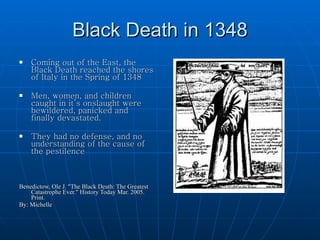
Black Death in 1348 Coming out of the East, the Black Death reached the shores of Italy in the Spring of 1348 Men, women, and children caught in it’s onslaught were bewildered, panicked and  finally devastated. They had no defense, and no understanding of the cause of the pestilence Benedictow, Ole J. "The Black Death: The Greatest Catastrophe Ever." History Today Mar. 2005. Print. By: Michelle
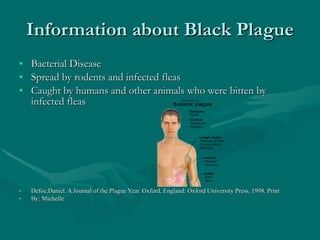
Information about Black Plague Bacterial Disease Spread by rodents and infected fleas Caught by humans and other animals who were bitten by infected fleas Defoe,Daniel. A Journal of the Plague Year. Oxford, England: Oxford University Press, 1998. Print By: Michelle
Historical Timing of Black Plague The arrival of the Mongols and the Ottomans had disrupted trade routes  Certain areas of Europe were edging into depression Climate was changing, with cooler and wetter weather creating lower crop yields Population was increasing The Church was in poor shape The Hundred Years’ War added to the plague and famine Difficulties created by war and a constricted economy were exacerbated by the Black Death Encyclopedia article; Plague. The Columbia Encyclopedia, Sixth Edition. Columbia University Press. New York. 2009 By: Michelle
Is The Children’s Game Lyrics really referring to the Black Death in 1348? Ring around the Rosy: One of the first visible signs of the infection were red rings surrounding a rosy bump, all over the victims body Pockets full of Posy: The plague created “foul air” so carrying flowers helped them deal with the smell of death Ashes, Ashes: This is referring to all the ashes in the air, after they had burned hundreds of dead bodies We all fall down: This means that they too will eventually die of the plague  Holmes, George. The Later Middle Ages, 1272-1485. Edinburgh: Thomas Nelson and Sons, 1962.iii.Print. By: Michelle
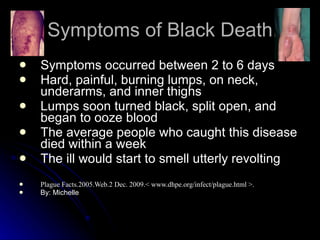
Symptoms of Black Death Symptoms occurred between 2 to 6 days  Hard, painful, burning lumps, on neck, underarms, and inner thighs Lumps soon turned black, split open, and began to ooze blood The average people who caught this disease died within a week The ill would start to smell utterly revolting Plague Facts.2005.Web.2 Dec. 2009.< www.dhpe.org/infect/plague.html >. By: Michelle
Black Death in Relationship to William Shakespeare William Shakespeare  lost, brothers, sisters, close friends, and fellow actors William Shakespeare lived in the Elizabethan Era, the same time when the Plague stated Theaters often closed due to the pestilence Actors and writers would leave London to try to escape the Plague The Black Death, 1348 Ibis, 2001. Web. 3, Dec. 2009.< http://www.eyewitnesstohistory.com/plague.htm >. By: Michelle
Work Cited Chapple, Mike.&quot;Could we survive Plague? The Black Death Decimated Europe in the Middle Ages and a New Epidemic Is Closer Than We Think.&quot; Daily Post 1 Sept. 2004.[Liverpool, England].Print. Barnett, Anthony. The Story of Rats: Their Impact on Us, and Our Impact on Them. Crows Nest, N.S.W.: Allen & Unwin. 2001. Print. Benedictow, Ole J. &quot;The Black Death: The Greatest Catastrophe Ever.&quot; History Today Mar. 2005. Print. Defoe,Daniel. A Journal of the Plague Year. Oxford, England: Oxford University Press, 1998. Print. Encyclopedia article; Plague. The Columbia Encyclopedia, Sixth Edition. Columbia University Press. New York. 2009. Holmes, George. The Later Middle Ages, 1272-1485. Edinburgh: Thomas Nelson and Sons, 1962.iii.Print. Plague Facts.2005.Web.2 Dec. 2009.< www.dhpe.org/infect/plague.html >. Totaro, Rebecca.&quot;English Plague and New World Promise.&quot; Utopian Studies 10 (1999). Print. The Black Death, 1348 Ibis, 2001. Web. 3, Dec. 2009.< http://www.eyewitnesstohistory.com/plague.htm >.
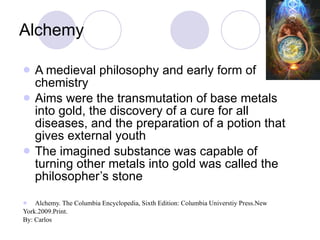
Alchemy A medieval philosophy and early form of chemistry Aims were the transmutation of base metals into gold, the discovery of a cure for all diseases, and the preparation of a potion that gives external youth The imagined substance was capable of turning other metals into gold was called the philosopher’s stone  Alchemy. The Columbia Encyclopedia, Sixth Edition: Columbia Universtiy Press.New  York.2009.Print. By: Carlos
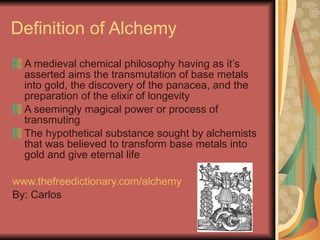
Definition of Alchemy A medieval chemical philosophy having as it’s asserted aims the transmutation of base metals into gold, the discovery of the panacea, and the preparation of the elixir of longevity  A seemingly magical power or process of transmuting The hypothetical substance sought by alchemists that was believed to transform base metals into gold and give eternal life www.thefreedictionary.com/alchemy By: Carlos
Practitioners of Alchemy Their goals were so unrealistic, and because they had trouble achieving them, people in the Middle Ages gave them the reputation of fakers and con artists While they never succeeded in turning lead into gold (one of their main goals), they did make discoveries that helped to shape modern chemistry Alchemists invented early forms of some of the laboratory equipment used today, including beakers, crucibles, filters and stirring rods. Alchemy In the Middle Ages.2009.Web.2 Dec. 2009.  <www.historymedren.about.com/od/alchemy/Alchemy_in_the _Middle_Ages.htm>. By: Carlos
Alchemists They discovered and purified a number of chemical elements, including mercury, sulfur, and arsenic The methods they developed are still important today  They were one of the first people to have discovered chemical elements Alchemy.The Free Dictionary Farlex, 2009. Web. 4 Dec. 2009. < http://www.thefreedictionary.com/alchemy >. By: Carlos
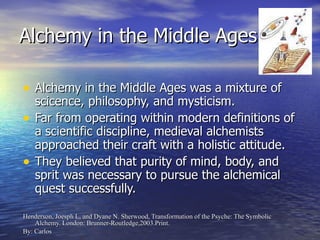
Alchemy in the Middle Ages Alchemy in the Middle Ages was a mixture of scicence, philosophy, and mysticism. Far from operating within modern definitions of a scientific discipline, medieval alchemists approached their craft with a holistic attitude. They believed that purity of mind, body, and sprit was necessary to pursue the alchemical quest successfully. Henderson, Joesph L, and Dyane N. Sherwood, Transformation of the Psyche: The Symbolic Alchemy. London: Brunner-Routledge,2003.Print. By: Carlos
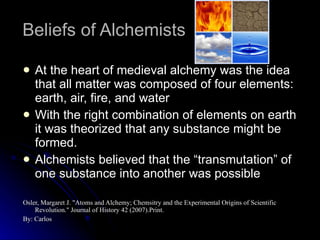
Beliefs of Alchemists At the heart of medieval alchemy was the idea that all matter was composed of four elements: earth, air, fire, and water With the right combination of elements on earth it was theorized that any substance might be formed. Alchemists believed that the “transmutation” of one substance into another was possible Osler, Margaret J. &quot;Atoms and Alchemy; Chemsitry and the Experimental Origins of Scientific Revolution.&quot; Journal of History 42 (2007).Print. By: Carlos
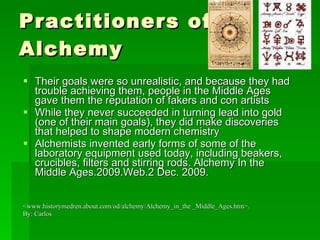
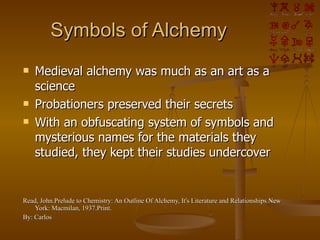
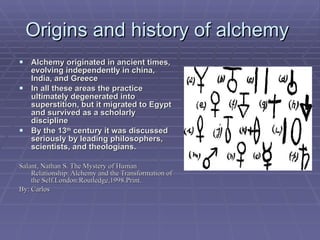
Symbols of Alchemy Medieval alchemy was much as an art as a science Probationers preserved their secrets With an obfuscating system of symbols and mysterious names for the materials they studied, they kept their studies undercover Read, John.Prelude to Chemistry: An Outline Of Alchemy, It's Literature and Relationships.New York: Macmilan, 1937.Print. By: Carlos
Origins and history of alchemy  Alchemy originated in ancient times, evolving independently in china, India, and Greece In all these areas the practice ultimately degenerated into superstition, but it migrated to Egypt and survived as a scholarly discipline By the 13 th  century it was discussed seriously by leading philosophers, scientists, and theologians. Salant, Nathan S. The Mystery of Human Relationship: Alchemy and the Transformation of the Self.London:Routledge,1998.Print. By: Carlos
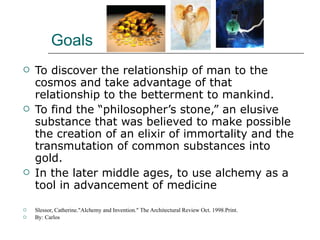
Goals To discover the relationship of man to the cosmos and take advantage of that relationship to the betterment to mankind. To find the “philosopher’s stone,” an elusive substance that was believed to make possible the creation of an elixir of immortality and the transmutation of common substances into gold.  In the later middle ages, to use alchemy as a tool in advancement of medicine  Slessor, Catherine.&quot;Alchemy and Invention.&quot; The Architectural Review Oct. 1998.Print. By: Carlos
Achievements Medieval alchemists produced hydrochloric acid, nitric acid, potash and sodium carbonate. Thought their experiments, medieval alchemists invented and developed laboratory devices and procedures that are, in modified form, still used today The practice of alchemy laid the foundation for the development f chemistry as a scientific discipline Alchemy In the Middle Ages.2009.Web.2 Dec. 2009. <www.historymedren.about.com/od/alchemy/Alchemy_in_the _Middle_Ages.htm>. By: Carlos
Work Cited Alchemy. The Columbia Encyclopedia, Sixth Edition: Columbia Universtiy Press.New York.2009.Print. Alchemy In the Middle Ages.2009.Web.2 Dec. 2009. <www.historymedren.about.com/od/alchemy/Alchemy_in_the _Middle_Ages.htm>. Alchemy.The Free Dictionary Farlex, 2009. Web. 4 Dec. 2009. < http://www.thefreedictionary.com/alchemy >. Henderson, Joesph L, and Dyane N. Sherwood, Transformation of the Psyche: The Symbolic Alchemy. London: Brunner-Routledge,2003.Print. Osler, Margaret J. &quot;Atoms and Alchemy; Chemsitry and the Experimental Origins of Scientific Revolution.&quot; Journal of History 42 (2007).Print. Read, John.Prelude to Chemistry: An Outline Of Alchemy, It's Literature and Relationships.New York: Macmilan, 1937.Print. Salant, Nathan S. The Mystery of Human Relationship: Alchemy and the Transformation of the Self.London:Routledge,1998.Print. Slessor, Catherine.&quot;Alchemy and Invention.&quot; The Architectural Review Oct. 1998.Print.

Black Plague

  • 1.
    Intro To BlackDeath Unleashed a rampage of death across Europe Lasted three years 25 to 50 percent of Europe’s population had fallen victim to pestilence www.eyewitnesstohistory.com By: Michelle
  • 2.
    Forms of BlackDeath Bubonic Plague (infection of the lymph glands) Septicemia Plague (infection of the blood) Pneumonic Plague ( infection of the lungs) Pneumonic Plague can spread from person to person www.dhpe.org/infect/plague.html By:Michelle
  • 3.
    Causes of BlackDeath Bites from infected fleas By direct contact with the tissue or body fluids of plague infected animals By inhaling infectious airborne droplets from persons or animals with the plague Chapple, Mike.&quot;Could we survive Plague? The Black Death Decimated Europe in the Middle Ages and a New Epidemic Is Closer Than We Think.&quot; Daily Post 1 Sept. 2004.[Liverpool, England].Print. By: Michelle
  • 4.
    Prevention of BlackDeath Controlling rodent fleas Educating the public Contacting the medical community in places where plague occurs Barnett, Anthony. The Story of Rats: Their Impact on Us, and Our Impact on Them. Crows Nest, N.S.W.: Allen & Unwin. 2001. Print. By: Michelle
  • 5.
    Black Death in1348 Coming out of the East, the Black Death reached the shores of Italy in the Spring of 1348 Men, women, and children caught in it’s onslaught were bewildered, panicked and finally devastated. They had no defense, and no understanding of the cause of the pestilence Benedictow, Ole J. &quot;The Black Death: The Greatest Catastrophe Ever.&quot; History Today Mar. 2005. Print. By: Michelle
  • 6.
    Information about BlackPlague Bacterial Disease Spread by rodents and infected fleas Caught by humans and other animals who were bitten by infected fleas Defoe,Daniel. A Journal of the Plague Year. Oxford, England: Oxford University Press, 1998. Print By: Michelle
  • 7.
    Historical Timing ofBlack Plague The arrival of the Mongols and the Ottomans had disrupted trade routes Certain areas of Europe were edging into depression Climate was changing, with cooler and wetter weather creating lower crop yields Population was increasing The Church was in poor shape The Hundred Years’ War added to the plague and famine Difficulties created by war and a constricted economy were exacerbated by the Black Death Encyclopedia article; Plague. The Columbia Encyclopedia, Sixth Edition. Columbia University Press. New York. 2009 By: Michelle
  • 8.
    Is The Children’sGame Lyrics really referring to the Black Death in 1348? Ring around the Rosy: One of the first visible signs of the infection were red rings surrounding a rosy bump, all over the victims body Pockets full of Posy: The plague created “foul air” so carrying flowers helped them deal with the smell of death Ashes, Ashes: This is referring to all the ashes in the air, after they had burned hundreds of dead bodies We all fall down: This means that they too will eventually die of the plague Holmes, George. The Later Middle Ages, 1272-1485. Edinburgh: Thomas Nelson and Sons, 1962.iii.Print. By: Michelle
  • 9.
    Symptoms of BlackDeath Symptoms occurred between 2 to 6 days Hard, painful, burning lumps, on neck, underarms, and inner thighs Lumps soon turned black, split open, and began to ooze blood The average people who caught this disease died within a week The ill would start to smell utterly revolting Plague Facts.2005.Web.2 Dec. 2009.< www.dhpe.org/infect/plague.html >. By: Michelle
  • 10.
    Black Death inRelationship to William Shakespeare William Shakespeare lost, brothers, sisters, close friends, and fellow actors William Shakespeare lived in the Elizabethan Era, the same time when the Plague stated Theaters often closed due to the pestilence Actors and writers would leave London to try to escape the Plague The Black Death, 1348 Ibis, 2001. Web. 3, Dec. 2009.< http://www.eyewitnesstohistory.com/plague.htm >. By: Michelle
  • 11.
    Work Cited Chapple,Mike.&quot;Could we survive Plague? The Black Death Decimated Europe in the Middle Ages and a New Epidemic Is Closer Than We Think.&quot; Daily Post 1 Sept. 2004.[Liverpool, England].Print. Barnett, Anthony. The Story of Rats: Their Impact on Us, and Our Impact on Them. Crows Nest, N.S.W.: Allen & Unwin. 2001. Print. Benedictow, Ole J. &quot;The Black Death: The Greatest Catastrophe Ever.&quot; History Today Mar. 2005. Print. Defoe,Daniel. A Journal of the Plague Year. Oxford, England: Oxford University Press, 1998. Print. Encyclopedia article; Plague. The Columbia Encyclopedia, Sixth Edition. Columbia University Press. New York. 2009. Holmes, George. The Later Middle Ages, 1272-1485. Edinburgh: Thomas Nelson and Sons, 1962.iii.Print. Plague Facts.2005.Web.2 Dec. 2009.< www.dhpe.org/infect/plague.html >. Totaro, Rebecca.&quot;English Plague and New World Promise.&quot; Utopian Studies 10 (1999). Print. The Black Death, 1348 Ibis, 2001. Web. 3, Dec. 2009.< http://www.eyewitnesstohistory.com/plague.htm >.
  • 12.
    Alchemy A medievalphilosophy and early form of chemistry Aims were the transmutation of base metals into gold, the discovery of a cure for all diseases, and the preparation of a potion that gives external youth The imagined substance was capable of turning other metals into gold was called the philosopher’s stone Alchemy. The Columbia Encyclopedia, Sixth Edition: Columbia Universtiy Press.New York.2009.Print. By: Carlos
  • 13.
    Definition of AlchemyA medieval chemical philosophy having as it’s asserted aims the transmutation of base metals into gold, the discovery of the panacea, and the preparation of the elixir of longevity A seemingly magical power or process of transmuting The hypothetical substance sought by alchemists that was believed to transform base metals into gold and give eternal life www.thefreedictionary.com/alchemy By: Carlos
  • 14.
    Practitioners of AlchemyTheir goals were so unrealistic, and because they had trouble achieving them, people in the Middle Ages gave them the reputation of fakers and con artists While they never succeeded in turning lead into gold (one of their main goals), they did make discoveries that helped to shape modern chemistry Alchemists invented early forms of some of the laboratory equipment used today, including beakers, crucibles, filters and stirring rods. Alchemy In the Middle Ages.2009.Web.2 Dec. 2009. <www.historymedren.about.com/od/alchemy/Alchemy_in_the _Middle_Ages.htm>. By: Carlos
  • 15.
    Alchemists They discoveredand purified a number of chemical elements, including mercury, sulfur, and arsenic The methods they developed are still important today They were one of the first people to have discovered chemical elements Alchemy.The Free Dictionary Farlex, 2009. Web. 4 Dec. 2009. < http://www.thefreedictionary.com/alchemy >. By: Carlos
  • 16.
    Alchemy in theMiddle Ages Alchemy in the Middle Ages was a mixture of scicence, philosophy, and mysticism. Far from operating within modern definitions of a scientific discipline, medieval alchemists approached their craft with a holistic attitude. They believed that purity of mind, body, and sprit was necessary to pursue the alchemical quest successfully. Henderson, Joesph L, and Dyane N. Sherwood, Transformation of the Psyche: The Symbolic Alchemy. London: Brunner-Routledge,2003.Print. By: Carlos
  • 17.
    Beliefs of AlchemistsAt the heart of medieval alchemy was the idea that all matter was composed of four elements: earth, air, fire, and water With the right combination of elements on earth it was theorized that any substance might be formed. Alchemists believed that the “transmutation” of one substance into another was possible Osler, Margaret J. &quot;Atoms and Alchemy; Chemsitry and the Experimental Origins of Scientific Revolution.&quot; Journal of History 42 (2007).Print. By: Carlos
  • 18.
    Symbols of AlchemyMedieval alchemy was much as an art as a science Probationers preserved their secrets With an obfuscating system of symbols and mysterious names for the materials they studied, they kept their studies undercover Read, John.Prelude to Chemistry: An Outline Of Alchemy, It's Literature and Relationships.New York: Macmilan, 1937.Print. By: Carlos
  • 19.
    Origins and historyof alchemy Alchemy originated in ancient times, evolving independently in china, India, and Greece In all these areas the practice ultimately degenerated into superstition, but it migrated to Egypt and survived as a scholarly discipline By the 13 th century it was discussed seriously by leading philosophers, scientists, and theologians. Salant, Nathan S. The Mystery of Human Relationship: Alchemy and the Transformation of the Self.London:Routledge,1998.Print. By: Carlos
  • 20.
    Goals To discoverthe relationship of man to the cosmos and take advantage of that relationship to the betterment to mankind. To find the “philosopher’s stone,” an elusive substance that was believed to make possible the creation of an elixir of immortality and the transmutation of common substances into gold. In the later middle ages, to use alchemy as a tool in advancement of medicine Slessor, Catherine.&quot;Alchemy and Invention.&quot; The Architectural Review Oct. 1998.Print. By: Carlos
  • 21.
    Achievements Medieval alchemistsproduced hydrochloric acid, nitric acid, potash and sodium carbonate. Thought their experiments, medieval alchemists invented and developed laboratory devices and procedures that are, in modified form, still used today The practice of alchemy laid the foundation for the development f chemistry as a scientific discipline Alchemy In the Middle Ages.2009.Web.2 Dec. 2009. <www.historymedren.about.com/od/alchemy/Alchemy_in_the _Middle_Ages.htm>. By: Carlos
  • 22.
    Work Cited Alchemy.The Columbia Encyclopedia, Sixth Edition: Columbia Universtiy Press.New York.2009.Print. Alchemy In the Middle Ages.2009.Web.2 Dec. 2009. <www.historymedren.about.com/od/alchemy/Alchemy_in_the _Middle_Ages.htm>. Alchemy.The Free Dictionary Farlex, 2009. Web. 4 Dec. 2009. < http://www.thefreedictionary.com/alchemy >. Henderson, Joesph L, and Dyane N. Sherwood, Transformation of the Psyche: The Symbolic Alchemy. London: Brunner-Routledge,2003.Print. Osler, Margaret J. &quot;Atoms and Alchemy; Chemsitry and the Experimental Origins of Scientific Revolution.&quot; Journal of History 42 (2007).Print. Read, John.Prelude to Chemistry: An Outline Of Alchemy, It's Literature and Relationships.New York: Macmilan, 1937.Print. Salant, Nathan S. The Mystery of Human Relationship: Alchemy and the Transformation of the Self.London:Routledge,1998.Print. Slessor, Catherine.&quot;Alchemy and Invention.&quot; The Architectural Review Oct. 1998.Print.