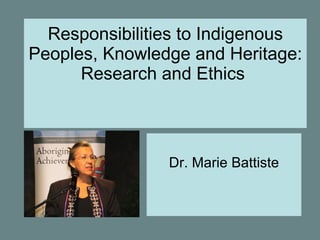
Responsibilities to Indigenous
Peoples, Knowledge and Heritage:
      Research and Ethics


                Dr. Marie Battiste
World’s Indigenous Peoples
•   300-500 million Indigenous people
•   Over 1 million in Canada
•   Represent 4% of world’s population
•   Indigenous peoples recognized as intimately
    connected to the world’s biodiversity
    – 95% of world’s cultural diversity with over 50% living
      in areas of high biodiversity
    – 80% of world’s population depend on Indigenous
      knowledge for health and security
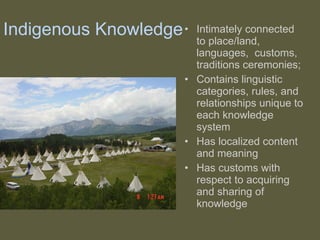
Indigenous Knowledge • Intimately connected
                       to place/land,
                       languages, customs,
                       traditions ceremonies;
                     • Contains linguistic
                       categories, rules, and
                       relationships unique to
                       each knowledge
                       system
                     • Has localized content
                       and meaning
                     • Has customs with
                       respect to acquiring
                       and sharing of
                       knowledge
“The term ‘research’ is inextricably
linked to European imperialism and
colonialism. The word itself, ‘research’,
is probably one of the dirtiest words in
the indigenous world’s vocabulary.”
(Linda Smith, Decolonizing
Methodologies 1999, 1)
Colonial Research Foundations
• Domain of researchers
• Privilege and power given to individual researcher
  for study, question, method, discourse, analysis,
  etc.
• Insulated research monologue among
  researchers
• Built on unreflective intrusive data collection,
  examining the parts, ignoring whole.
•   ‘Power’ in luggage of values, discourses,
    systems, rules, institutional processes unpacked
    and imposed on First Nations people
Effects of Unreflective
       Research Practices
• Outsiders provide interpretations and apply
  solutions and marginalize and exploit Indigenous
  Peoples
• Peoples pathologized and problematized based
  on culture, language, community and solutions
  given to them without resources to fix them
• Marginalizing location continues in research,
  biotechnology, tourism, green revolution and
  ecology.
• Creates wounded space
Limitations on Intellectual
   Property Regimes
• Copyright protects individual
  expression of ideas, but only for the
  lifetime plus additional 50 years.

• Patents & trademarks protect
  inventions but only for 20 years from
  the date of issuance.

• Enforcing rights of copyright and
  patents require expensive litigation.
Transforming Context
Indigenous researchers leading a
discourse on respect and decolonization

 Growing body of postcolonial-
indigenous/feminists/qualitative research
changing ‘langscape’ of research process

Courts defining new limitations on use of
Indigenous knowledge.
Sites of Transformation
 F ir s t N a t io n s s e e k in g
  c o m p e n s a t io n a n d r e d r e s s
  in C o u r t s - A b o r R t s / D u t y t o
  C o n s u lt
  ( D e lg a m u k w / H a id a / T a k u )

 U n a n im it y g r o w in g a m o n g
  d iv e r s e In d ig e n o u s
  p e o p le s o n r e s e a r c h
  is s u e s a n d p r in c ip le s
   ( R C A P , A F N , F S IN , N A H O ,
  C IH R , S S H R C , M i ’ k m a w
  E t h ic s W a t c h )
Researchers…
• Respect need for approval in multiple
  jurisdictions (double door:
  university/community)
• Engage appropriate participatory gendered
  frameworks and Indigenous methodologies
• Recognize need for translation across cultures
• Employ Indigenous theory and methods, when
  appropriate
• Consider widest community interest, impact
  and benefit of research
• Explore further conceptual development in
  area of research ethics involving IP
Indigenous Researchers
    Working in Indigenous Ethics/
            Consultation
•   Linda Smith (1999) Decolonizing Methodologies
•   Willie Ermine (2000);
•   Ermine, Sinclair & Browne (2005)
•   Marlene Brant Castellano
•   Margaret Kovach (In press)
•   Sean Wilson (2007) Research as Ceremony
•   Marie Battiste and Sakej Henderson (2000) Protecting
    Indigenous Knowledge
•   Richard Atleo (2004)
•   Brian Brayboy
Dr. Marie Battiste, Director

Aboriginal Education Research Centre

marie.battiste@usask.ca

http://www.usask.ca/education/people/battistem.htm
References
Battiste, Marie & Henderson, J. Youngblood (Sa’ke’j). (2000). Protecting Indigenous
          knowledge and heritage. Saskatoon, SK: Purich Press.
Brant Castellano, M. (2004). Ethics of Aboriginal research. Journal of Aboriginal
          Health, 98-114.
Denzin, N. & Lincoln, Y. (2000). Handbook of qualitative research. Thousand Oaks:
          Sage.
Ermine, W., Sinclair, R., & Jeffrey, B. (2004). The ethics of research
involving
          Indigenous peoples. Report of the Indigenous Peoples Research Centre to
          the Intra-agency Advisory Panel on Research Ethics. Saskatoon, SK:
          Indigenous Peoples Research Centre.
Mi’kmaw Ethics Watch (2000). Principles and guidelines for researchers conducting
          research with and or among Mi’kmaq people.
Smith, Linda. (1999). Decolonizing methodologies: Research and Indigenous peoples.
          London & New York: Zed Books.

Decolonizing The Academy

  • 1.
    Responsibilities to Indigenous Peoples,Knowledge and Heritage: Research and Ethics Dr. Marie Battiste
  • 2.
    World’s Indigenous Peoples • 300-500 million Indigenous people • Over 1 million in Canada • Represent 4% of world’s population • Indigenous peoples recognized as intimately connected to the world’s biodiversity – 95% of world’s cultural diversity with over 50% living in areas of high biodiversity – 80% of world’s population depend on Indigenous knowledge for health and security
  • 3.
    Indigenous Knowledge •Intimately connected to place/land, languages, customs, traditions ceremonies; • Contains linguistic categories, rules, and relationships unique to each knowledge system • Has localized content and meaning • Has customs with respect to acquiring and sharing of knowledge
  • 4.
    “The term ‘research’is inextricably linked to European imperialism and colonialism. The word itself, ‘research’, is probably one of the dirtiest words in the indigenous world’s vocabulary.” (Linda Smith, Decolonizing Methodologies 1999, 1)
  • 5.
    Colonial Research Foundations •Domain of researchers • Privilege and power given to individual researcher for study, question, method, discourse, analysis, etc. • Insulated research monologue among researchers • Built on unreflective intrusive data collection, examining the parts, ignoring whole. • ‘Power’ in luggage of values, discourses, systems, rules, institutional processes unpacked and imposed on First Nations people
  • 6.
    Effects of Unreflective Research Practices • Outsiders provide interpretations and apply solutions and marginalize and exploit Indigenous Peoples • Peoples pathologized and problematized based on culture, language, community and solutions given to them without resources to fix them • Marginalizing location continues in research, biotechnology, tourism, green revolution and ecology. • Creates wounded space
  • 7.
    Limitations on Intellectual Property Regimes • Copyright protects individual expression of ideas, but only for the lifetime plus additional 50 years. • Patents & trademarks protect inventions but only for 20 years from the date of issuance. • Enforcing rights of copyright and patents require expensive litigation.
  • 8.
    Transforming Context Indigenous researchersleading a discourse on respect and decolonization Growing body of postcolonial- indigenous/feminists/qualitative research changing ‘langscape’ of research process Courts defining new limitations on use of Indigenous knowledge.
  • 9.
    Sites of Transformation F ir s t N a t io n s s e e k in g c o m p e n s a t io n a n d r e d r e s s in C o u r t s - A b o r R t s / D u t y t o C o n s u lt ( D e lg a m u k w / H a id a / T a k u )  U n a n im it y g r o w in g a m o n g d iv e r s e In d ig e n o u s p e o p le s o n r e s e a r c h is s u e s a n d p r in c ip le s ( R C A P , A F N , F S IN , N A H O , C IH R , S S H R C , M i ’ k m a w E t h ic s W a t c h )
  • 10.
    Researchers… • Respect needfor approval in multiple jurisdictions (double door: university/community) • Engage appropriate participatory gendered frameworks and Indigenous methodologies • Recognize need for translation across cultures • Employ Indigenous theory and methods, when appropriate • Consider widest community interest, impact and benefit of research • Explore further conceptual development in area of research ethics involving IP
  • 11.
    Indigenous Researchers Working in Indigenous Ethics/ Consultation • Linda Smith (1999) Decolonizing Methodologies • Willie Ermine (2000); • Ermine, Sinclair & Browne (2005) • Marlene Brant Castellano • Margaret Kovach (In press) • Sean Wilson (2007) Research as Ceremony • Marie Battiste and Sakej Henderson (2000) Protecting Indigenous Knowledge • Richard Atleo (2004) • Brian Brayboy
  • 12.
    Dr. Marie Battiste,Director Aboriginal Education Research Centre marie.battiste@usask.ca http://www.usask.ca/education/people/battistem.htm
  • 13.
    References Battiste, Marie &Henderson, J. Youngblood (Sa’ke’j). (2000). Protecting Indigenous knowledge and heritage. Saskatoon, SK: Purich Press. Brant Castellano, M. (2004). Ethics of Aboriginal research. Journal of Aboriginal Health, 98-114. Denzin, N. & Lincoln, Y. (2000). Handbook of qualitative research. Thousand Oaks: Sage. Ermine, W., Sinclair, R., & Jeffrey, B. (2004). The ethics of research involving Indigenous peoples. Report of the Indigenous Peoples Research Centre to the Intra-agency Advisory Panel on Research Ethics. Saskatoon, SK: Indigenous Peoples Research Centre. Mi’kmaw Ethics Watch (2000). Principles and guidelines for researchers conducting research with and or among Mi’kmaq people. Smith, Linda. (1999). Decolonizing methodologies: Research and Indigenous peoples. London & New York: Zed Books.