

BLOCKCHAIN
Presented by Emrah Semiz
Agenda
• What is block chain
• History
• Blockchain overview
• Blockchain transaction flow
• Blockchain mining
• Applications of Blockchain
• Future of blockchain
• Q&A
What is Blockchain
• A blockchain is a data structure that makes it possible to
create a way to execute de-centralized consensus.
• Distributed public Ledger
History
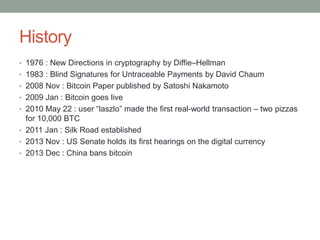
• 1976 : New Directions in cryptography by Diffie–Hellman
• 1983 : Blind Signatures for Untraceable Payments by David Chaum
• 2008 Nov : Bitcoin Paper published by Satoshi Nakamoto
• 2009 Jan : Bitcoin goes live
• 2010 May 22 : user “laszlo” made the first real-world transaction – two pizzas
for 10,000 BTC
• 2011 Jan : Silk Road established
• 2013 Nov : US Senate holds its first hearings on the digital currency
• 2013 Dec : China bans bitcoin
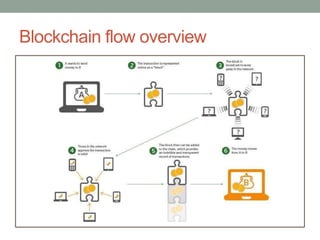
Blockchain flow overview
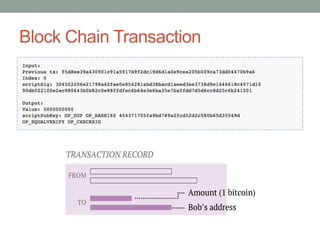
Block Chain Transaction
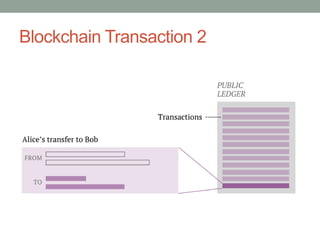
Blockchain Transaction 2
Blockchain transaction 3
Blockchain transaction 4 complex
Blockchain mining 1
Blockchain mining 2
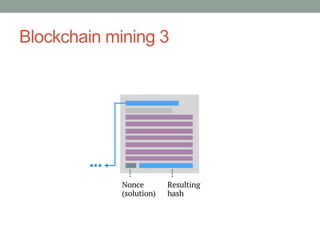
Blockchain mining 3
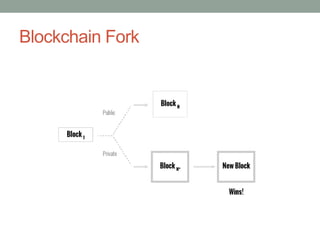
Blockchain Fork
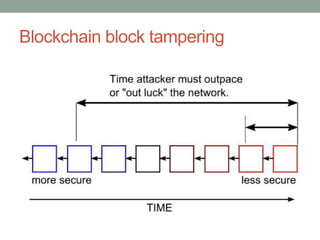
Blockchain block tampering
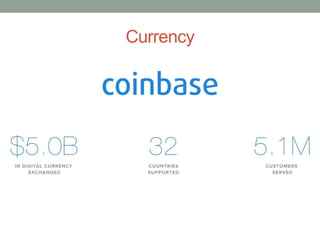
Currency
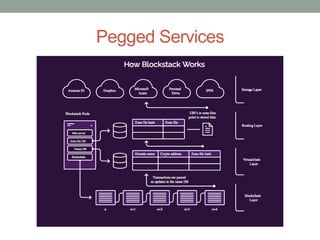
Pegged Services
Smart Contracts
Decentralized Autonomous Orgs
Future of blockchain
Links
• https://bitcoin.org/bitcoin.pdf
• https://www.ethereum.org/
• https://bitnation.co/
• https://blockstack.org/
• https://www.bigchaindb.com/whitepaper/bigchaindb-
whitepaper.pdf
• https://www-ee.stanford.edu/~hellman/publications/24.pdf
Introduction to blockchain

Introduction to blockchain

Editor's Notes

  • #4 Blockchain'e derinlemesine dalmadan once dikkat cekmek istedigim bir nokta var. Arkadamdaki resimde enteresan bir sey var ve interaksiyon icinde olan arkadaslar bunu umursamiyor. Su anda aslina bakarsaniz her birimizin yaptigi hukuki veya guven gerektiren interaksiyonda biz bu durumu yasiyoruz. Bundan kastim ne mesela bir dukkan'a girip birsey almak istedigimizde para kullaniyoruz. Cunku iki tarafinda guven duydugu bir kurum tarafinda basilmis bir araca ihtiyac var . Bu demek oluyorki bu alisverisi yapabilmek icin aslinda koca bir devlete ihtiyacimiz var . Ya da birisine para gondermek istiyoruz bunun icin guven duydugumuz bir banka alt yapisini kullaniyoruz. Bir belgenin gercek veya degismemis oldugu bize noter damgalariyla kanitlaniyor , gene guven duyulan bir kurum interaksiyona girmis oluyor . Bunlar gunluk hayatimizdaki filler'den sadece bazilari. Bu fillere su an ihtiyac var ama zamanla guveni baska bir sekilde saglayabiliriz iste bu noktada blockchain konuya giriyor.
  • #5 A blockchain is a data structure that makes it possible to create a digital ledger of transactions and share it among a distributed network of computers. Distributed consensus. A blockchain is a ledger of records arranged in data batches called blocks that use cryptographic validation to link themselves together. Put simply, each block references and identifies the previous block by a hashing function, forming an unbroken chain, hence the name.
  • #8 Alice wants to transfer bitcoin to Bob. For this Bob needs to create an address which is the public key of the PKI he will generate. When Alice sends the bitcoin from her wallet a transaction is generated as you can see above .
  • #9 Then this transaction gets broadcasted to all nodes of bitcoin. The miners validate the transaction and Add it to the public ledger (the block).
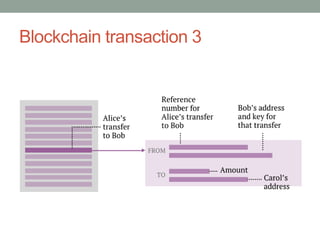
  • #10 Artik Bob’un bitcoin’I var ve simdi bunu Carol’a gondermek istiyor. Bunu yaparken Alice’in kendisine sahip oldugu bitcoin’I gonderdigi transaction’I referans gosteriyor. Ayrica bitcoin’in sahibi olan adresin kendine ait oldugunu kanitlamak icin adresi olustururken yarattigi public ve private key’lerden Private key ile transaction’I isaretliyor. Now Bob wants to transfer his bitcoins that are transferred by Alice’s transaction to Carol. He creates another transaction and references Alice’s transaction as the source of the bitcoin that will be transferred to Carol.
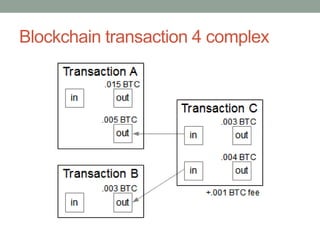
  • #11 As you can see a transaction can have more then one IN and OUT. With IN we are meaning referenced transactions that will be the source of bitcoin that will be transferred. And with OUT we mean destination addresses that the bitcoin will be transferred to. In the example above you see a 0.01 BTC fee, this is not mandatory .But miners prioritize Transactions with fees. So if you don’t want to wait for days for your transaction to be added to block , it is advised to add some transaction fee.
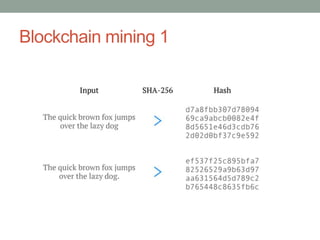
  • #12 A little reminder before going on with mining. A hash function is a one way function that takes an input and outputs a fixed sized unique output. You can will get the same length output for both a string that contains a whole book and a couple of letters. With one way what we mean is that you always get the same output with the same input , but it is very hard to find the input if only info you have is the output.
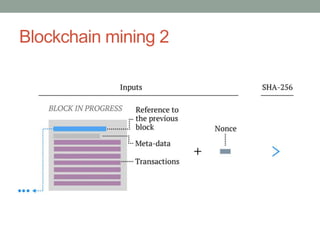
  • #13  This is the problem each and every miner is trying to solve on the world. What they are searching is the ‘Nonce’ a solution for the following problem : Which string concatenated with the hash of the blocks remaining data (transactions, meta data , and reference to previous block) will result an output with a fixed amount of leading zeros.
  • #14  When a miner finds a nonce he/she adds it to block which contains the transactions he/she validated. Then broadcasts it to other node . Every node can easily validate the nonce , all they need to do is concatenate hash data of block and nonce and hash it again. If the nonce is valid they add the block to their local blockchain. As you can see what miners are doing here is validating transactions and making the block tamper proof with the addition of the nonce. They get some fixed bitcoin for this effort and all the fees of that block’s transaction fees.
  • #15 Every once in a while 2 different miners find a valid nonce nearly at the same time (maybe a couple of sec apart) . Since blockchain Consists of a lot of nodes some of those nodes are in a proximity of on of those miners and some of the other. When they broadcast their blocks since the blocks are valid each receiving node add these blocks to their blockchains . For a time there are two valid blockchains this we call the blockchain fork. There is a simple rule that solves this problem when a node receives new blockchain forks he/she accepts the longest blockchain which has more proof of work in it. When a fork appears it gets resolved when one of the forks find the next block and broadcast it .
  • #20 Mist by https://www.ethereum.org/ : solidity language http://dapps.ethercasts.com/ DAPP’s Decentralized apps http://www.bspend.com/etherization civilization like game on DAPP
  • #21 http://www.lazooz.net/ : colobrative ride sharing app https://bitnation.co : The goal of this project is to learn and layout a simple process for anyone in the world to create their own Private Passport Service that can be used to validate and prove the existence of other persons using nothing but available tools. We will prefer open source where available and we will draw on the cryptographic tools like Public Private Key Cryptography (PGP) and blockchain technology in the form of Bitcoin.