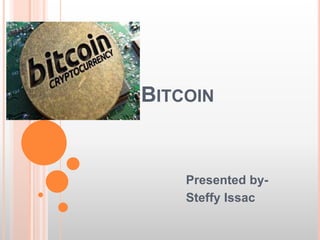
BITCOIN 
Presented by- 
Steffy Issac
WHAT IS BITCOIN 
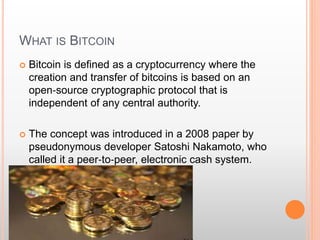
 Bitcoin is defined as a cryptocurrency where the 
creation and transfer of bitcoins is based on an 
open‐source cryptographic protocol that is 
independent of any central authority. 
 The concept was introduced in a 2008 paper by 
pseudonymous developer Satoshi Nakamoto, who 
called it a peer‐to‐peer, electronic cash system.
BENEFITS OF BITCOIN 
 Bitcoin allows anyone with an internet connection to 
send or receive payments from anywhere in the 
world, at almost no cost. 
 Bitcoin's unique features include pseudo anonymity, 
decentralization and irreversibility. 
 The transactions are processed by computers (or 
nodes) connected to the network. 
 To process this kind of transaction all nodes 
maintain a shared ledger balance of every bitcoin 
address that holds the balance or that held some 
balance in the past.
WHO PRINTS IT? 
 It is not physically printed. 
 It is created digitally by a community of people that 
anyone can join. 
 Bitcoins are mined, using computing power in a 
distributed network. 
 The network also processes transactions made with 
the virtual currency, effectively making bitcoin its 
own payment network.
GLOBAL CURRENCY 
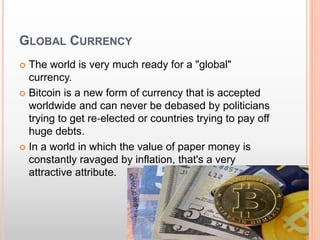
 The world is very much ready for a "global" 
currency. 
 Bitcoin is a new form of currency that is accepted 
worldwide and can never be debased by politicians 
trying to get re‐elected or countries trying to pay off 
huge debts. 
 In a world in which the value of paper money is 
constantly ravaged by inflation, that's a very 
attractive attribute.
PRICE / VALUE OF BITCOIN 
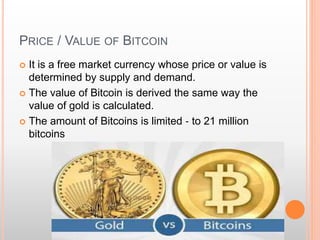
 It is a free market currency whose price or value is 
determined by supply and demand. 
 The value of Bitcoin is derived the same way the 
value of gold is calculated. 
 The amount of Bitcoins is limited ‐ to 21 million 
bitcoins
STORAGE OF BITCOINS 
 Bitcoins can be stored on your computer using a 
wallet software which can be downloaded, or in an 
online wallet. 
 Both methods provide you with an address and 
then send this address to people from whom you 
want to receive Bitcoin. 
 You can mine Bitcoin or buy them from trading 
exchanges.
STRENGTH 
 Fiat paper currencies are a relic of a past age. 
 As technology progresses, markets look for an 
alternative. 
 A single global digital currency is certainly in our 
future. Bitcoin is the most successful example of 
that so far. 
 Bitcoin can be easily used for international transfers 
without paying commissions to third parties like 
banks. 
 Bitcoin cuts down transaction times for bank wires 
from days to hours.
STRENGTHS 
 Non‐discriminating; single Global currency. 
 Increasing popularity and designed for the internet. 
 Can easily be exchanged with conventional currencies. 
 Secured by mathematics and cryptography, not trust. 
 Limited number of coins will ever be produced (cap at 21 
million), thus no inflation. 
 For Bitcoin, no third party is required as a clearing house 
like banks. Currently, no exchange commissions or taxes.
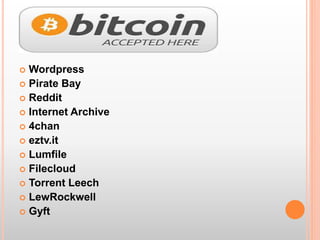
 Wordpress 
 Pirate Bay 
 Reddit 
 Internet Archive 
 4chan 
 eztv.it 
 Lumfile 
 Filecloud 
 Torrent Leech 
 LewRockwell 
 Gyft
CONCLUSION 
 It is always prudent on your part to view Bitcoins 
objectively and arrive at its value in your life. 
 Bitcoin is the Internet, applied to Money. 
 Bitcoin is not a stock, a company, a government or 
even a regular commodity. It is a technology.
Thank you…. 
Thank you

Bitcoin

  • 1.
    BITCOIN Presented by- Steffy Issac
  • 2.
    WHAT IS BITCOIN  Bitcoin is defined as a cryptocurrency where the creation and transfer of bitcoins is based on an open‐source cryptographic protocol that is independent of any central authority.  The concept was introduced in a 2008 paper by pseudonymous developer Satoshi Nakamoto, who called it a peer‐to‐peer, electronic cash system.
  • 3.
    BENEFITS OF BITCOIN  Bitcoin allows anyone with an internet connection to send or receive payments from anywhere in the world, at almost no cost.  Bitcoin's unique features include pseudo anonymity, decentralization and irreversibility.  The transactions are processed by computers (or nodes) connected to the network.  To process this kind of transaction all nodes maintain a shared ledger balance of every bitcoin address that holds the balance or that held some balance in the past.
  • 4.
    WHO PRINTS IT?  It is not physically printed.  It is created digitally by a community of people that anyone can join.  Bitcoins are mined, using computing power in a distributed network.  The network also processes transactions made with the virtual currency, effectively making bitcoin its own payment network.
  • 5.
    GLOBAL CURRENCY The world is very much ready for a "global" currency.  Bitcoin is a new form of currency that is accepted worldwide and can never be debased by politicians trying to get re‐elected or countries trying to pay off huge debts.  In a world in which the value of paper money is constantly ravaged by inflation, that's a very attractive attribute.
  • 6.
    PRICE / VALUEOF BITCOIN  It is a free market currency whose price or value is determined by supply and demand.  The value of Bitcoin is derived the same way the value of gold is calculated.  The amount of Bitcoins is limited ‐ to 21 million bitcoins
  • 7.
    STORAGE OF BITCOINS  Bitcoins can be stored on your computer using a wallet software which can be downloaded, or in an online wallet.  Both methods provide you with an address and then send this address to people from whom you want to receive Bitcoin.  You can mine Bitcoin or buy them from trading exchanges.
  • 8.
    STRENGTH  Fiatpaper currencies are a relic of a past age.  As technology progresses, markets look for an alternative.  A single global digital currency is certainly in our future. Bitcoin is the most successful example of that so far.  Bitcoin can be easily used for international transfers without paying commissions to third parties like banks.  Bitcoin cuts down transaction times for bank wires from days to hours.
  • 9.
    STRENGTHS  Non‐discriminating;single Global currency.  Increasing popularity and designed for the internet.  Can easily be exchanged with conventional currencies.  Secured by mathematics and cryptography, not trust.  Limited number of coins will ever be produced (cap at 21 million), thus no inflation.  For Bitcoin, no third party is required as a clearing house like banks. Currently, no exchange commissions or taxes.
  • 10.
     Wordpress Pirate Bay  Reddit  Internet Archive  4chan  eztv.it  Lumfile  Filecloud  Torrent Leech  LewRockwell  Gyft
  • 11.
    CONCLUSION  Itis always prudent on your part to view Bitcoins objectively and arrive at its value in your life.  Bitcoin is the Internet, applied to Money.  Bitcoin is not a stock, a company, a government or even a regular commodity. It is a technology.
  • 12.