CONTENT
 CONCEPT OF BIOTECHNOLOGY
 HISTORY
 DEFINITION OF BIOTECHNOLOGY
 APPLICATION OF BIOTECHNOLOGY
 THE INFRASTRUCTURAL ADVANTAGE
• The origin of biotechnology is as old as human civilization.
• Fermentation is the oldest biotechnological process discovered by the
people by prolonged soaking of grains or by sorting juices of fruits or
palms.
• Other early processes practiced by man included leavening of bread,
production of alcoholic beverages, production of vinegar, production of
curd, etc.
• Nowadays biotechnology has achieved greatest advancement in the
filed of Recombinant DNA technology, PCR, Cell-culture and fusion,
gene cloning, DNA fingerprinting, environmental engineering,
Immunology etc.
CONCEPT OF BIOTECHNOLOGY
 6000 B.C., Sumarians and Babylonians Knew the technique of preparing beer.
 2500 B.C.,Aryans started preparing curd.
 2000 B.C., Greeks were probably first to prepare cheese from milk.
 In 1920’s Clostridium acetobutylicum was used by Chaim Weizman for converting
starch into butanol and acetone, latter was an essential component of explosive
during World War- I.
 This raised hopes for commercial production of useful chemicals through biological
processes, and may be considered as the first rediscovery of biotechnology in the
present century.
 Similarly, during World War-II ( in 1940’s) , the production of penicillin (as an
antibiotic discovered by Alexaner Flemming in 1929) on a large scale from cultures
of Penicillium notatum marked the second rediscovery of biotechnology.
HISTORY
• Biotechnologies, as world indicate, is the product of interaction
between the science(living & viruses’) and technology.
• Biotechnology is the integrated use of biochemistry , microbiology
and engineering science in order to achieve technological application
of the capabilities of micro-organism, cultured tissue cells and part
thereof.
• Biotechnology is “a technology using biological phenomenon for
copying and manufacturing various kinds of useful substances.”
• Biotechnology is “the controlled use of biological agents such as
micro-organisms or cellular components for beneficial use. (U.S
National Science Foundation)
Definition
Application of Biotechnology
1. Tissue Culture Techniques in Biotechnology
2. Gene Technology as a Tool for Biotechnology
3. Hybridization and Monoclonal Antibodies in Biotechnology
4. Biotechnology in Medicine
5. Biotechnology and Protein Engineering
6. Biotechnology in Agriculture
7. Biotechnology and Environment
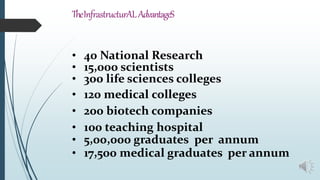
TheInfrastructurALAdvantageS
• 40 National Research
• 15,000 scientists
• 300 life sciences colleges
• 120 medical colleges
• 200 biotech companies
• 100 teaching hospital
• 5,00,000 graduates per annum
• 17,500 medical graduates per annum
BIOTECHNOLOGY :- CONCEPT HISTORY AND APPLICATION

BIOTECHNOLOGY :- CONCEPT HISTORY AND APPLICATION

  • 2.
    CONTENT  CONCEPT OFBIOTECHNOLOGY  HISTORY  DEFINITION OF BIOTECHNOLOGY  APPLICATION OF BIOTECHNOLOGY  THE INFRASTRUCTURAL ADVANTAGE
  • 3.
    • The originof biotechnology is as old as human civilization. • Fermentation is the oldest biotechnological process discovered by the people by prolonged soaking of grains or by sorting juices of fruits or palms. • Other early processes practiced by man included leavening of bread, production of alcoholic beverages, production of vinegar, production of curd, etc. • Nowadays biotechnology has achieved greatest advancement in the filed of Recombinant DNA technology, PCR, Cell-culture and fusion, gene cloning, DNA fingerprinting, environmental engineering, Immunology etc. CONCEPT OF BIOTECHNOLOGY
  • 4.
     6000 B.C.,Sumarians and Babylonians Knew the technique of preparing beer.  2500 B.C.,Aryans started preparing curd.  2000 B.C., Greeks were probably first to prepare cheese from milk.  In 1920’s Clostridium acetobutylicum was used by Chaim Weizman for converting starch into butanol and acetone, latter was an essential component of explosive during World War- I.  This raised hopes for commercial production of useful chemicals through biological processes, and may be considered as the first rediscovery of biotechnology in the present century.  Similarly, during World War-II ( in 1940’s) , the production of penicillin (as an antibiotic discovered by Alexaner Flemming in 1929) on a large scale from cultures of Penicillium notatum marked the second rediscovery of biotechnology. HISTORY
  • 5.
    • Biotechnologies, asworld indicate, is the product of interaction between the science(living & viruses’) and technology. • Biotechnology is the integrated use of biochemistry , microbiology and engineering science in order to achieve technological application of the capabilities of micro-organism, cultured tissue cells and part thereof. • Biotechnology is “a technology using biological phenomenon for copying and manufacturing various kinds of useful substances.” • Biotechnology is “the controlled use of biological agents such as micro-organisms or cellular components for beneficial use. (U.S National Science Foundation) Definition
  • 6.
    Application of Biotechnology 1.Tissue Culture Techniques in Biotechnology 2. Gene Technology as a Tool for Biotechnology 3. Hybridization and Monoclonal Antibodies in Biotechnology 4. Biotechnology in Medicine 5. Biotechnology and Protein Engineering 6. Biotechnology in Agriculture 7. Biotechnology and Environment
  • 7.
    TheInfrastructurALAdvantageS • 40 NationalResearch • 15,000 scientists • 300 life sciences colleges • 120 medical colleges • 200 biotech companies • 100 teaching hospital • 5,00,000 graduates per annum • 17,500 medical graduates per annum