DEFINITION AND IMPORTANCEOF BIOPOLYMERS:
Biopolymers:
Bio polymers are long chained molecules composed of repeating monomeric units that are
naturally synthesised by living organisms.
These include proteins, nucleic acids, and polysaccharides.
Their degradable nature and renewable sources make them more convenient for various
industries using polymers.
They are made of repeating monomeric units that are linked together by covalent bonds.
Common types of biopolymers are:
1. Proteins: - made of amino acids
2. Nucleic acids: - DNA and RNA made of nucleotides
3. Polysaccharides: - like cellulose and Strach, made of sugars.
Importance of biopolymers:
1. Biodegradable and sustainability:
> Unlike Synthetic polymers, like plastics, biopolymers degrade easily reducing
environmental pollution and waste accumulation making them better for industrial uses
2.Biocompatibility:
>Most biopolymers are non-toxic and compatible with the natural order of the environment.
This makes them ideal for medical applications like drug delivery, wound dressings and tissue
engineering.
3.Renewable resources:
>Biopolymers are derived from natural biological processes and from living sources like
plants animals and microorganisms, thus they are renewable supporting sustainable
3.
environment.
4.Industrial applications
>they areused in packaging and agricultural uses; textile uses and even electronics because
of their compatibility with the ecosystem.
5.Biomedical and pharmaceuticals:
>DNA, RNA and proteins are essential for genetic engineering, diagnostics and the
development of pharmaceuticals
4.
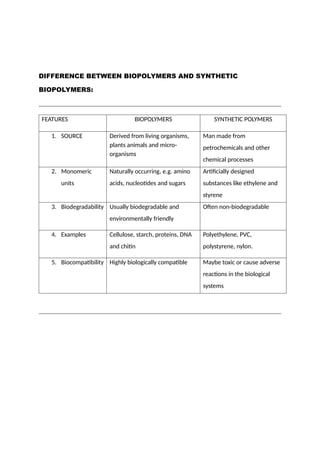
DIFFERENCE BETWEEN BIOPOLYMERSAND SYNTHETIC
BIOPOLYMERS:
FEATURES BIOPOLYMERS SYNTHETIC POLYMERS
1. SOURCE Derived from living organisms,
plants animals and micro-
organisms
Man made from
petrochemicals and other
chemical processes
2. Monomeric
units
Naturally occurring, e.g. amino
acids, nucleotides and sugars
Artificially designed
substances like ethylene and
styrene
3. Biodegradability Usually biodegradable and
environmentally friendly
Often non-biodegradable
4. Examples Cellulose, starch, proteins, DNA
and chitin
Polyethylene, PVC,
polystyrene, nylon.
5. Biocompatibility Highly biologically compatible Maybe toxic or cause adverse
reactions in the biological
systems
5.
BIOPOLYMERS:
BASED ON ORIGIN:
1.Natural biopolymers:
> They have plant origin; they are directly extracted from plant sources.
e.g. Cellulose: from cotton, wood. It is used in paper and packaging
starch: from potatoes, corn and is used in biodegradable plastics and food.
natural rubber: from the latex of rubber trees
2. Microbial biopolymers:
>synthesised by bacteria, fungi or algae. Often under the controlled lab or fermentation
conditions.
eg. Xanthan gum: produced by Xanthomonas bacteria, used as a food thickener.
Bacterial cellulose: it is used in wound dressings and cosmetics.
3. Synthetic polymers:
> Made under man-made conditions, made to imitate natural biopolymers.
eg. Polylactic acid PLA: made from corn starch or sugarcane; used in biodegradable plastics.
Polycaprolactone PCL: used in drug delivery and sutures
Polyethylene furanoate PEF: produced from sugars and is used as a sustainable
alternative to PET plastics
6.
BASED ON MONOMERICUNITS
1. Proteins:
> monomeric units are amino acids that are linked by peptide bonds. They can be separated
according to structure.
1. Primary: Linear sequence of amino acids
2. Secondary: Alpha helices and beta sheets
3.Tertiary: 3D folding due to interactions among R-groups
4.Quaternary: Multiple polypeptide chains forming a functional unit
7.
eg. Enzymes, keratinand haemoglobin
2. Polysaccharides:
> they are monomers of monosaccharides linked by glycosidic bonds.
Examples:
1.Cellulose – made of glucose; structural component in plant cell wall
2.Starch – energy storage in plants; also made of glucose
3.Chitin – found in exoskeletons of insects and crustaceans
3.Nucleic Acids
> They are monomers of nucleotides and are linked by phosphodiester bonds.
there are two type of nucleic acids that function as the genetic material for all living
organisms and they are:
DNA (Deoxyribonucleic Acid) – stores genetic information
RNA (Ribonucleic Acid) – involved in protein synthesis and gene
expression
8.
USES OF BIOPOLYMERSIN MEDICINE, FOOD, PACKAGING,
ARGICULTURE AND BIOTECHNOLOGY.
Biopolymers are a boon in the medical industry as they are used in
1. Drug delivery systems
2. Wound healing
3. Tissue engineering
4. Sutures and implants
5. Medical hydrogels
They are used in the food industry as
1. Edible film and coatings because of their ability to prolong the life of fruits and vegetables
2. Food packaging
3. Thickeners and stabilizers
4. Fat replacers
They are used in packaging as they are biodegradable and can easily replace non bio
degradable synthetic packaging making them more eco friendly
1. Biodegradable plastics such as PLA, PHB and starch blends.
Biopolymers are especially a boon in the agriculture industry because of their sustainable
and ecofriendly nature. Also, they are convenient because they are produced from natural
living organisms
Biodegradable Mulch Films: Used to conserve soil moisture and reduce weed growth;
break down after use, reducing pollution.
Seed Coatings: Biopolymers protect seeds and enhance germination.
Slow-release Fertilizers: Encapsulated fertilizers made with biopolymers provide
nutrients gradually.
Plant Growth Stimulators: Alginate and chitosan can enhance plant growth and
resistance to diseases.
9.
Biopolymers are usedin the specialization of Biotechnology:
1.Enzyme Immobilization: Biopolymers like alginate and agarose are used to trap enzymes
for reuse in industrial processes.
2.Bioseparation and Purification: Chitosan and cellulose are used in chromatography
columns.
3.Scaffold Material for Cell Culture: Biopolymers provide 3D structures for growing cells in
research and therapeutics.
4.Genetic Engineering: DNA and RNA (nucleic acid biopolymers) are central to recombinant
DNA technologies and gene editing.
SUMMARY
1. Biopolymers are natural polymers made by living organisms.
2. They consist of repeating units called monomers, such as sugars, amino acids, or
nucleotides.
3. They are biodegradable, renewable, and environmentally friendly, unlike synthetic
polymers which are made from chemicals and often cause pollution.
4.Based on origin, biopolymers are:
Natural (e.g., cellulose, starch)
Microbial (e.g., PHAs, xanthan gum)
10.
Synthetic bio-based(e.g., PLA, PCL).
5.Based on monomers, they are:
Polysaccharides (sugar-based),
Proteins (amino acids),
Nucleic acids (DNA, RNA).
6.Uses of biopolymers include:
Medicine: Drug delivery, wound healing, tissue engineering.
Food: Edible coatings, thickeners, packaging.
Packaging: Biodegradable plastics and films.
Agriculture: Mulch films, seed coatings, eco-friendly fertilizers.
Biotechnology: Cell culture scaffolds, enzyme supports, gene editing tools.
FUTURE SCOPE OF BIOPOLYMER RESEARCH
Biopolymer research will be in huge demand in the future due to growing demand of
sustainable and eco friendly substances.
At present, scientists are working on increasing the durability of biopolymers to match that
of synthetic polymers like plastic.
In the future of medicine, biopolymers will be used to develop more advanced drug delivery
systems, artificial organs and tissue engineering scaffolds
Biotechnology is also using biopolymers for enzyme carriers, biosensors, and gene therapy.
11.
REFRENCES
1. Reddy, C.S. K., Ghai, R., Rashmi, & Kalia, V. C. (2003).
Polyhydroxyalkanoates: An overview.
Bioresource Technology, 87(2), 137–146.
https://doi.org/10.1016/S0960-8524(02)00212-2
→ Discusses microbial biopolymers and their applications.
2. Auras, R., Harte, B., & Selke, S. (2004).
An overview of polylactide (PLA) polymers.
Macromolecular Bioscience, 4(9), 835–864.
12.
https://doi.org/10.1002/mabi.200400043
→ Covers properties,production, and applications of PLA, a synthetic biopolymer.
3. Lee, K. Y., & Mooney, D. J. (2012).
Alginate: Properties and biomedical applications.
Progress in Polymer Science, 37(1), 106–126.
https://doi.org/10.1016/j.progpolymsci.2011.06.003
→ A detailed review of alginate and its use in medicine and tissue engineering.



![Polymer [ बहुलक ] Chemistry Notes PDF - Irfanullah Mehar - JJ Sir Chemistry.pdf](https://cdn.slidesharecdn.com/ss_thumbnails/polymerchemistrynotespdf-irfanullahmehar-jjsirchemistry-260210172118-3f9b37f7-thumbnail.jpg?width=640&height=640&fit=bounds)


