BIO-MEDICAL WASTE
Suhas Dixit,
CMD, Pyrocrat Systems
Waste are Biomedical
Wastes?
 Wastes which are generated during
the diagnosis, treatment or
immunization of human beings or
animals or in research activities are
termed as biomedical wastes.
 Hospitals, health clinics, nursing
homes, medical research laboratories,
veterinarians, and funeral homes are
the common sources that produce
biomedical wastes.
Hazards of Biochemical
Wastes
 Can lead to spreading of diseases like
cholera, typhoid, hepatitis etc.
 Radioactive wastes can cause
headache, vomiting, dizziness, DNA
damage, carcinogenesis and other
serious issues.
 Poor handling of needles, blades etc.
can cause injuries
 Air, water and land pollution
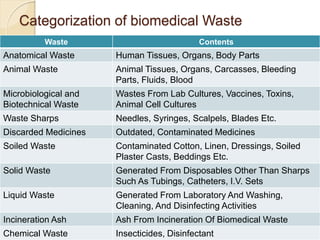
Categorization of biomedical Waste
Waste Contents
Anatomical Waste Human Tissues, Organs, Body Parts
Animal Waste Animal Tissues, Organs, Carcasses, Bleeding
Parts, Fluids, Blood
Microbiological and
Biotechnical Waste
Wastes From Lab Cultures, Vaccines, Toxins,
Animal Cell Cultures
Waste Sharps Needles, Syringes, Scalpels, Blades Etc.
Discarded Medicines Outdated, Contaminated Medicines
Soiled Waste Contaminated Cotton, Linen, Dressings, Soiled
Plaster Casts, Beddings Etc.
Solid Waste Generated From Disposables Other Than Sharps
Such As Tubings, Catheters, I.V. Sets
Liquid Waste Generated From Laboratory And Washing,
Cleaning, And Disinfecting Activities
Incineration Ash Ash From Incineration Of Biomedical Waste
Chemical Waste Insecticides, Disinfectant
Segregation of Biomedical
Wastes
 Segregation is the process of
separating of waste into different
streams and the treatment of each
stream to ensure complete sterilization
and recycling.
 Segregation shall be done at point of
generation.
 Non-infectious and infectious wastes
must always be kept separate.
Benefits of Segregation
 Segregation helps in reducing:
1. Total treatment cost.
2. Impacts of waste on community.
3. Chances of infecting healthcare
workers.
Biomedical Waste
Classification
 General Waste
 Pathological
 Radioactive
 Chemical
 Infectious waste
 Sharps
 Pharmaceuticals
 Pressurized containers
Biomedical Waste Treatment
 Incineration
Combustion of waste is carried out under
controlled conditions and is converted into inert
material and gases.
There are three types of incinerators
 Multiple hearth type
 Rotary kiln
 Controlled air types.
These incinerators can have primary and
secondary combustion chambers to achieve
optimal combustion.
Autoclave
The autoclave works similarly as a
pressure cooker where steam penetrates
into waste material, thus killing the
micro-organisms. Autoclaves are of
three categories; Gravity type, Pre-
vacuum type and Retort type.
 Conditions:
 Temperature-121⁰C
 Holding time-15 min.
 Pressure-15 pounds per sq.inch.
Microwave
 The waste is subjected to microwave
radiations which causes the molecules
of the material to heat up, thereby
killing the pathogens.
 Waves with Frequency of about 3000
MHz are used to destroy micro-
organisms.
 Heat is produced at 95-100 ⁰C for a
holding period of 25 to 30 minutes.
Hot Air Oven
 In this method the oven is electrically
heated. A fan is used for adequate
distribution of hot air in the chamber.
 A Thermostat is used to maintain a
temperature of chamber at
temperature of 160⁰C for a period of 2
hours.
Mechanical Treatment
 The bulk of biomedical waste is
processed in order to change its
physical form to facilitate waste
management.
 The common methods implied are
Compacting and Shredding.
Biological processes
 Biological enzymes can be used
decontaminate the waste or even to
cause the destruction of all the organic
constituents.
 Hence only inerts like plastics, glass,
and other inert remain in the residues.
Inertization
 Biomedical waste is mixed with
cement and other substances before
disposal to make them inert.
 This prevents toxic substances in
waste from contaminating the ground
or surface water.
 The mixture constitutes 65 % waste,
15 % lime, 15 % cement and 5 %
water.
Land Disposal
Sanitary landfills can be used to dispose
biomedical waste.
The site must have
 Full or partial hydrogeological isolation.
 Appropriate engineering preparations.
 Trained staff should supervise its
functioning.
 Planned waste emplacement and
covering: waste should be spread in
layers and compacted.
Thank You

Biomedical waste - Suhas Dixit

  • 1.
  • 2.
    Waste are Biomedical Wastes? Wastes which are generated during the diagnosis, treatment or immunization of human beings or animals or in research activities are termed as biomedical wastes.  Hospitals, health clinics, nursing homes, medical research laboratories, veterinarians, and funeral homes are the common sources that produce biomedical wastes.
  • 3.
    Hazards of Biochemical Wastes Can lead to spreading of diseases like cholera, typhoid, hepatitis etc.  Radioactive wastes can cause headache, vomiting, dizziness, DNA damage, carcinogenesis and other serious issues.  Poor handling of needles, blades etc. can cause injuries  Air, water and land pollution
  • 5.
    Categorization of biomedicalWaste Waste Contents Anatomical Waste Human Tissues, Organs, Body Parts Animal Waste Animal Tissues, Organs, Carcasses, Bleeding Parts, Fluids, Blood Microbiological and Biotechnical Waste Wastes From Lab Cultures, Vaccines, Toxins, Animal Cell Cultures Waste Sharps Needles, Syringes, Scalpels, Blades Etc. Discarded Medicines Outdated, Contaminated Medicines Soiled Waste Contaminated Cotton, Linen, Dressings, Soiled Plaster Casts, Beddings Etc. Solid Waste Generated From Disposables Other Than Sharps Such As Tubings, Catheters, I.V. Sets Liquid Waste Generated From Laboratory And Washing, Cleaning, And Disinfecting Activities Incineration Ash Ash From Incineration Of Biomedical Waste Chemical Waste Insecticides, Disinfectant
  • 6.
    Segregation of Biomedical Wastes Segregation is the process of separating of waste into different streams and the treatment of each stream to ensure complete sterilization and recycling.  Segregation shall be done at point of generation.  Non-infectious and infectious wastes must always be kept separate.
  • 7.
    Benefits of Segregation Segregation helps in reducing: 1. Total treatment cost. 2. Impacts of waste on community. 3. Chances of infecting healthcare workers.
  • 8.
    Biomedical Waste Classification  GeneralWaste  Pathological  Radioactive  Chemical  Infectious waste  Sharps  Pharmaceuticals  Pressurized containers
  • 9.
    Biomedical Waste Treatment Incineration Combustion of waste is carried out under controlled conditions and is converted into inert material and gases. There are three types of incinerators  Multiple hearth type  Rotary kiln  Controlled air types. These incinerators can have primary and secondary combustion chambers to achieve optimal combustion.
  • 10.
    Autoclave The autoclave workssimilarly as a pressure cooker where steam penetrates into waste material, thus killing the micro-organisms. Autoclaves are of three categories; Gravity type, Pre- vacuum type and Retort type.  Conditions:  Temperature-121⁰C  Holding time-15 min.  Pressure-15 pounds per sq.inch.
  • 11.
    Microwave  The wasteis subjected to microwave radiations which causes the molecules of the material to heat up, thereby killing the pathogens.  Waves with Frequency of about 3000 MHz are used to destroy micro- organisms.  Heat is produced at 95-100 ⁰C for a holding period of 25 to 30 minutes.
  • 12.
    Hot Air Oven In this method the oven is electrically heated. A fan is used for adequate distribution of hot air in the chamber.  A Thermostat is used to maintain a temperature of chamber at temperature of 160⁰C for a period of 2 hours.
  • 13.
    Mechanical Treatment  Thebulk of biomedical waste is processed in order to change its physical form to facilitate waste management.  The common methods implied are Compacting and Shredding.
  • 14.
    Biological processes  Biologicalenzymes can be used decontaminate the waste or even to cause the destruction of all the organic constituents.  Hence only inerts like plastics, glass, and other inert remain in the residues.
  • 15.
    Inertization  Biomedical wasteis mixed with cement and other substances before disposal to make them inert.  This prevents toxic substances in waste from contaminating the ground or surface water.  The mixture constitutes 65 % waste, 15 % lime, 15 % cement and 5 % water.
  • 16.
    Land Disposal Sanitary landfillscan be used to dispose biomedical waste. The site must have  Full or partial hydrogeological isolation.  Appropriate engineering preparations.  Trained staff should supervise its functioning.  Planned waste emplacement and covering: waste should be spread in layers and compacted.
  • 17.