DR.Abd Al-sallam Shbool
26/7/2015
Boiclimatic chart for Irbid
Najdat Mamoon Hazaimh
0141382
Bioclimatic chart for Irbid
Bioclimatic analysis is a systematic procedure for the assessment of thermal comfort in
relation to external climate. It has the purpose of identifying desirable adaptations of
structure to meet human comfort needs under specific climatological conditions.
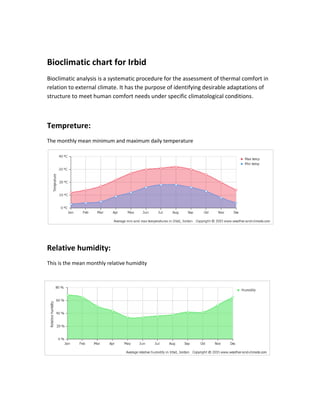
Tempreture:
The monthly mean minimum and maximum daily temperature
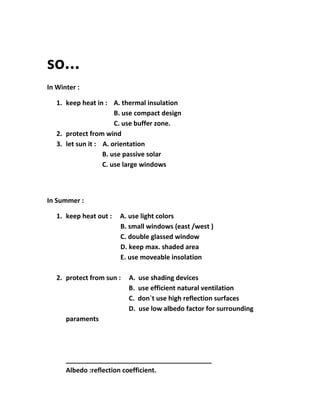
Relative humidity:
This is the mean monthly relative humidity
Irbid,
Irbid has a hot mediterranean/ dry-summer subtropical climate (Köppen-Geiger
classification: Csa) that is mild with moderate seasonality. Summers are dry and hot due
to the domination of subtropical high pressure systems while winters experience
moderate temperatures and changeable, rainy weather due to the polar front. These
climates usually occur on the western sides of continents between the latitudes of 30°
and 45°. Vegetation is adapted to the dry summers and is fragrant and oily making it
susceptible to fire. The typical Mediterranean climate average monthly temperatures in
excess of 22.0 °C (71.6 °F) in its warmest month and an average in the coldest month
between 18 to -3 °C (64 to 27 °F) with at least four months above 10 °C (50 °F).
Seasonality is moderate .
According to the Holdridge life zones system of bioclimatic classification Irbid is situated
in or near the subtropical thorn woodland biome.
✓ The mean annual temperature is 17.5 degrees Celsius (63.5 degrees Fahrenheit).
✓ Average monthly temperatures vary by 16.5 °C (29.7°F).
✓ Total annual Precipitation averages 475 mm (18.7 inches) which is equivalent to
475 Litres/m² (11.65 Gallons/ft²
conclusion...
✓ Hot season / summer is in June, July, August and September.
✓ Most rainfall (rainy season) is seen in September.
✓ Irbid has dry periods in April, May, June and July.
✓ On average, the warmest month is August.
✓ On average, the coolest month is January.
✓ September is the wettest month.
✓ May is the driest month.
____________________________________________________________________
reference
http://www.weather-and-climate.com
http://www.irbid.climatemps.com
so...
In Winter :
1. keep heat in : A. thermal insulation
B. use compact design
C. use buffer zone.
2. protect from wind
3. let sun it : A. orientation
B. use passive solar
C. use large windows
In Summer :
1. keep heat out : A. use light colors
B. small windows (east /west )
C. double glassed window
D. keep max. shaded area
E. use moveable insolation
2. protect from sun : A. use shading devices
B. use efficient natural ventilation
C. don`t use high reflection surfaces
D. use low albedo factor for surrounding
paraments
________________________________________
Albedo :reflection coefficient.

Bioclimatic chart for irbid

  • 1.
    DR.Abd Al-sallam Shbool 26/7/2015 Boiclimaticchart for Irbid Najdat Mamoon Hazaimh 0141382
  • 2.
    Bioclimatic chart forIrbid Bioclimatic analysis is a systematic procedure for the assessment of thermal comfort in relation to external climate. It has the purpose of identifying desirable adaptations of structure to meet human comfort needs under specific climatological conditions. Tempreture: The monthly mean minimum and maximum daily temperature Relative humidity: This is the mean monthly relative humidity
  • 3.
    Irbid, Irbid has ahot mediterranean/ dry-summer subtropical climate (Köppen-Geiger classification: Csa) that is mild with moderate seasonality. Summers are dry and hot due to the domination of subtropical high pressure systems while winters experience moderate temperatures and changeable, rainy weather due to the polar front. These climates usually occur on the western sides of continents between the latitudes of 30° and 45°. Vegetation is adapted to the dry summers and is fragrant and oily making it susceptible to fire. The typical Mediterranean climate average monthly temperatures in excess of 22.0 °C (71.6 °F) in its warmest month and an average in the coldest month between 18 to -3 °C (64 to 27 °F) with at least four months above 10 °C (50 °F). Seasonality is moderate . According to the Holdridge life zones system of bioclimatic classification Irbid is situated in or near the subtropical thorn woodland biome. ✓ The mean annual temperature is 17.5 degrees Celsius (63.5 degrees Fahrenheit). ✓ Average monthly temperatures vary by 16.5 °C (29.7°F). ✓ Total annual Precipitation averages 475 mm (18.7 inches) which is equivalent to 475 Litres/m² (11.65 Gallons/ft² conclusion... ✓ Hot season / summer is in June, July, August and September. ✓ Most rainfall (rainy season) is seen in September. ✓ Irbid has dry periods in April, May, June and July. ✓ On average, the warmest month is August. ✓ On average, the coolest month is January. ✓ September is the wettest month. ✓ May is the driest month. ____________________________________________________________________ reference http://www.weather-and-climate.com http://www.irbid.climatemps.com
  • 4.
    so... In Winter : 1.keep heat in : A. thermal insulation B. use compact design C. use buffer zone. 2. protect from wind 3. let sun it : A. orientation B. use passive solar C. use large windows In Summer : 1. keep heat out : A. use light colors B. small windows (east /west ) C. double glassed window D. keep max. shaded area E. use moveable insolation 2. protect from sun : A. use shading devices B. use efficient natural ventilation C. don`t use high reflection surfaces D. use low albedo factor for surrounding paraments ________________________________________ Albedo :reflection coefficient.