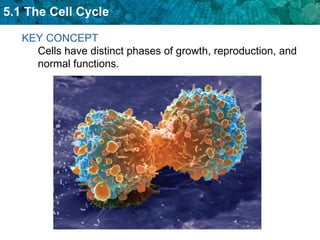
KEY CONCEPT  Cells have distinct phases of growth, reproduction, and normal functions.
The cell cycle has four main stages. The cell cycle is a regular pattern of growth, DNA replication, and cell division.
The main stages of the cell cycle are gap 1, synthesis, gap 2, and mitosis. Gap 1 (G 1 ): cell growth and  normal functions Mitosis occurs only if the cell is large enough and the DNA undamaged. DNA synthesis (S): copies DNA Gap 2 (G 2 ): additional growth Mitosis (M): includes  division of the cell nucleus (mitosis) and division of the cell cytoplasm (cytokinesis)
Cells divide at different rates. The rate of cell division varies with the need for those types of cells. Some cells are unlikely to divide (G 0 ).
Cell size is limited. Volume increases faster than surface area.
Surface area must allow for adequate exchange of materials. Cell growth is coordinated with division. Cells that must be large have unique shapes.

bio5.1

  • 1.
    KEY CONCEPT Cells have distinct phases of growth, reproduction, and normal functions.
  • 2.
    The cell cyclehas four main stages. The cell cycle is a regular pattern of growth, DNA replication, and cell division.
  • 3.
    The main stagesof the cell cycle are gap 1, synthesis, gap 2, and mitosis. Gap 1 (G 1 ): cell growth and normal functions Mitosis occurs only if the cell is large enough and the DNA undamaged. DNA synthesis (S): copies DNA Gap 2 (G 2 ): additional growth Mitosis (M): includes division of the cell nucleus (mitosis) and division of the cell cytoplasm (cytokinesis)
  • 4.
    Cells divide atdifferent rates. The rate of cell division varies with the need for those types of cells. Some cells are unlikely to divide (G 0 ).
  • 5.
    Cell size islimited. Volume increases faster than surface area.
  • 6.
    Surface area mustallow for adequate exchange of materials. Cell growth is coordinated with division. Cells that must be large have unique shapes.