Binomial Theorem
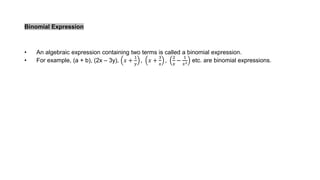
Binomial Expression
• An algebraic expression containing two terms is called a binomial expression.
• For example, (a + b), (2x – 3y), 𝑥 +
1
𝑦
, 𝑥 +
3
𝑥
,
2
𝑥
−
1
𝑥2 etc. are binomial expressions.
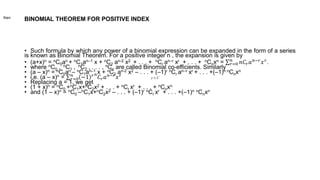
BINOMIAL THEOREM FOR POSITIVE INDEX
• Such formula by which any power of a binomial expression can be expanded in the form of a series
is known as Binomial Theorem. For a positive integer n , the expansion is given by
• (a+x)n = nC0an + nC1an–1 x + nC2 an-2 x2 + . . . + nCr an–r xr + . . . + nCnxn = 𝑟=0
𝑛
𝑛𝐶𝑟𝑎𝑛−𝑟𝑥𝑟.
• where nC0 , nC1 , nC2 , . . . , nCn are called Binomial co-efficients. Similarly
• (a – x)n = nC0an – nC1an–1 x + nC2 an-2 x2 – . . . + (–1)r nCr an–r xr + . . . +(–1)n nCnxn
• i.e. (a – x)n = 𝑟=0
𝑛
−1 𝑟𝑛
𝐶𝑟𝑎𝑛−𝑟
𝑥𝑟
• Replacing a = 1, we get
• (1 + x)n = nC0 +nC1x+nC2x2 + . . . + nCr xr + . . . + nCnxn
• and (1 – x)n = nC0 –nC1x+nC2x2 – . . . + (–1)r nCr xr + . . . +(–1)n nCnxn
C
y 
then
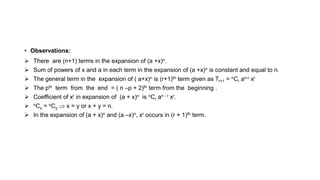
• Observations:
 There are (n+1) terms in the expansion of (a +x)n.
 Sum of powers of x and a in each term in the expansion of (a +x)n is constant and equal to n.
 The general term in the expansion of ( a+x)n is (r+1)th term given as Tr+1 = nCr an-r xr
 The pth term from the end = ( n –p + 2)th term from the beginning .
 Coefficient of xr in expansion of (a + x)n is nCr an - r xr.
 nCx = nCy  x = y or x + y = n.
 In the expansion of (a + x)n and (a –x)n, xr occurs in (r + 1)th term.
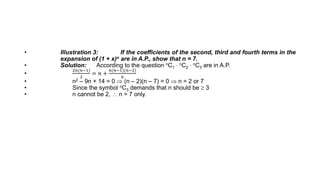
• Illustration 3: If the coefficients of the second, third and fourth terms in the
expansion of (1 + x)n are in A.P., show that n = 7.
• Solution: According to the question nC1  nC2  nC3 are in A.P.
•
2𝑛(𝑛−1)
2
= 𝑛 +
𝑛(𝑛−1)(𝑛−2)
6
• n2 – 9n + 14 = 0  (n – 2)(n – 7) = 0  n = 2 or 7
• Since the symbol nC3 demands that n should be  3
• n cannot be 2,  n = 7 only.
MIDDLE TERM
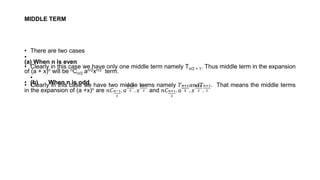
• There are two cases
•
(a) When n is even
• Clearly in this case we have only one middle term namely Tn/2 + 1. Thus middle term in the expansion
of (a + x)n will be nCn/2 an/2xn/2 term.
•
• (b) When n is odd
• Clearly in this case we have two middle terms namely 𝑇𝑛+1
2
𝑎𝑛𝑑𝑇𝑛+3
2
. That means the middle terms
in the expansion of (a +x)n are 𝑛𝐶𝑛−1
2
. 𝑎
𝑛+1
2 . 𝑥
𝑛−1
2 and 𝑛𝐶𝑛+1
2
. 𝑎
𝑛−1
2 . 𝑥
𝑛+1
2 .
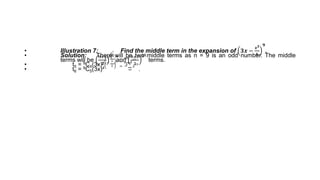
• Illustration 7: Find the middle term in the expansion of 𝟑𝒙 −
𝒙𝟑
𝟔
𝟗
.
• Solution: There will be two middle terms as n = 9 is an odd number. The middle
terms will be
9+1
2
𝑡ℎ
and
9+3
2
𝑡ℎ
terms.
• t5 = 9C4(3x)5
−
𝑥
3
6
4
=
189
8
𝑥
17
• t6 = 9C5(3x)4
−
𝑥
3
6
5
= −
21
16
𝑥
19
.
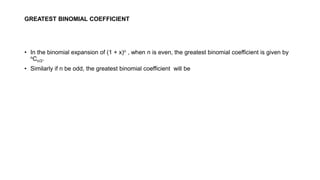
GREATEST BINOMIAL COEFFICIENT
• In the binomial expansion of (1 + x)n , when n is even, the greatest binomial coefficient is given by
nCn/2.
• Similarly if n be odd, the greatest binomial coefficient will be
NUMERICALY GREATEST TERM

Binomial Theorem for any index real.pptx

  • 1.
  • 2.
    Binomial Expression • Analgebraic expression containing two terms is called a binomial expression. • For example, (a + b), (2x – 3y), 𝑥 + 1 𝑦 , 𝑥 + 3 𝑥 , 2 𝑥 − 1 𝑥2 etc. are binomial expressions.
  • 3.
    BINOMIAL THEOREM FORPOSITIVE INDEX • Such formula by which any power of a binomial expression can be expanded in the form of a series is known as Binomial Theorem. For a positive integer n , the expansion is given by • (a+x)n = nC0an + nC1an–1 x + nC2 an-2 x2 + . . . + nCr an–r xr + . . . + nCnxn = 𝑟=0 𝑛 𝑛𝐶𝑟𝑎𝑛−𝑟𝑥𝑟. • where nC0 , nC1 , nC2 , . . . , nCn are called Binomial co-efficients. Similarly • (a – x)n = nC0an – nC1an–1 x + nC2 an-2 x2 – . . . + (–1)r nCr an–r xr + . . . +(–1)n nCnxn • i.e. (a – x)n = 𝑟=0 𝑛 −1 𝑟𝑛 𝐶𝑟𝑎𝑛−𝑟 𝑥𝑟 • Replacing a = 1, we get • (1 + x)n = nC0 +nC1x+nC2x2 + . . . + nCr xr + . . . + nCnxn • and (1 – x)n = nC0 –nC1x+nC2x2 – . . . + (–1)r nCr xr + . . . +(–1)n nCnxn C y  then
  • 4.
    • Observations:  Thereare (n+1) terms in the expansion of (a +x)n.  Sum of powers of x and a in each term in the expansion of (a +x)n is constant and equal to n.  The general term in the expansion of ( a+x)n is (r+1)th term given as Tr+1 = nCr an-r xr  The pth term from the end = ( n –p + 2)th term from the beginning .  Coefficient of xr in expansion of (a + x)n is nCr an - r xr.  nCx = nCy  x = y or x + y = n.  In the expansion of (a + x)n and (a –x)n, xr occurs in (r + 1)th term.
  • 5.
    • Illustration 3:If the coefficients of the second, third and fourth terms in the expansion of (1 + x)n are in A.P., show that n = 7. • Solution: According to the question nC1  nC2  nC3 are in A.P. • 2𝑛(𝑛−1) 2 = 𝑛 + 𝑛(𝑛−1)(𝑛−2) 6 • n2 – 9n + 14 = 0  (n – 2)(n – 7) = 0  n = 2 or 7 • Since the symbol nC3 demands that n should be  3 • n cannot be 2,  n = 7 only.
  • 7.
    MIDDLE TERM • Thereare two cases • (a) When n is even • Clearly in this case we have only one middle term namely Tn/2 + 1. Thus middle term in the expansion of (a + x)n will be nCn/2 an/2xn/2 term. • • (b) When n is odd • Clearly in this case we have two middle terms namely 𝑇𝑛+1 2 𝑎𝑛𝑑𝑇𝑛+3 2 . That means the middle terms in the expansion of (a +x)n are 𝑛𝐶𝑛−1 2 . 𝑎 𝑛+1 2 . 𝑥 𝑛−1 2 and 𝑛𝐶𝑛+1 2 . 𝑎 𝑛−1 2 . 𝑥 𝑛+1 2 .
  • 8.
    • Illustration 7:Find the middle term in the expansion of 𝟑𝒙 − 𝒙𝟑 𝟔 𝟗 . • Solution: There will be two middle terms as n = 9 is an odd number. The middle terms will be 9+1 2 𝑡ℎ and 9+3 2 𝑡ℎ terms. • t5 = 9C4(3x)5 − 𝑥 3 6 4 = 189 8 𝑥 17 • t6 = 9C5(3x)4 − 𝑥 3 6 5 = − 21 16 𝑥 19 .
  • 9.
    GREATEST BINOMIAL COEFFICIENT •In the binomial expansion of (1 + x)n , when n is even, the greatest binomial coefficient is given by nCn/2. • Similarly if n be odd, the greatest binomial coefficient will be
  • 10.