

Definition Binomial Experiment:
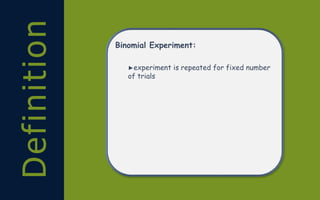
►experiment is repeated for fixed number
of trials
Definition Binomial Experiment:
►experiment is repeated for fixed number
of trials
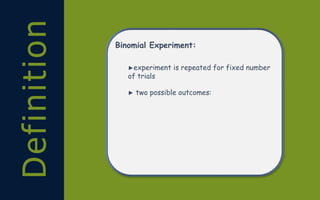
► two possible outcomes:
Definition Binomial Experiment:
►experiment is repeated for fixed number
of trials
► two possible outcomes:
► Success or Failure
Definition Binomial Experiment:
►experiment is repeated for fixed number
of trials
► two possible outcomes:
► Success or Failure
► probability of success is constant
Definition Binomial Experiment:
►experiment is repeated for fixed number
of trials
► two possible outcomes:
► Success or Failure
► probability of success is constant
► x counts the number of successful trials
Notation
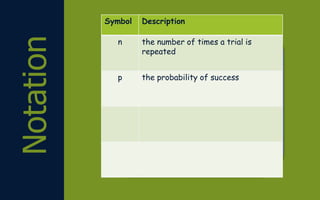
Symbol Description
n the number of times a trial is
repeated
Notation
Symbol Description
n the number of times a trial is
repeated
p the probability of success
Notation
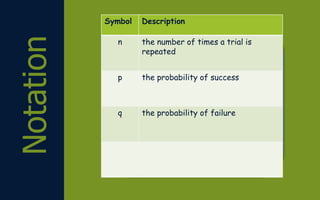
Symbol Description
n the number of times a trial is
repeated
p the probability of success
q the probability of failure
Notation
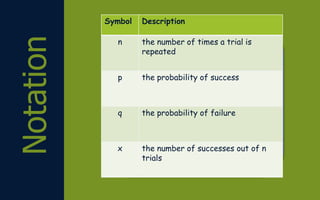
Symbol Description
n the number of times a trial is
repeated
p the probability of success
q the probability of failure
x the number of successes out of n
trials
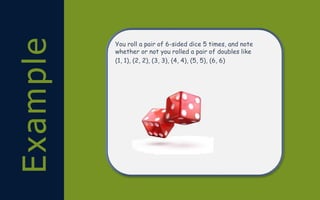
Example You roll a pair of 6-sided dice 5 times, and note
whether or not you rolled a pair of doubles like
(1, 1), (2, 2), (3, 3), (4, 4), (5, 5), (6, 6)
Example You roll a pair of 6-sided dice 5 times, and note whether or
not you rolled a pair of doubles like (1, 1), (2, 2), (3, 3), (4, 4),
(5, 5), (6, 6)
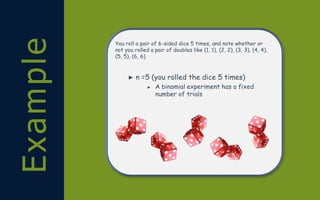
► n =5 (you rolled the dice 5 times)
► A binomial experiment has a fixed
number of trials
Example You roll a pair of 6-sided dice 5 times, and note whether or
not you rolled a pair of doubles like (1, 1), (2, 2), (3, 3), (4, 4),
(5, 5), (6, 6)
► n =5 (you rolled the dice 5 times)
► A binomial experiment has a fixed
number of trials
Example You roll a pair of 6-sided dice 5 times, and note whether or
not you rolled a pair of doubles like (1, 1), (2, 2), (3, 3), (4, 4),
(5, 5), (6, 6)
► n =5 (you rolled the dice 5 times)
► A binomial experiment has a fixed
number of trials
Example You roll a pair of 6-sided dice 5 times, and note whether or
not you rolled a pair of doubles like (1, 1), (2, 2), (3, 3), (4, 4),
(5, 5), (6, 6)
► n =5 (you rolled the dice 5 times)
► A binomial experiment has a fixed
number of trials
Example You roll a pair of 6-sided dice 5 times, and note whether or
not you rolled a pair of doubles like (1, 1), (2, 2), (3, 3), (4, 4),
(5, 5), (6, 6)
► n =5 (you rolled the dice 5 times)
► A binomial experiment has a fixed
number of trials
Example You roll a pair of 6-sided dice 5 times, and note whether or
not you rolled a pair of doubles like (1, 1), (2, 2), (3, 3), (4, 4),
(5, 5), (6, 6)
► n =5 (you rolled the dice 5 times)
► A binomial experiment has a fixed
number of trials
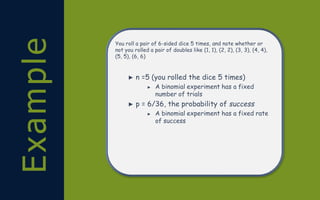
► p = 6/36, the probability of success
► A binomial experiment has a fixed rate
of success
Example You roll a pair of 6-sided dice 5 times, and note whether or
not you rolled a pair of doubles like (1, 1), (2, 2), (3, 3), (4, 4),
(5, 5), (6, 6)
► n =5 (you rolled the dice 5 times)
► A binomial experiment has a fixed
number of trials
► p = 6/36, the probability of success
► A binomial experiment has a fixed rate
of success
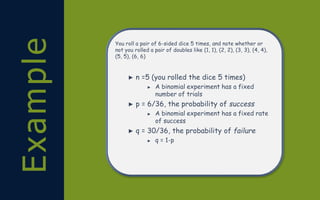
► q = 30/36, the probability of failure
► q = 1-p
Example You roll a pair of 6-sided dice 5 times, and note whether or
not you rolled a pair of doubles like (1, 1), (2, 2), (3, 3), (4, 4),
(5, 5), (6, 6)
► n =5 (you rolled the dice 5 times)
► A binomial experiment has a fixed
number of trials
► p = 6/36, the probability of success
► A binomial experiment has a fixed rate
of success
► q = 30/36, the probability of failure
► q = 1-p
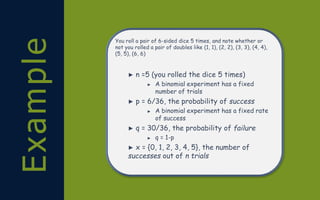
► x = {0, 1, 2, 3, 4, 5}, the number of
successes out of n trials
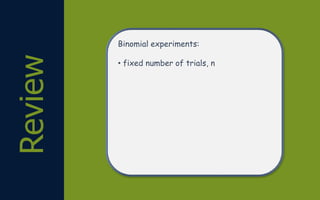
Review Binomial experiments:
• fixed number of trials, n
Review Binomial experiments:
• fixed number of trials, n
• Probability of success, p, is the same
for all trials
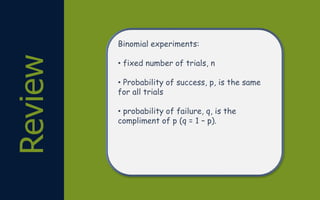
Review Binomial experiments:
• fixed number of trials, n
• Probability of success, p, is the same
for all trials
• probability of failure, q, is the
compliment of p (q = 1 – p).
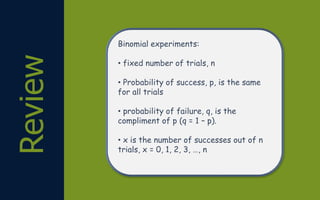
Review Binomial experiments:
• fixed number of trials, n
• Probability of success, p, is the same
for all trials
• probability of failure, q, is the
compliment of p (q = 1 – p).
• x is the number of successes out of n
trials, x = 0, 1, 2, 3, …, n

Binomial experiments

  • 1.
  • 2.
    Definition Binomial Experiment: ►experimentis repeated for fixed number of trials
  • 3.
    Definition Binomial Experiment: ►experimentis repeated for fixed number of trials ► two possible outcomes:
  • 4.
    Definition Binomial Experiment: ►experimentis repeated for fixed number of trials ► two possible outcomes: ► Success or Failure
  • 5.
    Definition Binomial Experiment: ►experimentis repeated for fixed number of trials ► two possible outcomes: ► Success or Failure ► probability of success is constant
  • 6.
    Definition Binomial Experiment: ►experimentis repeated for fixed number of trials ► two possible outcomes: ► Success or Failure ► probability of success is constant ► x counts the number of successful trials
  • 7.
    Notation Symbol Description n thenumber of times a trial is repeated
  • 8.
    Notation Symbol Description n thenumber of times a trial is repeated p the probability of success
  • 9.
    Notation Symbol Description n thenumber of times a trial is repeated p the probability of success q the probability of failure
  • 10.
    Notation Symbol Description n thenumber of times a trial is repeated p the probability of success q the probability of failure x the number of successes out of n trials
  • 11.
    Example You rolla pair of 6-sided dice 5 times, and note whether or not you rolled a pair of doubles like (1, 1), (2, 2), (3, 3), (4, 4), (5, 5), (6, 6)
  • 12.
    Example You rolla pair of 6-sided dice 5 times, and note whether or not you rolled a pair of doubles like (1, 1), (2, 2), (3, 3), (4, 4), (5, 5), (6, 6) ► n =5 (you rolled the dice 5 times) ► A binomial experiment has a fixed number of trials
  • 13.
    Example You rolla pair of 6-sided dice 5 times, and note whether or not you rolled a pair of doubles like (1, 1), (2, 2), (3, 3), (4, 4), (5, 5), (6, 6) ► n =5 (you rolled the dice 5 times) ► A binomial experiment has a fixed number of trials
  • 14.
    Example You rolla pair of 6-sided dice 5 times, and note whether or not you rolled a pair of doubles like (1, 1), (2, 2), (3, 3), (4, 4), (5, 5), (6, 6) ► n =5 (you rolled the dice 5 times) ► A binomial experiment has a fixed number of trials
  • 15.
    Example You rolla pair of 6-sided dice 5 times, and note whether or not you rolled a pair of doubles like (1, 1), (2, 2), (3, 3), (4, 4), (5, 5), (6, 6) ► n =5 (you rolled the dice 5 times) ► A binomial experiment has a fixed number of trials
  • 16.
    Example You rolla pair of 6-sided dice 5 times, and note whether or not you rolled a pair of doubles like (1, 1), (2, 2), (3, 3), (4, 4), (5, 5), (6, 6) ► n =5 (you rolled the dice 5 times) ► A binomial experiment has a fixed number of trials
  • 17.
    Example You rolla pair of 6-sided dice 5 times, and note whether or not you rolled a pair of doubles like (1, 1), (2, 2), (3, 3), (4, 4), (5, 5), (6, 6) ► n =5 (you rolled the dice 5 times) ► A binomial experiment has a fixed number of trials ► p = 6/36, the probability of success ► A binomial experiment has a fixed rate of success
  • 18.
    Example You rolla pair of 6-sided dice 5 times, and note whether or not you rolled a pair of doubles like (1, 1), (2, 2), (3, 3), (4, 4), (5, 5), (6, 6) ► n =5 (you rolled the dice 5 times) ► A binomial experiment has a fixed number of trials ► p = 6/36, the probability of success ► A binomial experiment has a fixed rate of success ► q = 30/36, the probability of failure ► q = 1-p
  • 19.
    Example You rolla pair of 6-sided dice 5 times, and note whether or not you rolled a pair of doubles like (1, 1), (2, 2), (3, 3), (4, 4), (5, 5), (6, 6) ► n =5 (you rolled the dice 5 times) ► A binomial experiment has a fixed number of trials ► p = 6/36, the probability of success ► A binomial experiment has a fixed rate of success ► q = 30/36, the probability of failure ► q = 1-p ► x = {0, 1, 2, 3, 4, 5}, the number of successes out of n trials
  • 20.
  • 21.
    Review Binomial experiments: •fixed number of trials, n
  • 22.
    Review Binomial experiments: •fixed number of trials, n • Probability of success, p, is the same for all trials
  • 23.
    Review Binomial experiments: •fixed number of trials, n • Probability of success, p, is the same for all trials • probability of failure, q, is the compliment of p (q = 1 – p).
  • 24.
    Review Binomial experiments: •fixed number of trials, n • Probability of success, p, is the same for all trials • probability of failure, q, is the compliment of p (q = 1 – p). • x is the number of successes out of n trials, x = 0, 1, 2, 3, …, n