This document provides a 3-step process for finding all the zeros of a function:
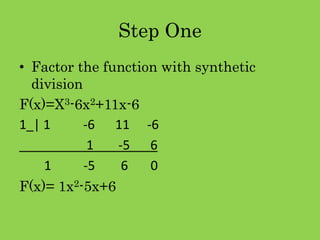
1) Factor the function using synthetic division. For the example function F(x)=X3-6x2+11x-6, this yields F(x)= 1x2-5x+6.
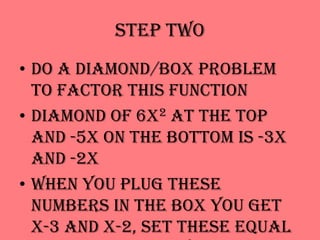
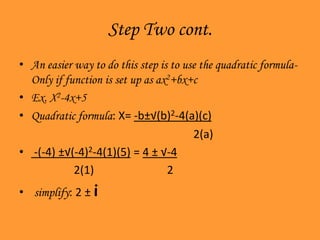
2) Factor the resulting quadratic function using the quadratic formula or completing the square. For the example, this gives the zeros as x-3 and x-2.
3) Identify the zeros by writing the factored function and graphing it. For the example, the zeros are 2, 2+i, and 2-i.