BIM for Baker
WHAT ARE THE BENEFITS OF BIM
There are many benefits and solutions
BIM is used for visualizations, quantity takeoffs, and design validation. These can be done
without the need for BIM, but BIM allows it to be done with very little error, more precession,
and more importantly much much quicker.
Secondly, BIM is great for Virtual Rehearsals. Where we build the job on the computer first,
logistics included, and make sure the schedule makes sense.
What does BIM do currently?
•PreConstruction
• Quantity Takeoffs
• Visualizations
• Schedule Validation
• Media – 4D (3D Model + Schedule) videos
• Logistics Plans
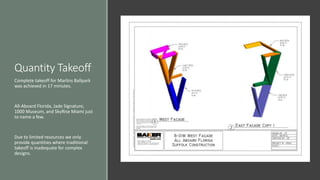
Quantity Takeoff
Complete takeoff for Marlins Ballpark
was achieved in 17 minutes.
All-Aboard Florida, Jade Signature,
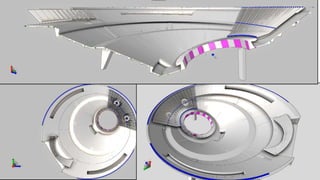
1000 Museum, and SkyRise Miami just
to name a few.
Due to limited resources we only
provide quantities where traditional
takeoff is inadequate for complex
designs.
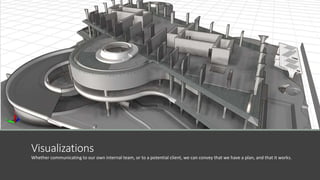
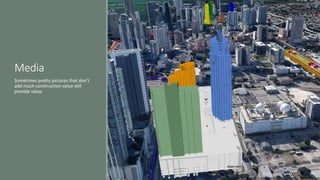
Visualizations
Whether communicating to our own internal team, or to a potential client, we can convey that we have a plan, and that it works.
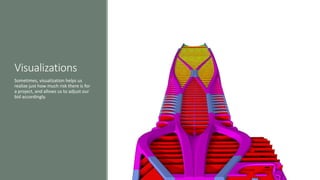
Visualizations
Sometimes, visualization helps us
realize just how much risk there is for
a project, and allows us to adjust our
bid accordingly.
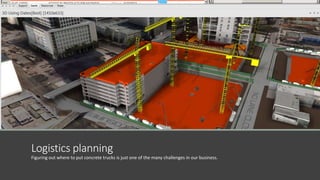
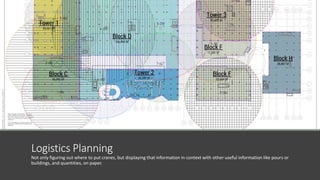
Logistics planning
Figuring out where to put concrete trucks is just one of the many challenges in our business.
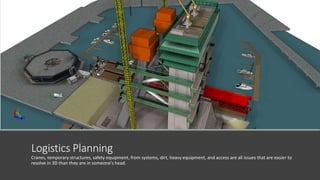
Logistics Planning
Cranes, temporary structures, safety equipment, from systems, dirt, heavy equipment, and access are all issues that are easier to
resolve in 3D than they are in someone's head.
Logistics Planning
Not only figuring out where to put cranes, but displaying that information in context with other useful information like pours or
buildings, and quantities, on paper.
Media
Sometimes pretty pictures that don’t
add much construction value still
provide value.
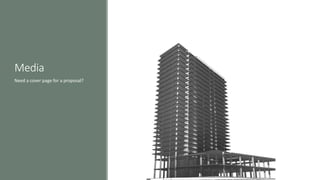
Media
Need a cover page for a proposal?
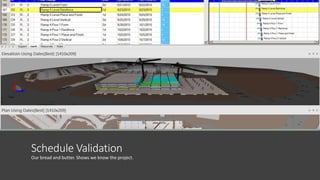
Schedule Validation
Our bread and butter. Shows we know the project.
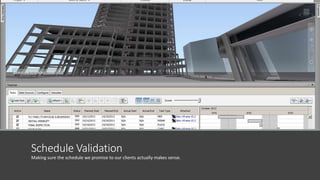
Schedule Validation
Making sure the schedule we promise to our clients actually makes sense.
What does BIM do currently?
•Operations
• Line Drawings
• Backgrounds for Engineering
• Visualizations
• Logistics Planning
• Spatial Coordination
• Schedule Validation
• Design Validation
• Quantity Takeoff
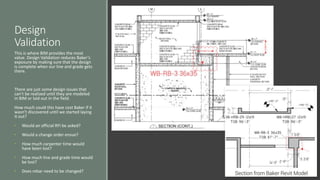
Design
Validation
This is where BIM provides the most
value. Design Validation reduces Baker’s
exposure by making sure that the design
is complete when our line and grade gets
there.
There are just some design issues that
can’t be realized until they are modeled
in BIM or laid out in the field.
How much could this have cost Baker if it
wasn’t discovered until we started laying
it out?
• Would an official RFI be asked?
• Would a change order ensue?
• How much carpenter time would
have been lost?
• How much line and grade time would
be lost?
• Does rebar need to be changed?
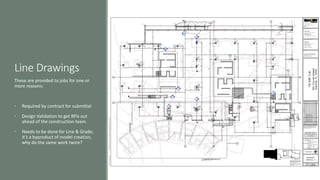
Line Drawings
These are provided to jobs for one or
more reasons:
• Required by contract for submittal
• Design Validation to get RFIs out
ahead of the construction team
• Needs to be done for Line & Grade,
it’s a byproduct of model creation,
why do the same work twice?
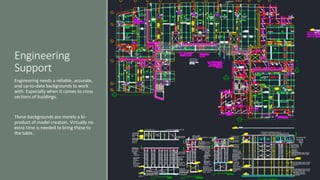
Engineering
Support
Engineering needs a reliable, accurate,
and up-to-date backgrounds to work
with. Especially when it comes to cross
sections of buildings.
These backgrounds are merely a bi-
product of model creation. Virtually no
extra time is needed to bring these to
the table.
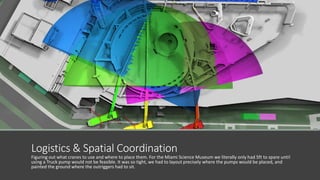
Logistics & Spatial Coordination
Figuring out what cranes to use and where to place them. For the Miami Science Museum we literally only had 5ft to spare until
using a Truck pump would not be feasible. It was so tight, we had to layout precisely where the pumps would be placed, and
painted the ground where the outriggers had to sit.
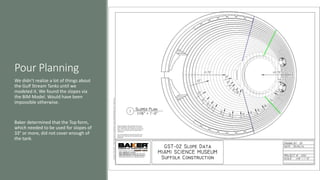
Pour Planning
We didn’t realize a lot of things about
the Gulf Stream Tanks until we
modeled it. We found the slopes via
the BIM Model. Would have been
impossible otherwise.
Baker determined that the Top form,
which needed to be used for slopes of
33° or more, did not cover enough of
the tank.
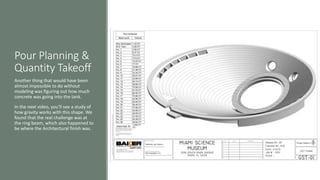
Pour Planning &
Quantity Takeoff
Another thing that would have been
almost impossible to do without
modeling was figuring out how much
concrete was going into the tank.
In the next video, you’ll see a study of
how gravity works with this shape. We
found that the real challenge was at
the ring beam, which also happened to
be where the Architectural finish was.
Schedules
1. 90% of construction schedules that weren’t validated using BIM have 5 or more logical
errors.
2. This is fine because 90% of construction schedules are so long and complicated that no one
bothers to look at them.
3. BIM can solve that with 4D (3D + time).
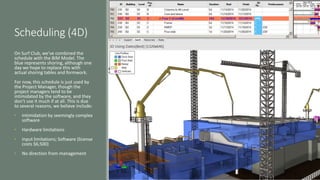
Scheduling (4D)
On Surf Club, we’ve combined the
schedule with the BIM Model. The
blue represents shoring, although one
day we hope to replace this with
actual shoring tables and formwork.
For now, this schedule is just used by
the Project Manager, though the
project managers tend to be
intimidated by the software, and they
don’t use it much if at all. This is due
to several reasons, we believe include:
• Intimidation by seemingly complex
software
• Hardware limitations
• Input limitations; Software (license
costs $6,500)
• No direction from management
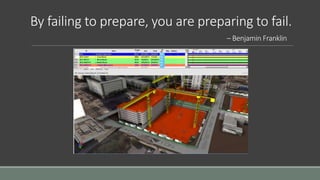
By failing to prepare, you are preparing to fail.
– Benjamin Franklin
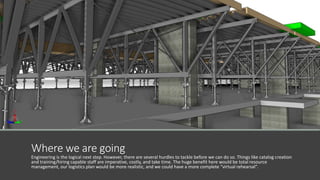
Where we are going
Engineering is the logical next step. However, there are several hurdles to tackle before we can do so. Things like catalog creation
and training/hiring capable staff are imperative, costly, and take time. The huge benefit here would be total resource
management, our logistics plan would be more realistic, and we could have a more complete “virtual rehearsal”.
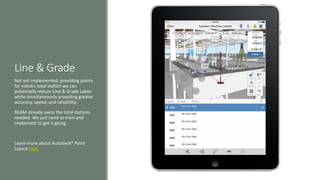
Line & Grade
Not yet implemented, providing points
for robotic total station we can
potentially reduce Line & Grade Labor
while simultaneously providing greater
accuracy, speed, and reliability.
BEAM already owns the total stations
needed. We just need to train and
implement to get it going.
Learn more about Autodesk® Point
Layout here
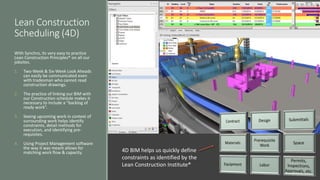
Lean Construction
Scheduling (4D)
With Synchro, its very easy to practice
Lean Construction Principles® on all our
jobsites.
1. Two-Week & Six-Week Look Aheads
can easily be communicated even
with tradesman who cannot read
construction drawings.
2. The practice of linking our BIM with
our Construction schedule makes it
necessary to include a “backlog of
ready work”.
3. Seeing upcoming work in context of
surrounding work helps identify
constraints, detail methods for
execution, and identifying pre-
requisites.
4. Using Project Management software
the way it was meant allows for
matching work flow & capacity. 4D BIM helps us quickly define
constraints as identified by the
Lean Construction Institute®
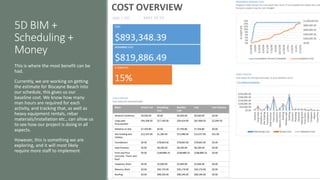
5D BIM +
Scheduling +
Money
This is where the most benefit can be
had.
Currently, we are working on getting
the estimate for Biscayne Beach into
our schedule, this gives us our
baseline cost. We know how many
man hours are required for each
activity, and tracking that, as well as
heavy equipment rentals, rebar
materials/installation etc., can allow us
to see how our project is doing in all
aspects.
However, this is something we are
exploring, and it will most likely
require more staff to implement.
BIM for Baker

BIM for Baker

  • 1.
    BIM for Baker WHATARE THE BENEFITS OF BIM
  • 2.
    There are manybenefits and solutions BIM is used for visualizations, quantity takeoffs, and design validation. These can be done without the need for BIM, but BIM allows it to be done with very little error, more precession, and more importantly much much quicker. Secondly, BIM is great for Virtual Rehearsals. Where we build the job on the computer first, logistics included, and make sure the schedule makes sense.
  • 3.
    What does BIMdo currently? •PreConstruction • Quantity Takeoffs • Visualizations • Schedule Validation • Media – 4D (3D Model + Schedule) videos • Logistics Plans
  • 4.
    Quantity Takeoff Complete takeofffor Marlins Ballpark was achieved in 17 minutes. All-Aboard Florida, Jade Signature, 1000 Museum, and SkyRise Miami just to name a few. Due to limited resources we only provide quantities where traditional takeoff is inadequate for complex designs.
  • 5.
    Visualizations Whether communicating toour own internal team, or to a potential client, we can convey that we have a plan, and that it works.
  • 6.
    Visualizations Sometimes, visualization helpsus realize just how much risk there is for a project, and allows us to adjust our bid accordingly.
  • 7.
    Logistics planning Figuring outwhere to put concrete trucks is just one of the many challenges in our business.
  • 8.
    Logistics Planning Cranes, temporarystructures, safety equipment, from systems, dirt, heavy equipment, and access are all issues that are easier to resolve in 3D than they are in someone's head.
  • 9.
    Logistics Planning Not onlyfiguring out where to put cranes, but displaying that information in context with other useful information like pours or buildings, and quantities, on paper.
  • 10.
    Media Sometimes pretty picturesthat don’t add much construction value still provide value.
  • 11.
    Media Need a coverpage for a proposal?
  • 12.
    Schedule Validation Our breadand butter. Shows we know the project.
  • 13.
    Schedule Validation Making surethe schedule we promise to our clients actually makes sense.
  • 14.
    What does BIMdo currently? •Operations • Line Drawings • Backgrounds for Engineering • Visualizations • Logistics Planning • Spatial Coordination • Schedule Validation • Design Validation • Quantity Takeoff
  • 15.
    Design Validation This is whereBIM provides the most value. Design Validation reduces Baker’s exposure by making sure that the design is complete when our line and grade gets there. There are just some design issues that can’t be realized until they are modeled in BIM or laid out in the field. How much could this have cost Baker if it wasn’t discovered until we started laying it out? • Would an official RFI be asked? • Would a change order ensue? • How much carpenter time would have been lost? • How much line and grade time would be lost? • Does rebar need to be changed?
  • 16.
    Line Drawings These areprovided to jobs for one or more reasons: • Required by contract for submittal • Design Validation to get RFIs out ahead of the construction team • Needs to be done for Line & Grade, it’s a byproduct of model creation, why do the same work twice?
  • 17.
    Engineering Support Engineering needs areliable, accurate, and up-to-date backgrounds to work with. Especially when it comes to cross sections of buildings. These backgrounds are merely a bi- product of model creation. Virtually no extra time is needed to bring these to the table.
  • 18.
    Logistics & SpatialCoordination Figuring out what cranes to use and where to place them. For the Miami Science Museum we literally only had 5ft to spare until using a Truck pump would not be feasible. It was so tight, we had to layout precisely where the pumps would be placed, and painted the ground where the outriggers had to sit.
  • 19.
    Pour Planning We didn’trealize a lot of things about the Gulf Stream Tanks until we modeled it. We found the slopes via the BIM Model. Would have been impossible otherwise. Baker determined that the Top form, which needed to be used for slopes of 33° or more, did not cover enough of the tank.
  • 20.
    Pour Planning & QuantityTakeoff Another thing that would have been almost impossible to do without modeling was figuring out how much concrete was going into the tank. In the next video, you’ll see a study of how gravity works with this shape. We found that the real challenge was at the ring beam, which also happened to be where the Architectural finish was.
  • 22.
    Schedules 1. 90% ofconstruction schedules that weren’t validated using BIM have 5 or more logical errors. 2. This is fine because 90% of construction schedules are so long and complicated that no one bothers to look at them. 3. BIM can solve that with 4D (3D + time).
  • 23.
    Scheduling (4D) On SurfClub, we’ve combined the schedule with the BIM Model. The blue represents shoring, although one day we hope to replace this with actual shoring tables and formwork. For now, this schedule is just used by the Project Manager, though the project managers tend to be intimidated by the software, and they don’t use it much if at all. This is due to several reasons, we believe include: • Intimidation by seemingly complex software • Hardware limitations • Input limitations; Software (license costs $6,500) • No direction from management
  • 24.
    By failing toprepare, you are preparing to fail. – Benjamin Franklin
  • 25.
    Where we aregoing Engineering is the logical next step. However, there are several hurdles to tackle before we can do so. Things like catalog creation and training/hiring capable staff are imperative, costly, and take time. The huge benefit here would be total resource management, our logistics plan would be more realistic, and we could have a more complete “virtual rehearsal”.
  • 26.
    Line & Grade Notyet implemented, providing points for robotic total station we can potentially reduce Line & Grade Labor while simultaneously providing greater accuracy, speed, and reliability. BEAM already owns the total stations needed. We just need to train and implement to get it going. Learn more about Autodesk® Point Layout here
  • 27.
    Lean Construction Scheduling (4D) WithSynchro, its very easy to practice Lean Construction Principles® on all our jobsites. 1. Two-Week & Six-Week Look Aheads can easily be communicated even with tradesman who cannot read construction drawings. 2. The practice of linking our BIM with our Construction schedule makes it necessary to include a “backlog of ready work”. 3. Seeing upcoming work in context of surrounding work helps identify constraints, detail methods for execution, and identifying pre- requisites. 4. Using Project Management software the way it was meant allows for matching work flow & capacity. 4D BIM helps us quickly define constraints as identified by the Lean Construction Institute®
  • 28.
    5D BIM + Scheduling+ Money This is where the most benefit can be had. Currently, we are working on getting the estimate for Biscayne Beach into our schedule, this gives us our baseline cost. We know how many man hours are required for each activity, and tracking that, as well as heavy equipment rentals, rebar materials/installation etc., can allow us to see how our project is doing in all aspects. However, this is something we are exploring, and it will most likely require more staff to implement.