The Billion  Business Model  Course By Marcelo Honores
" Ignore basic economic principles at your own risk. Technology changes. Economic laws do not."  Carl Shapiro and Hal R. Varian in Information Rules
Agenda Introduction How to  conquer entire markets  in the hyperconnected world What to  sell  and what to  share  in the hyperconnected world How to create  eternal loyalty  through customer communities Creating value with  partners  through business  ecosystems Using Information and Communication Technologies to build the  Infraestructure of Cooperation The  Billion Business Model
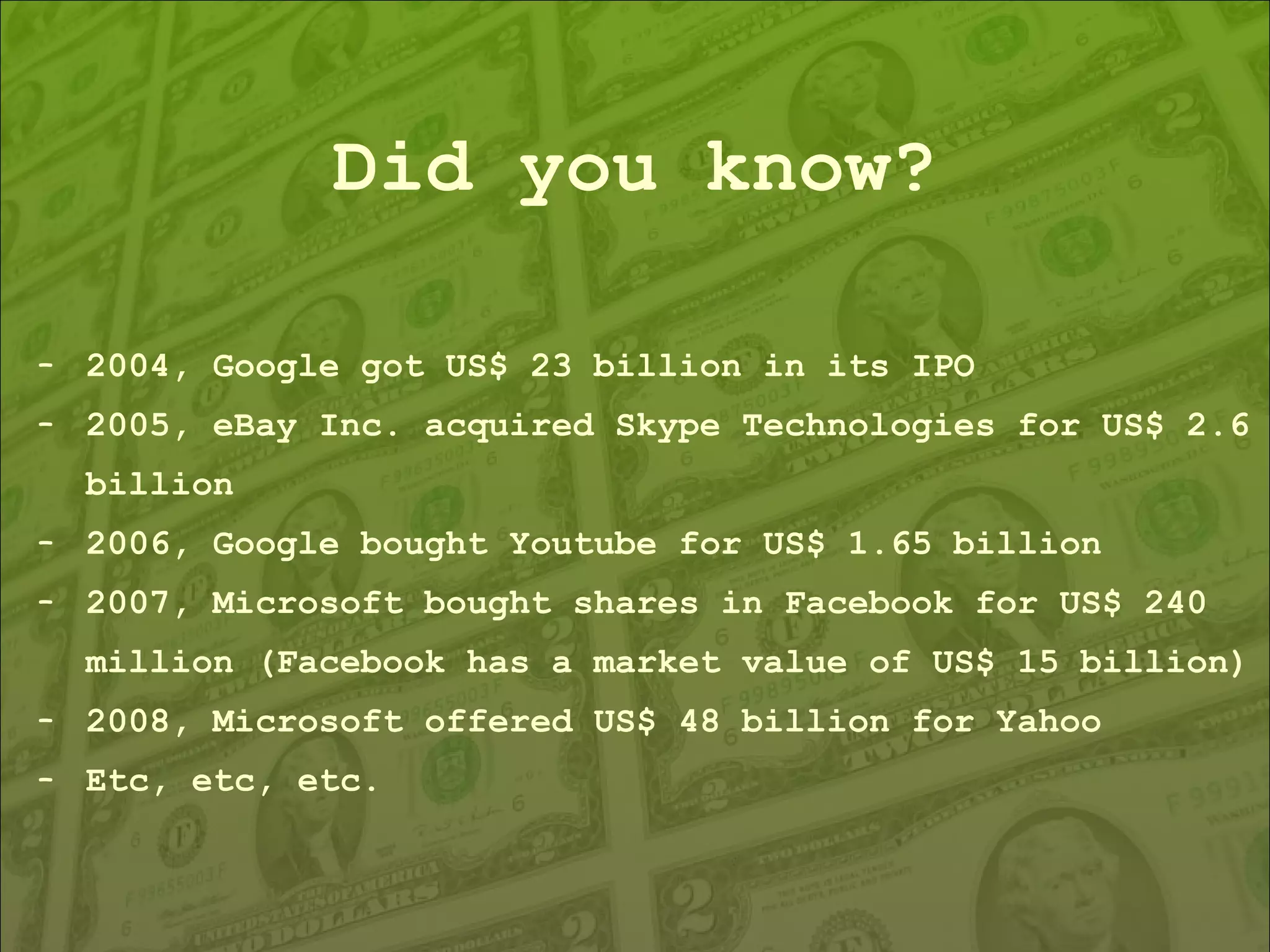
Did you know? 2004, Google got US$ 23 billion in its IPO 2005, eBay Inc. acquired Skype Technologies for US$ 2.6 billion 2006, Google bought Youtube for US$ 1.65 billion 2007, Microsoft bought shares in Facebook for US$ 240 million (Facebook has a market value of US$ 15 billion) 2008, Microsoft offered US$ 48 billion for Yahoo Etc, etc, etc.
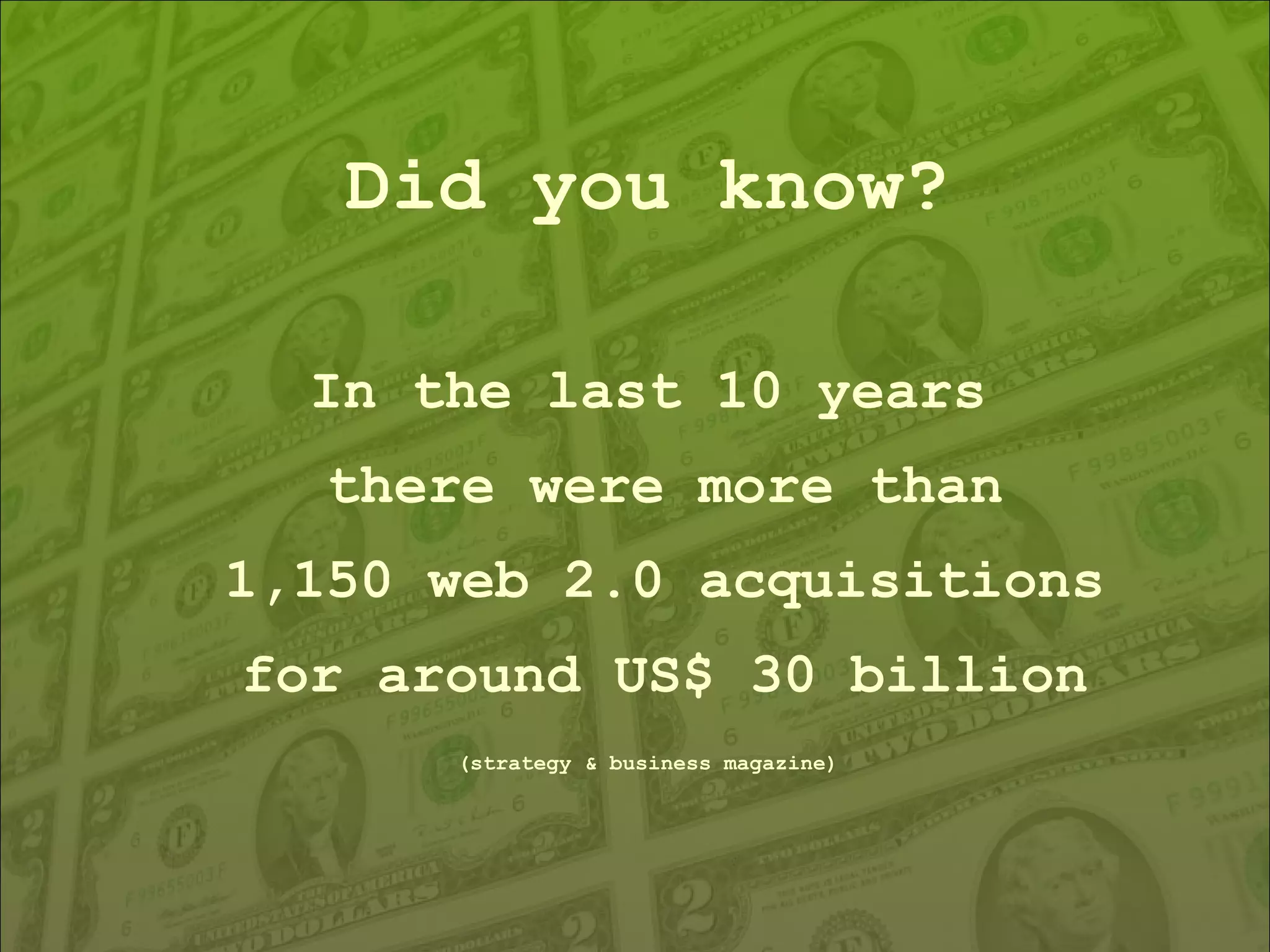
Did you know? In the last 10 years there were more than 1,150 web 2.0 acquisitions for around US$ 30 billion (strategy & business magazine)
Did you know that?
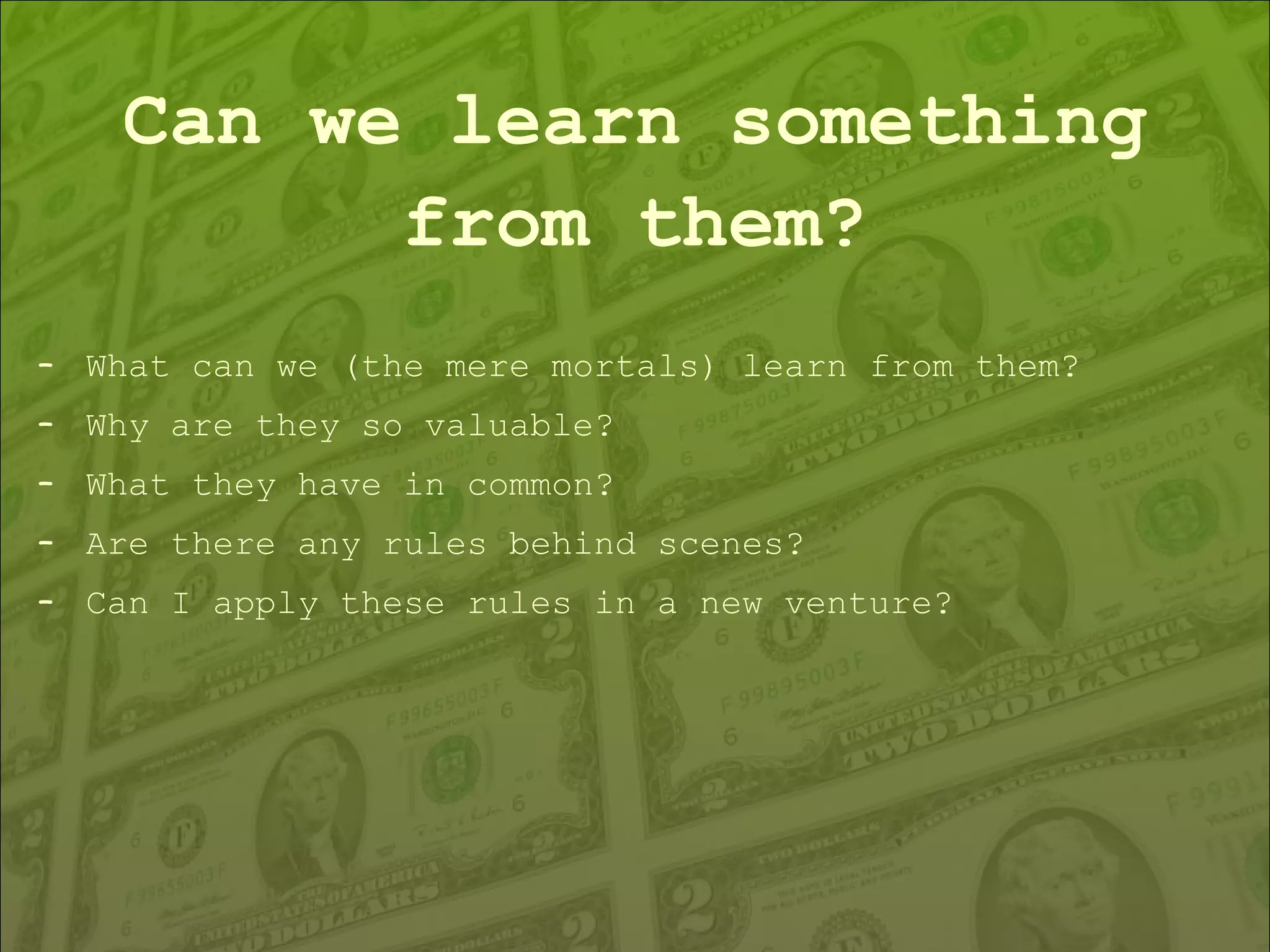
Can we learn something from them? What can we (the mere mortals) learn from them?  Why are they so valuable? What they have in common? Are there any rules behind scenes? Can I apply these rules in a new venture?
The answer is yes
First lesson
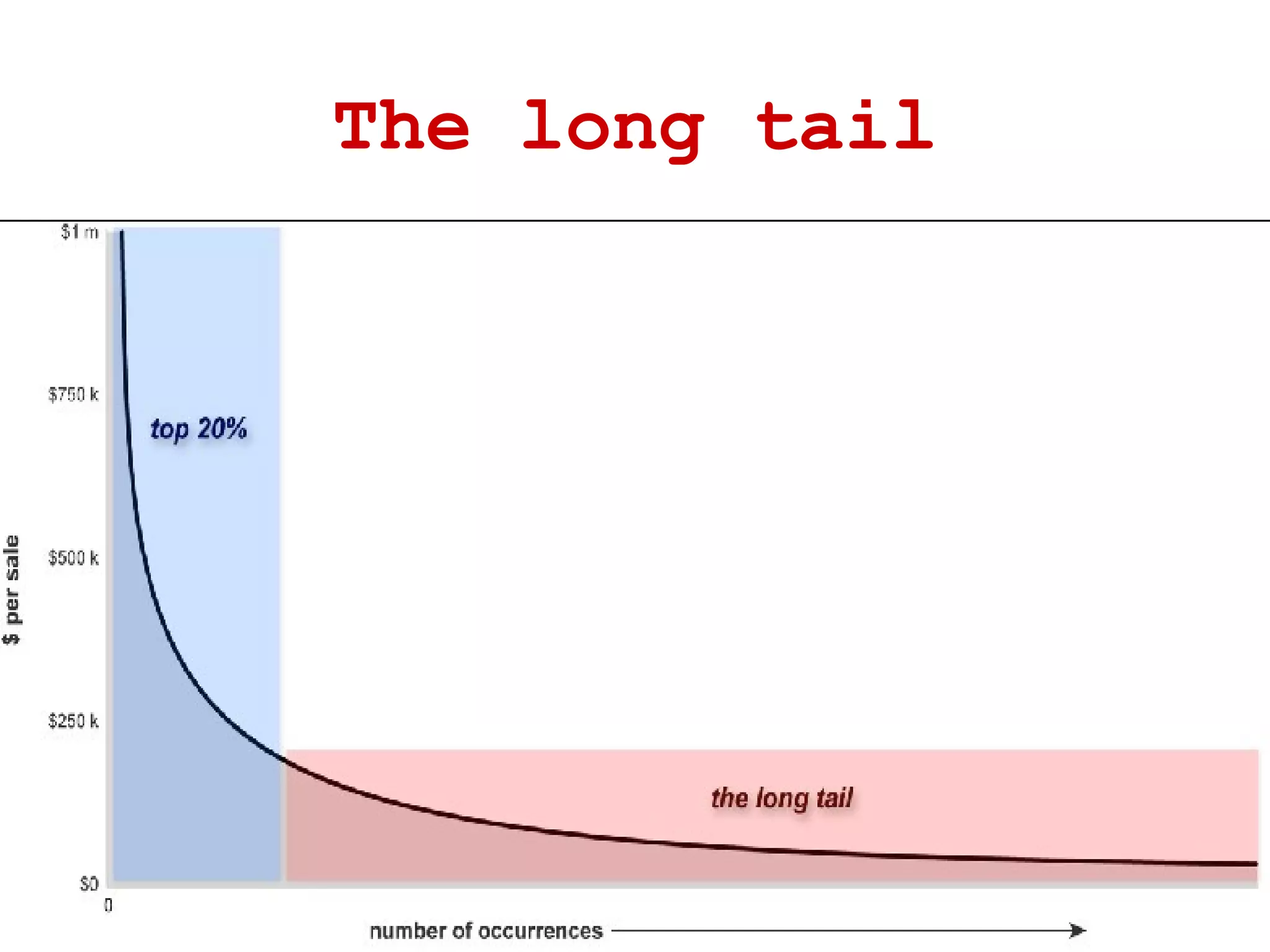
The long tail
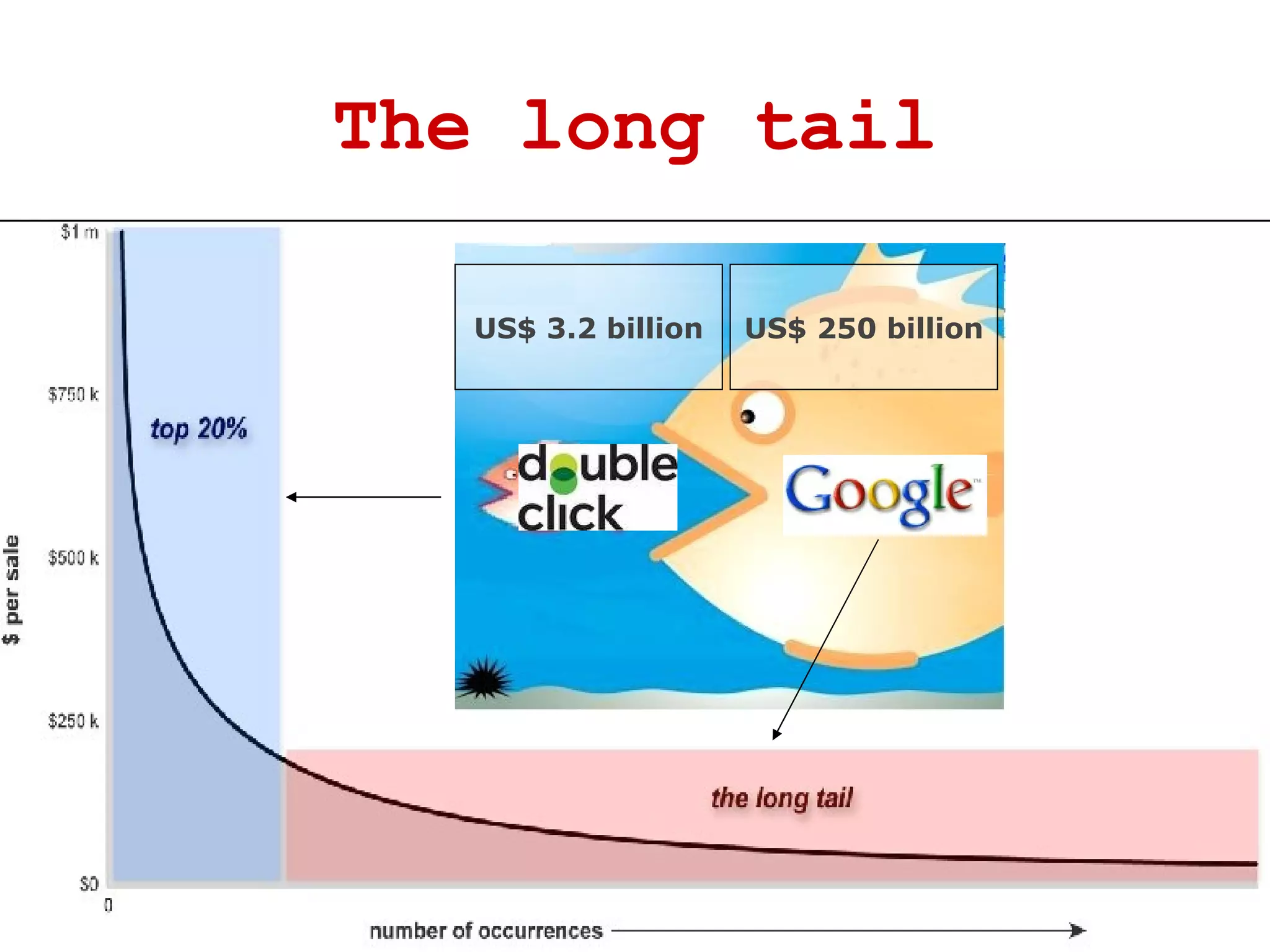
The long tail US$ 3.2 billion US$  250 billion
Agenda Introduction How to  conquer entire markets  in the hyperconnected world What to  sell  and what to  share  in the hyperconnected world How to create  eternal loyalty  through customer communities Creating value with  partners  through business  ecosystems Using Information and Communication Technologies to build the  Infraestructure of Cooperation The  Billion Business Model
How to conquer entire markets in Internet To know how to conquer entire markets in Internet, you need to review the microeconomics theory Microeconomics 101 Microeconomics of  traditional goods  (the past) Microeconomics of  shared goods  (the present) Microeconomics of  incentives  (the future) Warning!!! This part can be painful
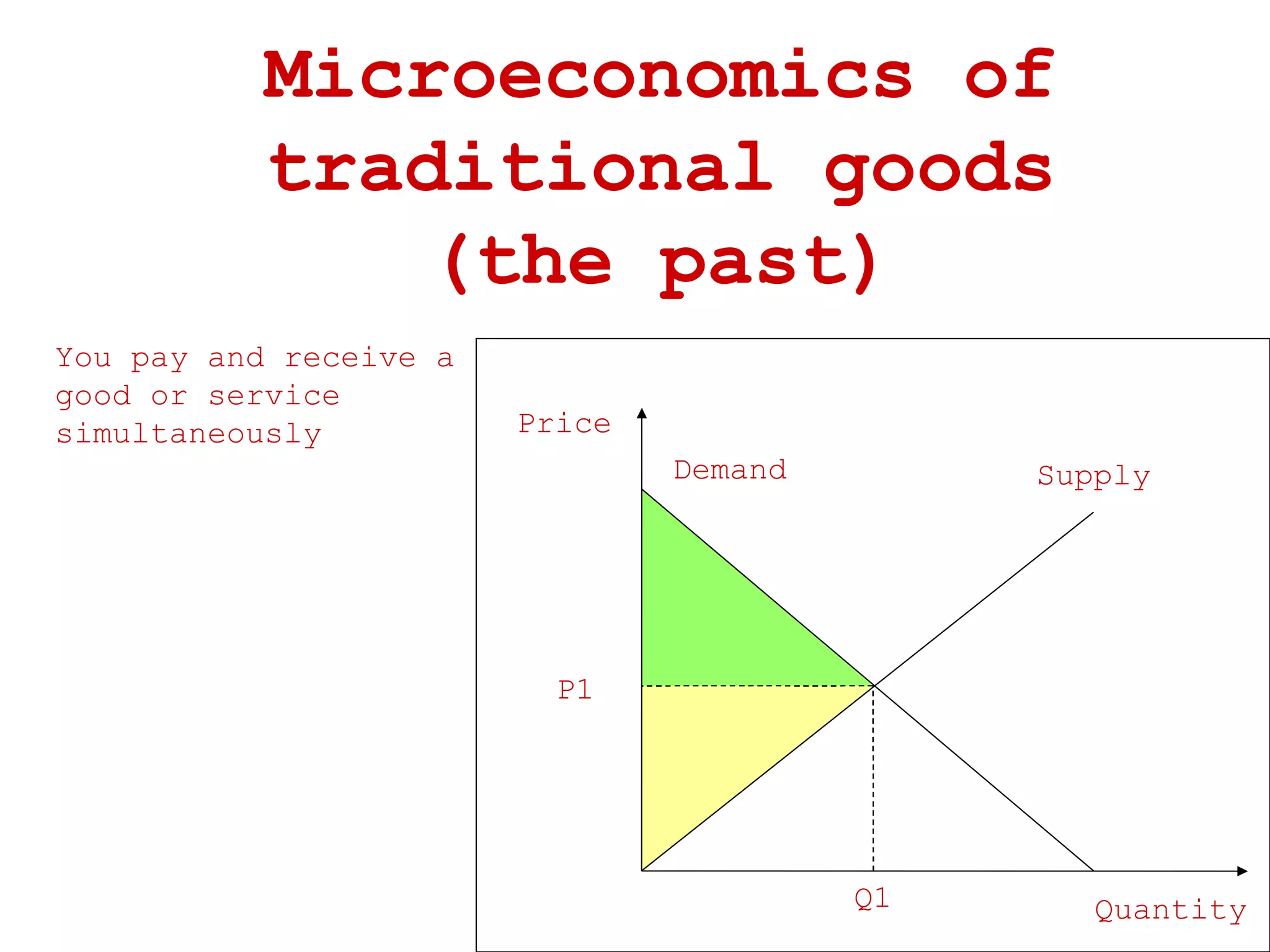
Microeconomics of traditional goods (the past) You pay and receive a good or service simultaneously Price Quantity Supply Demand P1 Q1
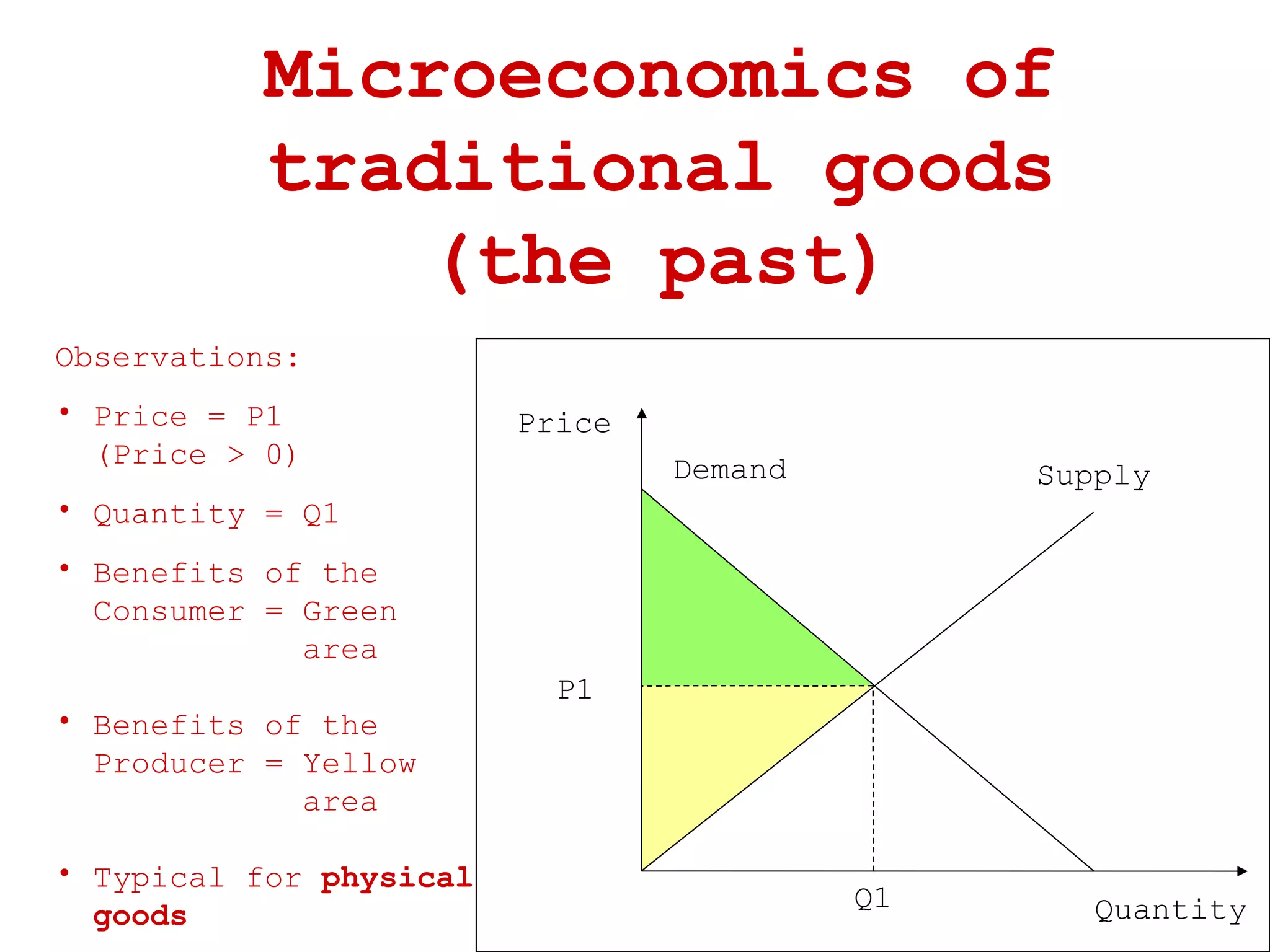
Microeconomics of traditional goods (the past) Observations: Price = P1 (Price > 0) Quantity = Q1 Benefits of the Consumer = Green area Benefits of the Producer = Yellow area Typical for  physical goods Price Quantity Supply Demand P1 Q1
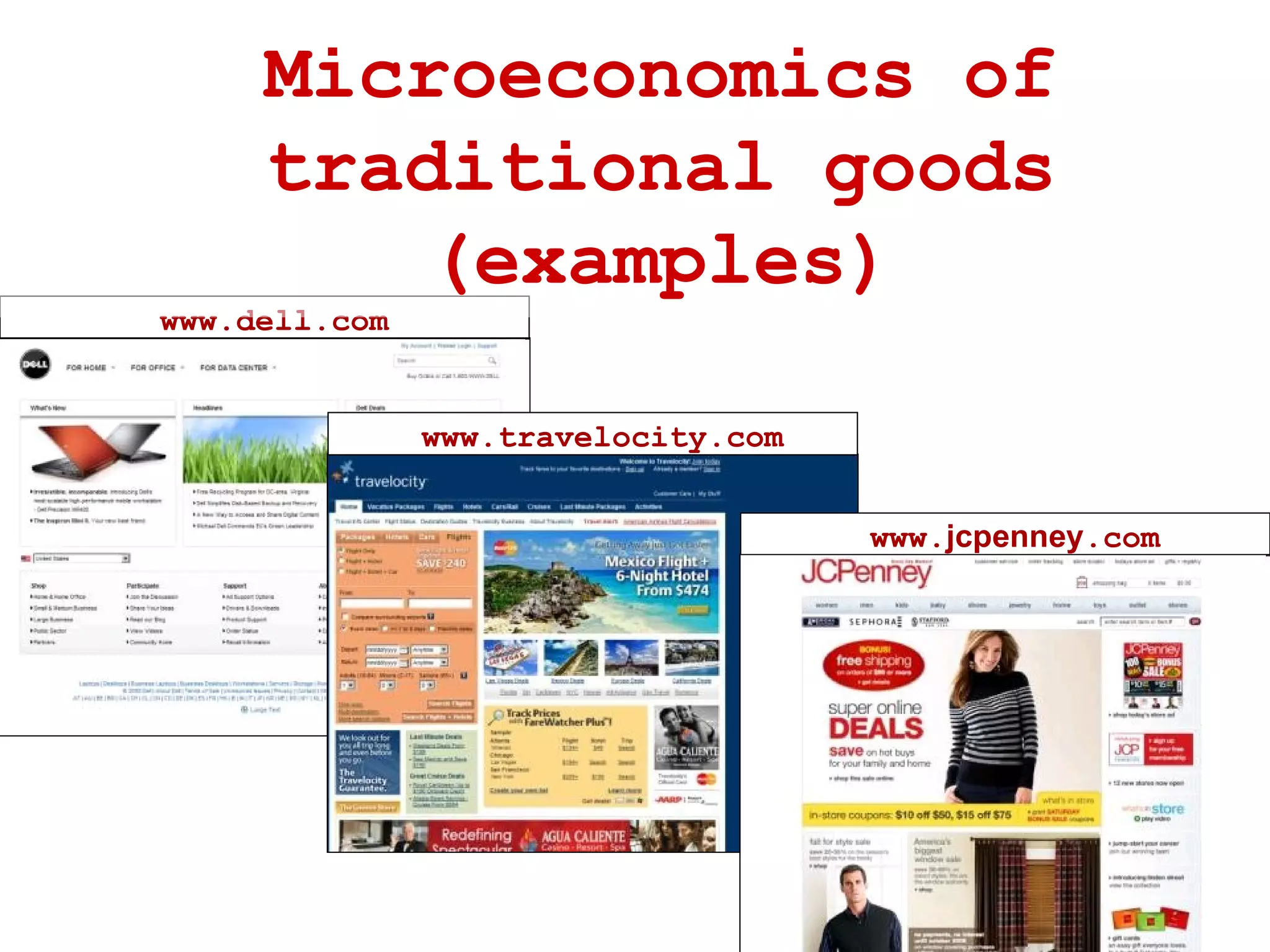
Microeconomics of traditional goods (examples) www.dell.com www.travelocity.com www. jcpenney .com
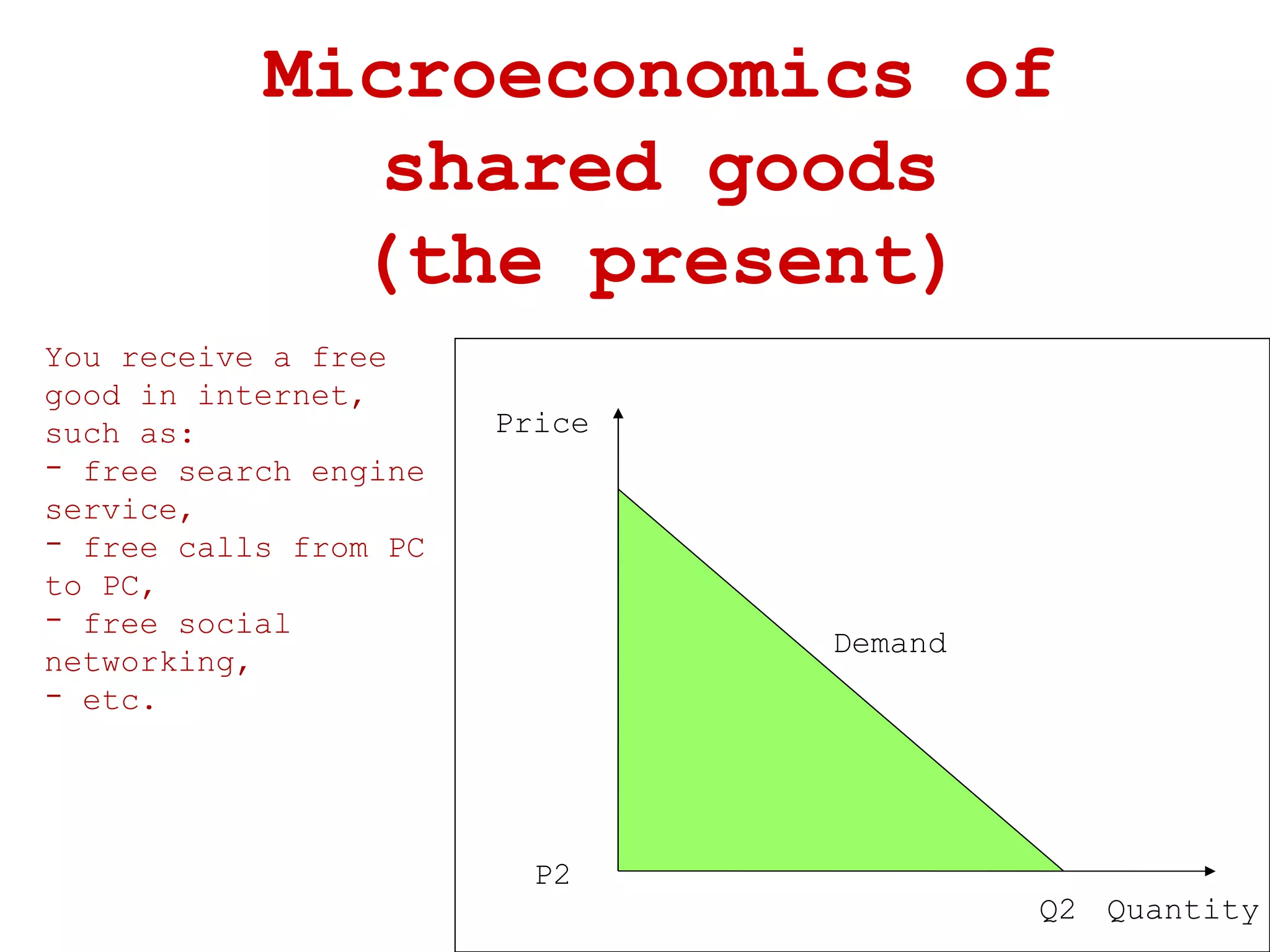
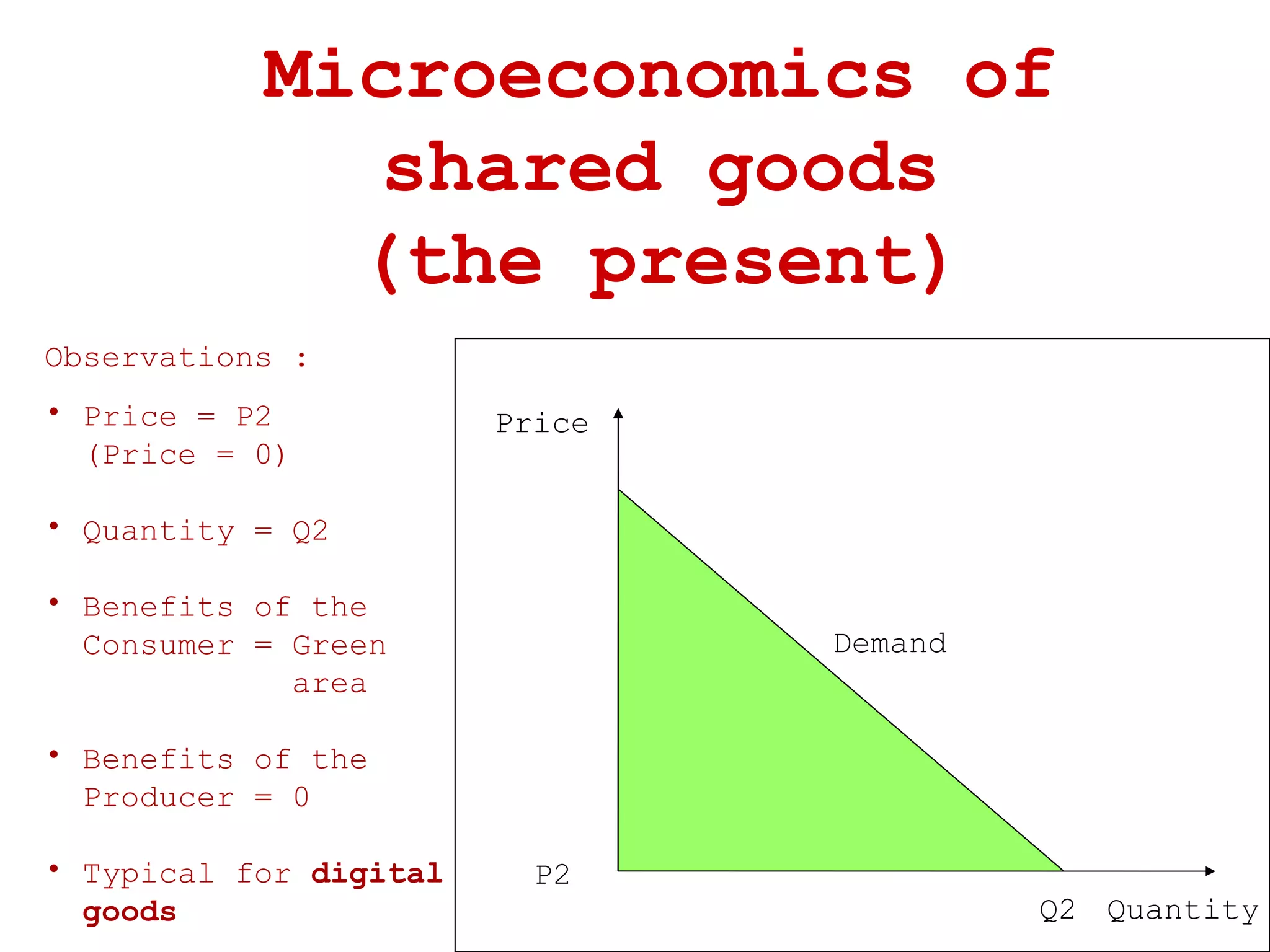
Microeconomics of shared goods (the present) You receive a free good in internet, such as: free search engine service, free calls from PC to PC, free social networking, etc. Price Quantity Demand P2 Q2
Microeconomics of shared goods (the present) Observations   : Price = P2 (Price = 0) Quantity = Q2 Benefits of the Consumer = Green area Benefits of the Producer = 0 Typical for  digital goods Price Quantity Demand P2 Q2
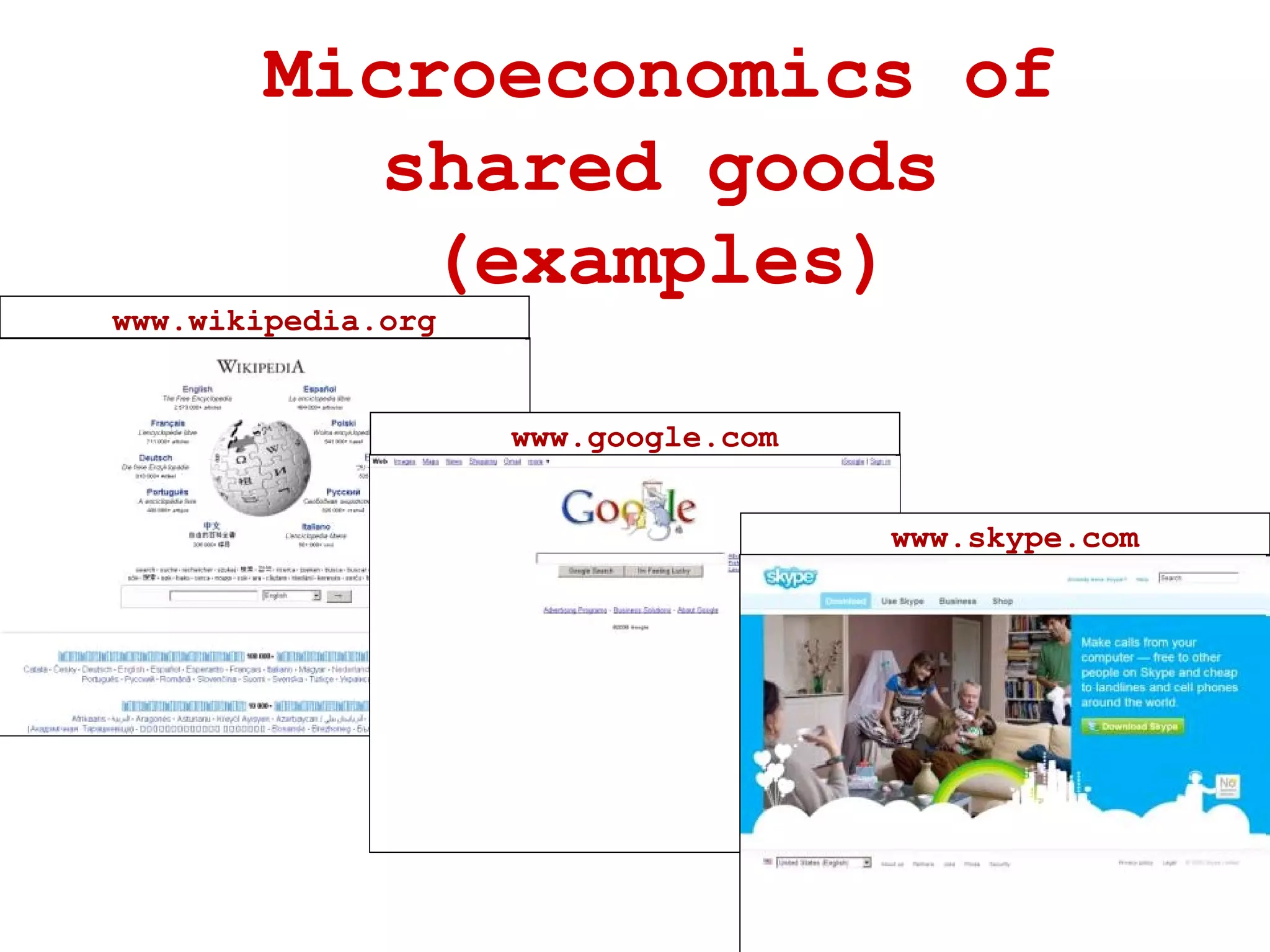
Microeconomics of shared goods (examples) www.wikipedia.org www.google.com www.skype.com
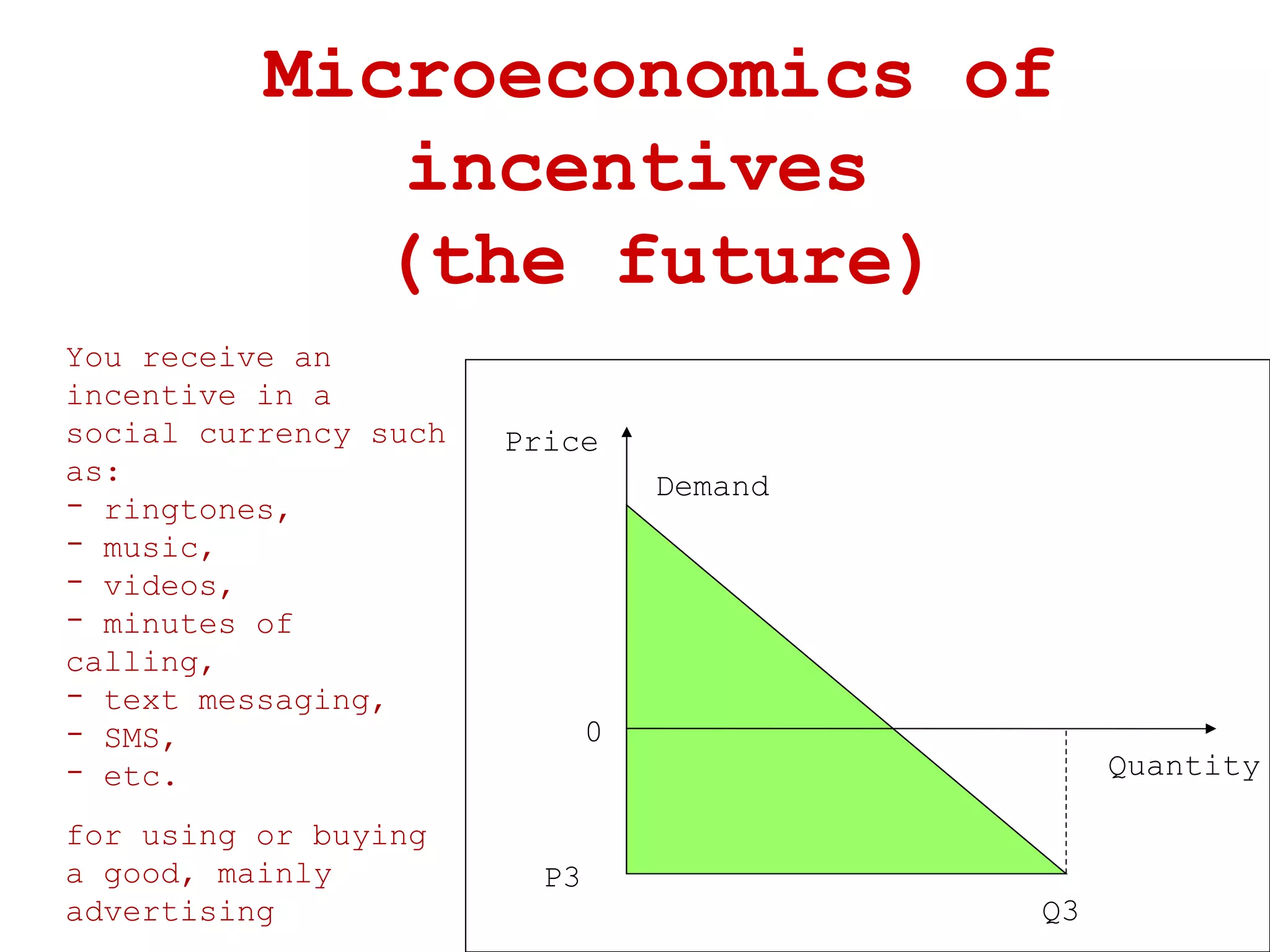
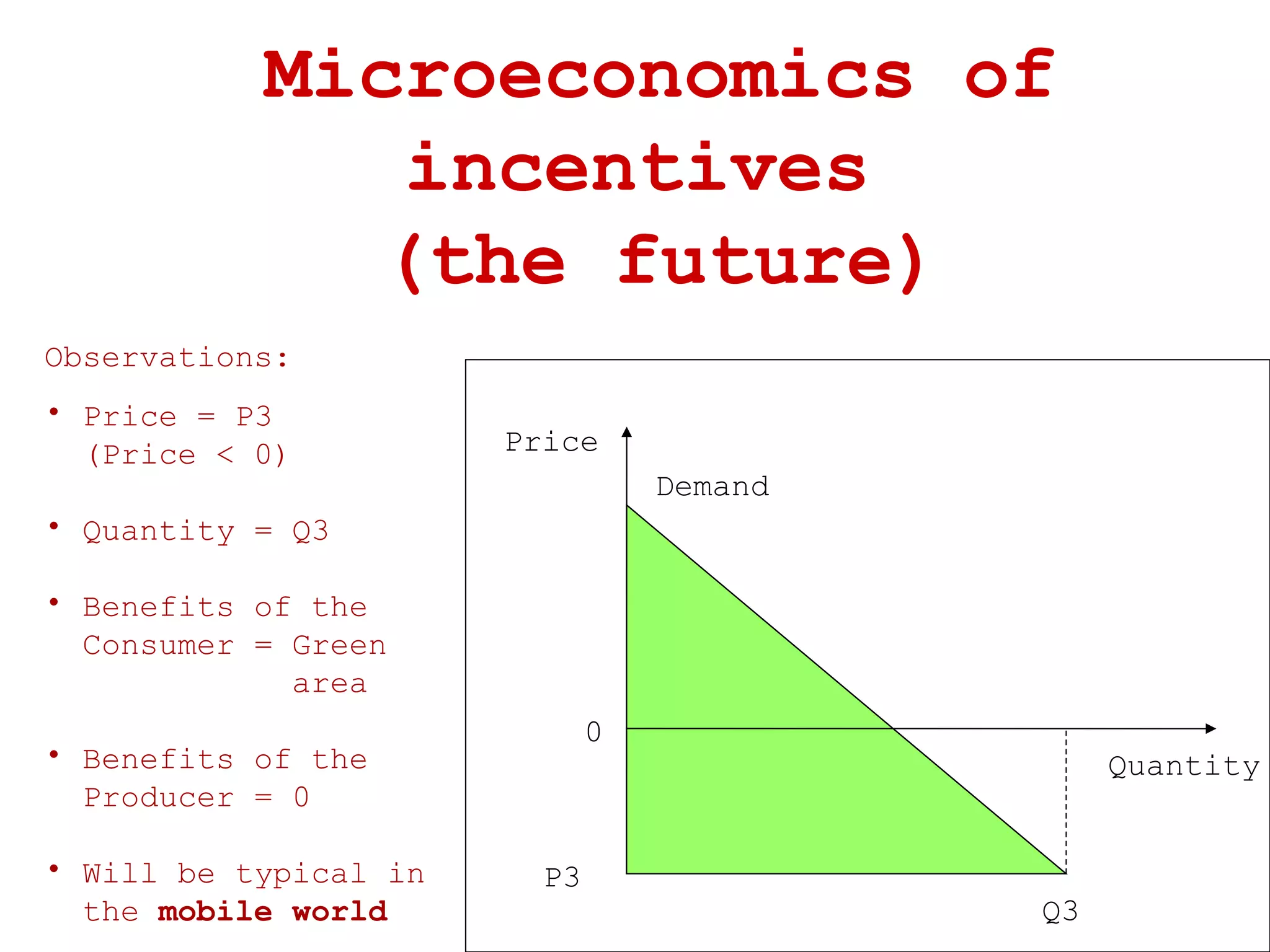
Microeconomics of incentives  (the future) You receive an incentive in a social currency such as: ringtones,  music, videos, minutes of calling, text messaging, SMS, etc.   for using or buying a good, mainly advertising Price Quantity Demand P3 Q3 0
Microeconomics of incentives  (the future) Observations: Price = P3 (Price < 0) Quantity = Q3 Benefits of the Consumer = Green area Benefits of the Producer = 0 Will be typical in the  mobile world Price Quantity Demand P3 Q3 0
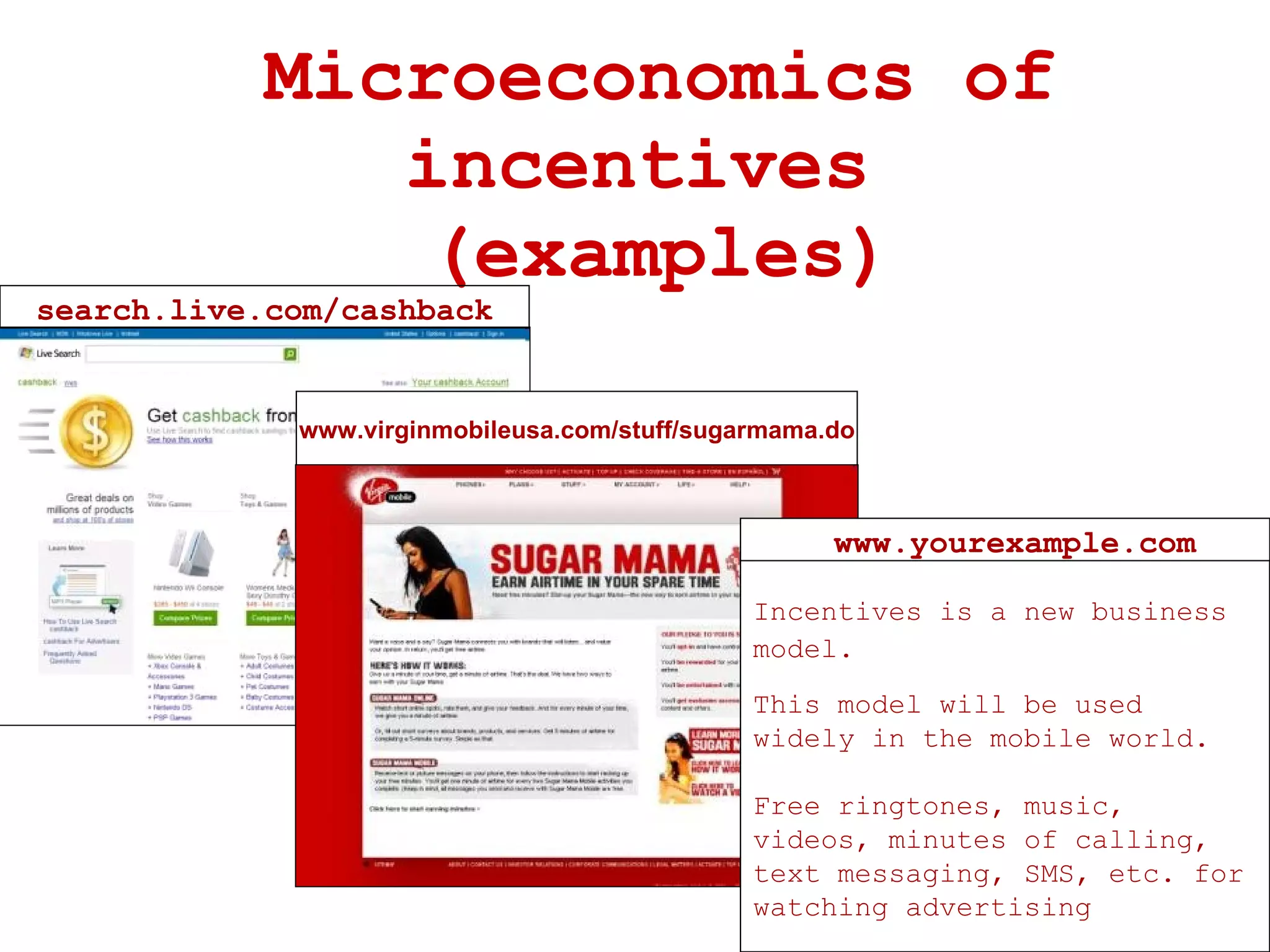
Microeconomics of incentives  (examples) search.live.com/cashback www.virginmobileusa.com/stuff/sugarmama.do Incentives is a new business model.   This model will be used widely in the mobile world. Free ringtones, music, videos, minutes of calling, text messaging, SMS, etc. for watching advertising www.yourexample.com
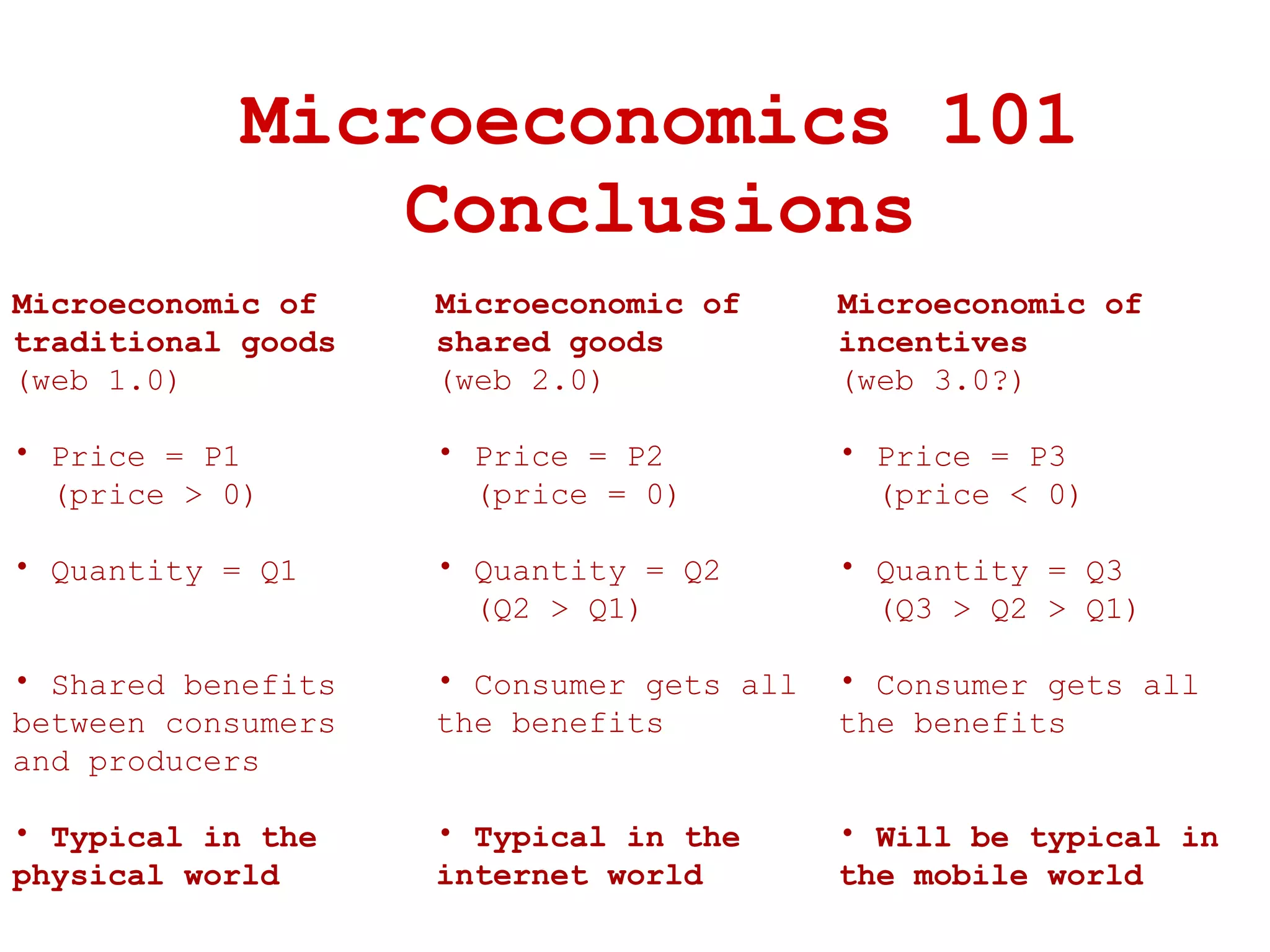
Microeconomics 101 Conclusions Microeconomic of traditional goods (web 1.0) Price = P1 (price > 0) Quantity = Q1 Shared benefits between consumers and producers Typical in the physical world Microeconomic of shared goods (web 2.0) Price = P2 (price = 0) Quantity = Q2 (Q2 > Q1) Consumer gets all the benefits Typical in the internet world Microeconomic of incentives (web 3.0?) Price = P3 (price < 0) Quantity = Q3 (Q3 > Q2 > Q1) Consumer gets all the benefits Will be typical in the mobile world
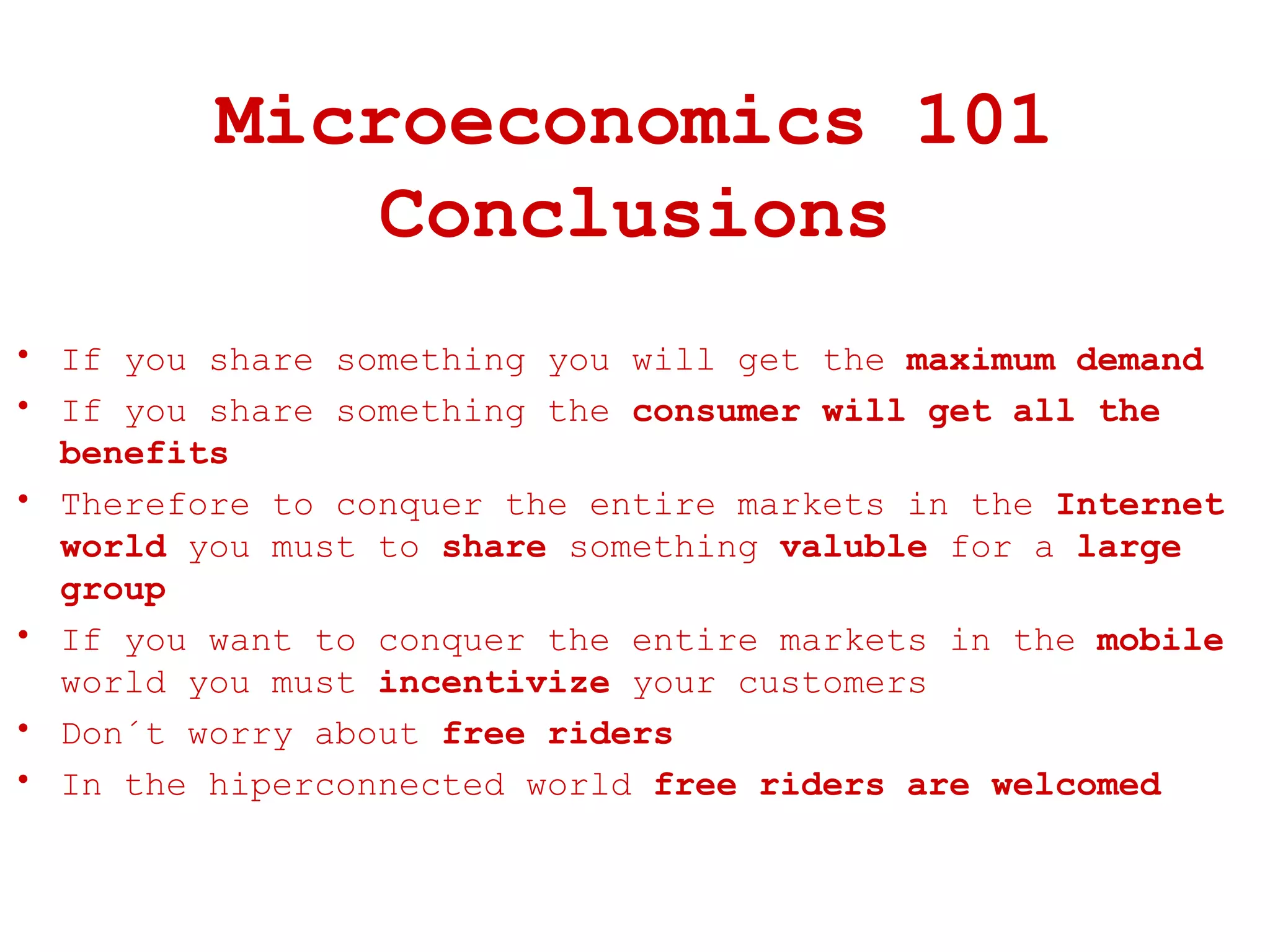
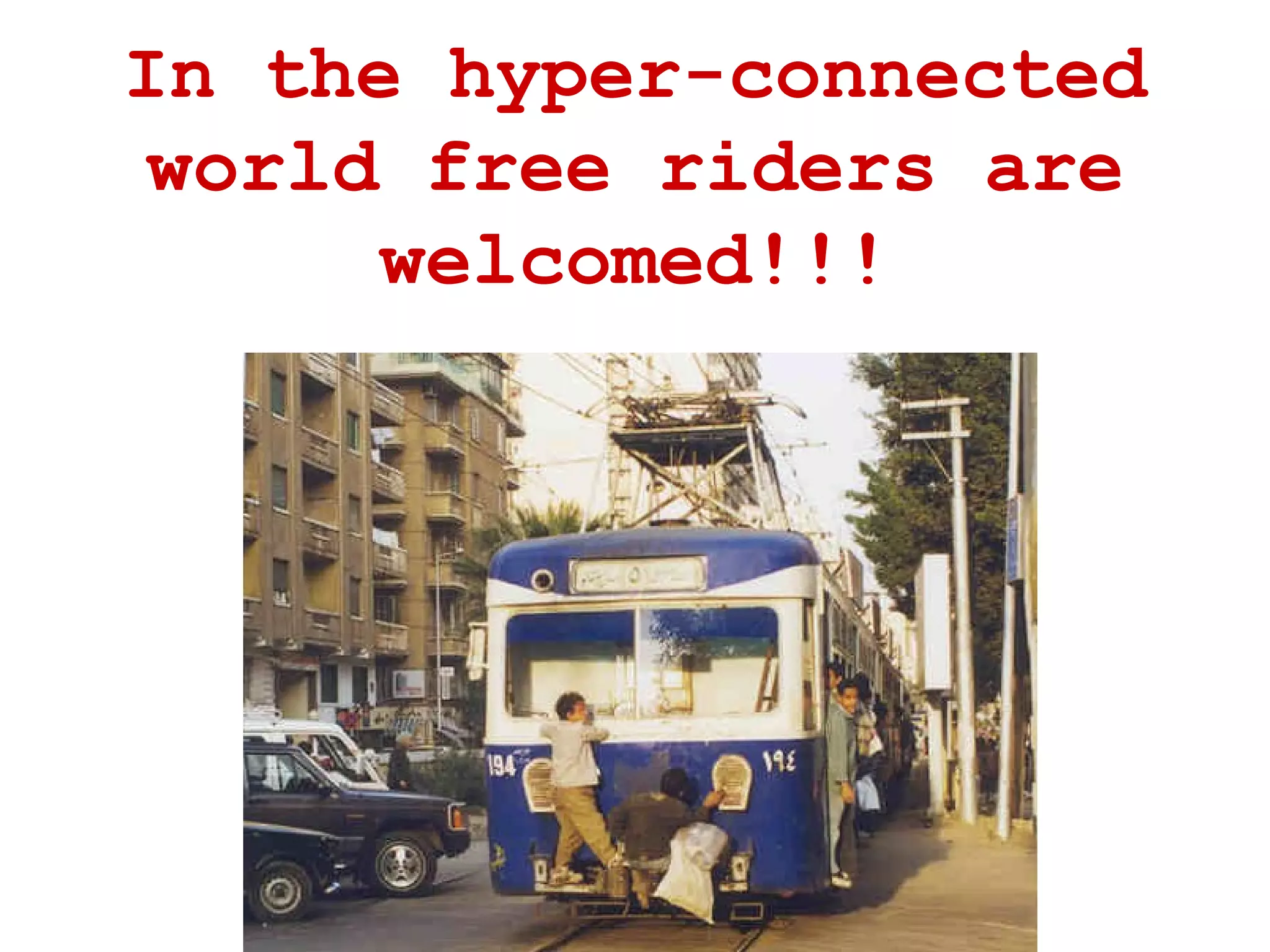
Microeconomics 101 Conclusions If you share something you will get the  maximum demand If you share something the  consumer will get all the benefits Therefore to conquer the entire markets in the  Internet world  you must to  share  something  valuble  for a  large group If you want to conquer the entire markets in the  mobile  world you must  incentivize  your customers Don´t worry about  free riders In the hiperconnected world  free riders are welcomed
In the hyper-connected world free riders are welcomed!!!
Agenda Introduction How to  conquer entire markets  in the hyperconnected world What to  sell  and what to  share  in the hyperconnected world How to create  eternal loyalty  through customer communities Creating value with  partners  through business  ecosystems Using Information and Communication Technologies to build the  Infraestructure of Cooperation The  Billion Business Model
What to sell and what to share in the hyperconnected world To know what to  sell  and what to  share  in the hyperconnected world, you should be aware of the economic properties of the goods: The  Public-Private goods theory The  complementary goods theory Warning!!! This part can be boring
Public and private goods theory Definition : “ In economics, a public good is a good that is  non-rivalry  and  non-excludable ”  No-rivalry The  consumption  of one good by one individual  does not reduce  its availability for others consumption. In other words: it is not  scarce . No-excludability .  One good cannot be effectively excluded from consumption of one good. In other words: you cannot  control  its distribution or consumption.
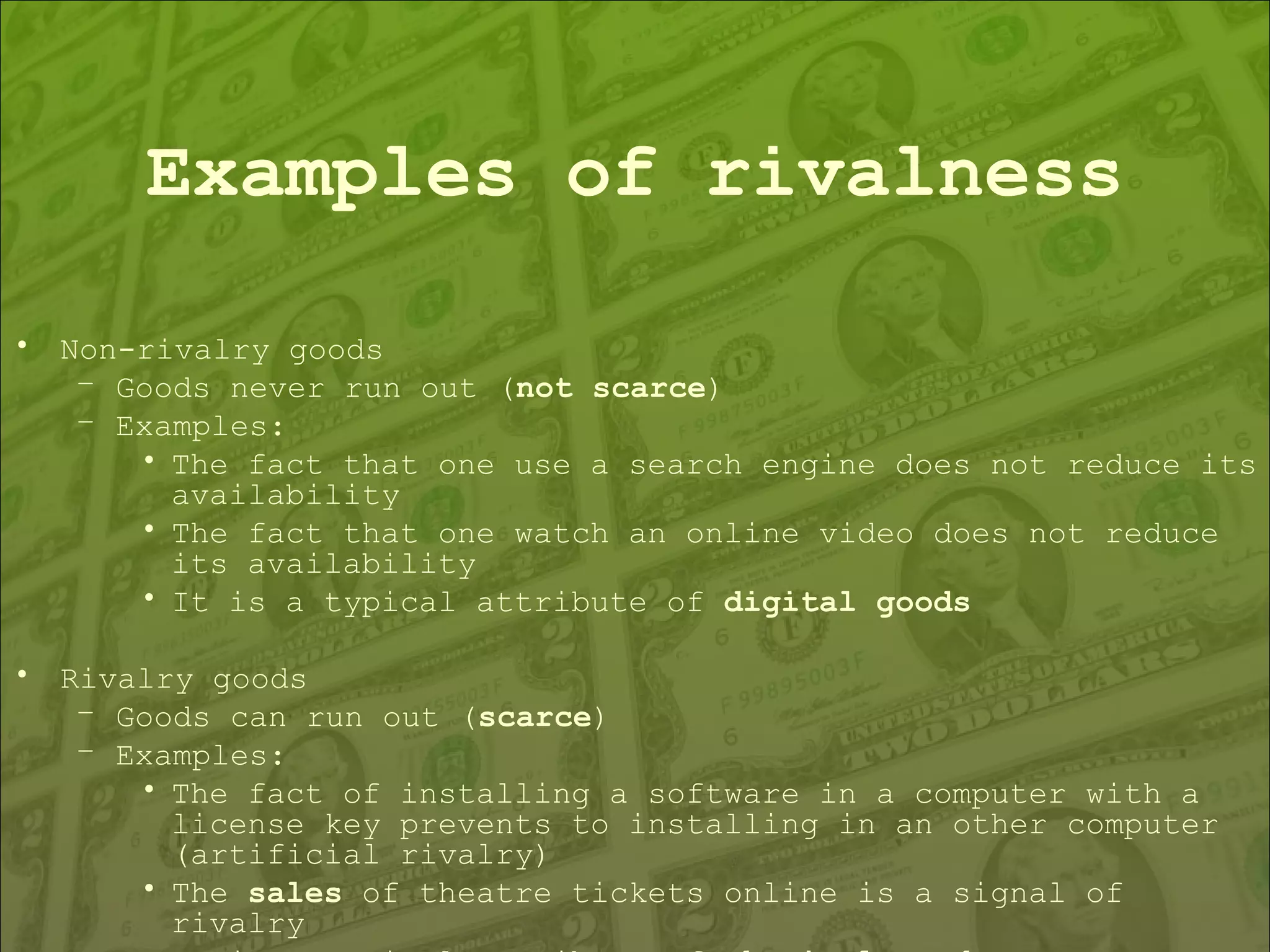
Examples of rivalness Non-rivalry goods  Goods never run out ( not scarce ) Examples: The fact that one use a search engine does not reduce its availability The fact that one watch an online video does not reduce its availability It is a typical attribute of  digital goods   Rivalry goods  Goods can run out ( scarce ) Examples: The fact of installing a software in a computer with a license key prevents to installing in an other computer (artificial rivalry) The  sales  of theatre tickets online is a signal of rivalry It is a typical attribute of  physical goods
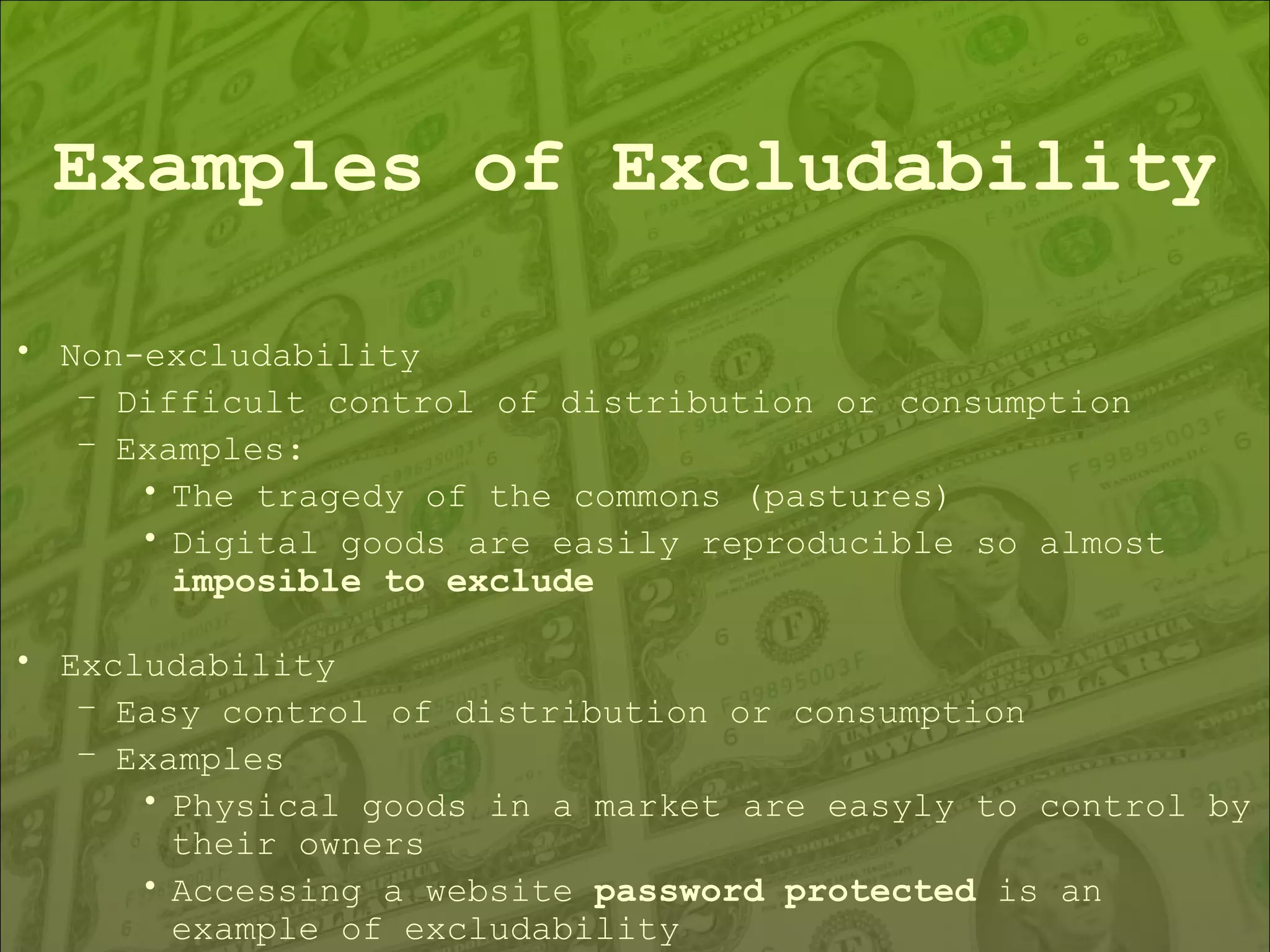
Examples of Excludability Non-excludability  Difficult control of distribution or consumption Examples: The tragedy of the commons (pastures) Digital goods are easily reproducible so almost  imposible to exclude Excludability Easy control of distribution or consumption Examples Physical goods in a market are easyly to control by their owners Accessing a website  password protected  is an example of excludability
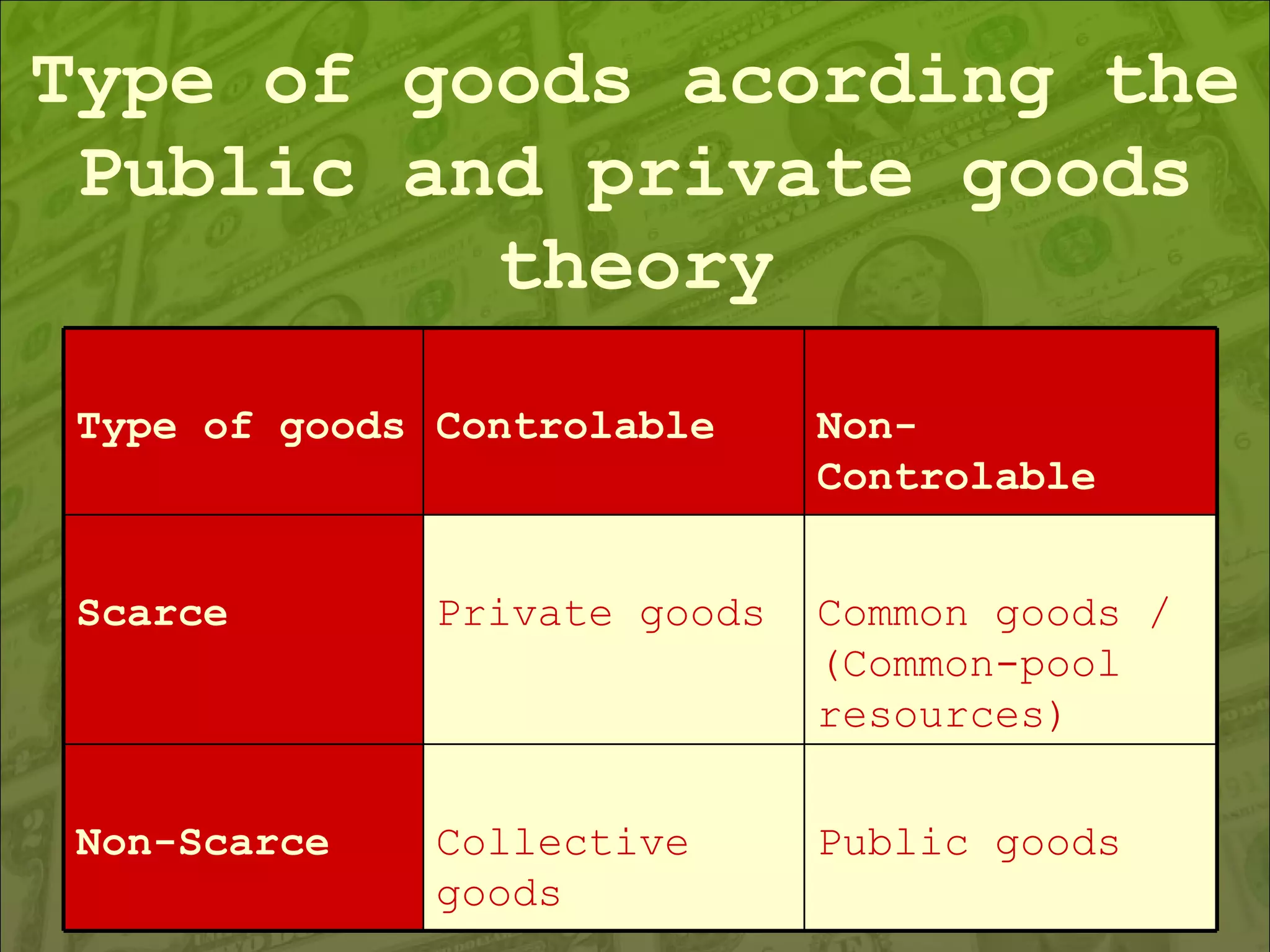
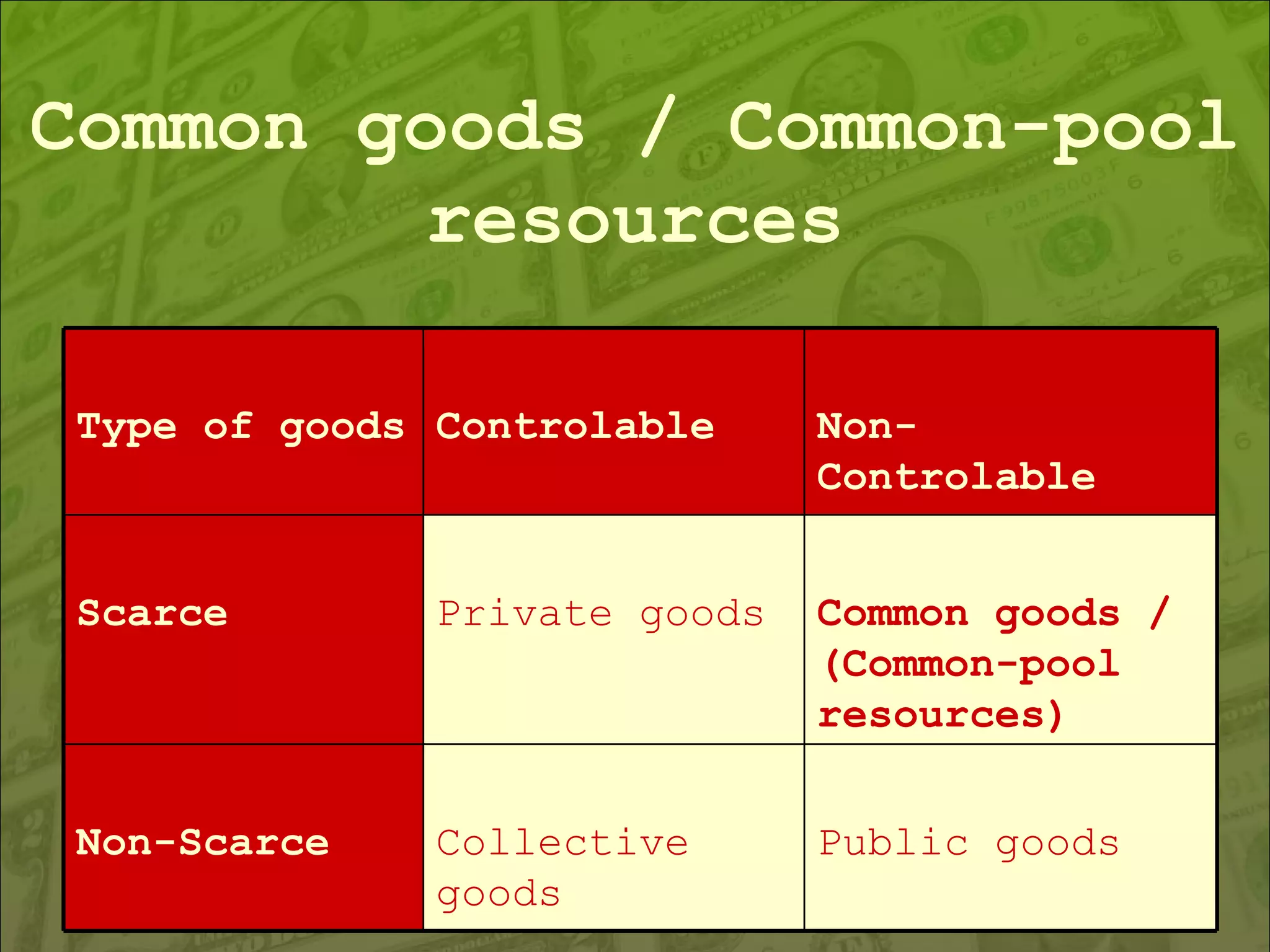
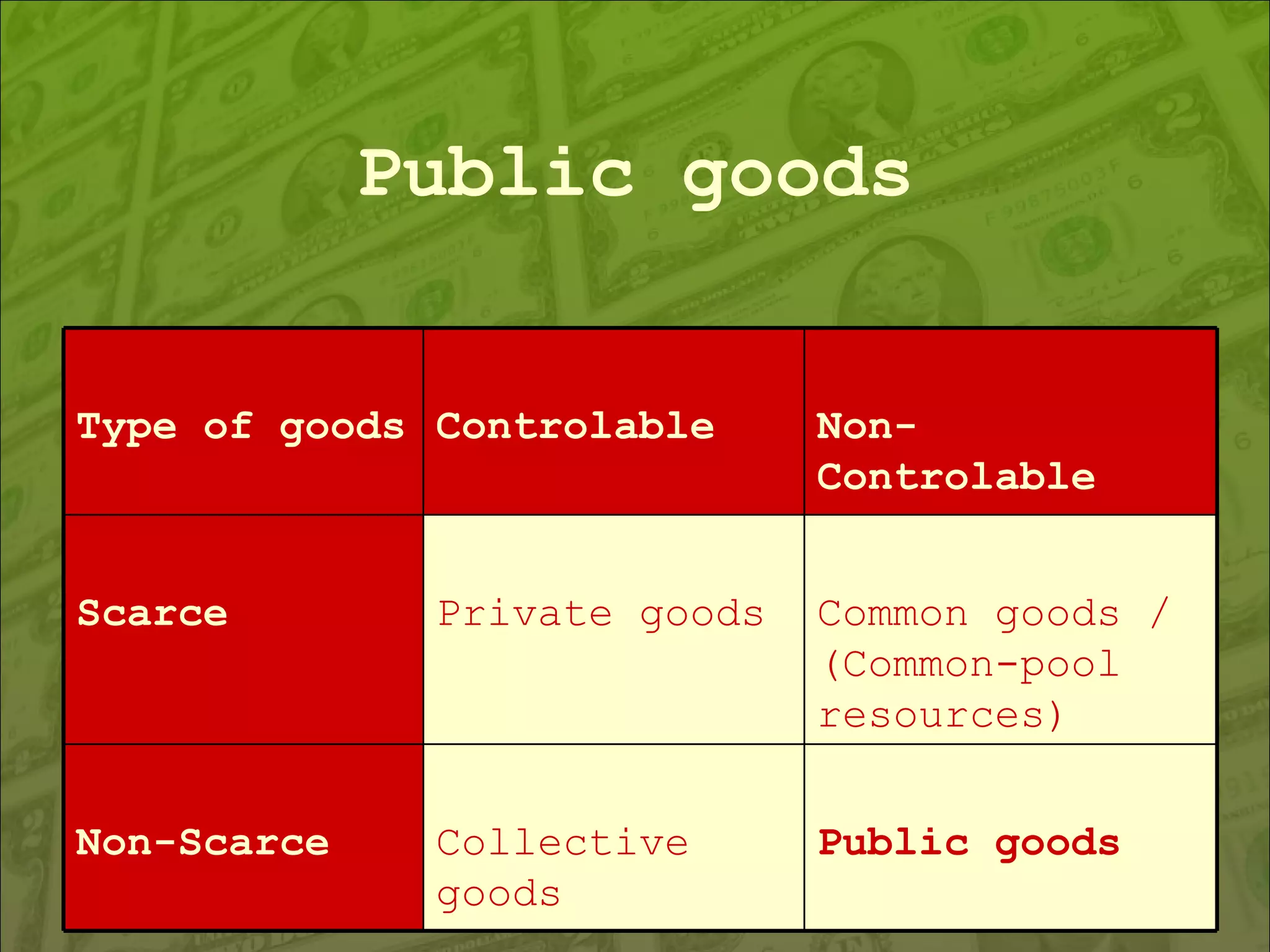
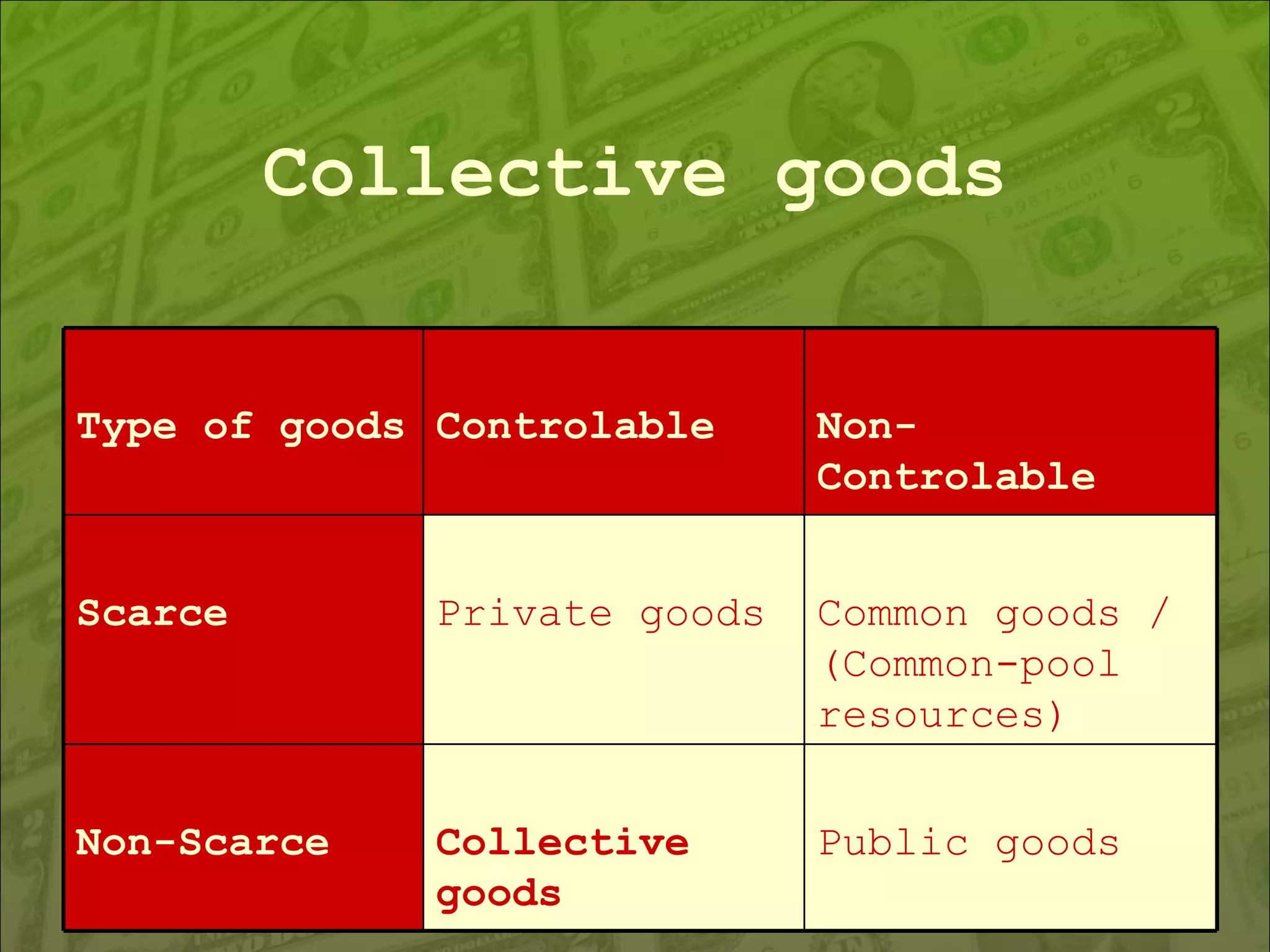
Type of goods acording the Public and private goods theory Public goods Collective goods Non-Scarce Common goods / (Common-pool resources) Private goods Scarce Non- Controlable Controlable Type of goods
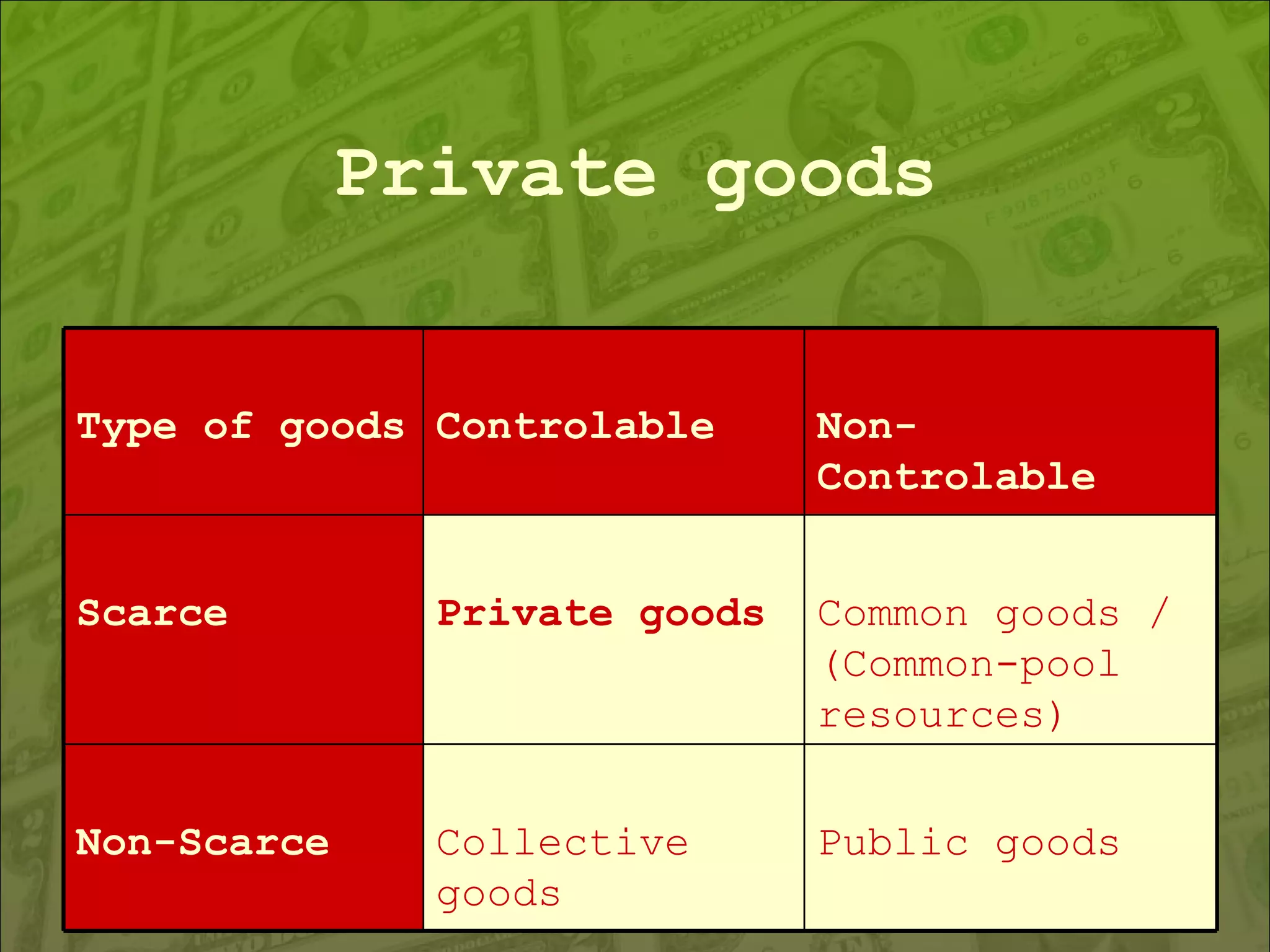
Private goods Public goods Collective goods Non-Scarce Common goods / (Common-pool resources) Private goods Scarce Non- Controlable Controlable Type of goods
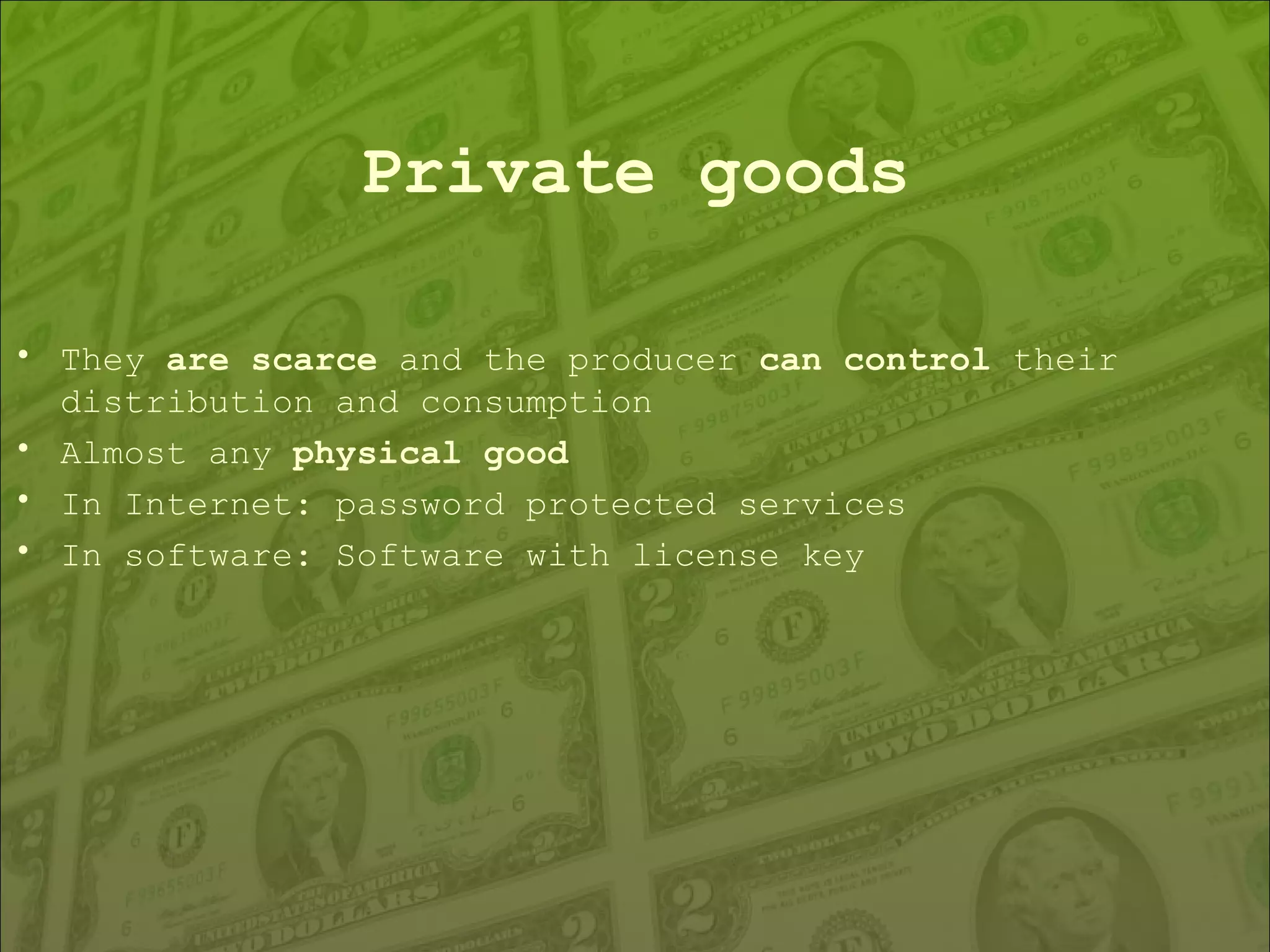
Private goods They  are scarce  and the producer  can control  their distribution and consumption Almost any  physical good In Internet: password protected services In software: Software with license key
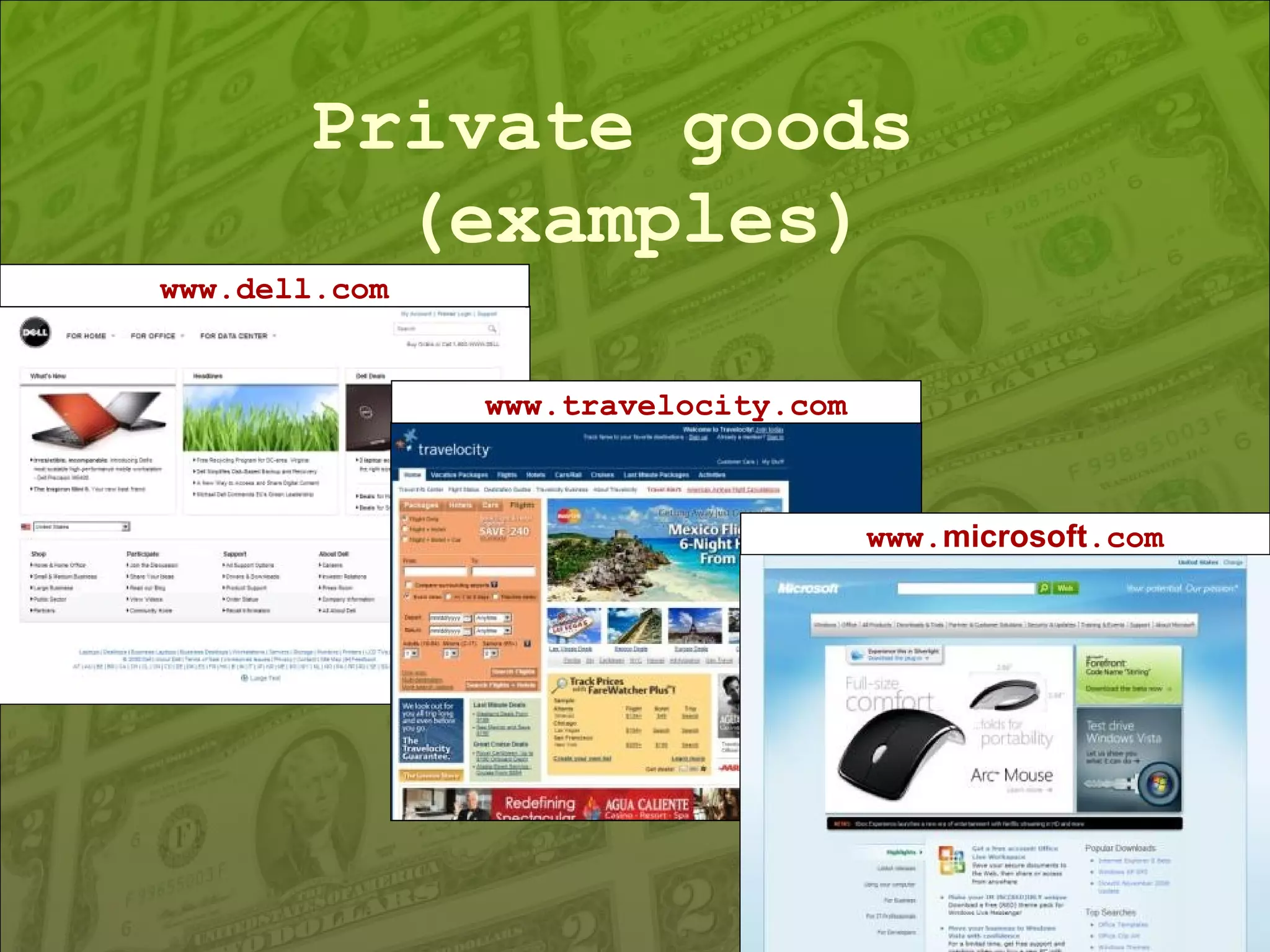
Private goods  (examples) www. microsoft .com www.dell.com www.travelocity.com
Common goods / Common-pool resources Public goods Collective goods Non-Scarce Common goods / (Common-pool resources) Private goods Scarce Non- Controlable Controlable Type of goods
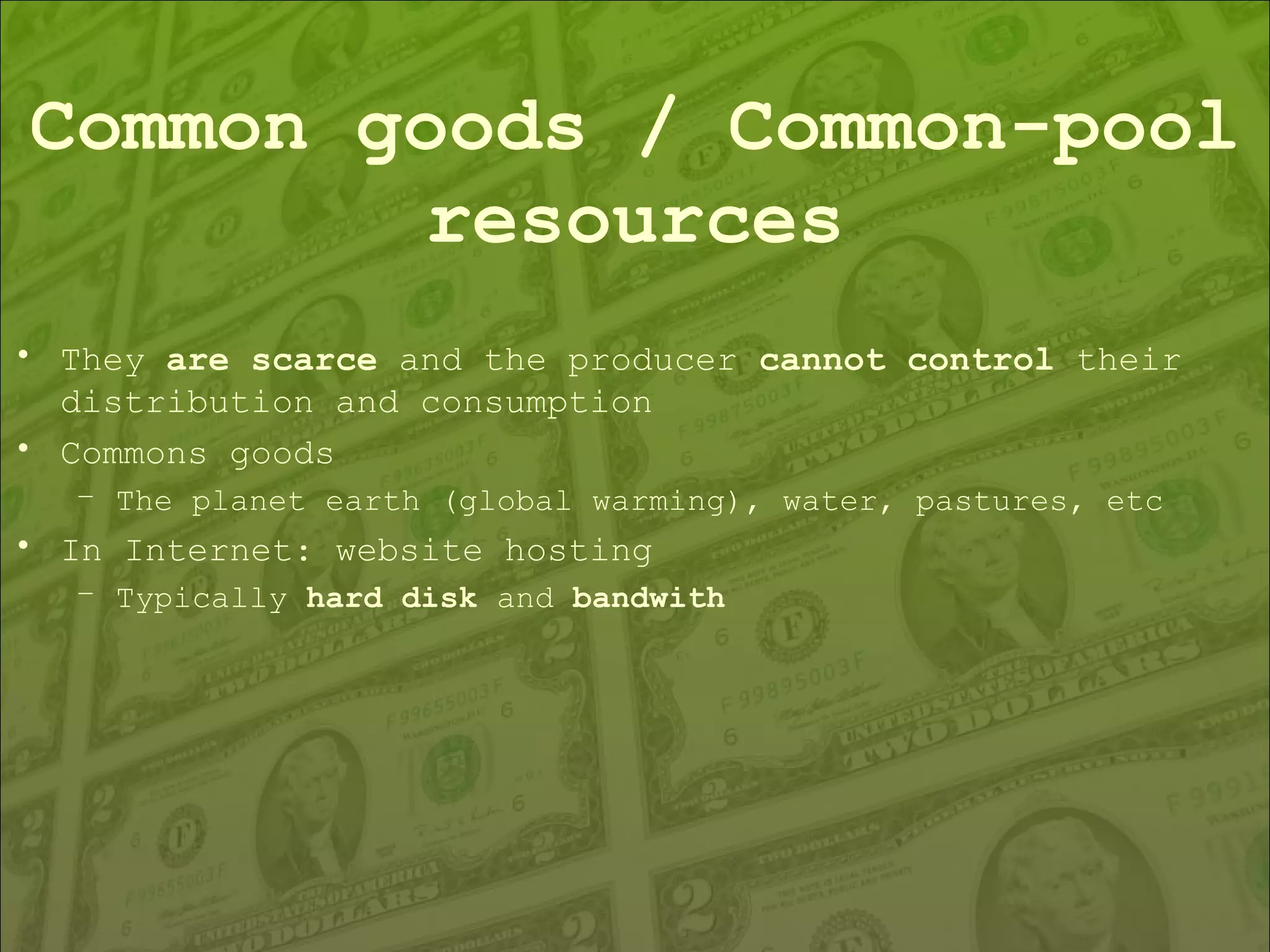
Common goods / Common-pool resources They  are scarce  and the producer  cannot control  their distribution and consumption Commons goods The planet earth (global warming), water, pastures, etc In Internet: website hosting Typically  hard disk  and  bandwith
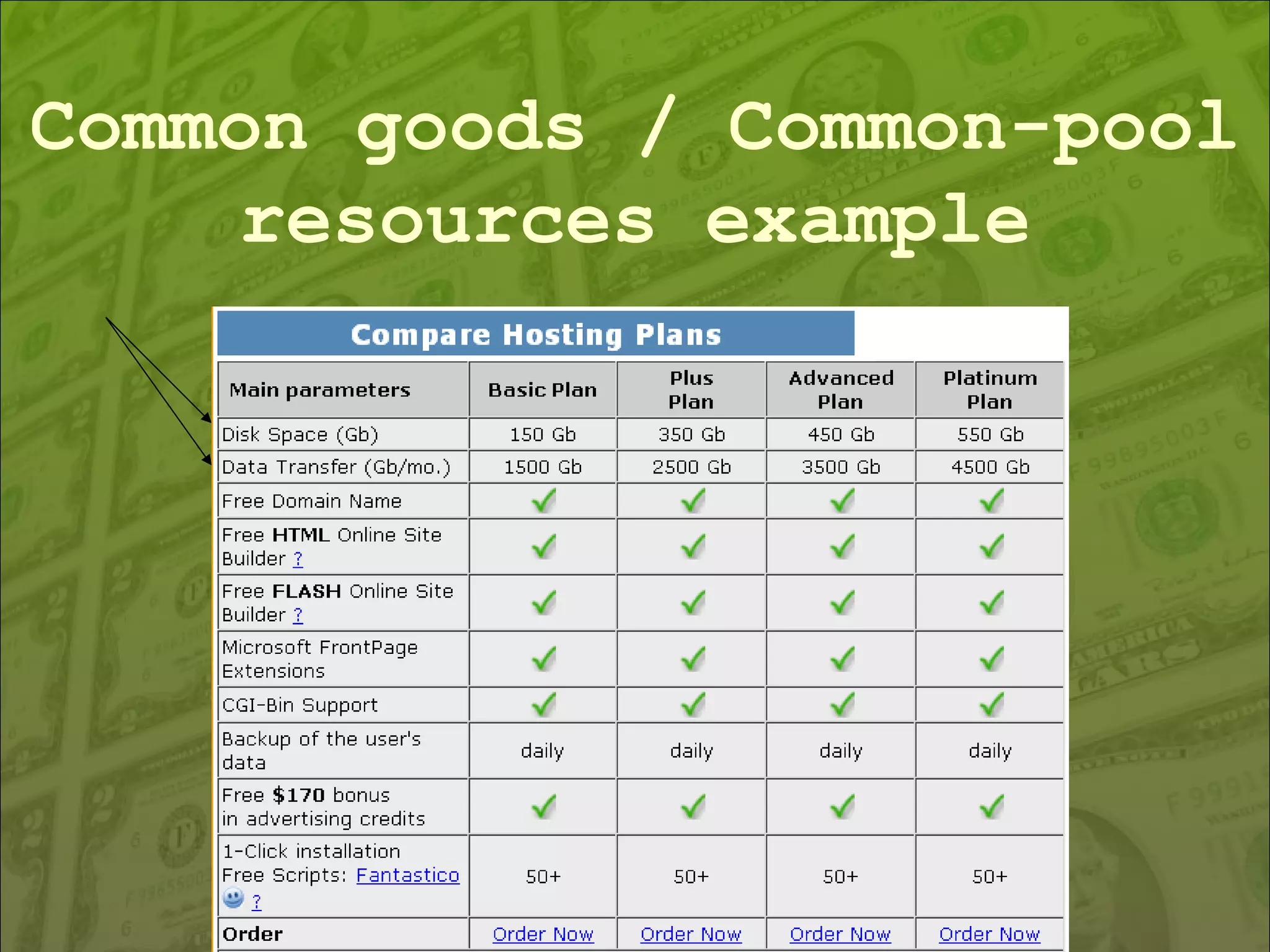
Common goods / Common-pool resources example
Collective goods Public goods Collective goods Non-Scarce Common goods / (Common-pool resources) Private goods Scarce Non- Controlable Controlable Type of goods
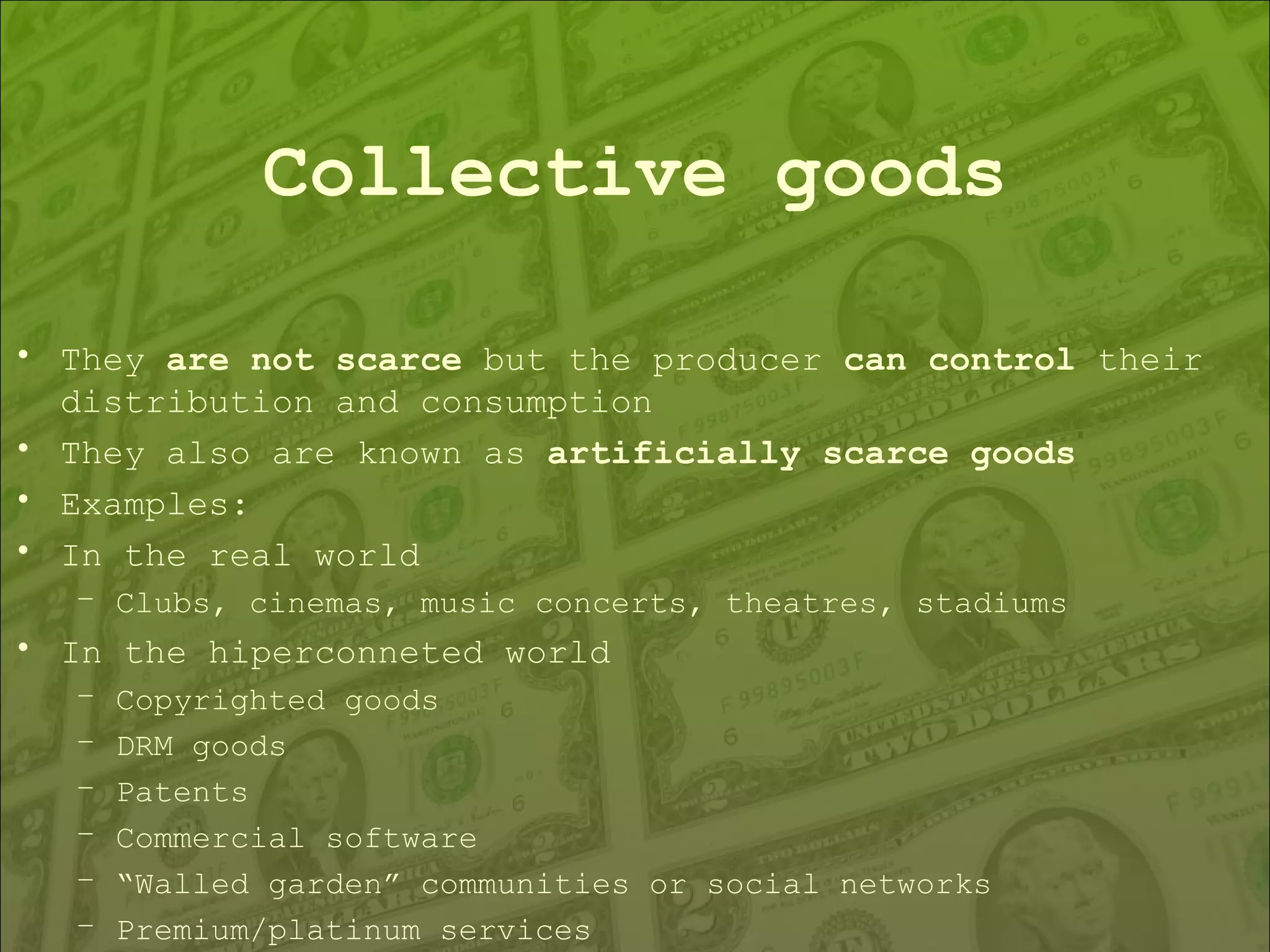
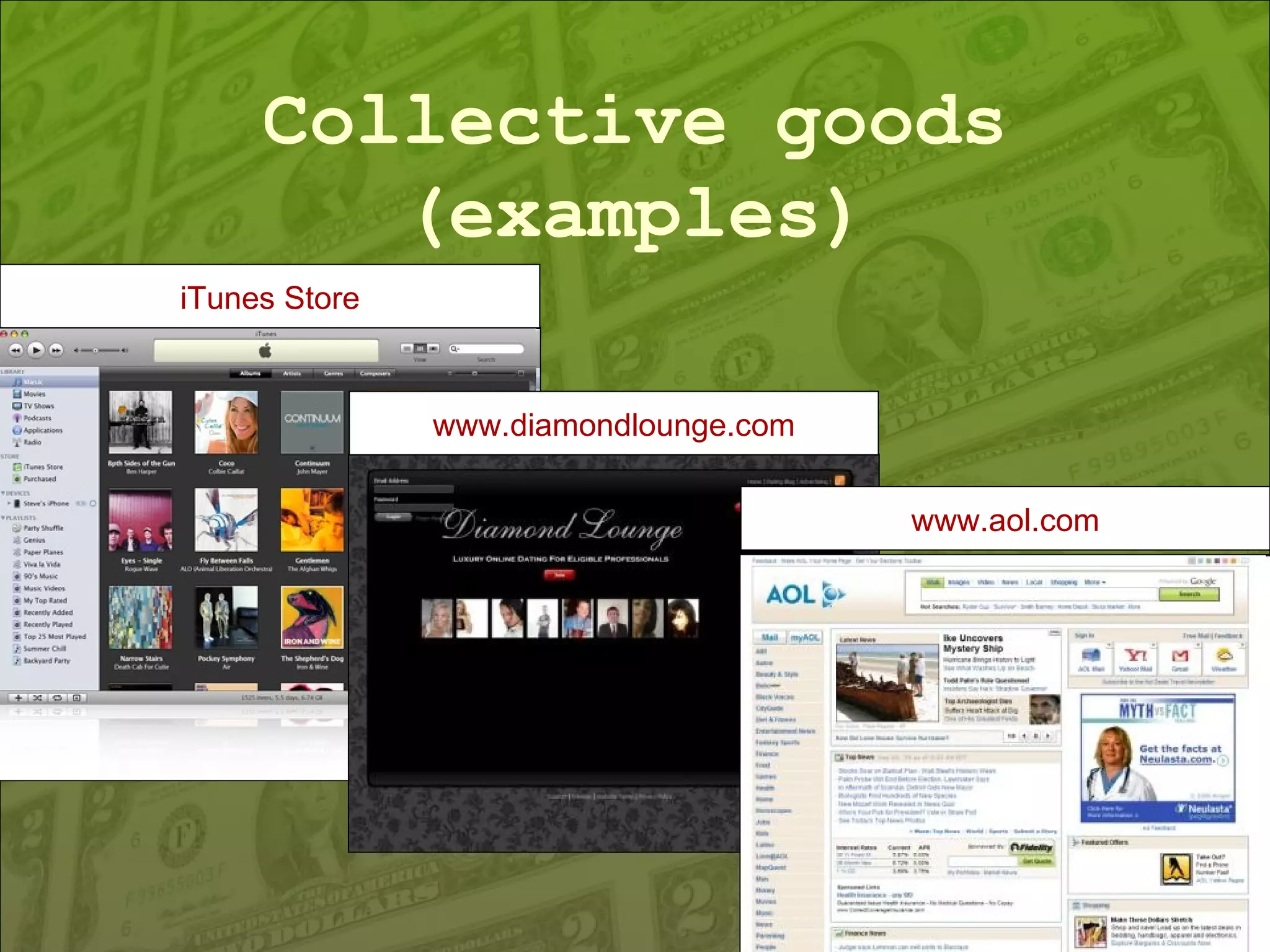
Collective goods They  are not scarce  but the producer  can control  their distribution and consumption They also are known as  artificially scarce goods Examples: In the real world Clubs, cinemas, music concerts, theatres, stadiums In the hiperconneted world Copyrighted goods DRM goods Patents Commercial software “ Walled garden” communities or social networks Premium/platinum services
Collective goods (examples) iTunes Store www.aol.com www.diamondlounge.com
Public goods Public goods Collective goods Non-Scarce Common goods / (Common-pool resources) Private goods Scarce Non- Controlable Controlable Type of goods
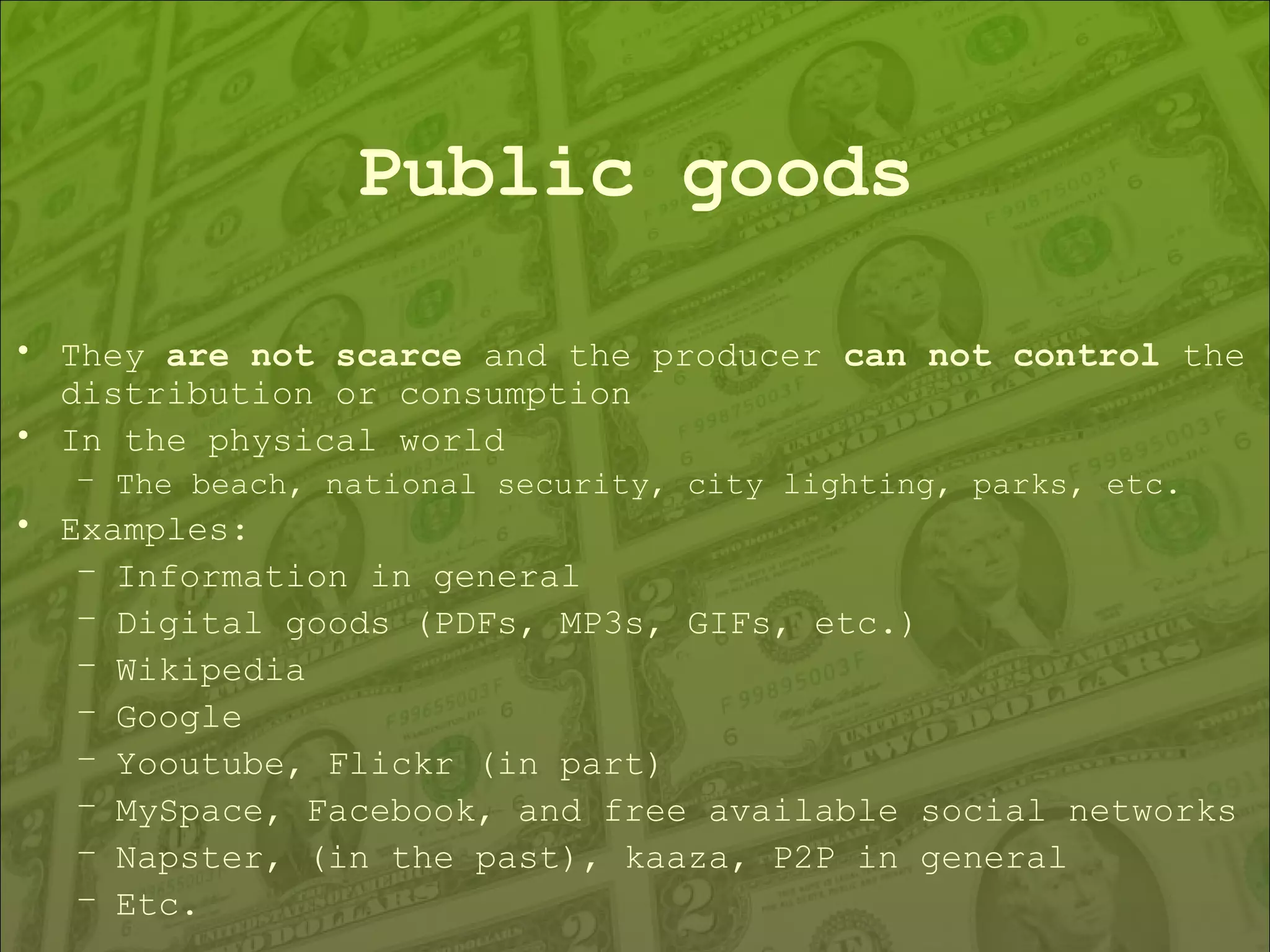
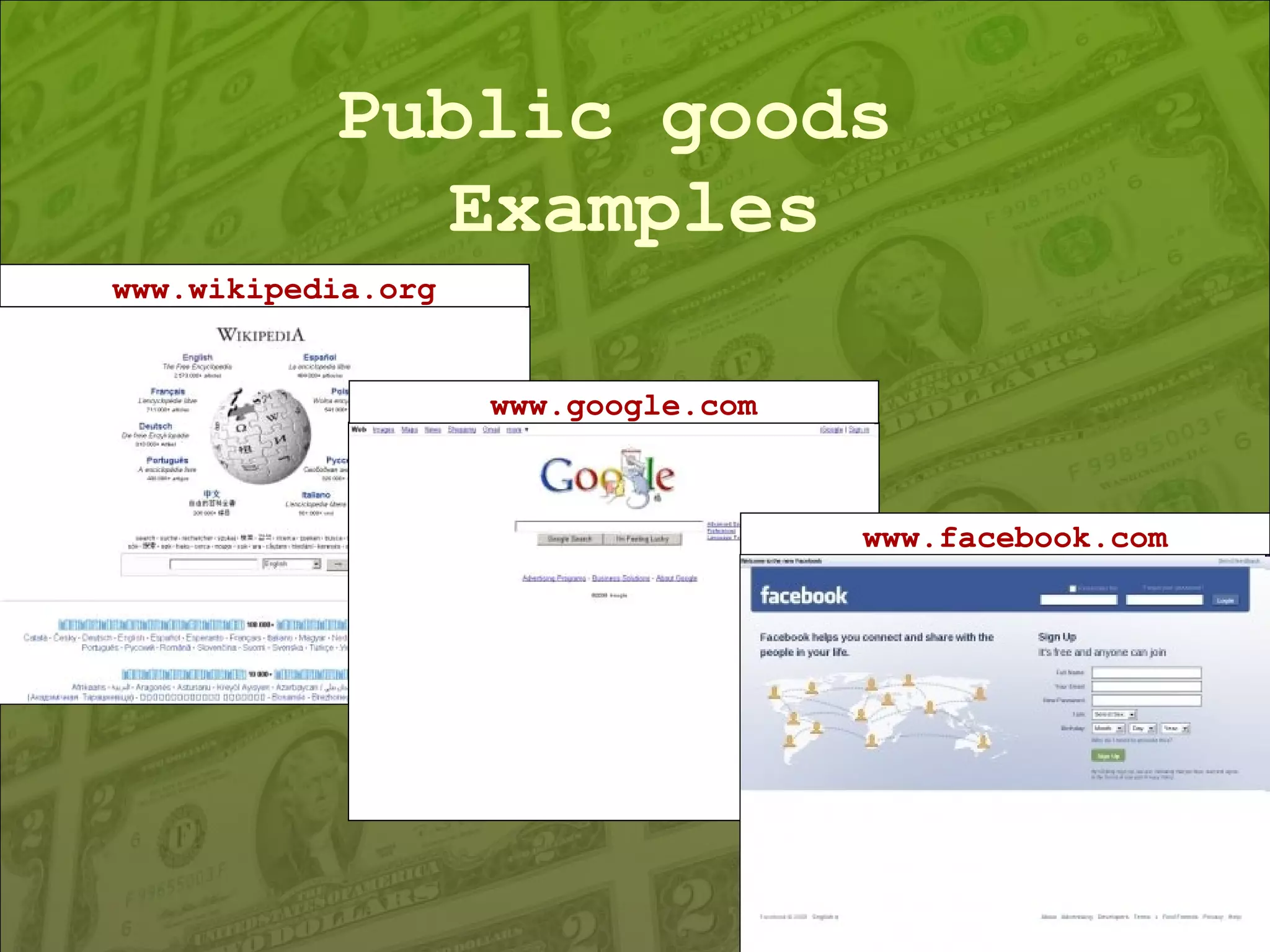
Public goods They  are not scarce  and the producer  can not control  the distribution or consumption In the physical world The beach, national security, city lighting, parks, etc. Examples: Information in general Digital goods (PDFs, MP3s, GIFs, etc.) Wikipedia Google Yooutube, Flickr (in part) MySpace, Facebook, and free available social networks  Napster, (in the past), kaaza, P2P in general Etc.
Public goods   Examples www.facebook.com www.wikipedia.org www.google.com
The complementary goods theory Complementary goods: Those directly related, if the consumption of one good raises, the consumption of the related one raises too (not ncesarily the inverse is true) Example Milk and coffee and bread Substitute goods: Those inversely related. if the consumption of one good raises, the consumption of the sustituted one lowers (not ncesarily the inverse is true) Example Gasoil with ethanol
The complementary goods theory (examples)
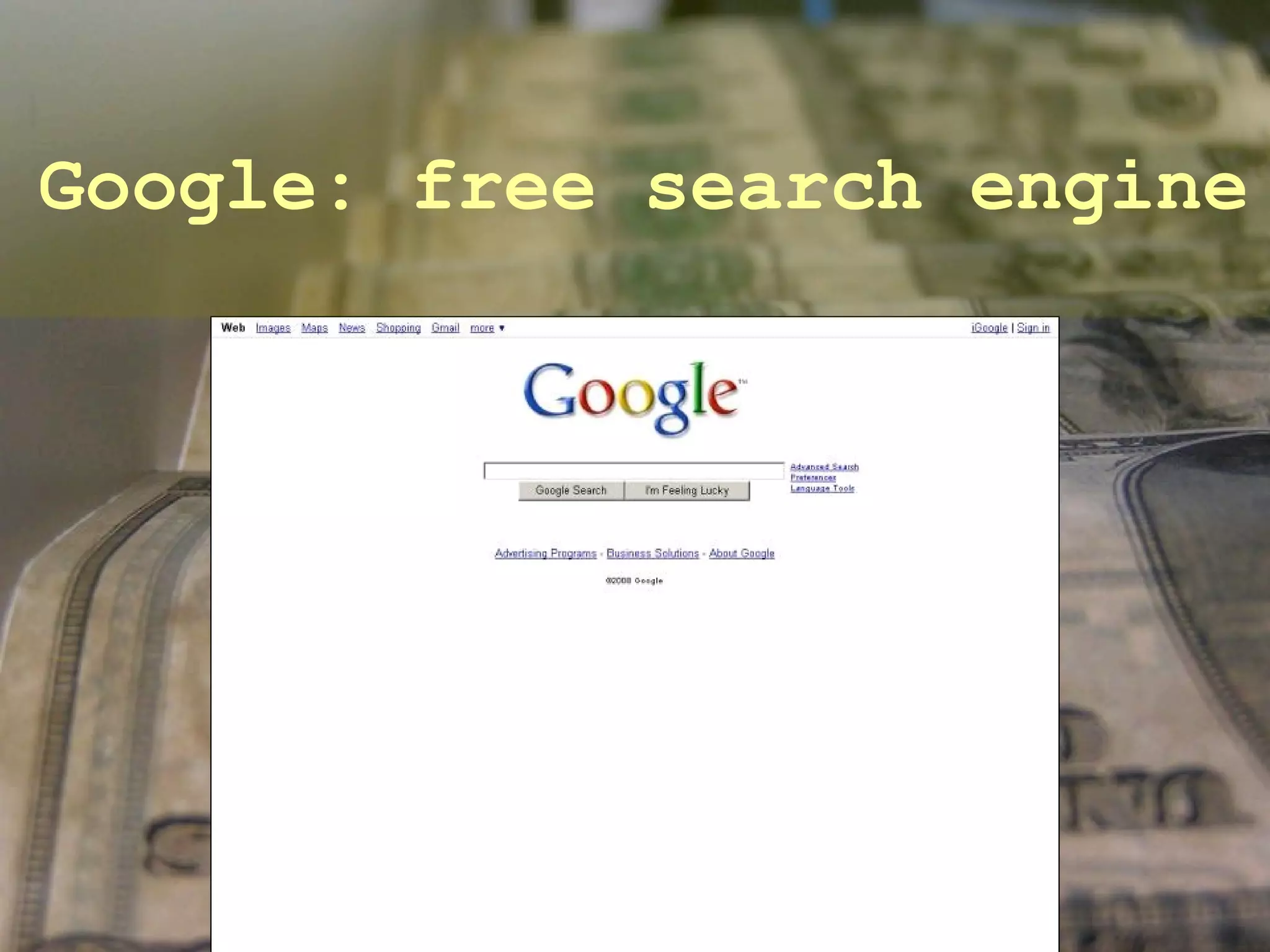
Google: free search engine
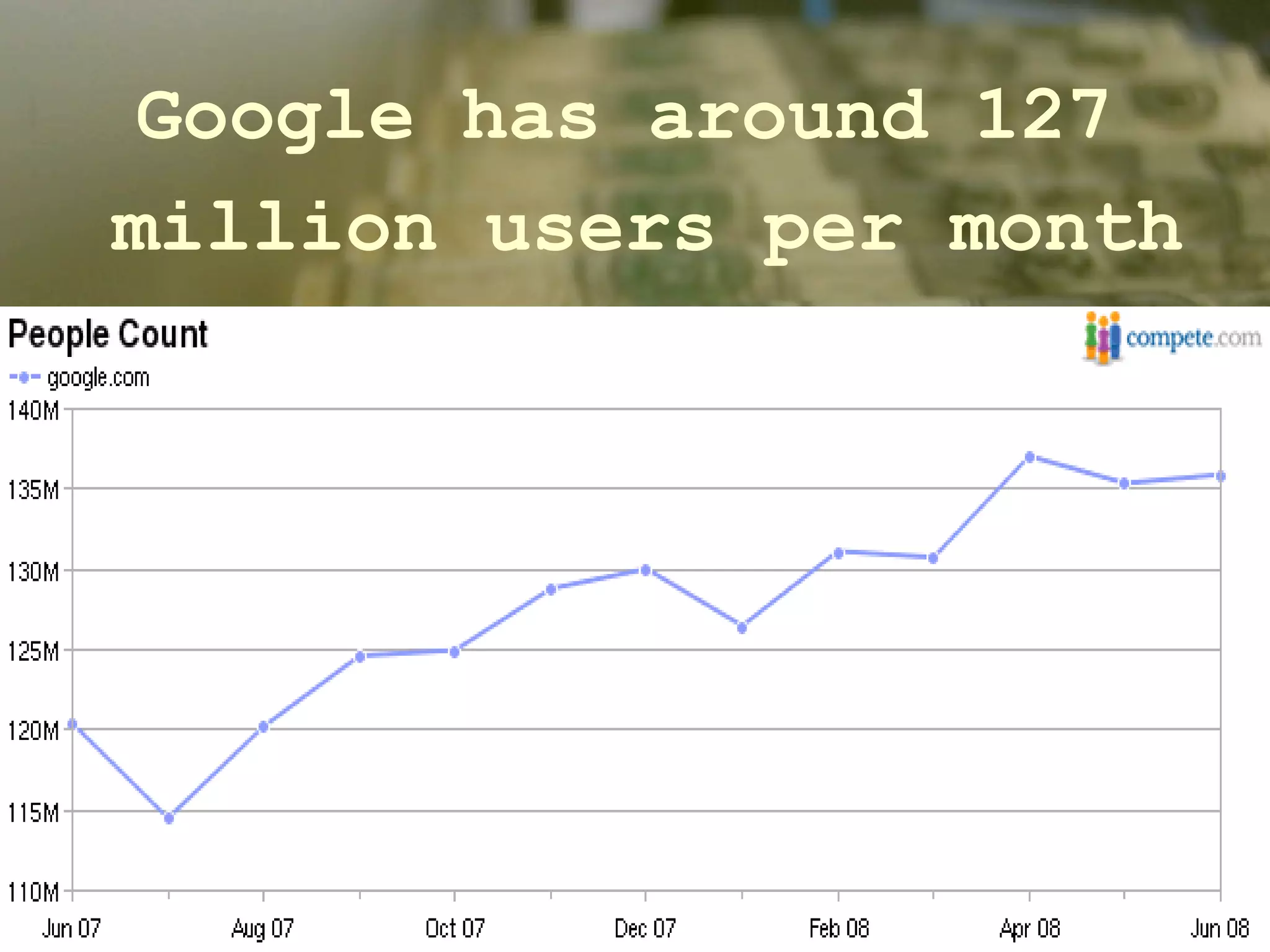
Google has around 127  million users per month
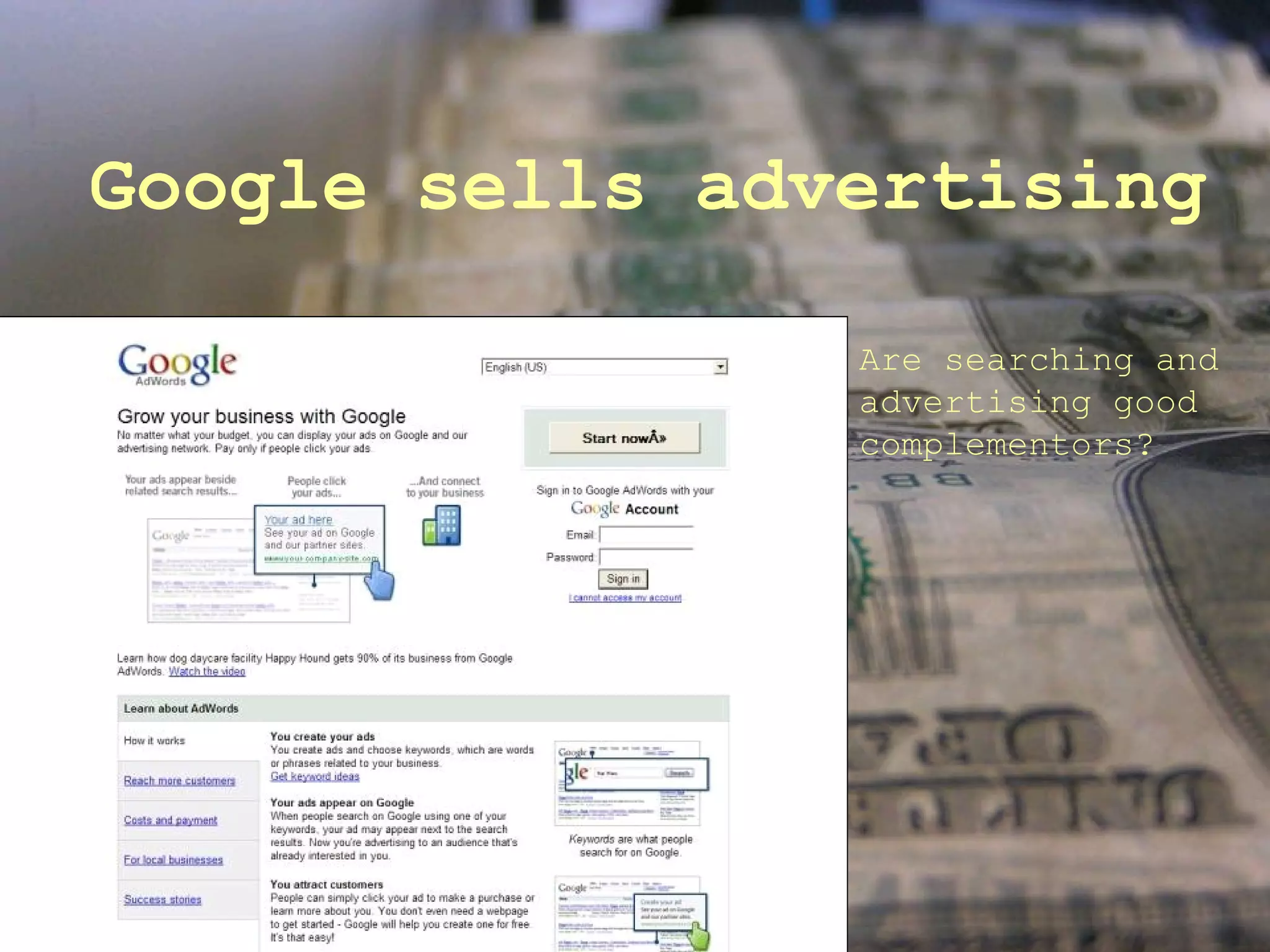
Google sells advertising Are searching and advertising good complementors?
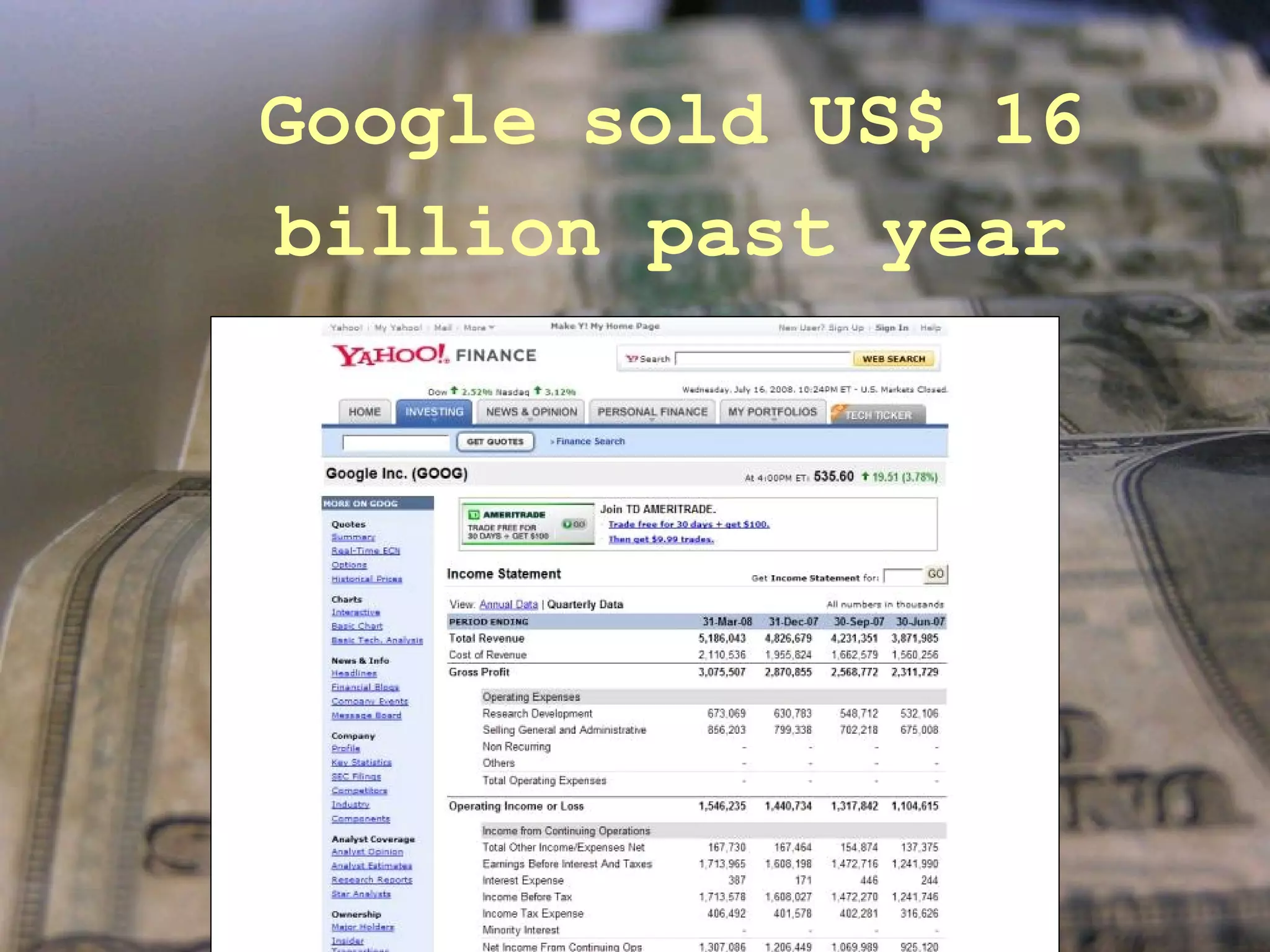
Google   sold   US$   16 billion past year
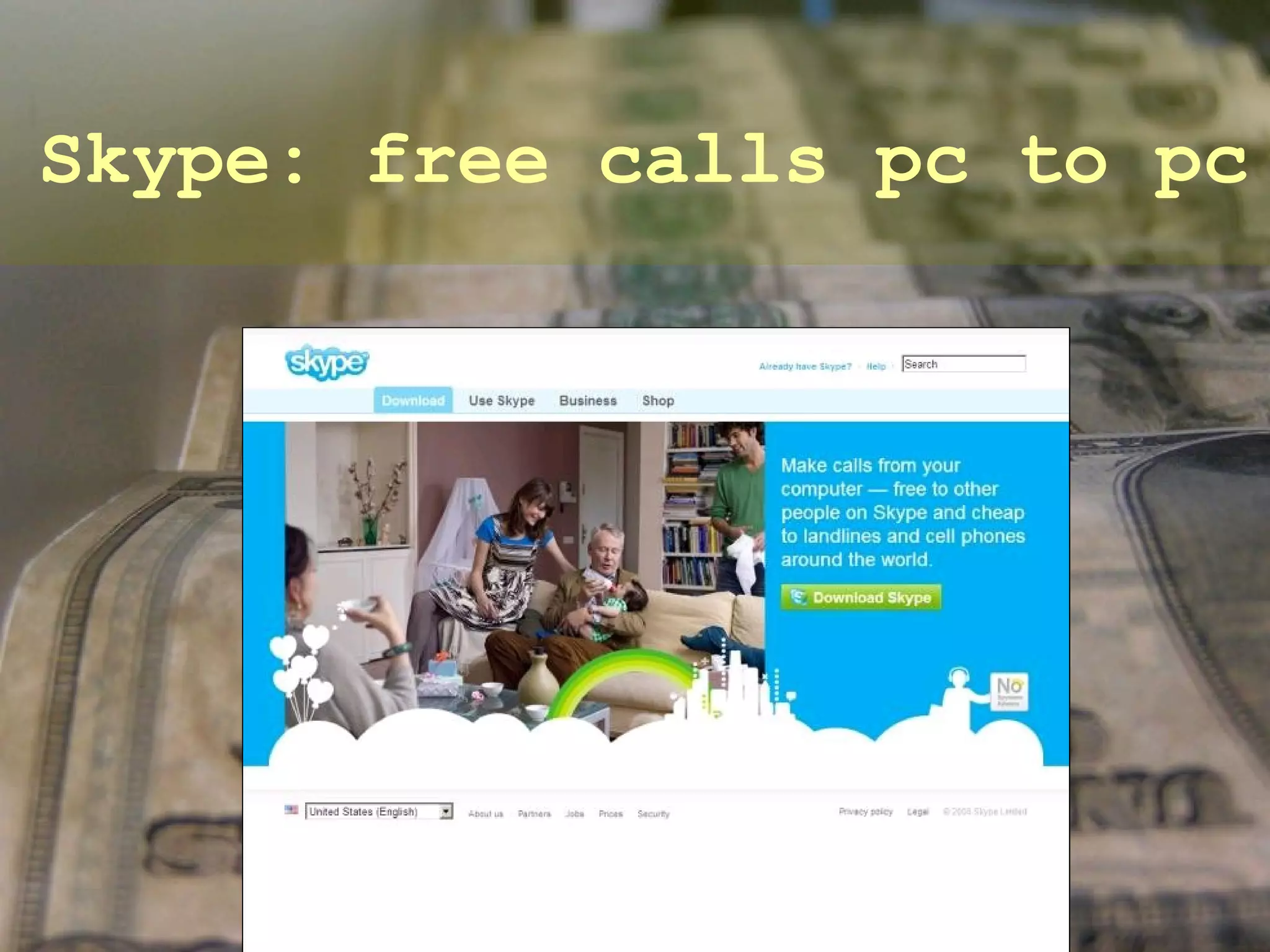
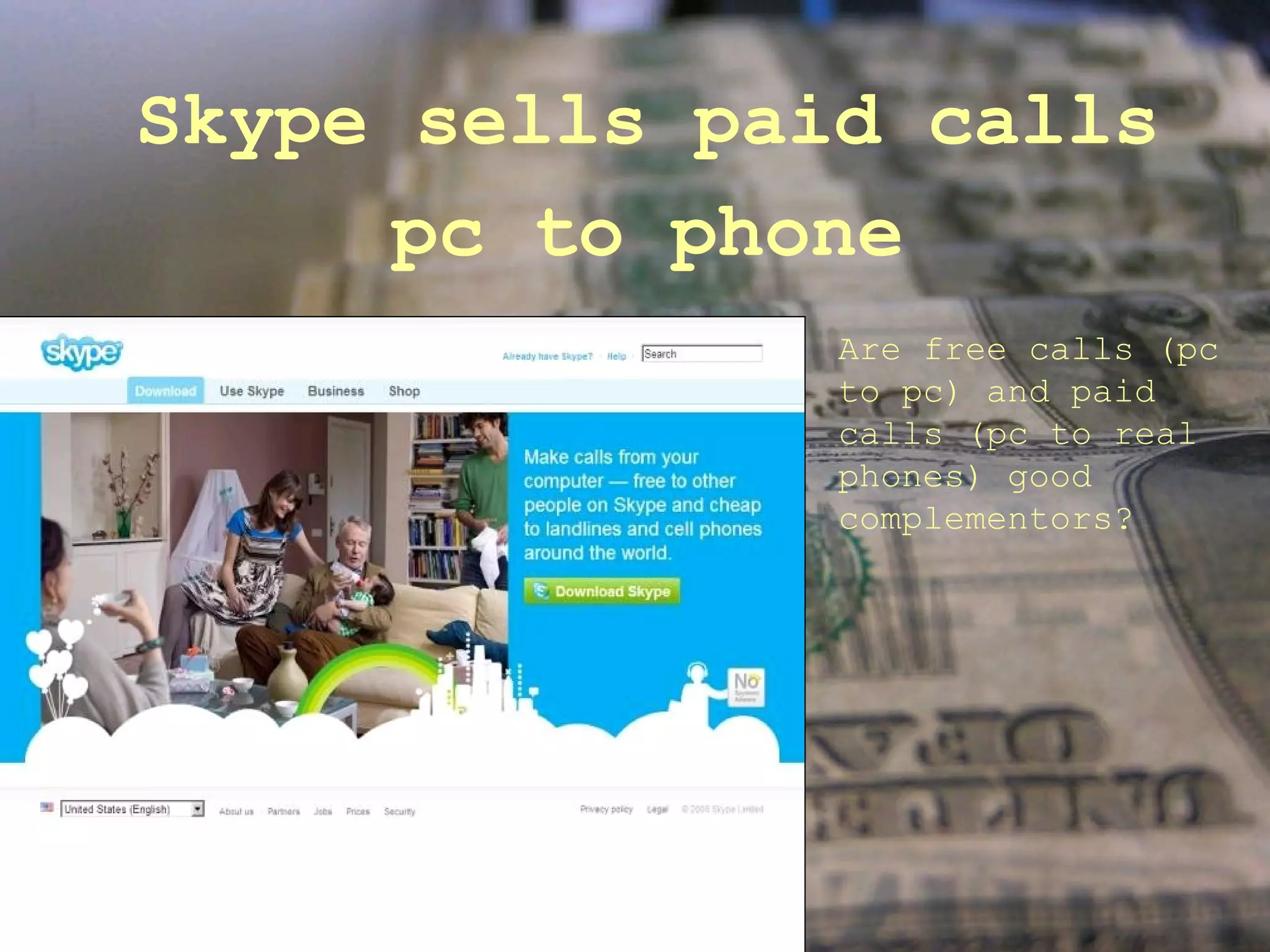
Skype: free calls pc to pc
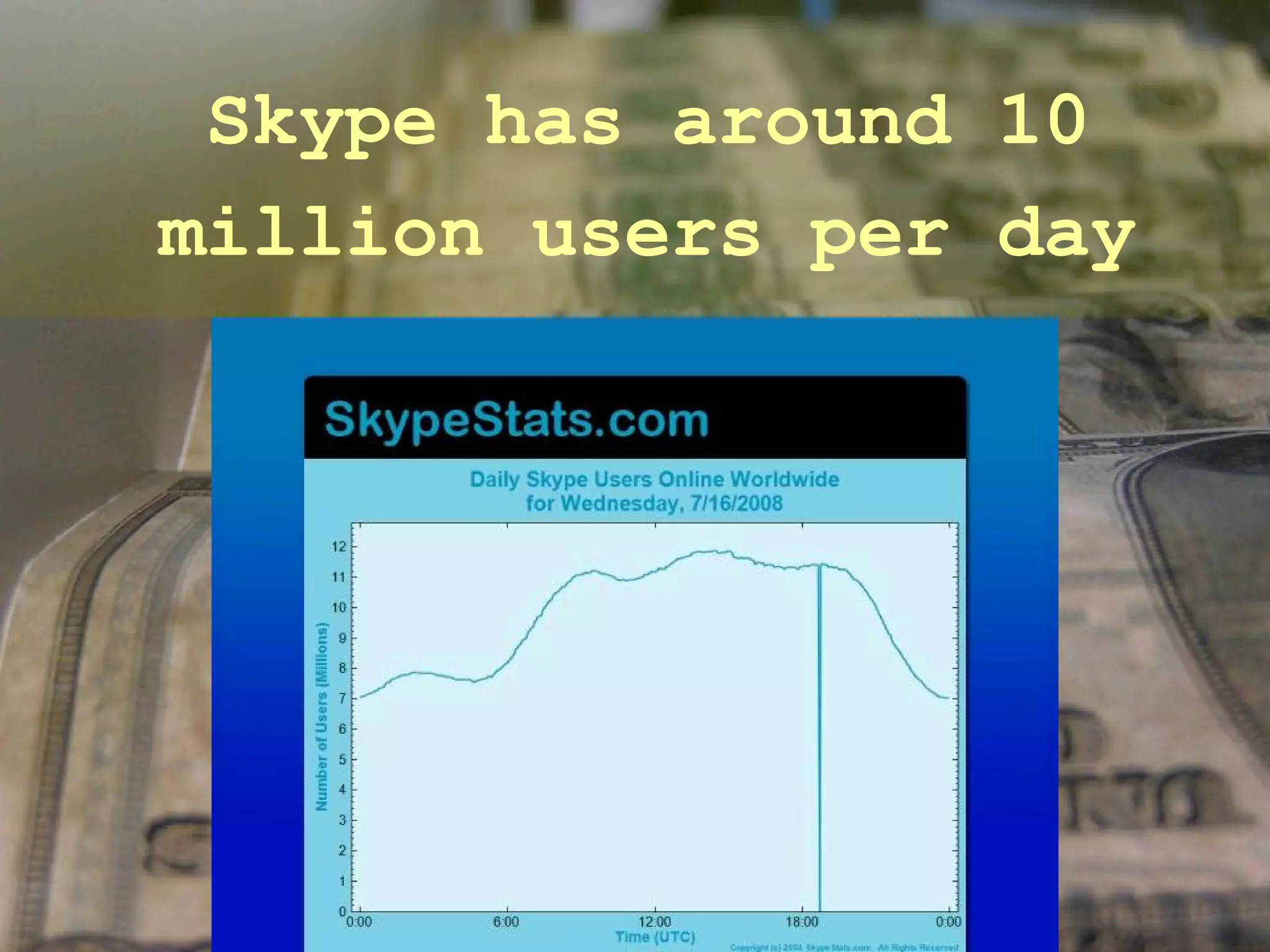
Skype has around 10 million users per day
Skype sells paid calls pc to phone Are free calls (pc to pc) and paid calls (pc to real phones) good complementors?
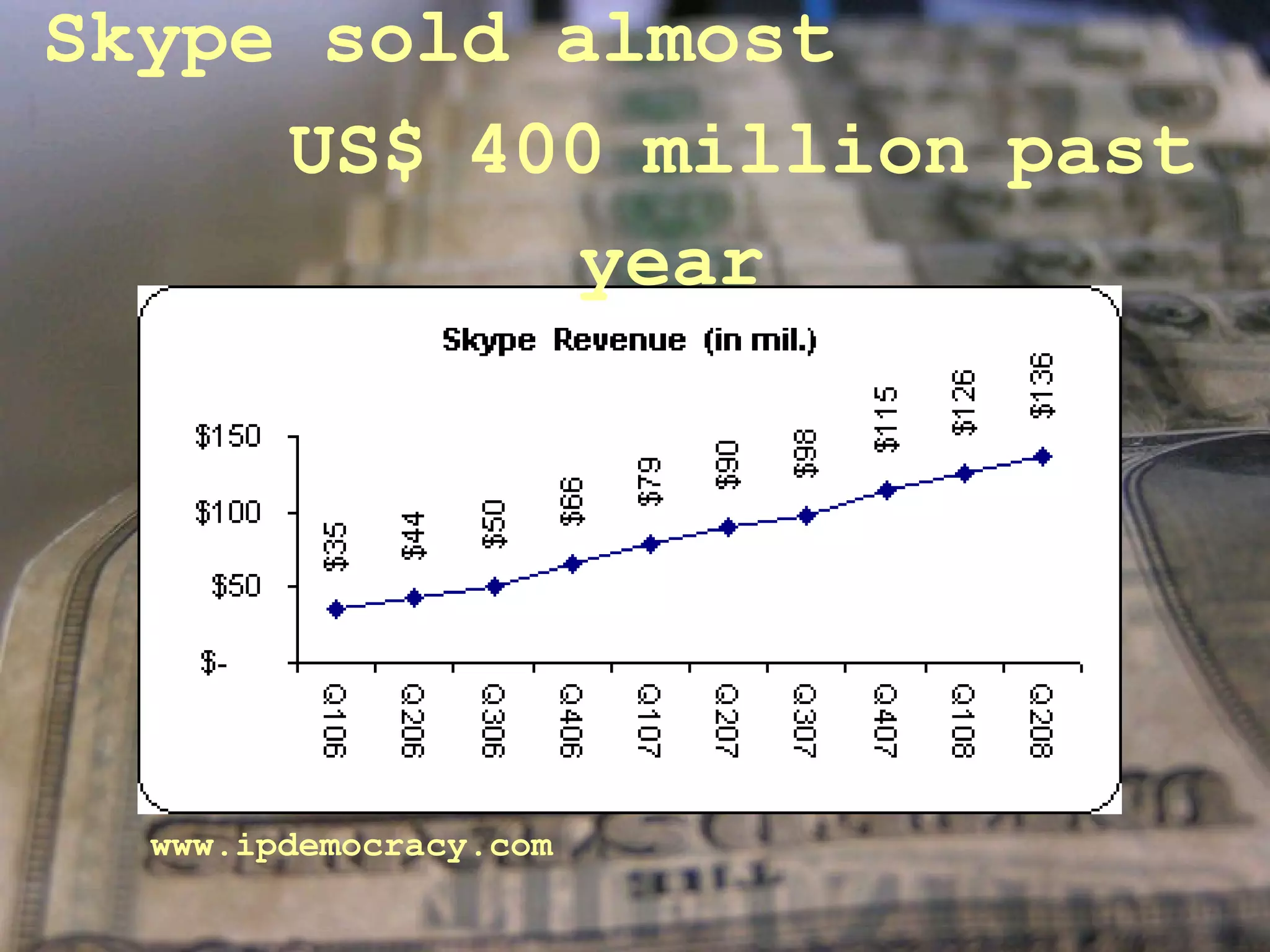
www.ipdemocracy.com Skype sold almost  US$   400   million   past   year
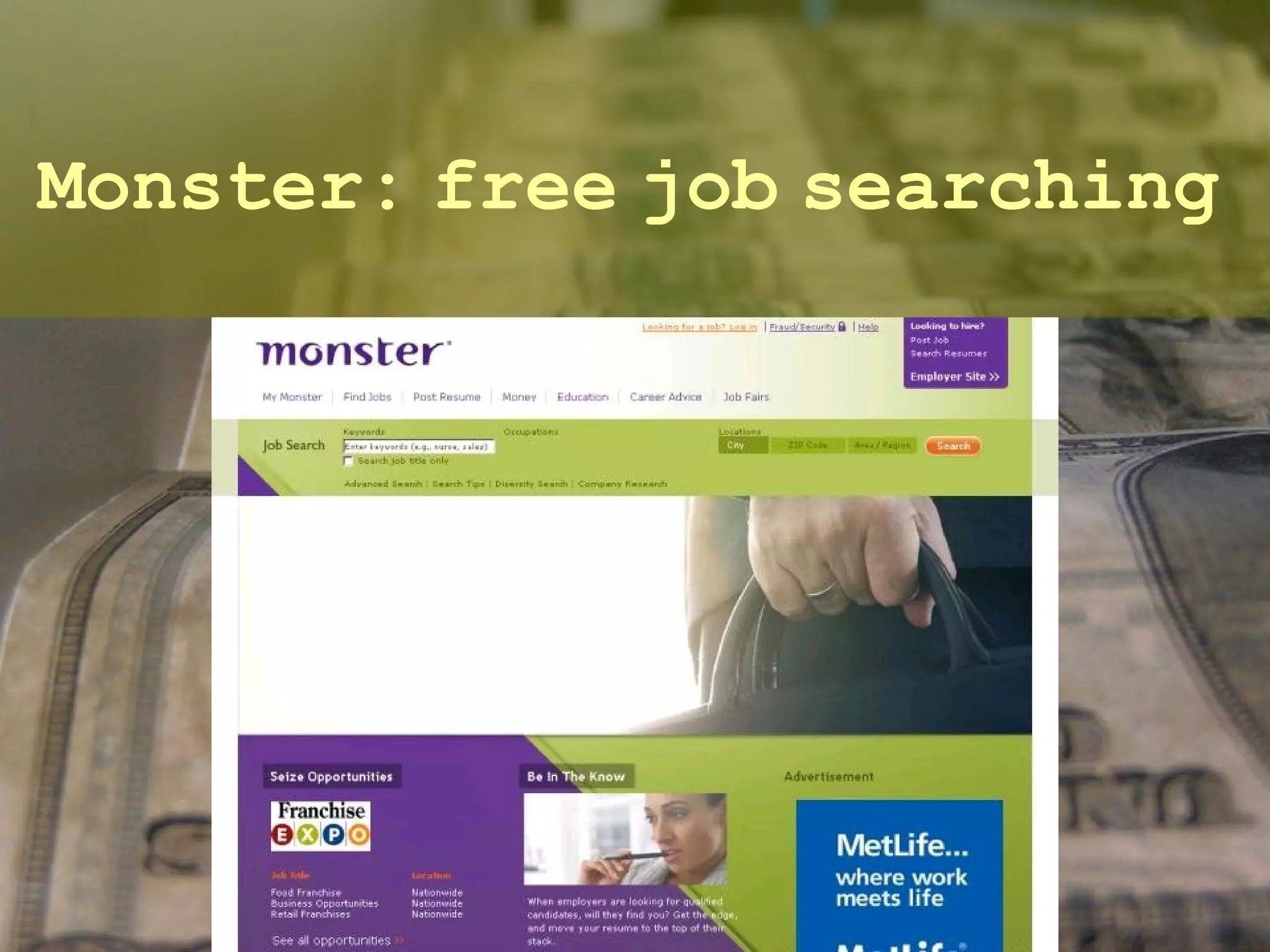
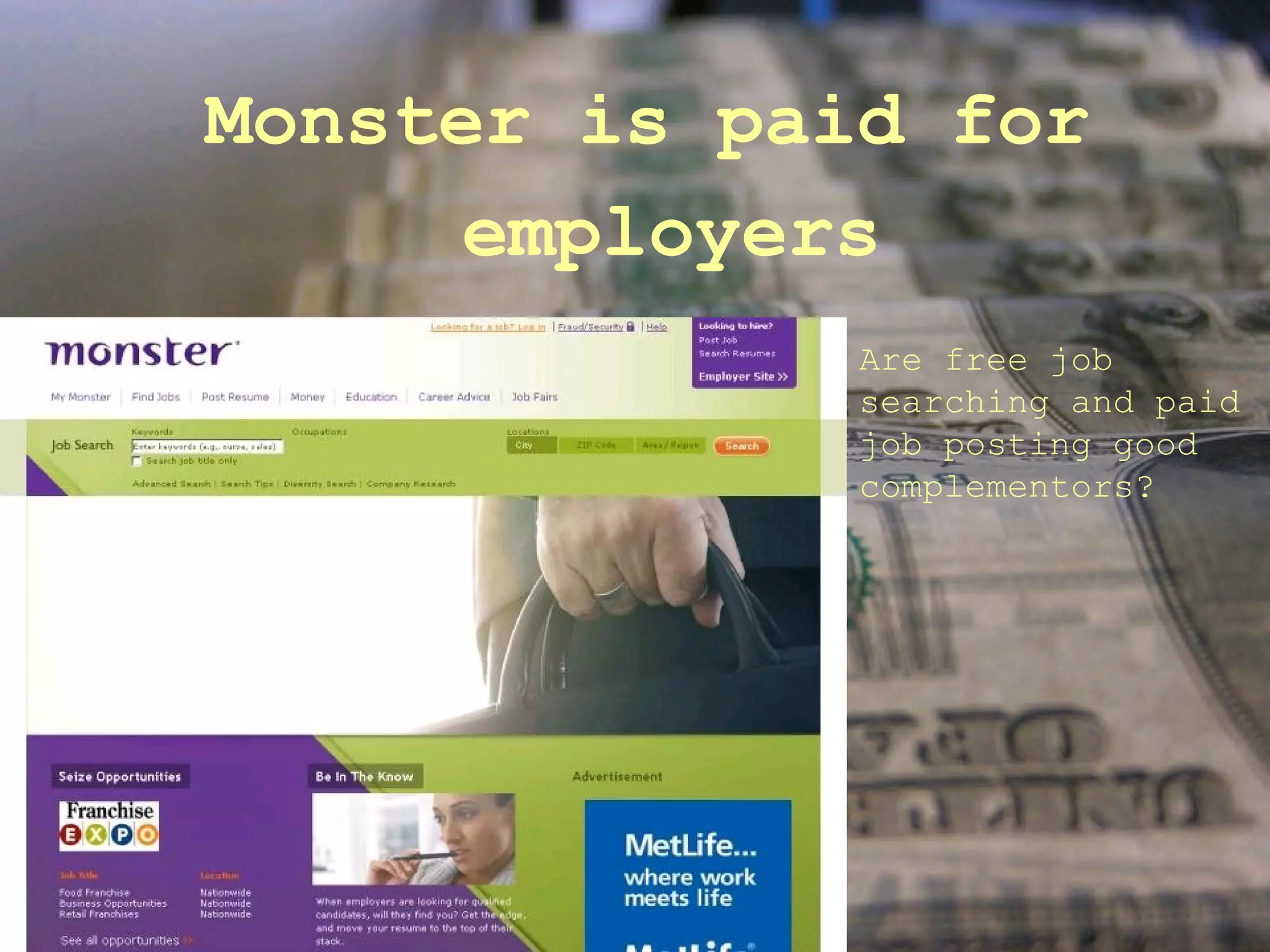
Monster:   free   job   searching
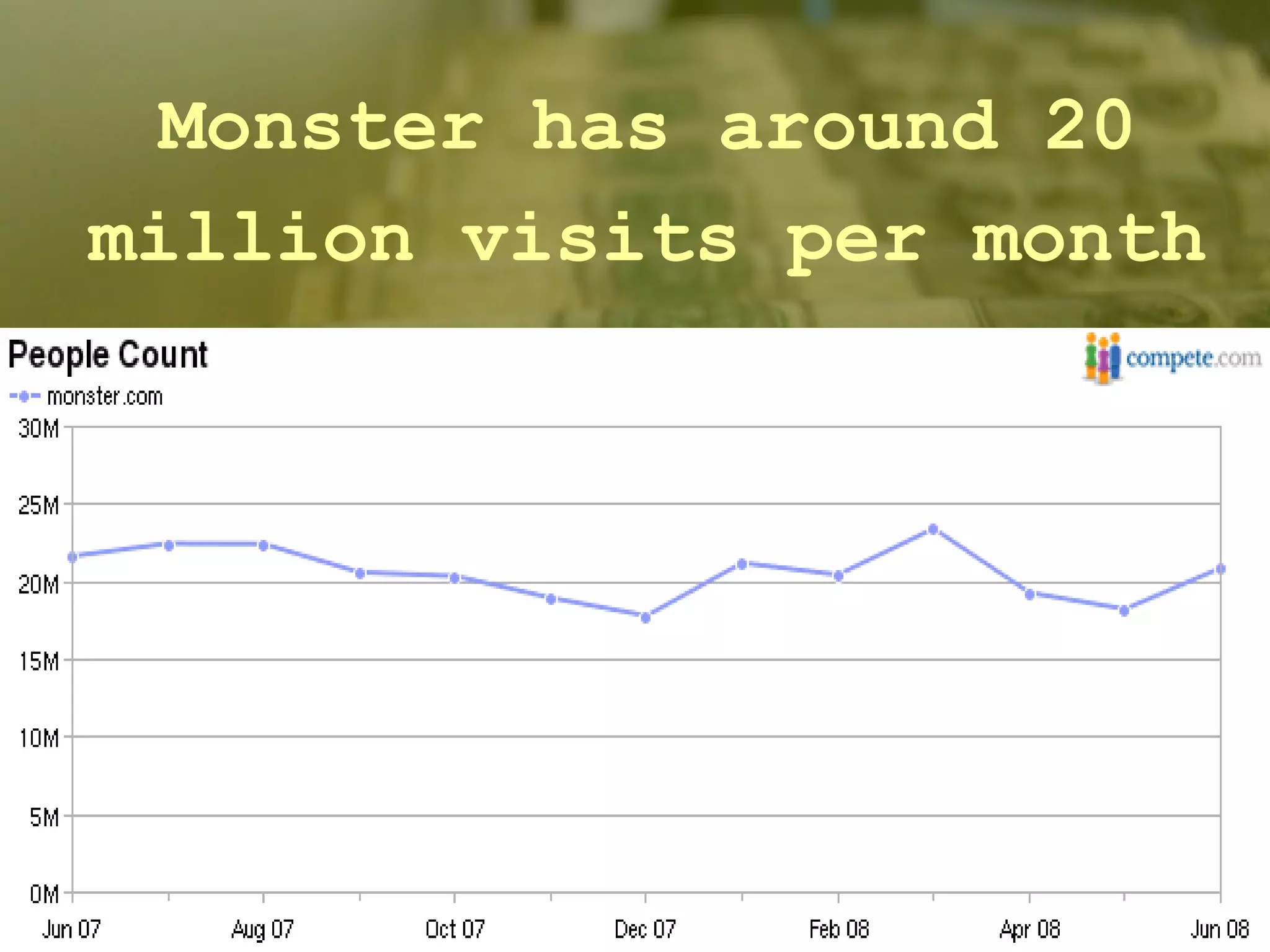
Monster has around 20 million visits per month
Monster is paid for employers Are free job searching and paid job posting good complementors?
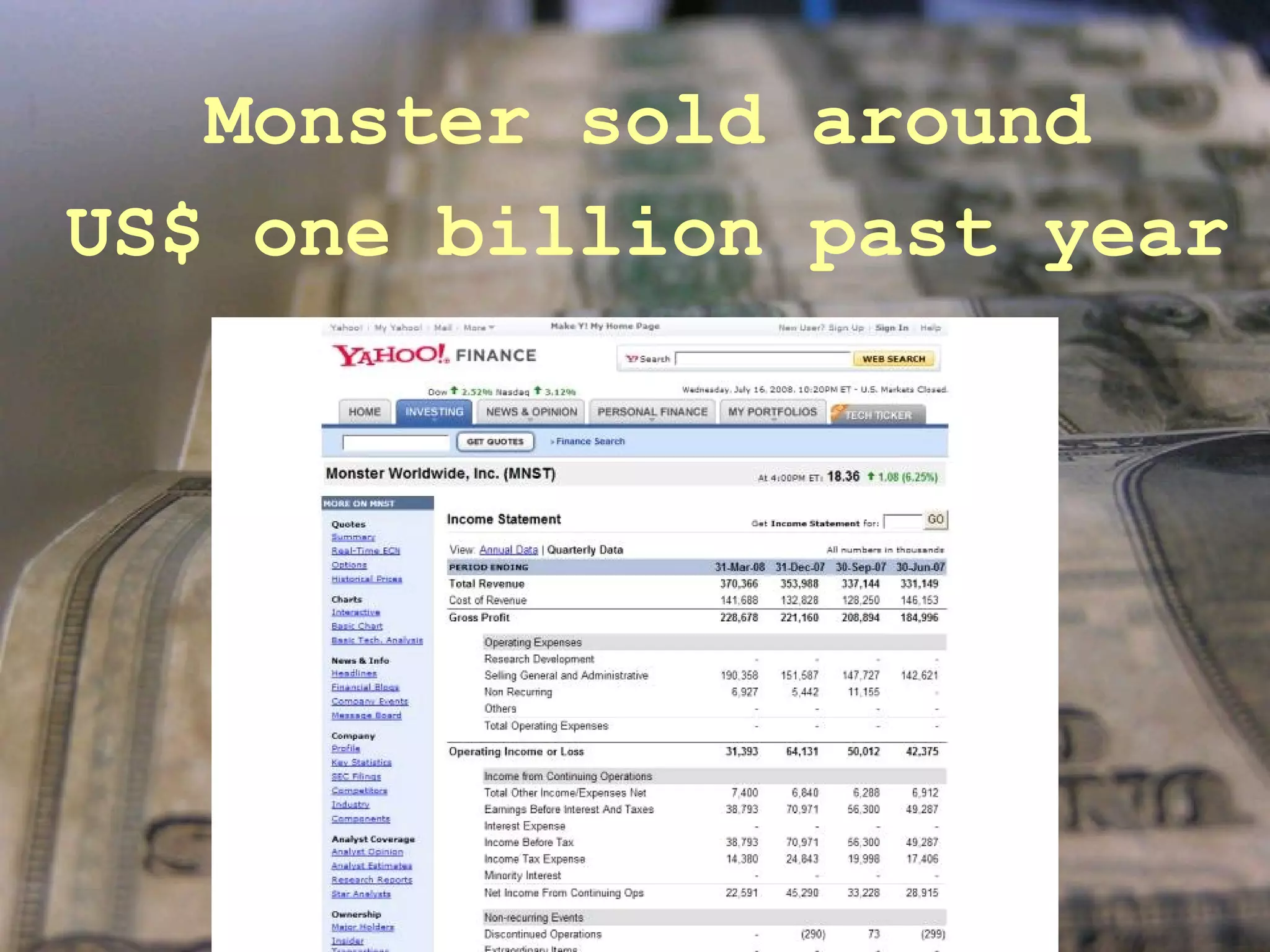
Monster sold around US$ one billion past year
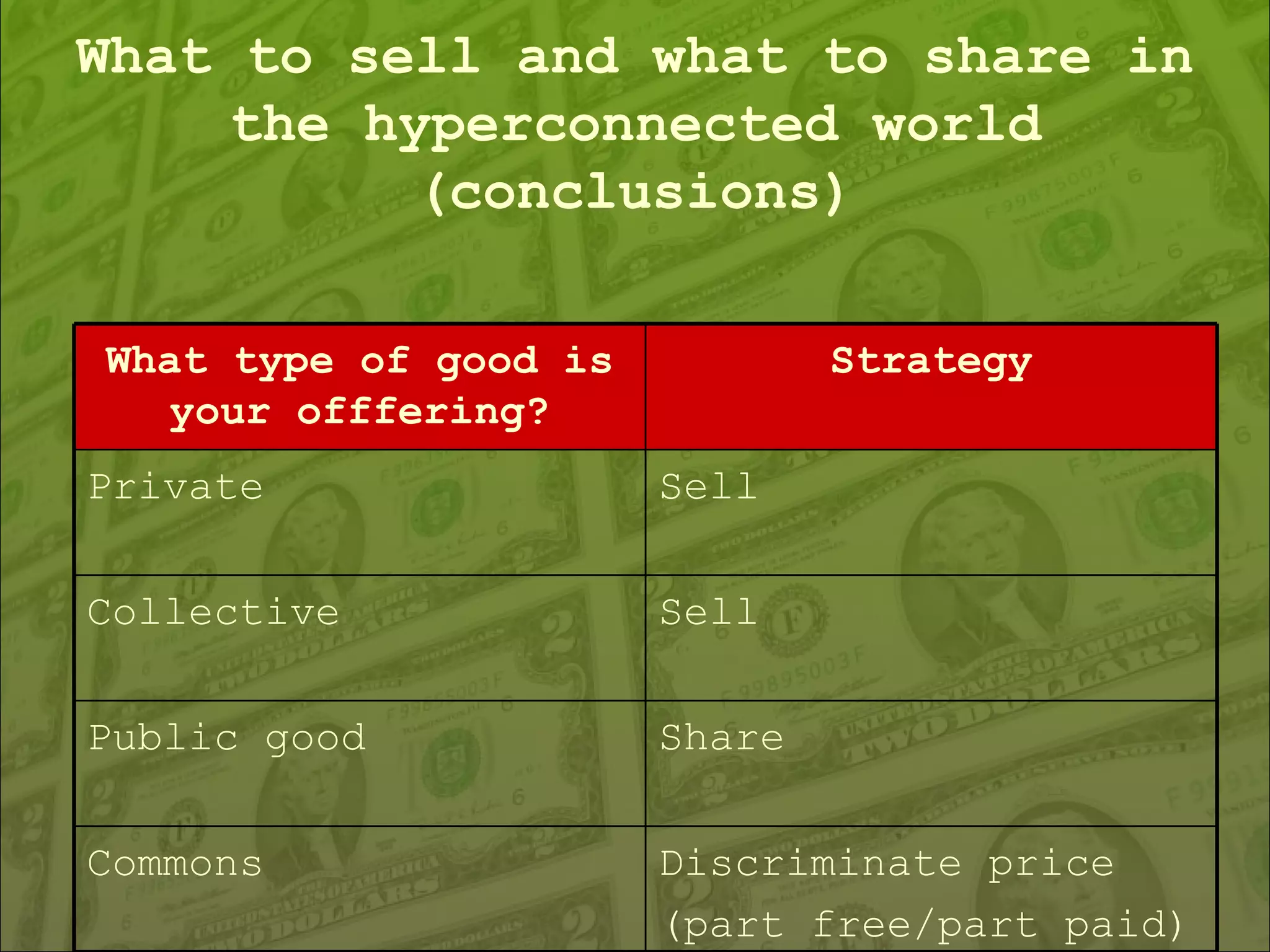
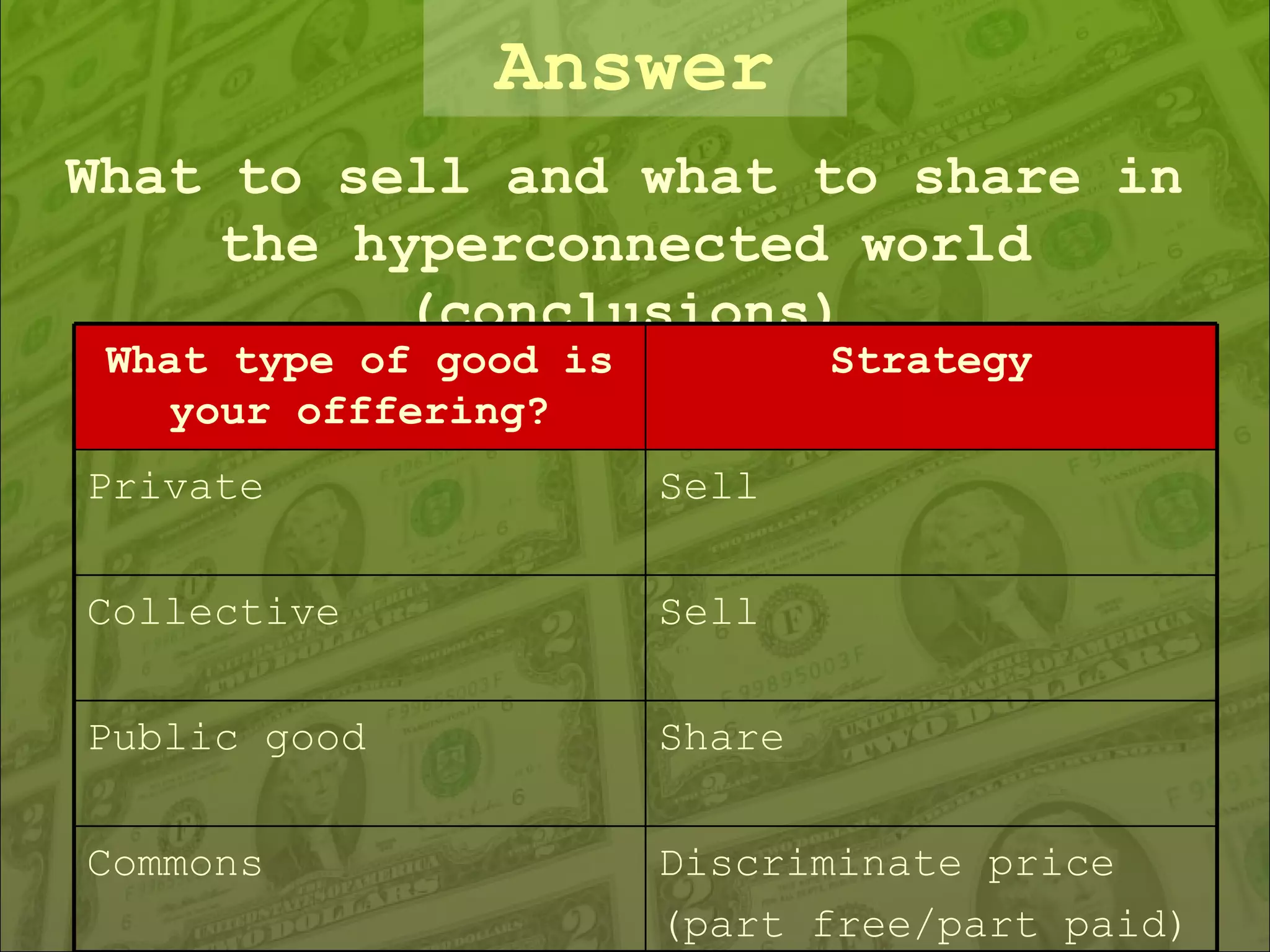
What to sell and what to share in the hyperconnected world (conclusions) Share Public good Discriminate price (part free/part paid) Commons Sell Collective Sell Private Strategy What type of good is your offfering?
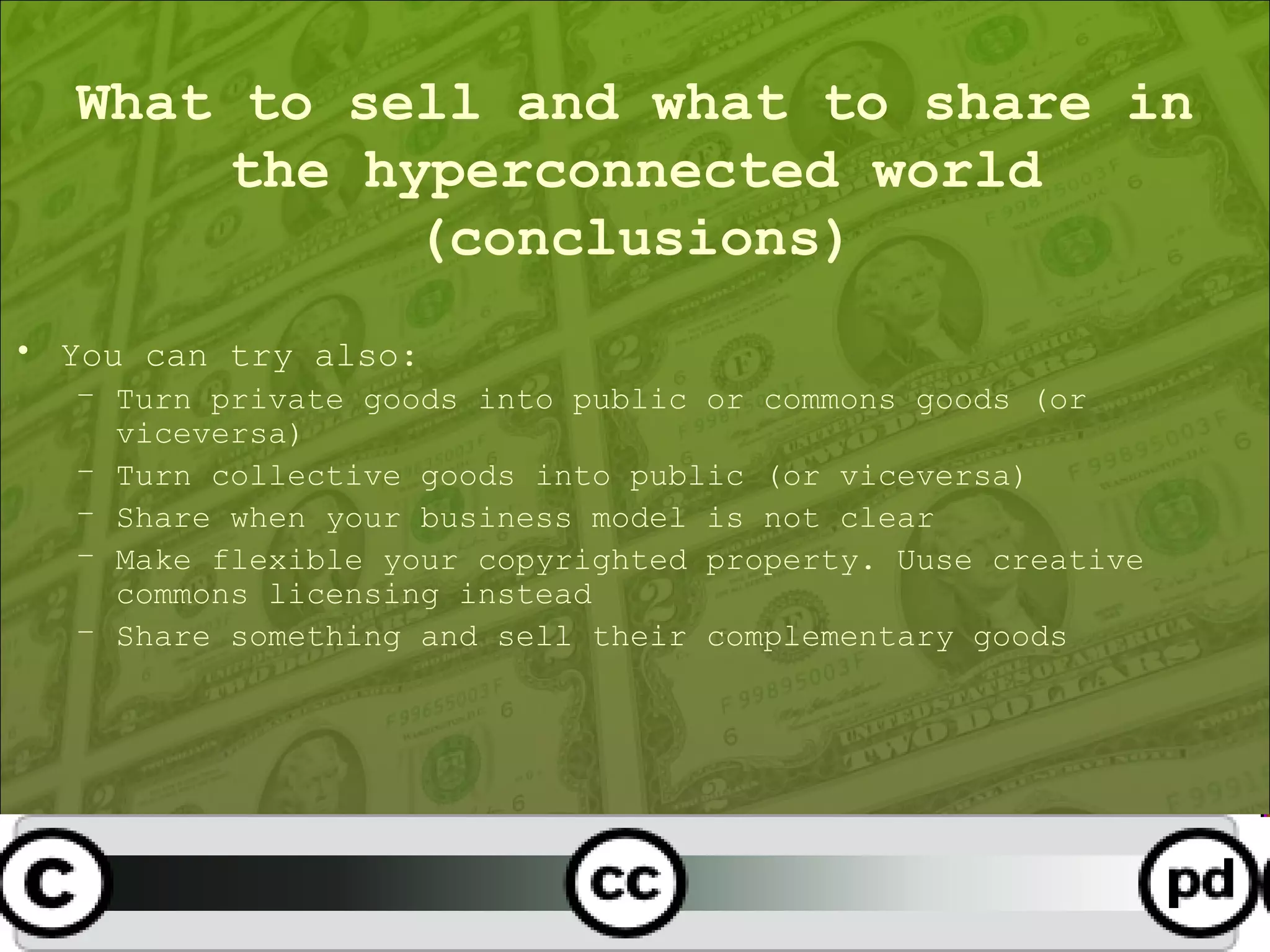
What to sell and what to share in the hyperconnected world (conclusions) You can try also: Turn private goods into public or commons goods (or viceversa) Turn collective goods into public (or viceversa) Share when your business model is not clear Make flexible your copyrighted property. Uuse creative commons licensing instead Share something and sell their complementary goods
Agenda Introduction How to  conquer entire markets  in the hyperconnected world What to  sell  and what to  share  in the hyperconnected world How to create  eternal loyalty  through customer communities Creating value with  partners  through business  ecosystems Using Information and Communication Technologies to build the  Infraestructure of Cooperation The  Billion Business Model
How to create eternal loyalty through customer communities
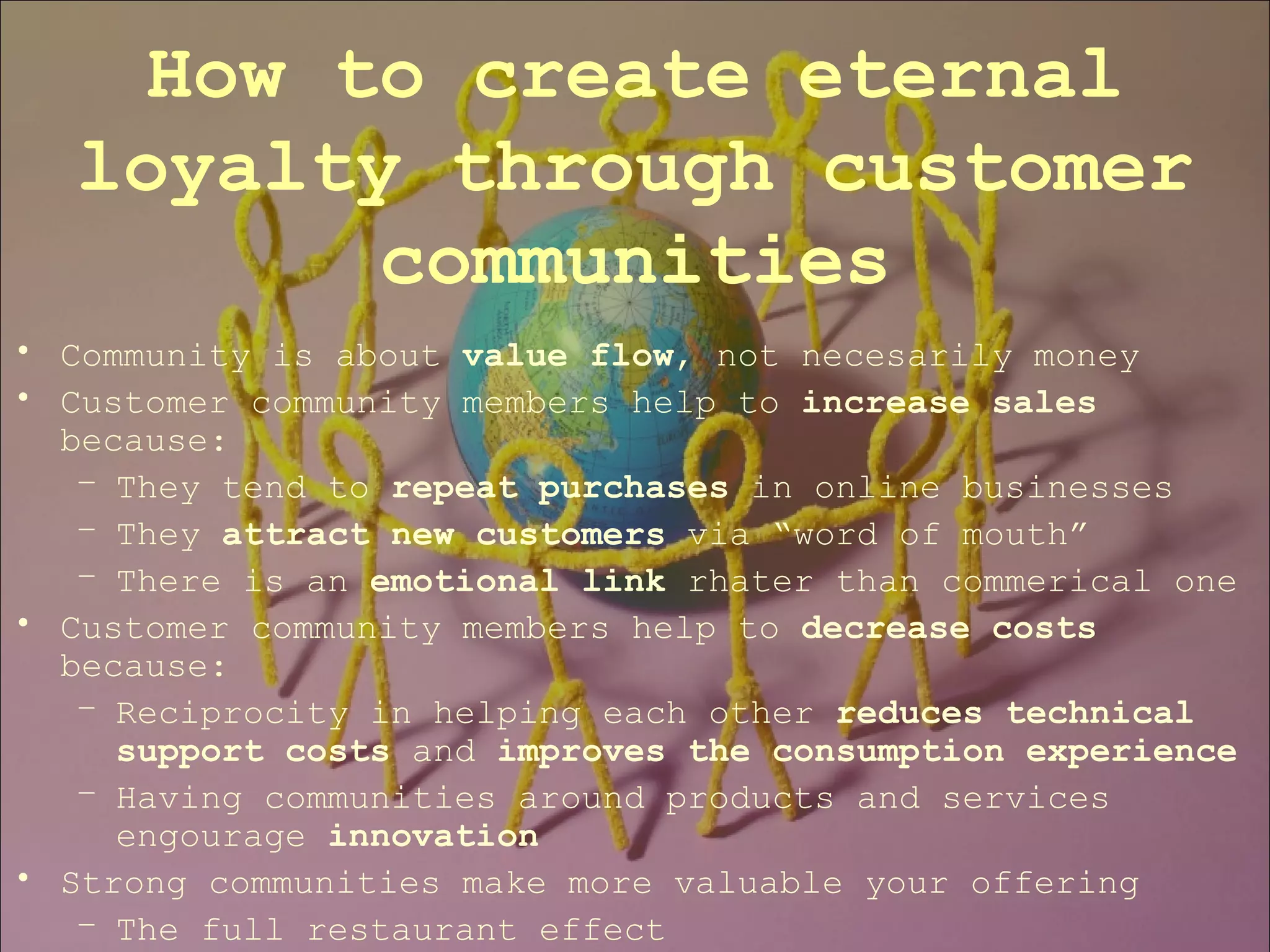
Community is about  value flow , not necesarily money Customer community members help to  increase sales  because: They tend to  repeat purchases  in online businesses They  attract new customers  via “word of mouth” There is an  emotional link  rhater than commerical one Customer community members help to  decrease costs  because: Reciprocity in helping each other  reduces technical support   costs  and  improves the consumption experience Having communities around products and services engourage  innovation Strong communities make more valuable your offering The full restaurant effect How to create eternal loyalty through customer communities
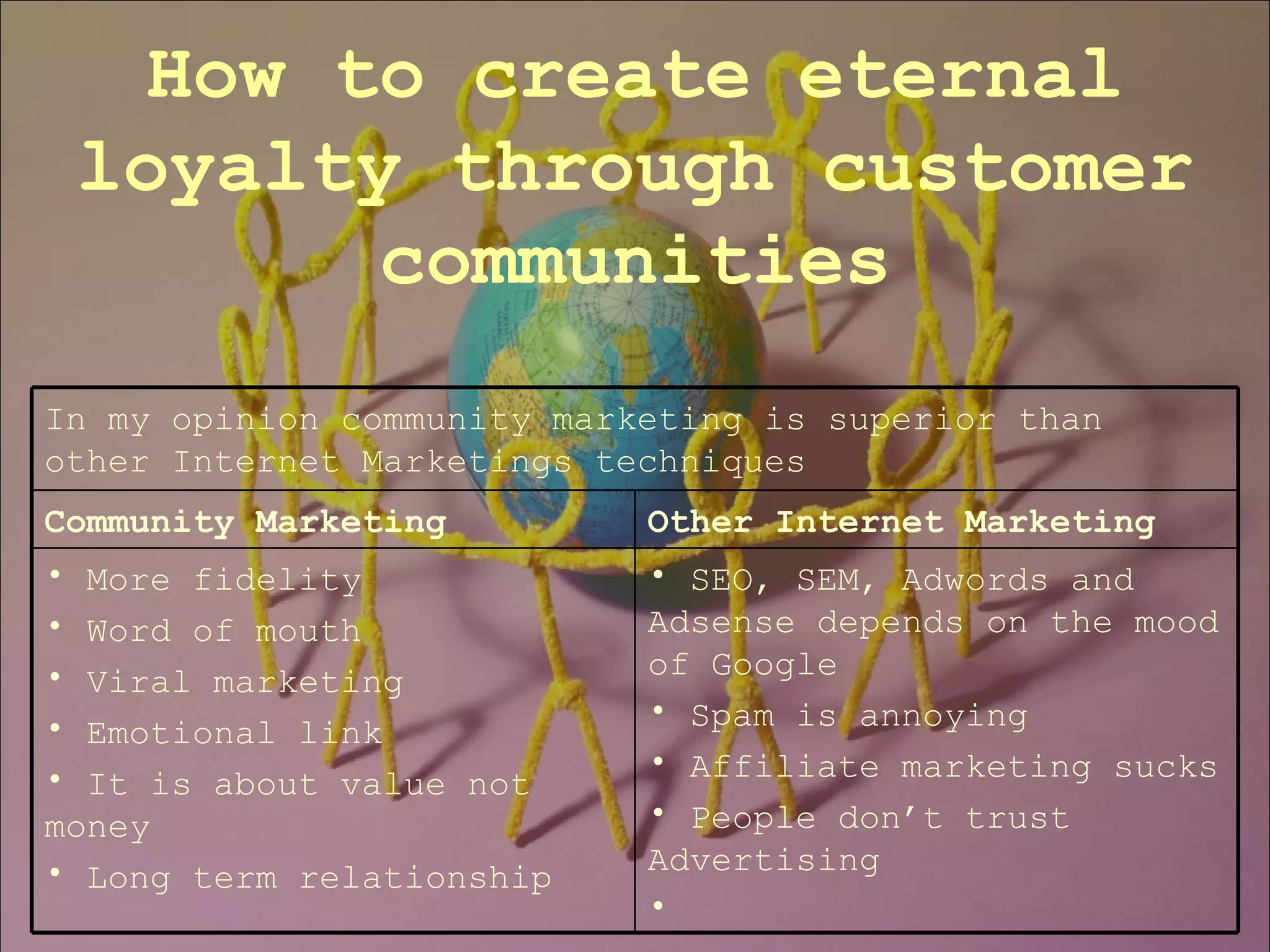
How to create eternal loyalty through customer communities In my opinion community marketing is superior than other Internet Marketings techniques SEO, SEM, Adwords and Adsense depends on the mood of Google Spam is annoying Affiliate marketing sucks People don’t trust Advertising More fidelity Word of mouth Viral marketing Emotional link It is about value not money Long term relationship Other Internet Marketing Community Marketing
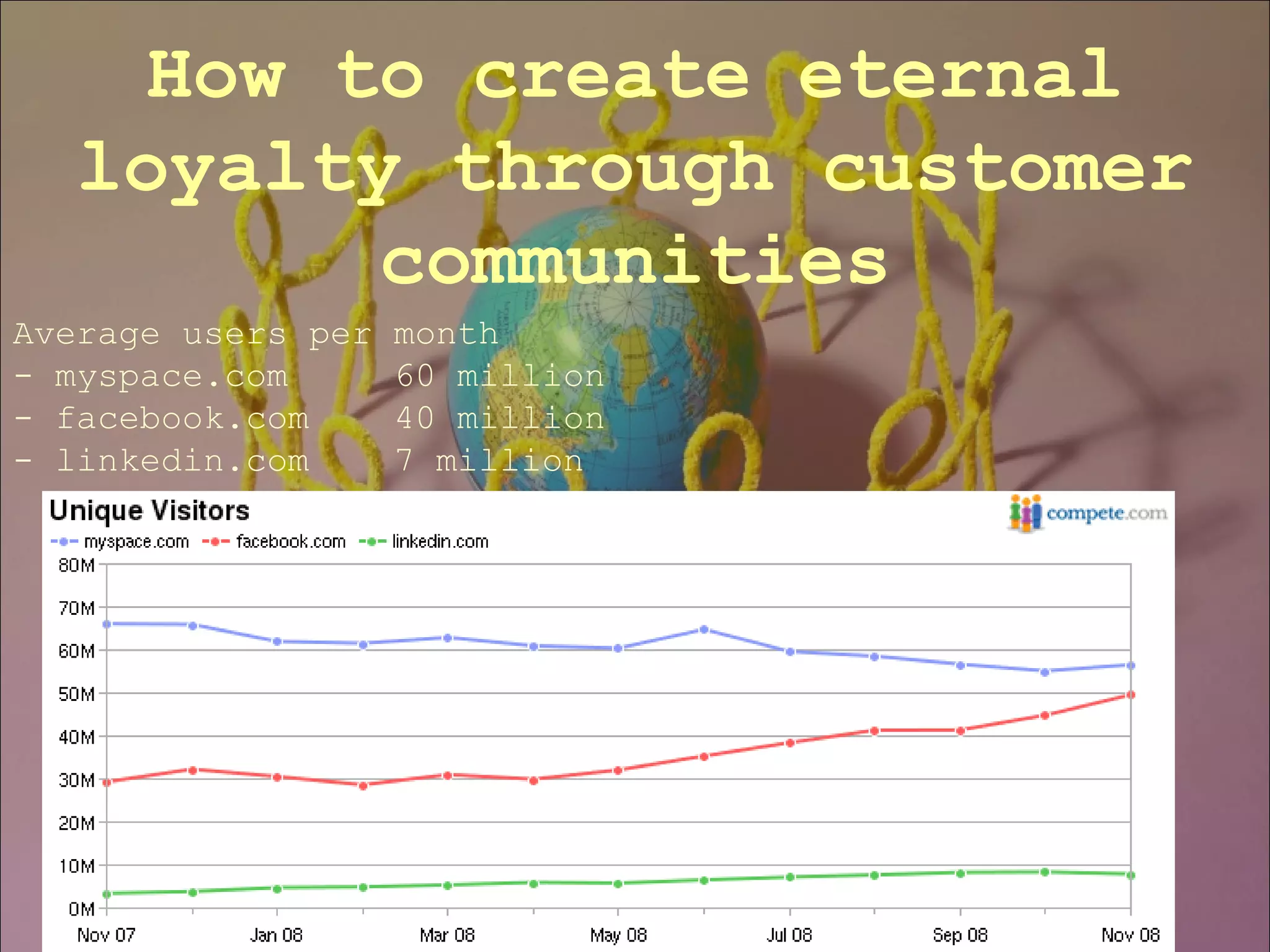
How to create eternal loyalty through customer communities Average users per month  - myspace.com 60 million - facebook.com 40 million - linkedin.com 7 million
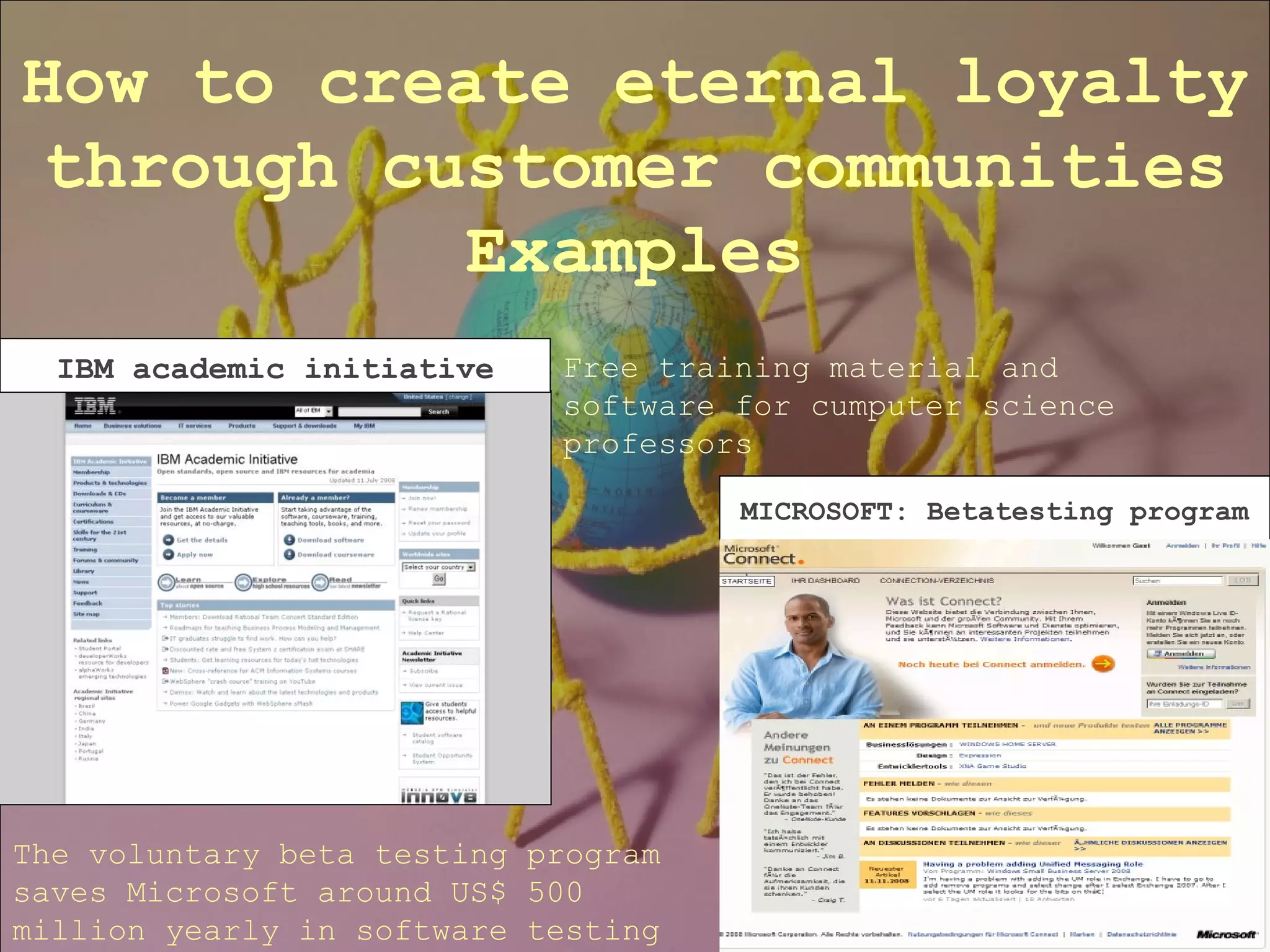
How to create eternal loyalty through customer communities Examples IBM academic initiative MICROSOFT: Betatesting program Free training material and software for cumputer science professors The voluntary beta testing program saves Microsoft around US$ 500 million yearly in software testing
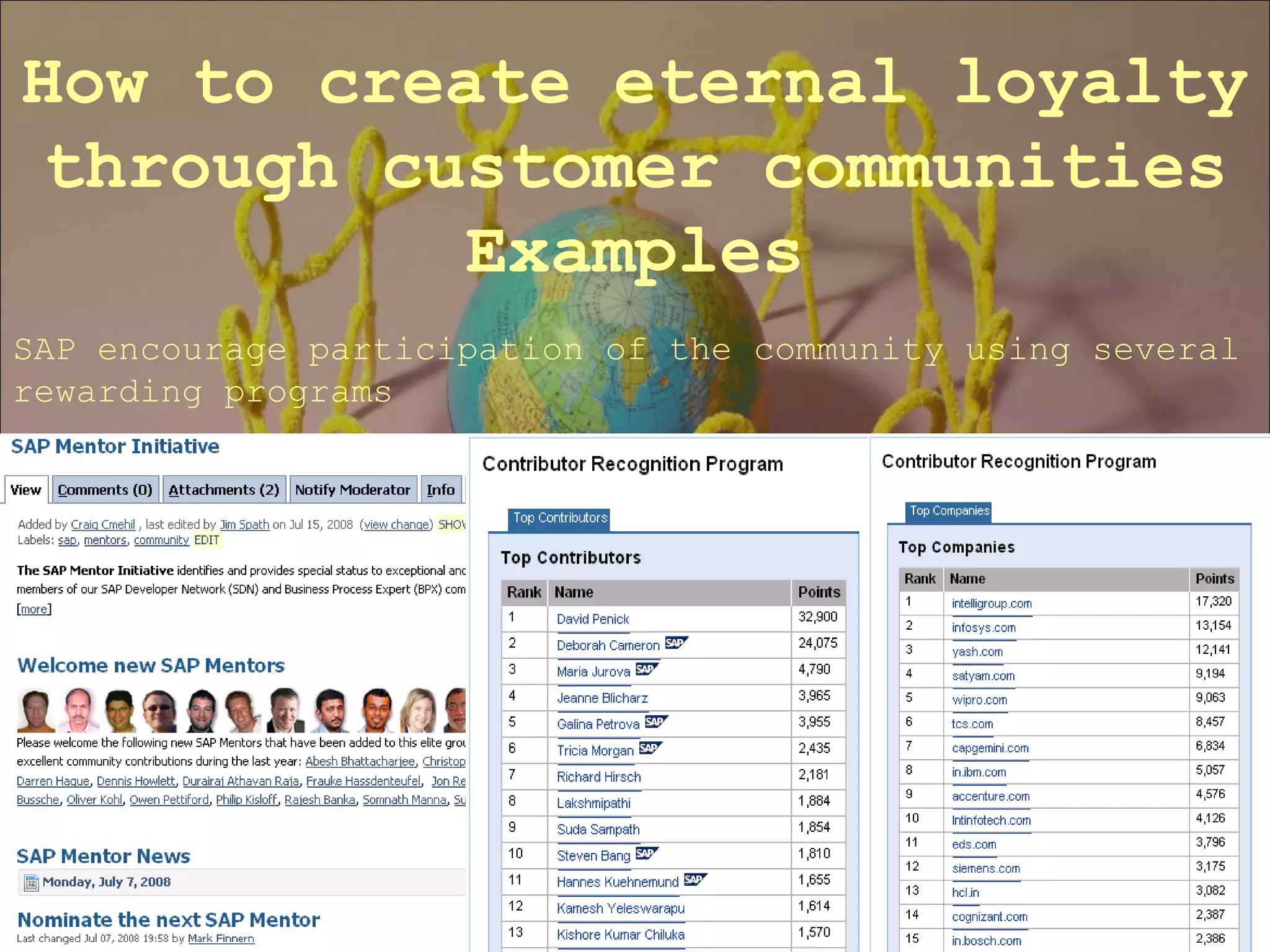
How to create eternal loyalty through customer communities Examples SAP encourage participation of the community using several rewarding programs
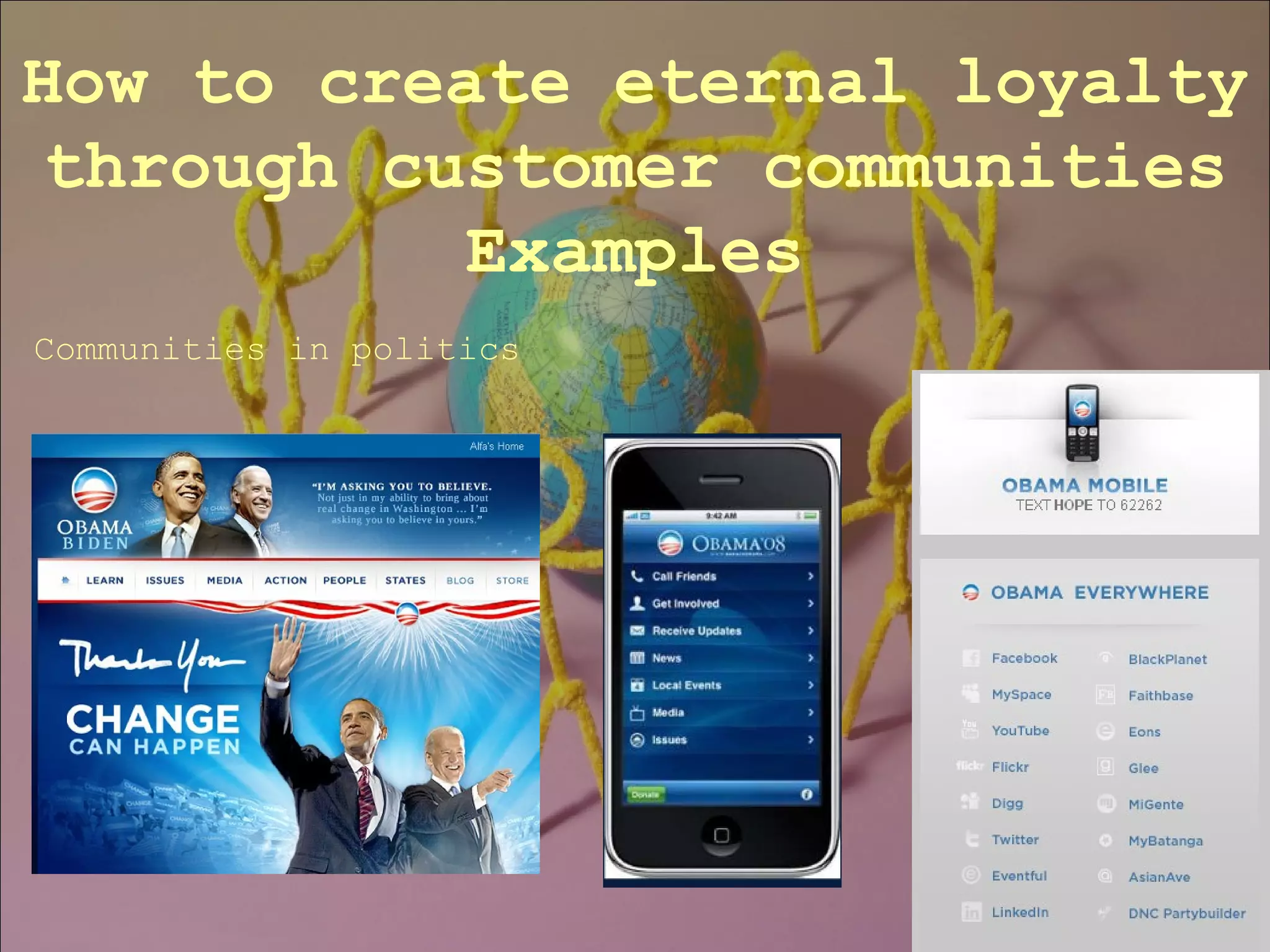
How to create eternal loyalty through customer communities Examples Communities in politics
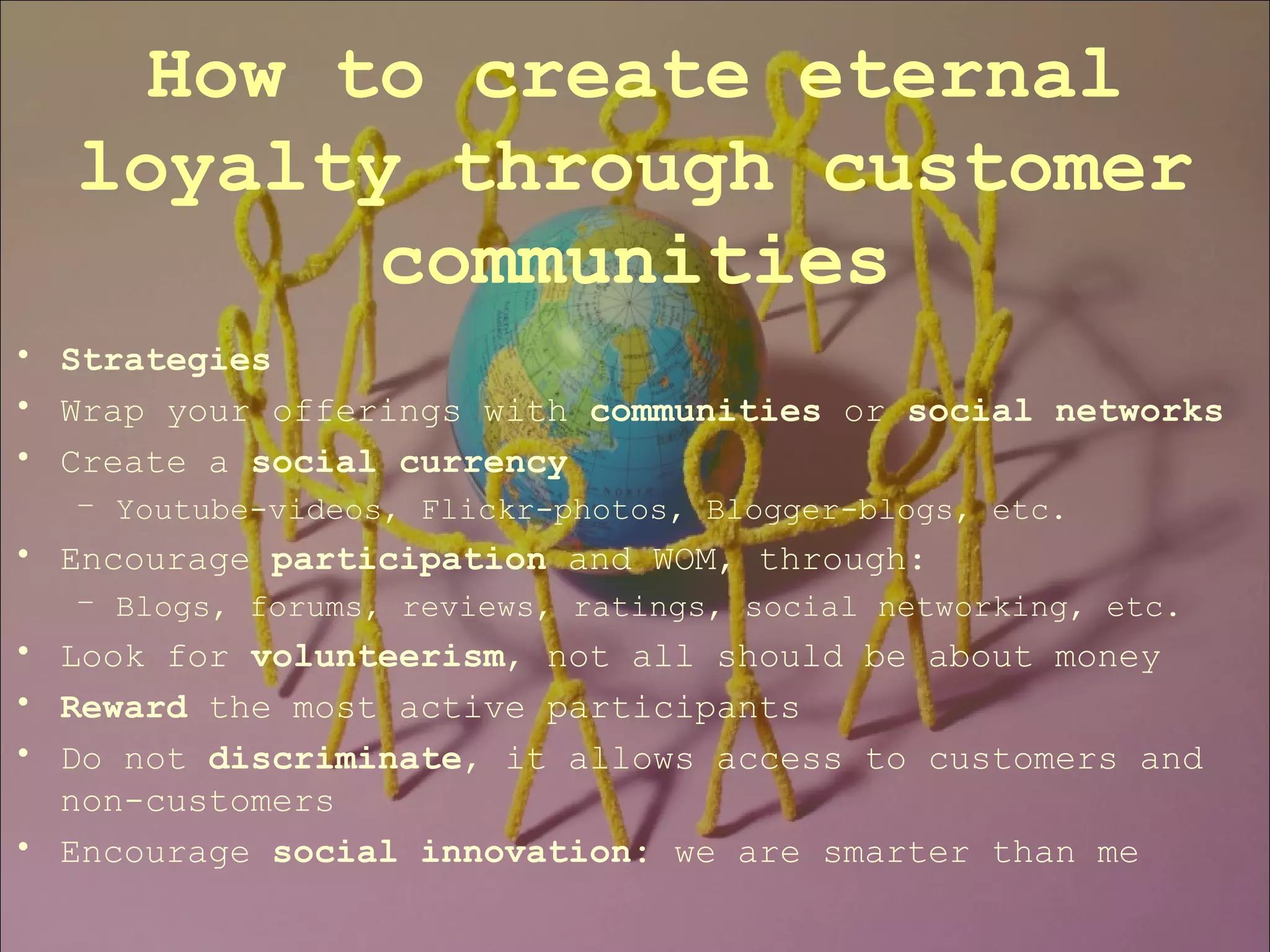
Strategies Wrap your offerings with  communities  or  social networks Create a  social currency Youtube-videos, Flickr-photos, Blogger-blogs, etc. Encourage  participation  and WOM, through: Blogs, forums, reviews, ratings, social networking, etc.    Look for  volunteerism , not all should be about money Reward  the most active participants  Do not  discriminate , it allows access to customers and non-customers Encourage  social innovation:  we are smarter than me How to create eternal loyalty through customer communities
Agenda Introduction How to  conquer entire markets  in the hyperconnected world What to  sell  and what to  share  in the hyperconnected world How to create  eternal loyalty  through customer communities Creating value with  partners  through business  ecosystems Using Information and Communication Technologies to build the  Infraestructure of Cooperation The  Billion Business Model
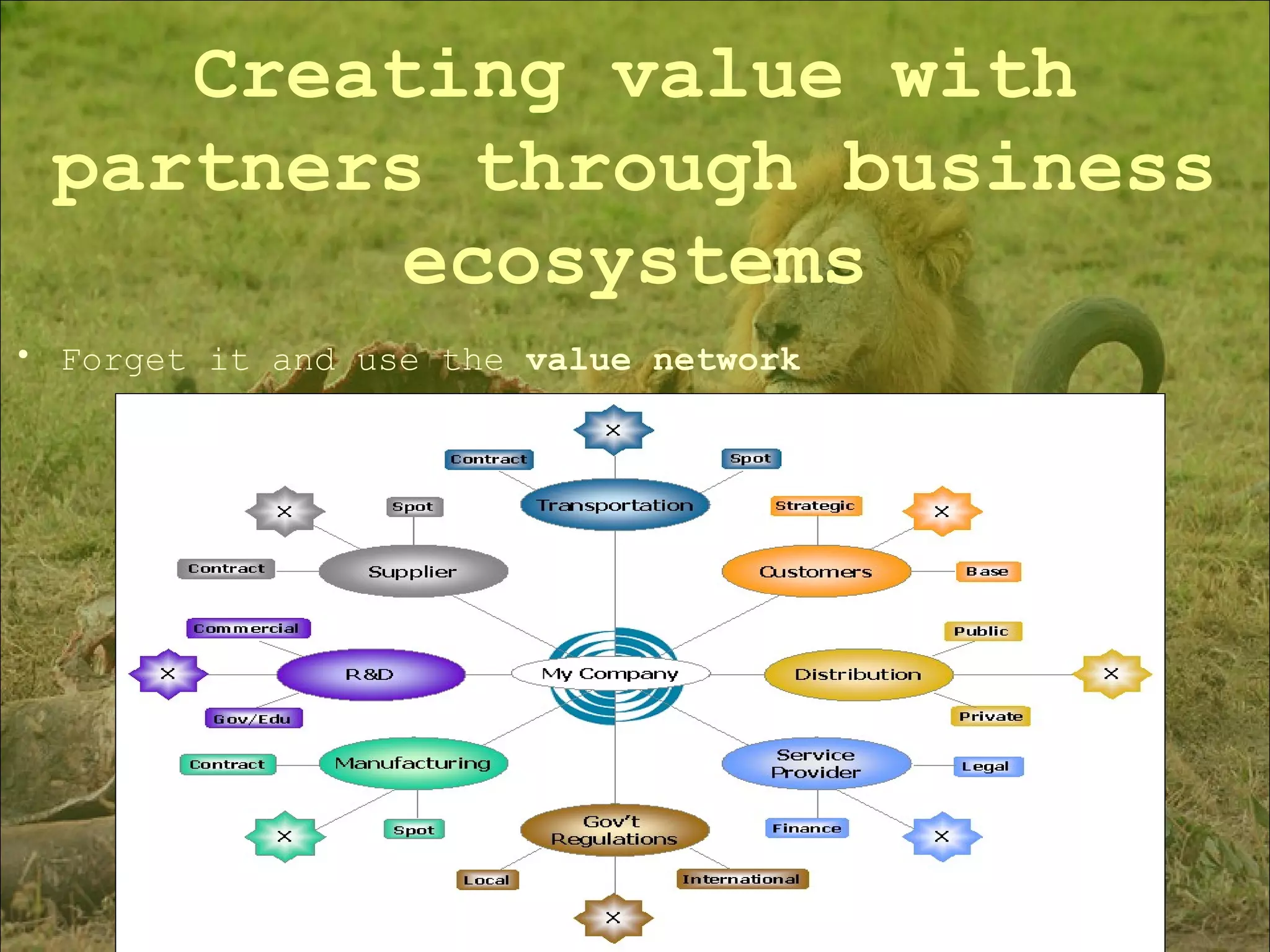
Creating value with partners through business ecosystems
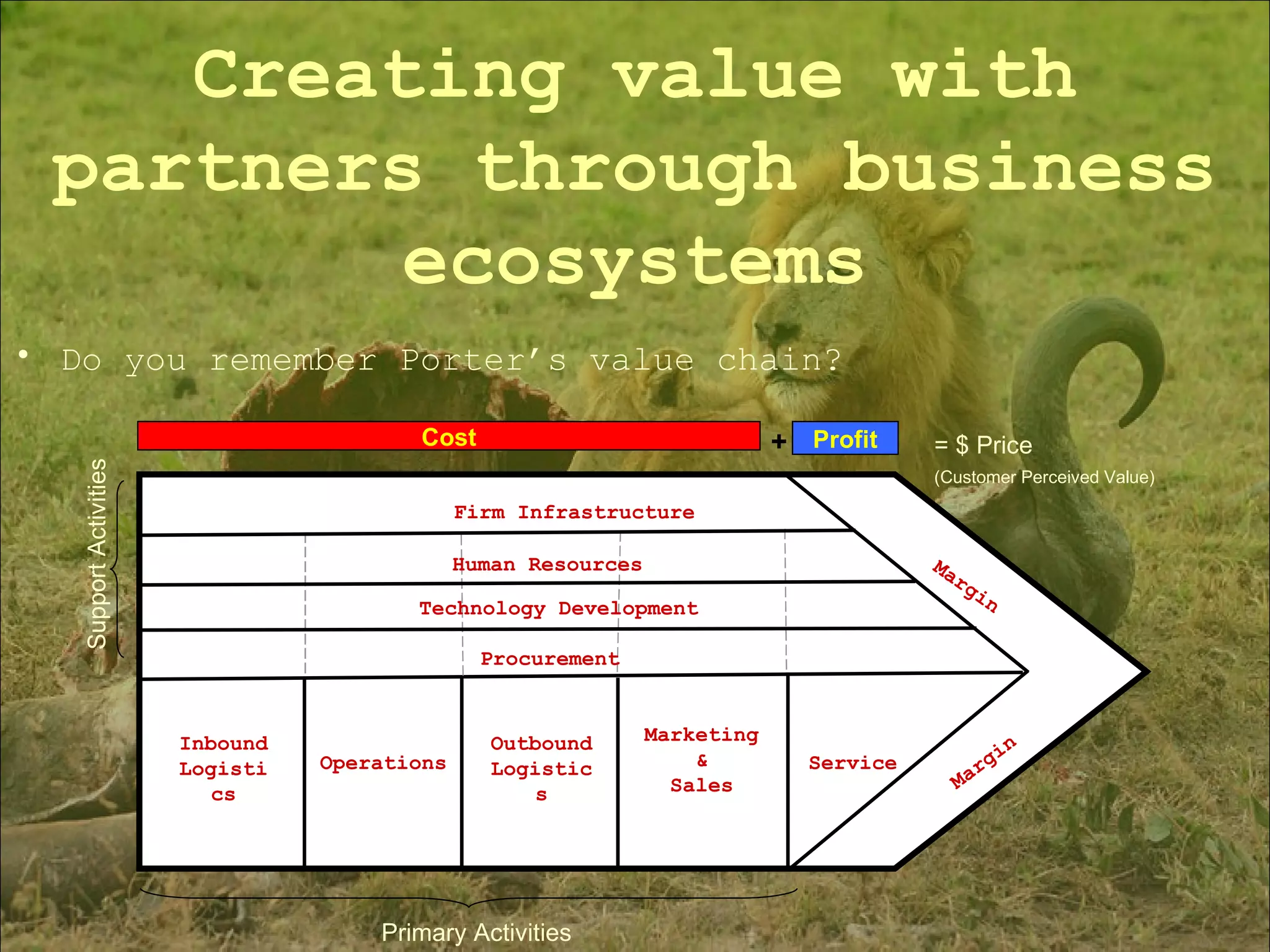
Do you remember Porter’s value chain? Creating value with partners through business ecosystems Primary Activities Support Activities Margin Margin Inbound Logistics Operations Outbound Logistics Marketing & Sales Service Procurement Technology Development Human Resources Firm Infrastructure Cost Profit = $ Price (Customer Perceived Value)   +
Forget it and use the  value network Creating value with partners through business ecosystems
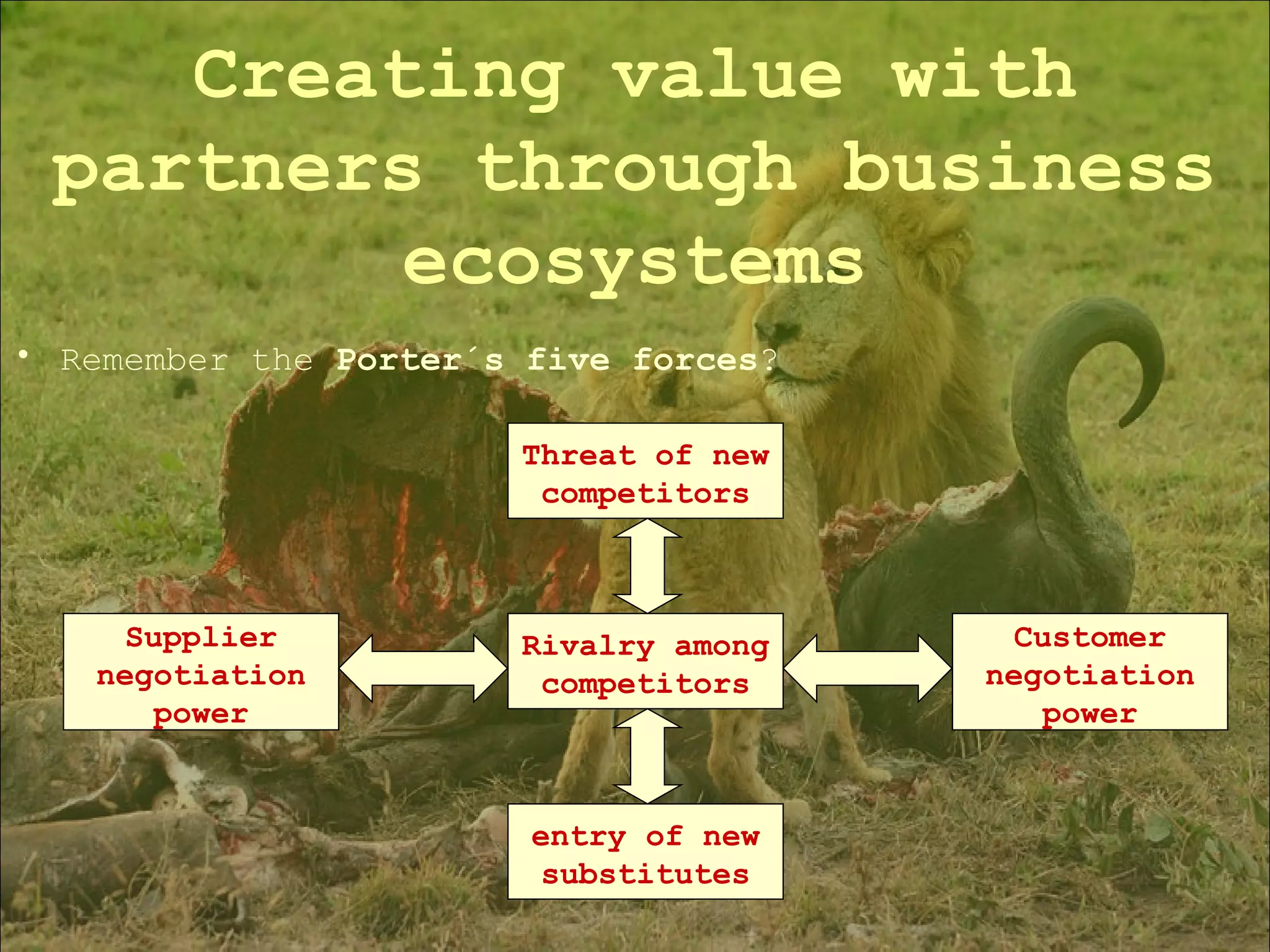
Remember the  Porter´s five forces ? Creating value with partners through business ecosystems Threat of new competitors entry of new substitutes Supplier negotiation power Customer negotiation power Rivalry among competitors
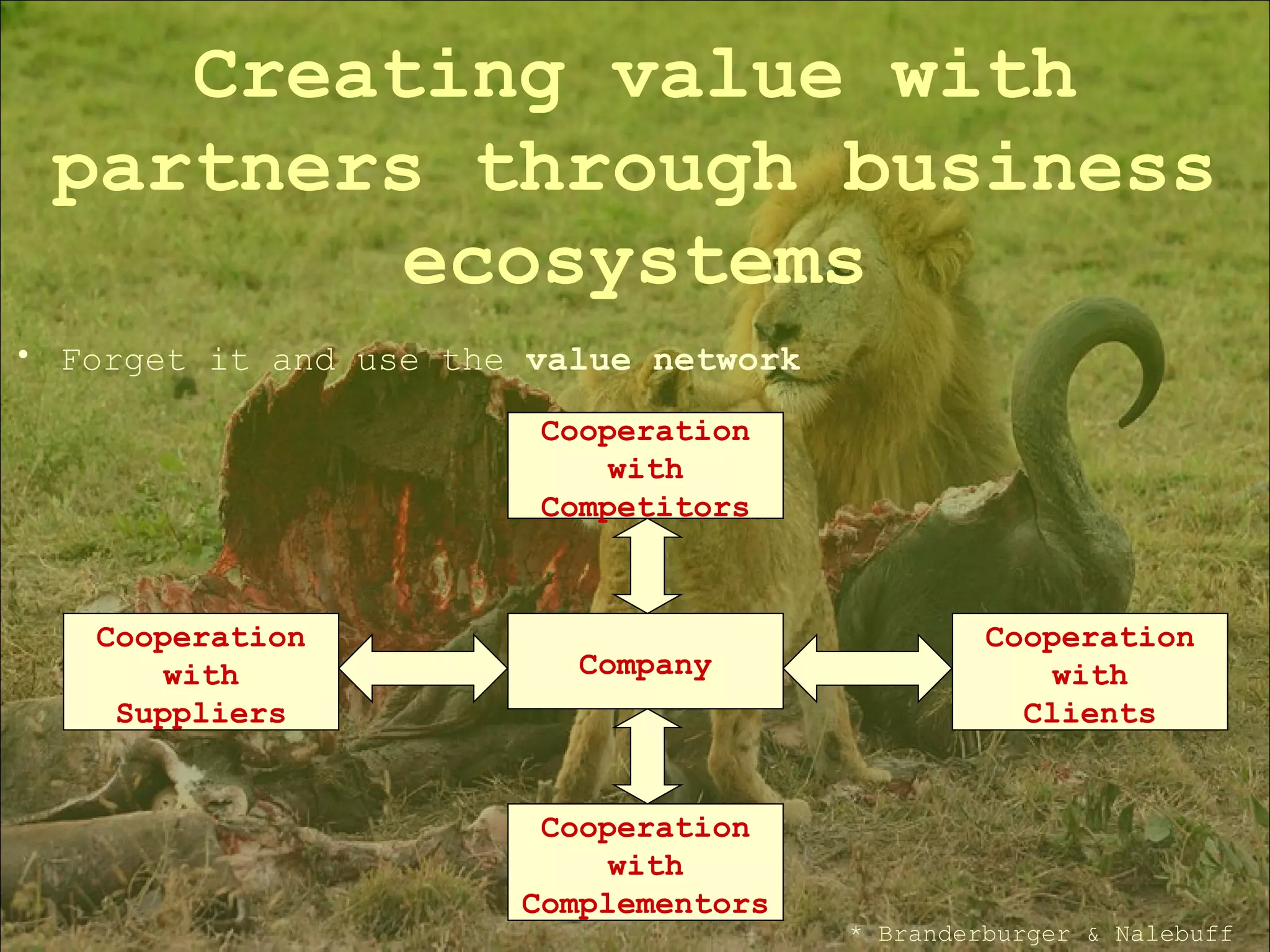
Forget it and use the  value network Creating value with partners through business ecosystems Cooperation with Competitors Cooperation with Complementors Cooperation with Suppliers Cooperation with Clients Company * Branderburger & Nalebuff
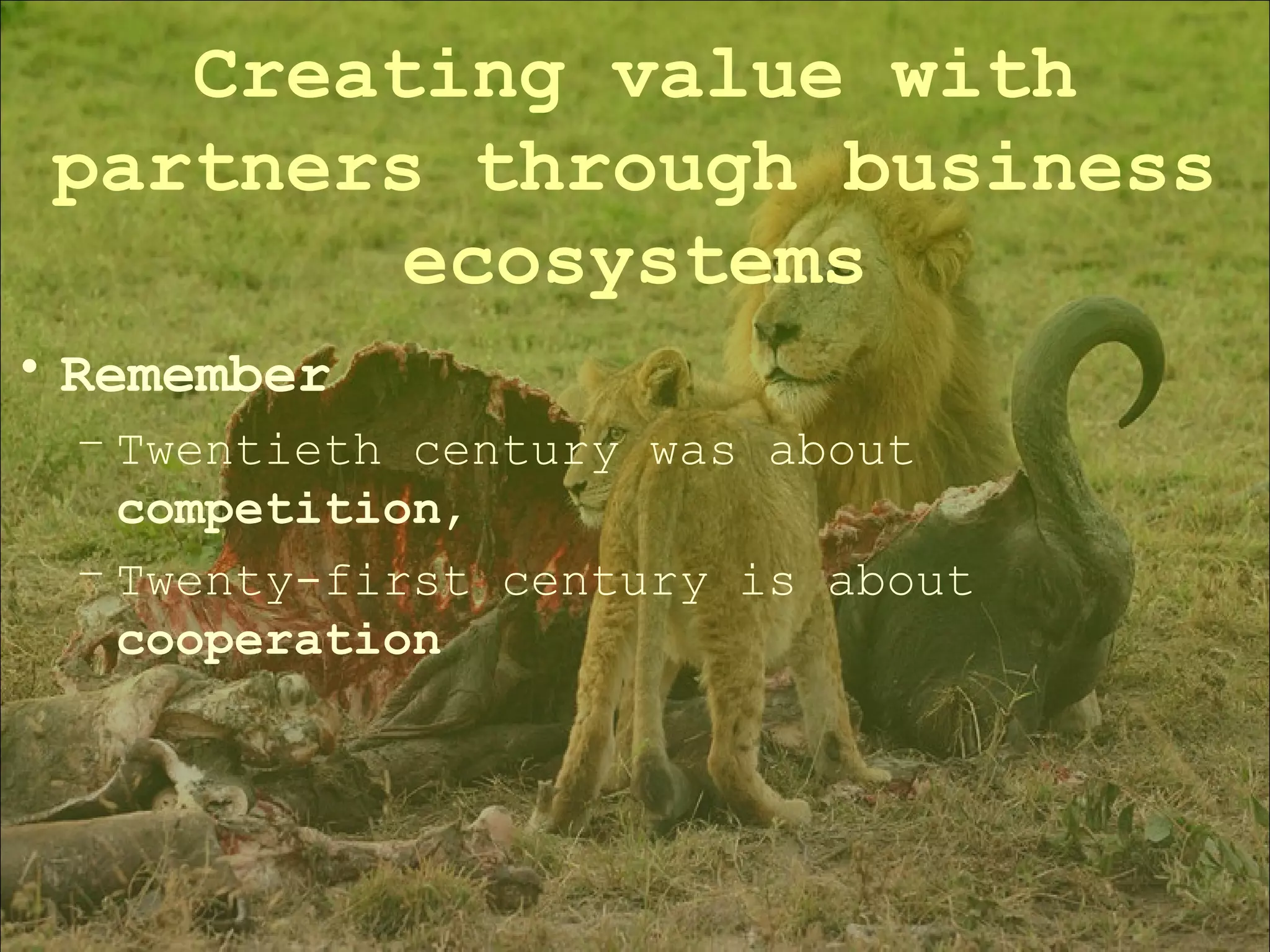
Remember Twentieth century was about  competition ,  Twenty-first century is about  cooperation Creating value with partners through business ecosystems
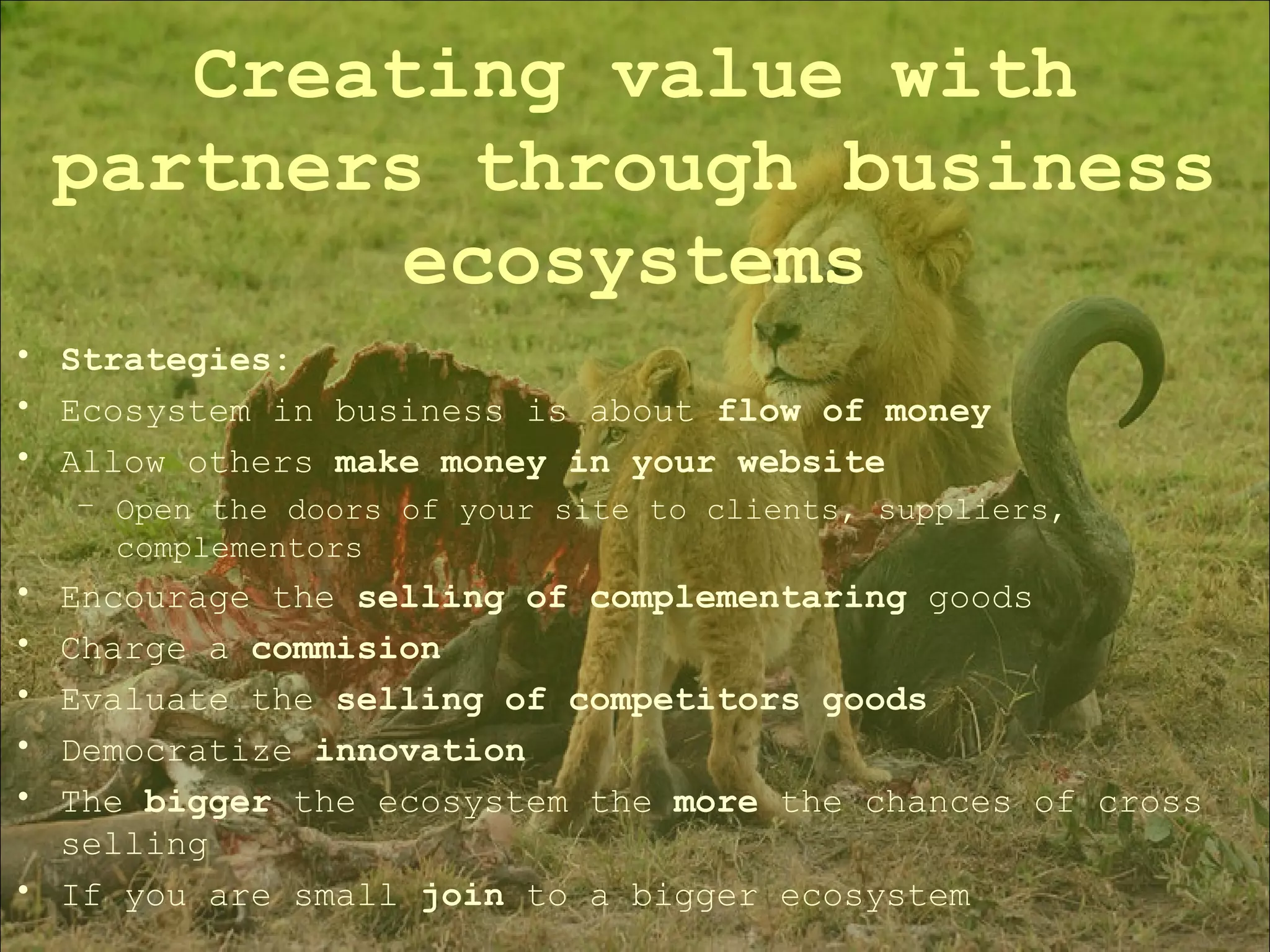
Strategies: Ecosystem in business is about  flow of money Allow others  make money in your website Open the doors of your site to clients, suppliers, complementors Encourage the  selling of complementaring  goods Charge a  commision Evaluate the  selling of competitors goods Democratize  innovation The  bigger  the ecosystem the  more  the chances of cross selling If you are small  join  to a bigger ecosystem Creating value with partners through business ecosystems
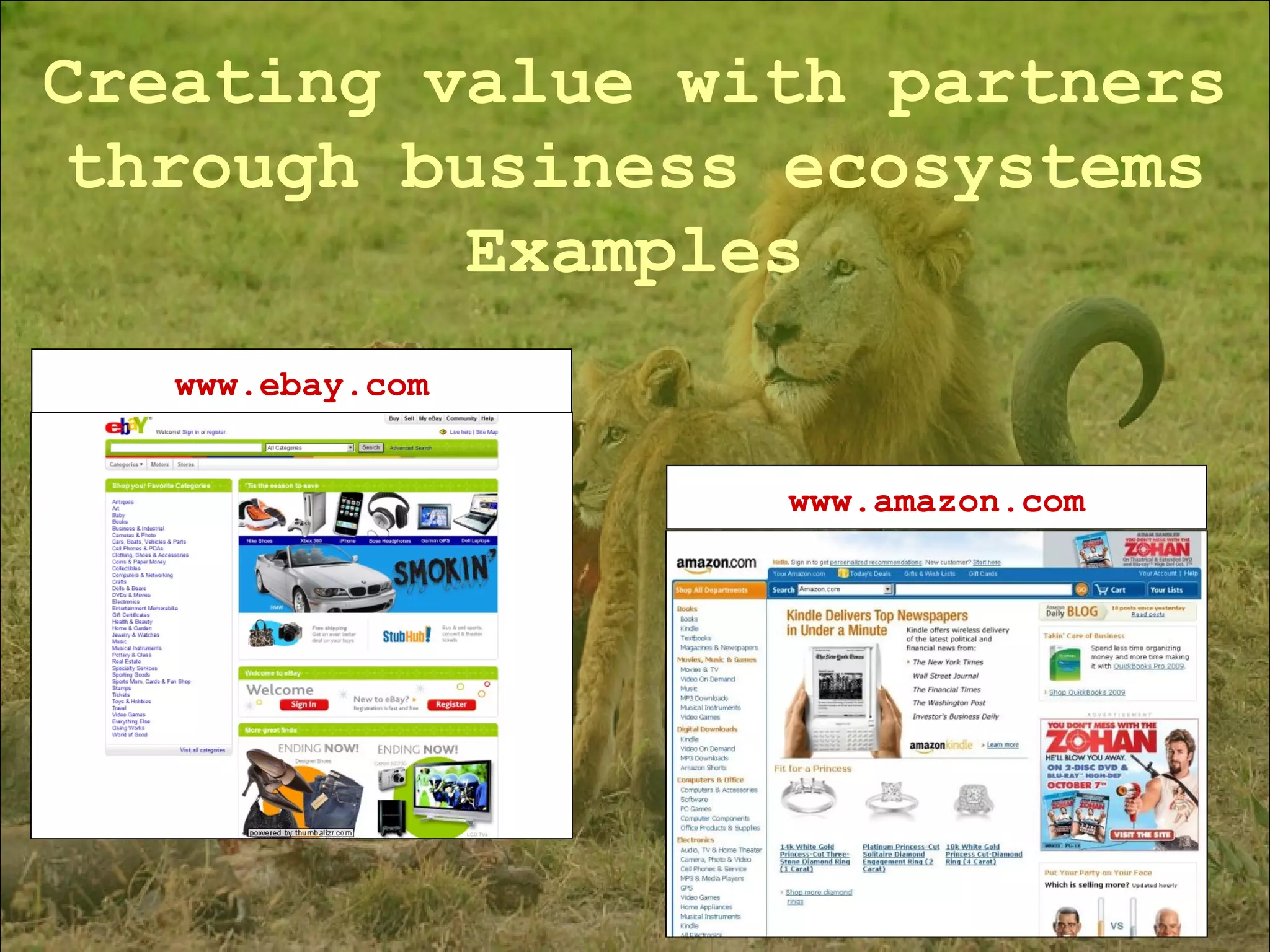
Creating value with partners through business ecosystems Examples www.ebay.com www.amazon.com
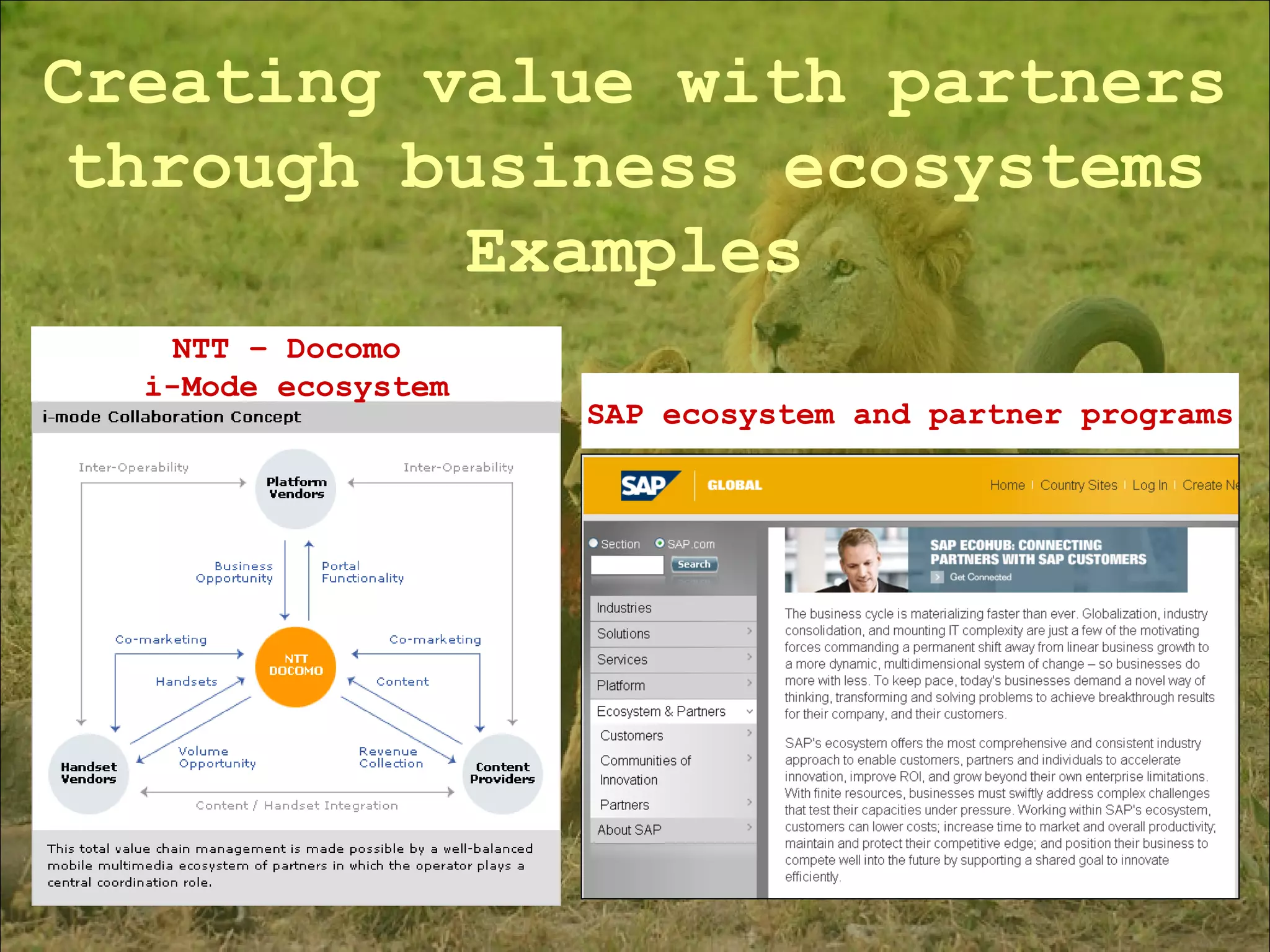
Creating value with partners through business ecosystems Examples SAP ecosystem and partner programs NTT – Docomo  i-Mode ecosystem
Agenda Introduction How to  conquer entire markets  in the hyperconnected world What to  sell  and what to  share  in the hyperconnected world How to create  eternal loyalty  through customer communities Creating value with  partners  through business  ecosystems Using Information and Communication Technologies to build the  Infraestructure of Cooperation The  Billion Business Model
Using ICT to build the Infraestructure of Cooperation
The infrastructure of cooperation: It is the web site It is where everything happens For sharing your free good For selling your paid good For the community For open innovation For the ecosystem (the others selling their goods) Using ICT to build the Infraestructure of Cooperation
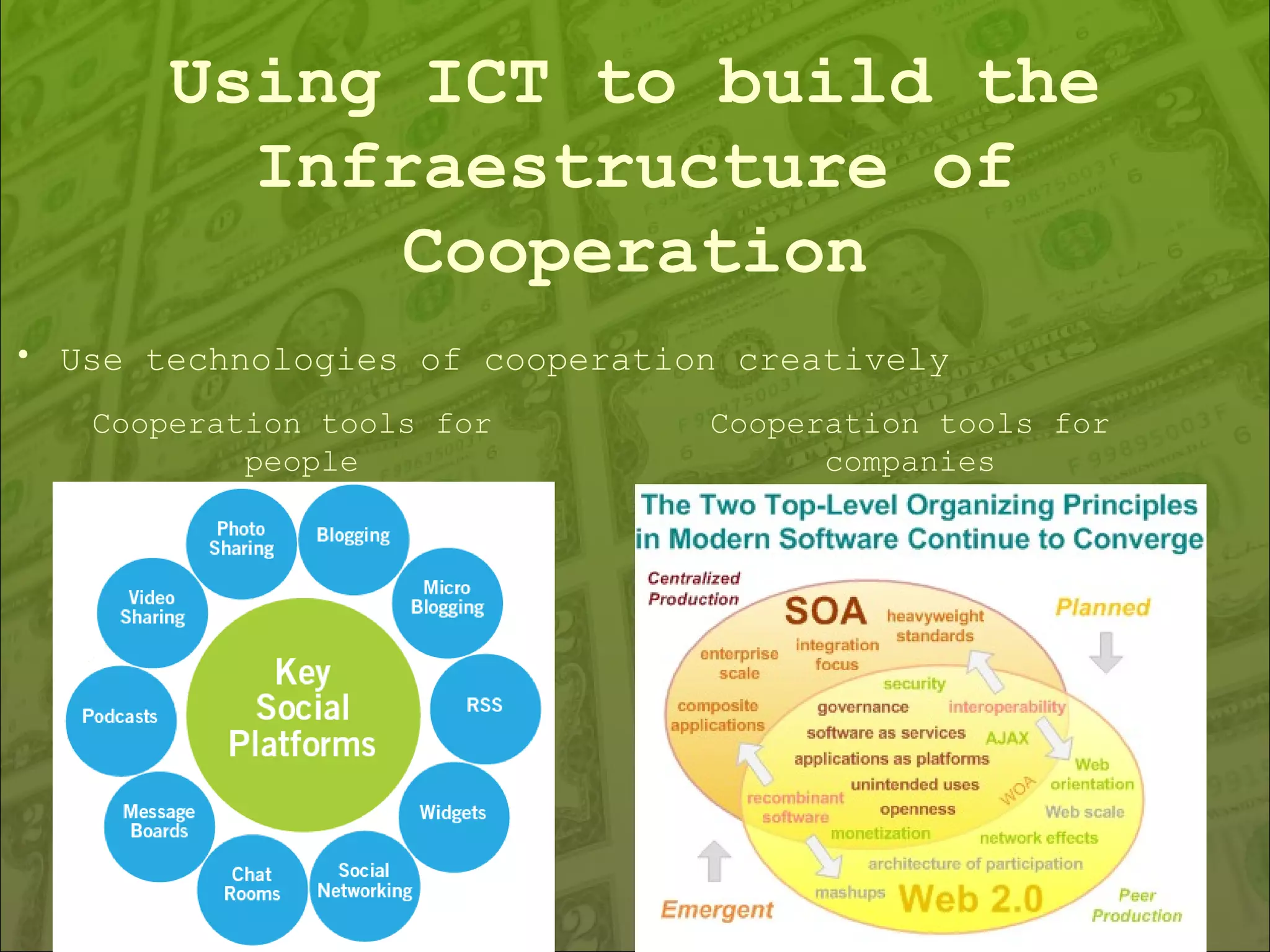
Use technologies of cooperation creatively Using ICT to build the Infraestructure of Cooperation Cooperation tools for  people Cooperation tools for companies
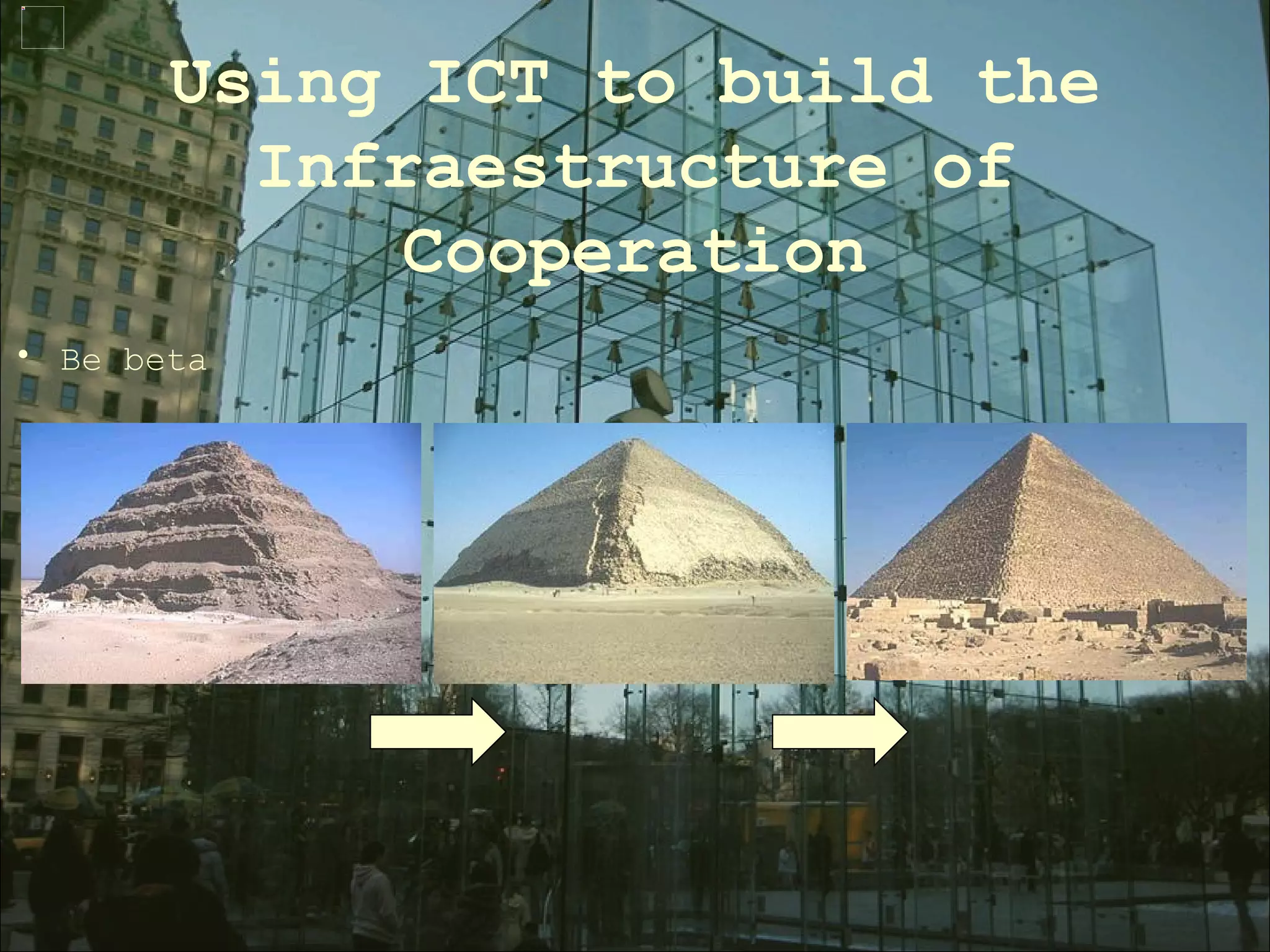
Be beta Using ICT to build the Infraestructure of Cooperation
Remember Ian Roughley Simplicity over Completeness Long Tail over Mass Audience Share over Protect Advertise over Subscribe Syndication over Stickiness Early Availability over Correctness Select by Crowd over Editor Honest Voice over Corporate Speak Participation over Publishing Community over Product Using ICT to build the Infraestructure of Cooperation
Strategies Create  incomplete architectures /products/services Encoureges  user generated content  (co-creation) Be  mashable Be  mobile Be  social SAS:  software as service SOA:  service oriented architecture Use  Ajax Hire  good programmers Using ICT to build the Infraestructure of Cooperation
Using ICT to build the Infraestructure of Cooperation Examples
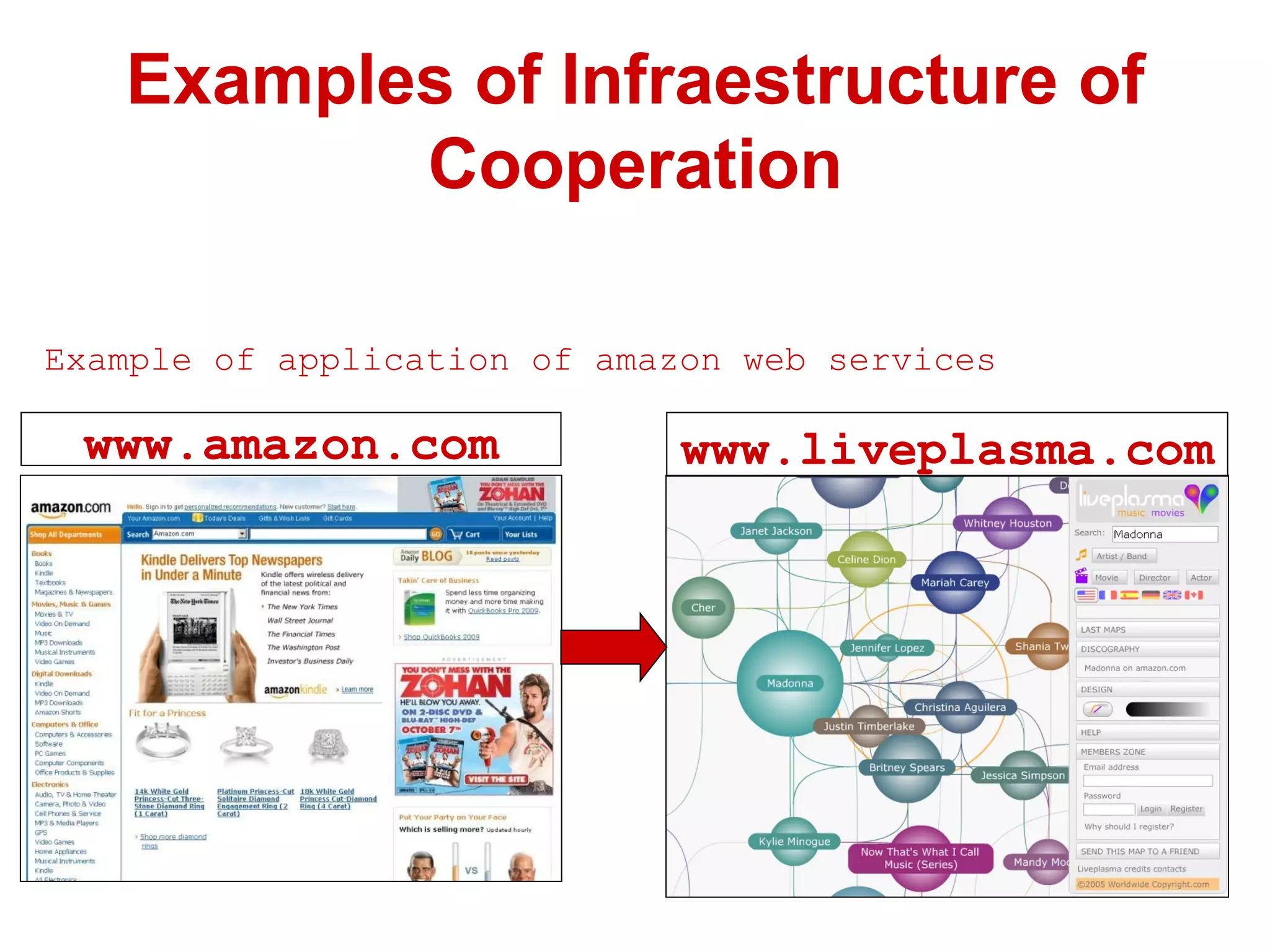
Examples of Infraestructure of Cooperation Example of application of amazon web services www.amazon.com www.liveplasma.com
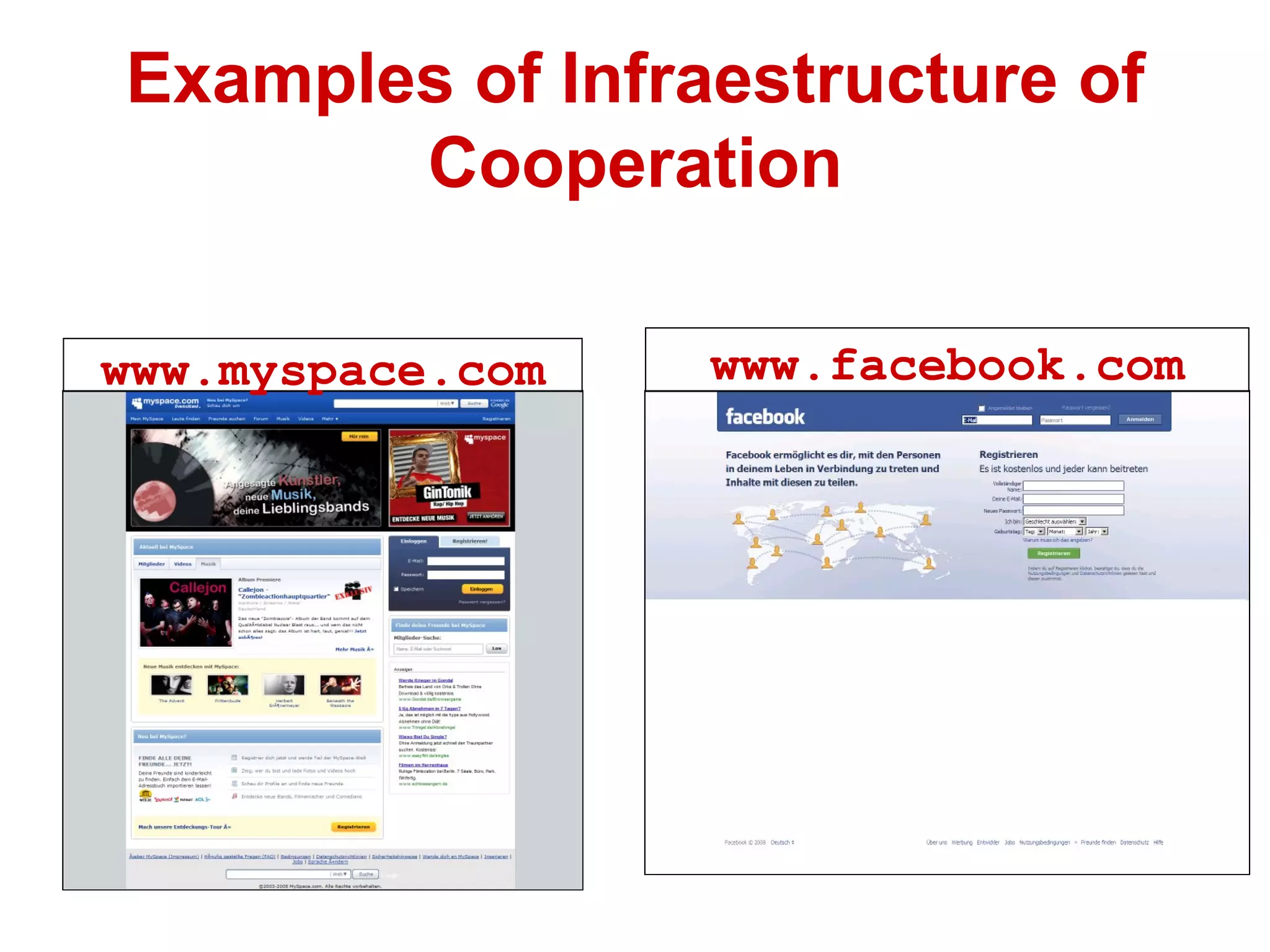
Examples of Infraestructure of Cooperation www.myspace.com www.facebook.com
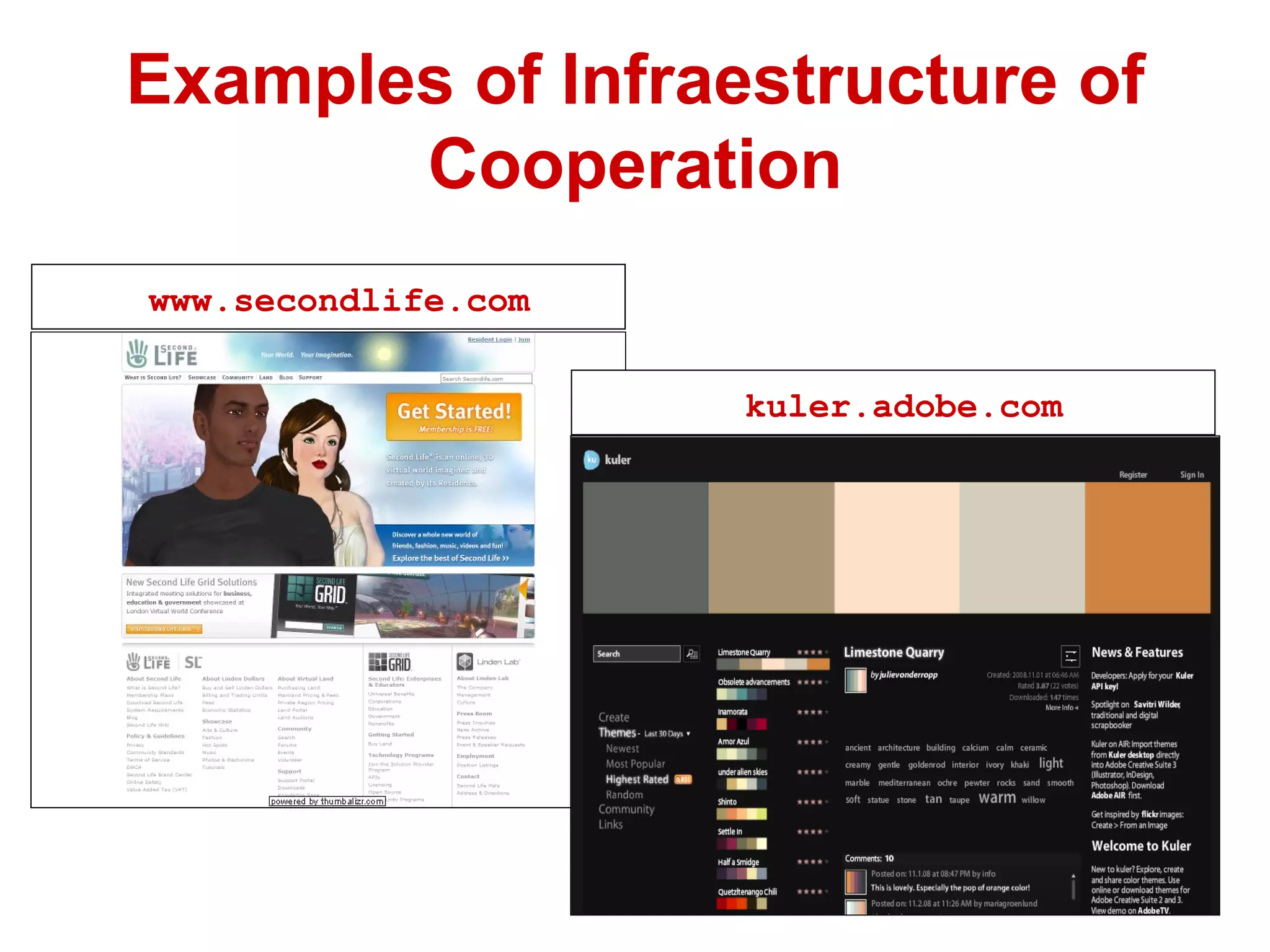
Examples of Infraestructure of Cooperation www.secondlife.com kuler.adobe.com
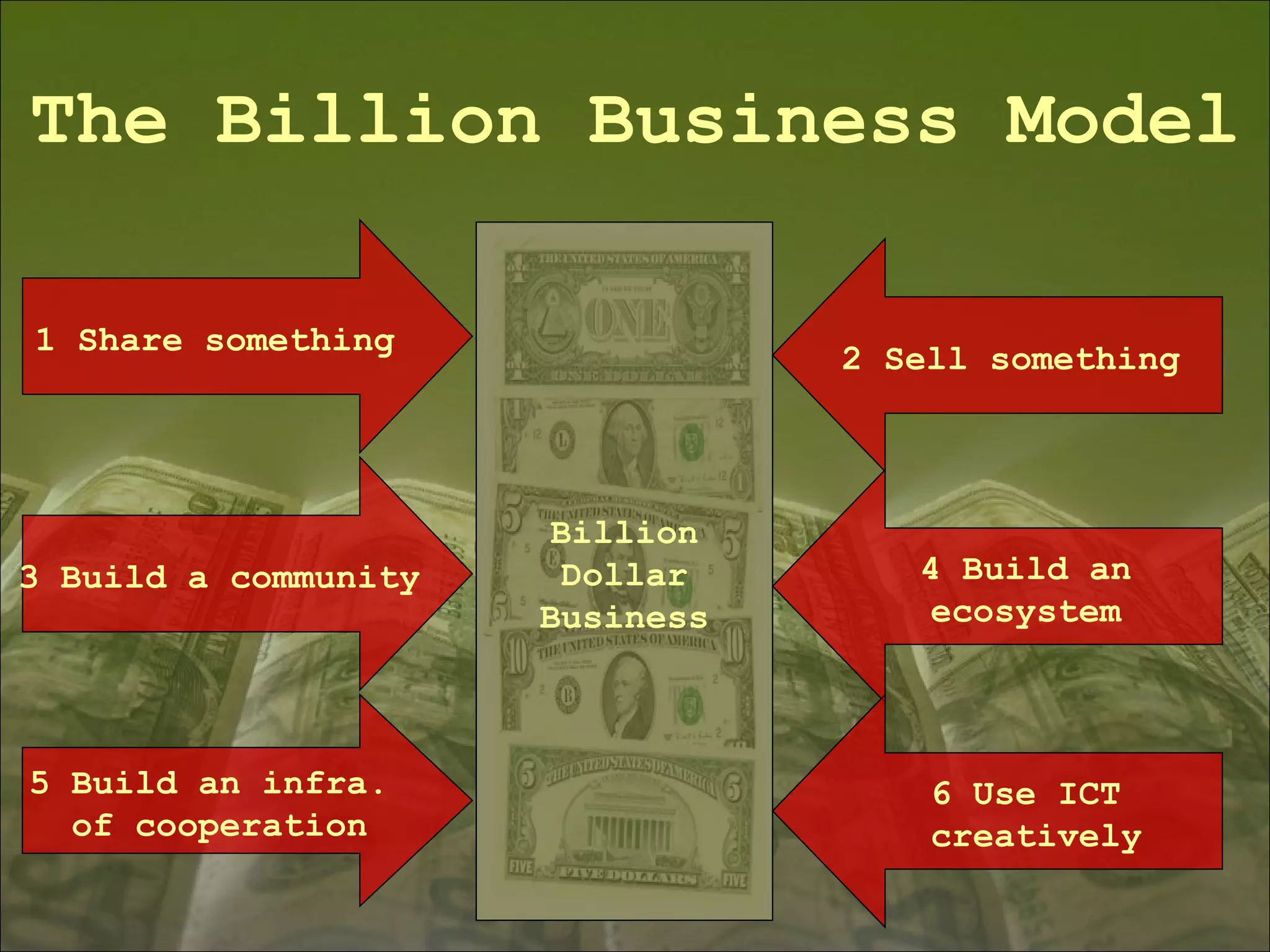
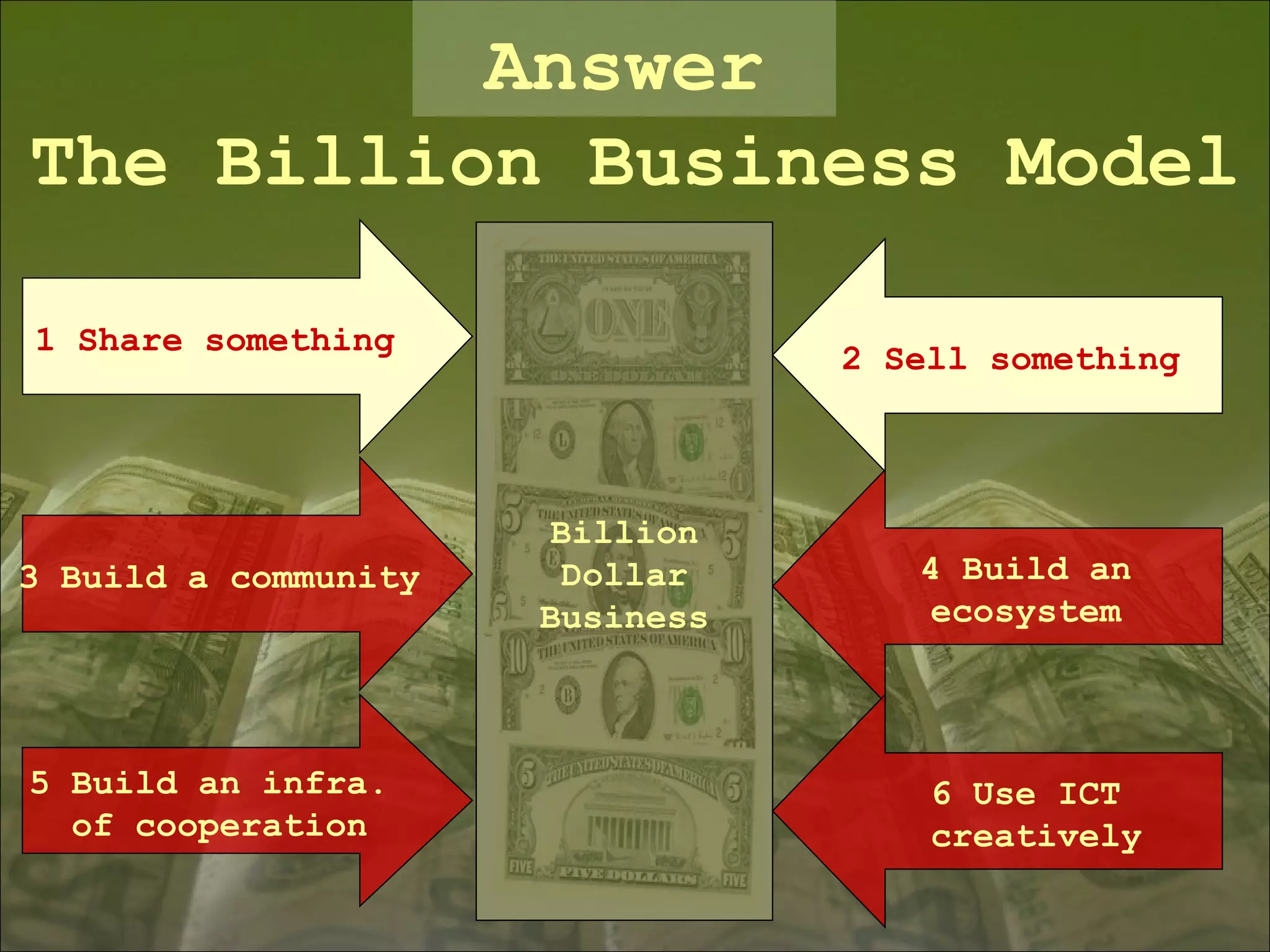
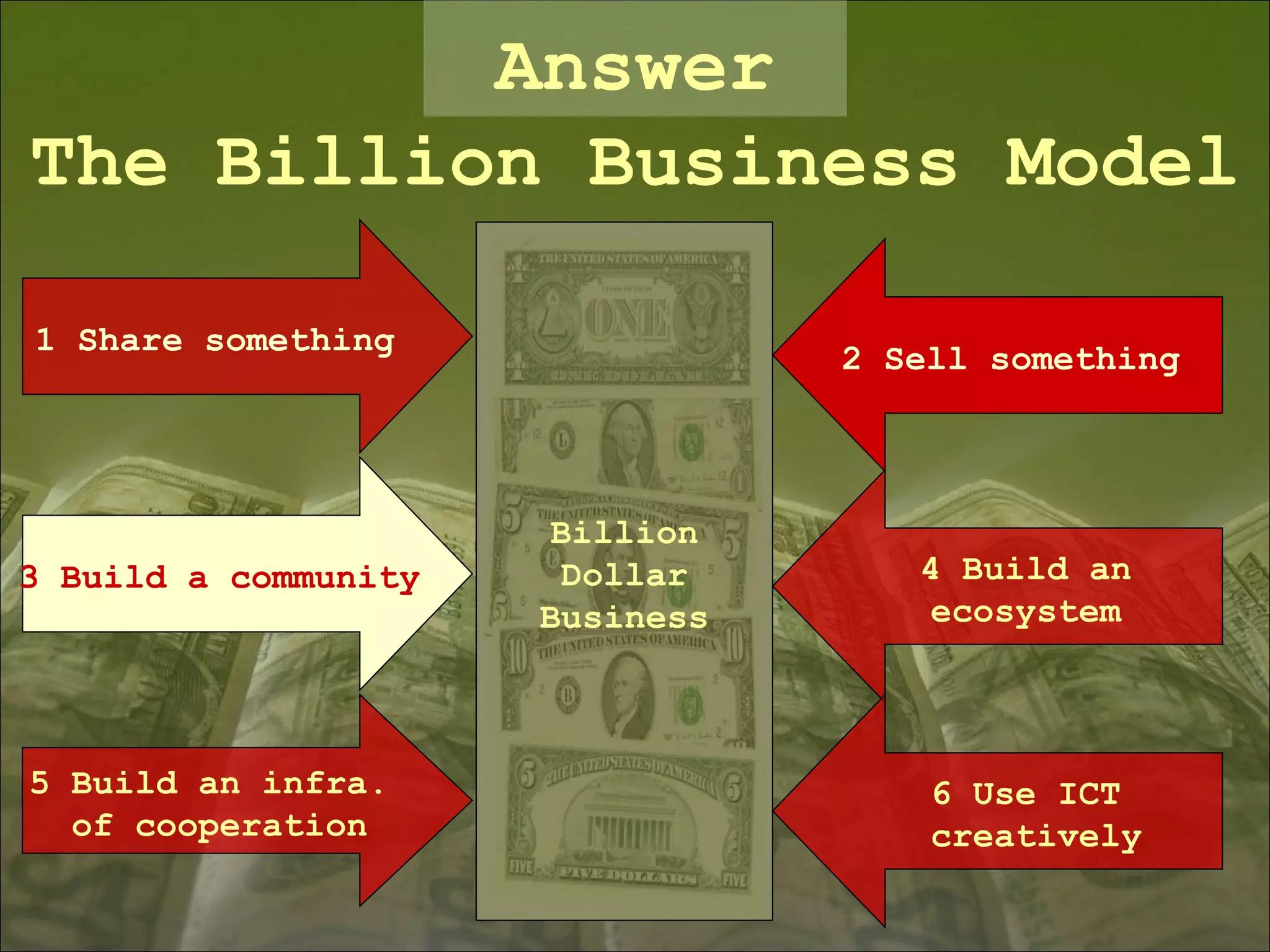
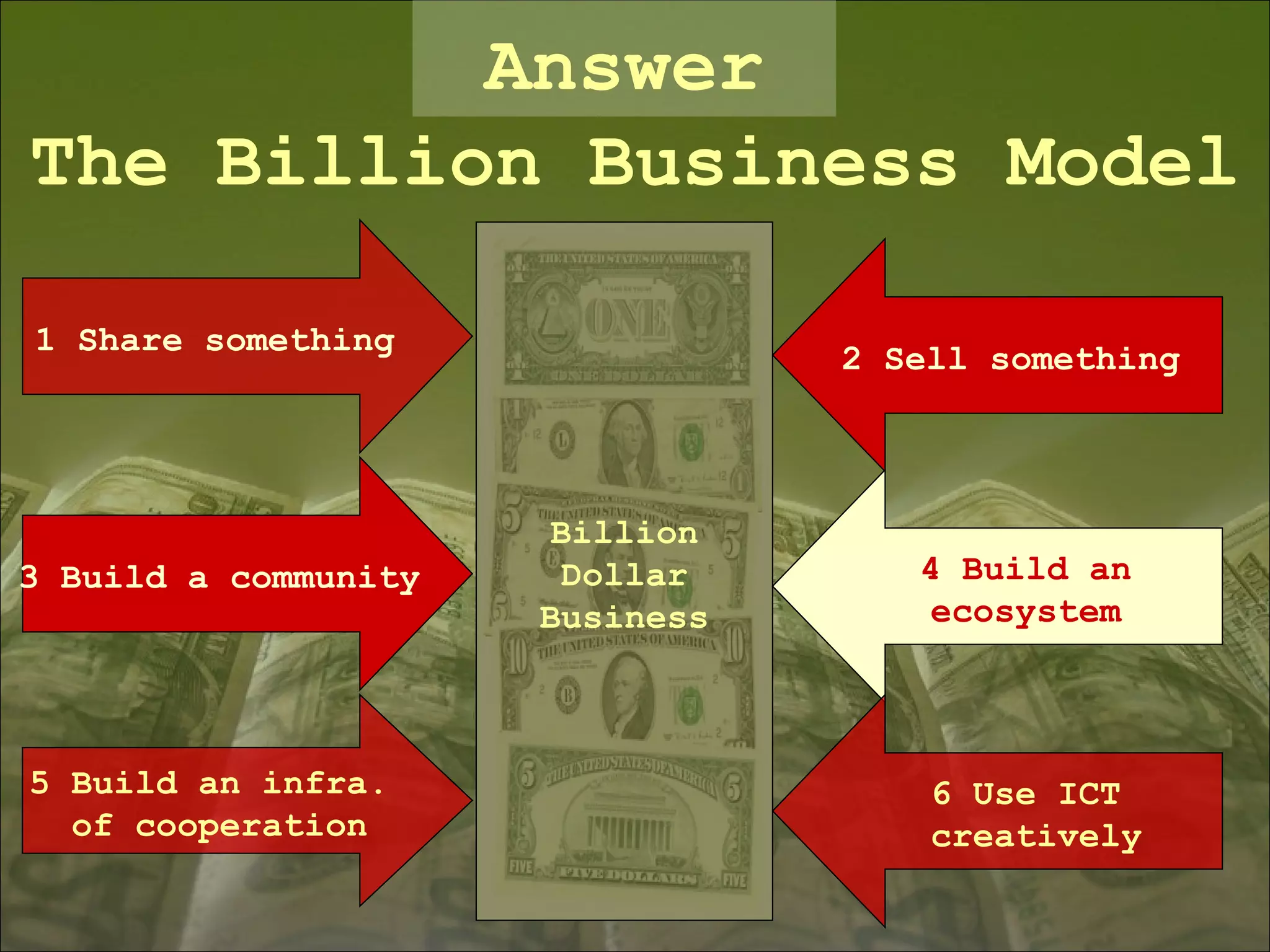
1  Share something 2 Sell something 3 Build a community Billion Dollar Business 5  Build an infra.  of cooperation 4 Build an ecosystem 6 Use ICT creatively The Billion Business Model
Exam
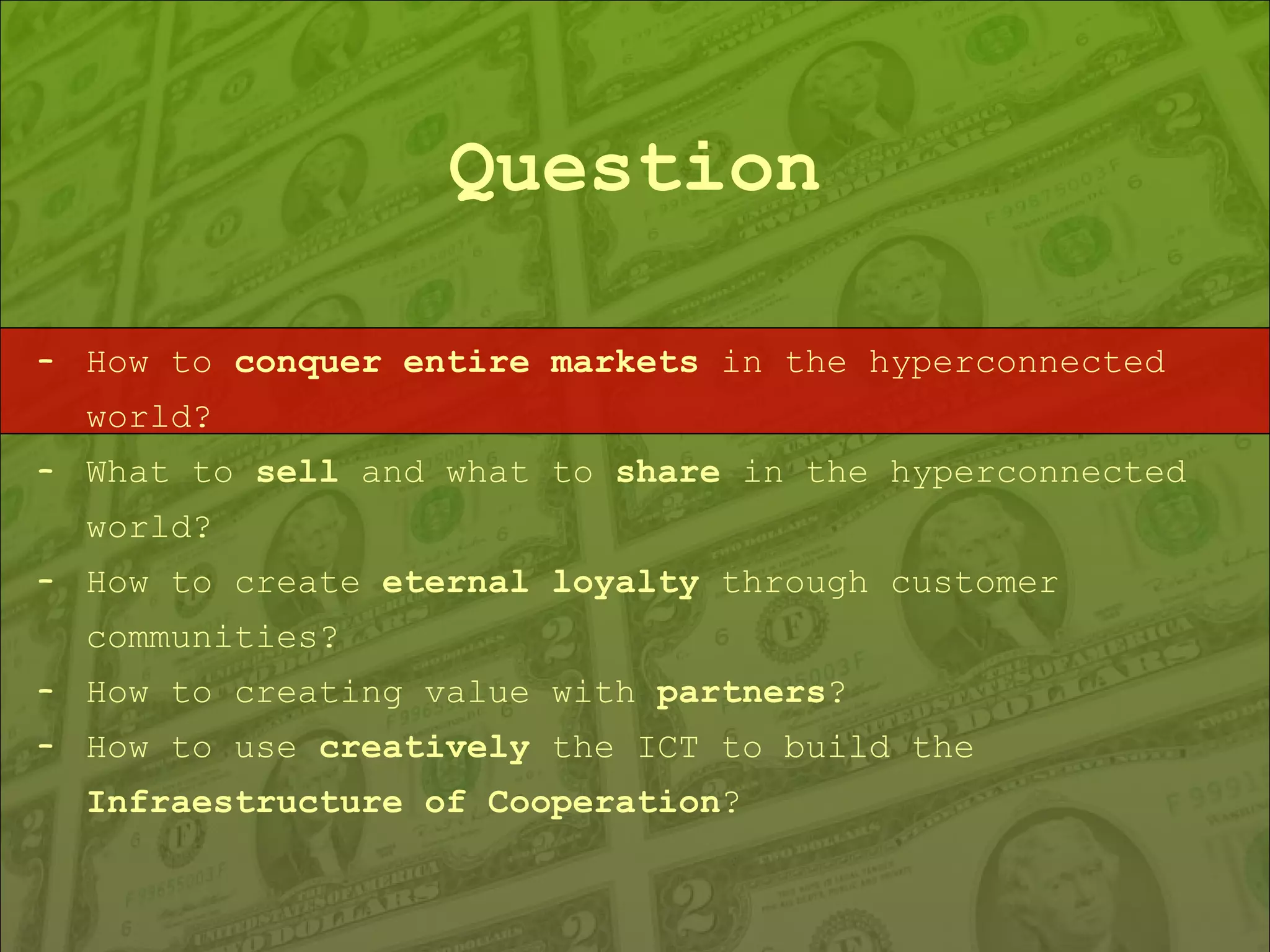
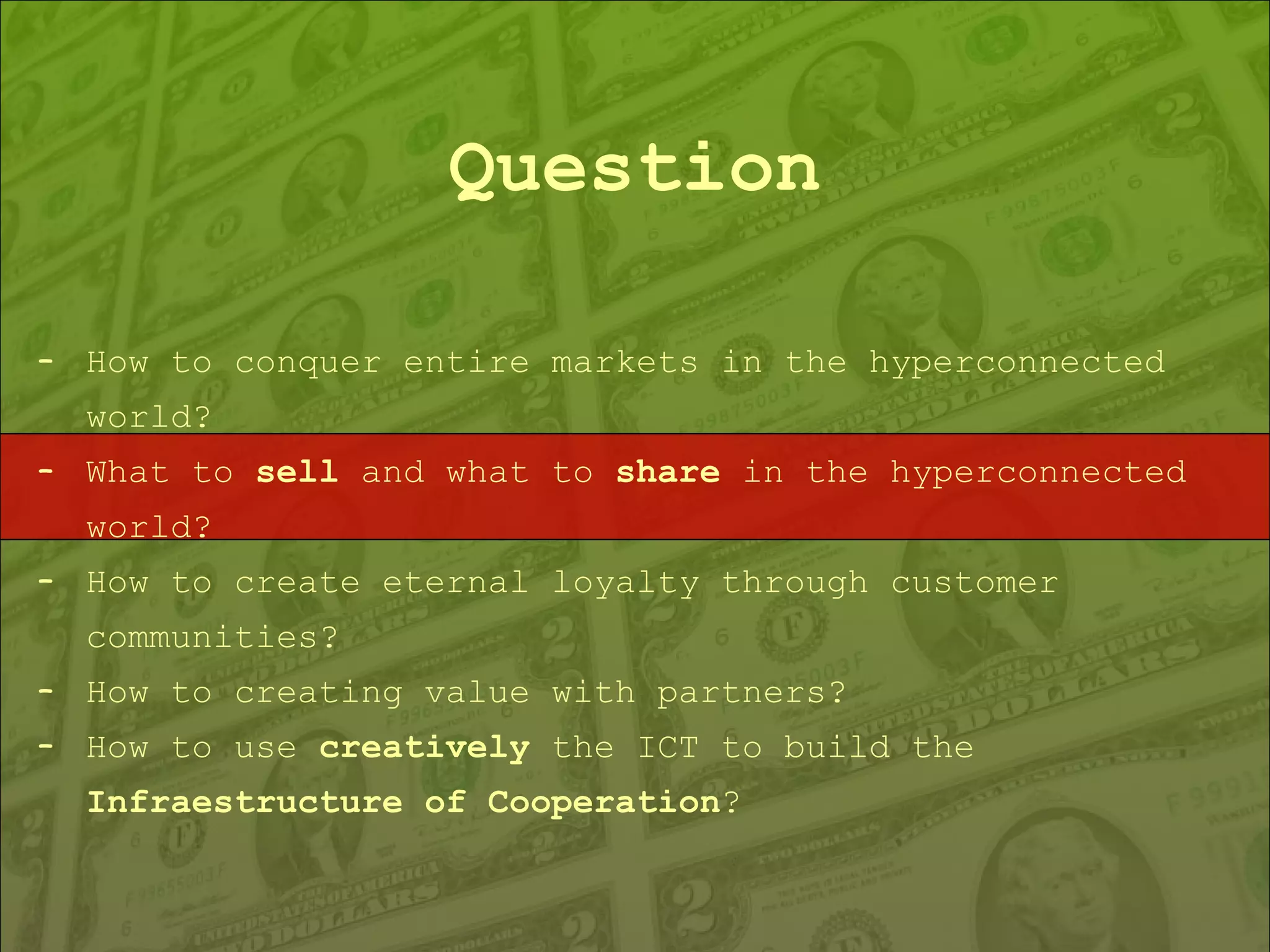
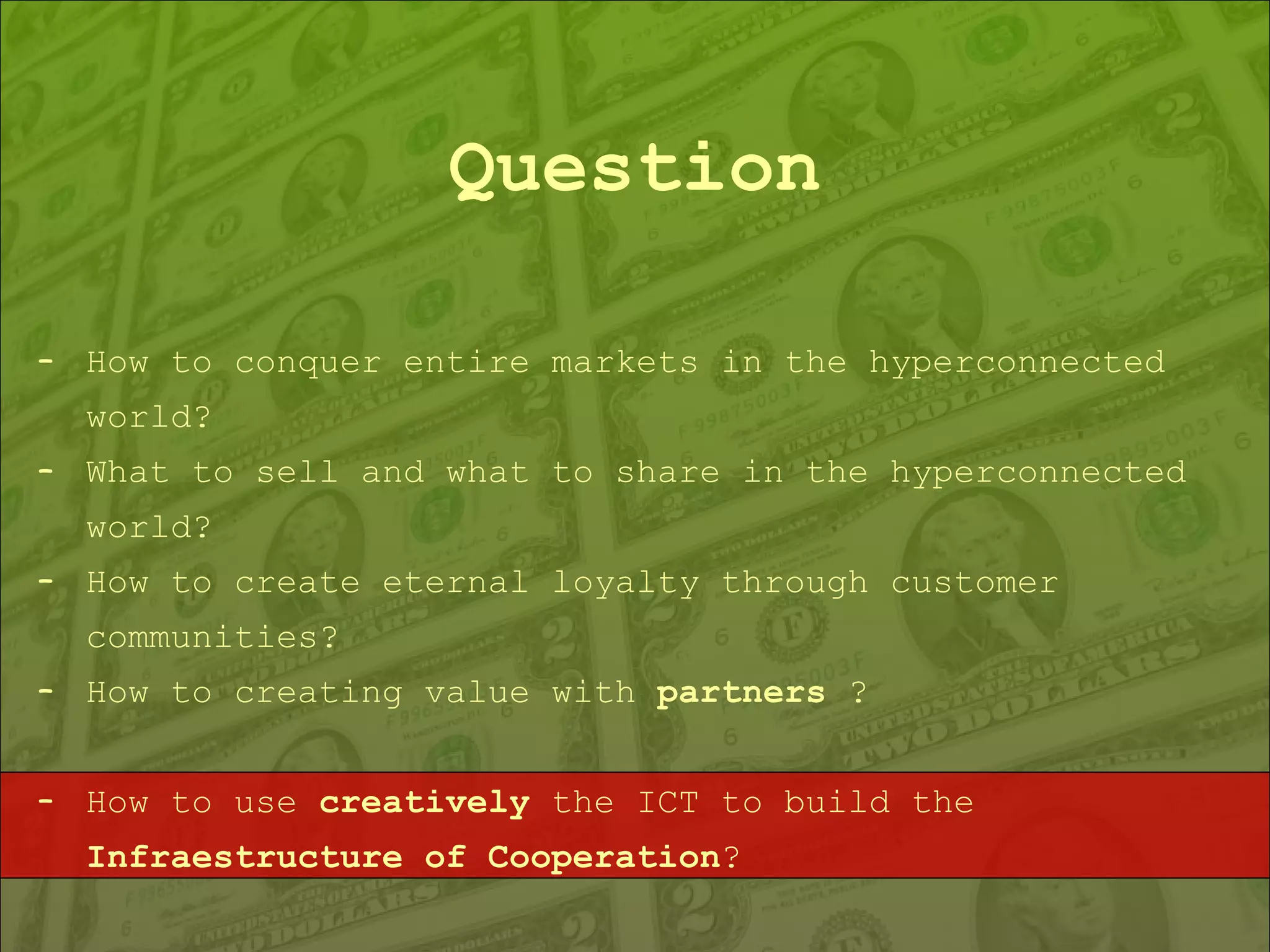
Question How to  conquer entire markets  in the hyperconnected world? What to  sell  and what to  share  in the hyperconnected world? How to create  eternal loyalty  through customer communities? How to creating value with  partners ? How to use  creatively  the ICT to build the  Infraestructure of Cooperation ?
1  Share something 2 Sell something 3 Build a community Billion Dollar Business 5  Build an infra.  of cooperation 4 Build an ecosystem 6 Use ICT creatively The Billion Business Model Answer
Question How to conquer entire markets in the hyperconnected world? What to  sell  and what to  share  in the hyperconnected world? How to create eternal loyalty through customer communities? How to creating value with partners? How to use  creatively  the ICT to build the  Infraestructure of Cooperation ?
What to sell and what to share in the hyperconnected world (conclusions) Answer Share Public good Discriminate price (part free/part paid) Commons Sell Collective Sell Private Strategy What type of good is your offfering?
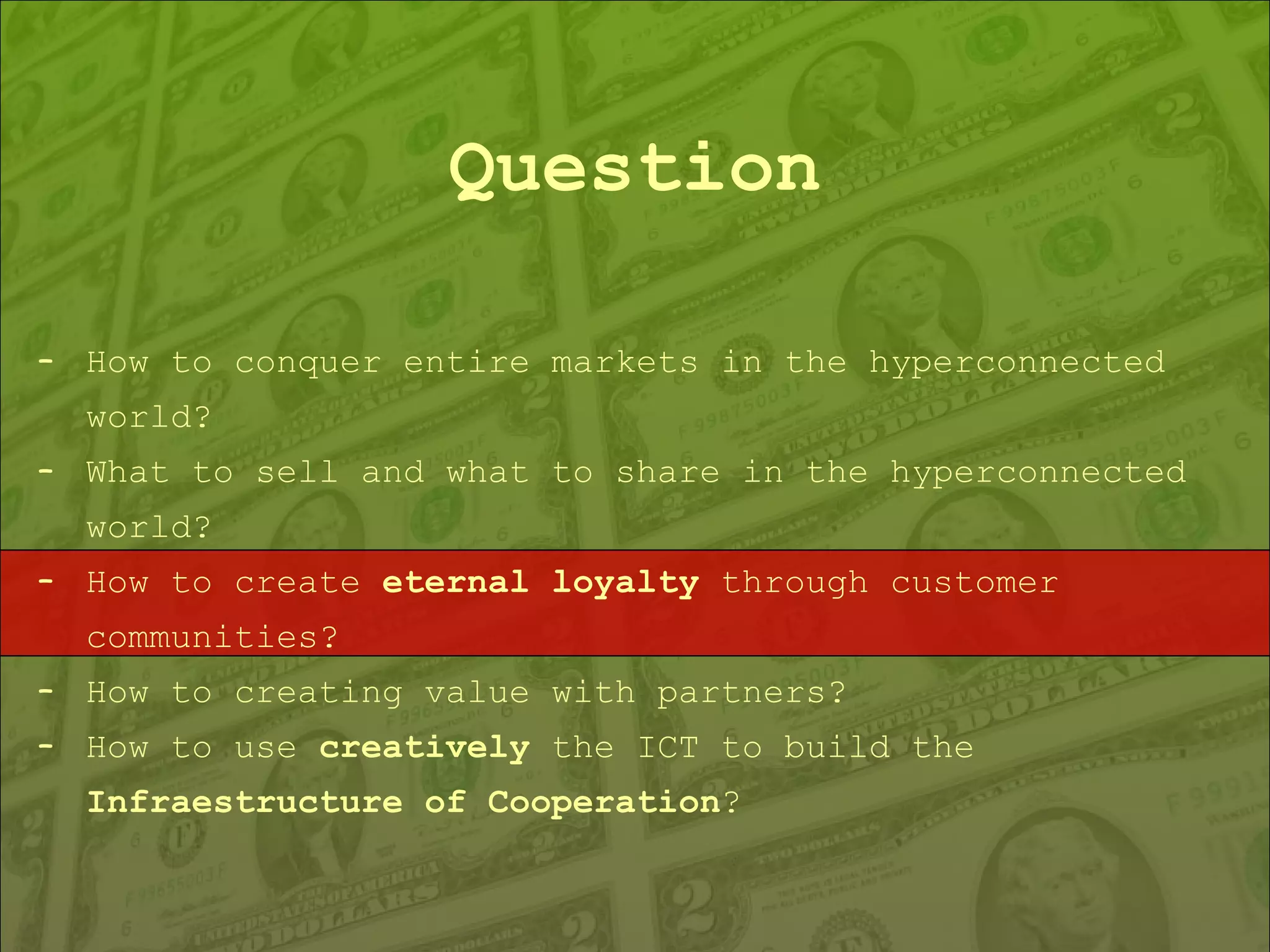
Question How to conquer entire markets in the hyperconnected world? What to sell and what to share in the hyperconnected world? How to create  eternal loyalty  through customer communities? How to creating value with partners? How to use  creatively  the ICT to build the  Infraestructure of Cooperation ?
1  Share something 2 Sell something 3 Build a community Billion Dollar Business 5  Build an infra.  of cooperation 4 Build an ecosystem 6 Use ICT creatively The Billion Business Model Answer
Question How to conquer entire markets in the hyperconnected world? What to sell and what to share in the hyperconnected world? How to create eternal loyalty through customer communities? How to creating value with  partners  ? How to use  creatively  the ICT to build the  Infraestructure of Cooperation ?
1  Share something 2 Sell something 3 Build a community Billion Dollar Business 5  Build an infra.  of cooperation 4 Build an ecosystem 6 Use ICT creatively The Billion Business Model Answer
Question How to conquer entire markets in the hyperconnected world? What to sell and what to share in the hyperconnected world? How to create eternal loyalty through customer communities? How to creating value with  partners  ? How to use  creatively  the ICT to build the  Infraestructure of Cooperation ?
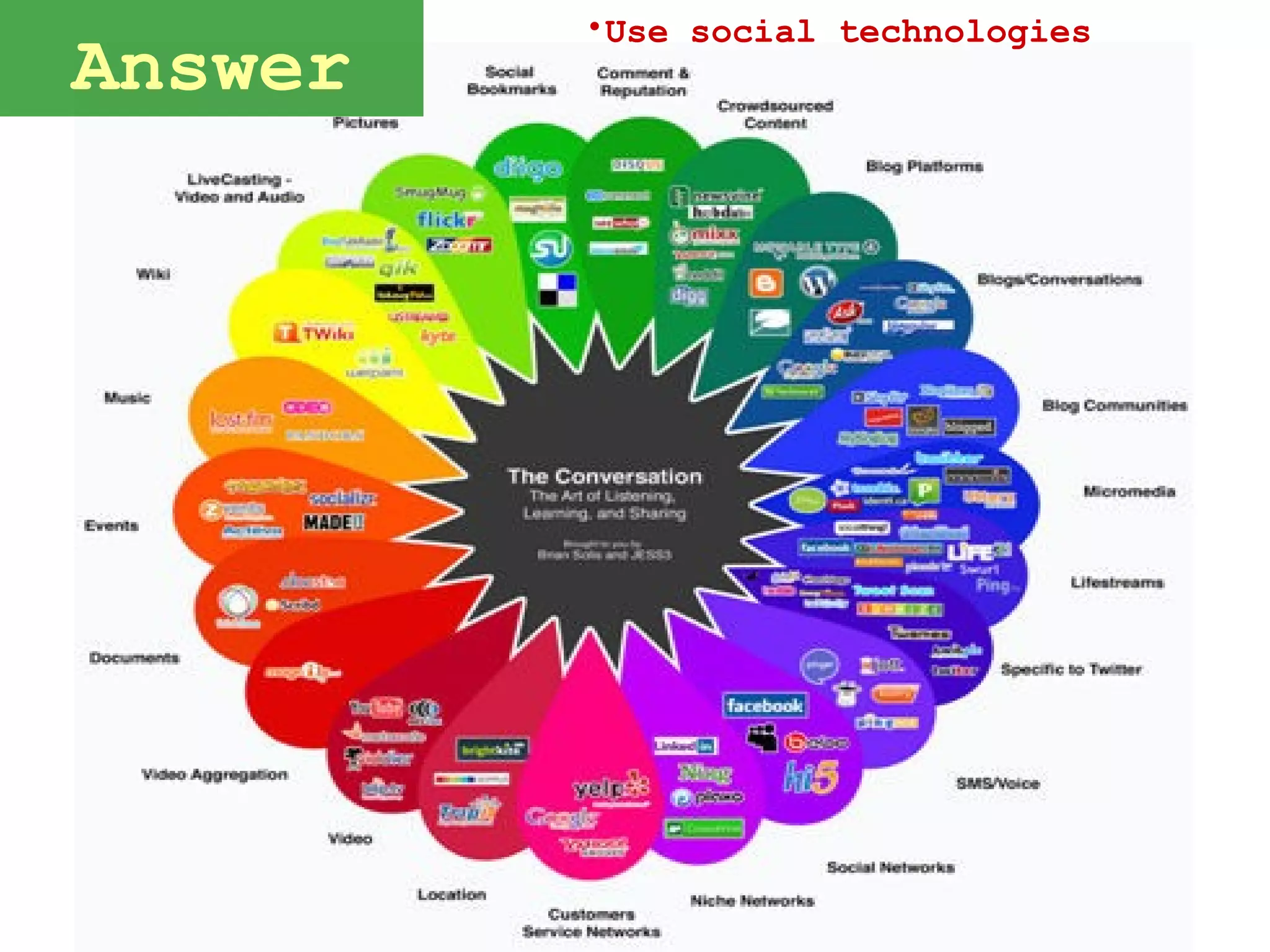
Use social technologies Answer
Common mistakes of web 2.0 entrepreneurs Sharing something without selling anything Selling something without sharing anything Building a community without allowing the selling of related items Building an ecosystem without allowing spontaneous cooperation Not using Information Technology in creative ways
Cooperate without being a saint Compete w/o killing the competition (Branderburger & Nalebuff)
Thanks for sharing Howard Rheingold and Andrea Saveri (www.cooperationcommons.com) Brandenburger and Nalebuff (mayet.som.yale.edu/coopetition) Don Tapscott (www.wikinomics.com)  Carl Shapiro and Hal Varian (www.inforules.com) www.wikimedia.org www.webshotspro.com finance.yahoo.com www.strategy-business.com www.compete.com
Still need more help?
Need training? - Wanna the explanation of this course? Need consulting? - Wanna turn your business into billionaire one Need implementation? Have great ideas but lack of technical skills? Contact me! - Also send opinions and critics Still need more help?
Marcelo Honores Economist Master in E-Busienss 15 years of experience in IT [email_address] marcelo-honores.blogspot.com www.linkedin.com/in/mhonores Not billionaire yet Looking for partners!!!

Billion Busienss Model Course

  • 1.
    TheBillion Business Model Course By Marcelo Honores
  • 2.
    &quot; Ignore basiceconomic principles at your own risk. Technology changes. Economic laws do not.&quot; Carl Shapiro and Hal R. Varian in Information Rules
  • 3.
    Agenda Introduction Howto conquer entire markets in the hyperconnected world What to sell and what to share in the hyperconnected world How to create eternal loyalty through customer communities Creating value with partners through business ecosystems Using Information and Communication Technologies to build the Infraestructure of Cooperation The Billion Business Model
  • 4.
    Agenda Introduction Howto conquer entire markets in the hyperconnected world What to sell and what to share in the hyperconnected world How to create eternal loyalty through customer communities Creating value with partners through business ecosystems Using Information and Communication Technologies to build the Infraestructure of Cooperation The Billion Business Model
  • 5.
    Did you know?2004, Google got US$ 23 billion in its IPO 2005, eBay Inc. acquired Skype Technologies for US$ 2.6 billion 2006, Google bought Youtube for US$ 1.65 billion 2007, Microsoft bought shares in Facebook for US$ 240 million (Facebook has a market value of US$ 15 billion) 2008, Microsoft offered US$ 48 billion for Yahoo Etc, etc, etc.
  • 6.
    Did you know?In the last 10 years there were more than 1,150 web 2.0 acquisitions for around US$ 30 billion (strategy & business magazine)
  • 7.
  • 8.
    Can we learnsomething from them? What can we (the mere mortals) learn from them? Why are they so valuable? What they have in common? Are there any rules behind scenes? Can I apply these rules in a new venture?
  • 9.
  • 10.
  • 11.
  • 12.
    The long tailUS$ 3.2 billion US$ 250 billion
  • 13.
    Agenda Introduction Howto conquer entire markets in the hyperconnected world What to sell and what to share in the hyperconnected world How to create eternal loyalty through customer communities Creating value with partners through business ecosystems Using Information and Communication Technologies to build the Infraestructure of Cooperation The Billion Business Model
  • 14.
    How to conquerentire markets in Internet To know how to conquer entire markets in Internet, you need to review the microeconomics theory Microeconomics 101 Microeconomics of traditional goods (the past) Microeconomics of shared goods (the present) Microeconomics of incentives (the future) Warning!!! This part can be painful
  • 15.
    Microeconomics of traditionalgoods (the past) You pay and receive a good or service simultaneously Price Quantity Supply Demand P1 Q1
  • 16.
    Microeconomics of traditionalgoods (the past) Observations: Price = P1 (Price > 0) Quantity = Q1 Benefits of the Consumer = Green area Benefits of the Producer = Yellow area Typical for physical goods Price Quantity Supply Demand P1 Q1
  • 17.
    Microeconomics of traditionalgoods (examples) www.dell.com www.travelocity.com www. jcpenney .com
  • 18.
    Microeconomics of sharedgoods (the present) You receive a free good in internet, such as: free search engine service, free calls from PC to PC, free social networking, etc. Price Quantity Demand P2 Q2
  • 19.
    Microeconomics of sharedgoods (the present) Observations : Price = P2 (Price = 0) Quantity = Q2 Benefits of the Consumer = Green area Benefits of the Producer = 0 Typical for digital goods Price Quantity Demand P2 Q2
  • 20.
    Microeconomics of sharedgoods (examples) www.wikipedia.org www.google.com www.skype.com
  • 21.
    Microeconomics of incentives (the future) You receive an incentive in a social currency such as: ringtones, music, videos, minutes of calling, text messaging, SMS, etc. for using or buying a good, mainly advertising Price Quantity Demand P3 Q3 0
  • 22.
    Microeconomics of incentives (the future) Observations: Price = P3 (Price < 0) Quantity = Q3 Benefits of the Consumer = Green area Benefits of the Producer = 0 Will be typical in the mobile world Price Quantity Demand P3 Q3 0
  • 23.
    Microeconomics of incentives (examples) search.live.com/cashback www.virginmobileusa.com/stuff/sugarmama.do Incentives is a new business model. This model will be used widely in the mobile world. Free ringtones, music, videos, minutes of calling, text messaging, SMS, etc. for watching advertising www.yourexample.com
  • 24.
    Microeconomics 101 ConclusionsMicroeconomic of traditional goods (web 1.0) Price = P1 (price > 0) Quantity = Q1 Shared benefits between consumers and producers Typical in the physical world Microeconomic of shared goods (web 2.0) Price = P2 (price = 0) Quantity = Q2 (Q2 > Q1) Consumer gets all the benefits Typical in the internet world Microeconomic of incentives (web 3.0?) Price = P3 (price < 0) Quantity = Q3 (Q3 > Q2 > Q1) Consumer gets all the benefits Will be typical in the mobile world
  • 25.
    Microeconomics 101 ConclusionsIf you share something you will get the maximum demand If you share something the consumer will get all the benefits Therefore to conquer the entire markets in the Internet world you must to share something valuble for a large group If you want to conquer the entire markets in the mobile world you must incentivize your customers Don´t worry about free riders In the hiperconnected world free riders are welcomed
  • 26.
    In the hyper-connectedworld free riders are welcomed!!!
  • 27.
    Agenda Introduction Howto conquer entire markets in the hyperconnected world What to sell and what to share in the hyperconnected world How to create eternal loyalty through customer communities Creating value with partners through business ecosystems Using Information and Communication Technologies to build the Infraestructure of Cooperation The Billion Business Model
  • 28.
    What to selland what to share in the hyperconnected world To know what to sell and what to share in the hyperconnected world, you should be aware of the economic properties of the goods: The Public-Private goods theory The complementary goods theory Warning!!! This part can be boring
  • 29.
    Public and privategoods theory Definition : “ In economics, a public good is a good that is non-rivalry and non-excludable ” No-rivalry The consumption of one good by one individual does not reduce its availability for others consumption. In other words: it is not scarce . No-excludability . One good cannot be effectively excluded from consumption of one good. In other words: you cannot control its distribution or consumption.
  • 30.
    Examples of rivalnessNon-rivalry goods Goods never run out ( not scarce ) Examples: The fact that one use a search engine does not reduce its availability The fact that one watch an online video does not reduce its availability It is a typical attribute of digital goods Rivalry goods Goods can run out ( scarce ) Examples: The fact of installing a software in a computer with a license key prevents to installing in an other computer (artificial rivalry) The sales of theatre tickets online is a signal of rivalry It is a typical attribute of physical goods
  • 31.
    Examples of ExcludabilityNon-excludability Difficult control of distribution or consumption Examples: The tragedy of the commons (pastures) Digital goods are easily reproducible so almost imposible to exclude Excludability Easy control of distribution or consumption Examples Physical goods in a market are easyly to control by their owners Accessing a website password protected is an example of excludability
  • 32.
    Type of goodsacording the Public and private goods theory Public goods Collective goods Non-Scarce Common goods / (Common-pool resources) Private goods Scarce Non- Controlable Controlable Type of goods
  • 33.
    Private goods Publicgoods Collective goods Non-Scarce Common goods / (Common-pool resources) Private goods Scarce Non- Controlable Controlable Type of goods
  • 34.
    Private goods They are scarce and the producer can control their distribution and consumption Almost any physical good In Internet: password protected services In software: Software with license key
  • 35.
    Private goods (examples) www. microsoft .com www.dell.com www.travelocity.com
  • 36.
    Common goods /Common-pool resources Public goods Collective goods Non-Scarce Common goods / (Common-pool resources) Private goods Scarce Non- Controlable Controlable Type of goods
  • 37.
    Common goods /Common-pool resources They are scarce and the producer cannot control their distribution and consumption Commons goods The planet earth (global warming), water, pastures, etc In Internet: website hosting Typically hard disk and bandwith
  • 38.
    Common goods /Common-pool resources example
  • 39.
    Collective goods Publicgoods Collective goods Non-Scarce Common goods / (Common-pool resources) Private goods Scarce Non- Controlable Controlable Type of goods
  • 40.
    Collective goods They are not scarce but the producer can control their distribution and consumption They also are known as artificially scarce goods Examples: In the real world Clubs, cinemas, music concerts, theatres, stadiums In the hiperconneted world Copyrighted goods DRM goods Patents Commercial software “ Walled garden” communities or social networks Premium/platinum services
  • 41.
    Collective goods (examples)iTunes Store www.aol.com www.diamondlounge.com
  • 42.
    Public goods Publicgoods Collective goods Non-Scarce Common goods / (Common-pool resources) Private goods Scarce Non- Controlable Controlable Type of goods
  • 43.
    Public goods They are not scarce and the producer can not control the distribution or consumption In the physical world The beach, national security, city lighting, parks, etc. Examples: Information in general Digital goods (PDFs, MP3s, GIFs, etc.) Wikipedia Google Yooutube, Flickr (in part) MySpace, Facebook, and free available social networks Napster, (in the past), kaaza, P2P in general Etc.
  • 44.
    Public goods Examples www.facebook.com www.wikipedia.org www.google.com
  • 45.
    The complementary goodstheory Complementary goods: Those directly related, if the consumption of one good raises, the consumption of the related one raises too (not ncesarily the inverse is true) Example Milk and coffee and bread Substitute goods: Those inversely related. if the consumption of one good raises, the consumption of the sustituted one lowers (not ncesarily the inverse is true) Example Gasoil with ethanol
  • 46.
    The complementary goodstheory (examples)
  • 47.
  • 48.
    Google has around127 million users per month
  • 49.
    Google sells advertisingAre searching and advertising good complementors?
  • 50.
    Google sold US$ 16 billion past year
  • 51.
  • 52.
    Skype has around10 million users per day
  • 53.
    Skype sells paidcalls pc to phone Are free calls (pc to pc) and paid calls (pc to real phones) good complementors?
  • 54.
    www.ipdemocracy.com Skype soldalmost US$ 400 million past year
  • 55.
    Monster: free job searching
  • 56.
    Monster has around20 million visits per month
  • 57.
    Monster is paidfor employers Are free job searching and paid job posting good complementors?
  • 58.
    Monster sold aroundUS$ one billion past year
  • 59.
    What to selland what to share in the hyperconnected world (conclusions) Share Public good Discriminate price (part free/part paid) Commons Sell Collective Sell Private Strategy What type of good is your offfering?
  • 60.
    What to selland what to share in the hyperconnected world (conclusions) You can try also: Turn private goods into public or commons goods (or viceversa) Turn collective goods into public (or viceversa) Share when your business model is not clear Make flexible your copyrighted property. Uuse creative commons licensing instead Share something and sell their complementary goods
  • 61.
    Agenda Introduction Howto conquer entire markets in the hyperconnected world What to sell and what to share in the hyperconnected world How to create eternal loyalty through customer communities Creating value with partners through business ecosystems Using Information and Communication Technologies to build the Infraestructure of Cooperation The Billion Business Model
  • 62.
    How to createeternal loyalty through customer communities
  • 63.
    Community is about value flow , not necesarily money Customer community members help to increase sales because: They tend to repeat purchases in online businesses They attract new customers via “word of mouth” There is an emotional link rhater than commerical one Customer community members help to decrease costs because: Reciprocity in helping each other reduces technical support costs and improves the consumption experience Having communities around products and services engourage innovation Strong communities make more valuable your offering The full restaurant effect How to create eternal loyalty through customer communities
  • 64.
    How to createeternal loyalty through customer communities In my opinion community marketing is superior than other Internet Marketings techniques SEO, SEM, Adwords and Adsense depends on the mood of Google Spam is annoying Affiliate marketing sucks People don’t trust Advertising More fidelity Word of mouth Viral marketing Emotional link It is about value not money Long term relationship Other Internet Marketing Community Marketing
  • 65.
    How to createeternal loyalty through customer communities Average users per month - myspace.com 60 million - facebook.com 40 million - linkedin.com 7 million
  • 66.
    How to createeternal loyalty through customer communities Examples IBM academic initiative MICROSOFT: Betatesting program Free training material and software for cumputer science professors The voluntary beta testing program saves Microsoft around US$ 500 million yearly in software testing
  • 67.
    How to createeternal loyalty through customer communities Examples SAP encourage participation of the community using several rewarding programs
  • 68.
    How to createeternal loyalty through customer communities Examples Communities in politics
  • 69.
    Strategies Wrap yourofferings with communities or social networks Create a social currency Youtube-videos, Flickr-photos, Blogger-blogs, etc. Encourage participation and WOM, through: Blogs, forums, reviews, ratings, social networking, etc.   Look for volunteerism , not all should be about money Reward the most active participants Do not discriminate , it allows access to customers and non-customers Encourage social innovation: we are smarter than me How to create eternal loyalty through customer communities
  • 70.
    Agenda Introduction Howto conquer entire markets in the hyperconnected world What to sell and what to share in the hyperconnected world How to create eternal loyalty through customer communities Creating value with partners through business ecosystems Using Information and Communication Technologies to build the Infraestructure of Cooperation The Billion Business Model
  • 71.
    Creating value withpartners through business ecosystems
  • 72.
    Do you rememberPorter’s value chain? Creating value with partners through business ecosystems Primary Activities Support Activities Margin Margin Inbound Logistics Operations Outbound Logistics Marketing & Sales Service Procurement Technology Development Human Resources Firm Infrastructure Cost Profit = $ Price (Customer Perceived Value) +
  • 73.
    Forget it anduse the value network Creating value with partners through business ecosystems
  • 74.
    Remember the Porter´s five forces ? Creating value with partners through business ecosystems Threat of new competitors entry of new substitutes Supplier negotiation power Customer negotiation power Rivalry among competitors
  • 75.
    Forget it anduse the value network Creating value with partners through business ecosystems Cooperation with Competitors Cooperation with Complementors Cooperation with Suppliers Cooperation with Clients Company * Branderburger & Nalebuff
  • 76.
    Remember Twentieth centurywas about competition , Twenty-first century is about cooperation Creating value with partners through business ecosystems
  • 77.
    Strategies: Ecosystem inbusiness is about flow of money Allow others make money in your website Open the doors of your site to clients, suppliers, complementors Encourage the selling of complementaring goods Charge a commision Evaluate the selling of competitors goods Democratize innovation The bigger the ecosystem the more the chances of cross selling If you are small join to a bigger ecosystem Creating value with partners through business ecosystems
  • 78.
    Creating value withpartners through business ecosystems Examples www.ebay.com www.amazon.com
  • 79.
    Creating value withpartners through business ecosystems Examples SAP ecosystem and partner programs NTT – Docomo i-Mode ecosystem
  • 80.
    Agenda Introduction Howto conquer entire markets in the hyperconnected world What to sell and what to share in the hyperconnected world How to create eternal loyalty through customer communities Creating value with partners through business ecosystems Using Information and Communication Technologies to build the Infraestructure of Cooperation The Billion Business Model
  • 81.
    Using ICT tobuild the Infraestructure of Cooperation
  • 82.
    The infrastructure ofcooperation: It is the web site It is where everything happens For sharing your free good For selling your paid good For the community For open innovation For the ecosystem (the others selling their goods) Using ICT to build the Infraestructure of Cooperation
  • 83.
    Use technologies ofcooperation creatively Using ICT to build the Infraestructure of Cooperation Cooperation tools for people Cooperation tools for companies
  • 84.
    Be beta UsingICT to build the Infraestructure of Cooperation
  • 85.
    Remember Ian RoughleySimplicity over Completeness Long Tail over Mass Audience Share over Protect Advertise over Subscribe Syndication over Stickiness Early Availability over Correctness Select by Crowd over Editor Honest Voice over Corporate Speak Participation over Publishing Community over Product Using ICT to build the Infraestructure of Cooperation
  • 86.
    Strategies Create incomplete architectures /products/services Encoureges user generated content (co-creation) Be mashable Be mobile Be social SAS: software as service SOA: service oriented architecture Use Ajax Hire good programmers Using ICT to build the Infraestructure of Cooperation
  • 87.
    Using ICT tobuild the Infraestructure of Cooperation Examples
  • 88.
    Examples of Infraestructureof Cooperation Example of application of amazon web services www.amazon.com www.liveplasma.com
  • 89.
    Examples of Infraestructureof Cooperation www.myspace.com www.facebook.com
  • 90.
    Examples of Infraestructureof Cooperation www.secondlife.com kuler.adobe.com
  • 91.
    1 Sharesomething 2 Sell something 3 Build a community Billion Dollar Business 5 Build an infra. of cooperation 4 Build an ecosystem 6 Use ICT creatively The Billion Business Model
  • 92.
  • 93.
    Question How to conquer entire markets in the hyperconnected world? What to sell and what to share in the hyperconnected world? How to create eternal loyalty through customer communities? How to creating value with partners ? How to use creatively the ICT to build the Infraestructure of Cooperation ?
  • 94.
    1 Sharesomething 2 Sell something 3 Build a community Billion Dollar Business 5 Build an infra. of cooperation 4 Build an ecosystem 6 Use ICT creatively The Billion Business Model Answer
  • 95.
    Question How toconquer entire markets in the hyperconnected world? What to sell and what to share in the hyperconnected world? How to create eternal loyalty through customer communities? How to creating value with partners? How to use creatively the ICT to build the Infraestructure of Cooperation ?
  • 96.
    What to selland what to share in the hyperconnected world (conclusions) Answer Share Public good Discriminate price (part free/part paid) Commons Sell Collective Sell Private Strategy What type of good is your offfering?
  • 97.
    Question How toconquer entire markets in the hyperconnected world? What to sell and what to share in the hyperconnected world? How to create eternal loyalty through customer communities? How to creating value with partners? How to use creatively the ICT to build the Infraestructure of Cooperation ?
  • 98.
    1 Sharesomething 2 Sell something 3 Build a community Billion Dollar Business 5 Build an infra. of cooperation 4 Build an ecosystem 6 Use ICT creatively The Billion Business Model Answer
  • 99.
    Question How toconquer entire markets in the hyperconnected world? What to sell and what to share in the hyperconnected world? How to create eternal loyalty through customer communities? How to creating value with partners ? How to use creatively the ICT to build the Infraestructure of Cooperation ?
  • 100.
    1 Sharesomething 2 Sell something 3 Build a community Billion Dollar Business 5 Build an infra. of cooperation 4 Build an ecosystem 6 Use ICT creatively The Billion Business Model Answer
  • 101.
    Question How toconquer entire markets in the hyperconnected world? What to sell and what to share in the hyperconnected world? How to create eternal loyalty through customer communities? How to creating value with partners ? How to use creatively the ICT to build the Infraestructure of Cooperation ?
  • 102.
  • 103.
    Common mistakes ofweb 2.0 entrepreneurs Sharing something without selling anything Selling something without sharing anything Building a community without allowing the selling of related items Building an ecosystem without allowing spontaneous cooperation Not using Information Technology in creative ways
  • 104.
    Cooperate without beinga saint Compete w/o killing the competition (Branderburger & Nalebuff)
  • 105.
    Thanks for sharingHoward Rheingold and Andrea Saveri (www.cooperationcommons.com) Brandenburger and Nalebuff (mayet.som.yale.edu/coopetition) Don Tapscott (www.wikinomics.com) Carl Shapiro and Hal Varian (www.inforules.com) www.wikimedia.org www.webshotspro.com finance.yahoo.com www.strategy-business.com www.compete.com
  • 106.
  • 107.
    Need training? -Wanna the explanation of this course? Need consulting? - Wanna turn your business into billionaire one Need implementation? Have great ideas but lack of technical skills? Contact me! - Also send opinions and critics Still need more help?
  • 108.
    Marcelo Honores EconomistMaster in E-Busienss 15 years of experience in IT [email_address] marcelo-honores.blogspot.com www.linkedin.com/in/mhonores Not billionaire yet Looking for partners!!!