Bicycle friendly in DFW
How bike friendly programs can benefit
North Texas communities
Mansfield Rotary Club
October 26, 2010
Marc Mumby, President
BikeDFW
www.bikedfw.org
What does “bike friendly”
mean?
 A bicycle friendly community welcomes
cyclists by providing safe accommodation
for cycling and encouraging people to bike
for transportation and recreation
 Increased bicycling is part of a larger trend
toward urban renewal and livable cities.
 Bicyclists are an indicator of a healthy,
vibrant community that offers improved
quality of life for families
2
Benefits to communities
 Improved environment
 Reduced congestion
 Increase public safety
 Enhance recreational opportunities
 Improve public health
 Save city funds
 It’s green
3
 Transportation
 Recreation
 Air quality
 Livable communities
 Habitat preservation
 Storm water management
4
Bike facilities serve multiple
objectives
 Bicycle tourism
 Fund raising rides and rallies
 Local bike industry contributes to
economy
5
Benefits to local economies
 Home buyers want quality of life
 Businesses want quality of life for
employees
 Biking and walking facilities are strong
indicators for quality of life
6
Improved quality of life promotes
economic development
What’s involved?
 People with vision and commitment
 Community support
 A Bike Plan
 Adoption of Bike Plan into the
city Master Plan
 Implementation
7
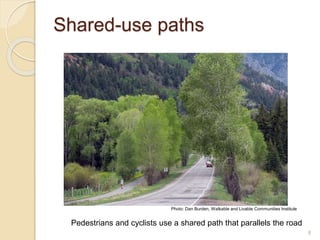
Shared-use paths
Photo: Dan Burden, Walkable and Livable Communities Institute
Pedestrians and cyclists use a shared path that parallels the road
8
9
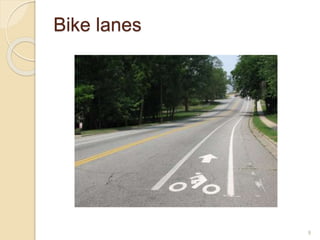
Bike lanes
10
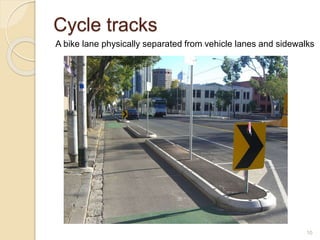
Cycle tracks
A bike lane physically separated from vehicle lanes and sidewalks
11
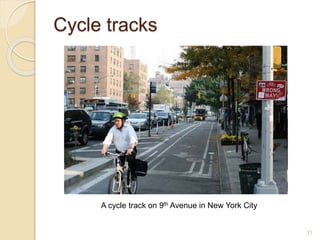
Cycle tracks
A cycle track on 9th Avenue in New York City
12
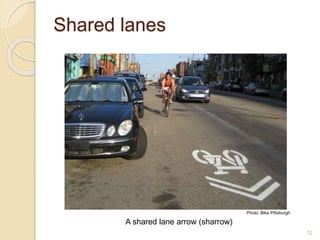
Shared lanes
Photo: Bike Pittsburgh
A shared lane arrow (sharrow)
Complete Streets Initiatives
 Complete streets are designed and operated to enable
safe access for all users.
◦ Pedestrians
◦ Bicyclists
◦ Motorists
◦ Transit riders
 Creating complete streets means transportation agencies
must change their orientation toward building primarily for
cars.
 Instituting a complete streets policy ensures that
transportation agencies routinely design and operate the
entire right of way to enable safe access for all users.
 Complete Streets policies adopted by 24 state governments
13
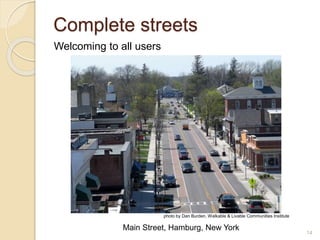
Complete streets
photo by Dan Burden, Walkable & Livable Communities Institute
Main Street, Hamburg, New York
Welcoming to all users
14
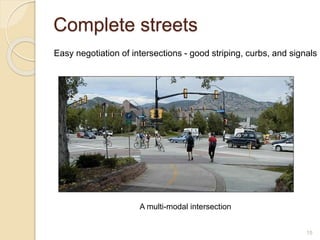
Complete streets
A multi-modal intersection
Easy negotiation of intersections - good striping, curbs, and signals
15
16
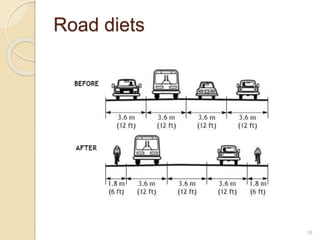
Road diets
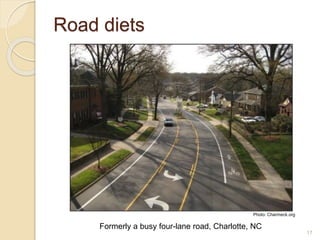
Road diets
Photo: Charmeck.org
Formerly a busy four-lane road, Charlotte, NC
17
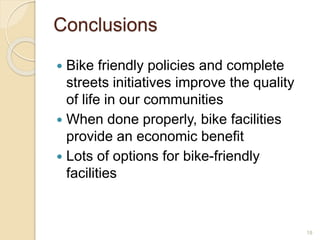
 Bike friendly policies and complete
streets initiatives improve the quality
of life in our communities
 When done properly, bike facilities
provide an economic benefit
 Lots of options for bike-friendly
facilities
18
Conclusions
 BikeDFW – www.bikedfw.org
 NCTCOG –
www.nctcog.org/trans/sustdev
 Bike Texas – www.biketexas.org
 League of American Bicyclists –
www.bikeleague.org
 Complete Streets Coalition –
www.completestreets.org
 Rails to Trails Conservancy –
www.railtrails.org
19
Resources

Bike DFW

  • 1.
    Bicycle friendly inDFW How bike friendly programs can benefit North Texas communities Mansfield Rotary Club October 26, 2010 Marc Mumby, President BikeDFW www.bikedfw.org
  • 2.
    What does “bikefriendly” mean?  A bicycle friendly community welcomes cyclists by providing safe accommodation for cycling and encouraging people to bike for transportation and recreation  Increased bicycling is part of a larger trend toward urban renewal and livable cities.  Bicyclists are an indicator of a healthy, vibrant community that offers improved quality of life for families 2
  • 3.
    Benefits to communities Improved environment  Reduced congestion  Increase public safety  Enhance recreational opportunities  Improve public health  Save city funds  It’s green 3
  • 4.
     Transportation  Recreation Air quality  Livable communities  Habitat preservation  Storm water management 4 Bike facilities serve multiple objectives
  • 5.
     Bicycle tourism Fund raising rides and rallies  Local bike industry contributes to economy 5 Benefits to local economies
  • 6.
     Home buyerswant quality of life  Businesses want quality of life for employees  Biking and walking facilities are strong indicators for quality of life 6 Improved quality of life promotes economic development
  • 7.
    What’s involved?  Peoplewith vision and commitment  Community support  A Bike Plan  Adoption of Bike Plan into the city Master Plan  Implementation 7
  • 8.
    Shared-use paths Photo: DanBurden, Walkable and Livable Communities Institute Pedestrians and cyclists use a shared path that parallels the road 8
  • 9.
  • 10.
    10 Cycle tracks A bikelane physically separated from vehicle lanes and sidewalks
  • 11.
    11 Cycle tracks A cycletrack on 9th Avenue in New York City
  • 12.
    12 Shared lanes Photo: BikePittsburgh A shared lane arrow (sharrow)
  • 13.
    Complete Streets Initiatives Complete streets are designed and operated to enable safe access for all users. ◦ Pedestrians ◦ Bicyclists ◦ Motorists ◦ Transit riders  Creating complete streets means transportation agencies must change their orientation toward building primarily for cars.  Instituting a complete streets policy ensures that transportation agencies routinely design and operate the entire right of way to enable safe access for all users.  Complete Streets policies adopted by 24 state governments 13
  • 14.
    Complete streets photo byDan Burden, Walkable & Livable Communities Institute Main Street, Hamburg, New York Welcoming to all users 14
  • 15.
    Complete streets A multi-modalintersection Easy negotiation of intersections - good striping, curbs, and signals 15
  • 16.
  • 17.
    Road diets Photo: Charmeck.org Formerlya busy four-lane road, Charlotte, NC 17
  • 18.
     Bike friendlypolicies and complete streets initiatives improve the quality of life in our communities  When done properly, bike facilities provide an economic benefit  Lots of options for bike-friendly facilities 18 Conclusions
  • 19.
     BikeDFW –www.bikedfw.org  NCTCOG – www.nctcog.org/trans/sustdev  Bike Texas – www.biketexas.org  League of American Bicyclists – www.bikeleague.org  Complete Streets Coalition – www.completestreets.org  Rails to Trails Conservancy – www.railtrails.org 19 Resources

Editor's Notes

  • #9 This two-lane road accommodates motorized traffic and bicyclists who are comfortable sharing the lane. Pedestrians and cyclists are welcome on the shared use path that runs parallel to the road. Photo: Dan Burden, Walkable and Livable Communities Institute
  • #15 Hamburg, NY's main street is welcoming to all users. Wide sidewalks, curb extensions, and well-marked crosswalks help pedestrians travel to the various businesses along the street. On-street parking gives those traveling by car easy access. Colored pavement narrows the travel lane, keeping speeds at an appropriate level.
  • #16 Cyclists on an off-road bike trail easily cross pedestrian and automobile areas thanks to good striping, curb cuts, and signals.
  • #18 Before its road diet, Charlotte's East Boulevard was a four-lane, undivided road, that carried over 20,000 per day! Now, East Blvd--with its bike lanes, center turn lane, and curb ramps--is a complete street. Photo: Charmeck.org