1
Big data for greater
energy efficiency
Prof. Kornelis Blok
Professor Energy Systems Analysis, Delft University of Technology
Director of Science, Ecofys
@kornelisblok
Webinar Leonardo Energy
20 April 2017
2
What can you expect?
1. New equipment is entering our buildings
2. Generating lots of data, but what to do with it?
3. Smart energy use can indeed save a lot
4. There are issues around security and privacy
5. So, what is the way forward?
3
Smart stuff is entering our homes
Market is estimated to be 26.5 billion US$ (2016)
Navigant Research
https://www.navigantresearch.com/research/market-data-iot-for-residential-energy-customers
Smart meters
Smart appliances
Sensors (presence, air quality,
window and door openings)
Smart plugs
Smart lamps
Smart thermostats
4
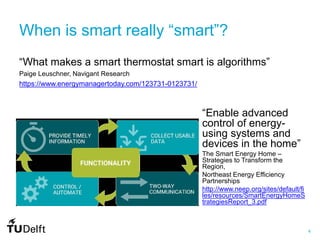
When is smart really “smart”?
“What makes a smart thermostat smart is algorithms”
Paige Leuschner, Navigant Research
https://www.energymanagertoday.com/123731-0123731/
“Enable advanced
control of energy-
using systems and
devices in the home”
The Smart Energy Home –
Strategies to Transform the
Region,
Northeast Energy Efficiency
Partnerships
http://www.neep.org/sites/default/fi
les/resources/SmartEnergyHomeS
trategiesReport_3.pdf
5
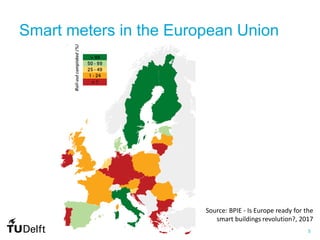
Smart meters in the European Union
Source: BPIE - Is Europe ready for the
smart buildings revolution?, 2017
6
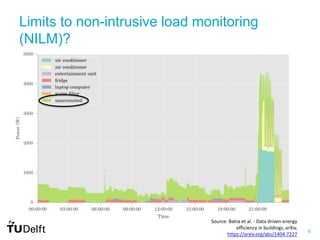
Limits to non-intrusive load monitoring
(NILM)?
Source: Batra et al. - Data driven energy
efficiency in buildings, arXiv,
https://arxiv.org/abs/1404.7227
7
Service sector buildings
• Building management systems are common for
most larger size buildings
• Energy monitoring and reporting systems are
long available
– Not widely introduced yet
– Temporal and spatial resolution of reporting is limited
• New data are being gathered and with higher
spatial precision
– Sensors (temperature, humidity, CO2)
– Location-detection (smartphone, iBeacons)
8
Established companies and start-ups active
in the field of 2nd generation building
management
Source: Navigant Research Leaderboard Report: Building Energy Management Systems
https://www.navigantresearch.com/research/navigant-research-leaderboard-report-building-energy-
management-systems
9
10
Many reasons to install …
… but energy is not first on the list
• Security (burglar alarm)
• Safety (CO, fire detection)
• Air quality (CO2, VOC)
• Wayfinding (colleagues, workplace, assets)
• Individual adjustment of climate and light
• Building usage optimization
• …. and fun
11
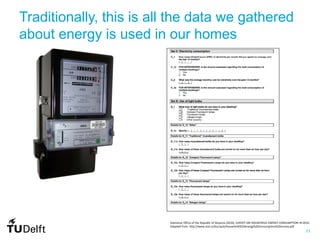
Traditionally, this is all the data we gathered
about energy is used in our homes
Statistical Office of the Republic of Slovenia (2010). SURVEY ON HOUSEHOLD ENERGY CONSUMPTION IN 2010.
Adapted from: http://www.stat.si/doc/pub/Household%20energy%20consumption%20survey.pdf
12
What to do with all these data?
• What gets measured gets done ….
• New data provide the opportunity to make a step-
change in knowledge about energy use and energy
efficiency
• First priority is to get a much better understanding
of;
– Energy use by appliance or application
– Real-life energy efficiency of equipment
– Developments in energy efficiency and energy use
– Detecting key drivers of energy use
13
Current energy statistics
Coal Crude oil Oil
products
Natural
gas
Nuclear Hydro Solar etc. Biofuels Electr. Heat Total
Residential 0.00 - 0.04 6.39 - - 0.02 0.44 1.97 0.26 9.12
Winning
Conversion boilers
Converions in heat pumps
End use
Space heating
Showering
Other hot water
Cooking
Light
Washing machines
Tumble driers
Computer equipment
….
….
Source: IEA Energy Statistics, 2016
(data for the Netherlands, 2014)
14
The dream about future energy statistics
Coal Crude oil Oil
products
Natural
gas
Nuclear Hydro Solar etc. Biofuels Electr. Heat Total
Residential 0.00 - 0.04 6.39 - - 0.02 0.44 1.97 0.26 9.12
Winning
Conversion boilers
Conversion heat pumps
End use
Space heating
Showering
Other hot water
Cooking
Light
Washing machines
Tumble driers
Computer equipment
….
….
Source: IEA Energy Statistics, 2016
(data for the Netherlands, 2014)
15
But the big prize is of course:
• How to make equipment and buildings more
efficient through the smart use of data?
16
Energy use in buildings is significant
17
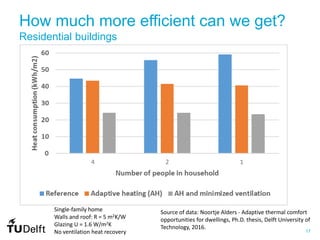
How much more efficient can we get?
Residential buildings
Source of data: Noortje Alders - Adaptive thermal comfort
opportunities for dwellings, Ph.D. thesis, Delft University of
Technology, 2016.
Single-family home
Walls and roof: R = 5 m2K/W
Glazing U = 1.6 W/m2K
No ventilation heat recovery
18
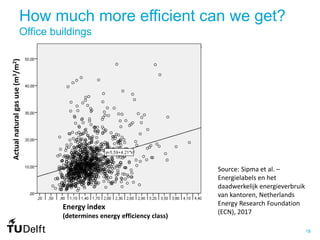
How much more efficient can we get?
Office buildings
Energy index
(determines energy efficiency class)
Actualnaturalgasuse(m3/m2)
Source: Sipma et al. –
Energielabels en het
daadwerkelijk energieverbruik
van kantoren, Netherlands
Energy Research Foundation
(ECN), 2017
19
What is needed for achieving higher energy
efficiency in buildings?
Residential buildings
• Broad platforms
• Programmability and
interconnectivity of
equipment
• Right hardware
• Supersmart
algorithms
Tertiary buildings
• Integrated and flexible
platforms
• Much more detailed
monitoring
• Data analytics at a
higher level
• Supersmart algorithms
Monitoring and evaluation
of energy savings
20
… and unstructured data
People leave traces on social media and through their search activities …
… and people can interact about energy via social media.
Source of data: Search intensity – Google Trends
Degree days – KWA Bedrijfsadviseurs, Amersfoort
Degree-days
(Netherlands)
Search intensity
“isolatie”
21
Privacy and cybersecurity
• Limited attention so far
• In tertiary buildings an important concern
• But in residential settings probably even more
risks
• First responsibility with system designers
• Regulatory framework needed regarding data
ownership and use, and security
22
Conclusions
• We are in an early stage when it comes to
harnessing new ICT for better energy efficiency
• Nevertheless, the opportunities are very
significant; size of the opportunity to early to tell
• Systems need to be designed with the clear end
of greater energy efficiency in the mind:
– What do want to improve
– What sensors and control hardware is needed
– How do design the best algoritms to get it done
– How to deal with all the data in a secure way
23
24
Contact
Prof. dr. Kornelis Blok
Chair of Energy Systems Analysis
Faculty Technology, Policy and Management
Jaffalaan 5, Room B3.060
2628 BX Delft
The Netherlands
E-mail: k.blok@tudelft.nl
phone: +31-15-27 85751
mobile: +31-6-558 667 36
Twitter: @kornelisblok

Big data for greater energy efficiency

  • 1.
    1 Big data forgreater energy efficiency Prof. Kornelis Blok Professor Energy Systems Analysis, Delft University of Technology Director of Science, Ecofys @kornelisblok Webinar Leonardo Energy 20 April 2017
  • 2.
    2 What can youexpect? 1. New equipment is entering our buildings 2. Generating lots of data, but what to do with it? 3. Smart energy use can indeed save a lot 4. There are issues around security and privacy 5. So, what is the way forward?
  • 3.
    3 Smart stuff isentering our homes Market is estimated to be 26.5 billion US$ (2016) Navigant Research https://www.navigantresearch.com/research/market-data-iot-for-residential-energy-customers Smart meters Smart appliances Sensors (presence, air quality, window and door openings) Smart plugs Smart lamps Smart thermostats
  • 4.
    4 When is smartreally “smart”? “What makes a smart thermostat smart is algorithms” Paige Leuschner, Navigant Research https://www.energymanagertoday.com/123731-0123731/ “Enable advanced control of energy- using systems and devices in the home” The Smart Energy Home – Strategies to Transform the Region, Northeast Energy Efficiency Partnerships http://www.neep.org/sites/default/fi les/resources/SmartEnergyHomeS trategiesReport_3.pdf
  • 5.
    5 Smart meters inthe European Union Source: BPIE - Is Europe ready for the smart buildings revolution?, 2017
  • 6.
    6 Limits to non-intrusiveload monitoring (NILM)? Source: Batra et al. - Data driven energy efficiency in buildings, arXiv, https://arxiv.org/abs/1404.7227
  • 7.
    7 Service sector buildings •Building management systems are common for most larger size buildings • Energy monitoring and reporting systems are long available – Not widely introduced yet – Temporal and spatial resolution of reporting is limited • New data are being gathered and with higher spatial precision – Sensors (temperature, humidity, CO2) – Location-detection (smartphone, iBeacons)
  • 8.
    8 Established companies andstart-ups active in the field of 2nd generation building management Source: Navigant Research Leaderboard Report: Building Energy Management Systems https://www.navigantresearch.com/research/navigant-research-leaderboard-report-building-energy- management-systems
  • 9.
  • 10.
    10 Many reasons toinstall … … but energy is not first on the list • Security (burglar alarm) • Safety (CO, fire detection) • Air quality (CO2, VOC) • Wayfinding (colleagues, workplace, assets) • Individual adjustment of climate and light • Building usage optimization • …. and fun
  • 11.
    11 Traditionally, this isall the data we gathered about energy is used in our homes Statistical Office of the Republic of Slovenia (2010). SURVEY ON HOUSEHOLD ENERGY CONSUMPTION IN 2010. Adapted from: http://www.stat.si/doc/pub/Household%20energy%20consumption%20survey.pdf
  • 12.
    12 What to dowith all these data? • What gets measured gets done …. • New data provide the opportunity to make a step- change in knowledge about energy use and energy efficiency • First priority is to get a much better understanding of; – Energy use by appliance or application – Real-life energy efficiency of equipment – Developments in energy efficiency and energy use – Detecting key drivers of energy use
  • 13.
    13 Current energy statistics CoalCrude oil Oil products Natural gas Nuclear Hydro Solar etc. Biofuels Electr. Heat Total Residential 0.00 - 0.04 6.39 - - 0.02 0.44 1.97 0.26 9.12 Winning Conversion boilers Converions in heat pumps End use Space heating Showering Other hot water Cooking Light Washing machines Tumble driers Computer equipment …. …. Source: IEA Energy Statistics, 2016 (data for the Netherlands, 2014)
  • 14.
    14 The dream aboutfuture energy statistics Coal Crude oil Oil products Natural gas Nuclear Hydro Solar etc. Biofuels Electr. Heat Total Residential 0.00 - 0.04 6.39 - - 0.02 0.44 1.97 0.26 9.12 Winning Conversion boilers Conversion heat pumps End use Space heating Showering Other hot water Cooking Light Washing machines Tumble driers Computer equipment …. …. Source: IEA Energy Statistics, 2016 (data for the Netherlands, 2014)
  • 15.
    15 But the bigprize is of course: • How to make equipment and buildings more efficient through the smart use of data?
  • 16.
    16 Energy use inbuildings is significant
  • 17.
    17 How much moreefficient can we get? Residential buildings Source of data: Noortje Alders - Adaptive thermal comfort opportunities for dwellings, Ph.D. thesis, Delft University of Technology, 2016. Single-family home Walls and roof: R = 5 m2K/W Glazing U = 1.6 W/m2K No ventilation heat recovery
  • 18.
    18 How much moreefficient can we get? Office buildings Energy index (determines energy efficiency class) Actualnaturalgasuse(m3/m2) Source: Sipma et al. – Energielabels en het daadwerkelijk energieverbruik van kantoren, Netherlands Energy Research Foundation (ECN), 2017
  • 19.
    19 What is neededfor achieving higher energy efficiency in buildings? Residential buildings • Broad platforms • Programmability and interconnectivity of equipment • Right hardware • Supersmart algorithms Tertiary buildings • Integrated and flexible platforms • Much more detailed monitoring • Data analytics at a higher level • Supersmart algorithms Monitoring and evaluation of energy savings
  • 20.
    20 … and unstructureddata People leave traces on social media and through their search activities … … and people can interact about energy via social media. Source of data: Search intensity – Google Trends Degree days – KWA Bedrijfsadviseurs, Amersfoort Degree-days (Netherlands) Search intensity “isolatie”
  • 21.
    21 Privacy and cybersecurity •Limited attention so far • In tertiary buildings an important concern • But in residential settings probably even more risks • First responsibility with system designers • Regulatory framework needed regarding data ownership and use, and security
  • 22.
    22 Conclusions • We arein an early stage when it comes to harnessing new ICT for better energy efficiency • Nevertheless, the opportunities are very significant; size of the opportunity to early to tell • Systems need to be designed with the clear end of greater energy efficiency in the mind: – What do want to improve – What sensors and control hardware is needed – How do design the best algoritms to get it done – How to deal with all the data in a secure way
  • 23.
  • 24.
    24 Contact Prof. dr. KornelisBlok Chair of Energy Systems Analysis Faculty Technology, Policy and Management Jaffalaan 5, Room B3.060 2628 BX Delft The Netherlands E-mail: k.blok@tudelft.nl phone: +31-15-27 85751 mobile: +31-6-558 667 36 Twitter: @kornelisblok