빅데이터 기술개요
2014.10.31
윤형기
hky@openwith.net
1
목 차
• 도입
• 빅데이터 기술 개요
• Hadoop
• NoSQL
• 분석
• 맺음말
2
도입
• 변화하는 세상
• 데이터의 힘
3
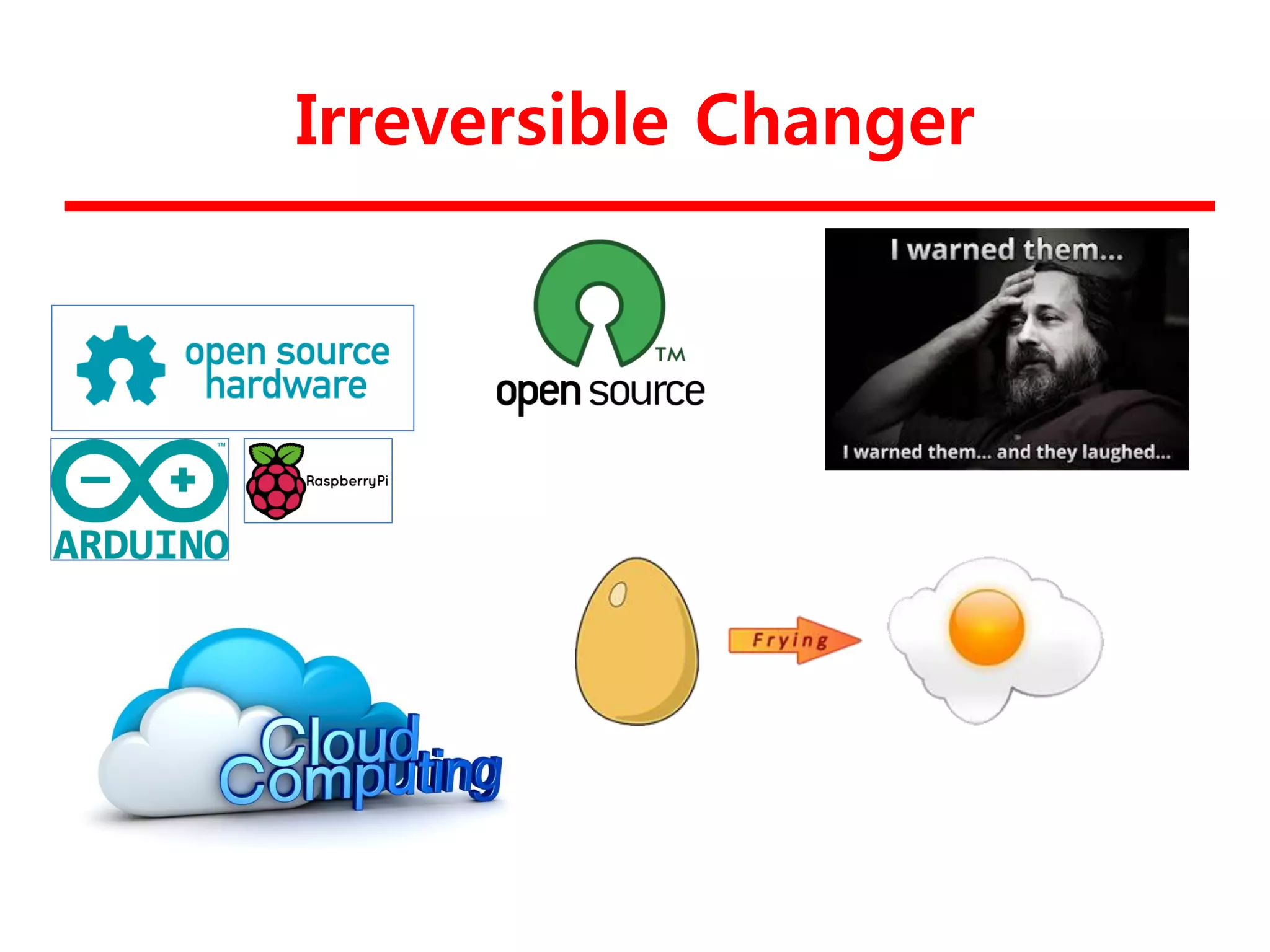
Irreversible Changer
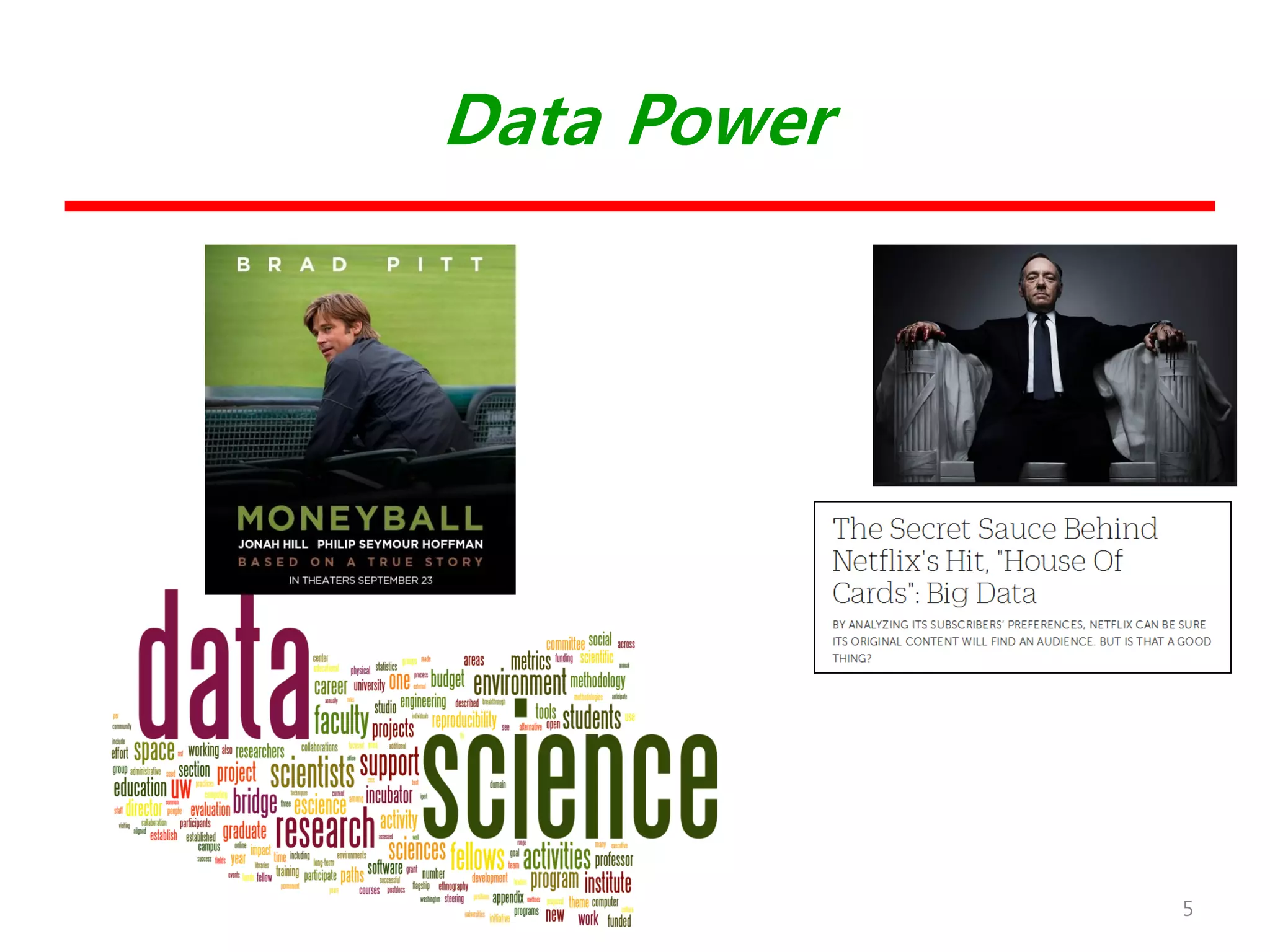
Data Power
5
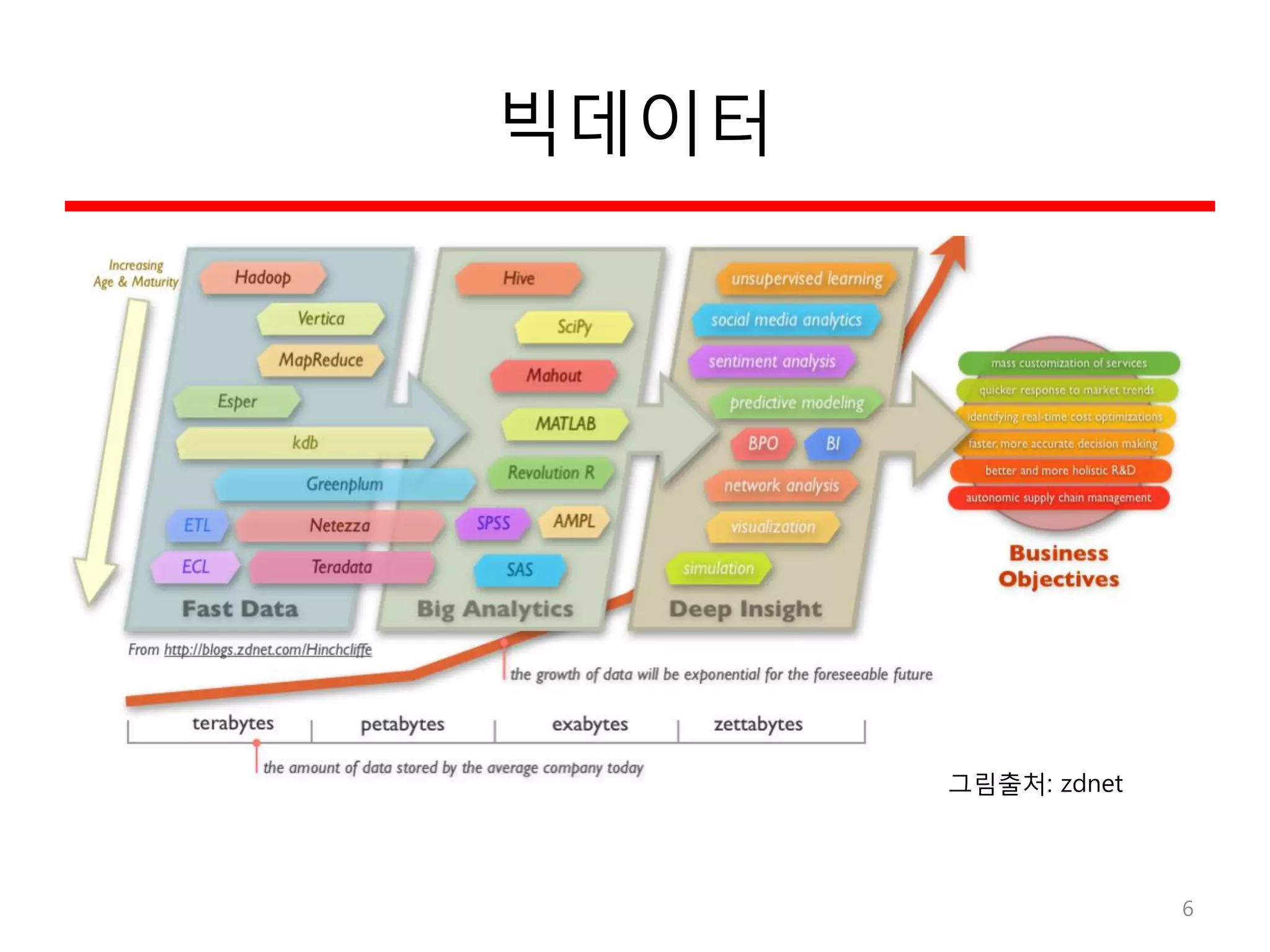
빅데이터
6
그림출처: zdnet
빅데이터 기술 개요
7
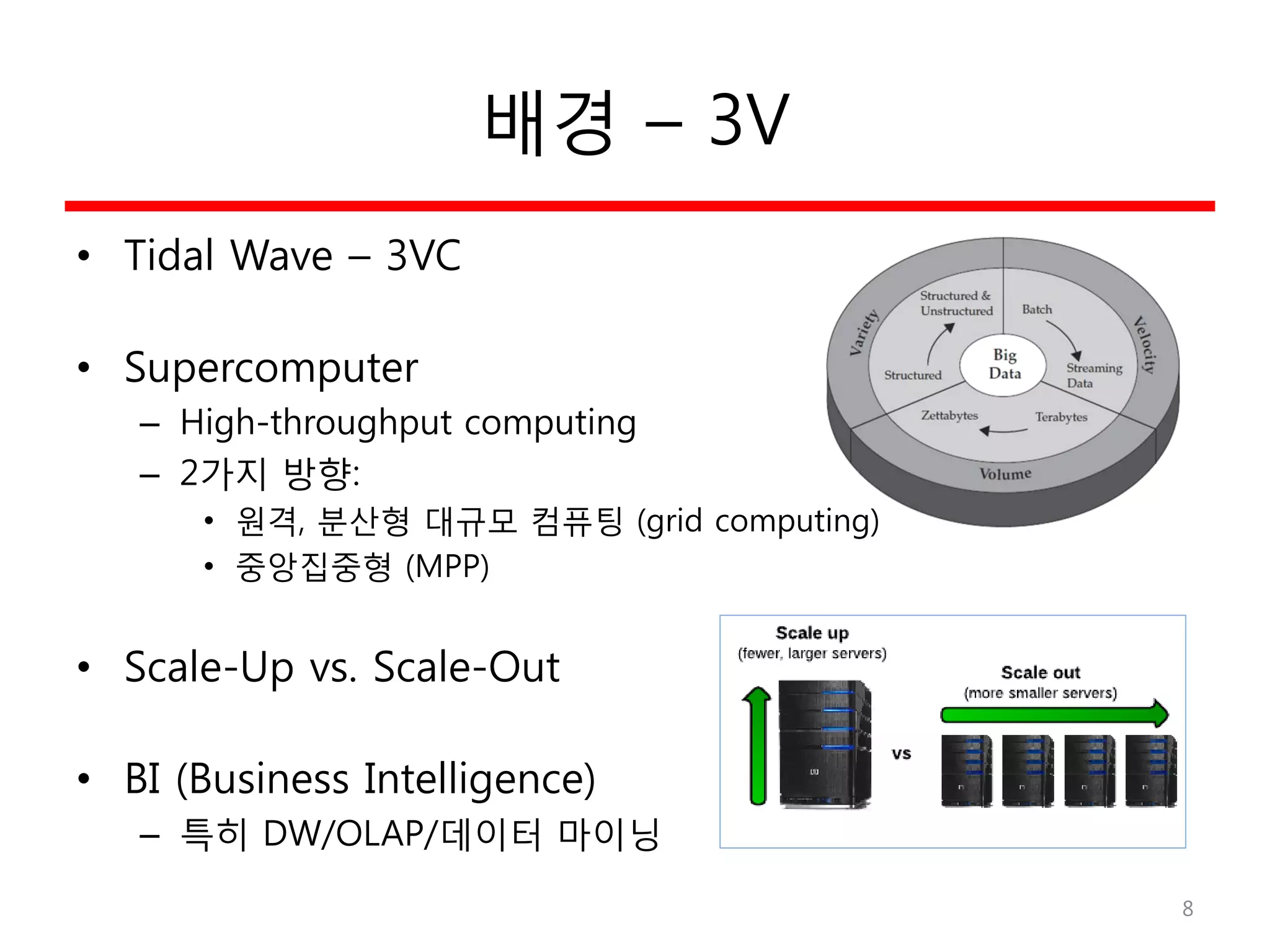
배경 – 3V
• Tidal Wave – 3VC
• Supercomputer
– High-throughput computing
– 2가지 방향:
• 원격, 분산형 대규모 컴퓨팅 (grid computing)
• 중앙집중형 (MPP)
• Scale-Up vs. Scale-Out
• BI (Business Intelligence)
– 특히 DW/OLAP/데이터 마이닝
8
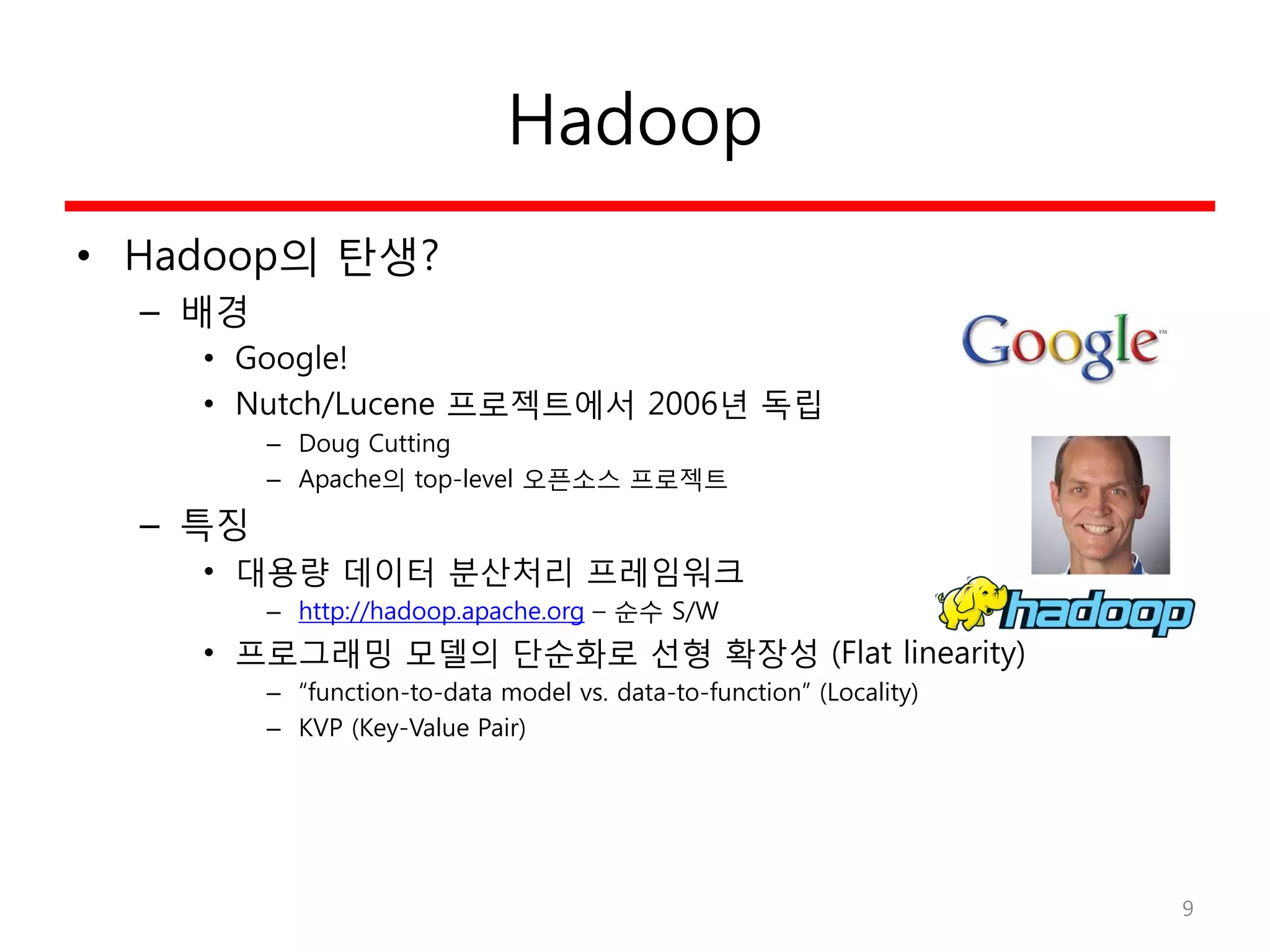
Hadoop
• Hadoop의 탄생?
– 배경
• Google!
• Nutch/Lucene 프로젝트에서 2006년 독립
– Doug Cutting
– Apache의 top-level 오픈소스 프로젝트
– 특징
• 대용량 데이터 분산처리 프레임워크
– http://hadoop.apache.org – 순수 S/W
• 프로그래밍 모델의 단순화로 선형 확장성 (Flat linearity)
– “function-to-data model vs. data-to-function” (Locality)
– KVP (Key-Value Pair)
9
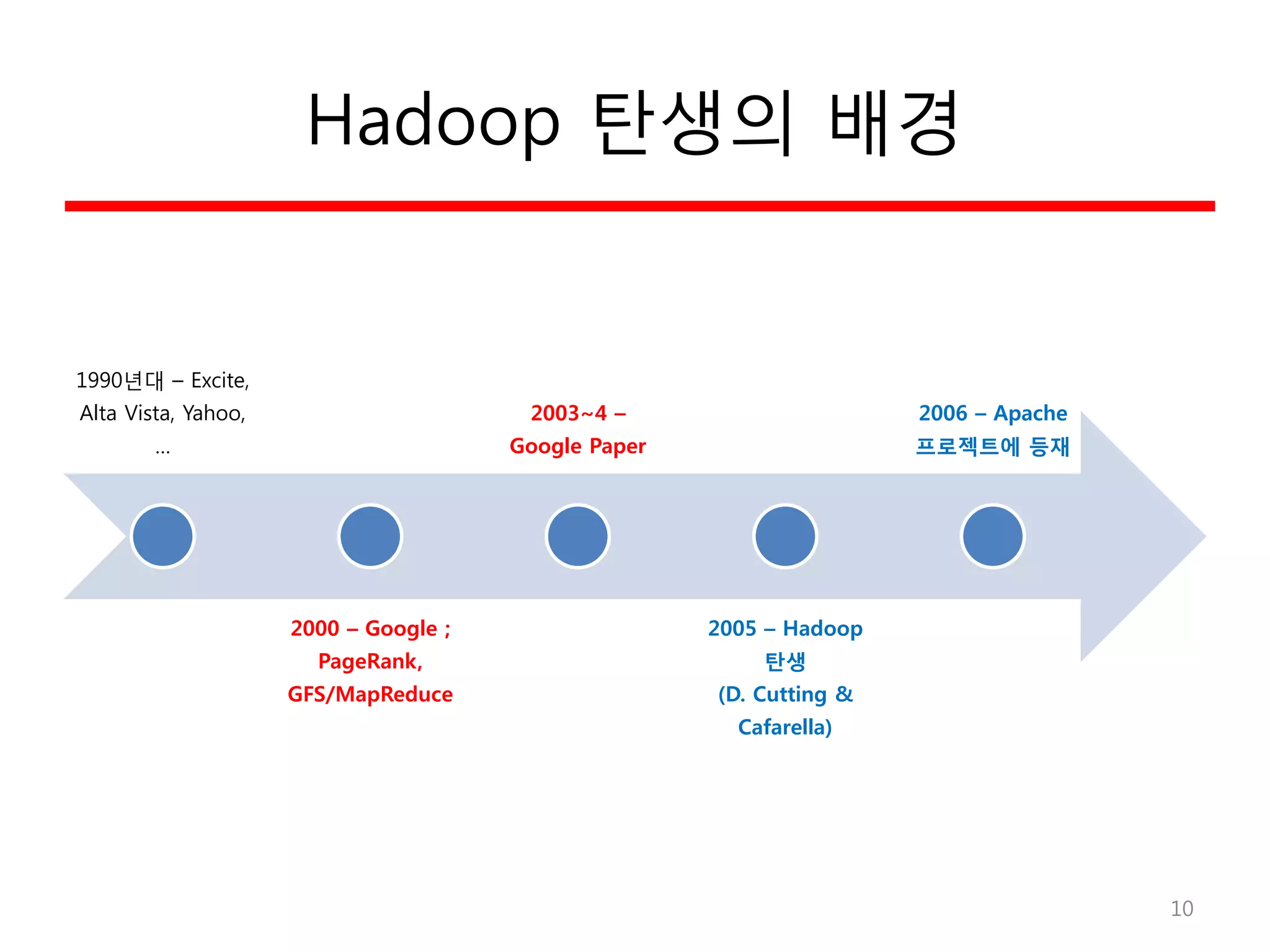
Hadoop 탄생의 배경
1990년대 – Excite,
Alta Vista, Yahoo,
…
2000 – Google ;
PageRank,
GFS/MapReduce
2003~4 –
Google Paper
2005 – Hadoop
탄생
(D. Cutting &
Cafarella)
2006 – Apache
프로젝트에 등재
10
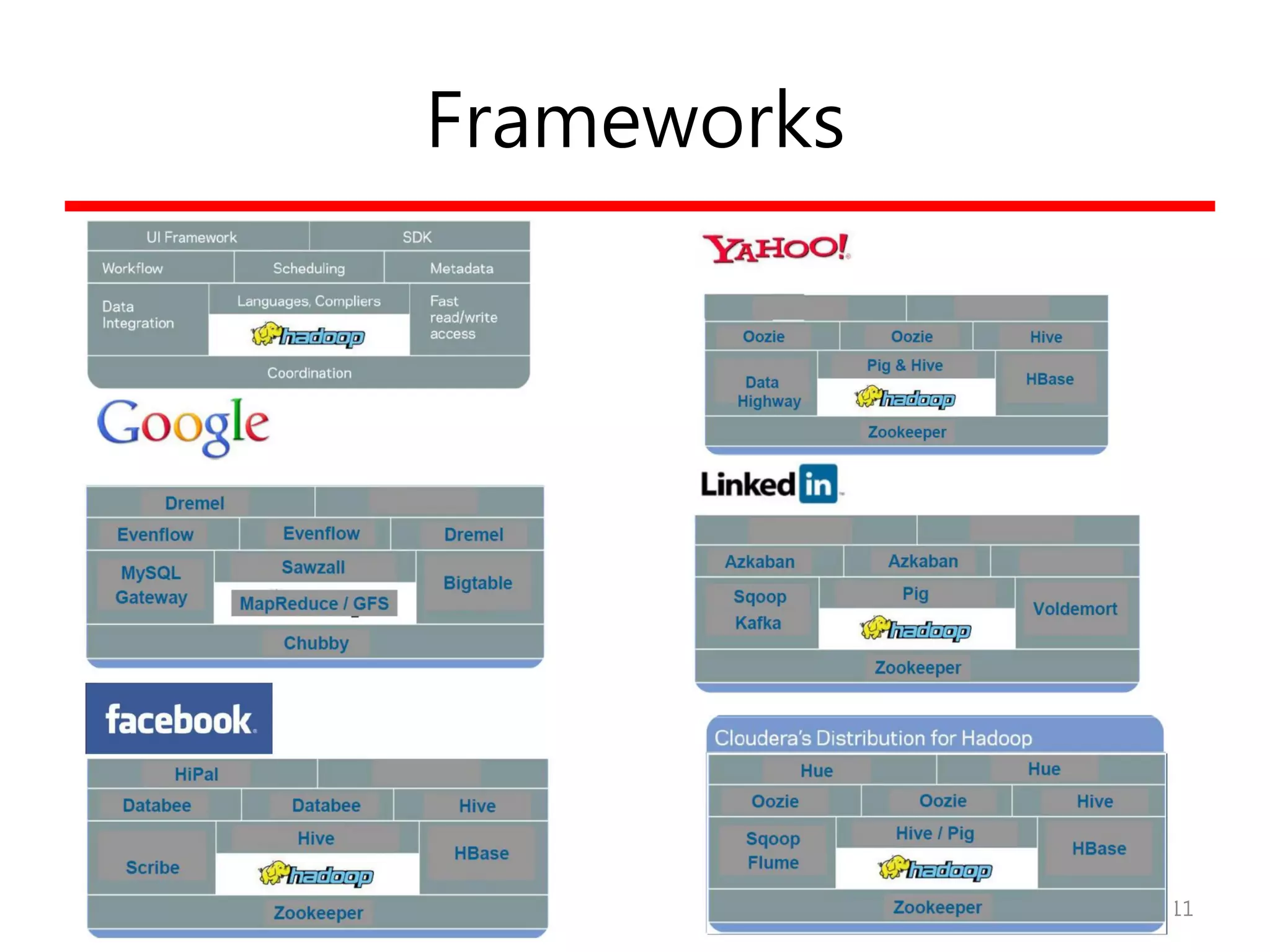
Frameworks
11
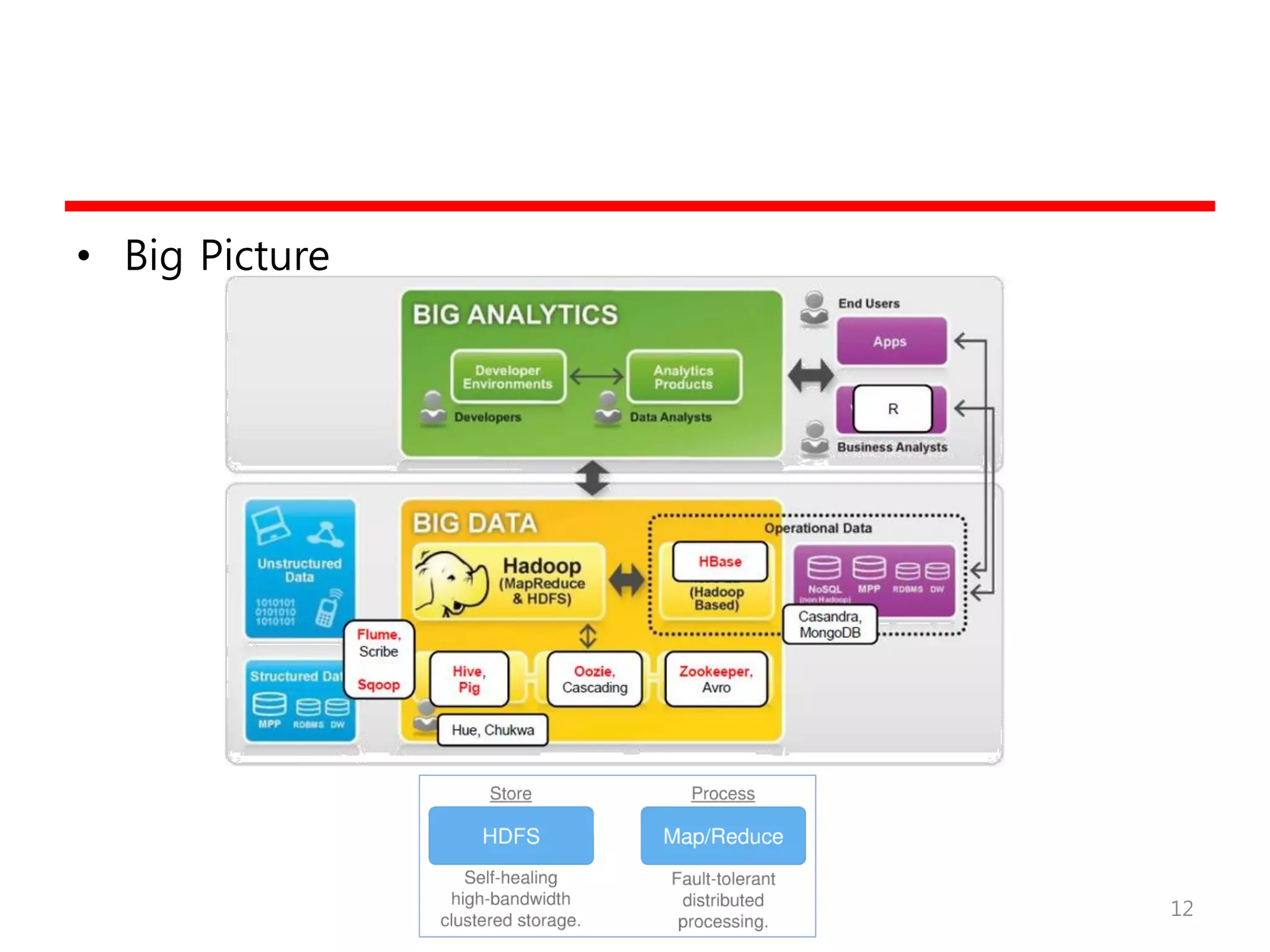
• Big Picture
12
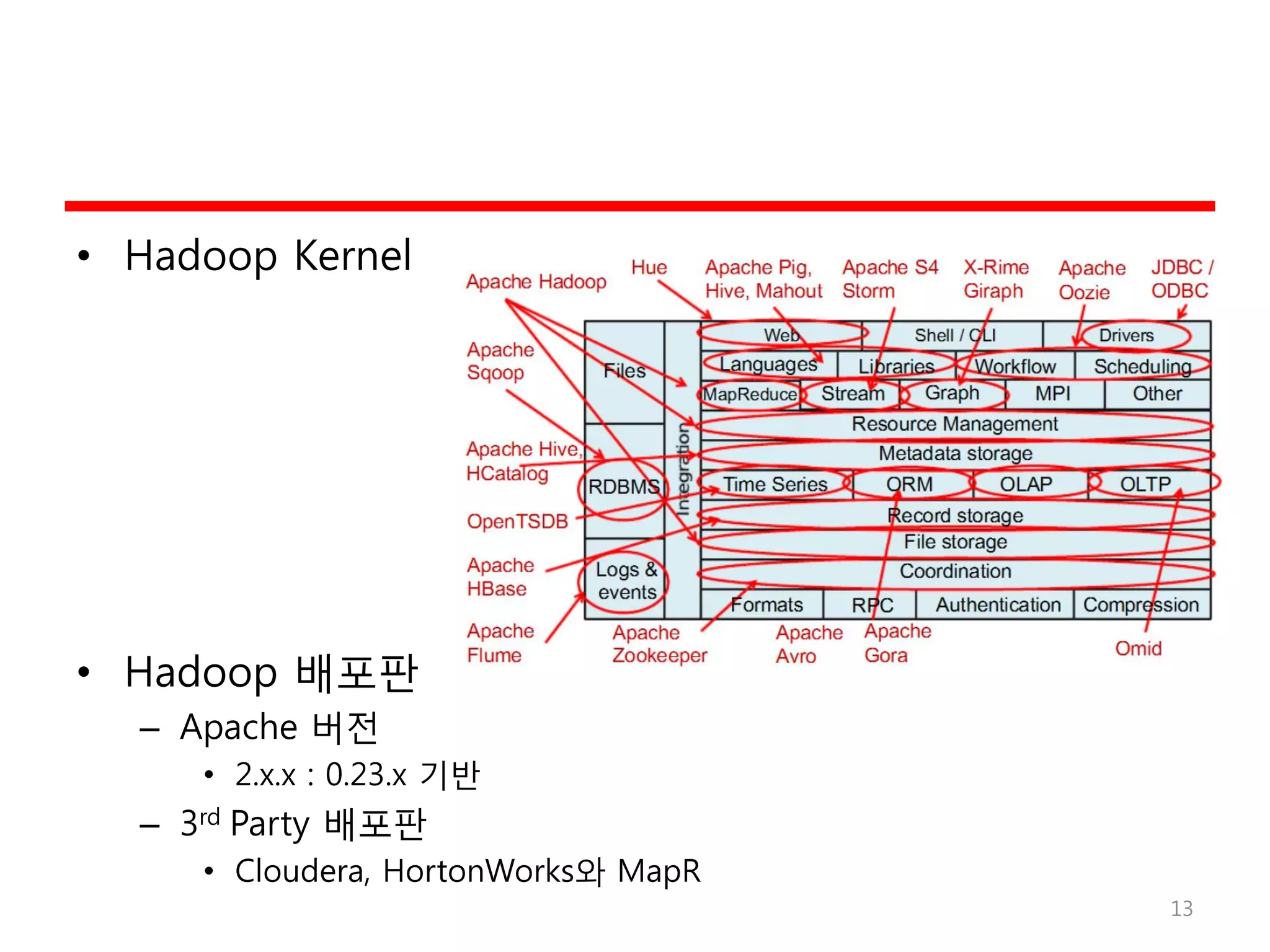
• Hadoop Kernel
• Hadoop 배포판
– Apache 버전
• 2.x.x : 0.23.x 기반
– 3rd Party 배포판
• Cloudera, HortonWorks와 MapR
13
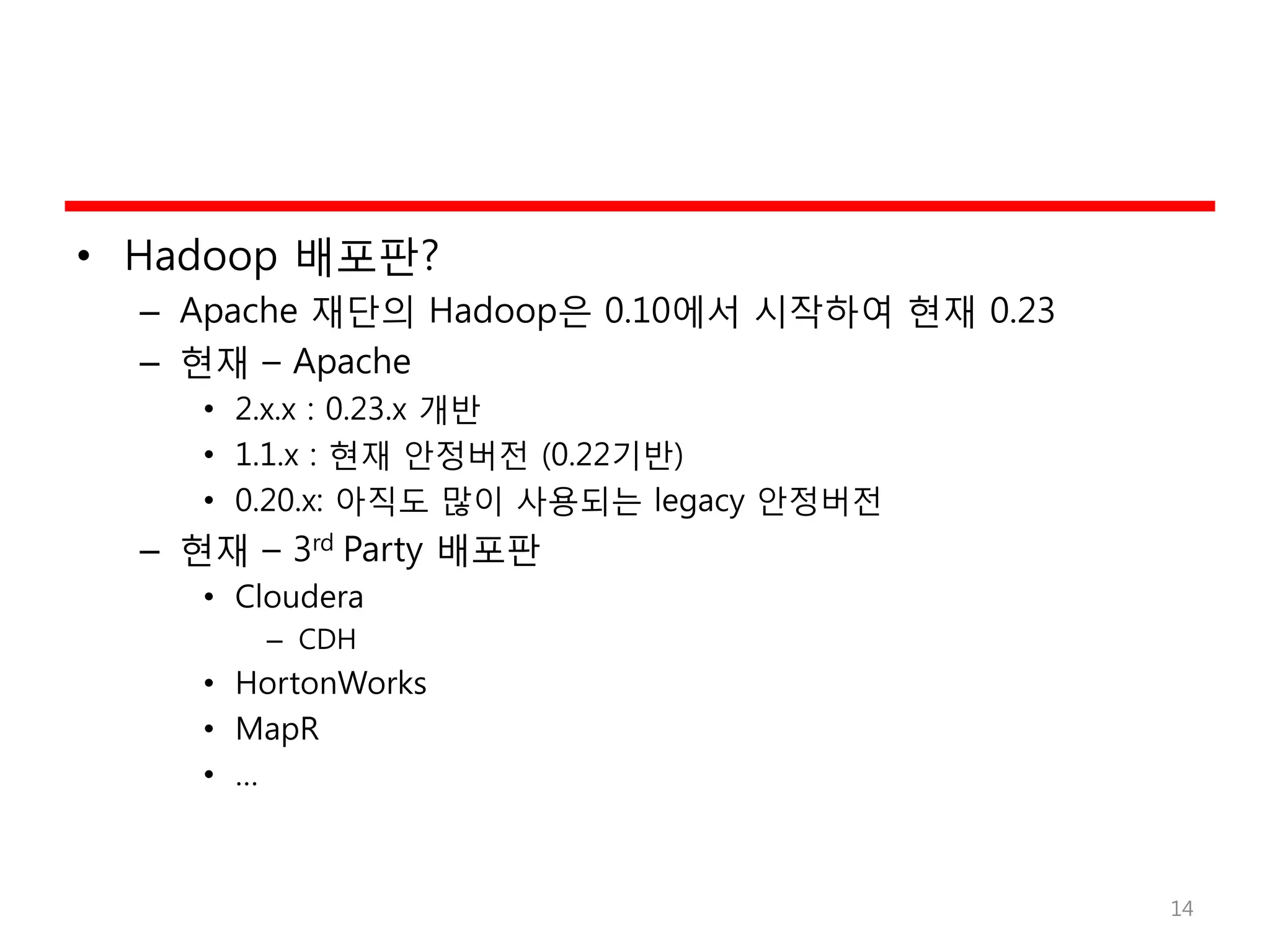
• Hadoop 배포판?
– Apache 재단의 Hadoop은 0.10에서 시작하여 현재 0.23
– 현재 – Apache
• 2.x.x : 0.23.x 개반
• 1.1.x : 현재 안정버전 (0.22기반)
• 0.20.x: 아직도 많이 사용되는 legacy 안정버전
– 현재 – 3rd Party 배포판
• Cloudera
– CDH
• HortonWorks
• MapR
• …
14
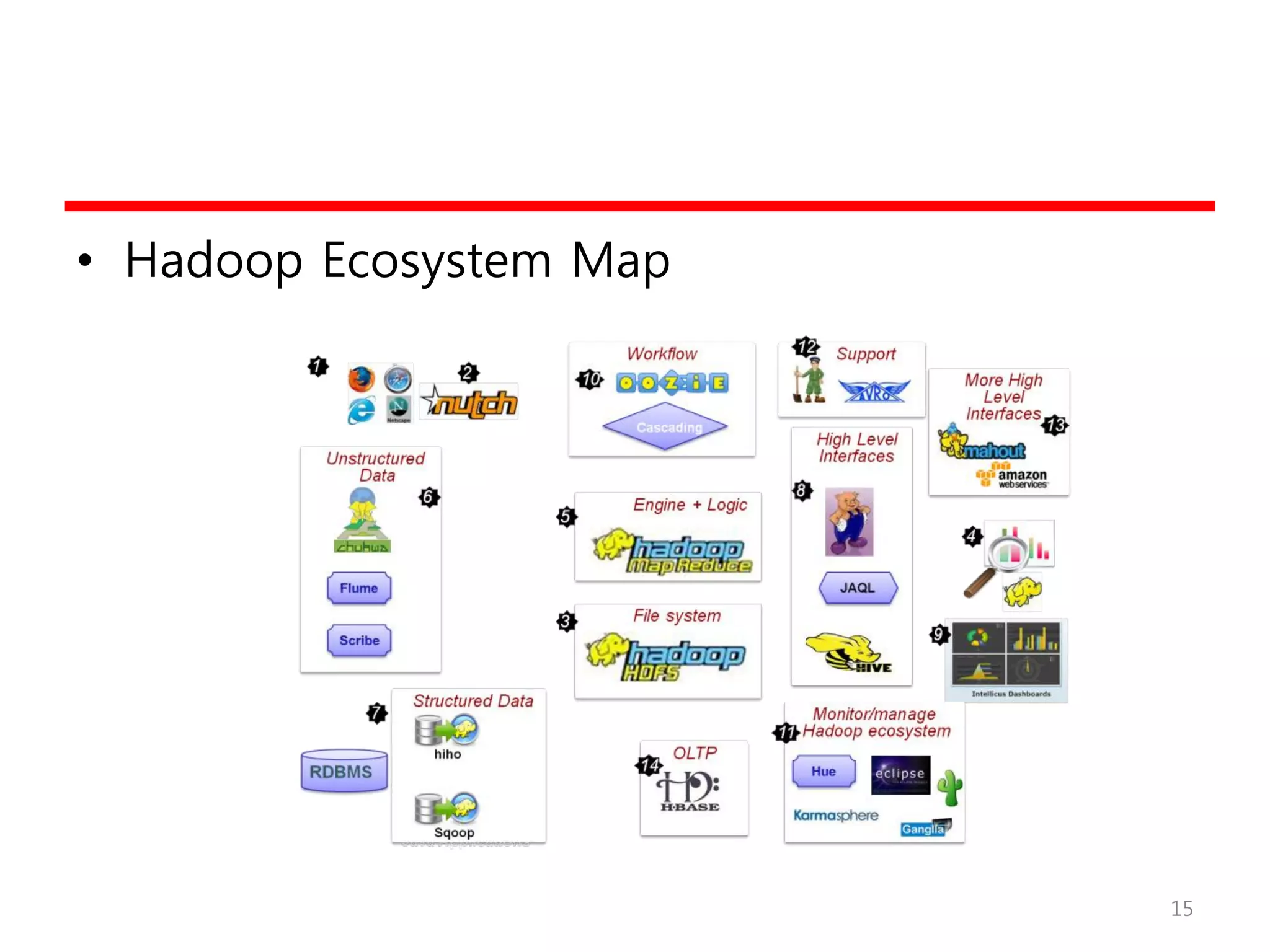
• Hadoop Ecosystem Map
15
Hadoop
– HDFS & MapReduce –
HDFS
요구사항
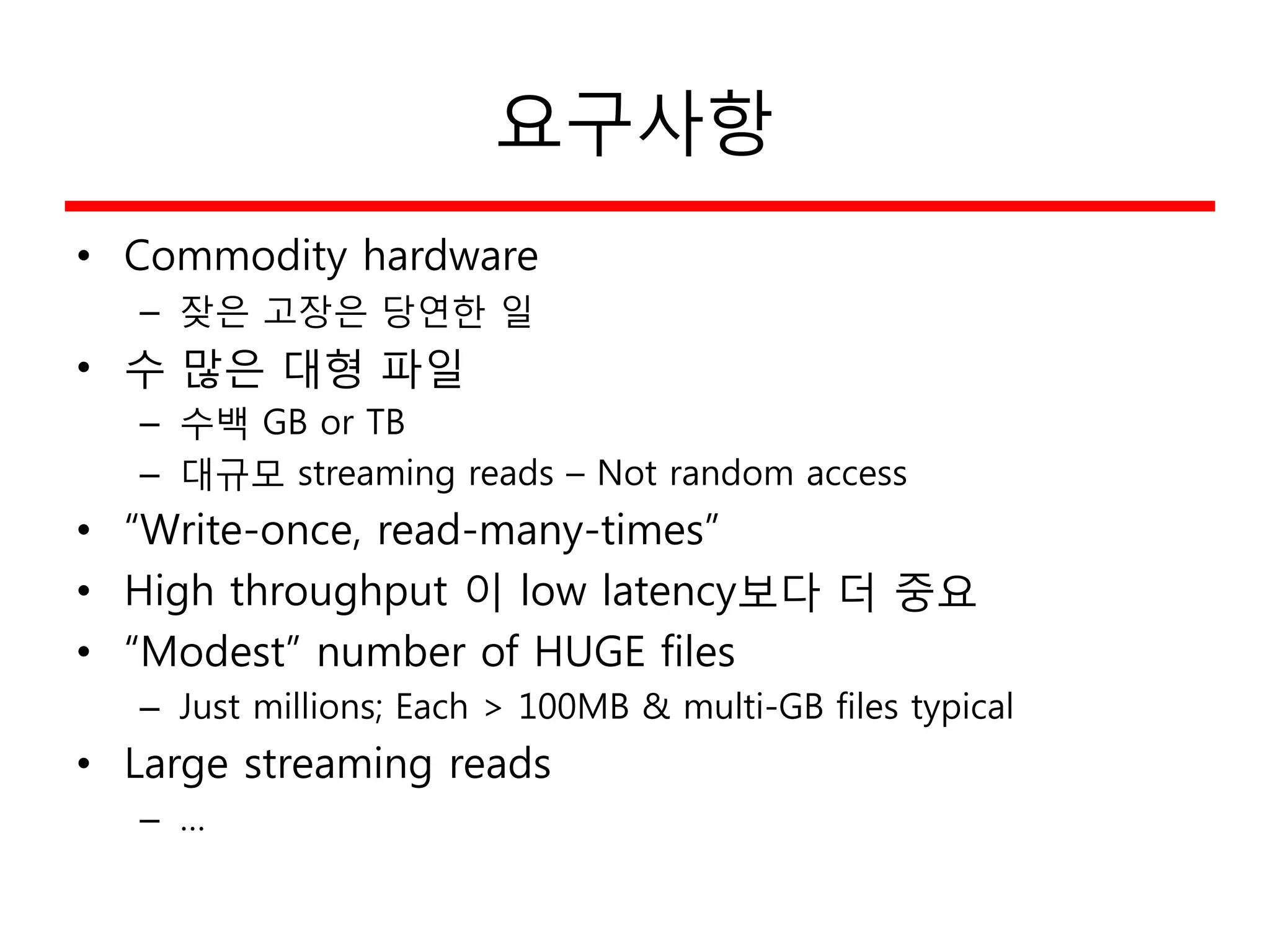
• Commodity hardware
– 잦은 고장은 당연한 일
• 수 많은 대형 파일
– 수백 GB or TB
– 대규모 streaming reads – Not random access
• “Write-once, read-many-times”
• High throughput 이 low latency보다 더 중요
• “Modest” number of HUGE files
– Just millions; Each > 100MB & multi-GB files typical
• Large streaming reads
– …
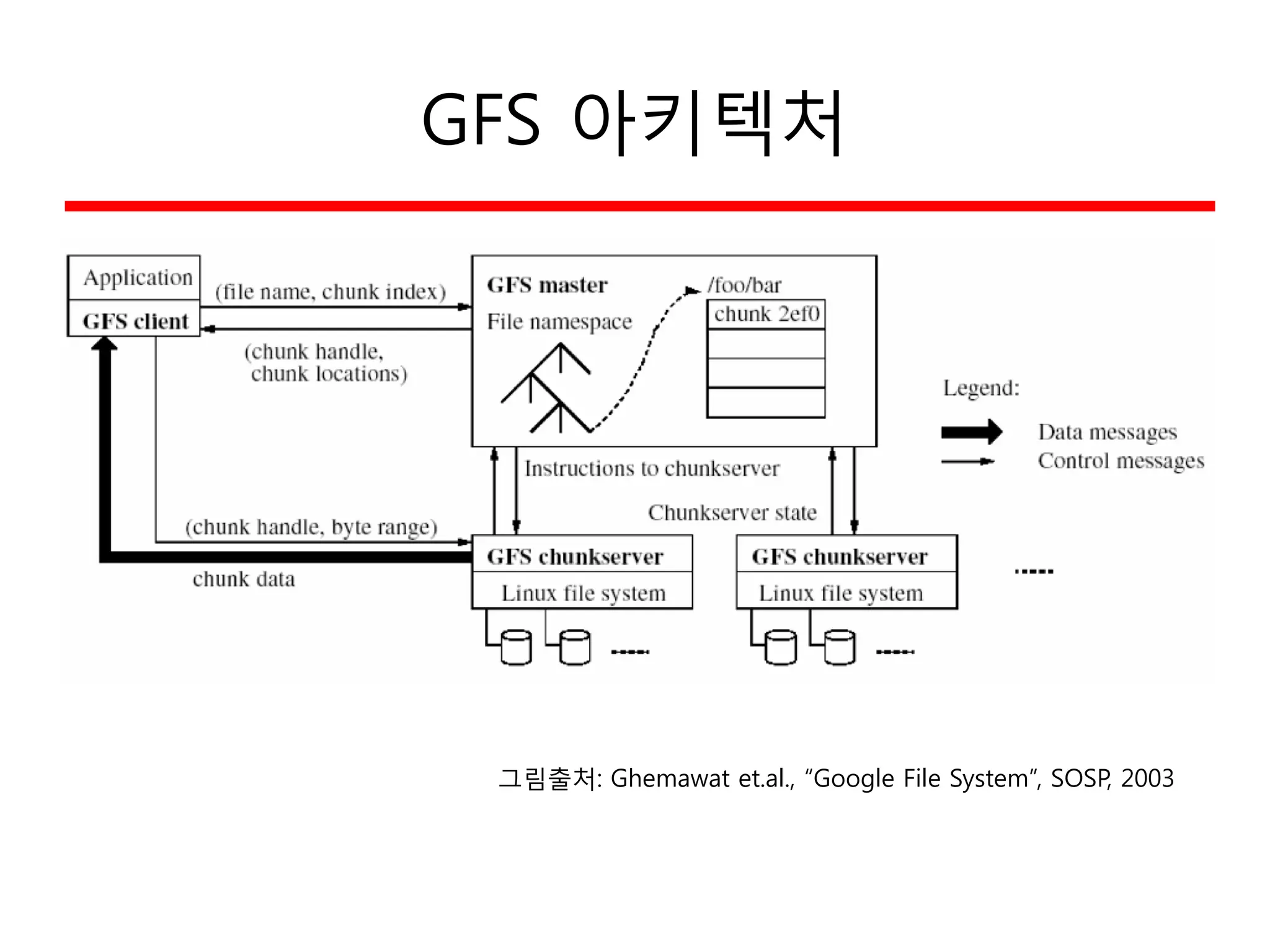
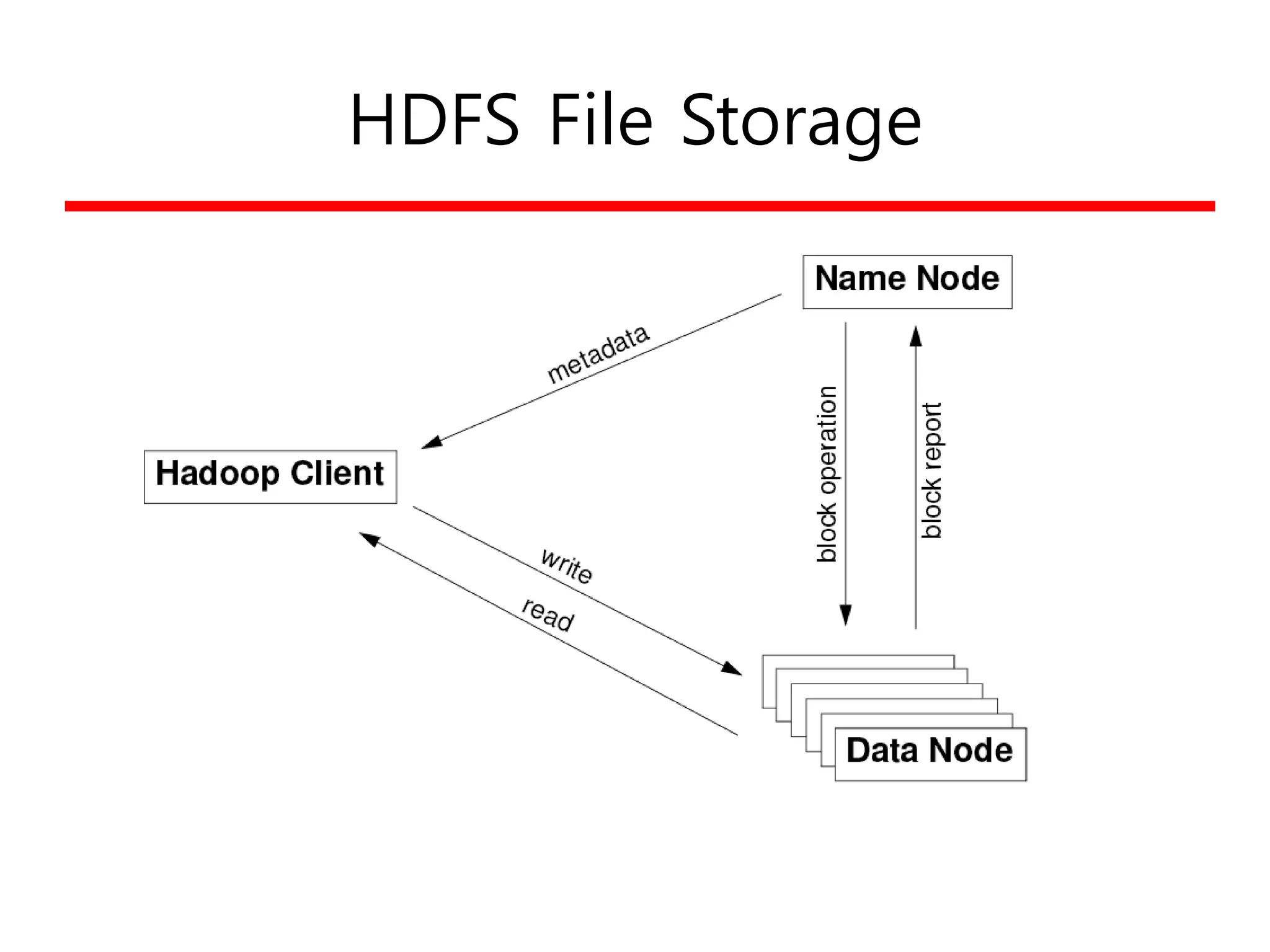
HDFS의 해결책
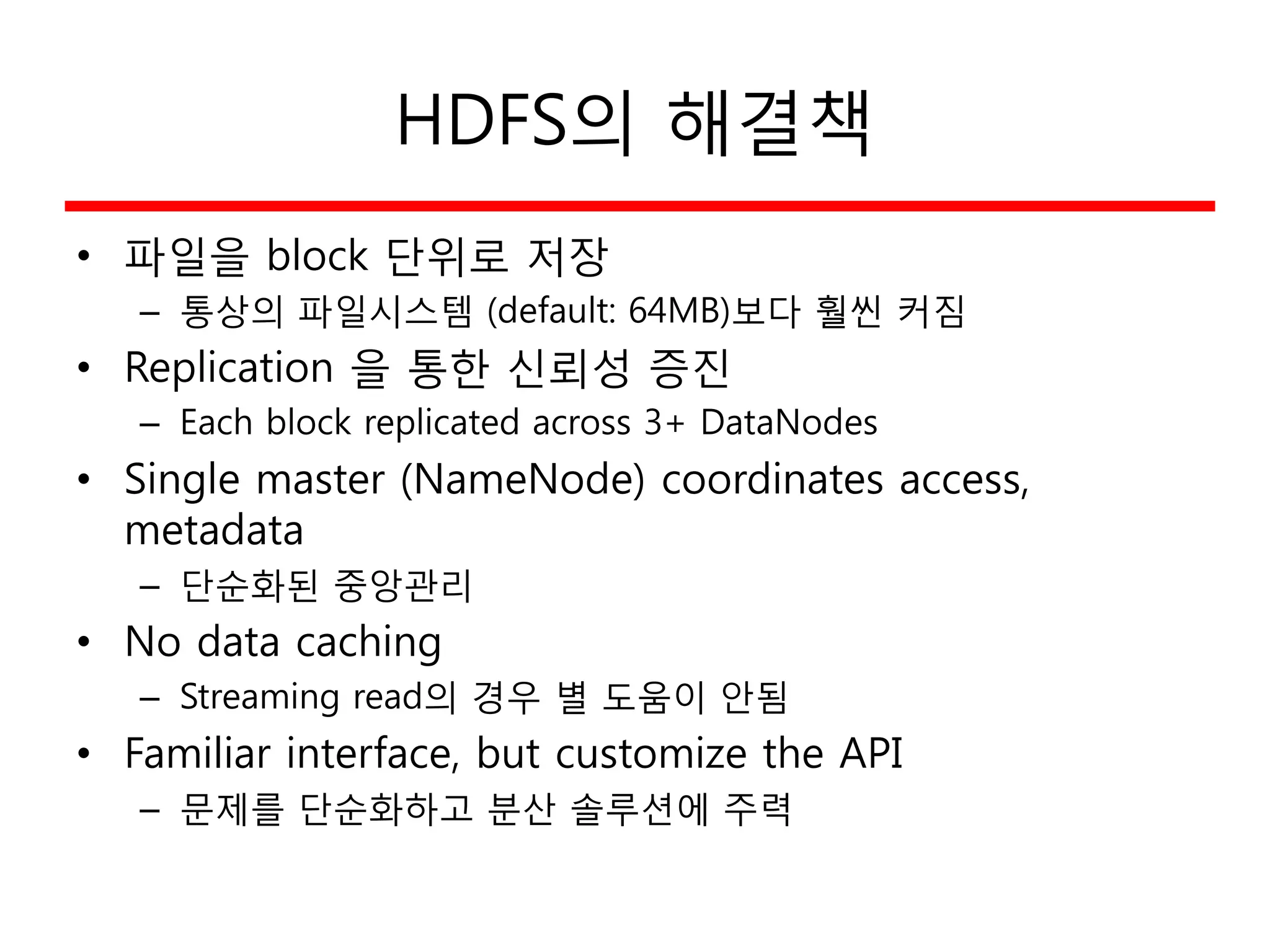
• 파일을 block 단위로 저장
– 통상의 파일시스템 (default: 64MB)보다 훨씬 커짐
• Replication 을 통한 신뢰성 증진
– Each block replicated across 3+ DataNodes
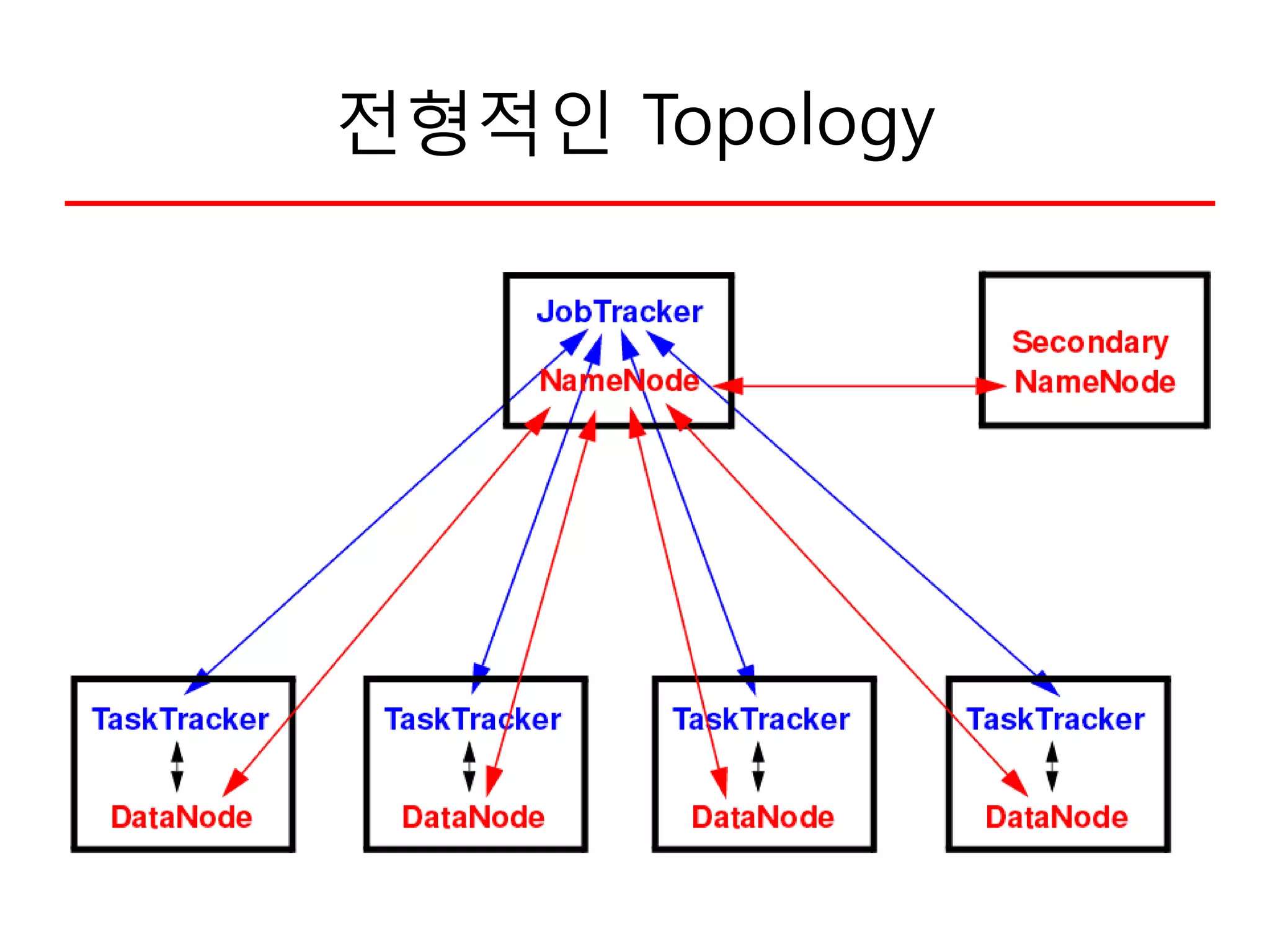
• Single master (NameNode) coordinates access,
metadata
– 단순화된 중앙관리
• No data caching
– Streaming read의 경우 별 도움이 안됨
• Familiar interface, but customize the API
– 문제를 단순화하고 분산 솔루션에 주력
GFS 아키텍처
그림출처: Ghemawat et.al., “Google File System”, SOSP, 2003
HDFS File Storage
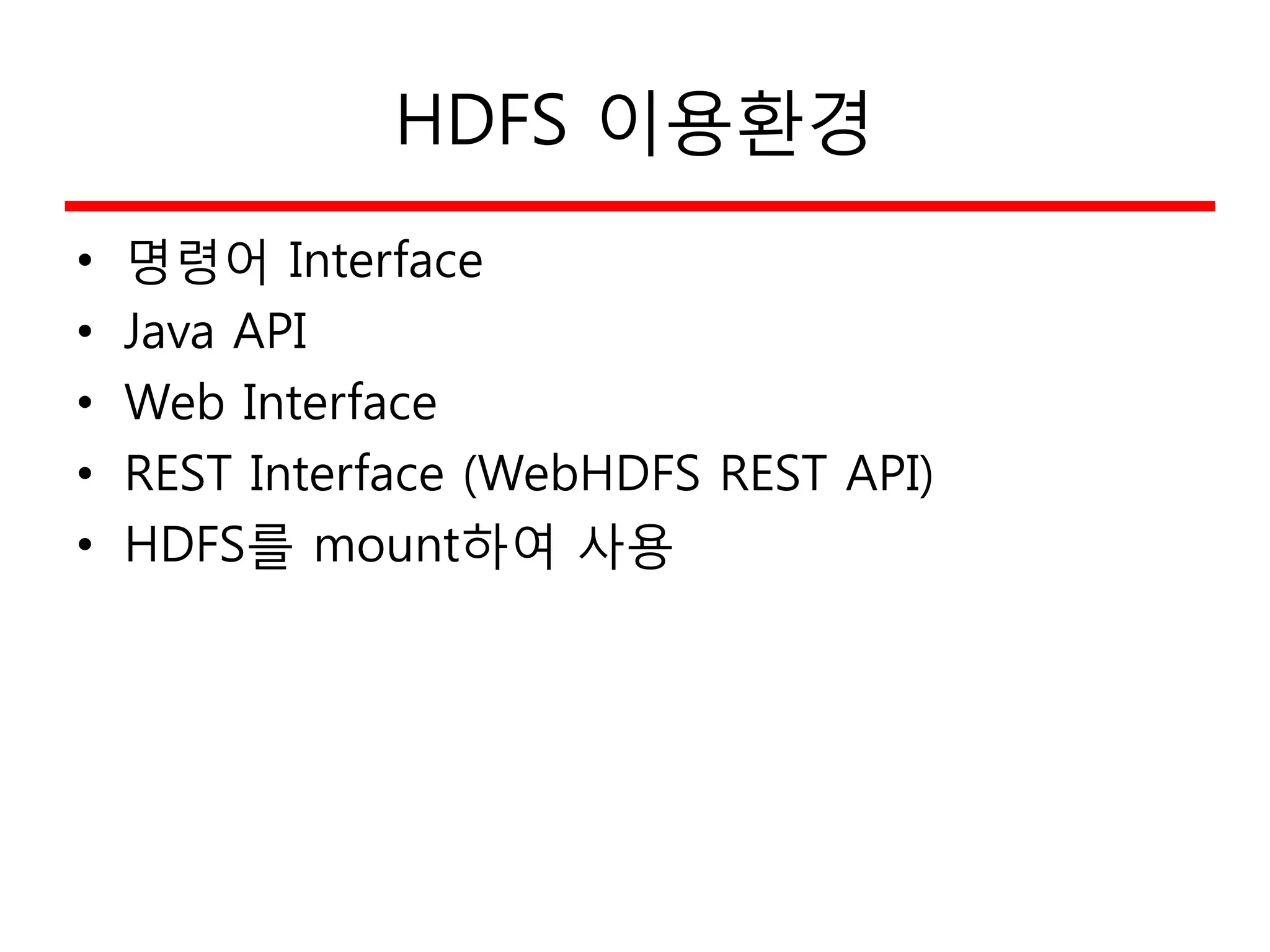
HDFS 이용환경
• 명령어 Interface
• Java API
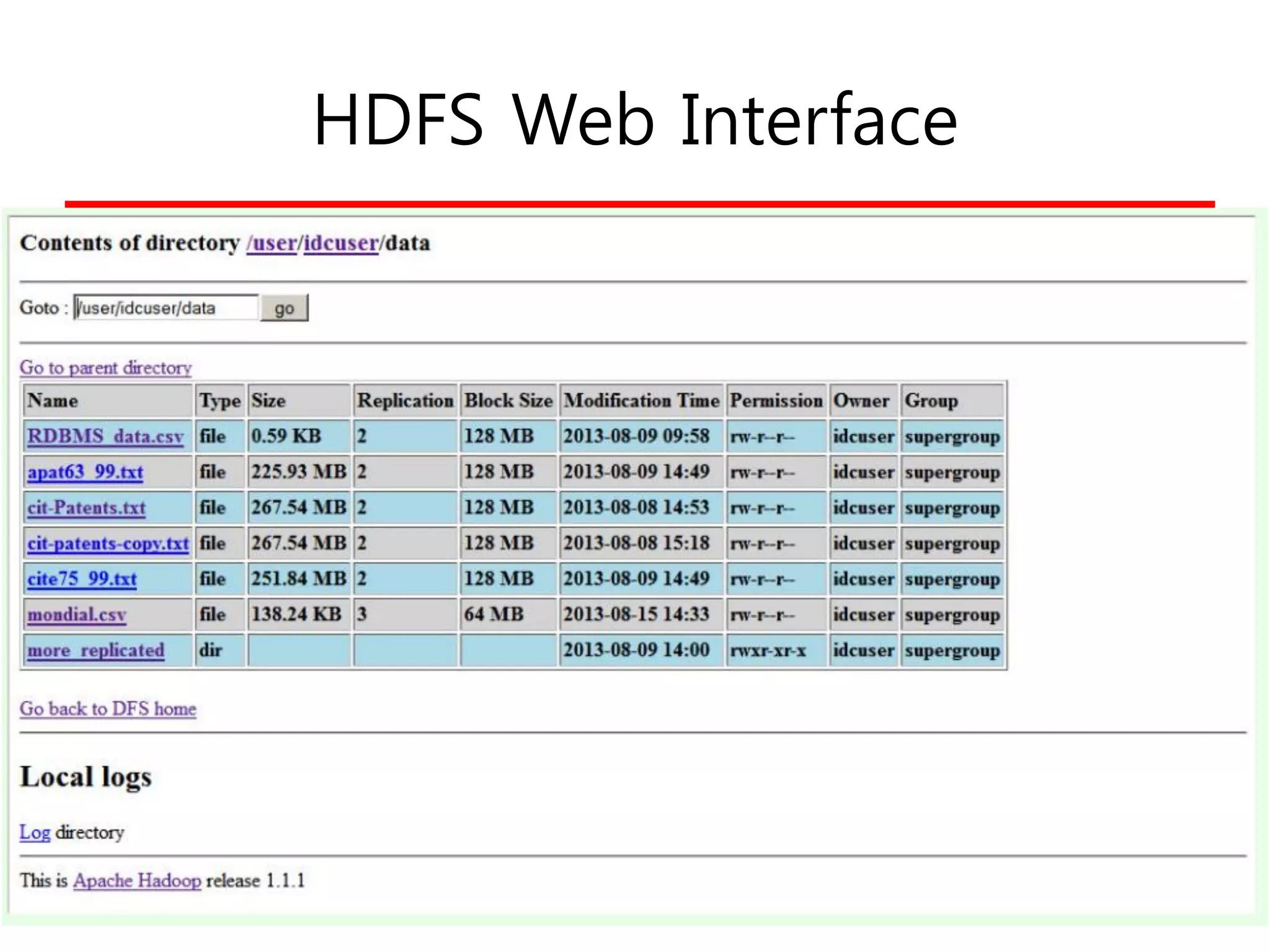
• Web Interface
• REST Interface (WebHDFS REST API)
• HDFS를 mount하여 사용
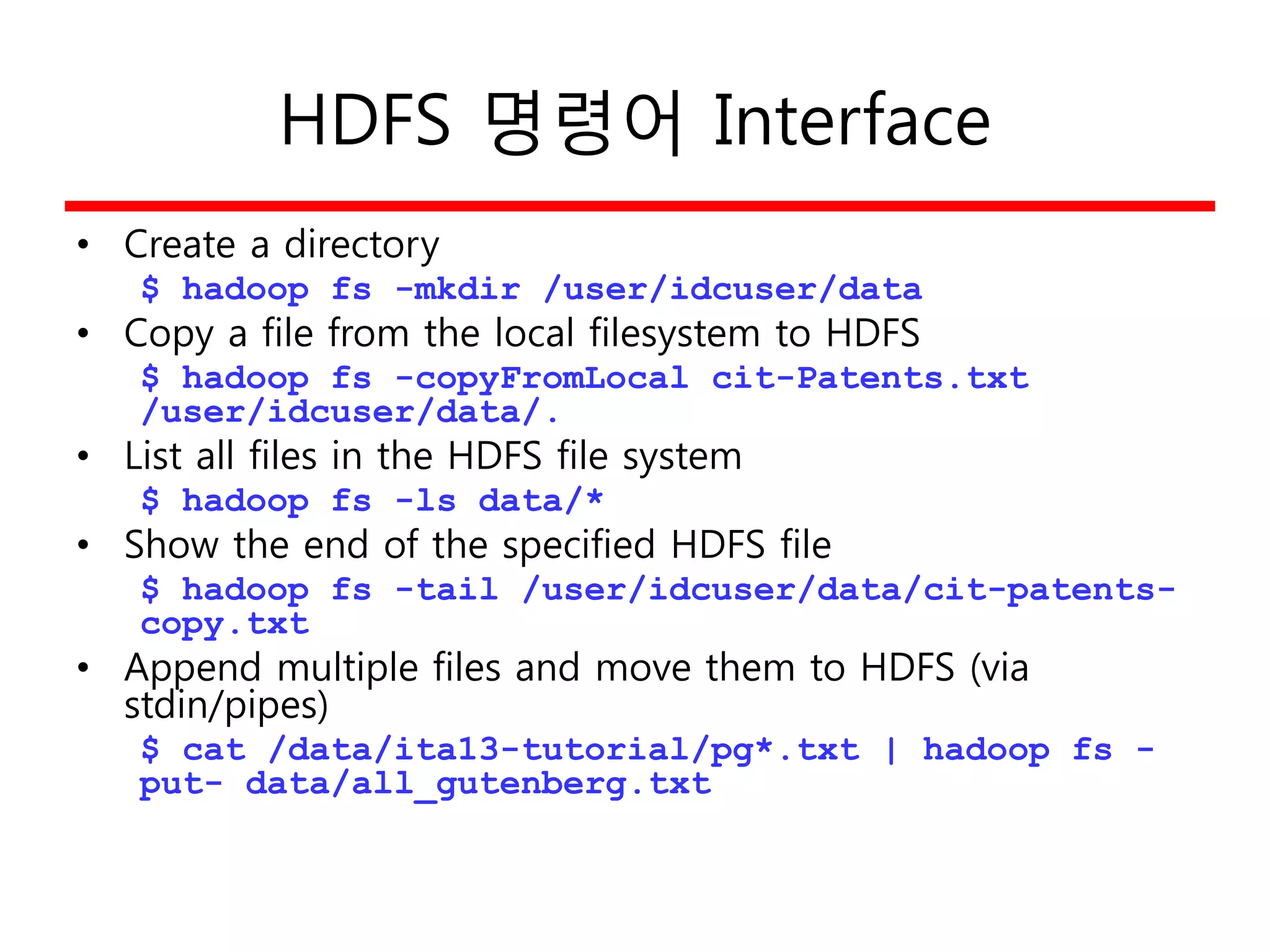
HDFS 명령어 Interface
• Create a directory
$ hadoop fs -mkdir /user/idcuser/data
• Copy a file from the local filesystem to HDFS
$ hadoop fs -copyFromLocal cit-Patents.txt
/user/idcuser/data/.
• List all files in the HDFS file system
$ hadoop fs -ls data/*
• Show the end of the specified HDFS file
$ hadoop fs -tail /user/idcuser/data/cit-patents-
copy.txt
• Append multiple files and move them to HDFS (via
stdin/pipes)
$ cat /data/ita13-tutorial/pg*.txt | hadoop fs -
put- data/all_gutenberg.txt
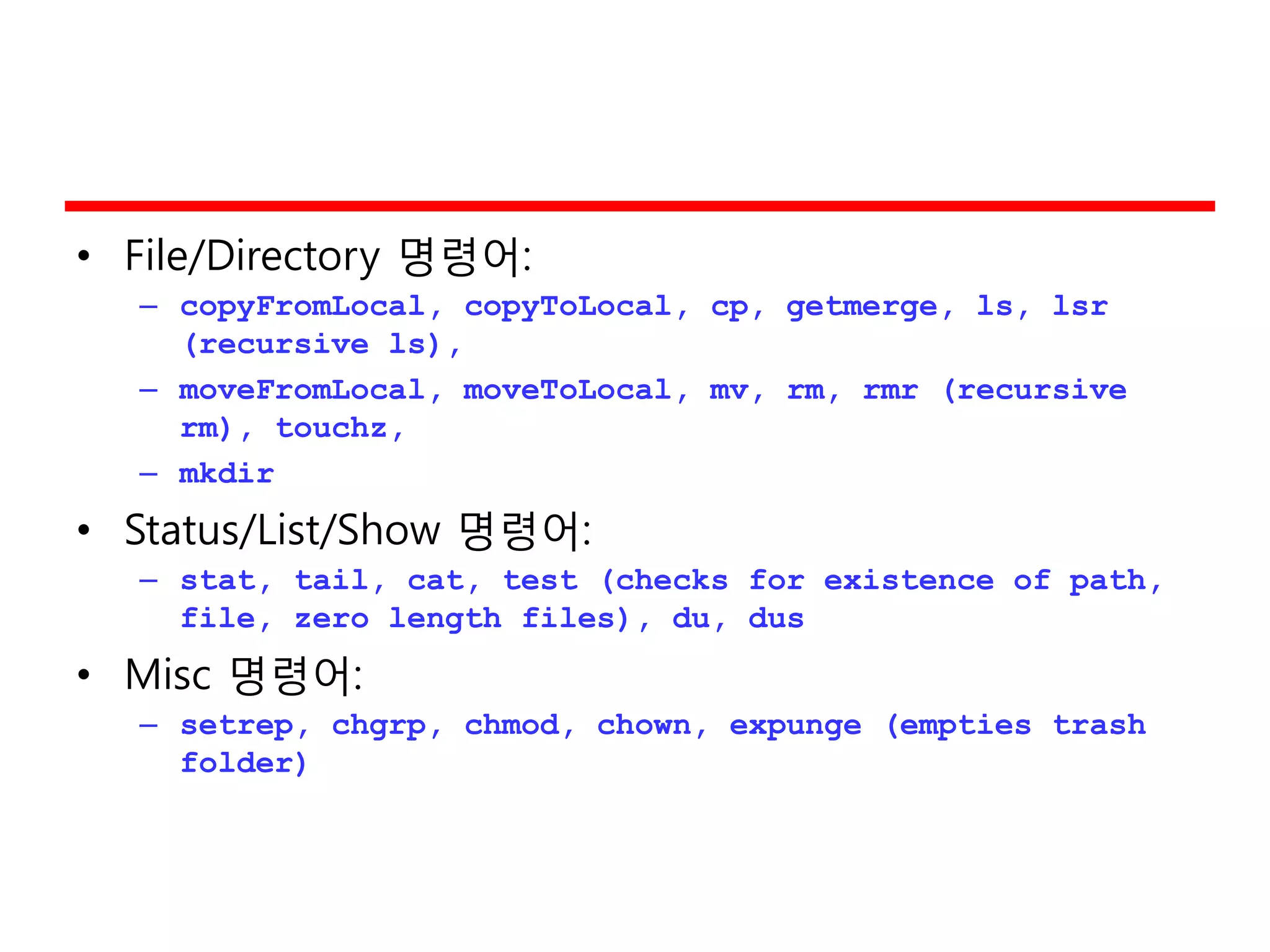
• File/Directory 명령어:
– copyFromLocal, copyToLocal, cp, getmerge, ls, lsr
(recursive ls),
– moveFromLocal, moveToLocal, mv, rm, rmr (recursive
rm), touchz,
– mkdir
• Status/List/Show 명령어:
– stat, tail, cat, test (checks for existence of path,
file, zero length files), du, dus
• Misc 명령어:
– setrep, chgrp, chmod, chown, expunge (empties trash
folder)
HDFS Java API
• Listing files/directories (globbing)
• Open/close inputstream
• Copy bytes (IOUtils)
• Seeking
• Write/append data to files
• Create/rename/delete files
• Create/remove directory
• Reading Data from HDFS
org.apache.hadoop.fs.FileSystem (abstract)
org.apache.hadoop.hdfs.DistributedFileSystem
org.apache.hadoop.fs.LocalFileSystem
org.apache.hadoop.fs.s3.S3FileSystem
HDFS Web Interface
전형적인 Topology
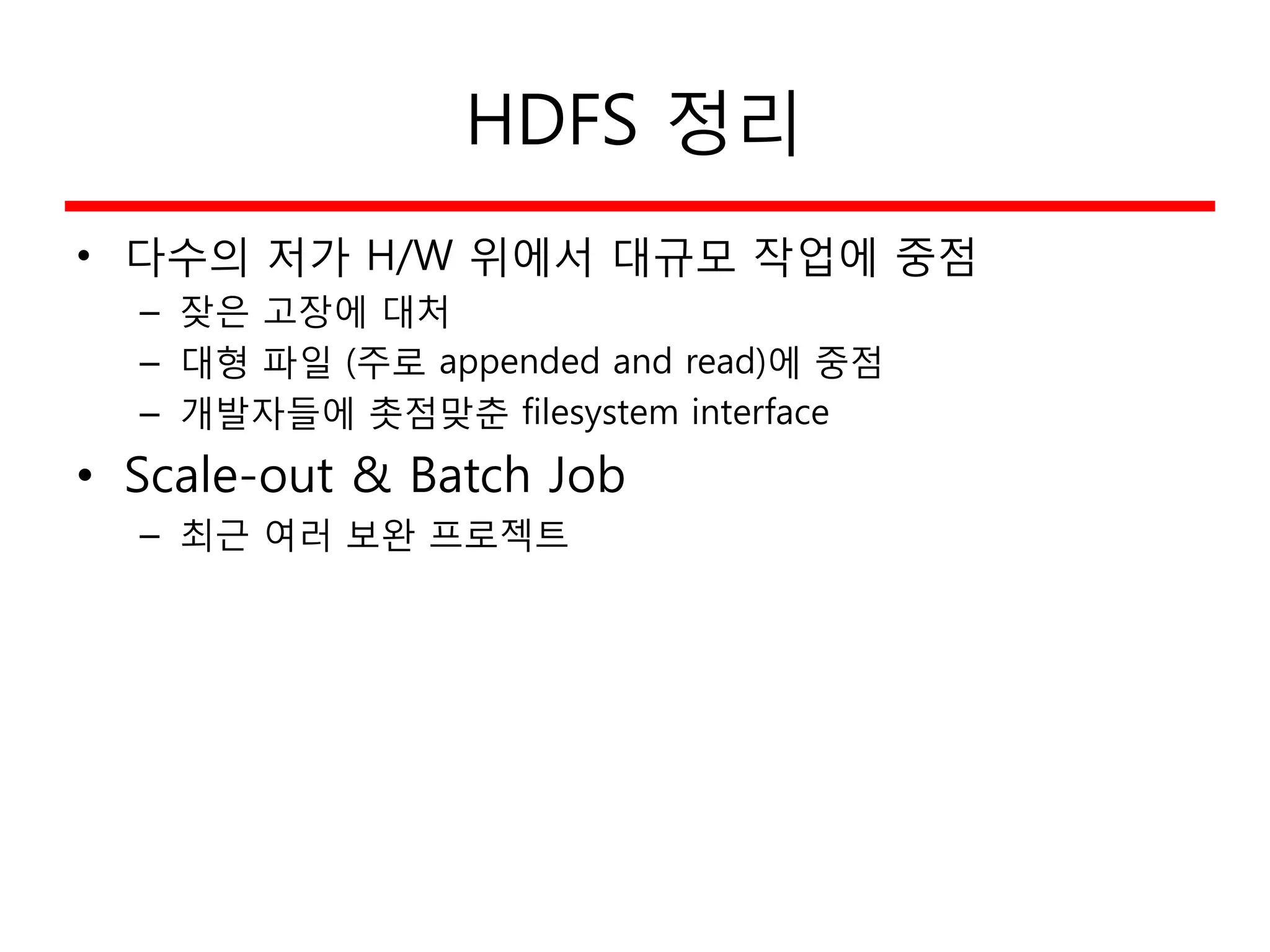
HDFS 정리
• 다수의 저가 H/W 위에서 대규모 작업에 중점
– 잦은 고장에 대처
– 대형 파일 (주로 appended and read)에 중점
– 개발자들에 촛점맞춘 filesystem interface
• Scale-out & Batch Job
– 최근 여러 보완 프로젝트
MapReduce
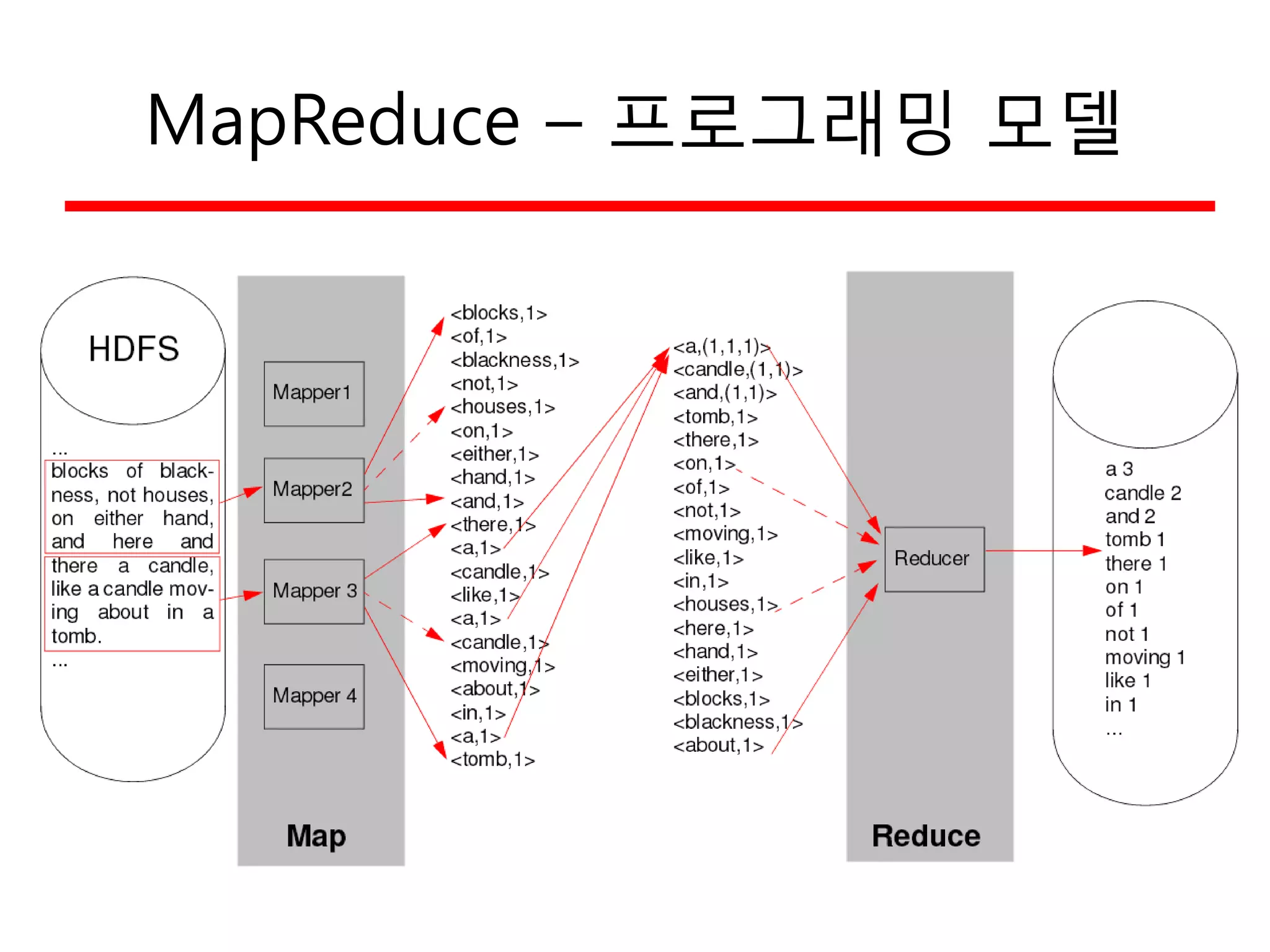
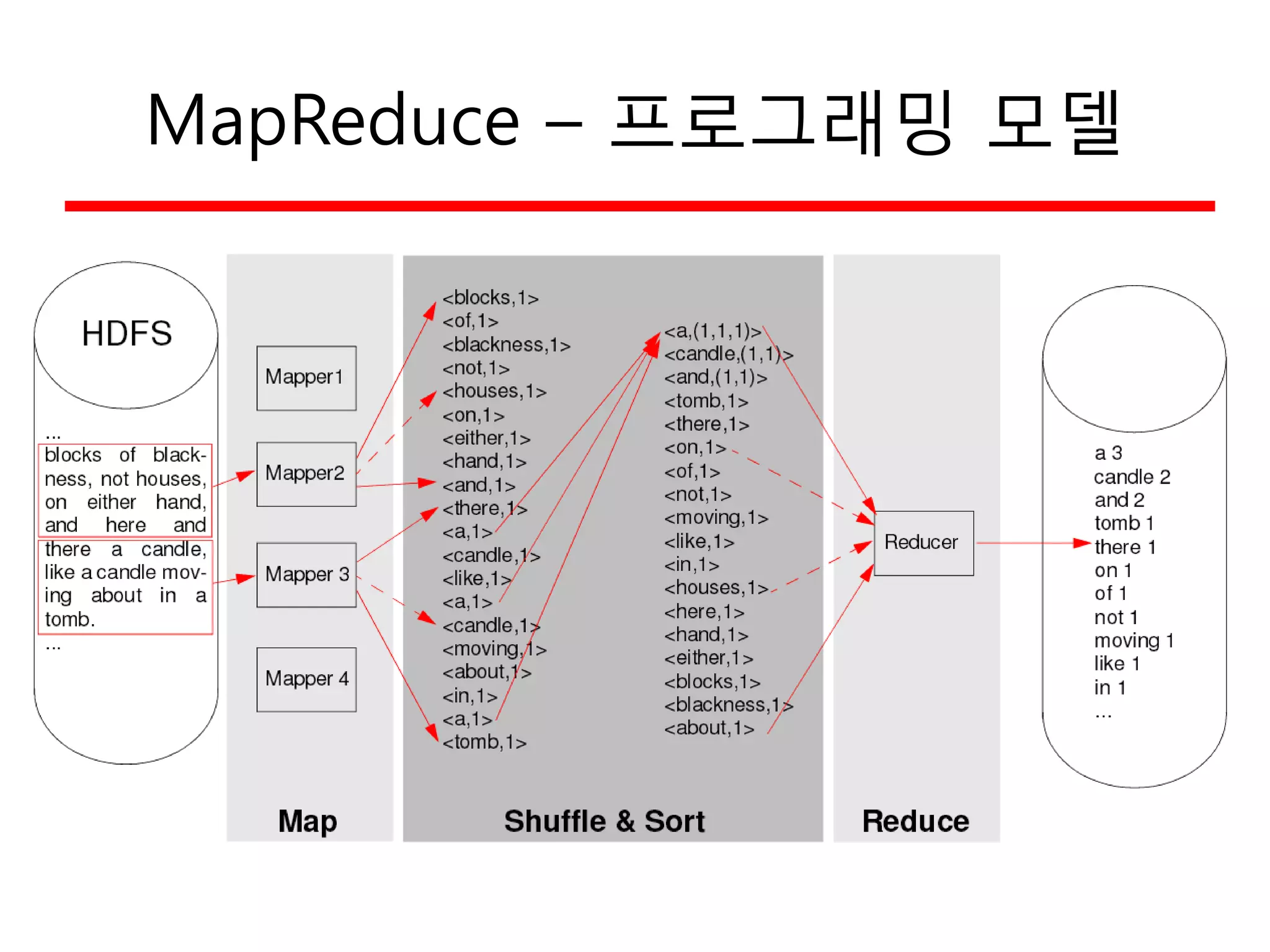
MapReduce – 프로그래밍 모델
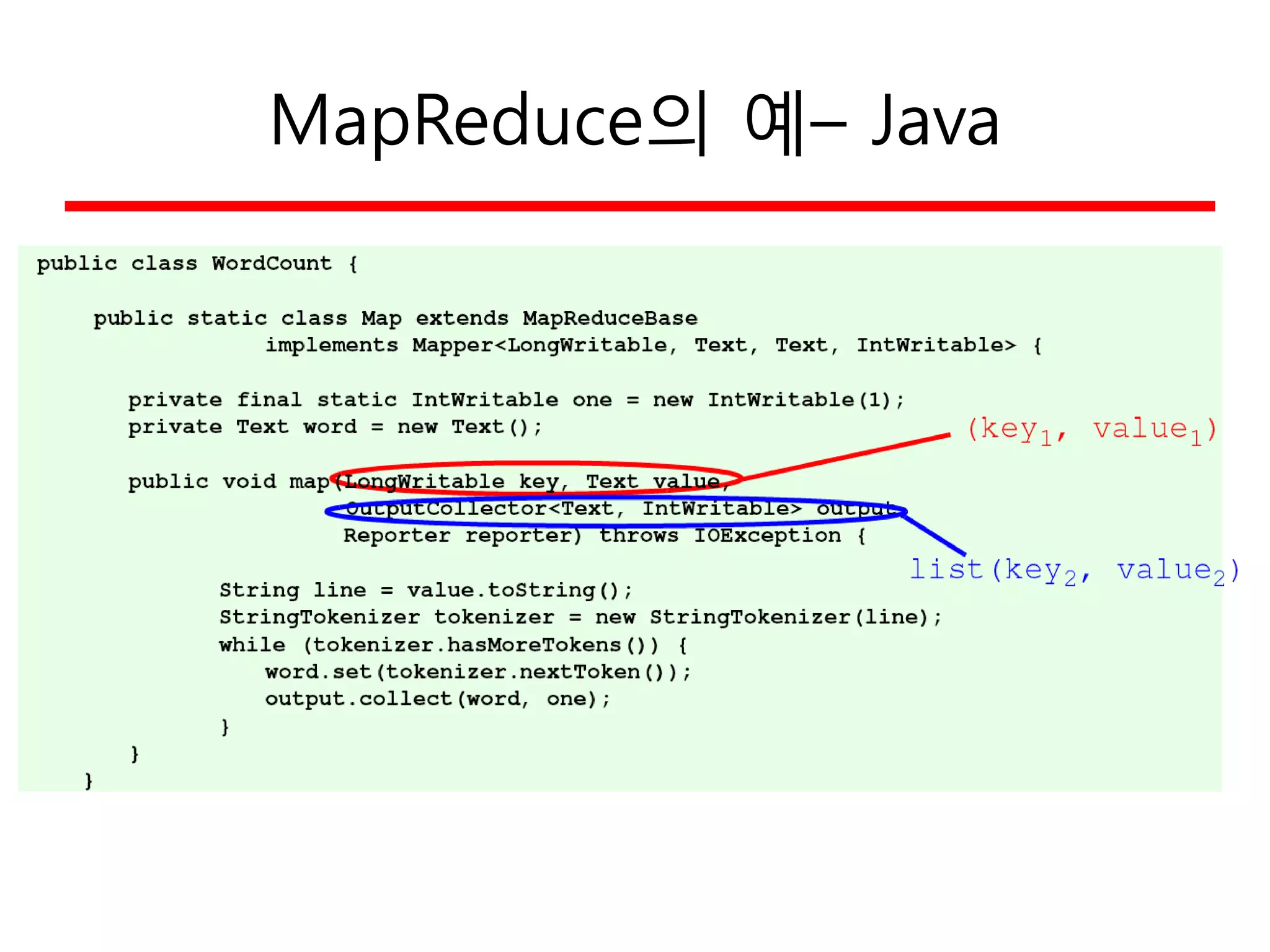
MapReduce의 예– Java
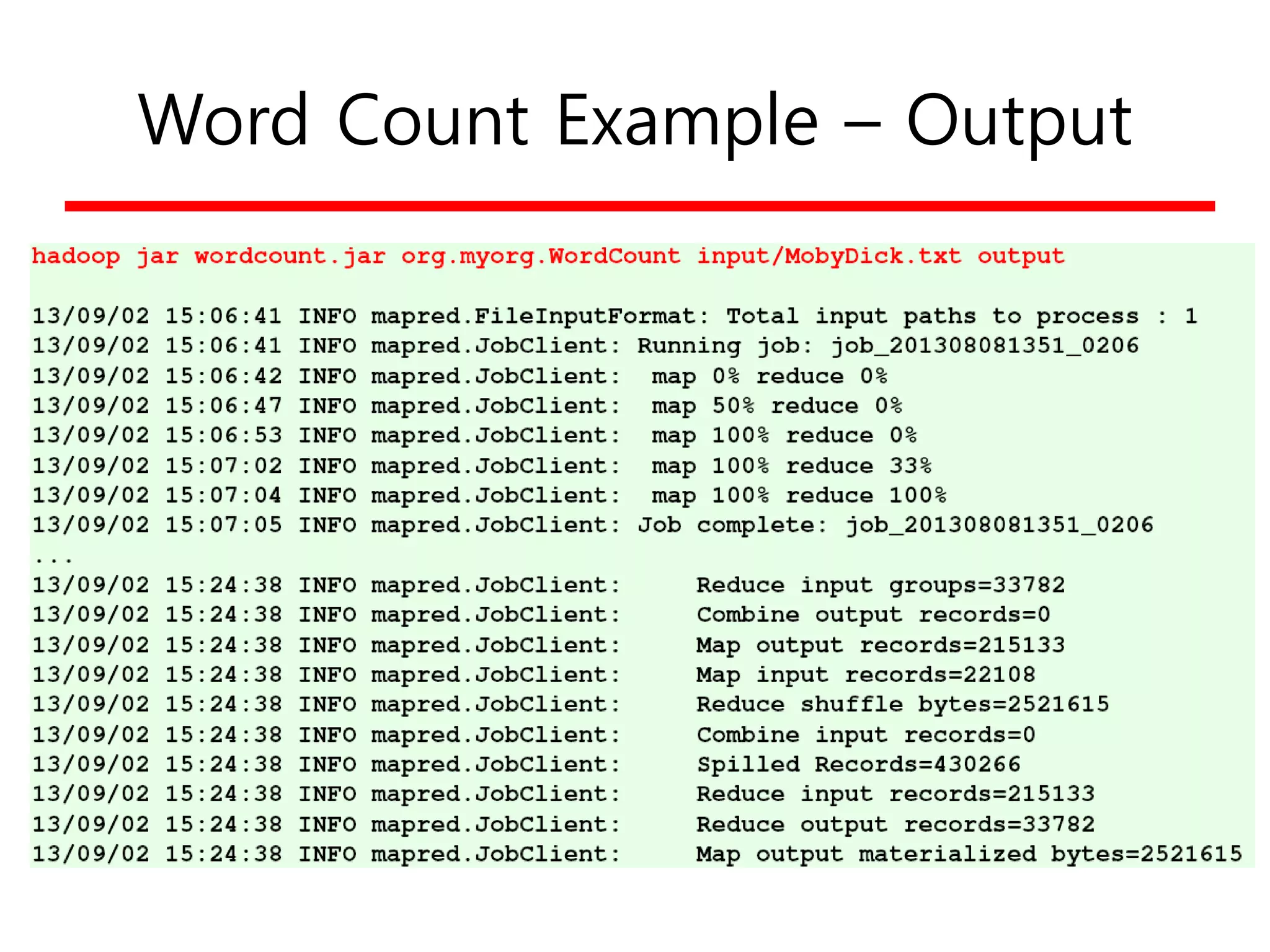
Word Count Example – Output
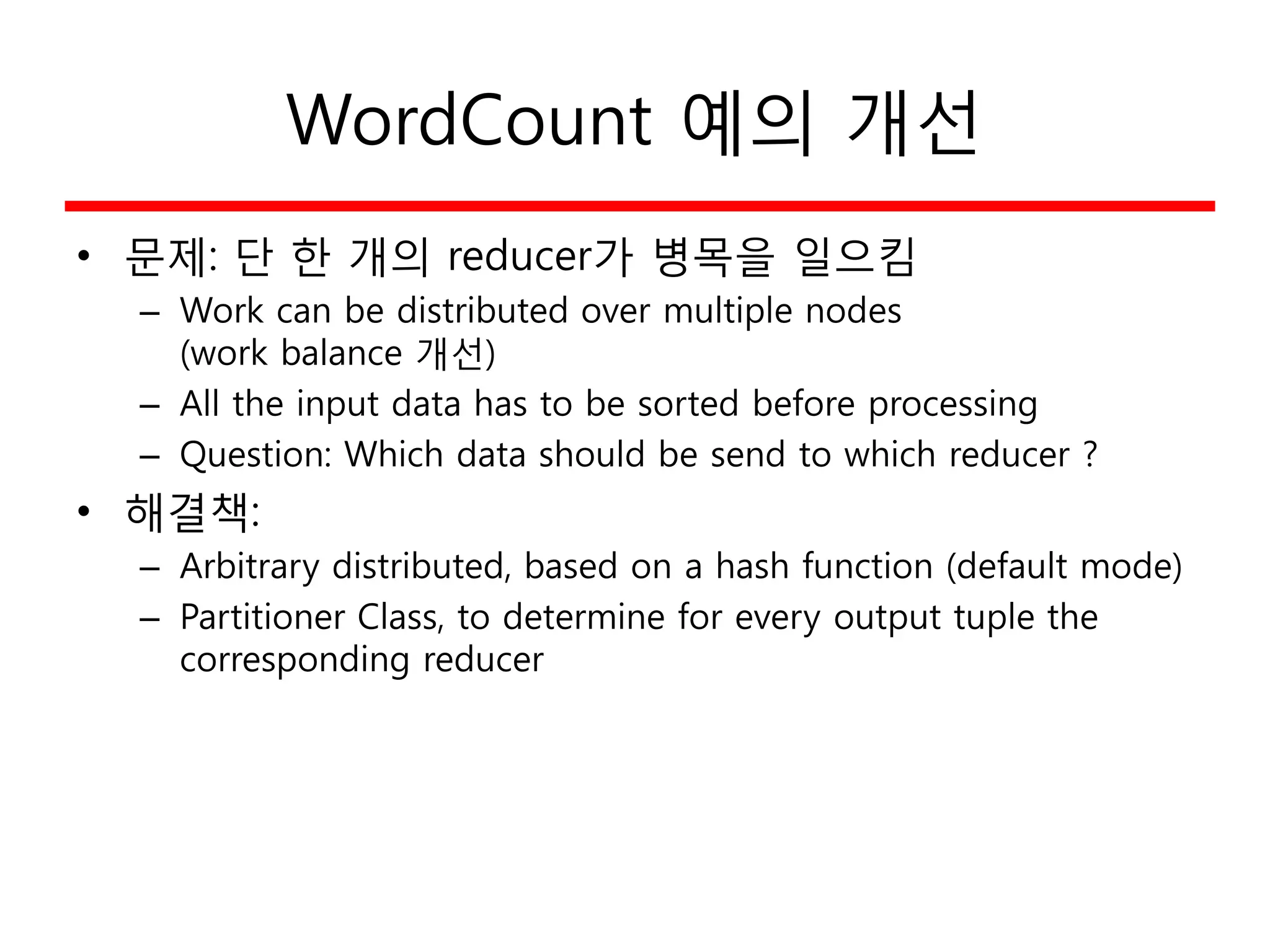
WordCount 예의 개선
• 문제: 단 한 개의 reducer가 병목을 일으킴
– Work can be distributed over multiple nodes
(work balance 개선)
– All the input data has to be sorted before processing
– Question: Which data should be send to which reducer ?
• 해결책:
– Arbitrary distributed, based on a hash function (default mode)
– Partitioner Class, to determine for every output tuple the
corresponding reducer
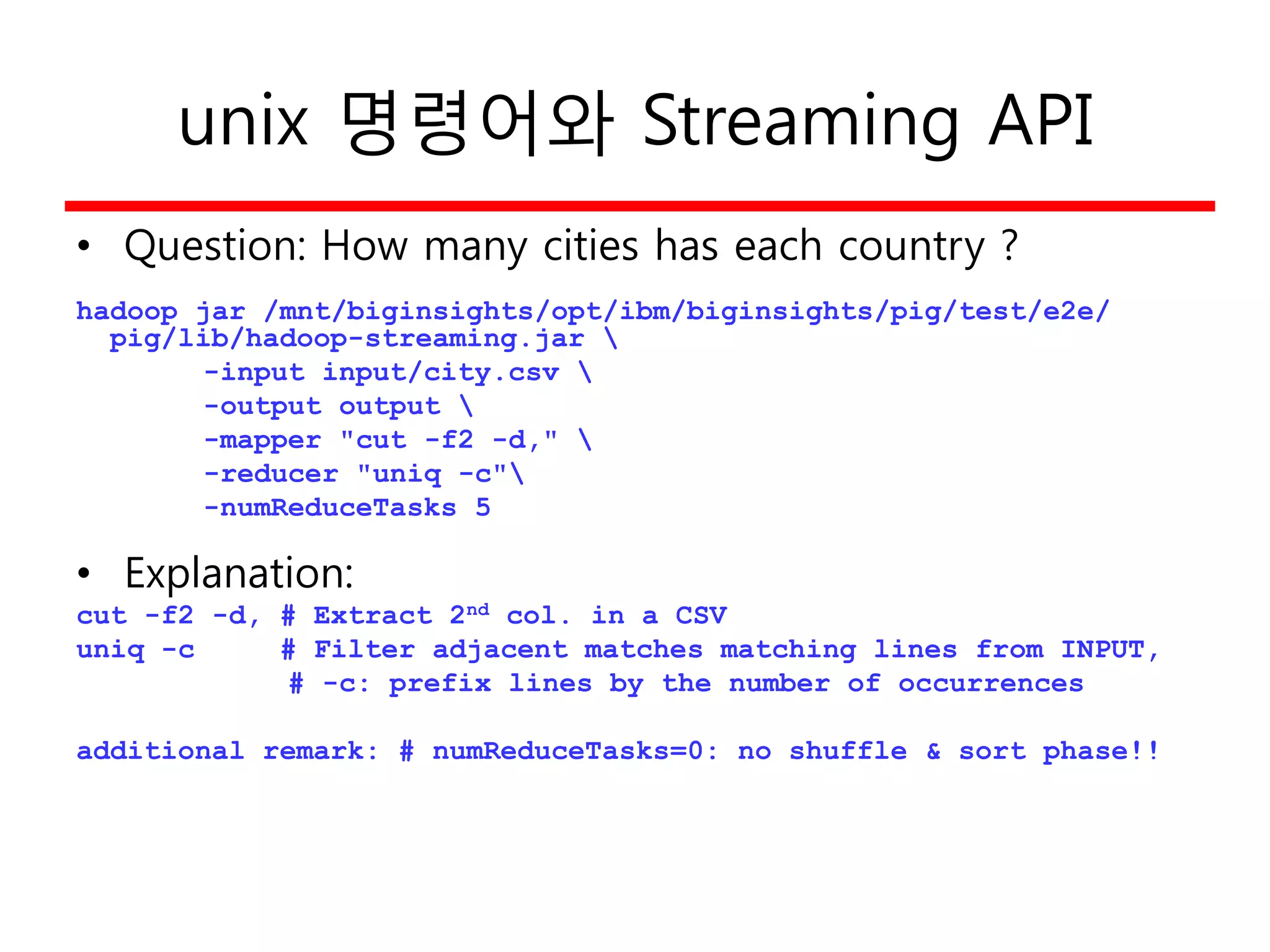
unix 명령어와 Streaming API
• Question: How many cities has each country ?
hadoop jar /mnt/biginsights/opt/ibm/biginsights/pig/test/e2e/
pig/lib/hadoop-streaming.jar 
-input input/city.csv 
-output output 
-mapper "cut -f2 -d," 
-reducer "uniq -c"
-numReduceTasks 5
• Explanation:
cut -f2 -d, # Extract 2nd col. in a CSV
uniq -c # Filter adjacent matches matching lines from INPUT,
# -c: prefix lines by the number of occurrences
additional remark: # numReduceTasks=0: no shuffle & sort phase!!
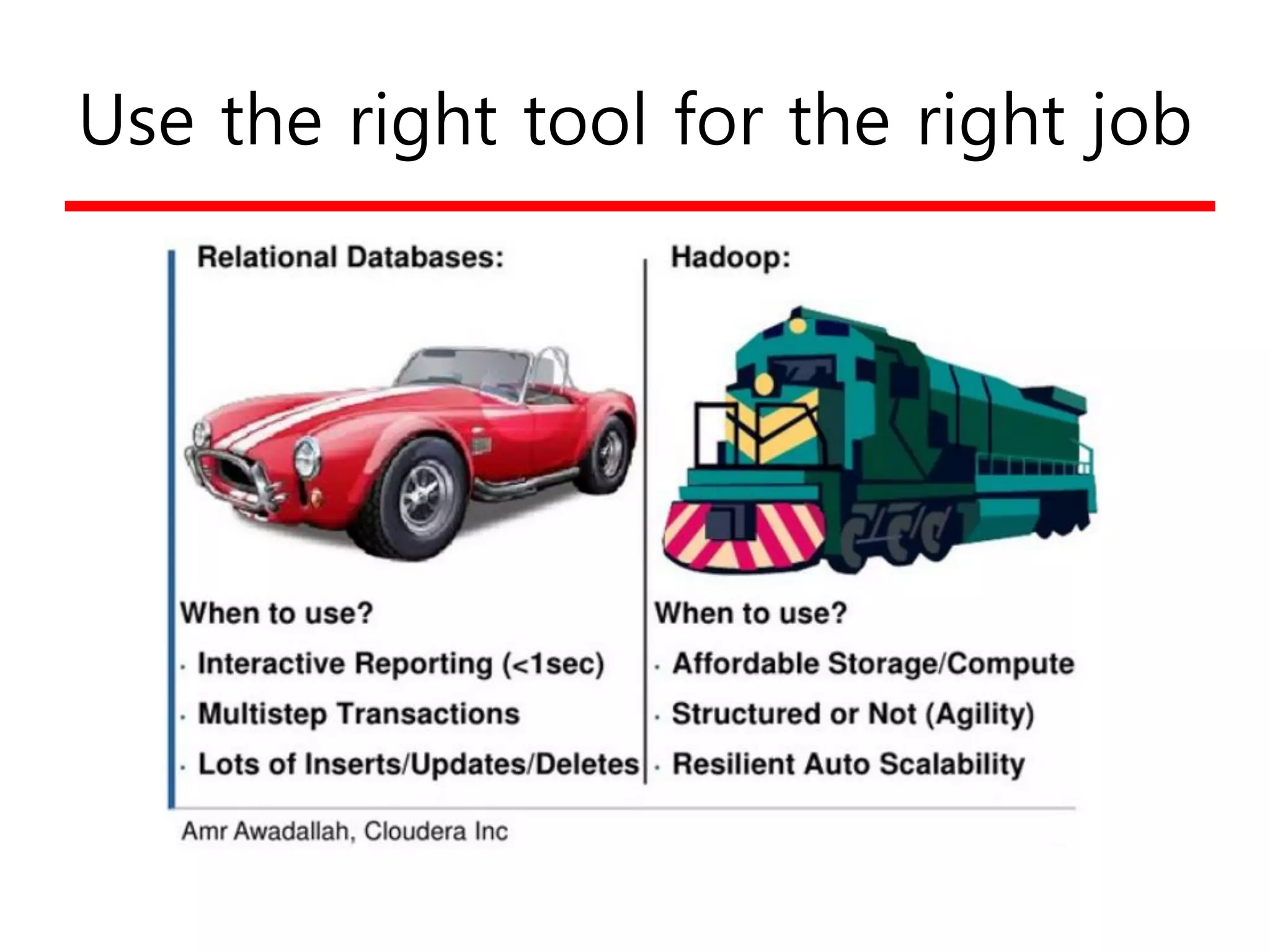
Use the right tool for the right job
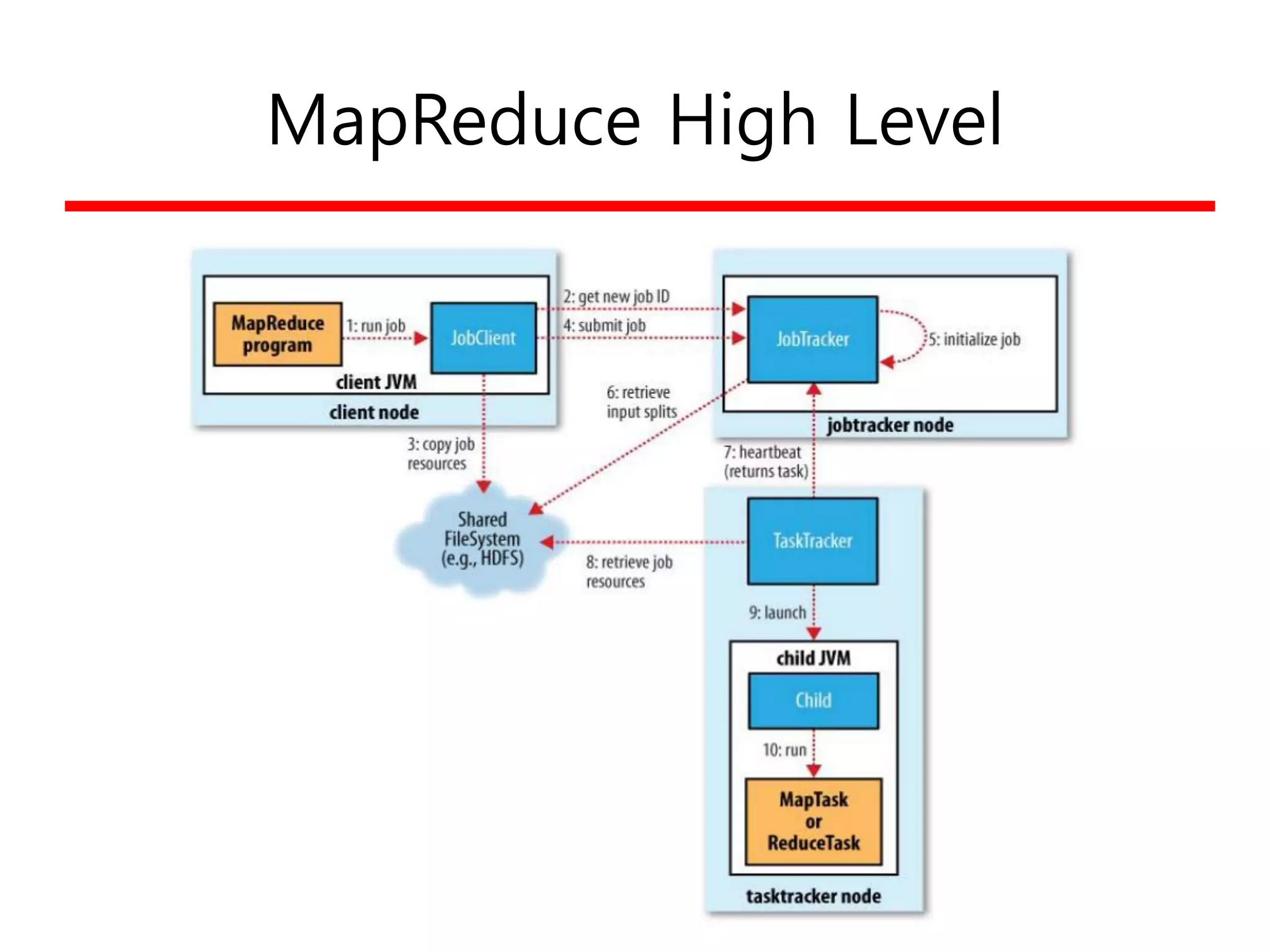
MapReduce High Level
Hadoop의 장단점과 대응
• Haddop의 장점
– commodity h/w
– scale-out
– fault-tolerance
– flexibility by MR
• Hadoop의 단점
– MR!
– Missing! - schema와
optimizer, index, view, ...
– 기존 tool과의 호환성 결여
• 해결책: Hive
– SQL to MR
– Compiler + Execution 엔진
– Pluggable storage layer
(SerDes)
• 미해결 숙제: Hive
– ANSI SQL, UDF, ...
– MR Latency overhead
– 계속 작업 중...!
38
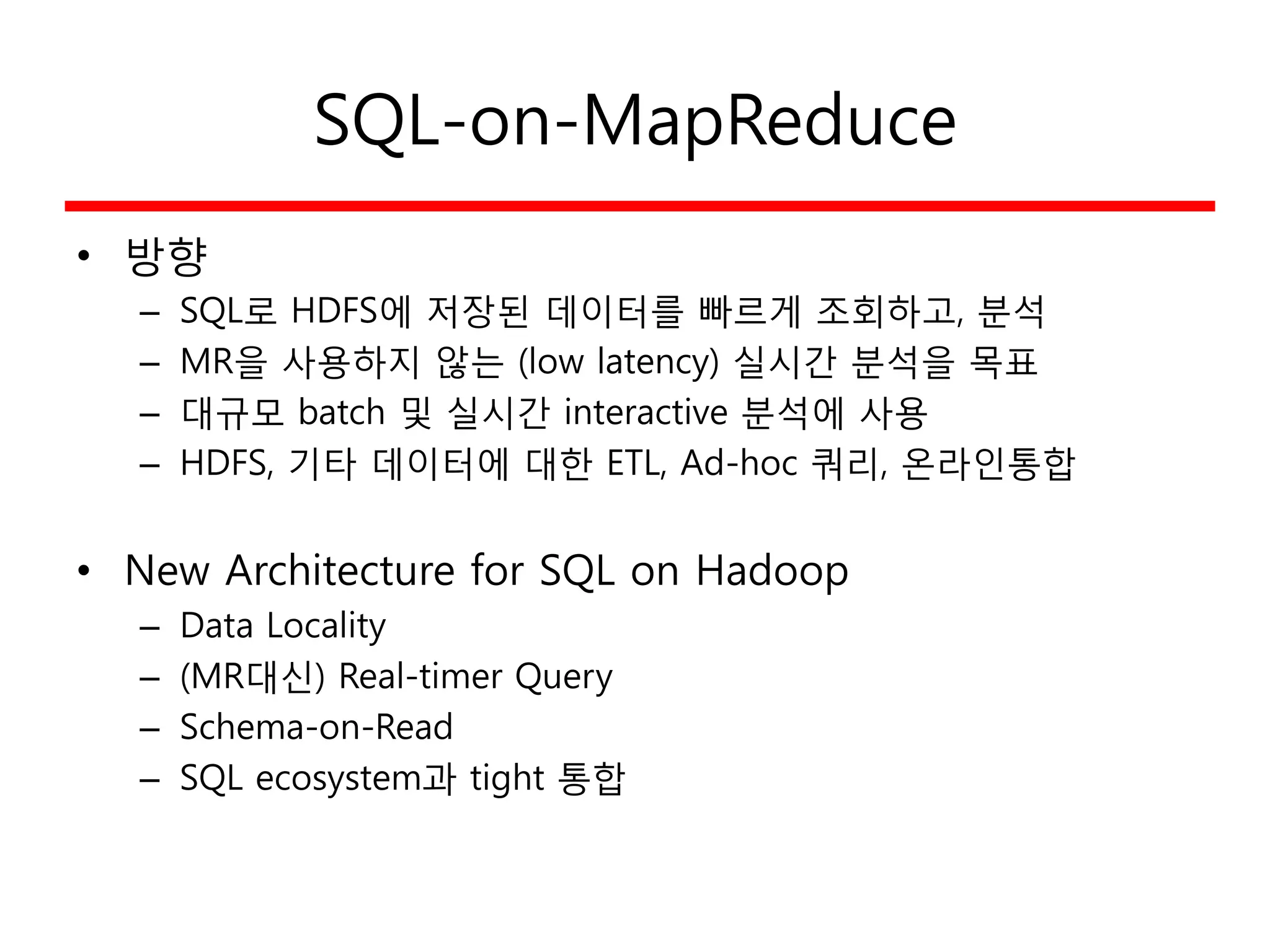
SQL-on-MapReduce
• 방향
– SQL로 HDFS에 저장된 데이터를 빠르게 조회하고, 분석
– MR을 사용하지 않는 (low latency) 실시간 분석을 목표
– 대규모 batch 및 실시간 interactive 분석에 사용
– HDFS, 기타 데이터에 대한 ETL, Ad-hoc 쿼리, 온라인통합
• New Architecture for SQL on Hadoop
– Data Locality
– (MR대신) Real-timer Query
– Schema-on-Read
– SQL ecosystem과 tight 통합
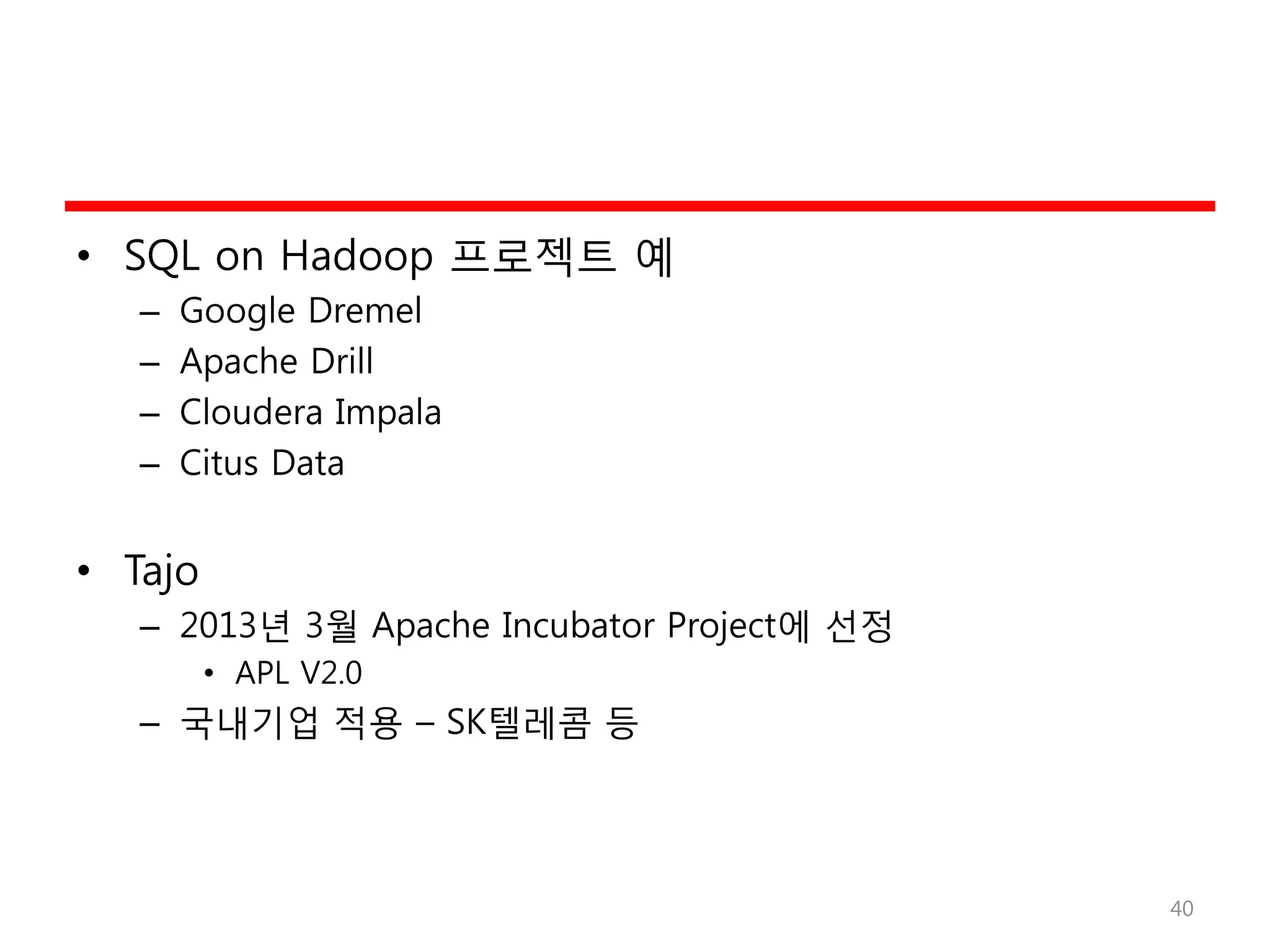
• SQL on Hadoop 프로젝트 예
– Google Dremel
– Apache Drill
– Cloudera Impala
– Citus Data
• Tajo
– 2013년 3월 Apache Incubator Project에 선정
• APL V2.0
– 국내기업 적용 – SK텔레콤 등
40
NoSQL
NoSQL?
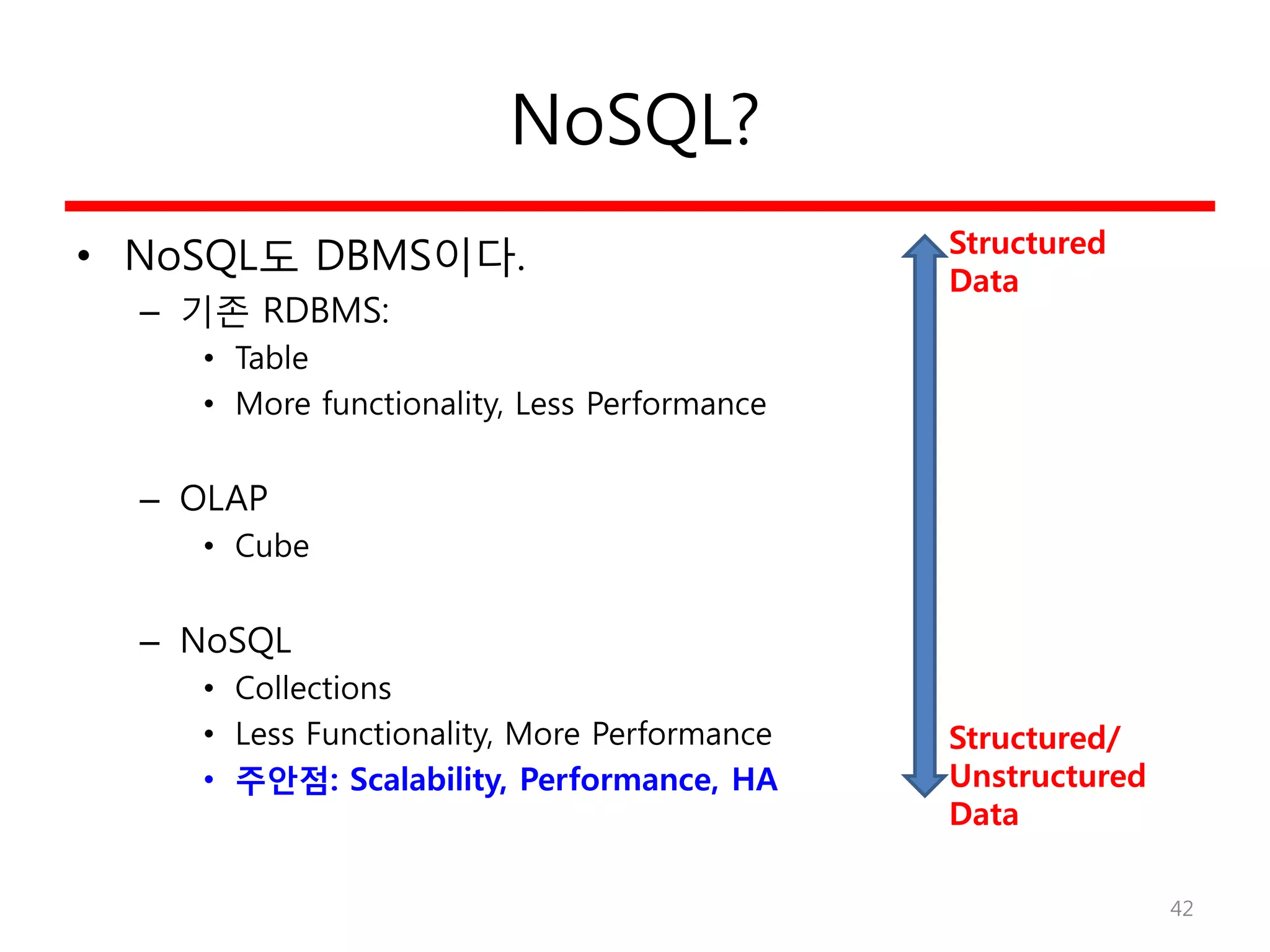
• NoSQL도 DBMS이다.
– 기존 RDBMS:
• Table
• More functionality, Less Performance
– OLAP
• Cube
– NoSQL
• Collections
• Less Functionality, More Performance
• 주안점: Scalability, Performance, HA
42
Structured
Data
Structured/
Unstructured
Data
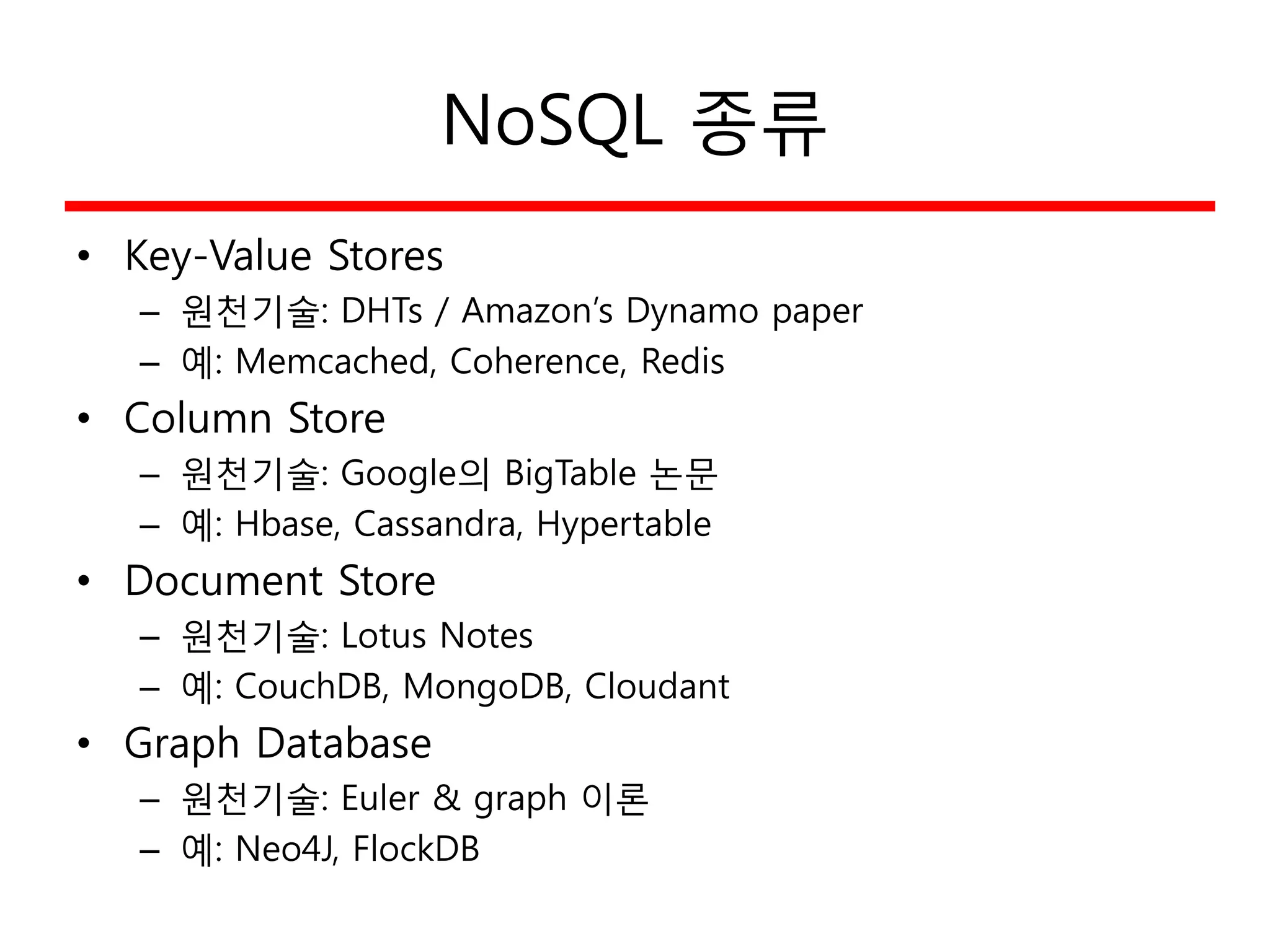
NoSQL 종류
• Key-Value Stores
– 원천기술: DHTs / Amazon’s Dynamo paper
– 예: Memcached, Coherence, Redis
• Column Store
– 원천기술: Google의 BigTable 논문
– 예: Hbase, Cassandra, Hypertable
• Document Store
– 원천기술: Lotus Notes
– 예: CouchDB, MongoDB, Cloudant
• Graph Database
– 원천기술: Euler & graph 이론
– 예: Neo4J, FlockDB
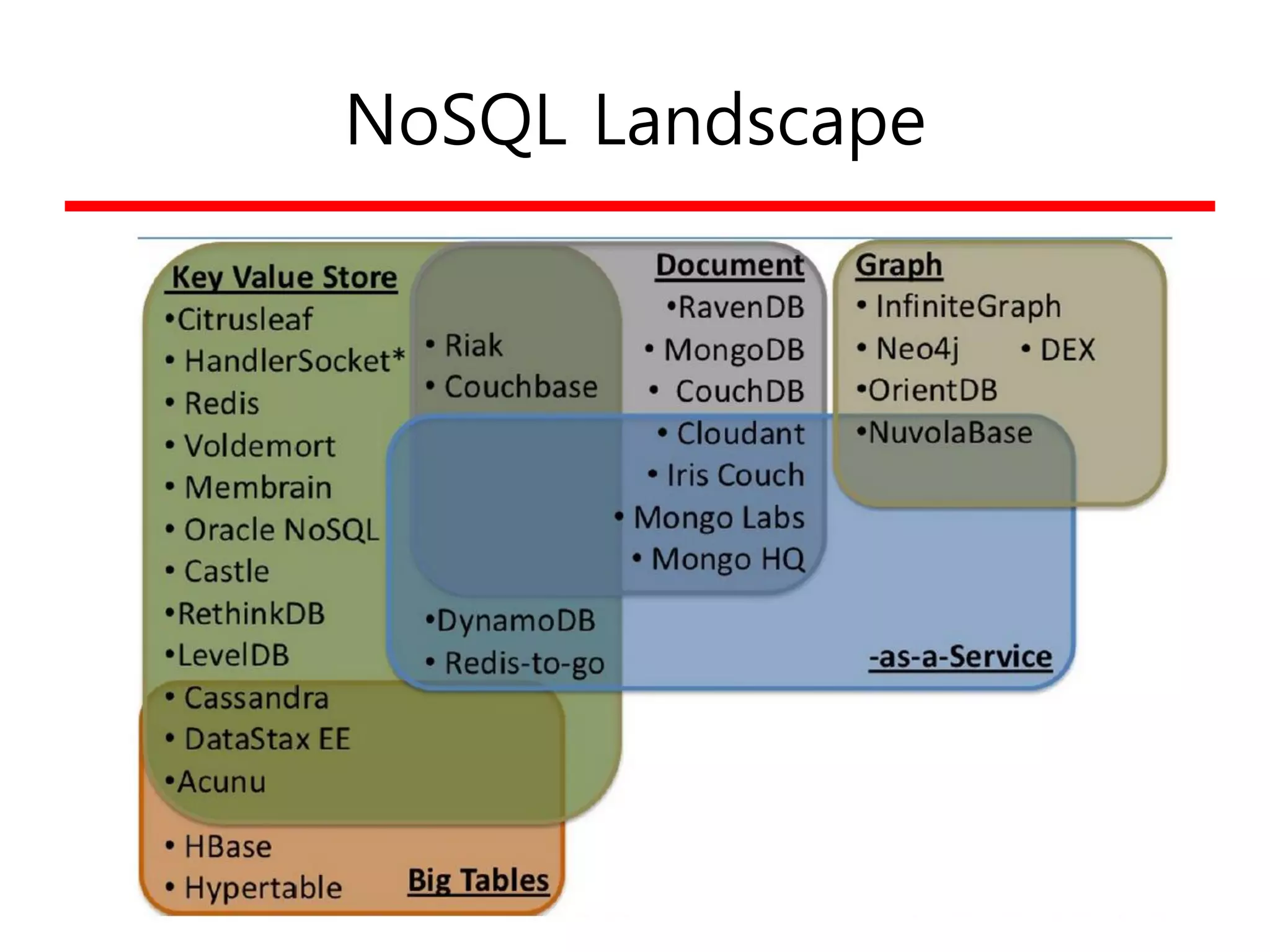
NoSQL Landscape
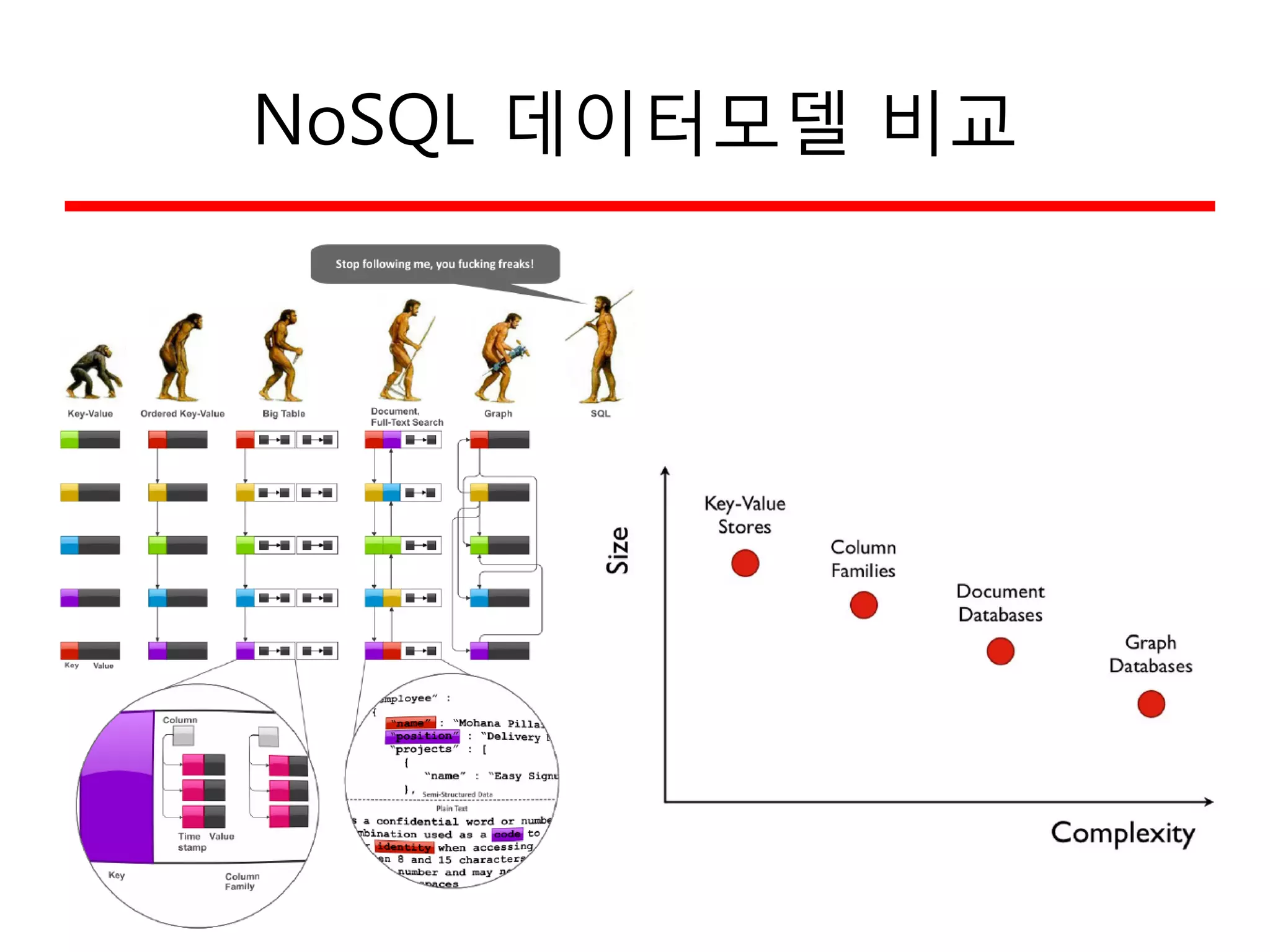
NoSQL 데이터모델 비교
NoSQL 특징
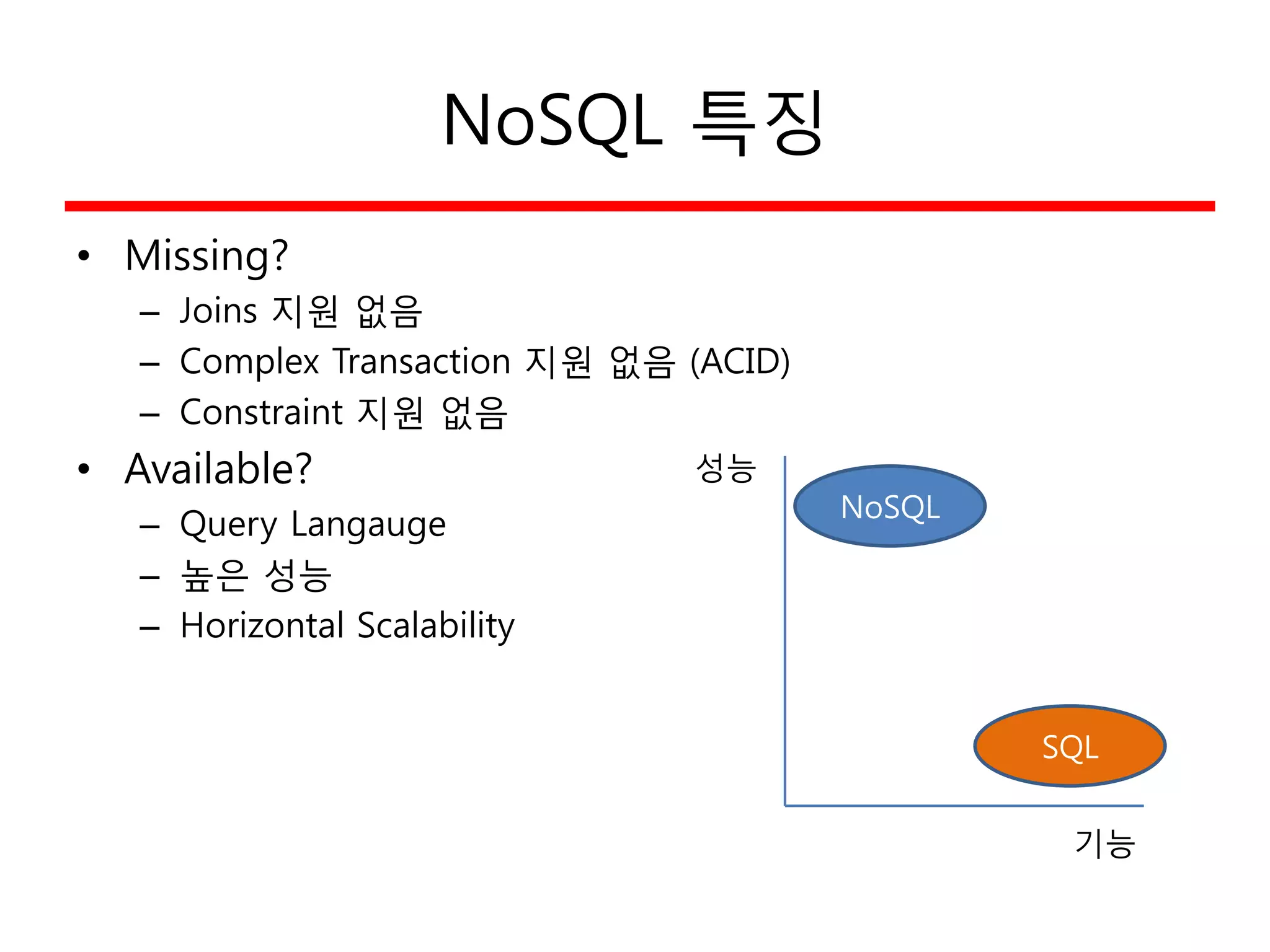
• Missing?
– Joins 지원 없음
– Complex Transaction 지원 없음 (ACID)
– Constraint 지원 없음
• Available?
– Query Langauge
– 높은 성능
– Horizontal Scalability
NoSQL
SQL
성능
기능
MongoDB의 예
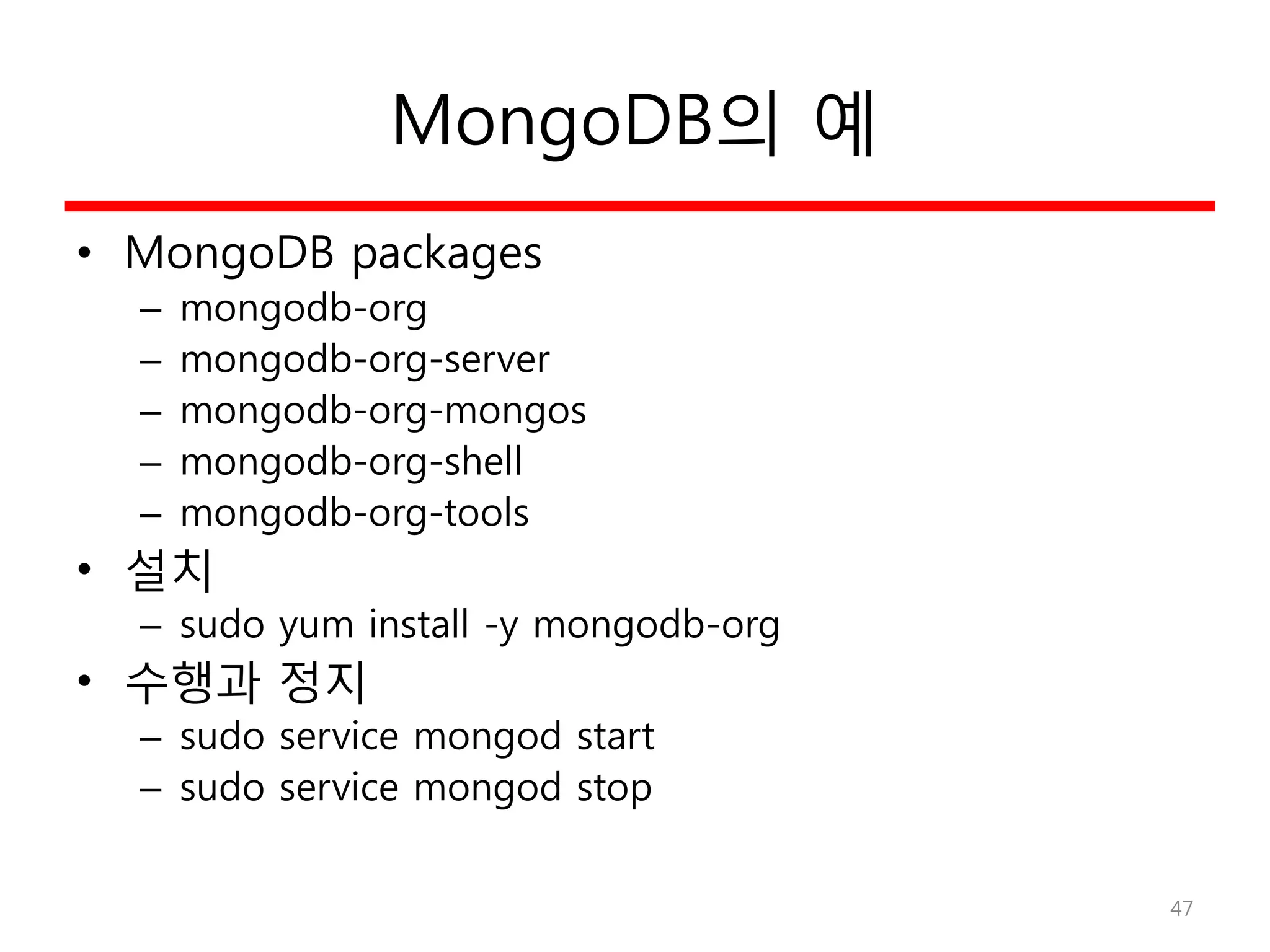
• MongoDB packages
– mongodb-org
– mongodb-org-server
– mongodb-org-mongos
– mongodb-org-shell
– mongodb-org-tools
• 설치
– sudo yum install -y mongodb-org
• 수행과 정지
– sudo service mongod start
– sudo service mongod stop
47
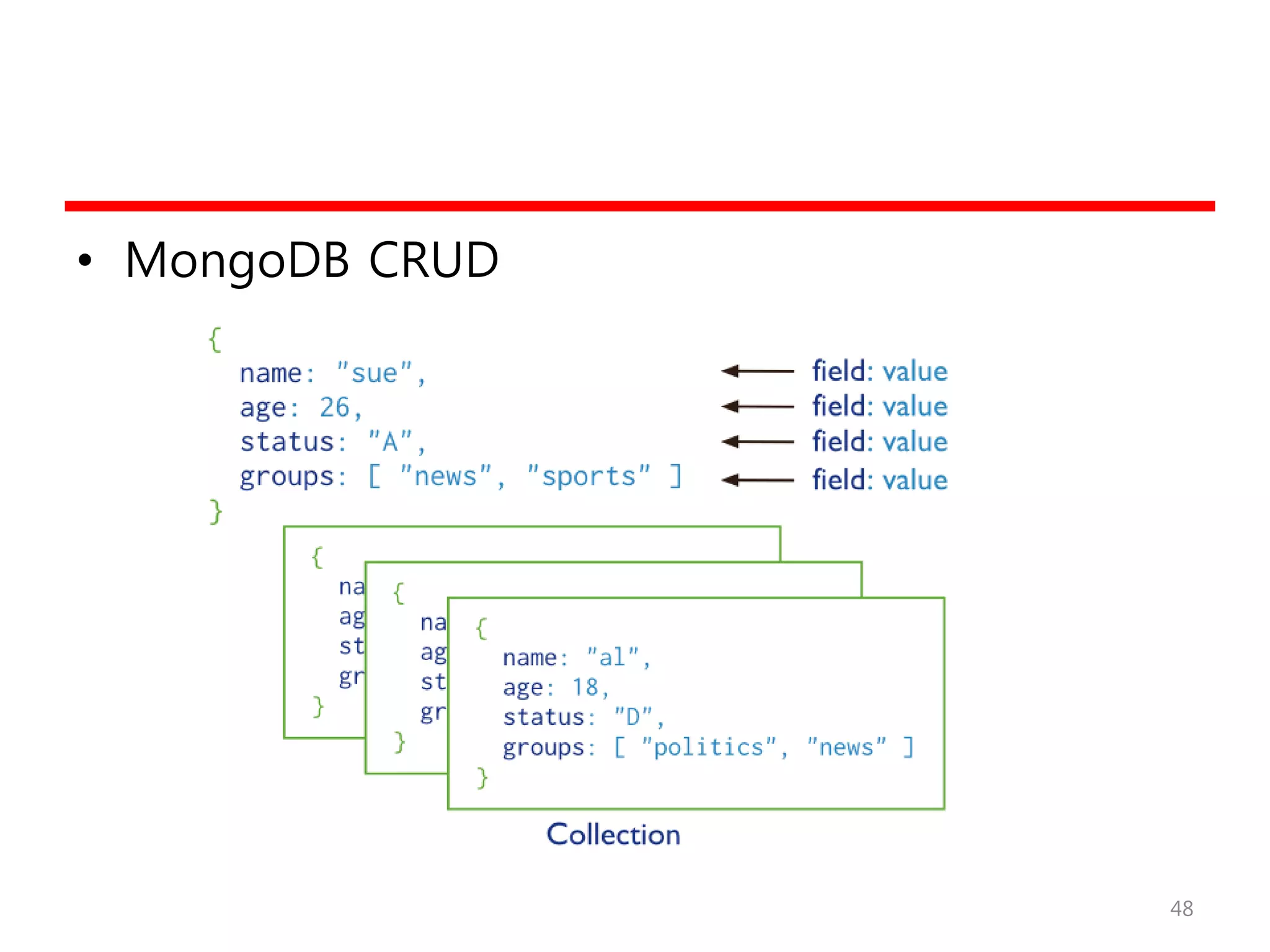
• MongoDB CRUD
48
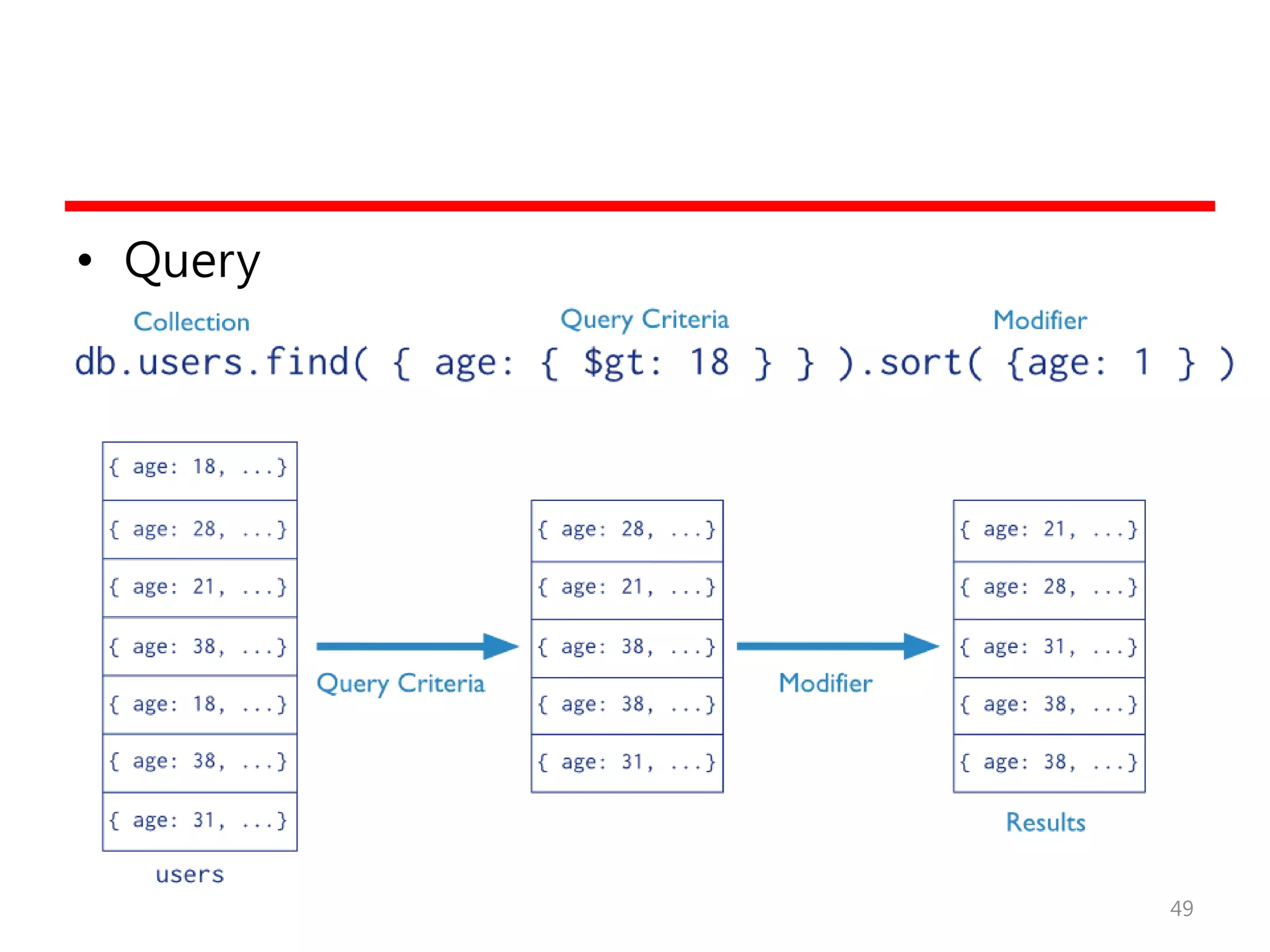
• Query
49
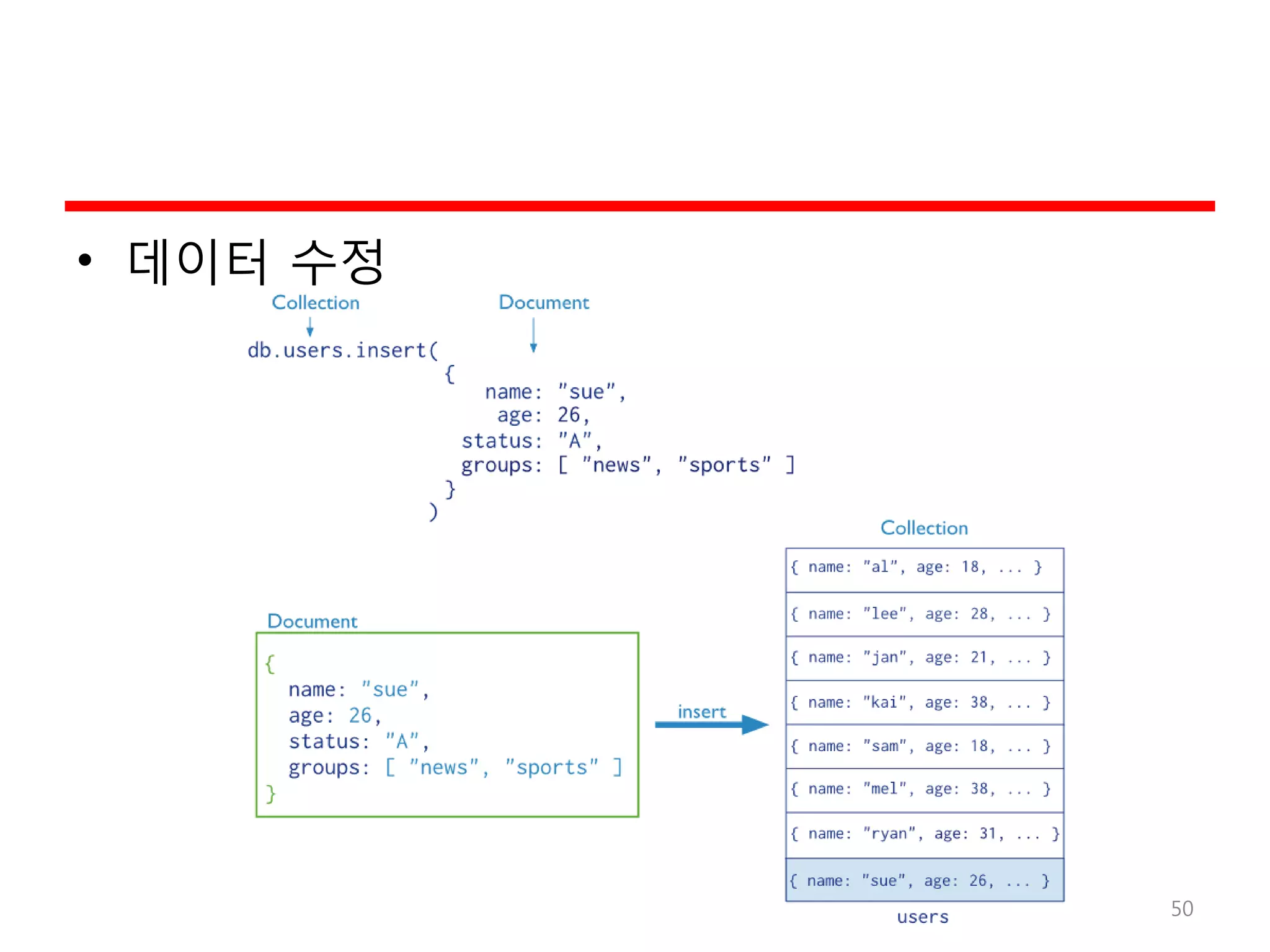
• 데이터 수정
50
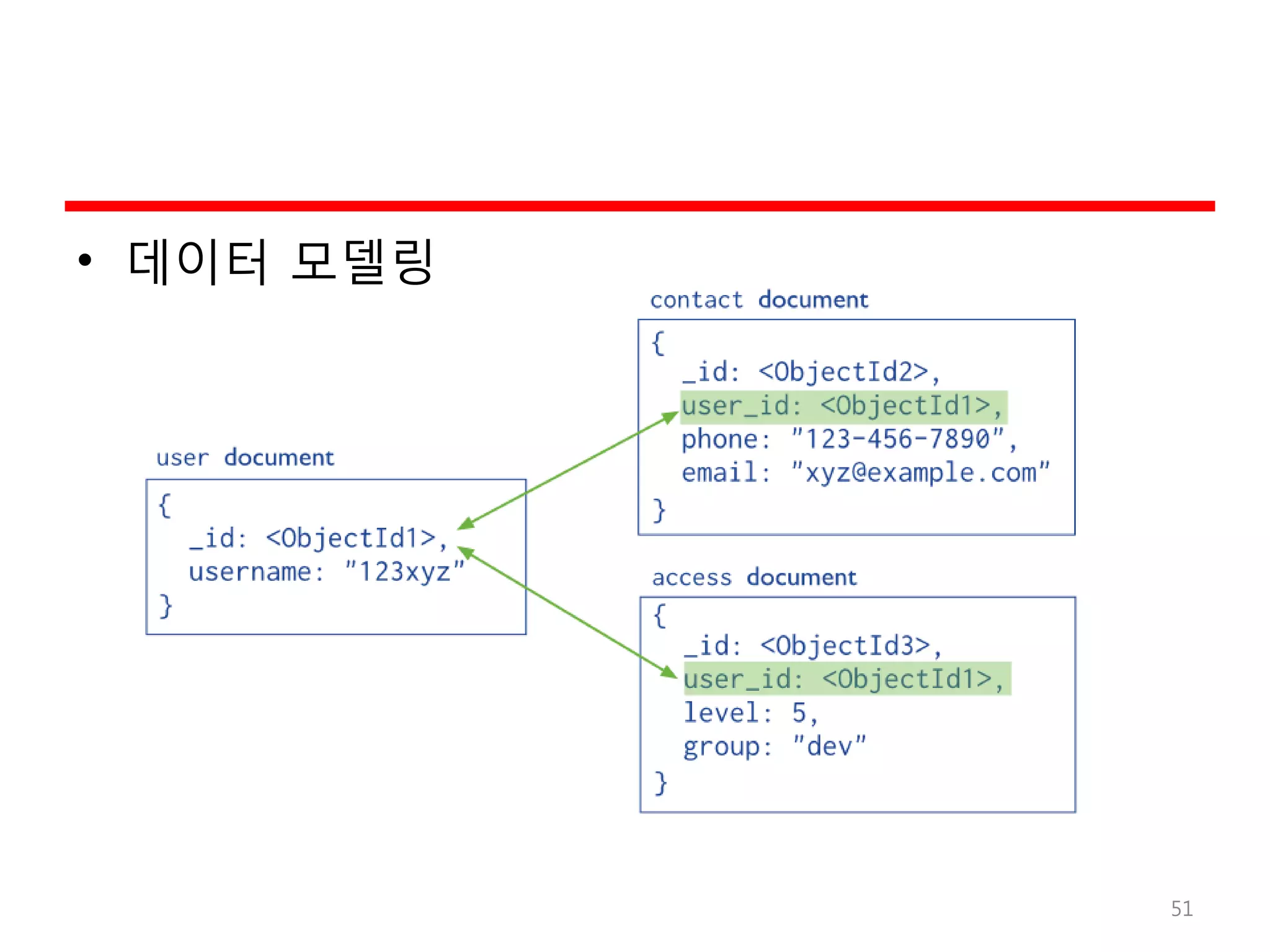
• 데이터 모델링
51
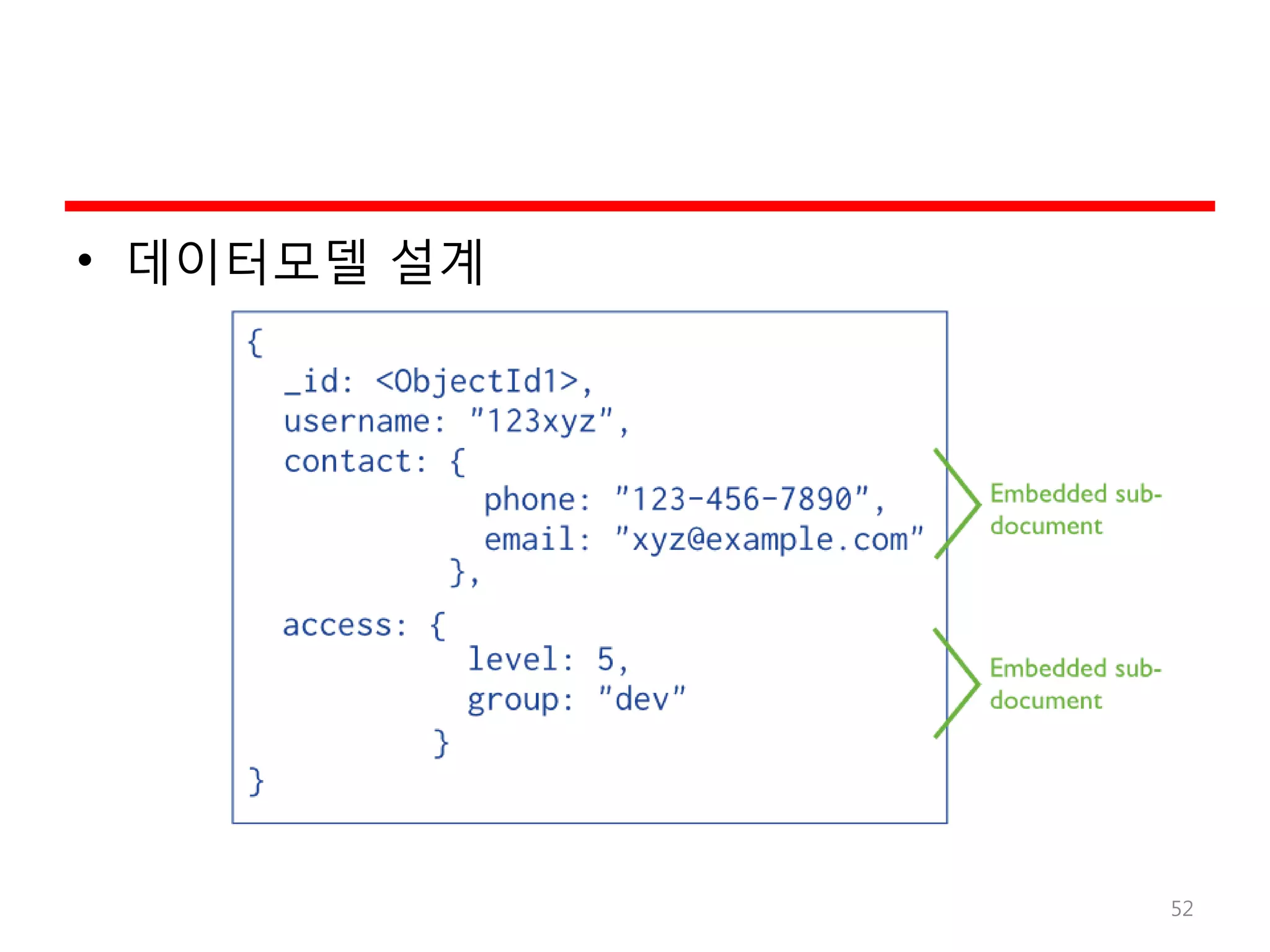
• 데이터모델 설계
52
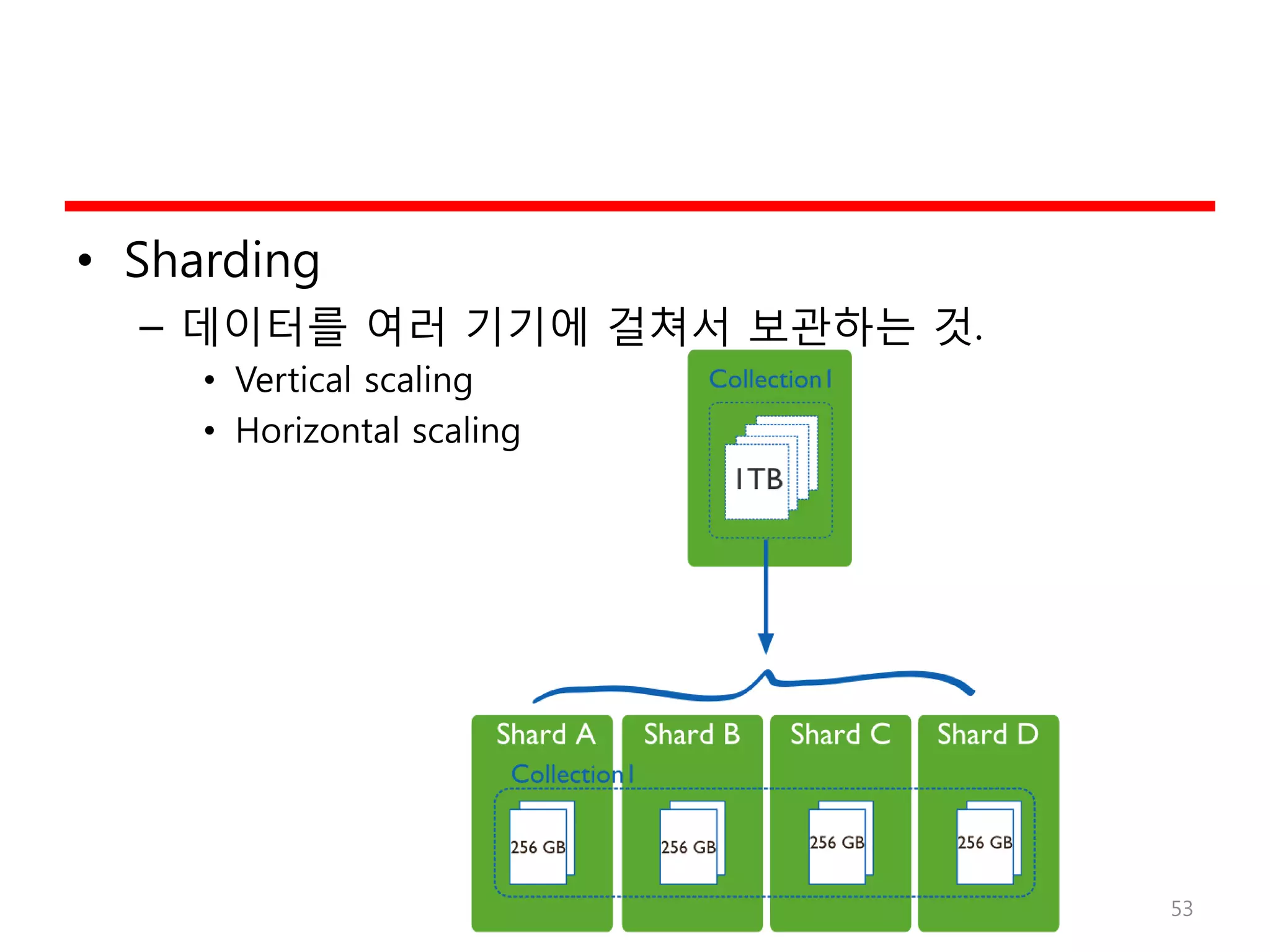
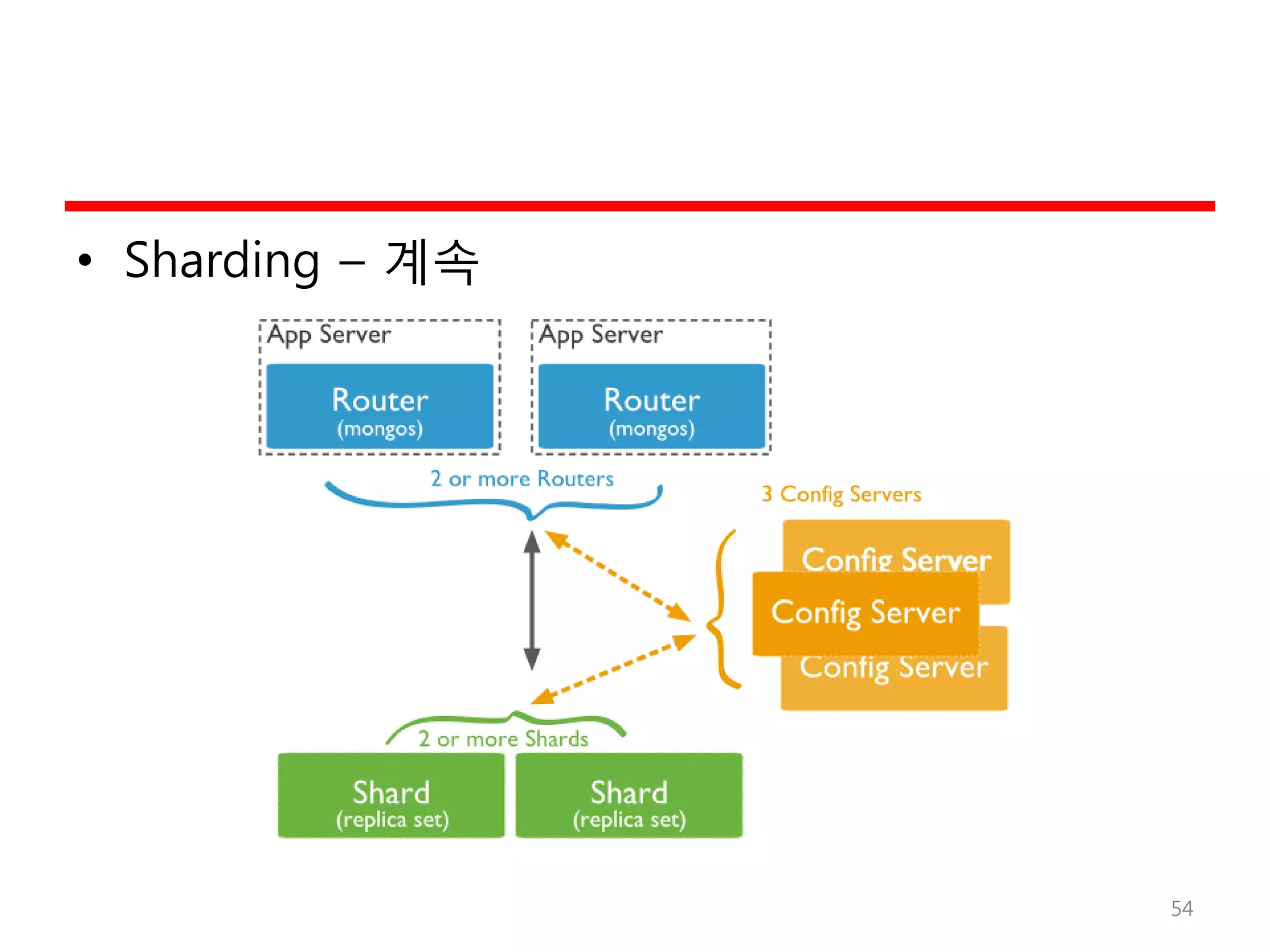
• Sharding
– 데이터를 여러 기기에 걸쳐서 보관하는 것.
• Vertical scaling
• Horizontal scaling
53
• Sharding – 계속
54
NoSQL 사용 – When?
• 대용량 데이터
• Element간의 relationship이 중요치 않을 때
• 비정형 데이터 (log, 는, twitter, blog, …)
• 신속한 prototyping
• 데이터의 변경이 빠를 때
• Business Logic을 DBMS가 아닌 Application에서 구현
55
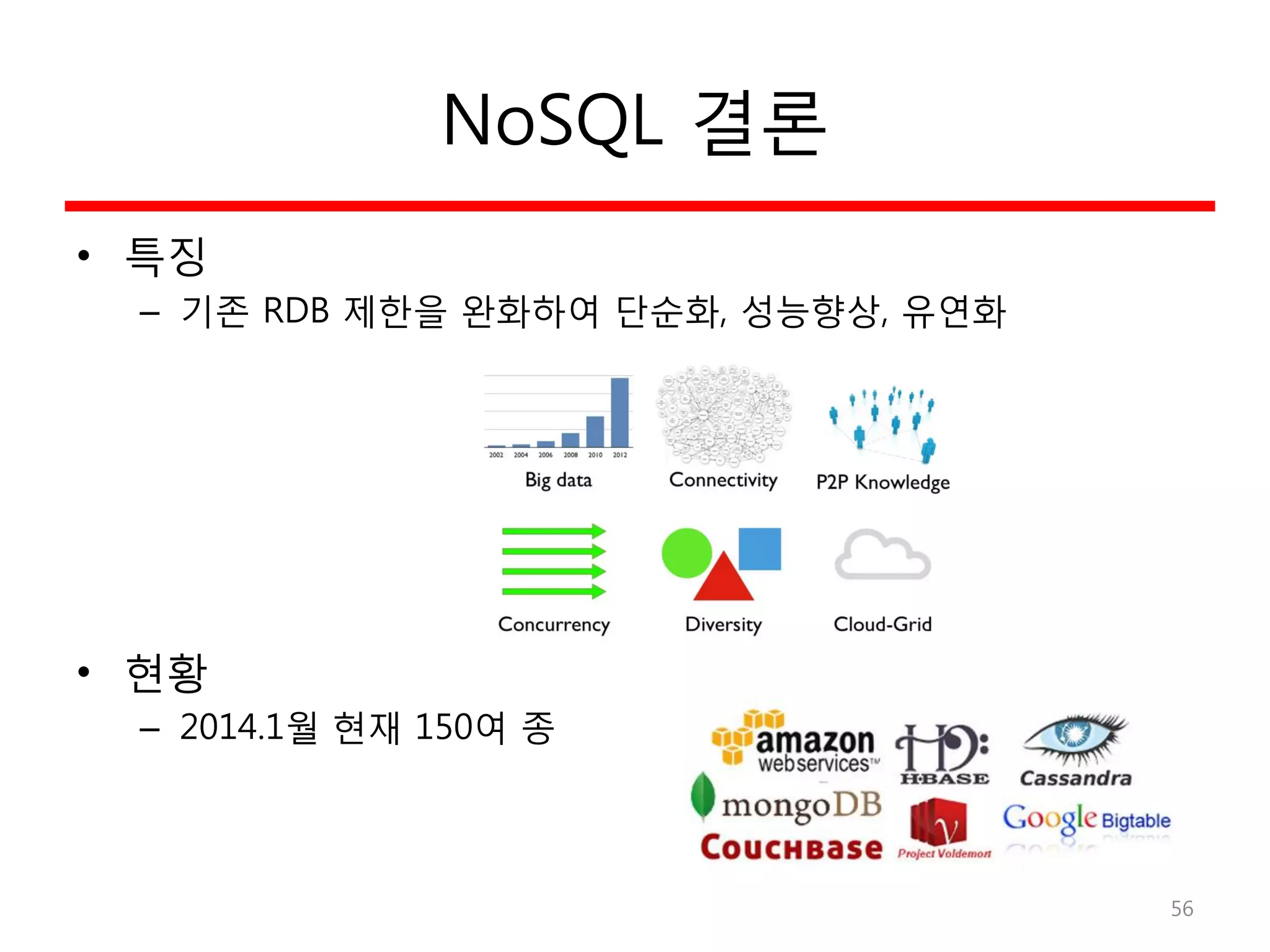
NoSQL 결론
• 특징
– 기존 RDB 제한을 완화하여 단순화, 성능향상, 유연화
• 현황
– 2014.1월 현재 150여 종
56
R과 분석론 (Analytics)
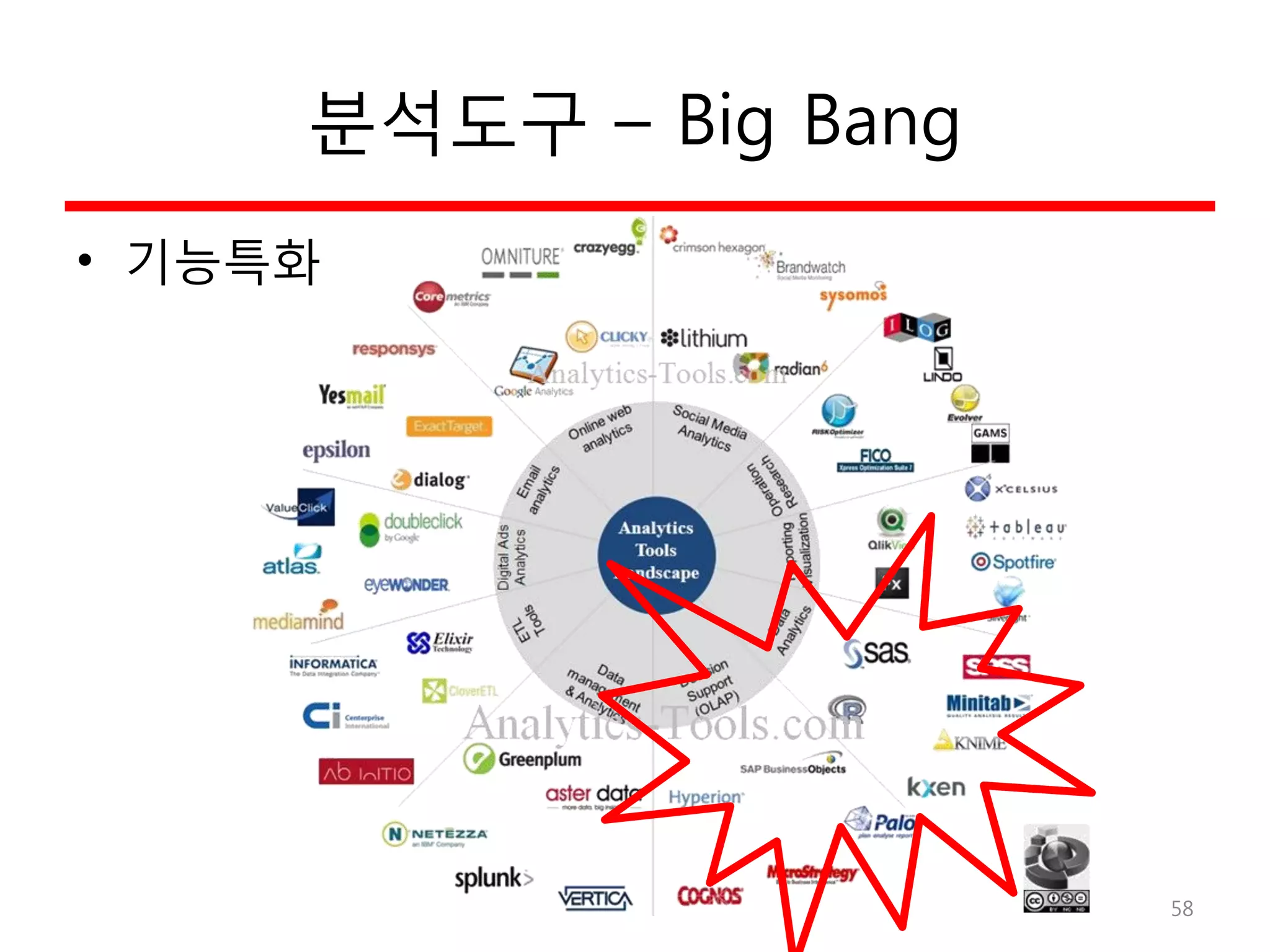
분석도구 – Big Bang
• 기능특화
58
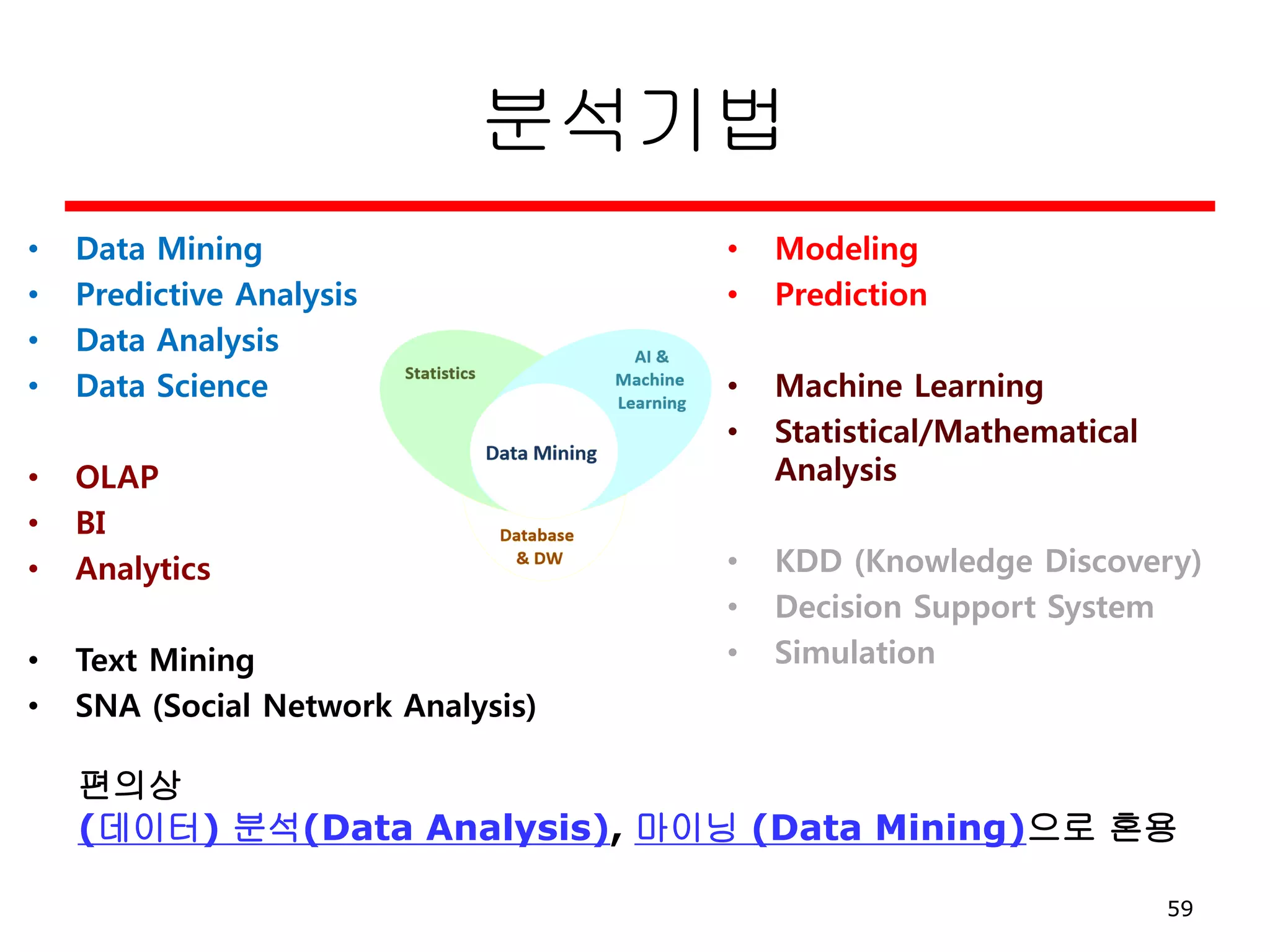
분석기법
• Data Mining
• Predictive Analysis
• Data Analysis
• Data Science
• OLAP
• BI
• Analytics
• Text Mining
• SNA (Social Network Analysis)
• Modeling
• Prediction
• Machine Learning
• Statistical/Mathematical
Analysis
• KDD (Knowledge Discovery)
• Decision Support System
• Simulation
편의상
(데이터) 분석(Data Analysis), 마이닝 (Data Mining)으로 혼용
59
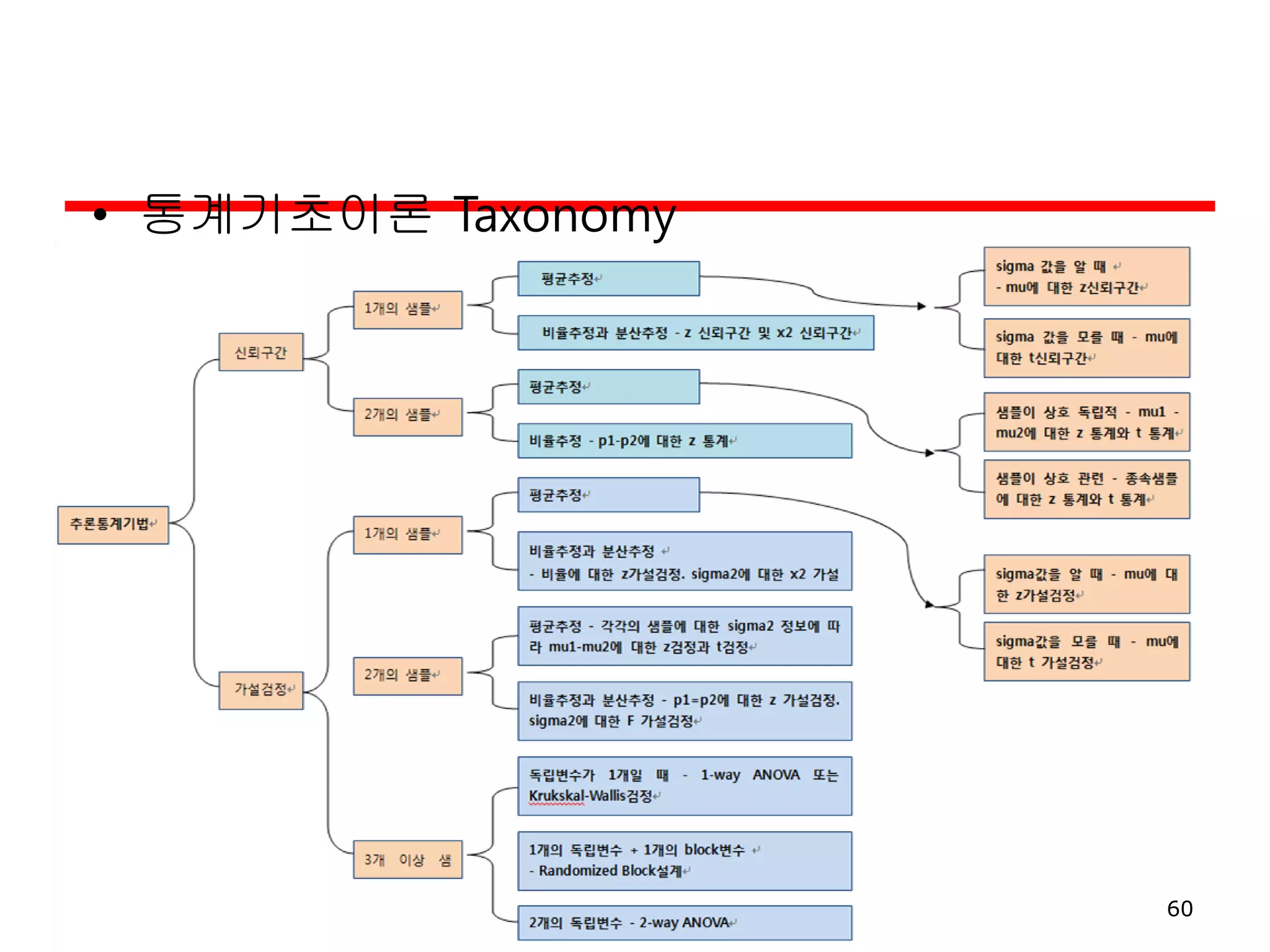
• 통계기초이론 Taxonomy
60
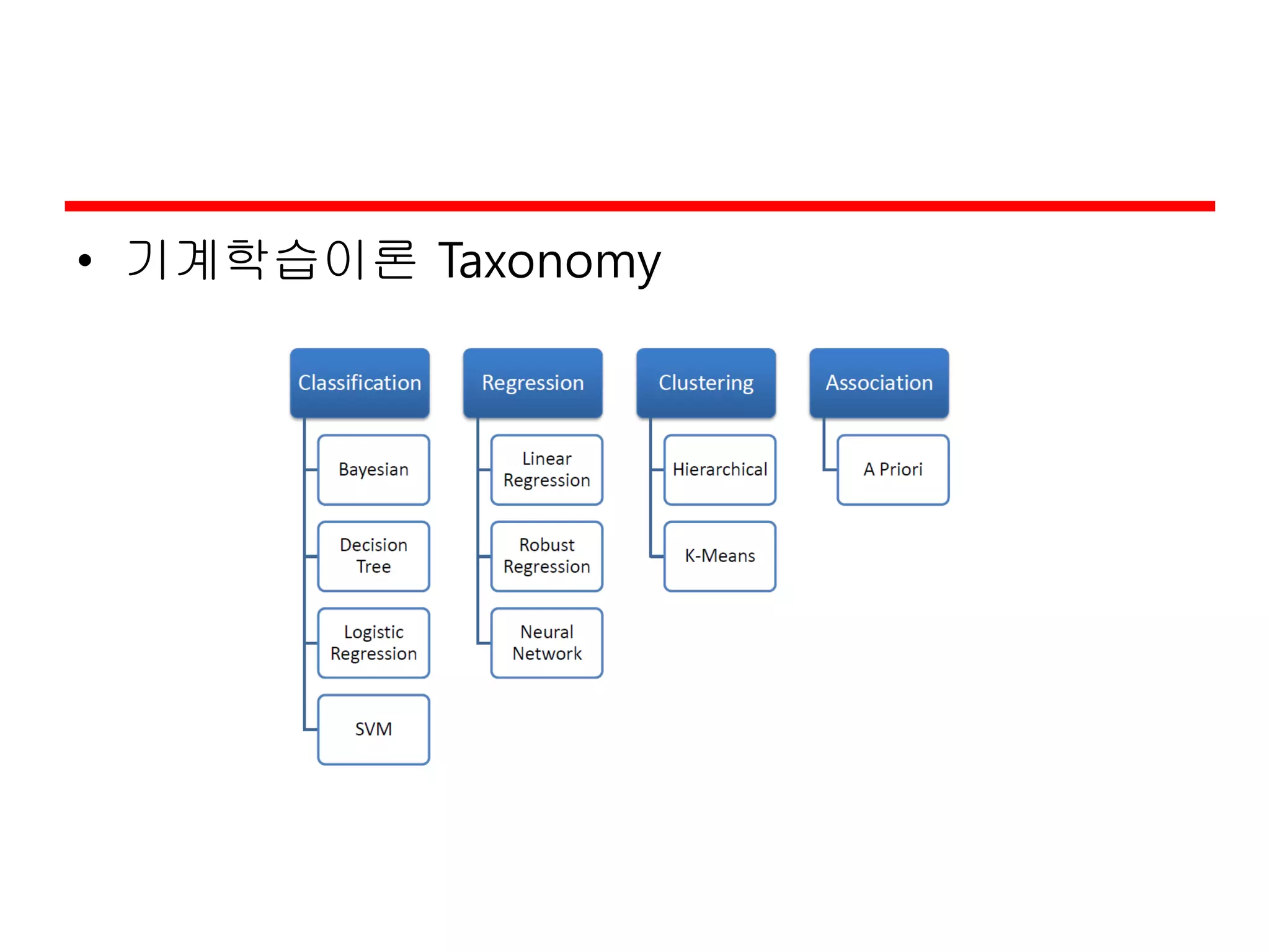
• 기계학습이론 Taxonomy
R
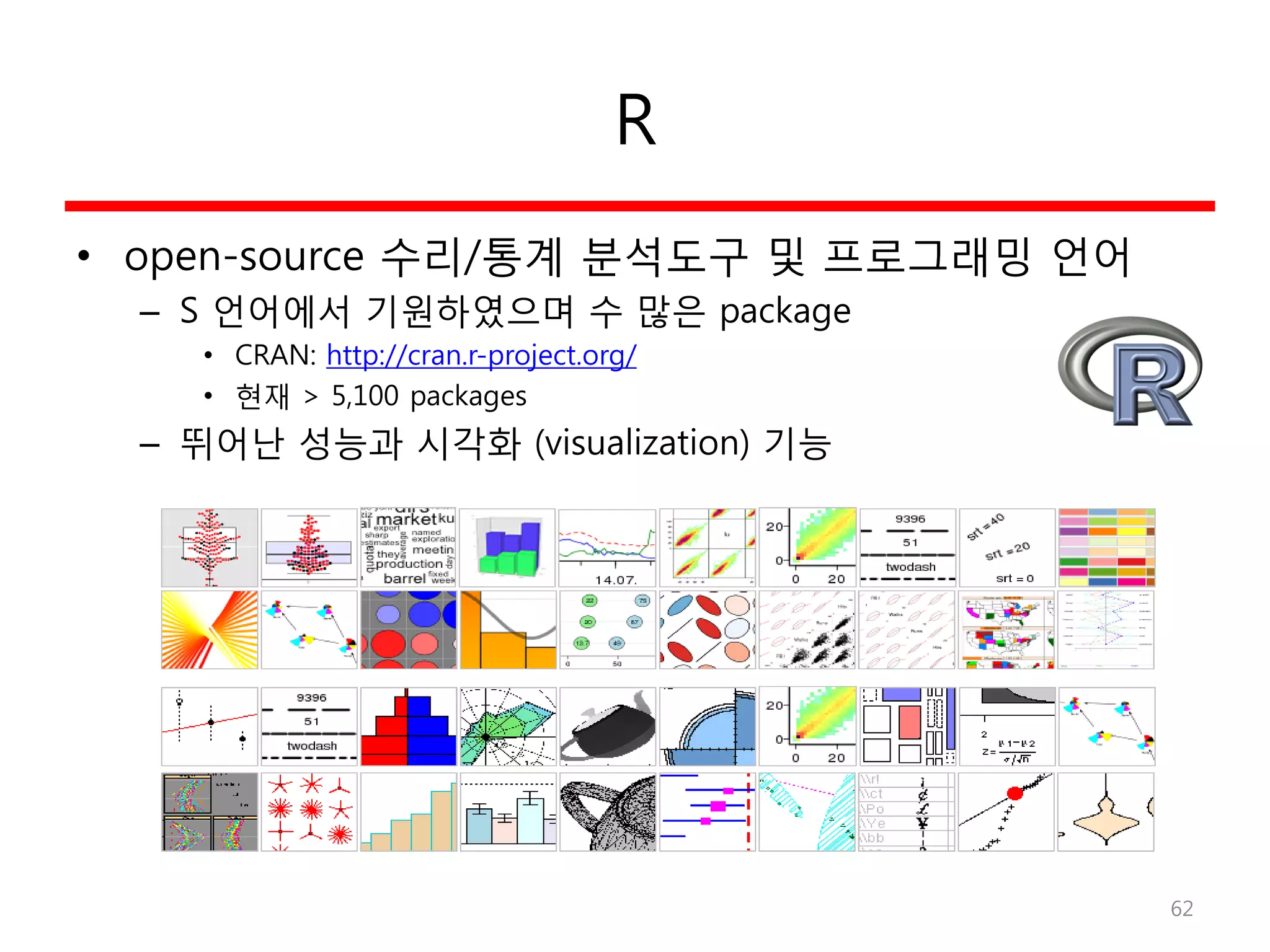
• open-source 수리/통계 분석도구 및 프로그래밍 언어
– S 언어에서 기원하였으며 수 많은 package
• CRAN: http://cran.r-project.org/
• 현재 > 5,100 packages
– 뛰어난 성능과 시각화 (visualization) 기능
62
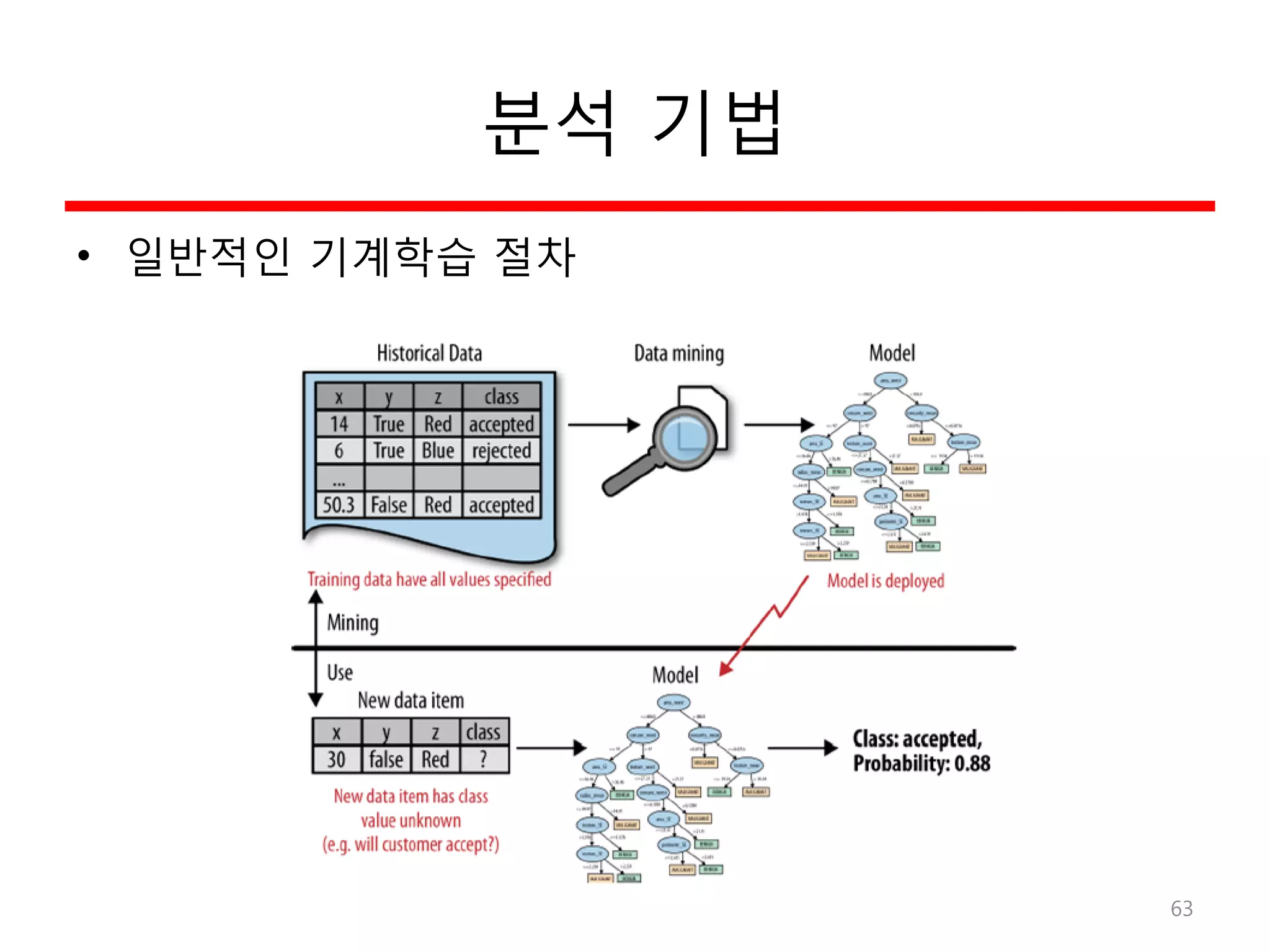
분석 기법
• 일반적인 기계학습 절차
63
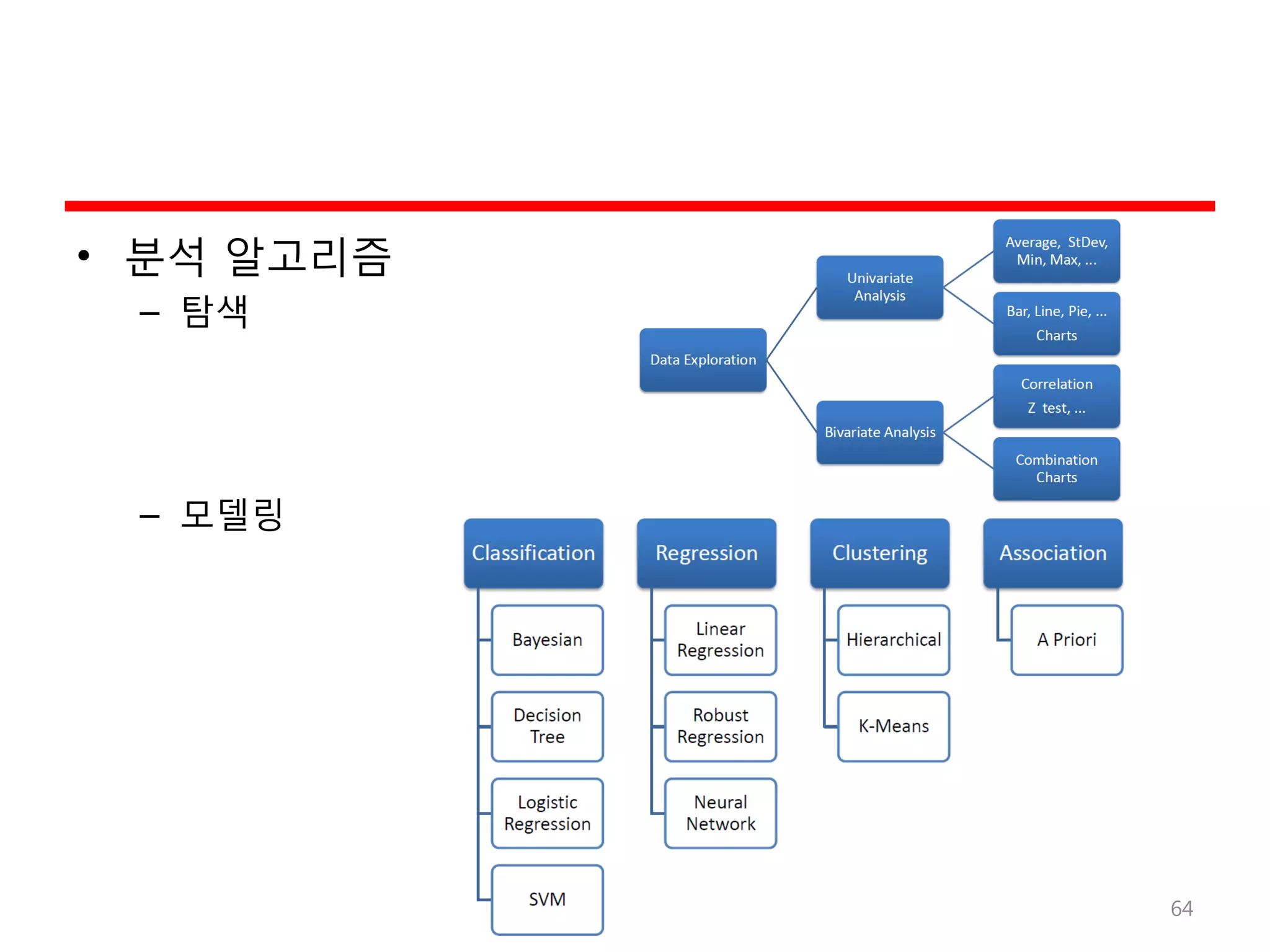
• 분석 알고리즘
– 탐색
– 모델링
64
결론
Data 즉, 객관적 증거 중심!
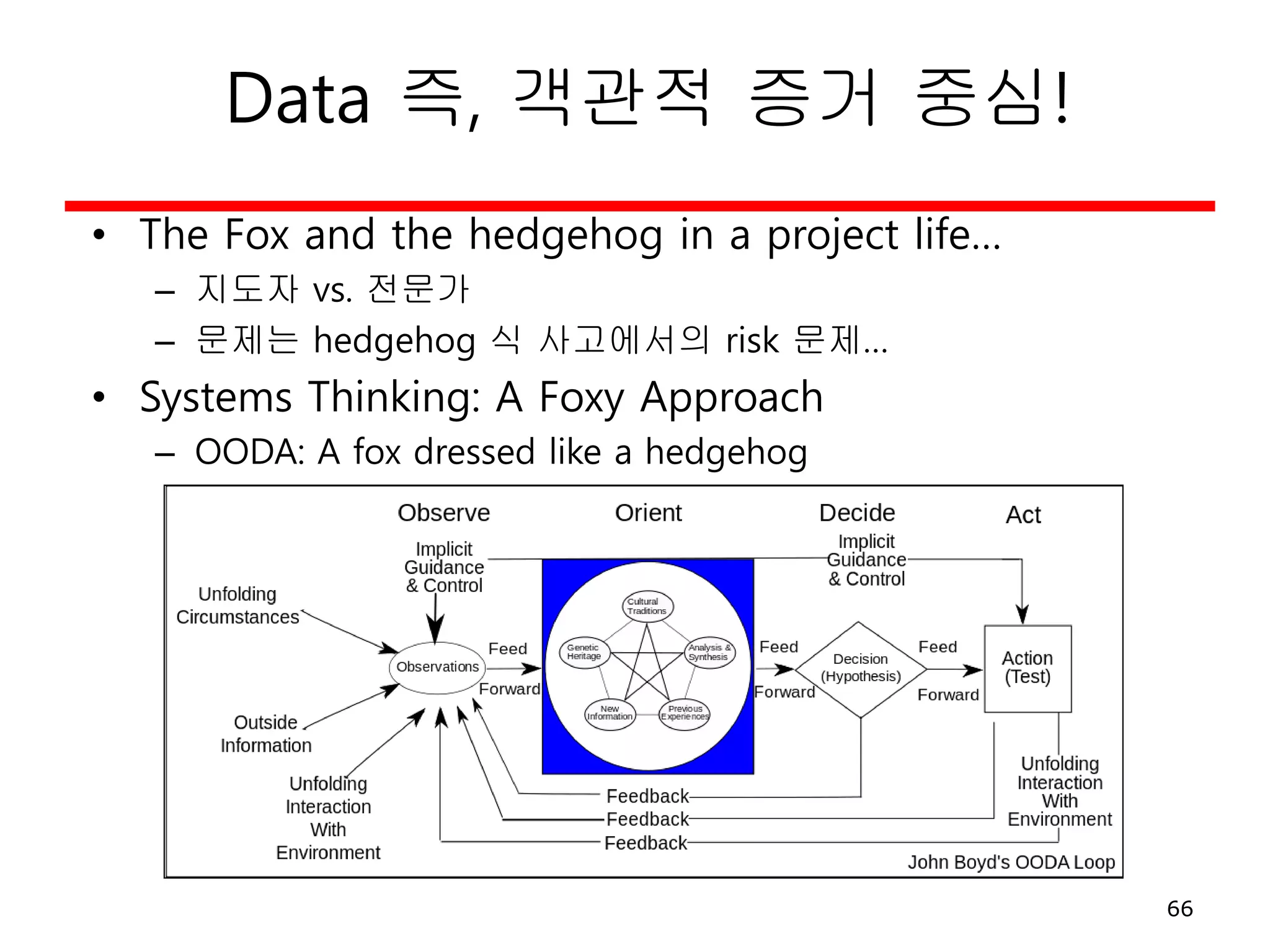
• The Fox and the hedgehog in a project life…
– 지도자 vs. 전문가
– 문제는 hedgehog 식 사고에서의 risk 문제…
• Systems Thinking: A Foxy Approach
– OODA: A fox dressed like a hedgehog
66
맺음말
• “Big Data is All Data”
• 개방성의 문제
– 오픈소스, Naver vs. Google
• 교육
– 교육 일반, BD 교육 (www.coursera.org/course/mmds )
• 빅데이터 4V vs. 4P's (hurdles)
– Practicality, privacy, power, Privilege
• 기타
– 복잡계 이론, System Dynamics, 데이터 잔해 (Data Exhaust)
67


빅데이터, big data

  • 1.
  • 2.
    목 차 • 도입 •빅데이터 기술 개요 • Hadoop • NoSQL • 분석 • 맺음말 2
  • 3.
  • 4.
  • 5.
  • 6.
  • 7.
  • 8.
    배경 – 3V •Tidal Wave – 3VC • Supercomputer – High-throughput computing – 2가지 방향: • 원격, 분산형 대규모 컴퓨팅 (grid computing) • 중앙집중형 (MPP) • Scale-Up vs. Scale-Out • BI (Business Intelligence) – 특히 DW/OLAP/데이터 마이닝 8
  • 9.
    Hadoop • Hadoop의 탄생? –배경 • Google! • Nutch/Lucene 프로젝트에서 2006년 독립 – Doug Cutting – Apache의 top-level 오픈소스 프로젝트 – 특징 • 대용량 데이터 분산처리 프레임워크 – http://hadoop.apache.org – 순수 S/W • 프로그래밍 모델의 단순화로 선형 확장성 (Flat linearity) – “function-to-data model vs. data-to-function” (Locality) – KVP (Key-Value Pair) 9
  • 10.
    Hadoop 탄생의 배경 1990년대– Excite, Alta Vista, Yahoo, … 2000 – Google ; PageRank, GFS/MapReduce 2003~4 – Google Paper 2005 – Hadoop 탄생 (D. Cutting & Cafarella) 2006 – Apache 프로젝트에 등재 10
  • 11.
  • 12.
  • 13.
    • Hadoop Kernel •Hadoop 배포판 – Apache 버전 • 2.x.x : 0.23.x 기반 – 3rd Party 배포판 • Cloudera, HortonWorks와 MapR 13
  • 14.
    • Hadoop 배포판? –Apache 재단의 Hadoop은 0.10에서 시작하여 현재 0.23 – 현재 – Apache • 2.x.x : 0.23.x 개반 • 1.1.x : 현재 안정버전 (0.22기반) • 0.20.x: 아직도 많이 사용되는 legacy 안정버전 – 현재 – 3rd Party 배포판 • Cloudera – CDH • HortonWorks • MapR • … 14
  • 15.
  • 16.
    Hadoop – HDFS &MapReduce –
  • 17.
  • 18.
    요구사항 • Commodity hardware –잦은 고장은 당연한 일 • 수 많은 대형 파일 – 수백 GB or TB – 대규모 streaming reads – Not random access • “Write-once, read-many-times” • High throughput 이 low latency보다 더 중요 • “Modest” number of HUGE files – Just millions; Each > 100MB & multi-GB files typical • Large streaming reads – …
  • 19.
    HDFS의 해결책 • 파일을block 단위로 저장 – 통상의 파일시스템 (default: 64MB)보다 훨씬 커짐 • Replication 을 통한 신뢰성 증진 – Each block replicated across 3+ DataNodes • Single master (NameNode) coordinates access, metadata – 단순화된 중앙관리 • No data caching – Streaming read의 경우 별 도움이 안됨 • Familiar interface, but customize the API – 문제를 단순화하고 분산 솔루션에 주력
  • 20.
    GFS 아키텍처 그림출처: Ghemawatet.al., “Google File System”, SOSP, 2003
  • 21.
  • 22.
    HDFS 이용환경 • 명령어Interface • Java API • Web Interface • REST Interface (WebHDFS REST API) • HDFS를 mount하여 사용
  • 23.
    HDFS 명령어 Interface •Create a directory $ hadoop fs -mkdir /user/idcuser/data • Copy a file from the local filesystem to HDFS $ hadoop fs -copyFromLocal cit-Patents.txt /user/idcuser/data/. • List all files in the HDFS file system $ hadoop fs -ls data/* • Show the end of the specified HDFS file $ hadoop fs -tail /user/idcuser/data/cit-patents- copy.txt • Append multiple files and move them to HDFS (via stdin/pipes) $ cat /data/ita13-tutorial/pg*.txt | hadoop fs - put- data/all_gutenberg.txt
  • 24.
    • File/Directory 명령어: –copyFromLocal, copyToLocal, cp, getmerge, ls, lsr (recursive ls), – moveFromLocal, moveToLocal, mv, rm, rmr (recursive rm), touchz, – mkdir • Status/List/Show 명령어: – stat, tail, cat, test (checks for existence of path, file, zero length files), du, dus • Misc 명령어: – setrep, chgrp, chmod, chown, expunge (empties trash folder)
  • 25.
    HDFS Java API •Listing files/directories (globbing) • Open/close inputstream • Copy bytes (IOUtils) • Seeking • Write/append data to files • Create/rename/delete files • Create/remove directory • Reading Data from HDFS org.apache.hadoop.fs.FileSystem (abstract) org.apache.hadoop.hdfs.DistributedFileSystem org.apache.hadoop.fs.LocalFileSystem org.apache.hadoop.fs.s3.S3FileSystem
  • 26.
  • 27.
  • 28.
    HDFS 정리 • 다수의저가 H/W 위에서 대규모 작업에 중점 – 잦은 고장에 대처 – 대형 파일 (주로 appended and read)에 중점 – 개발자들에 촛점맞춘 filesystem interface • Scale-out & Batch Job – 최근 여러 보완 프로젝트
  • 29.
  • 30.
  • 31.
  • 32.
  • 33.
  • 34.
    WordCount 예의 개선 •문제: 단 한 개의 reducer가 병목을 일으킴 – Work can be distributed over multiple nodes (work balance 개선) – All the input data has to be sorted before processing – Question: Which data should be send to which reducer ? • 해결책: – Arbitrary distributed, based on a hash function (default mode) – Partitioner Class, to determine for every output tuple the corresponding reducer
  • 35.
    unix 명령어와 StreamingAPI • Question: How many cities has each country ? hadoop jar /mnt/biginsights/opt/ibm/biginsights/pig/test/e2e/ pig/lib/hadoop-streaming.jar -input input/city.csv -output output -mapper "cut -f2 -d," -reducer "uniq -c" -numReduceTasks 5 • Explanation: cut -f2 -d, # Extract 2nd col. in a CSV uniq -c # Filter adjacent matches matching lines from INPUT, # -c: prefix lines by the number of occurrences additional remark: # numReduceTasks=0: no shuffle & sort phase!!
  • 36.
    Use the righttool for the right job
  • 37.
  • 38.
    Hadoop의 장단점과 대응 •Haddop의 장점 – commodity h/w – scale-out – fault-tolerance – flexibility by MR • Hadoop의 단점 – MR! – Missing! - schema와 optimizer, index, view, ... – 기존 tool과의 호환성 결여 • 해결책: Hive – SQL to MR – Compiler + Execution 엔진 – Pluggable storage layer (SerDes) • 미해결 숙제: Hive – ANSI SQL, UDF, ... – MR Latency overhead – 계속 작업 중...! 38
  • 39.
    SQL-on-MapReduce • 방향 – SQL로HDFS에 저장된 데이터를 빠르게 조회하고, 분석 – MR을 사용하지 않는 (low latency) 실시간 분석을 목표 – 대규모 batch 및 실시간 interactive 분석에 사용 – HDFS, 기타 데이터에 대한 ETL, Ad-hoc 쿼리, 온라인통합 • New Architecture for SQL on Hadoop – Data Locality – (MR대신) Real-timer Query – Schema-on-Read – SQL ecosystem과 tight 통합
  • 40.
    • SQL onHadoop 프로젝트 예 – Google Dremel – Apache Drill – Cloudera Impala – Citus Data • Tajo – 2013년 3월 Apache Incubator Project에 선정 • APL V2.0 – 국내기업 적용 – SK텔레콤 등 40
  • 41.
  • 42.
    NoSQL? • NoSQL도 DBMS이다. –기존 RDBMS: • Table • More functionality, Less Performance – OLAP • Cube – NoSQL • Collections • Less Functionality, More Performance • 주안점: Scalability, Performance, HA 42 Structured Data Structured/ Unstructured Data
  • 43.
    NoSQL 종류 • Key-ValueStores – 원천기술: DHTs / Amazon’s Dynamo paper – 예: Memcached, Coherence, Redis • Column Store – 원천기술: Google의 BigTable 논문 – 예: Hbase, Cassandra, Hypertable • Document Store – 원천기술: Lotus Notes – 예: CouchDB, MongoDB, Cloudant • Graph Database – 원천기술: Euler & graph 이론 – 예: Neo4J, FlockDB
  • 44.
  • 45.
  • 46.
    NoSQL 특징 • Missing? –Joins 지원 없음 – Complex Transaction 지원 없음 (ACID) – Constraint 지원 없음 • Available? – Query Langauge – 높은 성능 – Horizontal Scalability NoSQL SQL 성능 기능
  • 47.
    MongoDB의 예 • MongoDBpackages – mongodb-org – mongodb-org-server – mongodb-org-mongos – mongodb-org-shell – mongodb-org-tools • 설치 – sudo yum install -y mongodb-org • 수행과 정지 – sudo service mongod start – sudo service mongod stop 47
  • 48.
  • 49.
  • 50.
  • 51.
  • 52.
  • 53.
    • Sharding – 데이터를여러 기기에 걸쳐서 보관하는 것. • Vertical scaling • Horizontal scaling 53
  • 54.
  • 55.
    NoSQL 사용 –When? • 대용량 데이터 • Element간의 relationship이 중요치 않을 때 • 비정형 데이터 (log, 는, twitter, blog, …) • 신속한 prototyping • 데이터의 변경이 빠를 때 • Business Logic을 DBMS가 아닌 Application에서 구현 55
  • 56.
    NoSQL 결론 • 특징 –기존 RDB 제한을 완화하여 단순화, 성능향상, 유연화 • 현황 – 2014.1월 현재 150여 종 56
  • 57.
  • 58.
    분석도구 – BigBang • 기능특화 58
  • 59.
    분석기법 • Data Mining •Predictive Analysis • Data Analysis • Data Science • OLAP • BI • Analytics • Text Mining • SNA (Social Network Analysis) • Modeling • Prediction • Machine Learning • Statistical/Mathematical Analysis • KDD (Knowledge Discovery) • Decision Support System • Simulation 편의상 (데이터) 분석(Data Analysis), 마이닝 (Data Mining)으로 혼용 59
  • 60.
  • 61.
  • 62.
    R • open-source 수리/통계분석도구 및 프로그래밍 언어 – S 언어에서 기원하였으며 수 많은 package • CRAN: http://cran.r-project.org/ • 현재 > 5,100 packages – 뛰어난 성능과 시각화 (visualization) 기능 62
  • 63.
    분석 기법 • 일반적인기계학습 절차 63
  • 64.
    • 분석 알고리즘 –탐색 – 모델링 64
  • 65.
  • 66.
    Data 즉, 객관적증거 중심! • The Fox and the hedgehog in a project life… – 지도자 vs. 전문가 – 문제는 hedgehog 식 사고에서의 risk 문제… • Systems Thinking: A Foxy Approach – OODA: A fox dressed like a hedgehog 66
  • 67.
    맺음말 • “Big Datais All Data” • 개방성의 문제 – 오픈소스, Naver vs. Google • 교육 – 교육 일반, BD 교육 (www.coursera.org/course/mmds ) • 빅데이터 4V vs. 4P's (hurdles) – Practicality, privacy, power, Privilege • 기타 – 복잡계 이론, System Dynamics, 데이터 잔해 (Data Exhaust) 67