Part Two
The Big 100
by
Jeremy Kourdi
Top 10 Tools you need to succeed
FOR THE FULL BOOK VISIT
http://goo.gl/gm7xdm
INFORMATION LIFE CYCLE
Managing Information, Technology and Operations
Improving how your organisation gathers and uses information will enhance analysis, decision-
making, operations and strategic development. This starts with knowing how information flows, what
it is used for and how it is applied. This is known as the information life cycle. How you use
information at every stage of this cycle is critical to achieving targets optimising performance and
revealing new opportunities.
A modern competitive company is only as good as its ability to use information.
T H E B I G 1 0 0 T O P 1 0 T O O L S . Part Two
O V E R V I E W
T H E I N F O R M A T I O N L I F E C Y C L E
Managing Information, Technology and Operations
INFORMATION LIFE CYCLE
Make sure that the information is fit for purpose. For the right decisions to be made, the right data has
to be collected. There are two aspects to this: generating the data you know you will need and
gathering data that has yet to reveal valuable insight. Too often, information remains hidden – to be
of use, it must be gathered, collated and organised effectively.
T H E B I G 1 0 0 T O P 1 0 T O O L S . Part Two
T H E N G E N E R A T E T H E R I G H T D A T A
Managing Information, Technology and Operations
This will enable you to gather the right data for all aspects of your company and to put systems in
place to ensure that it is routinely gathered, consistent, reliable and made available to yourself and
others now and in the future. To do this, you will need to ask others what information they need
(including the best sources of that data) and when they need it.
U N D E R S T A N D I N G W H A T I N F O R M A T I O N Y O U R
C O M P A N Y N E E D S
N E X T , R E V I E W A N D A N A L Y S E T H E I N F O R M A T I O N
How you review and analyse the information will determine the quality of problem-solving, decision-
making, operational management and strategic development. To review the current situation, make
sense of data and to highlight trends, gaps, strengths, weaknesses and opportunities, subject the
information to quantitative methods,
rigorous assessment and discussions.
INFORMATION LIFE CYCLE
Surprisingly, given that gathering information is an expensive, time-consuming process, some people
neglect to follow through fully on what the data is telling them. To be of use, you have to be prepared
to listen to what the data is saying and be prepared to take action – choosing to ignore the data is likely
to lead strategy in the wrong direction, fail to resolve a problem or leave opportunities untapped. By
improving the quality of how you identify the information you need and how information is
gathered, analysed and stored, you will be better able to see what needs to happen, to make the right
decisions, and to guide strategy and implementation.
Make sure that the information is fit for purpose. For the right decisions to be made, the right data has
to be collected. There are two aspects to this: generating the data you know you will need and
gathering data that has yet to reveal valuable insight. Too often, information
remains hidden – to be of use, it must be gathered, collated and organised
effectively.
T H E B I G 1 0 0 T O P 1 0 T O O L S . Part Two
F I N A L L Y U S E A N D A C T U P O N T H E I N F O R M A T I O N
Managing Information,
Technology and Operations
Managing Information, Technology and Operations
To be effective and of use, information needs to be stored properly and it needs to be cost-effective.
It needs to be widely available and easily accessible. Make sure that it is clearly labelled and organised
– and that people know how to access it. Also, information should be kept relevant and up to date.
M A K E S U R E T H A T Y O U S T O R E T H E I N F O R M A T I O N
A N D A R E A B L E T O R E T R I E V E I T
In his book The Seven Habits of Highly Effective
People, writer Stephen Covey outlines the
following set of activities and attitudes that
promotes good leadership skills.
1. Be proactive
This involves self-determination and the power to
decide the best response to a situation, so you can
control your environment rather than it
controlling you.
2. Begin with the end in mind
This is essential to both personal leadership and
leading others. To achieve your aims, concentrate
on activities that are relevant. This will help you to
keep focused, to avoid distractions and to be more
productive and successful.
T H E B I G 1 0 0 T O P 1 0 T O O L S . Part Two
H O W E F F E C T I V E A R E Y O U ?
SEVEN HABITS OF HIGHLY
EFFECTIVE PEOPLE
Personal effectiveness and career success
5. Seek to understand first and then seek to be
understood.
Covey argues that for good communication you
need to ‘diagnose before you prescribe’ – this is an
extremely powerful tool.
6. Synergise
Leaders need to understand how to use co-
operation creatively. Given the principle of the
whole being greater than the sum of the parts,
organising co-operative activities to utilise each
person’s strengths will promote a successful
outcome. Covey argues that this requires us to see
both the good and the potential in the other
person’s contribution.
7. Sharpen the saw
Self-renewal both enables and strengthens the other
habits. Covey divides the self into four parts –
spiritual, mental physical and social/emotional –
which should all be developed if you wish to
T H E B I G 1 0 0 T O P 1 0 T O O L S . Part Two
SEVEN HABITS OF HIGHLY
EFFECTIVE PEOPLE
Personal effectiveness and career success
3. Put things first
Effective personal management involves
organising and implementing activities that will
help you and your team to achieve your aims.
While habit 2 requires mental creation, habit 3 is
about physical creation.
4.Think win-win
Leadership requires good interpersonal skills, as
achievements often depend on the co-operation of
others. Covey argues that win-win is based on two
assumptions: there is plenty for everyone and
success tends to follow a co-operative approach
rather than the confrontation of win-or-lose.
T H E B I G 1 0 0 T O P 1 0 T O O L S . Part Two
H O W E F F E C T I V E A R E Y O U ?
SEVEN HABITS OF HIGHLY
EFFECTIVE PEOPLE
Personal effectiveness and career success
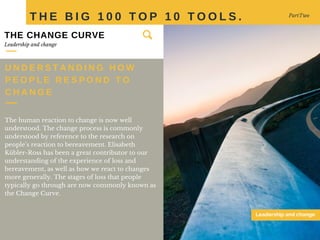
THE CHANGE CURVE
The human reaction to change is now well
understood. The change process is commonly
understood by reference to the research on
people’s reaction to bereavement. Elisabeth
Kübler-Ross has been a great contributor to our
understanding of the experience of loss and
bereavement, as well as how we react to changes
more generally. The stages of loss that people
typically go through are now commonly known as
the Change Curve.
T H E B I G 1 0 0 T O P 1 0 T O O L S . PartTwo
U N D E R S T A N D I N G H O W
P E O P L E R E S P O N D T O
C H A N G E
Leadership and change
THE CHANGE CURVE
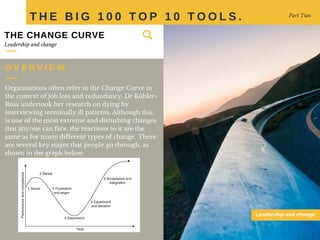
Organisations often refer to the Change Curve in
the context of job loss and redundancy. Dr Kübler-
Ross undertook her research on dying by
interviewing terminally ill patients. Although this
is one of the most extreme and disturbing changes
that anyone can face, the reactions to it are the
same as for many different types of change. There
are several key stages that people go through, as
shown in the graph below:
T H E B I G 1 0 0 T O P 1 0 T O O L S . Part Two
O V E R V I E W
Leadership and change
THE CHANGE CURVE
1. Shock: The first reaction can often be shock –
and all the emotion that results from this.
2. Denial: This is a typical reaction and it is
important and necessary. It helps cushion the
impact of the inevitability of change.
3. Frustration and anger: The Person resents the
change that they must face while others are less
affected.
4. Depression: First, the person feels deep
disappointment, perhaps a sense of personal
failing, things not done, wrongs committed.
Around this time they may also engage in
bargaining: beginning to accept the change but
striking bargains – for more time, for example.
T H E B I G 1 0 0 T O P 1 0 T O O L S . Part Two
Leadership and change
THE CHANGE CURVE
5. Experiment and decision: Initial engagement
with the new situation and learning how to work in
the new situation, as well as making choices and
decisions, and regaining control.
6. Acceptance and integration: Dr Kübler-Ross
describes this stage as neither happy nor unhappy.
While it is devoid of feelings, it is not resignation –
it is really a victory.
People who are made redundant can go through a
similar process. Just as with other types of change,
people often go through a first stage before denial
– that of shock or disbelief. We have witnessed
people in shock following news of their
redundancy. It can take a long time for people to
reach the acceptance stage and often people
oscillate between the different stages.
T H E B I G 1 0 0 T O P 1 0 T O O L S . Part Two
Leadership and change
Pareto analysis arose from Vilfredo Pareto’s
observation that many activities break down into
an 80;20 ratio, where 8o per cent of output is due
to 20 per cent of the contributory factors. This
observation is now used to focus business strategy,
problem-solving and operations on the key inputs
that are responsible for 80 per cent of the outcome.
T H E B I G 1 0 0 T O P 1 0 T O O L S . Part Two
F I N D I N G T H E R I G H T F O C U S
A N D A N S W E R U S I N G T H E 8 0 : 2 0
R U L E .
THE PARETO PRINCIPLE
Business strategy, planning and organizational effectiveness
Business strategy, planning
and organizational effectiveness
H O W I T W O R K S
The 80:20 ratio applies both to positive and
negative situations, providing a useful means of
dealing quickly with problems or opportunities. In
other words, by identifying the small number of
key factors that are contributing most to a situation,
we can better focus efforts to achieve the desired
result.
Pareto analysis is only as good as the data that is
used, so we need to ensure that all contributory
factors are identified and that appropriate and
revealing parameters and measures are established
and interpreted correctly. Although not everything
falls neatly into an 80:20 rule, Pareto analysis is still
useful for identifying the main causal factors.
T H E B I G 1 0 0 T O P 1 0 T O O L S . Part Two
THE PARETO PRINCIPLE
Business strategy, planning and organizational effectiveness
Business strategy, planning
and organizational effectiveness
This simple example shows how the process works.
1. Research and discuss the issue, identifying all
contributory factors
2. Decide an appropriate time period and method
of measurement.
3. Measure how frequently each factor occurs (or
another measure, such as cost).
4. Rank the factors in descending order, with the
largest one first.
5. Calculate the frequency of each factor as a
percentage of the total occurrences (or cost).
T H E B I G 1 0 0 T O P 1 0 T O O L S . Part Two
THE PARETO PRINCIPLE
Business strategy, planning and organizational effectiveness
Business strategy, planning
and organizational effectiveness
6. Calculate the cumulative percentage (current percentage plus all previous percentages). Depict
this information on a graph – with 'frequency as a percentage of total’ as a bar chart and
‘cumulative percentage’ as a line, adding a third line showing the 80 per cent cut-off point.
7. Depict this information on a graph – with ‘frequency as a percentage of total’ as a bar chart and
‘cumulative percentage’ as a line, adding a third line showing the 80 per cent cut-off point. All
factors that appear to the left of the intersection of the two lines are the ones contributing to 80
percent of the result – these are the factors to focus on.
All factors appear to the left of the intersection of the two lines are the ones contributing to 80
percent of the result – these are the factors to focus on.
By learning where the pitfalls lie in negotiations, it is possible to sidestep them and ensure results that
last for all the parties involved.
Harvard Business School professor James Sebenius argues that six mistakes are responsible for the
failure of negotiations. By avoiding them you can negotiate your way to success.
1. Neglecting the other side’s problems. If you do not understand the problems your negotiation
partner needs to overcome, you will not offer them the correct solution and you will lose an
effective bargaining chip.
2. Letting price bulldoze other interests. It is easy to focus exclusively on price. Make sure you
consider other important factors – such as creating a positive working relationship and goodwill
between both sides, and a deal-making process that is respectful and fair to everyone.
3. Letting positions drive out interests. While two sides of a debate may have opposing positions,
they may also have compatible interests. Rather than working to persuade someone to abandon
their position, it can be more productive to work on innovating and
creating a deal that is able to satisfy a range of interests. Here, keep
the big picture in mind: don’t give up or fail because the detailed
working is difficult or frustrating.me these biases by placing yourself
in the position of your ‘opponent’.
T H E B I G 1 0 0 T O P 1 0 T O O L S . Part Two
T H E S I X P I T F A L L S O F N E G T I A T I O N
Managing information, technology
and operations
Managing information, technology and operations
ACHIEVING A
WIN-WIN OUTCOME
4. Searching too hard for common ground. Common ground can help negotiations, but different
interest allow both sides to get something out of the deal. The key is to give and get: don’t simply look
for disappointing compromises.
5. Neglecting BATNA. BATNA stands for ‘best alternative to a negotiated agreement’ – that is, the
options if the deal falls through. These may include approaching other companies or adjusting your
business model. By fully analysing your prospects – and your partner’s prospects – you can decide
what to offer in the negotiation and when to offer it.
6. Failing to correct for skewed vision. Two types of bias can be present – role bias and partisan
perception. Role bias (the confirming evidence trap) is the tendency to interpret information in self-
serving ways, overestimating your chances of success. Partisan perception (the overconfidence trap) is
the propensity to glorify your own position while vilifying opponents. Overcome these biases by
placing yourself in the position of your ‘opponent’.
T H E B I G 1 0 0 T O P 1 0 T O O L S . Part Two
T H E S I X P I T F A L L S O F N E G T I A T I O N
Managing information, technology
and operations
Managing information, technology and operations
ACHIEVING A
WIN-WIN OUTCOME
As well as an ability to avoid pitfalls, great negotiators also have other qualities:
They understand the other side’s aims, perspectives and experience – essential to persuading them
why they should agree.
They also thoroughly research an individual or company before negotiations. They do not limit
research to information relevant to the deal. Broadening the scope to the industry goals and market
conditions provides extra weight in negotiations.
They are measured and avoid being overly aggressive. They may show firmness but remember that
mutual understanding and rapport is essential.
Above all, they seek a ‘win-win’ outcome by thoroughly exploring the full range of
potential agreements that would allow both sides to benefit from the negotiation.
T H E B I G 1 0 0 T O P 1 0 T O O L S . Part Two
Managing information, technology and
operations
Managing information, technology and operations
ACHIEVING A
WIN-WIN OUTCOME
A C T I O N S O F S U C C E S S F U L N E G O T I A T O R S
Part Two
The Big 100
by
Jeremy Kourdi
The world is full of business ideas.
But how do you know which the best ones are?
And how do you find time to read them?
THE BIG 100 may be a little book, but it contains the very
best business tools that have come from the very best
business brains on the planet. Each is summarized over
just two pages, so that you can quickly gain access to the
insights which are driving the most successful people in
all walks of life.
FOR THE FULL BOOK VISIT
http://goo.gl/gm7xdm

Big 100 Part Two by Jeremy Kourdi

  • 1.
    Part Two The Big100 by Jeremy Kourdi Top 10 Tools you need to succeed FOR THE FULL BOOK VISIT http://goo.gl/gm7xdm
  • 2.
    INFORMATION LIFE CYCLE ManagingInformation, Technology and Operations Improving how your organisation gathers and uses information will enhance analysis, decision- making, operations and strategic development. This starts with knowing how information flows, what it is used for and how it is applied. This is known as the information life cycle. How you use information at every stage of this cycle is critical to achieving targets optimising performance and revealing new opportunities. A modern competitive company is only as good as its ability to use information. T H E B I G 1 0 0 T O P 1 0 T O O L S . Part Two O V E R V I E W T H E I N F O R M A T I O N L I F E C Y C L E Managing Information, Technology and Operations
  • 3.
    INFORMATION LIFE CYCLE Makesure that the information is fit for purpose. For the right decisions to be made, the right data has to be collected. There are two aspects to this: generating the data you know you will need and gathering data that has yet to reveal valuable insight. Too often, information remains hidden – to be of use, it must be gathered, collated and organised effectively. T H E B I G 1 0 0 T O P 1 0 T O O L S . Part Two T H E N G E N E R A T E T H E R I G H T D A T A Managing Information, Technology and Operations Managing Information, Technology and Operations This will enable you to gather the right data for all aspects of your company and to put systems in place to ensure that it is routinely gathered, consistent, reliable and made available to yourself and others now and in the future. To do this, you will need to ask others what information they need (including the best sources of that data) and when they need it. U N D E R S T A N D I N G W H A T I N F O R M A T I O N Y O U R C O M P A N Y N E E D S N E X T , R E V I E W A N D A N A L Y S E T H E I N F O R M A T I O N How you review and analyse the information will determine the quality of problem-solving, decision- making, operational management and strategic development. To review the current situation, make sense of data and to highlight trends, gaps, strengths, weaknesses and opportunities, subject the information to quantitative methods, rigorous assessment and discussions.
  • 4.
    INFORMATION LIFE CYCLE Surprisingly,given that gathering information is an expensive, time-consuming process, some people neglect to follow through fully on what the data is telling them. To be of use, you have to be prepared to listen to what the data is saying and be prepared to take action – choosing to ignore the data is likely to lead strategy in the wrong direction, fail to resolve a problem or leave opportunities untapped. By improving the quality of how you identify the information you need and how information is gathered, analysed and stored, you will be better able to see what needs to happen, to make the right decisions, and to guide strategy and implementation. Make sure that the information is fit for purpose. For the right decisions to be made, the right data has to be collected. There are two aspects to this: generating the data you know you will need and gathering data that has yet to reveal valuable insight. Too often, information remains hidden – to be of use, it must be gathered, collated and organised effectively. T H E B I G 1 0 0 T O P 1 0 T O O L S . Part Two F I N A L L Y U S E A N D A C T U P O N T H E I N F O R M A T I O N Managing Information, Technology and Operations Managing Information, Technology and Operations To be effective and of use, information needs to be stored properly and it needs to be cost-effective. It needs to be widely available and easily accessible. Make sure that it is clearly labelled and organised – and that people know how to access it. Also, information should be kept relevant and up to date. M A K E S U R E T H A T Y O U S T O R E T H E I N F O R M A T I O N A N D A R E A B L E T O R E T R I E V E I T
  • 5.
    In his bookThe Seven Habits of Highly Effective People, writer Stephen Covey outlines the following set of activities and attitudes that promotes good leadership skills. 1. Be proactive This involves self-determination and the power to decide the best response to a situation, so you can control your environment rather than it controlling you. 2. Begin with the end in mind This is essential to both personal leadership and leading others. To achieve your aims, concentrate on activities that are relevant. This will help you to keep focused, to avoid distractions and to be more productive and successful. T H E B I G 1 0 0 T O P 1 0 T O O L S . Part Two H O W E F F E C T I V E A R E Y O U ? SEVEN HABITS OF HIGHLY EFFECTIVE PEOPLE Personal effectiveness and career success Personal effectiveness and career success
  • 6.
    5. Seek tounderstand first and then seek to be understood. Covey argues that for good communication you need to ‘diagnose before you prescribe’ – this is an extremely powerful tool. 6. Synergise Leaders need to understand how to use co- operation creatively. Given the principle of the whole being greater than the sum of the parts, organising co-operative activities to utilise each person’s strengths will promote a successful outcome. Covey argues that this requires us to see both the good and the potential in the other person’s contribution. 7. Sharpen the saw Self-renewal both enables and strengthens the other habits. Covey divides the self into four parts – spiritual, mental physical and social/emotional – which should all be developed if you wish to T H E B I G 1 0 0 T O P 1 0 T O O L S . Part Two SEVEN HABITS OF HIGHLY EFFECTIVE PEOPLE Personal effectiveness and career success Personal effectiveness and career success
  • 7.
    3. Put thingsfirst Effective personal management involves organising and implementing activities that will help you and your team to achieve your aims. While habit 2 requires mental creation, habit 3 is about physical creation. 4.Think win-win Leadership requires good interpersonal skills, as achievements often depend on the co-operation of others. Covey argues that win-win is based on two assumptions: there is plenty for everyone and success tends to follow a co-operative approach rather than the confrontation of win-or-lose. T H E B I G 1 0 0 T O P 1 0 T O O L S . Part Two H O W E F F E C T I V E A R E Y O U ? SEVEN HABITS OF HIGHLY EFFECTIVE PEOPLE Personal effectiveness and career success Personal effectiveness and career success
  • 8.
    THE CHANGE CURVE Thehuman reaction to change is now well understood. The change process is commonly understood by reference to the research on people’s reaction to bereavement. Elisabeth Kübler-Ross has been a great contributor to our understanding of the experience of loss and bereavement, as well as how we react to changes more generally. The stages of loss that people typically go through are now commonly known as the Change Curve. T H E B I G 1 0 0 T O P 1 0 T O O L S . PartTwo U N D E R S T A N D I N G H O W P E O P L E R E S P O N D T O C H A N G E Leadership and change Leadership and change
  • 9.
    THE CHANGE CURVE Organisationsoften refer to the Change Curve in the context of job loss and redundancy. Dr Kübler- Ross undertook her research on dying by interviewing terminally ill patients. Although this is one of the most extreme and disturbing changes that anyone can face, the reactions to it are the same as for many different types of change. There are several key stages that people go through, as shown in the graph below: T H E B I G 1 0 0 T O P 1 0 T O O L S . Part Two O V E R V I E W Leadership and change Leadership and change
  • 10.
    THE CHANGE CURVE 1.Shock: The first reaction can often be shock – and all the emotion that results from this. 2. Denial: This is a typical reaction and it is important and necessary. It helps cushion the impact of the inevitability of change. 3. Frustration and anger: The Person resents the change that they must face while others are less affected. 4. Depression: First, the person feels deep disappointment, perhaps a sense of personal failing, things not done, wrongs committed. Around this time they may also engage in bargaining: beginning to accept the change but striking bargains – for more time, for example. T H E B I G 1 0 0 T O P 1 0 T O O L S . Part Two Leadership and change Leadership and change
  • 11.
    THE CHANGE CURVE 5.Experiment and decision: Initial engagement with the new situation and learning how to work in the new situation, as well as making choices and decisions, and regaining control. 6. Acceptance and integration: Dr Kübler-Ross describes this stage as neither happy nor unhappy. While it is devoid of feelings, it is not resignation – it is really a victory. People who are made redundant can go through a similar process. Just as with other types of change, people often go through a first stage before denial – that of shock or disbelief. We have witnessed people in shock following news of their redundancy. It can take a long time for people to reach the acceptance stage and often people oscillate between the different stages. T H E B I G 1 0 0 T O P 1 0 T O O L S . Part Two Leadership and change Leadership and change
  • 12.
    Pareto analysis arosefrom Vilfredo Pareto’s observation that many activities break down into an 80;20 ratio, where 8o per cent of output is due to 20 per cent of the contributory factors. This observation is now used to focus business strategy, problem-solving and operations on the key inputs that are responsible for 80 per cent of the outcome. T H E B I G 1 0 0 T O P 1 0 T O O L S . Part Two F I N D I N G T H E R I G H T F O C U S A N D A N S W E R U S I N G T H E 8 0 : 2 0 R U L E . THE PARETO PRINCIPLE Business strategy, planning and organizational effectiveness Business strategy, planning and organizational effectiveness H O W I T W O R K S The 80:20 ratio applies both to positive and negative situations, providing a useful means of dealing quickly with problems or opportunities. In other words, by identifying the small number of key factors that are contributing most to a situation, we can better focus efforts to achieve the desired result.
  • 13.
    Pareto analysis isonly as good as the data that is used, so we need to ensure that all contributory factors are identified and that appropriate and revealing parameters and measures are established and interpreted correctly. Although not everything falls neatly into an 80:20 rule, Pareto analysis is still useful for identifying the main causal factors. T H E B I G 1 0 0 T O P 1 0 T O O L S . Part Two THE PARETO PRINCIPLE Business strategy, planning and organizational effectiveness Business strategy, planning and organizational effectiveness This simple example shows how the process works. 1. Research and discuss the issue, identifying all contributory factors 2. Decide an appropriate time period and method of measurement. 3. Measure how frequently each factor occurs (or another measure, such as cost). 4. Rank the factors in descending order, with the largest one first. 5. Calculate the frequency of each factor as a percentage of the total occurrences (or cost).
  • 14.
    T H EB I G 1 0 0 T O P 1 0 T O O L S . Part Two THE PARETO PRINCIPLE Business strategy, planning and organizational effectiveness Business strategy, planning and organizational effectiveness 6. Calculate the cumulative percentage (current percentage plus all previous percentages). Depict this information on a graph – with 'frequency as a percentage of total’ as a bar chart and ‘cumulative percentage’ as a line, adding a third line showing the 80 per cent cut-off point. 7. Depict this information on a graph – with ‘frequency as a percentage of total’ as a bar chart and ‘cumulative percentage’ as a line, adding a third line showing the 80 per cent cut-off point. All factors that appear to the left of the intersection of the two lines are the ones contributing to 80 percent of the result – these are the factors to focus on. All factors appear to the left of the intersection of the two lines are the ones contributing to 80 percent of the result – these are the factors to focus on.
  • 15.
    By learning wherethe pitfalls lie in negotiations, it is possible to sidestep them and ensure results that last for all the parties involved. Harvard Business School professor James Sebenius argues that six mistakes are responsible for the failure of negotiations. By avoiding them you can negotiate your way to success. 1. Neglecting the other side’s problems. If you do not understand the problems your negotiation partner needs to overcome, you will not offer them the correct solution and you will lose an effective bargaining chip. 2. Letting price bulldoze other interests. It is easy to focus exclusively on price. Make sure you consider other important factors – such as creating a positive working relationship and goodwill between both sides, and a deal-making process that is respectful and fair to everyone. 3. Letting positions drive out interests. While two sides of a debate may have opposing positions, they may also have compatible interests. Rather than working to persuade someone to abandon their position, it can be more productive to work on innovating and creating a deal that is able to satisfy a range of interests. Here, keep the big picture in mind: don’t give up or fail because the detailed working is difficult or frustrating.me these biases by placing yourself in the position of your ‘opponent’. T H E B I G 1 0 0 T O P 1 0 T O O L S . Part Two T H E S I X P I T F A L L S O F N E G T I A T I O N Managing information, technology and operations Managing information, technology and operations ACHIEVING A WIN-WIN OUTCOME
  • 16.
    4. Searching toohard for common ground. Common ground can help negotiations, but different interest allow both sides to get something out of the deal. The key is to give and get: don’t simply look for disappointing compromises. 5. Neglecting BATNA. BATNA stands for ‘best alternative to a negotiated agreement’ – that is, the options if the deal falls through. These may include approaching other companies or adjusting your business model. By fully analysing your prospects – and your partner’s prospects – you can decide what to offer in the negotiation and when to offer it. 6. Failing to correct for skewed vision. Two types of bias can be present – role bias and partisan perception. Role bias (the confirming evidence trap) is the tendency to interpret information in self- serving ways, overestimating your chances of success. Partisan perception (the overconfidence trap) is the propensity to glorify your own position while vilifying opponents. Overcome these biases by placing yourself in the position of your ‘opponent’. T H E B I G 1 0 0 T O P 1 0 T O O L S . Part Two T H E S I X P I T F A L L S O F N E G T I A T I O N Managing information, technology and operations Managing information, technology and operations ACHIEVING A WIN-WIN OUTCOME
  • 17.
    As well asan ability to avoid pitfalls, great negotiators also have other qualities: They understand the other side’s aims, perspectives and experience – essential to persuading them why they should agree. They also thoroughly research an individual or company before negotiations. They do not limit research to information relevant to the deal. Broadening the scope to the industry goals and market conditions provides extra weight in negotiations. They are measured and avoid being overly aggressive. They may show firmness but remember that mutual understanding and rapport is essential. Above all, they seek a ‘win-win’ outcome by thoroughly exploring the full range of potential agreements that would allow both sides to benefit from the negotiation. T H E B I G 1 0 0 T O P 1 0 T O O L S . Part Two Managing information, technology and operations Managing information, technology and operations ACHIEVING A WIN-WIN OUTCOME A C T I O N S O F S U C C E S S F U L N E G O T I A T O R S
  • 18.
    Part Two The Big100 by Jeremy Kourdi The world is full of business ideas. But how do you know which the best ones are? And how do you find time to read them? THE BIG 100 may be a little book, but it contains the very best business tools that have come from the very best business brains on the planet. Each is summarized over just two pages, so that you can quickly gain access to the insights which are driving the most successful people in all walks of life. FOR THE FULL BOOK VISIT http://goo.gl/gm7xdm