DEVELOPING THE WINNING EDGE
Organisational and Managerial Efforts
๏‚— Sustaining success depends on an organizationโ€˜s ability to adapt
to a changing environment โ€“ whether itโ€˜s an external change,
such as a transformative technology or a changing economy.
๏‚— Unfortunately, 70% of organizational transformations fail.
Why? Because too many crucial elements in the change process
are skipped.
๏‚— Sometimes we wrongly assume that change is all about
improving financial results โ€“ stock price, profitability, sales.We
forget that successful transformation also generates soft
โ€• โ€–
benefits, such as trust, new organizational capabilities, and
emotional commitment among employees.
๏‚— But even if we strive for financial and non-financial results,
additional perils await: painful emotions that boil up in our
workforces whenever we ask people to think or do things
differently.
๏‚— Whether itโ€˜s anger, alarm, or confusion, we must ease those
feelings by cultivating an environment of trust, involvement and
empowerment.
๏‚— Nothing about leading change is easy.
๏‚— Urgency-An organizational burning platform exists when
maintaining the status quo becomes prohibitively expensive.
๏‚— Major change is always costly, but when the present course of
action is even more expensive, a burning-platform situation
erupts.
Organisational and Managerial Efforts ...
๏‚— Create a sense of urgency based on the companyโ€˜s financial
performance, competitive situation, market position,
technological trends โ€“ create a burning platform:
๏‚— What will happen if we donโ€˜t react now?
๏‚— Compelling change story-Management need to be able to tell
a compelling change story that motivate employees.
๏‚— But before you get buy-in, people need to feel the problem.
๏‚— People arenโ€˜t going to consider anything until they are
convinced there is a problem that truly needs to be
addressed.
Organisational and Managerial Efforts ...
๏‚— Current strategy-When dealing with change management it is
often required to have a closer look at the current strategy.
๏‚— Vision and values-Successful change is hinged on a picture of a
desirable future.
๏‚— Vision can provide both a corporate sense of being and a sense
of enduring purpose.
๏‚— Without a sensible vision, change efforts can dissolve into a list
of confusing projects that take the organization in the wrong
direction.
๏‚— It is important that the vision be easy to communicate. Create a
shared vision, values and common directions.
Organisational and Managerial Efforts ...
๏‚— Communicate-Communicate this information broadly and
dramatically, especially with respect to crises, potential crises
etc.
๏‚— To successfully implement change initiatives, organizational
leaders must identify the need for change and communicate it
throughout the organization.
๏‚— Create a dialog-Involving employees right from the start,
where they have influence in the strategic plan of the
organization, tends to reduce employeesโ€˜ resistance, which is
always a very important factor in the success of any
organizational change
Organisational and Managerial Efforts ...
๏‚— Culture-All change in organizations is challenging, but
perhaps the most daunting is changing culture.
๏‚— Whenever possible use storytelling โ€“ storytelling can be a
powerful tool when you want to drive organizational change.
๏‚— Visualize the journey-Not only is it easier to communicate
โ€•
something using a picture, but itโ€˜s also much easier for
people to remember things that have been communicated to
them visually.
๏‚— People remember 10% of what they hear, 20% of what they
read and 80% of what they see and do.
Organisational and Managerial Efforts ...
๏‚— Measure-Measurement should be considered during the
planning of change and before any action is undertaken.
๏‚— Measure early and often and tell about itWithout measures
of success, the organization does not know if it has succeeded
in its efforts.
๏‚— Someone once said, What gets measured gets improved.
โ€•
๏‚— Someone else said, If you donโ€˜t know where you are
โ€•
going, any road will get you there.
Organisational and Managerial Efforts ...
๏‚— Create wins-It is critical for teams and individuals working
on change to achieve small wins regularly.
๏‚— So if you want something to grow, donโ€˜t forget to pour
champagne on it.
๏‚— Align performance management-Align performance
management processes to drive desired behavior changes
Lookout for inconsistencies-Continuously lookout for
inconsistencies โ€“ Deal proactively with resistance
Self Development
๏‚— Personal development is a lifelong process. It's a way for
people to assess their skills and qualities, consider their aims
in life and set goals in order to realise and maximise their
potential.
Personal development
๏‚— A personal development strategy begins with a simple
premise: your development is your responsibility.
๏‚— At heart we probably know this to be the case, yet how often
do we sit back waiting for that development to be put on a
plate for us.
๏‚— For a lucky few things might fall into place easily, but for
most of us that will not be the case.
๏‚— So why not decide that youโ€˜re going to make your own
development a priority, rather than leaving things to chance.
Personal development
๏‚— Here we suggest 15 tips to help you think about your own
personal development strategy.
๏‚— In doing so we propose that you think more widely about
how youโ€˜d like to develop.
๏‚— Donโ€˜t limit your thinking to just the work youโ€˜re currently
doing.
๏‚— For a happy manager, development is much wider than job
specific training, it should be about your career and about
your life.
15 Personal Development Strategy Tips
๏‚— 1. Make your own development your number 1 priority.
๏‚— 2. Spend more time developing as a person than developing as a
manager.
๏‚— 3. Imagine you had to make the case to yourself regarding the
development you need.What would it take to convince you to invest?
๏‚— 4. Give yourself a self-appraisal. (self-performance appraisal for some
useful questions to ask yourself)
๏‚— 5. Choose how you want to develop, rather than conform to
whatever an organization might tell you to do.
๏‚— In some cases they may be one and the same โ€“ but the difference is that
you choose to do it!
15 Personal Development Strategy Tips...
๏‚— 6. Spend much more time on getting better at what youโ€˜re
good at, than struggling to improve your weaknesses.
๏‚— 7. Identify some specific strengths you have and commit to
getting even better at them.
๏‚— 8.What do you aspire to do/be?
๏‚— 9. Make the ordinary part of your development โ€“ what
โ€•
happens in your normal dayโ€˜s work that can help you to
develop?
๏‚— 10. Choose something you do, then try to do it to the best of
your ability
15 Personal Development Strategy Tips...
๏‚— 11.Take real pride in something that you do.
๏‚— 12.Take on an ordinary project and find something extra-
ordinary in it โ€“ try to make a real impact.
๏‚— 13.Vary your learning diet. Experience bite-size learning,
the small learning snacks just when you need them.
๏‚— But make sure you also experience the breadth of learning
from a longer, more measured, learning meal taken
โ€•
regularly.
15 Personal Development Strategy Tips...
๏‚— 14. Cultivate a healthy dissatisfaction with how things are.
๏‚— If you are to improve you need to have some dissatisfaction with
your current abilities.
๏‚— Be careful that your motive here is to improve, not to become
frustrated or cynical.
๏‚— 15. Learn more about what you really enjoy doing.
Negotiation Skills
๏‚— Negotiation is a method by which people settle differences -
explore the stages of negotiation and learn how to improve
your negotiating skills.
These skills include:
๏‚— ๏‚ง Effective verbal communication. See our pages:Verbal
Communication and Effective Speaking.
๏‚— ๏‚ง Listening. ...
๏‚— ๏‚ง Reducing misunderstandings is a key part of effective
negotiation. ...
๏‚— ๏‚ง Rapport Building. ...
๏‚— ๏‚ง Problem Solving. ...
๏‚— ๏‚ง Decision Making. ...
๏‚— ๏‚ง Assertiveness. ...
๏‚— ๏‚ง Dealing with Difficult Situations
Problem Analysis
๏‚— Effective negotiators must have the skills to analyze a
problem to determine the interests of each party in the
negotiation.
๏‚— A detailed problem analysis identifies the issue, the interested
parties and the outcome goals.
๏‚— For example, in an employer and employee contract
negotiation, the problem or area where the parties disagree
may be in salary or benefits.
๏‚— Identifying the issues for both sides can help to find a
compromise for all parties
Preparation
๏‚— Before entering a bargaining meeting, the skilled negotiator
prepares for the meeting.
๏‚— Preparation includes determining goals, areas for trade and
alternatives to the stated goals.
๏‚— In addition, negotiators study the history of the relationship
between the two parties and past negotiations to find areas of
agreement and common goals.
๏‚— Past precedents and outcomes can set the tone for current
negotiations.
Active Listening
๏‚— Negotiators have the skills to listen actively to the other party
during the debate.
๏‚— Active listening involves the ability to read body language as
well as verbal communication.
๏‚— It is important to listen to the other party to find areas for
compromise during the meeting.
๏‚— Instead of spending the bulk of the time in negotiation
expounding the virtues of his viewpoint, the skilled
negotiator will spend more time listening to the other party.
Emotional Control
๏‚— It is vital that a negotiator have the ability to keep his emotions in
check during the negotiation.
๏‚— While a negotiation on contentious issues can be frustrating,
allowing emotions to take control during the meeting can lead to
unfavourable results.
๏‚— For example, a manager frustrated with the lack of progress
during a salary negotiation may concede more than is acceptable
to the organization in an attempt to end the frustration.
๏‚— On the other hand, employees negotiating a pay raise may become
too emotionally involved to accept a compromise with
management and take an all or nothing approach, which breaks
down the communication between the two parties
Verbal Communication
๏‚— Negotiators must have the ability to communicate clearly and
effectively to the other side during the negotiation.
๏‚— Misunderstandings can occur if the negotiator does not state
his case clearly.
๏‚— During a bargaining meeting, an effective negotiator must
have the skills to state his desired outcome as well as his
reasoning.
Collaboration and Teamwork
๏‚— Negotiation is not necessarily a one side against another
arrangement.
๏‚— Effective negotiators must have the skills to work together as
a team and foster a collaborative atmosphere during
negotiations.
๏‚— Those involved in a negotiation on both sides of the issue
must work together to reach an agreeable solution.
Problem Solving
๏‚— Individuals with negotiation skills have the ability to seek a
variety of solutions to problems.
๏‚— Instead of focusing on his ultimate goal for the negotiation,
the individual with skills can focus on solving the problem,
which may be a breakdown in communication, to benefit
both sides of the issue.
Decision Making Ability
๏‚— Leaders with negotiation skills have the ability to act
decisively during a negotiation.
๏‚— It may be necessary during a bargaining arrangement to agree
to a compromise quickly to end a stalemate.
Interpersonal Skills
๏‚— Effective negotiators have the interpersonal skills to maintain
a good working relationship with those involved in the
negotiation.
๏‚— Negotiators with patience and the ability to persuade others
without using manipulation can maintain a positive
atmosphere during a difficult negotiation.
Ethics and Reliability
๏‚— Ethical standards and reliability in an effective negotiator
promote a trusting environment for negotiations.
๏‚— Both sides in a negotiation must trust that the other party
will follow through on promises and agreements.
๏‚— A negotiator must have the skills to execute on his promises
after bargaining ends.
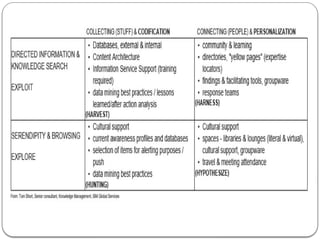
Knowledge Management
๏‚— Knowledge management (KM) is the process of capturing,
developing, sharing, and effectively using organizational
knowledge.
๏‚— It refers to a multi-disciplined approach to achieving organisational
objectives by making the best use of knowledge.
๏‚— "Knowledge management is a discipline that promotes an
integrated approach to identifying, capturing, evaluating,
retrieving, and sharing all of an enterprise's information assets.
๏‚— These assets may include databases, documents, policies,
procedures, and previously un-captured expertise and experience
in individual workers."
The Stages of Development of KM
๏‚— Looking at KM historically through the stages of its
development tells us not only about the history of KM,
๏‚— but it also reveals a great deal about what constitutes KM.
First Stage of KM: Information Technology
๏‚— The first stage has been described using an equestrian
metaphor as by the internet out of intellectual capital .
โ€• โ€–
๏‚— The concept of intellectual capital provided the justification
and the framework, the seed, and the availability of the
internet provided the tool.
๏‚— The hallmark phrase of Stage 1 was first best practices, to
โ€•
be replaced by the more politic lessons learned.
โ€•
๏‚— The salient point is that the first stage of KM was about how
to deploy that new technology to accomplish more effective
use of information and knowledge.
Second Stage of KM: HR and Corporate
Culture
๏‚— The second stage of KM emerged when it became apparent
that simply deploying new technology was not sufficient to
effectively enable information and knowledge sharing.
๏‚— Human and cultural dimensions needed to be addressed.The
second stage might be described as the โ€•
๏‚— If you build it they will comeโ€˜ is a fallacy stageโ€”the
recognition that โ€If you build it they will comeโ€ is a recipe
โ€•
that can easily lead to quick and embarrassing failure if human
factors are not sufficiently taken into account.
๏‚— The hallmark phrase of Stage 2 was communities of practice.
โ€•
๏‚— It became clear that KM implementation would involve changes in
the corporate culture, in many cases rather significant changes.
๏‚— Consider the case above of the new paediatric medicine and the
discovery of the efficacy of adding orange juice to the recipe.
๏‚— Pharmaceutical sales reps are compensated primarily not by salary,
but by bonuses based on sales results.
๏‚— What is in it for that sales rep to share her new discovery when the
most likely result is that next year her bonus would be substantially
reduced?
๏‚— The changes in corporate culture needed to facilitate and encourage
information and knowledge sharing can be major and profound.
๏‚— KM therefore extends far beyond just structuring information and
knowledge and making it more accessible.
Third Stage of KM: Taxonomy and Content
Management
๏‚— The third stage developed from the awareness of the importance
of content, and in particular the awareness of the importance of
the retrievability of content, and therefore of the importance of
the arrangement, description, and structure of that content.
๏‚— Since a good alternative description for the second stage of KM
is the itโ€˜s no good if they donโ€˜t use it stage, then in that vein,
โ€• โ€–
perhaps the best description for the new third stage is the itโ€˜s
โ€•
no good if they try to use it but canโ€˜t find it stage.
โ€–
๏‚— The hallmark phrases emerging for the third stage are content
management (or enterprise content management) and
taxonomies
Fostering Creativity and innovation
๏‚— It is a very common tendency of every employee to get into a rut
at work especially if one has been doing a same kind of job for a
very long time.
๏‚— The longer one has been doing the job the greater is the
tendency to keep doing things the way they have always done
them; as it gets monotonous, easy and boring.
๏‚— In almost every job there is opportunity for creativity and
innovation โ€“ sometimes they are small operational improvements
and sometimes they are big challenging innovations.
๏‚— How can you be creative and innovative at your work? Here are
five steps:
1. There is always a scope for improvement
๏‚— Every single product, service, method and aspect of any job
can be done in many different and better ways.
๏‚— Approach every task with the attitude that the current
method can always be improvised and that your job is to find
a better way to do it.
2. Asking is the beginning of improving
๏‚— Ask colleagues, friends, seniors and customers what problems
and issues they have with a product or service.
๏‚— Discuss ideas for cost savings and quality improvements.
๏‚— Inter-departmental communication about what could be
improvised is also a great way.
๏‚— People in other places have different exposure; thus different
viewpoints and can help to identify problem areas and
opportunities that you could have possibly missed looking at.
๏‚— Network with people in other fields and discuss their attitudes
and approaches to some of the topics that concern you.
3. Unleash the power of ideas
๏‚— Ideas are the raw material for progress.
๏‚— A well co-ordinated brainstorming or ideation session with a
group of diverse people helps generate great ideas for any
business challenge or new business opportunities.
๏‚— Testing, accepting and implementing the best ideas multiply
the chances of success.
4. Learn from the experience of others
๏‚— Experience may be a good teacher; someone elseโ€˜s
experience is a far better teacher.
๏‚— Look far outside.
๏‚— Discuss with superiors and people who have experience and
expertise in tackling the sort of challenges that you or your
organization faces.
4. Learn from the experience of others...
๏‚— Look far outside.
๏‚— How have other organizations in different sectors faired with
challenges?
๏‚— What do businesses similar to yours but in other zones of the
world do?
๏‚— Research may help pinch some of their great ideas and you
can try applying them locally. M
๏‚— Maybe you can contribute a few ideas of your own ideas
which will help your manager or the company at large.
๏‚— Exhibit that you are a positive contributor of ideas.
5. Change your attitude to failure:
๏‚— AsWoody Allen puts it; If youโ€˜re not failing now and
โ€•
again, itโ€˜s a sign you are not doing anything very innovative.โ€–
๏‚— The most innovative organizations really do think differently.
๏‚— The organizations that do not innovate inevitably age and
decline.
๏‚— Thus, to sustain in a period of rapid change it is vital to
recognize the fact that innovation is significant positive
change be it in products, processes or people.
๏‚— Every CEO says the same thing, We need creativity and
โ€•
innovation here.
๏‚— Ironically, in the same organization, we see people
frightened to try new things.
๏‚— There are many barriers to think and create innovatively โ€“
the fear of being judged, the fear of failure, employees being
overburdened, issues of budget etc.
๏‚— There are some other ways to foster innovation,
1. Let Every Employee Play Designer
๏‚— Three years ago, the five-person research and development team at
pet-accessory companyWest Paw Design had a case of collective
writer's block.
๏‚— A production manager named Seth Partain proposed holding a
contest for the company's three-dozen employees.
๏‚— Everyone from salespeople to seamstresses were encouraged to spend
an afternoon designing and producing prototypes for new products.
๏‚— Following an end-of-day vote, a winner was crowned at an award
ceremony.
๏‚— By making employees feel a part of the idea-creation process,West
Paw Design set up a new pipeline of product development.
2. Provide Lots of Free Time to Think.
๏‚— "The five last bastions of thinking are the car, the john, the
shower, the church or synagogue, and the gym," Joey
Reiman, CEO of BrightHouse, told Inc.'s Leigh Buchanan.
Note the absence of office from that roster.
๏‚— So, to allow for that crucial "think time," in addition to
nearly five weeks' vacation, BrightHouse's 18 staff members
get five "Your Days," in which they are encouraged to visit a
spot conducive to reflection and let their neurons rip.
3. Use New Software to Round Up Staff
Ideas
๏‚— What happens when your employees are too shy to pipe up?
๏‚— That happened at Solar Systems, an El Canjon, California,
company that installs solar power systems.
๏‚— So CEO Mike Hall decided to use an online survey tool to
allow employees to review their peers idea submissions โ€“ and
set a prize at $500.
๏‚— "We knew we had people who might be shy about
submitting ideas," he says.
๏‚— "We gave them a forum that encourages everyone to share."
4. Encourage Risk-Taking
๏‚— Another innovation booster at BrightHouse is the company's
annual event known as March Fo(u)rth.
๏‚— On that date, each employee is encouraged to do something
he or she has never before attempted โ€“ say, skydive or give a
large presentation.
๏‚— "If we're known for anything, it's possibilitarianism," says
CEO Reiman
5. Hold an Intern Contest
๏‚— La Jolla Group, an apparel company in Irvine, California, recognized in
2007 that it faced a shortage of designers specializing in surf fashions.
๏‚— So CEOToby Bost came up with the idea for a contest โ€“ a contest to earn
employment in his company.
๏‚— Now, each September, a handful of teens compete in a runway fashion show
judged by audience members who text message a vote for their favorite
designer.
๏‚— The winner of the fashion show receives an internship at La Jolla Group, a
$4,000 scholarship, free clothes, and a mention inTeenVogue.
๏‚— "I knew that we couldn't keep going on by pinching designers from each
other's backyards," Bost said.
๏‚— "We needed to manufacture long-term talent by targeting students early
and focusing them on a design career."
6. Reward Million-Dollar Ideas
๏‚— A few years ago, a college student spending the summer
programming at Fog Creek Software, came to his boss, Inc.
columnist Joel Spolsky, with an idea:
๏‚— What about running job ads on the company's blog?
๏‚— The site was popular in the programming community, and the
student, NoahWeiss, proposed hosting relevant classified job
ads could open up a new revenue stream.
๏‚— It did: more than $1 million came in. Spolsky decided a reward
was in order.
๏‚— But what? Spolsky offered the student an equity stakeโ€”if he
were to return to Fog Creek as a full-time employee.
7. New Project, New Team
๏‚— Innovation Labs inWalnut Creek, California, thrives on being an outfit
of outsiders.
๏‚— That's because the company has just four principals and pulls together a
new team for each new project.
๏‚— Teams are comprised of referrals, including business professors,
webmasters, scientists, and miscellaneous others.
๏‚— Innovation Labs allows these team members to work any way they like.
๏‚— "Some people are amused when they work with us, because we're so
averse to telling people what to do," says managing partner Langdon
Morris.
๏‚— "But we want our people to be creative about how they help clients be
creative."
8. Allocate 10 Percent of Time for Invention
๏‚— Scott Cook, the founder of Intuit, says one of the keys to
encouraging innovation is to let employees be as inventive as
possible.
๏‚— "We encourage this by allowing our engineers and product
managers in most of our divisions to devote 10 percent of
their workweeks to new ideas," Cook says.
๏‚— "That's how we developed many of our products and
features."

MANAGERIAL BEHAVIOUR AND EFFECTIVENESS PRESENATATION Unit 5.pptx

  • 1.
  • 2.
    Organisational and ManagerialEfforts ๏‚— Sustaining success depends on an organizationโ€˜s ability to adapt to a changing environment โ€“ whether itโ€˜s an external change, such as a transformative technology or a changing economy. ๏‚— Unfortunately, 70% of organizational transformations fail. Why? Because too many crucial elements in the change process are skipped. ๏‚— Sometimes we wrongly assume that change is all about improving financial results โ€“ stock price, profitability, sales.We forget that successful transformation also generates soft โ€• โ€– benefits, such as trust, new organizational capabilities, and emotional commitment among employees.
  • 3.
    ๏‚— But evenif we strive for financial and non-financial results, additional perils await: painful emotions that boil up in our workforces whenever we ask people to think or do things differently. ๏‚— Whether itโ€˜s anger, alarm, or confusion, we must ease those feelings by cultivating an environment of trust, involvement and empowerment. ๏‚— Nothing about leading change is easy. ๏‚— Urgency-An organizational burning platform exists when maintaining the status quo becomes prohibitively expensive. ๏‚— Major change is always costly, but when the present course of action is even more expensive, a burning-platform situation erupts.
  • 4.
    Organisational and ManagerialEfforts ... ๏‚— Create a sense of urgency based on the companyโ€˜s financial performance, competitive situation, market position, technological trends โ€“ create a burning platform: ๏‚— What will happen if we donโ€˜t react now? ๏‚— Compelling change story-Management need to be able to tell a compelling change story that motivate employees. ๏‚— But before you get buy-in, people need to feel the problem. ๏‚— People arenโ€˜t going to consider anything until they are convinced there is a problem that truly needs to be addressed.
  • 5.
    Organisational and ManagerialEfforts ... ๏‚— Current strategy-When dealing with change management it is often required to have a closer look at the current strategy. ๏‚— Vision and values-Successful change is hinged on a picture of a desirable future. ๏‚— Vision can provide both a corporate sense of being and a sense of enduring purpose. ๏‚— Without a sensible vision, change efforts can dissolve into a list of confusing projects that take the organization in the wrong direction. ๏‚— It is important that the vision be easy to communicate. Create a shared vision, values and common directions.
  • 6.
    Organisational and ManagerialEfforts ... ๏‚— Communicate-Communicate this information broadly and dramatically, especially with respect to crises, potential crises etc. ๏‚— To successfully implement change initiatives, organizational leaders must identify the need for change and communicate it throughout the organization. ๏‚— Create a dialog-Involving employees right from the start, where they have influence in the strategic plan of the organization, tends to reduce employeesโ€˜ resistance, which is always a very important factor in the success of any organizational change
  • 7.
    Organisational and ManagerialEfforts ... ๏‚— Culture-All change in organizations is challenging, but perhaps the most daunting is changing culture. ๏‚— Whenever possible use storytelling โ€“ storytelling can be a powerful tool when you want to drive organizational change. ๏‚— Visualize the journey-Not only is it easier to communicate โ€• something using a picture, but itโ€˜s also much easier for people to remember things that have been communicated to them visually. ๏‚— People remember 10% of what they hear, 20% of what they read and 80% of what they see and do.
  • 8.
    Organisational and ManagerialEfforts ... ๏‚— Measure-Measurement should be considered during the planning of change and before any action is undertaken. ๏‚— Measure early and often and tell about itWithout measures of success, the organization does not know if it has succeeded in its efforts. ๏‚— Someone once said, What gets measured gets improved. โ€• ๏‚— Someone else said, If you donโ€˜t know where you are โ€• going, any road will get you there.
  • 9.
    Organisational and ManagerialEfforts ... ๏‚— Create wins-It is critical for teams and individuals working on change to achieve small wins regularly. ๏‚— So if you want something to grow, donโ€˜t forget to pour champagne on it. ๏‚— Align performance management-Align performance management processes to drive desired behavior changes Lookout for inconsistencies-Continuously lookout for inconsistencies โ€“ Deal proactively with resistance
  • 10.
    Self Development ๏‚— Personaldevelopment is a lifelong process. It's a way for people to assess their skills and qualities, consider their aims in life and set goals in order to realise and maximise their potential.
  • 11.
    Personal development ๏‚— Apersonal development strategy begins with a simple premise: your development is your responsibility. ๏‚— At heart we probably know this to be the case, yet how often do we sit back waiting for that development to be put on a plate for us. ๏‚— For a lucky few things might fall into place easily, but for most of us that will not be the case. ๏‚— So why not decide that youโ€˜re going to make your own development a priority, rather than leaving things to chance.
  • 12.
    Personal development ๏‚— Herewe suggest 15 tips to help you think about your own personal development strategy. ๏‚— In doing so we propose that you think more widely about how youโ€˜d like to develop. ๏‚— Donโ€˜t limit your thinking to just the work youโ€˜re currently doing. ๏‚— For a happy manager, development is much wider than job specific training, it should be about your career and about your life.
  • 13.
    15 Personal DevelopmentStrategy Tips ๏‚— 1. Make your own development your number 1 priority. ๏‚— 2. Spend more time developing as a person than developing as a manager. ๏‚— 3. Imagine you had to make the case to yourself regarding the development you need.What would it take to convince you to invest? ๏‚— 4. Give yourself a self-appraisal. (self-performance appraisal for some useful questions to ask yourself) ๏‚— 5. Choose how you want to develop, rather than conform to whatever an organization might tell you to do. ๏‚— In some cases they may be one and the same โ€“ but the difference is that you choose to do it!
  • 14.
    15 Personal DevelopmentStrategy Tips... ๏‚— 6. Spend much more time on getting better at what youโ€˜re good at, than struggling to improve your weaknesses. ๏‚— 7. Identify some specific strengths you have and commit to getting even better at them. ๏‚— 8.What do you aspire to do/be? ๏‚— 9. Make the ordinary part of your development โ€“ what โ€• happens in your normal dayโ€˜s work that can help you to develop? ๏‚— 10. Choose something you do, then try to do it to the best of your ability
  • 15.
    15 Personal DevelopmentStrategy Tips... ๏‚— 11.Take real pride in something that you do. ๏‚— 12.Take on an ordinary project and find something extra- ordinary in it โ€“ try to make a real impact. ๏‚— 13.Vary your learning diet. Experience bite-size learning, the small learning snacks just when you need them. ๏‚— But make sure you also experience the breadth of learning from a longer, more measured, learning meal taken โ€• regularly.
  • 16.
    15 Personal DevelopmentStrategy Tips... ๏‚— 14. Cultivate a healthy dissatisfaction with how things are. ๏‚— If you are to improve you need to have some dissatisfaction with your current abilities. ๏‚— Be careful that your motive here is to improve, not to become frustrated or cynical. ๏‚— 15. Learn more about what you really enjoy doing.
  • 17.
    Negotiation Skills ๏‚— Negotiationis a method by which people settle differences - explore the stages of negotiation and learn how to improve your negotiating skills.
  • 18.
    These skills include: ๏‚—๏‚ง Effective verbal communication. See our pages:Verbal Communication and Effective Speaking. ๏‚— ๏‚ง Listening. ... ๏‚— ๏‚ง Reducing misunderstandings is a key part of effective negotiation. ... ๏‚— ๏‚ง Rapport Building. ... ๏‚— ๏‚ง Problem Solving. ... ๏‚— ๏‚ง Decision Making. ... ๏‚— ๏‚ง Assertiveness. ... ๏‚— ๏‚ง Dealing with Difficult Situations
  • 19.
    Problem Analysis ๏‚— Effectivenegotiators must have the skills to analyze a problem to determine the interests of each party in the negotiation. ๏‚— A detailed problem analysis identifies the issue, the interested parties and the outcome goals. ๏‚— For example, in an employer and employee contract negotiation, the problem or area where the parties disagree may be in salary or benefits. ๏‚— Identifying the issues for both sides can help to find a compromise for all parties
  • 20.
    Preparation ๏‚— Before enteringa bargaining meeting, the skilled negotiator prepares for the meeting. ๏‚— Preparation includes determining goals, areas for trade and alternatives to the stated goals. ๏‚— In addition, negotiators study the history of the relationship between the two parties and past negotiations to find areas of agreement and common goals. ๏‚— Past precedents and outcomes can set the tone for current negotiations.
  • 21.
    Active Listening ๏‚— Negotiatorshave the skills to listen actively to the other party during the debate. ๏‚— Active listening involves the ability to read body language as well as verbal communication. ๏‚— It is important to listen to the other party to find areas for compromise during the meeting. ๏‚— Instead of spending the bulk of the time in negotiation expounding the virtues of his viewpoint, the skilled negotiator will spend more time listening to the other party.
  • 22.
    Emotional Control ๏‚— Itis vital that a negotiator have the ability to keep his emotions in check during the negotiation. ๏‚— While a negotiation on contentious issues can be frustrating, allowing emotions to take control during the meeting can lead to unfavourable results. ๏‚— For example, a manager frustrated with the lack of progress during a salary negotiation may concede more than is acceptable to the organization in an attempt to end the frustration. ๏‚— On the other hand, employees negotiating a pay raise may become too emotionally involved to accept a compromise with management and take an all or nothing approach, which breaks down the communication between the two parties
  • 23.
    Verbal Communication ๏‚— Negotiatorsmust have the ability to communicate clearly and effectively to the other side during the negotiation. ๏‚— Misunderstandings can occur if the negotiator does not state his case clearly. ๏‚— During a bargaining meeting, an effective negotiator must have the skills to state his desired outcome as well as his reasoning.
  • 24.
    Collaboration and Teamwork ๏‚—Negotiation is not necessarily a one side against another arrangement. ๏‚— Effective negotiators must have the skills to work together as a team and foster a collaborative atmosphere during negotiations. ๏‚— Those involved in a negotiation on both sides of the issue must work together to reach an agreeable solution.
  • 25.
    Problem Solving ๏‚— Individualswith negotiation skills have the ability to seek a variety of solutions to problems. ๏‚— Instead of focusing on his ultimate goal for the negotiation, the individual with skills can focus on solving the problem, which may be a breakdown in communication, to benefit both sides of the issue.
  • 26.
    Decision Making Ability ๏‚—Leaders with negotiation skills have the ability to act decisively during a negotiation. ๏‚— It may be necessary during a bargaining arrangement to agree to a compromise quickly to end a stalemate.
  • 27.
    Interpersonal Skills ๏‚— Effectivenegotiators have the interpersonal skills to maintain a good working relationship with those involved in the negotiation. ๏‚— Negotiators with patience and the ability to persuade others without using manipulation can maintain a positive atmosphere during a difficult negotiation.
  • 28.
    Ethics and Reliability ๏‚—Ethical standards and reliability in an effective negotiator promote a trusting environment for negotiations. ๏‚— Both sides in a negotiation must trust that the other party will follow through on promises and agreements. ๏‚— A negotiator must have the skills to execute on his promises after bargaining ends.
  • 29.
    Knowledge Management ๏‚— Knowledgemanagement (KM) is the process of capturing, developing, sharing, and effectively using organizational knowledge. ๏‚— It refers to a multi-disciplined approach to achieving organisational objectives by making the best use of knowledge. ๏‚— "Knowledge management is a discipline that promotes an integrated approach to identifying, capturing, evaluating, retrieving, and sharing all of an enterprise's information assets. ๏‚— These assets may include databases, documents, policies, procedures, and previously un-captured expertise and experience in individual workers."
  • 31.
    The Stages ofDevelopment of KM ๏‚— Looking at KM historically through the stages of its development tells us not only about the history of KM, ๏‚— but it also reveals a great deal about what constitutes KM.
  • 32.
    First Stage ofKM: Information Technology ๏‚— The first stage has been described using an equestrian metaphor as by the internet out of intellectual capital . โ€• โ€– ๏‚— The concept of intellectual capital provided the justification and the framework, the seed, and the availability of the internet provided the tool. ๏‚— The hallmark phrase of Stage 1 was first best practices, to โ€• be replaced by the more politic lessons learned. โ€• ๏‚— The salient point is that the first stage of KM was about how to deploy that new technology to accomplish more effective use of information and knowledge.
  • 33.
    Second Stage ofKM: HR and Corporate Culture ๏‚— The second stage of KM emerged when it became apparent that simply deploying new technology was not sufficient to effectively enable information and knowledge sharing. ๏‚— Human and cultural dimensions needed to be addressed.The second stage might be described as the โ€• ๏‚— If you build it they will comeโ€˜ is a fallacy stageโ€”the recognition that โ€If you build it they will comeโ€ is a recipe โ€• that can easily lead to quick and embarrassing failure if human factors are not sufficiently taken into account. ๏‚— The hallmark phrase of Stage 2 was communities of practice. โ€•
  • 34.
    ๏‚— It becameclear that KM implementation would involve changes in the corporate culture, in many cases rather significant changes. ๏‚— Consider the case above of the new paediatric medicine and the discovery of the efficacy of adding orange juice to the recipe. ๏‚— Pharmaceutical sales reps are compensated primarily not by salary, but by bonuses based on sales results. ๏‚— What is in it for that sales rep to share her new discovery when the most likely result is that next year her bonus would be substantially reduced? ๏‚— The changes in corporate culture needed to facilitate and encourage information and knowledge sharing can be major and profound. ๏‚— KM therefore extends far beyond just structuring information and knowledge and making it more accessible.
  • 35.
    Third Stage ofKM: Taxonomy and Content Management ๏‚— The third stage developed from the awareness of the importance of content, and in particular the awareness of the importance of the retrievability of content, and therefore of the importance of the arrangement, description, and structure of that content. ๏‚— Since a good alternative description for the second stage of KM is the itโ€˜s no good if they donโ€˜t use it stage, then in that vein, โ€• โ€– perhaps the best description for the new third stage is the itโ€˜s โ€• no good if they try to use it but canโ€˜t find it stage. โ€– ๏‚— The hallmark phrases emerging for the third stage are content management (or enterprise content management) and taxonomies
  • 36.
    Fostering Creativity andinnovation ๏‚— It is a very common tendency of every employee to get into a rut at work especially if one has been doing a same kind of job for a very long time. ๏‚— The longer one has been doing the job the greater is the tendency to keep doing things the way they have always done them; as it gets monotonous, easy and boring. ๏‚— In almost every job there is opportunity for creativity and innovation โ€“ sometimes they are small operational improvements and sometimes they are big challenging innovations. ๏‚— How can you be creative and innovative at your work? Here are five steps:
  • 37.
    1. There isalways a scope for improvement ๏‚— Every single product, service, method and aspect of any job can be done in many different and better ways. ๏‚— Approach every task with the attitude that the current method can always be improvised and that your job is to find a better way to do it.
  • 38.
    2. Asking isthe beginning of improving ๏‚— Ask colleagues, friends, seniors and customers what problems and issues they have with a product or service. ๏‚— Discuss ideas for cost savings and quality improvements. ๏‚— Inter-departmental communication about what could be improvised is also a great way. ๏‚— People in other places have different exposure; thus different viewpoints and can help to identify problem areas and opportunities that you could have possibly missed looking at. ๏‚— Network with people in other fields and discuss their attitudes and approaches to some of the topics that concern you.
  • 39.
    3. Unleash thepower of ideas ๏‚— Ideas are the raw material for progress. ๏‚— A well co-ordinated brainstorming or ideation session with a group of diverse people helps generate great ideas for any business challenge or new business opportunities. ๏‚— Testing, accepting and implementing the best ideas multiply the chances of success.
  • 40.
    4. Learn fromthe experience of others ๏‚— Experience may be a good teacher; someone elseโ€˜s experience is a far better teacher. ๏‚— Look far outside. ๏‚— Discuss with superiors and people who have experience and expertise in tackling the sort of challenges that you or your organization faces.
  • 41.
    4. Learn fromthe experience of others... ๏‚— Look far outside. ๏‚— How have other organizations in different sectors faired with challenges? ๏‚— What do businesses similar to yours but in other zones of the world do? ๏‚— Research may help pinch some of their great ideas and you can try applying them locally. M ๏‚— Maybe you can contribute a few ideas of your own ideas which will help your manager or the company at large. ๏‚— Exhibit that you are a positive contributor of ideas.
  • 42.
    5. Change yourattitude to failure: ๏‚— AsWoody Allen puts it; If youโ€˜re not failing now and โ€• again, itโ€˜s a sign you are not doing anything very innovative.โ€– ๏‚— The most innovative organizations really do think differently. ๏‚— The organizations that do not innovate inevitably age and decline. ๏‚— Thus, to sustain in a period of rapid change it is vital to recognize the fact that innovation is significant positive change be it in products, processes or people.
  • 43.
    ๏‚— Every CEOsays the same thing, We need creativity and โ€• innovation here. ๏‚— Ironically, in the same organization, we see people frightened to try new things. ๏‚— There are many barriers to think and create innovatively โ€“ the fear of being judged, the fear of failure, employees being overburdened, issues of budget etc. ๏‚— There are some other ways to foster innovation,
  • 44.
    1. Let EveryEmployee Play Designer ๏‚— Three years ago, the five-person research and development team at pet-accessory companyWest Paw Design had a case of collective writer's block. ๏‚— A production manager named Seth Partain proposed holding a contest for the company's three-dozen employees. ๏‚— Everyone from salespeople to seamstresses were encouraged to spend an afternoon designing and producing prototypes for new products. ๏‚— Following an end-of-day vote, a winner was crowned at an award ceremony. ๏‚— By making employees feel a part of the idea-creation process,West Paw Design set up a new pipeline of product development.
  • 45.
    2. Provide Lotsof Free Time to Think. ๏‚— "The five last bastions of thinking are the car, the john, the shower, the church or synagogue, and the gym," Joey Reiman, CEO of BrightHouse, told Inc.'s Leigh Buchanan. Note the absence of office from that roster. ๏‚— So, to allow for that crucial "think time," in addition to nearly five weeks' vacation, BrightHouse's 18 staff members get five "Your Days," in which they are encouraged to visit a spot conducive to reflection and let their neurons rip.
  • 46.
    3. Use NewSoftware to Round Up Staff Ideas ๏‚— What happens when your employees are too shy to pipe up? ๏‚— That happened at Solar Systems, an El Canjon, California, company that installs solar power systems. ๏‚— So CEO Mike Hall decided to use an online survey tool to allow employees to review their peers idea submissions โ€“ and set a prize at $500. ๏‚— "We knew we had people who might be shy about submitting ideas," he says. ๏‚— "We gave them a forum that encourages everyone to share."
  • 47.
    4. Encourage Risk-Taking ๏‚—Another innovation booster at BrightHouse is the company's annual event known as March Fo(u)rth. ๏‚— On that date, each employee is encouraged to do something he or she has never before attempted โ€“ say, skydive or give a large presentation. ๏‚— "If we're known for anything, it's possibilitarianism," says CEO Reiman
  • 48.
    5. Hold anIntern Contest ๏‚— La Jolla Group, an apparel company in Irvine, California, recognized in 2007 that it faced a shortage of designers specializing in surf fashions. ๏‚— So CEOToby Bost came up with the idea for a contest โ€“ a contest to earn employment in his company. ๏‚— Now, each September, a handful of teens compete in a runway fashion show judged by audience members who text message a vote for their favorite designer. ๏‚— The winner of the fashion show receives an internship at La Jolla Group, a $4,000 scholarship, free clothes, and a mention inTeenVogue. ๏‚— "I knew that we couldn't keep going on by pinching designers from each other's backyards," Bost said. ๏‚— "We needed to manufacture long-term talent by targeting students early and focusing them on a design career."
  • 49.
    6. Reward Million-DollarIdeas ๏‚— A few years ago, a college student spending the summer programming at Fog Creek Software, came to his boss, Inc. columnist Joel Spolsky, with an idea: ๏‚— What about running job ads on the company's blog? ๏‚— The site was popular in the programming community, and the student, NoahWeiss, proposed hosting relevant classified job ads could open up a new revenue stream. ๏‚— It did: more than $1 million came in. Spolsky decided a reward was in order. ๏‚— But what? Spolsky offered the student an equity stakeโ€”if he were to return to Fog Creek as a full-time employee.
  • 50.
    7. New Project,New Team ๏‚— Innovation Labs inWalnut Creek, California, thrives on being an outfit of outsiders. ๏‚— That's because the company has just four principals and pulls together a new team for each new project. ๏‚— Teams are comprised of referrals, including business professors, webmasters, scientists, and miscellaneous others. ๏‚— Innovation Labs allows these team members to work any way they like. ๏‚— "Some people are amused when they work with us, because we're so averse to telling people what to do," says managing partner Langdon Morris. ๏‚— "But we want our people to be creative about how they help clients be creative."
  • 51.
    8. Allocate 10Percent of Time for Invention ๏‚— Scott Cook, the founder of Intuit, says one of the keys to encouraging innovation is to let employees be as inventive as possible. ๏‚— "We encourage this by allowing our engineers and product managers in most of our divisions to devote 10 percent of their workweeks to new ideas," Cook says. ๏‚— "That's how we developed many of our products and features."