Beyond EBR (Draft)
Quantum Columns, Spooky Joins and Virtual Integrity for ZDT Data Versioning
Jeff Jacobs, Consulting Data Architect
Jeffrey Jacobs & Associates
About Me
The Problem
• Complex Application
• 1,000s of Tables and Views
• Referential integrity constraints require enforcement
• Application code in PL/SQL, Java, etc.
• New releases/upgrades/patches require significant downtime
Partial Solution - Edition Based Redefinition
(EBR)
• Migrate to Edition Based Redefinition EBR for Zero Down Time (ZDT)
release
• Stage and test new release in same infrastructure independent of current
release
EBR Features
• EBR manages editions of an application for:
• PL/SQL changes
• DDL changes
• EBR’s edition triggers provide the ability to synch data between
editions for changes to DDL
• Edition to be used by code governed by SYS_CONTEXT variable
• Very transparent to existing code
• Each edition has an EDITION_NAME
What is Seed Data?
• Seed Data tables are (usually) reference only tables
• May be parent to multiple Non-Seed Data tables
• “Seed Data” tables contain data that is added/updated for a new release
• Data needs to be “versioned” for each release
• Data is not synched across releases
• Data changes not due to changes in DDL
• New, coordinated version of data for multiple tables for new edition
• Examples
• Field labels for application screen
• Text
• Font
• Color
• Size
• Demo/sample data
• Etc.
Solution Goals
• EBR does not provide support for managing Seed Data
• But we want independent Seed Data for each edition
• Minimal or no changes to existing DML
• Minimal or no changes to existing code
• Minimal or no affect on performance
• Avoid creation of new DB objects, i.e. VIEWS, synonyms, etc.
• Minimize rework
• Preserve referential integrity enforcement
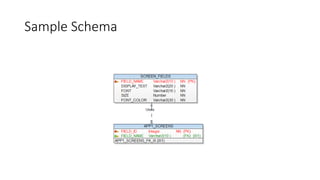
Sample Schema
SYS_CONTEXT Variables
• What are they?
• How to create?
• <code sample>
• How to use?
• <code sample>
Quantum Column Physics POP Quiz!
(Schrodinger’s Cat + Quantum Superposition)
• Can a given row’s virtual column have multiple values at the same
instant in time with no in-flight transactions?
• Yes
• Call this a “Quantum Column” (QC)
• How?
• Virtual column is based on a SYS_CONTEXT variable
• Value of QC is determined by value of SYS_CONTEXT variables
• Can this be used to solve our Seed Data problem?
• TBD!
Never Include a Quantum Column in an Index
• QCs are inherently non-deterministic
• Value is based on session’s value of SYS_CONTEXT variable at time of query
• Virtual column value is determined at runtime
• Indexes are deterministic:
• A virtual column’s value is persisted in the index with the value at the time of
INSERT/UPDATE
“Bollocks” – Bryn Lewellyn
• Starting simple, focus on normal runtime behavior
• Seed data patching issues later
• How it’s done!
• Add a Quantum Column to child table based on EBR SYS_CONTEXT variable
• We’ll name the Quantum Column “EDITION_NAME_QC”
• Drop the FK constraint(s)
• Add a non-virtual version column to parent/Seed table
• Holds the value of EBR editions
• We’ll name this “EDITION_NAME
• Drop PK constraint
• Recreate PK constraint with prior columns plus new version column
• Add Virtual Private Database expression to parent/Seed table to use appropriate EBR edition value
• Normal runtime code uses above EBR SYS_CONTEXT variable value
• Recreate FK
• NO CHANGES TO EXISTING DML!
Demos
• Query to show original query works without new columns in join
• Add new release to Seed Data with updated/new info
• Show same query works in both editions returning appropriate data
• Show referential integrity works
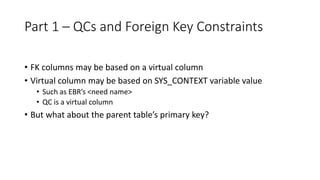
Part 1 – QCs and Foreign Key Constraints
• FK columns may be based on a virtual column
• Virtual column may be based on SYS_CONTEXT variable value
• Such as EBR’s <need name>
• QC is a virtual column
• But what about the parent table’s primary key?
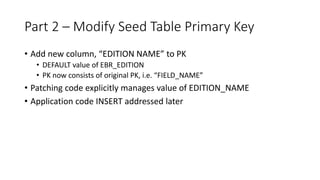
Part 2 – Modify Seed Table Primary Key
• Add new column, “EDITION NAME” to PK
• DEFAULT value of EBR_EDITION
• PK now consists of original PK, i.e. “FIELD_NAME”
• Patching code explicitly manages value of EDITION_NAME
• Application code INSERT addressed later
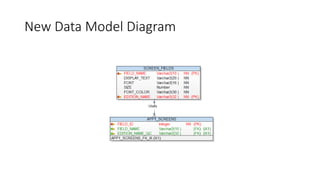
New Data Model Diagram
VPD Example (Spooky Join)
• VPD provides the additional join column between the Seed Data table
and the child table
• “Spooky” join
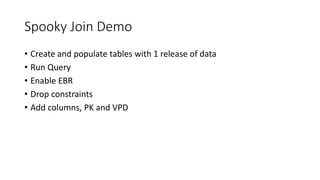
Spooky Join Demo
• Create and populate tables with 1 release of data
• Run Query
• Enable EBR
• Drop constraints
• Add columns, PK and VPD
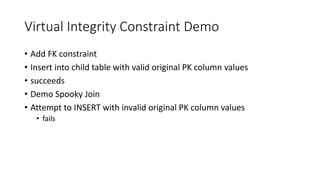
Virtual Integrity Constraint Demo
• Add FK constraint
• Insert into child table with valid original PK column values
• succeeds
• Demo Spooky Join
• Attempt to INSERT with invalid original PK column values
• fails
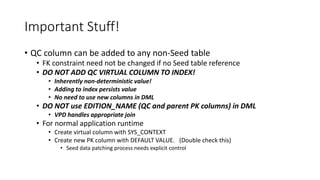
Important Stuff!
• QC column can be added to any non-Seed table
• FK constraint need not be changed if no Seed table reference
• DO NOT ADD QC VIRTUAL COLUMN TO INDEX!
• Inherently non-deterministic value!
• Adding to index persists value
• No need to use new columns in DML
• DO NOT use EDITION_NAME (QC and parent PK columns) in DML
• VPD handles appropriate join
• For normal application runtime
• Create virtual column with SYS_CONTEXT
• Create new PK column with DEFAULT VALUE. (Double check this)
• Seed data patching process needs explicit control
Recap
• Demo’ed and explained basic technique
Life Is Never That Simple
• Distinguish between:
• Normal application code
• Code to manage Seed Data – requires explicit control of values
• Distinguish between:
• Release/upgrade – a new version of the application
• Typically requires new Seed Data
• Patch/fix
• No, or very few, changes to Seed Data
• EBR may have many editions of either type
• Need indirection for SYS_CONTEXT variables and EBR Edition values
• What if end user can update/add to Seed Data table?
More Things to Consider
• The technique described assumes a complete set of Seed Data for
ZDT EBR Rollover to a given release
• For new release, typically bulk copy/MERGE from prior release either:
• At start of release work
• Prior to rollover
• For a fix/patch requiring a only a small amount of Seed Data changes
and small downtime is acceptable
• Backward MERGE from pending release
Beyond Simple EBR – Context Variable
Management
• There may be many EBR editions
• DDL and PL/SQL changes form a single line inheritance structure
• Each EBR edition holds only “true” changes
• Not every new edition requires Seed Data changes
• Solution
• Create new set of SYS_CONTEXT variable, i.e.
• RUNTIME_EDITION holds EBR edition name for current application code release
• PATCHING_EDITION holds EBR edition name for the next release
• Create a mapping table between DEFAULT_EBR and SYS_CONTEXT variable values
• RUNTIME_EDITION <> EBR Default
• Consider not using edition names
• Morph edition name into “release” values
Sample Mapping Table
Application Code INSERT/UPDATE
• Can application code INSERT/UPDATE into Seed Data Table
• If Yes:
• INSERT/UPDATE should be controlled in application, not ad-hoc
INSERT/UPDATE
• Prior to rollover, MERGE from runtime edition into patch edition
• May need to handle sequence/identity column issues
• Potential conflict between new release values and application values
• Out of Scope
• Assumes a brief freeze of such INSERT/UPDATE before rollover
• Worst case requires AFTER INSERT/AFTER UPDATE triggers
Beyond EBR
• This technique is NOT dependent on EBR!!!
• QC, Spook Joins, Virtual Integrity Constraints
• A new technique for versioning multi-row, multi-table datasets
Beyond EBR, Quantum Columns, Spook Joins and Virtual Integrity for ZDT Data Versioning

Beyond EBR, Quantum Columns, Spook Joins and Virtual Integrity for ZDT Data Versioning

  • 1.
    Beyond EBR (Draft) QuantumColumns, Spooky Joins and Virtual Integrity for ZDT Data Versioning Jeff Jacobs, Consulting Data Architect Jeffrey Jacobs & Associates
  • 2.
  • 3.
    The Problem • ComplexApplication • 1,000s of Tables and Views • Referential integrity constraints require enforcement • Application code in PL/SQL, Java, etc. • New releases/upgrades/patches require significant downtime
  • 4.
    Partial Solution -Edition Based Redefinition (EBR) • Migrate to Edition Based Redefinition EBR for Zero Down Time (ZDT) release • Stage and test new release in same infrastructure independent of current release
  • 5.
    EBR Features • EBRmanages editions of an application for: • PL/SQL changes • DDL changes • EBR’s edition triggers provide the ability to synch data between editions for changes to DDL • Edition to be used by code governed by SYS_CONTEXT variable • Very transparent to existing code • Each edition has an EDITION_NAME
  • 6.
    What is SeedData? • Seed Data tables are (usually) reference only tables • May be parent to multiple Non-Seed Data tables • “Seed Data” tables contain data that is added/updated for a new release • Data needs to be “versioned” for each release • Data is not synched across releases • Data changes not due to changes in DDL • New, coordinated version of data for multiple tables for new edition • Examples • Field labels for application screen • Text • Font • Color • Size • Demo/sample data • Etc.
  • 7.
    Solution Goals • EBRdoes not provide support for managing Seed Data • But we want independent Seed Data for each edition • Minimal or no changes to existing DML • Minimal or no changes to existing code • Minimal or no affect on performance • Avoid creation of new DB objects, i.e. VIEWS, synonyms, etc. • Minimize rework • Preserve referential integrity enforcement
  • 8.
  • 9.
    SYS_CONTEXT Variables • Whatare they? • How to create? • <code sample> • How to use? • <code sample>
  • 10.
    Quantum Column PhysicsPOP Quiz! (Schrodinger’s Cat + Quantum Superposition) • Can a given row’s virtual column have multiple values at the same instant in time with no in-flight transactions? • Yes • Call this a “Quantum Column” (QC) • How? • Virtual column is based on a SYS_CONTEXT variable • Value of QC is determined by value of SYS_CONTEXT variables • Can this be used to solve our Seed Data problem? • TBD!
  • 11.
    Never Include aQuantum Column in an Index • QCs are inherently non-deterministic • Value is based on session’s value of SYS_CONTEXT variable at time of query • Virtual column value is determined at runtime • Indexes are deterministic: • A virtual column’s value is persisted in the index with the value at the time of INSERT/UPDATE
  • 12.
    “Bollocks” – BrynLewellyn • Starting simple, focus on normal runtime behavior • Seed data patching issues later • How it’s done! • Add a Quantum Column to child table based on EBR SYS_CONTEXT variable • We’ll name the Quantum Column “EDITION_NAME_QC” • Drop the FK constraint(s) • Add a non-virtual version column to parent/Seed table • Holds the value of EBR editions • We’ll name this “EDITION_NAME • Drop PK constraint • Recreate PK constraint with prior columns plus new version column • Add Virtual Private Database expression to parent/Seed table to use appropriate EBR edition value • Normal runtime code uses above EBR SYS_CONTEXT variable value • Recreate FK • NO CHANGES TO EXISTING DML! Demos • Query to show original query works without new columns in join • Add new release to Seed Data with updated/new info • Show same query works in both editions returning appropriate data • Show referential integrity works
  • 13.
    Part 1 –QCs and Foreign Key Constraints • FK columns may be based on a virtual column • Virtual column may be based on SYS_CONTEXT variable value • Such as EBR’s <need name> • QC is a virtual column • But what about the parent table’s primary key?
  • 14.
    Part 2 –Modify Seed Table Primary Key • Add new column, “EDITION NAME” to PK • DEFAULT value of EBR_EDITION • PK now consists of original PK, i.e. “FIELD_NAME” • Patching code explicitly manages value of EDITION_NAME • Application code INSERT addressed later
  • 15.
  • 16.
    VPD Example (SpookyJoin) • VPD provides the additional join column between the Seed Data table and the child table • “Spooky” join
  • 17.
    Spooky Join Demo •Create and populate tables with 1 release of data • Run Query • Enable EBR • Drop constraints • Add columns, PK and VPD
  • 18.
    Virtual Integrity ConstraintDemo • Add FK constraint • Insert into child table with valid original PK column values • succeeds • Demo Spooky Join • Attempt to INSERT with invalid original PK column values • fails
  • 19.
    Important Stuff! • QCcolumn can be added to any non-Seed table • FK constraint need not be changed if no Seed table reference • DO NOT ADD QC VIRTUAL COLUMN TO INDEX! • Inherently non-deterministic value! • Adding to index persists value • No need to use new columns in DML • DO NOT use EDITION_NAME (QC and parent PK columns) in DML • VPD handles appropriate join • For normal application runtime • Create virtual column with SYS_CONTEXT • Create new PK column with DEFAULT VALUE. (Double check this) • Seed data patching process needs explicit control
  • 20.
    Recap • Demo’ed andexplained basic technique
  • 21.
    Life Is NeverThat Simple • Distinguish between: • Normal application code • Code to manage Seed Data – requires explicit control of values • Distinguish between: • Release/upgrade – a new version of the application • Typically requires new Seed Data • Patch/fix • No, or very few, changes to Seed Data • EBR may have many editions of either type • Need indirection for SYS_CONTEXT variables and EBR Edition values • What if end user can update/add to Seed Data table?
  • 22.
    More Things toConsider • The technique described assumes a complete set of Seed Data for ZDT EBR Rollover to a given release • For new release, typically bulk copy/MERGE from prior release either: • At start of release work • Prior to rollover • For a fix/patch requiring a only a small amount of Seed Data changes and small downtime is acceptable • Backward MERGE from pending release
  • 23.
    Beyond Simple EBR– Context Variable Management • There may be many EBR editions • DDL and PL/SQL changes form a single line inheritance structure • Each EBR edition holds only “true” changes • Not every new edition requires Seed Data changes • Solution • Create new set of SYS_CONTEXT variable, i.e. • RUNTIME_EDITION holds EBR edition name for current application code release • PATCHING_EDITION holds EBR edition name for the next release • Create a mapping table between DEFAULT_EBR and SYS_CONTEXT variable values • RUNTIME_EDITION <> EBR Default • Consider not using edition names • Morph edition name into “release” values
  • 24.
  • 25.
    Application Code INSERT/UPDATE •Can application code INSERT/UPDATE into Seed Data Table • If Yes: • INSERT/UPDATE should be controlled in application, not ad-hoc INSERT/UPDATE • Prior to rollover, MERGE from runtime edition into patch edition • May need to handle sequence/identity column issues • Potential conflict between new release values and application values • Out of Scope • Assumes a brief freeze of such INSERT/UPDATE before rollover • Worst case requires AFTER INSERT/AFTER UPDATE triggers
  • 26.
    Beyond EBR • Thistechnique is NOT dependent on EBR!!! • QC, Spook Joins, Virtual Integrity Constraints • A new technique for versioning multi-row, multi-table datasets