

SQL Parameterized Queries
Index
• Definition
• Why Parameterized Queries?
• Disadvantages
• Parameterized queries VS Stored Procedures
• Parameterized queries using Vb.net
2
Definition
• “Parameterized query (also known as
prepared statement) is a technique of query
execution which separates a query string from
query parameters values”.
3
WHY PARAMETERIZED QUERIES?
4
Protection against SQL Injection
Attack
• If the contents of a text field are just passed to
SQL Server and executed, then that text field
can contain a complete new query that does
something totally different.
• A parameter works because it‘s treated as a
literal value rather than executable code. And
it's also checked for type and length.
Why Parameterized Queries  Protection against SQL Injection Attack6
• A typical SQL injection string would have to be
much longer, and the SqlParameter class
would throw an exception.
Why Parameterized Queries  Protection against SQL Injection Attack7
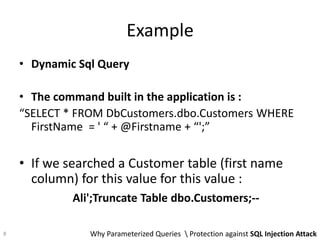
Example
• Dynamic Sql Query
• The command built in the application is :
“SELECT * FROM DbCustomers.dbo.Customers WHERE
FirstName = ' “ + @Firstname + “';”
• If we searched a Customer table (first name
column) for this value for this value :
Ali';Truncate Table dbo.Customers;--
Why Parameterized Queries  Protection against SQL Injection Attack8
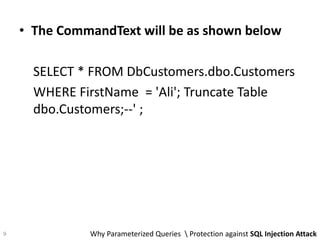
• The CommandText will be as shown below
SELECT * FROM DbCustomers.dbo.Customers
WHERE FirstName = 'Ali'; Truncate Table
dbo.Customers;--' ;
Why Parameterized Queries  Protection against SQL Injection Attack9
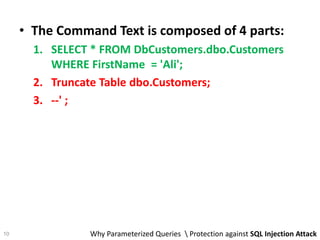
• The Command Text is composed of 4 parts:
1. SELECT * FROM DbCustomers.dbo.Customers
WHERE FirstName = 'Ali';
2. Truncate Table dbo.Customers;
3. --' ;
Why Parameterized Queries  Protection against SQL Injection Attack10
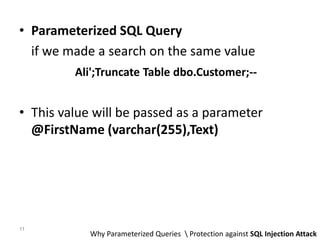
• Parameterized SQL Query
if we made a search on the same value
Ali';Truncate Table dbo.Customer;--
• This value will be passed as a parameter
@FirstName (varchar(255),Text)
Why Parameterized Queries  Protection against SQL Injection Attack
11
12 Why Parameterized Queries  Protection against SQL Injection Attack
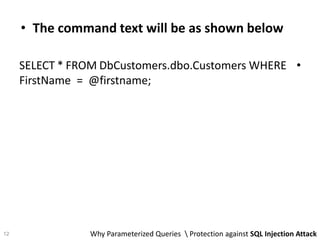
• The command text will be as shown below
•SELECT * FROM DbCustomers.dbo.Customers WHERE
FirstName = @firstname;
• [Firstname] will be compared with the value:
“Ali';Truncate Table dbo.Customer;--”
13 Why Parameterized Queries  Protection against SQL Injection Attack
PERFORMANCE IMPLICATIONS
14
• From the point of view of a developer, there is
no difference between dynamic and
parameterized queries, but there are many
from the point of view of SQL Server.
Why Parameterized Queries  Performance Implications15
• When using dynamic queries the entire query
has to be constructed and compiled by SQL
Server every time
• When using parameterized queries SQL Server
generates a query execution plan just once
and then plugs the parameter value into it.
Why Parameterized Queries  Performance Implications16
Simple Parameterization feature
• In cases in which values are specified explicitly, as
in query below, SQL Server invokes a feature
known as ‘simple parameterization’.
SELECT ZipCode, Latitude, Longitude, City, State,
Country FROM dbo.UsZipCodes WHERE ZipCode =
'54911'
• Simple parameterization is designed to reduce
the resource cost associated with parsing SQL
queries and forming execution plans by
automatically parameterizing queries.
Why Parameterized Queries  Performance Implications17
Simple Parameterization feature
• With simple parameterization, SQL Server
actually creates two execution plans for this
query.
• The first execution plan is a shell plan
containing a pointer to the second execution
plan.
Why Parameterized Queries  Performance Implications18
Experiments
• We will show 2 experiments made by David
Berry (worked extensively with both Oracle
and SQL Server with a special interest in
database performance tuning) concerning
performance implications of parameterized
queries.
Why Parameterized Queries  Performance Implications19
• David berry focused on four different metrics
for the analysis:
– The total elapsed time use to process n queries.
– The total CPU time used by SQL Server to process
n queries.
– The total number of plans in SQL Server’s plan
cache after processing n queries.
– The total amount of memory used by SQL Server’s
plan cache after processing n queries.
Why Parameterized Queries  Performance Implications20
A Most Basic Query
• We created a table called UsZipCodes that
contains a record for every zip code in the
United States along with the associated city,
state, longitude and latitude. In total, there
are 42,741 rows in the table.
Why Parameterized Queries  Performance Implications21
• For both dynamic SQL and parameterized SQL,
we will execute a query that selects a single
record from the table by querying on the zip
code itself.
• This query will then be repeated 5000 times
with a different zip code each time.
• Executing this query 5000 times will comprise
a single test run. To make sure the results are
repeatable, we have performed this test 20
times.
Why Parameterized Queries  Performance Implications22
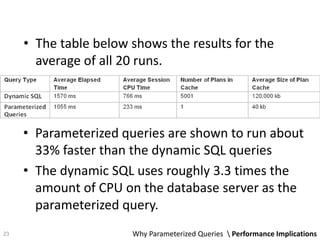
• Parameterized queries are shown to run about
33% faster than the dynamic SQL queries
• The dynamic SQL uses roughly 3.3 times the
amount of CPU on the database server as the
parameterized query.
• The table below shows the results for the
average of all 20 runs.
Why Parameterized Queries  Performance Implications23
• SQL Server is using simple parameterization to
automatically parameterize the dynamic SQL.
Inspecting the plan cache data shows that for
dynamic SQL, there are 5000 different shell
plans and a single auto-parameterized
execution plan.
Why Parameterized Queries  Performance Implications24
Query with a Join and an Order By
• This experiment is using the AdventureWorksLT
database
• Since the AdventureWorksLT contains a small
data sample size, we used a data generator to
insert data into the primary tables in the
database.
• In this test database, the SalesOrderHeader table
contains about 650,000 rows and the
SalesOrderDetail table around 8.5 million rows.
This larger dataset will provide more realistic test
conditions for our test.
Why Parameterized Queries  Performance Implications25
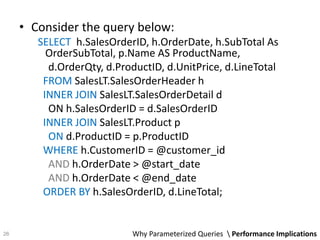
• Consider the query below:
SELECT h.SalesOrderID, h.OrderDate, h.SubTotal As
OrderSubTotal, p.Name AS ProductName,
d.OrderQty, d.ProductID, d.UnitPrice, d.LineTotal
FROM SalesLT.SalesOrderHeader h
INNER JOIN SalesLT.SalesOrderDetail d
ON h.SalesOrderID = d.SalesOrderID
INNER JOIN SalesLT.Product p
ON d.ProductID = p.ProductID
WHERE h.CustomerID = @customer_id
AND h.OrderDate > @start_date
AND h.OrderDate < @end_date
ORDER BY h.SalesOrderID, d.LineTotal;
Why Parameterized Queries  Performance Implications26
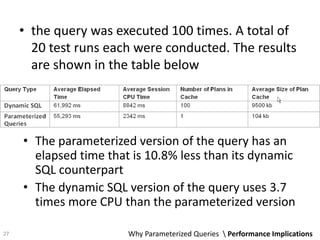
• the query was executed 100 times. A total of
20 test runs each were conducted. The results
are shown in the table below
• The parameterized version of the query has an
elapsed time that is 10.8% less than its dynamic
SQL counterpart
• The dynamic SQL version of the query uses 3.7
times more CPU than the parameterized version
Why Parameterized Queries  Performance Implications27
Experiment Conclusion
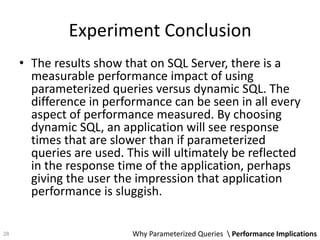
• The results show that on SQL Server, there is a
measurable performance impact of using
parameterized queries versus dynamic SQL. The
difference in performance can be seen in all every
aspect of performance measured. By choosing
dynamic SQL, an application will see response
times that are slower than if parameterized
queries are used. This will ultimately be reflected
in the response time of the application, perhaps
giving the user the impression that application
performance is sluggish.
Why Parameterized Queries  Performance Implications28
SINGLE AND DOUBLE QUOTES
PROBLEMS
29
• Most programmers find parameterized
queries easier to avoid errors when they don‘t
have to keep track of single and double quotes
to construct SQL strings using VB.NET
variables.
Why Parameterized Queries  Single and Double quotes problems30
DISADVANTAGES
31
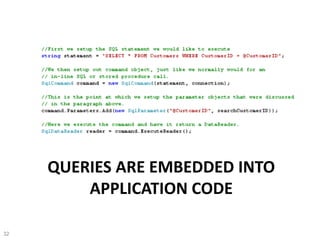
QUERIES ARE EMBEDDED INTO
APPLICATION CODE
32
• One of the main disadvantages is that since
the queries are embedded into your
application code, you could end up with the
same query in multiple places.
This duplication can be eliminated by creating a
central location to store your queries.
• Query are created for one application.
• DBA have no control over the code which
executes on application, which can be a
unsafe for large databases.
Disadvantages queries are embedded into application code33
PARAMETERIZED QUERIES
VS
STORED PROCEDURES
34
Parameterized queries
• DBA’s have less control on
queries.
• Parameters can be add
while building query string.
• Good Execution time.
• Used by single application
Stored procedures
• DBA’s have a very good
control on queries
• Fixed parameters number
• Good Execution time.
• Created once used by many
applications
• More secure; queries are
written on the data layer
Parameterized queries VS Stored Procedures35
• It’s up to you to choose working with
Parameterized queries or Stored Procedures
(According to the application and data
properties and many other factors…)
36
Parameterized queries VS Stored Procedures
PARAMETERIZED QUERIES USING
VB.NET
37
38 Parameterized queries using Vb.net
Any Question?
39
Thank you for listening
40

Sql parametrized queries

  • 1.
  • 2.
    Index • Definition • WhyParameterized Queries? • Disadvantages • Parameterized queries VS Stored Procedures • Parameterized queries using Vb.net 2
  • 3.
    Definition • “Parameterized query(also known as prepared statement) is a technique of query execution which separates a query string from query parameters values”. 3
  • 4.
  • 5.
    Protection against SQLInjection Attack
  • 6.
    • If thecontents of a text field are just passed to SQL Server and executed, then that text field can contain a complete new query that does something totally different. • A parameter works because it‘s treated as a literal value rather than executable code. And it's also checked for type and length. Why Parameterized Queries Protection against SQL Injection Attack6
  • 7.
    • A typicalSQL injection string would have to be much longer, and the SqlParameter class would throw an exception. Why Parameterized Queries Protection against SQL Injection Attack7
  • 8.
    Example • Dynamic SqlQuery • The command built in the application is : “SELECT * FROM DbCustomers.dbo.Customers WHERE FirstName = ' “ + @Firstname + “';” • If we searched a Customer table (first name column) for this value for this value : Ali';Truncate Table dbo.Customers;-- Why Parameterized Queries Protection against SQL Injection Attack8
  • 9.
    • The CommandTextwill be as shown below SELECT * FROM DbCustomers.dbo.Customers WHERE FirstName = 'Ali'; Truncate Table dbo.Customers;--' ; Why Parameterized Queries Protection against SQL Injection Attack9
  • 10.
    • The CommandText is composed of 4 parts: 1. SELECT * FROM DbCustomers.dbo.Customers WHERE FirstName = 'Ali'; 2. Truncate Table dbo.Customers; 3. --' ; Why Parameterized Queries Protection against SQL Injection Attack10
  • 11.
    • Parameterized SQLQuery if we made a search on the same value Ali';Truncate Table dbo.Customer;-- • This value will be passed as a parameter @FirstName (varchar(255),Text) Why Parameterized Queries Protection against SQL Injection Attack 11
  • 12.
    12 Why ParameterizedQueries Protection against SQL Injection Attack • The command text will be as shown below •SELECT * FROM DbCustomers.dbo.Customers WHERE FirstName = @firstname;
  • 13.
    • [Firstname] willbe compared with the value: “Ali';Truncate Table dbo.Customer;--” 13 Why Parameterized Queries Protection against SQL Injection Attack
  • 14.
  • 15.
    • From thepoint of view of a developer, there is no difference between dynamic and parameterized queries, but there are many from the point of view of SQL Server. Why Parameterized Queries Performance Implications15
  • 16.
    • When usingdynamic queries the entire query has to be constructed and compiled by SQL Server every time • When using parameterized queries SQL Server generates a query execution plan just once and then plugs the parameter value into it. Why Parameterized Queries Performance Implications16
  • 17.
    Simple Parameterization feature •In cases in which values are specified explicitly, as in query below, SQL Server invokes a feature known as ‘simple parameterization’. SELECT ZipCode, Latitude, Longitude, City, State, Country FROM dbo.UsZipCodes WHERE ZipCode = '54911' • Simple parameterization is designed to reduce the resource cost associated with parsing SQL queries and forming execution plans by automatically parameterizing queries. Why Parameterized Queries Performance Implications17
  • 18.
    Simple Parameterization feature •With simple parameterization, SQL Server actually creates two execution plans for this query. • The first execution plan is a shell plan containing a pointer to the second execution plan. Why Parameterized Queries Performance Implications18
  • 19.
    Experiments • We willshow 2 experiments made by David Berry (worked extensively with both Oracle and SQL Server with a special interest in database performance tuning) concerning performance implications of parameterized queries. Why Parameterized Queries Performance Implications19
  • 20.
    • David berryfocused on four different metrics for the analysis: – The total elapsed time use to process n queries. – The total CPU time used by SQL Server to process n queries. – The total number of plans in SQL Server’s plan cache after processing n queries. – The total amount of memory used by SQL Server’s plan cache after processing n queries. Why Parameterized Queries Performance Implications20
  • 21.
    A Most BasicQuery • We created a table called UsZipCodes that contains a record for every zip code in the United States along with the associated city, state, longitude and latitude. In total, there are 42,741 rows in the table. Why Parameterized Queries Performance Implications21
  • 22.
    • For bothdynamic SQL and parameterized SQL, we will execute a query that selects a single record from the table by querying on the zip code itself. • This query will then be repeated 5000 times with a different zip code each time. • Executing this query 5000 times will comprise a single test run. To make sure the results are repeatable, we have performed this test 20 times. Why Parameterized Queries Performance Implications22
  • 23.
    • Parameterized queriesare shown to run about 33% faster than the dynamic SQL queries • The dynamic SQL uses roughly 3.3 times the amount of CPU on the database server as the parameterized query. • The table below shows the results for the average of all 20 runs. Why Parameterized Queries Performance Implications23
  • 24.
    • SQL Serveris using simple parameterization to automatically parameterize the dynamic SQL. Inspecting the plan cache data shows that for dynamic SQL, there are 5000 different shell plans and a single auto-parameterized execution plan. Why Parameterized Queries Performance Implications24
  • 25.
    Query with aJoin and an Order By • This experiment is using the AdventureWorksLT database • Since the AdventureWorksLT contains a small data sample size, we used a data generator to insert data into the primary tables in the database. • In this test database, the SalesOrderHeader table contains about 650,000 rows and the SalesOrderDetail table around 8.5 million rows. This larger dataset will provide more realistic test conditions for our test. Why Parameterized Queries Performance Implications25
  • 26.
    • Consider thequery below: SELECT h.SalesOrderID, h.OrderDate, h.SubTotal As OrderSubTotal, p.Name AS ProductName, d.OrderQty, d.ProductID, d.UnitPrice, d.LineTotal FROM SalesLT.SalesOrderHeader h INNER JOIN SalesLT.SalesOrderDetail d ON h.SalesOrderID = d.SalesOrderID INNER JOIN SalesLT.Product p ON d.ProductID = p.ProductID WHERE h.CustomerID = @customer_id AND h.OrderDate > @start_date AND h.OrderDate < @end_date ORDER BY h.SalesOrderID, d.LineTotal; Why Parameterized Queries Performance Implications26
  • 27.
    • the querywas executed 100 times. A total of 20 test runs each were conducted. The results are shown in the table below • The parameterized version of the query has an elapsed time that is 10.8% less than its dynamic SQL counterpart • The dynamic SQL version of the query uses 3.7 times more CPU than the parameterized version Why Parameterized Queries Performance Implications27
  • 28.
    Experiment Conclusion • Theresults show that on SQL Server, there is a measurable performance impact of using parameterized queries versus dynamic SQL. The difference in performance can be seen in all every aspect of performance measured. By choosing dynamic SQL, an application will see response times that are slower than if parameterized queries are used. This will ultimately be reflected in the response time of the application, perhaps giving the user the impression that application performance is sluggish. Why Parameterized Queries Performance Implications28
  • 29.
    SINGLE AND DOUBLEQUOTES PROBLEMS 29
  • 30.
    • Most programmersfind parameterized queries easier to avoid errors when they don‘t have to keep track of single and double quotes to construct SQL strings using VB.NET variables. Why Parameterized Queries Single and Double quotes problems30
  • 31.
  • 32.
    QUERIES ARE EMBEDDEDINTO APPLICATION CODE 32
  • 33.
    • One ofthe main disadvantages is that since the queries are embedded into your application code, you could end up with the same query in multiple places. This duplication can be eliminated by creating a central location to store your queries. • Query are created for one application. • DBA have no control over the code which executes on application, which can be a unsafe for large databases. Disadvantages queries are embedded into application code33
  • 34.
  • 35.
    Parameterized queries • DBA’shave less control on queries. • Parameters can be add while building query string. • Good Execution time. • Used by single application Stored procedures • DBA’s have a very good control on queries • Fixed parameters number • Good Execution time. • Created once used by many applications • More secure; queries are written on the data layer Parameterized queries VS Stored Procedures35
  • 36.
    • It’s upto you to choose working with Parameterized queries or Stored Procedures (According to the application and data properties and many other factors…) 36 Parameterized queries VS Stored Procedures
  • 37.
  • 38.
  • 39.
  • 40.
    Thank you forlistening 40

Editor's Notes

  • #3  Index ===== Definition Why Parameterized Queries? Protection against SQL Injection Attack Performance Implications Single and double quotes Problems Disadvantages Queries are embedded into application code Parameterized queries VS Stored Procedures Parameterized queries using Vb.net ===============================
  • #4 Definition Reference: * Author: Mateusz Zoltak * URL: http://cran.r-project.org/web/packages/RODBCext/vignettes/Parameterized_SQL_queries.html * Date Posted: 2014-07-04 * Date Retrieved: 2014-09-11