CALIFORNIA	
  PUBLIC	
  UTILITIES	
  COMMISSION	
  
Beyond	
  33%	
  Renewables:	
  	
  
Grid	
  Integration	
  Policy	
  for	
  a	
  
Low-­‐Carbon	
  Future	


A	
  CPUC	
  Staff	
  White	
  Paper	


11/25/2015	


ACKNOWLEDGMENTS	
  
Authors:	
   	
   Meredith	
  Younghein,	
  J.D.,	
  Senior	
  Analyst,	
  Energy	
  Division	
  
Eric	
  Martinot,	
  Ph.D.,	
  CPUC	
  Visiting	
  Fellow,	
  and	
  Professor	
  of	
  Management	
  and	
  
Economics,	
  Beijing	
  Institute	
  of	
  Technology	
  	
  
Editor:	
   	
   	
   Jason	
  Ortego	
  
Division	
  Director:	
  	
   Edward	
  Randolph	
  
Deputy	
  Div.	
  Director:	
   Cynthia	
  Walker	
  
Program	
  Manager:	
   Molly	
  Sterkel	


CPUC	
  Energy	
  Division	
  Staff	
  Contributors	


Simon	
  Baker	
  
Lewis	
  Bichkoff	
  
Donald	
  Brooks	
  
Noel	
  Crisostomo	
  
Paul	
  Douglas	
  
Eric	
  Dupre	
  	
  
John	
  “Dave”	
  Erickson	
  
Joanna	
  Gubman	
  
Jason	
  Houck	
  
Sara	
  Kamins	
  
Forest	
  Kaser	
  
Michele	
  Kito	
  
Manisha	
  Lakhanpal	
  
Megha	
  Lakhchaura
Robert	
  Levin	
  
Scarlett	
  Liang-­‐Uejio	
  
Rachel	
  McMahon	
  
Marc	
  Monbouquette	
  
Joy	
  Morgenstern	
  
Gabe	
  Petlin	
  
Neal	
  Reardon	
  
Whitney	
  Richardson	
  	
  
Colin	
  Rizzo	
  
Ann-­‐Christina	
  Rothchild	
  
Robert	
  Strauss	
  
Katie	
  Wu	
  
Patrick	
  Young


The	
  authors	
  would	
  like	
  to	
  thank	
  the	
  CPUC	
  Energy	
  Division	
  staff,	
  especially	
  those	
  listed	
  above,	
  for	
  their	
  
invaluable	
  help	
  in	
  the	
  drafting	
  and	
  reviewing	
  of	
  this	
  paper.	
  The	
  authors	
  also	
  appreciate	
  the	
  contributions	
  of	
  
CAISO	
  staff	
  (Delphine	
  Hou,	
  Nan	
  Liu,	
  Shucheng	
  Liu)	
  to	
  the	
  contents	
  of	
  this	
  paper.	


The	
  views	
  expressed	
  in	
  this	
  White	
  Paper	
  do	
  not	
  necessarily	
  reflect	
  those	
  of	
  the	
  individuals	
  outside	
  the	
  CPUC-­‐	
  
Energy	
  Division.	


Table	
  of	
  Contents	
  
PREFACE ...................................................................................................................................................... vi	
  
EXECUTIVE	
  SUMMARY ................................................................................................................................vii	
  
LIST	
  OF	
  ACRONYMS...................................................................................................................................... x	
  
I.	
   Introduction:	
  The	
  Changing	
  Grid—Going	
  Beyond	
  33%	
  RPS .................................................................. 1	
  
A.	
   Revising	
  Policy-­‐Making	
  Structures................................................................................................. 2	
  
B.	
   Understanding	
  California’s	
  Changing	
  Power	
  Grid.......................................................................... 3	
  
C.	
   The	
  Changing	
  Paradigm	
  for	
  Grid	
  Planning	
  and	
  Reliability ............................................................. 4	
  
D.	
   Policy-­‐Making	
  along	
  the	
  “Grid	
  Integration	
  Policy	
  Pathway” ......................................................... 5	
  
II.	
   Signposts	
  of	
  Potential	
  Reliability	
  and	
  Economic	
  Impacts ...................................................................... 6	
  
A.	
   The	
  Electric	
  Grid	
  and	
  the	
  Continued	
  Growth	
  of	
  Renewable	
  Generation ...................................... 6	
  
B.	
   Signpost	
  of	
  Reliability:	
  Managing	
  the	
  Evening	
  Ramp .................................................................... 9	
  
C.	
   Signpost	
  of	
  Reliability:	
  Over-­‐Supply	
  vs.	
  Over-­‐Generation,	
  and	
  Resulting	
  Curtailments.............. 11	
  
1.	
   Causes	
  of	
  Over-­‐Supply,	
  Over-­‐Generation,	
  and	
  Curtailment ............................................... 11	
  
2.	
   Background	
  on	
  Economic	
  and	
  Manual	
  Curtailments .......................................................... 12	
  
3.	
   Curtailment	
  Observations ................................................................................................... 13	
  
4.	
   Over-­‐Supply	
  and	
  Over-­‐Generation	
  Predictions	
  in	
  Long-­‐Term	
  Modeling............................. 15	
  
5.	
   Cost-­‐Effectiveness	
  of	
  Curtailment....................................................................................... 16	
  
D.	
   Signpost	
  of	
  Reliability:	
  Need	
  for	
  Ancillary	
  Services ..................................................................... 17	
  
E.	
   Conclusion.................................................................................................................................... 18	
  
III.	
   Current	
  Actions	
  to	
  Address	
  Grid	
  Integration....................................................................................... 19	
  
A.	
   Flexibility	
  and	
  Grid	
  Integration	
  in	
  Long-­‐Term	
  Procurement	
  Planning......................................... 19	
  
B.	
   Supply-­‐Side	
  Flexibility	
  for	
  Grid	
  Integration.................................................................................. 20	
  
1.	
   Flexible	
  Capacity:	
  Flexible	
  Resource	
  Adequacy	
  and	
  CAISO	
  Flexible	
  Must-­‐Offer	
  Obligation 20	
  
2.	
   New	
  Market	
  Mechanism:	
  Flexible	
  Ramping	
  Product.......................................................... 21	
  
3.	
   Regionalization	
  of	
  Energy	
  Markets	
  and	
  Balancing	
  Areas .................................................... 22	


4.	
   Adjusting	
  the	
  Value	
  of	
  Renewables	
  in	
  Procurement........................................................... 23	
  
C.	
   Distributed	
  Energy	
  Resource	
  Flexibility	
  for	
  Grid	
  Integration....................................................... 25	
  
1.	
   Designing	
  Effective	
  Retail	
  Rates,	
  Tariffs,	
  and	
  Incentivizing	
  PEVs......................................... 25	
  
2.	
   Integrating,	
  Optimizing,	
  and	
  Interconnecting	
  Distributed	
  Energy	
  Resources..................... 27	
  
D.	
   Power	
  System	
  Dispatch	
  and	
  Control ........................................................................................... 30	
  
IV.	
   Beyond	
  Current	
  Actions	
  and	
  Toward	
  a	
  Long-­‐term	
  Vision.................................................................... 31	
  
A.	
   Recommendations	
  for	
  Short-­‐Term	
  “No	
  Regrets”	
  Approaches.................................................... 31	
  
1.	
   Enhance	
  Flexibility	
  with	
  Distributed	
  Energy	
  Resources:	
  Time-­‐of-­‐Use	
  Pricing,	
  PEV	
  Charging	
  
and	
  Demand	
  Response.................................................................................................. 31	
  
2.	
   Enhance	
  Supply-­‐Side	
  Resource	
  Flexibility:	
  Procurement	
  Mechanisms,	
  Valuation,	
  and	
  
Compensation................................................................................................................ 34	
  
3.	
   Balancing	
  the	
  Role	
  of	
  Procurement	
  vs.	
  the	
  Energy	
  Market ................................................ 34	
  
B.	
   Long-­‐Term	
  Vision......................................................................................................................... 35	
  
1.	
   Enhanced	
  Flexibility	
  from	
  Distributed	
  Energy	
  Resources.................................................... 36	
  
2.	
   Enhanced	
  Flexibility	
  from	
  Supply-­‐Side	
  Resources............................................................... 37	
  
3.	
   Advanced	
  Grid	
  Integration	
  Concepts	
  and	
  Frameworks....................................................... 37	
  
V.	
   Moving	
  Forward	
  along	
  the	
  “Grid	
  Integration	
  Policy	
  Pathway” ........................................................... 39	
  
A.	
   Guiding	
  Questions ....................................................................................................................... 39	
  
B.	
   Analysis	
  of	
  Existing	
  Efforts,	
  Future	
  Needs	
  and	
  Approaches,	
  and	
  Least-­‐Cost	
  Solutions ............... 39	
  
1.	
   Determine	
  the	
  Flexibility	
  Implications	
  of	
  Existing	
  Policies,	
  Programs	
  and	
  Initiatives ......... 39	
  
2.	
   Make	
  Improved	
  Assessments	
  of	
  Flexibility	
  Needs	
  under	
  Future	
  Procurement	
  Scenarios	
  
with	
  Higher	
  Shares	
  of	
  Variable	
  Renewables.................................................................. 40	
  
3.	
   Conduct	
  a	
  Comprehensive	
  Review	
  of	
  Potential	
  Supply-­‐Side	
  and	
  Demand-­‐Side	
  Approaches	
  
for	
  Grid	
  Integration........................................................................................................ 42	
  
4.	
   Create	
  the	
  Modeling	
  and	
  Analytical	
  Tools	
  to	
  Determine	
  Least-­‐Cost	
  Solutions	
  to	
  Grid	
  
Integration..................................................................................................................... 43	
  
C.	
   Developing	
  Grid	
  Integration	
  Policy.............................................................................................. 45	
  
D.	
   Conclusion:	
  Making	
  Progress	
  along	
  the	
  Grid-­‐Integration	
  Policy	
  Path	
  and	
  Developing	
  an	
  Action	
  
Plan............................................................................................................................................. 48	


Annex	
  to	
  Chapter	
  V:	
  Staff’s	
  Initial	
  Ideas	
  for	
  Strategies	
  within	
  Existing	
  Proceedings ........................... 50	
  
APPENDIX	
  A:	
  California	
  in	
  International	
  Context ....................................................................................... 52	
  
APPENDIX	
  B:	
  Selected	
  Literature ............................................................................................................... 58	
  
GLOSSARY................................................................................................................................................... 61	


Tables	
  
Table	
  1.	
  Renewable	
  Curtailment	
  Data	
  Provided	
  by	
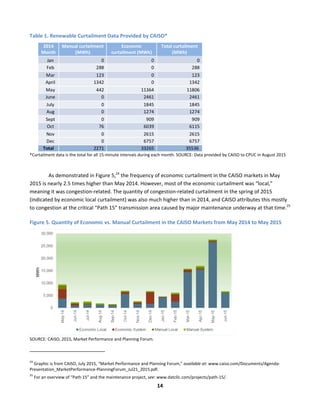
  CAISO......................................................................... 14	
  
Table	
  2.	
  CAISO-­‐Recommended	
  TOU	
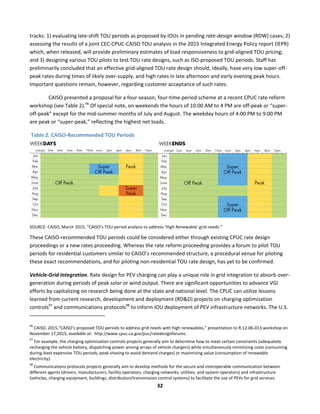
  Periods ............................................................................................. 32	
  
Table	
  3.	
  Key	
  Policy	
  Questions	
  to	
  Answer	
  through	
  CPUC	
  Proceedings ....................................................... 47	
  
Figures	
  
Figure	
  1.	
  Hourly	
  Renewable	
  Generation	
  in	
  CAISO’s	
  Service	
  Territory—June	
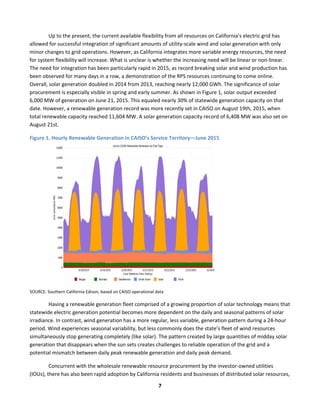
  2015 ..................................... 7	
  
Figure	
  2.	
  DG	
  Solar	
  PV	
  Capacity	
  Installed	
  by	
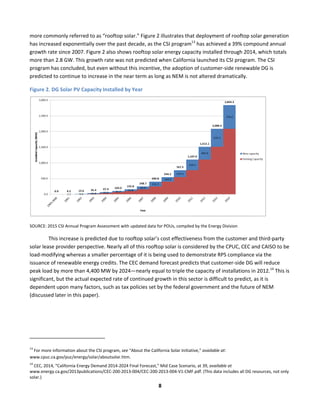
  Year ......................................................................................... 8	
  
Figure	
  3.	
  Load	
  vs.	
  Net	
  Load	
  in	
  April	
  and	
  December	
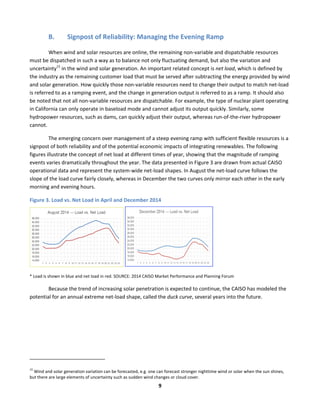
  2014 ............................................................................ 9	
  
Figure	
  4.	
  CAISO's	
  Duck	
  Curve:	
  Net	
  Load	
  Predictions	
  through	
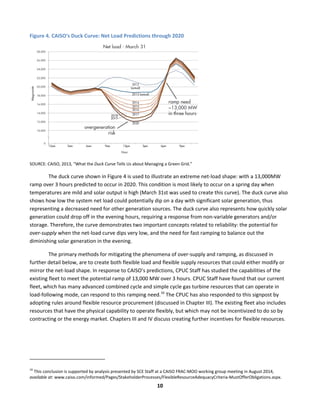
  2020 ........................................................... 10	
  
Figure	
  5.	
  Quantity	
  of	
  Economic	
  vs.	
  Manual	
  Curtailment	
  in	
  CAISO	
  May	
  2014	
  to	
  May	
  2015....................... 14	
  
Boxes	
  
Box	
  1.	
  Key	
  Elements	
  in	
  a	
  Flexibility	
  Assessment ........................................................................................ 42	
  
Box	
  2.	
  Production	
  Cost	
  Simulations	
  to	
  Assess	
  Integration	
  Costs ............................................................... 45	
  
 
vi	
  
PREFACE	
  
We,	
  the	
  Staff	
  of	
  the	
  California	
  Public	
  Utilities	
  Commission	
  (CPUC),	
  offer	
  this	
  paper	
  to	
  provide	
  discussion	
  
material	
  that	
  will	
  enable	
  the	
  CPUC	
  to	
  create	
  an	
  action	
  plan	
  for	
  grid	
  integration.	
  This	
  paper	
  aims	
  to	
  inform	
  and	
  
educate	
  the	
  reader	
  and	
  facilitate	
  CPUC	
  stakeholders	
  in	
  reaching	
  a	
  shared	
  understanding	
  of	
  grid	
  integration	
  
challenges	
  and	
  solutions.	
  This	
  paper	
  puts	
  forth	
  for	
  discussion	
  the	
  elements	
  of	
  a	
  path	
  forward,	
  in	
  terms	
  of	
  
existing	
  CPUC	
  proceedings	
  and	
  programs,	
  and	
  also	
  in	
  terms	
  of	
  the	
  incorporation	
  of	
  grid	
  integration	
  issues	
  in	
  
any	
  new	
  planning	
  process.	
  This	
  paper	
  also	
  emphasizes	
  the	
  magnitude	
  and	
  scope	
  of	
  the	
  analysis	
  required	
  to	
  
properly	
  identify	
  the	
  nature	
  of	
  the	
  grid	
  integration	
  challenges	
  and	
  solutions.	
  	
  
We	
  encourage	
  the	
  reader	
  to	
  consider	
  the	
  questions	
  listed	
  below.	
  Where	
  this	
  paper	
  may	
  fall	
  short	
  in	
  answering	
  
these	
  questions,	
  we	
  invite	
  interested	
  stakeholders	
  to	
  provide	
  further	
  ideas	
  and	
  information.	
  Our	
  expectation	
  is	
  
that	
  comments	
  from	
  stakeholders	
  will	
  allow	
  Staff	
  to	
  create	
  the	
  foundations	
  for	
  future	
  action.	
  	
  
• What	
  We	
  Need	
  to	
  Know.	
  What	
  critical	
  knowledge	
  is	
  the	
  CPUC	
  still	
  lacking?	
  What	
  are	
  the	
  missing	
  answers	
  to	
  
key	
  grid	
  integration	
  questions	
  that	
  may	
  prevent	
  the	
  CPUC	
  from	
  launching	
  policies	
  to	
  manage	
  grid	
  integration	
  
beyond	
  33%?	
  	
  
• Possible	
  Reliability	
  Concerns.	
  Does	
  this	
  paper	
  appropriately	
  capture	
  the	
  most	
  important	
  “reliability	
  
signposts”	
  of	
  grid	
  integration?	
  As	
  renewable	
  procurement	
  increases,	
  which	
  cost	
  and	
  reliability	
  concerns	
  
merit	
  the	
  CPUC’s	
  focus?	
  	
  
• Current	
  Activities.	
  What	
  actions	
  are	
  underway	
  to	
  address	
  grid	
  integration?	
  Does	
  the	
  paper	
  leave	
  out	
  
important	
  in-­‐progress	
  actions	
  by	
  California	
  agencies	
  to	
  assist	
  grid	
  integration?	
  
• Short-­‐Term	
  Approaches	
  and	
  a	
  Long-­‐Term	
  Vision.	
  How	
  can	
  the	
  CPUC,	
  over	
  the	
  next	
  two	
  years,	
  enhance	
  the	
  
approaches	
  to	
  grid	
  integration	
  that	
  have	
  already	
  been	
  identified?	
  What	
  is	
  an	
  appropriate	
  long-­‐term	
  vision	
  
for	
  grid	
  integration?	
  
• Moving	
  Forward	
  on	
  the	
  Grid	
  Integration	
  Pathway.	
  What	
  analyses	
  should	
  the	
  CPUC	
  pursue	
  in	
  the	
  next	
  two	
  
to	
  three	
  years,	
  and	
  how	
  should	
  these	
  be	
  pursued?	
  How	
  can	
  we	
  conduct	
  a	
  comprehensive	
  review	
  of	
  the	
  
supply-­‐side	
  and	
  demand-­‐side	
  approaches	
  for	
  addressing	
  grid	
  integration?	
  How	
  could	
  CPUC,	
  working	
  with	
  the	
  
California	
  Energy	
  Commission	
  and	
  CAISO,	
  develop	
  a	
  vision	
  and	
  embark	
  on	
  a	
  pathway	
  towards	
  long-­‐term	
  
solutions?	
  	
  
Staff	
  believes	
  that	
  “grid	
  integration”	
  is	
  both	
  an	
  end-­‐state	
  and	
  a	
  process.	
  Our	
  vision	
  for	
  an	
  integrated	
  electric	
  
grid	
  of	
  the	
  future	
  is	
  a	
  grid	
  that:	
  operates	
  seamlessly	
  and	
  reliably,	
  produces	
  much	
  lower	
  GHG	
  emissions,	
  includes	
  
large	
  proportions	
  of	
  variable	
  renewable	
  generation	
  resources,	
  allows	
  high	
  adoption	
  rates	
  of	
  electric	
  vehicles	
  to	
  
contribute	
  to	
  grid	
  support,	
  and	
  allows	
  a	
  transformation	
  in	
  distributed	
  energy	
  resources	
  of	
  all	
  types	
  in	
  providing	
  
energy,	
  flexibility,	
  and	
  reliability	
  services.	
  
The	
  process	
  to	
  achieve	
  grid	
  integration	
  is	
  to	
  solve	
  a	
  set	
  of	
  three	
  interlinked	
  challenges,	
  and	
  to	
  harness	
  the	
  
opportunities	
  created	
  by	
  these	
  challenges:	
  (1)	
  to	
  integrate	
  wind	
  and	
  solar	
  resources,	
  in	
  increasing	
  amounts,	
  
onto	
  the	
  grid,	
  particularly	
  at	
  the	
  bulk	
  or	
  transmission	
  level;	
  (2)	
  to	
  respond	
  to	
  the	
  changes	
  in	
  system-­‐wide	
  
customer	
  load	
  due	
  to	
  increased	
  rooftop	
  solar	
  installations	
  and	
  connected	
  electric	
  vehicles;	
  (3)	
  to	
  bring	
  about,	
  in	
  
concert:	
  changes	
  to	
  the	
  characteristics	
  of	
  traditional	
  resources,	
  changes	
  to	
  the	
  functionality	
  and	
  role	
  of	
  
distributed	
  energy	
  resources,	
  changes	
  to	
  operational	
  and	
  planning	
  practices	
  at	
  both	
  transmission	
  and	
  
distribution	
  levels,	
  and	
  changes	
  to	
  wholesale	
  and	
  retail	
  markets	
  and	
  tariffs.	
  
 
vii	
  
EXECUTIVE	
  SUMMARY	
  
California’s	
  Renewable	
  Portfolio	
  Standard	
  and	
  other	
  clean	
  energy	
  policies	
  put	
  the	
  state	
  on	
  a	
  clear	
  path	
  
to	
  dramatic	
  reductions	
  of	
  greenhouse	
  gas	
  emissions	
  and	
  a	
  transition	
  to	
  a	
  low-­‐carbon	
  power	
  grid.	
  The	
  state	
  is	
  
poised	
  to	
  achieve	
  its	
  33%	
  Renewable	
  Portfolio	
  Standard	
  target	
  on	
  schedule,	
  by	
  2020.	
  In	
  going	
  beyond	
  33%,	
  and	
  
especially	
  in	
  working	
  towards	
  the	
  new	
  Senate	
  Bill	
  350	
  mandate	
  for	
  a	
  50%	
  renewables	
  target,	
  a	
  number	
  of	
  
additional	
  technical,	
  economic,	
  market,	
  and	
  policy	
  issues	
  are	
  expected	
  to	
  arise.	
  These	
  issues	
  could	
  collectively	
  
be	
  considered	
  the	
  “grid	
  integration	
  challenge.”	
  These	
  issues	
  arise	
  in	
  the	
  context	
  of	
  a	
  power	
  grid	
  that	
  is	
  
undergoing	
  rapid	
  changes,	
  including	
  the	
  portfolio	
  of	
  utility-­‐scale	
  generation,	
  the	
  daily	
  pattern	
  of	
  energy	
  use	
  
(load)	
  and	
  generation,	
  and	
  the	
  quantity	
  and	
  role	
  of	
  distributed	
  energy	
  resources.	
  The	
  changes	
  to	
  the	
  power	
  
grid	
  are	
  being	
  driven	
  by	
  a	
  wide	
  variety	
  of	
  policies	
  and	
  market	
  forces.	
  This	
  transformation	
  of	
  the	
  physical	
  power	
  
grid,	
  in	
  turn,	
  is	
  driving	
  a	
  changing	
  paradigm	
  for	
  electric	
  system	
  planning	
  and	
  regulation,	
  the	
  core	
  objectives	
  of	
  
which	
  are	
  to	
  ensure	
  safe	
  and	
  reliable	
  service	
  at	
  reasonable	
  cost,	
  while	
  meeting	
  environmental	
  mandates.	
  
As	
  discussed	
  in	
  Chapter	
  I,	
  the	
  characteristics	
  of	
  California’s	
  existing	
  grid	
  infrastructure	
  have	
  allowed	
  for	
  
successful	
  integration	
  of	
  significant	
  amounts	
  of	
  variable	
  wind	
  and	
  solar	
  generation,	
  and	
  significant	
  de-­‐
carbonizing	
  of	
  the	
  electric	
  sector,	
  with	
  only	
  minor	
  changes	
  to	
  grid	
  operations	
  to	
  date.	
  In	
  2015,	
  record-­‐breaking	
  
solar	
  and	
  wind	
  production	
  was	
  observed	
  for	
  many	
  consecutive	
  days.	
  As	
  the	
  shares	
  of	
  solar	
  and	
  wind	
  generation	
  
grow,	
  the	
  need	
  for	
  grid	
  operators	
  to	
  respond	
  to	
  the	
  daily	
  and	
  seasonal	
  patterns	
  of	
  solar	
  and	
  wind	
  generators	
  
increases,	
  and	
  the	
  system	
  likely	
  faces	
  a	
  mismatch	
  between	
  the	
  daily	
  peak	
  of	
  renewable	
  generation	
  and	
  daily	
  
peak	
  demand.	
  	
  
Nevertheless,	
  the	
  CPUC	
  does	
  not	
  currently	
  observe	
  any	
  clear	
  signals	
  that	
  California’s	
  present	
  trajectory	
  
toward	
  33%	
  renewables	
  has	
  created	
  unexpected	
  and	
  unmanageable	
  reliability	
  issues.	
  However,	
  in	
  thinking	
  
about	
  a	
  renewables	
  future	
  beyond	
  33%,	
  there	
  are	
  three	
  emerging	
  reliability	
  “signposts”	
  that	
  point	
  to	
  the	
  need	
  
to	
  increase	
  system	
  flexibility	
  and	
  address	
  grid	
  integration	
  in	
  new	
  ways.	
  As	
  explained	
  in	
  Chapter	
  II,	
  these	
  three	
  
signposts	
  are	
  ramping	
  ability,	
  over-­‐generation,	
  and	
  the	
  need	
  for	
  ancillary	
  services.	
  	
  
In	
  terms	
  of	
  ramping	
  ability,	
  an	
  extreme	
  daily	
  net-­‐load	
  shape	
  with	
  a	
  13	
  GW	
  evening	
  ramp	
  occurring	
  over	
  
a	
  3-­‐hour	
  period	
  is	
  predicted	
  to	
  occur	
  by	
  2020.	
  Occasional	
  over-­‐generation	
  events	
  have	
  also	
  resulted	
  in	
  part	
  
from	
  increasing	
  renewable	
  output,	
  but	
  such	
  events	
  have	
  so	
  far	
  been	
  mitigated	
  by	
  curtailing	
  renewable	
  
generation	
  and	
  therefore	
  have	
  not	
  caused	
  reliability	
  impacts.	
  However,	
  the	
  California	
  Independent	
  System	
  
Operator	
  (CAISO)	
  predicts	
  that	
  increasing	
  renewable	
  penetration	
  may	
  lead	
  to	
  frequent	
  over-­‐generation	
  
conditions	
  in	
  the	
  future	
  and	
  significant	
  amounts	
  of	
  curtailed	
  renewable	
  energy.	
  It	
  is	
  unclear	
  whether	
  increasing	
  
curtailments	
  of	
  renewable	
  generation	
  is	
  a	
  cost-­‐effective	
  solution	
  to	
  over-­‐generation	
  in	
  the	
  long-­‐term,	
  or	
  
whether	
  California	
  should	
  focus	
  on	
  developing	
  more	
  cost-­‐effective	
  alternatives.	
  Finally,	
  increasing	
  penetration	
  
of	
  wind	
  and	
  solar	
  resources	
  creates	
  an	
  increased	
  need	
  for	
  ancillary	
  services	
  to	
  respond	
  to	
  fluctuations	
  and	
  
uncertainties,	
  but	
  wind	
  and	
  solar	
  generators	
  provide	
  ancillary	
  services	
  less	
  effectively	
  than	
  conventional	
  
generators,	
  particularly	
  under	
  current	
  designs	
  and	
  operations.	
  Because	
  of	
  this	
  situation,	
  determining	
  future	
  
ancillary	
  services	
  needs	
  and	
  the	
  most	
  reliable	
  and	
  economic	
  means	
  of	
  meeting	
  them	
  is	
  a	
  critical	
  part	
  of	
  
planning	
  for	
  high	
  levels	
  of	
  renewable	
  generation.	
  Therefore,	
  Chapter	
  II	
  concludes	
  that	
  it	
  is	
  unlikely	
  that	
  the	
  
state	
  will	
  be	
  able	
  to	
  cost-­‐effectively	
  achieve	
  the	
  Governor’s	
  new	
  greenhouse	
  gas	
  goals,	
  or	
  to	
  integrate	
  the	
  
renewables	
  necessary	
  to	
  reach	
  50%	
  renewables,	
  without	
  further	
  transformation	
  of	
  the	
  electric	
  grid.	


viii	
  
As	
  outlined	
  in	
  Chapter	
  III,	
  California	
  has	
  responded	
  in	
  significant	
  ways	
  to	
  the	
  grid	
  integration	
  challenge	
  
in	
  recent	
  years	
  by	
  implementing	
  many	
  practices	
  and	
  policies	
  that	
  assist	
  grid	
  integration.	
  The	
  state	
  will	
  continue	
  
to	
  do	
  so	
  as	
  it	
  reaches	
  its	
  33%	
  Renewable	
  Portfolio	
  Standard	
  by	
  2020.	
  These	
  practices	
  and	
  policies	
  are	
  
distributed	
  across	
  a	
  wide	
  array	
  of	
  CPUC	
  proceedings,	
  CAISO	
  initiatives,	
  and	
  California	
  Energy	
  Commission	
  
programs.	
  For	
  example,	
  the	
  scope	
  of	
  the	
  Long-­‐Term	
  Procurement	
  Plan	
  proceeding	
  has	
  evolved	
  in	
  a	
  number	
  of	
  
ways	
  to	
  more	
  directly	
  assess	
  the	
  grid	
  integration	
  challenge	
  through	
  modeling	
  flexible	
  needs,	
  curtailments,	
  and	
  
integration	
  costs.	
  This	
  proceeding	
  has	
  not	
  yet	
  found	
  that	
  grid	
  integration	
  challenges	
  merit	
  specialized	
  
procurement	
  to	
  meet	
  a	
  specific	
  long-­‐term	
  deficiency.	
  Nonetheless,	
  initiatives	
  and	
  programs	
  aimed	
  at	
  providing	
  
the	
  system	
  with	
  more	
  supply-­‐side	
  flexibility	
  are	
  underway	
  in	
  five	
  main	
  categories:	
  flexible	
  resource	
  adequacy	
  
and	
  must-­‐offer	
  obligations;	
  storage	
  procurement;	
  CAISO	
  market	
  mechanisms;	
  renewables	
  procurement	
  
changes	
  and	
  valuation;	
  and	
  regionalization	
  of	
  real-­‐time	
  energy	
  markets.	
  	
  
In	
  addition	
  to	
  supply-­‐side	
  responses,	
  California	
  has	
  initiated	
  grid	
  integration	
  solutions	
  that	
  will	
  aim	
  to	
  
provide	
  flexibility	
  for	
  grid	
  integration	
  via	
  distributed	
  energy	
  resources	
  and	
  demand-­‐side	
  initiatives,	
  including	
  
time-­‐of-­‐use	
  and	
  dynamic	
  rate	
  design,	
  demand	
  response	
  program	
  design,	
  distributed	
  storage,	
  smart	
  inverter	
  
standards,	
  and	
  plug-­‐in	
  electric	
  vehicle	
  integration.	
  Studies	
  are	
  also	
  being	
  conducted	
  to	
  understand	
  the	
  
potential	
  of	
  demand	
  response	
  and	
  distributed	
  generation	
  to	
  aid	
  with	
  grid	
  integration.	
  Finally,	
  innovations	
  in	
  
power	
  system	
  dispatch	
  and	
  control,	
  including	
  enhanced	
  day-­‐ahead	
  weather	
  forecasting,	
  have	
  greatly	
  increased	
  
CAISO’s	
  ability	
  to	
  integrate	
  renewables.	
  	
  
Chapter	
  IV	
  looks	
  ahead	
  to	
  recommend	
  how	
  to	
  expand	
  upon	
  the	
  current	
  activities	
  described	
  in	
  Chapter	
  
III.	
  To	
  provide	
  a	
  stronger	
  foundation	
  of	
  short-­‐term	
  approaches,	
  Chapter	
  IV	
  presents	
  a	
  series	
  of	
  in-­‐progress	
  and	
  
possible	
  “low	
  regrets”	
  or	
  “no	
  regrets”	
  approaches	
  that	
  may	
  provide	
  additional	
  flexibility.	
  Examples	
  of	
  enhanced	
  
policies	
  and	
  programs	
  include	
  establishing	
  time-­‐of-­‐use	
  and	
  dynamic	
  rates,	
  modifying	
  net	
  energy	
  metering,	
  and	
  
PEV	
  charging	
  tariffs	
  to	
  align	
  with	
  grid	
  needs;	
  considering	
  new	
  procurement	
  targets	
  for	
  storage	
  and	
  flexible	
  
capacity;	
  and	
  adopting	
  revisions	
  to	
  an	
  “integration	
  adder”	
  to	
  better	
  account	
  for	
  the	
  grid	
  integration	
  costs	
  of	
  
renewables	
  procurement.	
  	
  
Chapter	
  IV	
  also	
  proposes	
  a	
  long-­‐term	
  vision	
  for	
  what	
  the	
  power	
  grid	
  of	
  the	
  future	
  could	
  look	
  like	
  if	
  
California	
  fully	
  incorporates	
  grid	
  integration	
  into	
  our	
  planning,	
  procurement,	
  and	
  operation	
  processes.	
  The	
  
vision	
  is	
  one	
  of	
  a	
  grid	
  transformed,	
  wherein	
  utility	
  scale	
  wind	
  and	
  solar	
  are	
  balanced	
  through	
  responsive	
  load	
  
and	
  other	
  services	
  provided	
  by	
  distributed	
  resources.	
  These	
  resources	
  could	
  include	
  responsive	
  distributed	
  
generation,	
  plug-­‐in	
  electric	
  vehicle	
  charging,	
  and	
  energy	
  storage.	
  The	
  vision	
  for	
  supply-­‐side	
  flexible	
  resources	
  is	
  
seen	
  in	
  terms	
  of	
  “all-­‐source	
  procurement”	
  and	
  “all-­‐source	
  valuation,”	
  removing	
  the	
  distinction	
  between	
  
“supply-­‐side”	
  and	
  “demand-­‐side”	
  resources.	
  Furthermore,	
  the	
  vision	
  includes	
  new	
  conceptions	
  of	
  power	
  
system	
  architecture	
  that	
  may	
  redefine	
  the	
  operational,	
  planning,	
  and	
  technical	
  boundaries	
  between	
  the	
  bulk-­‐
grid	
  transmission	
  system	
  overseen	
  by	
  CAISO	
  and	
  distribution	
  systems	
  overseen	
  by	
  distribution	
  system	
  
operators.	
  
Chapter	
  V	
  presents	
  a	
  number	
  of	
  important	
  primary	
  analyses	
  that	
  must	
  be	
  completed	
  so	
  that	
  the	
  CPUC	
  
can	
  understand	
  how	
  best	
  to	
  proceed	
  toward	
  the	
  long-­‐term	
  vision	
  laid	
  out	
  in	
  Chapter	
  IV.	
  These	
  analyses	
  are	
  
necessary	
  for	
  the	
  CPUC	
  to	
  proceed	
  in	
  an	
  integrated	
  and	
  least-­‐cost	
  manner.	
  Broadly	
  speaking,	
  the	
  CPUC	
  should	
  
quantify	
  flexibility	
  needs,	
  consider	
  all	
  reasonable	
  solutions	
  to	
  create	
  flexibility,	
  and	
  attempt	
  to	
  understand	
  their	
  
relative	
  costs	
  and	
  time	
  frames.	
  More	
  specifically,	
  to	
  arrive	
  at	
  the	
  long-­‐term	
  vision	
  of	
  least-­‐cost	
  flexibility	
  
 
ix	
  
solutions,	
  the	
  CPUC	
  should	
  conduct	
  the	
  following	
  analyses:	
  	
  (1)	
  make	
  improved	
  assessments	
  of	
  flexibility,	
  
ancillary	
  services,	
  and	
  other	
  grid	
  needs	
  by	
  examining	
  the	
  existing	
  generation	
  fleet,	
  in	
  addition	
  to	
  the	
  emerging	
  
set	
  of	
  distributed	
  energy	
  resources;	
  (2)	
  conduct	
  a	
  cost-­‐benefit	
  analysis	
  of	
  all	
  potential	
  grid	
  integration	
  
solutions,	
  including	
  supply-­‐side	
  resources,	
  distributed	
  energy	
  resources,	
  and	
  market	
  designs;	
  and	
  (3)	
  assess	
  
least-­‐cost	
  pathways	
  towards	
  grid	
  integration	
  that	
  account	
  for	
  all	
  potential	
  solutions.	
  These	
  could	
  be	
  easily	
  
coordinated	
  with	
  the	
  SB	
  350	
  mandate	
  for	
  integrated	
  resource	
  planning	
  	
  
Before	
  these	
  analyses	
  can	
  be	
  performed,	
  the	
  CPUC	
  would	
  need	
  to	
  create,	
  with	
  help	
  from	
  other	
  
agencies	
  and	
  stakeholders,	
  the	
  modeling	
  and	
  analytical	
  tools	
  to	
  determine	
  least-­‐cost	
  solutions	
  to	
  grid	
  
integration,	
  beginning	
  by	
  determining	
  what	
  types	
  of	
  modeling	
  approaches	
  would	
  be	
  necessary	
  to	
  answer	
  basic	
  
questions	
  about	
  least-­‐cost	
  solutions.	
  This	
  type	
  of	
  far-­‐reaching	
  and	
  complex	
  analysis	
  may	
  need	
  to	
  be	
  overseen	
  in	
  
a	
  new	
  type	
  of	
  “grid	
  integration	
  planning”	
  process	
  focused	
  on	
  understanding	
  and	
  addressing	
  grid	
  integration	
  
challenges,	
  as	
  well	
  as	
  coordinating	
  with	
  the	
  ongoing	
  efforts	
  in	
  various	
  proceedings	
  and	
  programs.	


Chapter	
  V	
  also	
  suggests	
  how	
  grid	
  integration	
  planning	
  could	
  be	
  accomplished	
  through	
  existing	
  and	
  
future	
  proceedings.	
  To	
  determine	
  how	
  best	
  to	
  answer	
  the	
  policy	
  questions	
  raised	
  throughout	
  this	
  paper,	
  the	
  
CPUC	
  would	
  need	
  to	
  consider	
  making	
  program	
  changes	
  and	
  re-­‐focusing	
  proceedings.	
  Grid	
  integration	
  planning	
  
could	
  lead	
  towards	
  an	
  action	
  plan	
  based	
  on	
  the	
  results	
  of	
  the	
  analyses	
  recommended	
  in	
  Chapter	
  V	
  and	
  focused	
  
on	
  a	
  long-­‐term	
  vision	
  of	
  an	
  integrated	
  grid.	
  Policy	
  questions	
  to	
  address	
  through	
  a	
  grid	
  integration	
  planning	
  
process	
  involve	
  conducting	
  flexibility	
  cost-­‐benefit	
  analyses	
  that	
  cut	
  across	
  and	
  encompass	
  all	
  relevant	
  
proceedings;	
  targeting	
  and	
  enabling	
  the	
  role	
  of	
  distributed	
  energy	
  resources	
  and	
  load-­‐modifying	
  programs;	
  
incentivizing	
  storage;	
  procuring	
  supply-­‐side	
  flexible	
  resources;	
  undertaking	
  integrated	
  approaches	
  that	
  
combine	
  supply-­‐side	
  resources	
  and	
  distributed	
  energy	
  resources;	
  understanding	
  future	
  needs	
  for	
  ancillary	
  
services;	
  and	
  conducting	
  greenhouse	
  gas	
  analyses.	
  	
  
While	
  California	
  is	
  leading	
  the	
  way	
  and	
  faced	
  with	
  unique	
  circumstances,	
  it	
  is	
  not	
  alone	
  in	
  facing	
  the	
  
grid	
  integration	
  challenge.	
  As	
  outlined	
  in	
  Appendix	
  A,	
  many	
  other	
  jurisdictions	
  around	
  the	
  world	
  are	
  also	
  
committed	
  to	
  integrating	
  high	
  shares	
  of	
  renewables.	
  International	
  experience	
  points	
  to	
  curtailment	
  and	
  over-­‐
generation	
  as	
  growing	
  issues	
  internationally.	
  A	
  primary	
  concern	
  in	
  leading	
  countries	
  like	
  Germany,	
  Denmark,	
  
Ireland,	
  and	
  China	
  is	
  wind	
  power	
  over-­‐generation,	
  whereas	
  in	
  California,	
  solar	
  over-­‐generation	
  is	
  of	
  greater	
  
concern.	
  International	
  experience	
  also	
  points	
  to	
  many	
  issues	
  and	
  solutions	
  such	
  as	
  increased	
  attention	
  to	
  
flexible	
  conventional	
  generation,	
  enhanced	
  power	
  market	
  designs,	
  enhanced	
  transmission	
  planning,	
  the	
  
appropriate	
  contributions	
  of	
  storage	
  and	
  demand	
  response,	
  the	
  means	
  by	
  which	
  distributed	
  energy	
  resources	
  
can	
  be	
  part	
  of	
  the	
  solution,	
  and	
  new	
  ways	
  to	
  plan	
  and	
  operate	
  distribution	
  systems.	
  	
  
Further	
  integration	
  of	
  high	
  shares	
  of	
  renewable	
  energy	
  on	
  California’s	
  power	
  grid	
  of	
  the	
  future	
  will	
  
depend	
  fundamentally	
  on	
  managing	
  the	
  variability	
  and	
  flexibility	
  of	
  resources.	
  The	
  means	
  for	
  achieving	
  this	
  
future	
  could	
  be	
  called	
  the	
  “grid	
  integration	
  policy	
  path.”	
  This	
  paper	
  is	
  intended	
  to	
  advance	
  understanding,	
  
discussion,	
  and	
  ultimately	
  consensus	
  about	
  policy-­‐making	
  along	
  this	
  path,	
  and	
  to	
  help	
  the	
  reader	
  understand	
  
that	
  achieving	
  the	
  end-­‐state	
  of	
  an	
  integrated	
  grid	
  is	
  possible,	
  if	
  given	
  the	
  appropriate	
  attention.	
  
 
x	
  
LIST	
  OF	
  ACRONYMS	
  
AAEE	
  –	
  additional	
  achievable	
  energy	
  efficiency	
  
AB	
  32	
  –	
  Assembly	
  Bill	
  32,	
  Global	
  Warming	
  Solutions	
  Act	
  of	
  2006	
  
AFV	
  –	
  Alternative	
  Fuel	
  Vehicles	
  (proceeding)	
  
CAISO	
  –	
  California	
  Independent	
  System	
  Operator	
  
CEC	
  –	
  California	
  Energy	
  Commission	
  
CES-­‐21	
  –	
  California	
  Energy	
  Systems	
  for	
  the	
  21st	
  Century	
  
CHP	
  –	
  combined	
  heat	
  and	
  power	
  
CPUC	
  –	
  California	
  Public	
  Utilities	
  Commission	
  
CSI	
  –	
  California	
  Solar	
  Initiative	
  
DER	
  –	
  distributed	
  energy	
  resources	
  
DERGIS	
  –	
  Distributed	
  Energy	
  Resources	
  Generation	
  Integration	
  Study	
  
DERP	
  –	
  distributed	
  energy	
  resources	
  provider	
  
DG	
  –	
  distributed	
  generation	
  
DR	
  –	
  demand	
  response	
  
DRP	
  –	
  Distributed	
  Resources	
  Planning	
  (proceeding)	
  
EE	
  –	
  energy	
  efficiency	
  
EFC	
  –	
  effective	
  flexible	
  capacity	
  
EIM	
  –	
  Energy	
  Imbalance	
  Market	
  
ELCC	
  –	
  effective	
  load	
  carrying	
  capability	
  
EOM	
  –	
  energy-­‐only	
  market	
  
ESDER	
  –	
  energy	
  storage	
  and	
  distributed	
  energy	
  resources	
  
FERC	
  –	
  Federal	
  Energy	
  Regulatory	
  Commission	
  
FRAC-­‐MOO	
  –	
  Flexible	
  Resource	
  Adequacy–Must-­‐Offer	
  Obligation	
  
GHG	
  –	
  greenhouse	
  gas	
  
GW—gigawatt	
  	
  
GWh	
  –	
  gigawatt-­‐hour	
  
IDER	
  –	
  Integrated	
  Distributed	
  Energy	
  Resources	
  (proceeding)	
  
IEPR	
  –	
  Integrated	
  Energy	
  Policy	
  Report	
  
IOU	
  –	
  investor-­‐owned	
  utility	
  (usually	
  refers	
  to	
  PG&E,	
  SCE,	
  and	
  SDG&E	
  collectively)	
  
IRM	
  –	
  Intermittent	
  Resources	
  Management	
  
JASC	
  –	
  Joint	
  Agency	
  Steering	
  Committee	
  
kW	
  –	
  kilowatt	
  	
  
kWh	
  –	
  kilowatt-­‐hour	
  	
  
LCBF	
  –	
  least-­‐cost,	
  best-­‐fit	
  (methodology)	
  
LSE	
  –	
  load-­‐serving	
  entity	
  
LTPP	
  –	
  Long-­‐Term	
  Procurement	
  Plan	
  (proceeding)	
  
MOO	
  –	
  must-­‐offer	
  obligation	
  
MW	
  –	
  megawatt	
  	
  
MWh	
  –	
  megawatt-­‐hour	
  
NEM	
  –	
  net	
  energy	
  metering	
  
PEV	
  –	
  plug-­‐in	
  electric	
  vehicles	
  
PG&E	
  –	
  Pacific	
  Gas	
  &	
  Electric	
  
PV	
  –	
  photovoltaic	
  
RA	
  –	
  Resource	
  Adequacy	
  (proceeding)	
  
RD&D	
  –	
  research,	
  development	
  and	
  deployment	
  
RDW	
  –	
  rate-­‐design	
  window	
  
 
xi	
  
RPS	
  –	
  Renewable	
  Portfolio	
  Standard	
  
SB	
  350	
  –	
  Senate	
  Bill	
  350,	
  Clean	
  Energy	
  and	
  Pollution	
  Reduction	
  Act	
  of	
  2015	
  
SCE	
  –	
  Southern	
  California	
  Edison	
  
SDG&E	
  –	
  San	
  Diego	
  Gas	
  &	
  Electric	
  
SGIP	
  –	
  Self-­‐Generation	
  Incentive	
  Program	
  
SWIG	
  –	
  Smart	
  Inverter	
  Working	
  Group	
  
TOU	
  –	
  time	
  of	
  use	
  
VGI	
  –	
  vehicle-­‐grid	
  integration	
  
ZEV	
  –	
  zero	
  emission	
  vehicles	
  
 
1	
  
I. Introduction:	
  The	
  Changing	
  Grid—Going	
  Beyond	
  33%	
  RPS	
  
Why	
  must	
  California	
  plan	
  for	
  grid	
  integration	
  when	
  planning	
  for	
  a	
  high	
  renewable	
  energy	
  future?	
  
What	
  aspects	
  of	
  the	
  CPUC	
  policy-­‐making	
  structure	
  may	
  require	
  revision	
  to	
  address	
  a	
  challenge	
  of	
  this	
  
nature?	
  What	
  do	
  we	
  know	
  about	
  the	
  changing	
  grid	
  and	
  how	
  could	
  this	
  knowledge	
  lead	
  to	
  a	
  new	
  
planning	
  paradigm?	
  What	
  lies	
  ahead	
  on	
  the	
  “policy-­‐making	
  pathway”	
  for	
  grid	
  integration?	
  	
  
The	
  passage	
  of	
  the	
  Clean	
  Energy	
  and	
  Pollution	
  Reduction	
  Act	
  of	
  2015	
  (SB	
  350)	
  builds	
  upon	
  the	
  2006	
  
Global	
  Warming	
  Solutions	
  Act	
  (AB	
  32)1
	
  in	
  putting	
  California	
  on	
  a	
  clear	
  path	
  to	
  dramatic	
  reductions	
  of	
  
greenhouse	
  gas	
  (GHG)	
  emissions	
  and	
  the	
  transition	
  to	
  a	
  sustainable,	
  low-­‐carbon	
  future.	
  A	
  major	
  component	
  of	
  
this	
  transition	
  has	
  been	
  the	
  rapid	
  growth	
  of	
  renewable	
  energy	
  for	
  power	
  generation	
  over	
  the	
  past	
  decade.	
  
Actually,	
  California’s	
  transition	
  to	
  a	
  low-­‐carbon	
  grid	
  began	
  much	
  earlier.	
  The	
  state	
  has	
  been	
  a	
  leader	
  in	
  
renewable	
  energy	
  since	
  the	
  1980s,	
  and	
  during	
  the	
  1990s	
  and	
  2000s,	
  wind,	
  solar,	
  and	
  biomass	
  generation	
  grew	
  
rapidly	
  in	
  California,	
  in	
  parallel	
  with	
  growth	
  in	
  several	
  other	
  leading	
  U.S.	
  states	
  and	
  countries	
  worldwide.	
  This	
  
growth	
  was	
  in	
  response	
  to	
  both	
  declining	
  renewable	
  technology	
  costs	
  and	
  strong	
  policy	
  incentives.	
  By	
  2011,	
  
California	
  had	
  raised	
  its	
  Renewable	
  Portfolio	
  Standard	
  (RPS)	
  to	
  33%	
  by	
  2020,	
  one	
  of	
  the	
  highest	
  shares	
  of	
  any	
  
state	
  or	
  national	
  jurisdiction	
  in	
  the	
  world.	
  This	
  33%	
  RPS	
  became	
  a	
  key	
  pillar	
  of	
  the	
  state’s	
  GHG	
  reduction	
  plan.	
  	
  
California	
  is	
  poised	
  to	
  achieve	
  the	
  33%	
  RPS	
  program	
  target	
  on	
  schedule.2
	
  While	
  the	
  state	
  seems	
  well	
  
positioned	
  to	
  handle	
  the	
  33%	
  renewables	
  level	
  without	
  major	
  changes	
  to	
  other	
  planning,	
  procurement,	
  or	
  
energy	
  policies,	
  CPUC	
  Staff	
  has	
  concerns,	
  echoed	
  by	
  many	
  in	
  state	
  leadership,	
  that	
  going	
  above	
  33%	
  will	
  create	
  
significant	
  grid	
  reliability3
	
  challenges,	
  unless	
  the	
  CPUC	
  comprehensively	
  plans	
  for	
  grid	
  integration.	
  Staff’s	
  
concerns	
  have	
  become	
  more	
  pressing	
  since	
  the	
  Governor	
  released	
  very	
  ambitious	
  GHG	
  goals	
  via	
  an	
  executive	
  
order	
  in	
  early	
  2015,4
	
  followed	
  by	
  the	
  passage	
  of	
  SB	
  350,	
  which	
  codified	
  these	
  GHG	
  reducing	
  measures.5


In	
  going	
  beyond	
  33%	
  to	
  realize	
  a	
  vision	
  of	
  a	
  low-­‐carbon	
  grid,	
  a	
  number	
  of	
  technical,	
  economic,	
  market,	
  
and	
  policy	
  issues	
  are	
  likely	
  to	
  arise.	
  These	
  issues	
  could	
  collectively	
  be	
  considered	
  the	
  “grid	
  integration	
  
challenge.”	
  From	
  a	
  technical	
  and	
  market	
  point	
  of	
  view,	
  concerns	
  have	
  emerged	
  over	
  how	
  to	
  manage	
  the	
  types	
  
of	
  daily	
  resource	
  fluctuations	
  inherent	
  in	
  a	
  grid	
  powered	
  with	
  significant	
  quantities	
  of	
  variable	
  renewable	
  
energy	
  resources.	
  Staff	
  also	
  observes	
  that	
  without	
  proper	
  comprehensive	
  planning	
  there	
  will	
  likely	
  be	
  reliability	
  
and	
  cost	
  impacts	
  to	
  the	
  operation	
  of	
  California’s	
  power	
  grid.	
  Staff	
  has	
  recently	
  observed	
  a	
  trend	
  of	
  curtailment	
  
of	
  renewable	
  generation,	
  and	
  if	
  the	
  trend	
  continues	
  in	
  proportion	
  to	
  the	
  increase	
  in	
  renewables,	
  this	
  may	
  
impact	
  the	
  state’s	
  ability	
  to	
  meet	
  renewable	
  and	
  GHG	
  goals	
  in	
  the	
  most	
  cost-­‐effective	
  manner	
  possible.	


1
	
  AB	
  32	
  (2006),	
  CA	
  Health	
  &	
  Safety	
  Code	
  §38500	
  et	
  seq.	
  
2
	
  Based	
  on	
  current	
  procurement	
  contracts,	
  California’s	
  three	
  major	
  utilities	
  are	
  each	
  expected	
  to	
  reach	
  33%	
  by	
  2020	
  or	
  even	
  sooner.	
  
SDG&E	
  is	
  expected	
  to	
  reach	
  33%	
  by	
  2016.	
  
3
	
  Throughout	
  this	
  paper,	
  terms	
  that	
  are	
  defined	
  in	
  the	
  Glossary	
  are	
  introduced	
  with	
  italics	
  upon	
  their	
  first	
  use.	
  
4
	
  See	
  www.gov.ca.gov/news.php?id=18938.	
  	
  
5
	
  SB	
  350,	
  signed	
  into	
  law	
  by	
  Governor	
  Brown	
  on	
  October	
  7,2015,	
  lays	
  out	
  a	
  trajectory	
  of	
  40%	
  RPS	
  by	
  2024,	
  45%	
  by	
  2027,	
  and	
  50%	
  by	
  
2030;	
  see	
  Pub.	
  Util.	
  Code§	
  399.15(b)(2)(B).	
  SB	
  350	
  also	
  addresses	
  electric	
  vehicles,	
  energy	
  efficiency,	
  and	
  integrated	
  resource	
  planning.	
  
 
2	
  
The	
  CPUC’s	
  long-­‐term	
  planning	
  and	
  procurement	
  policies,	
  including	
  those	
  governing	
  both	
  utility-­‐scale	
  
resources	
  and	
  distributed	
  energy	
  resources	
  (DERs),	
  have	
  evolved	
  to	
  meet	
  the	
  33%	
  RPS	
  target.	
  The	
  California	
  
Independent	
  System	
  Operator	
  (CAISO)	
  has	
  similarly	
  adapted	
  its	
  electricity	
  markets	
  and	
  grid	
  operations.	
  
Evidence	
  for	
  these	
  evolutions	
  and	
  adaptations	
  can	
  be	
  seen	
  in	
  the	
  extensive	
  scope	
  of	
  ongoing	
  work	
  in	
  many	
  
CPUC	
  proceedings,	
  as	
  well	
  as	
  new	
  and	
  ongoing	
  market	
  initiatives	
  by	
  CAISO.	
  Analytical	
  work	
  by	
  the	
  California	
  
Energy	
  Commission	
  (CEC)	
  has	
  also	
  played	
  a	
  major	
  role	
  in	
  helping	
  the	
  state	
  plan	
  for	
  this	
  evolution.	
  
However,	
  many	
  questions	
  related	
  to	
  grid	
  integration	
  will	
  arise	
  with	
  higher	
  renewable	
  procurement	
  that	
  
we	
  cannot	
  answer	
  with	
  currently	
  available	
  information.	
  In	
  particular,	
  CPUC	
  Staff	
  sees	
  a	
  need	
  for	
  more	
  analysis	
  
on	
  the	
  need	
  for	
  flexibility,	
  the	
  role	
  of	
  flexible	
  resources,	
  and	
  how	
  to	
  ensure	
  least-­‐cost	
  solutions.	
  Many	
  of	
  the	
  
most	
  obvious	
  solutions	
  to	
  grid	
  integration	
  being	
  considered	
  in	
  California	
  and	
  around	
  the	
  world	
  could	
  have	
  
higher	
  costs,	
  longer	
  procurement	
  timeframes,	
  and	
  sub-­‐optimal	
  markets.	
  In	
  particular,	
  Staff	
  has	
  found	
  
indications	
  that	
  solutions	
  like	
  high	
  levels	
  of	
  renewable	
  curtailment,	
  more	
  pumped	
  storage,	
  and	
  transmission	
  
system	
  strengthening	
  may	
  be	
  better	
  understood	
  at	
  present	
  but	
  could	
  be	
  more	
  expensive	
  than	
  other	
  solutions,	
  
such	
  as	
  flexible	
  DERs	
  and	
  innovative	
  rate	
  designs.	
  Therefore,	
  Staff	
  recommends	
  comprehensive	
  analysis	
  of	
  all	
  
possible	
  options,	
  focused	
  on	
  the	
  effectiveness,	
  costs,	
  and	
  timescale	
  of	
  implementation.	
  A	
  variety	
  of	
  analytical	
  
approaches	
  would	
  enable	
  the	
  CPUC	
  to	
  better	
  quantify	
  grid	
  integration	
  challenges	
  and	
  reliability	
  concerns,	
  
identify	
  flexibility	
  needs,	
  characterize	
  flexible	
  resources,	
  develop	
  least-­‐cost	
  solutions,	
  and	
  guide	
  procurement	
  
and	
  market	
  policy	
  development	
  in	
  partnership	
  with	
  CAISO	
  and	
  CEC.	
  Staff	
  recommends	
  that	
  these	
  analyses	
  be	
  a	
  
significant	
  focus	
  of	
  the	
  CPUC’s	
  time	
  and	
  resources	
  in	
  the	
  next	
  five	
  years.	
  This	
  analysis	
  will	
  help	
  the	
  CPUC	
  
identify	
  short-­‐term,	
  no	
  regrets	
  approaches,	
  and	
  navigate	
  towards	
  the	
  vision	
  of	
  an	
  integrated	
  grid	
  of	
  the	
  future.	
  
A. Revising	
  Policy-­‐Making	
  Structures	
  	
  
To	
  implement	
  the	
  short-­‐term	
  approaches	
  and	
  achieve	
  the	
  long-­‐term	
  vision	
  discussed	
  in	
  this	
  paper,	
  the	
  
CPUC’s	
  policy	
  making	
  structures	
  may	
  need	
  revision	
  in	
  a	
  number	
  of	
  ways.	
  First,	
  the	
  siloed	
  procurement	
  
structure	
  created	
  by	
  governing	
  statutes	
  and	
  policies	
  makes	
  it	
  difficult	
  to	
  identify	
  the	
  most	
  efficient	
  and	
  cost-­‐
effective	
  solutions	
  to	
  grid	
  integration.	
  Staff	
  observes	
  that	
  policies	
  directing	
  resource	
  procurement	
  should	
  
consider	
  costs	
  and	
  benefits	
  from	
  a	
  system	
  perspective.	
  The	
  existing	
  siloed	
  structure	
  of	
  procurement	
  programs	
  
into	
  “supply	
  side”	
  and	
  “demand	
  side”	
  also	
  stands	
  as	
  a	
  possible	
  barrier	
  to	
  addressing	
  in	
  an	
  integrated	
  manner	
  
the	
  mismatches	
  of	
  load	
  and	
  supply	
  that	
  will	
  likely	
  occur	
  in	
  a	
  high-­‐renewables	
  future.	
  Similarly,	
  strengthening	
  
the	
  relationship	
  between	
  generation	
  planning	
  and	
  transmission	
  planning	
  becomes	
  especially	
  important.	
  	
  
Second,	
  the	
  CPUC’s	
  current	
  approach	
  of	
  opening	
  proceedings	
  and	
  developing	
  programs	
  to	
  address	
  one	
  
emerging	
  technology	
  area	
  may	
  not	
  invite	
  analysis	
  that	
  can	
  consider	
  the	
  interrelationships	
  holistically	
  with	
  other	
  
technologies	
  or	
  policy	
  goals.	
  While	
  this	
  approach	
  has	
  been	
  very	
  successful	
  at	
  increasing	
  procurement	
  of	
  pre-­‐
commercial	
  technologies,	
  the	
  grid	
  integration	
  challenge	
  requires	
  an	
  integrative	
  approach	
  that	
  encompasses	
  all	
  
potential	
  resource	
  types	
  and	
  encourages	
  comparison.	
  In	
  short,	
  Staff	
  observes	
  that	
  current	
  programs	
  and	
  
proceedings—even	
  our	
  comprehensive	
  planning	
  proceedings—may	
  not	
  be	
  well	
  structured	
  to	
  address	
  the	
  grid	
  
integration	
  challenge,	
  which	
  implicates	
  nearly	
  all	
  CPUC	
  work	
  in	
  electricity	
  programs	
  and	
  regulation.	
  	
  
Finally,	
  one	
  open	
  question	
  touched	
  upon	
  throughout	
  this	
  paper	
  is	
  to	
  what	
  extent	
  the	
  CPUC	
  should	
  
pursue	
  grid	
  integration	
  through	
  market-­‐based	
  solutions	
  versus	
  mandated	
  procurement	
  of	
  specific	
  
technologies.	
  Other	
  jurisdictions	
  around	
  the	
  world	
  are	
  also	
  facing	
  this	
  question.	
  At	
  present,	
  California	
  relies	
  
 
3	
  
upon	
  markets	
  to	
  set	
  the	
  price	
  for	
  energy	
  and	
  capacity,	
  but	
  federal	
  and	
  state	
  laws	
  and	
  CPUC	
  decisions	
  
simultaneously	
  direct	
  procurement	
  of	
  specific	
  resources.	
  The	
  state	
  has	
  used	
  command	
  and	
  control	
  regulatory	
  
structures	
  when	
  it	
  was	
  concerned	
  that	
  markets	
  alone	
  would	
  not	
  sufficiently	
  balance	
  competing	
  goals	
  of	
  
efficiency	
  and	
  reliability.	
  Because	
  the	
  state	
  further	
  decided	
  that	
  markets	
  alone	
  should	
  not	
  be	
  responsible	
  for	
  
ensuring	
  sufficient	
  resource	
  supplies	
  or	
  diversity,	
  as	
  evidenced	
  by	
  the	
  state’s	
  Resource	
  Adequacy	
  policy,	
  it	
  is	
  
harder	
  to	
  conceive	
  of	
  how	
  markets	
  can	
  be	
  primary	
  tools	
  for	
  grid	
  integration.	
  On	
  the	
  other	
  hand,	
  markets	
  
clearly	
  have	
  an	
  important	
  role	
  to	
  play	
  in	
  the	
  grid	
  integration	
  challenge,	
  and	
  this	
  paper	
  discusses	
  a	
  variety	
  of	
  
market-­‐based	
  mechanisms	
  for	
  grid	
  integration.	
  	
  
B. Understanding	
  California’s	
  Changing	
  Power	
  Grid	
  
What	
  do	
  we	
  know	
  about	
  the	
  changing	
  grid?	
  California’s	
  power	
  grid	
  has	
  undergone	
  fairly	
  rapid	
  
transformations	
  in	
  recent	
  years.	
  These	
  transformations	
  have	
  affected	
  all	
  aspects	
  of	
  the	
  grid,	
  including	
  the	
  
generating	
  resources	
  that	
  serve	
  load,	
  the	
  transmission	
  and	
  distribution	
  system	
  that	
  moves	
  electricity	
  to	
  
customers,	
  and	
  the	
  load	
  itself.	
  These	
  transformations	
  can	
  be	
  traced	
  directly	
  to	
  California’s	
  RPS	
  and	
  preferred	
  
resources	
  policies.	
  Before	
  the	
  RPS,	
  California’s	
  grid	
  used	
  moderate	
  amounts	
  of	
  renewable	
  generation,	
  coming	
  
mostly	
  from	
  large	
  hydropower,	
  biomass	
  and	
  geothermal	
  generators.	
  To	
  reach	
  the	
  RPS	
  target	
  of	
  33%	
  by	
  2020,	
  
California	
  has	
  embarked	
  upon	
  a	
  massive	
  infrastructure	
  campaign	
  over	
  the	
  past	
  decade	
  to	
  add	
  renewable	
  
generating	
  capacity	
  to	
  the	
  grid,	
  much	
  of	
  it	
  wind	
  and	
  solar.	
  This	
  has	
  included	
  significant	
  new	
  transmission	
  
projects	
  to	
  deliver	
  renewable	
  energy	
  as	
  well.	
  In	
  parallel,	
  California’s	
  preferred	
  resources	
  policies,	
  which	
  have	
  
enabled	
  the	
  CPUC	
  to	
  follow	
  a	
  loading	
  order6
	
  in	
  procuring	
  additional	
  resources,	
  have	
  meant	
  that	
  higher	
  priority	
  
has	
  been	
  given	
  to	
  procuring	
  all	
  available	
  and	
  cost-­‐effective	
  energy	
  efficiency	
  (EE),	
  demand	
  response	
  (DR),	
  and	
  
distributed	
  generation	
  (DG).	
  	
  
In	
  addition	
  to	
  the	
  RPS	
  and	
  preferred	
  resources	
  policies,	
  the	
  implementation	
  of	
  a	
  wide	
  variety	
  of	
  other	
  
renewable-­‐energy	
  and	
  load-­‐modifying	
  policies	
  has	
  had	
  a	
  profound	
  effect	
  on	
  California’s	
  power	
  system,	
  
including	
  net	
  energy	
  metering	
  (NEM),	
  the	
  California	
  Solar	
  Initiative	
  (CSI),	
  the	
  Self-­‐Generation	
  Incentive	
  Program	
  
(SGIP),	
  and	
  the	
  federal	
  Production	
  Tax	
  Credit	
  and	
  Investment	
  Tax	
  Credit.	
  These	
  policies	
  created	
  stronger	
  
economic	
  incentives	
  for	
  customer-­‐installed	
  DG	
  for	
  both	
  commercial	
  and	
  residential	
  customers,	
  and	
  especially	
  
incentivized	
  distributed	
  solar	
  resources.	
  	
  
Together,	
  these	
  policies	
  have	
  led	
  to	
  a	
  grid	
  that	
  is	
  becoming	
  physically	
  and	
  operationally	
  very	
  different	
  
from	
  historical	
  patterns.	
  Some	
  aspects	
  of	
  this	
  changing	
  grid	
  include:	
  	
  
• Increasing	
  quantities	
  of	
  variable	
  renewable	
  resources,	
  i.e.,	
  wind	
  and	
  solar,	
  most	
  of	
  which	
  is	
  not	
  
dispatchable	
  by	
  the	
  CAISO,	
  are	
  coming	
  online.	
  While	
  most	
  of	
  the	
  existing	
  pre-­‐RPS	
  renewable	
  generation	
  
fleet	
  was	
  dispatchable	
  hydro-­‐power,	
  geothermal	
  and	
  biomass,	
  much	
  of	
  the	
  added	
  capacity	
  under	
  the	
  RPS	
  
has	
  been	
  variable	
  resources	
  with	
  “must-­‐take”	
  contracts,	
  meaning	
  that	
  these	
  resources	
  do	
  not	
  economically	
  
bid	
  into	
  the	
  wholesale	
  market,	
  and	
  thus	
  their	
  energy	
  goes	
  onto	
  the	
  grid	
  whenever	
  they	
  can	
  generate.	


6
	
  The	
  loading	
  order	
  describes	
  the	
  priority	
  sequence	
  for	
  actions	
  to	
  address	
  increasing	
  energy	
  needs.	
  For	
  more	
  information	
  see	
  the	
  Energy	
  
Action	
  Plan,	
  2005,	
  available	
  at:	
  docs.cpuc.ca.gov/published//REPORT/51604.htm.	


4	
  
• The	
  share	
  of	
  solar	
  is	
  rapidly	
  increasing	
  relative	
  to	
  other	
  renewables.	
  Due	
  in	
  part	
  to	
  significant	
  reductions	
  in	
  
the	
  cost	
  of	
  manufacturing	
  solar	
  photovoltaic	
  (PV)	
  panels,	
  solar	
  is	
  forecasted	
  to	
  contribute	
  45%	
  of	
  the	
  total	
  
renewable	
  generation	
  mix	
  by	
  2020,7
	
  almost	
  double	
  the	
  2014	
  solar	
  share	
  of	
  25%.	
  
• Customer-­‐installed	
  generation,	
  which	
  is	
  considered	
  a	
  load-­‐modifying	
  resource	
  and	
  is	
  not	
  dispatchable,	
  has	
  
ballooned.	
  Customer-­‐installed	
  solar	
  grew	
  from	
  500	
  MW	
  in	
  2009	
  to	
  3.2	
  GW	
  by	
  June	
  2015,	
  among	
  over	
  
400,000	
  installations.8	


• The	
  grid	
  operator	
  must	
  now	
  respond	
  to	
  dramatic	
  changes	
  in	
  generation	
  during	
  certain	
  times	
  of	
  the	
  year.	
  
These	
  fast	
  changes	
  are	
  known	
  as	
  ramping	
  events.	
  The	
  need	
  for	
  fast	
  ramping	
  was	
  historically	
  in	
  response	
  to	
  
load	
  changes,	
  but	
  is	
  now	
  also	
  due	
  to	
  changes	
  in	
  generation	
  output.	
  	
  
• More	
  distributed	
  energy	
  resources,	
  such	
  as	
  demand	
  response,	
  plug-­‐in	
  electric	
  vehicles	
  (PEVs),9
	
  distributed	
  
generation,	
  and	
  storage,	
  are	
  interconnecting	
  to	
  the	
  distribution	
  grid,	
  with	
  potential	
  to	
  play	
  an	
  increasing	
  
role	
  in	
  CAISO	
  markets.	
  	
  
C. The	
  Changing	
  Paradigm	
  for	
  Grid	
  Planning	
  and	
  Reliability	
  	
  
How	
  is	
  our	
  understanding	
  of	
  the	
  changing	
  grid	
  leading	
  to	
  a	
  new	
  planning	
  paradigm?	
  The	
  
transformation	
  of	
  the	
  physical	
  power	
  grid	
  driven	
  by	
  California’s	
  GHG	
  goals	
  is	
  creating	
  a	
  changing	
  paradigm	
  for	
  
electric	
  system	
  planning,	
  the	
  core	
  objectives	
  of	
  which	
  are	
  to	
  ensure	
  reliability	
  and	
  cost-­‐effective	
  procurement	
  
while	
  meeting	
  environmental	
  standards	
  and	
  preferred	
  resource	
  policies.	
  The	
  core	
  planning	
  objective	
  
throughout	
  the	
  previous	
  century	
  was	
  to	
  ensure	
  reliability	
  and	
  universal	
  access	
  based	
  on	
  a	
  presumption	
  of	
  
unlimited	
  supply	
  of	
  cheap	
  baseload	
  and	
  dispatchable	
  power.	
  The	
  generation	
  planning	
  process	
  was	
  simpler:	
  
California	
  focused	
  on	
  developing	
  electric	
  generating	
  resources	
  to	
  meet	
  expected	
  peak	
  load,	
  and	
  also	
  developed	
  
demand-­‐side	
  programs	
  aimed	
  at	
  reducing	
  both	
  overall	
  energy	
  use	
  and	
  load	
  during	
  critical	
  peak	
  demand	
  
periods.	
  The	
  highest	
  energy	
  needs	
  occurred	
  on	
  summer	
  afternoons	
  due	
  to	
  electricity	
  demand	
  for	
  cooling,	
  so	
  
California	
  built	
  a	
  generation	
  fleet	
  that	
  could	
  meet	
  the	
  expected	
  summer	
  peak	
  load.	
  In	
  addition	
  to	
  a	
  large	
  
quantity	
  of	
  baseload	
  power	
  plants,	
  the	
  state	
  relied	
  upon	
  a	
  fleet	
  of	
  newer	
  load-­‐following	
  (intermediate)	
  gas-­‐
fired	
  plants	
  as	
  well	
  as	
  a	
  smaller	
  fleet	
  of	
  “peaker”	
  plants.	
  Most	
  newer	
  plants	
  operated	
  as	
  load-­‐following	
  
throughout	
  the	
  year,	
  ramping	
  up	
  and	
  down	
  according	
  to	
  load,	
  but	
  peaker	
  plants	
  operated	
  only	
  in	
  the	
  summer	
  
months,	
  if	
  at	
  all.	
  Now,	
  because	
  of	
  renewable	
  integration,	
  the	
  state	
  must	
  plan	
  for	
  reliability	
  issues	
  unrelated	
  to	
  
peak	
  load.	
  	
  
The	
  historical	
  focus	
  on	
  planning	
  to	
  meet	
  peak	
  summer	
  load	
  meant	
  that	
  the	
  Commission’s	
  preferred	
  
resource	
  programs—such	
  as	
  energy	
  efficiency,	
  demand	
  response,	
  and	
  distributed	
  generation	
  incentive	
  
programs—were	
  also	
  designed	
  to	
  reduce	
  peak	
  loads	
  and	
  the	
  need	
  for	
  new	
  gas-­‐fired	
  generation.	
  The	
  
performance	
  and	
  cost	
  effectiveness	
  of	
  these	
  programs	
  have	
  therefore	
  been	
  measured	
  against	
  those	
  goals.	
  For	
  
example,	
  the	
  cost	
  effectiveness	
  of	
  energy	
  efficiency	
  programs	
  is	
  based	
  on	
  the	
  avoided	
  costs	
  of	
  building	
  a	
  new	
  
combined-­‐cycle	
  gas	
  turbine	
  plant.	
  In	
  general,	
  such	
  demand-­‐side	
  programs	
  have	
  been	
  effective	
  at	
  reducing	
  peak	
  
loads	
  and	
  avoiding	
  the	
  costs	
  of	
  building	
  new	
  peaking	
  plants.	


7
	
  For	
  estimates	
  and	
  a	
  discussion	
  of	
  contributing	
  factors,	
  see	
  Staff	
  and	
  consultant	
  presentations	
  from	
  the	
  February	
  2015	
  RPS	
  Calculator	
  
Workshop,	
  available	
  at:	
  www.cpuc.ca.gov/PUC/energy/Renewables/hot/RPS+Calculator+Home.htm.	
  
8
	
  These	
  figures	
  include	
  IOU	
  data	
  through	
  Q2	
  2015	
  and	
  publicly	
  owned	
  utility	
  data	
  through	
  the	
  end	
  of	
  2014.	
  
9
	
  This	
  paper	
  uses	
  the	
  term	
  “plug-­‐in	
  electric	
  vehicle”	
  (PEV)	
  to	
  refer	
  to	
  both	
  plug-­‐in	
  hybrid	
  vehicles	
  and	
  electric-­‐only	
  vehicles.	
  
 
5	
  
This	
  historical	
  paradigm	
  for	
  power	
  system	
  planning	
  is	
  now	
  changing,	
  caused	
  in	
  large	
  part	
  by	
  the	
  high	
  
shares	
  of	
  renewable	
  energy	
  and	
  DERs	
  on	
  the	
  grid,	
  and	
  in	
  smaller	
  part	
  due	
  to	
  changing	
  energy-­‐consumption	
  
behaviors	
  and	
  technologies	
  giving	
  customers	
  better	
  information	
  and	
  control.	
  This	
  paradigm	
  shift	
  in	
  planning	
  
and	
  reliability	
  has	
  arrived	
  sooner	
  than	
  many	
  predicted.	
  By	
  their	
  nature,	
  many	
  renewable	
  resources	
  are	
  not	
  able	
  
to	
  follow	
  load	
  (be	
  dispatched)	
  like	
  other	
  generators.	
  Fortunately,	
  California’s	
  solar	
  generating	
  output	
  is	
  
generally	
  highest	
  in	
  the	
  summer	
  months,	
  when	
  the	
  weather	
  is	
  generally	
  very	
  sunny	
  and	
  the	
  sun	
  sets	
  later	
  in	
  the	
  
day.	
  On	
  many	
  days,	
  the	
  solar	
  generating	
  shape	
  matches	
  the	
  load	
  shape	
  fairly	
  well.	
  But	
  during	
  very	
  warm	
  
periods,	
  a	
  new	
  “net	
  peak”	
  has	
  emerged	
  later	
  in	
  the	
  evening,	
  when	
  the	
  sun	
  has	
  set	
  but	
  Californians	
  are	
  still	
  
using	
  power	
  to	
  cool	
  their	
  homes.	
  Solar	
  generation	
  also	
  does	
  not	
  line	
  up	
  as	
  well	
  with	
  load	
  on	
  mild	
  winter	
  days,	
  
when	
  the	
  sun	
  sets	
  earlier,	
  and	
  heavy	
  loads	
  occur	
  in	
  the	
  evening	
  due	
  to	
  lighting.	
  	
  
Thus,	
  while	
  peak	
  load	
  is	
  still	
  a	
  concern	
  that	
  must	
  continue	
  to	
  be	
  addressed	
  through	
  procurement	
  
policies,	
  peak	
  load	
  is	
  no	
  longer	
  the	
  only	
  planning	
  concern	
  or	
  the	
  most	
  significant	
  challenge.	
  Rather,	
  other	
  
concerns	
  have	
  emerged,	
  including	
  ramping,	
  over-­‐generation,	
  and	
  the	
  need	
  for	
  ancillary	
  services.	
  Central	
  to	
  
these	
  concerns	
  is	
  the	
  issue	
  of	
  flexibility—i.e.,	
  the	
  ability	
  of	
  both	
  generation	
  and	
  load	
  to	
  respond	
  quickly	
  and	
  in	
  
sufficient	
  magnitude	
  to	
  balance	
  out	
  swings	
  in	
  variable	
  renewable	
  generation.	
  
D. Policy-­‐Making	
  along	
  the	
  “Grid	
  Integration	
  Policy	
  Pathway”	
  
What	
  lies	
  ahead	
  on	
  the	
  policy-­‐making	
  path	
  for	
  grid	
  integration?	
  It	
  is	
  now	
  clear	
  that	
  California	
  will	
  be	
  
focused	
  on	
  the	
  continuing	
  evolution	
  of	
  the	
  electric	
  grid	
  in	
  order	
  to	
  achieve	
  a	
  40%	
  reduction	
  in	
  GHG	
  emissions	
  
from	
  the	
  electric	
  sector.10
	
  SB	
  350	
  provides	
  a	
  mandate	
  for	
  the	
  CPUC	
  to	
  bring	
  about	
  this	
  evolution	
  by	
  
“[i]dentify[ing]	
  a	
  diverse	
  and	
  balanced	
  portfolio	
  of	
  resources	
  needed	
  to	
  ensure	
  a	
  reliable	
  electricity	
  supply	
  that	
  
provides	
  optimal	
  integration	
  of	
  renewable	
  energy	
  in	
  a	
  cost-­‐effective	
  manner.”11
	
  However,	
  as	
  already	
  noted,	
  it	
  
is	
  not	
  clear	
  to	
  Staff	
  whether	
  the	
  current	
  structure	
  of	
  policymaking	
  at	
  the	
  CPUC	
  is	
  well-­‐equipped	
  to	
  deal	
  with	
  a	
  
challenge	
  of	
  this	
  nature	
  and	
  magnitude,	
  and	
  this	
  may	
  handicap	
  the	
  speed	
  and	
  efficiency	
  at	
  which	
  policies	
  and	
  
programs	
  respond	
  to	
  indications	
  of	
  emerging	
  needs.	
  	
  
If	
  actions	
  are	
  not	
  taken	
  in	
  the	
  short-­‐term,	
  California	
  may	
  miss	
  opportunities	
  for	
  least-­‐cost	
  solutions,	
  
and	
  it	
  will	
  be	
  much	
  harder	
  to	
  thoughtfully	
  craft	
  integrated	
  solutions	
  in	
  the	
  longer-­‐term.	
  Conversely,	
  adopting	
  
piecemeal	
  solutions	
  in	
  the	
  short-­‐term	
  that	
  some	
  see	
  as	
  a	
  “magic	
  bullet”	
  for	
  grid	
  integration	
  would	
  similarly	
  
frustrate	
  our	
  ability	
  to	
  manage	
  grid	
  integration	
  effectively	
  in	
  the	
  long-­‐term.	
  Picking	
  certain	
  technology	
  
“winners,”	
  without	
  thoroughly	
  considering	
  all	
  potential	
  cost-­‐effective	
  options,	
  may	
  inhibit	
  future	
  progress	
  and	
  
impose	
  higher	
  costs	
  on	
  the	
  state.	
  It	
  is	
  critical	
  that	
  policy-­‐makers	
  balance	
  the	
  competing	
  needs	
  of	
  early	
  action	
  
with	
  a	
  comprehensive	
  understanding	
  of	
  the	
  costs	
  and	
  benefits	
  of	
  all	
  feasible	
  solutions,	
  and	
  the	
  means	
  for	
  doing	
  
so	
  is	
  the	
  “grid	
  integration	
  policy	
  path”	
  laid	
  out	
  in	
  this	
  paper.	
  Progress	
  along	
  this	
  path	
  would	
  mean	
  that	
  the	
  
challenges	
  and	
  recommendations	
  discussed	
  in	
  this	
  paper	
  are	
  considered	
  in	
  a	
  comprehensive	
  and	
  thoughtful	
  
way,	
  so	
  that	
  the	
  most	
  effective	
  and	
  efficient	
  policies	
  to	
  address	
  grid	
  integration	
  can	
  be	
  put	
  in	
  place	
  through	
  a	
  
strategic	
  process,	
  with	
  the	
  close	
  cooperation	
  of	
  the	
  CEC	
  and	
  CAISO.	


10
	
  As	
  established	
  by	
  SB	
  350	
  (2015),	
  Pub.	
  Util.	
  Code	
  §	
  454.51	
  et	
  seq.	
  
11
	
  Id.	


6	
  
II. Signposts	
  of	
  Potential	
  Reliability	
  and	
  Economic	
  Impacts	
  
What	
  are	
  the	
  possible	
  impacts	
  on	
  the	
  reliability	
  and	
  cost	
  of	
  operating	
  the	
  grid	
  if	
  California	
  neither	
  
plans	
  most	
  appropriately	
  to	
  accommodate	
  increasing	
  renewables	
  nor	
  institutes	
  policy	
  changes?	
  	
  
In	
  this	
  chapter,	
  Staff	
  discusses	
  the	
  “status	
  quo”	
  electric	
  grid	
  in	
  California.	
  We	
  also	
  present	
  the	
  highest-­‐
order	
  challenges	
  facing	
  the	
  grid	
  in	
  transitioning	
  to	
  a	
  future	
  with	
  on	
  low-­‐GHG	
  emissions,	
  a	
  higher	
  RPS,	
  and	
  an	
  
increased	
  reliance	
  upon	
  distributed	
  energy	
  resources.	
  Specifically,	
  Staff	
  addresses	
  observations,	
  projections,	
  
and	
  predictions	
  regarding	
  reliability	
  metrics.	
  Assuming	
  that	
  California	
  will	
  move	
  forward	
  rapidly	
  in	
  pursuing	
  
GHG	
  goals	
  and	
  continuing	
  to	
  transform	
  our	
  electric	
  generation	
  fleet,	
  what	
  signposts	
  might	
  we	
  observe	
  that	
  
signal	
  undesirable	
  economic	
  and	
  reliability	
  impacts?	
  	
  
Based	
  on	
  literature	
  reviews	
  and	
  analysis	
  recently	
  conducted	
  by	
  CPUC	
  Staff,	
  stakeholders,	
  and	
  other	
  
agencies,	
  Staff	
  has	
  identified	
  ramping	
  ability,	
  over-­‐generation,	
  and	
  the	
  need	
  for	
  ancillary	
  services	
  as	
  potential	
  
reliability	
  “signposts”	
  likely	
  to	
  arise	
  on	
  the	
  path	
  towards	
  a	
  grid	
  with	
  higher	
  shares	
  of	
  renewables.12
	
  Each	
  is	
  
considered	
  in	
  the	
  context	
  of	
  the	
  continued	
  growth	
  of	
  renewables	
  as	
  a	
  share	
  of	
  the	
  state’s	
  overall	
  generation	
  
fleet.	
  Staff	
  does	
  not	
  currently	
  observe	
  any	
  clear	
  signals	
  that	
  our	
  present	
  trajectory	
  toward	
  33%	
  renewables	
  has	
  
created	
  unmanageable	
  reliability	
  issues.	
  However,	
  the	
  intent	
  of	
  this	
  paper	
  is	
  to	
  aid	
  the	
  CPUC	
  in	
  preparing	
  to	
  
address	
  any	
  issues	
  that	
  may	
  arise	
  on	
  a	
  higher	
  renewable,	
  lower	
  GHG	
  path.	
  
A. The	
  Electric	
  Grid	
  and	
  the	
  Continued	
  Growth	
  of	
  Renewable	
  Generation	
  	
  
The	
  challenge	
  of	
  operating	
  a	
  reliable	
  electric	
  system	
  has	
  always	
  been	
  one	
  of	
  adjusting	
  the	
  supply	
  of	
  
energy	
  to	
  match	
  fluctuating	
  demand,	
  in	
  timeframes	
  down	
  to	
  less	
  than	
  a	
  second.	
  Under	
  the	
  traditional	
  utility	
  
model,	
  this	
  is	
  accomplished	
  with	
  large,	
  centrally-­‐controlled	
  fossil-­‐fuel	
  powered	
  plants	
  that	
  can	
  match	
  customer	
  
demand	
  as	
  needed	
  and	
  respond	
  to	
  changes	
  in	
  voltage	
  and	
  frequency.	
  Because	
  continued	
  dependence	
  on	
  fossil	
  
fuels	
  is	
  not	
  sustainable	
  in	
  a	
  GHG-­‐constrained	
  world,	
  California	
  has	
  pursued—and	
  will	
  likely	
  continue	
  to	
  
pursue—reducing	
  reliance	
  on	
  fossil-­‐fueled	
  resources,	
  thus	
  upending	
  this	
  traditional	
  model.	
  California	
  will	
  likely	
  
continue	
  to	
  rely	
  on	
  generating	
  resources	
  that	
  can	
  neither	
  respond	
  in	
  the	
  same	
  way	
  to	
  load	
  nor	
  provide	
  the	
  
same	
  reliability	
  services	
  to	
  the	
  grid.	
  With	
  an	
  expansion	
  of	
  renewable	
  procurement	
  policy	
  in	
  California,	
  the	
  
expected	
  future	
  fleet	
  of	
  utility-­‐scale	
  renewable	
  generation	
  will	
  be	
  comprised	
  of	
  a	
  large	
  proportion	
  of	
  variable	
  
energy	
  resources,	
  i.e.	
  wind	
  and	
  solar.	
  
The	
  RPS	
  is	
  a	
  major	
  tenet	
  of	
  achieving	
  the	
  state’s	
  GHG	
  emission	
  reduction	
  goals,	
  but	
  a	
  renewable	
  MWh	
  
seldom	
  perfectly	
  replaces	
  a	
  conventional	
  MWh,	
  so	
  the	
  emissions	
  reductions	
  from	
  an	
  increased	
  RPS	
  will	
  not	
  be	
  
one-­‐for-­‐one	
  without	
  thoughtful	
  and	
  careful	
  planning.	
  For	
  example,	
  the	
  operation	
  of	
  fossil-­‐fuel	
  plants	
  to	
  balance	
  
variable	
  renewables	
  may	
  force	
  them	
  to	
  operate	
  at	
  higher	
  heat	
  rates,	
  i.e.,	
  lower	
  efficiencies.	
  This	
  will	
  likely	
  
increase	
  these	
  plants’	
  emissions	
  of	
  GHGs	
  and	
  local	
  criteria	
  air	
  pollutants.	
  The	
  GHG	
  implications	
  of	
  operating	
  a	
  
conventional	
  fleet	
  under	
  changing	
  conditions	
  are	
  not	
  fully	
  understood,	
  and	
  so	
  analysis	
  on	
  this	
  subject	
  is	
  
discussed	
  in	
  detail	
  in	
  Chapter	
  V.	


12
	
  For	
  an	
  overview,	
  see	
  CAISO,	
  2013,	
  “What	
  the	
  Duck	
  Curve	
  Tells	
  us	
  about	
  Managing	
  a	
  Green	
  Grid,”	
  available	
  at	
  
www.caiso.com/Documents/FlexibleResourcesHelpRenewables_FastFacts.pdf.	


7	
  
Up	
  to	
  the	
  present,	
  the	
  current	
  available	
  flexibility	
  from	
  all	
  resources	
  on	
  California’s	
  electric	
  grid	
  has	
  
allowed	
  for	
  successful	
  integration	
  of	
  significant	
  amounts	
  of	
  utility-­‐scale	
  wind	
  and	
  solar	
  generation	
  with	
  only	
  
minor	
  changes	
  to	
  grid	
  operations.	
  However,	
  as	
  California	
  integrates	
  more	
  variable	
  energy	
  resources,	
  the	
  need	
  
for	
  system	
  flexibility	
  will	
  increase.	
  What	
  is	
  unclear	
  is	
  whether	
  the	
  increasing	
  need	
  will	
  be	
  linear	
  or	
  non-­‐linear.	
  
The	
  need	
  for	
  integration	
  has	
  been	
  particularly	
  rapid	
  in	
  2015,	
  as	
  record	
  breaking	
  solar	
  and	
  wind	
  production	
  has	
  
been	
  observed	
  for	
  many	
  days	
  in	
  a	
  row,	
  a	
  demonstration	
  of	
  the	
  RPS	
  resources	
  continuing	
  to	
  come	
  online.	
  
Overall,	
  solar	
  generation	
  doubled	
  in	
  2014	
  from	
  2013,	
  reaching	
  nearly	
  12,000	
  GWh.	
  The	
  significance	
  of	
  solar	
  
procurement	
  is	
  especially	
  visible	
  in	
  spring	
  and	
  early	
  summer.	
  As	
  shown	
  in	
  Figure	
  1,	
  solar	
  output	
  exceeded	
  
6,000	
  MW	
  of	
  generation	
  on	
  June	
  21,	
  2015.	
  This	
  equaled	
  nearly	
  30%	
  of	
  statewide	
  generation	
  capacity	
  on	
  that	
  
date.	
  However,	
  a	
  renewable	
  generation	
  record	
  was	
  more	
  recently	
  set	
  in	
  CAISO	
  on	
  August	
  19th,	
  2015,	
  when	
  
total	
  renewable	
  capacity	
  reached	
  11,604	
  MW.	
  A	
  solar	
  generation	
  capacity	
  record	
  of	
  6,408	
  MW	
  was	
  also	
  set	
  on	
  
August	
  21st.	
  	
  
Figure	
  1.	
  Hourly	
  Renewable	
  Generation	
  in	
  CAISO’s	
  Service	
  Territory—June	
  2015	


SOURCE:	
  Southern	
  California	
  Edison,	
  based	
  on	
  CAISO	
  operational	
  data	
  	
  
Having	
  a	
  renewable	
  generation	
  fleet	
  comprised	
  of	
  a	
  growing	
  proportion	
  of	
  solar	
  technology	
  means	
  that	
  
statewide	
  electric	
  generation	
  potential	
  becomes	
  more	
  dependent	
  on	
  the	
  daily	
  and	
  seasonal	
  patterns	
  of	
  solar	
  
irradiance.	
  In	
  contrast,	
  wind	
  generation	
  has	
  a	
  more	
  regular,	
  less	
  variable,	
  generation	
  pattern	
  during	
  a	
  24-­‐hour	
  
period.	
  Wind	
  experiences	
  seasonal	
  variability,	
  but	
  less	
  commonly	
  does	
  the	
  state’s	
  fleet	
  of	
  wind	
  resources	
  
simultaneously	
  stop	
  generating	
  completely	
  (like	
  solar).	
  The	
  pattern	
  created	
  by	
  large	
  quantities	
  of	
  midday	
  solar	
  
generation	
  that	
  disappears	
  when	
  the	
  sun	
  sets	
  creates	
  challenges	
  to	
  reliable	
  operation	
  of	
  the	
  grid	
  and	
  a	
  
potential	
  mismatch	
  between	
  daily	
  peak	
  renewable	
  generation	
  and	
  daily	
  peak	
  demand.	
  	
  
Concurrent	
  with	
  the	
  wholesale	
  renewable	
  resource	
  procurement	
  by	
  the	
  investor-­‐owned	
  utilities	
  
(IOUs),	
  there	
  has	
  also	
  been	
  rapid	
  adoption	
  by	
  California	
  residents	
  and	
  businesses	
  of	
  distributed	
  solar	
  resources,	
  
 
8	
  
more	
  commonly	
  referred	
  to	
  as	
  “rooftop	
  solar.”	
  Figure	
  2	
  illustrates	
  that	
  deployment	
  of	
  rooftop	
  solar	
  generation	
  
has	
  increased	
  exponentially	
  over	
  the	
  past	
  decade,	
  as	
  the	
  CSI	
  program13
	
  has	
  achieved	
  a	
  39%	
  compound	
  annual	
  
growth	
  rate	
  since	
  2007.	
  Figure	
  2	
  also	
  shows	
  rooftop	
  solar	
  energy	
  capacity	
  installed	
  through	
  2014,	
  which	
  totals	
  
more	
  than	
  2.8	
  GW.	
  This	
  growth	
  rate	
  was	
  not	
  predicted	
  when	
  California	
  launched	
  its	
  CSI	
  program.	
  The	
  CSI	
  
program	
  has	
  concluded,	
  but	
  even	
  without	
  this	
  incentive,	
  the	
  adoption	
  of	
  customer-­‐side	
  renewable	
  DG	
  is	
  
predicted	
  to	
  continue	
  to	
  increase	
  in	
  the	
  near	
  term	
  as	
  long	
  as	
  NEM	
  is	
  not	
  altered	
  dramatically.	
  	
  
Figure	
  2.	
  DG	
  Solar	
  PV	
  Capacity	
  Installed	
  by	
  Year	


SOURCE:	
  2015	
  CSI	
  Annual	
  Program	
  Assessment	
  with	
  updated	
  data	
  for	
  POUs,	
  compiled	
  by	
  the	
  Energy	
  Division	
  
This	
  increase	
  is	
  predicted	
  due	
  to	
  rooftop	
  solar’s	
  cost	
  effectiveness	
  from	
  the	
  customer	
  and	
  third-­‐party	
  
solar	
  lease	
  provider	
  perspective.	
  Nearly	
  all	
  of	
  this	
  rooftop	
  solar	
  is	
  considered	
  by	
  the	
  CPUC,	
  CEC	
  and	
  CAISO	
  to	
  be	
  
load-­‐modifying	
  whereas	
  a	
  smaller	
  percentage	
  of	
  it	
  is	
  being	
  used	
  to	
  demonstrate	
  RPS	
  compliance	
  via	
  the	
  
issuance	
  of	
  renewable	
  energy	
  credits.	
  The	
  CEC	
  demand	
  forecast	
  predicts	
  that	
  customer-­‐side	
  DG	
  will	
  reduce	
  
peak	
  load	
  by	
  more	
  than	
  4,400	
  MW	
  by	
  2024—nearly	
  equal	
  to	
  triple	
  the	
  capacity	
  of	
  installations	
  in	
  2012.14
	
  This	
  is	
  
significant,	
  but	
  the	
  actual	
  expected	
  rate	
  of	
  continued	
  growth	
  in	
  this	
  sector	
  is	
  difficult	
  to	
  predict,	
  as	
  it	
  is	
  
dependent	
  upon	
  many	
  factors,	
  such	
  as	
  tax	
  policies	
  set	
  by	
  the	
  federal	
  government	
  and	
  the	
  future	
  of	
  NEM	
  
(discussed	
  later	
  in	
  this	
  paper).	


13
	
  For	
  more	
  information	
  about	
  the	
  CSI	
  program,	
  see	
  “About	
  the	
  California	
  Solar	
  Initiative,”	
  available	
  at:	
  
www.cpuc.ca.gov/puc/energy/solar/aboutsolar.htm.	
  
14
	
  CEC,	
  2014,	
  “California	
  Energy	
  Demand	
  2014-­‐2024	
  Final	
  Forecast,”	
  Mid	
  Case	
  Scenario,	
  at	
  39,	
  available	
  at	
  
www.energy.ca.gov/2013publications/CEC-­‐200-­‐2013-­‐004/CEC-­‐200-­‐2013-­‐004-­‐V1-­‐CMF.pdf.	
  (This	
  data	
  includes	
  all	
  DG	
  resources,	
  not	
  only	
  
solar.)	


9	
  
B. Signpost	
  of	
  Reliability:	
  Managing	
  the	
  Evening	
  Ramp	
  	
  
When	
  wind	
  and	
  solar	
  resources	
  are	
  online,	
  the	
  remaining	
  non-­‐variable	
  and	
  dispatchable	
  resources	
  
must	
  be	
  dispatched	
  in	
  such	
  a	
  way	
  as	
  to	
  balance	
  not	
  only	
  fluctuating	
  demand,	
  but	
  also	
  the	
  variation	
  and	
  
uncertainty15
	
  in	
  the	
  wind	
  and	
  solar	
  generation.	
  An	
  important	
  related	
  concept	
  is	
  net	
  load,	
  which	
  is	
  defined	
  by	
  
the	
  industry	
  as	
  the	
  remaining	
  customer	
  load	
  that	
  must	
  be	
  served	
  after	
  subtracting	
  the	
  energy	
  provided	
  by	
  wind	
  
and	
  solar	
  generation.	
  How	
  quickly	
  those	
  non-­‐variable	
  resources	
  need	
  to	
  change	
  their	
  output	
  to	
  match	
  net-­‐load	
  
is	
  referred	
  to	
  as	
  a	
  ramping	
  event,	
  and	
  the	
  change	
  in	
  generation	
  output	
  is	
  referred	
  to	
  as	
  a	
  ramp.	
  It	
  should	
  also	
  
be	
  noted	
  that	
  not	
  all	
  non-­‐variable	
  resources	
  are	
  dispatchable.	
  For	
  example,	
  the	
  type	
  of	
  nuclear	
  plant	
  operating	
  
in	
  California	
  can	
  only	
  operate	
  in	
  baseload	
  mode	
  and	
  cannot	
  adjust	
  its	
  output	
  quickly.	
  Similarly,	
  some	
  
hydropower	
  resources,	
  such	
  as	
  dams,	
  can	
  quickly	
  adjust	
  their	
  output,	
  whereas	
  run-­‐of-­‐the-­‐river	
  hydropower	
  
cannot.	
  	
  
The	
  emerging	
  concern	
  over	
  management	
  of	
  a	
  steep	
  evening	
  ramp	
  with	
  sufficient	
  flexible	
  resources	
  is	
  a	
  
signpost	
  of	
  both	
  reliability	
  and	
  of	
  the	
  potential	
  economic	
  impacts	
  of	
  integrating	
  renewables.	
  The	
  following	
  
figures	
  illustrate	
  the	
  concept	
  of	
  net	
  load	
  at	
  different	
  times	
  of	
  year,	
  showing	
  that	
  the	
  magnitude	
  of	
  ramping	
  
events	
  varies	
  dramatically	
  throughout	
  the	
  year.	
  The	
  data	
  presented	
  in	
  Figure	
  3	
  are	
  drawn	
  from	
  actual	
  CAISO	
  
operational	
  data	
  and	
  represent	
  the	
  system-­‐wide	
  net-­‐load	
  shapes.	
  In	
  August	
  the	
  net-­‐load	
  curve	
  follows	
  the	
  
slope	
  of	
  the	
  load	
  curve	
  fairly	
  closely,	
  whereas	
  in	
  December	
  the	
  two	
  curves	
  only	
  mirror	
  each	
  other	
  in	
  the	
  early	
  
morning	
  and	
  evening	
  hours.	
  	
  
Figure	
  3.	
  Load	
  vs.	
  Net	
  Load	
  in	
  April	
  and	
  December	
  2014	


*	
  Load	
  is	
  shown	
  in	
  blue	
  and	
  net	
  load	
  in	
  red.	
  SOURCE:	
  2014	
  CAISO	
  Market	
  Performance	
  and	
  Planning	
  Forum	
  
Because	
  the	
  trend	
  of	
  increasing	
  solar	
  penetration	
  is	
  expected	
  to	
  continue,	
  the	
  CAISO	
  has	
  modeled	
  the	
  
potential	
  for	
  an	
  annual	
  extreme	
  net-­‐load	
  shape,	
  called	
  the	
  duck	
  curve,	
  several	
  years	
  into	
  the	
  future.	


15
	
  Wind	
  and	
  solar	
  generation	
  variation	
  can	
  be	
  forecasted,	
  e.g.	
  one	
  can	
  forecast	
  stronger	
  nighttime	
  wind	
  or	
  solar	
  when	
  the	
  sun	
  shines,	
  
but	
  there	
  are	
  large	
  elements	
  of	
  uncertainty	
  such	
  as	
  sudden	
  wind	
  changes	
  or	
  cloud	
  cover.	
  
 
10	
  
Figure	
  4.	
  CAISO's	
  Duck	
  Curve:	
  Net	
  Load	
  Predictions	
  through	
  2020	


SOURCE:	
  CAISO,	
  2013,	
  “What	
  the	
  Duck	
  Curve	
  Tells	
  Us	
  about	
  Managing	
  a	
  Green	
  Grid.”	
  
The	
  duck	
  curve	
  shown	
  in	
  Figure	
  4	
  is	
  used	
  to	
  illustrate	
  an	
  extreme	
  net-­‐load	
  shape:	
  with	
  a	
  13,000MW	
  
ramp	
  over	
  3	
  hours	
  predicted	
  to	
  occur	
  in	
  2020.	
  This	
  condition	
  is	
  most	
  likely	
  to	
  occur	
  on	
  a	
  spring	
  day	
  when	
  
temperatures	
  are	
  mild	
  and	
  solar	
  output	
  is	
  high	
  (March	
  31st	
  was	
  used	
  to	
  create	
  this	
  curve).	
  The	
  duck	
  curve	
  also	
  
shows	
  how	
  low	
  the	
  system	
  net	
  load	
  could	
  potentially	
  dip	
  on	
  a	
  day	
  with	
  significant	
  solar	
  generation,	
  thus	
  
representing	
  a	
  decreased	
  need	
  for	
  other	
  generation	
  sources.	
  The	
  duck	
  curve	
  also	
  represents	
  how	
  quickly	
  solar	
  
generation	
  could	
  drop	
  off	
  in	
  the	
  evening	
  hours,	
  requiring	
  a	
  response	
  from	
  non-­‐variable	
  generators	
  and/or	
  
storage.	
  Therefore,	
  the	
  curve	
  demonstrates	
  two	
  important	
  concepts	
  related	
  to	
  reliability:	
  the	
  potential	
  for	
  
over-­‐supply	
  when	
  the	
  net-­‐load	
  curve	
  dips	
  very	
  low,	
  and	
  the	
  need	
  for	
  fast	
  ramping	
  to	
  balance	
  out	
  the	
  
diminishing	
  solar	
  generation	
  in	
  the	
  evening.	
  	
  
The	
  primary	
  methods	
  for	
  mitigating	
  the	
  phenomena	
  of	
  over-­‐supply	
  and	
  ramping,	
  as	
  discussed	
  in	
  
further	
  detail	
  below,	
  are	
  to	
  create	
  both	
  flexible	
  load	
  and	
  flexible	
  supply	
  resources	
  that	
  could	
  either	
  modify	
  or	
  
mirror	
  the	
  net-­‐load	
  shape.	
  In	
  response	
  to	
  CAISO’s	
  predictions,	
  CPUC	
  Staff	
  has	
  studied	
  the	
  capabilities	
  of	
  the	
  
existing	
  fleet	
  to	
  meet	
  the	
  potential	
  ramp	
  of	
  13,000	
  MW	
  over	
  3	
  hours.	
  CPUC	
  Staff	
  have	
  found	
  that	
  our	
  current	
  
fleet,	
  which	
  has	
  many	
  advanced	
  combined	
  cycle	
  and	
  simple	
  cycle	
  gas	
  turbine	
  resources	
  that	
  can	
  operate	
  in	
  
load-­‐following	
  mode,	
  can	
  respond	
  to	
  this	
  ramping	
  need.16
	
  The	
  CPUC	
  has	
  also	
  responded	
  to	
  this	
  signpost	
  by	
  
adopting	
  rules	
  around	
  flexible	
  resource	
  procurement	
  (discussed	
  in	
  Chapter	
  III).	
  The	
  existing	
  fleet	
  also	
  includes	
  
resources	
  that	
  have	
  the	
  physical	
  capability	
  to	
  operate	
  flexibly,	
  but	
  which	
  may	
  not	
  be	
  incentivized	
  to	
  do	
  so	
  by	
  
contracting	
  or	
  the	
  energy	
  market.	
  Chapters	
  III	
  and	
  IV	
  discuss	
  creating	
  further	
  incentives	
  for	
  flexible	
  resources.	


16
	
  This	
  conclusion	
  is	
  supported	
  by	
  analysis	
  presented	
  by	
  SCE	
  Staff	
  at	
  a	
  CAISO	
  FRAC-­‐MOO	
  working	
  group	
  meeting	
  in	
  August	
  2014,	
  
available	
  at:	
  www.caiso.com/informed/Pages/StakeholderProcesses/FlexibleResourceAdequacyCriteria-­‐MustOfferObligations.aspx.	


11	
  
C. Signpost	
  of	
  Reliability:	
  Over-­‐Supply	
  vs.	
  Over-­‐Generation,	
  and	
  Resulting	
  
Curtailments	
  	
  
Over-­‐supply	
  is	
  a	
  term	
  used	
  to	
  describe	
  a	
  condition	
  when	
  the	
  grid	
  has	
  more	
  generation	
  being	
  produced	
  
from	
  all	
  of	
  the	
  resources	
  on	
  the	
  grid	
  than	
  is	
  needed,	
  based	
  on	
  the	
  load—in	
  other	
  words,	
  an	
  imbalance	
  between	
  
electricity	
  supply	
  and	
  demand.	
  In	
  a	
  perfect	
  electric	
  system,	
  an	
  over-­‐supply	
  of	
  resources	
  should	
  only	
  occur	
  when	
  
there	
  has	
  been	
  an	
  inaccurate	
  forecast	
  of	
  either	
  load,	
  or	
  of	
  wind	
  and	
  solar	
  output.	
  However,	
  as	
  discussed	
  below,	
  
the	
  reality	
  of	
  balancing	
  the	
  grid	
  is	
  more	
  complicated,	
  and	
  resources	
  are	
  not	
  perfectly	
  flexible	
  and	
  
instantaneously	
  dispatchable.	
  During	
  those	
  periods	
  when	
  CAISO	
  can	
  no	
  longer	
  manage	
  an	
  over-­‐supply	
  
condition	
  reliably	
  through	
  normal	
  market	
  functioning,	
  the	
  system	
  may	
  experience	
  what	
  CAISO	
  categorizes	
  as	
  
an	
  over-­‐generation	
  event.17


Thus	
  far,	
  occasional	
  over-­‐generation	
  events	
  may	
  be	
  the	
  major	
  negative—and	
  possibly	
  unexpected—
consequence	
  of	
  increasing	
  renewable	
  output.	
  These	
  events	
  have	
  so	
  far	
  been	
  mitigated	
  by	
  curtailing	
  renewable	
  
generation	
  and	
  therefore	
  have	
  not	
  caused	
  reliability	
  impacts.	
  However,	
  there	
  is	
  an	
  economic	
  cost	
  to	
  curtailing	
  
renewables,	
  and	
  reliability	
  impacts	
  may	
  occur	
  if	
  over-­‐generation	
  events	
  are	
  frequent	
  and	
  require	
  out-­‐of-­‐market	
  
responses.	
  	
  
Occasional	
  over-­‐generation	
  events	
  and	
  more	
  frequent	
  renewable	
  curtailment	
  events	
  are	
  signposts	
  of	
  
both	
  reliability	
  and	
  economic	
  impacts	
  from	
  integrating	
  renewables.	
  However,	
  while	
  curtailment	
  and	
  over-­‐
generation	
  events	
  are	
  related,	
  the	
  causes	
  of	
  an	
  over-­‐generation	
  event	
  are	
  not	
  always	
  the	
  same	
  as	
  the	
  causes	
  of	
  
a	
  significant	
  curtailment	
  event.	
  For	
  example,	
  transmission	
  congestion	
  may	
  lead	
  to	
  local	
  curtailment	
  but	
  may	
  
not	
  indicate	
  system-­‐wide	
  over-­‐supply	
  or	
  an	
  over-­‐generation	
  risk.	
  In	
  other	
  words,	
  curtailment	
  is	
  one	
  means	
  of	
  
managing	
  over-­‐supply	
  and	
  over-­‐generation	
  conditions,	
  but	
  curtailments	
  also	
  result	
  from	
  conditions	
  unrelated	
  
to	
  over-­‐generation.	
  
1. Causes	
  of	
  Over-­‐Supply,	
  Over-­‐Generation,	
  and	
  Curtailment	
  
The	
  factors	
  that	
  contribute	
  to	
  the	
  occurrence	
  of	
  over-­‐supply,	
  over-­‐generation,	
  and	
  the	
  curtailment	
  of	
  
renewables	
  vary.	
  First,	
  as	
  the	
  duck	
  curve	
  illustrates,	
  there	
  is	
  a	
  diminishing	
  need	
  for	
  baseload	
  resources	
  during	
  
certain	
  months,	
  suggesting	
  that	
  in	
  the	
  spring,	
  a	
  much	
  lower	
  proportion	
  of	
  baseload	
  resources	
  will	
  be	
  needed	
  as	
  
RPS	
  procurement	
  increases.	
  The	
  current	
  conventional	
  generation	
  fleet’s	
  capacity	
  consists	
  of	
  a	
  significant	
  
quantity	
  of	
  physically	
  inflexible,	
  baseload	
  resources	
  (such	
  as	
  the	
  Diablo	
  Canyon	
  nuclear	
  plant)	
  that	
  cannot	
  ramp	
  
up	
  or	
  down	
  quickly	
  in	
  response	
  to	
  market	
  conditions	
  or	
  system	
  needs.18
	
  Because	
  many	
  baseload	
  resources	
  
have	
  long-­‐term	
  contracts	
  in	
  place,	
  the	
  inflexibility	
  of	
  a	
  certain	
  percentage	
  of	
  overall	
  fleet	
  is	
  a	
  given	
  for	
  the	
  near	
  
future.	
  Similarly,	
  even	
  among	
  the	
  flexible	
  generating	
  resources,	
  a	
  significant	
  portion	
  of	
  those	
  have	
  minimum	
  
performance	
  operating	
  levels	
  (“Pmin”)	
  of	
  at	
  least	
  25%	
  of	
  their	
  maximum	
  output	
  (“Pmax”).	
  These	
  factors	
  could	
  
become	
  more	
  problematic	
  with	
  the	
  increased	
  RPS	
  mandate.	
  Second,	
  it	
  is	
  not	
  possible	
  to	
  perfectly	
  predict	
  how	
  
much	
  power	
  will	
  be	
  produced	
  from	
  solar	
  at	
  any	
  specific	
  time,	
  due	
  to	
  changes	
  in	
  irradiance,	
  or	
  how	
  much	
  the	


17
	
  An	
  over-­‐generation	
  event	
  triggers	
  a	
  specific	
  CAISO	
  operating	
  procedure.	
  See	
  CAISO,	
  2015,	
  “Operating	
  Procedure,”	
  Effective	
  October	
  
22nd,	
  available	
  at:	
  www.caiso.com/Documents/2390.pdf.	
  
18
	
  The	
  following	
  RA	
  resources	
  are	
  considered	
  “inflexible”:	
  Diablo	
  Canyon	
  Nuclear	
  Power	
  Plant	
  (approx.	
  2200	
  MW),	
  CHP	
  facilities	
  (or	
  
“qualifying	
  facilities”)	
  (approx.	
  3,800	
  MW),	
  gas-­‐fired	
  plants	
  without	
  an	
  EFC,	
  older	
  biomass	
  plants	
  (35	
  MW),	
  and	
  run-­‐of-­‐river	
  hydropower.	
  
 
12	
  
wind	
  will	
  blow	
  during	
  certain	
  hours	
  of	
  any	
  day,	
  even	
  though	
  we	
  have	
  very	
  sophisticated	
  models	
  that	
  are	
  
constantly	
  improving	
  to	
  predict	
  wind	
  and	
  solar	
  output.	
  Third,	
  even	
  with	
  the	
  IOUs’	
  and	
  CAISO’s	
  advanced	
  
weather	
  forecasting	
  models,	
  it	
  is	
  also	
  impossible	
  to	
  perfectly	
  predict	
  temperatures,	
  which	
  are	
  a	
  significant	
  
driving	
  factor	
  in	
  customer	
  load	
  due	
  to	
  cooling	
  needs	
  and	
  thus	
  a	
  primary	
  driver	
  of	
  system	
  load.	
  	
  
Therefore,	
  an	
  over-­‐generation	
  event	
  could	
  be	
  caused	
  in	
  part	
  by	
  conventional	
  resources	
  being	
  
dispatched	
  unnecessarily	
  in	
  the	
  day-­‐ahead	
  market,	
  and	
  then	
  not	
  being	
  able	
  to—or	
  not	
  directed	
  to—ramp	
  
down	
  sufficiently	
  to	
  accommodate	
  solar	
  or	
  wind	
  generation.	
  It	
  may	
  also	
  be	
  that	
  the	
  grid	
  operator	
  believed	
  the	
  
conventional	
  resources	
  would	
  be	
  needed	
  to	
  meet	
  the	
  afternoon	
  ramp	
  and	
  wanted	
  them	
  to	
  be	
  online	
  to	
  
maintain	
  reliability.	
  Over-­‐predicting	
  load	
  or	
  under-­‐predicting	
  solar	
  and	
  wind	
  output	
  would	
  increase	
  the	
  
difficultly	
  in	
  managing	
  such	
  conditions.	
  	
  
A	
  compounding	
  factor	
  that	
  can	
  lead	
  to	
  renewable	
  curtailments,	
  unrelated	
  to	
  system-­‐wide	
  over-­‐supply,	
  
is	
  transmission	
  congestion.	
  Congestion	
  can	
  contribute	
  to	
  the	
  curtailment	
  of	
  renewables	
  even	
  when	
  the	
  overall	
  
system	
  is	
  not	
  experiencing	
  an	
  over-­‐supply	
  condition,	
  because	
  many	
  utility-­‐scale	
  renewables	
  projects	
  are	
  
located	
  in	
  the	
  same	
  geographic	
  transmission	
  area,	
  and	
  load	
  is	
  often	
  not	
  in	
  close	
  proximity	
  to	
  generators.	
  	
  
2. Background	
  on	
  Economic	
  and	
  Manual	
  Curtailments	
  	
  
In	
  the	
  CAISO	
  wholesale	
  energy	
  market,	
  generators	
  reflect	
  their	
  marginal	
  cost	
  of	
  operation	
  through	
  
their	
  bid	
  price.	
  When	
  the	
  bid	
  price	
  for	
  any	
  interval	
  is	
  higher	
  than	
  the	
  market-­‐clearing	
  price,	
  this	
  indicates	
  that	
  
the	
  generator	
  would	
  prefer	
  not	
  to	
  produce	
  electricity	
  because	
  the	
  cost	
  of	
  operation	
  will	
  be	
  higher	
  than	
  the	
  
market	
  payment.	
  It	
  should	
  be	
  noted	
  that	
  many	
  generators	
  in	
  the	
  CAISO	
  are	
  unresponsive	
  to	
  changes	
  in	
  real-­‐
time	
  market	
  prices	
  because	
  they	
  have	
  “self-­‐scheduled”	
  their	
  generation,	
  meaning	
  they	
  have	
  chosen	
  to	
  
generate	
  regardless	
  of	
  market	
  price,	
  and	
  therefore	
  act	
  as	
  price-­‐takers	
  in	
  the	
  real-­‐time	
  market.	


Technically,	
  an	
  economic	
  or	
  “market”	
  curtailment	
  occurs	
  in	
  the	
  real-­‐time	
  market	
  whenever	
  a	
  
generator’s	
  bid	
  price	
  is	
  higher	
  than	
  the	
  market	
  clearing	
  price	
  for	
  a	
  given	
  interval.	
  When	
  there	
  are	
  low	
  prices	
  
driven	
  by	
  over-­‐supply,	
  resources	
  with	
  higher	
  operational	
  costs	
  undergo	
  economic	
  curtailment,	
  beginning	
  with	
  
generators	
  with	
  the	
  highest	
  price	
  and	
  continuing	
  to	
  those	
  with	
  the	
  lowest	
  bid	
  price.	
  A	
  related	
  phenomenon	
  is	
  
negative	
  pricing.	
  A	
  negative	
  market	
  price	
  also	
  typically	
  indicates	
  there	
  is	
  an	
  over-­‐supply	
  of	
  generation,	
  which	
  
indicates	
  that	
  more	
  electricity	
  is	
  being	
  produced	
  from	
  resources	
  on	
  the	
  grid	
  than	
  there	
  is	
  load.	
  This	
  can	
  occur	
  at	
  
a	
  particular	
  location	
  (local)	
  or	
  across	
  the	
  grid	
  (system-­‐wide).	
  However,	
  negative	
  prices	
  in	
  one	
  location	
  can	
  be	
  
driven	
  only	
  by	
  congestion,	
  not	
  over-­‐supply,	
  as	
  discussed	
  later.	
  	
  
Occasionally,	
  certain	
  generators	
  (usually	
  wind	
  and	
  solar)	
  prefer	
  to	
  keep	
  putting	
  power	
  on	
  the	
  grid	
  
during	
  a	
  negative	
  pricing	
  interval,	
  even	
  when	
  they	
  will	
  incur	
  a	
  cost	
  rather	
  than	
  receiving	
  a	
  payment	
  from	
  the	
  
energy	
  market.	
  It	
  is	
  generally	
  only	
  wind	
  and	
  solar	
  resources	
  that	
  are	
  willing	
  to	
  take	
  a	
  negative	
  price,	
  because	
  
they	
  are	
  often	
  receiving	
  other	
  payments	
  associated	
  with	
  their	
  energy	
  generation	
  (such	
  as	
  from	
  their	
  long-­‐term	
  
contracts,	
  sales	
  of	
  renewable	
  energy	
  credits,	
  and	
  through	
  production	
  tax	
  credits).	
  What	
  this	
  also	
  indicates	
  is	
  
that	
  some	
  generators	
  are	
  unable	
  or	
  unwilling	
  to	
  shut-­‐off	
  generation,	
  and	
  those	
  willing	
  and	
  able	
  to	
  curtail	
  will	
  
have	
  a	
  strong	
  incentive	
  to	
  do	
  so.	
  Because	
  wind	
  and	
  solar	
  resources	
  typically	
  have	
  the	
  lowest	
  bid	
  price,	
  they	
  are	
  
the	
  last	
  to	
  be	
  economically	
  curtailed	
  in	
  order	
  to	
  maintain	
  supply	
  and	
  demand	
  balance	
  in	
  the	
  market.	
  In	
  general,	
  
during	
  an	
  economic	
  curtailment	
  event,	
  many	
  non-­‐renewable	
  resources	
  can	
  be	
  curtailed.	
  In	
  contrast,	
  when	
  the	
  
market	
  cannot	
  or	
  does	
  not	
  sufficiently	
  deal	
  with	
  an	
  over-­‐supply	
  or	
  congestion	
  condition,	
  CAISO	
  calls	
  for	
  a	
  
 
13	
  
manual	
  curtailment,	
  meaning	
  it	
  directs	
  specific	
  generators	
  to	
  stop	
  generating	
  through	
  “exceptional	
  dispatch.”	
  
CAISO	
  has	
  recently	
  used	
  manual	
  curtailment	
  of	
  renewables	
  to	
  mitigate	
  over-­‐generation.	
  	
  
3. Curtailment	
  Observations	
  
Based	
  on	
  CPUC	
  Staff	
  and	
  CAISO	
  analysis,19
	
  congestion	
  appears	
  to	
  have	
  caused	
  more	
  curtailment	
  events	
  
than	
  system-­‐wide	
  over-­‐supply	
  or	
  over-­‐generation	
  events	
  in	
  the	
  past	
  18	
  months	
  (from	
  early	
  2014	
  to	
  late	
  
2015).20
	
  CAISO	
  refers	
  to	
  congestion-­‐related	
  curtailment	
  events	
  as	
  local	
  curtailment	
  and	
  over-­‐supply-­‐induced	
  
curtailment	
  as	
  system	
  curtailment.	
  At	
  current	
  levels	
  of	
  renewable	
  energy	
  penetration,	
  observed	
  over-­‐supply	
  
events	
  have	
  occurred	
  mostly	
  in	
  winter	
  and	
  spring	
  months,	
  and	
  have	
  been	
  mitigated	
  by	
  the	
  CAISO	
  either	
  
through	
  manual	
  curtailment	
  (directing	
  renewable	
  generators	
  to	
  remove	
  their	
  generation	
  from	
  the	
  grid)	
  or,	
  
more	
  recently,	
  economic	
  (market-­‐based)	
  curtailment.	
  The	
  few	
  over-­‐generation	
  events	
  that	
  have	
  occurred	
  have	
  
required	
  manual	
  curtailment	
  through	
  exceptional	
  dispatch	
  to	
  reduce	
  generator	
  output.	
  	
  
As	
  shown	
  in	
  Table	
  1,	
  in	
  2014,	
  total	
  renewable	
  curtailment	
  in	
  CAISO	
  was	
  around	
  36	
  GWh.	
  For	
  
comparison,	
  about	
  44,000	
  GWh	
  of	
  renewable	
  energy	
  was	
  delivered	
  to	
  the	
  CAISO	
  grid	
  in	
  2014.21
	
  Most	
  of	
  the	
  
curtailment	
  observed	
  in	
  2014	
  was	
  economic	
  or	
  market-­‐based,	
  rather	
  than	
  manual	
  or	
  ordered	
  curtailment,	
  and	
  
it	
  mostly	
  occurred	
  in	
  spring	
  and	
  fall.	
  Approximately	
  11	
  GWh	
  of	
  economic	
  curtailment	
  occurred	
  in	
  May	
  2014	
  and	
  
15	
  GWh	
  total	
  from	
  October	
  through	
  December.	
  In	
  contrast,	
  only	
  roughly	
  2.2	
  GWh	
  of	
  manual	
  curtailment	
  
occurred	
  in	
  2014.	
  In	
  April	
  and	
  May	
  2014	
  CAISO	
  implemented	
  two	
  significant	
  changes	
  to	
  the	
  market.	
  One	
  was	
  to	
  
lower	
  the	
  bid	
  floor	
  (allowing	
  prices	
  down	
  to	
  negative	
  $150/kWh).	
  The	
  second	
  was	
  to	
  encourage	
  economic	
  
responses	
  from	
  wind	
  and	
  solar	
  generators,	
  part	
  of	
  implementing	
  Federal	
  Energy	
  Regulatory	
  Commission	
  (FERC)	
  
Rule	
  764.22
	
  Once	
  these	
  two	
  changes	
  were	
  implemented,	
  manual	
  curtailments	
  have	
  comprised	
  only	
  a	
  small	
  
fraction	
  of	
  overall	
  curtailments.	
  	
  
The	
  quantities	
  of	
  curtailment	
  that	
  occurred	
  in	
  2014,	
  as	
  shown	
  in	
  Table	
  1,	
  were	
  higher	
  than	
  previously	
  
anticipated	
  by	
  CAISO.	
  In	
  context	
  however,	
  the	
  absolute	
  amount	
  of	
  curtailment	
  is	
  still	
  small	
  compared	
  to	
  total	
  
annual	
  RPS-­‐eligible	
  generation	
  in	
  2014,	
  roughly	
  equal	
  to	
  less	
  than	
  0.1%.23


19
	
  CPUC	
  and	
  CAISO	
  Staff	
  conducted	
  this	
  analysis	
  in	
  September	
  2015.	
  Details	
  cannot	
  be	
  shared	
  due	
  to	
  the	
  confidentiality	
  of	
  market	
  
sensitive	
  information.	
  
20
	
  According	
  to	
  CAISO,	
  there	
  were	
  three	
  system	
  over-­‐generation	
  events	
  in	
  2015.	
  	
  
21
	
  See	
  generation	
  totals	
  of	
  small	
  hydro,	
  geothermal,	
  biomass,	
  wind,	
  and	
  solar	
  for	
  the	
  year	
  2014,	
  compiled	
  by	
  CEC	
  and	
  available	
  at:	
  
www.energyalmanac.ca.gov/electricity/electricity_gen_1983-­‐2014.xls.	
  	
  
22
	
  See	
  “FERC	
  Order	
  No.	
  764	
  market	
  changes,”	
  available	
  at:	
  
www.caiso.com/informed/Pages/StakeholderProcesses/FERCOrderNo764MarketChanges.aspx,	
  and	
  
www.caiso.com/Documents/Mar20_2014_OrderConditionallyAcceptingTariffAmendment-­‐Order764_ER14-­‐480.pdf.	
  
23
	
  Less	
  than	
  0.1%	
  when	
  total	
  2014	
  CAISO	
  balancing	
  area	
  curtailment	
  is	
  compared	
  to	
  statewide	
  2014	
  total	
  annual	
  RPS-­‐eligible	
  generation	
  
(which	
  excludes	
  large	
  hydro).	
  
 
14	
  
Table	
  1.	
  Renewable	
  Curtailment	
  Data	
  Provided	
  by	
  CAISO*	
  
*Curtailment	
  data	
  is	
  the	
  total	
  for	
  all	
  15-­‐minute	
  intervals	
  during	
  each	
  month.	
  SOURCE:	
  Data	
  provided	
  by	
  CAISO	
  to	
  CPUC	
  in	
  August	
  2015	


As	
  demonstrated	
  in	
  Figure	
  5,24
	
  the	
  frequency	
  of	
  economic	
  curtailment	
  in	
  the	
  CAISO	
  markets	
  in	
  May	
  
2015	
  is	
  nearly	
  2.5	
  times	
  higher	
  than	
  May	
  2014.	
  However,	
  most	
  of	
  the	
  economic	
  curtailment	
  was	
  “local,”	
  
meaning	
  it	
  was	
  congestion-­‐related.	
  The	
  quantity	
  of	
  congestion-­‐related	
  curtailment	
  in	
  the	
  spring	
  of	
  2015	
  
(indicated	
  by	
  economic	
  local	
  curtailment)	
  was	
  also	
  much	
  higher	
  than	
  in	
  2014,	
  and	
  CAISO	
  attributes	
  this	
  mostly	
  
to	
  congestion	
  at	
  the	
  critical	
  “Path	
  15”	
  transmission	
  area	
  caused	
  by	
  major	
  maintenance	
  underway	
  at	
  that	
  time.25


Figure	
  5.	
  Quantity	
  of	
  Economic	
  vs.	
  Manual	
  Curtailment	
  in	
  the	
  CAISO	
  Markets	
  from	
  May	
  2014	
  to	
  May	
  2015	


SOURCE:	
  CAISO,	
  2015,	
  Market	
  Performance	
  and	
  Planning	
  Forum.	


24
	
  Graphic	
  is	
  from	
  CAISO,	
  July	
  2015,	
  “Market	
  Performance	
  and	
  Planning	
  Forum,”	
  available	
  at:	
  www.caiso.com/Documents/Agenda-­‐
Presentation_MarketPerformance-­‐PlanningForum_Jul21_2015.pdf.	
  
25
	
  For	
  an	
  overview	
  of	
  “Path	
  15”	
  and	
  the	
  maintenance	
  project,	
  see:	
  www.datcllc.com/projects/path-­‐15/.	
  
 
15	
  
	
   Separate	
  from	
  curtailment,	
  the	
  market	
  also	
  had	
  many	
  negative	
  pricing	
  intervals	
  in	
  the	
  spring	
  months.	
  
In	
  May	
  2015,	
  on	
  average,	
  15%	
  of	
  real-­‐time	
  intervals	
  had	
  negative	
  energy	
  prices.	
  For	
  one	
  week	
  in	
  May	
  2015,	
  
20%	
  of	
  real-­‐time	
  intervals	
  had	
  negative	
  prices,	
  whereas	
  in	
  May	
  2014,	
  the	
  frequency	
  did	
  not	
  exceed	
  5%.	
  The	
  
negative	
  prices	
  corresponding	
  with	
  this	
  increased	
  frequency	
  reached	
  the	
  price	
  floor	
  of	
  negative	
  $150/kWh	
  in	
  
May	
  2015.	
  The	
  CAISO	
  Department	
  of	
  Market	
  Monitoring	
  attributes	
  these	
  negative	
  pricing	
  events	
  to	
  a	
  
combination	
  of	
  record	
  solar	
  output,	
  low	
  load	
  conditions,	
  and	
  some	
  transmission	
  congestion.	
  While	
  it	
  is	
  
impossible	
  to	
  say	
  how	
  much	
  each	
  factor	
  contributed,	
  Figure	
  5	
  demonstrates	
  that	
  CAISO	
  classified	
  nearly	
  all	
  of	
  
the	
  economic	
  curtailment	
  events	
  in	
  March-­‐June	
  2015	
  as	
  “local,”	
  meaning	
  that	
  congestion	
  played	
  a	
  significant	
  
role	
  in	
  these	
  events.	
  Given	
  that	
  2015	
  to	
  date	
  is	
  a	
  year	
  with	
  record	
  low	
  hydropower	
  generation,	
  CAISO	
  has	
  
concluded	
  that	
  over-­‐supply	
  conditions	
  and	
  resulting	
  negative	
  pricing	
  events	
  would	
  have	
  been	
  more	
  frequent	
  if	
  
hydropower	
  had	
  been	
  operating	
  near	
  its	
  full	
  capacity	
  in	
  the	
  spring	
  (which	
  is	
  generally	
  the	
  highest	
  point	
  of	
  the	
  
year).26
	
  
In	
  conclusion,	
  there	
  have	
  been	
  tangible	
  economic	
  effects	
  from	
  over-­‐supply	
  conditions	
  and	
  the	
  resulting	
  
economic	
  curtailment	
  of	
  renewables.	
  While	
  over-­‐generation	
  events	
  have	
  occurred,	
  they	
  have	
  been	
  infrequent	
  
and	
  CAISO	
  has	
  been	
  able	
  to	
  manage	
  them	
  with	
  manual	
  curtailments	
  so	
  that	
  reliability	
  was	
  not	
  compromised.	
  
4. Over-­‐Supply	
  and	
  Over-­‐Generation	
  Predictions	
  in	
  Long-­‐Term	
  Modeling	
  
	
  Increasing	
  renewable	
  penetration	
  may	
  lead	
  to	
  more	
  common	
  over-­‐supply	
  conditions	
  in	
  the	
  coming	
  
years,	
  which	
  would	
  be	
  most	
  prevalent	
  in	
  the	
  spring.	
  Also,	
  predictions	
  indicate	
  that	
  the	
  current	
  trend	
  of	
  
curtailment	
  of	
  solar	
  resources	
  will	
  likely	
  continue	
  to	
  increase	
  somewhat	
  over	
  the	
  next	
  few	
  years.	
  Over-­‐
generation	
  events	
  could	
  therefore	
  result	
  when	
  the	
  market	
  response	
  to	
  over-­‐supply	
  is	
  insufficient,	
  and	
  this	
  
could	
  happen	
  more	
  frequently.	
  However,	
  various	
  studies	
  and	
  modeling	
  done	
  through	
  the	
  2014	
  Long-­‐Term	
  
Procurement	
  Plan	
  (LTPP),27
	
  the	
  RPS	
  Calculator	
  6.0,28
	
  and	
  the	
  CES-­‐2129
	
  effort	
  generally	
  lead	
  to	
  the	
  conclusion	
  
that	
  over-­‐generation	
  and	
  resulting	
  curtailment	
  would	
  not	
  create	
  significant	
  reliability	
  or	
  economic	
  concerns	
  at	
  
a	
  33%	
  RPS.	
  	
  
Many	
  modeling	
  projects	
  are	
  underway	
  to	
  better	
  understand	
  the	
  range	
  of	
  likely	
  over-­‐generation	
  levels	
  
and	
  renewable	
  curtailments	
  in	
  the	
  near	
  term.	
  The	
  RPS	
  Calculator	
  was	
  first	
  developed	
  in	
  2009	
  as	
  a	
  planning	
  tool	
  
to	
  forecast	
  the	
  amounts,	
  types,	
  and	
  locations	
  of	
  future	
  renewable	
  energy	
  and	
  transmission	
  development	
  
needed	
  to	
  meet	
  the	
  renewable	
  portfolio	
  standard.	
  It	
  has	
  undergone	
  revisions	
  to	
  reflect	
  and	
  anticipate	
  major	
  
technological	
  and	
  market	
  changes	
  occurring	
  in	
  the	
  renewable	
  energy	
  industry.	
  The	
  newest	
  version	
  of	
  the	
  
calculator,	
  6.0,	
  is	
  addressing	
  and	
  attempting	
  to	
  predict	
  quantities	
  of	
  renewable	
  curtailment	
  in	
  the	
  next	
  10	
  
years.	
  Version	
  6.0,	
  although	
  still	
  in	
  draft	
  form,	
  models	
  integration	
  challenges	
  that	
  future	
  additional	
  renewable	
  
energy	
  development	
  in	
  California	
  faces,	
  including	
  declining	
  capacity	
  value,	
  potential	
  over-­‐generation,	
  and	


26
	
  CAISO,	
  2015,	
  FRAC-­‐MOO	
  2	
  Working	
  Group	
  presentation,	
  July	
  22nd,	
  available	
  at:	
  
www.caiso.com/informed/Pages/StakeholderProcesses/FlexibleResourceAdequacyCriteria-­‐MustOfferObligations.aspx.	
  
27
	
  See	
  “Long-­‐Term	
  Procurement	
  Plan	
  History,”	
  available	
  at:	
  www.cpuc.ca.gov/PUC/energy/procurement/LTPP/ltpp_history.htm.	
  
28
	
  See	
  “RPS	
  Calculator	
  Home	
  Page,”	
  available	
  at:	
  www.cpuc.ca.gov/PUC/energy/Renewables/hot/RPS+Calculator+Home.htm.	
  
29
	
  California	
  Energy	
  Systems	
  for	
  the	
  21st	
  Century	
  (CES-­‐21)	
  is	
  a	
  collaborative	
  research	
  project	
  between	
  the	
  IOUs	
  and	
  LLNL	
  authorized	
  in	
  
D.14-­‐03-­‐029,	
  which	
  modified	
  D.12-­‐12-­‐031.	
  A	
  portion	
  of	
  this	
  research	
  is	
  dedicated	
  to	
  development	
  of	
  modeling	
  tools	
  to	
  measure	
  the	
  
level	
  of	
  system	
  reliability	
  and	
  flexibility	
  in	
  the	
  system	
  under	
  a	
  range	
  of	
  conditions.	
  More	
  information	
  is	
  available	
  at:	
  
www.ora.ca.gov/general.aspx?id=1864.	
  
 
16	
  
related	
  curtailment.	
  The	
  calculator	
  generates	
  a	
  range	
  of	
  possible	
  curtailment	
  amounts	
  under	
  different	
  
scenarios.30
	
  It	
  predicts	
  that	
  there	
  will	
  not	
  be	
  a	
  significant	
  increase	
  in	
  curtailment	
  caused	
  by	
  over-­‐supply	
  
between	
  now	
  and	
  2020	
  under	
  a	
  33%	
  RPS.	
  However,	
  if	
  the	
  RPS	
  were	
  increased	
  to	
  50%,	
  the	
  low	
  range	
  of	
  
curtailment	
  predicted	
  in	
  2025	
  is	
  approximately	
  600	
  GWh,	
  representing	
  0.7%	
  of	
  RPS	
  generation.	
  The	
  high	
  end	
  is	
  
predicted	
  to	
  be	
  around	
  1.7%	
  of	
  generation,	
  or	
  1,550	
  GWh.	
  	
  
Studies	
  submitted	
  by	
  CAISO	
  and	
  SCE	
  in	
  the	
  LTPP	
  proceeding	
  highlight	
  the	
  potential	
  for	
  significant	
  
curtailment	
  in	
  2024	
  if	
  the	
  RPS	
  increased	
  to	
  40%	
  without	
  any	
  other	
  policy	
  changes.	
  CAISO	
  studies	
  projected	
  
about	
  400	
  GWh	
  of	
  curtailment	
  in	
  2024,	
  whereas	
  SCE	
  studies	
  projected	
  about	
  900	
  GWh.	
  The	
  results	
  highlight	
  
the	
  large	
  uncertainties	
  in	
  the	
  outcomes,	
  likely	
  dependent	
  upon	
  the	
  study’s	
  assumptions	
  and	
  modeling	
  
methods.	
  
Furthermore,	
  solar	
  is	
  expected	
  to	
  make	
  up	
  45%	
  of	
  renewables	
  by	
  2030	
  under	
  a	
  50%	
  renewables	
  
scenario,31
	
  assuming	
  other	
  procurement	
  policies	
  remain	
  the	
  same,	
  which	
  may	
  not	
  be	
  ideal	
  to	
  meet	
  the	
  evolving	
  
needs	
  of	
  the	
  grid.	
  The	
  expected	
  ratio	
  of	
  solar/wind	
  added	
  to	
  the	
  grid	
  in	
  the	
  next	
  few	
  years	
  results	
  from	
  the	
  
least-­‐cost,	
  best-­‐fit	
  (LCBF)	
  procurement	
  methodology	
  used	
  by	
  the	
  IOUs.	
  In	
  the	
  past	
  LCBF	
  has	
  led	
  to	
  more	
  wind	
  
procurement,	
  but	
  given	
  that	
  most	
  high	
  quality	
  and	
  easily	
  developable	
  wind	
  sites	
  in	
  California	
  have	
  been	
  used,	
  
this	
  trend	
  is	
  not	
  expected	
  to	
  continue.	
  If	
  renewable	
  mix	
  of	
  an	
  increased	
  RPS	
  continues	
  to	
  tip	
  towards	
  solar,	
  
curtailment	
  could	
  be	
  a	
  bigger	
  issue.	
  The	
  opposite	
  is	
  also	
  true:	
  if	
  the	
  renewable	
  mix	
  changed,	
  curtailments	
  might	
  
be	
  less	
  frequent,	
  but	
  different	
  issues	
  could	
  emerge.	
  Although	
  the	
  RPS	
  proceeding	
  is	
  considering	
  LCBF	
  changes	
  
(discussed	
  in	
  Chapter	
  III),	
  it	
  will	
  take	
  a	
  few	
  years	
  to	
  create	
  new	
  policies,	
  so	
  some	
  amount	
  of	
  solar	
  development	
  
is	
  already	
  in	
  the	
  pipeline	
  and	
  likely	
  to	
  come	
  to	
  fruition	
  regardless	
  of	
  modifications	
  to	
  procurement	
  rules.	
  
Therefore,	
  solar	
  curtailment	
  continuing	
  to	
  increase	
  in	
  the	
  near	
  term	
  is	
  inevitable.	
  LTPP	
  and	
  RPS	
  modeling	
  is	
  
discussed	
  in	
  further	
  detail	
  in	
  Chapter	
  III.	
  	
  
5. Cost-­‐Effectiveness	
  of	
  Curtailment	
  	
  
Mitigating	
  over-­‐supply	
  conditions	
  by	
  curtailing	
  renewable	
  generation	
  may	
  be	
  acceptable	
  in	
  moderate	
  
amounts	
  and	
  may	
  not	
  result	
  in	
  significant	
  costs	
  to	
  ratepayers.	
  However,	
  larger	
  amounts	
  of	
  curtailment	
  that	
  
occur	
  on	
  a	
  regular	
  basis	
  may	
  not	
  be	
  desirable	
  because	
  curtailment	
  wastes	
  renewable	
  energy,	
  thus	
  undermining	
  
achievement	
  of	
  California’s	
  RPS	
  targets	
  and	
  GHG	
  reduction	
  goals.	
  Curtailment	
  may	
  also	
  be	
  an	
  uneconomic	
  way	
  
to	
  plan	
  and	
  operate	
  the	
  grid	
  and	
  may	
  impose	
  excess	
  costs	
  on	
  ratepayers,	
  because	
  if	
  curtailment	
  exceeds	
  the	
  
amounts	
  allowed	
  by	
  contract	
  terms,	
  the	
  generator	
  is	
  still	
  paid	
  for	
  the	
  energy	
  that	
  is	
  curtailed	
  (i.e.	
  not	
  
produced)	
  as	
  if	
  it	
  was	
  delivered.	
  Also,	
  financing	
  for	
  renewable	
  projects	
  is	
  commonly	
  based	
  on	
  actual	
  output	
  and	
  
the	
  related	
  tax	
  incentives,	
  so	
  curtailment	
  may	
  be	
  problematic	
  in	
  the	
  long-­‐term.	
  	
  
Nevertheless,	
  curtailment	
  may	
  continue	
  to	
  be	
  an	
  economically	
  efficient	
  solution	
  in	
  the	
  near	
  future	
  if	
  
the	
  overall	
  quantity	
  of	
  curtailment	
  is	
  within	
  a	
  few	
  percent	
  of	
  total	
  RPS	
  eligible	
  generation.	
  Indeed,	
  economic	
  
curtailment	
  can	
  occur	
  as	
  needed	
  through	
  the	
  market	
  price,	
  and	
  it	
  does	
  not	
  require	
  investment	
  in	
  permanent	
  
resources.	
  However,	
  given	
  that	
  curtailing	
  RPS	
  resources	
  is	
  inherently	
  counter-­‐productive	
  to	
  meeting	
  RPS	
  and	


30
	
  Thus	
  far,	
  the	
  v6.0	
  calculator	
  has	
  modeled	
  30	
  different	
  scenarios.	
  	
  
31
	
  E3,	
  2014,	
  “Investigating	
  a	
  Higher	
  Renewables	
  Portfolio	
  Standard	
  in	
  California,”	
  January,	
  available	
  at:	
  
www.ethree.com/documents/E3_Final_RPS_Report_2014_01_06_with_appendices.pdf.	
  
 
17	
  
GHG	
  goals,	
  increasing	
  curtailment	
  is	
  unlikely	
  to	
  be	
  the	
  most	
  preferred	
  option	
  in	
  the	
  long-­‐term.	
  CPUC	
  Staff	
  has	
  
begun	
  to	
  analyze	
  what	
  levels	
  of	
  curtailment	
  in	
  2020	
  could	
  result	
  in	
  little	
  or	
  no	
  cost	
  to	
  ratepayers.	
  	
  
California	
  in	
  International	
  Context:	
  Other	
  countries	
  with	
  high	
  shares	
  of	
  renewables,	
  such	
  as	
  Germany	
  and	
  
Denmark,	
  are	
  facing	
  very	
  low	
  projected	
  curtailment	
  levels	
  and	
  costs,	
  and	
  these	
  countries	
  continue	
  to	
  be	
  
primarily	
  concerned	
  with	
  wind-­‐power	
  curtailment.	
  The	
  significant	
  predicted	
  curtailment	
  of	
  solar,	
  and	
  the	
  
challenges	
  this	
  poses,	
  so	
  far	
  appear	
  to	
  be	
  rather	
  unique	
  to	
  California	
  amongst	
  electric	
  grids	
  worldwide.	
  (See	
  
Appendix	
  A.)	
  	
  
D. Signpost	
  of	
  Reliability:	
  Need	
  for	
  Ancillary	
  Services	
  
The	
  traditional	
  utility	
  model,	
  as	
  discussed	
  above,	
  provided	
  grid	
  operators	
  with	
  the	
  ability	
  to	
  commit	
  
and	
  to	
  dispatch	
  (to	
  start	
  up	
  and	
  to	
  specify	
  desired	
  output	
  levels	
  for)	
  system	
  resources	
  to	
  serve	
  fluctuating	
  
energy	
  loads	
  while	
  also	
  being	
  positioned	
  to	
  respond	
  to	
  changing	
  and	
  sometimes	
  unexpected	
  conditions.	
  
However,	
  to	
  ensure	
  that	
  they	
  can	
  respond	
  to	
  conditions	
  such	
  as	
  generator	
  or	
  transmission	
  outages,	
  grid	
  
operators	
  also	
  rely	
  on	
  additional	
  tools	
  generally	
  called	
  ancillary	
  services.32
	
  Ancillary	
  services,	
  so-­‐called	
  because	
  
they	
  are	
  services	
  in	
  addition	
  to	
  the	
  provision	
  of	
  energy	
  to	
  meet	
  load,	
  are	
  generally	
  provided	
  by	
  natural	
  gas	
  
power	
  plants	
  and	
  hydropower	
  in	
  California	
  today.	
  These	
  resources	
  have	
  high	
  controllability	
  including	
  ability	
  to	
  
ramp	
  their	
  output	
  up	
  and	
  down	
  rapidly	
  and	
  also	
  to	
  start	
  and	
  stop	
  with	
  relatively	
  high	
  frequency.33


The	
  different	
  types	
  of	
  ancillary	
  services	
  needed	
  by	
  grid	
  operators	
  typically	
  include	
  the	
  following:	
  load-­‐
following,	
  regulation	
  (up	
  and	
  down),	
  contingency	
  reserves	
  (spin	
  and	
  non-­‐spin),	
  frequency	
  response,	
  reactive	
  
power	
  (voltage	
  support),	
  and	
  “black	
  start.”34	
  
CAISO	
  currently	
  operates	
  ancillary	
  services	
  markets	
  only	
  for	
  
regulation	
  (up	
  and	
  down	
  separately)	
  and	
  for	
  contingency	
  reserves.35
	
  The	
  other	
  services	
  are	
  provided	
  by	
  
generators	
  without	
  a	
  comprehensive	
  market	
  framework	
  for	
  procurement	
  and	
  compensation.	
  CAISO	
  is	
  currently	
  
considering	
  market	
  frameworks	
  for	
  the	
  provision	
  of	
  and	
  compensation	
  for	
  reactive	
  power	
  (for	
  voltage	
  
support),	
  frequency	
  response,	
  and	
  a	
  flexible	
  ramping	
  product	
  (which	
  is	
  similar	
  to	
  load	
  following	
  and	
  discussed	
  
in	
  Chapter	
  III).36


As	
  already	
  discussed,	
  wind	
  and	
  solar	
  are	
  variable	
  and	
  generally	
  less	
  controllable	
  and	
  predictable	
  than	
  
conventional	
  generation	
  (such	
  as	
  gas-­‐fired	
  and	
  hydro	
  generation).	
  Therefore,	
  increasing	
  penetration	
  of	
  wind	
  
and	
  solar	
  creates	
  an	
  increased	
  need	
  for	
  ancillary	
  services	
  to	
  respond	
  to	
  fluctuations	
  and	
  uncertainties.	
  At	
  the	
  
same	
  time,	
  wind	
  and	
  solar	
  generators	
  are	
  less	
  able	
  to	
  provide	
  ancillary	
  services	
  than	
  conventional	
  generators,	


32
	
  Ancillary	
  services	
  refer	
  to	
  “those	
  services	
  necessary	
  to	
  support	
  the	
  transmission	
  of	
  electric	
  power	
  from	
  seller	
  to	
  purchaser,	
  given	
  the	
  
obligations	
  of	
  control	
  areas	
  and	
  transmitting	
  utilities	
  within	
  those	
  control	
  areas,	
  to	
  maintain	
  reliable	
  operations	
  of	
  the	
  interconnected	
  
transmission	
  system.”	
  See	
  FERC’s	
  online	
  glossary,	
  available	
  at:	
  www.ferc.gov/market-­‐oversight/guide/glossary.asp.	
  
33
	
  To	
  provide	
  ancillary	
  services,	
  natural	
  gas	
  plants	
  must	
  be	
  online,	
  which	
  means	
  they	
  are	
  emitting	
  GHGs	
  even	
  when	
  they	
  are	
  not	
  
necessarily	
  needed	
  to	
  provide	
  energy	
  to	
  meet	
  load.	
  
34
	
  “Black	
  start”	
  is	
  the	
  ability	
  of	
  a	
  generating	
  unit	
  to	
  go	
  from	
  a	
  shutdown	
  condition	
  to	
  an	
  operating	
  condition,	
  and	
  start	
  delivering	
  power	
  
without	
  assistance	
  from	
  a	
  power	
  system.	
  
35
	
  Generally,	
  it	
  is	
  assumed	
  that	
  a	
  contract	
  (power	
  purchase	
  agreement)	
  compensates	
  a	
  generator	
  for	
  these	
  services	
  where	
  there	
  is	
  not	
  a	
  
separate	
  market	
  mechanism.	
  	
  
36
	
  For	
  information	
  about	
  reactive	
  power,	
  see:	
  www.caiso.com/informed/Pages/StakeholderProcesses/ReactivePowerRequirements-­‐
FinancialCompensation.aspx;	
  for	
  information	
  about	
  frequency	
  response,	
  see:	
  
www.caiso.com/informed/Pages/StakeholderProcesses/FrequencyResponse.aspx	
  
 
18	
  
particularly	
  under	
  current	
  designs	
  and	
  operations.	
  Conventional	
  sources	
  will	
  likely	
  be	
  needed	
  to	
  provide	
  a	
  
substantial	
  portion	
  of	
  ancillary	
  services	
  for	
  the	
  near	
  future	
  until	
  new	
  sources,	
  such	
  as	
  advanced	
  storage	
  and	
  
DERs	
  (including	
  controllable	
  demand	
  response,	
  smart	
  inverters,	
  and	
  PEV	
  charging)	
  can	
  provide	
  these	
  services.	
  
Determining	
  future	
  ancillary	
  services	
  needs	
  and	
  the	
  most	
  reliable	
  and	
  economic	
  means	
  of	
  meeting	
  
them	
  is	
  a	
  critical	
  part	
  of	
  planning	
  for	
  grid	
  integration.	
  Many	
  studies	
  are	
  underway	
  on	
  a	
  national	
  level	
  to	
  
understand	
  and	
  evaluate	
  the	
  ability	
  of	
  wind	
  and	
  solar	
  resources	
  to	
  be	
  designed	
  and	
  operated	
  to	
  provide	
  
ancillary	
  services.	
  One	
  study	
  recently	
  conducted	
  evaluates	
  how	
  the	
  Texas	
  balancing	
  area	
  (ERCOT)	
  can	
  integrate	
  
wind	
  power	
  by	
  using	
  synthetic	
  (electronically	
  emulated)	
  inertia	
  from	
  this	
  inverter-­‐based	
  generation	
  to	
  enable	
  
wind	
  power	
  to	
  provide	
  reactive	
  power	
  capabilities.
37
	
  Other	
  grid	
  operators	
  have	
  also	
  integrated	
  ancillary	
  
services	
  provided	
  by	
  wind	
  into	
  their	
  markets.38
	
  At	
  least	
  two	
  recently	
  released	
  studies	
  for	
  California	
  also	
  discuss	
  
the	
  potential	
  for	
  wind	
  and	
  solar	
  to	
  provide	
  regulating	
  reserves	
  (or	
  “up-­‐reserves”)	
  when	
  there	
  are	
  over-­‐
generation	
  conditions	
  and	
  they	
  are	
  curtailed.39
	
  In	
  these	
  studies,	
  the	
  need	
  for	
  ancillary	
  services	
  is	
  linked	
  to	
  
renewable	
  curtailments.	
  The	
  need	
  for	
  load-­‐following	
  and	
  regulation-­‐down	
  reserves	
  currently	
  necessitates	
  the	
  
dispatch	
  of	
  conventional	
  resources,	
  thereby	
  contributing	
  to	
  the	
  need	
  to	
  curtail	
  wind	
  and	
  solar	
  resources.	
  	
  
CAISO	
  markets	
  for	
  ancillary	
  services	
  have	
  recently	
  experienced	
  scarcity	
  events.	
  CAISO	
  triggered	
  
ancillary	
  service	
  scarcity	
  pricing	
  once	
  in	
  December	
  2014,	
  February	
  2015	
  and	
  April	
  2015,	
  and	
  twice	
  in	
  May	
  
2015.40
	
  Four	
  out	
  of	
  the	
  five	
  events	
  were	
  called	
  in	
  part	
  or	
  in	
  whole	
  for	
  regulation-­‐down	
  scarcity	
  in	
  either	
  or	
  both	
  
the	
  integrated	
  forward	
  market	
  run	
  and	
  the	
  15-­‐minute	
  market	
  run.	
  One	
  event	
  in	
  May	
  was	
  for	
  both	
  regulation-­‐
down	
  and	
  spinning	
  reserves.	
  The	
  April	
  event	
  was	
  the	
  only	
  regulation-­‐up	
  scarcity	
  event.	
  Most	
  of	
  the	
  events	
  
were	
  for	
  a	
  few	
  intervals	
  in	
  a	
  one-­‐	
  or	
  two-­‐hour	
  period,	
  but	
  the	
  second	
  May	
  event	
  (May	
  24th)	
  spanned	
  an	
  eight-­‐
hour	
  period.	
  CAISO	
  predicts	
  that	
  in	
  the	
  near	
  term,	
  there	
  may	
  continue	
  to	
  be	
  scarcity	
  events	
  for	
  ancillary	
  
services.	
  Further	
  analysis	
  of	
  the	
  ability	
  of	
  renewables	
  to	
  provide	
  ancillary	
  services	
  is	
  needed,	
  and	
  this	
  analysis	
  
will	
  be	
  discussed	
  further	
  in	
  Chapter	
  IV.	
  	
  
E. Conclusion	
  	
  
With	
  a	
  status-­‐quo	
  grid,	
  California	
  will	
  likely	
  achieve	
  a	
  33%	
  RPS	
  without	
  major	
  reliability	
  implications.	
  
However,	
  the	
  state	
  cannot	
  achieve	
  the	
  Governor’s	
  new	
  GHG	
  goals,	
  and	
  is	
  unlikely	
  to	
  cost-­‐effectively	
  integrate	
  
the	
  renewables	
  necessary	
  to	
  reach	
  a	
  50%	
  renewable	
  target,	
  without	
  further	
  transformation	
  of	
  the	
  electric	
  grid.	


37
	
  J.	
  Weiss	
  and	
  B.	
  Tsuchida,	
  2015,	
  “Integrating	
  Renewable	
  Energy	
  into	
  the	
  Electricity	
  Grid:	
  Case	
  studies	
  showing	
  how	
  system	
  operators	
  
are	
  maintaining	
  reliability,”	
  prepared	
  for	
  Advanced	
  Energy	
  Economy	
  Institute,	
  June.	
  	
  
38
	
  Ibid.	
  
39
	
  J.H.	
  Nelson	
  and	
  L.M.	
  Wisland,	
  2015,	
  “Achieving	
  50	
  Percent	
  Renewable	
  Electricity	
  in	
  California:	
  The	
  Role	
  of	
  Non-­‐Fossil	
  Flexibility	
  in	
  a	
  
Cleaner	
  Electricity	
  Grid,”	
  Union	
  of	
  Concerned	
  Scientists;	
  see	
  also:	
  D.	
  Lew,	
  M.	
  Schroder,	
  N.	
  Miller,	
  and	
  M.	
  Lecar,	
  2015,	
  “Integrating	
  Higher	
  
Levels	
  of	
  Variable	
  Energy	
  Resources	
  in	
  California,”	
  GE	
  Energy	
  Consulting,	
  Prepared	
  for	
  Large-­‐scale	
  Solar	
  Association..	
  	
  
40
	
  See	
  “CAISO	
  market	
  notices,”	
  available	
  at:	
  www.caiso.com/informed/Pages/Notifications/MarketNotices/Default.aspx.	
  
 
19	
  
III. Current	
  Actions	
  to	
  Address	
  Grid	
  Integration	
  
What	
  is	
  California	
  doing	
  currently	
  to	
  assist	
  the	
  integration	
  of	
  increasing	
  renewables	
  on	
  the	
  grid?	
  What	
  
responses	
  are	
  already	
  underway?	
  
In	
  recent	
  years,	
  California	
  has	
  implemented	
  many	
  practices	
  and	
  policies	
  that	
  are	
  assisting	
  grid	
  
integration	
  and	
  will	
  continue	
  to	
  do	
  so	
  as	
  California	
  reaches	
  a	
  33%	
  RPS	
  by	
  2020.	
  These	
  practices	
  and	
  policies	
  are	
  
distributed	
  across	
  a	
  wide	
  array	
  of	
  CPUC	
  proceedings	
  and	
  CAISO	
  initiatives,	
  and	
  involve	
  three	
  primary	
  
institutions	
  (CPUC,	
  CEC,	
  and	
  CAISO).	
  
A. Flexibility	
  and	
  Grid	
  Integration	
  in	
  Long-­‐Term	
  Procurement	
  Planning	
  
The	
  Long-­‐Term	
  Procurement	
  Plan	
  (LTPP)	
  proceeding	
  and	
  framework	
  is	
  currently	
  the	
  “home”	
  for	
  most	
  
of	
  the	
  analysis	
  and	
  planning	
  related	
  to	
  flexibility	
  and	
  grid	
  integration	
  at	
  the	
  CPUC.	
  Through	
  the	
  LTPP,	
  the	
  CPUC	
  
determines	
  whether	
  existing	
  resource	
  are	
  sufficient	
  to	
  meet	
  future	
  reliability	
  needs	
  and	
  authorizes	
  the	
  plans	
  of	
  
utilities	
  for	
  procuring	
  or	
  building	
  new	
  capacity	
  over	
  the	
  next	
  ten	
  years.	
  The	
  LTPP	
  framework	
  specifically	
  
examines	
  reliability	
  in	
  the	
  context	
  of	
  ensuring	
  resource	
  sufficiency	
  for	
  the	
  overall	
  system,	
  transmission	
  
constrained	
  (local)	
  areas,	
  and	
  operational	
  flexibility.	
  Analysis	
  in	
  the	
  LTPP	
  incorporates	
  a	
  number	
  of	
  variables	
  
including	
  forecasts	
  of	
  load,	
  DG,	
  storage,	
  energy	
  efficiency,	
  demand	
  response,	
  combined	
  heat	
  and	
  power,	
  
resource	
  retirements,	
  as	
  well	
  as	
  the	
  flexibility	
  of	
  generation.	
  The	
  scope	
  of	
  the	
  LTPP	
  has	
  evolved	
  in	
  a	
  number	
  of	
  
ways	
  in	
  recent	
  years	
  to	
  more	
  directly	
  address	
  the	
  grid	
  integration	
  challenge,	
  for	
  example,	
  the	
  proceeding	
  has	
  
encouraged	
  the	
  development	
  of	
  stochastic	
  modeling	
  techniques	
  to	
  better	
  understand	
  the	
  probabilities	
  of	
  
forecasts.	
  Stochastic	
  modeling	
  may	
  be	
  better	
  suited	
  than	
  deterministic	
  modeling	
  to	
  understanding	
  some	
  of	
  the	
  
key	
  factors	
  related	
  to	
  integrating	
  a	
  high	
  level	
  of	
  renewables	
  onto	
  the	
  grid,	
  because	
  stochastic	
  modeling	
  can	
  
capture	
  grid	
  reliability	
  and	
  flexibility	
  issues	
  during	
  non-­‐peak	
  periods	
  and	
  under	
  a	
  range	
  of	
  renewable	
  resource	
  
conditions.41


Most	
  recently,	
  the	
  2014	
  LTPP	
  (R.13-­‐12-­‐010)	
  directed	
  technical	
  studies	
  to	
  assess	
  whether	
  additional	
  
flexible	
  resources	
  would	
  be	
  needed	
  to	
  ensure	
  system	
  reliability	
  through	
  2024.	
  The	
  modeling	
  conducted	
  by	
  
parties	
  since	
  this	
  ruling	
  has	
  been	
  responsive	
  to	
  grid-­‐integration	
  concerns,	
  although	
  preliminary	
  study	
  results	
  
appear	
  to	
  conclude	
  that	
  no	
  new	
  procurement	
  for	
  flexible	
  resources	
  is	
  required	
  at	
  this	
  time,	
  while	
  recognizing	
  
that	
  the	
  current	
  models	
  need	
  improvement.	
  A	
  ruling	
  issued	
  
in	
  March	
  2015	
  directed	
  the	
  LTPP	
  proceeding	
  to	
  
begin	
  a	
  new	
  phase,	
  42
	
  which	
  focuses	
  on	
  validating	
  the	
  parties’	
  modeling	
  results	
  and	
  investigating	
  efficient	
  
solutions	
  to	
  potential	
  operational	
  flexibility	
  concerns	
  such	
  as	
  over-­‐generation.43
	
  This	
  new	
  phase	
  (Phase	
  1b)	
  is	
  
addressing	
  a	
  number	
  of	
  issues	
  related	
  to	
  operational	
  flexibility,	
  such	
  as	
  the	
  implications	
  of	
  constraining	


41
	
  Whereas	
  deterministic	
  modeling	
  only	
  considers	
  one	
  fixed	
  set	
  of	
  future	
  conditions,	
  stochastic	
  modeling	
  models	
  a	
  wide	
  variety	
  of	
  
conditions	
  establishing	
  probabilities	
  and	
  reliability	
  risk.	
  In	
  conducting	
  long-­‐term	
  stochastic	
  modeling,	
  California	
  is	
  one	
  of	
  the	
  early	
  global	
  
leaders.	
  For	
  more	
  background	
  on	
  both	
  deterministic	
  and	
  stochastic	
  modeling,	
  refer	
  to	
  the	
  “Collaborative	
  Review	
  of	
  Planning	
  Models,”	
  
available	
  at:	
  www.cpuc.ca.gov/NR/rdonlyres/ECE43E97-­‐26E4-­‐45B7-­‐AAF9-­‐
1F17B7B77BCE/0/CombinedLongTermProcure2014OIR_Report_CollaborativeReview.pdf.	
  
42
	
  Ruling	
  issued	
  on	
  March	
  25th	
  into	
  R.13-­‐12-­‐010.	
  	
  
43
	
  For	
  more	
  information	
  on	
  Phase	
  1b,	
  see	
  “Long-­‐Term	
  Procurement	
  Plan	
  History,”	
  available	
  at:	
  
www.cpuc.ca.gov/PUC/energy/procurement/LTPP/ltpp_history.htm.	
  
 
20	
  
renewable	
  curtailment.	
  It	
  is	
  also	
  focused	
  on	
  validating	
  and	
  improving	
  modeling	
  methods	
  and	
  standardizing	
  
modeling	
  output	
  formats.44
	
  A	
  separate	
  ruling	
  in	
  the	
  2014	
  LTPP	
  was	
  aimed	
  at	
  developing	
  a	
  robust	
  calculation	
  
method	
  for	
  a	
  renewable	
  integration	
  adder,	
  which	
  would	
  reflect	
  the	
  costs	
  to	
  the	
  power	
  system,	
  and	
  require	
  a	
  
curtailment	
  “cost	
  curve”	
  to	
  be	
  developed.	
  The	
  integration	
  adder	
  is	
  further	
  discussed	
  below.	
  
California	
  in	
  International	
  Context.	
  Current	
  curtailment	
  and	
  over-­‐generation	
  experience	
  from	
  Germany,	
  Spain,	
  
Italy,	
  and	
  other	
  jurisdictions	
  worldwide	
  is	
  relevant	
  to	
  California	
  and	
  the	
  LTPP	
  proceeding.	
  So	
  far,	
  curtailment	
  is	
  
minimal	
  in	
  most	
  of	
  these	
  jurisdictions,	
  but	
  many	
  strategies	
  are	
  emerging	
  to	
  address	
  over-­‐generation	
  in	
  the	
  
future.	
  Notable	
  is	
  that	
  these	
  strategies	
  are	
  directly	
  primarily	
  at	
  wind	
  generation,	
  while	
  in	
  California	
  over-­‐
generation	
  of	
  solar	
  may	
  be	
  of	
  greater	
  concern.	
  (See	
  Appendix	
  A	
  and	
  references	
  in	
  Chapter	
  II.)	
  
B. Supply-­‐Side	
  Flexibility	
  for	
  Grid	
  Integration	
  
Initiatives	
  and	
  programs	
  aimed	
  at	
  providing	
  greater	
  supply-­‐side	
  flexibility	
  are	
  underway	
  in	
  five	
  main	
  
categories:	
  (i)	
  flexible	
  capacity;	
  (ii)	
  market	
  mechanisms,	
  (iii)	
  regionalization	
  of	
  energy	
  markets,	
  (iv)	
  renewables	
  
procurement	
  and	
  valuation;	
  and	
  (v)	
  energy	
  storage.	
  	
  
1. Flexible	
  Capacity:	
  Flexible	
  Resource	
  Adequacy	
  and	
  CAISO	
  Flexible	
  Must-­‐Offer	
  Obligation	
  	
  
Flexible	
  Resource	
  Adequacy:	
  The	
  CPUC’s	
  Resource	
  Adequacy	
  (RA)	
  regulatory	
  framework	
  ensures	
  that	
  the	
  IOUs	
  
have	
  procured	
  adequate	
  generation	
  capacity	
  to	
  meet	
  115%	
  of	
  peak	
  demand.	
  The	
  CPUC-­‐jurisdictional	
  load-­‐
serving	
  entities	
  (LSEs)45
	
  must	
  show,	
  on	
  both	
  a	
  monthly	
  and	
  annual	
  basis,	
  that	
  they	
  have	
  sufficient	
  generation	
  
resources	
  to	
  meet	
  the	
  needs	
  of	
  the	
  power	
  system.	
  In	
  2011,	
  the	
  RA	
  regulatory	
  framework	
  was	
  modified	
  to	
  go	
  
beyond	
  system	
  and	
  local	
  RA	
  to	
  account	
  for	
  “flexible	
  capacity	
  need.”46
	
  This	
  was	
  done	
  in	
  response	
  to	
  changing	
  
grid	
  conditions,	
  especially	
  increased	
  renewables	
  and	
  related	
  need	
  for	
  ramping.	
  This	
  was	
  the	
  first	
  time	
  that	
  the	
  
CPUC	
  explicitly	
  recognized	
  that	
  flexible	
  resources	
  were	
  something	
  that	
  should	
  be	
  defined	
  and	
  considered	
  in	
  a	
  
special	
  way.	
  RA	
  flexible	
  capacity	
  targets	
  were	
  first	
  implemented	
  for	
  the	
  2014	
  RA	
  year.47
	
  In	
  2014,	
  the	
  CPUC	
  
developed	
  and	
  adopted	
  interim	
  counting	
  rules,	
  eligibility	
  criteria,	
  and	
  must-­‐offer	
  obligations	
  for	
  preferred	
  
resources	
  and	
  energy	
  storage,	
  valid	
  through	
  2017.	
  The	
  2014	
  decision	
  defines	
  three	
  different	
  categories	
  of	
  
flexible	
  capacity:	
  base	
  flexibility,	
  peak	
  flexibility,	
  and	
  super-­‐peak	
  flexibility.48
	
  The	
  also	
  defines	
  the	
  calculation	
  of	


44
	
  Standardizing	
  includes:	
  developing	
  common	
  definitions,	
  metrics,	
  and	
  standards	
  for	
  measuring	
  system	
  reliability.	
  
45
	
  The	
  CPUC	
  jurisdictional	
  LSEs	
  are:	
  PG&E,	
  SDG&E,	
  SCE,	
  3	
  Phases	
  Renewables,	
  Calpine,	
  Commerce	
  Energy,	
  Commercial	
  Energy	
  of	
  
California,	
  Constellation	
  New	
  Energy,	
  Direct	
  Energy,	
  EDF	
  Industrial	
  Power	
  Services,	
  GEXA	
  Energy	
  California,	
  Glacial	
  Energy	
  of	
  California,	
  
Lancaster	
  Choice	
  Holdings,	
  Liberty	
  Power	
  Holdings,	
  Marin	
  Energy	
  Authority,	
  Noble	
  Americas	
  Energy	
  Solutions,	
  Pilot	
  Power	
  Group,	
  Shell	
  
Energy,	
  Sonoma	
  Clean	
  Power,	
  Tiger	
  Natural	
  Gas,	
  and	
  the	
  UC	
  Regents.	
  
46
	
  “Flexible	
  capacity	
  need”	
  was	
  defined	
  as	
  “the	
  quantity	
  of	
  resources	
  needed	
  by	
  the	
  ISO	
  to	
  manage	
  grid	
  reliability	
  during	
  the	
  greatest	
  
three-­‐hour	
  continuous	
  ramp	
  in	
  each	
  month.”	
  Resources	
  will	
  be	
  considered	
  “flexible	
  capacity”	
  if	
  they	
  can	
  sustain	
  or	
  increase	
  output,	
  or	
  
reduce	
  ramping	
  needs,	
  during	
  the	
  hours	
  of	
  the	
  ramping	
  period	
  of	
  “flexible	
  need”	
  (R.11-­‐10-­‐023,	
  D.13-­‐06-­‐024).	
  See	
  also	
  CPUC,	
  2014,	
  
“Joint	
  Reliability	
  Plan:	
  Track	
  One	
  Staff	
  Report,”	
  October,	
  available	
  at:	
  www.cpuc.ca.gov/NR/rdonlyres/DBE8AA4B-­‐EED7-­‐4650-­‐A87B-­‐
1A519AF54A2C/0/JRPStaffReportFinal_share.pdf.	
  
47
	
  D.13-­‐06-­‐024.	
  	
  
48
	
  D.14-­‐06-­‐050.	
  “Base	
  flexibility”	
  is	
  the	
  capacity	
  needed	
  to	
  handle	
  the	
  largest	
  3-­‐hour	
  secondary	
  ramp	
  that	
  occurs	
  anytime	
  during	
  a	
  one-­‐
month	
  period.	
  “Peak	
  flexibility”	
  is	
  the	
  additional	
  capacity	
  needed,	
  in	
  addition	
  to	
  “base	
  flexibility”	
  capacity,	
  to	
  handle	
  the	
  largest	
  3-­‐hour	
  
primary	
  ramp	
  anytime	
  during	
  a	
  one-­‐month	
  period.	
  “Super-­‐peak	
  flexibility”	
  is	
  the	
  additional	
  capacity	
  needed	
  to	
  handle	
  the	
  final	
  5%	
  of	
  
the	
  largest	
  3-­‐hour	
  primary	
  ramp	
  anytime	
  during	
  a	
  one-­‐month	
  period.	
  Thus,	
  “base	
  flexibility”	
  and	
  “peak	
  flexibility”	
  together	
  allow	
  
 
21	
  
effective	
  flexible	
  capacity	
  based	
  on	
  the	
  ability	
  of	
  a	
  resource	
  to	
  meet	
  and	
  sustain	
  a	
  three	
  hour	
  ramp,	
  with	
  
various	
  other	
  caveats	
  and	
  allowances	
  for	
  non-­‐generating	
  resources	
  such	
  as	
  demand	
  response	
  and	
  storage.49


Starting	
  in	
  2014,	
  the	
  LSEs	
  were	
  required	
  to	
  ensure	
  sufficient	
  flexible	
  capacity	
  in	
  these	
  three	
  categories	
  
on	
  a	
  monthly	
  and	
  annual	
  basis	
  as	
  part	
  of	
  their	
  RA	
  compliance.	
  The	
  specific	
  amount	
  of	
  flexible	
  capacity	
  need	
  to	
  
be	
  allocated	
  among	
  the	
  LSEs	
  is	
  determined	
  through	
  an	
  annual	
  flexible	
  capacity	
  needs	
  assessment	
  conducted	
  by	
  
CAISO	
  and	
  is	
  based	
  on	
  the	
  largest	
  3-­‐hour	
  ramp	
  predicted	
  for	
  each	
  month	
  of	
  the	
  year.	
  Flexible	
  capacity	
  needs	
  
assessments	
  were	
  first	
  published	
  in	
  2014,50
	
  and	
  2015	
  is	
  the	
  first	
  compliance	
  year	
  for	
  the	
  IOUs	
  to	
  demonstrate	
  
that	
  they	
  have	
  procured	
  sufficient	
  flexible	
  capacity.	
  When	
  the	
  CPUC	
  adopted	
  these	
  requirements	
  and	
  the	
  
current	
  definition	
  of	
  “flexible	
  capacity,”	
  it	
  acknowledged	
  these	
  requirements	
  were	
  “interim”	
  and	
  therefore	
  the	
  
CPUC	
  is	
  expected	
  to	
  assess,	
  through	
  the	
  RA	
  proceeding,	
  and	
  in	
  coordination	
  with	
  CAISO,	
  whether	
  the	
  
requirements	
  should	
  be	
  revised	
  by	
  2018	
  to	
  be	
  more	
  effective	
  at	
  addressing	
  grid	
  integration	
  needs.	
  In	
  adopting	
  
the	
  flexible	
  RA	
  requirements,	
  the	
  CPUC	
  also	
  acknowledged	
  the	
  need	
  to	
  balance	
  the	
  assurance	
  that	
  specific	
  
identified	
  future	
  capacity	
  needs	
  are	
  met,	
  with	
  creating	
  a	
  compliance	
  program	
  that	
  is	
  not	
  so	
  complex	
  that	
  it	
  is	
  
infeasible	
  to	
  implement.51


CAISO’s	
  Flexible	
  RA	
  Must-­‐Offer	
  Obligation	
  Requirements:	
  Must-­‐offer	
  obligations	
  bind	
  RA	
  generators	
  to	
  making	
  
themselves	
  available	
  to	
  the	
  CAISO	
  through	
  bids	
  or	
  “self-­‐schedules.”	
  In	
  2014,	
  CAISO	
  filed,	
  and	
  FERC	
  
subsequently	
  approved,	
  tariff	
  revisions	
  to	
  implement	
  the	
  Flexible	
  Resource	
  Adequacy	
  Must-­‐Offer	
  Obligation	
  
(FRAC-­‐MOO).52
	
  FRAC-­‐MOO	
  requires	
  that	
  generators	
  designated	
  as	
  flexible	
  RA	
  make	
  their	
  flexible	
  capacity	
  
available	
  as	
  one	
  of	
  three	
  types	
  of	
  must-­‐offer	
  obligations	
  in	
  the	
  day-­‐ahead	
  and	
  real-­‐time	
  energy	
  market	
  (not	
  
through	
  self-­‐scheduling).	
  Although	
  the	
  FRAC-­‐MOO	
  tariff	
  requirements	
  have	
  been	
  in	
  place	
  less	
  than	
  a	
  year,	
  
CAISO	
  plans	
  to	
  assess	
  the	
  effectiveness	
  of	
  the	
  current	
  requirements	
  and	
  to	
  consider	
  revising	
  them	
  for	
  
implementation	
  as	
  soon	
  as	
  2017,	
  and	
  has	
  begun	
  a	
  new	
  stakeholder	
  initiative	
  to	
  this	
  effect.53
	
  Through	
  this	
  
initiative,	
  CAISO	
  has	
  also	
  committed	
  to	
  considering	
  how	
  flexible	
  capacity	
  can	
  be	
  provided	
  by	
  imported	
  
resources,	
  and	
  to	
  determining	
  flexible	
  capacity	
  counting	
  rules	
  for	
  storage	
  and	
  demand	
  response.54
	
  
2. New	
  Market	
  Mechanism:	
  Flexible	
  Ramping	
  Product	
  	
  
Since	
  2011,	
  CAISO	
  has	
  been	
  developing	
  a	
  new	
  flexible	
  ramping	
  product	
  (“Flexiramp”)	
  to	
  aid	
  in	
  the	
  
availability	
  of	
  flexible	
  resources	
  to	
  support	
  upward	
  and	
  downward	
  ramping.	
  After	
  an	
  extensive	
  stakeholder	


meeting	
  the	
  largest	
  ramp	
  during	
  the	
  month.	
  Technically	
  speaking,	
  “base	
  flexibility”	
  plus	
  “peak	
  flexibility”	
  are	
  defined	
  as	
  95%	
  of	
  this	
  
largest	
  ramp	
  of	
  the	
  month.	
  
49
	
  D.14-­‐06-­‐050.	
  	
  
50
	
  CAISO,	
  2015,	
  “Final	
  Flexible	
  Capacity	
  Needs	
  Assessment	
  for	
  2016,”	
  available	
  at	
  
www.caiso.com/Documents/FinalFlexibleCapacityNeedsAssessmentFor2016.pdf.	
  
51
	
  See	
  D.14-­‐06-­‐050.	
  	
  
52
	
  FRAC-­‐MOO	
  tariff	
  provisions	
  established:	
  (1)	
  a	
  methodology	
  for	
  determining	
  flexible	
  capacity	
  needs	
  and	
  allocating	
  among	
  California’s	
  
regulatory	
  authorities;	
  (2)	
  rules	
  for	
  assessing	
  the	
  system-­‐wide	
  adequacy	
  of	
  flexible	
  capacity	
  showings;	
  (3)	
  backstop	
  procurement	
  
authority	
  to	
  address	
  system-­‐wide	
  deficiencies	
  of	
  flexible	
  capacity;	
  and	
  (4)	
  must-­‐off	
  obligations	
  as	
  part	
  of	
  its	
  normal	
  market	
  operations.	
  
53
	
  See	
  CAISO,	
  FRAC-­‐MOO	
  2	
  stakeholder	
  initiative	
  working	
  group	
  presentations,	
  available	
  at	
  
www.caiso.com/informed/Pages/StakeholderProcesses/FlexibleResourceAdequacyCriteria-­‐MustOfferObligations.aspx.	
  
54
	
  See	
  “Reliability	
  Services,”	
  available	
  at:	
  www.caiso.com/informed/Pages/StakeholderProcesses/ReliabilityServices.aspx.	


22	
  
process,	
  CAISO	
  is	
  expected	
  to	
  begin	
  offering	
  this	
  product	
  in	
  the	
  wholesale	
  market	
  before	
  the	
  end	
  of	
  2016.	
  The	
  
basic	
  goal	
  of	
  Flexiramp	
  is	
  to	
  shift	
  generation	
  in	
  small	
  increments	
  of	
  time	
  away	
  from	
  low-­‐ramp	
  periods	
  and	
  to	
  
high-­‐ramp	
  periods.	
  	
  
Flexiramp	
  allows	
  the	
  CAISO	
  market	
  to	
  pay	
  generators	
  their	
  opportunity	
  cost	
  some	
  of	
  their	
  capacity	
  to	
  
remain	
  on	
  standby	
  during	
  low-­‐ramp	
  periods,	
  so	
  that	
  the	
  generator	
  is	
  then	
  available	
  to	
  turn	
  on	
  during	
  high-­‐
ramp	
  periods	
  at	
  the	
  request	
  (dispatch)	
  of	
  CAISO,	
  thus	
  potentially	
  supporting	
  integration.	
  Generators	
  receive	
  
compensation	
  for	
  the	
  opportunity	
  costs	
  (equal	
  to	
  the	
  market	
  price)	
  of	
  not	
  selling	
  energy	
  during	
  the	
  period	
  
when	
  the	
  resource	
  remained	
  “off,”	
  plus	
  the	
  market	
  price	
  if	
  and	
  when	
  they	
  do	
  provide	
  energy	
  later.	
  The	
  flexible	
  
generation	
  “market”	
  actually	
  takes	
  place	
  within	
  15-­‐	
  and	
  5-­‐minute	
  intervals,	
  as	
  CAISO	
  determines	
  during	
  those	
  
intervals	
  whether	
  it	
  needs	
  more	
  or	
  less	
  ramping	
  than	
  was	
  dispatched	
  at	
  the	
  start	
  of	
  each	
  interval.	
  Flexiramp	
  is	
  
designed	
  to	
  allow	
  all	
  types	
  of	
  generators	
  to	
  participate,	
  including	
  wind	
  and	
  solar,	
  and	
  also	
  non-­‐generating	
  
resources	
  like	
  storage.55


California	
  in	
  International	
  Context.	
  Flexible	
  generation	
  capacity	
  and	
  new	
  or	
  more	
  effective	
  market	
  mechanisms,	
  
including	
  regionalization,	
  are	
  emerging	
  as	
  cornerstones	
  of	
  grid	
  integration	
  strategies	
  in	
  other	
  jurisdictions	
  
worldwide.	
  (See	
  Appendix	
  A.)	
  However,	
  supply-­‐side	
  storage	
  is	
  still	
  a	
  very	
  nascent	
  strategy	
  in	
  jurisdictions	
  facing	
  
high	
  shares	
  of	
  renewables	
  in	
  the	
  future,	
  with	
  some	
  jurisdictions	
  now	
  viewing	
  storage	
  as	
  only	
  a	
  long-­‐term	
  
solution.	
  For	
  example,	
  many	
  in	
  Germany	
  no	
  longer	
  see	
  the	
  need	
  for	
  storage	
  in	
  the	
  short	
  to	
  medium	
  term,	
  given	
  
other	
  flexibility	
  options.56
	
  
3. Regionalization	
  of	
  Energy	
  Markets	
  and	
  Balancing	
  Areas	
  
CAISO’s	
  market	
  systems	
  automatically	
  balance	
  supply	
  and	
  demand	
  for	
  electricity	
  every	
  fifteen	
  minutes,	
  
dispatching	
  the	
  least-­‐cost	
  resources	
  every	
  5-­‐minutes.	
  In	
  November,	
  2014	
  CAISO	
  began	
  implementing	
  a	
  regional	
  
Energy	
  Imbalance	
  Market	
  (EIM)	
  that	
  allows	
  participation	
  of	
  other	
  neighboring	
  balancing	
  authorities	
  in	
  the	
  real-­‐
time	
  (15-­‐	
  and	
  5-­‐minute)	
  market	
  as	
  a	
  way	
  to	
  share	
  reserves	
  and	
  integrate	
  renewable	
  resources	
  across	
  a	
  larger	
  
geographic	
  region.	
  57
	
  Currently,	
  PacifiCorp	
  is	
  participating	
  in	
  the	
  EIM	
  for	
  all	
  of	
  its	
  service	
  territory.	
  CAISO	
  is	
  in	
  
planning	
  stages	
  to	
  expand	
  the	
  EIM	
  to	
  NV	
  Energy,	
  Arizona	
  Public	
  Service,	
  and	
  Puget	
  Sound	
  Energy.	
  The	
  full	
  
implementation	
  of	
  the	
  EIM	
  is	
  expected	
  to	
  mitigate	
  over-­‐generation	
  events	
  and	
  potentially	
  reduce	
  curtailments	
  
in	
  California	
  and	
  neighboring	
  balancing	
  areas.	
  	
  
A	
  longer-­‐term	
  vision	
  for	
  regionalization	
  also	
  includes	
  day-­‐ahead	
  scheduling	
  coordination	
  within	
  a	
  
combined	
  balancing	
  area.	
  PacifiCorp	
  and	
  CAISO	
  are	
  also	
  considering	
  a	
  full	
  integration	
  of	
  their	
  balancing	
  areas,	
  
and	
  are	
  exploring	
  the	
  feasibility,	
  costs	
  and	
  benefits	
  of	
  PacifiCorp	
  becoming	
  a	
  fully	
  participating	
  transmission	
  
owner	
  on	
  a	
  day-­‐ahead	
  basis	
  like	
  a	
  California	
  IOU,	
  including	
  sharing	
  costs	
  (grid	
  management	
  charges	
  and	


55
	
  Generators	
  that	
  are	
  flexible	
  RA	
  resources	
  subject	
  to	
  FRAC-­‐MOO	
  will	
  also	
  be	
  subject	
  to	
  a	
  subset	
  of	
  those	
  requirements	
  under	
  
Flexiramp,	
  and	
  thus	
  Flexiramp	
  is	
  a	
  combination	
  of	
  market	
  mechanism	
  and	
  must-­‐offer	
  obligation	
  (mandate).	
  For	
  example,	
  in	
  the	
  day-­‐
ahead	
  market,	
  a	
  300	
  MW	
  gas	
  plant	
  might	
  be	
  required	
  to	
  offer	
  100	
  MW	
  into	
  the	
  day-­‐ahead	
  market	
  as	
  base,	
  peak,	
  or	
  super-­‐peak	
  
flexibility.	
  Under	
  Flexiramp,	
  that	
  same	
  obligation	
  would	
  apply,	
  but	
  for	
  a	
  smaller	
  amount	
  of	
  capacity.	
  So	
  the	
  300-­‐MW	
  gas	
  plant	
  might	
  be	
  
required	
  to	
  bid	
  50	
  MW	
  of	
  capacity	
  in	
  the	
  day-­‐ahead	
  market	
  under	
  Flexiramp.	
  
56
	
  See	
  Agora	
  Energiewende,	
  2015,	
  and	
  Miller	
  et	
  al.,	
  2015,	
  in	
  Appendix	
  B.	
  
57
	
  For	
  complete	
  information	
  about	
  the	
  EIM	
  and	
  ongoing	
  stakeholder	
  initiatives	
  related	
  to	
  the	
  EIM,	
  see:	
  
www.caiso.com/informed/Pages/StakeholderProcesses/EnergyImbalanceMarketFoundation.aspx.	
  
 
23	
  
transmission	
  access	
  charges).58
	
  If	
  neighboring	
  balancing	
  authorities	
  (“out	
  of	
  state	
  parties”)	
  become	
  integrated	
  
with	
  CAISO,	
  their	
  participation	
  in	
  the	
  day-­‐ahead	
  market	
  likely	
  poses	
  significant	
  potential	
  to	
  increase	
  flexibility	
  
and	
  grid	
  integration	
  for	
  California.	
  However,	
  many	
  governance	
  and	
  political	
  hurdles	
  will	
  need	
  to	
  be	
  overcome	
  
before	
  this	
  integration	
  could	
  become	
  a	
  reality,	
  and	
  CAISO	
  would	
  conduct	
  a	
  full	
  stakeholder	
  and	
  regulatory	
  
process	
  before	
  further	
  implementation.	


4. Adjusting	
  the	
  Value	
  of	
  Renewables	
  in	
  Procurement	
  	
  
Least-­‐Cost,	
  Best-­‐Fit	
  Reform:	
  The	
  RPS	
  proceedings	
  have	
  established	
  a	
  least-­‐cost,	
  best-­‐fit	
  (LCBF)	
  evaluation	
  
framework	
  for	
  how	
  IOUs	
  compare	
  the	
  value	
  of	
  different	
  renewable	
  resources	
  in	
  the	
  procurement	
  process.	
  The	
  
framework	
  was	
  designed	
  to	
  balance	
  ratepayers’	
  interests	
  in	
  minimizing	
  the	
  nominal	
  cost	
  of	
  a	
  renewable	
  energy	
  
contract	
  (“least-­‐cost”)	
  with	
  the	
  value	
  that	
  the	
  resource	
  can	
  provide	
  within	
  the	
  context	
  of	
  the	
  system	
  in	
  which	
  it	
  
will	
  be	
  operating	
  (“best-­‐fit”).	
  Currently,	
  the	
  least-­‐cost	
  methodologies	
  used	
  by	
  IOUs,	
  which	
  determine	
  a	
  
resource’s	
  net-­‐market	
  value,	
  do	
  not	
  fully	
  account	
  for	
  the	
  relative	
  impact	
  that	
  different	
  renewable	
  resources	
  
may	
  have	
  on	
  grid	
  reliability.	
  For	
  example,	
  grid	
  integration	
  costs	
  related	
  to	
  the	
  needs	
  for	
  additional	
  system	
  
flexibility	
  and	
  ancillary	
  services	
  at	
  high	
  RPS	
  penetration	
  have	
  not	
  been	
  fully	
  studied	
  and	
  determined.	
  	
  
The	
  CPUC	
  recently	
  began	
  LCBF	
  reform	
  by	
  adopting	
  generic	
  (not	
  California-­‐specific)	
  renewable	
  
integration	
  cost59
	
  adders	
  for	
  wind	
  and	
  solar	
  resources	
  in	
  the	
  utilities’	
  2014	
  RPS	
  Procurement	
  Plans.	
  The	
  
integration	
  adders	
  reduce	
  the	
  net-­‐market	
  value	
  of	
  wind	
  and	
  solar	
  resources	
  relative	
  to	
  non-­‐variable	
  renewable	
  
resources,	
  changing	
  how	
  utilities	
  rank	
  bids	
  during	
  bid	
  evaluation.	
  In	
  parallel,	
  SCE	
  was	
  directed60
	
  via	
  a	
  ruling	
  to	
  
model	
  the	
  California-­‐specific	
  integration	
  costs	
  related	
  to	
  increased	
  need	
  for	
  ancillary	
  services.	
  The	
  results	
  are	
  
being	
  considered	
  in	
  the	
  LTPP	
  proceedings.61
	
  If	
  adopted,	
  the	
  CA-­‐specific	
  integration	
  adders	
  will	
  replace	
  the	
  
generic	
  interim	
  adders.	
  
Improved	
  procurement	
  valuations	
  of	
  variable	
  renewable	
  resources	
  can	
  lead	
  to	
  a	
  mix	
  of	
  renewables	
  
that	
  requires	
  fewer	
  grid	
  integration	
  services.	
  Therefore,	
  the	
  adder	
  could	
  result	
  in	
  a	
  different	
  mix	
  of	
  renewables	
  
that	
  lessens	
  the	
  grid	
  integration	
  needs	
  created	
  by	
  an	
  increased	
  RPS.	
  In	
  some	
  respects,	
  CPUC’s	
  current	
  work	
  to	
  
reform	
  LCBF	
  is	
  closing	
  the	
  conceptual	
  distance	
  between	
  “least-­‐cost”	
  and	
  “best-­‐fit”	
  by	
  better	
  reflecting	
  the	
  fit	
  of	
  
the	
  resource	
  within	
  the	
  system	
  as	
  a	
  whole.	
  Similarly,	
  ongoing	
  revisions	
  to	
  the	
  methodology	
  used	
  to	
  value	
  
renewables’	
  capacity	
  contributions	
  (discussed	
  below)	
  will	
  bring	
  an	
  additional	
  aspect	
  of	
  how	
  the	
  resource	
  fits	
  
into	
  the	
  system	
  as	
  a	
  whole	
  into	
  its	
  net	
  market	
  value.	
  	
  
Changing	
  Renewables’	
  Capacity	
  Value:	
  The	
  methodology	
  for	
  determining	
  the	
  capacity	
  value	
  of	
  a	
  renewable	
  
resource	
  for	
  RA	
  and	
  RPS	
  procurement	
  purposes	
  is	
  also	
  changing.	
  CPUC	
  Staff	
  recently	
  released	
  an	
  initial	


58
	
  Detailed	
  information	
  about	
  the	
  consideration	
  of	
  a	
  regional	
  energy	
  market	
  and	
  the	
  MOU	
  between	
  CAISO	
  and	
  PacifiCorp	
  is	
  available	
  at:	
  
www.caiso.com/informed/Pages/BenefitsofaRegionalEnergyMarket.aspx#PacifiCorp.	
  	
  
59
	
  “The	
  term	
  renewable	
  integration	
  cost	
  does	
  not	
  have	
  a	
  single	
  standard	
  or	
  uniform	
  definition,	
  and	
  depending	
  on	
  the	
  usage	
  may	
  be	
  used	
  
to	
  describe	
  costs	
  associated	
  with:	
  holding	
  increased	
  load-­‐following	
  and	
  regulation	
  operating	
  reserves	
  to	
  balance	
  renewable	
  forecast	
  
error	
  and	
  sub-­‐hourly	
  variability;	
  meeting	
  hour-­‐to-­‐hour	
  and	
  multi-­‐hour	
  ramps	
  in	
  net	
  load;	
  impacts	
  associated	
  with	
  increased	
  starts	
  and	
  
cycling	
  of	
  flexible	
  resources;	
  curtailing	
  renewable	
  resources;	
  procuring	
  or	
  investing	
  in	
  flexible	
  generation	
  capacity	
  to	
  facilitate	
  reliable	
  
operations;	
  and	
  with	
  costs	
  of	
  ancillary	
  service	
  capacity.”	
  Excerpt	
  from	
  SCE	
  filing,	
  available	
  at:	
  
docs.cpuc.ca.gov/SearchRes.aspx?DocFormat=ALL&DocID=152483173.	
  
60
	
  R.13-­‐12-­‐010.	
  	
  
61
	
  See	
  report	
  filed	
  by	
  SCE,	
  available	
  at:	
  docs.cpuc.ca.gov/SearchRes.aspx?DocFormat=ALL&DocID=152483173.	
  
 
24	
  
proposal	
  for	
  the	
  “effective	
  load	
  carrying	
  capability”	
  (ELCC)	
  methodology	
  in	
  the	
  RA	
  proceeding.62
	
  Pursuant	
  to	
  a	
  
statutory	
  requirement,63
	
  the	
  current	
  method	
  of	
  valuing	
  wind	
  and	
  solar	
  resources’	
  capacity	
  value	
  will	
  be	
  
replaced	
  with	
  an	
  ELCC	
  method.	
  ELCC	
  considers	
  both	
  system	
  reliability	
  needs	
  and	
  facility	
  performance,	
  and	
  
reflects	
  not	
  just	
  the	
  output	
  capabilities	
  of	
  a	
  facility	
  but	
  also	
  the	
  usefulness	
  of	
  this	
  output	
  in	
  meeting	
  overall	
  
electric	
  system	
  reliability	
  needs.	
  This	
  will	
  change	
  the	
  way	
  that	
  RPS	
  resources	
  are	
  valued	
  in	
  meeting	
  RA	
  
obligations	
  and	
  thus	
  will	
  likely	
  lead	
  to	
  changes	
  to	
  the	
  mixture	
  of	
  renewable	
  resource	
  types,	
  and	
  therefore	
  may	
  
have	
  positive	
  impacts	
  on	
  future	
  flexibility	
  needs.64


   Separately,	
  Staff	
  issued	
  a	
  proposal	
  in	
  the	
  RPS	
  proceeding	
  recommending	
  that	
  the	
  IOUs	
  develop	
  and	
  
standardize	
  an	
  ELCC	
  methodology	
  to	
  use	
  in	
  their	
  LCBF	
  evaluations	
  of	
  future	
  RPS	
  solicitations.65
	
  This	
  will	
  require	
  
developing	
  marginal	
  ELCC	
  values	
  with	
  a	
  20-­‐year	
  outlook	
  (as	
  opposed	
  to	
  2-­‐3	
  years	
  forward,	
  which	
  is	
  the	
  focus	
  of	
  
the	
  ELCC	
  work	
  under	
  the	
  RA	
  proceeding).	
  66
	
  The	
  proposal	
  includes	
  guidelines	
  for	
  identifying	
  and	
  developing	
  
common	
  methodologies,	
  inputs,	
  and	
  assumptions	
  that	
  can	
  be	
  used	
  across	
  ELCC	
  value	
  calculations.67
	
  
Storage	
  Procurement	
  and	
  Roadmap.	
  Assembly	
  Bill	
  2514	
  directed	
  the	
  CPUC	
  to	
  determine	
  appropriate	
  storage	
  
procurement	
  targets	
  for	
  each	
  LSE	
  and	
  to	
  consider	
  policies	
  to	
  encourage	
  deployment	
  of	
  energy	
  storage.68
	
  CPUC	
  
decisions	
  implementing	
  this	
  bill	
  created	
  a	
  storage	
  framework	
  and	
  established	
  a	
  target	
  for	
  each	
  LSE	
  to	
  procure	
  
viable	
  and	
  cost-­‐effective	
  thermal	
  energy	
  storage	
  by	
  the	
  end	
  of	
  years	
  2015	
  and	
  2020.69
	
  These	
  targets	
  total	
  1.325	
  
GW	
  of	
  storage	
  procurement	
  by	
  the	
  end	
  of	
  2020	
  across	
  three	
  grid	
  domains:	
  transmission,	
  distribution,	
  and	
  
customer-­‐side.70
	
  The	
  targets	
  require	
  that	
  all	
  installations	
  occur	
  no	
  later	
  than	
  2024.71
	
  The	
  first	
  procurement	
  cycle	
  
(2014-­‐2016)	
  is	
  underway	
  and	
  the	
  resulting	
  storage	
  contracts	
  will	
  be	
  submitted	
  for	
  CPUC	
  approval	
  in	
  December	
  
2015.	
  Under	
  the	
  Storage	
  Framework,	
  projects	
  must	
  address	
  at	
  least	
  one	
  of	
  three	
  policy	
  objectives:	
  (1)	
  
Integration	
  of	
  renewable	
  energy	
  sources;	
  (2)	
  Grid	
  optimization,	
  including	
  peak	
  load	
  reduction,	
  reliability	
  needs,	
  
or	
  deferment	
  of	
  transmission	
  and	
  distribution	
  upgrades;	
  or	
  (3)	
  Reduction	
  of	
  GHG	
  emissions.	
  Through	
  the	
  active	


62
	
  CPUC,	
  2015,	
  “Probabilistic	
  Reliability	
  Modeling	
  Inputs	
  and	
  Assumptions,”	
  July	
  15th,	
  available	
  at:	
  
www.cpuc.ca.gov/NR/rdonlyres/54510A14-­‐B894-­‐4E05-­‐A933-­‐
3665DA72F060/0/ProbabilisticReliabilityModelingInputsandAssumptionsPartTwo.pdf.	
  
63
	
  Pub.	
  Util.	
  Code	
  §	
  399.14	
  et	
  seq.	
  
64
	
  The	
  “exceedance	
  method”is	
  currently	
  used	
  to	
  calculate	
  capacity	
  values,	
  and	
  reflects	
  mostly	
  on	
  the	
  facility’s	
  historical	
  production	
  at	
  
system	
  peak.	
  ELCC	
  values	
  are	
  being	
  determined	
  based	
  on	
  stochastic	
  modeling	
  using	
  the	
  SERVM	
  modeling	
  tool.	
  SERVM	
  calculates	
  
numerous	
  cost	
  and	
  reliability	
  metrics	
  for	
  a	
  given	
  study	
  year	
  as	
  a	
  function	
  of	
  weather	
  conditions,	
  overall	
  economic	
  growth,	
  and	
  unit	
  
performance.	
  See	
  Staff	
  Paper	
  for	
  further	
  detail.	
  
65
	
  See	
  “Ruling	
  of	
  Assigned	
  Administrative	
  Law	
  Judge	
  Accepting	
  into	
  the	
  Record	
  Energy	
  Division	
  Staff	
  Paper	
  on	
  the	
  Use	
  of	
  Effective	
  Load	
  
Carrying	
  Capability	
  for	
  Renewables	
  Portfolio	
  Standard	
  Procurement	
  and	
  Requesting	
  Comment,”	
  available	
  at:	
  
docs.cpuc.ca.gov/PublishedDocs/Efile/G000/M154/K691/154691996.PDF.	
  
66
	
  “Once	
  implemented,	
  multi-­‐year	
  marginal	
  ELCC	
  values	
  will	
  be	
  applied	
  to	
  the	
  facility’s	
  maximum	
  output	
  in	
  order	
  to	
  determine	
  a	
  new	
  
RPS	
  resource’s	
  RA	
  value	
  in	
  RPS	
  procurement	
  and	
  the	
  RPS	
  calculator.	
  	
  
67
	
  “LCBF	
  requires	
  multi-­‐year	
  ELCC	
  values	
  [and]	
  .	
  .	
  .	
  should	
  have	
  a	
  long	
  term	
  (20-­‐year)	
  focus	
  due	
  to	
  the	
  duration	
  of	
  RPS	
  contracts	
  while	
  RA	
  
ELCC	
  value	
  only	
  covers	
  1-­‐3	
  years	
  .	
  .	
  .	
  RA	
  ELCC	
  values	
  do	
  not	
  require	
  distinctions	
  between	
  technology	
  types	
  and	
  locations	
  which	
  are	
  
important	
  factors	
  for	
  LCBF	
  valuation.”	
  Id.	
  	
  
68
	
  See	
  “Energy	
  Storage,”	
  available	
  at:	
  www.cpuc.ca.gov/PUC/energy/storage.htm.	
  
69
	
  D.13-­‐10-­‐040.	
  
70
	
  Note:	
  the	
  distinction	
  created	
  by	
  these	
  targets	
  between	
  “distribution”	
  and	
  “customer-­‐side”	
  is	
  inconsistent	
  with	
  how	
  the	
  terms	
  
“distribution”	
  and	
  “distributed”	
  are	
  used	
  in	
  this	
  paper.	


71
	
  The	
  decision	
  also	
  requires	
  LSEs,	
  such	
  as	
  CCAs	
  and	
  ESPs	
  to	
  procure	
  energy	
  storage	
  equal	
  to	
  1%	
  of	
  their	
  annual	
  2020	
  peak	
  load	
  by	
  2020	
  
with	
  installation	
  no	
  later	
  than	
  2024.	
  
 
25	
  
proceeding,	
  R.15-­‐03-­‐011,	
  storage	
  policies	
  are	
  being	
  refined	
  and	
  program	
  details	
  are	
  being	
  developed	
  to	
  
consider	
  how	
  storage	
  can	
  contribute	
  to	
  flexible	
  needs	
  for	
  grid	
  integration.	
  	
  
As	
  a	
  compliment	
  to	
  CPUC	
  efforts,	
  in	
  December	
  2014,	
  the	
  CPUC,	
  CEC	
  and	
  CAISO	
  jointly	
  published	
  an	
  
energy	
  storage	
  roadmap.72
	
  This	
  roadmap	
  was	
  developed	
  through	
  a	
  multi-­‐agency	
  approach	
  and	
  extensive	
  
stakeholder	
  consultations.	
  The	
  roadmap	
  lays	
  out	
  priority	
  actions	
  for	
  planning,	
  procurement,	
  rate	
  design,	
  
interconnection,	
  and	
  market	
  participation,	
  and	
  assigns	
  actions	
  to	
  each	
  of	
  the	
  three	
  agencies.	
  	
  
C. Distributed	
  Energy	
  Resource	
  Flexibility	
  for	
  Grid	
  Integration	
  
	
  Various	
  statewide	
  proceedings,	
  initiatives,	
  and	
  programs	
  are	
  in	
  place	
  to	
  support	
  energy-­‐resource	
  
measures	
  at	
  the	
  distribution	
  level	
  (i.e.	
  not	
  directly	
  interconnected	
  to	
  the	
  transmission	
  grid).	
  Many	
  of	
  these	
  
measures	
  can	
  increase	
  the	
  flexibility	
  of	
  distributed	
  energy	
  resources,	
  thereby	
  supporting	
  grid	
  integration.	
  This	
  
paper	
  uses	
  the	
  term	
  “distributed	
  energy	
  resources”	
  (DERs)	
  rather	
  than	
  “demand-­‐side	
  resources”	
  to	
  reflect	
  the	
  
shrinking	
  distinction	
  between	
  “supply-­‐side”	
  and	
  “demand-­‐side/	
  load-­‐modifying”	
  programs	
  at	
  the	
  CPUC.	
  The	
  
Integrated	
  Distributed	
  Energy	
  Resources	
  (IDER)	
  proceeding	
  (R.14-­‐10-­‐003)	
  is	
  specifically	
  aimed	
  at	
  bridging	
  this	
  
divide.73


California	
  in	
  International	
  Context.	
  California	
  is	
  among	
  the	
  first	
  jurisdictions	
  worldwide	
  to	
  pioneer	
  many	
  of	
  the	
  
demand-­‐side	
  flexibility	
  options	
  for	
  grid	
  integration	
  discussed	
  here.	
  In	
  particular,	
  demand	
  response	
  for	
  flexibility	
  
purposes,	
  time-­‐of-­‐use	
  and	
  dynamic	
  rates,	
  distributed	
  storage,	
  and	
  smart	
  inverters	
  are	
  nascent	
  or	
  not-­‐yet-­‐
emerging	
  strategies	
  in	
  jurisdictions	
  that	
  are	
  leading	
  the	
  way	
  with	
  high	
  shares	
  of	
  renewables,	
  such	
  as	
  Germany,	
  
Denmark,	
  Spain,	
  Ireland,	
  and	
  China.	
  Thermal	
  storage	
  coupled	
  with	
  flexible	
  combined	
  heat	
  and	
  power	
  (CHP)	
  
plants	
  is	
  one	
  of	
  Denmark’s	
  core	
  demand-­‐side	
  flexibility	
  measures,	
  which	
  has	
  no	
  real	
  analog	
  yet	
  in	
  California.	
  
(See	
  Appendix	
  A.)	
  
1. Designing	
  Effective	
  Retail	
  Rates,	
  Tariffs,	
  and	
  Incentivizing	
  PEVs	
  
TOU	
  and	
  Dynamic	
  Rates.	
  Rate	
  design,	
  including	
  time-­‐of-­‐use	
  (TOU)	
  and	
  dynamic	
  rates,	
  has	
  an	
  important	
  role	
  in	
  
assisting	
  grid	
  integration	
  because	
  it	
  can	
  lead	
  to	
  loads	
  that	
  are	
  better	
  aligned	
  with	
  solar	
  generation.	
  New	
  
residential	
  TOU	
  rates	
  are	
  being	
  considered,	
  piloted,	
  and	
  designed	
  to	
  do	
  the	
  following:	
  (1)	
  Reduce	
  over-­‐supply	
  
by	
  incentivizing	
  more	
  demand	
  in	
  mid-­‐day	
  hours	
  when	
  solar	
  generation	
  is	
  greatest;	
  and	
  (2)	
  reduce	
  ramping	
  
capacity	
  needs	
  (magnitudes)	
  by	
  creating	
  economic	
  signals	
  for	
  demand-­‐side	
  load	
  reduction	
  during	
  periods	
  of	
  
upward-­‐ramping,	
  and	
  demand-­‐side	
  load	
  increases	
  during	
  periods	
  of	
  rapid	
  downward-­‐ramping.	
  	
  
TOU	
  pricing	
  is	
  already	
  in	
  place	
  for	
  non-­‐residential	
  load,	
  with	
  recent	
  TOU	
  rates	
  mandatory	
  for	
  small	
  and	
  
medium	
  commercial	
  and	
  industrial	
  customers,	
  beginning	
  in	
  2012.	
  However,	
  existing	
  commercial	
  TOU	
  rates	
  
were	
  not	
  designed	
  around	
  integrating	
  renewables.	
  A	
  process	
  leading	
  to	
  residential	
  TOU	
  pricing	
  was	
  adopted	
  by	


72
	
  CAISO,	
  2014,	
  “Advancing	
  and	
  Maximizing	
  the	
  Value	
  of	
  Energy	
  Storage	
  Technology:	
  A	
  California	
  Roadmap,”	
  December,	
  available	
  at:	
  
www.caiso.com/Documents/Advancing-­‐MaximizingValueofEnergyStorageTechnology_CaliforniaRoadmap.pdf.	
  
73
	
  D.15-­‐09-­‐022.	
  
 
26	
  
the	
  CPUC	
  in	
  July	
  2015.74
	
  This	
  decision	
  will	
  set	
  in	
  motion	
  a	
  series	
  of	
  residential	
  TOU	
  pilots	
  leading	
  to	
  the	
  
implementation	
  of	
  default	
  residential	
  TOU	
  by	
  2019.	
  	
  
Each	
  of	
  the	
  IOUs	
  has	
  proposed	
  changes	
  to	
  their	
  peak	
  TOU	
  periods	
  to	
  provide	
  better	
  alignment	
  with	
  
hours	
  of	
  high	
  net	
  loads	
  and	
  high	
  wholesale	
  energy	
  prices.75
	
  Each	
  of	
  their	
  proposals	
  call	
  for	
  a	
  shift	
  in	
  peak	
  TOU	
  
periods	
  to	
  later	
  in	
  the	
  day	
  (e.g.,	
  4-­‐9	
  pm),	
  which	
  aligns	
  with	
  expected	
  peak	
  or	
  “super-­‐peak”	
  periods.	
  However,	
  
CAISO	
  has	
  noted	
  in	
  public	
  proceedings	
  that	
  the	
  IOUs	
  proposed	
  changes	
  do	
  not	
  fully	
  address	
  expected	
  changes	
  
to	
  the	
  California	
  electric	
  grid,	
  because	
  the	
  accelerated	
  growth	
  in	
  solar	
  generation	
  has	
  already	
  resulted	
  in	
  
traditionally	
  accepted	
  TOU	
  periods	
  becoming	
  increasingly	
  misaligned	
  with	
  energy	
  demand	
  and	
  cost.76
	
  In	
  
contrast,	
  dynamic	
  rates,	
  which	
  involve	
  smaller	
  time	
  intervals,	
  and	
  properly	
  grid-­‐aligned	
  TOU	
  periods	
  can	
  shift	
  
peak	
  load	
  demand,	
  incentivize	
  energy	
  consumption	
  during	
  low-­‐demand	
  periods	
  to	
  minimize	
  over-­‐generation,	
  
and	
  reduce	
  the	
  need	
  for	
  flexible	
  capacity	
  resources.77


Cost-­‐based	
  TOU	
  rates	
  may	
  also	
  be	
  a	
  factor	
  in	
  incentivizing	
  solar	
  customers	
  to	
  co-­‐install	
  storage.	
  These	
  
rates	
  are	
  being	
  reviewed	
  and	
  piloted	
  in	
  the	
  residential	
  rate	
  reform	
  proceeding	
  (R.12-­‐06-­‐013).	
  Non-­‐residential	
  
customer	
  adoption	
  of	
  solar,	
  storage,	
  and	
  EVs	
  is	
  also	
  influencing	
  rate	
  design	
  elements,	
  such	
  as	
  TOU	
  and	
  demand	
  
charges.	
  These	
  are	
  addressed	
  in	
  other	
  rate-­‐design	
  proceedings	
  and	
  through	
  general	
  rate	
  cases.	
  	
  
Net	
  Energy	
  Metering	
  Enhancements.	
  TOU	
  and	
  dynamic	
  rates	
  can	
  affect	
  customer	
  decisions	
  about	
  installing	
  
DERs,	
  and	
  the	
  CPUC	
  is	
  scheduled	
  to	
  adopt	
  a	
  NEM	
  successor	
  tariff	
  to	
  take	
  effect	
  by	
  July	
  2017.	
  Under	
  the	
  ongoing	
  
NEM	
  successor	
  tariff	
  proceeding,78
	
  parties	
  to	
  the	
  proceeding	
  have	
  proposed	
  various	
  compensation	
  and	
  rate	
  
structures	
  (including	
  TOU).	
  These	
  structures	
  could	
  incentivize	
  system	
  configurations	
  that	
  facilitate	
  integration	
  
of	
  customer-­‐side	
  renewable	
  DG	
  onto	
  the	
  grid,	
  including	
  west-­‐facing	
  solar	
  systems,	
  solar-­‐plus-­‐storage	
  systems,	
  
and	
  aggregated	
  resources	
  that	
  can	
  be	
  dispatchable	
  in	
  wholesale	
  markets.	
  The	
  CPUC	
  is	
  required	
  to	
  adopt	
  a	
  NEM	
  
successor	
  tariff	
  by	
  the	
  end	
  of	
  2015.	
  	
  
Vehicle-­‐Grid	
  Integration.	
  Through	
  the	
  Alternative	
  Fuel	
  Vehicles	
  (AFV)	
  proceeding,79
	
  the	
  CPUC	
  is	
  considering	
  
how	
  to	
  define	
  a	
  PEV	
  resource,	
  the	
  role	
  of	
  utilities	
  and	
  third	
  party	
  aggregators	
  in	
  providing	
  grid	
  services,	
  and	
  
how	
  to	
  capture	
  and	
  return	
  the	
  value	
  of	
  providing	
  grid	
  services	
  to	
  customers	
  and	
  PEV	
  drivers.	
  In	
  coordination	
  
with	
  this	
  proceeding,	
  CPUC	
  Staff	
  published	
  a	
  white	
  paper	
  on	
  vehicle-­‐grid	
  integration	
  (VGI),80
	
  which	
  proposed	
  to	
  
harness	
  the	
  usage	
  characteristics	
  and	
  technology	
  capabilities	
  of	
  PEVs	
  as	
  a	
  grid	
  integration	
  asset.	


74
	
  D.15-­‐07-­‐001.	
  
75
	
  SCE:	
  proposed	
  in	
  A.13-­‐12-­‐015	
  and	
  adopted	
  in	
  D.14-­‐12-­‐048.	
  SDG&E:	
  proposed	
  in	
  A.14-­‐01-­‐027	
  and	
  denied	
  without	
  prejudice	
  in	
  D.15-­‐
08-­‐040	
  (may	
  be	
  resubmitted	
  in	
  A.15-­‐04-­‐012).	
  PG&E:	
  proposed	
  in	
  A.14-­‐11-­‐014,	
  settlement	
  pending.	
  
76
	
  See	
  CAISO,	
  2014,	
  “Multi-­‐Agency	
  Update	
  on	
  VGI	
  Research,”	
  Presentation	
  to	
  California	
  Energy	
  Commission,	
  November	
  19,	
  available	
  at:	
  
www.energy.ca.gov/research/notices/2014-­‐11-­‐19_workshop/presentations/CAISO_ISO_Multi_Agency_EV_Update_2014-­‐11-­‐19.pdf.	
  
77
	
  Adapted	
  from	
  CAISO,	
  2015,	
  “CAISO’s	
  TOU	
  period	
  analysis	
  to	
  address	
  ‘High	
  Renewable’	
  grid	
  needs,”	
  Presentation	
  to	
  California	
  
stakeholders,	
  March	
  12,	
  available	
  at:	
  www.caiso.com/Documents/CaliforniaISO_Time_UsePeriodAnalysis.pdf.	
  
78
	
  R.14-­‐07-­‐002	
  
79
	
  R.13-­‐11-­‐007.	
  
80
	
  CPUC,	
  2014,	
  “Vehicle	
  -­‐	
  Grid	
  Integration,”	
  March,	
  available	
  at:	
  www.cpuc.ca.gov/NR/rdonlyres/5052DF0E-­‐950C-­‐4CF6-­‐A4E0-­‐
A691DBD64C8E/0/CPUCEnergyDivisionVehicleGridIntegrationZEVSummit.pdf.	
  
 
27	
  
Rate	
  design	
  for	
  PEVs	
  can	
  play	
  a	
  unique	
  role	
  in	
  grid	
  integration,	
  as	
  recognized	
  by	
  SB	
  350:	
  “[d]eploying	
  
electric	
  vehicles	
  should	
  assist	
  in	
  grid	
  management,	
  integrating	
  generation	
  from	
  eligible	
  renewable	
  energy	
  
resources.”81
	
  The	
  VGI	
  white	
  paper	
  recognizes	
  that	
  PEV	
  batteries,	
  while	
  primarily	
  used	
  for	
  personal	
  mobility,	
  can	
  
be	
  more	
  fully	
  utilized	
  as	
  storage	
  to	
  provide	
  grid	
  services.82
	
  Staff	
  envisions	
  use-­‐cases	
  in	
  which	
  PEVs	
  would	
  have	
  
the	
  capability	
  to:	
  modulate	
  charging	
  levels,	
  discharge	
  power	
  onto	
  the	
  grid,	
  co-­‐optimize	
  drivers’	
  mobility	
  needs	
  
with	
  the	
  grid’s	
  needs,	
  and	
  have	
  their	
  capacity	
  aggregated	
  in	
  fleets	
  of	
  mobile	
  energy	
  resources.	
  
The	
  VGI	
  Roadmap,83
	
  currently	
  being	
  implemented	
  by	
  CPUC,	
  CEC,	
  and	
  CAISO	
  staff	
  is	
  expected	
  to	
  
determine	
  how	
  price-­‐based	
  incentives	
  for	
  PEV	
  charging	
  could	
  absorb	
  over-­‐generation.	
  The	
  three	
  agencies	
  
released	
  the	
  roadmap	
  in	
  February	
  2014,	
  pursuant	
  to	
  the	
  Governor’s	
  2012	
  Executive	
  Order	
  on	
  Zero	
  Emission	
  
Vehicles	
  (ZEV),84
	
  which	
  calls	
  for	
  1.5	
  million	
  ZEVs	
  on	
  state	
  roadways	
  by	
  2025	
  and	
  80%	
  reductions	
  in	
  GHG	
  
emissions	
  from	
  the	
  transportation	
  sector	
  by	
  2050.	
  The	
  Roadmap	
  identified	
  three	
  pre-­‐requisites	
  before	
  PEVs	
  
can	
  be	
  used	
  to	
  integrate	
  renewable	
  energy.	
  First,	
  the	
  grid	
  impacts	
  of	
  PEVs	
  must	
  be	
  modeled,	
  which	
  requires	
  
understanding	
  their	
  likely	
  market	
  share	
  and	
  adoption	
  rate.	
  Next,	
  the	
  CPUC	
  could	
  define	
  procurement	
  policies	
  
and	
  create	
  IOU	
  incentives	
  for	
  PEV	
  purchase.	
  In	
  the	
  third	
  phase,	
  automakers	
  would	
  be	
  able	
  to	
  incorporate	
  
capabilities	
  like	
  communications	
  and	
  bidirectional	
  charge	
  controllers	
  in	
  to	
  their	
  vehicles	
  to	
  enable	
  them	
  to	
  
communicate	
  with	
  the	
  grid.	
  	
  
As	
  a	
  major	
  first	
  step	
  in	
  implementation	
  of	
  the	
  roadmap,	
  each	
  of	
  the	
  IOUs	
  has	
  filed	
  applications	
  with	
  the	
  
CPUC	
  that	
  include	
  approximately	
  $1.1	
  billion	
  in	
  total	
  costs	
  to	
  install,	
  own,	
  and	
  operate	
  (to	
  varying	
  extents)	
  PEV	
  
charging	
  infrastructure85
	
  that	
  could	
  facilitate	
  additional	
  vehicle	
  load.	
  These	
  proposals	
  represent	
  between	
  one-­‐
fifth	
  and	
  one-­‐third	
  of	
  the	
  charging	
  infrastructure	
  needed	
  to	
  serve	
  the	
  1.5-­‐million	
  ZEV	
  goal	
  per	
  a	
  statewide	
  
assessment	
  conducted	
  by	
  the	
  National	
  Renewable	
  Energy	
  Laboratory.	
  The	
  impressive	
  industry	
  response	
  to	
  the	
  
VGI	
  whitepaper	
  and	
  Roadmap	
  highlights	
  the	
  need	
  for	
  the	
  CPUC	
  to	
  coordinate	
  interagency	
  efforts	
  on	
  VGI.	
  
2. Integrating,	
  Optimizing,	
  and	
  Interconnecting	
  Distributed	
  Energy	
  Resources	
  	
  
Integrated	
  Distributed	
  Energy	
  Resources.	
  The	
  CPUC	
  recently	
  expanded	
  the	
  scope	
  of	
  the	
  Integrated	
  Distributed	
  
Energy	
  Resources	
  (IDER)	
  proceeding	
  (R.14-­‐10-­‐003)	
  to	
  focus	
  on	
  collective	
  actions	
  to	
  optimize	
  distributed	
  energy	
  
resources,	
  based	
  on	
  the	
  impact	
  and	
  interaction	
  of	
  such	
  resources	
  on	
  the	
  system	
  as	
  a	
  whole,	
  as	
  well	
  as	
  on	
  a	
  
customer’s	
  energy	
  usage.	
  The	
  IDER	
  proceeding	
  (formerly	
  IDSR)	
  will	
  develop	
  a	
  regulatory	
  framework	
  that	
  
enables	
  customers	
  to	
  effectively	
  and	
  efficiently	
  choose	
  from	
  an	
  array	
  of	
  demand-­‐side	
  and	
  DERs.	
  Phase	
  One	
  of	
  
the	
  proceeding	
  (expected	
  to	
  conclude	
  in	
  the	
  next	
  two	
  years)	
  will	
  begin	
  to	
  develop	
  this	
  framework	
  through	
  
relevant	
  technology-­‐agnostic	
  valuation	
  methods	
  and	
  “sourcing”	
  mechanisms.86
	
  Policies	
  on	
  localized	
  incentives	


81
	
  Pub.	
  Util.	
  Code	
  §	
  	
  740.12	
  
82
	
  For	
  example,	
  the	
  Storage	
  Procurement	
  Framework	
  Decision	
  13-­‐10-­‐040	
  Conclusion	
  of	
  Law	
  35	
  found	
  that	
  electric	
  vehicles	
  providing	
  
Vehicle	
  to	
  Grid	
  (V2G)	
  services	
  qualified	
  as	
  customer-­‐side	
  storage.	
  
83
	
  CAISO,	
  2014,	
  “California	
  Vehicle-­‐Grid	
  Integration	
  (VGI)	
  Roadmap:	
  Enabling	
  vehicle-­‐based	
  grid	
  services,”	
  February,	
  available	
  at:	
  
www.caiso.com/Documents/Vehicle-­‐GridIntegrationRoadmap.pdf.	
  
84
	
  See	
  www.gov.ca.gov/news.php?id=17463.	
  	
  
85
	
  SDG&E	
  A.14-­‐04-­‐014,	
  SCE	
  A.14-­‐10-­‐014,	
  and	
  PG&E	
  A.15-­‐02-­‐009.	
  
86
	
  Sourcing	
  mechanisms	
  may	
  include	
  pricing	
  (rates),	
  tariffs,	
  contracts,	
  procurement,	
  market	
  mechanism,	
  or	
  other	
  strategies	
  to	
  deploy	
  
DERs	
  where	
  and	
  when	
  needed.	
  
 
28	
  
and	
  consistency	
  across	
  demand-­‐side	
  cost-­‐effectiveness	
  methods	
  are	
  expected	
  to	
  be	
  developed	
  in	
  parallel	
  as	
  
part	
  of	
  Phase	
  One.	
  
The	
  IDER	
  proceeding	
  will	
  be	
  closely	
  coordinated	
  with	
  the	
  Distributed	
  Resources	
  Plan	
  (DRP)	
  proceeding	
  
(R.14-­‐08-­‐013).	
  It	
  is	
  expected	
  that	
  the	
  IDER	
  proceeding	
  will	
  create	
  the	
  framework	
  to	
  determine	
  how	
  to	
  source	
  
the	
  DERs	
  that	
  would	
  fit	
  the	
  needs	
  and	
  characteristics	
  of	
  the	
  distribution	
  system	
  identified	
  in	
  the	
  DRP	
  
proceeding.	
  It	
  is	
  also	
  expected	
  that	
  the	
  IDER	
  proceeding	
  will	
  implement	
  the	
  “tariffs,	
  contracts,	
  or	
  other	
  
mechanisms	
  for	
  the	
  deployment	
  of	
  cost-­‐effective	
  distributed	
  resources,”	
  after	
  they	
  are	
  identified	
  and	
  proposed	
  
in	
  the	
  DRP	
  proceeding,	
  in	
  accordance	
  with	
  Public	
  Utilities	
  Code	
  Section	
  769(b)(2).	
  
Demand	
  Response.	
  Virtually	
  all	
  demand	
  response	
  in	
  California	
  to	
  date	
  has	
  been	
  procured	
  through	
  IOU	
  
demand-­‐side	
  programs.	
  In	
  2014,	
  LSEs	
  invested	
  slightly	
  more	
  than	
  $300	
  million	
  of	
  ratepayer	
  funds	
  in	
  demand	
  
response.	
  Most	
  demand	
  response	
  investment	
  has	
  focused	
  on	
  reducing	
  peak	
  load,	
  rather	
  than	
  on	
  providing	
  
additional	
  system	
  flexibility	
  (for	
  example,	
  handling	
  ramping	
  or	
  over-­‐generation).	
  However,	
  this	
  is	
  changing.	
  One	
  
of	
  the	
  major	
  decisions	
  made	
  in	
  the	
  current	
  demand	
  response	
  proceeding87
	
  in	
  2014	
  was	
  to	
  bifurcate	
  demand	
  
response	
  resources	
  into	
  supply-­‐side	
  resources,	
  which	
  can	
  be	
  integrated	
  into	
  CAISO’s	
  wholesale	
  market,	
  and	
  
demand-­‐side	
  (load-­‐modifying)	
  resources.	
  Demand	
  response	
  capacity	
  is	
  now	
  being	
  offered	
  into	
  CAISO’s	
  
wholesale	
  energy	
  market	
  through	
  various	
  “products,”	
  which	
  include	
  proxy	
  demand	
  response	
  and	
  reliability	
  
demand	
  response.	
  To	
  make	
  this	
  possible,	
  the	
  RA	
  program	
  has	
  adopted	
  specific	
  effective	
  flexible	
  capacity	
  and	
  
qualifying	
  capacity	
  rules	
  for	
  demand	
  response.	
  Once	
  fully	
  integrated	
  into	
  CAISO’s	
  markets,	
  supply-­‐side	
  demand	
  
response	
  resources	
  will	
  be	
  able	
  to	
  provide	
  flexible	
  ramping	
  capacity	
  to	
  the	
  grid.	
  However,	
  this	
  complete	
  
integration	
  is	
  highly	
  dependent	
  upon	
  the	
  CAISO	
  and	
  CPUC	
  removing	
  barriers	
  and	
  adjusting	
  rules	
  in	
  order	
  to	
  
accommodate	
  a	
  larger	
  penetration	
  of	
  demand	
  response	
  in	
  general.	
  	
  
The	
  concept	
  of	
  enabling	
  demand	
  response	
  resources	
  in	
  retail	
  and	
  wholesale	
  markets	
  to	
  “go	
  in	
  reverse”	
  
(to	
  stimulate	
  increased	
  consumption	
  during	
  times	
  of	
  excess	
  solar	
  generation)	
  is	
  key	
  to	
  grid	
  integration.	
  A	
  
variety	
  of	
  initiatives	
  and	
  pilots	
  are	
  already	
  underway	
  at	
  both	
  CPUC	
  and	
  CAISO	
  that	
  aim	
  to	
  determine	
  how	
  this	
  
can	
  be	
  done	
  and	
  how	
  customers	
  can	
  be	
  appropriately	
  compensated	
  for	
  grid	
  integration	
  services	
  they	
  provide.	
  
The	
  CAISO	
  has	
  scoped	
  this	
  issue	
  into	
  the	
  second	
  phase	
  of	
  its	
  Energy	
  Storage	
  and	
  Distributed	
  Energy	
  Resources	
  
(ESDER)	
  initiative	
  stakeholder	
  process.	
  The	
  CPUC	
  authorized	
  and	
  sought	
  stakeholder	
  input	
  on	
  a	
  proposed	
  PG&E	
  
pilot	
  to	
  test	
  supply-­‐side	
  demand	
  response	
  products	
  that	
  may	
  be	
  able	
  to	
  provide	
  a	
  flexible	
  ramping	
  product	
  to	
  
help	
  with	
  grid	
  integration.88


The	
  CPUC	
  also	
  commissioned	
  a	
  demand	
  response	
  “Potential	
  Study,”	
  which	
  will	
  assess	
  the	
  potential	
  for	
  
emerging	
  products,	
  such	
  as	
  reverse	
  demand	
  response,	
  to	
  absorb	
  excess	
  generation	
  and	
  flatten	
  afternoon	
  
ramping	
  needs.	
  This	
  study	
  builds	
  upon	
  CAISO’s	
  roadmap,89
	
  which	
  focuses	
  on	
  the	
  objective	
  of	
  “planning	
  for	
  
increased	
  reliance	
  on	
  distributed	
  resources	
  to	
  meet	
  grid	
  needs.”	
  The	
  Potential	
  Study	
  will	
  also	
  look	
  
comprehensively	
  at	
  the	
  technical	
  potential	
  of	
  residential,	
  commercial,	
  and	
  industrial	
  end	
  users	
  to	
  provide	


87
	
  R.13-­‐09-­‐011.	
  
88
	
  D.14-­‐05-­‐025,	
  p.	
  22	
  and	
  OP	
  6(f).	
  
89
	
  The	
  roadmap	
  serves	
  as	
  a	
  coordinating	
  document	
  between	
  CAISO,	
  the	
  CPUC	
  and	
  the	
  CEC,	
  to	
  create	
  and	
  adjust	
  rules	
  and	
  programs	
  as	
  
appropriate	
  in	
  each	
  agency’s	
  programs	
  and	
  proceedings.	
  It	
  states	
  that	
  “demand	
  response	
  resources	
  will	
  contribute	
  to	
  the	
  low-­‐carbon	
  
flexible	
  capacity	
  needed	
  to	
  maintain	
  real-­‐time	
  system	
  balance	
  and	
  reliability	
  while	
  also	
  supporting	
  the	
  integration	
  of	
  increasing	
  levels	
  of	
  
renewable	
  energy	
  resources.”	
  Implementation	
  of	
  the	
  roadmap	
  is	
  ongoing.	
  
 
29	
  
demand	
  response,	
  and	
  the	
  economic	
  and	
  market	
  potential	
  of	
  demand	
  response	
  products.	
  The	
  analysis	
  will	
  
include	
  evaluating	
  the	
  capabilities	
  of	
  end-­‐use	
  loads	
  to	
  shift,	
  shed,	
  or	
  take	
  electricity	
  use,	
  and	
  will	
  emphasize	
  
evaluating	
  existing	
  market	
  products	
  and	
  how	
  demand	
  response	
  fits	
  into	
  the	
  wholesale	
  market.	
  The	
  study	
  is	
  
expected	
  to	
  be	
  completed	
  in	
  two	
  phases	
  in	
  2016,	
  and	
  the	
  results	
  will	
  be	
  used	
  to	
  establish	
  demand	
  response	
  
goals	
  in	
  California.	
  
Another	
  demand	
  response	
  enhancement	
  effort	
  already	
  showing	
  promise	
  is	
  the	
  improvement	
  of	
  the	
  
CPUC’s	
  Demand	
  Response	
  Cost-­‐effectiveness	
  Protocols,90
	
  which	
  provide	
  guidelines	
  for	
  the	
  estimation	
  of	
  
integration	
  costs	
  and	
  benefits.	
  A	
  recently	
  proposed	
  update	
  to	
  the	
  Protocols	
  included	
  a	
  proposed	
  “flexibility”	
  
adder.	
  The	
  exact	
  definition	
  and	
  structure	
  of	
  the	
  adder	
  has	
  not	
  been	
  determined,	
  but	
  it	
  could	
  increase	
  the	
  
measured	
  value	
  of	
  any	
  demand	
  response	
  resource	
  that	
  can	
  provide	
  flexible	
  capacity.	
  
Distributed	
  Storage	
  Incentives	
  and	
  Interconnection:	
  The	
  CPUC’s	
  SGIP	
  provides	
  incentives	
  to	
  support	
  existing,	
  
new,	
  and	
  emerging	
  DERs.	
  SGIP	
  was	
  expanded	
  in	
  2008	
  to	
  include	
  customer-­‐side	
  energy	
  storage,	
  and	
  CPUC	
  staff	
  
is	
  currently	
  reviewing	
  the	
  SGIP	
  rebates	
  for	
  all	
  eligible	
  technologies,	
  including	
  storage.	
  The	
  CPUC	
  is	
  also	
  
assessing	
  the	
  operational	
  constraints	
  and	
  incentives	
  affecting	
  storage,	
  including	
  its	
  role	
  in	
  assisting	
  renewables	
  
integration.	
  The	
  introduction	
  of	
  storage	
  as	
  an	
  addition	
  to	
  customer-­‐side	
  solar	
  systems	
  could	
  help	
  mitigate	
  the	
  
predicted	
  impacts	
  of	
  solar	
  generation	
  on	
  the	
  grid.	
  With	
  the	
  program	
  currently	
  authorized	
  to	
  run	
  through	
  2020,	
  
and	
  with	
  falling	
  battery	
  prices,	
  substantial	
  installation	
  increases	
  are	
  expected.91
	
  The	
  CPUC	
  is	
  currently	
  
establishing	
  rules	
  governing	
  the	
  ability	
  of	
  SGIP-­‐funded	
  storage	
  to	
  participate	
  in	
  Demand	
  Response.92
	
  Most	
  of	
  
these	
  projects	
  are	
  expected	
  to	
  come	
  from	
  commercial,	
  not	
  residential,	
  customers.	
  	
  
Stakeholder	
  consultations	
  on	
  Rule	
  21	
  Interconnection	
  for	
  storage	
  have	
  led	
  to	
  some	
  fundamental	
  
discussions	
  on	
  the	
  role	
  of	
  these	
  resources.	
  Discharging	
  is	
  currently	
  treated	
  as	
  generation	
  under	
  Rule	
  21,	
  but	
  
stakeholders	
  are	
  currently	
  considering	
  whether	
  storage	
  should	
  be	
  treated	
  as	
  load,	
  as	
  generation,	
  or	
  both.	
  The	
  
basic	
  question	
  stakeholders	
  have	
  focused	
  on	
  is:	
  how	
  should	
  the	
  interconnection	
  screening	
  by	
  LSEs	
  of	
  non-­‐
exporting	
  storage	
  be	
  treated	
  for	
  the	
  “discharging”	
  aspect	
  of	
  storage	
  resources?	
  These	
  discussions	
  are	
  
productively	
  leading	
  to	
  further	
  understanding	
  of	
  storage	
  for	
  both	
  demand-­‐side	
  and	
  supply-­‐side	
  flexibility.	
  	
  
CAISO	
  Distributed	
  Energy	
  Resources	
  Provider	
  and	
  DER	
  Interconnection:	
  CAISO	
  recently	
  created	
  the	
  Distributed	
  
Energy	
  Resources	
  Provider	
  (DERP)	
  category	
  for	
  participation	
  in	
  the	
  wholesale	
  market.	
  This	
  category	
  allows	
  for	
  
aggregation	
  of	
  DER	
  sub-­‐resources	
  and	
  streamlined	
  metering	
  and	
  telemetry	
  requirements.	
  It	
  was	
  created	
  in	
  part	
  
because	
  CAISO’s	
  current	
  tariff	
  does	
  not	
  offer	
  a	
  clear	
  platform	
  for	
  smaller	
  (i.e.,	
  <	
  0.5	
  MW)	
  resources	
  to	
  
participate	
  in	
  CAISO	
  energy	
  and	
  ancillary	
  services	
  markets.	
  The	
  original	
  DERP	
  proposal	
  was	
  adopted	
  by	
  the	
  
CAISO	
  board	
  in	
  June	
  2015,93
	
  but	
  CAISO	
  is	
  continuing	
  the	
  stakeholder	
  initiative	
  to	
  focus	
  on	
  removing	
  barriers	
  to	
  
small	
  resource	
  participation	
  in	
  CAISO	
  markets	
  and	
  supporting	
  emerging	
  business	
  models	
  for	
  DERs	


90
	
  See	
  “Demand	
  Response	
  Cost-­‐Effectiveness,”	
  available	
  at:	
  www.cpuc.ca.gov/PUC/energy/Demand+Response/Cost-­‐Effectiveness.htm.	
  
91
	
  In	
  2014	
  SGIP	
  enrolled	
  534	
  storage	
  projects	
  totaling	
  47	
  MW,	
  and	
  329	
  projects	
  were	
  enrolled	
  in	
  2015	
  totaling	
  65	
  MW.	
  This	
  is	
  a	
  dramatic	
  
increase	
  from	
  the	
  prior	
  four	
  years	
  (2010-­‐2013),	
  during	
  which	
  the	
  program	
  saw	
  437	
  total	
  projects	
  filed,	
  equal	
  to	
  23	
  MW.	
  
92
	
  R.12-­‐11-­‐005.	
  
93
	
  See	
  CAISO	
  initiative	
  page:	
  www.caiso.com/informed/Pages/StakeholderProcesses/ExpandingMetering-­‐TelemetryOptions.aspx	
  
 
30	
  
interconnecting	
  to	
  the	
  distribution	
  grid.	
  94
	
  As	
  such,	
  CAISO	
  is	
  proposing	
  further	
  tariff	
  amendments	
  to	
  facilitate	
  
greater	
  DER	
  participation,	
  and	
  will	
  seek	
  board	
  approval	
  of	
  the	
  enhanced	
  tariff	
  amendments.	
  	
  
Smart	
  Inverters:	
  When	
  installed	
  alongside	
  distributed	
  solar	
  resources,	
  advanced	
  or	
  “smart”	
  inverters	
  have	
  the	
  
potential	
  to	
  contribute	
  to	
  system-­‐level	
  flexibility,	
  reliability,	
  thus	
  supporting	
  grid	
  integration.	
  Smart	
  inverters	
  
can	
  sense	
  real-­‐time	
  grid	
  conditions	
  and	
  autonomously	
  adjust	
  or	
  modulate	
  DER	
  power	
  output	
  to	
  serve	
  a	
  
localized	
  grid	
  balancing	
  function.	
  Smart	
  inverters	
  also	
  have	
  the	
  ability	
  to	
  communicate	
  with	
  and	
  respond	
  to	
  
commands	
  from	
  a	
  utility	
  or	
  DER	
  aggregator	
  to	
  provide	
  voltage	
  and	
  frequency	
  support.	
  	
  
California	
  is	
  among	
  the	
  very	
  first	
  states	
  to	
  address	
  standards	
  and	
  practices	
  for	
  smart	
  inverters,	
  which	
  
help	
  mitigate	
  the	
  impacts	
  of	
  DERs	
  at	
  high	
  local	
  penetrations.	
  Over	
  the	
  past	
  few	
  years,	
  the	
  CPUC	
  has	
  been	
  
working	
  closely	
  with	
  utilities,	
  inverter	
  manufacturers,	
  and	
  DER	
  developers	
  to	
  formalize	
  rules	
  for	
  advanced	
  or	
  
smart	
  inverter	
  functionality	
  through	
  a	
  collaborative	
  Smart	
  Inverter	
  Working	
  Group	
  (SIWG).	
  Phase	
  1	
  of	
  the	
  SIWG	
  
resulted	
  in	
  the	
  development	
  of	
  autonomous	
  smart	
  inverter	
  functionality,	
  adopted	
  in	
  D.14-­‐12-­‐035,	
  requiring	
  
inverters	
  to	
  be	
  able	
  to,	
  amongst	
  other	
  things,	
  correct	
  for	
  deviations	
  from	
  nominal	
  voltage	
  or	
  frequency	
  and	
  
perform	
  dynamic	
  reactive	
  power	
  management.	
  Phase	
  2	
  resulted	
  in	
  inverter	
  communication	
  protocols	
  that	
  are	
  
being	
  incorporated	
  into	
  LSE	
  interconnection	
  handbooks	
  and	
  will	
  be	
  referenced	
  in	
  Rule	
  21.	
  Phase	
  3	
  is	
  
proceeding	
  to	
  develop	
  standards	
  for	
  even	
  more	
  advanced	
  smart	
  inverter	
  functionality	
  for	
  potentially	
  broader	
  
contributions	
  to	
  system	
  flexibility.	
  
D. Power	
  System	
  Dispatch	
  and	
  Control	
  
A	
  number	
  of	
  innovations	
  in	
  power	
  system	
  dispatch	
  and	
  control	
  have	
  greatly	
  increased	
  the	
  ability	
  of	
  
California’s	
  power	
  system	
  to	
  integrate	
  variable	
  renewables.	
  Two	
  of	
  the	
  most	
  significant	
  follow:	
  	
  
Day-­‐Ahead	
  Renewables	
  Output	
  (Weather)	
  Forecasting.	
  The	
  incorporation	
  of	
  advanced	
  day-­‐ahead	
  weather	
  
forecasting	
  into	
  the	
  operation	
  of	
  power	
  system	
  control	
  and	
  dispatch	
  has	
  become	
  common	
  and	
  highly	
  
sophisticated	
  in	
  regions	
  with	
  high	
  shares	
  of	
  renewables,	
  such	
  as	
  California,	
  Germany,	
  and	
  Spain.	
  Such	
  weather	
  
forecasting	
  can	
  be	
  credited	
  as	
  a	
  major	
  contribution	
  to	
  our	
  ability	
  to	
  integrate	
  and	
  balance	
  high	
  shares	
  of	
  
renewables,	
  because	
  it	
  makes	
  variable	
  renewables	
  highly	
  predictable	
  for	
  power	
  system	
  control	
  and	
  dispatch	
  on	
  
a	
  day-­‐ahead	
  basis.	
  When	
  forecasting	
  does	
  not	
  match	
  actual	
  solar	
  output,	
  especially	
  when	
  output	
  is	
  over-­‐
forecasted,	
  the	
  energy	
  market	
  has	
  responded	
  with	
  either	
  real-­‐time	
  price	
  spikes	
  or	
  negative	
  pricing	
  events,	
  thus	
  
indicating	
  the	
  importance	
  of	
  accurate	
  forecasting.	
  California	
  has	
  also	
  made	
  great	
  improvements	
  in	
  its	
  modeling	
  
and	
  forecasting	
  of	
  tomorrow’s	
  weather,	
  to	
  be	
  able	
  to	
  predict	
  variable	
  solar	
  and	
  wind,	
  and	
  dispatch	
  all	
  
resources	
  appropriately	
  in	
  the	
  day-­‐ahead	
  wholesale	
  market.	
  	
  
Grid	
  Reliability	
  Calculations	
  and	
  Dispatch.	
  California’s	
  power	
  control	
  and	
  market	
  operations	
  have	
  also	
  evolved	
  
an	
  advanced	
  system	
  for	
  balance	
  management	
  and	
  grid	
  reliability.	
  CAISO’s	
  power	
  control	
  center	
  makes	
  an	
  
updated	
  forecast	
  every	
  5	
  minutes	
  for	
  the	
  upcoming	
  5-­‐minute	
  period.	
  This	
  rapid	
  updating	
  allows	
  both	
  the	
  
power	
  control	
  and	
  energy	
  market	
  to	
  quickly	
  respond	
  to	
  changes	
  in	
  renewable	
  output.	
  And	
  CAISO	
  has	
  greatly	
  
improved	
  its	
  daily	
  N-­‐1	
  reliability	
  calculations,	
  to	
  make	
  sure	
  the	
  lights	
  stay	
  on	
  in	
  the	
  event	
  of	
  unexpected	
  events	
  
or	
  outages,	
  even	
  with	
  variable	
  renewables.	


94
	
  See	
  www.caiso.com/informed/Pages/StakeholderProcesses/ExpandingMetering-­‐TelemetryOptions.aspx.	


31	
  
IV. Beyond	
  Current	
  Actions	
  and	
  Toward	
  a	
  Long-­term	
  Vision	


   Chapter	
  III	
  outlined	
  actions	
  that	
  California’s	
  energy	
  agencies	
  are	
  currently	
  taking	
  to	
  address	
  grid	
  
integration.	
  This	
  chapter	
  goes	
  beyond	
  those	
  actions	
  to	
  recommend	
  short-­‐term	
  approaches	
  in	
  the	
  form	
  of	
  “no	
  
regrets”	
  policies	
  that	
  could	
  be	
  implemented	
  by	
  the	
  CPUC	
  through	
  existing	
  proceedings	
  and	
  programs.	
  These	
  
actions	
  would	
  not	
  require	
  the	
  level	
  of	
  analysis	
  that	
  Staff	
  considers	
  necessary	
  to	
  identify	
  and	
  prioritize	
  longer-­‐
term	
  solutions.	
  Following	
  the	
  short-­‐term	
  approaches,	
  this	
  chapter	
  then	
  outlines	
  a	
  long-­‐term	
  vision	
  for	
  an	
  
integrated	
  grid	
  of	
  the	
  future,	
  suggesting	
  how	
  the	
  “Grid	
  Integration	
  Policy	
  Pathway”	
  can	
  lead	
  to	
  solutions	
  that	
  
provide	
  needed	
  flexibility	
  while	
  maintaining	
  reliability.	
  	
  
A. Recommendations	
  for	
  Short-­‐Term	
  “No	
  Regrets”	
  Approaches	
  
How	
  can	
  the	
  CPUC,	
  over	
  the	
  next	
  few	
  years,	
  enhance	
  the	
  approaches	
  to	
  grid	
  integration	
  that	
  have	
  
already	
  been	
  identified?	
  Which	
  additional	
  short-­‐term	
  approaches	
  are	
  “no	
  regrets”	
  and	
  are	
  fairly	
  well	
  
understood?	
  	
  
Staff	
  recommends	
  the	
  following	
  short-­‐term	
  approaches	
  to	
  enhancing	
  existing	
  CPUC	
  programs	
  and	
  
policies.	
  Some	
  of	
  these	
  approaches	
  may	
  be	
  considered	
  through	
  an	
  existing	
  proceeding,	
  either	
  within	
  the	
  
current	
  scope	
  of	
  the	
  proceeding	
  or	
  by	
  modifying	
  the	
  scope.	
  Many	
  of	
  these	
  approaches	
  require	
  close	
  
collaboration	
  with	
  other	
  agencies	
  but	
  could	
  still	
  be	
  considered	
  and	
  implemented	
  over	
  the	
  next	
  few	
  years.	
  
1. Enhance	
  Flexibility	
  with	
  Distributed	
  Energy	
  Resources:	
  Time-­‐of-­‐Use	
  Pricing,	
  PEV	
  Charging	
  and	
  
Demand	
  Response	


  Numerous	
  approaches	
  to	
  the	
  grid	
  integration	
  challenge	
  come	
  from	
  CPUC	
  programs	
  related	
  to	
  DERs.	
  
Enhancing	
  these	
  programs	
  in	
  the	
  short-­‐term	
  will	
  ease	
  the	
  transition	
  to	
  a	
  high-­‐renewable	
  energy	
  future.	
  
Thoughtfully	
  designed	
  and	
  coordinated	
  sets	
  of	
  DER	
  can	
  mitigate	
  the	
  effects	
  of	
  the	
  reliability	
  signposts	
  discussed	
  
in	
  Chapter	
  II.	
  
Time-­‐of-­‐Use	
  and	
  Dynamic	
  Pricing.	
  The	
  time	
  is	
  ripe	
  for	
  the	
  CPUC	
  to	
  consider	
  rate	
  design	
  issues	
  holistically.95
	
  
Recent	
  CPUC	
  decisions	
  have	
  identified	
  improved	
  retail	
  rate	
  design	
  as	
  a	
  high	
  priority	
  for	
  future	
  action,	
  but	
  they	
  
have	
  not	
  laid	
  out	
  the	
  specifics	
  for	
  what	
  should	
  be	
  required	
  of	
  TOU	
  rates	
  to	
  assist	
  with	
  grid	
  integration.	
  Also,	
  if	
  
the	
  CPUC	
  were	
  to	
  undertake	
  a	
  comprehensive	
  review	
  of	
  rate	
  design	
  issues,	
  this	
  could	
  reveal	
  opportunities	
  to	
  
further	
  optimize	
  DER	
  adoption	
  to	
  meet	
  grid	
  integration	
  needs.	
  As	
  discussed	
  in	
  Chapter	
  III,	
  the	
  primary	
  flexibility	
  
needs	
  that	
  should	
  be	
  addressed	
  through	
  TOU	
  pricing	
  are	
  diminishing	
  the	
  impact	
  of	
  the	
  later	
  evening	
  peak	
  and	
  
the	
  mid-­‐day	
  periods	
  of	
  surplus	
  renewables.	
  In	
  particular,	
  CAISO	
  has	
  developed	
  an	
  informal	
  proposal	
  that	
  would	
  
employ	
  a	
  four-­‐season,	
  four-­‐time-­‐period	
  scheme	
  to	
  smooth	
  and	
  flatten	
  the	
  net-­‐load	
  curve	
  by	
  season.	
  	
  
A	
  holistic	
  rate	
  design	
  review	
  would	
  allow	
  the	
  CPUC	
  to	
  implement	
  TOU	
  and	
  dynamic	
  rates	
  for	
  all	
  
customers	
  that	
  align	
  with	
  grid	
  needs,	
  and	
  may	
  incentivize	
  customers	
  to	
  adopt	
  different	
  distributed	
  solar	
  and	
  
storage	
  technology	
  configurations.	
  The	
  CPUC’s	
  consideration	
  of	
  retail	
  rate	
  design	
  could	
  be	
  organized	
  into	
  three	


95
	
  The	
  CPUC	
  will	
  consider	
  opening	
  a	
  new	
  OIR	
  for	
  TOU	
  rate	
  design	
  issues,	
  as	
  per	
  the	
  draft	
  OIR	
  issued	
  on	
  11/17/15.	
  More	
  details	
  are	
  not	
  
available	
  given	
  the	
  timing	
  of	
  this	
  publication.	
  
 
32	
  
tracks:	
  1)	
  evaluating	
  late-­‐shift	
  TOU	
  periods	
  as	
  proposed	
  by	
  IOUs	
  in	
  pending	
  rate-­‐design	
  window	
  (RDW)	
  cases;	
  2)	
  
assessing	
  the	
  results	
  of	
  a	
  joint	
  CEC-­‐CPUC-­‐CAISO	
  TOU	
  analysis	
  in	
  the	
  2015	
  Integrated	
  Energy	
  Policy	
  report	
  (IEPR)	
  
which,	
  when	
  released,	
  will	
  provide	
  preliminary	
  estimates	
  of	
  load	
  responsiveness	
  to	
  grid-­‐aligned	
  TOU	
  pricing;	
  
and	
  3)	
  designing	
  various	
  TOU	
  pilots	
  to	
  test	
  TOU	
  rate	
  designs,	
  such	
  as	
  ISO-­‐proposed	
  TOU	
  periods.	
  Staff	
  has	
  
preliminarily	
  concluded	
  that	
  an	
  effective	
  grid-­‐aligned	
  TOU	
  rate	
  design	
  should,	
  ideally,	
  have	
  very	
  low	
  super-­‐off-­‐
peak	
  rates	
  during	
  times	
  of	
  likely	
  over-­‐supply,	
  and	
  high	
  rates	
  in	
  late	
  afternoon	
  and	
  early	
  evening	
  peak	
  hours.	
  
Important	
  questions	
  remain,	
  however,	
  regarding	
  customer	
  acceptance	
  of	
  such	
  rates.	
  	
  
CAISO	
  presented	
  a	
  proposal	
  for	
  a	
  four-­‐season,	
  four-­‐time-­‐period	
  scheme	
  at	
  a	
  recent	
  CPUC	
  rate	
  reform	
  
workshop	
  (see	
  Table	
  2).96
	
  Of	
  special	
  note,	
  on	
  weekends	
  the	
  hours	
  of	
  10:00	
  AM	
  to	
  4	
  PM	
  are	
  off-­‐peak	
  or	
  “super-­‐
off-­‐peak”	
  except	
  for	
  the	
  mid-­‐summer	
  months	
  of	
  July	
  and	
  August.	
  The	
  weekday	
  hours	
  of	
  4:00	
  PM	
  to	
  9:00	
  PM	
  
are	
  peak	
  or	
  “super-­‐peak,”	
  reflecting	
  the	
  highest	
  net	
  loads.	


  Table	
  2.	
  CAISO-­‐Recommended	
  TOU	
  Periods	


SOURCE:	
  CAISO,	
  March	
  2015,	
  “CAISO’s	
  TOU	
  period	
  analysis	
  to	
  address	
  ‘High	
  Renewable’	
  grid	
  needs.”	
  
These	
  CAISO-­‐recommended	
  TOU	
  periods	
  could	
  be	
  considered	
  either	
  through	
  existing	
  CPUC	
  rate	
  design	
  
proceedings	
  or	
  a	
  new	
  rates	
  proceeding.	
  Whereas	
  the	
  rate	
  reform	
  proceeding	
  provides	
  a	
  forum	
  to	
  pilot	
  TOU	
  
periods	
  for	
  residential	
  customers	
  similar	
  to	
  CAISO’s	
  recommended	
  structure,	
  a	
  procedural	
  venue	
  for	
  piloting	
  
these	
  exact	
  recommendations,	
  and	
  for	
  piloting	
  non-­‐residential	
  TOU	
  rate	
  design,	
  has	
  yet	
  to	
  be	
  confirmed.	
  
Vehicle-­‐Grid	
  Integration.	
  Rate	
  design	
  for	
  PEV	
  charging	
  can	
  play	
  a	
  unique	
  role	
  in	
  grid	
  integration	
  to	
  absorb	
  over-­‐
generation	
  during	
  periods	
  of	
  peak	
  solar	
  or	
  wind	
  output.	
  There	
  are	
  significant	
  opportunities	
  to	
  advance	
  VGI	
  
efforts	
  by	
  capitalizing	
  on	
  research	
  being	
  done	
  at	
  the	
  state	
  and	
  national	
  level.	
  The	
  CPUC	
  can	
  utilize	
  lessons	
  
learned	
  from	
  current	
  research,	
  development	
  and	
  deployment	
  (RD&D)	
  projects	
  on	
  charging	
  optimization	
  
controls97
	
  and	
  communications	
  protocols98
	
  to	
  inform	
  IOU	
  deployment	
  of	
  PEV	
  infrastructure	
  networks.	
  The	
  U.S.	


96
	
  CAISO,	
  2015,“CAISO’s	
  proposed	
  TOU	
  periods	
  to	
  address	
  grid	
  needs	
  with	
  high	
  renewables,”	
  presentation	
  to	
  R.12-­‐06-­‐013	
  workshop	
  on	
  
November	
  17,2015,	
  available	
  at:	
  	
  http://www.cpuc.ca.gov/puc/ratedesignforums.	
  
97
	
  For	
  example,	
  the	
  charging	
  optimization	
  controls	
  projects	
  generally	
  aim	
  to	
  determine	
  how	
  to	
  meet	
  certain	
  constraints	
  (adequately	
  
recharging	
  the	
  vehicle	
  battery,	
  dispatching	
  power	
  among	
  arrays	
  of	
  vehicle	
  chargers)	
  while	
  simultaneously	
  minimizing	
  costs	
  (consuming	
  
during	
  least	
  expensive	
  TOU	
  periods,	
  peak	
  shaving	
  to	
  avoid	
  demand	
  charges)	
  or	
  maximizing	
  value	
  (consumption	
  of	
  renewable	
  
electricity).	
  	
  
98
	
  Communications	
  protocols	
  projects	
  generally	
  aim	
  to	
  develop	
  methods	
  for	
  the	
  secure	
  and	
  interoperable	
  communication	
  between	
  
different	
  agents	
  (drivers,	
  manufacturers,	
  facility	
  operators,	
  charging	
  networks,	
  utilities,	
  and	
  system	
  operators)	
  and	
  infrastructure	
  
(vehicles,	
  charging	
  equipment,	
  buildings,	
  distribution/transmission	
  control	
  systems)	
  to	
  facilitate	
  the	
  use	
  of	
  PEVs	
  for	
  grid	
  services.	
  
 
33	
  
Department	
  of	
  Energy	
  is	
  also	
  doing	
  significant	
  research	
  on	
  power	
  electronics,	
  communications	
  protocols,	
  and	
  is	
  
modeling	
  integrated	
  electricity	
  and	
  transportation	
  systems.99
	
  
The	
  CPUC	
  should	
  use	
  current	
  research	
  and	
  lessons	
  learned	
  from	
  RD&D	
  projects	
  to	
  inform	
  rate	
  
development	
  and	
  planning	
  activities	
  for	
  vehicle-­‐grid	
  integration.	
  SB	
  350	
  requires	
  the	
  CPUC	
  to	
  direct	
  the	
  IOUs	
  to	
  
propose	
  multiyear	
  programs	
  and	
  investments	
  to	
  accelerate	
  widespread	
  transportation	
  electrification.100
	
  
Through	
  this	
  oversight	
  role,	
  the	
  CPUC	
  should	
  ensure	
  that	
  IOU	
  deployment	
  of	
  PEV	
  charging	
  infrastructure	
  
leverages	
  and	
  returns	
  ratepayer	
  RD&D	
  investments.	
  This	
  would	
  mean	
  that	
  equipment	
  installed	
  can	
  effectively	
  
maximize	
  the	
  use	
  of	
  zero-­‐emission	
  renewable	
  electricity	
  for	
  charging	
  (e.g.,	
  absorb	
  over-­‐supply),	
  particularly	
  in	
  
air	
  quality	
  management	
  districts	
  that	
  require	
  transportation	
  to	
  minimize	
  fossil	
  fuel	
  emissions	
  in	
  order	
  to	
  meet	
  
Federal	
  Clean	
  Air	
  Act	
  mandates	
  by	
  2023.101
	
  It	
  is	
  important	
  for	
  the	
  CPUC	
  to	
  provide	
  direction	
  within	
  its	
  electricity	
  
regulations	
  and	
  markets	
  early	
  on	
  in	
  the	
  deployment	
  of	
  infrastructure,	
  given	
  the	
  timing	
  required	
  for	
  automakers	
  
to	
  design	
  and	
  manufacture	
  “VGI-­‐ready”	
  vehicles.	
  
Demand	
  Response	
  Enhancements.	
  A	
  number	
  of	
  barriers	
  stand	
  in	
  the	
  way	
  of	
  making	
  demand	
  response	
  
programs	
  more	
  effective	
  at	
  addressing	
  grid	
  integration;	
  these	
  include	
  the	
  immature	
  stage	
  of	
  wholesale	
  market	
  
integration,	
  the	
  lack	
  of	
  knowledge	
  about	
  how	
  much	
  flexible	
  demand	
  response	
  potential	
  exists,	
  and	
  untested	
  
program	
  designs	
  for	
  demand	
  response	
  to	
  provide	
  flexible	
  capacity.	
  By	
  enhancing	
  CPUC	
  policies	
  and	
  CAISO	
  
market	
  structures	
  to	
  address	
  these	
  barriers,	
  demand	
  response	
  can	
  be	
  transformed	
  into	
  a	
  highly	
  flexible	
  
generation	
  and	
  load-­‐building	
  resource.	
  	
  
Most	
  immediately,	
  the	
  CPUC	
  should	
  continue	
  to	
  remove	
  barriers	
  to	
  wholesale	
  market	
  integration	
  of	
  
demand	
  response	
  through	
  existing	
  CPUC-­‐managed	
  working	
  groups,	
  CAISO	
  stakeholder	
  initiatives,	
  and	
  through	
  
the	
  CPUC’s	
  demand	
  response	
  and	
  Rule	
  24	
  Interconnection	
  proceedings.	
  Specifically,	
  the	
  lessons	
  learned	
  from	
  
the	
  capacity	
  procurement	
  pilot	
  for	
  supply-­‐side	
  demand	
  response102
	
  should	
  be	
  applied	
  to	
  making	
  further	
  
program	
  improvements	
  in	
  coordination	
  with	
  CAISO.	
  	
  
The	
  CPUC	
  should	
  also	
  take	
  other	
  near-­‐term	
  steps	
  to	
  enhance	
  demand	
  response	
  programs,	
  including	
  
accounting	
  for	
  locational	
  values	
  that	
  could	
  contribute	
  to	
  grid	
  integration;	
  defining	
  transitional	
  steps	
  to	
  full	
  
demand	
  response	
  program	
  bifurcation	
  through	
  a	
  “transition	
  year”	
  of	
  2017;	
  providing	
  policy	
  guidance	
  to	
  the	
  
IOUs	
  for	
  demand	
  response	
  portfolios	
  for	
  post-­‐2018;	
  and	
  beginning	
  development	
  of	
  flexible	
  demand	
  response	
  
resources	
  that	
  can	
  integrate	
  into	
  wholesale	
  markets.	
  In	
  addition,	
  the	
  IDER	
  proceeding	
  could	
  consider	
  
addressing	
  the	
  valuation	
  of	
  coordinated	
  sets	
  of	
  DERs	
  in	
  terms	
  of	
  their	
  contribution	
  to	
  grid	
  integration.	
  
Furthermore,	
  the	
  demand	
  response	
  potential	
  study,	
  as	
  discussed	
  in	
  Chapter	
  III,	
  should	
  be	
  used	
  to	
  set	
  ambitious	
  
but	
  achievable	
  goals	
  for	
  integrating	
  appropriate	
  demand	
  response	
  resources	
  into	
  the	
  pool	
  of	
  available	
  flexible	
  
capacity.	
  Through	
  the	
  RA	
  proceeding	
  and	
  CAISO	
  RSI	
  initiative,	
  DERs	
  can	
  be	
  given	
  an	
  effective	
  flexible	
  capacity	
  
value	
  and	
  associated	
  must-­‐offer-­‐obligations.	


99
	
  See	
  National	
  Renewable	
  Energy	
  Laboratory,	
  2015,	
  “Multi-­‐Lab	
  EV	
  Smart	
  Grid	
  Integration	
  Requirements	
  Study:	
  Providing	
  Guidance	
  on	
  
Technology	
  Development	
  and	
  Demonstration,”	
  available	
  at:	
  www.nrel.gov/docs/fy15osti/63963.pdf.	
  
100
	
  Pub.	
  Util.	
  Code	
  §740.12	
  
101
	
  California	
  Air	
  Resources	
  Board,	
  Air	
  Quality	
  Standards	
  and	
  Area	
  Designations,	
  available	
  at:	
  www.arb.ca.gov/desig/desig.htm;	
  
California	
  Air	
  Resources	
  Board,	
  South	
  Coast	
  Air	
  Quality	
  Management	
  District,	
  and	
  San	
  Joaquin	
  Valley	
  Unified	
  Air	
  District	
  (June	
  27,	
  2012),	
  
available	
  at:	
  www.arb.ca.gov/planning/vision/docs/vision_for_clean_air_public_review_draft.pdf.	
  
102
	
  This	
  pilot	
  is	
  commonly	
  referred	
  to	
  as	
  the	
  “Demand	
  Response	
  Auction	
  Mechanism.”	
  
 
34	
  
2. Enhance	
  Supply-­‐Side	
  Resource	
  Flexibility:	
  Procurement	
  Mechanisms,	
  Valuation,	
  and	
  
Compensation	
  	
  
Storage	
  Procurement.	
  Three	
  questions	
  about	
  storage	
  resources	
  need	
  to	
  be	
  answered	
  comprehensively	
  in	
  the	
  
context	
  of	
  grid	
  integration:	
  first,	
  whether	
  additional	
  storage	
  procurement	
  will	
  be	
  needed	
  and	
  will	
  be	
  cost-­‐
effective	
  in	
  the	
  near	
  future;	
  second,	
  what	
  other	
  services	
  storage	
  can	
  provide	
  to	
  the	
  grid;	
  and	
  third,	
  whether	
  
storage	
  deserves	
  a	
  role	
  in	
  meeting	
  local	
  capacity	
  needs.103
	
  The	
  CPUC	
  should	
  holistically	
  consider	
  whether	
  
storage	
  procurement	
  would	
  be	
  a	
  cost-­‐effective	
  way	
  to	
  procure	
  flexibility,	
  relative	
  to	
  other	
  identified	
  solutions,	
  
and	
  which	
  types	
  of	
  storage	
  can	
  provide	
  needed	
  flexibility	
  characteristics.	
  	
  
Renewable	
  Capacity	
  Value.	
  Changing	
  the	
  assigned	
  capacity	
  value	
  of	
  a	
  renewable	
  resource	
  may—on	
  its	
  own—
cause	
  the	
  renewable	
  resource	
  procurement	
  mix	
  to	
  evolve	
  in	
  the	
  next	
  few	
  years,	
  thus	
  decreasing	
  integration	
  
needs.	
  ELCC	
  implementation	
  has	
  the	
  potential	
  to	
  deliver	
  to	
  market	
  renewable	
  resources	
  that	
  will	
  have	
  lower	
  
overall	
  demands	
  on	
  the	
  system	
  in	
  terms	
  of	
  integration,	
  thereby	
  diminishing	
  the	
  effects	
  of	
  the	
  duck	
  curve,	
  
providing	
  more	
  flexible	
  capacity,	
  and	
  possibly	
  offering	
  more	
  ancillary	
  services	
  to	
  the	
  system.	
  Going	
  forward,	
  the	
  
CPUC	
  should	
  enhance	
  its	
  understanding	
  of	
  the	
  impacts	
  of	
  ELCC	
  on	
  both	
  procurement	
  and	
  the	
  make-­‐up	
  of	
  the	
  
generation	
  fleet,	
  and	
  evaluate	
  these	
  impacts	
  for	
  longer	
  timeframes	
  (e.g.,	
  over	
  the	
  next	
  3-­‐10	
  years).	
  
In	
  addition,	
  LCBF	
  reform	
  could	
  better	
  align	
  the	
  valuation	
  of	
  renewables	
  with	
  grid	
  needs	
  and	
  send	
  
proper	
  signals	
  to	
  the	
  market	
  to	
  encourage	
  the	
  development	
  of	
  optimal	
  renewable	
  portfolios	
  that	
  meet	
  the	
  50%	
  
renewable	
  and	
  other	
  statutory	
  mandates.	
  The	
  CPUC	
  could	
  expand	
  its	
  current	
  efforts	
  within	
  LCBF	
  reform	
  to	
  
develop	
  a	
  renewable	
  integration	
  adder	
  to	
  create	
  an	
  operational	
  flexibility	
  valuation	
  tool	
  that	
  could	
  be	
  applied	
  
to	
  all	
  resource	
  types—not	
  just	
  renewables—to	
  account	
  for	
  how	
  each	
  resource	
  type	
  supports	
  or	
  hinders	
  the	
  
integration	
  of	
  renewables.	
  Such	
  an	
  approach	
  could	
  allow	
  long-­‐term	
  costs	
  of	
  grid	
  integration	
  (both	
  procurement	
  
and	
  investment)	
  to	
  be	
  considered	
  in	
  an	
  integrated	
  manner.	
  	
  
3. Balancing	
  the	
  Role	
  of	
  Procurement	
  vs.	
  the	
  Energy	
  Market	
  
Flexible	
  Capacity	
  Procurement.	
  The	
  existence	
  of	
  flexible	
  RA	
  requirements,	
  CAISO’s	
  flexible	
  ramping	
  product,	
  
and	
  the	
  implementation	
  of	
  negative	
  real-­‐time	
  market	
  prices	
  should,	
  in	
  concert,	
  begin	
  to	
  provide	
  financial	
  
incentives	
  to	
  generators	
  to	
  provide	
  flexible	
  capacity	
  to	
  the	
  system	
  as	
  well	
  as	
  participate	
  in	
  the	
  day-­‐ahead	
  and	
  
real-­‐time	
  markets	
  in	
  a	
  way	
  that	
  supports	
  grid	
  integration.	
  Because	
  the	
  flexible	
  RA	
  requirements	
  have	
  been	
  in	
  
place	
  less	
  than	
  a	
  year,	
  it	
  is	
  too	
  early	
  to	
  determine	
  how	
  the	
  requirements	
  should	
  be	
  further	
  improved	
  in	
  the	
  
short-­‐term.	
  However,	
  it	
  is	
  unclear	
  how	
  the	
  CPUC	
  would	
  deal	
  with	
  a	
  near-­‐term	
  situation	
  in	
  which	
  the	
  CAISO	
  
observes	
  that	
  new	
  operational	
  needs	
  are	
  emerging	
  and	
  current	
  RA	
  resources	
  are	
  unable	
  to	
  meet	
  those	
  needs,	
  
or	
  are	
  not	
  making	
  themselves	
  available	
  to	
  the	
  market	
  to	
  meet	
  these	
  needs.	
  For	
  example,	
  the	
  CAISO	
  has	
  
identified	
  new	
  operational	
  needs	
  emerging	
  in	
  the	
  spring	
  months	
  of	
  2020,	
  when	
  they	
  predict	
  significant	
  over-­‐
generation	
  may	
  occur.104
	
  The	
  CPUC	
  has	
  not	
  established	
  a	
  policy	
  on	
  whether	
  this	
  situation	
  should	
  be	
  managed	
  
through	
  market-­‐based	
  or	
  procurement	
  mechanisms.	


103
	
  D.13-­‐10-­‐040	
  ordered	
  200MW	
  of	
  distributed	
  storage,	
  and	
  D.14-­‐03-­‐004	
  also	
  ordered	
  distributed	
  storage	
  (as	
  part	
  of	
  100MW	
  storage	
  
mandate).	
  
104
	
  For	
  CAISO’s	
  discussion	
  of	
  this	
  topic	
  in	
  their	
  FRAC-­‐MOO	
  2	
  initiative	
  working	
  group	
  presentations,	
  see	
  
www.caiso.com/informed/Pages/StakeholderProcesses/FlexibleResourceAdequacyCriteria-­‐MustOfferObligations.	


35	
  
Therefore,	
  the	
  CPUC,	
  working	
  with	
  the	
  CAISO,	
  should	
  conduct	
  a	
  thorough	
  evaluation	
  of	
  the	
  flexible	
  RA	
  
program	
  after	
  it	
  has	
  been	
  in	
  place	
  for	
  one	
  full	
  compliance	
  year.	
  This	
  evaluation	
  could	
  be	
  done	
  in	
  mid-­‐2016,	
  and	
  
it	
  could	
  lead	
  to	
  an	
  evolution	
  in	
  the	
  program	
  requirements.	
  In	
  considering	
  potential	
  changes	
  to	
  flexible	
  RA	
  
requirement	
  and	
  the	
  EFC	
  qualifications,	
  the	
  CPUC	
  should	
  also	
  continue	
  to	
  ensure	
  that	
  forward	
  contracting	
  by	
  
LSEs	
  can	
  occur	
  with	
  certainty	
  and	
  market	
  fluidity.	
  Over	
  time,	
  as	
  less	
  traditional	
  sources	
  of	
  flexibility	
  are	
  
developed,	
  the	
  EFC	
  rules	
  may	
  need	
  to	
  evolve	
  so	
  that	
  new	
  resource	
  types	
  can	
  be	
  counted	
  as	
  flexible	
  capacity,	
  as	
  
appropriate.	
  With	
  regard	
  to	
  the	
  must-­‐offer	
  obligation	
  associated	
  with	
  a	
  flexible	
  RA	
  resource	
  (FRAC-­‐MOO),	
  the	
  
CAISO	
  could	
  similarly	
  conduct	
  an	
  evaluation	
  in	
  2016	
  to	
  determine	
  whether	
  the	
  obligation	
  resulted	
  in	
  more	
  
resources	
  making	
  themselves	
  available	
  to	
  support	
  system	
  needs,	
  such	
  as	
  ramping,	
  at	
  critical	
  times.	
  	
  
New	
  Market	
  Products.	
  CPUC	
  Staff	
  should	
  continue	
  to	
  review	
  data	
  provided	
  by	
  CAISO	
  and	
  produce	
  analyses	
  of	
  
negative	
  pricing	
  events	
  and	
  economic	
  curtailments	
  (such	
  as	
  the	
  data	
  presented	
  in	
  Chapter	
  II).	
  The	
  agencies	
  
should	
  work	
  together	
  to	
  create	
  a	
  common	
  understanding	
  of	
  the	
  reliability	
  signposts	
  and	
  how	
  quickly	
  their	
  
effects	
  may	
  increase	
  in	
  coming	
  years.	
  These	
  evaluations	
  would	
  establish	
  foundational	
  knowledge	
  for	
  the	
  CPUC	
  
and	
  stakeholders	
  to	
  consider	
  when	
  analyzing	
  whether,	
  and	
  under	
  which	
  circumstances,	
  increasing	
  economic	
  
curtailment	
  is	
  less	
  desirable	
  than	
  changing	
  procurement	
  or	
  market	
  mechanisms	
  to	
  reduce	
  curtailment.	
  	
  
The	
  question	
  of	
  the	
  appropriate	
  balance	
  between	
  energy	
  and	
  capacity	
  markets	
  in	
  providing	
  
compensation	
  for	
  generators	
  will	
  continue	
  to	
  arise,	
  especially	
  as	
  the	
  CPUC	
  and	
  CAISO	
  closely	
  monitor	
  the	
  
sufficiency	
  of	
  flexible	
  resources,	
  and	
  as	
  CAISO	
  continues	
  developing	
  new	
  market	
  products	
  to	
  solve	
  emerging	
  
grid	
  integration	
  challenges.	
  With	
  regards	
  to	
  CAISO’s	
  new	
  market	
  products,	
  such	
  as	
  Flexiramp,	
  the	
  CPUC	
  should	
  
aim	
  to	
  understand	
  whether	
  these	
  products	
  provide	
  additional	
  compensation	
  to	
  flexible	
  generators.	


B. Long-­‐Term	
  Vision	
  
Where	
  does	
  the	
  “Grid	
  Integration	
  Policy	
  Pathway”	
  lead	
  in	
  the	
  next	
  5-­‐10	
  years?	
  	
  
Developing	
  a	
  long-­‐term	
  vision	
  for	
  grid	
  integration	
  policy	
  will	
  depend	
  upon	
  the	
  experience	
  and	
  findings	
  
from	
  the	
  short-­‐term	
  approaches	
  discussed	
  above,	
  along	
  with	
  the	
  results	
  of	
  the	
  analyses	
  recommended	
  in	
  
Chapter	
  V.	
  Therefore,	
  the	
  solutions	
  discussed	
  here	
  are	
  framed	
  in	
  terms	
  of	
  a	
  “vision”	
  for	
  future	
  CPUC	
  policy	
  and	
  
program	
  development	
  over	
  the	
  next	
  5-­‐10	
  years,	
  rather	
  than	
  as	
  a	
  set	
  of	
  already-­‐formed	
  recommendations.	
  The	
  
achievement	
  of	
  each	
  of	
  these	
  solutions	
  is	
  therefore	
  discussed	
  in	
  the	
  present	
  tense.	
  	
  
One	
  key	
  aspect	
  of	
  the	
  vision	
  outlined	
  here	
  is	
  the	
  joint	
  contribution	
  of	
  both	
  DERs	
  and	
  supply-­‐side	
  
resources	
  to	
  system	
  flexibility	
  and	
  reliability—leading	
  to	
  a	
  “fully	
  integrated	
  grid.”	
  The	
  vision	
  outlines	
  how	
  DERs	
  
will	
  support	
  the	
  grid,	
  whether	
  behind-­‐the-­‐meter,	
  on	
  the	
  distribution	
  system,	
  or	
  at	
  the	
  transmission	
  system	
  
level	
  (through	
  aggregation).	
  A	
  second	
  key	
  aspect	
  is	
  the	
  modification	
  of	
  the	
  shape	
  of	
  the	
  gross	
  load	
  curve	
  to	
  
better	
  correlate	
  with	
  solar	
  and	
  wind	
  generation.	
  A	
  third	
  key	
  aspect	
  is	
  the	
  emergence	
  of	
  new	
  power	
  system	
  
architectures	
  that	
  would	
  facilitate	
  these	
  visions,	
  architectures	
  that	
  probably	
  will	
  blur	
  or	
  even	
  eliminate	
  the	
  
traditional	
  distinction	
  between	
  “supply	
  side”	
  and	
  “demand	
  side”	
  that	
  has	
  prevailed	
  in	
  power	
  systems	
  for	
  many	
  
decades.	
  	
  
The	
  “Grid	
  Integration	
  Policy	
  Pathway”	
  recommended	
  in	
  this	
  paper	
  would	
  ultimately	
  result	
  in	
  
frameworks	
  for	
  markets,	
  rates,	
  and	
  procurement	
  to	
  support	
  least-­‐cost	
  approaches	
  to	
  achieving	
  the	
  necessary	
  
levels	
  of	
  flexibility	
  and	
  reliability,	
  considering	
  all	
  possible	
  resources.	
  That	
  is,	
  many	
  elements	
  of	
  this	
  long-­‐term	
  
 
36	
  
vision	
  are	
  possible	
  to	
  achieve	
  individually,	
  but	
  only	
  when	
  considered	
  together	
  and	
  under	
  least-­‐cost	
  
frameworks,	
  can	
  true	
  long-­‐term	
  solutions	
  emerge.	
  Elements	
  of	
  each	
  of	
  the	
  solutions	
  below	
  have	
  been	
  
discussed	
  in	
  recent	
  published	
  studies	
  on	
  grid	
  integration,	
  a	
  selection	
  of	
  which	
  are	
  referenced	
  in	
  Appendix	
  B.	
  	
  
1. Enhanced	
  Flexibility	
  from	
  Distributed	
  Energy	
  Resources	
  
The	
  vision	
  for	
  enhanced	
  flexibility	
  is	
  characterized	
  by	
  a	
  wide	
  variety	
  of	
  DERs	
  that	
  contribute	
  to	
  
flexibility	
  at	
  the	
  customer,	
  distribution,	
  and	
  transmission	
  levels	
  of	
  the	
  entire	
  power	
  system,	
  all	
  working	
  
together	
  to	
  provide	
  the	
  most	
  cost-­‐effective	
  grid	
  services	
  at	
  the	
  times	
  and	
  locations	
  necessary.	
  The	
  exact	
  
combinations	
  and	
  methods	
  of	
  sourcing,	
  integrating,	
  and	
  managing	
  these	
  DERs,	
  in	
  conjunction	
  with	
  the	
  
flexibility	
  from	
  supply-­‐side	
  resources,	
  can	
  be	
  determined	
  from	
  the	
  analytical	
  and	
  policy	
  processes	
  outlined	
  in	
  
Chapter	
  V.	
  
Responsive	
  customer	
  loads.	
  Responsive	
  loads	
  are	
  created	
  from	
  a	
  wide	
  variety	
  of	
  solutions,	
  including	
  demand	
  
response,	
  energy	
  efficiency,	
  TOU	
  and	
  dynamic	
  rates,	
  and	
  storage.	
  Demand	
  response	
  products,	
  programs,	
  rules,	
  
and	
  appropriate	
  accounting	
  mechanisms	
  (such	
  as	
  baselines)	
  are	
  implemented	
  to	
  allow	
  demand	
  response	
  
customers	
  to	
  shift	
  load	
  to	
  absorb	
  some	
  of	
  the	
  excess	
  supply	
  during	
  periods	
  of	
  renewable	
  over-­‐generation	
  (and	
  
vice-­‐versa	
  during	
  times	
  without	
  enough	
  supply,	
  such	
  as	
  evening).	
  Thermal	
  energy	
  storage	
  is	
  added	
  to	
  building	
  
chillers.	
  Energy	
  efficiency	
  program	
  goals	
  are	
  redesigned	
  to	
  focus	
  on	
  reducing	
  load	
  during	
  “new”	
  net	
  peaks	
  
based	
  on	
  the	
  future	
  solar-­‐supply	
  and	
  net-­‐load	
  curves.	
  In	
  other	
  words,	
  they	
  are	
  targeted	
  to	
  creating	
  savings	
  
during	
  specific	
  times	
  of	
  day	
  and	
  seasons.	
  TOU	
  and	
  dynamic	
  rates	
  are	
  designed	
  to	
  respond	
  to	
  system	
  needs,	
  and	
  
solar	
  load	
  shapes,	
  and	
  encourage	
  customers	
  to	
  increase	
  consumption	
  during	
  periods	
  of	
  likely	
  over-­‐supply	
  and	
  
reduce	
  during	
  likely	
  shortages.	
  More	
  responsive	
  load	
  is	
  created	
  from	
  large	
  customers	
  such	
  as	
  water	
  utilities,	
  for	
  
uses	
  such	
  as	
  water	
  pumping	
  and	
  water	
  recycling.	
  A	
  number	
  of	
  new	
  load	
  sources	
  are	
  developed	
  to	
  provide	
  more	
  
flexibility	
  in	
  absorbing	
  over-­‐generation,	
  and	
  incentivized	
  through	
  TOU	
  rates	
  to	
  operate	
  during	
  periods	
  of	
  over-­‐
generation.	
  Examples	
  include	
  hydrogen	
  or	
  synthetic	
  natural	
  gas	
  production.	
  
Responsive	
  PEVs.	
  PEV	
  charging	
  rates,	
  aggregator	
  business	
  models,	
  and	
  responsive	
  car-­‐side	
  algorithms	
  for	
  PEV	
  
charging	
  and	
  discharging	
  are	
  integrated	
  together	
  to	
  allow	
  PEVs	
  to	
  make	
  the	
  most	
  effective	
  contribution.	
  PEVs	
  
communicate	
  with	
  the	
  grid	
  when	
  parked	
  to	
  absorb	
  over-­‐generation	
  and	
  support	
  high	
  demand	
  and	
  ramping	
  
needs	
  by	
  discharging	
  (acting	
  as	
  storage	
  resources).	
  	
  
Responsive	
  distributed	
  generation	
  and	
  storage.	
  DG	
  and	
  storage	
  are	
  aligned	
  with	
  grid	
  needs,	
  such	
  that	
  their	
  
technical	
  characteristics,	
  scheduling,	
  dispatch,	
  and/or	
  control	
  are	
  consistent	
  with	
  grid	
  needs	
  for	
  flexibility	
  and	
  
reliability.	
  Micro-­‐grids	
  self-­‐balance	
  DERS	
  that	
  provide	
  reliability	
  or	
  flexibility	
  services	
  to	
  central	
  grid	
  via	
  market	
  
or	
  tariff	
  mechanisms.	
  The	
  use	
  of	
  storage	
  allows	
  customers	
  with	
  DG	
  solar	
  to	
  respond	
  to	
  system	
  conditions	
  such	
  
as	
  over-­‐supply,	
  and	
  evening	
  ramping	
  needs.	
  This	
  alignment	
  happens	
  through	
  a	
  combination	
  of	
  incentives,	
  rate	
  
design	
  (including	
  TOU,	
  dynamic	
  rates,	
  and	
  NEM),	
  and	
  perhaps	
  through	
  new	
  contractual	
  arrangements	
  between	
  
generation	
  and	
  storage	
  owners,	
  IOUs,	
  aggregators,	
  and/or	
  local	
  market	
  participants.	
  This	
  could	
  mean	
  that	
  SGIP	
  
and	
  CHP	
  are	
  re-­‐designed,	
  advanced	
  smart	
  inverter	
  standards	
  are	
  developed,	
  more	
  commercial	
  integration	
  is	
  
achieved	
  between	
  generation,	
  storage,	
  and	
  load	
  at	
  the	
  customer	
  level,	
  and	
  closer	
  regulatory	
  integration	
  is	
  
achieved	
  across	
  customer-­‐side	
  proceedings	
  (i.e.,	
  the	
  goals	
  of	
  the	
  IDER	
  proceeding	
  are	
  realized).	
  If	
  appropriate,	
  
economic	
  incentives	
  may	
  exist	
  for	
  customers	
  to	
  install	
  DERs	
  that	
  can	
  provide	
  locational	
  benefits.	
  In	
  addition,	
  
storage	
  interconnection	
  and	
  the	
  rules	
  governing	
  storage’s	
  role	
  on	
  distribution	
  systems	
  are	
  improved,	
  including	
  
 
37	
  
policy	
  modifications	
  and	
  rule	
  clarifications	
  for	
  charging,	
  discharging,	
  exporting	
  vs.	
  non-­‐exporting,	
  and	
  
customer-­‐level	
  vs.	
  distribution-­‐level.	
  	
  
2. Enhanced	
  Flexibility	
  from	
  Supply-­‐Side	
  Resources	
  
	
   The	
  vision	
  for	
  enhanced	
  flexibility	
  is	
  also	
  characterized	
  by	
  contributions	
  from	
  a	
  variety	
  of	
  supply-­‐side	
  
resources,	
  including	
  conventional	
  generation,	
  aggregated	
  DERs	
  that	
  participate	
  in	
  CAISO	
  wholesale	
  markets,	
  
and	
  out-­‐of-­‐state	
  resources.	


Flexible	
  conventional	
  generation.	
  The	
  LSEs	
  procure	
  flexibility	
  from	
  conventional	
  generators	
  in	
  the	
  most	
  cost-­‐
effective	
  manner.	
  The	
  existing	
  gas-­‐fired	
  generators	
  have	
  retrofitted	
  to	
  allow	
  for	
  lower	
  Pmin	
  and	
  faster	
  start-­‐up	
  
times.	
  CAISO	
  market	
  evolutions	
  provide	
  market-­‐based	
  signals	
  to	
  encourage	
  resources	
  to	
  behave	
  flexibly	
  
through	
  Flexiramp,	
  EIM,	
  and	
  other	
  market	
  frameworks.	
  Procurement	
  frameworks	
  and	
  market	
  incentives	
  work	
  
synergistically	
  to	
  ensure	
  that	
  authorizations	
  for	
  flexible	
  resources	
  needed	
  for	
  future	
  reliability	
  can	
  be	
  provided	
  
in	
  a	
  timely	
  manner,	
  that	
  revenue	
  streams	
  for	
  flexible	
  resources	
  are	
  adequate,	
  and	
  that	
  if	
  additional	
  flexibility	
  is	
  
needed	
  from	
  new	
  and/or	
  conventional	
  resources,	
  compensation	
  mechanisms	
  cover	
  the	
  costs	
  of	
  retrofitting	
  or	
  
constructing.	
  The	
  responsiveness	
  of	
  the	
  CHP	
  fleet	
  has	
  been	
  improved	
  as	
  CHP	
  resources	
  become	
  market	
  
participants	
  and	
  therefore	
  responsive	
  to	
  market	
  conditions.	
  	
  
Demand	
  response	
  and	
  storage	
  participation	
  in	
  CAISO	
  market.	
  Viable	
  and	
  commercial	
  business	
  models	
  for	
  
aggregated	
  demand	
  response	
  and	
  storage—which	
  depend	
  on	
  appropriate	
  CAISO	
  market	
  designs—become	
  
well-­‐defined	
  and	
  established.	
  Market	
  signals	
  result	
  in	
  demand	
  response	
  and	
  storage	
  resources	
  that	
  best	
  match	
  
the	
  grid’s	
  needs	
  for	
  flexibility	
  and	
  reliability.	
  In	
  other	
  words,	
  the	
  responsiveness	
  of	
  load	
  and	
  DERs	
  becomes	
  
commercialized.	
  In	
  addition,	
  markets	
  are	
  created	
  to	
  compensate	
  demand	
  response	
  and	
  storage	
  resources	
  for	
  
providing	
  different	
  types	
  of	
  services	
  to	
  support	
  the	
  distribution	
  grid,	
  such	
  as	
  distribution-­‐system	
  balancing	
  (i.e.,	
  
assisting	
  the	
  local	
  distribution	
  system	
  in	
  providing	
  reliability	
  or	
  flexibility	
  services	
  to	
  the	
  bulk	
  grid).	
  	
  
New	
  sources	
  of	
  ancillary	
  services.	
  Non-­‐fossil-­‐fuel	
  resources	
  such	
  as	
  wind,	
  solar,	
  storage	
  and	
  demand	
  response	
  
play	
  significant	
  roles	
  in	
  providing	
  ancillary	
  services.	
  In	
  particularly,	
  these	
  alternative	
  sources	
  of	
  ancillary	
  services	
  
reduce	
  the	
  burden	
  of	
  relying	
  upon	
  gas-­‐fired	
  generators	
  for	
  spinning	
  and	
  non-­‐spinning	
  reserves,	
  and	
  thus	
  
contribute	
  to	
  mitigating	
  over-­‐generation	
  conditions.	
  	
  
Expansion	
  of	
  EIM.	
  Full	
  implementation	
  of	
  the	
  EIM,	
  including	
  day-­‐ahead	
  scheduling	
  of	
  resources	
  through	
  the	
  
EIM	
  allows	
  CAISO	
  to	
  better	
  manage	
  predicted	
  over-­‐supply	
  conditions	
  (through	
  planned	
  exports)	
  and	
  allows	
  
other	
  balancing	
  areas	
  to	
  mitigate	
  over-­‐generation	
  events	
  in	
  real-­‐time.	
  Also,	
  imports	
  of	
  resources	
  from	
  other	
  
balancing	
  areas	
  do	
  not	
  contribute	
  to	
  over-­‐supply	
  conditions,	
  and	
  are	
  relied	
  upon	
  for	
  providing	
  flexibility.	
  	
  
3. Advanced	
  Grid	
  Integration	
  Concepts	
  and	
  Frameworks	
  
The	
  vision	
  for	
  enhanced	
  flexibility	
  is	
  also	
  characterized	
  by	
  a	
  variety	
  of	
  potentially	
  new	
  concepts	
  and	
  
frameworks.	
  While	
  some	
  of	
  these	
  concepts	
  may	
  be	
  classified	
  as	
  “very	
  long-­‐term”	
  thinking,	
  some	
  can	
  and	
  will	
  
have	
  a	
  profound	
  impact	
  on	
  flexibility	
  considerations,	
  and	
  thus	
  their	
  initial	
  consideration	
  should	
  actually	
  begin	
  in	
  
the	
  medium-­‐term.	
  
New	
  resource	
  procurement	
  concepts.	
  All	
  procurement	
  contributes	
  to	
  flexibility	
  and	
  enhanced	
  grid	
  integration	
  
capacity.	
  The	
  existing	
  program	
  division	
  between	
  “supply	
  side”	
  and	
  “demand	
  side”	
  may	
  not	
  be	
  advisable	
  in	
  the	
  
 
38	
  
longer	
  term	
  for	
  most	
  DERs,	
  all	
  of	
  which	
  have	
  the	
  potential	
  to	
  contribute	
  to	
  creating	
  flexible	
  load	
  and	
  generation	
  
for	
  the	
  grid.	
  In	
  the	
  vision	
  for	
  enhanced	
  flexibility,	
  new	
  concepts	
  may	
  become	
  fully	
  operationalized,	
  such	
  as	
  “all-­‐
source	
  procurement”	
  for	
  flexibility.	
  Resources	
  may	
  also	
  be	
  categorized	
  based	
  on	
  the	
  scale	
  of	
  their	
  dispatch	
  or	
  
control,	
  such	
  as	
  “system-­‐level	
  resources,”	
  “distribution-­‐level	
  resources,”	
  “micro-­‐grid-­‐level	
  resources,”	
  and	
  
“customer-­‐level	
  resources.”	
  
New	
  resource	
  valuation	
  concepts	
  like	
  “all-­‐source	
  valuation.”	
  This	
  concept	
  becomes	
  an	
  integral	
  part	
  of	
  all-­‐
source	
  procurement.	
  For	
  example,	
  an	
  operational	
  flexibility	
  valuation	
  tool	
  (or	
  perhaps	
  an	
  “integration	
  
subtractor”	
  for	
  DER,	
  values	
  all	
  resource	
  types	
  for	
  either	
  their	
  contribution	
  to	
  managing	
  grid	
  integration	
  or	
  
causing	
  grid	
  integration	
  challenges,	
  and	
  cost-­‐effectiveness	
  frameworks	
  are	
  integrated	
  across	
  all	
  proceedings.	
  
For	
  example,	
  the	
  IDER	
  proceeding	
  leads	
  to	
  an	
  “all-­‐technology	
  valuation	
  framework,”	
  building	
  on	
  its	
  existing	
  all-­‐
source	
  valuation	
  goals	
  for	
  DERs	
  (see	
  Chapter	
  III).	
  In	
  other	
  words,	
  the	
  IDER	
  proceeding	
  leads	
  to	
  a	
  process	
  which	
  
integrates	
  the	
  IDER	
  cost-­‐effectiveness	
  framework	
  with	
  supply-­‐side	
  valuation	
  processes,	
  creating	
  a	
  consistent	
  
process	
  for	
  valuing	
  all	
  resources	
  so	
  that	
  all	
  resources	
  can	
  in	
  the	
  future	
  be	
  procured	
  on	
  a	
  level	
  playing	
  field.	
  	
  
Re-­‐defining	
  “preferred	
  resources.”	
  The	
  CPUC	
  and	
  CEC	
  reconsider	
  policies	
  related	
  to	
  “preferred	
  resources”	
  in	
  
the	
  context	
  of	
  meeting	
  flexibility	
  needs.	
  Specifically,	
  the	
  agencies	
  reconsider	
  whether	
  it	
  is	
  still	
  appropriate	
  to	
  
include	
  CHP	
  as	
  a	
  preferred	
  resource	
  in	
  the	
  state’s	
  loading	
  order	
  if	
  the	
  persistence	
  or	
  growth	
  of	
  inflexible,	
  
baseload,	
  fossil-­‐fueled	
  resources	
  like	
  CHP	
  hinders	
  the	
  integration	
  of	
  zero-­‐emitting,	
  renewable	
  generation	
  into	
  
the	
  electric	
  grid.	
  It	
  may	
  be	
  appropriate	
  to	
  consider	
  whether	
  it	
  is	
  still	
  reasonable	
  to	
  promote	
  the	
  growth	
  of	
  
baseload	
  fossil-­‐fueled	
  CHP	
  unless	
  such	
  facilities	
  can	
  meet	
  sufficiently	
  strict	
  efficiency	
  standards,	
  ensuring	
  that	
  
new	
  CHP	
  resources	
  do	
  not	
  displace	
  zero-­‐emission	
  renewable	
  generation.	
  	
  
Distribution	
  systems	
  as	
  providers	
  of	
  grid	
  services.	
  Distribution	
  systems	
  will	
  no	
  longer	
  be	
  passive	
  conduits	
  for	
  
transfer	
  of	
  power	
  from	
  the	
  transmission	
  system	
  to	
  end-­‐users.	
  In	
  the	
  future,	
  distribution	
  systems	
  will	
  play	
  a	
  role	
  
in	
  providing	
  system-­‐level	
  services,	
  including	
  flexibility	
  and	
  reliability	
  services	
  that	
  reduce	
  the	
  need	
  for	
  flexible	
  
resources,	
  ramping	
  resources	
  and	
  markets,	
  and	
  ancillary	
  services.	
  In	
  the	
  long-­‐term,	
  the	
  DRP	
  has	
  evolved	
  to	
  
account	
  for	
  all	
  the	
  distribution-­‐level	
  and	
  customer-­‐side	
  measures	
  discussed	
  above.	
  Distribution	
  systems	
  have	
  
been	
  enabled	
  by	
  smart-­‐grid	
  technologies	
  to	
  facilitate	
  responsive	
  load,	
  responsive	
  customer-­‐side	
  generation,	
  
demand	
  response,	
  and	
  storage.	
  In	
  the	
  long-­‐term,	
  the	
  DRP	
  proceeding105
	
  (or	
  a	
  successor	
  proceeding)	
  allows	
  
distribution	
  systems	
  to	
  become	
  more	
  self-­‐balancing	
  and	
  to	
  provide	
  flexibility	
  and	
  reliability	
  services	
  to	
  the	
  grid,	
  
and	
  smart	
  inverters	
  also	
  play	
  cost-­‐effective	
  roles	
  in	
  contributing	
  to	
  overall	
  system	
  flexibility	
  and	
  reliability.	
  	
  
New	
  visions	
  for	
  overall	
  power	
  system	
  architecture.	
  CPUC	
  and	
  CAISO	
  (and	
  by	
  extension	
  FERC)	
  have	
  
reconsidered	
  the	
  boundary	
  between	
  transmission	
  and	
  distribution,	
  such	
  as	
  how	
  distributed	
  resources	
  
(including	
  demand	
  response,	
  storage,	
  DG,	
  and	
  micro-­‐grids)	
  are	
  scheduled,	
  dispatched,	
  controlled,	
  and	
  
compensated.	
  The	
  architecture	
  can	
  also	
  extend	
  to	
  market	
  models,	
  such	
  as	
  possible	
  models	
  of	
  localized	
  energy	
  
markets	
  (e.g.,	
  those	
  envisioned	
  at	
  the	
  distribution	
  level	
  under	
  New	
  York’s	
  proposed	
  “Reforming	
  the	
  Energy	
  
Vision”	
  architecture).	


105
	
  R.14-­‐08-­‐013.	
  
 
39	
  
V. Moving	
  Forward	
  along	
  the	
  “Grid	
  Integration	
  Policy	
  Pathway”	
  
Chapter	
  IV	
  presented	
  short-­‐term	
  “no	
  regrets”	
  approaches	
  that	
  the	
  CPUC	
  could	
  undertake	
  immediately	
  
to	
  assist	
  with	
  grid	
  integration,	
  along	
  with	
  a	
  long-­‐term	
  vision	
  of	
  where	
  the	
  “Grid	
  Integration	
  Policy	
  Pathway”	
  
could	
  lead.	
  To	
  achieve	
  that	
  long-­‐term	
  vision,	
  particularly	
  for	
  a	
  grid	
  where	
  the	
  additional	
  renewables	
  necessary	
  
to	
  reach	
  a	
  50%	
  renewables	
  goal	
  have	
  been	
  fully	
  integrated	
  at	
  least	
  cost,	
  and	
  with	
  minimal	
  reliability	
  impacts,	
  
significant	
  analytical	
  work	
  and	
  planning	
  will	
  be	
  required.	
  Implementing	
  the	
  solutions	
  outlined	
  in	
  Chapter	
  IV(B)	
  
would	
  require	
  significant	
  analysis,	
  re-­‐focusing	
  existing	
  proceedings,	
  and	
  actively	
  promoting	
  cross-­‐coordination	
  
across	
  proceedings	
  and	
  programs	
  that	
  currently	
  may	
  operate	
  relatively	
  independently.	
  This	
  chapter	
  presents	
  
recommended	
  areas	
  of	
  analytical	
  focus,	
  as	
  well	
  as	
  procedural	
  vehicles	
  for	
  progressing	
  in	
  an	
  integrated	
  manner	
  
towards	
  the	
  goal	
  of	
  identifying	
  and	
  implementing	
  the	
  least-­‐cost	
  solutions	
  to	
  grid	
  integration.	
  
A. Guiding	
  Questions	
  	
  
Despite	
  the	
  relative	
  success	
  of	
  California’s	
  efforts	
  to	
  date,	
  a	
  range	
  of	
  questions	
  related	
  to	
  grid	
  
integration	
  remain	
  unanswered	
  due	
  to	
  a	
  lack	
  of	
  information,	
  analytical	
  capabilities,	
  or	
  established	
  frameworks	
  
for	
  considering	
  the	
  questions	
  in	
  the	
  most	
  productive	
  ways.	
  Unanswered	
  questions	
  fall	
  into	
  the	
  following	
  
categories:	
  
1. What	
  are	
  the	
  flexibility	
  characteristics	
  of	
  existing	
  resources?	
  What	
  are	
  future	
  flexible	
  needs?	
  How	
  might	
  
the	
  two	
  be	
  mismatched?	
  	
  
2. How	
  will	
  adopted	
  statewide	
  policies,	
  and/or	
  decisions	
  that	
  may	
  result	
  from	
  current	
  CPUC	
  proceedings	
  
affect	
  the	
  quantity	
  of	
  flexible	
  resources	
  in	
  the	
  future?	
  	
  
3. What	
  are	
  the	
  least-­‐cost	
  solutions	
  available	
  to	
  creating	
  additional	
  flexibility?	
  	
  
4. What	
  are	
  the	
  technical	
  issues	
  related	
  to	
  over-­‐generation	
  and	
  curtailment	
  and	
  when	
  do	
  they	
  have	
  the	
  
potential	
  to	
  create	
  real	
  reliability	
  issues?	


   Answering	
  these	
  questions	
  will	
  pose	
  a	
  significant	
  but	
  surmountable	
  challenge	
  on	
  the	
  path	
  toward	
  grid	
  
integration.	
  The	
  remainder	
  of	
  this	
  chapter	
  outlines	
  a	
  comprehensive	
  set	
  of	
  actions	
  that	
  CPUC	
  could	
  undertake	
  
to	
  address	
  these	
  questions	
  and	
  further	
  our	
  progress	
  along	
  the	
  grid	
  integration	
  policy	
  path.	
  	
  
B. Analysis	
  of	
  Existing	
  Efforts,	
  Future	
  Needs	
  and	
  Approaches,	
  and	
  Least-­‐Cost	
  
Solutions	
  
What	
  are	
  the	
  key	
  analytical	
  actions	
  that	
  the	
  CPUC	
  should	
  pursue	
  in	
  the	
  next	
  2-­‐4	
  years,	
  and	
  how	
  
should	
  these	
  be	
  pursued?	
  What	
  should	
  the	
  focus	
  be	
  of	
  CPUC	
  staff-­‐led	
  analysis,	
  or	
  analysis	
  conducted	
  
in	
  consultation/coordination	
  with	
  partner	
  agencies?	
  	
  
1. Determine	
  the	
  Flexibility	
  Implications	
  of	
  Existing	
  Policies,	
  Programs	
  and	
  Initiatives	
  	
  
Before	
  launching	
  into	
  major	
  program	
  redesigns	
  to	
  address	
  flexibility	
  needs	
  for	
  grid	
  integration,	
  Staff	
  
recommends	
  that	
  the	
  CPUC	
  assess	
  how	
  far	
  the	
  programs	
  currently	
  being	
  implemented	
  will	
  take	
  us	
  on	
  the	
  
pathway	
  toward	
  a	
  50%	
  renewables	
  goal.	
  Many	
  existing	
  CPUC	
  proceedings,	
  along	
  with	
  CAISO	
  initiatives,	
  are	
  
 
40	
  
expected	
  to	
  result	
  in	
  increased	
  quantities	
  of	
  flexible	
  resources	
  in	
  the	
  future.	
  However,	
  the	
  CPUC	
  currently	
  lacks	
  
adequate	
  assessment	
  tools	
  for	
  considering	
  how	
  changes	
  to	
  CPUC	
  programs	
  and/or	
  CAISO	
  market	
  operations	
  
would	
  impact	
  flexibility.	
  It	
  is	
  imperative	
  that	
  California	
  continually	
  assess	
  the	
  progress	
  towards	
  grid	
  integration	
  
as	
  policies	
  are	
  implemented,	
  especially	
  while	
  new	
  programs	
  are	
  being	
  considered	
  and	
  designed.	
  	
  
Staff	
  recommends	
  that	
  the	
  CPUC	
  should	
  focus	
  in	
  the	
  next	
  few	
  years	
  on	
  understanding	
  the	
  implications	
  
of	
  existing	
  policies	
  and	
  emerging	
  outcomes	
  of	
  ongoing	
  proceedings,	
  and	
  answering	
  the	
  following:	
  
• What	
  levels	
  of	
  added	
  flexibility	
  are	
  likely	
  to	
  be	
  created	
  by	
  new	
  DERs?	
  Will	
  any	
  of	
  these	
  resources	
  add	
  to	
  
integration	
  needs	
  and/or	
  meet	
  integration	
  needs?	
  For	
  example,	
  will	
  new	
  distributed	
  solar,	
  based	
  on	
  the	
  
outcomes	
  of	
  the	
  current	
  NEM	
  proceeding,	
  increase	
  or	
  decrease	
  the	
  need	
  for	
  flexibility	
  to	
  be	
  provided	
  by	
  
other	
  resources?	
  Will	
  co-­‐installing	
  storage	
  change	
  the	
  need	
  for	
  flexibility	
  from	
  other	
  resources	
  on	
  the	
  
system?	
  If	
  so,	
  how	
  much?	
  	
  
• What	
  updates	
  need	
  to	
  be	
  made	
  to	
  our	
  long-­‐term	
  planning	
  assumptions	
  regarding	
  levels	
  of	
  energy	
  
efficiency,	
  demand	
  response,	
  storage,	
  DERs,	
  smart	
  inverters,	
  PEVs,	
  etc.	
  that	
  are	
  likely	
  be	
  added	
  in	
  the	
  
future	
  based	
  on	
  existing	
  programs	
  and	
  recently	
  adopted	
  decisions?	
  Will	
  the	
  rate	
  of	
  distributed	
  solar	
  
interconnections	
  be	
  faster	
  or	
  slower	
  due	
  to	
  current	
  policies,	
  lower	
  technology	
  costs	
  and	
  new	
  industry	
  
financing	
  and	
  business	
  models?	
  	
  
• How	
  will	
  customers’	
  investment	
  decisions	
  (in	
  energy	
  efficiency,	
  DERs,	
  etc.)	
  be	
  influenced	
  by	
  retail	
  rate	
  
reform	
  or	
  by	
  new	
  market	
  products?	
  Similarly,	
  how	
  will	
  generators’	
  investment	
  decisions	
  be	
  influenced	
  by	
  
new	
  RA	
  requirements	
  or	
  CAISO	
  market	
  operation	
  enhancements?	
  	
  
2. Make	
  Improved	
  Assessments	
  of	
  Flexibility	
  Needs	
  under	
  Future	
  Procurement	
  Scenarios	
  with	
  
Higher	
  Shares	
  of	
  Variable	
  Renewables	
  	
  
The	
  need	
  to	
  match	
  electric	
  generation	
  and	
  load	
  is	
  fundamental	
  to	
  the	
  reliable	
  operation	
  of	
  the	
  electric	
  
grid.	
  The	
  timescale	
  on	
  which	
  this	
  matching	
  must	
  occur	
  includes	
  the	
  sub-­‐second	
  level,	
  24	
  hours	
  ahead	
  with	
  bids	
  
into	
  the	
  wholesale	
  energy	
  markets,	
  a	
  year	
  ahead	
  for	
  sufficient	
  capacity	
  procurement,	
  and	
  10	
  years	
  ahead	
  for	
  
sufficient	
  new	
  capacity.	
  Flexibility	
  needs	
  exist	
  across	
  the	
  entire	
  spectrum,	
  and	
  understanding	
  these	
  different	
  
needs	
  requires	
  significant	
  evaluation.	
  	
  
A	
  comprehensive	
  assessment	
  is	
  required	
  to	
  develop	
  a	
  better	
  understanding	
  of	
  needs	
  related	
  to	
  
flexibility.	
  Current	
  law	
  now	
  requires	
  that	
  the	
  CPUC	
  “[i]dentify	
  a	
  diverse	
  and	
  balanced	
  portfolio	
  of	
  resources	
  
needed	
  to	
  ensure	
  a	
  reliable	
  electricity	
  supply	
  that	
  provides	
  optimal	
  integration	
  of	
  renewable	
  energy	
  in	
  a	
  cost-­‐
effective	
  manner.”106
	
  Therefore,	
  this	
  assessment	
  must	
  go	
  beyond	
  the	
  current	
  annual	
  CAISO	
  Flexibility	
  Needs	
  
Assessment	
  (near	
  term)	
  and	
  the	
  2014	
  LTPP	
  flexible	
  needs	
  modeling.	
  The	
  Joint	
  Reliability	
  Plan	
  proceeding	
  is	
  
focused	
  on	
  conducting	
  a	
  medium-­‐term	
  assessment	
  of	
  system,	
  local	
  and	
  flexible	
  needs	
  that	
  could	
  provide	
  a	
  
starting	
  point	
  for	
  a	
  comprehensive	
  assessment	
  of	
  flexibility	
  needs,	
  which	
  could	
  be	
  built	
  upon	
  in	
  integrated	
  
resource	
  plans.107
	
  The	
  type	
  of	
  comprehensive	
  assessment	
  required	
  would	
  consider	
  the	
  different	
  types	
  of	
  
flexibility	
  needed	
  in	
  ascending	
  timescale	
  order:	
  to	
  compensate	
  for	
  rapid	
  changes	
  in	
  solar/	
  wind	
  output	
  due	
  to	


106
	
  SB	
  350	
  (2015):	
  PU	
  Code	
  §454.51	
  
107
	
  In	
  accordance	
  with	
  SB	
  350	
  (2015),	
  PU	
  Code	
  §452.52	
  
 
41	
  
weather,	
  for	
  ramping	
  over	
  one-­‐hour	
  and	
  three-­‐hour	
  periods,	
  to	
  mitigate	
  over-­‐generation	
  (a	
  seasonal	
  
phenomenon),	
  and	
  to	
  balance	
  out	
  seasonal	
  variations	
  of	
  resources	
  and	
  loads.	
  	
  
This	
  assessment	
  might	
  examine	
  the	
  existing	
  generation	
  fleet,	
  in	
  addition	
  to	
  the	
  emerging	
  set	
  of	
  DERs,	
  
for	
  existing	
  flexibility	
  characteristics	
  and	
  should	
  be	
  recurring.	
  This	
  review	
  would	
  explore	
  additional	
  
measurements	
  of	
  flexibility	
  (beyond	
  the	
  existing	
  EFC	
  capacity	
  valuation)	
  to	
  characterize	
  the	
  existing	
  and	
  
planned	
  generation	
  fleet,	
  as	
  well	
  as	
  DERs.	
  It	
  might	
  also	
  need	
  to	
  combine	
  assessments	
  of	
  current	
  programs	
  with	
  
complex	
  analysis	
  of	
  specific	
  future	
  needs,	
  not	
  just	
  the	
  need	
  for	
  additional	
  generating	
  capacity.	
  This	
  may	
  be	
  
effectively	
  accomplished	
  simultaneously	
  with	
  the	
  development	
  of	
  integrated	
  resource	
  plans	
  by	
  the	
  LSEs.	
  Many	
  
studies	
  are	
  underway	
  that	
  should	
  be	
  integrated	
  into	
  the	
  comprehensive	
  assessment,	
  and	
  these	
  are	
  discussed	
  
here.	
  
Load	
  shape.	
  Currently,	
  CAISO’s	
  flexible	
  capacity	
  needs	
  technical	
  studies108
	
  make	
  assumptions	
  about	
  the	
  load	
  
shape	
  of	
  load-­‐modifying	
  resources,	
  such	
  as	
  additional	
  achievable	
  energy	
  efficiency	
  (AAEE).	
  The	
  current	
  
modeling	
  assumption	
  is	
  that	
  the	
  AAEE	
  load	
  shape	
  is	
  flat,	
  meaning	
  the	
  impacts	
  are	
  evenly	
  distributed	
  across	
  
every	
  hour	
  of	
  the	
  year.	
  Yet,	
  more	
  refined	
  load	
  shape	
  data	
  exist	
  (e.g.,	
  in	
  the	
  Database	
  for	
  Energy	
  Efficiency	
  
Resources)	
  and	
  could	
  be	
  used	
  to	
  generate	
  a	
  more	
  accurate	
  shape.	
  A	
  more	
  accurate	
  shape	
  would	
  likely	
  reflect	
  
more	
  energy	
  efficiency	
  impacts	
  from	
  lighting	
  programs	
  in	
  the	
  evening	
  hours,	
  thus	
  reducing	
  the	
  CAISO’s	
  
forecasted	
  evening	
  peaks	
  and	
  perhaps	
  softening	
  the	
  evening	
  ramp.	
  Improved	
  AAEE	
  load	
  shapes	
  could	
  
potentially	
  emerge	
  from	
  the	
  2015	
  IEPR	
  demand	
  forecast	
  process	
  for	
  input	
  into	
  the	
  next	
  round	
  of	
  CAISO	
  
flexibility	
  studies,	
  and	
  should	
  be	
  used	
  in	
  the	
  overall	
  assessment	
  of	
  flexibility	
  needs	
  outlined	
  here.	
  	
  
Ancillary	
  services.	
  Studies	
  are	
  underway	
  to	
  consider	
  the	
  greater	
  need	
  for	
  ancillary	
  services	
  with	
  increasing	
  
renewable	
  penetration,	
  but	
  these	
  studies	
  may	
  not	
  be	
  sufficient	
  to	
  understand	
  the	
  rate	
  at	
  which	
  the	
  need	
  will	
  
increase.109
	
  Therefore,	
  the	
  CPUC,	
  in	
  concert	
  with	
  CAISO	
  and	
  CEC,	
  should	
  aim	
  to	
  develop	
  accurate	
  predictions	
  
regarding	
  how	
  the	
  need	
  for	
  ancillary	
  services	
  may	
  change	
  under	
  different	
  future	
  procurement	
  scenarios,	
  and	
  
whether	
  adequate	
  resources	
  presently	
  exist	
  to	
  meet	
  those	
  needs.	
  While	
  conclusions	
  from	
  current	
  modeling	
  
efforts	
  indicate	
  that	
  additional	
  procurement	
  of	
  ancillary	
  services	
  may	
  not	
  be	
  needed	
  at	
  33%,	
  CAISO	
  ancillary	
  
service	
  markets	
  have	
  experienced	
  scarcities.110
	
  This	
  indicates	
  that	
  the	
  models	
  may	
  need	
  to	
  be	
  improved	
  to	
  
better	
  simulate	
  potential	
  real-­‐world	
  events	
  and	
  market	
  participation,	
  or	
  market	
  design	
  may	
  need	
  to	
  be	
  
improved.	
  	
  
Curtailment	
  and	
  Over-­‐generation.	
  Central	
  to	
  an	
  improved	
  assessment	
  of	
  flexibility	
  needs	
  is	
  analysis	
  of	
  how	
  
inflexibility	
  may	
  lead	
  to	
  over-­‐generation	
  events,	
  and	
  what	
  the	
  root	
  causes	
  of	
  renewable	
  curtailment	
  may	
  be.	
  
Only	
  with	
  such	
  analysis	
  can	
  the	
  CPUC	
  understand	
  how	
  much	
  curtailment	
  may	
  increase	
  under	
  different	
  
scenarios.	
  At	
  present,	
  neither	
  the	
  CPUC	
  nor	
  CAISO	
  has	
  predicted,	
  with	
  any	
  degree	
  of	
  detail	
  or	
  certainty,	
  how	
  
“low”	
  the	
  net-­‐load	
  curve	
  will	
  likely	
  dip	
  in	
  years	
  2018-­‐2024.	
  Also,	
  we	
  do	
  not	
  currently	
  understand	
  how	
  much	
  
non-­‐congestion-­‐caused	
  renewable	
  curtailment	
  is	
  being	
  caused	
  by	
  forecasting	
  errors/unpredictable	
  situations,	


108
	
  See	
  “Flexible	
  capacity	
  needs	
  technical	
  study	
  process,”	
  available	
  at:	
  
www.caiso.com/informed/Pages/StakeholderProcesses/FlexibleCapacityNeedsTechnicalStudyProcess.aspx.	
  
109
	
  See	
  references	
  in	
  Chapter	
  II,	
  as	
  well	
  as	
  Appendix	
  B	
  for	
  a	
  selected	
  list	
  of	
  relevant	
  literature.	
  	
  
110
	
  See	
  CAISO,	
  2015,	
  “2014	
  Ancillary	
  Service	
  Scarcity	
  Event	
  Report,”	
  available	
  at:	
  
www.caiso.com/Documents/2014AncillaryServiceScarcityEventReport.pdf.	
  
 
42	
  
and	
  how	
  much	
  is	
  caused	
  by	
  an	
  inability	
  to	
  dispatch	
  conventional	
  resources	
  appropriately	
  to	
  meet	
  load	
  needs	
  
the	
  following	
  day.	
  Understanding	
  the	
  nature	
  of	
  net	
  load	
  and	
  which	
  types	
  of	
  low	
  net-­‐load	
  situations	
  represent	
  a	
  
need	
  for	
  flexibility	
  is	
  a	
  prerequisite	
  to	
  understanding	
  what	
  levels	
  of	
  curtailment	
  may	
  be	
  economically	
  optimal.	
  
An	
  improved	
  assessment	
  would	
  consider	
  different	
  levels	
  of	
  flexibility	
  need	
  depending	
  on	
  different	
  levels	
  of	
  
over-­‐generation.111
	
  This	
  assessment	
  would	
  also	
  have	
  to	
  take	
  into	
  account	
  current	
  procurement	
  (RPS)	
  
contracting	
  provisions	
  and	
  anticipate	
  possible	
  changes	
  to	
  those	
  provisions,	
  as	
  to	
  how	
  they	
  affect	
  achieving	
  
economically	
  optimum	
  levels	
  of	
  curtailment.	
  Box	
  1	
  elaborates	
  on	
  elements	
  of	
  a	
  flexibility	
  assessment.	
  
Box	
  1.	
  Key	
  Elements	
  in	
  a	
  Flexibility	
  Assessment	
  
Making	
  improved	
  assessments	
  of	
  flexibility	
  needs	
  require	
  an	
  integrated	
  analysis	
  of	
  the	
  power	
  grid.	
  The	
  
comprehensive	
  assessment	
  should	
  include	
  these	
  key	
  elements.	
  	
  
• Transmission	
  system	
  planning	
  and	
  locational	
  constraints	
  that	
  may	
  create	
  local	
  flexibility	
  needs.	
  
• Scenarios	
  of	
  future	
  solar	
  “supply	
  curves”	
  (which	
  are	
  under	
  development	
  through	
  the	
  RPS	
  calculator	
  project)	
  
and	
  model	
  outcomes	
  that	
  suggest	
  the	
  quantity	
  and	
  timing	
  of	
  flexibility	
  needed	
  during	
  to	
  match	
  load	
  with	
  the	
  
predicted	
  solar	
  supply	
  curve.112
	
  
• Hourly	
  load	
  shapes	
  in	
  IEPR	
  forecasts.	
  These	
  are	
  important	
  to	
  understand	
  the	
  impact	
  of	
  multiple	
  demand-­‐side	
  
initiatives	
  on	
  load.	
  	
  
• IEPR	
  projections	
  for	
  DERs,	
  which	
  account	
  for	
  how	
  flexible	
  DERs	
  may	
  become.	
  	
  
• Robust	
  and	
  accurate	
  DER	
  growth	
  projections	
  from	
  sources	
  extrinsic	
  to	
  the	
  IEPR,	
  such	
  as	
  the	
  DRP	
  proceeding.	
  
(Having	
  these	
  growth	
  forecasts	
  and	
  projections	
  from	
  the	
  IEPR	
  will	
  enable	
  the	
  CPUC	
  to	
  study	
  with	
  specificity	
  
how	
  these	
  various	
  approaches	
  can	
  impact	
  net	
  load	
  and	
  ramping	
  needs.)	
  
• Consideration	
  of	
  potential	
  changes	
  to	
  CPUC’s	
  reliability	
  standards.	
  Reliability	
  in	
  the	
  future	
  may	
  also	
  depend	
  
on	
  non-­‐peak	
  ramping	
  and	
  low-­‐load	
  spring-­‐season	
  conditions.	
  The	
  LTPP	
  proceeding	
  is	
  currently	
  considering	
  
how	
  these	
  standards	
  and	
  metrics	
  could	
  be	
  changed,	
  but	
  decision	
  making	
  will	
  likely	
  be	
  a	
  long-­‐term	
  process.	
  	
  
• Analysis	
  and	
  assumptions	
  regarding	
  potential	
  unplanned	
  resource	
  retirements	
  that	
  could	
  create	
  ancillary	
  
services	
  shortages.	
  	
  
3. Conduct	
  a	
  Comprehensive	
  Review	
  of	
  Potential	
  Supply-­‐Side	
  and	
  Demand-­‐Side	
  Approaches	
  for	
  
Grid	
  Integration	
  	
  
As	
  discussed	
  above,	
  there	
  are	
  few	
  established	
  benchmarks	
  and	
  insufficient	
  information	
  available	
  about	
  
the	
  flexible	
  capabilities	
  of	
  existing	
  resources	
  in	
  California,	
  as	
  well	
  as	
  insufficient	
  information	
  about	
  how	
  much	
  
additional	
  flexibility	
  could	
  be	
  obtained	
  from	
  existing	
  and	
  new	
  resources—a	
  so-­‐called	
  “flexibility	
  supply	
  curve.”	
  
The	
  answers	
  to	
  the	
  following	
  questions	
  are	
  a	
  pre-­‐requisite	
  to	
  building	
  such	
  a	
  supply	
  curve	
  so	
  that	
  the	
  CPUC	
  can	
  
ensure	
  “optimal	
  integration	
  of	
  renewable	
  energy”	
  as	
  required	
  by	
  SB	
  350:	


1) How	
  effectively	
  will	
  potential	
  distributed	
  or	
  supply-­‐side	
  approaches	
  deliver	
  additional	
  flexibility?	
  	
  
a. How	
  much	
  can	
  the	
  approach	
  support	
  the	
  system’s	
  afternoon	
  ramping	
  needs?	


111
	
  Through	
  the	
  LTPP,	
  CAISO’s	
  analysis	
  has	
  bookended	
  “unlimited	
  curtailment”	
  and	
  “zero	
  curtailment”	
  cases,	
  but	
  an	
  “optimum	
  
curtailment”	
  case	
  has	
  not	
  been	
  developed.	
  
112
	
  As	
  discussed	
  on	
  page	
  15,	
  the	
  Energy	
  Division	
  is	
  currently	
  developing	
  these	
  through	
  the	
  RPS	
  calculator	
  v.6.1.	
  
 
43	
  
b. How	
  much	
  can	
  the	
  approach	
  mitigate	
  over-­‐generation	
  during	
  the	
  periods	
  of	
  the	
  year	
  and	
  hours	
  of	
  the	
  
day	
  when	
  over-­‐generation	
  is	
  most	
  likely	
  to	
  occur?	
  	
  
c. Does	
  the	
  approach	
  provide	
  ancillary	
  services?	
  In	
  what	
  quantity?	
  	
  
2) What	
  is	
  the	
  likely	
  timeframe	
  for	
  implementing	
  the	
  approach?	


The	
  CPUC	
  should,	
  in	
  conjunction	
  with	
  other	
  agencies,	
  conduct	
  a	
  comprehensive	
  review	
  of	
  all	
  the	
  
potential	
  distributed	
  and	
  supply-­‐side	
  approaches	
  that	
  could	
  provide	
  increased	
  flexibility	
  on	
  the	
  grid,	
  including,	
  
but	
  not	
  limited	
  to,	
  all	
  of	
  the	
  short-­‐term	
  approaches	
  and	
  pieces	
  of	
  the	
  long-­‐term	
  vision	
  laid	
  out	
  in	
  Chapter	
  IV.	
  
This	
  review	
  would	
  build	
  upon	
  the	
  flexibility	
  needs	
  assessment	
  and	
  therefore	
  would	
  consider	
  options	
  for	
  
meeting	
  operational	
  flexibility	
  needs	
  at	
  various	
  time-­‐scales.	
  As	
  discussed	
  later	
  in	
  this	
  chapter,	
  a	
  review	
  of	
  this	
  
scope	
  and	
  breadth	
  would	
  likely	
  need	
  to	
  be	
  conducted	
  through	
  a	
  multi-­‐agency	
  work	
  effort,	
  and	
  the	
  results	
  
introduced	
  into	
  a	
  comprehensive	
  proceeding	
  at	
  the	
  CPUC,	
  to	
  be	
  reviewed	
  by	
  a	
  diverse	
  set	
  of	
  parties	
  and	
  
stakeholders.	


This	
  review	
  should	
  project	
  the	
  quantity	
  of	
  various	
  flexibility	
  attributes	
  from	
  each	
  approach,	
  such	
  as:	
  
ramping	
  speed,	
  ability	
  to	
  modify	
  the	
  net-­‐load	
  shape,	
  provision	
  of	
  ancillary	
  services,	
  etc.	
  This	
  review	
  would	
  need	
  
to	
  build	
  upon	
  the	
  assessment	
  of	
  existing	
  policies	
  and	
  programs	
  (including	
  their	
  trajectories)	
  discussed	
  at	
  the	
  
conclusion	
  of	
  Chapter	
  III.	
  Then,	
  this	
  review	
  would	
  determine	
  what	
  is	
  possible	
  under	
  each	
  of	
  the	
  approaches	
  
suggested	
  in	
  Chapter	
  IV.	
  After	
  the	
  potential	
  for	
  each	
  approach	
  is	
  assessed,	
  the	
  CPUC	
  could	
  determine	
  whether	
  
these	
  desired	
  outcomes	
  are	
  likely	
  to	
  occur	
  based	
  on	
  existing	
  policies.	
  	
  
Some	
  of	
  the	
  approaches	
  discussed	
  in	
  Chapter	
  IV	
  are	
  already	
  being	
  employed	
  or	
  considered	
  for	
  grid	
  
integration	
  purposes	
  in	
  other	
  U.S.	
  jurisdictions	
  and	
  worldwide	
  (see	
  Appendix	
  A).	
  However,	
  many	
  grid-­‐planning	
  
authorities	
  are	
  choosing	
  to	
  pursue	
  supply-­‐side	
  flexibility	
  options	
  first	
  and	
  are	
  not	
  yet	
  challenging	
  DERs	
  to	
  help	
  
integrate	
  renewables.	
  For	
  example,	
  in	
  Germany	
  and	
  other	
  European	
  countries,	
  transmission	
  strengthening	
  and	
  
transmission	
  planning	
  for	
  renewables	
  integration	
  are	
  receiving	
  strong	
  attention	
  and	
  given	
  initial	
  preference	
  
over	
  other	
  solutions.	
  This	
  is	
  likely	
  because	
  of	
  regional	
  imbalances	
  between	
  the	
  location	
  of	
  renewable	
  resources	
  
and	
  load.	
  As	
  discussed	
  in	
  Chapters	
  III	
  and	
  IV,	
  California	
  may	
  have	
  many	
  low-­‐cost	
  and	
  “no	
  regrets”	
  options	
  to	
  
pursue	
  before	
  considering	
  transmission	
  strengthening,	
  and	
  least-­‐cost	
  analysis	
  will	
  be	
  important	
  to	
  determine	
  
prioritization.	
  	
  
4. Create	
  the	
  Modeling	
  and	
  Analytical	
  Tools	
  to	
  Determine	
  Least-­‐Cost	
  Solutions	
  to	
  Grid	
  
Integration	
  
After	
  determining	
  what	
  flexibility	
  characteristics	
  are	
  possible	
  to	
  attain	
  from	
  the	
  approaches	
  suggested	
  
in	
  Chapter	
  IV,	
  it	
  will	
  be	
  possible	
  to	
  determine	
  how	
  to	
  achieve	
  the	
  optimal	
  or	
  most	
  effective	
  portfolio	
  of	
  
solutions.	
  The	
  most	
  optimally	
  efficient	
  portfolio	
  is	
  one	
  that	
  would	
  result	
  in	
  equivalent	
  levels	
  of	
  system-­‐wide	
  
flexibility	
  at	
  least	
  cost.	
  California’s	
  planning	
  agencies	
  have	
  not	
  yet	
  completed	
  a	
  comprehensive	
  analysis	
  to	
  
determine	
  least-­‐cost	
  approaches	
  to	
  flexibility	
  and	
  integration	
  across	
  all	
  flexibility	
  options,	
  and	
  doing	
  so	
  will	
  
 
44	
  
require	
  new	
  modeling	
  capabilities	
  and	
  methods.113
	
  A	
  further	
  discussion	
  of	
  how	
  production	
  cost	
  modeling	
  could	
  
be	
  used	
  to	
  understand	
  least-­‐cost	
  solutions	
  is	
  given	
  in	
  Box	
  2.	
  	
  
Two	
  basic	
  questions	
  about	
  least-­‐cost	
  solutions	
  to	
  answer	
  through	
  modeling	
  are:	
  	
  
1) What	
  are	
  the	
  potential	
  economic	
  costs	
  to	
  California	
  of	
  the	
  projected	
  levels	
  of	
  curtailment,	
  increased	
  need	
  
for	
  ancillary	
  services,	
  potential	
  reliability	
  impacts	
  from	
  over-­‐generation,	
  and	
  other	
  potential	
  costs	
  
associated	
  with	
  going	
  from	
  33	
  to	
  50%	
  renewables	
  while	
  maintaining	
  a	
  “status	
  quo”	
  system?	
  	
  
2) How	
  can	
  these	
  costs	
  be	
  weighed	
  against	
  the	
  costs	
  of	
  pursuing	
  the	
  grid	
  integration	
  solutions	
  outlined	
  in	
  
Chapter	
  IV?	


   In	
  other	
  words,	
  if	
  the	
  CPUC	
  Staff	
  considered	
  all	
  identified	
  resource	
  options	
  and	
  strategies	
  currently	
  
being	
  considered	
  in	
  CPUC	
  proceedings	
  what	
  would	
  we	
  determine	
  are	
  the	
  most	
  cost-­‐effective	
  solutions	
  to	
  
achieving	
  the	
  necessary	
  levels	
  of	
  flexibility?	
  What	
  are	
  the	
  least	
  cost-­‐effective	
  options?	
  The	
  CPUC	
  should	
  
determine	
  what	
  types	
  of	
  modeling	
  approaches	
  would	
  be	
  necessary	
  to	
  answer	
  this	
  question	
  and	
  how	
  such	
  
modeling	
  approaches	
  could	
  be	
  implemented.	
  A	
  prerequisite	
  to	
  any	
  comparison	
  of	
  integration	
  options	
  is	
  an	
  
understanding	
  of	
  the	
  cost	
  of	
  curtailing	
  renewable	
  generation.	
  We	
  know	
  that	
  curtailment	
  currently	
  can	
  be	
  
valued	
  based	
  on	
  (a)	
  the	
  real-­‐time	
  market	
  price	
  and	
  (b)	
  the	
  price	
  to	
  replace	
  curtailed	
  RPS	
  kWh	
  with	
  other	
  RPS	
  
kWh.	
  The	
  CPUC	
  should	
  be	
  considering	
  other	
  costs	
  of	
  curtailment,	
  or	
  other	
  negative	
  economic	
  consequences	
  of	
  
grid	
  integration,	
  that	
  could	
  be	
  easily	
  captured	
  and	
  understood.	
  	
  
Furthermore,	
  determining	
  the	
  least-­‐cost	
  solutions	
  to	
  grid	
  integration	
  necessitates	
  an	
  understanding	
  of	
  
what	
  amount	
  of	
  curtailment	
  (in	
  MWh)	
  throughout	
  the	
  year	
  is	
  economically	
  efficient	
  or	
  optimal.	
  This	
  includes	
  
understanding	
  under	
  which	
  conditions	
  continued	
  economic	
  and/or	
  manual	
  curtailment	
  is	
  actually	
  the	
  
preferred	
  solution	
  to	
  dealing	
  with	
  over-­‐generation	
  or	
  other	
  reliability	
  issues.	
  So	
  the	
  analysis	
  must	
  determine	
  
the	
  true	
  cost	
  of	
  curtailing	
  one	
  kWh	
  of	
  renewable	
  generation	
  at	
  different	
  times	
  of	
  year.114
	
  The	
  economic	
  analysis	
  
should	
  also	
  provide	
  understanding	
  of	
  whether	
  negative-­‐market	
  pricing	
  events	
  achieve	
  an	
  efficient	
  result	
  and	
  
how	
  many	
  generators	
  are	
  likely	
  to	
  continue	
  generating	
  at	
  different	
  negative	
  price	
  points.	
  This	
  could	
  inform	
  
whether	
  “deeper”	
  negative	
  prices	
  should	
  be	
  part	
  of	
  a	
  grid	
  integration	
  strategy.115


Finally,	
  least-­‐cost	
  solutions	
  must	
  also	
  account	
  for	
  different	
  reliability	
  standards	
  and	
  metrics,	
  and	
  the	
  
costs	
  and	
  provisions	
  of	
  ancillary	
  services.	
  The	
  CPUC	
  should	
  consider	
  whether	
  alternative	
  definitions,	
  standards,	
  
and	
  metrics	
  of	
  reliability	
  would	
  allow	
  for	
  lower-­‐cost	
  renewable	
  integration	
  while	
  still	
  providing	
  acceptable	
  
levels	
  of	
  electric	
  service	
  to	
  all	
  customers.	


113
	
  CPUC	
  should	
  assess	
  to	
  what	
  extent	
  CAISO’s	
  modeling	
  efforts	
  	
  will	
  begin	
  to	
  address	
  the	
  goals	
  described	
  below.	
  Such	
  modeling	
  has	
  
been	
  done	
  in	
  the	
  abstract	
  by	
  the	
  International	
  Energy	
  Agency,	
  but	
  not	
  in	
  any	
  specific	
  utility	
  jurisdiction	
  anywhere	
  in	
  the	
  world,	
  as	
  far	
  as	
  
we	
  know,	
  so	
  this	
  is	
  far	
  from	
  an	
  “off-­‐the-­‐shelf”	
  process.	
  
114
	
  Note:	
  this	
  is	
  currently	
  under	
  development	
  in	
  the	
  RPS	
  calculator	
  exercise,	
  but	
  an	
  actual	
  “avoided	
  cost”	
  for	
  grid	
  integration	
  solutions	
  
that	
  reduce	
  the	
  incidence	
  of	
  renewable	
  curtailment	
  should	
  be	
  calculated	
  and	
  assigned	
  as	
  a	
  beneficial	
  value	
  of	
  those	
  solutions.	
  
115
	
  For	
  more	
  analysis	
  on	
  negative	
  pricing	
  events,	
  see	
  the	
  CAISO	
  Department	
  of	
  Market	
  Monitoring’s	
  2014	
  Annual	
  report,	
  available	
  at	
  
www.caiso.com/Documents/2014AnnualReport_MarketIssues_Performance.pdf.	


45	
  
Box	
  2.	
  Production	
  Cost	
  Simulations	
  to	
  Assess	
  Integration	
  Costs	
  
Integration	
  costs	
  are	
  largely	
  the	
  costs	
  of	
  rebalancing	
  the	
  surrounding	
  fleet	
  of	
  transmission	
  and	
  generation	
  
resources	
  around	
  the	
  intermittent	
  renewable	
  resources.	
  Integration	
  of	
  intermittent	
  resources	
  will	
  lower	
  costs	
  
in	
  some	
  ways,	
  such	
  as	
  by	
  reducing	
  fuel	
  burned	
  in	
  conventional	
  power	
  plants.	
  Conversely,	
  intermittent	
  
resources	
  can	
  increase	
  costs	
  from	
  operating	
  fuel-­‐based	
  resources,	
  because	
  they	
  will	
  not	
  consistently	
  operate	
  at	
  
their	
  most	
  fuel-­‐efficient	
  levels,	
  and	
  they	
  will	
  need	
  to	
  cycle	
  more	
  often,	
  thus	
  increasing	
  maintenance	
  
requirements.	
  The	
  assessment	
  of	
  these	
  integration	
  costs	
  could	
  be	
  best	
  served	
  through	
  a	
  production	
  cost	
  
simulation,	
  which	
  is	
  a	
  two-­‐step	
  process.	
  First,	
  the	
  current	
  power	
  system	
  is	
  simulated,	
  and	
  costs	
  such	
  as	
  fuel,	
  
maintenance,	
  and	
  variable	
  cost	
  are	
  tabulated	
  and	
  analyzed.	
  Then,	
  intermittent	
  renewable	
  resources	
  are	
  added	
  
to	
  the	
  fleet,	
  another	
  production	
  simulation	
  is	
  made,	
  and	
  a	
  new	
  set	
  of	
  fuel,	
  maintenance,	
  and	
  variable	
  operating	
  
costs	
  is	
  captured	
  and	
  analyzed.	
  The	
  incremental	
  added	
  costs	
  comprise	
  the	
  integration	
  costs	
  of	
  the	
  new	
  
intermittent	
  resources.	
  	
  
Production	
  cost	
  simulations	
  are	
  a	
  good	
  way	
  of	
  gauging	
  cost	
  trajectories,	
  or	
  of	
  gaining	
  an	
  appreciation	
  for	
  order	
  
of	
  magnitude	
  cost	
  increase.	
  Even	
  if	
  it	
  is	
  hard	
  to	
  be	
  precise	
  or	
  entirely	
  accurate	
  in	
  the	
  forecasted	
  operation	
  of	
  a	
  
large	
  and	
  complex	
  electric	
  system,	
  it	
  is	
  possible	
  to	
  compare	
  fuel	
  quantities,	
  energy	
  quantities,	
  general	
  patterns	
  
of	
  operation,	
  and	
  gain	
  insights.	
  This	
  enables	
  assessments	
  of	
  the	
  cost	
  impact	
  of	
  adding	
  incremental	
  generating	
  
resources,	
  which	
  can	
  then	
  be	
  compared	
  to	
  the	
  decreased	
  costs	
  of	
  operating	
  conventional	
  generators.	
  
Production	
  cost	
  simulations	
  are	
  often	
  performed	
  probabilistically,	
  so	
  that	
  multiple	
  scenarios	
  can	
  be	
  assessed	
  at	
  
the	
  same	
  time,	
  with	
  a	
  range	
  of	
  outcomes.	
  Scenario	
  analysis	
  shows	
  how	
  mixtures	
  of	
  future	
  resources	
  can	
  impact	
  
production	
  costs,	
  what	
  cost	
  impacts	
  can	
  be	
  attributed	
  to	
  intermittent	
  renewables,	
  and	
  what	
  other	
  resources	
  
can	
  synergize	
  with	
  renewables	
  to	
  reduce	
  costs.	
  Integration	
  costs	
  of	
  intermittent	
  renewable	
  generators	
  are	
  very	
  
sensitive	
  to	
  interactions	
  with	
  everything	
  else	
  happening	
  in	
  the	
  electric	
  grid,	
  and	
  a	
  range	
  of	
  integration	
  costs	
  can	
  
result	
  from	
  alternative	
  scenarios	
  of	
  resources.	
  Thus	
  it	
  is	
  important	
  to	
  simulate	
  the	
  production	
  cost	
  impacts	
  of	
  
additional	
  intermittent	
  renewable	
  generation	
  together	
  with	
  other	
  scenarios	
  about	
  future	
  energy	
  grid	
  
developments.	
  
C. Developing	
  Grid	
  Integration	
  Policy	
  	
  
What	
  are	
  the	
  most	
  significant	
  policy	
  questions	
  that	
  could	
  be	
  addressed	
  through	
  a	
  grid	
  integration	
  
planning	
  process?	
  What	
  policy	
  questions	
  could	
  be	
  addressed	
  in	
  existing	
  proceedings?	


There	
  is	
  no	
  single	
  current	
  CPUC	
  proceeding	
  designed	
  to	
  address	
  a	
  challenge	
  that	
  implicates	
  nearly	
  all	
  of	
  
our	
  work	
  in	
  electric	
  programs	
  and	
  regulation.	
  The	
  CPUC	
  often	
  initiates	
  proceedings	
  to	
  address	
  one	
  emerging	
  
technology	
  or	
  policy	
  area,	
  and	
  these	
  types	
  of	
  proceedings	
  do	
  not	
  look	
  holistically	
  at	
  the	
  interrelationships	
  with	
  
other	
  technologies,	
  programs,	
  or	
  the	
  interactions	
  between	
  decisions.	
  SB	
  350	
  mandates	
  the	
  CPUC	
  to	
  develop	
  a	
  
process	
  for	
  conducting	
  integrated	
  resource	
  planning,	
  and	
  an	
  integrated	
  process	
  could	
  be	
  an	
  effective	
  vehicle	
  
for	
  developing	
  comprehensive	
  grid	
  integration	
  policy.	
  	
  
Furthermore,	
  because	
  procurement	
  policies	
  are	
  currently	
  made	
  in	
  supply-­‐side	
  and	
  demand-­‐side	
  silos,	
  
there	
  is	
  a	
  structural	
  impediment	
  to	
  addressing	
  mismatches	
  of	
  load	
  and	
  supply	
  and	
  the	
  reliability	
  issues	
  that	
  
must	
  be	
  anticipated	
  under	
  a	
  high	
  renewables	
  future.	
  While	
  the	
  technology-­‐specific	
  or	
  program-­‐specific	
  
 
46	
  
approach	
  has	
  worked	
  well	
  in	
  the	
  past,	
  the	
  grid	
  integration	
  challenge	
  provides	
  an	
  opportunity	
  for	
  a	
  more	
  
integrative	
  or	
  comprehensive	
  approach	
  that	
  encompasses	
  potentially	
  all	
  technologies	
  and	
  programs.	
  This	
  
approach	
  is	
  suggested	
  in	
  the	
  SB	
  350	
  requirements	
  to	
  develop	
  a	
  “diverse	
  and	
  balanced	
  portfolio”	
  through	
  
implementing	
  an	
  integrated	
  resource	
  planning	
  process.	


To	
  determine	
  how	
  best	
  to	
  answer	
  the	
  policy	
  questions	
  raised	
  throughout	
  this	
  paper,	
  the	
  CPUC	
  would	
  
need	
  to	
  consider	
  re-­‐focusing	
  proceedings	
  and	
  programs.	
  Grid	
  integration	
  planning	
  could	
  lead	
  towards	
  an	
  action	
  
plan	
  based	
  on	
  the	
  results	
  of	
  the	
  analyses	
  discussed	
  above,	
  and	
  focused	
  on	
  a	
  long-­‐term	
  vision	
  of	
  an	
  integrated	
  
grid.	
  The	
  analytical	
  work	
  needed	
  to	
  understand	
  flexibility	
  needs	
  and	
  approaches	
  would	
  be	
  best	
  overseen	
  in	
  a	
  
comprehensive	
  process.	
  Comprehensive	
  grid	
  integration	
  planning	
  would	
  involve	
  three	
  discrete	
  tasks:	
  	
  
1. Create	
  new	
  guidance	
  for	
  existing	
  proceedings	
  and	
  programs	
  to	
  implement	
  “no	
  regrets”	
  short-­‐term	
  
approaches	
  to	
  grid	
  integration;	
  
2. Oversee	
  the	
  comprehensive	
  analysis	
  of	
  challenges,	
  flexibility	
  needs,	
  and	
  solutions	
  discussed	
  in	
  this	
  
chapter;	
  and	
  
3. Draw	
  conclusions	
  regarding	
  which	
  solutions	
  to	
  grid-­‐integration	
  should	
  be	
  pursued	
  to	
  achieve	
  a	
  long-­‐
term	
  vision,	
  and	
  how	
  these	
  solutions	
  should	
  be	
  prioritized	
  and	
  implemented.	
  	
  
By	
  focusing	
  on	
  these	
  tasks,	
  the	
  CPUC	
  could	
  determine	
  the	
  answers	
  to	
  many	
  existing	
  policy	
  questions,	
  including:	


• How	
  should	
  the	
  costs	
  and	
  benefits	
  of	
  flexibility	
  options	
  be	
  assessed?	
  How	
  should	
  the	
  GHG	
  benefits	
  of	
  
different	
  options	
  for	
  flexibility	
  be	
  weighed?	


• Is	
  the	
  current	
  mix	
  of	
  compensation	
  from	
  capacity	
  contracts	
  and	
  energy/ancillary	
  services	
  market	
  revenues	
  
sufficient	
  to	
  compensate	
  the	
  flexible	
  generators	
  that	
  the	
  system	
  relies	
  upon,	
  and	
  which	
  may	
  be	
  relied	
  upon	
  
more	
  heavily	
  in	
  the	
  future?	
  	
  
• What	
  are	
  the	
  potential	
  additional	
  lowest-­‐cost	
  sources	
  of	
  ancillary	
  services,	
  and	
  how	
  can	
  their	
  development	
  
be	
  incentivized?	
  
• Should	
  the	
  CPUC	
  consider	
  a	
  new	
  vision	
  for	
  overall	
  power	
  system	
  architecture?	
  
The	
  first	
  task	
  is	
  to	
  provide	
  guidance	
  to	
  various	
  CPUC	
  proceedings	
  related	
  to	
  short-­‐term	
  actions.	
  Next,	
  
when	
  a	
  least-­‐cost	
  flexibility	
  analysis	
  is	
  complete,	
  the	
  CPUC	
  can	
  determine	
  the	
  best	
  way	
  to	
  align	
  individual	
  
proceedings	
  to	
  optimize	
  grid	
  integration	
  solutions	
  over	
  the	
  longer	
  term.	
  This	
  could	
  be	
  a	
  part	
  of	
  the	
  integrated	
  
resource	
  planning	
  process	
  required	
  by	
  SB	
  350.	
  It	
  would	
  be	
  up	
  to	
  the	
  individual	
  proceedings	
  to	
  consider	
  re-­‐
designing	
  procurement	
  and	
  demand-­‐side	
  programs	
  to	
  address	
  the	
  short-­‐term	
  grid	
  integration	
  approaches	
  and	
  
long-­‐term	
  solutions.	
  Table	
  3	
  provides	
  a	
  cross	
  reference	
  with	
  those	
  approaches	
  and	
  solutions,	
  and	
  suggests	
  how	
  
Staff’s	
  recommendations	
  could	
  be	
  addressed	
  by	
  answering	
  key	
  questions	
  through	
  new	
  or	
  existing	
  proceedings.	


47	
  
Table	
  3.	
  Key	
  Policy	
  Questions	
  to	
  Answer	
  through	
  CPUC	
  Proceedings	
  
Topic	
  	
   	
  Questions	
  to	
  Consider	
   Relevant	
  
Proceedings	
  
Approaches	
  in	
  Chapter	
  IV	
  
DERs:	
  Guidance	
  can	
  be	
  
developed	
  through	
  the	
  
IDER	
  or	
  other	
  integrated	
  
planning	
  process	
  for	
  the	
  
multiple	
  programs	
  that	
  
deal	
  with	
  DERs.	
  One	
  result	
  
would	
  be	
  to	
  determine	
  if	
  
additional	
  or	
  revised	
  
incentive	
  programs	
  are	
  
necessary.	
  
(a)	
  How	
  should	
  integration	
  costs	
  and	
  
benefits	
  for	
  DERs	
  be	
  determined	
  and	
  
allocated?	
  
(b)	
  What	
  are	
  the	
  best	
  ways	
  for	
  load-­‐
modifying	
  programs	
  to	
  contribute	
  to	
  
grid	
  integration?	
  	
  
(c)	
  What	
  operational,	
  locational,	
  and	
  
other	
  characteristics	
  are	
  desirable	
  for	
  
customer-­‐sited	
  renewable	
  energy	
  
projects	
  to	
  achieve	
  the	
  greatest	
  
system-­‐wide	
  benefits?	
  	
  
(d)	
  Which	
  entities	
  should	
  schedule,	
  
dispatch,	
  and	
  control	
  future	
  DG	
  
resources,	
  and	
  what	
  are	
  the	
  
appropriate	
  roles	
  and	
  relationships	
  of	
  
ISO,	
  IOUs,	
  customers,	
  and	
  third-­‐
parties?	
  
DRP,	
  SGIP,	
  
Storage,	
  DR,	
  
IDER,	
  EE,	
  Rates,	
  
Interconnection,	
  
and	
  RPS	
  
(IV-­‐A)	
  Enhancing	
  Flexibility	
  
from	
  Distributed	
  Energy	
  
Resources	
  
(IV-­‐B)	
  Responsive	
  loads,	
  
responsive	
  EV	
  charging,	
  
responsive	
  DG	
  and	
  storage,	
  
new	
  types	
  of	
  load	
  
Storage	
  and	
  PEVs:	
  
Guidance	
  can	
  be	
  
developed	
  for	
  proceedings	
  
focused	
  on	
  utility-­‐scale	
  and	
  
distributed	
  storage	
  
procurement	
  to	
  focus	
  on	
  
how	
  storage	
  should	
  be	
  
incentivized	
  and/or	
  
procured	
  to	
  produce	
  the	
  
maximum	
  flexibility	
  benefit	
  
at	
  lowest	
  cost.	
  
(a)	
  What	
  forms	
  and	
  configurations	
  of	
  
storage	
  should	
  be	
  encouraged,	
  given	
  
the	
  results	
  of	
  analyses	
  on	
  flexibility	
  
options	
  and	
  least-­‐cost	
  flexibility	
  
modeling?	
  	
  
(b)	
  Should	
  the	
  Commission	
  be	
  
incentivizing	
  customer-­‐side	
  storage?	
  	
  
(c)	
  What	
  should	
  the	
  Commission’s	
  
long-­‐term	
  strategy	
  for	
  PEV-­‐to-­‐grid	
  
discharging	
  applications	
  be?	
  
Storage,	
  but	
  
also	
  within	
  a	
  
unified	
  
framework	
  
across	
  several	
  
relevant	
  
proceedings,	
  
including	
  NEM,	
  
SGIP,	
  PEVs,	
  and	
  
TOU.	
  
(IV-­‐A)	
  Enhancing	
  Flexibility	
  
from	
  Distributed	
  Energy	
  
Resources	
  
(IV-­‐B)	
  Responsive	
  loads,	
  
responsive	
  EV	
  charging,	
  
responsive	
  DG	
  and	
  storage,	
  
demand	
  response	
  and	
  
storage	
  as	
  significant	
  market-­‐
based	
  supply-­‐side	
  resources.	
  
Procurement	
  and	
  Resource	
  
Adequacy.	
  Guidance	
  can	
  be	
  
provided	
  to	
  existing	
  or	
  
future	
  procurement	
  
proceedings	
  to	
  consider	
  
factors	
  for	
  evaluating	
  
flexible	
  procurement	
  
needs.	
  
(a)	
  What	
  factors	
  should	
  be	
  considered	
  
when	
  evaluating	
  applications	
  for	
  new	
  
thermal	
  generation?	
  	
  
(b)	
  Should	
  the	
  CPUC	
  mandate	
  specific	
  
flexibility	
  characteristics	
  of	
  any	
  new	
  
conventional	
  and	
  renewable	
  
resources,	
  such	
  as	
  Pmin	
  and	
  start-­‐up	
  
time?	
  	
  
(c)	
  Should	
  new	
  renewable	
  generation	
  
be	
  required	
  to	
  provide	
  certain	
  
ancillary	
  services?	


LTPP,	
  RPS,	
  RA,	
  
JRP	
  
(IV-­‐A)	
  Enhancing	
  Supply-­‐Side	
  
Resource	
  Flexibility	
  
(IV-­‐B)	
  Responsive	
  
conventional	
  generation,	
  
demand	
  response	
  and	
  
storage	
  as	
  significant	
  market-­‐
based	
  supply-­‐side	
  resources	


48	
  
D. Conclusion:	
  Making	
  Progress	
  along	
  the	
  Grid-­‐Integration	
  Policy	
  Path	
  and	
  
Developing	
  an	
  Action	
  Plan	
  
This	
  paper	
  has	
  identified	
  the	
  key	
  signposts	
  of	
  the	
  grid	
  integration	
  challenge,	
  reviewed	
  the	
  wide	
  variety	
  
of	
  actions	
  underway	
  to	
  address	
  the	
  challenges,	
  recommended	
  enhancements	
  to	
  current	
  actions,	
  put	
  forth	
  a	
  
long-­‐term	
  vision,	
  and	
  identified	
  the	
  key	
  questions	
  and	
  analyses	
  that	
  have	
  yet	
  to	
  be	
  completed.	
  Staff	
  has	
  not	
  
made	
  recommendations	
  of	
  specific	
  procedural	
  vehicles,	
  other	
  than	
  to	
  suggest	
  that	
  the	
  existing	
  siloed	
  nature	
  of	
  
CPUC	
  proceedings	
  does	
  not	
  lend	
  itself	
  to	
  comprehensive	
  consideration	
  of	
  solutions	
  to	
  grid	
  integration	
  
challenges,	
  and	
  therefore	
  a	
  comprehensive	
  type	
  of	
  planning	
  process	
  is	
  suggested.	
  	
  
This	
  paper	
  covers	
  a	
  multitude	
  of	
  small	
  and	
  large	
  actions	
  that	
  the	
  CPUC	
  could	
  undertake.	
  Such	
  actions,	
  
underpinned	
  by	
  the	
  analytical	
  and	
  policy	
  considerations	
  addressed	
  in	
  this	
  paper,	
  create	
  a	
  framework	
  for	
  
developing	
  an	
  action	
  plan	
  for	
  grid	
  integration.	
  The	
  action	
  plan	
  could	
  be	
  CPUC-­‐specific,	
  but	
  to	
  be	
  more	
  effective,	
  
it	
  would	
  likely	
  also	
  require	
  developing	
  coordinated	
  plans	
  with	
  other	
  agencies,	
  especially	
  with	
  the	
  CEC	
  and	
  
CAISO.	
  	
  
As	
  outlined	
  in	
  this	
  paper,	
  there	
  are	
  many	
  areas	
  where	
  we	
  do	
  not	
  have	
  a	
  full	
  and	
  complete	
  
understanding	
  of	
  the	
  problem,	
  or	
  where	
  different	
  organizations’	
  interpretations	
  diverge.	
  Thus,	
  a	
  first	
  step	
  is	
  for	
  
the	
  CPUC,	
  CEC	
  and	
  CAISO	
  to	
  work	
  towards	
  consensus	
  on	
  determining	
  flexibility	
  and	
  integration	
  needs	
  and	
  
metrics.	
  Admittedly,	
  the	
  path	
  forward	
  for	
  creating	
  this	
  consensus	
  is	
  unclear.	
  A	
  first	
  step	
  may	
  be	
  for	
  the	
  three	
  
agencies	
  to	
  find	
  a	
  common	
  “problem	
  statement”	
  of	
  integration	
  and	
  flexibility	
  concerns	
  (such	
  as	
  over-­‐
generation	
  and	
  curtailments).	
  A	
  second	
  step	
  would	
  be	
  for	
  the	
  agencies	
  to	
  agree	
  to	
  some	
  shared	
  organizational	
  
goals.	
  A	
  third	
  step	
  would	
  be	
  to	
  agree	
  to	
  coordinated	
  actions.	
  	
  
Most	
  importantly,	
  while	
  the	
  potential	
  reliability	
  or	
  economic	
  impacts	
  from	
  integrating	
  greater	
  than	
  
33%	
  renewables	
  onto	
  the	
  grid	
  have	
  not	
  yet	
  materialized,	
  Staff	
  stresses	
  that	
  action	
  should	
  not	
  be	
  delayed	
  until	
  
these	
  impacts	
  become	
  real.	
  The	
  various	
  potential	
  solutions	
  discussed	
  in	
  this	
  paper	
  will	
  require	
  thoughtful	
  
decision-­‐making	
  that	
  will	
  take	
  many	
  years	
  to	
  develop.	
  The	
  longer	
  state	
  agencies	
  wait	
  to	
  prioritize	
  the	
  needed	
  
analysis	
  and	
  determine	
  least-­‐cost	
  solutions	
  to	
  grid	
  integration,	
  the	
  more	
  difficult	
  it	
  may	
  become	
  to	
  implement	
  
those	
  solutions.	
  Staff	
  recommends	
  that	
  the	
  CPUC,	
  working	
  with	
  other	
  state	
  agencies,	
  act	
  quickly	
  to	
  avoid	
  
passing	
  up	
  available	
  and	
  low-­‐cost	
  solutions	
  that	
  have	
  already	
  been	
  identified.	
  If	
  actions	
  are	
  not	
  taken	
  in	
  the	
  
short-­‐term	
  to	
  plan	
  for	
  integrating	
  significantly	
  more	
  renewable	
  energy,	
  California	
  may	
  lose	
  opportunities	
  for	
  no	
  
regrets	
  solutions.	
  Staff	
  has	
  recommended	
  potential	
  short-­‐term	
  actions	
  and	
  analyses	
  to	
  be	
  completed,	
  and	
  has	
  
laid	
  out	
  a	
  visionary	
  “end-­‐state”	
  for	
  an	
  electric	
  grid	
  where	
  high	
  proportions	
  of	
  renewable	
  energy	
  are	
  fully	
  
integrated.	
  	
  
The	
  rapid	
  development	
  and	
  deployment	
  of	
  exciting	
  new	
  technologies	
  calls	
  out	
  for	
  rapid	
  regulatory	
  
response.	
  As	
  the	
  adoption	
  by	
  residential	
  and	
  commercial	
  customers	
  of	
  DER	
  technologies	
  including	
  solar	
  
resources,	
  PEVs,	
  batteries,	
  and	
  smart	
  inverters	
  increases,	
  the	
  motivation	
  for	
  adaptive	
  policymaking	
  should	
  
increase.	
  The	
  time	
  is	
  ripe	
  for	
  policymakers	
  to	
  face	
  head-­‐on	
  questions	
  regarding	
  how	
  these	
  technologies	
  can	
  
and	
  will	
  transform	
  the	
  grid.	
  	
  
In	
  Staff’s	
  opinion,	
  it	
  is	
  important	
  that	
  CPUC	
  conducts	
  analyses	
  on	
  a	
  range	
  of	
  options	
  and	
  finds	
  the	
  least-­‐
cost	
  solutions	
  to	
  grid	
  integration,	
  rather	
  than	
  having	
  the	
  “preferred	
  solutions”	
  decided	
  elsewhere,	
  without	
  the	
  
 
49	
  
same	
  analytical	
  vigor	
  that	
  the	
  CPUC	
  can	
  apply	
  through	
  a	
  comprehensive	
  planning	
  and/or	
  procurement	
  
proceeding.	
  The	
  future	
  grid	
  integration	
  challenge	
  for	
  the	
  CPUC	
  is	
  much	
  more	
  than	
  just	
  providing	
  adequate	


resources	
  for	
  CAISO	
  to	
  dispatch.	
  Addressing	
  the	
  grid	
  integration	
  challenge	
  likely	
  means	
  that	
  CPUC	
  and	
  CAISO	
  
need	
  to	
  find	
  new	
  ways	
  to	
  work	
  together	
  to	
  make	
  procurement,	
  rates,	
  markets	
  and	
  grid	
  operations	
  fit	
  together	
  
to	
  ensure	
  reliability	
  in	
  a	
  least-­‐cost	
  manner.	
  
The	
  convergence	
  of	
  many	
  promising	
  technologies	
  and	
  new	
  market	
  mechanisms	
  is	
  evidence	
  that	
  
progress	
  can	
  be	
  made	
  along	
  the	
  grid	
  integration	
  path,	
  and	
  Staff	
  is	
  hopeful	
  that	
  the	
  new	
  mandate	
  for	
  50%	
  
renewables	
  will	
  lead	
  to	
  institutional	
  opportunities	
  in	
  the	
  near	
  term.	
  If	
  the	
  recommendations	
  made	
  in	
  this	
  paper	
  
are	
  considered	
  in	
  a	
  comprehensive	
  and	
  thoughtful	
  way,	
  then	
  the	
  most	
  effective	
  and	
  cost-­‐efficient	
  policies	
  to	
  
address	
  grid	
  integration	
  can	
  be	
  put	
  in	
  place	
  before	
  significant	
  quantities	
  of	
  additional	
  renewable	
  resources	
  are	
  
delivered	
  to	
  the	
  grid.	
  The	
  low-­‐carbon	
  grid	
  of	
  the	
  future	
  depends	
  on	
  the	
  CPUC’s	
  success.	
  
 
50	


Annex	
  to	
  Chapter	
  V:	
  Staff’s	
  Initial	
  Ideas	
  for	
  Strategies	
  within	
  Existing	
  Proceedings	
  
	
   This	
  table	
  contains	
  Staff’s	
  initial	
  ideas	
  for	
  strategies	
  that	
  could	
  be	
  implemented	
  within	
  existing	
  
proceedings	
  to	
  further	
  grid	
  integration.	
  Some	
  of	
  the	
  strategies	
  are	
  programmatic,	
  and	
  some	
  are	
  analytical	
  
tools.	
  Many	
  of	
  the	
  strategies	
  could	
  be	
  implemented	
  in	
  multiple	
  proceedings,	
  but	
  given	
  how	
  complicated	
  this	
  
might	
  be,	
  they	
  would	
  likely	
  need	
  guidance	
  from	
  a	
  comprehensive	
  grid	
  integration	
  planning	
  process.	
  	
  
Category	
   Example	
  Strategy	
  Ideas	
   Relevant	
  
Proceedings	
  
Use	
  improved	
  load	
  forecasting	
  to	
  evaluate	
  energy	
  efficiency	
  program	
  goals	
  and	
  
potential.	
  The	
  CPUC	
  could,	
  through	
  the	
  Joint	
  Agency	
  Steering	
  Committee	
  (JASC)	
  
process,	
  revise	
  forecasts	
  of	
  AAEE	
  to	
  reflect	
  a	
  “realistic”	
  hourly	
  variation	
  in	
  load	
  
impact.	
  This	
  would	
  be	
  possible	
  based	
  on	
  an	
  improved	
  Energy	
  Efficiency	
  Goals	
  
and	
  Potential	
  study,	
  which	
  should	
  be	
  revamped	
  in	
  the	
  next	
  planning	
  cycle	
  to	
  
make	
  it	
  sensitive	
  to	
  TOU	
  rate	
  design.
1
	
  
EE	


Develop	
  analysis	
  of	
  continued	
  improvements	
  in	
  retail	
  rate	
  design.	
  Based	
  on	
  the	
  
outcomes	
  of	
  TOU	
  pilots	
  over	
  the	
  next	
  two	
  years,	
  the	
  CPUC	
  could	
  authorize	
  more	
  
advanced	
  pilot	
  programs	
  to	
  experiment	
  with	
  dynamic	
  rates.	
  If	
  a	
  rate	
  structure	
  
similar	
  to	
  the	
  CAISO	
  proposal	
  is	
  implemented	
  in	
  the	
  near	
  term,	
  then	
  Staff	
  could	
  
analyze	
  the	
  observed	
  impact	
  of	
  “super	
  off-­‐peak”	
  rates	
  for	
  shoulder	
  months	
  and	
  
determine	
  the	
  impacts	
  on	
  load	
  and	
  over-­‐generation.	
  	
  
TOU	
  
NEM	
  	
  
Develop	
  an	
  “integration	
  subtractor”	
  for	
  demand-­‐side	
  resources.	
  This	
  would	
  apply	
  
to	
  determining	
  the	
  cost-­‐effectiveness	
  of	
  resources	
  such	
  as	
  demand	
  response,	
  
energy	
  efficiency,	
  storage,	
  and	
  smart-­‐inverter-­‐based	
  DG	
  that	
  positively	
  
contribute	
  to	
  grid	
  integration.	
  This	
  would	
  mean	
  that	
  resources	
  get	
  credit	
  for	
  
their	
  positive	
  contribution	
  to	
  integration.	
  	
  
IDER	
  
DR	
  
Storage-­‐
Interconnection	
  
EE	
  
SGIP	
  
DRP	
  
Consider	
  PEV	
  charging	
  regimes	
  and	
  rates.	
  Ensure	
  that	
  retail	
  rates	
  are	
  favorable	
  
for	
  PEV	
  charging	
  at	
  the	
  “right”	
  times,	
  consistent	
  with	
  time-­‐based	
  grid	
  operating	
  
and	
  energy	
  costs,	
  ramping	
  needs,	
  and	
  over-­‐generation	
  conditions.	
  
PEV	
  
TOU	
  
Load-­‐
Modifying	
  
Programs	
  
Assess	
  TOU	
  rate	
  impacts	
  on	
  GHG.	
  Capture	
  potential	
  GHG	
  reductions	
  from	
  
predicted/projected	
  TOU	
  rates,	
  due	
  to	
  shifts	
  in	
  energy	
  use	
  from	
  periods	
  of	
  high	
  
carbon	
  intensity	
  to	
  periods	
  of	
  low	
  (or	
  even	
  zero)	
  carbon	
  intensity.	
  Understanding	
  
whether	
  the	
  implementation	
  of	
  robust	
  TOU	
  rates	
  for	
  all	
  customers	
  would	
  reduce	
  
GHGs	
  would	
  aid	
  progress	
  in	
  the	
  GO	
  Executive	
  Order	
  would	
  be	
  valuable	
  
information.2
	
  
TOU	
  
 
51	


   Create	
  an	
  all-­‐source,	
  all-­‐technology	
  valuation	
  framework	
  to	
  apply	
  to	
  demand-­‐	
  
and	
  supply-­‐side	
  resources.	
  A	
  staff	
  proposal	
  in	
  the	
  IDER	
  proceeding	
  recommends	
  
leveraging	
  the	
  work	
  to	
  align	
  demand-­‐side	
  cost-­‐effectiveness	
  frameworks	
  to	
  also	
  
coordinate	
  with	
  supply-­‐side	
  valuation	
  models	
  to	
  create	
  an	
  all-­‐source	
  valuation	
  
framework	
  that	
  reflects	
  state	
  policies	
  and	
  goals	
  related	
  to	
  climate	
  change	
  and	
  
GHG	
  reduction.	
  The	
  valuation	
  framework	
  would	
  require	
  inputs	
  that	
  quantify	
  the	
  
value	
  of	
  grid	
  services	
  and	
  integration.	
  	
  
IDER	
  
PEV	
  
RPS	
  
DRP	
  
LTPP	
  
Declining	
  CSI-­‐type	
  incentive	
  structure	
  for	
  Storage-­‐PV	
  co-­‐installations.	
  Consider	
  
the	
  cost-­‐effectiveness	
  of	
  a	
  declining	
  CSI-­‐type	
  incentive	
  structure	
  applicable	
  
[only]	
  to	
  PV	
  customers	
  who	
  invest	
  in	
  storage.	
  	
  
SGIP	
  
Storage	
  
DRP	
  
Storage	
  
Electric	
  vehicle	
  discharging	
  regimes.	
  Ensure	
  that	
  tariffs	
  are	
  favorable	
  for	
  PEV	
  
discharging	
  at	
  the	
  “right”	
  times,	
  consistent	
  with	
  time-­‐based	
  grid	
  operating	
  and	
  
energy	
  costs,	
  ramping	
  needs,	
  and	
  over-­‐generation	
  conditions.	
  	
  
PEV	
  
TOU	
  
Evaluate	
  compensation	
  for	
  flexible	
  resources.	
  Is	
  the	
  current	
  mix	
  of	
  
compensation,	
  from	
  capacity	
  contracts	
  and	
  energy	
  market	
  revenues	
  sufficient	
  to	
  
compensate	
  the	
  valuable	
  flexible	
  generators	
  that	
  the	
  system	
  relies	
  upon,	
  and	
  
which	
  may	
  be	
  relied	
  upon	
  more	
  heavily	
  in	
  the	
  future?	
  If	
  they	
  are	
  not,	
  then	
  a	
  re-­‐
scoped	
  RA/	
  JRP	
  proceeding	
  could	
  consider	
  developing	
  new	
  compensation	
  
schemes	
  for	
  these	
  resources,	
  in	
  coordination	
  with	
  the	
  CAISO’s	
  evaluation	
  of	
  
Flexiramp	
  and	
  other	
  mechanisms	
  to	
  compensate	
  flexible	
  generation	
  through	
  the	
  
energy	
  markets.	
  	
  
RA	
  
JRP	
  
Supply-­‐Side	
  
Programs	
  
Re-­‐consider	
  CHP	
  program	
  benefits	
  and	
  costs.	
  Opportunities	
  to	
  increase	
  the	
  
flexibility	
  of	
  the	
  existing	
  CHP	
  fleet	
  include	
  repowering	
  and	
  making	
  excess	
  
capacity	
  available	
  for	
  dispatch.	
  Recent	
  utility-­‐led	
  competitive	
  solicitations	
  have	
  
valued	
  locational	
  benefits	
  and	
  flexibility	
  needs	
  and	
  have	
  transitioned	
  facilities	
  
from	
  baseload	
  to	
  dispatchable	
  operations	
  when	
  feasible.	
  The	
  CPUC	
  can	
  
encourage	
  new	
  CHP	
  to	
  be	
  located	
  in	
  areas	
  with	
  high	
  location	
  benefits	
  and	
  with	
  
operational	
  profiles	
  that	
  benefit	
  the	
  grid.	
  	
  
CHP	
  
DRP	
  
1
Currently,	
  the	
  CEC	
  rate	
  forecast	
  used	
  in	
  the	
  Energy	
  Efficiency	
  Goals	
  and	
  Potential	
  Study	
  consists	
  of	
  a	
  single	
  average	
  rate	
  value	
  for	
  each	
  
year	
  and	
  each	
  utility.	
  
2
Staff	
  expects	
  that	
  this	
  will	
  be	
  studied	
  in	
  the	
  2016	
  LTPP,	
  based	
  on	
  load	
  impacts	
  from	
  the	
  current	
  JASC	
  Supplemental	
  Rate	
  Analysis.	
  
 
52	


APPENDIX	
  A:	
  California	
  in	
  International	
  Context	
  
California	
  is	
  already	
  a	
  global	
  leader	
  in	
  adopting	
  high	
  shares	
  of	
  renewable	
  energy	
  and	
  addressing	
  the	
  
grid	
  integration	
  challenge.	
  Many	
  of	
  the	
  grid-­‐integration	
  issues	
  and	
  potential	
  solutions	
  discussed	
  in	
  this	
  paper	
  
are	
  at	
  the	
  forefront	
  of	
  global	
  practice	
  and	
  thinking.	
  However,	
  a	
  growing	
  number	
  of	
  other	
  U.S.	
  states	
  and	
  other	
  
countries	
  around	
  the	
  world	
  are	
  beginning	
  to	
  more	
  seriously	
  address	
  the	
  grid	
  integration	
  issue.	
  This	
  is	
  
particularly	
  true	
  for	
  countries	
  with	
  high	
  shares	
  of	
  variable	
  renewables.	
  And	
  their	
  experience	
  and	
  thinking	
  is	
  
relevant	
  to	
  the	
  choices	
  and	
  approaches	
  California	
  faces	
  now	
  and	
  in	
  the	
  future.	
  
Germany	
  is	
  another	
  one	
  of	
  the	
  global	
  leaders	
  in	
  adopting	
  high	
  shares	
  of	
  renewable	
  energy.	
  In	
  
Germany,	
  renewables	
  now	
  provide	
  close	
  to	
  30%	
  of	
  Germany’s	
  power	
  on	
  an	
  average	
  basis.	
  And	
  on	
  some	
  peak	
  
days	
  in	
  2014,	
  solar	
  and	
  wind	
  alone	
  supplied	
  close	
  to	
  80%	
  of	
  peak	
  power	
  demand	
  at	
  specific	
  times	
  of	
  the	
  day.	
  In	
  
the	
  future,	
  Germany	
  is	
  targeting	
  a	
  35%	
  average	
  share	
  from	
  renewables	
  by	
  2020	
  and	
  a	
  50%	
  average	
  share	
  by	
  
2030.	
  Because	
  of	
  Germany’s	
  feed-­‐in	
  tariff	
  law,	
  renewables	
  have	
  dispatch	
  priority,	
  meaning	
  they	
  are	
  always	
  
used	
  first,	
  sometimes	
  leaving	
  very	
  little	
  power	
  demand	
  left	
  to	
  be	
  supplied	
  by	
  coal,	
  nuclear,	
  and	
  natural	
  gas	
  
plants,	
  which	
  must	
  reduce	
  their	
  output,	
  not	
  operate	
  at	
  all,	
  earn	
  revenue	
  through	
  ancillary	
  markets,	
  and/or	
  
export	
  to	
  neighboring	
  countries.	
  	
  
However,	
  Germany	
  has	
  not	
  had	
  to	
  face	
  serious	
  difficulties	
  with	
  grid	
  integration	
  yet,	
  for	
  a	
  number	
  of	
  
reasons,	
  including	
  active	
  import/export	
  markets	
  with	
  neighboring	
  countries,	
  the	
  fact	
  that	
  conventional	
  
generation	
  over-­‐capacity	
  exists	
  due	
  to	
  lowered	
  demand	
  from	
  economic	
  conditions,	
  and	
  the	
  fact	
  that	
  
Germany’s	
  grids	
  are	
  historically	
  strong	
  (over-­‐designed).	
  So	
  Germany	
  is	
  just	
  beginning	
  to	
  comprehensively	
  
confront	
  the	
  grid	
  integration	
  issues	
  that	
  will	
  arise	
  in	
  the	
  future.	
  In	
  2015,	
  the	
  Germany	
  government	
  issued	
  a	
  
“green	
  paper”	
  with	
  proposed	
  changes	
  to	
  Germany’s	
  electricity	
  law	
  and	
  market,	
  which	
  were	
  under	
  discussion.	
  	
  
Striking	
  evidence	
  of	
  Germany’s	
  current	
  sufficiency	
  of	
  grid	
  integration	
  capability	
  comes	
  from	
  two	
  
specific	
  events	
  that	
  occurred	
  in	
  2014-­‐2015.	
  First,	
  during	
  the	
  solar	
  eclipse	
  in	
  Europe	
  in	
  March	
  2015,	
  Germany	
  
experienced	
  a	
  ramp-­‐down	
  of	
  about	
  6	
  GW	
  of	
  solar	
  generation	
  capacity	
  in	
  one	
  hour,	
  followed	
  by	
  an	
  increase	
  of	
  
about	
  13	
  GW	
  in	
  solar	
  capacity	
  during	
  a	
  75-­‐minute	
  period	
  at	
  the	
  end	
  of	
  the	
  eclipse.	
  These	
  ramping	
  rates	
  are	
  
about	
  the	
  same	
  magnitude	
  and	
  more	
  than	
  twice	
  as	
  rapid	
  as	
  those	
  projected	
  by	
  CAISO	
  for	
  California	
  by	
  2020.	
  
Germany’s	
  existing	
  power	
  market	
  design	
  and	
  conventional	
  generation	
  resources	
  handled	
  these	
  huge	
  power	
  
swings	
  with	
  no	
  power	
  outages,	
  by	
  using	
  existing	
  mechanisms,	
  particularly	
  market	
  price	
  swings,	
  imports	
  and	
  
exports,	
  and	
  flexible	
  response	
  of	
  hard-­‐coal	
  power	
  plants.	
  Second,	
  during	
  late	
  December	
  2014,	
  wind	
  power	
  
provided	
  over	
  40%	
  of	
  Germany’s	
  power	
  capacity	
  (i.e.,	
  30	
  GW	
  out	
  of	
  70	
  GW	
  during	
  the	
  daytime)	
  power	
  for	
  
several	
  days	
  in	
  a	
  row,	
  and	
  then	
  virtually	
  zero	
  power	
  the	
  next	
  day.	
  Germany’s	
  power	
  system	
  was	
  able	
  to	
  handle	
  
this	
  huge	
  change	
  from	
  high-­‐wind	
  to	
  no-­‐wind	
  from	
  one	
  day	
  to	
  the	
  next,	
  in	
  similar	
  manner	
  to	
  how	
  it	
  handled	
  the	
  
eclipse.	
  
Denmark	
  is	
  another	
  global	
  leader.	
  Denmark	
  is	
  targeting	
  100%	
  of	
  its	
  electricity	
  from	
  renewables	
  by	
  
2035,	
  arguably	
  the	
  most	
  ambitious	
  target	
  of	
  any	
  country.	
  In	
  2013,	
  the	
  capacity	
  of	
  renewable	
  energy	
  in	
  
 
53	


Denmark	
  was	
  about	
  5	
  GW,	
  which	
  was	
  just	
  slightly	
  less	
  than	
  the	
  peak	
  power	
  demand	
  of	
  Denmark’s	
  entire	
  power	
  
grid	
  (about	
  6.5	
  GW).	
  Most	
  of	
  this	
  5	
  GW	
  of	
  renewables	
  is	
  onshore	
  wind,	
  with	
  a	
  smaller	
  share	
  of	
  offshore	
  wind,	
  
and	
  a	
  small	
  amount	
  of	
  solar	
  PV	
  (about	
  0.5	
  GW).	
  In	
  2013,	
  wind	
  power	
  provided	
  an	
  average	
  33%	
  share	
  of	
  
Denmark’s	
  total	
  power	
  demand.	
  In	
  January	
  2014,	
  wind	
  supplied	
  an	
  average	
  62%	
  of	
  total	
  power	
  demand.	
  On	
  
one	
  day	
  in	
  January	
  2014,	
  wind	
  generated	
  an	
  amount	
  of	
  electricity	
  equal	
  to	
  105%	
  of	
  Denmark’s	
  power	
  demand	
  
for	
  the	
  24-­‐hour	
  period.	
  Denmark	
  has	
  many	
  plans	
  and	
  strategies	
  for	
  grid	
  integration	
  that	
  are	
  evolving,	
  some	
  of	
  
which	
  are	
  discussed	
  later	
  in	
  this	
  Appendix.	
  
Other	
  countries	
  with	
  high	
  shares	
  of	
  renewables	
  include	
  Ireland,	
  Spain	
  (>25%),	
  and	
  Italy	
  (10%	
  for	
  entire	
  
country,	
  30%	
  for	
  southern	
  Italy).	
  In	
  these	
  countries,	
  much	
  of	
  the	
  total	
  renewables	
  is	
  variable	
  wind	
  and	
  solar,	
  
and	
  these	
  countries	
  certainly	
  face	
  grid	
  integration	
  challenges	
  in	
  the	
  coming	
  years.	
  Spain	
  has	
  an	
  abundance	
  of	
  
natural	
  gas	
  plants	
  that	
  could	
  be	
  used	
  for	
  integration,	
  but	
  many	
  of	
  these	
  are	
  inflexible	
  combined-­‐cycle	
  plants,	
  
and	
  natural	
  gas	
  prices	
  are	
  so	
  high	
  that	
  gas	
  is	
  generally	
  not	
  economic	
  in	
  Spain.	
  In	
  both	
  Spain	
  and	
  Germany,	
  many	
  
gas	
  plants	
  are	
  being	
  considered	
  for	
  retirement,	
  in	
  favor	
  of	
  keeping	
  (or	
  upgrading)	
  flexible	
  coal	
  plants.	
  Spain’s	
  
situation	
  is	
  similar	
  to	
  California	
  in	
  being	
  isolated	
  from	
  neighboring	
  jurisdictions,	
  with	
  only	
  modest	
  
interconnection	
  capability.	
  So	
  far,	
  Spain	
  has	
  relied	
  on	
  wind	
  power	
  curtailment	
  as	
  a	
  primary	
  integration	
  strategy,	
  
coupled	
  with	
  its	
  reservoir	
  hydro	
  and	
  pumped	
  hydro	
  resources.	
  
Several	
  countries	
  have	
  very	
  high	
  shares	
  of	
  renewables,	
  in	
  the	
  60-­‐80%	
  range	
  for	
  example,	
  such	
  as	
  
Iceland,	
  Norway,	
  and	
  New	
  Zealand.	
  But	
  in	
  these	
  cases	
  the	
  renewables	
  are	
  not	
  variable,	
  but	
  dispatchable	
  hydro,	
  
geothermal,	
  and	
  biomass.	
  So	
  the	
  grid	
  integration	
  challenge,	
  which	
  arises	
  primarily	
  from	
  large	
  shares	
  of	
  variable	
  
wind	
  and	
  solar,	
  has	
  yet	
  to	
  reach	
  these	
  countries.	
  
In	
  the	
  U.S.,	
  beyond	
  California,	
  the	
  MISO,	
  PJM,	
  and	
  ERCOT	
  grids	
  are	
  among	
  the	
  leaders	
  in	
  terms	
  of	
  
renewable	
  shares	
  and	
  grid-­‐integration	
  strategies.	
  These	
  jurisdictions	
  face	
  many	
  of	
  the	
  same	
  challenges	
  as	
  
California	
  does.	
  However,	
  these	
  jurisdictions	
  face	
  different	
  market,	
  procurement,	
  regional	
  interconnection,	
  and	
  
operational	
  conditions	
  relative	
  to	
  those	
  in	
  California,	
  so	
  solutions	
  and	
  strategies	
  may	
  or	
  may	
  not	
  be	
  relevant.	
  
(Much	
  further	
  analytical	
  work	
  could	
  be	
  done	
  on	
  exploring	
  this	
  relevance.)	
  
A.	
  Curtailment	
  Experience	
  and	
  Strategy	
  
More	
  than	
  a	
  dozen	
  jurisdictions	
  with	
  high	
  renewables	
  shares	
  in	
  the	
  U.S.	
  and	
  around	
  the	
  world	
  face	
  
curtailment	
  issues	
  currently	
  and	
  in	
  the	
  future.	
  China	
  is	
  experiencing	
  the	
  highest	
  levels	
  of	
  curtailment	
  among	
  
any	
  jurisdiction,	
  with	
  some	
  provinces	
  curtailing	
  15-­‐25%	
  of	
  wind	
  power	
  output	
  due	
  to	
  insufficient	
  local	
  demand	
  
coupled	
  with	
  lack	
  of	
  transmission	
  capacity	
  to	
  other	
  regions.	
  Spain,	
  which	
  received	
  21%	
  of	
  its	
  electricity	
  from	
  
wind	
  in	
  2013,	
  routinely	
  curtails	
  wind	
  power	
  for	
  grid	
  reliability	
  and	
  balance.	
  Although	
  wind	
  curtailment	
  has	
  been	
  
about	
  2-­‐3%	
  in	
  recent	
  years	
  in	
  Spain,	
  this	
  still	
  amounts	
  to	
  hundreds	
  of	
  millions	
  of	
  Euros	
  per	
  year	
  in	
  economic	
  
losses	
  to	
  wind	
  generators.	
  Japan	
  allows	
  up	
  to	
  8%	
  curtailment	
  without	
  economic	
  compensation,	
  although	
  data	
  
are	
  lacking	
  on	
  actual	
  levels	
  of	
  curtailment.	
  	
  
Other	
  countries	
  with	
  high	
  shares	
  of	
  renewables	
  have	
  managed	
  so	
  far	
  to	
  avoid	
  high	
  levels	
  of	
  
curtailment,	
  including	
  Portugal,	
  where	
  curtailment	
  is	
  legally	
  not	
  allowed	
  except	
  under	
  declared	
  grid	
  “technical	
  
problems”	
  (which	
  have	
  so	
  far	
  not	
  happened	
  despite	
  the	
  fact	
  that	
  wind	
  power	
  supplied	
  20%	
  of	
  Portugal’s	
  
 
54	


electricity	
  in	
  2012).	
  Wind	
  curtailment	
  in	
  Italy	
  was	
  1.2%	
  in	
  2012,	
  and	
  in	
  Ireland	
  was	
  2%	
  in	
  2012.	
  Curtailment	
  in	
  
Italy	
  occurs	
  mostly	
  on	
  low-­‐load	
  days	
  when	
  all	
  conventional	
  generation	
  is	
  at	
  Pmin	
  and	
  adequate	
  reserve	
  margins	
  
must	
  be	
  maintained.	
  Denmark	
  has	
  virtually	
  no	
  forced	
  curtailment,	
  although	
  sometimes	
  a	
  number	
  of	
  hours	
  per	
  
month	
  of	
  (economic)	
  negative-­‐price	
  curtailment,	
  despite	
  the	
  fact	
  that	
  wind	
  supplies	
  33%	
  of	
  Denmark’s	
  
electricity.	
  (And	
  on	
  at	
  least	
  two	
  specific	
  24-­‐hour	
  periods	
  in	
  2014,	
  wind	
  supplied	
  electricity	
  equal	
  to	
  100%	
  of	
  
Denmark’s	
  total	
  national	
  electricity	
  demand.)	
  Germany	
  currently	
  curtails	
  about	
  0.3%	
  of	
  wind	
  power.	
  
In	
  other	
  countries	
  with	
  high	
  amounts	
  of	
  solar,	
  no	
  solar	
  curtailment	
  yet	
  occurs.	
  This	
  includes	
  Italy	
  (18	
  
GW	
  of	
  solar	
  in	
  2013)	
  and	
  Germany	
  (38	
  GW	
  of	
  solar	
  in	
  2013).	
  Due	
  to	
  the	
  island	
  nature	
  of	
  the	
  grid	
  and	
  huge	
  
influx	
  of	
  solar	
  in	
  recent	
  years,	
  Hawaii	
  may	
  have	
  the	
  most	
  solar	
  curtailment	
  currently	
  of	
  any	
  jurisdiction	
  in	
  the	
  
world.	
  Hawaii’s	
  experience	
  is	
  thus	
  at	
  least	
  partly	
  relevant	
  to	
  California.	
  
Among	
  U.S.	
  states,	
  curtailment	
  levels	
  have	
  declined	
  in	
  some	
  jurisdictions	
  in	
  recent	
  years,	
  and	
  in	
  2013,	
  
curtailment	
  levels	
  were	
  typically	
  less	
  than	
  2%,	
  except	
  for	
  MISO	
  at	
  3%.	
  ERCOT	
  had	
  seen	
  levels	
  reach	
  8%	
  and	
  
higher	
  during	
  2008-­‐2011,	
  but	
  by	
  2013	
  had	
  declined	
  to	
  2%.	
  Primary	
  reasons	
  for	
  curtailment	
  are	
  transmission	
  
constraints	
  and	
  oversupply	
  in	
  most	
  jurisdictions,	
  plus	
  high	
  wind	
  ramps	
  and	
  voltage	
  control	
  in	
  a	
  few	
  
jurisdictions.	
  
Virtually	
  all	
  of	
  past	
  and	
  current	
  curtailment,	
  and	
  thinking	
  about	
  the	
  future,	
  is	
  based	
  on	
  over-­‐generation	
  
of	
  wind	
  power,	
  not	
  solar,	
  and	
  the	
  consequent	
  need	
  to	
  curtail	
  wind	
  power.	
  California	
  is	
  unique	
  among	
  other	
  
jurisdictions,	
  with	
  the	
  exception	
  of	
  perhaps	
  Hawaii	
  and	
  Southern	
  Italy,	
  in	
  the	
  degree	
  of	
  solar	
  on	
  its	
  grid,	
  and	
  
thus	
  the	
  issue	
  of	
  solar	
  curtailment	
  and	
  over-­‐generation	
  from	
  solar	
  rather	
  than	
  wind.	
  Germany	
  has	
  very	
  high	
  
shares	
  of	
  solar	
  already,	
  but	
  curtailment	
  and	
  over-­‐generation	
  of	
  solar	
  are	
  not	
  primary	
  issues	
  because	
  of	
  
Germany’s	
  interconnection	
  with	
  neighboring	
  countries	
  for	
  imports	
  and	
  exports.	
  
Solar	
  curtailment	
  differs	
  from	
  wind	
  curtailment	
  in	
  that	
  the	
  curtailed	
  solar	
  is	
  more	
  likely	
  to	
  result	
  from	
  
over-­‐generation	
  conditions	
  present	
  during	
  mid-­‐day	
  periods	
  of	
  peak	
  or	
  near-­‐peak	
  load,	
  and	
  thus	
  the	
  solutions	
  
may	
  include	
  increasing	
  load	
  during	
  peak	
  periods	
  (in	
  contrast	
  to	
  a	
  hundred	
  years	
  of	
  power-­‐sector	
  practice	
  to	
  try	
  
to	
  reduce	
  peak	
  loads).	
  Also,	
  solar	
  contributes	
  directly	
  to	
  morning	
  and	
  afternoon	
  net	
  load	
  ramping	
  
requirements,	
  and	
  curtailment	
  of	
  solar	
  is	
  more	
  likely	
  to	
  be	
  associated	
  with	
  insufficient	
  ramping	
  capacity.	
  Wind	
  
may	
  also	
  be	
  curtailed	
  for	
  these	
  two	
  reasons,	
  but	
  much	
  wind	
  curtailment	
  also	
  occurs	
  for	
  other	
  reasons.	
  For	
  
example,	
  in	
  Ireland,	
  wind	
  curtailment	
  mostly	
  happens	
  during	
  nighttime,	
  when	
  all	
  conventional	
  generation	
  is	
  
running	
  at	
  Pmin	
  and	
  thus	
  can’t	
  be	
  reduced	
  further.	
  
B.	
  Grid	
  Integration	
  Solutions	
  and	
  Strategies	
  
A	
  wide	
  variety	
  of	
  grid	
  integration	
  options	
  are	
  being	
  discussed	
  and	
  considered	
  in	
  other	
  jurisdictions.	
  The	
  
two	
  most	
  common	
  options	
  are:	
  (1)	
  Transmission	
  strengthening	
  and	
  transmission	
  planning	
  for	
  future	
  
renewables;	
  and	
  (2)	
  increased	
  flexibility	
  of	
  conventional	
  generation.	
  In	
  Germany,	
  these	
  two	
  options	
  are	
  
receiving	
  the	
  most	
  attention,	
  particularly	
  transmission	
  planning	
  accounting	
  for	
  where	
  renewable	
  resources	
  will	
  
be	
  developed	
  in	
  the	
  future	
  (plus	
  addressing	
  existing	
  north-­‐south	
  imbalances	
  with	
  respect	
  to	
  existing	
  wind	
  
generation	
  and	
  load).	
  Germany	
  is	
  also	
  focusing	
  on	
  retiring	
  its	
  fleet	
  of	
  inflexible	
  (and	
  GHG-­‐intensive)	
  lignite	
  
plants,	
  in	
  favor	
  of	
  flexible	
  hard	
  coal	
  plants.	
  (Coal	
  is	
  currently	
  much	
  cheaper	
  than	
  gas	
  in	
  Germany,	
  so	
  much	
  
 
55	


existing	
  gas	
  capacity	
  goes	
  unused	
  due	
  to	
  economics.)	
  Another	
  priority	
  for	
  Germany	
  is	
  heat	
  thermal	
  storage	
  
coupled	
  with	
  flexible	
  CHP	
  plants	
  in	
  an	
  electricity-­‐following	
  mode,	
  along	
  with	
  inter-­‐region	
  transfers	
  and	
  
interruptible	
  loads	
  in	
  industry.	
  
Denmark	
  also	
  is	
  focusing	
  on	
  flexible	
  CHP	
  plants	
  coupled	
  with	
  thermal	
  heat	
  storage	
  (to	
  allow	
  the	
  CHP	
  
plants	
  to	
  be	
  operated	
  flexibly	
  without	
  sacrificing	
  heat	
  load),	
  and	
  also	
  highly	
  flexible	
  coal	
  plants,	
  
imports/exports,	
  and	
  tighter	
  market	
  integration	
  with	
  the	
  Nordic	
  Pool	
  market.	
  Denmark’s	
  attention	
  to	
  grid	
  
integration	
  dates	
  back	
  to	
  the	
  1990s,	
  and	
  many	
  of	
  its	
  CHP	
  plants	
  and	
  coal	
  plants	
  have	
  been	
  designed	
  and	
  built	
  
for	
  highly	
  flexible	
  operation.	
  
However,	
  none	
  of	
  these	
  options	
  are	
  necessarily	
  the	
  first	
  priorities	
  for	
  California.	
  Thermal	
  storage	
  in	
  
California’s	
  context	
  is	
  more	
  likely	
  to	
  encompass	
  thermal	
  storage	
  in	
  chillers	
  for	
  air	
  conditioning,	
  not	
  CHP	
  plants.	
  
Where	
  other	
  countries	
  like	
  Germany	
  and	
  Denmark	
  are	
  focusing	
  on	
  flexible	
  coal,	
  California	
  must	
  focus	
  on	
  
flexible	
  natural	
  gas.	
  (European	
  countries	
  are	
  not	
  focusing	
  on	
  flexible	
  gas	
  because	
  gas	
  power	
  is	
  much	
  more	
  
expensive	
  than	
  coal	
  power	
  currently,	
  even	
  when	
  carbon	
  prices	
  are	
  included	
  under	
  the	
  European	
  Emissions	
  
Trading	
  System,	
  which	
  applies	
  to	
  power	
  plants.)	
  	
  
Other	
  options	
  being	
  discussed,	
  studied,	
  incentivized,	
  or	
  implemented	
  in	
  other	
  jurisdictions	
  include:	
  
• Customer-­‐side	
  batteries	
  coupled	
  with	
  solar	
  systems.	
  Similar	
  to	
  California,	
  both	
  Germany	
  and	
  Italy	
  provide	
  
incentives	
  for	
  customer-­‐side	
  batteries	
  coupled	
  with	
  solar.	
  In	
  Germany,	
  more	
  than	
  10,000	
  such	
  systems	
  
already	
  exist.	
  Germany,	
  however,	
  has	
  begun	
  to	
  reduce	
  its	
  emphasis	
  on	
  storage,	
  and	
  so	
  the	
  residential	
  
storage	
  program	
  has	
  been	
  scaled	
  back.	
  Italy’s	
  situation,	
  particularly	
  southern	
  Italy,	
  may	
  be	
  most	
  similar	
  to	
  
California	
  in	
  dealing	
  with	
  large	
  shares	
  of	
  solar	
  and	
  the	
  consequent	
  grid	
  integration	
  questions.	
  	
  
• “Virtual	
  power	
  plants”	
  combining	
  DR,	
  storage,	
  and	
  DG	
  at	
  the	
  customer	
  level,	
  and	
  aggregated	
  over	
  large	
  
number	
  of	
  customers.	
  Germany	
  is	
  actively	
  investigating	
  this	
  idea.	
  
• Wind	
  power	
  contribution	
  to	
  voltage	
  and	
  VAR	
  support,	
  and	
  down-­‐ramping	
  ancillary	
  services.	
  Wind	
  turbines	
  in	
  
Ireland	
  have	
  these	
  capabilities,	
  but	
  these	
  capabilities	
  are	
  currently	
  not	
  being	
  used.	
  
• Non-­‐synchronous	
  limits.	
  Ireland	
  currently	
  limits	
  wind	
  power	
  such	
  that	
  wind	
  power	
  generation	
  plus	
  imports	
  
on	
  HVDC	
  transmission	
  lines	
  do	
  not	
  exceed	
  50%	
  of	
  load	
  (“system	
  non-­‐synchronous	
  penetration	
  limit”).	
  
Ireland	
  is	
  working	
  on	
  improvements	
  to	
  allow	
  this	
  limit	
  to	
  be	
  raised	
  to	
  75%.	
  	
  
• Negative	
  prices	
  are	
  also	
  increasing	
  part	
  of	
  a	
  market-­‐based	
  strategy	
  for	
  renewables	
  integration	
  in	
  several	
  
European	
  countries,	
  especially	
  Germany	
  and	
  Denmark.	
  
C.	
  Energy	
  Storage	
  and	
  Demand	
  Response	
  
Very	
  few	
  jurisdictions	
  are	
  yet	
  actively	
  addressing	
  the	
  subject	
  of	
  energy	
  storage	
  in	
  terms	
  of	
  contribution	
  
to	
  flexibility	
  and	
  integration	
  of	
  renewables.	
  Many	
  RD&D	
  pilot	
  projects	
  exist	
  around	
  the	
  world,	
  and	
  a	
  number	
  of	
  
commercial	
  IPP	
  storage	
  projects	
  have	
  emerged	
  in	
  some	
  U.S.	
  jurisdictions,	
  where	
  storage	
  can	
  sell	
  into	
  
wholesale,	
  capacity,	
  and/or	
  ancillary	
  markets.	


56	


In	
  past	
  years,	
  many	
  people	
  have	
  thought	
  of	
  energy	
  storage	
  first	
  when	
  it	
  comes	
  to	
  integrating	
  and	
  
balancing	
  renewable	
  energy	
  on	
  power	
  grids.	
  But	
  many	
  experts,	
  scenarios,	
  and	
  analyses	
  are	
  now	
  showing	
  that	
  
power	
  grids	
  can	
  reach	
  high	
  shares	
  of	
  renewables	
  without	
  much	
  energy	
  storage,	
  at	
  least	
  in	
  the	
  range	
  of	
  25-­‐40%	
  
renewables	
  share,	
  because	
  of	
  the	
  many	
  other	
  options	
  for	
  integrating	
  and	
  balancing	
  variable	
  renewables.	
  This	
  
includes	
  studies	
  in	
  recent	
  years	
  by	
  the	
  U.S.	
  National	
  Renewable	
  Energy	
  Laboratory,	
  the	
  International	
  Energy	
  
Agency,	
  Agora	
  Energiewende,	
  and	
  others.	
  
The	
  evolution	
  of	
  thinking	
  about	
  storage	
  in	
  Germany	
  is	
  instructive	
  and	
  potentially	
  relevant	
  to	
  California.	
  
Energy	
  storage	
  has	
  played	
  almost	
  no	
  role	
  in	
  Germany’s	
  integrating	
  and	
  balancing	
  renewables	
  so	
  far,	
  aside	
  from	
  
a	
  modest	
  capacity	
  of	
  pumped	
  hydro.	
  A	
  few	
  years	
  ago,	
  Germany	
  had	
  plans	
  to	
  develop	
  a	
  whole	
  network	
  of	
  
additional	
  pumped-­‐hydro	
  facilities,	
  but	
  has	
  reconsidered	
  and	
  abandoned	
  those	
  plans,	
  and	
  now	
  many	
  in	
  
Germany	
  believe	
  that	
  Germany	
  can	
  reach	
  up	
  to	
  40%	
  shares	
  of	
  renewables	
  or	
  higher	
  with	
  no	
  additional	
  energy	
  
storage.	
  For	
  example,	
  Agora	
  Energiewende	
  studies	
  show	
  storage	
  only	
  being	
  used	
  after	
  2032,	
  as	
  Germany	
  
approaches	
  a	
  50%	
  share	
  of	
  renewables.	
  Only	
  a	
  few	
  pilot	
  projects	
  exist.	
  Of	
  course,	
  there	
  is	
  interest	
  in	
  
household-­‐level	
  storage	
  in	
  conjunction	
  with	
  the	
  “self-­‐consumption”	
  economic	
  model	
  for	
  distributed	
  solar	
  PV,	
  
now	
  that	
  retail	
  electricity	
  tariffs	
  (and	
  thus	
  avoided	
  energy	
  costs	
  from	
  self-­‐generation)	
  are	
  so	
  much	
  higher	
  than	
  
the	
  feed-­‐in	
  tariff	
  rate	
  for	
  selling	
  to	
  the	
  grid.	
  During	
  2009-­‐2013,	
  the	
  German	
  government	
  created	
  a	
  “small	
  
residential	
  storage”	
  program	
  that	
  provided	
  incentives	
  for	
  distributed	
  customer-­‐side	
  storage,	
  with	
  the	
  aim	
  of	
  
fostering	
  self-­‐consumption	
  of	
  distributed	
  solar.	
  However,	
  this	
  program	
  continues	
  at	
  only	
  a	
  small	
  scale.	
  
Denmark	
  also	
  has	
  no	
  plans	
  for	
  electricity	
  storage,	
  partly	
  because	
  it	
  has	
  such	
  well-­‐developed	
  heat	
  
(thermal)	
  storage,	
  which	
  is	
  much	
  cheaper	
  and	
  equally	
  effective	
  for	
  balancing	
  variable	
  renewables	
  on	
  the	
  power	
  
grid.	
  Long-­‐term,	
  Denmark	
  is	
  considering	
  other	
  ideas	
  for	
  energy	
  storage,	
  such	
  as	
  generating	
  synthetic	
  natural	
  
gas	
  or	
  hydrogen	
  from	
  excess	
  electricity	
  generation,	
  and	
  storing	
  the	
  natural	
  gas	
  and/or	
  hydrogen	
  (in	
  small	
  
percentages)	
  within	
  the	
  country’s	
  extensive	
  natural	
  gas	
  storage	
  capacities.	
  
Demand	
  response	
  has	
  yet	
  to	
  make	
  any	
  significant	
  contributions	
  to	
  flexibility	
  and	
  integration	
  anywhere	
  
in	
  the	
  world.	
  This	
  means	
  that	
  California’s	
  efforts	
  to	
  utilize	
  DR	
  for	
  grid-­‐integration	
  purposes,	
  are	
  among	
  the	
  
leading	
  efforts	
  worldwide.	
  In	
  the	
  U.S.,	
  most	
  DR	
  comes	
  in	
  the	
  form	
  of	
  peak	
  shaving	
  and/or	
  ancillary	
  reserve	
  
capacity,	
  and	
  there	
  is	
  a	
  large	
  capacity	
  (>	
  90	
  GW)	
  of	
  contracted	
  DR	
  according	
  to	
  a	
  2014	
  FERC	
  report.	
  But	
  DR	
  in	
  
the	
  U.S.	
  is	
  typically	
  called	
  upon	
  just	
  a	
  handful	
  of	
  hours	
  (<100)	
  per	
  year.	
  In	
  contrast,	
  Germany	
  has	
  less	
  than	
  1	
  
GW	
  of	
  DR,	
  but	
  this	
  capacity	
  is	
  used	
  daily	
  and	
  actively	
  in	
  the	
  ancillary/balancing	
  markets.	
  (It	
  is	
  being	
  sold	
  into	
  
the	
  balancing/ancillary	
  markets,	
  by	
  large	
  power	
  generators	
  to	
  complement	
  their	
  existing	
  conventional	
  
generation	
  for	
  the	
  balancing	
  markets.)	
  Some	
  ISOs	
  in	
  Germany	
  have	
  also	
  been	
  contracting	
  directly	
  with	
  large	
  
demand	
  response	
  providers	
  on	
  a	
  pilot	
  basis.	
  However,	
  the	
  regulatory	
  authority	
  does	
  not	
  explicitly	
  include	
  
demand	
  response	
  in	
  its	
  planning,	
  or	
  set	
  rules	
  specifically	
  for	
  demand	
  response.	
  	
  
D.	
  Capacity	
  Markets	
  and	
  Declining	
  Full-­‐Load	
  Hours	
  of	
  Conventional	
  Plants	
  
Capacity	
  markets	
  or	
  capacity-­‐remuneration	
  mechanisms	
  are	
  under	
  discussion	
  in	
  some	
  jurisdictions	
  as	
  a	
  
way	
  to	
  ensure	
  sufficient	
  balancing	
  and	
  flexible	
  capacity	
  in	
  the	
  longer-­‐term.	
  Given	
  California’s	
  established	
  RA	
  
and	
  FRAC-­‐MOO	
  frameworks,	
  the	
  relevance	
  of	
  these	
  discussions	
  to	
  California	
  may	
  not	
  be	
  too	
  significant.	
  
Nevertheless,	
  they	
  may	
  still	
  be	
  instructive.	
  
 
57	


There	
  is	
  currently	
  a	
  prominent	
  debate	
  in	
  Germany	
  about	
  keeping	
  an	
  energy-­‐only	
  market	
  (EOM),	
  or	
  
instituting	
  some	
  type	
  of	
  capacity-­‐remuneration	
  mechanism.	
  EOM	
  advocates	
  say	
  an	
  EOM	
  is	
  enough	
  to	
  deliver	
  
system	
  reliability.	
  If	
  EOM	
  is	
  followed,	
  Germany	
  is	
  considering	
  adopting	
  a	
  “strategic	
  reserve”	
  of	
  capacity	
  in	
  case	
  
it	
  is	
  needed,	
  which	
  might	
  be	
  outside	
  of	
  the	
  normal	
  market.	
  If	
  this	
  capacity	
  ends	
  up	
  not	
  being	
  needed	
  over	
  a	
  
period	
  of	
  years,	
  then	
  it	
  could	
  be	
  eliminated.	
  Capacity	
  market	
  proposals	
  include	
  a	
  “full”	
  capacity	
  market	
  in	
  
which	
  all	
  capacity	
  is	
  treated	
  equally	
  and	
  eligible	
  for	
  auctions,	
  and	
  a	
  “targeted”	
  capacity	
  market	
  in	
  which	
  the	
  
government	
  would	
  define	
  different	
  types	
  and	
  levels	
  of	
  flexibility	
  needed,	
  and	
  only	
  resources	
  able	
  to	
  provide	
  
those	
  flexibility	
  attributes	
  would	
  be	
  eligible	
  for	
  auctions.	
  	
  
Part	
  of	
  the	
  debate	
  about	
  capacity	
  markets	
  in	
  Germany	
  and	
  elsewhere	
  is	
  the	
  recognition	
  that	
  inevitably	
  
in	
  a	
  higher-­‐renewables	
  future,	
  full-­‐load	
  hours	
  of	
  conventional	
  plants	
  will	
  decline	
  in	
  the	
  future.	
  For	
  example	
  one	
  
analysis	
  by	
  Agora	
  Energiewende	
  shows	
  that	
  by	
  2020,	
  Germany	
  will	
  have	
  20	
  GW	
  of	
  dispatchable	
  resources	
  that	
  
are	
  dispatched	
  less	
  than	
  200	
  hours	
  per	
  year,	
  given	
  the	
  projected	
  growth	
  of	
  renewables	
  and	
  their	
  model	
  of	
  
power	
  system	
  operation.	
  So	
  the	
  question	
  for	
  policy	
  makers	
  becomes	
  the	
  issue	
  of	
  the	
  profitability	
  (and	
  market	
  
adequacy)	
  of	
  resources	
  used	
  at	
  very	
  low	
  full-­‐load	
  hours,	
  under	
  EOM	
  or	
  capacity	
  market	
  scenarios.	
  
 
58	


APPENDIX	
  B:	
  Selected	
  Literature	
  
Advanced	
  Energy	
  Economy	
  Institute.	
  Toward	
  a	
  21st	
  Century	
  Electricity	
  System	
  in	
  California.	
  San	
  Francisco,	
  CA,	
  
2015.	
  
Agora	
  Energiewende.	
  The	
  Energiewende	
  in	
  the	
  Power	
  Sector:	
  State	
  of	
  Affairs	
  2014:	
  A	
  Review	
  of	
  the	
  Significant	
  
Developments	
  and	
  an	
  Outlook	
  for	
  2015.	
  Berlin,	
  Germany:	
  Agora	
  Energiewende,	
  2015.	
  
Bayer,	
  Benjamin.	
  “Current	
  practice	
  and	
  thinking	
  with	
  demand	
  response	
  for	
  power	
  system	
  flexibility	
  in	
  U.S.	
  and	
  
German	
  electricity	
  markets.”	
  Current	
  Sustainable	
  and	
  Renewable	
  Energy	
  Reports	
  2	
  (2015):	
  55–62.	
  
Bird,	
  Lori,	
  Jaquelin	
  Cochran,	
  and	
  Xi	
  Wang.	
  Wind	
  and	
  Solar	
  Energy	
  Curtailment:	
  Experience	
  and	
  Practices	
  in	
  the	
  
United	
  States.	
  NREL/TP-­‐6A20-­‐60983.	
  Golden,	
  CO:	
  National	
  Renewable	
  Energy	
  Laboratory,	
  2014.	
  
Brinkman,	
  G.,	
  J.	
  Jorgenson,	
  and	
  M.	
  Hummon.	
  California	
  Low	
  Carbon	
  Grid	
  Study,	
  Phase	
  I.	
  Golden,	
  CO:	
  National	
  
Renewable	
  Energy	
  Laboratory,	
  2014.	
  
Cochran,	
  Jaquelin,	
  Debra	
  Lew,	
  and	
  Nikhil	
  Kumar.	
  Flexible	
  Coal:	
  Evolution	
  from	
  Baseload	
  to	
  Peaking	
  Plant.	
  BR-­‐
6A20-­‐60575.	
  Golden,	
  CO:	
  21st	
  Century	
  Power	
  Partnership,	
  2013.	
  	
  
Cochran,	
  Jaquelin,	
  Lori	
  Bird,	
  Jenny	
  Heeter,	
  and	
  Douglas	
  J.	
  Arent.	
  Integrating	
  Variable	
  Renewable	
  Energy	
  In	
  
Electric	
  Power	
  Markets:	
  Best	
  Practices	
  from	
  International	
  Experience.	
  NREL/TP-­‐6A00-­‐53732.	
  Golden,	
  CO:	
  
National	
  Renewable	
  Energy	
  Laboratory,	
  2012.	
  	
  
Edison	
  Foundation	
  Institute	
  for	
  Electric	
  Innovation.	
  Innovations	
  Across	
  the	
  Grid:	
  Partnerships	
  Transforming	
  the	
  
Power	
  Sector.	
  Washington,	
  DC:	
  Edison	
  Foundation,	
  2014.	
  
Ela	
  E,	
  V	
  Gevorgian,	
  P	
  Fleming,	
  YC	
  Zhang,	
  M	
  Singh,	
  et	
  al.	
  Operating	
  Reserves	
  and	
  Variable	
  Generation.	
  NREL/TP-­‐
5500-­‐51978.	
  Golden,	
  CO:	
  National	
  Renewable	
  Energy	
  Laboratory,	
  2011.	
  
Energy	
  and	
  Environmental	
  Economics	
  (E3).	
  Summary	
  of	
  the	
  California	
  State	
  Agencies	
  PATHWAYS	
  Project:	
  Long-­‐
term	
  Greenhouse	
  Gas	
  Reduction	
  Scenarios.	
  San	
  Francisco,	
  CA,	
  2015.	
  
Energy	
  and	
  Environmental	
  Economics	
  (E3).	
  Investigating	
  a	
  Higher	
  Reneawbles	
  Portfolio	
  Standard	
  in	
  California.	
  
San	
  Francisco,	
  CA,	
  2015.	
  
Environmental	
  Protection	
  Agency.	
  “Combined	
  Heat	
  and	
  Power	
  Partnership:	
  Efficiency	
  Benefits.”	
  Last	
  modified	
  
February	
  24,	
  2015.	
  Available	
  at:	
  www.epa.gov/chp/basic/efficiency.html.	
  
European	
  Network	
  of	
  Transmission	
  System	
  Operators	
  for	
  Electricity	
  (ENTSO-­‐E).	
  2014	
  Ten-­‐Year	
  Network	
  
Development	
  Plan	
  and	
  Regional	
  Investment	
  Plan.	
  Brussels,	
  Belgium:	
  European	
  Network	
  of	
  Transmission	
  
System	
  Operators	
  for	
  Electricity,	
  2014.	
  
 
59	


GE	
  Energy	
  Consulting.	
  PJM	
  Renewable	
  Integration	
  Study:	
  Executive	
  Summary.	
  Schenectady,	
  NY,	
  2014.	
  
Hogan,	
  M.,	
  F.	
  Weston,	
  and	
  M.	
  Gottstein.	
  Power	
  Market	
  Operations	
  and	
  System	
  Reliability	
  in	
  the	
  Transition	
  to	
  a	
  
Low-­‐Carbon	
  Power	
  System:	
  A	
  Contribution	
  to	
  the	
  Market	
  Design	
  Debate.	
  Brussels,	
  Belgium:	
  Regulatory	
  
Assistance	
  Project,	
  2015.	
  
Holttinen,	
  Hannele.	
  Expert	
  Group	
  Report	
  on	
  Recommended	
  Practices:	
  Wind	
  Integration	
  Studies,	
  International	
  
Energy	
  Agency	
  Wind	
  Task	
  25.	
  Paris,	
  France:	
  International	
  Energy	
  Agency,	
  2013.	
  
International	
  Energy	
  Agency.	
  The	
  Power	
  of	
  Transformation:	
  Wind,	
  Sun	
  and	
  the	
  Economics	
  of	
  Flexible	
  Power	
  
Systems.	
  Paris,	
  France:	
  International	
  Energy	
  Agency,	
  2014.	
  
International	
  Energy	
  Agency,	
  Renewable	
  Energy	
  Technology	
  Deployment	
  (RETD).	
  2014.	
  RE-­‐Integration:	
  
Integration	
  of	
  Variable	
  Renewable	
  Electricity	
  Sources	
  in	
  Electricity	
  Systems—Lessons	
  Learnt	
  and	
  Guidelines.	
  
Paris:	
  OECD.	
  
International	
  Energy	
  Agency.	
  Technology	
  Roadmap:	
  Energy	
  Storage.	
  Paris,	
  France:	
  International	
  Energy	
  Agency,	
  
2014.	
  
Jones,	
  Lawrence.	
  Renewable	
  Energy	
  Integration:	
  Practical	
  Management	
  of	
  Variability,	
  Uncertainty,	
  and	
  
Flexibility	
  in	
  Power	
  Grids.	
  London:	
  Elsevier,	
  2014.	
  
Lazar,	
  Jim.	
  Teaching	
  the	
  “Duck”	
  to	
  Fly.	
  Monpelier,	
  VT:	
  Regulatory	
  Assistance	
  Project,	
  2014.	
  
Lehr,	
  Ronald.	
  America’s	
  Power	
  Plan:	
  Utility	
  and	
  Regulatory	
  Models	
  for	
  the	
  Modern	
  Era.	
  San	
  Francisco,	
  CA:	
  
Energy	
  Innovation:	
  Policy	
  and	
  Technology	
  LLC,	
  2013.	
  
Lew,	
  Debra,	
  Lori	
  Bird,	
  Michael	
  Milligan,	
  Bethany	
  Speer,	
  Xi	
  Wang,	
  et	
  al.	
  “Wind	
  and	
  solar	
  curtailment.”	
  Paper	
  
presented	
  at	
  the	
  International	
  Workshop	
  on	
  Large-­‐Scale	
  Integration	
  of	
  Wind	
  Power	
  Into	
  Power	
  Systems	
  as	
  
Well	
  as	
  on	
  transmission	
  networks	
  for	
  Offshore	
  Wind	
  Power	
  Plants,	
  London,	
  England,	
  October	
  22–24,	
  2013.	
  
NREL/CP-­‐5500-­‐60245.	
  Golden,	
  CO:	
  National	
  Renewable	
  Energy	
  Laboratory,	
  2013.	
  
Lew,	
  Debra,	
  Mark	
  Schroder,	
  Nicholas	
  Miller,	
  Matt	
  Lecar.	
  Integrating	
  High	
  Levels	
  of	
  Variable	
  Energy	
  Resources	
  in	
  
California.	
  Report	
  prepared	
  for	
  Large-­‐scale	
  Solar	
  Association.	
  Schenectady,	
  NY:	
  GE	
  Energy	
  Consulting,	
  2015.	
  	
  
Linville,	
  Carl,	
  Janine	
  Migden-­‐Ostrander,	
  and	
  Mike	
  Hogan.	
  Clean	
  Energy	
  Keeps	
  the	
  Lights	
  On.	
  Monpelier,	
  VT:	
  
Regulatory	
  Assistance	
  Project,	
  2014.	
  
Madrigal,	
  Marcelino,	
  and	
  Kevin	
  Porter.	
  Operating	
  and	
  Planning	
  Electricity	
  Grids	
  with	
  Variable	
  Renewable	
  
Generation:	
  Review	
  of	
  Emerging	
  Lessons	
  from	
  Selected	
  Operational	
  Experiences	
  and	
  Desktop	
  Studies.	
  
Washington,	
  DC:	
  World	
  Bank,	
  2013.	
  	
  
Martinot,	
  Eric,	
  Lorenzo	
  Kristov,	
  and	
  J.	
  David	
  Erickson.	
  “Distribution	
  system	
  planning	
  and	
  innovation	
  for	
  
distributed	
  energy	
  futures.”	
  Current	
  Sustainable	
  and	
  Renewable	
  Energy	
  Reports	
  2	
  (2015):	
  47–54.	
  
 
60	


Miller,	
  M.,	
  L.	
  Bird,	
  J.	
  Cochran,	
  M.	
  Milligan,	
  M.	
  Bazilian,	
  et	
  al.	
  RES-­‐E-­‐NEXT:	
  Next	
  Generation	
  of	
  RES-­‐E	
  Policy	
  
Instruments.	
  Utrecht,	
  Netherlands:	
  IEA-­‐Renewable	
  Energy	
  Technology	
  Deployment,	
  2013.	
  
Miller,	
  Mackay,	
  and	
  Sadie	
  Cox.	
  Overview	
  of	
  Variable	
  Renewable	
  Energy	
  Regulatory	
  Issues:	
  A	
  Clean	
  Energy	
  
Regulators	
  Initiative	
  Report.	
  NREL/TP-­‐6A20-­‐61350.	
  Golden,	
  CO:	
  National	
  Renewable	
  Energy	
  Laboratory,	
  
2014.	
  
Miller,	
  Mackay,	
  Eric	
  Martinot,	
  Sadie	
  Cox,	
  Bethany	
  Speer,	
  Owen	
  Zinaman,	
  et	
  al.	
  Status	
  Report	
  on	
  Power	
  System	
  
Transformation.	
  NREL/TP-­‐6A20-­‐63366.	
  A	
  report	
  of	
  the	
  21st	
  Century	
  Power	
  Partnership.	
  Golden,	
  CO:	
  
National	
  Renewable	
  Energy	
  Laboratory,	
  2015.	
  
National	
  Renewable	
  Energy	
  Laboratory.	
  “Power	
  systems	
  of	
  the	
  future.”	
  NREL/TP-­‐6A20-­‐62611.	
  A	
  report	
  of	
  the	
  
21st	
  Century	
  Power	
  Partnership.	
  Golden,	
  CO.;	
  2015.	
  
National	
  Renewable	
  Energy	
  Laboratory.	
  “Flexibility	
  in	
  21st	
  century	
  power	
  systems.”	
  NREL	
  Report	
  61721.	
  A	
  
report	
  of	
  the	
  21st	
  Century	
  Power	
  Partnership.	
  Golden,	
  CO.;	
  2014.	
  
Nelson,	
  James,	
  and	
  Laura	
  Wisland.	
  Achieving	
  50	
  Percent	
  Renewable	
  Electricity	
  in	
  California.	
  Oakland,	
  CA:	
  Union	
  
of	
  Concerned	
  Scientists,	
  2015.	
  
New	
  York	
  State	
  Department	
  of	
  Public	
  Service.	
  Reforming	
  the	
  Energy	
  Vision.	
  Albany,	
  NY:	
  New	
  York	
  State	
  
Department	
  of	
  Public	
  Service,	
  2014.	
  
Union	
  of	
  Concerned	
  Scientists.	
  Renewables	
  and	
  Reliability:	
  Grid	
  Management	
  Solutions	
  to	
  Support	
  California’s	
  
Clean	
  Energy	
  Future.	
  Cambridge,	
  MA,	
  2015.	
  
Wilson,	
  Rachel	
  and	
  Bruce	
  Biewald.	
  Best	
  Practices	
  in	
  Electric	
  Utility	
  Integrated	
  Resource	
  Planning:	
  Examples	
  of	
  
State	
  Regulations	
  and	
  Recent	
  Utility	
  Plans.	
  Montpelier,	
  VT:	
  Regulatory	
  Assistance	
  Project,	
  2013.	
  
Zegers,	
  Antony,	
  and	
  Helfried	
  Brunner.	
  TSO-­‐DSO	
  interaction:	
  An	
  Overview	
  of	
  current	
  interaction	
  between	
  
transmission	
  and	
  distribution	
  system	
  operators	
  and	
  an	
  assessment	
  of	
  their	
  cooperation	
  in	
  Smart	
  Grids.	
  
Seoul,	
  Korea:	
  International	
  Smart	
  Grid	
  Action	
  Network	
  (ISGAN),	
  2014.	


61	


GLOSSARY	
   	
  
TERM	
   DEFINITION	
  
ancillary	
  services	
   The	
  term	
  “ancillary	
  services”	
  as	
  defined	
  by	
  Federal	
  Energy	
  Regulatory	
  
Commission	
  (FERC)	
  in	
  75	
  FERC	
  ¶	
  61,080	
  (1996)	
  are	
  those	
  services	
  necessary	
  to	
  
support	
  the	
  transmission	
  of	
  electric	
  power	
  from	
  seller	
  to	
  purchaser	
  given	
  the	
  
obligations	
  of	
  control	
  areas	
  and	
  transmitting	
  utilities	
  within	
  those	
  control	
  areas	
  
to	
  maintain	
  reliable	
  operations	
  of	
  the	
  interconnected	
  transmission	
  system.	
  In	
  
Order	
  888,	
  FERC	
  defined	
  six	
  ancillary	
  services:	
  (1)	
  scheduling,	
  system	
  control	
  
and	
  dispatch;	
  (2)	
  reactive	
  supply	
  and	
  voltage	
  control	
  from	
  generation	
  service;	
  
(3)	
  regulation	
  and	
  frequency	
  response	
  service;	
  (4)	
  energy	
  imbalance	
  service;	
  (5)	
  
operating	
  reserve	
  –	
  synchronized	
  reserve	
  service;	
  and	
  (6)	
  operating	
  reserve	
  –	
  
supplemental	
  reserve	
  service.	
  (D.12-­‐11-­‐016,	
  Footnote	
  42	
  at	
  24).	
  
balancing	
  area/	
  
balancing	
  authority	
  	
  
Refers	
  to	
  the	
  geographic	
  area	
  of	
  the	
  electric	
  power	
  system	
  in	
  which	
  electrical	
  
balance	
  is	
  maintained.	
  In	
  a	
  balancing	
  authority	
  area,	
  the	
  total	
  of	
  all	
  generation	
  
must	
  equal	
  the	
  total	
  of	
  all	
  loads	
  (as	
  supplemented	
  by	
  electrical	
  imports	
  into	
  
and	
  exports	
  out	
  of	
  the	
  area).	
  
California	
  Independent	
  
System	
  Operator	
  
(CAISO)	
  
The	
  CAISO	
  operates	
  the	
  wholesale	
  electric	
  grid	
  for	
  over	
  80%	
  of	
  California.	
  It	
  is	
  a	
  
non-­‐profit	
  corporation	
  that	
  provides	
  open	
  and	
  non-­‐discriminatory	
  access	
  to	
  
state’s	
  wholesale	
  transmission	
  grid,	
  supported	
  by	
  a	
  competitive	
  energy	
  market	
  
and	
  comprehensive	
  infrastructure	
  planning	
  efforts.	
  
California	
  Energy	
  
Commission	
  (CEC)	
  
The	
  CEC	
  is	
  the	
  state’s	
  primary	
  energy	
  policy	
  and	
  planning	
  agency.	
  Established	
  
by	
  the	
  Legislature	
  in	
  1974	
  and	
  located	
  in	
  Sacramento,	
  its	
  responsibilities	
  
including	
  forecasting	
  future	
  energy	
  needs,	
  setting	
  energy	
  efficiency	
  standards,	
  
and	
  supporting	
  research	
  that	
  advances	
  energy	
  science	
  and	
  technology.	
  
Combined	
  Heat	
  and	
  
Power	
  (CHP)	
  
Combined	
  heat	
  and	
  power	
  (also	
  known	
  as	
  “cogeneration”)	
  means	
  the	
  
sequential	
  use	
  of	
  energy	
  for	
  the	
  production	
  of	
  electrical	
  and	
  useful	
  thermal	
  
energy.	
  
coincident	
  peak	
  demand	
  	
   Coincident	
  peak	
  demand	
  is	
  the	
  demand	
  from	
  an	
  aggregate	
  of	
  customers	
  that	
  
coincides	
  (in	
  time)	
  with	
  total	
  demand	
  on	
  the	
  system.	
  A	
  region’s	
  coincident	
  peak	
  
is	
  the	
  actual	
  peak	
  for	
  the	
  region	
  (e.g.	
  the	
  CAISO	
  balancing	
  area),	
  whereas	
  the	
  
non-­‐coincident	
  peak	
  is	
  the	
  sum	
  of	
  actual	
  peaks	
  for	
  sub-­‐regions	
  (e.g.	
  the	
  service	
  
areas	
  of	
  the	
  LSEs	
  within	
  the	
  CAISO	
  balancing	
  area),	
  which	
  may	
  occur	
  at	
  
different	
  times.	
  
curtailment	
  (of	
  
renewable	
  energy):	
  
local	
  and	
  system	
  
curtailment,	
  economic	
  
vs.	
  manual	
  curtailment	
  	
  
Curtailment	
  of	
  renewable	
  energy	
  output	
  causes	
  a	
  downward	
  adjustment	
  in	
  the	
  
amount	
  of	
  electricity	
  being	
  generated	
  by	
  a	
  renewable	
  resource.	
  It	
  may	
  be	
  
required	
  by	
  the	
  system	
  operator	
  to	
  maintain	
  reliability,	
  or	
  may	
  occur	
  through	
  
the	
  market	
  due	
  to	
  supply	
  conditions.	
  Local	
  curtailment	
  is	
  related	
  to	
  localized	
  
transmission	
  congestion.	
  System	
  curtailment	
  is	
  related	
  to	
  a	
  system-­‐wide	
  over-­‐
supply	
  condition.	
  Economic	
  curtailment	
  occurs	
  through	
  the	
  wholesale	
  market,	
  
based	
  on	
  a	
  generator’s	
  bid	
  price.	
  Manual	
  curtailment	
  is	
  ordered	
  by	
  the	
  system	
  
operator	
  and	
  in	
  the	
  CAISO	
  is	
  accomplished	
  through	
  exceptional	
  dispatch	
  
(manually	
  “calling”	
  generators	
  to	
  direct	
  them	
  to	
  reduce	
  or	
  cease	
  generation).	
  
For	
  further	
  explanation,	
  see	
  Chapter	
  II.	
  	
  
customer-­‐side	
  resources	
   Energy	
  resources	
  that	
  are	
  sited	
  on	
  the	
  customer	
  side	
  of	
  the	
  utility	
  meter	
  and	
  
provide	
  electricity	
  for	
  a	
  portion	
  or	
  all	
  of	
  that	
  customer’s	
  electric	
  load.	
  See	
  also	
  
"Demand-­‐Side	
  Resources."	
  
 
62	


day-­‐ahead	
  market	
   The	
  day-­‐ahead	
  market	
  produces	
  the	
  schedule	
  and	
  financial	
  terms	
  of	
  energy	
  
production	
  and	
  use	
  for	
  the	
  operating	
  day.	
  It	
  allows	
  participants	
  to	
  secure	
  prices	
  
for	
  electric	
  energy	
  the	
  day	
  before	
  the	
  operating	
  day	
  and	
  hedge	
  against	
  price	
  
fluctuations	
  that	
  can	
  occur	
  in	
  real	
  time.	
  
demand	
  response	
   Reductions	
  in	
  customer	
  demand	
  for	
  electricity	
  in	
  response	
  to	
  grid	
  conditions.	
  
Most	
  demand	
  response	
  is	
  temporary	
  and	
  done	
  at	
  the	
  request	
  of	
  a	
  utility	
  or	
  
third	
  party,	
  which	
  pays	
  the	
  customer	
  for	
  temporarily	
  reducing	
  their	
  load.	
  Some	
  
demand	
  response	
  is	
  permanent	
  in	
  that	
  the	
  customer	
  shifts	
  their	
  electricity	
  use	
  
from	
  periods	
  of	
  high	
  demand	
  to	
  times	
  when	
  demand	
  for	
  electricity	
  is	
  low.	
  
demand-­‐side	
  resources	
  
/	
  demand-­‐side	
  
programs	
  
Electricity	
  generation	
  technologies	
  that	
  are	
  sited	
  on	
  the	
  customer	
  side	
  of	
  the	
  
utility	
  meter	
  and	
  provide	
  electricity	
  for	
  a	
  portion	
  or	
  all	
  of	
  that	
  customer’s	
  
electric	
  load.	
  
dispatchable	
  
(generation)	
  
Refers	
  to	
  sources	
  of	
  electricity	
  (e.g.,	
  natural	
  gas	
  power	
  plants)	
  that	
  can	
  adjust	
  
their	
  power	
  output	
  in	
  real	
  time	
  to	
  respond	
  to	
  market	
  conditions	
  or	
  at	
  the	
  
request	
  of	
  grid	
  operators.	
  
distributed	
  energy	
  
resources	
  (DERs)	
  
Generic	
  term	
  used	
  to	
  refer	
  either	
  to	
  demand-­‐side	
  resources	
  or	
  distributed	
  
generation.	
  (See	
  definitions	
  for	
  demand-­‐side	
  resources	
  and	
  distributed	
  
generation.)	
  	
  
distributed	
  generation	
  
(DG)	
  
Distributed	
  generation	
  is	
  a	
  parallel	
  or	
  stand-­‐alone	
  electric	
  generation	
  unit	
  
generally	
  located	
  within	
  the	
  electric	
  distribution	
  system	
  at	
  or	
  near	
  the	
  point	
  of	
  
consumption	
  (R.04-­‐03-­‐017).	
  Distributed	
  resources	
  can	
  be	
  owned	
  by	
  an	
  electric	
  
utility,	
  a	
  customer,	
  or	
  a	
  third	
  party.	
  	
  
distribution	
  system	
   The	
  network	
  of	
  wires	
  with	
  a	
  voltage	
  of	
  less	
  than	
  250	
  kV	
  that	
  distributes	
  
electricity	
  to	
  the	
  majority	
  of	
  retail	
  customers.	
  Each	
  distribution	
  network	
  is	
  
owned	
  and	
  operated	
  by	
  an	
  individual	
  utility.	
  	
  
duck	
  curve	
  	
   A	
  collection	
  of	
  net	
  load	
  curves	
  illustrating	
  the	
  net	
  load	
  curve	
  for	
  the	
  same	
  24-­‐
hour	
  period	
  over	
  the	
  years	
  2012-­‐2020.	
  The	
  CAISO	
  modeled	
  several	
  future	
  years	
  
of	
  the	
  same	
  24-­‐hour	
  period	
  to	
  illustrate	
  the	
  change	
  in	
  daily	
  net	
  load	
  curve	
  in	
  
future	
  years	
  as	
  higher	
  levels	
  of	
  wind	
  and	
  solar	
  generation	
  are	
  integrated	
  into	
  
the	
  electric	
  grid	
  operated	
  by	
  the	
  CAISO.	
  In	
  certain	
  times	
  of	
  the	
  year,	
  these	
  
curves	
  produce	
  a	
  “belly”	
  appearance	
  in	
  the	
  mid-­‐afternoon	
  that	
  quickly	
  ramps	
  
up	
  to	
  produce	
  an	
  “arch”	
  similar	
  to	
  the	
  neck	
  of	
  a	
  duck—hence	
  the	
  industry	
  
adopted	
  term	
  of	
  the	
  “duck	
  curve.”	
  	
  
dynamic	
  rates	
  	
   A	
  form	
  of	
  retail	
  rate	
  in	
  which	
  the	
  customer	
  is	
  charged	
  variable	
  amounts	
  related	
  
to	
  the	
  current	
  cost	
  of	
  electricity.	
  (See	
  also	
  TOU	
  rates.)	
  	
  
economic	
  curtailment	
   See	
  “curtailment.”	
  
effective	
  flexible	
  
capacity	
  (EFC)	
  
A	
  generating	
  resource’s	
  EFC	
  is	
  derived	
  from	
  its	
  Net-­‐Qualifying-­‐Capacity	
  and	
  is	
  a	
  
measurement	
  of	
  the	
  resource’s	
  ability	
  to	
  ramp	
  or	
  sustain	
  output	
  for	
  a	
  3-­‐hour	
  
period	
  of	
  time.	
  	
  
energy	
  efficiency	
   Energy	
  efficiency	
  refers	
  to	
  reductions	
  in	
  customer	
  energy	
  consumption	
  by	
  use	
  
of	
  technologies	
  which	
  provide	
  the	
  same	
  service	
  using	
  less	
  energy	
  (e.g.,	
  LED	
  light	
  
bulbs,	
  which	
  provide	
  the	
  same	
  amount	
  of	
  illumination	
  as	
  an	
  incandescent	
  or	
  
fluorescent	
  bulb	
  but	
  use	
  fewer	
  kW).	
  
 
63	


Federal	
  Energy	
  
Regulatory	
  Commission	
  
(FERC)	
  
FERC	
  regulates	
  the	
  function	
  of	
  wholesale	
  electricity	
  markets	
  in	
  the	
  United	
  
States	
  (except	
  for	
  Texas)	
  and	
  regulates	
  the	
  operation	
  of	
  regional	
  balancing	
  
authorities,	
  such	
  as	
  the	
  California	
  ISO.	


fleet	
   See	
  “generation	
  fleet.”	
  
flexibility	
   As	
  used	
  in	
  this	
  paper,	
  flexibility	
  refers	
  to	
  the	
  ability	
  to	
  respond	
  to	
  changes	
  in	
  
load,	
  variable	
  generation	
  output,	
  and/or	
  generator	
  outages	
  on	
  various	
  
timescales	
  to	
  assist	
  the	
  system	
  operator	
  in	
  maintaining	
  the	
  operational	
  
reliability	
  of	
  the	
  power	
  system.	
  
flexible	
  capacity,	
  
flexible	
  resource	
  
adequacy	
  
Resources	
  that	
  can	
  provide	
  operational	
  flexibility	
  for	
  the	
  power	
  system	
  because	
  
of	
  their	
  ability	
  to	
  ramp	
  up	
  over	
  a	
  relatively	
  short	
  time	
  period.	
  “Flexible	
  capacity	
  
need”	
  is	
  “the	
  quantity	
  of	
  resources	
  needed	
  by	
  CAISO	
  to	
  manage	
  grid	
  reliability	
  
during	
  the	
  greatest	
  three-­‐hour	
  continuous	
  ramp	
  in	
  each	
  month.”	
  Also,	
  
resources	
  are	
  considered	
  flexible	
  capacity	
  “if	
  they	
  can	
  sustain	
  or	
  increase	
  
output,	
  or	
  reduce	
  ramping	
  needs,	
  during	
  the	
  hours	
  of	
  the	
  ramping	
  period	
  of	
  
flexible	
  need”	
  (D.14-­‐06-­‐050).	
  
Flexible	
  Resource	
  
Adequacy	
  Must-­‐Offer	
  
Obligation	
  (FRAC-­‐MOO)	
  
FRAC-­‐MOO	
  is	
  the	
  “must	
  offer”	
  obligation	
  in	
  CAISO’s	
  tariff	
  related	
  to	
  flexible	
  RA	
  
resources.	
  	
  See	
  also	
  “must-­‐offer	
  obligation.”	
  
electric	
  generation	
  
fleet/	
  generation	
  fleet	
  	
  
The	
  electric	
  generation	
  fleet	
  includes	
  all	
  existing	
  facilities/resources	
  capable	
  of	
  
generating	
  electricity	
  and	
  delivering	
  it	
  to	
  the	
  grid.	
  	
  May	
  also	
  include	
  resources	
  
that	
  can	
  store	
  power	
  and	
  discharge	
  it	
  to	
  the	
  grid	
  (called	
  “non-­‐generating	
  
resources”	
  by	
  CAISO).	
  	
  
grid	
  reliability/	
  
reliability	
  	
  
NERC’s	
  traditional	
  definition	
  of	
  “reliability”	
  consists	
  of	
  two	
  fundamental	
  
concepts: adequacy	
  and	
  operating	
  reliability.	
  Adequacy	
  is	
  the	
  ability	
  of	
  the	
  
electric	
  system	
  to	
  supply	
  the	
  aggregate	
  electric	
  power	
  and	
  energy	
  
requirements	
  of	
  the	
  electricity	
  consumers	
  at	
  all	
  times,	
  taking	
  into	
  account	
  
scheduled	
  and	
  reasonably	
  expected	
  unscheduled	
  outages	
  of	
  system	
  
components.	
  Operating	
  reliability	
  is	
  the	
  ability	
  of	
  the	
  electric	
  system	
  to	
  
withstand	
  sudden	
  disturbances	
  such	
  as	
  electric	
  short	
  circuits	
  or	
  unanticipated	
  
loss	
  of	
  system	
  components.	
  
Integrated	
  Energy	
  Policy	
  
Report	
  (IEPR)	
  
The	
  IEPR	
  is	
  a	
  biennial	
  report	
  adopted	
  by	
  the	
  CEC	
  in	
  compliance	
  with	
  Senate	
  Bill	
  
1389	
  to	
  “conduct	
  assessments	
  and	
  forecasts	
  of	
  all	
  aspects	
  of	
  energy	
  industry	
  
supply,	
  production,	
  transportation,	
  delivery	
  and	
  distribution,	
  demand,	
  and	
  
prices.	
  The	
  Energy	
  Commission	
  shall	
  use	
  these	
  assessments	
  and	
  forecasts	
  to	
  
develop	
  energy	
  policies	
  that	
  conserve	
  resources,	
  protect	
  the	
  environment,	
  
ensure	
  energy	
  reliability,	
  enhance	
  the	
  state's	
  economy,	
  and	
  protect	
  public	
  
health	
  and	
  safety”	
  (Pub.	
  Res.	
  Code	
  §	
  25301(a)).	
  
independent	
  system	
  
operator	
  (ISO)	
  
Formed	
  at	
  the	
  direction	
  or	
  recommendation	
  of	
  the	
  Federal	
  Energy	
  Regulatory	
  
Commission,	
  an	
  ISO	
  is	
  responsible	
  for	
  operating	
  the	
  electrical	
  power	
  system	
  in	
  
an	
  established	
  area	
  (see	
  also	
  “California	
  Independent	
  System	
  Operator”).	
  
 
64	


least-­‐cost,	
  best-­‐fit	
  
(LCBF)	
  
LCBF	
  criteria	
  are	
  established	
  in	
  the	
  RPS	
  statute.	
  They	
  require	
  utilities	
  to	
  
evaluate	
  and	
  rank	
  new	
  renewable	
  energy	
  projects	
  based	
  on	
  their	
  net	
  market	
  
value,	
  using	
  a	
  LCBF	
  methodology.	
  Net	
  market	
  value	
  is	
  the	
  generation,	
  
transmission,	
  and	
  integration	
  cost	
  of	
  the	
  project	
  minus	
  the	
  energy	
  and	
  capacity	
  
value	
  that	
  it	
  provides	
  to	
  the	
  electricity	
  system,	
  which	
  measures	
  the	
  project’s	
  
“fit”	
  with	
  the	
  system.	
  For	
  example,	
  the	
  LCBF	
  approach	
  should,	
  over	
  time,	
  reflect	
  
the	
  decreasing	
  value	
  of	
  solar	
  PV	
  by	
  favoring	
  other	
  renewable	
  resources	
  that	
  
may	
  have	
  higher	
  costs,	
  but	
  generate	
  more	
  value.	
  
load-­‐following	
  
(resources)	
  
Resources	
  that	
  can	
  quickly	
  ramp	
  production	
  up	
  and	
  down	
  to	
  follow	
  changes	
  in	
  
load	
  throughout	
  the	
  day.	
  	
  
load-­‐modifying	
  program	
   A	
  demand-­‐side	
  program	
  intended	
  to	
  alter	
  energy	
  demand	
  or	
  load.	
  
loading	
  order	
   The	
  California	
  Energy	
  Action	
  Plan,	
  which	
  defined	
  California’s	
  official	
  energy	
  
policies,	
  created	
  a	
  “loading	
  order,”	
  which	
  states	
  that	
  electricity	
  demand	
  should	
  
first	
  be	
  met	
  by	
  “cost-­‐effective	
  energy	
  efficiency	
  and	
  demand	
  reductions,”	
  then	
  
by	
  renewable	
  generation,	
  then	
  by	
  traditional	
  generation.	
  Hence,	
  energy	
  
efficiency	
  and	
  demand	
  response	
  are	
  first	
  in	
  the	
  loading	
  order,	
  and	
  renewable	
  
generation	
  is	
  second.	
  Because	
  these	
  technologies	
  are	
  higher	
  in	
  the	
  loading	
  
order	
  than	
  traditional	
  generation,	
  they	
  are	
  referred	
  to	
  as	
  “preferred	
  
resources.”	
  
locational	
  benefit	
   The	
  benefit	
  to	
  a	
  small,	
  local	
  area	
  of	
  the	
  electric	
  grid,	
  such	
  as	
  a	
  distribution	
  
feeder,	
  of	
  a	
  distributed	
  resource.	
  
manual	
  curtailment	
   See	
  “curtailment.”	
  
must-­‐offer	
  obligation	
   An	
  obligation	
  held	
  by	
  certain	
  RA	
  resources	
  to	
  make	
  themselves	
  available	
  via	
  
economic	
  bids	
  into	
  CAISO’s	
  wholesale	
  electricity	
  market.	
  	
  These	
  obligations	
  are	
  
codified	
  in	
  the	
  CAISO	
  tariff.	
  	
  
"N-­‐1"	
  reliability	
  
calculations	
  
NERC	
  Reliability	
  standards	
  based	
  on	
  ensuring	
  the	
  electric	
  grid	
  can	
  recover	
  from	
  
the	
  sudden	
  loss	
  of	
  generating	
  and/or	
  transmission	
  resources.	
  These	
  standards	
  
are	
  commonly	
  used	
  in	
  transmission	
  planning.	
  An	
  “N-­‐1”	
  condition	
  is	
  the	
  loss	
  of	
  
one	
  resource	
  and	
  an	
  “N-­‐2”	
  is	
  the	
  simultaneous	
  loss	
  of	
  two	
  resources.	
  	
  An	
  “N-­‐1-­‐
1”	
  is	
  the	
  loss	
  of	
  one	
  resource	
  followed	
  by	
  the	
  loss	
  of	
  another	
  resource	
  after	
  30	
  
minutes	
  (the	
  time	
  allotted	
  for	
  the	
  system	
  to	
  recover	
  from	
  the	
  initial	
  “N-­‐1”	
  to	
  
prepare	
  for	
  another	
  possible	
  resource	
  loss).	
  The	
  standard	
  is	
  usually	
  tested	
  by	
  
modeling	
  the	
  loss	
  of	
  the	
  single	
  largest	
  generation	
  or	
  transmission	
  asset.	
  
net	
  energy	
  metering	
  
(NEM)	
  
NEM	
  is	
  a	
  customer	
  tariff	
  that	
  provides	
  a	
  retail	
  bill	
  credit	
  to	
  utility	
  customers	
  
with	
  eligible	
  renewable	
  generation	
  systems	
  that	
  deliver	
  surplus	
  energy	
  into	
  the	
  
utility	
  grid.	
  	
  
net	
  load	
   As	
  used	
  in	
  this	
  paper,	
  net	
  load	
  refers	
  to	
  the	
  residual	
  electricity	
  demand	
  not	
  met	
  
by	
  wind	
  and	
  solar	
  generation,	
  i.e.	
  total	
  electricity	
  demand	
  for	
  a	
  specific	
  time	
  
period	
  minus	
  the	
  total	
  wind	
  and	
  solar	
  generation	
  for	
  the	
  same	
  time	
  period.	
  	
  
Alternative	
  definition	
  (not	
  used	
  in	
  this	
  paper):	
  the	
  difference	
  between	
  
forecasted	
  load	
  and	
  expected	
  electricity	
  production	
  from	
  variable	
  generation	
  
resources.	
  
 
65	


non-­‐generating	
  assets/	
  
non-­‐generating	
  
resources	
  
As	
  defined	
  by	
  CAISO,	
  non-­‐generating	
  resources	
  include	
  “Limited	
  Energy	
  Storage	
  
Resources”	
  and	
  “Participating	
  Loads”	
  acting	
  as	
  “Dispatchable	
  Demand	
  
Response.”	
  See	
  www.caiso.com/Documents/Non-­‐
GeneratorResourceRegulationEnergyManagementImplementationPlan.pdf.	
  See	
  
also,	
  “storage.”	
  	
  
operational	
  flexibility	
   See	
  “flexibility.”	
  
peak	
  load	
   The	
  highest	
  load	
  experienced	
  by	
  the	
  electric	
  system,	
  typically	
  occurring	
  during	
  
the	
  hottest	
  late	
  summer	
  days	
  in	
  California.	
  CAISO’s	
  historic	
  system	
  peak	
  load	
  
was	
  50,270	
  MW,	
  which	
  occurred	
  on	
  July	
  24,	
  2006	
  at	
  2:44	
  pm.	
  	
  
power	
  system	
  
architecture	
  
Refers	
  to	
  the	
  configuration	
  and	
  operation	
  of	
  the	
  system	
  required	
  to	
  produce	
  
and	
  deliver	
  electricity.	
  This	
  system	
  is	
  composed	
  of	
  three	
  sub-­‐systems:	
  
generation,	
  transmission	
  and	
  distribution.	
  It	
  has	
  four	
  operational	
  entities:	
  the	
  
power	
  plant	
  operator,	
  the	
  transmission	
  operator,	
  the	
  independent	
  system	
  
operator	
  and	
  the	
  distribution	
  system	
  operator.	
  Within	
  each	
  of	
  these	
  sub-­‐
systems,	
  the	
  system	
  architecture	
  describes	
  the	
  array	
  of	
  data	
  sensors,	
  controls	
  
and	
  management	
  devices	
  used	
  to	
  sense	
  grid	
  condition,	
  manage	
  faults	
  and	
  
manage	
  voltage	
  and	
  frequency	
  of	
  the	
  delivered	
  electricity.	
  In	
  the	
  future,	
  the	
  
system	
  architecture	
  may	
  include	
  sub-­‐systems	
  used	
  to	
  manage	
  distributed	
  
energy	
  resources	
  and	
  other	
  functions	
  required	
  to	
  produce	
  and	
  deliver	
  safe	
  and	
  
reliable	
  electricity	
  based	
  on	
  distribution	
  system	
  assets.	
  
preferred	
  resources	
   See	
  “loading	
  order.”	
  
pumped	
  storage/	
  
pumped	
  hydro	
  
A	
  hydropower	
  resource	
  where	
  water	
  is	
  pumped	
  between	
  two	
  reservoirs	
  to	
  
then	
  generate	
  electricity	
  when	
  the	
  water	
  flows	
  (by	
  gravity)	
  the	
  lower	
  reservoir.	
  	
  
Typically,	
  the	
  pumping	
  is	
  done	
  when	
  electric	
  rates	
  are	
  low,	
  and	
  power	
  is	
  
generated	
  when	
  electric	
  prices	
  are	
  high.	


ramping	
  /	
  ramping	
  
event	
  
Generally	
  refers	
  to	
  the	
  rapid	
  need	
  for	
  an	
  adjustment	
  of	
  generator	
  output.	
  	
  
Technically	
  ramping	
  is	
  any	
  change	
  of	
  electrical	
  output	
  measured	
  over	
  a	
  certain	
  
period	
  of	
  time	
  (and	
  expressed	
  as	
  a	
  Δ	
  of	
  MW/minutes	
  or	
  hours).	
  	
  
real-­‐time	
  market	
   An	
  energy	
  market	
  that	
  uses	
  final	
  day-­‐ahead	
  schedules	
  for	
  resources	
  within	
  the	
  
ISO	
  and	
  final	
  hour-­‐ahead	
  schedules	
  for	
  imports	
  and	
  exports	
  as	
  a	
  starting	
  point.	
  
It	
  then	
  re-­‐dispatches	
  energy	
  resources	
  based	
  on	
  their	
  bids	
  every	
  five	
  minutes	
  to	
  
balance	
  generation	
  and	
  loads.	
  
renewable	
  portfolio	
  
standard	
  (RPS)	
  
RPS	
  refers	
  to	
  the	
  “specified	
  percentage	
  of	
  electricity	
  generated	
  by	
  eligible	
  
renewable	
  energy	
  resources	
  that	
  a	
  retail	
  seller	
  or	
  a	
  local	
  publicly	
  owned	
  electric	
  
utility	
  is	
  required	
  to	
  procure”	
  (SB	
  350	
  SEC.	
  18(i)).	
  
renewable	
  integration	
  
adder	
  /	
  renewable	
  
integration	
  cost	
  
The	
  renewable	
  integration	
  adder	
  (required	
  by	
  AB	
  2363)	
  reflects	
  the	
  costs	
  of	
  
integrating	
  renewable	
  resources	
  onto	
  the	
  grid,	
  which	
  are	
  levelized	
  and	
  
expressed	
  in	
  terms	
  of	
  dollars	
  per	
  megawatt-­‐hour	
  ($/MWh).	


66	


Resource	
  Adequacy	
  (RA)	
   The	
  Resource	
  Adequacy	
  program	
  has	
  two	
  goals.	
  First,	
  it	
  provides	
  sufficient	
  
resources	
  to	
  the	
  California	
  Independent	
  System	
  Operator	
  to	
  ensure	
  the	
  safe	
  
and	
  reliable	
  operation	
  of	
  the	
  grid	
  in	
  real	
  time.	
  Second,	
  it	
  is	
  designed	
  to	
  provide	
  
appropriate	
  incentives	
  for	
  the	
  siting	
  and	
  construction	
  of	
  new	
  resources	
  needed	
  
for	
  reliability	
  in	
  the	
  future.	
  The	
  Basics:	
  The	
  CPUC	
  adopted	
  a	
  Resource	
  Adequacy	
  
(RA)	
  policy	
  framework	
  (Pub.	
  Util.	
  Code	
  section	
  380)	
  in	
  2004	
  to	
  in	
  order	
  to	
  
ensure	
  the	
  reliability	
  of	
  electric	
  service	
  in	
  California.	
  	
  The	
  CPUC	
  established	
  RA	
  
obligations	
  applicable	
  to	
  all	
  Load	
  Serving	
  Entities	
  (LSEs)	
  within	
  the	
  CPUC’s	
  
jurisdiction,	
  including	
  investor	
  owned	
  utilities	
  (IOUs),	
  energy	
  service	
  providers	
  
(ESPs),	
  and	
  community	
  choice	
  aggregators	
  (CCAs).	
  	
  The	
  Commission’s	
  RA	
  policy	
  
framework	
  –	
  implemented	
  as	
  the	
  RA	
  program	
  –	
  guides	
  resource	
  procurement	
  
and	
  promotes	
  infrastructure	
  investment	
  by	
  requiring	
  that	
  LSEs	
  procure	
  capacity	
  
so	
  that	
  capacity	
  is	
  available	
  to	
  the	
  CAISO	
  when	
  and	
  where	
  needed.	
  	
  
Rule	
  21-­‐Interconnection	
  	
   For	
  entities	
  under	
  the	
  CPUC’s	
  jurisdiction,	
  Rule	
  21	
  governs	
  the	
  interconnection	
  
of	
  distributed	
  energy	
  resources	
  (DERs)	
  such	
  as	
  solar	
  PV,	
  energy	
  storage,	
  and	
  
non-­‐inverter	
  based	
  synchronous	
  generators.	
  Rule	
  21	
  applies	
  to	
  all	
  
interconnecting	
  DERs	
  under	
  20	
  MW	
  that	
  do	
  not	
  plan	
  on	
  participating	
  in	
  
wholesale	
  markets.	
  Rule	
  21	
  is	
  largely	
  based	
  on	
  IEEE	
  1547,	
  “Standard	
  for	
  
Interconnecting	
  Distributed	
  Resources	
  with	
  Electric	
  Power	
  Systems,”	
  and	
  lays	
  
out	
  the	
  design	
  requirements	
  for	
  DERs	
  as	
  well	
  as	
  the	
  process	
  by	
  which	
  
prospective	
  DERs	
  apply	
  and	
  are	
  studied	
  for	
  interconnection	
  to	
  the	
  distribution	
  
grid.	
  	
  
smart	
  inverters	
   Smart	
  inverters	
  build	
  on	
  basic	
  inverter	
  functionality	
  (converting	
  DC	
  to	
  AC	
  
power)	
  by	
  autonomously	
  adjusting	
  or	
  modulating	
  distributed	
  energy	
  resource	
  
power	
  output	
  to	
  serve	
  a	
  localized	
  grid	
  balancing	
  function,	
  and	
  can	
  
communicate	
  with	
  IOUs,	
  aggregators,	
  or	
  market	
  operators	
  for	
  purposes	
  of	
  
system	
  monitoring	
  and	
  control.	
  Smart	
  inverters	
  have	
  the	
  potential	
  to	
  
contribute	
  to	
  system-­‐level	
  flexibility	
  and	
  reliability	
  and	
  assist	
  with	
  grid	
  
integration.	
  
Storage/energy	
  storage	
  
system	
  
As	
  defined	
  by	
  AB	
  2514,	
  “energy	
  storage	
  system”	
  means	
  commercially	
  available	
  
technology	
  that	
  is	
  capable	
  of	
  absorbing	
  energy,	
  storing	
  it	
  for	
  a	
  period	
  of	
  time,	
  
and	
  thereafter	
  dispatching	
  the	
  energy.	
  Pub.	
  Util.	
  Code	
  §2835(a)	
  expands	
  on	
  the	
  
desired	
  and	
  required	
  characteristics	
  to	
  qualify	
  as	
  a	
  storage	
  system.	
  
supply-­‐side	
  resources	
   Generally,	
  these	
  are	
  resources	
  interconnected	
  with	
  the	
  transmission	
  grid	
  that	
  
participate	
  in	
  the	
  wholesale	
  energy	
  market,	
  and	
  were	
  traditionally	
  large-­‐scale	
  
generation	
  resources.	
  This	
  distinction	
  is	
  currently	
  evolving.	
  	
  
time-­‐of-­‐use	
  (TOU)	
  rates	
   Retail	
  electric	
  billing	
  rates	
  which	
  vary	
  based	
  on	
  the	
  time	
  of	
  day,	
  week,	
  or	
  year.	
  
Time	
  of	
  Use	
  (TOU)	
  rates	
  and	
  dynamic	
  rates	
  are	
  two	
  varieties	
  of	
  time-­‐variant	
  
pricing	
  for	
  electricity.	
  TOU	
  rates	
  charge	
  fixed	
  rates	
  at	
  fixed	
  periods	
  that	
  roughly	
  
correlate	
  with	
  the	
  high	
  (peak)	
  and	
  low	
  (off-­‐peak)	
  cost	
  hours	
  	
  of	
  procuring	
  
energy	
  throughout	
  the	
  day.	
  (See	
  also	
  dynamic	
  rates.)	
  
transmission	
  system	
   The	
  system	
  of	
  high	
  voltage	
  electric	
  lines	
  (250	
  kV	
  and	
  above)	
  that	
  interconnects	
  
the	
  wholesale	
  power	
  grid	
  in	
  California.	
  This	
  paper	
  is	
  generally	
  concerned	
  with	
  
the	
  transmission	
  system	
  operated	
  by	
  CAISO.	


utility-­‐scale	
  resources	
   See	
  “supply-­‐side	
  resources.”	
  
 
67	


variable	
  (renewable	
  
energy)	
  energy	
  
resources/	
  variable	
  
resources	
  
Those	
  resources	
  that	
  can	
  generate	
  electricity	
  only	
  when	
  wind	
  and	
  solar	
  
resources	
  are	
  available.	
  Their	
  energy	
  output	
  is	
  subject	
  to	
  both	
  variability	
  and	
  
uncertainty,	
  which	
  fluctuates	
  from	
  moment	
  to	
  moment	
  in	
  a	
  manner	
  that	
  is	
  not	
  
entirely	
  predictable.	
  
vehicle-­‐grid	
  integration	
  
(VGI)	
  
VGI	
  uses	
  transportation	
  electricity	
  as	
  a	
  system	
  resource	
  that	
  accelerates	
  Zero-­‐
Emission	
  Vehicle	
  adoption	
  and	
  hastens	
  their	
  associated	
  environmental	
  
benefits.	
  VGI	
  harnesses	
  plug-­‐in	
  electric	
  vehicle	
  usage	
  characteristics	
  and	
  
technologies	
  to	
  provide	
  storage	
  and	
  demand	
  response	
  to	
  integrate	
  renewable	
  
energy	
  in	
  a	
  manner	
  that	
  maximizes	
  the	
  vehicles’	
  value	
  to	
  drivers	
  (by	
  reducing	
  
fuel	
  or	
  capital	
  costs)	
  and	
  the	
  grid	
  (by	
  reducing	
  infrastructure	
  and	
  maintenance	
  
costs	
  borne	
  by	
  utility	
  customers).	
  
wholesale	
  energy	
  
market	
  (wholesale	
  
market,	
  or	
  energy	
  
market)	
  
Generally	
  refers	
  to	
  the	
  electricity	
  market	
  operated	
  by	
  CAISO	
  for	
  the	
  majority	
  of	
  
electricity	
  sold	
  in	
  California.	
  Includes	
  a	
  competitive	
  day-­‐ahead	
  and	
  real-­‐time	
  
platform	
  for	
  generators	
  to	
  submit	
  bids	
  and	
  be	
  dispatched	
  when	
  the	
  market	
  
clears	
  above	
  their	
  bid	
  price.	
  Not	
  all	
  resources	
  bid	
  into	
  the	
  market,	
  rather,	
  many	
  
resources	
  are	
  “self-­‐scheduled”	
  or	
  are	
  “must	
  take.”	


Beyond 33 Percent Renewables_Grid Integration Policy_Final

  • 1.
    CALIFORNIA  PUBLIC  UTILITIES  COMMISSION   Beyond  33%  Renewables:     Grid  Integration  Policy  for  a   Low-­‐Carbon  Future               A  CPUC  Staff  White  Paper     11/25/2015                    
  • 2.
      ACKNOWLEDGMENTS   Authors:     Meredith  Younghein,  J.D.,  Senior  Analyst,  Energy  Division   Eric  Martinot,  Ph.D.,  CPUC  Visiting  Fellow,  and  Professor  of  Management  and   Economics,  Beijing  Institute  of  Technology     Editor:       Jason  Ortego   Division  Director:     Edward  Randolph   Deputy  Div.  Director:   Cynthia  Walker   Program  Manager:   Molly  Sterkel         CPUC  Energy  Division  Staff  Contributors     Simon  Baker   Lewis  Bichkoff   Donald  Brooks   Noel  Crisostomo   Paul  Douglas   Eric  Dupre     John  “Dave”  Erickson   Joanna  Gubman   Jason  Houck   Sara  Kamins   Forest  Kaser   Michele  Kito   Manisha  Lakhanpal   Megha  Lakhchaura Robert  Levin   Scarlett  Liang-­‐Uejio   Rachel  McMahon   Marc  Monbouquette   Joy  Morgenstern   Gabe  Petlin   Neal  Reardon   Whitney  Richardson     Colin  Rizzo   Ann-­‐Christina  Rothchild   Robert  Strauss   Katie  Wu   Patrick  Young     The  authors  would  like  to  thank  the  CPUC  Energy  Division  staff,  especially  those  listed  above,  for  their   invaluable  help  in  the  drafting  and  reviewing  of  this  paper.  The  authors  also  appreciate  the  contributions  of   CAISO  staff  (Delphine  Hou,  Nan  Liu,  Shucheng  Liu)  to  the  contents  of  this  paper.       The  views  expressed  in  this  White  Paper  do  not  necessarily  reflect  those  of  the  individuals  outside  the  CPUC-­‐   Energy  Division.        
  • 3.
        Table  of  Contents   PREFACE ...................................................................................................................................................... vi   EXECUTIVE  SUMMARY ................................................................................................................................vii   LIST  OF  ACRONYMS...................................................................................................................................... x   I.   Introduction:  The  Changing  Grid—Going  Beyond  33%  RPS .................................................................. 1   A.   Revising  Policy-­‐Making  Structures................................................................................................. 2   B.   Understanding  California’s  Changing  Power  Grid.......................................................................... 3   C.   The  Changing  Paradigm  for  Grid  Planning  and  Reliability ............................................................. 4   D.   Policy-­‐Making  along  the  “Grid  Integration  Policy  Pathway” ......................................................... 5   II.   Signposts  of  Potential  Reliability  and  Economic  Impacts ...................................................................... 6   A.   The  Electric  Grid  and  the  Continued  Growth  of  Renewable  Generation ...................................... 6   B.   Signpost  of  Reliability:  Managing  the  Evening  Ramp .................................................................... 9   C.   Signpost  of  Reliability:  Over-­‐Supply  vs.  Over-­‐Generation,  and  Resulting  Curtailments.............. 11   1.   Causes  of  Over-­‐Supply,  Over-­‐Generation,  and  Curtailment ............................................... 11   2.   Background  on  Economic  and  Manual  Curtailments .......................................................... 12   3.   Curtailment  Observations ................................................................................................... 13   4.   Over-­‐Supply  and  Over-­‐Generation  Predictions  in  Long-­‐Term  Modeling............................. 15   5.   Cost-­‐Effectiveness  of  Curtailment....................................................................................... 16   D.   Signpost  of  Reliability:  Need  for  Ancillary  Services ..................................................................... 17   E.   Conclusion.................................................................................................................................... 18   III.   Current  Actions  to  Address  Grid  Integration....................................................................................... 19   A.   Flexibility  and  Grid  Integration  in  Long-­‐Term  Procurement  Planning......................................... 19   B.   Supply-­‐Side  Flexibility  for  Grid  Integration.................................................................................. 20   1.   Flexible  Capacity:  Flexible  Resource  Adequacy  and  CAISO  Flexible  Must-­‐Offer  Obligation 20   2.   New  Market  Mechanism:  Flexible  Ramping  Product.......................................................... 21   3.   Regionalization  of  Energy  Markets  and  Balancing  Areas .................................................... 22  
  • 4.
        4.  Adjusting  the  Value  of  Renewables  in  Procurement........................................................... 23   C.   Distributed  Energy  Resource  Flexibility  for  Grid  Integration....................................................... 25   1.   Designing  Effective  Retail  Rates,  Tariffs,  and  Incentivizing  PEVs......................................... 25   2.   Integrating,  Optimizing,  and  Interconnecting  Distributed  Energy  Resources..................... 27   D.   Power  System  Dispatch  and  Control ........................................................................................... 30   IV.   Beyond  Current  Actions  and  Toward  a  Long-­‐term  Vision.................................................................... 31   A.   Recommendations  for  Short-­‐Term  “No  Regrets”  Approaches.................................................... 31   1.   Enhance  Flexibility  with  Distributed  Energy  Resources:  Time-­‐of-­‐Use  Pricing,  PEV  Charging   and  Demand  Response.................................................................................................. 31   2.   Enhance  Supply-­‐Side  Resource  Flexibility:  Procurement  Mechanisms,  Valuation,  and   Compensation................................................................................................................ 34   3.   Balancing  the  Role  of  Procurement  vs.  the  Energy  Market ................................................ 34   B.   Long-­‐Term  Vision......................................................................................................................... 35   1.   Enhanced  Flexibility  from  Distributed  Energy  Resources.................................................... 36   2.   Enhanced  Flexibility  from  Supply-­‐Side  Resources............................................................... 37   3.   Advanced  Grid  Integration  Concepts  and  Frameworks....................................................... 37   V.   Moving  Forward  along  the  “Grid  Integration  Policy  Pathway” ........................................................... 39   A.   Guiding  Questions ....................................................................................................................... 39   B.   Analysis  of  Existing  Efforts,  Future  Needs  and  Approaches,  and  Least-­‐Cost  Solutions ............... 39   1.   Determine  the  Flexibility  Implications  of  Existing  Policies,  Programs  and  Initiatives ......... 39   2.   Make  Improved  Assessments  of  Flexibility  Needs  under  Future  Procurement  Scenarios   with  Higher  Shares  of  Variable  Renewables.................................................................. 40   3.   Conduct  a  Comprehensive  Review  of  Potential  Supply-­‐Side  and  Demand-­‐Side  Approaches   for  Grid  Integration........................................................................................................ 42   4.   Create  the  Modeling  and  Analytical  Tools  to  Determine  Least-­‐Cost  Solutions  to  Grid   Integration..................................................................................................................... 43   C.   Developing  Grid  Integration  Policy.............................................................................................. 45   D.   Conclusion:  Making  Progress  along  the  Grid-­‐Integration  Policy  Path  and  Developing  an  Action   Plan............................................................................................................................................. 48  
  • 5.
        Annex  to  Chapter  V:  Staff’s  Initial  Ideas  for  Strategies  within  Existing  Proceedings ........................... 50   APPENDIX  A:  California  in  International  Context ....................................................................................... 52   APPENDIX  B:  Selected  Literature ............................................................................................................... 58   GLOSSARY................................................................................................................................................... 61     Tables   Table  1.  Renewable  Curtailment  Data  Provided  by  CAISO......................................................................... 14   Table  2.  CAISO-­‐Recommended  TOU  Periods ............................................................................................. 32   Table  3.  Key  Policy  Questions  to  Answer  through  CPUC  Proceedings ....................................................... 47   Figures   Figure  1.  Hourly  Renewable  Generation  in  CAISO’s  Service  Territory—June  2015 ..................................... 7   Figure  2.  DG  Solar  PV  Capacity  Installed  by  Year ......................................................................................... 8   Figure  3.  Load  vs.  Net  Load  in  April  and  December  2014 ............................................................................ 9   Figure  4.  CAISO's  Duck  Curve:  Net  Load  Predictions  through  2020 ........................................................... 10   Figure  5.  Quantity  of  Economic  vs.  Manual  Curtailment  in  CAISO  May  2014  to  May  2015....................... 14   Boxes   Box  1.  Key  Elements  in  a  Flexibility  Assessment ........................................................................................ 42   Box  2.  Production  Cost  Simulations  to  Assess  Integration  Costs ............................................................... 45  
  • 6.
      vi   PREFACE   We,  the  Staff  of  the  California  Public  Utilities  Commission  (CPUC),  offer  this  paper  to  provide  discussion   material  that  will  enable  the  CPUC  to  create  an  action  plan  for  grid  integration.  This  paper  aims  to  inform  and   educate  the  reader  and  facilitate  CPUC  stakeholders  in  reaching  a  shared  understanding  of  grid  integration   challenges  and  solutions.  This  paper  puts  forth  for  discussion  the  elements  of  a  path  forward,  in  terms  of   existing  CPUC  proceedings  and  programs,  and  also  in  terms  of  the  incorporation  of  grid  integration  issues  in   any  new  planning  process.  This  paper  also  emphasizes  the  magnitude  and  scope  of  the  analysis  required  to   properly  identify  the  nature  of  the  grid  integration  challenges  and  solutions.     We  encourage  the  reader  to  consider  the  questions  listed  below.  Where  this  paper  may  fall  short  in  answering   these  questions,  we  invite  interested  stakeholders  to  provide  further  ideas  and  information.  Our  expectation  is   that  comments  from  stakeholders  will  allow  Staff  to  create  the  foundations  for  future  action.     • What  We  Need  to  Know.  What  critical  knowledge  is  the  CPUC  still  lacking?  What  are  the  missing  answers  to   key  grid  integration  questions  that  may  prevent  the  CPUC  from  launching  policies  to  manage  grid  integration   beyond  33%?     • Possible  Reliability  Concerns.  Does  this  paper  appropriately  capture  the  most  important  “reliability   signposts”  of  grid  integration?  As  renewable  procurement  increases,  which  cost  and  reliability  concerns   merit  the  CPUC’s  focus?     • Current  Activities.  What  actions  are  underway  to  address  grid  integration?  Does  the  paper  leave  out   important  in-­‐progress  actions  by  California  agencies  to  assist  grid  integration?   • Short-­‐Term  Approaches  and  a  Long-­‐Term  Vision.  How  can  the  CPUC,  over  the  next  two  years,  enhance  the   approaches  to  grid  integration  that  have  already  been  identified?  What  is  an  appropriate  long-­‐term  vision   for  grid  integration?   • Moving  Forward  on  the  Grid  Integration  Pathway.  What  analyses  should  the  CPUC  pursue  in  the  next  two   to  three  years,  and  how  should  these  be  pursued?  How  can  we  conduct  a  comprehensive  review  of  the   supply-­‐side  and  demand-­‐side  approaches  for  addressing  grid  integration?  How  could  CPUC,  working  with  the   California  Energy  Commission  and  CAISO,  develop  a  vision  and  embark  on  a  pathway  towards  long-­‐term   solutions?     Staff  believes  that  “grid  integration”  is  both  an  end-­‐state  and  a  process.  Our  vision  for  an  integrated  electric   grid  of  the  future  is  a  grid  that:  operates  seamlessly  and  reliably,  produces  much  lower  GHG  emissions,  includes   large  proportions  of  variable  renewable  generation  resources,  allows  high  adoption  rates  of  electric  vehicles  to   contribute  to  grid  support,  and  allows  a  transformation  in  distributed  energy  resources  of  all  types  in  providing   energy,  flexibility,  and  reliability  services.   The  process  to  achieve  grid  integration  is  to  solve  a  set  of  three  interlinked  challenges,  and  to  harness  the   opportunities  created  by  these  challenges:  (1)  to  integrate  wind  and  solar  resources,  in  increasing  amounts,   onto  the  grid,  particularly  at  the  bulk  or  transmission  level;  (2)  to  respond  to  the  changes  in  system-­‐wide   customer  load  due  to  increased  rooftop  solar  installations  and  connected  electric  vehicles;  (3)  to  bring  about,  in   concert:  changes  to  the  characteristics  of  traditional  resources,  changes  to  the  functionality  and  role  of   distributed  energy  resources,  changes  to  operational  and  planning  practices  at  both  transmission  and   distribution  levels,  and  changes  to  wholesale  and  retail  markets  and  tariffs.  
  • 7.
      vii   EXECUTIVE  SUMMARY   California’s  Renewable  Portfolio  Standard  and  other  clean  energy  policies  put  the  state  on  a  clear  path   to  dramatic  reductions  of  greenhouse  gas  emissions  and  a  transition  to  a  low-­‐carbon  power  grid.  The  state  is   poised  to  achieve  its  33%  Renewable  Portfolio  Standard  target  on  schedule,  by  2020.  In  going  beyond  33%,  and   especially  in  working  towards  the  new  Senate  Bill  350  mandate  for  a  50%  renewables  target,  a  number  of   additional  technical,  economic,  market,  and  policy  issues  are  expected  to  arise.  These  issues  could  collectively   be  considered  the  “grid  integration  challenge.”  These  issues  arise  in  the  context  of  a  power  grid  that  is   undergoing  rapid  changes,  including  the  portfolio  of  utility-­‐scale  generation,  the  daily  pattern  of  energy  use   (load)  and  generation,  and  the  quantity  and  role  of  distributed  energy  resources.  The  changes  to  the  power   grid  are  being  driven  by  a  wide  variety  of  policies  and  market  forces.  This  transformation  of  the  physical  power   grid,  in  turn,  is  driving  a  changing  paradigm  for  electric  system  planning  and  regulation,  the  core  objectives  of   which  are  to  ensure  safe  and  reliable  service  at  reasonable  cost,  while  meeting  environmental  mandates.   As  discussed  in  Chapter  I,  the  characteristics  of  California’s  existing  grid  infrastructure  have  allowed  for   successful  integration  of  significant  amounts  of  variable  wind  and  solar  generation,  and  significant  de-­‐ carbonizing  of  the  electric  sector,  with  only  minor  changes  to  grid  operations  to  date.  In  2015,  record-­‐breaking   solar  and  wind  production  was  observed  for  many  consecutive  days.  As  the  shares  of  solar  and  wind  generation   grow,  the  need  for  grid  operators  to  respond  to  the  daily  and  seasonal  patterns  of  solar  and  wind  generators   increases,  and  the  system  likely  faces  a  mismatch  between  the  daily  peak  of  renewable  generation  and  daily   peak  demand.     Nevertheless,  the  CPUC  does  not  currently  observe  any  clear  signals  that  California’s  present  trajectory   toward  33%  renewables  has  created  unexpected  and  unmanageable  reliability  issues.  However,  in  thinking   about  a  renewables  future  beyond  33%,  there  are  three  emerging  reliability  “signposts”  that  point  to  the  need   to  increase  system  flexibility  and  address  grid  integration  in  new  ways.  As  explained  in  Chapter  II,  these  three   signposts  are  ramping  ability,  over-­‐generation,  and  the  need  for  ancillary  services.     In  terms  of  ramping  ability,  an  extreme  daily  net-­‐load  shape  with  a  13  GW  evening  ramp  occurring  over   a  3-­‐hour  period  is  predicted  to  occur  by  2020.  Occasional  over-­‐generation  events  have  also  resulted  in  part   from  increasing  renewable  output,  but  such  events  have  so  far  been  mitigated  by  curtailing  renewable   generation  and  therefore  have  not  caused  reliability  impacts.  However,  the  California  Independent  System   Operator  (CAISO)  predicts  that  increasing  renewable  penetration  may  lead  to  frequent  over-­‐generation   conditions  in  the  future  and  significant  amounts  of  curtailed  renewable  energy.  It  is  unclear  whether  increasing   curtailments  of  renewable  generation  is  a  cost-­‐effective  solution  to  over-­‐generation  in  the  long-­‐term,  or   whether  California  should  focus  on  developing  more  cost-­‐effective  alternatives.  Finally,  increasing  penetration   of  wind  and  solar  resources  creates  an  increased  need  for  ancillary  services  to  respond  to  fluctuations  and   uncertainties,  but  wind  and  solar  generators  provide  ancillary  services  less  effectively  than  conventional   generators,  particularly  under  current  designs  and  operations.  Because  of  this  situation,  determining  future   ancillary  services  needs  and  the  most  reliable  and  economic  means  of  meeting  them  is  a  critical  part  of   planning  for  high  levels  of  renewable  generation.  Therefore,  Chapter  II  concludes  that  it  is  unlikely  that  the   state  will  be  able  to  cost-­‐effectively  achieve  the  Governor’s  new  greenhouse  gas  goals,  or  to  integrate  the   renewables  necessary  to  reach  50%  renewables,  without  further  transformation  of  the  electric  grid.    
  • 8.
      viii   As  outlined  in  Chapter  III,  California  has  responded  in  significant  ways  to  the  grid  integration  challenge   in  recent  years  by  implementing  many  practices  and  policies  that  assist  grid  integration.  The  state  will  continue   to  do  so  as  it  reaches  its  33%  Renewable  Portfolio  Standard  by  2020.  These  practices  and  policies  are   distributed  across  a  wide  array  of  CPUC  proceedings,  CAISO  initiatives,  and  California  Energy  Commission   programs.  For  example,  the  scope  of  the  Long-­‐Term  Procurement  Plan  proceeding  has  evolved  in  a  number  of   ways  to  more  directly  assess  the  grid  integration  challenge  through  modeling  flexible  needs,  curtailments,  and   integration  costs.  This  proceeding  has  not  yet  found  that  grid  integration  challenges  merit  specialized   procurement  to  meet  a  specific  long-­‐term  deficiency.  Nonetheless,  initiatives  and  programs  aimed  at  providing   the  system  with  more  supply-­‐side  flexibility  are  underway  in  five  main  categories:  flexible  resource  adequacy   and  must-­‐offer  obligations;  storage  procurement;  CAISO  market  mechanisms;  renewables  procurement   changes  and  valuation;  and  regionalization  of  real-­‐time  energy  markets.     In  addition  to  supply-­‐side  responses,  California  has  initiated  grid  integration  solutions  that  will  aim  to   provide  flexibility  for  grid  integration  via  distributed  energy  resources  and  demand-­‐side  initiatives,  including   time-­‐of-­‐use  and  dynamic  rate  design,  demand  response  program  design,  distributed  storage,  smart  inverter   standards,  and  plug-­‐in  electric  vehicle  integration.  Studies  are  also  being  conducted  to  understand  the   potential  of  demand  response  and  distributed  generation  to  aid  with  grid  integration.  Finally,  innovations  in   power  system  dispatch  and  control,  including  enhanced  day-­‐ahead  weather  forecasting,  have  greatly  increased   CAISO’s  ability  to  integrate  renewables.     Chapter  IV  looks  ahead  to  recommend  how  to  expand  upon  the  current  activities  described  in  Chapter   III.  To  provide  a  stronger  foundation  of  short-­‐term  approaches,  Chapter  IV  presents  a  series  of  in-­‐progress  and   possible  “low  regrets”  or  “no  regrets”  approaches  that  may  provide  additional  flexibility.  Examples  of  enhanced   policies  and  programs  include  establishing  time-­‐of-­‐use  and  dynamic  rates,  modifying  net  energy  metering,  and   PEV  charging  tariffs  to  align  with  grid  needs;  considering  new  procurement  targets  for  storage  and  flexible   capacity;  and  adopting  revisions  to  an  “integration  adder”  to  better  account  for  the  grid  integration  costs  of   renewables  procurement.     Chapter  IV  also  proposes  a  long-­‐term  vision  for  what  the  power  grid  of  the  future  could  look  like  if   California  fully  incorporates  grid  integration  into  our  planning,  procurement,  and  operation  processes.  The   vision  is  one  of  a  grid  transformed,  wherein  utility  scale  wind  and  solar  are  balanced  through  responsive  load   and  other  services  provided  by  distributed  resources.  These  resources  could  include  responsive  distributed   generation,  plug-­‐in  electric  vehicle  charging,  and  energy  storage.  The  vision  for  supply-­‐side  flexible  resources  is   seen  in  terms  of  “all-­‐source  procurement”  and  “all-­‐source  valuation,”  removing  the  distinction  between   “supply-­‐side”  and  “demand-­‐side”  resources.  Furthermore,  the  vision  includes  new  conceptions  of  power   system  architecture  that  may  redefine  the  operational,  planning,  and  technical  boundaries  between  the  bulk-­‐ grid  transmission  system  overseen  by  CAISO  and  distribution  systems  overseen  by  distribution  system   operators.   Chapter  V  presents  a  number  of  important  primary  analyses  that  must  be  completed  so  that  the  CPUC   can  understand  how  best  to  proceed  toward  the  long-­‐term  vision  laid  out  in  Chapter  IV.  These  analyses  are   necessary  for  the  CPUC  to  proceed  in  an  integrated  and  least-­‐cost  manner.  Broadly  speaking,  the  CPUC  should   quantify  flexibility  needs,  consider  all  reasonable  solutions  to  create  flexibility,  and  attempt  to  understand  their   relative  costs  and  time  frames.  More  specifically,  to  arrive  at  the  long-­‐term  vision  of  least-­‐cost  flexibility  
  • 9.
      ix   solutions,  the  CPUC  should  conduct  the  following  analyses:    (1)  make  improved  assessments  of  flexibility,   ancillary  services,  and  other  grid  needs  by  examining  the  existing  generation  fleet,  in  addition  to  the  emerging   set  of  distributed  energy  resources;  (2)  conduct  a  cost-­‐benefit  analysis  of  all  potential  grid  integration   solutions,  including  supply-­‐side  resources,  distributed  energy  resources,  and  market  designs;  and  (3)  assess   least-­‐cost  pathways  towards  grid  integration  that  account  for  all  potential  solutions.  These  could  be  easily   coordinated  with  the  SB  350  mandate  for  integrated  resource  planning     Before  these  analyses  can  be  performed,  the  CPUC  would  need  to  create,  with  help  from  other   agencies  and  stakeholders,  the  modeling  and  analytical  tools  to  determine  least-­‐cost  solutions  to  grid   integration,  beginning  by  determining  what  types  of  modeling  approaches  would  be  necessary  to  answer  basic   questions  about  least-­‐cost  solutions.  This  type  of  far-­‐reaching  and  complex  analysis  may  need  to  be  overseen  in   a  new  type  of  “grid  integration  planning”  process  focused  on  understanding  and  addressing  grid  integration   challenges,  as  well  as  coordinating  with  the  ongoing  efforts  in  various  proceedings  and  programs.       Chapter  V  also  suggests  how  grid  integration  planning  could  be  accomplished  through  existing  and   future  proceedings.  To  determine  how  best  to  answer  the  policy  questions  raised  throughout  this  paper,  the   CPUC  would  need  to  consider  making  program  changes  and  re-­‐focusing  proceedings.  Grid  integration  planning   could  lead  towards  an  action  plan  based  on  the  results  of  the  analyses  recommended  in  Chapter  V  and  focused   on  a  long-­‐term  vision  of  an  integrated  grid.  Policy  questions  to  address  through  a  grid  integration  planning   process  involve  conducting  flexibility  cost-­‐benefit  analyses  that  cut  across  and  encompass  all  relevant   proceedings;  targeting  and  enabling  the  role  of  distributed  energy  resources  and  load-­‐modifying  programs;   incentivizing  storage;  procuring  supply-­‐side  flexible  resources;  undertaking  integrated  approaches  that   combine  supply-­‐side  resources  and  distributed  energy  resources;  understanding  future  needs  for  ancillary   services;  and  conducting  greenhouse  gas  analyses.     While  California  is  leading  the  way  and  faced  with  unique  circumstances,  it  is  not  alone  in  facing  the   grid  integration  challenge.  As  outlined  in  Appendix  A,  many  other  jurisdictions  around  the  world  are  also   committed  to  integrating  high  shares  of  renewables.  International  experience  points  to  curtailment  and  over-­‐ generation  as  growing  issues  internationally.  A  primary  concern  in  leading  countries  like  Germany,  Denmark,   Ireland,  and  China  is  wind  power  over-­‐generation,  whereas  in  California,  solar  over-­‐generation  is  of  greater   concern.  International  experience  also  points  to  many  issues  and  solutions  such  as  increased  attention  to   flexible  conventional  generation,  enhanced  power  market  designs,  enhanced  transmission  planning,  the   appropriate  contributions  of  storage  and  demand  response,  the  means  by  which  distributed  energy  resources   can  be  part  of  the  solution,  and  new  ways  to  plan  and  operate  distribution  systems.     Further  integration  of  high  shares  of  renewable  energy  on  California’s  power  grid  of  the  future  will   depend  fundamentally  on  managing  the  variability  and  flexibility  of  resources.  The  means  for  achieving  this   future  could  be  called  the  “grid  integration  policy  path.”  This  paper  is  intended  to  advance  understanding,   discussion,  and  ultimately  consensus  about  policy-­‐making  along  this  path,  and  to  help  the  reader  understand   that  achieving  the  end-­‐state  of  an  integrated  grid  is  possible,  if  given  the  appropriate  attention.  
  • 10.
      x   LIST  OF  ACRONYMS   AAEE  –  additional  achievable  energy  efficiency   AB  32  –  Assembly  Bill  32,  Global  Warming  Solutions  Act  of  2006   AFV  –  Alternative  Fuel  Vehicles  (proceeding)   CAISO  –  California  Independent  System  Operator   CEC  –  California  Energy  Commission   CES-­‐21  –  California  Energy  Systems  for  the  21st  Century   CHP  –  combined  heat  and  power   CPUC  –  California  Public  Utilities  Commission   CSI  –  California  Solar  Initiative   DER  –  distributed  energy  resources   DERGIS  –  Distributed  Energy  Resources  Generation  Integration  Study   DERP  –  distributed  energy  resources  provider   DG  –  distributed  generation   DR  –  demand  response   DRP  –  Distributed  Resources  Planning  (proceeding)   EE  –  energy  efficiency   EFC  –  effective  flexible  capacity   EIM  –  Energy  Imbalance  Market   ELCC  –  effective  load  carrying  capability   EOM  –  energy-­‐only  market   ESDER  –  energy  storage  and  distributed  energy  resources   FERC  –  Federal  Energy  Regulatory  Commission   FRAC-­‐MOO  –  Flexible  Resource  Adequacy–Must-­‐Offer  Obligation   GHG  –  greenhouse  gas   GW—gigawatt     GWh  –  gigawatt-­‐hour   IDER  –  Integrated  Distributed  Energy  Resources  (proceeding)   IEPR  –  Integrated  Energy  Policy  Report   IOU  –  investor-­‐owned  utility  (usually  refers  to  PG&E,  SCE,  and  SDG&E  collectively)   IRM  –  Intermittent  Resources  Management   JASC  –  Joint  Agency  Steering  Committee   kW  –  kilowatt     kWh  –  kilowatt-­‐hour     LCBF  –  least-­‐cost,  best-­‐fit  (methodology)   LSE  –  load-­‐serving  entity   LTPP  –  Long-­‐Term  Procurement  Plan  (proceeding)   MOO  –  must-­‐offer  obligation   MW  –  megawatt     MWh  –  megawatt-­‐hour   NEM  –  net  energy  metering   PEV  –  plug-­‐in  electric  vehicles   PG&E  –  Pacific  Gas  &  Electric   PV  –  photovoltaic   RA  –  Resource  Adequacy  (proceeding)   RD&D  –  research,  development  and  deployment   RDW  –  rate-­‐design  window  
  • 11.
      xi   RPS  –  Renewable  Portfolio  Standard   SB  350  –  Senate  Bill  350,  Clean  Energy  and  Pollution  Reduction  Act  of  2015   SCE  –  Southern  California  Edison   SDG&E  –  San  Diego  Gas  &  Electric   SGIP  –  Self-­‐Generation  Incentive  Program   SWIG  –  Smart  Inverter  Working  Group   TOU  –  time  of  use   VGI  –  vehicle-­‐grid  integration   ZEV  –  zero  emission  vehicles  
  • 12.
      1   I. Introduction:  The  Changing  Grid—Going  Beyond  33%  RPS   Why  must  California  plan  for  grid  integration  when  planning  for  a  high  renewable  energy  future?   What  aspects  of  the  CPUC  policy-­‐making  structure  may  require  revision  to  address  a  challenge  of  this   nature?  What  do  we  know  about  the  changing  grid  and  how  could  this  knowledge  lead  to  a  new   planning  paradigm?  What  lies  ahead  on  the  “policy-­‐making  pathway”  for  grid  integration?     The  passage  of  the  Clean  Energy  and  Pollution  Reduction  Act  of  2015  (SB  350)  builds  upon  the  2006   Global  Warming  Solutions  Act  (AB  32)1  in  putting  California  on  a  clear  path  to  dramatic  reductions  of   greenhouse  gas  (GHG)  emissions  and  the  transition  to  a  sustainable,  low-­‐carbon  future.  A  major  component  of   this  transition  has  been  the  rapid  growth  of  renewable  energy  for  power  generation  over  the  past  decade.   Actually,  California’s  transition  to  a  low-­‐carbon  grid  began  much  earlier.  The  state  has  been  a  leader  in   renewable  energy  since  the  1980s,  and  during  the  1990s  and  2000s,  wind,  solar,  and  biomass  generation  grew   rapidly  in  California,  in  parallel  with  growth  in  several  other  leading  U.S.  states  and  countries  worldwide.  This   growth  was  in  response  to  both  declining  renewable  technology  costs  and  strong  policy  incentives.  By  2011,   California  had  raised  its  Renewable  Portfolio  Standard  (RPS)  to  33%  by  2020,  one  of  the  highest  shares  of  any   state  or  national  jurisdiction  in  the  world.  This  33%  RPS  became  a  key  pillar  of  the  state’s  GHG  reduction  plan.     California  is  poised  to  achieve  the  33%  RPS  program  target  on  schedule.2  While  the  state  seems  well   positioned  to  handle  the  33%  renewables  level  without  major  changes  to  other  planning,  procurement,  or   energy  policies,  CPUC  Staff  has  concerns,  echoed  by  many  in  state  leadership,  that  going  above  33%  will  create   significant  grid  reliability3  challenges,  unless  the  CPUC  comprehensively  plans  for  grid  integration.  Staff’s   concerns  have  become  more  pressing  since  the  Governor  released  very  ambitious  GHG  goals  via  an  executive   order  in  early  2015,4  followed  by  the  passage  of  SB  350,  which  codified  these  GHG  reducing  measures.5     In  going  beyond  33%  to  realize  a  vision  of  a  low-­‐carbon  grid,  a  number  of  technical,  economic,  market,   and  policy  issues  are  likely  to  arise.  These  issues  could  collectively  be  considered  the  “grid  integration   challenge.”  From  a  technical  and  market  point  of  view,  concerns  have  emerged  over  how  to  manage  the  types   of  daily  resource  fluctuations  inherent  in  a  grid  powered  with  significant  quantities  of  variable  renewable   energy  resources.  Staff  also  observes  that  without  proper  comprehensive  planning  there  will  likely  be  reliability   and  cost  impacts  to  the  operation  of  California’s  power  grid.  Staff  has  recently  observed  a  trend  of  curtailment   of  renewable  generation,  and  if  the  trend  continues  in  proportion  to  the  increase  in  renewables,  this  may   impact  the  state’s  ability  to  meet  renewable  and  GHG  goals  in  the  most  cost-­‐effective  manner  possible.                                                                                                                             1  AB  32  (2006),  CA  Health  &  Safety  Code  §38500  et  seq.   2  Based  on  current  procurement  contracts,  California’s  three  major  utilities  are  each  expected  to  reach  33%  by  2020  or  even  sooner.   SDG&E  is  expected  to  reach  33%  by  2016.   3  Throughout  this  paper,  terms  that  are  defined  in  the  Glossary  are  introduced  with  italics  upon  their  first  use.   4  See  www.gov.ca.gov/news.php?id=18938.     5  SB  350,  signed  into  law  by  Governor  Brown  on  October  7,2015,  lays  out  a  trajectory  of  40%  RPS  by  2024,  45%  by  2027,  and  50%  by   2030;  see  Pub.  Util.  Code§  399.15(b)(2)(B).  SB  350  also  addresses  electric  vehicles,  energy  efficiency,  and  integrated  resource  planning.  
  • 13.
      2   The  CPUC’s  long-­‐term  planning  and  procurement  policies,  including  those  governing  both  utility-­‐scale   resources  and  distributed  energy  resources  (DERs),  have  evolved  to  meet  the  33%  RPS  target.  The  California   Independent  System  Operator  (CAISO)  has  similarly  adapted  its  electricity  markets  and  grid  operations.   Evidence  for  these  evolutions  and  adaptations  can  be  seen  in  the  extensive  scope  of  ongoing  work  in  many   CPUC  proceedings,  as  well  as  new  and  ongoing  market  initiatives  by  CAISO.  Analytical  work  by  the  California   Energy  Commission  (CEC)  has  also  played  a  major  role  in  helping  the  state  plan  for  this  evolution.   However,  many  questions  related  to  grid  integration  will  arise  with  higher  renewable  procurement  that   we  cannot  answer  with  currently  available  information.  In  particular,  CPUC  Staff  sees  a  need  for  more  analysis   on  the  need  for  flexibility,  the  role  of  flexible  resources,  and  how  to  ensure  least-­‐cost  solutions.  Many  of  the   most  obvious  solutions  to  grid  integration  being  considered  in  California  and  around  the  world  could  have   higher  costs,  longer  procurement  timeframes,  and  sub-­‐optimal  markets.  In  particular,  Staff  has  found   indications  that  solutions  like  high  levels  of  renewable  curtailment,  more  pumped  storage,  and  transmission   system  strengthening  may  be  better  understood  at  present  but  could  be  more  expensive  than  other  solutions,   such  as  flexible  DERs  and  innovative  rate  designs.  Therefore,  Staff  recommends  comprehensive  analysis  of  all   possible  options,  focused  on  the  effectiveness,  costs,  and  timescale  of  implementation.  A  variety  of  analytical   approaches  would  enable  the  CPUC  to  better  quantify  grid  integration  challenges  and  reliability  concerns,   identify  flexibility  needs,  characterize  flexible  resources,  develop  least-­‐cost  solutions,  and  guide  procurement   and  market  policy  development  in  partnership  with  CAISO  and  CEC.  Staff  recommends  that  these  analyses  be  a   significant  focus  of  the  CPUC’s  time  and  resources  in  the  next  five  years.  This  analysis  will  help  the  CPUC   identify  short-­‐term,  no  regrets  approaches,  and  navigate  towards  the  vision  of  an  integrated  grid  of  the  future.   A. Revising  Policy-­‐Making  Structures     To  implement  the  short-­‐term  approaches  and  achieve  the  long-­‐term  vision  discussed  in  this  paper,  the   CPUC’s  policy  making  structures  may  need  revision  in  a  number  of  ways.  First,  the  siloed  procurement   structure  created  by  governing  statutes  and  policies  makes  it  difficult  to  identify  the  most  efficient  and  cost-­‐ effective  solutions  to  grid  integration.  Staff  observes  that  policies  directing  resource  procurement  should   consider  costs  and  benefits  from  a  system  perspective.  The  existing  siloed  structure  of  procurement  programs   into  “supply  side”  and  “demand  side”  also  stands  as  a  possible  barrier  to  addressing  in  an  integrated  manner   the  mismatches  of  load  and  supply  that  will  likely  occur  in  a  high-­‐renewables  future.  Similarly,  strengthening   the  relationship  between  generation  planning  and  transmission  planning  becomes  especially  important.     Second,  the  CPUC’s  current  approach  of  opening  proceedings  and  developing  programs  to  address  one   emerging  technology  area  may  not  invite  analysis  that  can  consider  the  interrelationships  holistically  with  other   technologies  or  policy  goals.  While  this  approach  has  been  very  successful  at  increasing  procurement  of  pre-­‐ commercial  technologies,  the  grid  integration  challenge  requires  an  integrative  approach  that  encompasses  all   potential  resource  types  and  encourages  comparison.  In  short,  Staff  observes  that  current  programs  and   proceedings—even  our  comprehensive  planning  proceedings—may  not  be  well  structured  to  address  the  grid   integration  challenge,  which  implicates  nearly  all  CPUC  work  in  electricity  programs  and  regulation.     Finally,  one  open  question  touched  upon  throughout  this  paper  is  to  what  extent  the  CPUC  should   pursue  grid  integration  through  market-­‐based  solutions  versus  mandated  procurement  of  specific   technologies.  Other  jurisdictions  around  the  world  are  also  facing  this  question.  At  present,  California  relies  
  • 14.
      3   upon  markets  to  set  the  price  for  energy  and  capacity,  but  federal  and  state  laws  and  CPUC  decisions   simultaneously  direct  procurement  of  specific  resources.  The  state  has  used  command  and  control  regulatory   structures  when  it  was  concerned  that  markets  alone  would  not  sufficiently  balance  competing  goals  of   efficiency  and  reliability.  Because  the  state  further  decided  that  markets  alone  should  not  be  responsible  for   ensuring  sufficient  resource  supplies  or  diversity,  as  evidenced  by  the  state’s  Resource  Adequacy  policy,  it  is   harder  to  conceive  of  how  markets  can  be  primary  tools  for  grid  integration.  On  the  other  hand,  markets   clearly  have  an  important  role  to  play  in  the  grid  integration  challenge,  and  this  paper  discusses  a  variety  of   market-­‐based  mechanisms  for  grid  integration.     B. Understanding  California’s  Changing  Power  Grid   What  do  we  know  about  the  changing  grid?  California’s  power  grid  has  undergone  fairly  rapid   transformations  in  recent  years.  These  transformations  have  affected  all  aspects  of  the  grid,  including  the   generating  resources  that  serve  load,  the  transmission  and  distribution  system  that  moves  electricity  to   customers,  and  the  load  itself.  These  transformations  can  be  traced  directly  to  California’s  RPS  and  preferred   resources  policies.  Before  the  RPS,  California’s  grid  used  moderate  amounts  of  renewable  generation,  coming   mostly  from  large  hydropower,  biomass  and  geothermal  generators.  To  reach  the  RPS  target  of  33%  by  2020,   California  has  embarked  upon  a  massive  infrastructure  campaign  over  the  past  decade  to  add  renewable   generating  capacity  to  the  grid,  much  of  it  wind  and  solar.  This  has  included  significant  new  transmission   projects  to  deliver  renewable  energy  as  well.  In  parallel,  California’s  preferred  resources  policies,  which  have   enabled  the  CPUC  to  follow  a  loading  order6  in  procuring  additional  resources,  have  meant  that  higher  priority   has  been  given  to  procuring  all  available  and  cost-­‐effective  energy  efficiency  (EE),  demand  response  (DR),  and   distributed  generation  (DG).     In  addition  to  the  RPS  and  preferred  resources  policies,  the  implementation  of  a  wide  variety  of  other   renewable-­‐energy  and  load-­‐modifying  policies  has  had  a  profound  effect  on  California’s  power  system,   including  net  energy  metering  (NEM),  the  California  Solar  Initiative  (CSI),  the  Self-­‐Generation  Incentive  Program   (SGIP),  and  the  federal  Production  Tax  Credit  and  Investment  Tax  Credit.  These  policies  created  stronger   economic  incentives  for  customer-­‐installed  DG  for  both  commercial  and  residential  customers,  and  especially   incentivized  distributed  solar  resources.     Together,  these  policies  have  led  to  a  grid  that  is  becoming  physically  and  operationally  very  different   from  historical  patterns.  Some  aspects  of  this  changing  grid  include:     • Increasing  quantities  of  variable  renewable  resources,  i.e.,  wind  and  solar,  most  of  which  is  not   dispatchable  by  the  CAISO,  are  coming  online.  While  most  of  the  existing  pre-­‐RPS  renewable  generation   fleet  was  dispatchable  hydro-­‐power,  geothermal  and  biomass,  much  of  the  added  capacity  under  the  RPS   has  been  variable  resources  with  “must-­‐take”  contracts,  meaning  that  these  resources  do  not  economically   bid  into  the  wholesale  market,  and  thus  their  energy  goes  onto  the  grid  whenever  they  can  generate.                                                                                                                             6  The  loading  order  describes  the  priority  sequence  for  actions  to  address  increasing  energy  needs.  For  more  information  see  the  Energy   Action  Plan,  2005,  available  at:  docs.cpuc.ca.gov/published//REPORT/51604.htm.    
  • 15.
      4   • The  share  of  solar  is  rapidly  increasing  relative  to  other  renewables.  Due  in  part  to  significant  reductions  in   the  cost  of  manufacturing  solar  photovoltaic  (PV)  panels,  solar  is  forecasted  to  contribute  45%  of  the  total   renewable  generation  mix  by  2020,7  almost  double  the  2014  solar  share  of  25%.   • Customer-­‐installed  generation,  which  is  considered  a  load-­‐modifying  resource  and  is  not  dispatchable,  has   ballooned.  Customer-­‐installed  solar  grew  from  500  MW  in  2009  to  3.2  GW  by  June  2015,  among  over   400,000  installations.8     • The  grid  operator  must  now  respond  to  dramatic  changes  in  generation  during  certain  times  of  the  year.   These  fast  changes  are  known  as  ramping  events.  The  need  for  fast  ramping  was  historically  in  response  to   load  changes,  but  is  now  also  due  to  changes  in  generation  output.     • More  distributed  energy  resources,  such  as  demand  response,  plug-­‐in  electric  vehicles  (PEVs),9  distributed   generation,  and  storage,  are  interconnecting  to  the  distribution  grid,  with  potential  to  play  an  increasing   role  in  CAISO  markets.     C. The  Changing  Paradigm  for  Grid  Planning  and  Reliability     How  is  our  understanding  of  the  changing  grid  leading  to  a  new  planning  paradigm?  The   transformation  of  the  physical  power  grid  driven  by  California’s  GHG  goals  is  creating  a  changing  paradigm  for   electric  system  planning,  the  core  objectives  of  which  are  to  ensure  reliability  and  cost-­‐effective  procurement   while  meeting  environmental  standards  and  preferred  resource  policies.  The  core  planning  objective   throughout  the  previous  century  was  to  ensure  reliability  and  universal  access  based  on  a  presumption  of   unlimited  supply  of  cheap  baseload  and  dispatchable  power.  The  generation  planning  process  was  simpler:   California  focused  on  developing  electric  generating  resources  to  meet  expected  peak  load,  and  also  developed   demand-­‐side  programs  aimed  at  reducing  both  overall  energy  use  and  load  during  critical  peak  demand   periods.  The  highest  energy  needs  occurred  on  summer  afternoons  due  to  electricity  demand  for  cooling,  so   California  built  a  generation  fleet  that  could  meet  the  expected  summer  peak  load.  In  addition  to  a  large   quantity  of  baseload  power  plants,  the  state  relied  upon  a  fleet  of  newer  load-­‐following  (intermediate)  gas-­‐ fired  plants  as  well  as  a  smaller  fleet  of  “peaker”  plants.  Most  newer  plants  operated  as  load-­‐following   throughout  the  year,  ramping  up  and  down  according  to  load,  but  peaker  plants  operated  only  in  the  summer   months,  if  at  all.  Now,  because  of  renewable  integration,  the  state  must  plan  for  reliability  issues  unrelated  to   peak  load.     The  historical  focus  on  planning  to  meet  peak  summer  load  meant  that  the  Commission’s  preferred   resource  programs—such  as  energy  efficiency,  demand  response,  and  distributed  generation  incentive   programs—were  also  designed  to  reduce  peak  loads  and  the  need  for  new  gas-­‐fired  generation.  The   performance  and  cost  effectiveness  of  these  programs  have  therefore  been  measured  against  those  goals.  For   example,  the  cost  effectiveness  of  energy  efficiency  programs  is  based  on  the  avoided  costs  of  building  a  new   combined-­‐cycle  gas  turbine  plant.  In  general,  such  demand-­‐side  programs  have  been  effective  at  reducing  peak   loads  and  avoiding  the  costs  of  building  new  peaking  plants.                                                                                                                             7  For  estimates  and  a  discussion  of  contributing  factors,  see  Staff  and  consultant  presentations  from  the  February  2015  RPS  Calculator   Workshop,  available  at:  www.cpuc.ca.gov/PUC/energy/Renewables/hot/RPS+Calculator+Home.htm.   8  These  figures  include  IOU  data  through  Q2  2015  and  publicly  owned  utility  data  through  the  end  of  2014.   9  This  paper  uses  the  term  “plug-­‐in  electric  vehicle”  (PEV)  to  refer  to  both  plug-­‐in  hybrid  vehicles  and  electric-­‐only  vehicles.  
  • 16.
      5   This  historical  paradigm  for  power  system  planning  is  now  changing,  caused  in  large  part  by  the  high   shares  of  renewable  energy  and  DERs  on  the  grid,  and  in  smaller  part  due  to  changing  energy-­‐consumption   behaviors  and  technologies  giving  customers  better  information  and  control.  This  paradigm  shift  in  planning   and  reliability  has  arrived  sooner  than  many  predicted.  By  their  nature,  many  renewable  resources  are  not  able   to  follow  load  (be  dispatched)  like  other  generators.  Fortunately,  California’s  solar  generating  output  is   generally  highest  in  the  summer  months,  when  the  weather  is  generally  very  sunny  and  the  sun  sets  later  in  the   day.  On  many  days,  the  solar  generating  shape  matches  the  load  shape  fairly  well.  But  during  very  warm   periods,  a  new  “net  peak”  has  emerged  later  in  the  evening,  when  the  sun  has  set  but  Californians  are  still   using  power  to  cool  their  homes.  Solar  generation  also  does  not  line  up  as  well  with  load  on  mild  winter  days,   when  the  sun  sets  earlier,  and  heavy  loads  occur  in  the  evening  due  to  lighting.     Thus,  while  peak  load  is  still  a  concern  that  must  continue  to  be  addressed  through  procurement   policies,  peak  load  is  no  longer  the  only  planning  concern  or  the  most  significant  challenge.  Rather,  other   concerns  have  emerged,  including  ramping,  over-­‐generation,  and  the  need  for  ancillary  services.  Central  to   these  concerns  is  the  issue  of  flexibility—i.e.,  the  ability  of  both  generation  and  load  to  respond  quickly  and  in   sufficient  magnitude  to  balance  out  swings  in  variable  renewable  generation.   D. Policy-­‐Making  along  the  “Grid  Integration  Policy  Pathway”   What  lies  ahead  on  the  policy-­‐making  path  for  grid  integration?  It  is  now  clear  that  California  will  be   focused  on  the  continuing  evolution  of  the  electric  grid  in  order  to  achieve  a  40%  reduction  in  GHG  emissions   from  the  electric  sector.10  SB  350  provides  a  mandate  for  the  CPUC  to  bring  about  this  evolution  by   “[i]dentify[ing]  a  diverse  and  balanced  portfolio  of  resources  needed  to  ensure  a  reliable  electricity  supply  that   provides  optimal  integration  of  renewable  energy  in  a  cost-­‐effective  manner.”11  However,  as  already  noted,  it   is  not  clear  to  Staff  whether  the  current  structure  of  policymaking  at  the  CPUC  is  well-­‐equipped  to  deal  with  a   challenge  of  this  nature  and  magnitude,  and  this  may  handicap  the  speed  and  efficiency  at  which  policies  and   programs  respond  to  indications  of  emerging  needs.     If  actions  are  not  taken  in  the  short-­‐term,  California  may  miss  opportunities  for  least-­‐cost  solutions,   and  it  will  be  much  harder  to  thoughtfully  craft  integrated  solutions  in  the  longer-­‐term.  Conversely,  adopting   piecemeal  solutions  in  the  short-­‐term  that  some  see  as  a  “magic  bullet”  for  grid  integration  would  similarly   frustrate  our  ability  to  manage  grid  integration  effectively  in  the  long-­‐term.  Picking  certain  technology   “winners,”  without  thoroughly  considering  all  potential  cost-­‐effective  options,  may  inhibit  future  progress  and   impose  higher  costs  on  the  state.  It  is  critical  that  policy-­‐makers  balance  the  competing  needs  of  early  action   with  a  comprehensive  understanding  of  the  costs  and  benefits  of  all  feasible  solutions,  and  the  means  for  doing   so  is  the  “grid  integration  policy  path”  laid  out  in  this  paper.  Progress  along  this  path  would  mean  that  the   challenges  and  recommendations  discussed  in  this  paper  are  considered  in  a  comprehensive  and  thoughtful   way,  so  that  the  most  effective  and  efficient  policies  to  address  grid  integration  can  be  put  in  place  through  a   strategic  process,  with  the  close  cooperation  of  the  CEC  and  CAISO.                                                                                                                             10  As  established  by  SB  350  (2015),  Pub.  Util.  Code  §  454.51  et  seq.   11  Id.    
  • 17.
      6   II. Signposts  of  Potential  Reliability  and  Economic  Impacts   What  are  the  possible  impacts  on  the  reliability  and  cost  of  operating  the  grid  if  California  neither   plans  most  appropriately  to  accommodate  increasing  renewables  nor  institutes  policy  changes?     In  this  chapter,  Staff  discusses  the  “status  quo”  electric  grid  in  California.  We  also  present  the  highest-­‐ order  challenges  facing  the  grid  in  transitioning  to  a  future  with  on  low-­‐GHG  emissions,  a  higher  RPS,  and  an   increased  reliance  upon  distributed  energy  resources.  Specifically,  Staff  addresses  observations,  projections,   and  predictions  regarding  reliability  metrics.  Assuming  that  California  will  move  forward  rapidly  in  pursuing   GHG  goals  and  continuing  to  transform  our  electric  generation  fleet,  what  signposts  might  we  observe  that   signal  undesirable  economic  and  reliability  impacts?     Based  on  literature  reviews  and  analysis  recently  conducted  by  CPUC  Staff,  stakeholders,  and  other   agencies,  Staff  has  identified  ramping  ability,  over-­‐generation,  and  the  need  for  ancillary  services  as  potential   reliability  “signposts”  likely  to  arise  on  the  path  towards  a  grid  with  higher  shares  of  renewables.12  Each  is   considered  in  the  context  of  the  continued  growth  of  renewables  as  a  share  of  the  state’s  overall  generation   fleet.  Staff  does  not  currently  observe  any  clear  signals  that  our  present  trajectory  toward  33%  renewables  has   created  unmanageable  reliability  issues.  However,  the  intent  of  this  paper  is  to  aid  the  CPUC  in  preparing  to   address  any  issues  that  may  arise  on  a  higher  renewable,  lower  GHG  path.   A. The  Electric  Grid  and  the  Continued  Growth  of  Renewable  Generation     The  challenge  of  operating  a  reliable  electric  system  has  always  been  one  of  adjusting  the  supply  of   energy  to  match  fluctuating  demand,  in  timeframes  down  to  less  than  a  second.  Under  the  traditional  utility   model,  this  is  accomplished  with  large,  centrally-­‐controlled  fossil-­‐fuel  powered  plants  that  can  match  customer   demand  as  needed  and  respond  to  changes  in  voltage  and  frequency.  Because  continued  dependence  on  fossil   fuels  is  not  sustainable  in  a  GHG-­‐constrained  world,  California  has  pursued—and  will  likely  continue  to   pursue—reducing  reliance  on  fossil-­‐fueled  resources,  thus  upending  this  traditional  model.  California  will  likely   continue  to  rely  on  generating  resources  that  can  neither  respond  in  the  same  way  to  load  nor  provide  the   same  reliability  services  to  the  grid.  With  an  expansion  of  renewable  procurement  policy  in  California,  the   expected  future  fleet  of  utility-­‐scale  renewable  generation  will  be  comprised  of  a  large  proportion  of  variable   energy  resources,  i.e.  wind  and  solar.   The  RPS  is  a  major  tenet  of  achieving  the  state’s  GHG  emission  reduction  goals,  but  a  renewable  MWh   seldom  perfectly  replaces  a  conventional  MWh,  so  the  emissions  reductions  from  an  increased  RPS  will  not  be   one-­‐for-­‐one  without  thoughtful  and  careful  planning.  For  example,  the  operation  of  fossil-­‐fuel  plants  to  balance   variable  renewables  may  force  them  to  operate  at  higher  heat  rates,  i.e.,  lower  efficiencies.  This  will  likely   increase  these  plants’  emissions  of  GHGs  and  local  criteria  air  pollutants.  The  GHG  implications  of  operating  a   conventional  fleet  under  changing  conditions  are  not  fully  understood,  and  so  analysis  on  this  subject  is   discussed  in  detail  in  Chapter  V.                                                                                                                             12  For  an  overview,  see  CAISO,  2013,  “What  the  Duck  Curve  Tells  us  about  Managing  a  Green  Grid,”  available  at   www.caiso.com/Documents/FlexibleResourcesHelpRenewables_FastFacts.pdf.    
  • 18.
      7   Up  to  the  present,  the  current  available  flexibility  from  all  resources  on  California’s  electric  grid  has   allowed  for  successful  integration  of  significant  amounts  of  utility-­‐scale  wind  and  solar  generation  with  only   minor  changes  to  grid  operations.  However,  as  California  integrates  more  variable  energy  resources,  the  need   for  system  flexibility  will  increase.  What  is  unclear  is  whether  the  increasing  need  will  be  linear  or  non-­‐linear.   The  need  for  integration  has  been  particularly  rapid  in  2015,  as  record  breaking  solar  and  wind  production  has   been  observed  for  many  days  in  a  row,  a  demonstration  of  the  RPS  resources  continuing  to  come  online.   Overall,  solar  generation  doubled  in  2014  from  2013,  reaching  nearly  12,000  GWh.  The  significance  of  solar   procurement  is  especially  visible  in  spring  and  early  summer.  As  shown  in  Figure  1,  solar  output  exceeded   6,000  MW  of  generation  on  June  21,  2015.  This  equaled  nearly  30%  of  statewide  generation  capacity  on  that   date.  However,  a  renewable  generation  record  was  more  recently  set  in  CAISO  on  August  19th,  2015,  when   total  renewable  capacity  reached  11,604  MW.  A  solar  generation  capacity  record  of  6,408  MW  was  also  set  on   August  21st.     Figure  1.  Hourly  Renewable  Generation  in  CAISO’s  Service  Territory—June  2015     SOURCE:  Southern  California  Edison,  based  on  CAISO  operational  data     Having  a  renewable  generation  fleet  comprised  of  a  growing  proportion  of  solar  technology  means  that   statewide  electric  generation  potential  becomes  more  dependent  on  the  daily  and  seasonal  patterns  of  solar   irradiance.  In  contrast,  wind  generation  has  a  more  regular,  less  variable,  generation  pattern  during  a  24-­‐hour   period.  Wind  experiences  seasonal  variability,  but  less  commonly  does  the  state’s  fleet  of  wind  resources   simultaneously  stop  generating  completely  (like  solar).  The  pattern  created  by  large  quantities  of  midday  solar   generation  that  disappears  when  the  sun  sets  creates  challenges  to  reliable  operation  of  the  grid  and  a   potential  mismatch  between  daily  peak  renewable  generation  and  daily  peak  demand.     Concurrent  with  the  wholesale  renewable  resource  procurement  by  the  investor-­‐owned  utilities   (IOUs),  there  has  also  been  rapid  adoption  by  California  residents  and  businesses  of  distributed  solar  resources,  
  • 19.
      8   more  commonly  referred  to  as  “rooftop  solar.”  Figure  2  illustrates  that  deployment  of  rooftop  solar  generation   has  increased  exponentially  over  the  past  decade,  as  the  CSI  program13  has  achieved  a  39%  compound  annual   growth  rate  since  2007.  Figure  2  also  shows  rooftop  solar  energy  capacity  installed  through  2014,  which  totals   more  than  2.8  GW.  This  growth  rate  was  not  predicted  when  California  launched  its  CSI  program.  The  CSI   program  has  concluded,  but  even  without  this  incentive,  the  adoption  of  customer-­‐side  renewable  DG  is   predicted  to  continue  to  increase  in  the  near  term  as  long  as  NEM  is  not  altered  dramatically.     Figure  2.  DG  Solar  PV  Capacity  Installed  by  Year     SOURCE:  2015  CSI  Annual  Program  Assessment  with  updated  data  for  POUs,  compiled  by  the  Energy  Division   This  increase  is  predicted  due  to  rooftop  solar’s  cost  effectiveness  from  the  customer  and  third-­‐party   solar  lease  provider  perspective.  Nearly  all  of  this  rooftop  solar  is  considered  by  the  CPUC,  CEC  and  CAISO  to  be   load-­‐modifying  whereas  a  smaller  percentage  of  it  is  being  used  to  demonstrate  RPS  compliance  via  the   issuance  of  renewable  energy  credits.  The  CEC  demand  forecast  predicts  that  customer-­‐side  DG  will  reduce   peak  load  by  more  than  4,400  MW  by  2024—nearly  equal  to  triple  the  capacity  of  installations  in  2012.14  This  is   significant,  but  the  actual  expected  rate  of  continued  growth  in  this  sector  is  difficult  to  predict,  as  it  is   dependent  upon  many  factors,  such  as  tax  policies  set  by  the  federal  government  and  the  future  of  NEM   (discussed  later  in  this  paper).                                                                                                                           13  For  more  information  about  the  CSI  program,  see  “About  the  California  Solar  Initiative,”  available  at:   www.cpuc.ca.gov/puc/energy/solar/aboutsolar.htm.   14  CEC,  2014,  “California  Energy  Demand  2014-­‐2024  Final  Forecast,”  Mid  Case  Scenario,  at  39,  available  at   www.energy.ca.gov/2013publications/CEC-­‐200-­‐2013-­‐004/CEC-­‐200-­‐2013-­‐004-­‐V1-­‐CMF.pdf.  (This  data  includes  all  DG  resources,  not  only   solar.)    
  • 20.
      9   B. Signpost  of  Reliability:  Managing  the  Evening  Ramp     When  wind  and  solar  resources  are  online,  the  remaining  non-­‐variable  and  dispatchable  resources   must  be  dispatched  in  such  a  way  as  to  balance  not  only  fluctuating  demand,  but  also  the  variation  and   uncertainty15  in  the  wind  and  solar  generation.  An  important  related  concept  is  net  load,  which  is  defined  by   the  industry  as  the  remaining  customer  load  that  must  be  served  after  subtracting  the  energy  provided  by  wind   and  solar  generation.  How  quickly  those  non-­‐variable  resources  need  to  change  their  output  to  match  net-­‐load   is  referred  to  as  a  ramping  event,  and  the  change  in  generation  output  is  referred  to  as  a  ramp.  It  should  also   be  noted  that  not  all  non-­‐variable  resources  are  dispatchable.  For  example,  the  type  of  nuclear  plant  operating   in  California  can  only  operate  in  baseload  mode  and  cannot  adjust  its  output  quickly.  Similarly,  some   hydropower  resources,  such  as  dams,  can  quickly  adjust  their  output,  whereas  run-­‐of-­‐the-­‐river  hydropower   cannot.     The  emerging  concern  over  management  of  a  steep  evening  ramp  with  sufficient  flexible  resources  is  a   signpost  of  both  reliability  and  of  the  potential  economic  impacts  of  integrating  renewables.  The  following   figures  illustrate  the  concept  of  net  load  at  different  times  of  year,  showing  that  the  magnitude  of  ramping   events  varies  dramatically  throughout  the  year.  The  data  presented  in  Figure  3  are  drawn  from  actual  CAISO   operational  data  and  represent  the  system-­‐wide  net-­‐load  shapes.  In  August  the  net-­‐load  curve  follows  the   slope  of  the  load  curve  fairly  closely,  whereas  in  December  the  two  curves  only  mirror  each  other  in  the  early   morning  and  evening  hours.     Figure  3.  Load  vs.  Net  Load  in  April  and  December  2014         *  Load  is  shown  in  blue  and  net  load  in  red.  SOURCE:  2014  CAISO  Market  Performance  and  Planning  Forum   Because  the  trend  of  increasing  solar  penetration  is  expected  to  continue,  the  CAISO  has  modeled  the   potential  for  an  annual  extreme  net-­‐load  shape,  called  the  duck  curve,  several  years  into  the  future.                                                                                                                             15  Wind  and  solar  generation  variation  can  be  forecasted,  e.g.  one  can  forecast  stronger  nighttime  wind  or  solar  when  the  sun  shines,   but  there  are  large  elements  of  uncertainty  such  as  sudden  wind  changes  or  cloud  cover.  
  • 21.
      10   Figure  4.  CAISO's  Duck  Curve:  Net  Load  Predictions  through  2020       SOURCE:  CAISO,  2013,  “What  the  Duck  Curve  Tells  Us  about  Managing  a  Green  Grid.”   The  duck  curve  shown  in  Figure  4  is  used  to  illustrate  an  extreme  net-­‐load  shape:  with  a  13,000MW   ramp  over  3  hours  predicted  to  occur  in  2020.  This  condition  is  most  likely  to  occur  on  a  spring  day  when   temperatures  are  mild  and  solar  output  is  high  (March  31st  was  used  to  create  this  curve).  The  duck  curve  also   shows  how  low  the  system  net  load  could  potentially  dip  on  a  day  with  significant  solar  generation,  thus   representing  a  decreased  need  for  other  generation  sources.  The  duck  curve  also  represents  how  quickly  solar   generation  could  drop  off  in  the  evening  hours,  requiring  a  response  from  non-­‐variable  generators  and/or   storage.  Therefore,  the  curve  demonstrates  two  important  concepts  related  to  reliability:  the  potential  for   over-­‐supply  when  the  net-­‐load  curve  dips  very  low,  and  the  need  for  fast  ramping  to  balance  out  the   diminishing  solar  generation  in  the  evening.     The  primary  methods  for  mitigating  the  phenomena  of  over-­‐supply  and  ramping,  as  discussed  in   further  detail  below,  are  to  create  both  flexible  load  and  flexible  supply  resources  that  could  either  modify  or   mirror  the  net-­‐load  shape.  In  response  to  CAISO’s  predictions,  CPUC  Staff  has  studied  the  capabilities  of  the   existing  fleet  to  meet  the  potential  ramp  of  13,000  MW  over  3  hours.  CPUC  Staff  have  found  that  our  current   fleet,  which  has  many  advanced  combined  cycle  and  simple  cycle  gas  turbine  resources  that  can  operate  in   load-­‐following  mode,  can  respond  to  this  ramping  need.16  The  CPUC  has  also  responded  to  this  signpost  by   adopting  rules  around  flexible  resource  procurement  (discussed  in  Chapter  III).  The  existing  fleet  also  includes   resources  that  have  the  physical  capability  to  operate  flexibly,  but  which  may  not  be  incentivized  to  do  so  by   contracting  or  the  energy  market.  Chapters  III  and  IV  discuss  creating  further  incentives  for  flexible  resources.                                                                                                                             16  This  conclusion  is  supported  by  analysis  presented  by  SCE  Staff  at  a  CAISO  FRAC-­‐MOO  working  group  meeting  in  August  2014,   available  at:  www.caiso.com/informed/Pages/StakeholderProcesses/FlexibleResourceAdequacyCriteria-­‐MustOfferObligations.aspx.    
  • 22.
      11   C. Signpost  of  Reliability:  Over-­‐Supply  vs.  Over-­‐Generation,  and  Resulting   Curtailments     Over-­‐supply  is  a  term  used  to  describe  a  condition  when  the  grid  has  more  generation  being  produced   from  all  of  the  resources  on  the  grid  than  is  needed,  based  on  the  load—in  other  words,  an  imbalance  between   electricity  supply  and  demand.  In  a  perfect  electric  system,  an  over-­‐supply  of  resources  should  only  occur  when   there  has  been  an  inaccurate  forecast  of  either  load,  or  of  wind  and  solar  output.  However,  as  discussed  below,   the  reality  of  balancing  the  grid  is  more  complicated,  and  resources  are  not  perfectly  flexible  and   instantaneously  dispatchable.  During  those  periods  when  CAISO  can  no  longer  manage  an  over-­‐supply   condition  reliably  through  normal  market  functioning,  the  system  may  experience  what  CAISO  categorizes  as   an  over-­‐generation  event.17     Thus  far,  occasional  over-­‐generation  events  may  be  the  major  negative—and  possibly  unexpected— consequence  of  increasing  renewable  output.  These  events  have  so  far  been  mitigated  by  curtailing  renewable   generation  and  therefore  have  not  caused  reliability  impacts.  However,  there  is  an  economic  cost  to  curtailing   renewables,  and  reliability  impacts  may  occur  if  over-­‐generation  events  are  frequent  and  require  out-­‐of-­‐market   responses.     Occasional  over-­‐generation  events  and  more  frequent  renewable  curtailment  events  are  signposts  of   both  reliability  and  economic  impacts  from  integrating  renewables.  However,  while  curtailment  and  over-­‐ generation  events  are  related,  the  causes  of  an  over-­‐generation  event  are  not  always  the  same  as  the  causes  of   a  significant  curtailment  event.  For  example,  transmission  congestion  may  lead  to  local  curtailment  but  may   not  indicate  system-­‐wide  over-­‐supply  or  an  over-­‐generation  risk.  In  other  words,  curtailment  is  one  means  of   managing  over-­‐supply  and  over-­‐generation  conditions,  but  curtailments  also  result  from  conditions  unrelated   to  over-­‐generation.   1. Causes  of  Over-­‐Supply,  Over-­‐Generation,  and  Curtailment   The  factors  that  contribute  to  the  occurrence  of  over-­‐supply,  over-­‐generation,  and  the  curtailment  of   renewables  vary.  First,  as  the  duck  curve  illustrates,  there  is  a  diminishing  need  for  baseload  resources  during   certain  months,  suggesting  that  in  the  spring,  a  much  lower  proportion  of  baseload  resources  will  be  needed  as   RPS  procurement  increases.  The  current  conventional  generation  fleet’s  capacity  consists  of  a  significant   quantity  of  physically  inflexible,  baseload  resources  (such  as  the  Diablo  Canyon  nuclear  plant)  that  cannot  ramp   up  or  down  quickly  in  response  to  market  conditions  or  system  needs.18  Because  many  baseload  resources   have  long-­‐term  contracts  in  place,  the  inflexibility  of  a  certain  percentage  of  overall  fleet  is  a  given  for  the  near   future.  Similarly,  even  among  the  flexible  generating  resources,  a  significant  portion  of  those  have  minimum   performance  operating  levels  (“Pmin”)  of  at  least  25%  of  their  maximum  output  (“Pmax”).  These  factors  could   become  more  problematic  with  the  increased  RPS  mandate.  Second,  it  is  not  possible  to  perfectly  predict  how   much  power  will  be  produced  from  solar  at  any  specific  time,  due  to  changes  in  irradiance,  or  how  much  the                                                                                                                           17  An  over-­‐generation  event  triggers  a  specific  CAISO  operating  procedure.  See  CAISO,  2015,  “Operating  Procedure,”  Effective  October   22nd,  available  at:  www.caiso.com/Documents/2390.pdf.   18  The  following  RA  resources  are  considered  “inflexible”:  Diablo  Canyon  Nuclear  Power  Plant  (approx.  2200  MW),  CHP  facilities  (or   “qualifying  facilities”)  (approx.  3,800  MW),  gas-­‐fired  plants  without  an  EFC,  older  biomass  plants  (35  MW),  and  run-­‐of-­‐river  hydropower.  
  • 23.
      12   wind  will  blow  during  certain  hours  of  any  day,  even  though  we  have  very  sophisticated  models  that  are   constantly  improving  to  predict  wind  and  solar  output.  Third,  even  with  the  IOUs’  and  CAISO’s  advanced   weather  forecasting  models,  it  is  also  impossible  to  perfectly  predict  temperatures,  which  are  a  significant   driving  factor  in  customer  load  due  to  cooling  needs  and  thus  a  primary  driver  of  system  load.     Therefore,  an  over-­‐generation  event  could  be  caused  in  part  by  conventional  resources  being   dispatched  unnecessarily  in  the  day-­‐ahead  market,  and  then  not  being  able  to—or  not  directed  to—ramp   down  sufficiently  to  accommodate  solar  or  wind  generation.  It  may  also  be  that  the  grid  operator  believed  the   conventional  resources  would  be  needed  to  meet  the  afternoon  ramp  and  wanted  them  to  be  online  to   maintain  reliability.  Over-­‐predicting  load  or  under-­‐predicting  solar  and  wind  output  would  increase  the   difficultly  in  managing  such  conditions.     A  compounding  factor  that  can  lead  to  renewable  curtailments,  unrelated  to  system-­‐wide  over-­‐supply,   is  transmission  congestion.  Congestion  can  contribute  to  the  curtailment  of  renewables  even  when  the  overall   system  is  not  experiencing  an  over-­‐supply  condition,  because  many  utility-­‐scale  renewables  projects  are   located  in  the  same  geographic  transmission  area,  and  load  is  often  not  in  close  proximity  to  generators.     2. Background  on  Economic  and  Manual  Curtailments     In  the  CAISO  wholesale  energy  market,  generators  reflect  their  marginal  cost  of  operation  through   their  bid  price.  When  the  bid  price  for  any  interval  is  higher  than  the  market-­‐clearing  price,  this  indicates  that   the  generator  would  prefer  not  to  produce  electricity  because  the  cost  of  operation  will  be  higher  than  the   market  payment.  It  should  be  noted  that  many  generators  in  the  CAISO  are  unresponsive  to  changes  in  real-­‐ time  market  prices  because  they  have  “self-­‐scheduled”  their  generation,  meaning  they  have  chosen  to   generate  regardless  of  market  price,  and  therefore  act  as  price-­‐takers  in  the  real-­‐time  market.       Technically,  an  economic  or  “market”  curtailment  occurs  in  the  real-­‐time  market  whenever  a   generator’s  bid  price  is  higher  than  the  market  clearing  price  for  a  given  interval.  When  there  are  low  prices   driven  by  over-­‐supply,  resources  with  higher  operational  costs  undergo  economic  curtailment,  beginning  with   generators  with  the  highest  price  and  continuing  to  those  with  the  lowest  bid  price.  A  related  phenomenon  is   negative  pricing.  A  negative  market  price  also  typically  indicates  there  is  an  over-­‐supply  of  generation,  which   indicates  that  more  electricity  is  being  produced  from  resources  on  the  grid  than  there  is  load.  This  can  occur  at   a  particular  location  (local)  or  across  the  grid  (system-­‐wide).  However,  negative  prices  in  one  location  can  be   driven  only  by  congestion,  not  over-­‐supply,  as  discussed  later.     Occasionally,  certain  generators  (usually  wind  and  solar)  prefer  to  keep  putting  power  on  the  grid   during  a  negative  pricing  interval,  even  when  they  will  incur  a  cost  rather  than  receiving  a  payment  from  the   energy  market.  It  is  generally  only  wind  and  solar  resources  that  are  willing  to  take  a  negative  price,  because   they  are  often  receiving  other  payments  associated  with  their  energy  generation  (such  as  from  their  long-­‐term   contracts,  sales  of  renewable  energy  credits,  and  through  production  tax  credits).  What  this  also  indicates  is   that  some  generators  are  unable  or  unwilling  to  shut-­‐off  generation,  and  those  willing  and  able  to  curtail  will   have  a  strong  incentive  to  do  so.  Because  wind  and  solar  resources  typically  have  the  lowest  bid  price,  they  are   the  last  to  be  economically  curtailed  in  order  to  maintain  supply  and  demand  balance  in  the  market.  In  general,   during  an  economic  curtailment  event,  many  non-­‐renewable  resources  can  be  curtailed.  In  contrast,  when  the   market  cannot  or  does  not  sufficiently  deal  with  an  over-­‐supply  or  congestion  condition,  CAISO  calls  for  a  
  • 24.
      13   manual  curtailment,  meaning  it  directs  specific  generators  to  stop  generating  through  “exceptional  dispatch.”   CAISO  has  recently  used  manual  curtailment  of  renewables  to  mitigate  over-­‐generation.     3. Curtailment  Observations   Based  on  CPUC  Staff  and  CAISO  analysis,19  congestion  appears  to  have  caused  more  curtailment  events   than  system-­‐wide  over-­‐supply  or  over-­‐generation  events  in  the  past  18  months  (from  early  2014  to  late   2015).20  CAISO  refers  to  congestion-­‐related  curtailment  events  as  local  curtailment  and  over-­‐supply-­‐induced   curtailment  as  system  curtailment.  At  current  levels  of  renewable  energy  penetration,  observed  over-­‐supply   events  have  occurred  mostly  in  winter  and  spring  months,  and  have  been  mitigated  by  the  CAISO  either   through  manual  curtailment  (directing  renewable  generators  to  remove  their  generation  from  the  grid)  or,   more  recently,  economic  (market-­‐based)  curtailment.  The  few  over-­‐generation  events  that  have  occurred  have   required  manual  curtailment  through  exceptional  dispatch  to  reduce  generator  output.     As  shown  in  Table  1,  in  2014,  total  renewable  curtailment  in  CAISO  was  around  36  GWh.  For   comparison,  about  44,000  GWh  of  renewable  energy  was  delivered  to  the  CAISO  grid  in  2014.21  Most  of  the   curtailment  observed  in  2014  was  economic  or  market-­‐based,  rather  than  manual  or  ordered  curtailment,  and   it  mostly  occurred  in  spring  and  fall.  Approximately  11  GWh  of  economic  curtailment  occurred  in  May  2014  and   15  GWh  total  from  October  through  December.  In  contrast,  only  roughly  2.2  GWh  of  manual  curtailment   occurred  in  2014.  In  April  and  May  2014  CAISO  implemented  two  significant  changes  to  the  market.  One  was  to   lower  the  bid  floor  (allowing  prices  down  to  negative  $150/kWh).  The  second  was  to  encourage  economic   responses  from  wind  and  solar  generators,  part  of  implementing  Federal  Energy  Regulatory  Commission  (FERC)   Rule  764.22  Once  these  two  changes  were  implemented,  manual  curtailments  have  comprised  only  a  small   fraction  of  overall  curtailments.     The  quantities  of  curtailment  that  occurred  in  2014,  as  shown  in  Table  1,  were  higher  than  previously   anticipated  by  CAISO.  In  context  however,  the  absolute  amount  of  curtailment  is  still  small  compared  to  total   annual  RPS-­‐eligible  generation  in  2014,  roughly  equal  to  less  than  0.1%.23                                                                                                                             19  CPUC  and  CAISO  Staff  conducted  this  analysis  in  September  2015.  Details  cannot  be  shared  due  to  the  confidentiality  of  market   sensitive  information.   20  According  to  CAISO,  there  were  three  system  over-­‐generation  events  in  2015.     21  See  generation  totals  of  small  hydro,  geothermal,  biomass,  wind,  and  solar  for  the  year  2014,  compiled  by  CEC  and  available  at:   www.energyalmanac.ca.gov/electricity/electricity_gen_1983-­‐2014.xls.     22  See  “FERC  Order  No.  764  market  changes,”  available  at:   www.caiso.com/informed/Pages/StakeholderProcesses/FERCOrderNo764MarketChanges.aspx,  and   www.caiso.com/Documents/Mar20_2014_OrderConditionallyAcceptingTariffAmendment-­‐Order764_ER14-­‐480.pdf.   23  Less  than  0.1%  when  total  2014  CAISO  balancing  area  curtailment  is  compared  to  statewide  2014  total  annual  RPS-­‐eligible  generation   (which  excludes  large  hydro).  
  • 25.
      14   Table  1.  Renewable  Curtailment  Data  Provided  by  CAISO*   *Curtailment  data  is  the  total  for  all  15-­‐minute  intervals  during  each  month.  SOURCE:  Data  provided  by  CAISO  to  CPUC  in  August  2015     As  demonstrated  in  Figure  5,24  the  frequency  of  economic  curtailment  in  the  CAISO  markets  in  May   2015  is  nearly  2.5  times  higher  than  May  2014.  However,  most  of  the  economic  curtailment  was  “local,”   meaning  it  was  congestion-­‐related.  The  quantity  of  congestion-­‐related  curtailment  in  the  spring  of  2015   (indicated  by  economic  local  curtailment)  was  also  much  higher  than  in  2014,  and  CAISO  attributes  this  mostly   to  congestion  at  the  critical  “Path  15”  transmission  area  caused  by  major  maintenance  underway  at  that  time.25       Figure  5.  Quantity  of  Economic  vs.  Manual  Curtailment  in  the  CAISO  Markets  from  May  2014  to  May  2015     SOURCE:  CAISO,  2015,  Market  Performance  and  Planning  Forum.                                                                                                                             24  Graphic  is  from  CAISO,  July  2015,  “Market  Performance  and  Planning  Forum,”  available  at:  www.caiso.com/Documents/Agenda-­‐ Presentation_MarketPerformance-­‐PlanningForum_Jul21_2015.pdf.   25  For  an  overview  of  “Path  15”  and  the  maintenance  project,  see:  www.datcllc.com/projects/path-­‐15/.  
  • 26.
      15    Separate  from  curtailment,  the  market  also  had  many  negative  pricing  intervals  in  the  spring  months.   In  May  2015,  on  average,  15%  of  real-­‐time  intervals  had  negative  energy  prices.  For  one  week  in  May  2015,   20%  of  real-­‐time  intervals  had  negative  prices,  whereas  in  May  2014,  the  frequency  did  not  exceed  5%.  The   negative  prices  corresponding  with  this  increased  frequency  reached  the  price  floor  of  negative  $150/kWh  in   May  2015.  The  CAISO  Department  of  Market  Monitoring  attributes  these  negative  pricing  events  to  a   combination  of  record  solar  output,  low  load  conditions,  and  some  transmission  congestion.  While  it  is   impossible  to  say  how  much  each  factor  contributed,  Figure  5  demonstrates  that  CAISO  classified  nearly  all  of   the  economic  curtailment  events  in  March-­‐June  2015  as  “local,”  meaning  that  congestion  played  a  significant   role  in  these  events.  Given  that  2015  to  date  is  a  year  with  record  low  hydropower  generation,  CAISO  has   concluded  that  over-­‐supply  conditions  and  resulting  negative  pricing  events  would  have  been  more  frequent  if   hydropower  had  been  operating  near  its  full  capacity  in  the  spring  (which  is  generally  the  highest  point  of  the   year).26   In  conclusion,  there  have  been  tangible  economic  effects  from  over-­‐supply  conditions  and  the  resulting   economic  curtailment  of  renewables.  While  over-­‐generation  events  have  occurred,  they  have  been  infrequent   and  CAISO  has  been  able  to  manage  them  with  manual  curtailments  so  that  reliability  was  not  compromised.   4. Over-­‐Supply  and  Over-­‐Generation  Predictions  in  Long-­‐Term  Modeling    Increasing  renewable  penetration  may  lead  to  more  common  over-­‐supply  conditions  in  the  coming   years,  which  would  be  most  prevalent  in  the  spring.  Also,  predictions  indicate  that  the  current  trend  of   curtailment  of  solar  resources  will  likely  continue  to  increase  somewhat  over  the  next  few  years.  Over-­‐ generation  events  could  therefore  result  when  the  market  response  to  over-­‐supply  is  insufficient,  and  this   could  happen  more  frequently.  However,  various  studies  and  modeling  done  through  the  2014  Long-­‐Term   Procurement  Plan  (LTPP),27  the  RPS  Calculator  6.0,28  and  the  CES-­‐2129  effort  generally  lead  to  the  conclusion   that  over-­‐generation  and  resulting  curtailment  would  not  create  significant  reliability  or  economic  concerns  at   a  33%  RPS.     Many  modeling  projects  are  underway  to  better  understand  the  range  of  likely  over-­‐generation  levels   and  renewable  curtailments  in  the  near  term.  The  RPS  Calculator  was  first  developed  in  2009  as  a  planning  tool   to  forecast  the  amounts,  types,  and  locations  of  future  renewable  energy  and  transmission  development   needed  to  meet  the  renewable  portfolio  standard.  It  has  undergone  revisions  to  reflect  and  anticipate  major   technological  and  market  changes  occurring  in  the  renewable  energy  industry.  The  newest  version  of  the   calculator,  6.0,  is  addressing  and  attempting  to  predict  quantities  of  renewable  curtailment  in  the  next  10   years.  Version  6.0,  although  still  in  draft  form,  models  integration  challenges  that  future  additional  renewable   energy  development  in  California  faces,  including  declining  capacity  value,  potential  over-­‐generation,  and                                                                                                                           26  CAISO,  2015,  FRAC-­‐MOO  2  Working  Group  presentation,  July  22nd,  available  at:   www.caiso.com/informed/Pages/StakeholderProcesses/FlexibleResourceAdequacyCriteria-­‐MustOfferObligations.aspx.   27  See  “Long-­‐Term  Procurement  Plan  History,”  available  at:  www.cpuc.ca.gov/PUC/energy/procurement/LTPP/ltpp_history.htm.   28  See  “RPS  Calculator  Home  Page,”  available  at:  www.cpuc.ca.gov/PUC/energy/Renewables/hot/RPS+Calculator+Home.htm.   29  California  Energy  Systems  for  the  21st  Century  (CES-­‐21)  is  a  collaborative  research  project  between  the  IOUs  and  LLNL  authorized  in   D.14-­‐03-­‐029,  which  modified  D.12-­‐12-­‐031.  A  portion  of  this  research  is  dedicated  to  development  of  modeling  tools  to  measure  the   level  of  system  reliability  and  flexibility  in  the  system  under  a  range  of  conditions.  More  information  is  available  at:   www.ora.ca.gov/general.aspx?id=1864.  
  • 27.
      16   related  curtailment.  The  calculator  generates  a  range  of  possible  curtailment  amounts  under  different   scenarios.30  It  predicts  that  there  will  not  be  a  significant  increase  in  curtailment  caused  by  over-­‐supply   between  now  and  2020  under  a  33%  RPS.  However,  if  the  RPS  were  increased  to  50%,  the  low  range  of   curtailment  predicted  in  2025  is  approximately  600  GWh,  representing  0.7%  of  RPS  generation.  The  high  end  is   predicted  to  be  around  1.7%  of  generation,  or  1,550  GWh.     Studies  submitted  by  CAISO  and  SCE  in  the  LTPP  proceeding  highlight  the  potential  for  significant   curtailment  in  2024  if  the  RPS  increased  to  40%  without  any  other  policy  changes.  CAISO  studies  projected   about  400  GWh  of  curtailment  in  2024,  whereas  SCE  studies  projected  about  900  GWh.  The  results  highlight   the  large  uncertainties  in  the  outcomes,  likely  dependent  upon  the  study’s  assumptions  and  modeling   methods.   Furthermore,  solar  is  expected  to  make  up  45%  of  renewables  by  2030  under  a  50%  renewables   scenario,31  assuming  other  procurement  policies  remain  the  same,  which  may  not  be  ideal  to  meet  the  evolving   needs  of  the  grid.  The  expected  ratio  of  solar/wind  added  to  the  grid  in  the  next  few  years  results  from  the   least-­‐cost,  best-­‐fit  (LCBF)  procurement  methodology  used  by  the  IOUs.  In  the  past  LCBF  has  led  to  more  wind   procurement,  but  given  that  most  high  quality  and  easily  developable  wind  sites  in  California  have  been  used,   this  trend  is  not  expected  to  continue.  If  renewable  mix  of  an  increased  RPS  continues  to  tip  towards  solar,   curtailment  could  be  a  bigger  issue.  The  opposite  is  also  true:  if  the  renewable  mix  changed,  curtailments  might   be  less  frequent,  but  different  issues  could  emerge.  Although  the  RPS  proceeding  is  considering  LCBF  changes   (discussed  in  Chapter  III),  it  will  take  a  few  years  to  create  new  policies,  so  some  amount  of  solar  development   is  already  in  the  pipeline  and  likely  to  come  to  fruition  regardless  of  modifications  to  procurement  rules.   Therefore,  solar  curtailment  continuing  to  increase  in  the  near  term  is  inevitable.  LTPP  and  RPS  modeling  is   discussed  in  further  detail  in  Chapter  III.     5. Cost-­‐Effectiveness  of  Curtailment     Mitigating  over-­‐supply  conditions  by  curtailing  renewable  generation  may  be  acceptable  in  moderate   amounts  and  may  not  result  in  significant  costs  to  ratepayers.  However,  larger  amounts  of  curtailment  that   occur  on  a  regular  basis  may  not  be  desirable  because  curtailment  wastes  renewable  energy,  thus  undermining   achievement  of  California’s  RPS  targets  and  GHG  reduction  goals.  Curtailment  may  also  be  an  uneconomic  way   to  plan  and  operate  the  grid  and  may  impose  excess  costs  on  ratepayers,  because  if  curtailment  exceeds  the   amounts  allowed  by  contract  terms,  the  generator  is  still  paid  for  the  energy  that  is  curtailed  (i.e.  not   produced)  as  if  it  was  delivered.  Also,  financing  for  renewable  projects  is  commonly  based  on  actual  output  and   the  related  tax  incentives,  so  curtailment  may  be  problematic  in  the  long-­‐term.     Nevertheless,  curtailment  may  continue  to  be  an  economically  efficient  solution  in  the  near  future  if   the  overall  quantity  of  curtailment  is  within  a  few  percent  of  total  RPS  eligible  generation.  Indeed,  economic   curtailment  can  occur  as  needed  through  the  market  price,  and  it  does  not  require  investment  in  permanent   resources.  However,  given  that  curtailing  RPS  resources  is  inherently  counter-­‐productive  to  meeting  RPS  and                                                                                                                           30  Thus  far,  the  v6.0  calculator  has  modeled  30  different  scenarios.     31  E3,  2014,  “Investigating  a  Higher  Renewables  Portfolio  Standard  in  California,”  January,  available  at:   www.ethree.com/documents/E3_Final_RPS_Report_2014_01_06_with_appendices.pdf.  
  • 28.
      17   GHG  goals,  increasing  curtailment  is  unlikely  to  be  the  most  preferred  option  in  the  long-­‐term.  CPUC  Staff  has   begun  to  analyze  what  levels  of  curtailment  in  2020  could  result  in  little  or  no  cost  to  ratepayers.     California  in  International  Context:  Other  countries  with  high  shares  of  renewables,  such  as  Germany  and   Denmark,  are  facing  very  low  projected  curtailment  levels  and  costs,  and  these  countries  continue  to  be   primarily  concerned  with  wind-­‐power  curtailment.  The  significant  predicted  curtailment  of  solar,  and  the   challenges  this  poses,  so  far  appear  to  be  rather  unique  to  California  amongst  electric  grids  worldwide.  (See   Appendix  A.)     D. Signpost  of  Reliability:  Need  for  Ancillary  Services   The  traditional  utility  model,  as  discussed  above,  provided  grid  operators  with  the  ability  to  commit   and  to  dispatch  (to  start  up  and  to  specify  desired  output  levels  for)  system  resources  to  serve  fluctuating   energy  loads  while  also  being  positioned  to  respond  to  changing  and  sometimes  unexpected  conditions.   However,  to  ensure  that  they  can  respond  to  conditions  such  as  generator  or  transmission  outages,  grid   operators  also  rely  on  additional  tools  generally  called  ancillary  services.32  Ancillary  services,  so-­‐called  because   they  are  services  in  addition  to  the  provision  of  energy  to  meet  load,  are  generally  provided  by  natural  gas   power  plants  and  hydropower  in  California  today.  These  resources  have  high  controllability  including  ability  to   ramp  their  output  up  and  down  rapidly  and  also  to  start  and  stop  with  relatively  high  frequency.33     The  different  types  of  ancillary  services  needed  by  grid  operators  typically  include  the  following:  load-­‐ following,  regulation  (up  and  down),  contingency  reserves  (spin  and  non-­‐spin),  frequency  response,  reactive   power  (voltage  support),  and  “black  start.”34   CAISO  currently  operates  ancillary  services  markets  only  for   regulation  (up  and  down  separately)  and  for  contingency  reserves.35  The  other  services  are  provided  by   generators  without  a  comprehensive  market  framework  for  procurement  and  compensation.  CAISO  is  currently   considering  market  frameworks  for  the  provision  of  and  compensation  for  reactive  power  (for  voltage   support),  frequency  response,  and  a  flexible  ramping  product  (which  is  similar  to  load  following  and  discussed   in  Chapter  III).36     As  already  discussed,  wind  and  solar  are  variable  and  generally  less  controllable  and  predictable  than   conventional  generation  (such  as  gas-­‐fired  and  hydro  generation).  Therefore,  increasing  penetration  of  wind   and  solar  creates  an  increased  need  for  ancillary  services  to  respond  to  fluctuations  and  uncertainties.  At  the   same  time,  wind  and  solar  generators  are  less  able  to  provide  ancillary  services  than  conventional  generators,                                                                                                                           32  Ancillary  services  refer  to  “those  services  necessary  to  support  the  transmission  of  electric  power  from  seller  to  purchaser,  given  the   obligations  of  control  areas  and  transmitting  utilities  within  those  control  areas,  to  maintain  reliable  operations  of  the  interconnected   transmission  system.”  See  FERC’s  online  glossary,  available  at:  www.ferc.gov/market-­‐oversight/guide/glossary.asp.   33  To  provide  ancillary  services,  natural  gas  plants  must  be  online,  which  means  they  are  emitting  GHGs  even  when  they  are  not   necessarily  needed  to  provide  energy  to  meet  load.   34  “Black  start”  is  the  ability  of  a  generating  unit  to  go  from  a  shutdown  condition  to  an  operating  condition,  and  start  delivering  power   without  assistance  from  a  power  system.   35  Generally,  it  is  assumed  that  a  contract  (power  purchase  agreement)  compensates  a  generator  for  these  services  where  there  is  not  a   separate  market  mechanism.     36  For  information  about  reactive  power,  see:  www.caiso.com/informed/Pages/StakeholderProcesses/ReactivePowerRequirements-­‐ FinancialCompensation.aspx;  for  information  about  frequency  response,  see:   www.caiso.com/informed/Pages/StakeholderProcesses/FrequencyResponse.aspx  
  • 29.
      18   particularly  under  current  designs  and  operations.  Conventional  sources  will  likely  be  needed  to  provide  a   substantial  portion  of  ancillary  services  for  the  near  future  until  new  sources,  such  as  advanced  storage  and   DERs  (including  controllable  demand  response,  smart  inverters,  and  PEV  charging)  can  provide  these  services.   Determining  future  ancillary  services  needs  and  the  most  reliable  and  economic  means  of  meeting   them  is  a  critical  part  of  planning  for  grid  integration.  Many  studies  are  underway  on  a  national  level  to   understand  and  evaluate  the  ability  of  wind  and  solar  resources  to  be  designed  and  operated  to  provide   ancillary  services.  One  study  recently  conducted  evaluates  how  the  Texas  balancing  area  (ERCOT)  can  integrate   wind  power  by  using  synthetic  (electronically  emulated)  inertia  from  this  inverter-­‐based  generation  to  enable   wind  power  to  provide  reactive  power  capabilities. 37  Other  grid  operators  have  also  integrated  ancillary   services  provided  by  wind  into  their  markets.38  At  least  two  recently  released  studies  for  California  also  discuss   the  potential  for  wind  and  solar  to  provide  regulating  reserves  (or  “up-­‐reserves”)  when  there  are  over-­‐ generation  conditions  and  they  are  curtailed.39  In  these  studies,  the  need  for  ancillary  services  is  linked  to   renewable  curtailments.  The  need  for  load-­‐following  and  regulation-­‐down  reserves  currently  necessitates  the   dispatch  of  conventional  resources,  thereby  contributing  to  the  need  to  curtail  wind  and  solar  resources.     CAISO  markets  for  ancillary  services  have  recently  experienced  scarcity  events.  CAISO  triggered   ancillary  service  scarcity  pricing  once  in  December  2014,  February  2015  and  April  2015,  and  twice  in  May   2015.40  Four  out  of  the  five  events  were  called  in  part  or  in  whole  for  regulation-­‐down  scarcity  in  either  or  both   the  integrated  forward  market  run  and  the  15-­‐minute  market  run.  One  event  in  May  was  for  both  regulation-­‐ down  and  spinning  reserves.  The  April  event  was  the  only  regulation-­‐up  scarcity  event.  Most  of  the  events   were  for  a  few  intervals  in  a  one-­‐  or  two-­‐hour  period,  but  the  second  May  event  (May  24th)  spanned  an  eight-­‐ hour  period.  CAISO  predicts  that  in  the  near  term,  there  may  continue  to  be  scarcity  events  for  ancillary   services.  Further  analysis  of  the  ability  of  renewables  to  provide  ancillary  services  is  needed,  and  this  analysis   will  be  discussed  further  in  Chapter  IV.     E. Conclusion     With  a  status-­‐quo  grid,  California  will  likely  achieve  a  33%  RPS  without  major  reliability  implications.   However,  the  state  cannot  achieve  the  Governor’s  new  GHG  goals,  and  is  unlikely  to  cost-­‐effectively  integrate   the  renewables  necessary  to  reach  a  50%  renewable  target,  without  further  transformation  of  the  electric  grid.                                                                                                                             37  J.  Weiss  and  B.  Tsuchida,  2015,  “Integrating  Renewable  Energy  into  the  Electricity  Grid:  Case  studies  showing  how  system  operators   are  maintaining  reliability,”  prepared  for  Advanced  Energy  Economy  Institute,  June.     38  Ibid.   39  J.H.  Nelson  and  L.M.  Wisland,  2015,  “Achieving  50  Percent  Renewable  Electricity  in  California:  The  Role  of  Non-­‐Fossil  Flexibility  in  a   Cleaner  Electricity  Grid,”  Union  of  Concerned  Scientists;  see  also:  D.  Lew,  M.  Schroder,  N.  Miller,  and  M.  Lecar,  2015,  “Integrating  Higher   Levels  of  Variable  Energy  Resources  in  California,”  GE  Energy  Consulting,  Prepared  for  Large-­‐scale  Solar  Association..     40  See  “CAISO  market  notices,”  available  at:  www.caiso.com/informed/Pages/Notifications/MarketNotices/Default.aspx.  
  • 30.
      19   III. Current  Actions  to  Address  Grid  Integration   What  is  California  doing  currently  to  assist  the  integration  of  increasing  renewables  on  the  grid?  What   responses  are  already  underway?   In  recent  years,  California  has  implemented  many  practices  and  policies  that  are  assisting  grid   integration  and  will  continue  to  do  so  as  California  reaches  a  33%  RPS  by  2020.  These  practices  and  policies  are   distributed  across  a  wide  array  of  CPUC  proceedings  and  CAISO  initiatives,  and  involve  three  primary   institutions  (CPUC,  CEC,  and  CAISO).   A. Flexibility  and  Grid  Integration  in  Long-­‐Term  Procurement  Planning   The  Long-­‐Term  Procurement  Plan  (LTPP)  proceeding  and  framework  is  currently  the  “home”  for  most   of  the  analysis  and  planning  related  to  flexibility  and  grid  integration  at  the  CPUC.  Through  the  LTPP,  the  CPUC   determines  whether  existing  resource  are  sufficient  to  meet  future  reliability  needs  and  authorizes  the  plans  of   utilities  for  procuring  or  building  new  capacity  over  the  next  ten  years.  The  LTPP  framework  specifically   examines  reliability  in  the  context  of  ensuring  resource  sufficiency  for  the  overall  system,  transmission   constrained  (local)  areas,  and  operational  flexibility.  Analysis  in  the  LTPP  incorporates  a  number  of  variables   including  forecasts  of  load,  DG,  storage,  energy  efficiency,  demand  response,  combined  heat  and  power,   resource  retirements,  as  well  as  the  flexibility  of  generation.  The  scope  of  the  LTPP  has  evolved  in  a  number  of   ways  in  recent  years  to  more  directly  address  the  grid  integration  challenge,  for  example,  the  proceeding  has   encouraged  the  development  of  stochastic  modeling  techniques  to  better  understand  the  probabilities  of   forecasts.  Stochastic  modeling  may  be  better  suited  than  deterministic  modeling  to  understanding  some  of  the   key  factors  related  to  integrating  a  high  level  of  renewables  onto  the  grid,  because  stochastic  modeling  can   capture  grid  reliability  and  flexibility  issues  during  non-­‐peak  periods  and  under  a  range  of  renewable  resource   conditions.41     Most  recently,  the  2014  LTPP  (R.13-­‐12-­‐010)  directed  technical  studies  to  assess  whether  additional   flexible  resources  would  be  needed  to  ensure  system  reliability  through  2024.  The  modeling  conducted  by   parties  since  this  ruling  has  been  responsive  to  grid-­‐integration  concerns,  although  preliminary  study  results   appear  to  conclude  that  no  new  procurement  for  flexible  resources  is  required  at  this  time,  while  recognizing   that  the  current  models  need  improvement.  A  ruling  issued   in  March  2015  directed  the  LTPP  proceeding  to   begin  a  new  phase,  42  which  focuses  on  validating  the  parties’  modeling  results  and  investigating  efficient   solutions  to  potential  operational  flexibility  concerns  such  as  over-­‐generation.43  This  new  phase  (Phase  1b)  is   addressing  a  number  of  issues  related  to  operational  flexibility,  such  as  the  implications  of  constraining                                                                                                                           41  Whereas  deterministic  modeling  only  considers  one  fixed  set  of  future  conditions,  stochastic  modeling  models  a  wide  variety  of   conditions  establishing  probabilities  and  reliability  risk.  In  conducting  long-­‐term  stochastic  modeling,  California  is  one  of  the  early  global   leaders.  For  more  background  on  both  deterministic  and  stochastic  modeling,  refer  to  the  “Collaborative  Review  of  Planning  Models,”   available  at:  www.cpuc.ca.gov/NR/rdonlyres/ECE43E97-­‐26E4-­‐45B7-­‐AAF9-­‐ 1F17B7B77BCE/0/CombinedLongTermProcure2014OIR_Report_CollaborativeReview.pdf.   42  Ruling  issued  on  March  25th  into  R.13-­‐12-­‐010.     43  For  more  information  on  Phase  1b,  see  “Long-­‐Term  Procurement  Plan  History,”  available  at:   www.cpuc.ca.gov/PUC/energy/procurement/LTPP/ltpp_history.htm.  
  • 31.
      20   renewable  curtailment.  It  is  also  focused  on  validating  and  improving  modeling  methods  and  standardizing   modeling  output  formats.44  A  separate  ruling  in  the  2014  LTPP  was  aimed  at  developing  a  robust  calculation   method  for  a  renewable  integration  adder,  which  would  reflect  the  costs  to  the  power  system,  and  require  a   curtailment  “cost  curve”  to  be  developed.  The  integration  adder  is  further  discussed  below.   California  in  International  Context.  Current  curtailment  and  over-­‐generation  experience  from  Germany,  Spain,   Italy,  and  other  jurisdictions  worldwide  is  relevant  to  California  and  the  LTPP  proceeding.  So  far,  curtailment  is   minimal  in  most  of  these  jurisdictions,  but  many  strategies  are  emerging  to  address  over-­‐generation  in  the   future.  Notable  is  that  these  strategies  are  directly  primarily  at  wind  generation,  while  in  California  over-­‐ generation  of  solar  may  be  of  greater  concern.  (See  Appendix  A  and  references  in  Chapter  II.)   B. Supply-­‐Side  Flexibility  for  Grid  Integration   Initiatives  and  programs  aimed  at  providing  greater  supply-­‐side  flexibility  are  underway  in  five  main   categories:  (i)  flexible  capacity;  (ii)  market  mechanisms,  (iii)  regionalization  of  energy  markets,  (iv)  renewables   procurement  and  valuation;  and  (v)  energy  storage.     1. Flexible  Capacity:  Flexible  Resource  Adequacy  and  CAISO  Flexible  Must-­‐Offer  Obligation     Flexible  Resource  Adequacy:  The  CPUC’s  Resource  Adequacy  (RA)  regulatory  framework  ensures  that  the  IOUs   have  procured  adequate  generation  capacity  to  meet  115%  of  peak  demand.  The  CPUC-­‐jurisdictional  load-­‐ serving  entities  (LSEs)45  must  show,  on  both  a  monthly  and  annual  basis,  that  they  have  sufficient  generation   resources  to  meet  the  needs  of  the  power  system.  In  2011,  the  RA  regulatory  framework  was  modified  to  go   beyond  system  and  local  RA  to  account  for  “flexible  capacity  need.”46  This  was  done  in  response  to  changing   grid  conditions,  especially  increased  renewables  and  related  need  for  ramping.  This  was  the  first  time  that  the   CPUC  explicitly  recognized  that  flexible  resources  were  something  that  should  be  defined  and  considered  in  a   special  way.  RA  flexible  capacity  targets  were  first  implemented  for  the  2014  RA  year.47  In  2014,  the  CPUC   developed  and  adopted  interim  counting  rules,  eligibility  criteria,  and  must-­‐offer  obligations  for  preferred   resources  and  energy  storage,  valid  through  2017.  The  2014  decision  defines  three  different  categories  of   flexible  capacity:  base  flexibility,  peak  flexibility,  and  super-­‐peak  flexibility.48  The  also  defines  the  calculation  of                                                                                                                           44  Standardizing  includes:  developing  common  definitions,  metrics,  and  standards  for  measuring  system  reliability.   45  The  CPUC  jurisdictional  LSEs  are:  PG&E,  SDG&E,  SCE,  3  Phases  Renewables,  Calpine,  Commerce  Energy,  Commercial  Energy  of   California,  Constellation  New  Energy,  Direct  Energy,  EDF  Industrial  Power  Services,  GEXA  Energy  California,  Glacial  Energy  of  California,   Lancaster  Choice  Holdings,  Liberty  Power  Holdings,  Marin  Energy  Authority,  Noble  Americas  Energy  Solutions,  Pilot  Power  Group,  Shell   Energy,  Sonoma  Clean  Power,  Tiger  Natural  Gas,  and  the  UC  Regents.   46  “Flexible  capacity  need”  was  defined  as  “the  quantity  of  resources  needed  by  the  ISO  to  manage  grid  reliability  during  the  greatest   three-­‐hour  continuous  ramp  in  each  month.”  Resources  will  be  considered  “flexible  capacity”  if  they  can  sustain  or  increase  output,  or   reduce  ramping  needs,  during  the  hours  of  the  ramping  period  of  “flexible  need”  (R.11-­‐10-­‐023,  D.13-­‐06-­‐024).  See  also  CPUC,  2014,   “Joint  Reliability  Plan:  Track  One  Staff  Report,”  October,  available  at:  www.cpuc.ca.gov/NR/rdonlyres/DBE8AA4B-­‐EED7-­‐4650-­‐A87B-­‐ 1A519AF54A2C/0/JRPStaffReportFinal_share.pdf.   47  D.13-­‐06-­‐024.     48  D.14-­‐06-­‐050.  “Base  flexibility”  is  the  capacity  needed  to  handle  the  largest  3-­‐hour  secondary  ramp  that  occurs  anytime  during  a  one-­‐ month  period.  “Peak  flexibility”  is  the  additional  capacity  needed,  in  addition  to  “base  flexibility”  capacity,  to  handle  the  largest  3-­‐hour   primary  ramp  anytime  during  a  one-­‐month  period.  “Super-­‐peak  flexibility”  is  the  additional  capacity  needed  to  handle  the  final  5%  of   the  largest  3-­‐hour  primary  ramp  anytime  during  a  one-­‐month  period.  Thus,  “base  flexibility”  and  “peak  flexibility”  together  allow  
  • 32.
      21   effective  flexible  capacity  based  on  the  ability  of  a  resource  to  meet  and  sustain  a  three  hour  ramp,  with   various  other  caveats  and  allowances  for  non-­‐generating  resources  such  as  demand  response  and  storage.49     Starting  in  2014,  the  LSEs  were  required  to  ensure  sufficient  flexible  capacity  in  these  three  categories   on  a  monthly  and  annual  basis  as  part  of  their  RA  compliance.  The  specific  amount  of  flexible  capacity  need  to   be  allocated  among  the  LSEs  is  determined  through  an  annual  flexible  capacity  needs  assessment  conducted  by   CAISO  and  is  based  on  the  largest  3-­‐hour  ramp  predicted  for  each  month  of  the  year.  Flexible  capacity  needs   assessments  were  first  published  in  2014,50  and  2015  is  the  first  compliance  year  for  the  IOUs  to  demonstrate   that  they  have  procured  sufficient  flexible  capacity.  When  the  CPUC  adopted  these  requirements  and  the   current  definition  of  “flexible  capacity,”  it  acknowledged  these  requirements  were  “interim”  and  therefore  the   CPUC  is  expected  to  assess,  through  the  RA  proceeding,  and  in  coordination  with  CAISO,  whether  the   requirements  should  be  revised  by  2018  to  be  more  effective  at  addressing  grid  integration  needs.  In  adopting   the  flexible  RA  requirements,  the  CPUC  also  acknowledged  the  need  to  balance  the  assurance  that  specific   identified  future  capacity  needs  are  met,  with  creating  a  compliance  program  that  is  not  so  complex  that  it  is   infeasible  to  implement.51     CAISO’s  Flexible  RA  Must-­‐Offer  Obligation  Requirements:  Must-­‐offer  obligations  bind  RA  generators  to  making   themselves  available  to  the  CAISO  through  bids  or  “self-­‐schedules.”  In  2014,  CAISO  filed,  and  FERC   subsequently  approved,  tariff  revisions  to  implement  the  Flexible  Resource  Adequacy  Must-­‐Offer  Obligation   (FRAC-­‐MOO).52  FRAC-­‐MOO  requires  that  generators  designated  as  flexible  RA  make  their  flexible  capacity   available  as  one  of  three  types  of  must-­‐offer  obligations  in  the  day-­‐ahead  and  real-­‐time  energy  market  (not   through  self-­‐scheduling).  Although  the  FRAC-­‐MOO  tariff  requirements  have  been  in  place  less  than  a  year,   CAISO  plans  to  assess  the  effectiveness  of  the  current  requirements  and  to  consider  revising  them  for   implementation  as  soon  as  2017,  and  has  begun  a  new  stakeholder  initiative  to  this  effect.53  Through  this   initiative,  CAISO  has  also  committed  to  considering  how  flexible  capacity  can  be  provided  by  imported   resources,  and  to  determining  flexible  capacity  counting  rules  for  storage  and  demand  response.54   2. New  Market  Mechanism:  Flexible  Ramping  Product     Since  2011,  CAISO  has  been  developing  a  new  flexible  ramping  product  (“Flexiramp”)  to  aid  in  the   availability  of  flexible  resources  to  support  upward  and  downward  ramping.  After  an  extensive  stakeholder                                                                                                                                                                                                                                                                                                                                                                                                                             meeting  the  largest  ramp  during  the  month.  Technically  speaking,  “base  flexibility”  plus  “peak  flexibility”  are  defined  as  95%  of  this   largest  ramp  of  the  month.   49  D.14-­‐06-­‐050.     50  CAISO,  2015,  “Final  Flexible  Capacity  Needs  Assessment  for  2016,”  available  at   www.caiso.com/Documents/FinalFlexibleCapacityNeedsAssessmentFor2016.pdf.   51  See  D.14-­‐06-­‐050.     52  FRAC-­‐MOO  tariff  provisions  established:  (1)  a  methodology  for  determining  flexible  capacity  needs  and  allocating  among  California’s   regulatory  authorities;  (2)  rules  for  assessing  the  system-­‐wide  adequacy  of  flexible  capacity  showings;  (3)  backstop  procurement   authority  to  address  system-­‐wide  deficiencies  of  flexible  capacity;  and  (4)  must-­‐off  obligations  as  part  of  its  normal  market  operations.   53  See  CAISO,  FRAC-­‐MOO  2  stakeholder  initiative  working  group  presentations,  available  at   www.caiso.com/informed/Pages/StakeholderProcesses/FlexibleResourceAdequacyCriteria-­‐MustOfferObligations.aspx.   54  See  “Reliability  Services,”  available  at:  www.caiso.com/informed/Pages/StakeholderProcesses/ReliabilityServices.aspx.    
  • 33.
      22   process,  CAISO  is  expected  to  begin  offering  this  product  in  the  wholesale  market  before  the  end  of  2016.  The   basic  goal  of  Flexiramp  is  to  shift  generation  in  small  increments  of  time  away  from  low-­‐ramp  periods  and  to   high-­‐ramp  periods.     Flexiramp  allows  the  CAISO  market  to  pay  generators  their  opportunity  cost  some  of  their  capacity  to   remain  on  standby  during  low-­‐ramp  periods,  so  that  the  generator  is  then  available  to  turn  on  during  high-­‐ ramp  periods  at  the  request  (dispatch)  of  CAISO,  thus  potentially  supporting  integration.  Generators  receive   compensation  for  the  opportunity  costs  (equal  to  the  market  price)  of  not  selling  energy  during  the  period   when  the  resource  remained  “off,”  plus  the  market  price  if  and  when  they  do  provide  energy  later.  The  flexible   generation  “market”  actually  takes  place  within  15-­‐  and  5-­‐minute  intervals,  as  CAISO  determines  during  those   intervals  whether  it  needs  more  or  less  ramping  than  was  dispatched  at  the  start  of  each  interval.  Flexiramp  is   designed  to  allow  all  types  of  generators  to  participate,  including  wind  and  solar,  and  also  non-­‐generating   resources  like  storage.55         California  in  International  Context.  Flexible  generation  capacity  and  new  or  more  effective  market  mechanisms,   including  regionalization,  are  emerging  as  cornerstones  of  grid  integration  strategies  in  other  jurisdictions   worldwide.  (See  Appendix  A.)  However,  supply-­‐side  storage  is  still  a  very  nascent  strategy  in  jurisdictions  facing   high  shares  of  renewables  in  the  future,  with  some  jurisdictions  now  viewing  storage  as  only  a  long-­‐term   solution.  For  example,  many  in  Germany  no  longer  see  the  need  for  storage  in  the  short  to  medium  term,  given   other  flexibility  options.56   3. Regionalization  of  Energy  Markets  and  Balancing  Areas   CAISO’s  market  systems  automatically  balance  supply  and  demand  for  electricity  every  fifteen  minutes,   dispatching  the  least-­‐cost  resources  every  5-­‐minutes.  In  November,  2014  CAISO  began  implementing  a  regional   Energy  Imbalance  Market  (EIM)  that  allows  participation  of  other  neighboring  balancing  authorities  in  the  real-­‐ time  (15-­‐  and  5-­‐minute)  market  as  a  way  to  share  reserves  and  integrate  renewable  resources  across  a  larger   geographic  region.  57  Currently,  PacifiCorp  is  participating  in  the  EIM  for  all  of  its  service  territory.  CAISO  is  in   planning  stages  to  expand  the  EIM  to  NV  Energy,  Arizona  Public  Service,  and  Puget  Sound  Energy.  The  full   implementation  of  the  EIM  is  expected  to  mitigate  over-­‐generation  events  and  potentially  reduce  curtailments   in  California  and  neighboring  balancing  areas.     A  longer-­‐term  vision  for  regionalization  also  includes  day-­‐ahead  scheduling  coordination  within  a   combined  balancing  area.  PacifiCorp  and  CAISO  are  also  considering  a  full  integration  of  their  balancing  areas,   and  are  exploring  the  feasibility,  costs  and  benefits  of  PacifiCorp  becoming  a  fully  participating  transmission   owner  on  a  day-­‐ahead  basis  like  a  California  IOU,  including  sharing  costs  (grid  management  charges  and                                                                                                                           55  Generators  that  are  flexible  RA  resources  subject  to  FRAC-­‐MOO  will  also  be  subject  to  a  subset  of  those  requirements  under   Flexiramp,  and  thus  Flexiramp  is  a  combination  of  market  mechanism  and  must-­‐offer  obligation  (mandate).  For  example,  in  the  day-­‐ ahead  market,  a  300  MW  gas  plant  might  be  required  to  offer  100  MW  into  the  day-­‐ahead  market  as  base,  peak,  or  super-­‐peak   flexibility.  Under  Flexiramp,  that  same  obligation  would  apply,  but  for  a  smaller  amount  of  capacity.  So  the  300-­‐MW  gas  plant  might  be   required  to  bid  50  MW  of  capacity  in  the  day-­‐ahead  market  under  Flexiramp.   56  See  Agora  Energiewende,  2015,  and  Miller  et  al.,  2015,  in  Appendix  B.   57  For  complete  information  about  the  EIM  and  ongoing  stakeholder  initiatives  related  to  the  EIM,  see:   www.caiso.com/informed/Pages/StakeholderProcesses/EnergyImbalanceMarketFoundation.aspx.  
  • 34.
      23   transmission  access  charges).58  If  neighboring  balancing  authorities  (“out  of  state  parties”)  become  integrated   with  CAISO,  their  participation  in  the  day-­‐ahead  market  likely  poses  significant  potential  to  increase  flexibility   and  grid  integration  for  California.  However,  many  governance  and  political  hurdles  will  need  to  be  overcome   before  this  integration  could  become  a  reality,  and  CAISO  would  conduct  a  full  stakeholder  and  regulatory   process  before  further  implementation.         4. Adjusting  the  Value  of  Renewables  in  Procurement     Least-­‐Cost,  Best-­‐Fit  Reform:  The  RPS  proceedings  have  established  a  least-­‐cost,  best-­‐fit  (LCBF)  evaluation   framework  for  how  IOUs  compare  the  value  of  different  renewable  resources  in  the  procurement  process.  The   framework  was  designed  to  balance  ratepayers’  interests  in  minimizing  the  nominal  cost  of  a  renewable  energy   contract  (“least-­‐cost”)  with  the  value  that  the  resource  can  provide  within  the  context  of  the  system  in  which  it   will  be  operating  (“best-­‐fit”).  Currently,  the  least-­‐cost  methodologies  used  by  IOUs,  which  determine  a   resource’s  net-­‐market  value,  do  not  fully  account  for  the  relative  impact  that  different  renewable  resources   may  have  on  grid  reliability.  For  example,  grid  integration  costs  related  to  the  needs  for  additional  system   flexibility  and  ancillary  services  at  high  RPS  penetration  have  not  been  fully  studied  and  determined.     The  CPUC  recently  began  LCBF  reform  by  adopting  generic  (not  California-­‐specific)  renewable   integration  cost59  adders  for  wind  and  solar  resources  in  the  utilities’  2014  RPS  Procurement  Plans.  The   integration  adders  reduce  the  net-­‐market  value  of  wind  and  solar  resources  relative  to  non-­‐variable  renewable   resources,  changing  how  utilities  rank  bids  during  bid  evaluation.  In  parallel,  SCE  was  directed60  via  a  ruling  to   model  the  California-­‐specific  integration  costs  related  to  increased  need  for  ancillary  services.  The  results  are   being  considered  in  the  LTPP  proceedings.61  If  adopted,  the  CA-­‐specific  integration  adders  will  replace  the   generic  interim  adders.   Improved  procurement  valuations  of  variable  renewable  resources  can  lead  to  a  mix  of  renewables   that  requires  fewer  grid  integration  services.  Therefore,  the  adder  could  result  in  a  different  mix  of  renewables   that  lessens  the  grid  integration  needs  created  by  an  increased  RPS.  In  some  respects,  CPUC’s  current  work  to   reform  LCBF  is  closing  the  conceptual  distance  between  “least-­‐cost”  and  “best-­‐fit”  by  better  reflecting  the  fit  of   the  resource  within  the  system  as  a  whole.  Similarly,  ongoing  revisions  to  the  methodology  used  to  value   renewables’  capacity  contributions  (discussed  below)  will  bring  an  additional  aspect  of  how  the  resource  fits   into  the  system  as  a  whole  into  its  net  market  value.     Changing  Renewables’  Capacity  Value:  The  methodology  for  determining  the  capacity  value  of  a  renewable   resource  for  RA  and  RPS  procurement  purposes  is  also  changing.  CPUC  Staff  recently  released  an  initial                                                                                                                           58  Detailed  information  about  the  consideration  of  a  regional  energy  market  and  the  MOU  between  CAISO  and  PacifiCorp  is  available  at:   www.caiso.com/informed/Pages/BenefitsofaRegionalEnergyMarket.aspx#PacifiCorp.     59  “The  term  renewable  integration  cost  does  not  have  a  single  standard  or  uniform  definition,  and  depending  on  the  usage  may  be  used   to  describe  costs  associated  with:  holding  increased  load-­‐following  and  regulation  operating  reserves  to  balance  renewable  forecast   error  and  sub-­‐hourly  variability;  meeting  hour-­‐to-­‐hour  and  multi-­‐hour  ramps  in  net  load;  impacts  associated  with  increased  starts  and   cycling  of  flexible  resources;  curtailing  renewable  resources;  procuring  or  investing  in  flexible  generation  capacity  to  facilitate  reliable   operations;  and  with  costs  of  ancillary  service  capacity.”  Excerpt  from  SCE  filing,  available  at:   docs.cpuc.ca.gov/SearchRes.aspx?DocFormat=ALL&DocID=152483173.   60  R.13-­‐12-­‐010.     61  See  report  filed  by  SCE,  available  at:  docs.cpuc.ca.gov/SearchRes.aspx?DocFormat=ALL&DocID=152483173.  
  • 35.
      24   proposal  for  the  “effective  load  carrying  capability”  (ELCC)  methodology  in  the  RA  proceeding.62  Pursuant  to  a   statutory  requirement,63  the  current  method  of  valuing  wind  and  solar  resources’  capacity  value  will  be   replaced  with  an  ELCC  method.  ELCC  considers  both  system  reliability  needs  and  facility  performance,  and   reflects  not  just  the  output  capabilities  of  a  facility  but  also  the  usefulness  of  this  output  in  meeting  overall   electric  system  reliability  needs.  This  will  change  the  way  that  RPS  resources  are  valued  in  meeting  RA   obligations  and  thus  will  likely  lead  to  changes  to  the  mixture  of  renewable  resource  types,  and  therefore  may   have  positive  impacts  on  future  flexibility  needs.64       Separately,  Staff  issued  a  proposal  in  the  RPS  proceeding  recommending  that  the  IOUs  develop  and   standardize  an  ELCC  methodology  to  use  in  their  LCBF  evaluations  of  future  RPS  solicitations.65  This  will  require   developing  marginal  ELCC  values  with  a  20-­‐year  outlook  (as  opposed  to  2-­‐3  years  forward,  which  is  the  focus  of   the  ELCC  work  under  the  RA  proceeding).  66  The  proposal  includes  guidelines  for  identifying  and  developing   common  methodologies,  inputs,  and  assumptions  that  can  be  used  across  ELCC  value  calculations.67   Storage  Procurement  and  Roadmap.  Assembly  Bill  2514  directed  the  CPUC  to  determine  appropriate  storage   procurement  targets  for  each  LSE  and  to  consider  policies  to  encourage  deployment  of  energy  storage.68  CPUC   decisions  implementing  this  bill  created  a  storage  framework  and  established  a  target  for  each  LSE  to  procure   viable  and  cost-­‐effective  thermal  energy  storage  by  the  end  of  years  2015  and  2020.69  These  targets  total  1.325   GW  of  storage  procurement  by  the  end  of  2020  across  three  grid  domains:  transmission,  distribution,  and   customer-­‐side.70  The  targets  require  that  all  installations  occur  no  later  than  2024.71  The  first  procurement  cycle   (2014-­‐2016)  is  underway  and  the  resulting  storage  contracts  will  be  submitted  for  CPUC  approval  in  December   2015.  Under  the  Storage  Framework,  projects  must  address  at  least  one  of  three  policy  objectives:  (1)   Integration  of  renewable  energy  sources;  (2)  Grid  optimization,  including  peak  load  reduction,  reliability  needs,   or  deferment  of  transmission  and  distribution  upgrades;  or  (3)  Reduction  of  GHG  emissions.  Through  the  active                                                                                                                           62  CPUC,  2015,  “Probabilistic  Reliability  Modeling  Inputs  and  Assumptions,”  July  15th,  available  at:   www.cpuc.ca.gov/NR/rdonlyres/54510A14-­‐B894-­‐4E05-­‐A933-­‐ 3665DA72F060/0/ProbabilisticReliabilityModelingInputsandAssumptionsPartTwo.pdf.   63  Pub.  Util.  Code  §  399.14  et  seq.   64  The  “exceedance  method”is  currently  used  to  calculate  capacity  values,  and  reflects  mostly  on  the  facility’s  historical  production  at   system  peak.  ELCC  values  are  being  determined  based  on  stochastic  modeling  using  the  SERVM  modeling  tool.  SERVM  calculates   numerous  cost  and  reliability  metrics  for  a  given  study  year  as  a  function  of  weather  conditions,  overall  economic  growth,  and  unit   performance.  See  Staff  Paper  for  further  detail.   65  See  “Ruling  of  Assigned  Administrative  Law  Judge  Accepting  into  the  Record  Energy  Division  Staff  Paper  on  the  Use  of  Effective  Load   Carrying  Capability  for  Renewables  Portfolio  Standard  Procurement  and  Requesting  Comment,”  available  at:   docs.cpuc.ca.gov/PublishedDocs/Efile/G000/M154/K691/154691996.PDF.   66  “Once  implemented,  multi-­‐year  marginal  ELCC  values  will  be  applied  to  the  facility’s  maximum  output  in  order  to  determine  a  new   RPS  resource’s  RA  value  in  RPS  procurement  and  the  RPS  calculator.     67  “LCBF  requires  multi-­‐year  ELCC  values  [and]  .  .  .  should  have  a  long  term  (20-­‐year)  focus  due  to  the  duration  of  RPS  contracts  while  RA   ELCC  value  only  covers  1-­‐3  years  .  .  .  RA  ELCC  values  do  not  require  distinctions  between  technology  types  and  locations  which  are   important  factors  for  LCBF  valuation.”  Id.     68  See  “Energy  Storage,”  available  at:  www.cpuc.ca.gov/PUC/energy/storage.htm.   69  D.13-­‐10-­‐040.   70  Note:  the  distinction  created  by  these  targets  between  “distribution”  and  “customer-­‐side”  is  inconsistent  with  how  the  terms   “distribution”  and  “distributed”  are  used  in  this  paper.       71  The  decision  also  requires  LSEs,  such  as  CCAs  and  ESPs  to  procure  energy  storage  equal  to  1%  of  their  annual  2020  peak  load  by  2020   with  installation  no  later  than  2024.  
  • 36.
      25   proceeding,  R.15-­‐03-­‐011,  storage  policies  are  being  refined  and  program  details  are  being  developed  to   consider  how  storage  can  contribute  to  flexible  needs  for  grid  integration.     As  a  compliment  to  CPUC  efforts,  in  December  2014,  the  CPUC,  CEC  and  CAISO  jointly  published  an   energy  storage  roadmap.72  This  roadmap  was  developed  through  a  multi-­‐agency  approach  and  extensive   stakeholder  consultations.  The  roadmap  lays  out  priority  actions  for  planning,  procurement,  rate  design,   interconnection,  and  market  participation,  and  assigns  actions  to  each  of  the  three  agencies.     C. Distributed  Energy  Resource  Flexibility  for  Grid  Integration    Various  statewide  proceedings,  initiatives,  and  programs  are  in  place  to  support  energy-­‐resource   measures  at  the  distribution  level  (i.e.  not  directly  interconnected  to  the  transmission  grid).  Many  of  these   measures  can  increase  the  flexibility  of  distributed  energy  resources,  thereby  supporting  grid  integration.  This   paper  uses  the  term  “distributed  energy  resources”  (DERs)  rather  than  “demand-­‐side  resources”  to  reflect  the   shrinking  distinction  between  “supply-­‐side”  and  “demand-­‐side/  load-­‐modifying”  programs  at  the  CPUC.  The   Integrated  Distributed  Energy  Resources  (IDER)  proceeding  (R.14-­‐10-­‐003)  is  specifically  aimed  at  bridging  this   divide.73     California  in  International  Context.  California  is  among  the  first  jurisdictions  worldwide  to  pioneer  many  of  the   demand-­‐side  flexibility  options  for  grid  integration  discussed  here.  In  particular,  demand  response  for  flexibility   purposes,  time-­‐of-­‐use  and  dynamic  rates,  distributed  storage,  and  smart  inverters  are  nascent  or  not-­‐yet-­‐ emerging  strategies  in  jurisdictions  that  are  leading  the  way  with  high  shares  of  renewables,  such  as  Germany,   Denmark,  Spain,  Ireland,  and  China.  Thermal  storage  coupled  with  flexible  combined  heat  and  power  (CHP)   plants  is  one  of  Denmark’s  core  demand-­‐side  flexibility  measures,  which  has  no  real  analog  yet  in  California.   (See  Appendix  A.)   1. Designing  Effective  Retail  Rates,  Tariffs,  and  Incentivizing  PEVs   TOU  and  Dynamic  Rates.  Rate  design,  including  time-­‐of-­‐use  (TOU)  and  dynamic  rates,  has  an  important  role  in   assisting  grid  integration  because  it  can  lead  to  loads  that  are  better  aligned  with  solar  generation.  New   residential  TOU  rates  are  being  considered,  piloted,  and  designed  to  do  the  following:  (1)  Reduce  over-­‐supply   by  incentivizing  more  demand  in  mid-­‐day  hours  when  solar  generation  is  greatest;  and  (2)  reduce  ramping   capacity  needs  (magnitudes)  by  creating  economic  signals  for  demand-­‐side  load  reduction  during  periods  of   upward-­‐ramping,  and  demand-­‐side  load  increases  during  periods  of  rapid  downward-­‐ramping.     TOU  pricing  is  already  in  place  for  non-­‐residential  load,  with  recent  TOU  rates  mandatory  for  small  and   medium  commercial  and  industrial  customers,  beginning  in  2012.  However,  existing  commercial  TOU  rates   were  not  designed  around  integrating  renewables.  A  process  leading  to  residential  TOU  pricing  was  adopted  by                                                                                                                           72  CAISO,  2014,  “Advancing  and  Maximizing  the  Value  of  Energy  Storage  Technology:  A  California  Roadmap,”  December,  available  at:   www.caiso.com/Documents/Advancing-­‐MaximizingValueofEnergyStorageTechnology_CaliforniaRoadmap.pdf.   73  D.15-­‐09-­‐022.  
  • 37.
      26   the  CPUC  in  July  2015.74  This  decision  will  set  in  motion  a  series  of  residential  TOU  pilots  leading  to  the   implementation  of  default  residential  TOU  by  2019.     Each  of  the  IOUs  has  proposed  changes  to  their  peak  TOU  periods  to  provide  better  alignment  with   hours  of  high  net  loads  and  high  wholesale  energy  prices.75  Each  of  their  proposals  call  for  a  shift  in  peak  TOU   periods  to  later  in  the  day  (e.g.,  4-­‐9  pm),  which  aligns  with  expected  peak  or  “super-­‐peak”  periods.  However,   CAISO  has  noted  in  public  proceedings  that  the  IOUs  proposed  changes  do  not  fully  address  expected  changes   to  the  California  electric  grid,  because  the  accelerated  growth  in  solar  generation  has  already  resulted  in   traditionally  accepted  TOU  periods  becoming  increasingly  misaligned  with  energy  demand  and  cost.76  In   contrast,  dynamic  rates,  which  involve  smaller  time  intervals,  and  properly  grid-­‐aligned  TOU  periods  can  shift   peak  load  demand,  incentivize  energy  consumption  during  low-­‐demand  periods  to  minimize  over-­‐generation,   and  reduce  the  need  for  flexible  capacity  resources.77     Cost-­‐based  TOU  rates  may  also  be  a  factor  in  incentivizing  solar  customers  to  co-­‐install  storage.  These   rates  are  being  reviewed  and  piloted  in  the  residential  rate  reform  proceeding  (R.12-­‐06-­‐013).  Non-­‐residential   customer  adoption  of  solar,  storage,  and  EVs  is  also  influencing  rate  design  elements,  such  as  TOU  and  demand   charges.  These  are  addressed  in  other  rate-­‐design  proceedings  and  through  general  rate  cases.     Net  Energy  Metering  Enhancements.  TOU  and  dynamic  rates  can  affect  customer  decisions  about  installing   DERs,  and  the  CPUC  is  scheduled  to  adopt  a  NEM  successor  tariff  to  take  effect  by  July  2017.  Under  the  ongoing   NEM  successor  tariff  proceeding,78  parties  to  the  proceeding  have  proposed  various  compensation  and  rate   structures  (including  TOU).  These  structures  could  incentivize  system  configurations  that  facilitate  integration   of  customer-­‐side  renewable  DG  onto  the  grid,  including  west-­‐facing  solar  systems,  solar-­‐plus-­‐storage  systems,   and  aggregated  resources  that  can  be  dispatchable  in  wholesale  markets.  The  CPUC  is  required  to  adopt  a  NEM   successor  tariff  by  the  end  of  2015.     Vehicle-­‐Grid  Integration.  Through  the  Alternative  Fuel  Vehicles  (AFV)  proceeding,79  the  CPUC  is  considering   how  to  define  a  PEV  resource,  the  role  of  utilities  and  third  party  aggregators  in  providing  grid  services,  and   how  to  capture  and  return  the  value  of  providing  grid  services  to  customers  and  PEV  drivers.  In  coordination   with  this  proceeding,  CPUC  Staff  published  a  white  paper  on  vehicle-­‐grid  integration  (VGI),80  which  proposed  to   harness  the  usage  characteristics  and  technology  capabilities  of  PEVs  as  a  grid  integration  asset.                                                                                                                           74  D.15-­‐07-­‐001.   75  SCE:  proposed  in  A.13-­‐12-­‐015  and  adopted  in  D.14-­‐12-­‐048.  SDG&E:  proposed  in  A.14-­‐01-­‐027  and  denied  without  prejudice  in  D.15-­‐ 08-­‐040  (may  be  resubmitted  in  A.15-­‐04-­‐012).  PG&E:  proposed  in  A.14-­‐11-­‐014,  settlement  pending.   76  See  CAISO,  2014,  “Multi-­‐Agency  Update  on  VGI  Research,”  Presentation  to  California  Energy  Commission,  November  19,  available  at:   www.energy.ca.gov/research/notices/2014-­‐11-­‐19_workshop/presentations/CAISO_ISO_Multi_Agency_EV_Update_2014-­‐11-­‐19.pdf.   77  Adapted  from  CAISO,  2015,  “CAISO’s  TOU  period  analysis  to  address  ‘High  Renewable’  grid  needs,”  Presentation  to  California   stakeholders,  March  12,  available  at:  www.caiso.com/Documents/CaliforniaISO_Time_UsePeriodAnalysis.pdf.   78  R.14-­‐07-­‐002   79  R.13-­‐11-­‐007.   80  CPUC,  2014,  “Vehicle  -­‐  Grid  Integration,”  March,  available  at:  www.cpuc.ca.gov/NR/rdonlyres/5052DF0E-­‐950C-­‐4CF6-­‐A4E0-­‐ A691DBD64C8E/0/CPUCEnergyDivisionVehicleGridIntegrationZEVSummit.pdf.  
  • 38.
      27   Rate  design  for  PEVs  can  play  a  unique  role  in  grid  integration,  as  recognized  by  SB  350:  “[d]eploying   electric  vehicles  should  assist  in  grid  management,  integrating  generation  from  eligible  renewable  energy   resources.”81  The  VGI  white  paper  recognizes  that  PEV  batteries,  while  primarily  used  for  personal  mobility,  can   be  more  fully  utilized  as  storage  to  provide  grid  services.82  Staff  envisions  use-­‐cases  in  which  PEVs  would  have   the  capability  to:  modulate  charging  levels,  discharge  power  onto  the  grid,  co-­‐optimize  drivers’  mobility  needs   with  the  grid’s  needs,  and  have  their  capacity  aggregated  in  fleets  of  mobile  energy  resources.   The  VGI  Roadmap,83  currently  being  implemented  by  CPUC,  CEC,  and  CAISO  staff  is  expected  to   determine  how  price-­‐based  incentives  for  PEV  charging  could  absorb  over-­‐generation.  The  three  agencies   released  the  roadmap  in  February  2014,  pursuant  to  the  Governor’s  2012  Executive  Order  on  Zero  Emission   Vehicles  (ZEV),84  which  calls  for  1.5  million  ZEVs  on  state  roadways  by  2025  and  80%  reductions  in  GHG   emissions  from  the  transportation  sector  by  2050.  The  Roadmap  identified  three  pre-­‐requisites  before  PEVs   can  be  used  to  integrate  renewable  energy.  First,  the  grid  impacts  of  PEVs  must  be  modeled,  which  requires   understanding  their  likely  market  share  and  adoption  rate.  Next,  the  CPUC  could  define  procurement  policies   and  create  IOU  incentives  for  PEV  purchase.  In  the  third  phase,  automakers  would  be  able  to  incorporate   capabilities  like  communications  and  bidirectional  charge  controllers  in  to  their  vehicles  to  enable  them  to   communicate  with  the  grid.     As  a  major  first  step  in  implementation  of  the  roadmap,  each  of  the  IOUs  has  filed  applications  with  the   CPUC  that  include  approximately  $1.1  billion  in  total  costs  to  install,  own,  and  operate  (to  varying  extents)  PEV   charging  infrastructure85  that  could  facilitate  additional  vehicle  load.  These  proposals  represent  between  one-­‐ fifth  and  one-­‐third  of  the  charging  infrastructure  needed  to  serve  the  1.5-­‐million  ZEV  goal  per  a  statewide   assessment  conducted  by  the  National  Renewable  Energy  Laboratory.  The  impressive  industry  response  to  the   VGI  whitepaper  and  Roadmap  highlights  the  need  for  the  CPUC  to  coordinate  interagency  efforts  on  VGI.   2. Integrating,  Optimizing,  and  Interconnecting  Distributed  Energy  Resources     Integrated  Distributed  Energy  Resources.  The  CPUC  recently  expanded  the  scope  of  the  Integrated  Distributed   Energy  Resources  (IDER)  proceeding  (R.14-­‐10-­‐003)  to  focus  on  collective  actions  to  optimize  distributed  energy   resources,  based  on  the  impact  and  interaction  of  such  resources  on  the  system  as  a  whole,  as  well  as  on  a   customer’s  energy  usage.  The  IDER  proceeding  (formerly  IDSR)  will  develop  a  regulatory  framework  that   enables  customers  to  effectively  and  efficiently  choose  from  an  array  of  demand-­‐side  and  DERs.  Phase  One  of   the  proceeding  (expected  to  conclude  in  the  next  two  years)  will  begin  to  develop  this  framework  through   relevant  technology-­‐agnostic  valuation  methods  and  “sourcing”  mechanisms.86  Policies  on  localized  incentives                                                                                                                           81  Pub.  Util.  Code  §    740.12   82  For  example,  the  Storage  Procurement  Framework  Decision  13-­‐10-­‐040  Conclusion  of  Law  35  found  that  electric  vehicles  providing   Vehicle  to  Grid  (V2G)  services  qualified  as  customer-­‐side  storage.   83  CAISO,  2014,  “California  Vehicle-­‐Grid  Integration  (VGI)  Roadmap:  Enabling  vehicle-­‐based  grid  services,”  February,  available  at:   www.caiso.com/Documents/Vehicle-­‐GridIntegrationRoadmap.pdf.   84  See  www.gov.ca.gov/news.php?id=17463.     85  SDG&E  A.14-­‐04-­‐014,  SCE  A.14-­‐10-­‐014,  and  PG&E  A.15-­‐02-­‐009.   86  Sourcing  mechanisms  may  include  pricing  (rates),  tariffs,  contracts,  procurement,  market  mechanism,  or  other  strategies  to  deploy   DERs  where  and  when  needed.  
  • 39.
      28   and  consistency  across  demand-­‐side  cost-­‐effectiveness  methods  are  expected  to  be  developed  in  parallel  as   part  of  Phase  One.   The  IDER  proceeding  will  be  closely  coordinated  with  the  Distributed  Resources  Plan  (DRP)  proceeding   (R.14-­‐08-­‐013).  It  is  expected  that  the  IDER  proceeding  will  create  the  framework  to  determine  how  to  source   the  DERs  that  would  fit  the  needs  and  characteristics  of  the  distribution  system  identified  in  the  DRP   proceeding.  It  is  also  expected  that  the  IDER  proceeding  will  implement  the  “tariffs,  contracts,  or  other   mechanisms  for  the  deployment  of  cost-­‐effective  distributed  resources,”  after  they  are  identified  and  proposed   in  the  DRP  proceeding,  in  accordance  with  Public  Utilities  Code  Section  769(b)(2).   Demand  Response.  Virtually  all  demand  response  in  California  to  date  has  been  procured  through  IOU   demand-­‐side  programs.  In  2014,  LSEs  invested  slightly  more  than  $300  million  of  ratepayer  funds  in  demand   response.  Most  demand  response  investment  has  focused  on  reducing  peak  load,  rather  than  on  providing   additional  system  flexibility  (for  example,  handling  ramping  or  over-­‐generation).  However,  this  is  changing.  One   of  the  major  decisions  made  in  the  current  demand  response  proceeding87  in  2014  was  to  bifurcate  demand   response  resources  into  supply-­‐side  resources,  which  can  be  integrated  into  CAISO’s  wholesale  market,  and   demand-­‐side  (load-­‐modifying)  resources.  Demand  response  capacity  is  now  being  offered  into  CAISO’s   wholesale  energy  market  through  various  “products,”  which  include  proxy  demand  response  and  reliability   demand  response.  To  make  this  possible,  the  RA  program  has  adopted  specific  effective  flexible  capacity  and   qualifying  capacity  rules  for  demand  response.  Once  fully  integrated  into  CAISO’s  markets,  supply-­‐side  demand   response  resources  will  be  able  to  provide  flexible  ramping  capacity  to  the  grid.  However,  this  complete   integration  is  highly  dependent  upon  the  CAISO  and  CPUC  removing  barriers  and  adjusting  rules  in  order  to   accommodate  a  larger  penetration  of  demand  response  in  general.     The  concept  of  enabling  demand  response  resources  in  retail  and  wholesale  markets  to  “go  in  reverse”   (to  stimulate  increased  consumption  during  times  of  excess  solar  generation)  is  key  to  grid  integration.  A   variety  of  initiatives  and  pilots  are  already  underway  at  both  CPUC  and  CAISO  that  aim  to  determine  how  this   can  be  done  and  how  customers  can  be  appropriately  compensated  for  grid  integration  services  they  provide.   The  CAISO  has  scoped  this  issue  into  the  second  phase  of  its  Energy  Storage  and  Distributed  Energy  Resources   (ESDER)  initiative  stakeholder  process.  The  CPUC  authorized  and  sought  stakeholder  input  on  a  proposed  PG&E   pilot  to  test  supply-­‐side  demand  response  products  that  may  be  able  to  provide  a  flexible  ramping  product  to   help  with  grid  integration.88     The  CPUC  also  commissioned  a  demand  response  “Potential  Study,”  which  will  assess  the  potential  for   emerging  products,  such  as  reverse  demand  response,  to  absorb  excess  generation  and  flatten  afternoon   ramping  needs.  This  study  builds  upon  CAISO’s  roadmap,89  which  focuses  on  the  objective  of  “planning  for   increased  reliance  on  distributed  resources  to  meet  grid  needs.”  The  Potential  Study  will  also  look   comprehensively  at  the  technical  potential  of  residential,  commercial,  and  industrial  end  users  to  provide                                                                                                                           87  R.13-­‐09-­‐011.   88  D.14-­‐05-­‐025,  p.  22  and  OP  6(f).   89  The  roadmap  serves  as  a  coordinating  document  between  CAISO,  the  CPUC  and  the  CEC,  to  create  and  adjust  rules  and  programs  as   appropriate  in  each  agency’s  programs  and  proceedings.  It  states  that  “demand  response  resources  will  contribute  to  the  low-­‐carbon   flexible  capacity  needed  to  maintain  real-­‐time  system  balance  and  reliability  while  also  supporting  the  integration  of  increasing  levels  of   renewable  energy  resources.”  Implementation  of  the  roadmap  is  ongoing.  
  • 40.
      29   demand  response,  and  the  economic  and  market  potential  of  demand  response  products.  The  analysis  will   include  evaluating  the  capabilities  of  end-­‐use  loads  to  shift,  shed,  or  take  electricity  use,  and  will  emphasize   evaluating  existing  market  products  and  how  demand  response  fits  into  the  wholesale  market.  The  study  is   expected  to  be  completed  in  two  phases  in  2016,  and  the  results  will  be  used  to  establish  demand  response   goals  in  California.   Another  demand  response  enhancement  effort  already  showing  promise  is  the  improvement  of  the   CPUC’s  Demand  Response  Cost-­‐effectiveness  Protocols,90  which  provide  guidelines  for  the  estimation  of   integration  costs  and  benefits.  A  recently  proposed  update  to  the  Protocols  included  a  proposed  “flexibility”   adder.  The  exact  definition  and  structure  of  the  adder  has  not  been  determined,  but  it  could  increase  the   measured  value  of  any  demand  response  resource  that  can  provide  flexible  capacity.   Distributed  Storage  Incentives  and  Interconnection:  The  CPUC’s  SGIP  provides  incentives  to  support  existing,   new,  and  emerging  DERs.  SGIP  was  expanded  in  2008  to  include  customer-­‐side  energy  storage,  and  CPUC  staff   is  currently  reviewing  the  SGIP  rebates  for  all  eligible  technologies,  including  storage.  The  CPUC  is  also   assessing  the  operational  constraints  and  incentives  affecting  storage,  including  its  role  in  assisting  renewables   integration.  The  introduction  of  storage  as  an  addition  to  customer-­‐side  solar  systems  could  help  mitigate  the   predicted  impacts  of  solar  generation  on  the  grid.  With  the  program  currently  authorized  to  run  through  2020,   and  with  falling  battery  prices,  substantial  installation  increases  are  expected.91  The  CPUC  is  currently   establishing  rules  governing  the  ability  of  SGIP-­‐funded  storage  to  participate  in  Demand  Response.92  Most  of   these  projects  are  expected  to  come  from  commercial,  not  residential,  customers.     Stakeholder  consultations  on  Rule  21  Interconnection  for  storage  have  led  to  some  fundamental   discussions  on  the  role  of  these  resources.  Discharging  is  currently  treated  as  generation  under  Rule  21,  but   stakeholders  are  currently  considering  whether  storage  should  be  treated  as  load,  as  generation,  or  both.  The   basic  question  stakeholders  have  focused  on  is:  how  should  the  interconnection  screening  by  LSEs  of  non-­‐ exporting  storage  be  treated  for  the  “discharging”  aspect  of  storage  resources?  These  discussions  are   productively  leading  to  further  understanding  of  storage  for  both  demand-­‐side  and  supply-­‐side  flexibility.     CAISO  Distributed  Energy  Resources  Provider  and  DER  Interconnection:  CAISO  recently  created  the  Distributed   Energy  Resources  Provider  (DERP)  category  for  participation  in  the  wholesale  market.  This  category  allows  for   aggregation  of  DER  sub-­‐resources  and  streamlined  metering  and  telemetry  requirements.  It  was  created  in  part   because  CAISO’s  current  tariff  does  not  offer  a  clear  platform  for  smaller  (i.e.,  <  0.5  MW)  resources  to   participate  in  CAISO  energy  and  ancillary  services  markets.  The  original  DERP  proposal  was  adopted  by  the   CAISO  board  in  June  2015,93  but  CAISO  is  continuing  the  stakeholder  initiative  to  focus  on  removing  barriers  to   small  resource  participation  in  CAISO  markets  and  supporting  emerging  business  models  for  DERs                                                                                                                           90  See  “Demand  Response  Cost-­‐Effectiveness,”  available  at:  www.cpuc.ca.gov/PUC/energy/Demand+Response/Cost-­‐Effectiveness.htm.   91  In  2014  SGIP  enrolled  534  storage  projects  totaling  47  MW,  and  329  projects  were  enrolled  in  2015  totaling  65  MW.  This  is  a  dramatic   increase  from  the  prior  four  years  (2010-­‐2013),  during  which  the  program  saw  437  total  projects  filed,  equal  to  23  MW.   92  R.12-­‐11-­‐005.   93  See  CAISO  initiative  page:  www.caiso.com/informed/Pages/StakeholderProcesses/ExpandingMetering-­‐TelemetryOptions.aspx  
  • 41.
      30   interconnecting  to  the  distribution  grid.  94  As  such,  CAISO  is  proposing  further  tariff  amendments  to  facilitate   greater  DER  participation,  and  will  seek  board  approval  of  the  enhanced  tariff  amendments.     Smart  Inverters:  When  installed  alongside  distributed  solar  resources,  advanced  or  “smart”  inverters  have  the   potential  to  contribute  to  system-­‐level  flexibility,  reliability,  thus  supporting  grid  integration.  Smart  inverters   can  sense  real-­‐time  grid  conditions  and  autonomously  adjust  or  modulate  DER  power  output  to  serve  a   localized  grid  balancing  function.  Smart  inverters  also  have  the  ability  to  communicate  with  and  respond  to   commands  from  a  utility  or  DER  aggregator  to  provide  voltage  and  frequency  support.     California  is  among  the  very  first  states  to  address  standards  and  practices  for  smart  inverters,  which   help  mitigate  the  impacts  of  DERs  at  high  local  penetrations.  Over  the  past  few  years,  the  CPUC  has  been   working  closely  with  utilities,  inverter  manufacturers,  and  DER  developers  to  formalize  rules  for  advanced  or   smart  inverter  functionality  through  a  collaborative  Smart  Inverter  Working  Group  (SIWG).  Phase  1  of  the  SIWG   resulted  in  the  development  of  autonomous  smart  inverter  functionality,  adopted  in  D.14-­‐12-­‐035,  requiring   inverters  to  be  able  to,  amongst  other  things,  correct  for  deviations  from  nominal  voltage  or  frequency  and   perform  dynamic  reactive  power  management.  Phase  2  resulted  in  inverter  communication  protocols  that  are   being  incorporated  into  LSE  interconnection  handbooks  and  will  be  referenced  in  Rule  21.  Phase  3  is   proceeding  to  develop  standards  for  even  more  advanced  smart  inverter  functionality  for  potentially  broader   contributions  to  system  flexibility.   D. Power  System  Dispatch  and  Control   A  number  of  innovations  in  power  system  dispatch  and  control  have  greatly  increased  the  ability  of   California’s  power  system  to  integrate  variable  renewables.  Two  of  the  most  significant  follow:     Day-­‐Ahead  Renewables  Output  (Weather)  Forecasting.  The  incorporation  of  advanced  day-­‐ahead  weather   forecasting  into  the  operation  of  power  system  control  and  dispatch  has  become  common  and  highly   sophisticated  in  regions  with  high  shares  of  renewables,  such  as  California,  Germany,  and  Spain.  Such  weather   forecasting  can  be  credited  as  a  major  contribution  to  our  ability  to  integrate  and  balance  high  shares  of   renewables,  because  it  makes  variable  renewables  highly  predictable  for  power  system  control  and  dispatch  on   a  day-­‐ahead  basis.  When  forecasting  does  not  match  actual  solar  output,  especially  when  output  is  over-­‐ forecasted,  the  energy  market  has  responded  with  either  real-­‐time  price  spikes  or  negative  pricing  events,  thus   indicating  the  importance  of  accurate  forecasting.  California  has  also  made  great  improvements  in  its  modeling   and  forecasting  of  tomorrow’s  weather,  to  be  able  to  predict  variable  solar  and  wind,  and  dispatch  all   resources  appropriately  in  the  day-­‐ahead  wholesale  market.     Grid  Reliability  Calculations  and  Dispatch.  California’s  power  control  and  market  operations  have  also  evolved   an  advanced  system  for  balance  management  and  grid  reliability.  CAISO’s  power  control  center  makes  an   updated  forecast  every  5  minutes  for  the  upcoming  5-­‐minute  period.  This  rapid  updating  allows  both  the   power  control  and  energy  market  to  quickly  respond  to  changes  in  renewable  output.  And  CAISO  has  greatly   improved  its  daily  N-­‐1  reliability  calculations,  to  make  sure  the  lights  stay  on  in  the  event  of  unexpected  events   or  outages,  even  with  variable  renewables.                                                                                                                           94  See  www.caiso.com/informed/Pages/StakeholderProcesses/ExpandingMetering-­‐TelemetryOptions.aspx.    
  • 42.
      31   IV. Beyond  Current  Actions  and  Toward  a  Long-­term  Vision       Chapter  III  outlined  actions  that  California’s  energy  agencies  are  currently  taking  to  address  grid   integration.  This  chapter  goes  beyond  those  actions  to  recommend  short-­‐term  approaches  in  the  form  of  “no   regrets”  policies  that  could  be  implemented  by  the  CPUC  through  existing  proceedings  and  programs.  These   actions  would  not  require  the  level  of  analysis  that  Staff  considers  necessary  to  identify  and  prioritize  longer-­‐ term  solutions.  Following  the  short-­‐term  approaches,  this  chapter  then  outlines  a  long-­‐term  vision  for  an   integrated  grid  of  the  future,  suggesting  how  the  “Grid  Integration  Policy  Pathway”  can  lead  to  solutions  that   provide  needed  flexibility  while  maintaining  reliability.     A. Recommendations  for  Short-­‐Term  “No  Regrets”  Approaches   How  can  the  CPUC,  over  the  next  few  years,  enhance  the  approaches  to  grid  integration  that  have   already  been  identified?  Which  additional  short-­‐term  approaches  are  “no  regrets”  and  are  fairly  well   understood?     Staff  recommends  the  following  short-­‐term  approaches  to  enhancing  existing  CPUC  programs  and   policies.  Some  of  these  approaches  may  be  considered  through  an  existing  proceeding,  either  within  the   current  scope  of  the  proceeding  or  by  modifying  the  scope.  Many  of  these  approaches  require  close   collaboration  with  other  agencies  but  could  still  be  considered  and  implemented  over  the  next  few  years.   1. Enhance  Flexibility  with  Distributed  Energy  Resources:  Time-­‐of-­‐Use  Pricing,  PEV  Charging  and   Demand  Response      Numerous  approaches  to  the  grid  integration  challenge  come  from  CPUC  programs  related  to  DERs.   Enhancing  these  programs  in  the  short-­‐term  will  ease  the  transition  to  a  high-­‐renewable  energy  future.   Thoughtfully  designed  and  coordinated  sets  of  DER  can  mitigate  the  effects  of  the  reliability  signposts  discussed   in  Chapter  II.   Time-­‐of-­‐Use  and  Dynamic  Pricing.  The  time  is  ripe  for  the  CPUC  to  consider  rate  design  issues  holistically.95   Recent  CPUC  decisions  have  identified  improved  retail  rate  design  as  a  high  priority  for  future  action,  but  they   have  not  laid  out  the  specifics  for  what  should  be  required  of  TOU  rates  to  assist  with  grid  integration.  Also,  if   the  CPUC  were  to  undertake  a  comprehensive  review  of  rate  design  issues,  this  could  reveal  opportunities  to   further  optimize  DER  adoption  to  meet  grid  integration  needs.  As  discussed  in  Chapter  III,  the  primary  flexibility   needs  that  should  be  addressed  through  TOU  pricing  are  diminishing  the  impact  of  the  later  evening  peak  and   the  mid-­‐day  periods  of  surplus  renewables.  In  particular,  CAISO  has  developed  an  informal  proposal  that  would   employ  a  four-­‐season,  four-­‐time-­‐period  scheme  to  smooth  and  flatten  the  net-­‐load  curve  by  season.     A  holistic  rate  design  review  would  allow  the  CPUC  to  implement  TOU  and  dynamic  rates  for  all   customers  that  align  with  grid  needs,  and  may  incentivize  customers  to  adopt  different  distributed  solar  and   storage  technology  configurations.  The  CPUC’s  consideration  of  retail  rate  design  could  be  organized  into  three                                                                                                                           95  The  CPUC  will  consider  opening  a  new  OIR  for  TOU  rate  design  issues,  as  per  the  draft  OIR  issued  on  11/17/15.  More  details  are  not   available  given  the  timing  of  this  publication.  
  • 43.
      32   tracks:  1)  evaluating  late-­‐shift  TOU  periods  as  proposed  by  IOUs  in  pending  rate-­‐design  window  (RDW)  cases;  2)   assessing  the  results  of  a  joint  CEC-­‐CPUC-­‐CAISO  TOU  analysis  in  the  2015  Integrated  Energy  Policy  report  (IEPR)   which,  when  released,  will  provide  preliminary  estimates  of  load  responsiveness  to  grid-­‐aligned  TOU  pricing;   and  3)  designing  various  TOU  pilots  to  test  TOU  rate  designs,  such  as  ISO-­‐proposed  TOU  periods.  Staff  has   preliminarily  concluded  that  an  effective  grid-­‐aligned  TOU  rate  design  should,  ideally,  have  very  low  super-­‐off-­‐ peak  rates  during  times  of  likely  over-­‐supply,  and  high  rates  in  late  afternoon  and  early  evening  peak  hours.   Important  questions  remain,  however,  regarding  customer  acceptance  of  such  rates.     CAISO  presented  a  proposal  for  a  four-­‐season,  four-­‐time-­‐period  scheme  at  a  recent  CPUC  rate  reform   workshop  (see  Table  2).96  Of  special  note,  on  weekends  the  hours  of  10:00  AM  to  4  PM  are  off-­‐peak  or  “super-­‐ off-­‐peak”  except  for  the  mid-­‐summer  months  of  July  and  August.  The  weekday  hours  of  4:00  PM  to  9:00  PM   are  peak  or  “super-­‐peak,”  reflecting  the  highest  net  loads.      Table  2.  CAISO-­‐Recommended  TOU  Periods       SOURCE:  CAISO,  March  2015,  “CAISO’s  TOU  period  analysis  to  address  ‘High  Renewable’  grid  needs.”   These  CAISO-­‐recommended  TOU  periods  could  be  considered  either  through  existing  CPUC  rate  design   proceedings  or  a  new  rates  proceeding.  Whereas  the  rate  reform  proceeding  provides  a  forum  to  pilot  TOU   periods  for  residential  customers  similar  to  CAISO’s  recommended  structure,  a  procedural  venue  for  piloting   these  exact  recommendations,  and  for  piloting  non-­‐residential  TOU  rate  design,  has  yet  to  be  confirmed.   Vehicle-­‐Grid  Integration.  Rate  design  for  PEV  charging  can  play  a  unique  role  in  grid  integration  to  absorb  over-­‐ generation  during  periods  of  peak  solar  or  wind  output.  There  are  significant  opportunities  to  advance  VGI   efforts  by  capitalizing  on  research  being  done  at  the  state  and  national  level.  The  CPUC  can  utilize  lessons   learned  from  current  research,  development  and  deployment  (RD&D)  projects  on  charging  optimization   controls97  and  communications  protocols98  to  inform  IOU  deployment  of  PEV  infrastructure  networks.  The  U.S.                                                                                                                           96  CAISO,  2015,“CAISO’s  proposed  TOU  periods  to  address  grid  needs  with  high  renewables,”  presentation  to  R.12-­‐06-­‐013  workshop  on   November  17,2015,  available  at:    http://www.cpuc.ca.gov/puc/ratedesignforums.   97  For  example,  the  charging  optimization  controls  projects  generally  aim  to  determine  how  to  meet  certain  constraints  (adequately   recharging  the  vehicle  battery,  dispatching  power  among  arrays  of  vehicle  chargers)  while  simultaneously  minimizing  costs  (consuming   during  least  expensive  TOU  periods,  peak  shaving  to  avoid  demand  charges)  or  maximizing  value  (consumption  of  renewable   electricity).     98  Communications  protocols  projects  generally  aim  to  develop  methods  for  the  secure  and  interoperable  communication  between   different  agents  (drivers,  manufacturers,  facility  operators,  charging  networks,  utilities,  and  system  operators)  and  infrastructure   (vehicles,  charging  equipment,  buildings,  distribution/transmission  control  systems)  to  facilitate  the  use  of  PEVs  for  grid  services.  
  • 44.
      33   Department  of  Energy  is  also  doing  significant  research  on  power  electronics,  communications  protocols,  and  is   modeling  integrated  electricity  and  transportation  systems.99   The  CPUC  should  use  current  research  and  lessons  learned  from  RD&D  projects  to  inform  rate   development  and  planning  activities  for  vehicle-­‐grid  integration.  SB  350  requires  the  CPUC  to  direct  the  IOUs  to   propose  multiyear  programs  and  investments  to  accelerate  widespread  transportation  electrification.100   Through  this  oversight  role,  the  CPUC  should  ensure  that  IOU  deployment  of  PEV  charging  infrastructure   leverages  and  returns  ratepayer  RD&D  investments.  This  would  mean  that  equipment  installed  can  effectively   maximize  the  use  of  zero-­‐emission  renewable  electricity  for  charging  (e.g.,  absorb  over-­‐supply),  particularly  in   air  quality  management  districts  that  require  transportation  to  minimize  fossil  fuel  emissions  in  order  to  meet   Federal  Clean  Air  Act  mandates  by  2023.101  It  is  important  for  the  CPUC  to  provide  direction  within  its  electricity   regulations  and  markets  early  on  in  the  deployment  of  infrastructure,  given  the  timing  required  for  automakers   to  design  and  manufacture  “VGI-­‐ready”  vehicles.   Demand  Response  Enhancements.  A  number  of  barriers  stand  in  the  way  of  making  demand  response   programs  more  effective  at  addressing  grid  integration;  these  include  the  immature  stage  of  wholesale  market   integration,  the  lack  of  knowledge  about  how  much  flexible  demand  response  potential  exists,  and  untested   program  designs  for  demand  response  to  provide  flexible  capacity.  By  enhancing  CPUC  policies  and  CAISO   market  structures  to  address  these  barriers,  demand  response  can  be  transformed  into  a  highly  flexible   generation  and  load-­‐building  resource.     Most  immediately,  the  CPUC  should  continue  to  remove  barriers  to  wholesale  market  integration  of   demand  response  through  existing  CPUC-­‐managed  working  groups,  CAISO  stakeholder  initiatives,  and  through   the  CPUC’s  demand  response  and  Rule  24  Interconnection  proceedings.  Specifically,  the  lessons  learned  from   the  capacity  procurement  pilot  for  supply-­‐side  demand  response102  should  be  applied  to  making  further   program  improvements  in  coordination  with  CAISO.     The  CPUC  should  also  take  other  near-­‐term  steps  to  enhance  demand  response  programs,  including   accounting  for  locational  values  that  could  contribute  to  grid  integration;  defining  transitional  steps  to  full   demand  response  program  bifurcation  through  a  “transition  year”  of  2017;  providing  policy  guidance  to  the   IOUs  for  demand  response  portfolios  for  post-­‐2018;  and  beginning  development  of  flexible  demand  response   resources  that  can  integrate  into  wholesale  markets.  In  addition,  the  IDER  proceeding  could  consider   addressing  the  valuation  of  coordinated  sets  of  DERs  in  terms  of  their  contribution  to  grid  integration.   Furthermore,  the  demand  response  potential  study,  as  discussed  in  Chapter  III,  should  be  used  to  set  ambitious   but  achievable  goals  for  integrating  appropriate  demand  response  resources  into  the  pool  of  available  flexible   capacity.  Through  the  RA  proceeding  and  CAISO  RSI  initiative,  DERs  can  be  given  an  effective  flexible  capacity   value  and  associated  must-­‐offer-­‐obligations.                                                                                                                             99  See  National  Renewable  Energy  Laboratory,  2015,  “Multi-­‐Lab  EV  Smart  Grid  Integration  Requirements  Study:  Providing  Guidance  on   Technology  Development  and  Demonstration,”  available  at:  www.nrel.gov/docs/fy15osti/63963.pdf.   100  Pub.  Util.  Code  §740.12   101  California  Air  Resources  Board,  Air  Quality  Standards  and  Area  Designations,  available  at:  www.arb.ca.gov/desig/desig.htm;   California  Air  Resources  Board,  South  Coast  Air  Quality  Management  District,  and  San  Joaquin  Valley  Unified  Air  District  (June  27,  2012),   available  at:  www.arb.ca.gov/planning/vision/docs/vision_for_clean_air_public_review_draft.pdf.   102  This  pilot  is  commonly  referred  to  as  the  “Demand  Response  Auction  Mechanism.”  
  • 45.
      34   2. Enhance  Supply-­‐Side  Resource  Flexibility:  Procurement  Mechanisms,  Valuation,  and   Compensation     Storage  Procurement.  Three  questions  about  storage  resources  need  to  be  answered  comprehensively  in  the   context  of  grid  integration:  first,  whether  additional  storage  procurement  will  be  needed  and  will  be  cost-­‐ effective  in  the  near  future;  second,  what  other  services  storage  can  provide  to  the  grid;  and  third,  whether   storage  deserves  a  role  in  meeting  local  capacity  needs.103  The  CPUC  should  holistically  consider  whether   storage  procurement  would  be  a  cost-­‐effective  way  to  procure  flexibility,  relative  to  other  identified  solutions,   and  which  types  of  storage  can  provide  needed  flexibility  characteristics.     Renewable  Capacity  Value.  Changing  the  assigned  capacity  value  of  a  renewable  resource  may—on  its  own— cause  the  renewable  resource  procurement  mix  to  evolve  in  the  next  few  years,  thus  decreasing  integration   needs.  ELCC  implementation  has  the  potential  to  deliver  to  market  renewable  resources  that  will  have  lower   overall  demands  on  the  system  in  terms  of  integration,  thereby  diminishing  the  effects  of  the  duck  curve,   providing  more  flexible  capacity,  and  possibly  offering  more  ancillary  services  to  the  system.  Going  forward,  the   CPUC  should  enhance  its  understanding  of  the  impacts  of  ELCC  on  both  procurement  and  the  make-­‐up  of  the   generation  fleet,  and  evaluate  these  impacts  for  longer  timeframes  (e.g.,  over  the  next  3-­‐10  years).   In  addition,  LCBF  reform  could  better  align  the  valuation  of  renewables  with  grid  needs  and  send   proper  signals  to  the  market  to  encourage  the  development  of  optimal  renewable  portfolios  that  meet  the  50%   renewable  and  other  statutory  mandates.  The  CPUC  could  expand  its  current  efforts  within  LCBF  reform  to   develop  a  renewable  integration  adder  to  create  an  operational  flexibility  valuation  tool  that  could  be  applied   to  all  resource  types—not  just  renewables—to  account  for  how  each  resource  type  supports  or  hinders  the   integration  of  renewables.  Such  an  approach  could  allow  long-­‐term  costs  of  grid  integration  (both  procurement   and  investment)  to  be  considered  in  an  integrated  manner.     3. Balancing  the  Role  of  Procurement  vs.  the  Energy  Market   Flexible  Capacity  Procurement.  The  existence  of  flexible  RA  requirements,  CAISO’s  flexible  ramping  product,   and  the  implementation  of  negative  real-­‐time  market  prices  should,  in  concert,  begin  to  provide  financial   incentives  to  generators  to  provide  flexible  capacity  to  the  system  as  well  as  participate  in  the  day-­‐ahead  and   real-­‐time  markets  in  a  way  that  supports  grid  integration.  Because  the  flexible  RA  requirements  have  been  in   place  less  than  a  year,  it  is  too  early  to  determine  how  the  requirements  should  be  further  improved  in  the   short-­‐term.  However,  it  is  unclear  how  the  CPUC  would  deal  with  a  near-­‐term  situation  in  which  the  CAISO   observes  that  new  operational  needs  are  emerging  and  current  RA  resources  are  unable  to  meet  those  needs,   or  are  not  making  themselves  available  to  the  market  to  meet  these  needs.  For  example,  the  CAISO  has   identified  new  operational  needs  emerging  in  the  spring  months  of  2020,  when  they  predict  significant  over-­‐ generation  may  occur.104  The  CPUC  has  not  established  a  policy  on  whether  this  situation  should  be  managed   through  market-­‐based  or  procurement  mechanisms.                                                                                                                             103  D.13-­‐10-­‐040  ordered  200MW  of  distributed  storage,  and  D.14-­‐03-­‐004  also  ordered  distributed  storage  (as  part  of  100MW  storage   mandate).   104  For  CAISO’s  discussion  of  this  topic  in  their  FRAC-­‐MOO  2  initiative  working  group  presentations,  see   www.caiso.com/informed/Pages/StakeholderProcesses/FlexibleResourceAdequacyCriteria-­‐MustOfferObligations.    
  • 46.
      35   Therefore,  the  CPUC,  working  with  the  CAISO,  should  conduct  a  thorough  evaluation  of  the  flexible  RA   program  after  it  has  been  in  place  for  one  full  compliance  year.  This  evaluation  could  be  done  in  mid-­‐2016,  and   it  could  lead  to  an  evolution  in  the  program  requirements.  In  considering  potential  changes  to  flexible  RA   requirement  and  the  EFC  qualifications,  the  CPUC  should  also  continue  to  ensure  that  forward  contracting  by   LSEs  can  occur  with  certainty  and  market  fluidity.  Over  time,  as  less  traditional  sources  of  flexibility  are   developed,  the  EFC  rules  may  need  to  evolve  so  that  new  resource  types  can  be  counted  as  flexible  capacity,  as   appropriate.  With  regard  to  the  must-­‐offer  obligation  associated  with  a  flexible  RA  resource  (FRAC-­‐MOO),  the   CAISO  could  similarly  conduct  an  evaluation  in  2016  to  determine  whether  the  obligation  resulted  in  more   resources  making  themselves  available  to  support  system  needs,  such  as  ramping,  at  critical  times.     New  Market  Products.  CPUC  Staff  should  continue  to  review  data  provided  by  CAISO  and  produce  analyses  of   negative  pricing  events  and  economic  curtailments  (such  as  the  data  presented  in  Chapter  II).  The  agencies   should  work  together  to  create  a  common  understanding  of  the  reliability  signposts  and  how  quickly  their   effects  may  increase  in  coming  years.  These  evaluations  would  establish  foundational  knowledge  for  the  CPUC   and  stakeholders  to  consider  when  analyzing  whether,  and  under  which  circumstances,  increasing  economic   curtailment  is  less  desirable  than  changing  procurement  or  market  mechanisms  to  reduce  curtailment.     The  question  of  the  appropriate  balance  between  energy  and  capacity  markets  in  providing   compensation  for  generators  will  continue  to  arise,  especially  as  the  CPUC  and  CAISO  closely  monitor  the   sufficiency  of  flexible  resources,  and  as  CAISO  continues  developing  new  market  products  to  solve  emerging   grid  integration  challenges.  With  regards  to  CAISO’s  new  market  products,  such  as  Flexiramp,  the  CPUC  should   aim  to  understand  whether  these  products  provide  additional  compensation  to  flexible  generators.         B. Long-­‐Term  Vision   Where  does  the  “Grid  Integration  Policy  Pathway”  lead  in  the  next  5-­‐10  years?     Developing  a  long-­‐term  vision  for  grid  integration  policy  will  depend  upon  the  experience  and  findings   from  the  short-­‐term  approaches  discussed  above,  along  with  the  results  of  the  analyses  recommended  in   Chapter  V.  Therefore,  the  solutions  discussed  here  are  framed  in  terms  of  a  “vision”  for  future  CPUC  policy  and   program  development  over  the  next  5-­‐10  years,  rather  than  as  a  set  of  already-­‐formed  recommendations.  The   achievement  of  each  of  these  solutions  is  therefore  discussed  in  the  present  tense.     One  key  aspect  of  the  vision  outlined  here  is  the  joint  contribution  of  both  DERs  and  supply-­‐side   resources  to  system  flexibility  and  reliability—leading  to  a  “fully  integrated  grid.”  The  vision  outlines  how  DERs   will  support  the  grid,  whether  behind-­‐the-­‐meter,  on  the  distribution  system,  or  at  the  transmission  system   level  (through  aggregation).  A  second  key  aspect  is  the  modification  of  the  shape  of  the  gross  load  curve  to   better  correlate  with  solar  and  wind  generation.  A  third  key  aspect  is  the  emergence  of  new  power  system   architectures  that  would  facilitate  these  visions,  architectures  that  probably  will  blur  or  even  eliminate  the   traditional  distinction  between  “supply  side”  and  “demand  side”  that  has  prevailed  in  power  systems  for  many   decades.     The  “Grid  Integration  Policy  Pathway”  recommended  in  this  paper  would  ultimately  result  in   frameworks  for  markets,  rates,  and  procurement  to  support  least-­‐cost  approaches  to  achieving  the  necessary   levels  of  flexibility  and  reliability,  considering  all  possible  resources.  That  is,  many  elements  of  this  long-­‐term  
  • 47.
      36   vision  are  possible  to  achieve  individually,  but  only  when  considered  together  and  under  least-­‐cost   frameworks,  can  true  long-­‐term  solutions  emerge.  Elements  of  each  of  the  solutions  below  have  been   discussed  in  recent  published  studies  on  grid  integration,  a  selection  of  which  are  referenced  in  Appendix  B.     1. Enhanced  Flexibility  from  Distributed  Energy  Resources   The  vision  for  enhanced  flexibility  is  characterized  by  a  wide  variety  of  DERs  that  contribute  to   flexibility  at  the  customer,  distribution,  and  transmission  levels  of  the  entire  power  system,  all  working   together  to  provide  the  most  cost-­‐effective  grid  services  at  the  times  and  locations  necessary.  The  exact   combinations  and  methods  of  sourcing,  integrating,  and  managing  these  DERs,  in  conjunction  with  the   flexibility  from  supply-­‐side  resources,  can  be  determined  from  the  analytical  and  policy  processes  outlined  in   Chapter  V.   Responsive  customer  loads.  Responsive  loads  are  created  from  a  wide  variety  of  solutions,  including  demand   response,  energy  efficiency,  TOU  and  dynamic  rates,  and  storage.  Demand  response  products,  programs,  rules,   and  appropriate  accounting  mechanisms  (such  as  baselines)  are  implemented  to  allow  demand  response   customers  to  shift  load  to  absorb  some  of  the  excess  supply  during  periods  of  renewable  over-­‐generation  (and   vice-­‐versa  during  times  without  enough  supply,  such  as  evening).  Thermal  energy  storage  is  added  to  building   chillers.  Energy  efficiency  program  goals  are  redesigned  to  focus  on  reducing  load  during  “new”  net  peaks   based  on  the  future  solar-­‐supply  and  net-­‐load  curves.  In  other  words,  they  are  targeted  to  creating  savings   during  specific  times  of  day  and  seasons.  TOU  and  dynamic  rates  are  designed  to  respond  to  system  needs,  and   solar  load  shapes,  and  encourage  customers  to  increase  consumption  during  periods  of  likely  over-­‐supply  and   reduce  during  likely  shortages.  More  responsive  load  is  created  from  large  customers  such  as  water  utilities,  for   uses  such  as  water  pumping  and  water  recycling.  A  number  of  new  load  sources  are  developed  to  provide  more   flexibility  in  absorbing  over-­‐generation,  and  incentivized  through  TOU  rates  to  operate  during  periods  of  over-­‐ generation.  Examples  include  hydrogen  or  synthetic  natural  gas  production.   Responsive  PEVs.  PEV  charging  rates,  aggregator  business  models,  and  responsive  car-­‐side  algorithms  for  PEV   charging  and  discharging  are  integrated  together  to  allow  PEVs  to  make  the  most  effective  contribution.  PEVs   communicate  with  the  grid  when  parked  to  absorb  over-­‐generation  and  support  high  demand  and  ramping   needs  by  discharging  (acting  as  storage  resources).     Responsive  distributed  generation  and  storage.  DG  and  storage  are  aligned  with  grid  needs,  such  that  their   technical  characteristics,  scheduling,  dispatch,  and/or  control  are  consistent  with  grid  needs  for  flexibility  and   reliability.  Micro-­‐grids  self-­‐balance  DERS  that  provide  reliability  or  flexibility  services  to  central  grid  via  market   or  tariff  mechanisms.  The  use  of  storage  allows  customers  with  DG  solar  to  respond  to  system  conditions  such   as  over-­‐supply,  and  evening  ramping  needs.  This  alignment  happens  through  a  combination  of  incentives,  rate   design  (including  TOU,  dynamic  rates,  and  NEM),  and  perhaps  through  new  contractual  arrangements  between   generation  and  storage  owners,  IOUs,  aggregators,  and/or  local  market  participants.  This  could  mean  that  SGIP   and  CHP  are  re-­‐designed,  advanced  smart  inverter  standards  are  developed,  more  commercial  integration  is   achieved  between  generation,  storage,  and  load  at  the  customer  level,  and  closer  regulatory  integration  is   achieved  across  customer-­‐side  proceedings  (i.e.,  the  goals  of  the  IDER  proceeding  are  realized).  If  appropriate,   economic  incentives  may  exist  for  customers  to  install  DERs  that  can  provide  locational  benefits.  In  addition,   storage  interconnection  and  the  rules  governing  storage’s  role  on  distribution  systems  are  improved,  including  
  • 48.
      37   policy  modifications  and  rule  clarifications  for  charging,  discharging,  exporting  vs.  non-­‐exporting,  and   customer-­‐level  vs.  distribution-­‐level.     2. Enhanced  Flexibility  from  Supply-­‐Side  Resources     The  vision  for  enhanced  flexibility  is  also  characterized  by  contributions  from  a  variety  of  supply-­‐side   resources,  including  conventional  generation,  aggregated  DERs  that  participate  in  CAISO  wholesale  markets,   and  out-­‐of-­‐state  resources.       Flexible  conventional  generation.  The  LSEs  procure  flexibility  from  conventional  generators  in  the  most  cost-­‐ effective  manner.  The  existing  gas-­‐fired  generators  have  retrofitted  to  allow  for  lower  Pmin  and  faster  start-­‐up   times.  CAISO  market  evolutions  provide  market-­‐based  signals  to  encourage  resources  to  behave  flexibly   through  Flexiramp,  EIM,  and  other  market  frameworks.  Procurement  frameworks  and  market  incentives  work   synergistically  to  ensure  that  authorizations  for  flexible  resources  needed  for  future  reliability  can  be  provided   in  a  timely  manner,  that  revenue  streams  for  flexible  resources  are  adequate,  and  that  if  additional  flexibility  is   needed  from  new  and/or  conventional  resources,  compensation  mechanisms  cover  the  costs  of  retrofitting  or   constructing.  The  responsiveness  of  the  CHP  fleet  has  been  improved  as  CHP  resources  become  market   participants  and  therefore  responsive  to  market  conditions.     Demand  response  and  storage  participation  in  CAISO  market.  Viable  and  commercial  business  models  for   aggregated  demand  response  and  storage—which  depend  on  appropriate  CAISO  market  designs—become   well-­‐defined  and  established.  Market  signals  result  in  demand  response  and  storage  resources  that  best  match   the  grid’s  needs  for  flexibility  and  reliability.  In  other  words,  the  responsiveness  of  load  and  DERs  becomes   commercialized.  In  addition,  markets  are  created  to  compensate  demand  response  and  storage  resources  for   providing  different  types  of  services  to  support  the  distribution  grid,  such  as  distribution-­‐system  balancing  (i.e.,   assisting  the  local  distribution  system  in  providing  reliability  or  flexibility  services  to  the  bulk  grid).     New  sources  of  ancillary  services.  Non-­‐fossil-­‐fuel  resources  such  as  wind,  solar,  storage  and  demand  response   play  significant  roles  in  providing  ancillary  services.  In  particularly,  these  alternative  sources  of  ancillary  services   reduce  the  burden  of  relying  upon  gas-­‐fired  generators  for  spinning  and  non-­‐spinning  reserves,  and  thus   contribute  to  mitigating  over-­‐generation  conditions.     Expansion  of  EIM.  Full  implementation  of  the  EIM,  including  day-­‐ahead  scheduling  of  resources  through  the   EIM  allows  CAISO  to  better  manage  predicted  over-­‐supply  conditions  (through  planned  exports)  and  allows   other  balancing  areas  to  mitigate  over-­‐generation  events  in  real-­‐time.  Also,  imports  of  resources  from  other   balancing  areas  do  not  contribute  to  over-­‐supply  conditions,  and  are  relied  upon  for  providing  flexibility.     3. Advanced  Grid  Integration  Concepts  and  Frameworks   The  vision  for  enhanced  flexibility  is  also  characterized  by  a  variety  of  potentially  new  concepts  and   frameworks.  While  some  of  these  concepts  may  be  classified  as  “very  long-­‐term”  thinking,  some  can  and  will   have  a  profound  impact  on  flexibility  considerations,  and  thus  their  initial  consideration  should  actually  begin  in   the  medium-­‐term.   New  resource  procurement  concepts.  All  procurement  contributes  to  flexibility  and  enhanced  grid  integration   capacity.  The  existing  program  division  between  “supply  side”  and  “demand  side”  may  not  be  advisable  in  the  
  • 49.
      38   longer  term  for  most  DERs,  all  of  which  have  the  potential  to  contribute  to  creating  flexible  load  and  generation   for  the  grid.  In  the  vision  for  enhanced  flexibility,  new  concepts  may  become  fully  operationalized,  such  as  “all-­‐ source  procurement”  for  flexibility.  Resources  may  also  be  categorized  based  on  the  scale  of  their  dispatch  or   control,  such  as  “system-­‐level  resources,”  “distribution-­‐level  resources,”  “micro-­‐grid-­‐level  resources,”  and   “customer-­‐level  resources.”   New  resource  valuation  concepts  like  “all-­‐source  valuation.”  This  concept  becomes  an  integral  part  of  all-­‐ source  procurement.  For  example,  an  operational  flexibility  valuation  tool  (or  perhaps  an  “integration   subtractor”  for  DER,  values  all  resource  types  for  either  their  contribution  to  managing  grid  integration  or   causing  grid  integration  challenges,  and  cost-­‐effectiveness  frameworks  are  integrated  across  all  proceedings.   For  example,  the  IDER  proceeding  leads  to  an  “all-­‐technology  valuation  framework,”  building  on  its  existing  all-­‐ source  valuation  goals  for  DERs  (see  Chapter  III).  In  other  words,  the  IDER  proceeding  leads  to  a  process  which   integrates  the  IDER  cost-­‐effectiveness  framework  with  supply-­‐side  valuation  processes,  creating  a  consistent   process  for  valuing  all  resources  so  that  all  resources  can  in  the  future  be  procured  on  a  level  playing  field.     Re-­‐defining  “preferred  resources.”  The  CPUC  and  CEC  reconsider  policies  related  to  “preferred  resources”  in   the  context  of  meeting  flexibility  needs.  Specifically,  the  agencies  reconsider  whether  it  is  still  appropriate  to   include  CHP  as  a  preferred  resource  in  the  state’s  loading  order  if  the  persistence  or  growth  of  inflexible,   baseload,  fossil-­‐fueled  resources  like  CHP  hinders  the  integration  of  zero-­‐emitting,  renewable  generation  into   the  electric  grid.  It  may  be  appropriate  to  consider  whether  it  is  still  reasonable  to  promote  the  growth  of   baseload  fossil-­‐fueled  CHP  unless  such  facilities  can  meet  sufficiently  strict  efficiency  standards,  ensuring  that   new  CHP  resources  do  not  displace  zero-­‐emission  renewable  generation.     Distribution  systems  as  providers  of  grid  services.  Distribution  systems  will  no  longer  be  passive  conduits  for   transfer  of  power  from  the  transmission  system  to  end-­‐users.  In  the  future,  distribution  systems  will  play  a  role   in  providing  system-­‐level  services,  including  flexibility  and  reliability  services  that  reduce  the  need  for  flexible   resources,  ramping  resources  and  markets,  and  ancillary  services.  In  the  long-­‐term,  the  DRP  has  evolved  to   account  for  all  the  distribution-­‐level  and  customer-­‐side  measures  discussed  above.  Distribution  systems  have   been  enabled  by  smart-­‐grid  technologies  to  facilitate  responsive  load,  responsive  customer-­‐side  generation,   demand  response,  and  storage.  In  the  long-­‐term,  the  DRP  proceeding105  (or  a  successor  proceeding)  allows   distribution  systems  to  become  more  self-­‐balancing  and  to  provide  flexibility  and  reliability  services  to  the  grid,   and  smart  inverters  also  play  cost-­‐effective  roles  in  contributing  to  overall  system  flexibility  and  reliability.     New  visions  for  overall  power  system  architecture.  CPUC  and  CAISO  (and  by  extension  FERC)  have   reconsidered  the  boundary  between  transmission  and  distribution,  such  as  how  distributed  resources   (including  demand  response,  storage,  DG,  and  micro-­‐grids)  are  scheduled,  dispatched,  controlled,  and   compensated.  The  architecture  can  also  extend  to  market  models,  such  as  possible  models  of  localized  energy   markets  (e.g.,  those  envisioned  at  the  distribution  level  under  New  York’s  proposed  “Reforming  the  Energy   Vision”  architecture).                                                                                                                           105  R.14-­‐08-­‐013.  
  • 50.
      39   V. Moving  Forward  along  the  “Grid  Integration  Policy  Pathway”   Chapter  IV  presented  short-­‐term  “no  regrets”  approaches  that  the  CPUC  could  undertake  immediately   to  assist  with  grid  integration,  along  with  a  long-­‐term  vision  of  where  the  “Grid  Integration  Policy  Pathway”   could  lead.  To  achieve  that  long-­‐term  vision,  particularly  for  a  grid  where  the  additional  renewables  necessary   to  reach  a  50%  renewables  goal  have  been  fully  integrated  at  least  cost,  and  with  minimal  reliability  impacts,   significant  analytical  work  and  planning  will  be  required.  Implementing  the  solutions  outlined  in  Chapter  IV(B)   would  require  significant  analysis,  re-­‐focusing  existing  proceedings,  and  actively  promoting  cross-­‐coordination   across  proceedings  and  programs  that  currently  may  operate  relatively  independently.  This  chapter  presents   recommended  areas  of  analytical  focus,  as  well  as  procedural  vehicles  for  progressing  in  an  integrated  manner   towards  the  goal  of  identifying  and  implementing  the  least-­‐cost  solutions  to  grid  integration.   A. Guiding  Questions     Despite  the  relative  success  of  California’s  efforts  to  date,  a  range  of  questions  related  to  grid   integration  remain  unanswered  due  to  a  lack  of  information,  analytical  capabilities,  or  established  frameworks   for  considering  the  questions  in  the  most  productive  ways.  Unanswered  questions  fall  into  the  following   categories:   1. What  are  the  flexibility  characteristics  of  existing  resources?  What  are  future  flexible  needs?  How  might   the  two  be  mismatched?     2. How  will  adopted  statewide  policies,  and/or  decisions  that  may  result  from  current  CPUC  proceedings   affect  the  quantity  of  flexible  resources  in  the  future?     3. What  are  the  least-­‐cost  solutions  available  to  creating  additional  flexibility?     4. What  are  the  technical  issues  related  to  over-­‐generation  and  curtailment  and  when  do  they  have  the   potential  to  create  real  reliability  issues?       Answering  these  questions  will  pose  a  significant  but  surmountable  challenge  on  the  path  toward  grid   integration.  The  remainder  of  this  chapter  outlines  a  comprehensive  set  of  actions  that  CPUC  could  undertake   to  address  these  questions  and  further  our  progress  along  the  grid  integration  policy  path.     B. Analysis  of  Existing  Efforts,  Future  Needs  and  Approaches,  and  Least-­‐Cost   Solutions   What  are  the  key  analytical  actions  that  the  CPUC  should  pursue  in  the  next  2-­‐4  years,  and  how   should  these  be  pursued?  What  should  the  focus  be  of  CPUC  staff-­‐led  analysis,  or  analysis  conducted   in  consultation/coordination  with  partner  agencies?     1. Determine  the  Flexibility  Implications  of  Existing  Policies,  Programs  and  Initiatives     Before  launching  into  major  program  redesigns  to  address  flexibility  needs  for  grid  integration,  Staff   recommends  that  the  CPUC  assess  how  far  the  programs  currently  being  implemented  will  take  us  on  the   pathway  toward  a  50%  renewables  goal.  Many  existing  CPUC  proceedings,  along  with  CAISO  initiatives,  are  
  • 51.
      40   expected  to  result  in  increased  quantities  of  flexible  resources  in  the  future.  However,  the  CPUC  currently  lacks   adequate  assessment  tools  for  considering  how  changes  to  CPUC  programs  and/or  CAISO  market  operations   would  impact  flexibility.  It  is  imperative  that  California  continually  assess  the  progress  towards  grid  integration   as  policies  are  implemented,  especially  while  new  programs  are  being  considered  and  designed.     Staff  recommends  that  the  CPUC  should  focus  in  the  next  few  years  on  understanding  the  implications   of  existing  policies  and  emerging  outcomes  of  ongoing  proceedings,  and  answering  the  following:   • What  levels  of  added  flexibility  are  likely  to  be  created  by  new  DERs?  Will  any  of  these  resources  add  to   integration  needs  and/or  meet  integration  needs?  For  example,  will  new  distributed  solar,  based  on  the   outcomes  of  the  current  NEM  proceeding,  increase  or  decrease  the  need  for  flexibility  to  be  provided  by   other  resources?  Will  co-­‐installing  storage  change  the  need  for  flexibility  from  other  resources  on  the   system?  If  so,  how  much?     • What  updates  need  to  be  made  to  our  long-­‐term  planning  assumptions  regarding  levels  of  energy   efficiency,  demand  response,  storage,  DERs,  smart  inverters,  PEVs,  etc.  that  are  likely  be  added  in  the   future  based  on  existing  programs  and  recently  adopted  decisions?  Will  the  rate  of  distributed  solar   interconnections  be  faster  or  slower  due  to  current  policies,  lower  technology  costs  and  new  industry   financing  and  business  models?     • How  will  customers’  investment  decisions  (in  energy  efficiency,  DERs,  etc.)  be  influenced  by  retail  rate   reform  or  by  new  market  products?  Similarly,  how  will  generators’  investment  decisions  be  influenced  by   new  RA  requirements  or  CAISO  market  operation  enhancements?     2. Make  Improved  Assessments  of  Flexibility  Needs  under  Future  Procurement  Scenarios  with   Higher  Shares  of  Variable  Renewables     The  need  to  match  electric  generation  and  load  is  fundamental  to  the  reliable  operation  of  the  electric   grid.  The  timescale  on  which  this  matching  must  occur  includes  the  sub-­‐second  level,  24  hours  ahead  with  bids   into  the  wholesale  energy  markets,  a  year  ahead  for  sufficient  capacity  procurement,  and  10  years  ahead  for   sufficient  new  capacity.  Flexibility  needs  exist  across  the  entire  spectrum,  and  understanding  these  different   needs  requires  significant  evaluation.     A  comprehensive  assessment  is  required  to  develop  a  better  understanding  of  needs  related  to   flexibility.  Current  law  now  requires  that  the  CPUC  “[i]dentify  a  diverse  and  balanced  portfolio  of  resources   needed  to  ensure  a  reliable  electricity  supply  that  provides  optimal  integration  of  renewable  energy  in  a  cost-­‐ effective  manner.”106  Therefore,  this  assessment  must  go  beyond  the  current  annual  CAISO  Flexibility  Needs   Assessment  (near  term)  and  the  2014  LTPP  flexible  needs  modeling.  The  Joint  Reliability  Plan  proceeding  is   focused  on  conducting  a  medium-­‐term  assessment  of  system,  local  and  flexible  needs  that  could  provide  a   starting  point  for  a  comprehensive  assessment  of  flexibility  needs,  which  could  be  built  upon  in  integrated   resource  plans.107  The  type  of  comprehensive  assessment  required  would  consider  the  different  types  of   flexibility  needed  in  ascending  timescale  order:  to  compensate  for  rapid  changes  in  solar/  wind  output  due  to                                                                                                                           106  SB  350  (2015):  PU  Code  §454.51   107  In  accordance  with  SB  350  (2015),  PU  Code  §452.52  
  • 52.
      41   weather,  for  ramping  over  one-­‐hour  and  three-­‐hour  periods,  to  mitigate  over-­‐generation  (a  seasonal   phenomenon),  and  to  balance  out  seasonal  variations  of  resources  and  loads.     This  assessment  might  examine  the  existing  generation  fleet,  in  addition  to  the  emerging  set  of  DERs,   for  existing  flexibility  characteristics  and  should  be  recurring.  This  review  would  explore  additional   measurements  of  flexibility  (beyond  the  existing  EFC  capacity  valuation)  to  characterize  the  existing  and   planned  generation  fleet,  as  well  as  DERs.  It  might  also  need  to  combine  assessments  of  current  programs  with   complex  analysis  of  specific  future  needs,  not  just  the  need  for  additional  generating  capacity.  This  may  be   effectively  accomplished  simultaneously  with  the  development  of  integrated  resource  plans  by  the  LSEs.  Many   studies  are  underway  that  should  be  integrated  into  the  comprehensive  assessment,  and  these  are  discussed   here.   Load  shape.  Currently,  CAISO’s  flexible  capacity  needs  technical  studies108  make  assumptions  about  the  load   shape  of  load-­‐modifying  resources,  such  as  additional  achievable  energy  efficiency  (AAEE).  The  current   modeling  assumption  is  that  the  AAEE  load  shape  is  flat,  meaning  the  impacts  are  evenly  distributed  across   every  hour  of  the  year.  Yet,  more  refined  load  shape  data  exist  (e.g.,  in  the  Database  for  Energy  Efficiency   Resources)  and  could  be  used  to  generate  a  more  accurate  shape.  A  more  accurate  shape  would  likely  reflect   more  energy  efficiency  impacts  from  lighting  programs  in  the  evening  hours,  thus  reducing  the  CAISO’s   forecasted  evening  peaks  and  perhaps  softening  the  evening  ramp.  Improved  AAEE  load  shapes  could   potentially  emerge  from  the  2015  IEPR  demand  forecast  process  for  input  into  the  next  round  of  CAISO   flexibility  studies,  and  should  be  used  in  the  overall  assessment  of  flexibility  needs  outlined  here.     Ancillary  services.  Studies  are  underway  to  consider  the  greater  need  for  ancillary  services  with  increasing   renewable  penetration,  but  these  studies  may  not  be  sufficient  to  understand  the  rate  at  which  the  need  will   increase.109  Therefore,  the  CPUC,  in  concert  with  CAISO  and  CEC,  should  aim  to  develop  accurate  predictions   regarding  how  the  need  for  ancillary  services  may  change  under  different  future  procurement  scenarios,  and   whether  adequate  resources  presently  exist  to  meet  those  needs.  While  conclusions  from  current  modeling   efforts  indicate  that  additional  procurement  of  ancillary  services  may  not  be  needed  at  33%,  CAISO  ancillary   service  markets  have  experienced  scarcities.110  This  indicates  that  the  models  may  need  to  be  improved  to   better  simulate  potential  real-­‐world  events  and  market  participation,  or  market  design  may  need  to  be   improved.     Curtailment  and  Over-­‐generation.  Central  to  an  improved  assessment  of  flexibility  needs  is  analysis  of  how   inflexibility  may  lead  to  over-­‐generation  events,  and  what  the  root  causes  of  renewable  curtailment  may  be.   Only  with  such  analysis  can  the  CPUC  understand  how  much  curtailment  may  increase  under  different   scenarios.  At  present,  neither  the  CPUC  nor  CAISO  has  predicted,  with  any  degree  of  detail  or  certainty,  how   “low”  the  net-­‐load  curve  will  likely  dip  in  years  2018-­‐2024.  Also,  we  do  not  currently  understand  how  much   non-­‐congestion-­‐caused  renewable  curtailment  is  being  caused  by  forecasting  errors/unpredictable  situations,                                                                                                                           108  See  “Flexible  capacity  needs  technical  study  process,”  available  at:   www.caiso.com/informed/Pages/StakeholderProcesses/FlexibleCapacityNeedsTechnicalStudyProcess.aspx.   109  See  references  in  Chapter  II,  as  well  as  Appendix  B  for  a  selected  list  of  relevant  literature.     110  See  CAISO,  2015,  “2014  Ancillary  Service  Scarcity  Event  Report,”  available  at:   www.caiso.com/Documents/2014AncillaryServiceScarcityEventReport.pdf.  
  • 53.
      42   and  how  much  is  caused  by  an  inability  to  dispatch  conventional  resources  appropriately  to  meet  load  needs   the  following  day.  Understanding  the  nature  of  net  load  and  which  types  of  low  net-­‐load  situations  represent  a   need  for  flexibility  is  a  prerequisite  to  understanding  what  levels  of  curtailment  may  be  economically  optimal.   An  improved  assessment  would  consider  different  levels  of  flexibility  need  depending  on  different  levels  of   over-­‐generation.111  This  assessment  would  also  have  to  take  into  account  current  procurement  (RPS)   contracting  provisions  and  anticipate  possible  changes  to  those  provisions,  as  to  how  they  affect  achieving   economically  optimum  levels  of  curtailment.  Box  1  elaborates  on  elements  of  a  flexibility  assessment.   Box  1.  Key  Elements  in  a  Flexibility  Assessment   Making  improved  assessments  of  flexibility  needs  require  an  integrated  analysis  of  the  power  grid.  The   comprehensive  assessment  should  include  these  key  elements.     • Transmission  system  planning  and  locational  constraints  that  may  create  local  flexibility  needs.   • Scenarios  of  future  solar  “supply  curves”  (which  are  under  development  through  the  RPS  calculator  project)   and  model  outcomes  that  suggest  the  quantity  and  timing  of  flexibility  needed  during  to  match  load  with  the   predicted  solar  supply  curve.112   • Hourly  load  shapes  in  IEPR  forecasts.  These  are  important  to  understand  the  impact  of  multiple  demand-­‐side   initiatives  on  load.     • IEPR  projections  for  DERs,  which  account  for  how  flexible  DERs  may  become.     • Robust  and  accurate  DER  growth  projections  from  sources  extrinsic  to  the  IEPR,  such  as  the  DRP  proceeding.   (Having  these  growth  forecasts  and  projections  from  the  IEPR  will  enable  the  CPUC  to  study  with  specificity   how  these  various  approaches  can  impact  net  load  and  ramping  needs.)   • Consideration  of  potential  changes  to  CPUC’s  reliability  standards.  Reliability  in  the  future  may  also  depend   on  non-­‐peak  ramping  and  low-­‐load  spring-­‐season  conditions.  The  LTPP  proceeding  is  currently  considering   how  these  standards  and  metrics  could  be  changed,  but  decision  making  will  likely  be  a  long-­‐term  process.     • Analysis  and  assumptions  regarding  potential  unplanned  resource  retirements  that  could  create  ancillary   services  shortages.     3. Conduct  a  Comprehensive  Review  of  Potential  Supply-­‐Side  and  Demand-­‐Side  Approaches  for   Grid  Integration     As  discussed  above,  there  are  few  established  benchmarks  and  insufficient  information  available  about   the  flexible  capabilities  of  existing  resources  in  California,  as  well  as  insufficient  information  about  how  much   additional  flexibility  could  be  obtained  from  existing  and  new  resources—a  so-­‐called  “flexibility  supply  curve.”   The  answers  to  the  following  questions  are  a  pre-­‐requisite  to  building  such  a  supply  curve  so  that  the  CPUC  can   ensure  “optimal  integration  of  renewable  energy”  as  required  by  SB  350:       1) How  effectively  will  potential  distributed  or  supply-­‐side  approaches  deliver  additional  flexibility?     a. How  much  can  the  approach  support  the  system’s  afternoon  ramping  needs?                                                                                                                             111  Through  the  LTPP,  CAISO’s  analysis  has  bookended  “unlimited  curtailment”  and  “zero  curtailment”  cases,  but  an  “optimum   curtailment”  case  has  not  been  developed.   112  As  discussed  on  page  15,  the  Energy  Division  is  currently  developing  these  through  the  RPS  calculator  v.6.1.  
  • 54.
      43   b. How  much  can  the  approach  mitigate  over-­‐generation  during  the  periods  of  the  year  and  hours  of  the   day  when  over-­‐generation  is  most  likely  to  occur?     c. Does  the  approach  provide  ancillary  services?  In  what  quantity?     2) What  is  the  likely  timeframe  for  implementing  the  approach?       The  CPUC  should,  in  conjunction  with  other  agencies,  conduct  a  comprehensive  review  of  all  the   potential  distributed  and  supply-­‐side  approaches  that  could  provide  increased  flexibility  on  the  grid,  including,   but  not  limited  to,  all  of  the  short-­‐term  approaches  and  pieces  of  the  long-­‐term  vision  laid  out  in  Chapter  IV.   This  review  would  build  upon  the  flexibility  needs  assessment  and  therefore  would  consider  options  for   meeting  operational  flexibility  needs  at  various  time-­‐scales.  As  discussed  later  in  this  chapter,  a  review  of  this   scope  and  breadth  would  likely  need  to  be  conducted  through  a  multi-­‐agency  work  effort,  and  the  results   introduced  into  a  comprehensive  proceeding  at  the  CPUC,  to  be  reviewed  by  a  diverse  set  of  parties  and   stakeholders.       This  review  should  project  the  quantity  of  various  flexibility  attributes  from  each  approach,  such  as:   ramping  speed,  ability  to  modify  the  net-­‐load  shape,  provision  of  ancillary  services,  etc.  This  review  would  need   to  build  upon  the  assessment  of  existing  policies  and  programs  (including  their  trajectories)  discussed  at  the   conclusion  of  Chapter  III.  Then,  this  review  would  determine  what  is  possible  under  each  of  the  approaches   suggested  in  Chapter  IV.  After  the  potential  for  each  approach  is  assessed,  the  CPUC  could  determine  whether   these  desired  outcomes  are  likely  to  occur  based  on  existing  policies.     Some  of  the  approaches  discussed  in  Chapter  IV  are  already  being  employed  or  considered  for  grid   integration  purposes  in  other  U.S.  jurisdictions  and  worldwide  (see  Appendix  A).  However,  many  grid-­‐planning   authorities  are  choosing  to  pursue  supply-­‐side  flexibility  options  first  and  are  not  yet  challenging  DERs  to  help   integrate  renewables.  For  example,  in  Germany  and  other  European  countries,  transmission  strengthening  and   transmission  planning  for  renewables  integration  are  receiving  strong  attention  and  given  initial  preference   over  other  solutions.  This  is  likely  because  of  regional  imbalances  between  the  location  of  renewable  resources   and  load.  As  discussed  in  Chapters  III  and  IV,  California  may  have  many  low-­‐cost  and  “no  regrets”  options  to   pursue  before  considering  transmission  strengthening,  and  least-­‐cost  analysis  will  be  important  to  determine   prioritization.     4. Create  the  Modeling  and  Analytical  Tools  to  Determine  Least-­‐Cost  Solutions  to  Grid   Integration   After  determining  what  flexibility  characteristics  are  possible  to  attain  from  the  approaches  suggested   in  Chapter  IV,  it  will  be  possible  to  determine  how  to  achieve  the  optimal  or  most  effective  portfolio  of   solutions.  The  most  optimally  efficient  portfolio  is  one  that  would  result  in  equivalent  levels  of  system-­‐wide   flexibility  at  least  cost.  California’s  planning  agencies  have  not  yet  completed  a  comprehensive  analysis  to   determine  least-­‐cost  approaches  to  flexibility  and  integration  across  all  flexibility  options,  and  doing  so  will  
  • 55.
      44   require  new  modeling  capabilities  and  methods.113  A  further  discussion  of  how  production  cost  modeling  could   be  used  to  understand  least-­‐cost  solutions  is  given  in  Box  2.     Two  basic  questions  about  least-­‐cost  solutions  to  answer  through  modeling  are:     1) What  are  the  potential  economic  costs  to  California  of  the  projected  levels  of  curtailment,  increased  need   for  ancillary  services,  potential  reliability  impacts  from  over-­‐generation,  and  other  potential  costs   associated  with  going  from  33  to  50%  renewables  while  maintaining  a  “status  quo”  system?     2) How  can  these  costs  be  weighed  against  the  costs  of  pursuing  the  grid  integration  solutions  outlined  in   Chapter  IV?       In  other  words,  if  the  CPUC  Staff  considered  all  identified  resource  options  and  strategies  currently   being  considered  in  CPUC  proceedings  what  would  we  determine  are  the  most  cost-­‐effective  solutions  to   achieving  the  necessary  levels  of  flexibility?  What  are  the  least  cost-­‐effective  options?  The  CPUC  should   determine  what  types  of  modeling  approaches  would  be  necessary  to  answer  this  question  and  how  such   modeling  approaches  could  be  implemented.  A  prerequisite  to  any  comparison  of  integration  options  is  an   understanding  of  the  cost  of  curtailing  renewable  generation.  We  know  that  curtailment  currently  can  be   valued  based  on  (a)  the  real-­‐time  market  price  and  (b)  the  price  to  replace  curtailed  RPS  kWh  with  other  RPS   kWh.  The  CPUC  should  be  considering  other  costs  of  curtailment,  or  other  negative  economic  consequences  of   grid  integration,  that  could  be  easily  captured  and  understood.     Furthermore,  determining  the  least-­‐cost  solutions  to  grid  integration  necessitates  an  understanding  of   what  amount  of  curtailment  (in  MWh)  throughout  the  year  is  economically  efficient  or  optimal.  This  includes   understanding  under  which  conditions  continued  economic  and/or  manual  curtailment  is  actually  the   preferred  solution  to  dealing  with  over-­‐generation  or  other  reliability  issues.  So  the  analysis  must  determine   the  true  cost  of  curtailing  one  kWh  of  renewable  generation  at  different  times  of  year.114  The  economic  analysis   should  also  provide  understanding  of  whether  negative-­‐market  pricing  events  achieve  an  efficient  result  and   how  many  generators  are  likely  to  continue  generating  at  different  negative  price  points.  This  could  inform   whether  “deeper”  negative  prices  should  be  part  of  a  grid  integration  strategy.115     Finally,  least-­‐cost  solutions  must  also  account  for  different  reliability  standards  and  metrics,  and  the   costs  and  provisions  of  ancillary  services.  The  CPUC  should  consider  whether  alternative  definitions,  standards,   and  metrics  of  reliability  would  allow  for  lower-­‐cost  renewable  integration  while  still  providing  acceptable   levels  of  electric  service  to  all  customers.                                                                                                                             113  CPUC  should  assess  to  what  extent  CAISO’s  modeling  efforts    will  begin  to  address  the  goals  described  below.  Such  modeling  has   been  done  in  the  abstract  by  the  International  Energy  Agency,  but  not  in  any  specific  utility  jurisdiction  anywhere  in  the  world,  as  far  as   we  know,  so  this  is  far  from  an  “off-­‐the-­‐shelf”  process.   114  Note:  this  is  currently  under  development  in  the  RPS  calculator  exercise,  but  an  actual  “avoided  cost”  for  grid  integration  solutions   that  reduce  the  incidence  of  renewable  curtailment  should  be  calculated  and  assigned  as  a  beneficial  value  of  those  solutions.   115  For  more  analysis  on  negative  pricing  events,  see  the  CAISO  Department  of  Market  Monitoring’s  2014  Annual  report,  available  at   www.caiso.com/Documents/2014AnnualReport_MarketIssues_Performance.pdf.    
  • 56.
      45   Box  2.  Production  Cost  Simulations  to  Assess  Integration  Costs   Integration  costs  are  largely  the  costs  of  rebalancing  the  surrounding  fleet  of  transmission  and  generation   resources  around  the  intermittent  renewable  resources.  Integration  of  intermittent  resources  will  lower  costs   in  some  ways,  such  as  by  reducing  fuel  burned  in  conventional  power  plants.  Conversely,  intermittent   resources  can  increase  costs  from  operating  fuel-­‐based  resources,  because  they  will  not  consistently  operate  at   their  most  fuel-­‐efficient  levels,  and  they  will  need  to  cycle  more  often,  thus  increasing  maintenance   requirements.  The  assessment  of  these  integration  costs  could  be  best  served  through  a  production  cost   simulation,  which  is  a  two-­‐step  process.  First,  the  current  power  system  is  simulated,  and  costs  such  as  fuel,   maintenance,  and  variable  cost  are  tabulated  and  analyzed.  Then,  intermittent  renewable  resources  are  added   to  the  fleet,  another  production  simulation  is  made,  and  a  new  set  of  fuel,  maintenance,  and  variable  operating   costs  is  captured  and  analyzed.  The  incremental  added  costs  comprise  the  integration  costs  of  the  new   intermittent  resources.     Production  cost  simulations  are  a  good  way  of  gauging  cost  trajectories,  or  of  gaining  an  appreciation  for  order   of  magnitude  cost  increase.  Even  if  it  is  hard  to  be  precise  or  entirely  accurate  in  the  forecasted  operation  of  a   large  and  complex  electric  system,  it  is  possible  to  compare  fuel  quantities,  energy  quantities,  general  patterns   of  operation,  and  gain  insights.  This  enables  assessments  of  the  cost  impact  of  adding  incremental  generating   resources,  which  can  then  be  compared  to  the  decreased  costs  of  operating  conventional  generators.   Production  cost  simulations  are  often  performed  probabilistically,  so  that  multiple  scenarios  can  be  assessed  at   the  same  time,  with  a  range  of  outcomes.  Scenario  analysis  shows  how  mixtures  of  future  resources  can  impact   production  costs,  what  cost  impacts  can  be  attributed  to  intermittent  renewables,  and  what  other  resources   can  synergize  with  renewables  to  reduce  costs.  Integration  costs  of  intermittent  renewable  generators  are  very   sensitive  to  interactions  with  everything  else  happening  in  the  electric  grid,  and  a  range  of  integration  costs  can   result  from  alternative  scenarios  of  resources.  Thus  it  is  important  to  simulate  the  production  cost  impacts  of   additional  intermittent  renewable  generation  together  with  other  scenarios  about  future  energy  grid   developments.   C. Developing  Grid  Integration  Policy     What  are  the  most  significant  policy  questions  that  could  be  addressed  through  a  grid  integration   planning  process?  What  policy  questions  could  be  addressed  in  existing  proceedings?       There  is  no  single  current  CPUC  proceeding  designed  to  address  a  challenge  that  implicates  nearly  all  of   our  work  in  electric  programs  and  regulation.  The  CPUC  often  initiates  proceedings  to  address  one  emerging   technology  or  policy  area,  and  these  types  of  proceedings  do  not  look  holistically  at  the  interrelationships  with   other  technologies,  programs,  or  the  interactions  between  decisions.  SB  350  mandates  the  CPUC  to  develop  a   process  for  conducting  integrated  resource  planning,  and  an  integrated  process  could  be  an  effective  vehicle   for  developing  comprehensive  grid  integration  policy.     Furthermore,  because  procurement  policies  are  currently  made  in  supply-­‐side  and  demand-­‐side  silos,   there  is  a  structural  impediment  to  addressing  mismatches  of  load  and  supply  and  the  reliability  issues  that   must  be  anticipated  under  a  high  renewables  future.  While  the  technology-­‐specific  or  program-­‐specific  
  • 57.
      46   approach  has  worked  well  in  the  past,  the  grid  integration  challenge  provides  an  opportunity  for  a  more   integrative  or  comprehensive  approach  that  encompasses  potentially  all  technologies  and  programs.  This   approach  is  suggested  in  the  SB  350  requirements  to  develop  a  “diverse  and  balanced  portfolio”  through   implementing  an  integrated  resource  planning  process.       To  determine  how  best  to  answer  the  policy  questions  raised  throughout  this  paper,  the  CPUC  would   need  to  consider  re-­‐focusing  proceedings  and  programs.  Grid  integration  planning  could  lead  towards  an  action   plan  based  on  the  results  of  the  analyses  discussed  above,  and  focused  on  a  long-­‐term  vision  of  an  integrated   grid.  The  analytical  work  needed  to  understand  flexibility  needs  and  approaches  would  be  best  overseen  in  a   comprehensive  process.  Comprehensive  grid  integration  planning  would  involve  three  discrete  tasks:     1. Create  new  guidance  for  existing  proceedings  and  programs  to  implement  “no  regrets”  short-­‐term   approaches  to  grid  integration;   2. Oversee  the  comprehensive  analysis  of  challenges,  flexibility  needs,  and  solutions  discussed  in  this   chapter;  and   3. Draw  conclusions  regarding  which  solutions  to  grid-­‐integration  should  be  pursued  to  achieve  a  long-­‐ term  vision,  and  how  these  solutions  should  be  prioritized  and  implemented.     By  focusing  on  these  tasks,  the  CPUC  could  determine  the  answers  to  many  existing  policy  questions,  including:       • How  should  the  costs  and  benefits  of  flexibility  options  be  assessed?  How  should  the  GHG  benefits  of   different  options  for  flexibility  be  weighed?       • Is  the  current  mix  of  compensation  from  capacity  contracts  and  energy/ancillary  services  market  revenues   sufficient  to  compensate  the  flexible  generators  that  the  system  relies  upon,  and  which  may  be  relied  upon   more  heavily  in  the  future?     • What  are  the  potential  additional  lowest-­‐cost  sources  of  ancillary  services,  and  how  can  their  development   be  incentivized?   • Should  the  CPUC  consider  a  new  vision  for  overall  power  system  architecture?   The  first  task  is  to  provide  guidance  to  various  CPUC  proceedings  related  to  short-­‐term  actions.  Next,   when  a  least-­‐cost  flexibility  analysis  is  complete,  the  CPUC  can  determine  the  best  way  to  align  individual   proceedings  to  optimize  grid  integration  solutions  over  the  longer  term.  This  could  be  a  part  of  the  integrated   resource  planning  process  required  by  SB  350.  It  would  be  up  to  the  individual  proceedings  to  consider  re-­‐ designing  procurement  and  demand-­‐side  programs  to  address  the  short-­‐term  grid  integration  approaches  and   long-­‐term  solutions.  Table  3  provides  a  cross  reference  with  those  approaches  and  solutions,  and  suggests  how   Staff’s  recommendations  could  be  addressed  by  answering  key  questions  through  new  or  existing  proceedings.    
  • 58.
      47   Table  3.  Key  Policy  Questions  to  Answer  through  CPUC  Proceedings   Topic      Questions  to  Consider   Relevant   Proceedings   Approaches  in  Chapter  IV   DERs:  Guidance  can  be   developed  through  the   IDER  or  other  integrated   planning  process  for  the   multiple  programs  that   deal  with  DERs.  One  result   would  be  to  determine  if   additional  or  revised   incentive  programs  are   necessary.   (a)  How  should  integration  costs  and   benefits  for  DERs  be  determined  and   allocated?   (b)  What  are  the  best  ways  for  load-­‐ modifying  programs  to  contribute  to   grid  integration?     (c)  What  operational,  locational,  and   other  characteristics  are  desirable  for   customer-­‐sited  renewable  energy   projects  to  achieve  the  greatest   system-­‐wide  benefits?     (d)  Which  entities  should  schedule,   dispatch,  and  control  future  DG   resources,  and  what  are  the   appropriate  roles  and  relationships  of   ISO,  IOUs,  customers,  and  third-­‐ parties?   DRP,  SGIP,   Storage,  DR,   IDER,  EE,  Rates,   Interconnection,   and  RPS   (IV-­‐A)  Enhancing  Flexibility   from  Distributed  Energy   Resources   (IV-­‐B)  Responsive  loads,   responsive  EV  charging,   responsive  DG  and  storage,   new  types  of  load   Storage  and  PEVs:   Guidance  can  be   developed  for  proceedings   focused  on  utility-­‐scale  and   distributed  storage   procurement  to  focus  on   how  storage  should  be   incentivized  and/or   procured  to  produce  the   maximum  flexibility  benefit   at  lowest  cost.   (a)  What  forms  and  configurations  of   storage  should  be  encouraged,  given   the  results  of  analyses  on  flexibility   options  and  least-­‐cost  flexibility   modeling?     (b)  Should  the  Commission  be   incentivizing  customer-­‐side  storage?     (c)  What  should  the  Commission’s   long-­‐term  strategy  for  PEV-­‐to-­‐grid   discharging  applications  be?   Storage,  but   also  within  a   unified   framework   across  several   relevant   proceedings,   including  NEM,   SGIP,  PEVs,  and   TOU.   (IV-­‐A)  Enhancing  Flexibility   from  Distributed  Energy   Resources   (IV-­‐B)  Responsive  loads,   responsive  EV  charging,   responsive  DG  and  storage,   demand  response  and   storage  as  significant  market-­‐ based  supply-­‐side  resources.   Procurement  and  Resource   Adequacy.  Guidance  can  be   provided  to  existing  or   future  procurement   proceedings  to  consider   factors  for  evaluating   flexible  procurement   needs.   (a)  What  factors  should  be  considered   when  evaluating  applications  for  new   thermal  generation?     (b)  Should  the  CPUC  mandate  specific   flexibility  characteristics  of  any  new   conventional  and  renewable   resources,  such  as  Pmin  and  start-­‐up   time?     (c)  Should  new  renewable  generation   be  required  to  provide  certain   ancillary  services?       LTPP,  RPS,  RA,   JRP   (IV-­‐A)  Enhancing  Supply-­‐Side   Resource  Flexibility   (IV-­‐B)  Responsive   conventional  generation,   demand  response  and   storage  as  significant  market-­‐ based  supply-­‐side  resources      
  • 59.
      48   D. Conclusion:  Making  Progress  along  the  Grid-­‐Integration  Policy  Path  and   Developing  an  Action  Plan   This  paper  has  identified  the  key  signposts  of  the  grid  integration  challenge,  reviewed  the  wide  variety   of  actions  underway  to  address  the  challenges,  recommended  enhancements  to  current  actions,  put  forth  a   long-­‐term  vision,  and  identified  the  key  questions  and  analyses  that  have  yet  to  be  completed.  Staff  has  not   made  recommendations  of  specific  procedural  vehicles,  other  than  to  suggest  that  the  existing  siloed  nature  of   CPUC  proceedings  does  not  lend  itself  to  comprehensive  consideration  of  solutions  to  grid  integration   challenges,  and  therefore  a  comprehensive  type  of  planning  process  is  suggested.     This  paper  covers  a  multitude  of  small  and  large  actions  that  the  CPUC  could  undertake.  Such  actions,   underpinned  by  the  analytical  and  policy  considerations  addressed  in  this  paper,  create  a  framework  for   developing  an  action  plan  for  grid  integration.  The  action  plan  could  be  CPUC-­‐specific,  but  to  be  more  effective,   it  would  likely  also  require  developing  coordinated  plans  with  other  agencies,  especially  with  the  CEC  and   CAISO.     As  outlined  in  this  paper,  there  are  many  areas  where  we  do  not  have  a  full  and  complete   understanding  of  the  problem,  or  where  different  organizations’  interpretations  diverge.  Thus,  a  first  step  is  for   the  CPUC,  CEC  and  CAISO  to  work  towards  consensus  on  determining  flexibility  and  integration  needs  and   metrics.  Admittedly,  the  path  forward  for  creating  this  consensus  is  unclear.  A  first  step  may  be  for  the  three   agencies  to  find  a  common  “problem  statement”  of  integration  and  flexibility  concerns  (such  as  over-­‐ generation  and  curtailments).  A  second  step  would  be  for  the  agencies  to  agree  to  some  shared  organizational   goals.  A  third  step  would  be  to  agree  to  coordinated  actions.     Most  importantly,  while  the  potential  reliability  or  economic  impacts  from  integrating  greater  than   33%  renewables  onto  the  grid  have  not  yet  materialized,  Staff  stresses  that  action  should  not  be  delayed  until   these  impacts  become  real.  The  various  potential  solutions  discussed  in  this  paper  will  require  thoughtful   decision-­‐making  that  will  take  many  years  to  develop.  The  longer  state  agencies  wait  to  prioritize  the  needed   analysis  and  determine  least-­‐cost  solutions  to  grid  integration,  the  more  difficult  it  may  become  to  implement   those  solutions.  Staff  recommends  that  the  CPUC,  working  with  other  state  agencies,  act  quickly  to  avoid   passing  up  available  and  low-­‐cost  solutions  that  have  already  been  identified.  If  actions  are  not  taken  in  the   short-­‐term  to  plan  for  integrating  significantly  more  renewable  energy,  California  may  lose  opportunities  for  no   regrets  solutions.  Staff  has  recommended  potential  short-­‐term  actions  and  analyses  to  be  completed,  and  has   laid  out  a  visionary  “end-­‐state”  for  an  electric  grid  where  high  proportions  of  renewable  energy  are  fully   integrated.     The  rapid  development  and  deployment  of  exciting  new  technologies  calls  out  for  rapid  regulatory   response.  As  the  adoption  by  residential  and  commercial  customers  of  DER  technologies  including  solar   resources,  PEVs,  batteries,  and  smart  inverters  increases,  the  motivation  for  adaptive  policymaking  should   increase.  The  time  is  ripe  for  policymakers  to  face  head-­‐on  questions  regarding  how  these  technologies  can   and  will  transform  the  grid.     In  Staff’s  opinion,  it  is  important  that  CPUC  conducts  analyses  on  a  range  of  options  and  finds  the  least-­‐ cost  solutions  to  grid  integration,  rather  than  having  the  “preferred  solutions”  decided  elsewhere,  without  the  
  • 60.
      49   same  analytical  vigor  that  the  CPUC  can  apply  through  a  comprehensive  planning  and/or  procurement   proceeding.  The  future  grid  integration  challenge  for  the  CPUC  is  much  more  than  just  providing  adequate       resources  for  CAISO  to  dispatch.  Addressing  the  grid  integration  challenge  likely  means  that  CPUC  and  CAISO   need  to  find  new  ways  to  work  together  to  make  procurement,  rates,  markets  and  grid  operations  fit  together   to  ensure  reliability  in  a  least-­‐cost  manner.   The  convergence  of  many  promising  technologies  and  new  market  mechanisms  is  evidence  that   progress  can  be  made  along  the  grid  integration  path,  and  Staff  is  hopeful  that  the  new  mandate  for  50%   renewables  will  lead  to  institutional  opportunities  in  the  near  term.  If  the  recommendations  made  in  this  paper   are  considered  in  a  comprehensive  and  thoughtful  way,  then  the  most  effective  and  cost-­‐efficient  policies  to   address  grid  integration  can  be  put  in  place  before  significant  quantities  of  additional  renewable  resources  are   delivered  to  the  grid.  The  low-­‐carbon  grid  of  the  future  depends  on  the  CPUC’s  success.  
  • 61.
      50     Annex  to  Chapter  V:  Staff’s  Initial  Ideas  for  Strategies  within  Existing  Proceedings     This  table  contains  Staff’s  initial  ideas  for  strategies  that  could  be  implemented  within  existing   proceedings  to  further  grid  integration.  Some  of  the  strategies  are  programmatic,  and  some  are  analytical   tools.  Many  of  the  strategies  could  be  implemented  in  multiple  proceedings,  but  given  how  complicated  this   might  be,  they  would  likely  need  guidance  from  a  comprehensive  grid  integration  planning  process.     Category   Example  Strategy  Ideas   Relevant   Proceedings   Use  improved  load  forecasting  to  evaluate  energy  efficiency  program  goals  and   potential.  The  CPUC  could,  through  the  Joint  Agency  Steering  Committee  (JASC)   process,  revise  forecasts  of  AAEE  to  reflect  a  “realistic”  hourly  variation  in  load   impact.  This  would  be  possible  based  on  an  improved  Energy  Efficiency  Goals   and  Potential  study,  which  should  be  revamped  in  the  next  planning  cycle  to   make  it  sensitive  to  TOU  rate  design. 1   EE     Develop  analysis  of  continued  improvements  in  retail  rate  design.  Based  on  the   outcomes  of  TOU  pilots  over  the  next  two  years,  the  CPUC  could  authorize  more   advanced  pilot  programs  to  experiment  with  dynamic  rates.  If  a  rate  structure   similar  to  the  CAISO  proposal  is  implemented  in  the  near  term,  then  Staff  could   analyze  the  observed  impact  of  “super  off-­‐peak”  rates  for  shoulder  months  and   determine  the  impacts  on  load  and  over-­‐generation.     TOU   NEM     Develop  an  “integration  subtractor”  for  demand-­‐side  resources.  This  would  apply   to  determining  the  cost-­‐effectiveness  of  resources  such  as  demand  response,   energy  efficiency,  storage,  and  smart-­‐inverter-­‐based  DG  that  positively   contribute  to  grid  integration.  This  would  mean  that  resources  get  credit  for   their  positive  contribution  to  integration.     IDER   DR   Storage-­‐ Interconnection   EE   SGIP   DRP   Consider  PEV  charging  regimes  and  rates.  Ensure  that  retail  rates  are  favorable   for  PEV  charging  at  the  “right”  times,  consistent  with  time-­‐based  grid  operating   and  energy  costs,  ramping  needs,  and  over-­‐generation  conditions.   PEV   TOU   Load-­‐ Modifying   Programs   Assess  TOU  rate  impacts  on  GHG.  Capture  potential  GHG  reductions  from   predicted/projected  TOU  rates,  due  to  shifts  in  energy  use  from  periods  of  high   carbon  intensity  to  periods  of  low  (or  even  zero)  carbon  intensity.  Understanding   whether  the  implementation  of  robust  TOU  rates  for  all  customers  would  reduce   GHGs  would  aid  progress  in  the  GO  Executive  Order  would  be  valuable   information.2   TOU  
  • 62.
      51       Create  an  all-­‐source,  all-­‐technology  valuation  framework  to  apply  to  demand-­‐   and  supply-­‐side  resources.  A  staff  proposal  in  the  IDER  proceeding  recommends   leveraging  the  work  to  align  demand-­‐side  cost-­‐effectiveness  frameworks  to  also   coordinate  with  supply-­‐side  valuation  models  to  create  an  all-­‐source  valuation   framework  that  reflects  state  policies  and  goals  related  to  climate  change  and   GHG  reduction.  The  valuation  framework  would  require  inputs  that  quantify  the   value  of  grid  services  and  integration.     IDER   PEV   RPS   DRP   LTPP   Declining  CSI-­‐type  incentive  structure  for  Storage-­‐PV  co-­‐installations.  Consider   the  cost-­‐effectiveness  of  a  declining  CSI-­‐type  incentive  structure  applicable   [only]  to  PV  customers  who  invest  in  storage.     SGIP   Storage   DRP   Storage   Electric  vehicle  discharging  regimes.  Ensure  that  tariffs  are  favorable  for  PEV   discharging  at  the  “right”  times,  consistent  with  time-­‐based  grid  operating  and   energy  costs,  ramping  needs,  and  over-­‐generation  conditions.     PEV   TOU   Evaluate  compensation  for  flexible  resources.  Is  the  current  mix  of   compensation,  from  capacity  contracts  and  energy  market  revenues  sufficient  to   compensate  the  valuable  flexible  generators  that  the  system  relies  upon,  and   which  may  be  relied  upon  more  heavily  in  the  future?  If  they  are  not,  then  a  re-­‐ scoped  RA/  JRP  proceeding  could  consider  developing  new  compensation   schemes  for  these  resources,  in  coordination  with  the  CAISO’s  evaluation  of   Flexiramp  and  other  mechanisms  to  compensate  flexible  generation  through  the   energy  markets.     RA   JRP   Supply-­‐Side   Programs   Re-­‐consider  CHP  program  benefits  and  costs.  Opportunities  to  increase  the   flexibility  of  the  existing  CHP  fleet  include  repowering  and  making  excess   capacity  available  for  dispatch.  Recent  utility-­‐led  competitive  solicitations  have   valued  locational  benefits  and  flexibility  needs  and  have  transitioned  facilities   from  baseload  to  dispatchable  operations  when  feasible.  The  CPUC  can   encourage  new  CHP  to  be  located  in  areas  with  high  location  benefits  and  with   operational  profiles  that  benefit  the  grid.     CHP   DRP   1 Currently,  the  CEC  rate  forecast  used  in  the  Energy  Efficiency  Goals  and  Potential  Study  consists  of  a  single  average  rate  value  for  each   year  and  each  utility.   2 Staff  expects  that  this  will  be  studied  in  the  2016  LTPP,  based  on  load  impacts  from  the  current  JASC  Supplemental  Rate  Analysis.  
  • 63.
      52       APPENDIX  A:  California  in  International  Context   California  is  already  a  global  leader  in  adopting  high  shares  of  renewable  energy  and  addressing  the   grid  integration  challenge.  Many  of  the  grid-­‐integration  issues  and  potential  solutions  discussed  in  this  paper   are  at  the  forefront  of  global  practice  and  thinking.  However,  a  growing  number  of  other  U.S.  states  and  other   countries  around  the  world  are  beginning  to  more  seriously  address  the  grid  integration  issue.  This  is   particularly  true  for  countries  with  high  shares  of  variable  renewables.  And  their  experience  and  thinking  is   relevant  to  the  choices  and  approaches  California  faces  now  and  in  the  future.   Germany  is  another  one  of  the  global  leaders  in  adopting  high  shares  of  renewable  energy.  In   Germany,  renewables  now  provide  close  to  30%  of  Germany’s  power  on  an  average  basis.  And  on  some  peak   days  in  2014,  solar  and  wind  alone  supplied  close  to  80%  of  peak  power  demand  at  specific  times  of  the  day.  In   the  future,  Germany  is  targeting  a  35%  average  share  from  renewables  by  2020  and  a  50%  average  share  by   2030.  Because  of  Germany’s  feed-­‐in  tariff  law,  renewables  have  dispatch  priority,  meaning  they  are  always   used  first,  sometimes  leaving  very  little  power  demand  left  to  be  supplied  by  coal,  nuclear,  and  natural  gas   plants,  which  must  reduce  their  output,  not  operate  at  all,  earn  revenue  through  ancillary  markets,  and/or   export  to  neighboring  countries.     However,  Germany  has  not  had  to  face  serious  difficulties  with  grid  integration  yet,  for  a  number  of   reasons,  including  active  import/export  markets  with  neighboring  countries,  the  fact  that  conventional   generation  over-­‐capacity  exists  due  to  lowered  demand  from  economic  conditions,  and  the  fact  that   Germany’s  grids  are  historically  strong  (over-­‐designed).  So  Germany  is  just  beginning  to  comprehensively   confront  the  grid  integration  issues  that  will  arise  in  the  future.  In  2015,  the  Germany  government  issued  a   “green  paper”  with  proposed  changes  to  Germany’s  electricity  law  and  market,  which  were  under  discussion.     Striking  evidence  of  Germany’s  current  sufficiency  of  grid  integration  capability  comes  from  two   specific  events  that  occurred  in  2014-­‐2015.  First,  during  the  solar  eclipse  in  Europe  in  March  2015,  Germany   experienced  a  ramp-­‐down  of  about  6  GW  of  solar  generation  capacity  in  one  hour,  followed  by  an  increase  of   about  13  GW  in  solar  capacity  during  a  75-­‐minute  period  at  the  end  of  the  eclipse.  These  ramping  rates  are   about  the  same  magnitude  and  more  than  twice  as  rapid  as  those  projected  by  CAISO  for  California  by  2020.   Germany’s  existing  power  market  design  and  conventional  generation  resources  handled  these  huge  power   swings  with  no  power  outages,  by  using  existing  mechanisms,  particularly  market  price  swings,  imports  and   exports,  and  flexible  response  of  hard-­‐coal  power  plants.  Second,  during  late  December  2014,  wind  power   provided  over  40%  of  Germany’s  power  capacity  (i.e.,  30  GW  out  of  70  GW  during  the  daytime)  power  for   several  days  in  a  row,  and  then  virtually  zero  power  the  next  day.  Germany’s  power  system  was  able  to  handle   this  huge  change  from  high-­‐wind  to  no-­‐wind  from  one  day  to  the  next,  in  similar  manner  to  how  it  handled  the   eclipse.   Denmark  is  another  global  leader.  Denmark  is  targeting  100%  of  its  electricity  from  renewables  by   2035,  arguably  the  most  ambitious  target  of  any  country.  In  2013,  the  capacity  of  renewable  energy  in  
  • 64.
      53     Denmark  was  about  5  GW,  which  was  just  slightly  less  than  the  peak  power  demand  of  Denmark’s  entire  power   grid  (about  6.5  GW).  Most  of  this  5  GW  of  renewables  is  onshore  wind,  with  a  smaller  share  of  offshore  wind,   and  a  small  amount  of  solar  PV  (about  0.5  GW).  In  2013,  wind  power  provided  an  average  33%  share  of   Denmark’s  total  power  demand.  In  January  2014,  wind  supplied  an  average  62%  of  total  power  demand.  On   one  day  in  January  2014,  wind  generated  an  amount  of  electricity  equal  to  105%  of  Denmark’s  power  demand   for  the  24-­‐hour  period.  Denmark  has  many  plans  and  strategies  for  grid  integration  that  are  evolving,  some  of   which  are  discussed  later  in  this  Appendix.   Other  countries  with  high  shares  of  renewables  include  Ireland,  Spain  (>25%),  and  Italy  (10%  for  entire   country,  30%  for  southern  Italy).  In  these  countries,  much  of  the  total  renewables  is  variable  wind  and  solar,   and  these  countries  certainly  face  grid  integration  challenges  in  the  coming  years.  Spain  has  an  abundance  of   natural  gas  plants  that  could  be  used  for  integration,  but  many  of  these  are  inflexible  combined-­‐cycle  plants,   and  natural  gas  prices  are  so  high  that  gas  is  generally  not  economic  in  Spain.  In  both  Spain  and  Germany,  many   gas  plants  are  being  considered  for  retirement,  in  favor  of  keeping  (or  upgrading)  flexible  coal  plants.  Spain’s   situation  is  similar  to  California  in  being  isolated  from  neighboring  jurisdictions,  with  only  modest   interconnection  capability.  So  far,  Spain  has  relied  on  wind  power  curtailment  as  a  primary  integration  strategy,   coupled  with  its  reservoir  hydro  and  pumped  hydro  resources.   Several  countries  have  very  high  shares  of  renewables,  in  the  60-­‐80%  range  for  example,  such  as   Iceland,  Norway,  and  New  Zealand.  But  in  these  cases  the  renewables  are  not  variable,  but  dispatchable  hydro,   geothermal,  and  biomass.  So  the  grid  integration  challenge,  which  arises  primarily  from  large  shares  of  variable   wind  and  solar,  has  yet  to  reach  these  countries.   In  the  U.S.,  beyond  California,  the  MISO,  PJM,  and  ERCOT  grids  are  among  the  leaders  in  terms  of   renewable  shares  and  grid-­‐integration  strategies.  These  jurisdictions  face  many  of  the  same  challenges  as   California  does.  However,  these  jurisdictions  face  different  market,  procurement,  regional  interconnection,  and   operational  conditions  relative  to  those  in  California,  so  solutions  and  strategies  may  or  may  not  be  relevant.   (Much  further  analytical  work  could  be  done  on  exploring  this  relevance.)   A.  Curtailment  Experience  and  Strategy   More  than  a  dozen  jurisdictions  with  high  renewables  shares  in  the  U.S.  and  around  the  world  face   curtailment  issues  currently  and  in  the  future.  China  is  experiencing  the  highest  levels  of  curtailment  among   any  jurisdiction,  with  some  provinces  curtailing  15-­‐25%  of  wind  power  output  due  to  insufficient  local  demand   coupled  with  lack  of  transmission  capacity  to  other  regions.  Spain,  which  received  21%  of  its  electricity  from   wind  in  2013,  routinely  curtails  wind  power  for  grid  reliability  and  balance.  Although  wind  curtailment  has  been   about  2-­‐3%  in  recent  years  in  Spain,  this  still  amounts  to  hundreds  of  millions  of  Euros  per  year  in  economic   losses  to  wind  generators.  Japan  allows  up  to  8%  curtailment  without  economic  compensation,  although  data   are  lacking  on  actual  levels  of  curtailment.     Other  countries  with  high  shares  of  renewables  have  managed  so  far  to  avoid  high  levels  of   curtailment,  including  Portugal,  where  curtailment  is  legally  not  allowed  except  under  declared  grid  “technical   problems”  (which  have  so  far  not  happened  despite  the  fact  that  wind  power  supplied  20%  of  Portugal’s  
  • 65.
      54     electricity  in  2012).  Wind  curtailment  in  Italy  was  1.2%  in  2012,  and  in  Ireland  was  2%  in  2012.  Curtailment  in   Italy  occurs  mostly  on  low-­‐load  days  when  all  conventional  generation  is  at  Pmin  and  adequate  reserve  margins   must  be  maintained.  Denmark  has  virtually  no  forced  curtailment,  although  sometimes  a  number  of  hours  per   month  of  (economic)  negative-­‐price  curtailment,  despite  the  fact  that  wind  supplies  33%  of  Denmark’s   electricity.  (And  on  at  least  two  specific  24-­‐hour  periods  in  2014,  wind  supplied  electricity  equal  to  100%  of   Denmark’s  total  national  electricity  demand.)  Germany  currently  curtails  about  0.3%  of  wind  power.   In  other  countries  with  high  amounts  of  solar,  no  solar  curtailment  yet  occurs.  This  includes  Italy  (18   GW  of  solar  in  2013)  and  Germany  (38  GW  of  solar  in  2013).  Due  to  the  island  nature  of  the  grid  and  huge   influx  of  solar  in  recent  years,  Hawaii  may  have  the  most  solar  curtailment  currently  of  any  jurisdiction  in  the   world.  Hawaii’s  experience  is  thus  at  least  partly  relevant  to  California.   Among  U.S.  states,  curtailment  levels  have  declined  in  some  jurisdictions  in  recent  years,  and  in  2013,   curtailment  levels  were  typically  less  than  2%,  except  for  MISO  at  3%.  ERCOT  had  seen  levels  reach  8%  and   higher  during  2008-­‐2011,  but  by  2013  had  declined  to  2%.  Primary  reasons  for  curtailment  are  transmission   constraints  and  oversupply  in  most  jurisdictions,  plus  high  wind  ramps  and  voltage  control  in  a  few   jurisdictions.   Virtually  all  of  past  and  current  curtailment,  and  thinking  about  the  future,  is  based  on  over-­‐generation   of  wind  power,  not  solar,  and  the  consequent  need  to  curtail  wind  power.  California  is  unique  among  other   jurisdictions,  with  the  exception  of  perhaps  Hawaii  and  Southern  Italy,  in  the  degree  of  solar  on  its  grid,  and   thus  the  issue  of  solar  curtailment  and  over-­‐generation  from  solar  rather  than  wind.  Germany  has  very  high   shares  of  solar  already,  but  curtailment  and  over-­‐generation  of  solar  are  not  primary  issues  because  of   Germany’s  interconnection  with  neighboring  countries  for  imports  and  exports.   Solar  curtailment  differs  from  wind  curtailment  in  that  the  curtailed  solar  is  more  likely  to  result  from   over-­‐generation  conditions  present  during  mid-­‐day  periods  of  peak  or  near-­‐peak  load,  and  thus  the  solutions   may  include  increasing  load  during  peak  periods  (in  contrast  to  a  hundred  years  of  power-­‐sector  practice  to  try   to  reduce  peak  loads).  Also,  solar  contributes  directly  to  morning  and  afternoon  net  load  ramping   requirements,  and  curtailment  of  solar  is  more  likely  to  be  associated  with  insufficient  ramping  capacity.  Wind   may  also  be  curtailed  for  these  two  reasons,  but  much  wind  curtailment  also  occurs  for  other  reasons.  For   example,  in  Ireland,  wind  curtailment  mostly  happens  during  nighttime,  when  all  conventional  generation  is   running  at  Pmin  and  thus  can’t  be  reduced  further.   B.  Grid  Integration  Solutions  and  Strategies   A  wide  variety  of  grid  integration  options  are  being  discussed  and  considered  in  other  jurisdictions.  The   two  most  common  options  are:  (1)  Transmission  strengthening  and  transmission  planning  for  future   renewables;  and  (2)  increased  flexibility  of  conventional  generation.  In  Germany,  these  two  options  are   receiving  the  most  attention,  particularly  transmission  planning  accounting  for  where  renewable  resources  will   be  developed  in  the  future  (plus  addressing  existing  north-­‐south  imbalances  with  respect  to  existing  wind   generation  and  load).  Germany  is  also  focusing  on  retiring  its  fleet  of  inflexible  (and  GHG-­‐intensive)  lignite   plants,  in  favor  of  flexible  hard  coal  plants.  (Coal  is  currently  much  cheaper  than  gas  in  Germany,  so  much  
  • 66.
      55     existing  gas  capacity  goes  unused  due  to  economics.)  Another  priority  for  Germany  is  heat  thermal  storage   coupled  with  flexible  CHP  plants  in  an  electricity-­‐following  mode,  along  with  inter-­‐region  transfers  and   interruptible  loads  in  industry.   Denmark  also  is  focusing  on  flexible  CHP  plants  coupled  with  thermal  heat  storage  (to  allow  the  CHP   plants  to  be  operated  flexibly  without  sacrificing  heat  load),  and  also  highly  flexible  coal  plants,   imports/exports,  and  tighter  market  integration  with  the  Nordic  Pool  market.  Denmark’s  attention  to  grid   integration  dates  back  to  the  1990s,  and  many  of  its  CHP  plants  and  coal  plants  have  been  designed  and  built   for  highly  flexible  operation.   However,  none  of  these  options  are  necessarily  the  first  priorities  for  California.  Thermal  storage  in   California’s  context  is  more  likely  to  encompass  thermal  storage  in  chillers  for  air  conditioning,  not  CHP  plants.   Where  other  countries  like  Germany  and  Denmark  are  focusing  on  flexible  coal,  California  must  focus  on   flexible  natural  gas.  (European  countries  are  not  focusing  on  flexible  gas  because  gas  power  is  much  more   expensive  than  coal  power  currently,  even  when  carbon  prices  are  included  under  the  European  Emissions   Trading  System,  which  applies  to  power  plants.)     Other  options  being  discussed,  studied,  incentivized,  or  implemented  in  other  jurisdictions  include:   • Customer-­‐side  batteries  coupled  with  solar  systems.  Similar  to  California,  both  Germany  and  Italy  provide   incentives  for  customer-­‐side  batteries  coupled  with  solar.  In  Germany,  more  than  10,000  such  systems   already  exist.  Germany,  however,  has  begun  to  reduce  its  emphasis  on  storage,  and  so  the  residential   storage  program  has  been  scaled  back.  Italy’s  situation,  particularly  southern  Italy,  may  be  most  similar  to   California  in  dealing  with  large  shares  of  solar  and  the  consequent  grid  integration  questions.     • “Virtual  power  plants”  combining  DR,  storage,  and  DG  at  the  customer  level,  and  aggregated  over  large   number  of  customers.  Germany  is  actively  investigating  this  idea.   • Wind  power  contribution  to  voltage  and  VAR  support,  and  down-­‐ramping  ancillary  services.  Wind  turbines  in   Ireland  have  these  capabilities,  but  these  capabilities  are  currently  not  being  used.   • Non-­‐synchronous  limits.  Ireland  currently  limits  wind  power  such  that  wind  power  generation  plus  imports   on  HVDC  transmission  lines  do  not  exceed  50%  of  load  (“system  non-­‐synchronous  penetration  limit”).   Ireland  is  working  on  improvements  to  allow  this  limit  to  be  raised  to  75%.     • Negative  prices  are  also  increasing  part  of  a  market-­‐based  strategy  for  renewables  integration  in  several   European  countries,  especially  Germany  and  Denmark.   C.  Energy  Storage  and  Demand  Response   Very  few  jurisdictions  are  yet  actively  addressing  the  subject  of  energy  storage  in  terms  of  contribution   to  flexibility  and  integration  of  renewables.  Many  RD&D  pilot  projects  exist  around  the  world,  and  a  number  of   commercial  IPP  storage  projects  have  emerged  in  some  U.S.  jurisdictions,  where  storage  can  sell  into   wholesale,  capacity,  and/or  ancillary  markets.    
  • 67.
      56     In  past  years,  many  people  have  thought  of  energy  storage  first  when  it  comes  to  integrating  and   balancing  renewable  energy  on  power  grids.  But  many  experts,  scenarios,  and  analyses  are  now  showing  that   power  grids  can  reach  high  shares  of  renewables  without  much  energy  storage,  at  least  in  the  range  of  25-­‐40%   renewables  share,  because  of  the  many  other  options  for  integrating  and  balancing  variable  renewables.  This   includes  studies  in  recent  years  by  the  U.S.  National  Renewable  Energy  Laboratory,  the  International  Energy   Agency,  Agora  Energiewende,  and  others.   The  evolution  of  thinking  about  storage  in  Germany  is  instructive  and  potentially  relevant  to  California.   Energy  storage  has  played  almost  no  role  in  Germany’s  integrating  and  balancing  renewables  so  far,  aside  from   a  modest  capacity  of  pumped  hydro.  A  few  years  ago,  Germany  had  plans  to  develop  a  whole  network  of   additional  pumped-­‐hydro  facilities,  but  has  reconsidered  and  abandoned  those  plans,  and  now  many  in   Germany  believe  that  Germany  can  reach  up  to  40%  shares  of  renewables  or  higher  with  no  additional  energy   storage.  For  example,  Agora  Energiewende  studies  show  storage  only  being  used  after  2032,  as  Germany   approaches  a  50%  share  of  renewables.  Only  a  few  pilot  projects  exist.  Of  course,  there  is  interest  in   household-­‐level  storage  in  conjunction  with  the  “self-­‐consumption”  economic  model  for  distributed  solar  PV,   now  that  retail  electricity  tariffs  (and  thus  avoided  energy  costs  from  self-­‐generation)  are  so  much  higher  than   the  feed-­‐in  tariff  rate  for  selling  to  the  grid.  During  2009-­‐2013,  the  German  government  created  a  “small   residential  storage”  program  that  provided  incentives  for  distributed  customer-­‐side  storage,  with  the  aim  of   fostering  self-­‐consumption  of  distributed  solar.  However,  this  program  continues  at  only  a  small  scale.   Denmark  also  has  no  plans  for  electricity  storage,  partly  because  it  has  such  well-­‐developed  heat   (thermal)  storage,  which  is  much  cheaper  and  equally  effective  for  balancing  variable  renewables  on  the  power   grid.  Long-­‐term,  Denmark  is  considering  other  ideas  for  energy  storage,  such  as  generating  synthetic  natural   gas  or  hydrogen  from  excess  electricity  generation,  and  storing  the  natural  gas  and/or  hydrogen  (in  small   percentages)  within  the  country’s  extensive  natural  gas  storage  capacities.   Demand  response  has  yet  to  make  any  significant  contributions  to  flexibility  and  integration  anywhere   in  the  world.  This  means  that  California’s  efforts  to  utilize  DR  for  grid-­‐integration  purposes,  are  among  the   leading  efforts  worldwide.  In  the  U.S.,  most  DR  comes  in  the  form  of  peak  shaving  and/or  ancillary  reserve   capacity,  and  there  is  a  large  capacity  (>  90  GW)  of  contracted  DR  according  to  a  2014  FERC  report.  But  DR  in   the  U.S.  is  typically  called  upon  just  a  handful  of  hours  (<100)  per  year.  In  contrast,  Germany  has  less  than  1   GW  of  DR,  but  this  capacity  is  used  daily  and  actively  in  the  ancillary/balancing  markets.  (It  is  being  sold  into   the  balancing/ancillary  markets,  by  large  power  generators  to  complement  their  existing  conventional   generation  for  the  balancing  markets.)  Some  ISOs  in  Germany  have  also  been  contracting  directly  with  large   demand  response  providers  on  a  pilot  basis.  However,  the  regulatory  authority  does  not  explicitly  include   demand  response  in  its  planning,  or  set  rules  specifically  for  demand  response.     D.  Capacity  Markets  and  Declining  Full-­‐Load  Hours  of  Conventional  Plants   Capacity  markets  or  capacity-­‐remuneration  mechanisms  are  under  discussion  in  some  jurisdictions  as  a   way  to  ensure  sufficient  balancing  and  flexible  capacity  in  the  longer-­‐term.  Given  California’s  established  RA   and  FRAC-­‐MOO  frameworks,  the  relevance  of  these  discussions  to  California  may  not  be  too  significant.   Nevertheless,  they  may  still  be  instructive.  
  • 68.
      57     There  is  currently  a  prominent  debate  in  Germany  about  keeping  an  energy-­‐only  market  (EOM),  or   instituting  some  type  of  capacity-­‐remuneration  mechanism.  EOM  advocates  say  an  EOM  is  enough  to  deliver   system  reliability.  If  EOM  is  followed,  Germany  is  considering  adopting  a  “strategic  reserve”  of  capacity  in  case   it  is  needed,  which  might  be  outside  of  the  normal  market.  If  this  capacity  ends  up  not  being  needed  over  a   period  of  years,  then  it  could  be  eliminated.  Capacity  market  proposals  include  a  “full”  capacity  market  in   which  all  capacity  is  treated  equally  and  eligible  for  auctions,  and  a  “targeted”  capacity  market  in  which  the   government  would  define  different  types  and  levels  of  flexibility  needed,  and  only  resources  able  to  provide   those  flexibility  attributes  would  be  eligible  for  auctions.     Part  of  the  debate  about  capacity  markets  in  Germany  and  elsewhere  is  the  recognition  that  inevitably   in  a  higher-­‐renewables  future,  full-­‐load  hours  of  conventional  plants  will  decline  in  the  future.  For  example  one   analysis  by  Agora  Energiewende  shows  that  by  2020,  Germany  will  have  20  GW  of  dispatchable  resources  that   are  dispatched  less  than  200  hours  per  year,  given  the  projected  growth  of  renewables  and  their  model  of   power  system  operation.  So  the  question  for  policy  makers  becomes  the  issue  of  the  profitability  (and  market   adequacy)  of  resources  used  at  very  low  full-­‐load  hours,  under  EOM  or  capacity  market  scenarios.  
  • 69.
      58       APPENDIX  B:  Selected  Literature   Advanced  Energy  Economy  Institute.  Toward  a  21st  Century  Electricity  System  in  California.  San  Francisco,  CA,   2015.   Agora  Energiewende.  The  Energiewende  in  the  Power  Sector:  State  of  Affairs  2014:  A  Review  of  the  Significant   Developments  and  an  Outlook  for  2015.  Berlin,  Germany:  Agora  Energiewende,  2015.   Bayer,  Benjamin.  “Current  practice  and  thinking  with  demand  response  for  power  system  flexibility  in  U.S.  and   German  electricity  markets.”  Current  Sustainable  and  Renewable  Energy  Reports  2  (2015):  55–62.   Bird,  Lori,  Jaquelin  Cochran,  and  Xi  Wang.  Wind  and  Solar  Energy  Curtailment:  Experience  and  Practices  in  the   United  States.  NREL/TP-­‐6A20-­‐60983.  Golden,  CO:  National  Renewable  Energy  Laboratory,  2014.   Brinkman,  G.,  J.  Jorgenson,  and  M.  Hummon.  California  Low  Carbon  Grid  Study,  Phase  I.  Golden,  CO:  National   Renewable  Energy  Laboratory,  2014.   Cochran,  Jaquelin,  Debra  Lew,  and  Nikhil  Kumar.  Flexible  Coal:  Evolution  from  Baseload  to  Peaking  Plant.  BR-­‐ 6A20-­‐60575.  Golden,  CO:  21st  Century  Power  Partnership,  2013.     Cochran,  Jaquelin,  Lori  Bird,  Jenny  Heeter,  and  Douglas  J.  Arent.  Integrating  Variable  Renewable  Energy  In   Electric  Power  Markets:  Best  Practices  from  International  Experience.  NREL/TP-­‐6A00-­‐53732.  Golden,  CO:   National  Renewable  Energy  Laboratory,  2012.     Edison  Foundation  Institute  for  Electric  Innovation.  Innovations  Across  the  Grid:  Partnerships  Transforming  the   Power  Sector.  Washington,  DC:  Edison  Foundation,  2014.   Ela  E,  V  Gevorgian,  P  Fleming,  YC  Zhang,  M  Singh,  et  al.  Operating  Reserves  and  Variable  Generation.  NREL/TP-­‐ 5500-­‐51978.  Golden,  CO:  National  Renewable  Energy  Laboratory,  2011.   Energy  and  Environmental  Economics  (E3).  Summary  of  the  California  State  Agencies  PATHWAYS  Project:  Long-­‐ term  Greenhouse  Gas  Reduction  Scenarios.  San  Francisco,  CA,  2015.   Energy  and  Environmental  Economics  (E3).  Investigating  a  Higher  Reneawbles  Portfolio  Standard  in  California.   San  Francisco,  CA,  2015.   Environmental  Protection  Agency.  “Combined  Heat  and  Power  Partnership:  Efficiency  Benefits.”  Last  modified   February  24,  2015.  Available  at:  www.epa.gov/chp/basic/efficiency.html.   European  Network  of  Transmission  System  Operators  for  Electricity  (ENTSO-­‐E).  2014  Ten-­‐Year  Network   Development  Plan  and  Regional  Investment  Plan.  Brussels,  Belgium:  European  Network  of  Transmission   System  Operators  for  Electricity,  2014.  
  • 70.
      59     GE  Energy  Consulting.  PJM  Renewable  Integration  Study:  Executive  Summary.  Schenectady,  NY,  2014.   Hogan,  M.,  F.  Weston,  and  M.  Gottstein.  Power  Market  Operations  and  System  Reliability  in  the  Transition  to  a   Low-­‐Carbon  Power  System:  A  Contribution  to  the  Market  Design  Debate.  Brussels,  Belgium:  Regulatory   Assistance  Project,  2015.   Holttinen,  Hannele.  Expert  Group  Report  on  Recommended  Practices:  Wind  Integration  Studies,  International   Energy  Agency  Wind  Task  25.  Paris,  France:  International  Energy  Agency,  2013.   International  Energy  Agency.  The  Power  of  Transformation:  Wind,  Sun  and  the  Economics  of  Flexible  Power   Systems.  Paris,  France:  International  Energy  Agency,  2014.   International  Energy  Agency,  Renewable  Energy  Technology  Deployment  (RETD).  2014.  RE-­‐Integration:   Integration  of  Variable  Renewable  Electricity  Sources  in  Electricity  Systems—Lessons  Learnt  and  Guidelines.   Paris:  OECD.   International  Energy  Agency.  Technology  Roadmap:  Energy  Storage.  Paris,  France:  International  Energy  Agency,   2014.   Jones,  Lawrence.  Renewable  Energy  Integration:  Practical  Management  of  Variability,  Uncertainty,  and   Flexibility  in  Power  Grids.  London:  Elsevier,  2014.   Lazar,  Jim.  Teaching  the  “Duck”  to  Fly.  Monpelier,  VT:  Regulatory  Assistance  Project,  2014.   Lehr,  Ronald.  America’s  Power  Plan:  Utility  and  Regulatory  Models  for  the  Modern  Era.  San  Francisco,  CA:   Energy  Innovation:  Policy  and  Technology  LLC,  2013.   Lew,  Debra,  Lori  Bird,  Michael  Milligan,  Bethany  Speer,  Xi  Wang,  et  al.  “Wind  and  solar  curtailment.”  Paper   presented  at  the  International  Workshop  on  Large-­‐Scale  Integration  of  Wind  Power  Into  Power  Systems  as   Well  as  on  transmission  networks  for  Offshore  Wind  Power  Plants,  London,  England,  October  22–24,  2013.   NREL/CP-­‐5500-­‐60245.  Golden,  CO:  National  Renewable  Energy  Laboratory,  2013.   Lew,  Debra,  Mark  Schroder,  Nicholas  Miller,  Matt  Lecar.  Integrating  High  Levels  of  Variable  Energy  Resources  in   California.  Report  prepared  for  Large-­‐scale  Solar  Association.  Schenectady,  NY:  GE  Energy  Consulting,  2015.     Linville,  Carl,  Janine  Migden-­‐Ostrander,  and  Mike  Hogan.  Clean  Energy  Keeps  the  Lights  On.  Monpelier,  VT:   Regulatory  Assistance  Project,  2014.   Madrigal,  Marcelino,  and  Kevin  Porter.  Operating  and  Planning  Electricity  Grids  with  Variable  Renewable   Generation:  Review  of  Emerging  Lessons  from  Selected  Operational  Experiences  and  Desktop  Studies.   Washington,  DC:  World  Bank,  2013.     Martinot,  Eric,  Lorenzo  Kristov,  and  J.  David  Erickson.  “Distribution  system  planning  and  innovation  for   distributed  energy  futures.”  Current  Sustainable  and  Renewable  Energy  Reports  2  (2015):  47–54.  
  • 71.
      60     Miller,  M.,  L.  Bird,  J.  Cochran,  M.  Milligan,  M.  Bazilian,  et  al.  RES-­‐E-­‐NEXT:  Next  Generation  of  RES-­‐E  Policy   Instruments.  Utrecht,  Netherlands:  IEA-­‐Renewable  Energy  Technology  Deployment,  2013.   Miller,  Mackay,  and  Sadie  Cox.  Overview  of  Variable  Renewable  Energy  Regulatory  Issues:  A  Clean  Energy   Regulators  Initiative  Report.  NREL/TP-­‐6A20-­‐61350.  Golden,  CO:  National  Renewable  Energy  Laboratory,   2014.   Miller,  Mackay,  Eric  Martinot,  Sadie  Cox,  Bethany  Speer,  Owen  Zinaman,  et  al.  Status  Report  on  Power  System   Transformation.  NREL/TP-­‐6A20-­‐63366.  A  report  of  the  21st  Century  Power  Partnership.  Golden,  CO:   National  Renewable  Energy  Laboratory,  2015.   National  Renewable  Energy  Laboratory.  “Power  systems  of  the  future.”  NREL/TP-­‐6A20-­‐62611.  A  report  of  the   21st  Century  Power  Partnership.  Golden,  CO.;  2015.   National  Renewable  Energy  Laboratory.  “Flexibility  in  21st  century  power  systems.”  NREL  Report  61721.  A   report  of  the  21st  Century  Power  Partnership.  Golden,  CO.;  2014.   Nelson,  James,  and  Laura  Wisland.  Achieving  50  Percent  Renewable  Electricity  in  California.  Oakland,  CA:  Union   of  Concerned  Scientists,  2015.   New  York  State  Department  of  Public  Service.  Reforming  the  Energy  Vision.  Albany,  NY:  New  York  State   Department  of  Public  Service,  2014.   Union  of  Concerned  Scientists.  Renewables  and  Reliability:  Grid  Management  Solutions  to  Support  California’s   Clean  Energy  Future.  Cambridge,  MA,  2015.   Wilson,  Rachel  and  Bruce  Biewald.  Best  Practices  in  Electric  Utility  Integrated  Resource  Planning:  Examples  of   State  Regulations  and  Recent  Utility  Plans.  Montpelier,  VT:  Regulatory  Assistance  Project,  2013.   Zegers,  Antony,  and  Helfried  Brunner.  TSO-­‐DSO  interaction:  An  Overview  of  current  interaction  between   transmission  and  distribution  system  operators  and  an  assessment  of  their  cooperation  in  Smart  Grids.   Seoul,  Korea:  International  Smart  Grid  Action  Network  (ISGAN),  2014.        
  • 72.
      61     GLOSSARY     TERM   DEFINITION   ancillary  services   The  term  “ancillary  services”  as  defined  by  Federal  Energy  Regulatory   Commission  (FERC)  in  75  FERC  ¶  61,080  (1996)  are  those  services  necessary  to   support  the  transmission  of  electric  power  from  seller  to  purchaser  given  the   obligations  of  control  areas  and  transmitting  utilities  within  those  control  areas   to  maintain  reliable  operations  of  the  interconnected  transmission  system.  In   Order  888,  FERC  defined  six  ancillary  services:  (1)  scheduling,  system  control   and  dispatch;  (2)  reactive  supply  and  voltage  control  from  generation  service;   (3)  regulation  and  frequency  response  service;  (4)  energy  imbalance  service;  (5)   operating  reserve  –  synchronized  reserve  service;  and  (6)  operating  reserve  –   supplemental  reserve  service.  (D.12-­‐11-­‐016,  Footnote  42  at  24).   balancing  area/   balancing  authority     Refers  to  the  geographic  area  of  the  electric  power  system  in  which  electrical   balance  is  maintained.  In  a  balancing  authority  area,  the  total  of  all  generation   must  equal  the  total  of  all  loads  (as  supplemented  by  electrical  imports  into   and  exports  out  of  the  area).   California  Independent   System  Operator   (CAISO)   The  CAISO  operates  the  wholesale  electric  grid  for  over  80%  of  California.  It  is  a   non-­‐profit  corporation  that  provides  open  and  non-­‐discriminatory  access  to   state’s  wholesale  transmission  grid,  supported  by  a  competitive  energy  market   and  comprehensive  infrastructure  planning  efforts.   California  Energy   Commission  (CEC)   The  CEC  is  the  state’s  primary  energy  policy  and  planning  agency.  Established   by  the  Legislature  in  1974  and  located  in  Sacramento,  its  responsibilities   including  forecasting  future  energy  needs,  setting  energy  efficiency  standards,   and  supporting  research  that  advances  energy  science  and  technology.   Combined  Heat  and   Power  (CHP)   Combined  heat  and  power  (also  known  as  “cogeneration”)  means  the   sequential  use  of  energy  for  the  production  of  electrical  and  useful  thermal   energy.   coincident  peak  demand     Coincident  peak  demand  is  the  demand  from  an  aggregate  of  customers  that   coincides  (in  time)  with  total  demand  on  the  system.  A  region’s  coincident  peak   is  the  actual  peak  for  the  region  (e.g.  the  CAISO  balancing  area),  whereas  the   non-­‐coincident  peak  is  the  sum  of  actual  peaks  for  sub-­‐regions  (e.g.  the  service   areas  of  the  LSEs  within  the  CAISO  balancing  area),  which  may  occur  at   different  times.   curtailment  (of   renewable  energy):   local  and  system   curtailment,  economic   vs.  manual  curtailment     Curtailment  of  renewable  energy  output  causes  a  downward  adjustment  in  the   amount  of  electricity  being  generated  by  a  renewable  resource.  It  may  be   required  by  the  system  operator  to  maintain  reliability,  or  may  occur  through   the  market  due  to  supply  conditions.  Local  curtailment  is  related  to  localized   transmission  congestion.  System  curtailment  is  related  to  a  system-­‐wide  over-­‐ supply  condition.  Economic  curtailment  occurs  through  the  wholesale  market,   based  on  a  generator’s  bid  price.  Manual  curtailment  is  ordered  by  the  system   operator  and  in  the  CAISO  is  accomplished  through  exceptional  dispatch   (manually  “calling”  generators  to  direct  them  to  reduce  or  cease  generation).   For  further  explanation,  see  Chapter  II.     customer-­‐side  resources   Energy  resources  that  are  sited  on  the  customer  side  of  the  utility  meter  and   provide  electricity  for  a  portion  or  all  of  that  customer’s  electric  load.  See  also   "Demand-­‐Side  Resources."  
  • 73.
      62     day-­‐ahead  market   The  day-­‐ahead  market  produces  the  schedule  and  financial  terms  of  energy   production  and  use  for  the  operating  day.  It  allows  participants  to  secure  prices   for  electric  energy  the  day  before  the  operating  day  and  hedge  against  price   fluctuations  that  can  occur  in  real  time.   demand  response   Reductions  in  customer  demand  for  electricity  in  response  to  grid  conditions.   Most  demand  response  is  temporary  and  done  at  the  request  of  a  utility  or   third  party,  which  pays  the  customer  for  temporarily  reducing  their  load.  Some   demand  response  is  permanent  in  that  the  customer  shifts  their  electricity  use   from  periods  of  high  demand  to  times  when  demand  for  electricity  is  low.   demand-­‐side  resources   /  demand-­‐side   programs   Electricity  generation  technologies  that  are  sited  on  the  customer  side  of  the   utility  meter  and  provide  electricity  for  a  portion  or  all  of  that  customer’s   electric  load.   dispatchable   (generation)   Refers  to  sources  of  electricity  (e.g.,  natural  gas  power  plants)  that  can  adjust   their  power  output  in  real  time  to  respond  to  market  conditions  or  at  the   request  of  grid  operators.   distributed  energy   resources  (DERs)   Generic  term  used  to  refer  either  to  demand-­‐side  resources  or  distributed   generation.  (See  definitions  for  demand-­‐side  resources  and  distributed   generation.)     distributed  generation   (DG)   Distributed  generation  is  a  parallel  or  stand-­‐alone  electric  generation  unit   generally  located  within  the  electric  distribution  system  at  or  near  the  point  of   consumption  (R.04-­‐03-­‐017).  Distributed  resources  can  be  owned  by  an  electric   utility,  a  customer,  or  a  third  party.     distribution  system   The  network  of  wires  with  a  voltage  of  less  than  250  kV  that  distributes   electricity  to  the  majority  of  retail  customers.  Each  distribution  network  is   owned  and  operated  by  an  individual  utility.     duck  curve     A  collection  of  net  load  curves  illustrating  the  net  load  curve  for  the  same  24-­‐ hour  period  over  the  years  2012-­‐2020.  The  CAISO  modeled  several  future  years   of  the  same  24-­‐hour  period  to  illustrate  the  change  in  daily  net  load  curve  in   future  years  as  higher  levels  of  wind  and  solar  generation  are  integrated  into   the  electric  grid  operated  by  the  CAISO.  In  certain  times  of  the  year,  these   curves  produce  a  “belly”  appearance  in  the  mid-­‐afternoon  that  quickly  ramps   up  to  produce  an  “arch”  similar  to  the  neck  of  a  duck—hence  the  industry   adopted  term  of  the  “duck  curve.”     dynamic  rates     A  form  of  retail  rate  in  which  the  customer  is  charged  variable  amounts  related   to  the  current  cost  of  electricity.  (See  also  TOU  rates.)     economic  curtailment   See  “curtailment.”   effective  flexible   capacity  (EFC)   A  generating  resource’s  EFC  is  derived  from  its  Net-­‐Qualifying-­‐Capacity  and  is  a   measurement  of  the  resource’s  ability  to  ramp  or  sustain  output  for  a  3-­‐hour   period  of  time.     energy  efficiency   Energy  efficiency  refers  to  reductions  in  customer  energy  consumption  by  use   of  technologies  which  provide  the  same  service  using  less  energy  (e.g.,  LED  light   bulbs,  which  provide  the  same  amount  of  illumination  as  an  incandescent  or   fluorescent  bulb  but  use  fewer  kW).  
  • 74.
      63     Federal  Energy   Regulatory  Commission   (FERC)   FERC  regulates  the  function  of  wholesale  electricity  markets  in  the  United   States  (except  for  Texas)  and  regulates  the  operation  of  regional  balancing   authorities,  such  as  the  California  ISO.       fleet   See  “generation  fleet.”   flexibility   As  used  in  this  paper,  flexibility  refers  to  the  ability  to  respond  to  changes  in   load,  variable  generation  output,  and/or  generator  outages  on  various   timescales  to  assist  the  system  operator  in  maintaining  the  operational   reliability  of  the  power  system.   flexible  capacity,   flexible  resource   adequacy   Resources  that  can  provide  operational  flexibility  for  the  power  system  because   of  their  ability  to  ramp  up  over  a  relatively  short  time  period.  “Flexible  capacity   need”  is  “the  quantity  of  resources  needed  by  CAISO  to  manage  grid  reliability   during  the  greatest  three-­‐hour  continuous  ramp  in  each  month.”  Also,   resources  are  considered  flexible  capacity  “if  they  can  sustain  or  increase   output,  or  reduce  ramping  needs,  during  the  hours  of  the  ramping  period  of   flexible  need”  (D.14-­‐06-­‐050).   Flexible  Resource   Adequacy  Must-­‐Offer   Obligation  (FRAC-­‐MOO)   FRAC-­‐MOO  is  the  “must  offer”  obligation  in  CAISO’s  tariff  related  to  flexible  RA   resources.    See  also  “must-­‐offer  obligation.”   electric  generation   fleet/  generation  fleet     The  electric  generation  fleet  includes  all  existing  facilities/resources  capable  of   generating  electricity  and  delivering  it  to  the  grid.    May  also  include  resources   that  can  store  power  and  discharge  it  to  the  grid  (called  “non-­‐generating   resources”  by  CAISO).     grid  reliability/   reliability     NERC’s  traditional  definition  of  “reliability”  consists  of  two  fundamental   concepts: adequacy  and  operating  reliability.  Adequacy  is  the  ability  of  the   electric  system  to  supply  the  aggregate  electric  power  and  energy   requirements  of  the  electricity  consumers  at  all  times,  taking  into  account   scheduled  and  reasonably  expected  unscheduled  outages  of  system   components.  Operating  reliability  is  the  ability  of  the  electric  system  to   withstand  sudden  disturbances  such  as  electric  short  circuits  or  unanticipated   loss  of  system  components.   Integrated  Energy  Policy   Report  (IEPR)   The  IEPR  is  a  biennial  report  adopted  by  the  CEC  in  compliance  with  Senate  Bill   1389  to  “conduct  assessments  and  forecasts  of  all  aspects  of  energy  industry   supply,  production,  transportation,  delivery  and  distribution,  demand,  and   prices.  The  Energy  Commission  shall  use  these  assessments  and  forecasts  to   develop  energy  policies  that  conserve  resources,  protect  the  environment,   ensure  energy  reliability,  enhance  the  state's  economy,  and  protect  public   health  and  safety”  (Pub.  Res.  Code  §  25301(a)).   independent  system   operator  (ISO)   Formed  at  the  direction  or  recommendation  of  the  Federal  Energy  Regulatory   Commission,  an  ISO  is  responsible  for  operating  the  electrical  power  system  in   an  established  area  (see  also  “California  Independent  System  Operator”).  
  • 75.
      64     least-­‐cost,  best-­‐fit   (LCBF)   LCBF  criteria  are  established  in  the  RPS  statute.  They  require  utilities  to   evaluate  and  rank  new  renewable  energy  projects  based  on  their  net  market   value,  using  a  LCBF  methodology.  Net  market  value  is  the  generation,   transmission,  and  integration  cost  of  the  project  minus  the  energy  and  capacity   value  that  it  provides  to  the  electricity  system,  which  measures  the  project’s   “fit”  with  the  system.  For  example,  the  LCBF  approach  should,  over  time,  reflect   the  decreasing  value  of  solar  PV  by  favoring  other  renewable  resources  that   may  have  higher  costs,  but  generate  more  value.   load-­‐following   (resources)   Resources  that  can  quickly  ramp  production  up  and  down  to  follow  changes  in   load  throughout  the  day.     load-­‐modifying  program   A  demand-­‐side  program  intended  to  alter  energy  demand  or  load.   loading  order   The  California  Energy  Action  Plan,  which  defined  California’s  official  energy   policies,  created  a  “loading  order,”  which  states  that  electricity  demand  should   first  be  met  by  “cost-­‐effective  energy  efficiency  and  demand  reductions,”  then   by  renewable  generation,  then  by  traditional  generation.  Hence,  energy   efficiency  and  demand  response  are  first  in  the  loading  order,  and  renewable   generation  is  second.  Because  these  technologies  are  higher  in  the  loading   order  than  traditional  generation,  they  are  referred  to  as  “preferred   resources.”   locational  benefit   The  benefit  to  a  small,  local  area  of  the  electric  grid,  such  as  a  distribution   feeder,  of  a  distributed  resource.   manual  curtailment   See  “curtailment.”   must-­‐offer  obligation   An  obligation  held  by  certain  RA  resources  to  make  themselves  available  via   economic  bids  into  CAISO’s  wholesale  electricity  market.    These  obligations  are   codified  in  the  CAISO  tariff.     "N-­‐1"  reliability   calculations   NERC  Reliability  standards  based  on  ensuring  the  electric  grid  can  recover  from   the  sudden  loss  of  generating  and/or  transmission  resources.  These  standards   are  commonly  used  in  transmission  planning.  An  “N-­‐1”  condition  is  the  loss  of   one  resource  and  an  “N-­‐2”  is  the  simultaneous  loss  of  two  resources.    An  “N-­‐1-­‐ 1”  is  the  loss  of  one  resource  followed  by  the  loss  of  another  resource  after  30   minutes  (the  time  allotted  for  the  system  to  recover  from  the  initial  “N-­‐1”  to   prepare  for  another  possible  resource  loss).  The  standard  is  usually  tested  by   modeling  the  loss  of  the  single  largest  generation  or  transmission  asset.   net  energy  metering   (NEM)   NEM  is  a  customer  tariff  that  provides  a  retail  bill  credit  to  utility  customers   with  eligible  renewable  generation  systems  that  deliver  surplus  energy  into  the   utility  grid.     net  load   As  used  in  this  paper,  net  load  refers  to  the  residual  electricity  demand  not  met   by  wind  and  solar  generation,  i.e.  total  electricity  demand  for  a  specific  time   period  minus  the  total  wind  and  solar  generation  for  the  same  time  period.     Alternative  definition  (not  used  in  this  paper):  the  difference  between   forecasted  load  and  expected  electricity  production  from  variable  generation   resources.  
  • 76.
      65     non-­‐generating  assets/   non-­‐generating   resources   As  defined  by  CAISO,  non-­‐generating  resources  include  “Limited  Energy  Storage   Resources”  and  “Participating  Loads”  acting  as  “Dispatchable  Demand   Response.”  See  www.caiso.com/Documents/Non-­‐ GeneratorResourceRegulationEnergyManagementImplementationPlan.pdf.  See   also,  “storage.”     operational  flexibility   See  “flexibility.”   peak  load   The  highest  load  experienced  by  the  electric  system,  typically  occurring  during   the  hottest  late  summer  days  in  California.  CAISO’s  historic  system  peak  load   was  50,270  MW,  which  occurred  on  July  24,  2006  at  2:44  pm.     power  system   architecture   Refers  to  the  configuration  and  operation  of  the  system  required  to  produce   and  deliver  electricity.  This  system  is  composed  of  three  sub-­‐systems:   generation,  transmission  and  distribution.  It  has  four  operational  entities:  the   power  plant  operator,  the  transmission  operator,  the  independent  system   operator  and  the  distribution  system  operator.  Within  each  of  these  sub-­‐ systems,  the  system  architecture  describes  the  array  of  data  sensors,  controls   and  management  devices  used  to  sense  grid  condition,  manage  faults  and   manage  voltage  and  frequency  of  the  delivered  electricity.  In  the  future,  the   system  architecture  may  include  sub-­‐systems  used  to  manage  distributed   energy  resources  and  other  functions  required  to  produce  and  deliver  safe  and   reliable  electricity  based  on  distribution  system  assets.   preferred  resources   See  “loading  order.”   pumped  storage/   pumped  hydro   A  hydropower  resource  where  water  is  pumped  between  two  reservoirs  to   then  generate  electricity  when  the  water  flows  (by  gravity)  the  lower  reservoir.     Typically,  the  pumping  is  done  when  electric  rates  are  low,  and  power  is   generated  when  electric  prices  are  high.       ramping  /  ramping   event   Generally  refers  to  the  rapid  need  for  an  adjustment  of  generator  output.     Technically  ramping  is  any  change  of  electrical  output  measured  over  a  certain   period  of  time  (and  expressed  as  a  Δ  of  MW/minutes  or  hours).     real-­‐time  market   An  energy  market  that  uses  final  day-­‐ahead  schedules  for  resources  within  the   ISO  and  final  hour-­‐ahead  schedules  for  imports  and  exports  as  a  starting  point.   It  then  re-­‐dispatches  energy  resources  based  on  their  bids  every  five  minutes  to   balance  generation  and  loads.   renewable  portfolio   standard  (RPS)   RPS  refers  to  the  “specified  percentage  of  electricity  generated  by  eligible   renewable  energy  resources  that  a  retail  seller  or  a  local  publicly  owned  electric   utility  is  required  to  procure”  (SB  350  SEC.  18(i)).   renewable  integration   adder  /  renewable   integration  cost   The  renewable  integration  adder  (required  by  AB  2363)  reflects  the  costs  of   integrating  renewable  resources  onto  the  grid,  which  are  levelized  and   expressed  in  terms  of  dollars  per  megawatt-­‐hour  ($/MWh).        
  • 77.
      66     Resource  Adequacy  (RA)   The  Resource  Adequacy  program  has  two  goals.  First,  it  provides  sufficient   resources  to  the  California  Independent  System  Operator  to  ensure  the  safe   and  reliable  operation  of  the  grid  in  real  time.  Second,  it  is  designed  to  provide   appropriate  incentives  for  the  siting  and  construction  of  new  resources  needed   for  reliability  in  the  future.  The  Basics:  The  CPUC  adopted  a  Resource  Adequacy   (RA)  policy  framework  (Pub.  Util.  Code  section  380)  in  2004  to  in  order  to   ensure  the  reliability  of  electric  service  in  California.    The  CPUC  established  RA   obligations  applicable  to  all  Load  Serving  Entities  (LSEs)  within  the  CPUC’s   jurisdiction,  including  investor  owned  utilities  (IOUs),  energy  service  providers   (ESPs),  and  community  choice  aggregators  (CCAs).    The  Commission’s  RA  policy   framework  –  implemented  as  the  RA  program  –  guides  resource  procurement   and  promotes  infrastructure  investment  by  requiring  that  LSEs  procure  capacity   so  that  capacity  is  available  to  the  CAISO  when  and  where  needed.     Rule  21-­‐Interconnection     For  entities  under  the  CPUC’s  jurisdiction,  Rule  21  governs  the  interconnection   of  distributed  energy  resources  (DERs)  such  as  solar  PV,  energy  storage,  and   non-­‐inverter  based  synchronous  generators.  Rule  21  applies  to  all   interconnecting  DERs  under  20  MW  that  do  not  plan  on  participating  in   wholesale  markets.  Rule  21  is  largely  based  on  IEEE  1547,  “Standard  for   Interconnecting  Distributed  Resources  with  Electric  Power  Systems,”  and  lays   out  the  design  requirements  for  DERs  as  well  as  the  process  by  which   prospective  DERs  apply  and  are  studied  for  interconnection  to  the  distribution   grid.     smart  inverters   Smart  inverters  build  on  basic  inverter  functionality  (converting  DC  to  AC   power)  by  autonomously  adjusting  or  modulating  distributed  energy  resource   power  output  to  serve  a  localized  grid  balancing  function,  and  can   communicate  with  IOUs,  aggregators,  or  market  operators  for  purposes  of   system  monitoring  and  control.  Smart  inverters  have  the  potential  to   contribute  to  system-­‐level  flexibility  and  reliability  and  assist  with  grid   integration.   Storage/energy  storage   system   As  defined  by  AB  2514,  “energy  storage  system”  means  commercially  available   technology  that  is  capable  of  absorbing  energy,  storing  it  for  a  period  of  time,   and  thereafter  dispatching  the  energy.  Pub.  Util.  Code  §2835(a)  expands  on  the   desired  and  required  characteristics  to  qualify  as  a  storage  system.   supply-­‐side  resources   Generally,  these  are  resources  interconnected  with  the  transmission  grid  that   participate  in  the  wholesale  energy  market,  and  were  traditionally  large-­‐scale   generation  resources.  This  distinction  is  currently  evolving.     time-­‐of-­‐use  (TOU)  rates   Retail  electric  billing  rates  which  vary  based  on  the  time  of  day,  week,  or  year.   Time  of  Use  (TOU)  rates  and  dynamic  rates  are  two  varieties  of  time-­‐variant   pricing  for  electricity.  TOU  rates  charge  fixed  rates  at  fixed  periods  that  roughly   correlate  with  the  high  (peak)  and  low  (off-­‐peak)  cost  hours    of  procuring   energy  throughout  the  day.  (See  also  dynamic  rates.)   transmission  system   The  system  of  high  voltage  electric  lines  (250  kV  and  above)  that  interconnects   the  wholesale  power  grid  in  California.  This  paper  is  generally  concerned  with   the  transmission  system  operated  by  CAISO.       utility-­‐scale  resources   See  “supply-­‐side  resources.”  
  • 78.
      67     variable  (renewable   energy)  energy   resources/  variable   resources   Those  resources  that  can  generate  electricity  only  when  wind  and  solar   resources  are  available.  Their  energy  output  is  subject  to  both  variability  and   uncertainty,  which  fluctuates  from  moment  to  moment  in  a  manner  that  is  not   entirely  predictable.   vehicle-­‐grid  integration   (VGI)   VGI  uses  transportation  electricity  as  a  system  resource  that  accelerates  Zero-­‐ Emission  Vehicle  adoption  and  hastens  their  associated  environmental   benefits.  VGI  harnesses  plug-­‐in  electric  vehicle  usage  characteristics  and   technologies  to  provide  storage  and  demand  response  to  integrate  renewable   energy  in  a  manner  that  maximizes  the  vehicles’  value  to  drivers  (by  reducing   fuel  or  capital  costs)  and  the  grid  (by  reducing  infrastructure  and  maintenance   costs  borne  by  utility  customers).   wholesale  energy   market  (wholesale   market,  or  energy   market)   Generally  refers  to  the  electricity  market  operated  by  CAISO  for  the  majority  of   electricity  sold  in  California.  Includes  a  competitive  day-­‐ahead  and  real-­‐time   platform  for  generators  to  submit  bids  and  be  dispatched  when  the  market   clears  above  their  bid  price.  Not  all  resources  bid  into  the  market,  rather,  many   resources  are  “self-­‐scheduled”  or  are  “must  take.”