Beijing Energy Week
2017
Accelerating structural change in the early 21 st century
Manuel Pinho
BEW 2017
• What is BEW
• Focus
• Founders
• Why in Being
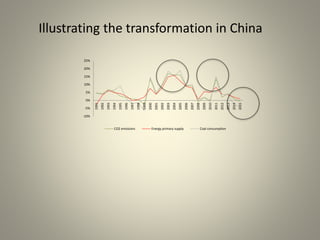
Illustrating the transformation in China
-10%
-5%
0%
5%
10%
15%
20%
25%
1991
1992
1993
1994
1995
1996
1997
1998
1999
2000
2001
2002
2003
2004
2005
2006
2007
2008
2009
2010
2011
2012
2013
2014
2015
CO2 emissions Energy primary supply Coal consumption
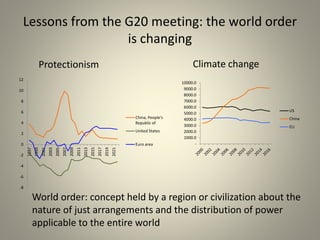
Lessons from the G20 meeting: the world order
is changing
-8
-6
-4
-2
0
2
4
6
8
10
12
1997
1999
2001
2003
2005
2007
2009
2011
2013
2015
2017
2019
2021
China, People's
Republic of
United States
Euro area -
1000.0
2000.0
3000.0
4000.0
5000.0
6000.0
7000.0
8000.0
9000.0
10000.0
US
China
EU
World order: concept held by a region or civilization about the
nature of just arrangements and the distribution of power
applicable to the entire world
Protectionism Climate change
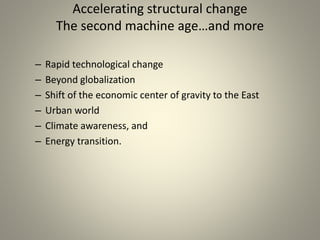
Accelerating structural change
The second machine age…and more
– Rapid technological change
– Beyond globalization
– Shift of the economic center of gravity to the East
– Urban world
– Climate awareness, and
– Energy transition.
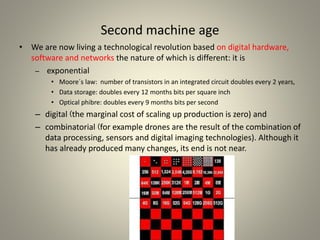
Second machine age
• We are now living a technological revolution based on digital hardware,
software and networks the nature of which is different: it is
– exponential
• Moore´s law: number of transistors in an integrated circuit doubles every 2 years,
• Data storage: doubles every 12 months bits per square inch
• Optical phibre: doubles every 9 months bits per second
– digital ❨the marginal cost of scaling up production is zero) and
– combinatorial ❨for example drones are the result of the combination of
data processing, sensors and digital imaging technologies). Although it
has already produced many changes, its end is not near.
Digital revolution
• Nature
– Data processing
– Platforms
– Storage
– Sensors
– Artificial intelligence
– Robots
• Skill intensive
• Economics
– Non rival
– Zero marginal costs
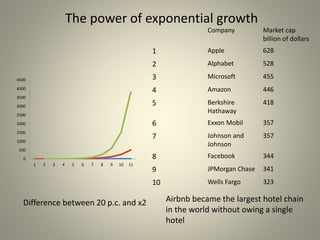
The power of exponential growth
0
500
1000
1500
2000
2500
3000
3500
4000
4500
1 2 3 4 5 6 7 8 9 10 11
Difference between 20 p.c. and x2
Company Market cap
billion of dollars
1 Apple 628
2 Alphabet 528
3 Microsoft 455
4 Amazon 446
5 Berkshire
Hathaway
418
6 Exxon Mobil 357
7 Johnson and
Johnson
357
8 Facebook 344
9 JPMorgan Chase 341
10 Wells Fargo 323
Airbnb became the largest hotel chain
in the world without owing a single
hotel
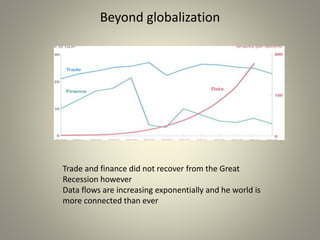
Beyond globalization
Trade and finance did not recover from the Great
Recession however
Data flows are increasing exponentially and he world is
more connected than ever
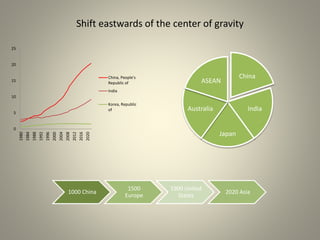
Shift eastwards of the center of gravity
0
5
10
15
20
25
1980
1984
1988
1992
1996
2000
2004
2008
2012
2016
2020
China, People's
Republic of
India
Korea, Republic
of
China
India
Japan
Australia
ASEAN
1000 China
1500
Europe
1900 United
States
2020 Asia
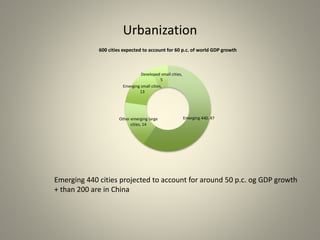
Urbanization
Emerging 440, 47Other emerging large
cities, 14
Emerging small cities,
13
Developed small cities,
5
600 cities expected to account for 60 p.c. of world GDP growth
Emerging 440 cities projected to account for around 50 p.c. og GDP growth
+ than 200 are in China
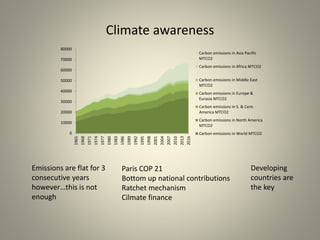
Climate awareness
0
10000
20000
30000
40000
50000
60000
70000
80000
1965
1968
1971
1974
1977
1980
1983
1986
1989
1992
1995
1998
2001
2004
2007
2010
2013
2016
Carbon emissions in Asia Pacific
MTCO2
Carbon emissions in Africa MTCO2
Carbon emissions in Middle East
MTCO2
Carbon emissions in Europe &
Eurasia MTCO2
Carbon emissions in S. & Cent.
America MTCO2
Carbon emissions in North America
MTCO2
Carbon emissions in World MTCO2
Emissions are flat for 3
consecutive years
however…this is not
enough
Paris COP 21
Bottom up national contributions
Ratchet mechanism
Cilmate finance
Developing
countries are
the key
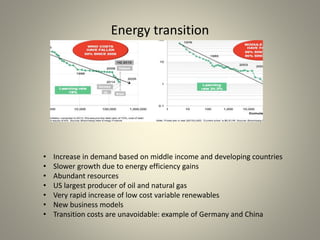
Energy transition
• Increase in demand based on middle income and developing countries
• Slower growth due to energy efficiency gains
• Abundant resources
• US largest producer of oil and natural gas
• Very rapid increase of low cost variable renewables
• New business models
• Transition costs are unavoidable: example of Germany and China
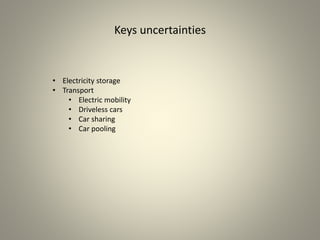
Keys uncertainties
• Electricity storage
• Transport
• Electric mobility
• Driveless cars
• Car sharing
• Car pooling
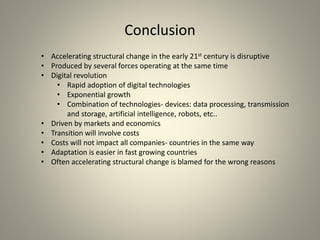
Conclusion
• Accelerating structural change in the early 21st century is disruptive
• Produced by several forces operating at the same time
• Digital revolution
• Rapid adoption of digital technologies
• Exponential growth
• Combination of technologies- devices: data processing, transmission
and storage, artificial intelligence, robots, etc..
• Driven by markets and economics
• Transition will involve costs
• Costs will not impact all companies- countries in the same way
• Adaptation is easier in fast growing countries
• Often accelerating structural change is blamed for the wrong reasons

Bew ppt

  • 1.
    Beijing Energy Week 2017 Acceleratingstructural change in the early 21 st century Manuel Pinho
  • 2.
    BEW 2017 • Whatis BEW • Focus • Founders • Why in Being
  • 3.
    Illustrating the transformationin China -10% -5% 0% 5% 10% 15% 20% 25% 1991 1992 1993 1994 1995 1996 1997 1998 1999 2000 2001 2002 2003 2004 2005 2006 2007 2008 2009 2010 2011 2012 2013 2014 2015 CO2 emissions Energy primary supply Coal consumption
  • 4.
    Lessons from theG20 meeting: the world order is changing -8 -6 -4 -2 0 2 4 6 8 10 12 1997 1999 2001 2003 2005 2007 2009 2011 2013 2015 2017 2019 2021 China, People's Republic of United States Euro area - 1000.0 2000.0 3000.0 4000.0 5000.0 6000.0 7000.0 8000.0 9000.0 10000.0 US China EU World order: concept held by a region or civilization about the nature of just arrangements and the distribution of power applicable to the entire world Protectionism Climate change
  • 5.
    Accelerating structural change Thesecond machine age…and more – Rapid technological change – Beyond globalization – Shift of the economic center of gravity to the East – Urban world – Climate awareness, and – Energy transition.
  • 6.
    Second machine age •We are now living a technological revolution based on digital hardware, software and networks the nature of which is different: it is – exponential • Moore´s law: number of transistors in an integrated circuit doubles every 2 years, • Data storage: doubles every 12 months bits per square inch • Optical phibre: doubles every 9 months bits per second – digital ❨the marginal cost of scaling up production is zero) and – combinatorial ❨for example drones are the result of the combination of data processing, sensors and digital imaging technologies). Although it has already produced many changes, its end is not near.
  • 7.
    Digital revolution • Nature –Data processing – Platforms – Storage – Sensors – Artificial intelligence – Robots • Skill intensive • Economics – Non rival – Zero marginal costs
  • 8.
    The power ofexponential growth 0 500 1000 1500 2000 2500 3000 3500 4000 4500 1 2 3 4 5 6 7 8 9 10 11 Difference between 20 p.c. and x2 Company Market cap billion of dollars 1 Apple 628 2 Alphabet 528 3 Microsoft 455 4 Amazon 446 5 Berkshire Hathaway 418 6 Exxon Mobil 357 7 Johnson and Johnson 357 8 Facebook 344 9 JPMorgan Chase 341 10 Wells Fargo 323 Airbnb became the largest hotel chain in the world without owing a single hotel
  • 9.
    Beyond globalization Trade andfinance did not recover from the Great Recession however Data flows are increasing exponentially and he world is more connected than ever
  • 10.
    Shift eastwards ofthe center of gravity 0 5 10 15 20 25 1980 1984 1988 1992 1996 2000 2004 2008 2012 2016 2020 China, People's Republic of India Korea, Republic of China India Japan Australia ASEAN 1000 China 1500 Europe 1900 United States 2020 Asia
  • 11.
    Urbanization Emerging 440, 47Otheremerging large cities, 14 Emerging small cities, 13 Developed small cities, 5 600 cities expected to account for 60 p.c. of world GDP growth Emerging 440 cities projected to account for around 50 p.c. og GDP growth + than 200 are in China
  • 12.
    Climate awareness 0 10000 20000 30000 40000 50000 60000 70000 80000 1965 1968 1971 1974 1977 1980 1983 1986 1989 1992 1995 1998 2001 2004 2007 2010 2013 2016 Carbon emissionsin Asia Pacific MTCO2 Carbon emissions in Africa MTCO2 Carbon emissions in Middle East MTCO2 Carbon emissions in Europe & Eurasia MTCO2 Carbon emissions in S. & Cent. America MTCO2 Carbon emissions in North America MTCO2 Carbon emissions in World MTCO2 Emissions are flat for 3 consecutive years however…this is not enough Paris COP 21 Bottom up national contributions Ratchet mechanism Cilmate finance Developing countries are the key
  • 13.
    Energy transition • Increasein demand based on middle income and developing countries • Slower growth due to energy efficiency gains • Abundant resources • US largest producer of oil and natural gas • Very rapid increase of low cost variable renewables • New business models • Transition costs are unavoidable: example of Germany and China
  • 14.
    Keys uncertainties • Electricitystorage • Transport • Electric mobility • Driveless cars • Car sharing • Car pooling
  • 15.
    Conclusion • Accelerating structuralchange in the early 21st century is disruptive • Produced by several forces operating at the same time • Digital revolution • Rapid adoption of digital technologies • Exponential growth • Combination of technologies- devices: data processing, transmission and storage, artificial intelligence, robots, etc.. • Driven by markets and economics • Transition will involve costs • Costs will not impact all companies- countries in the same way • Adaptation is easier in fast growing countries • Often accelerating structural change is blamed for the wrong reasons