BAR
CONTENTS
 BAR PLANNING
 BAR DESIGNING
 COSTING
 CORKAGE
 Size and shape of the bar area
 Activities within the bar area
 Entry / exit and relationship of bar to
restaurants and service areas
 Décor, equipment, furniture and fittings
 Licensing regulations, state laws, dry days
 Budget limits
BAR PLANNING
BAR PLANNING
 The environment of bar is cozy seating,
with dim lights, may have channel or live
instrumental music
 Bottles are displayed at the back
 There is an ice machine
BAR PLANNING
 It has an upper counter and a lower
working counter, with wash basin,
chopping board, garnishes, stirrers, cock
tail swords, pourer bottles with juices,
fresh lime juice, syrups, coasters, straws,
tooth picks, napkins, ice bucket with ice
etc.
 Chilled bottles of soft drinks, beer, juices etc
are arranged in the fridge
 Unopened Spirits bottles are kept in the
cupboard
 Bar glasses are arranged in the glass
racks
BAR PLANNING
 Bar garnishes are –cherry, pineapple,
olives, nutmeg powder, cinnamon powder,
lemon wedges, lemon zest, mint leaves etc.
 Bar requisition – there are separate
requisition books for hard and soft
beverages
BAR PLANNING
 These are triplicate, par stock of drinks is
maintained by the barman as decided by the
management
BAR PLANNING
FRONT BAR /PLANNING
 Its the customers area where they order
their drinks and where their drinks are
served
 The bar is typically 16-18 inches wide with a
laminated surface
 The last few inches of the Front bar rail is
used by the bartender to dispense drinks
FRONT BAR /PLANNING
 The front as an armrest for guests
 The bar is like a wall separating the
customer from the working area
FRONT BAR /PLANNING
 If it is a sit down bar, it will have stools tall
enough to turn the counter into a table
 All of the front bar – the surface, die, armrest,
footrest and stools must be planned as visual
elements in the total décor
BACK BAR/PLANNING
 It has a double function:
 The decorative function of display
 and the work function of storage
 Its an area where the bottle displays and the
glassware are displayed
BACK BAR/PLANNING
 Mirrors maybe used
 It adds depth, the customers view of others at
the bar and of the action that goes on behind
them
 Stemware hanging from slotted racks
overhead is popular as a design element as
well as for functional glass storage
BACK BAR/PLANNING
 The base is likely to be storage space or it
may house special equipments
 Frozen drink and espresso machines
maybe on top of the back-bar
 The cash register is usually on the back-
bar too
THE UNDER BAR
 It’s the heart of the entire bar operations,
in its space the equipments and supplies
for the products you are selling must be
arranged compactly and efficiently with
speed the overriding concern
THE UNDER BAR
 Each barman must have an individual
supply of pouring liquor, ice, mixes,
glasses, blender and garnishes all within
arms reach in the pouring station
 A pickup station maybe provided for main
bars
THE UNDER BAR
 The supply of glasses in close proximity,
the blender maybe on a recessed shelf
besides the ice bin, while the garnishes
are typically on the bar top in a
condiment tray
 A mechanical dishwasher, compartment
sink, waste disposal and a hand sink is
essential
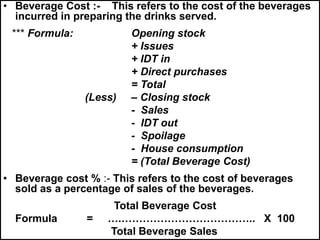
• Beverage Cost :- This refers to the cost of the beverages
incurred in preparing the drinks served.
*** Formula: Opening stock
+ Issues
+ IDT in
+ Direct purchases
= Total
(Less) – Closing stock
- Sales
- IDT out
- Spoilage
- House consumption
= (Total Beverage Cost)
• Beverage cost % :- This refers to the cost of beverages
sold as a percentage of sales of the beverages.
Total Beverage Cost
Formula = ….……………………………….. X 100
Total Beverage Sales
19
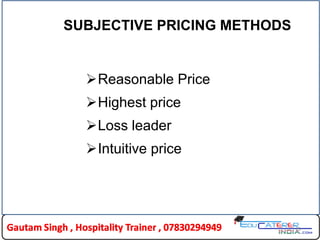
SUBJECTIVE PRICING METHODS
Reasonable Price
Highest price
Loss leader
Intuitive price
20
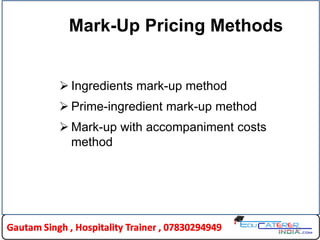
Mark-Up Pricing Methods
 Ingredients mark-up method
 Prime-ingredient mark-up method
 Mark-up with accompaniment costs
method
21
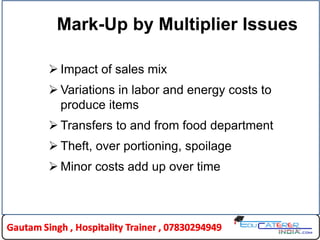
Mark-Up by Multiplier Issues
 Impact of sales mix
 Variations in labor and energy costs to
produce items
 Transfers to and from food department
 Theft, over portioning, spoilage
 Minor costs add up over time
22
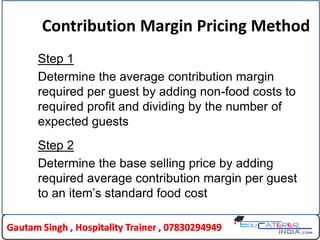
Contribution Margin Pricing Method
Step 1
Determine the average contribution margin
required per guest by adding non-food costs to
required profit and dividing by the number of
expected guests
Step 2
Determine the base selling price by adding
required average contribution margin per guest
to an item’s standard food cost
23
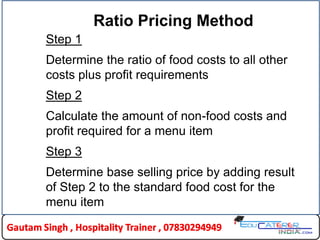
Ratio Pricing Method
Step 1
Determine the ratio of food costs to all other
costs plus profit requirements
Step 2
Calculate the amount of non-food costs and
profit required for a menu item
Step 3
Determine base selling price by adding result
of Step 2 to the standard food cost for the
menu item
24
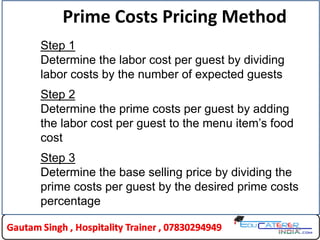
Prime Costs Pricing Method
Step 1
Determine the labor cost per guest by dividing
labor costs by the number of expected guests
Step 2
Determine the prime costs per guest by adding
the labor cost per guest to the menu item’s food
cost
Step 3
Determine the base selling price by dividing the
prime costs per guest by the desired prime costs
percentage
25
PRICING CONSIDERATIONS
 Value (price relative to quality)
 Supply and demand
 Volume of business
 Competition
 Elasticity of demand
CORKAGE
 In hotels (having bar license) specially in
banquet parties when the guest requests the
manager to allow him to get his own wine or
whisky etc
 A certain amount of money is charged per
bottle opened as per policy. This is called as
corkage charge
REFERENCES
 www.wikipedia.com
 www.tastings.com
 www.in-the-spirit.com
 www.buzzle.com
 www.tulleho.com
 Text book of Food and Beverage Service by
Anita Sharma and S. N. Bagchi
 Food and Beverage Service by Sandeep
Chatterjee
THANK YOU

Bar plandesigncost

  • 1.
  • 2.
    CONTENTS  BAR PLANNING BAR DESIGNING  COSTING  CORKAGE
  • 3.
     Size andshape of the bar area  Activities within the bar area  Entry / exit and relationship of bar to restaurants and service areas  Décor, equipment, furniture and fittings  Licensing regulations, state laws, dry days  Budget limits BAR PLANNING
  • 4.
    BAR PLANNING  Theenvironment of bar is cozy seating, with dim lights, may have channel or live instrumental music  Bottles are displayed at the back  There is an ice machine
  • 5.
    BAR PLANNING  Ithas an upper counter and a lower working counter, with wash basin, chopping board, garnishes, stirrers, cock tail swords, pourer bottles with juices, fresh lime juice, syrups, coasters, straws, tooth picks, napkins, ice bucket with ice etc.
  • 6.
     Chilled bottlesof soft drinks, beer, juices etc are arranged in the fridge  Unopened Spirits bottles are kept in the cupboard  Bar glasses are arranged in the glass racks BAR PLANNING
  • 7.
     Bar garnishesare –cherry, pineapple, olives, nutmeg powder, cinnamon powder, lemon wedges, lemon zest, mint leaves etc.  Bar requisition – there are separate requisition books for hard and soft beverages BAR PLANNING
  • 8.
     These aretriplicate, par stock of drinks is maintained by the barman as decided by the management BAR PLANNING
  • 9.
    FRONT BAR /PLANNING Its the customers area where they order their drinks and where their drinks are served  The bar is typically 16-18 inches wide with a laminated surface  The last few inches of the Front bar rail is used by the bartender to dispense drinks
  • 10.
    FRONT BAR /PLANNING The front as an armrest for guests  The bar is like a wall separating the customer from the working area
  • 11.
    FRONT BAR /PLANNING If it is a sit down bar, it will have stools tall enough to turn the counter into a table  All of the front bar – the surface, die, armrest, footrest and stools must be planned as visual elements in the total décor
  • 12.
    BACK BAR/PLANNING  Ithas a double function:  The decorative function of display  and the work function of storage  Its an area where the bottle displays and the glassware are displayed
  • 13.
    BACK BAR/PLANNING  Mirrorsmaybe used  It adds depth, the customers view of others at the bar and of the action that goes on behind them  Stemware hanging from slotted racks overhead is popular as a design element as well as for functional glass storage
  • 14.
    BACK BAR/PLANNING  Thebase is likely to be storage space or it may house special equipments  Frozen drink and espresso machines maybe on top of the back-bar  The cash register is usually on the back- bar too
  • 15.
    THE UNDER BAR It’s the heart of the entire bar operations, in its space the equipments and supplies for the products you are selling must be arranged compactly and efficiently with speed the overriding concern
  • 16.
    THE UNDER BAR Each barman must have an individual supply of pouring liquor, ice, mixes, glasses, blender and garnishes all within arms reach in the pouring station  A pickup station maybe provided for main bars
  • 17.
    THE UNDER BAR The supply of glasses in close proximity, the blender maybe on a recessed shelf besides the ice bin, while the garnishes are typically on the bar top in a condiment tray  A mechanical dishwasher, compartment sink, waste disposal and a hand sink is essential
  • 18.
    • Beverage Cost:- This refers to the cost of the beverages incurred in preparing the drinks served. *** Formula: Opening stock + Issues + IDT in + Direct purchases = Total (Less) – Closing stock - Sales - IDT out - Spoilage - House consumption = (Total Beverage Cost) • Beverage cost % :- This refers to the cost of beverages sold as a percentage of sales of the beverages. Total Beverage Cost Formula = ….……………………………….. X 100 Total Beverage Sales
  • 19.
    19 SUBJECTIVE PRICING METHODS ReasonablePrice Highest price Loss leader Intuitive price
  • 20.
    20 Mark-Up Pricing Methods Ingredients mark-up method  Prime-ingredient mark-up method  Mark-up with accompaniment costs method
  • 21.
    21 Mark-Up by MultiplierIssues  Impact of sales mix  Variations in labor and energy costs to produce items  Transfers to and from food department  Theft, over portioning, spoilage  Minor costs add up over time
  • 22.
    22 Contribution Margin PricingMethod Step 1 Determine the average contribution margin required per guest by adding non-food costs to required profit and dividing by the number of expected guests Step 2 Determine the base selling price by adding required average contribution margin per guest to an item’s standard food cost
  • 23.
    23 Ratio Pricing Method Step1 Determine the ratio of food costs to all other costs plus profit requirements Step 2 Calculate the amount of non-food costs and profit required for a menu item Step 3 Determine base selling price by adding result of Step 2 to the standard food cost for the menu item
  • 24.
    24 Prime Costs PricingMethod Step 1 Determine the labor cost per guest by dividing labor costs by the number of expected guests Step 2 Determine the prime costs per guest by adding the labor cost per guest to the menu item’s food cost Step 3 Determine the base selling price by dividing the prime costs per guest by the desired prime costs percentage
  • 25.
    25 PRICING CONSIDERATIONS  Value(price relative to quality)  Supply and demand  Volume of business  Competition  Elasticity of demand
  • 26.
    CORKAGE  In hotels(having bar license) specially in banquet parties when the guest requests the manager to allow him to get his own wine or whisky etc  A certain amount of money is charged per bottle opened as per policy. This is called as corkage charge
  • 27.
    REFERENCES  www.wikipedia.com  www.tastings.com www.in-the-spirit.com  www.buzzle.com  www.tulleho.com  Text book of Food and Beverage Service by Anita Sharma and S. N. Bagchi  Food and Beverage Service by Sandeep Chatterjee
  • 28.