Building and scaling a
data-driven Customer
Success team
Speakers
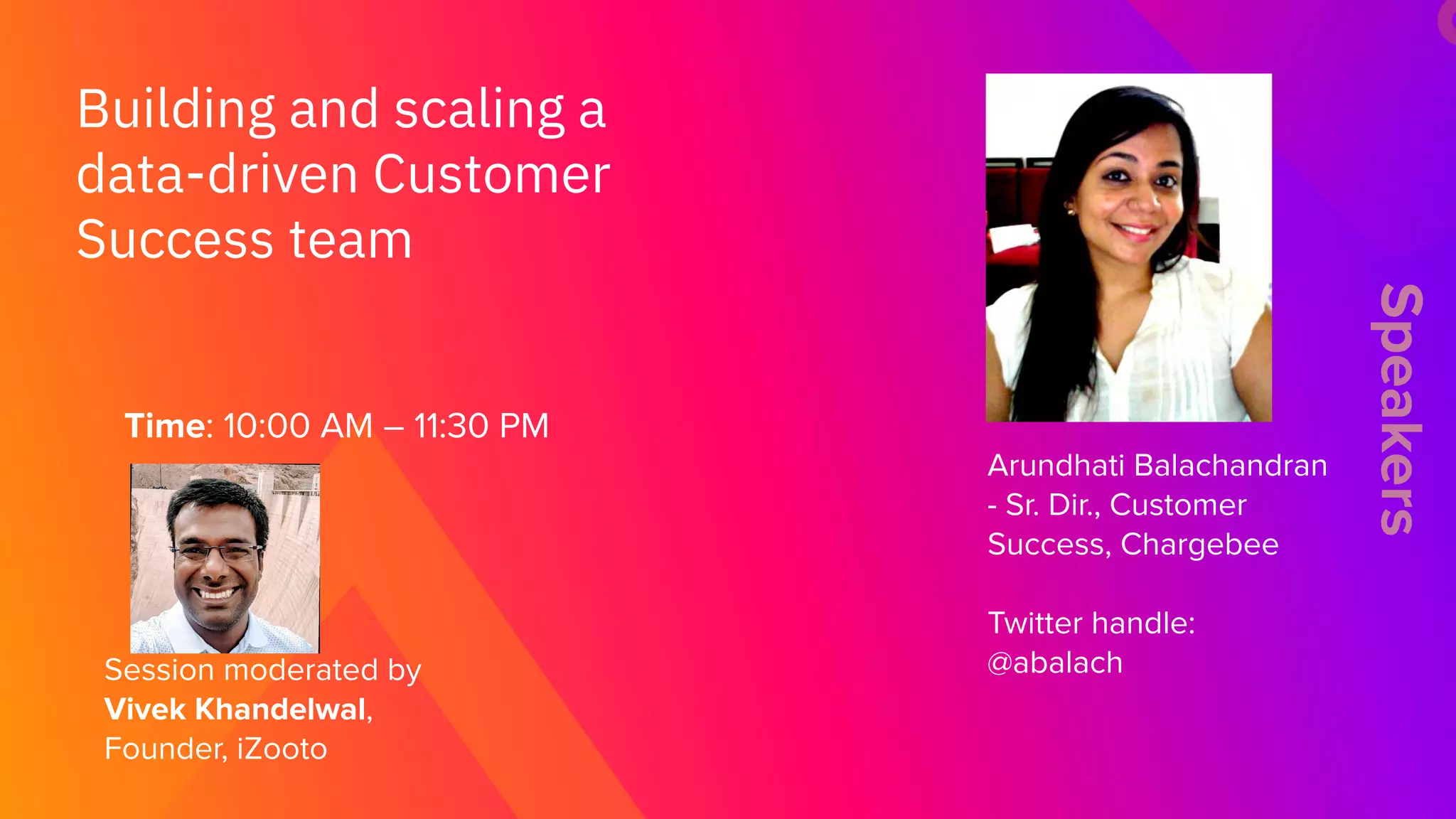
Arundhati Balachandran
- Sr. Dir., Customer
Success, Chargebee
Twitter handle:
@abalachSession moderated by
Vivek Khandelwal,
Founder, iZooto
Time: 10:00 AM – 11:30 PM
Introductions
Speaker: Arundhati Balachandran
Senior Director, Customer Success @ Chargebee
- 14+ years experience in the GTM space
for services and B2B SaaS
- Bachelors in Engineering, SVCE, Chennai
- Double Masters in Computer Science &
Advanced Analytics, NC State, USA
Busting some Customer Success myths
What Customer Success is NOT:
Customer Success is NOT Customer Support ++
Customer Success is NOT a Cost Center but is a
Revenue Org.
Customer Success is NOT a set of disparate
initiatives for retention, advocacy and expansion.
These are simply lagging indicators of the
effectiveness of your CS team
What Customer Success SHOULD BE:
Customer Success is all about knowing your
customers i.e. a 360 deg view
Customer Success is about anticipating your
customers’ needs even before they do
Customer Success is being a trusted partner and
the VOC and working proactively together with
customers to achieve their long-term goals
Context Setting
Data, people and processes towards Churn prediction and ultimately Net Negative Churn :)
❏ Data ----> Priorities
❏ Picking your battles ----> High impact vs low impact initiatives
❏ Initiatives ---> Experiment - Optimise - Scale -> Repeatable process framework
Retention as the core objective for Customer
Success
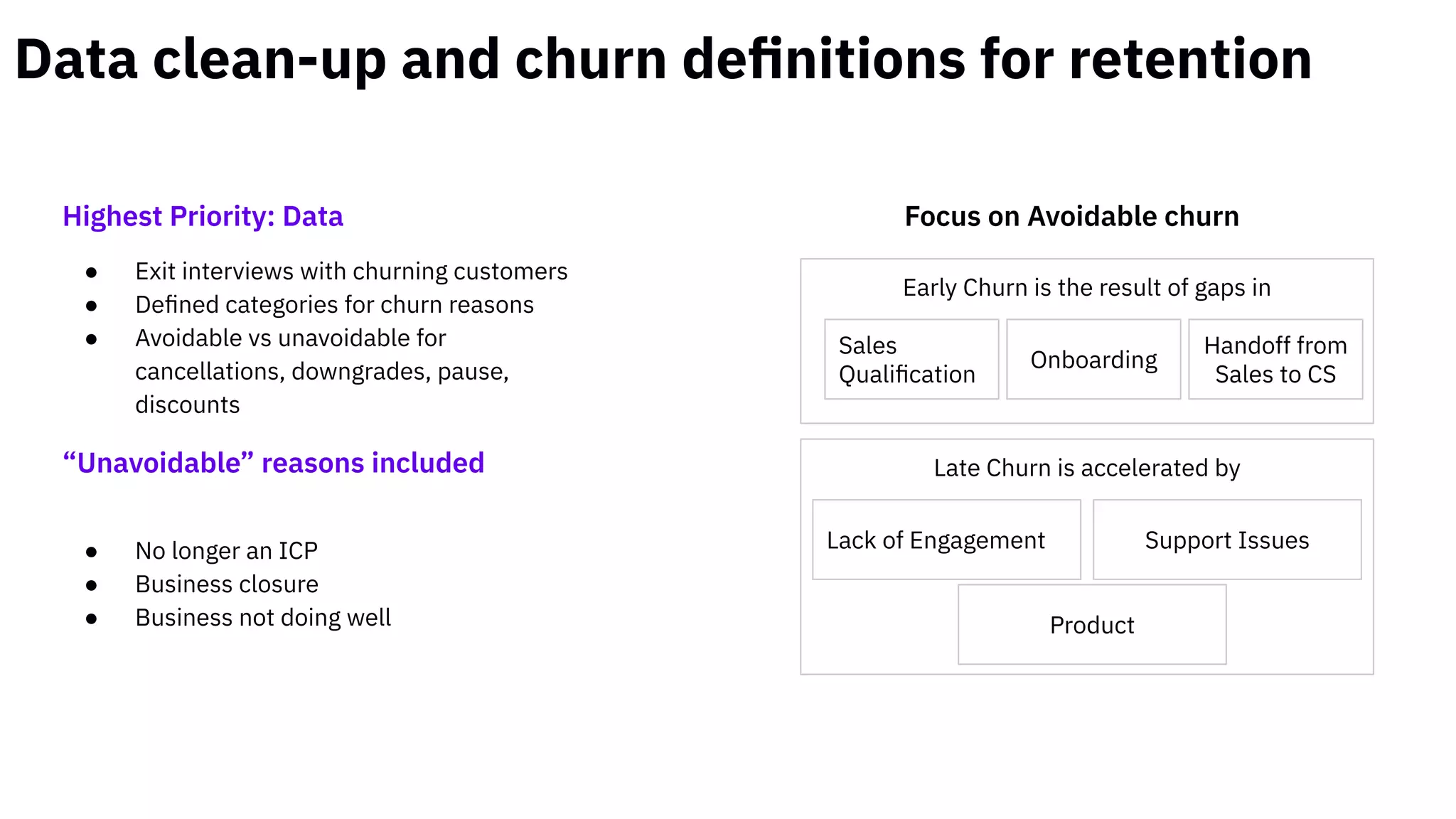
Data clean-up and churn definitions for retention
Highest Priority: Data
● Exit interviews with churning customers
● Defined categories for churn reasons
● Avoidable vs unavoidable for
cancellations, downgrades, pause,
discounts
“Unavoidable” reasons included
● No longer an ICP
● Business closure
● Business not doing well
Early Churn is the result of gaps in
Sales
Qualification
Onboarding
Handoff from
Sales to CS
Late Churn is accelerated by
Lack of Engagement Support Issues
Focus on Avoidable churn
Product
● Customer segmentation is key to prioritization
● Rules of engagement between Sales <> Customer Success
● Onboarding playbook and leading indicators
Addressing early churn
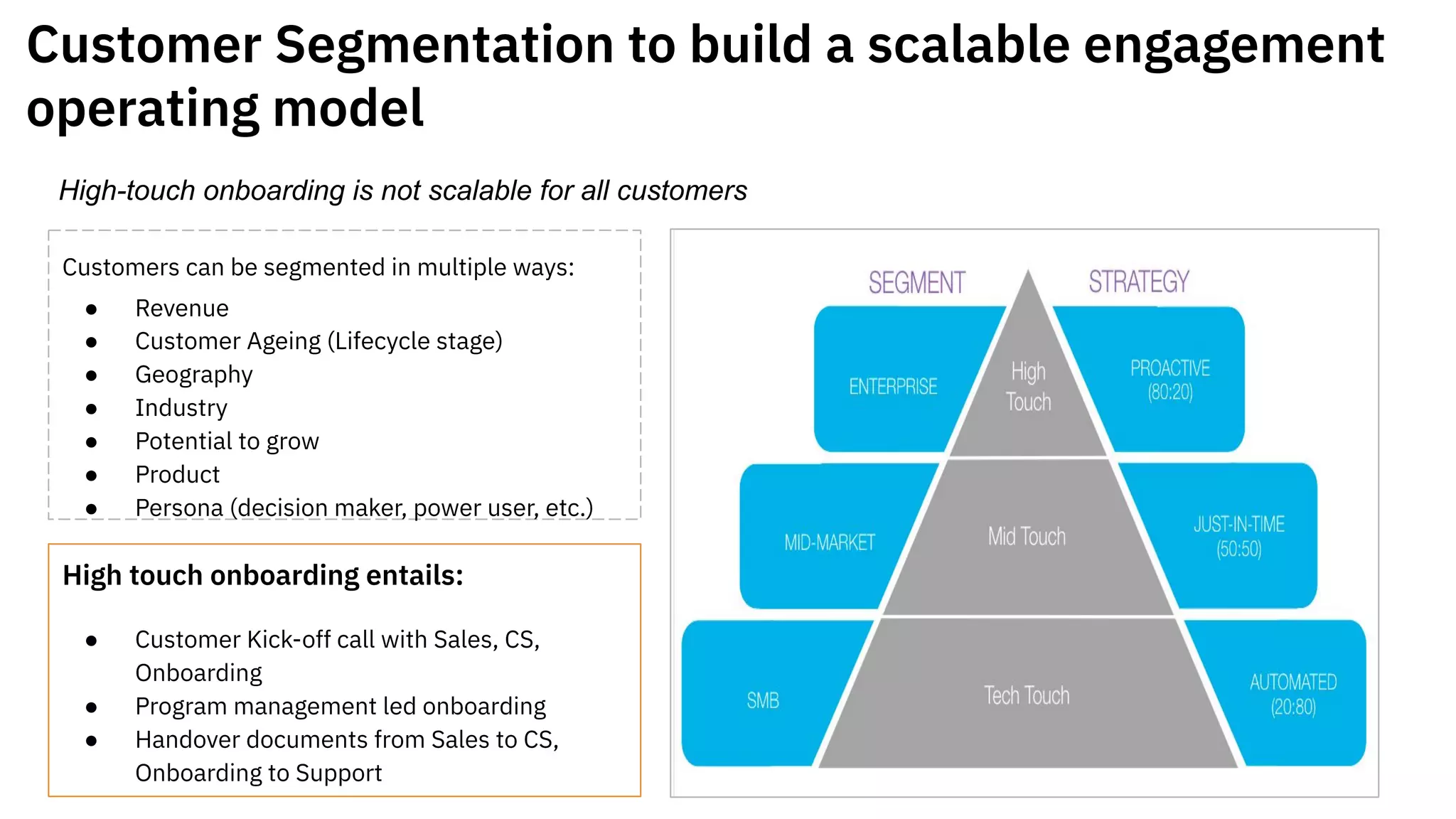
Customer Segmentation to build a scalable engagement
operating model
Customers can be segmented in multiple ways:
● Revenue
● Customer Ageing (Lifecycle stage)
● Geography
● Industry
● Potential to grow
● Product
● Persona (decision maker, power user, etc.)
High touch onboarding entails:
● Customer Kick-off call with Sales, CS,
Onboarding
● Program management led onboarding
● Handover documents from Sales to CS,
Onboarding to Support
High-touch onboarding is not scalable for all customers
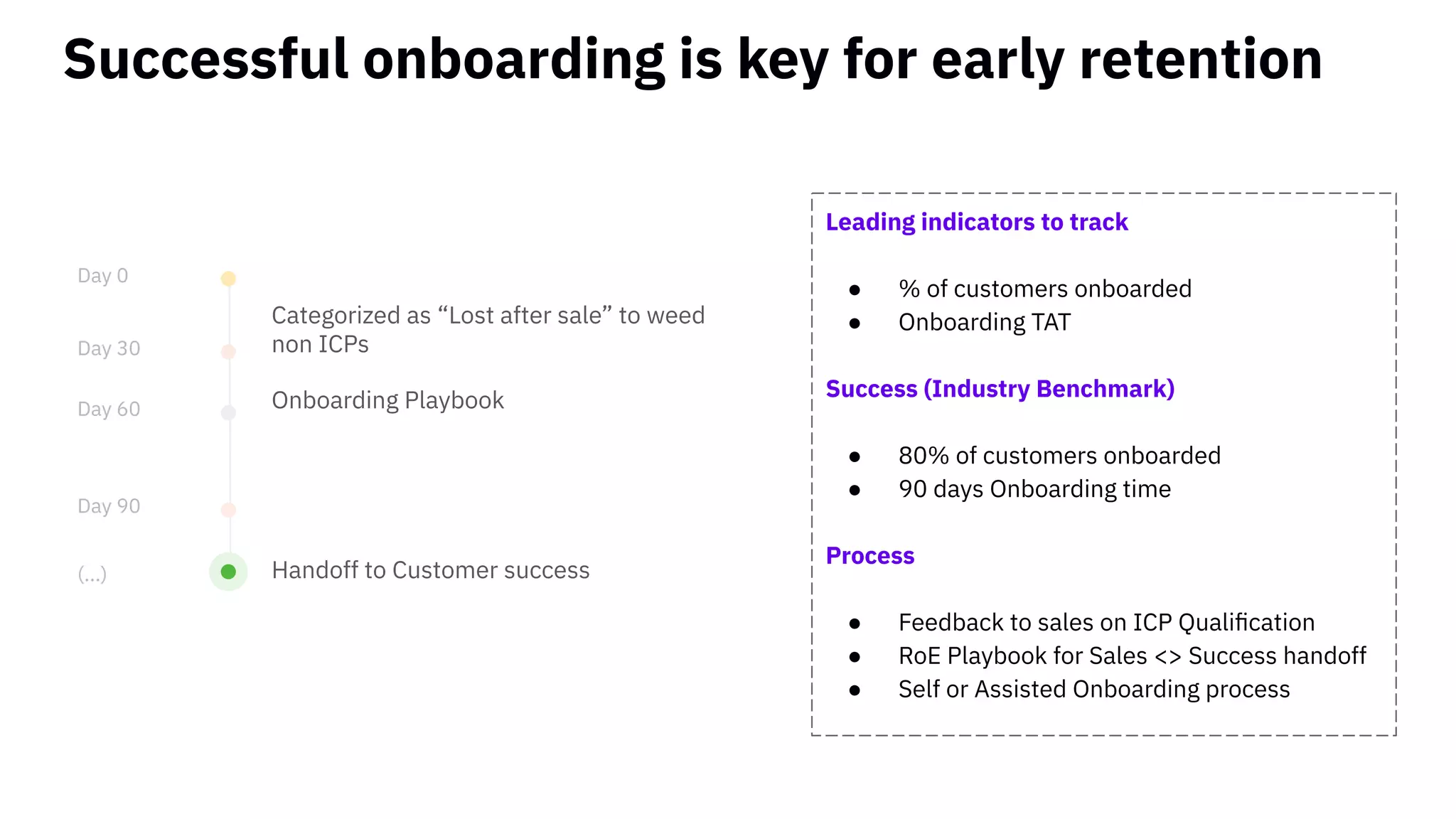
Successful onboarding is key for early retention
Day 0
Day 30
Day 60
Day 90
(...)
Categorized as “Lost after sale” to weed
non ICPs
Onboarding Playbook
Leading indicators to track
● % of customers onboarded
● Onboarding TAT
Success (Industry Benchmark)
● 80% of customers onboarded
● 90 days Onboarding time
Process
● Feedback to sales on ICP Qualification
● RoE Playbook for Sales <> Success handoff
● Self or Assisted Onboarding process
Handoff to Customer success
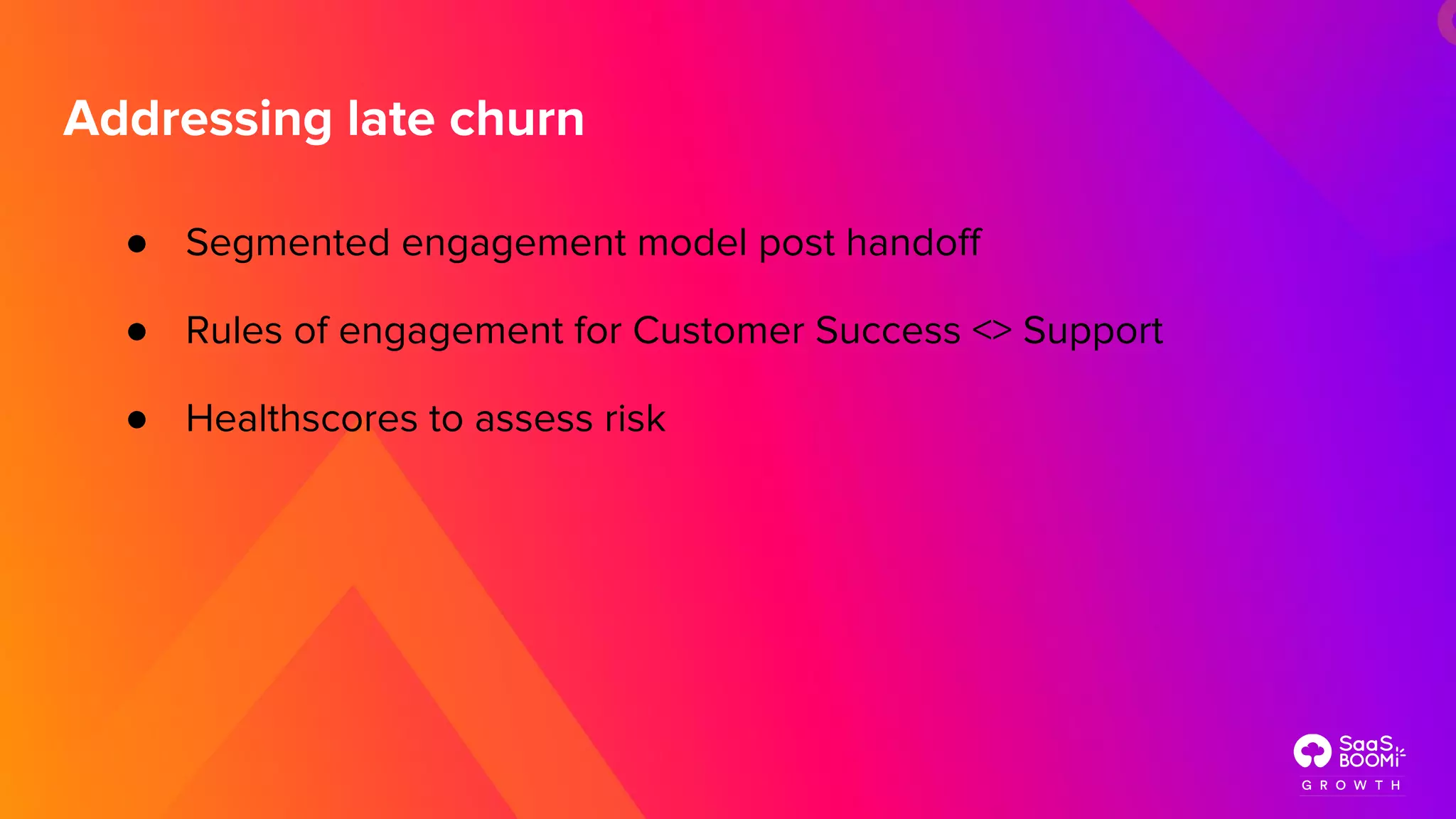
● Segmented engagement model post handoff
● Rules of engagement for Customer Success <> Support
● Healthscores to assess risk
Addressing late churn
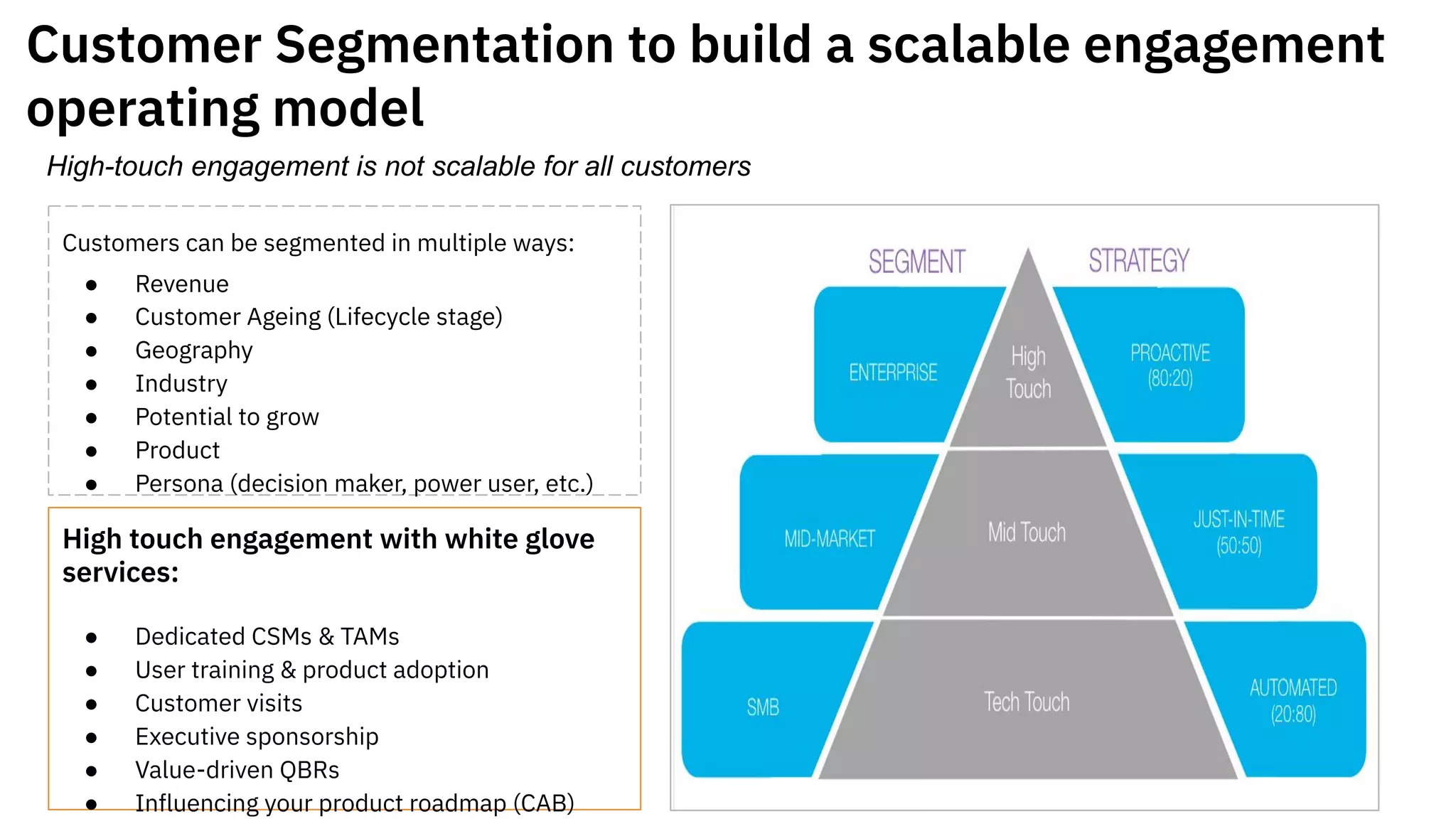
Customer Segmentation to build a scalable engagement
operating model
Customers can be segmented in multiple ways:
● Revenue
● Customer Ageing (Lifecycle stage)
● Geography
● Industry
● Potential to grow
● Product
● Persona (decision maker, power user, etc.)
High touch engagement with white glove
services:
● Dedicated CSMs & TAMs
● User training & product adoption
● Customer visits
● Executive sponsorship
● Value-driven QBRs
● Influencing your product roadmap (CAB)
High-touch engagement is not scalable for all customers
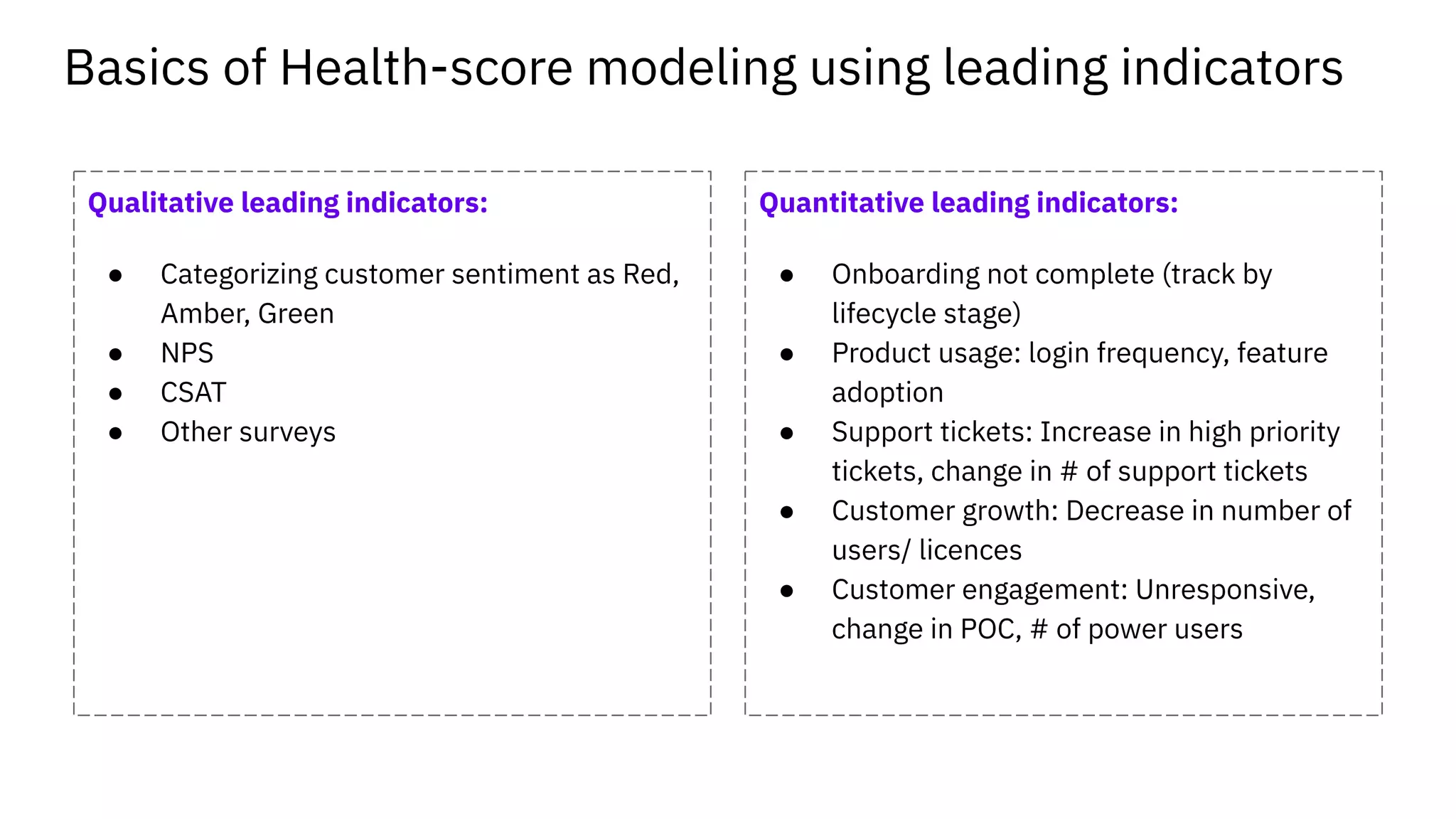
Basics of Health-score modeling using leading indicators
Qualitative leading indicators:
● Categorizing customer sentiment as Red,
Amber, Green
● NPS
● CSAT
● Other surveys
Quantitative leading indicators:
● Onboarding not complete (track by
lifecycle stage)
● Product usage: login frequency, feature
adoption
● Support tickets: Increase in high priority
tickets, change in # of support tickets
● Customer growth: Decrease in number of
users/ licences
● Customer engagement: Unresponsive,
change in POC, # of power users
People: Team structure, Hiring, KPIs
Transforming a 5 member CS team to 25 in 15 months @ Chargebee
Lead - NAMER Lead - APACLead - EMEA
Success Operations & Enablement
[3/3]
Pooled resources of
SMB CSMs
India CSM
[2]
Pooled resources of
SMB CSMs
India-CSM
[2/2]
Pooled resources of
SMB CSMs
India CSM
[1/1]
Account Management
[2/2]
TAM
[1/1]
TAM
[2/2]
TAM
[2/3]
US -CSM
[2]
Senior Director - Customer Success
EU -CSM
[0/1]
Manager - NAMER Manager - APAC+EMEA
Account Management
[1/2]
Director - Support & Success
SMB CSMs
Enterprise CSMs
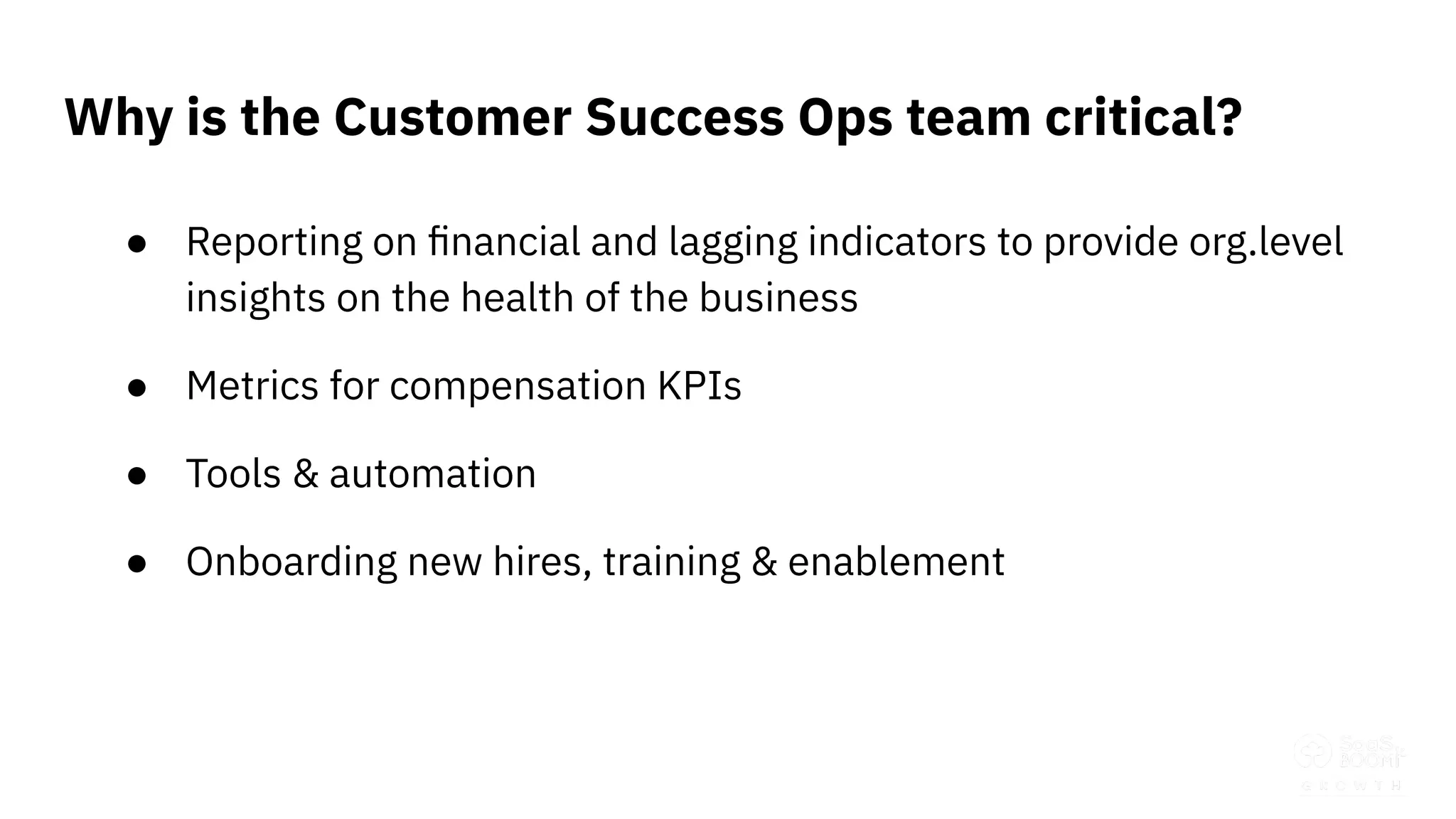
● Reporting on financial and lagging indicators to provide org.level
insights on the health of the business
● Metrics for compensation KPIs
● Tools & automation
● Onboarding new hires, training & enablement
Why is the Customer Success Ops team critical?
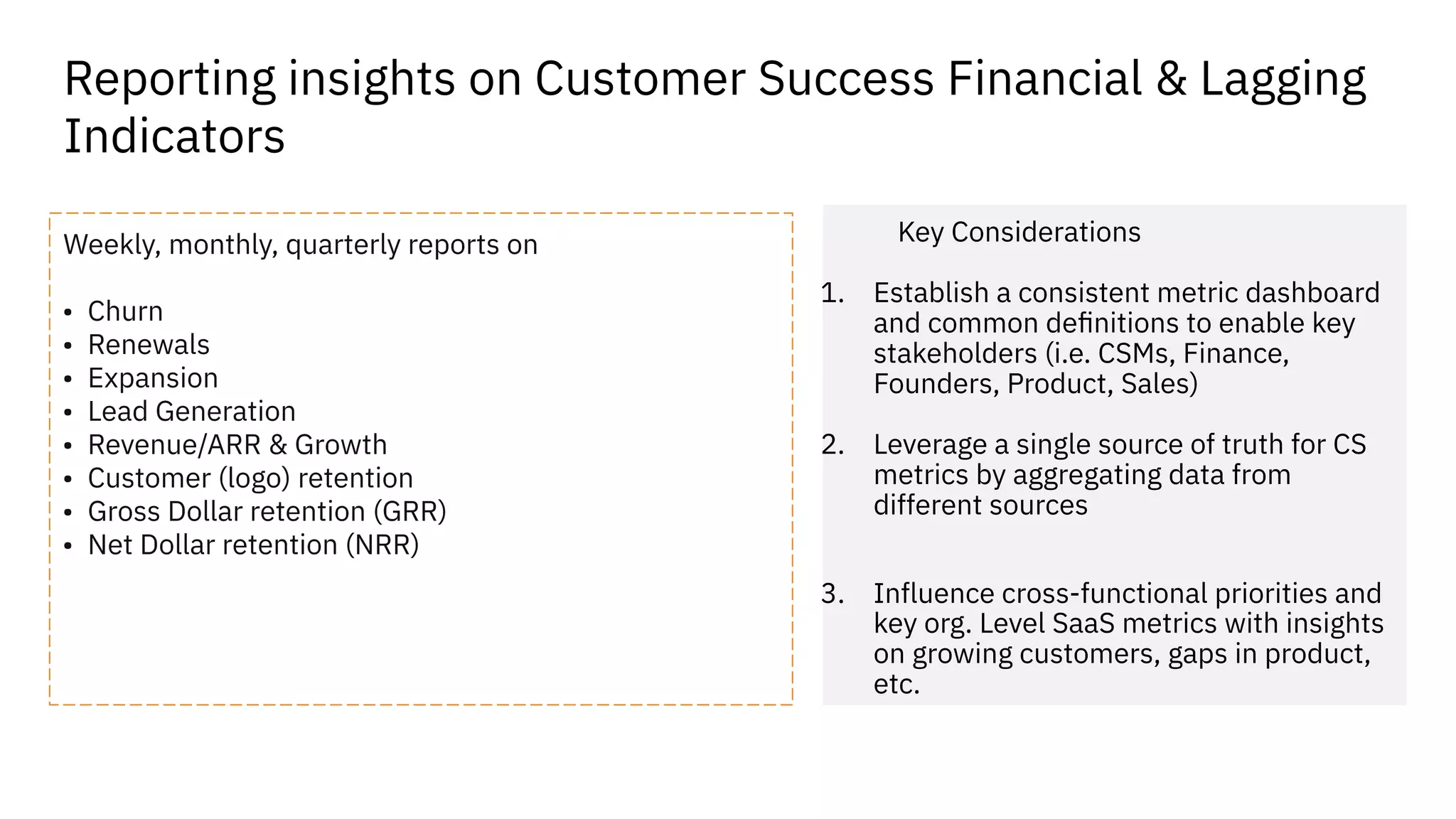
Reporting insights on Customer Success Financial & Lagging
Indicators
Weekly, monthly, quarterly reports on
• Churn
• Renewals
• Expansion
• Lead Generation
• Revenue/ARR & Growth
• Customer (logo) retention
• Gross Dollar retention (GRR)
• Net Dollar retention (NRR)
Key Considerations
1. Establish a consistent metric dashboard
and common definitions to enable key
stakeholders (i.e. CSMs, Finance,
Founders, Product, Sales)
2. Leverage a single source of truth for CS
metrics by aggregating data from
different sources
3. Influence cross-functional priorities and
key org. Level SaaS metrics with insights
on growing customers, gaps in product,
etc.
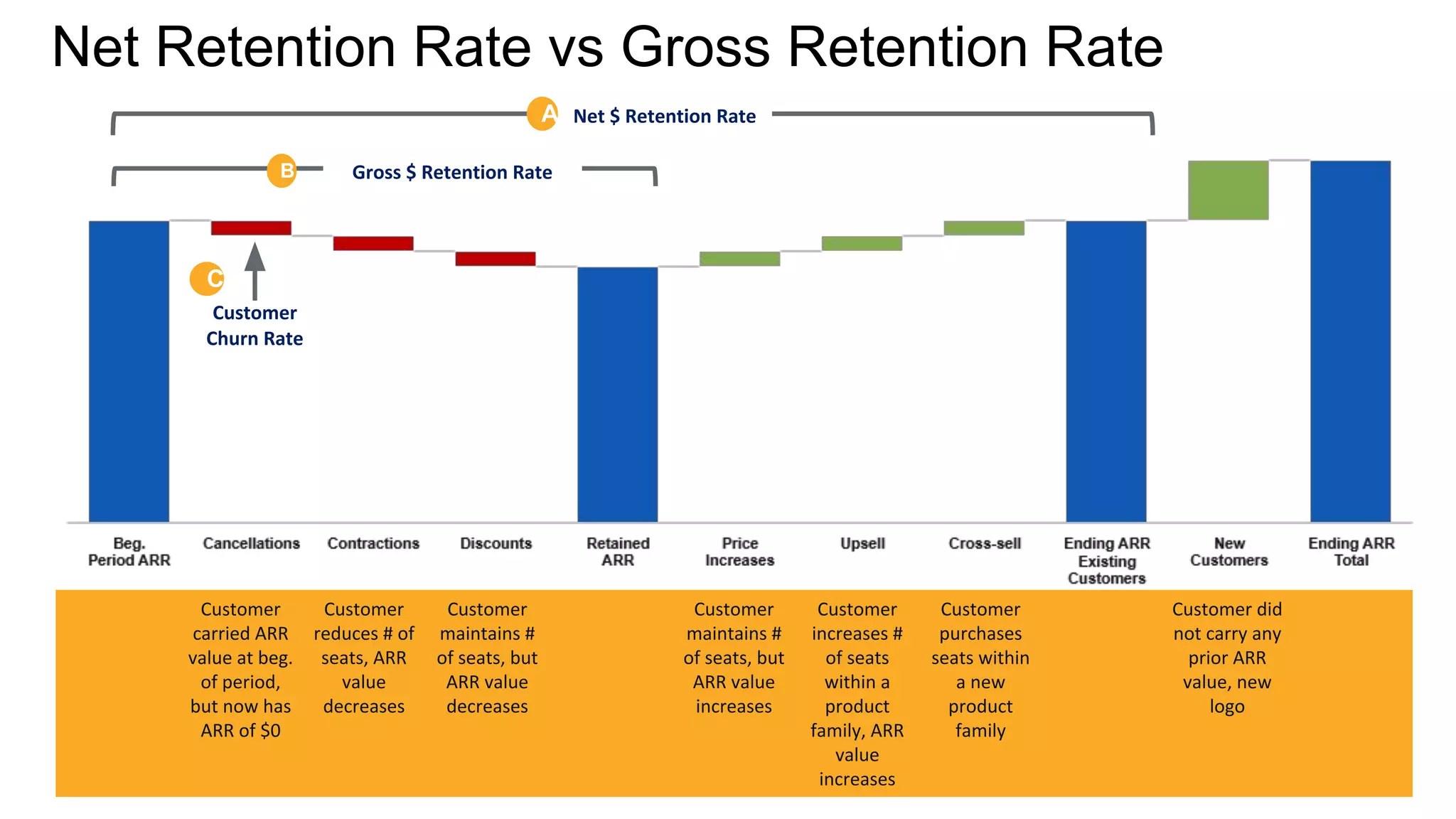
Net Retention Rate vs Gross Retention Rate
Customer
carried ARR
value at beg.
of period,
but now has
ARR of $0
Customer
reduces # of
seats, ARR
value
decreases
Customer
maintains #
of seats, but
ARR value
decreases
Customer
maintains #
of seats, but
ARR value
increases
Customer
increases #
of seats
within a
product
family, ARR
value
increases
Customer
purchases
seats within
a new
product
family
Customer did
not carry any
prior ARR
value, new
logo
Customer
Churn Rate
C
B Gross $ Retention Rate
Net $ Retention RateA
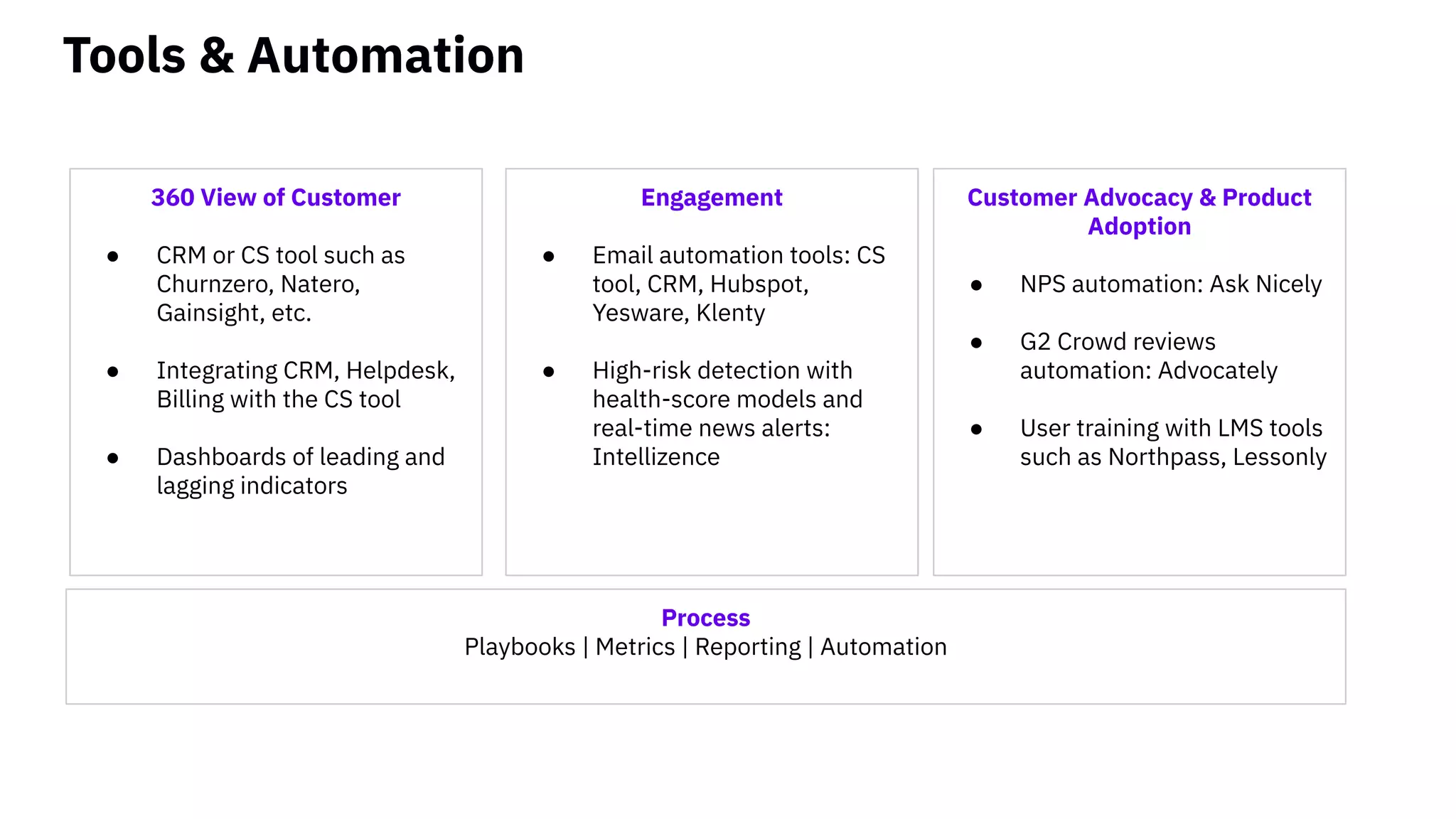
Tools & Automation
360 View of Customer
● CRM or CS tool such as
Churnzero, Natero,
Gainsight, etc.
● Integrating CRM, Helpdesk,
Billing with the CS tool
● Dashboards of leading and
lagging indicators
Customer Advocacy & Product
Adoption
● NPS automation: Ask Nicely
● G2 Crowd reviews
automation: Advocately
● User training with LMS tools
such as Northpass, Lessonly
Engagement
● Email automation tools: CS
tool, CRM, Hubspot,
Yesware, Klenty
● High-risk detection with
health-score models and
real-time news alerts:
Intellizence
Process
Playbooks | Metrics | Reporting | Automation
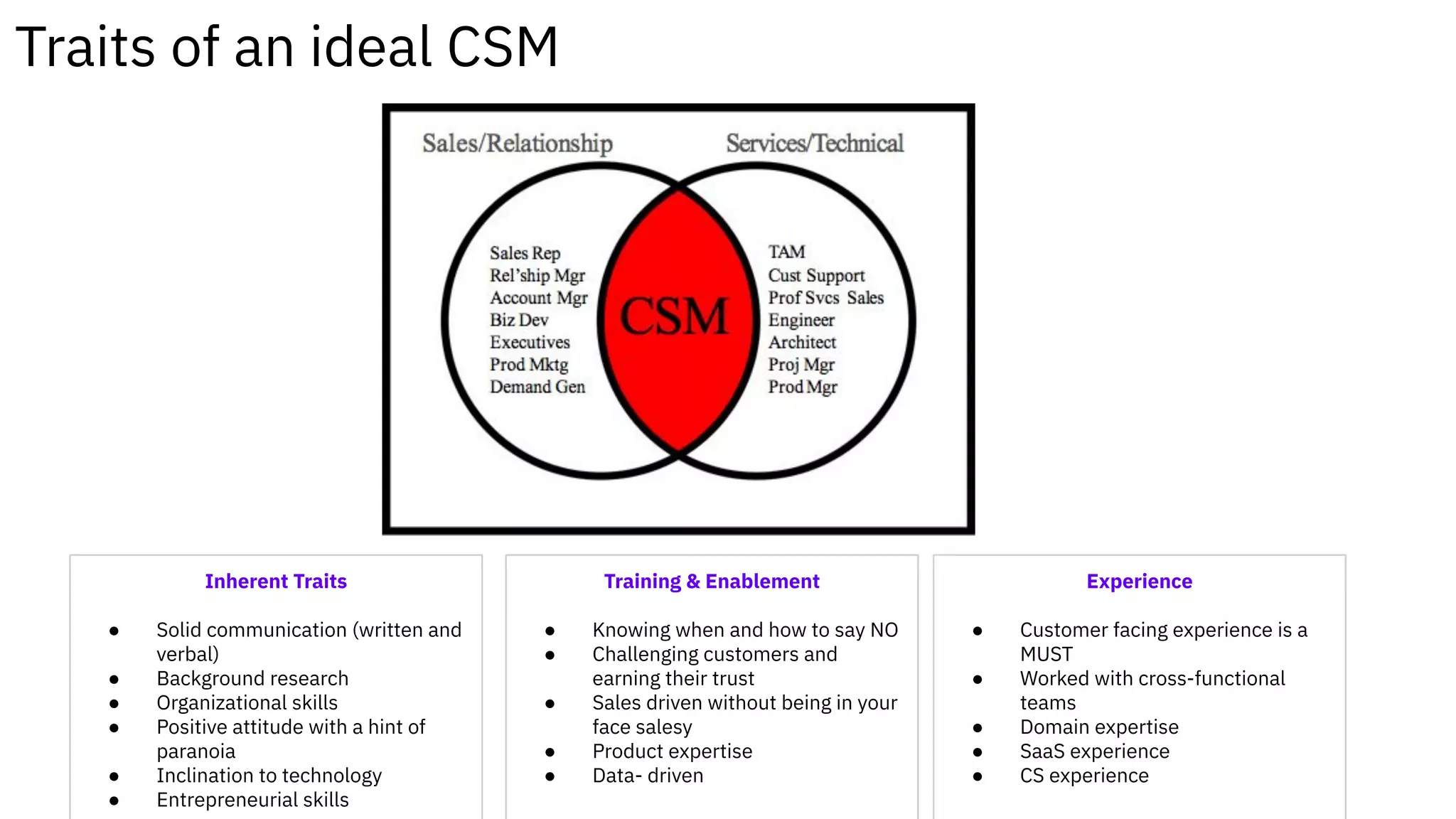
Traits of an ideal CSM
Inherent Traits
● Solid communication (written and
verbal)
● Background research
● Organizational skills
● Positive attitude with a hint of
paranoia
● Inclination to technology
● Entrepreneurial skills
Experience
● Customer facing experience is a
MUST
● Worked with cross-functional
teams
● Domain expertise
● SaaS experience
● CS experience
Training & Enablement
● Knowing when and how to say NO
● Challenging customers and
earning their trust
● Sales driven without being in your
face salesy
● Product expertise
● Data- driven
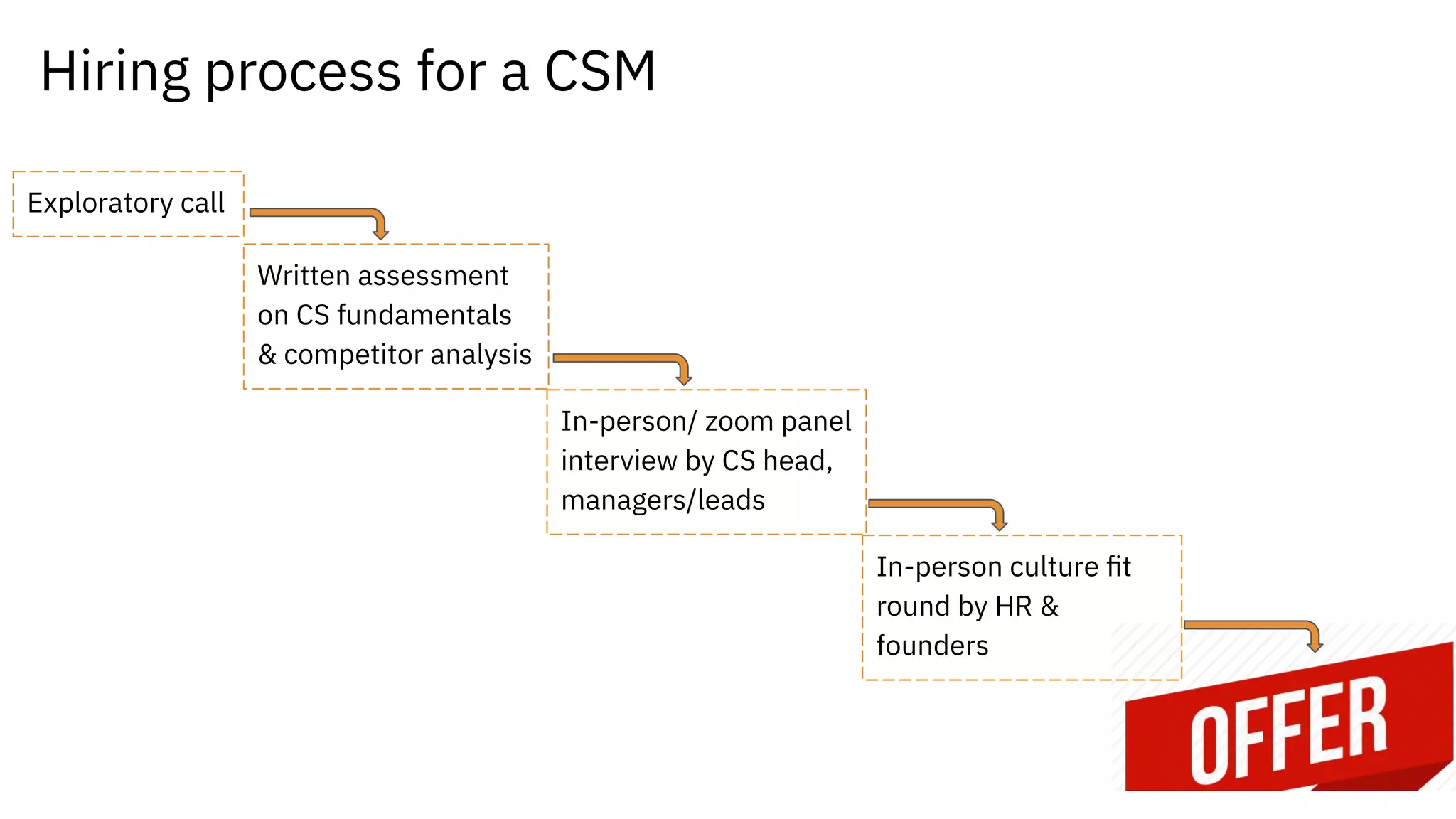
Hiring process for a CSM
Exploratory call
Written assessment
on CS fundamentals
& competitor analysis
In-person/ zoom panel
interview by CS head,
managers/leads
In-person culture fit
round by HR &
founders
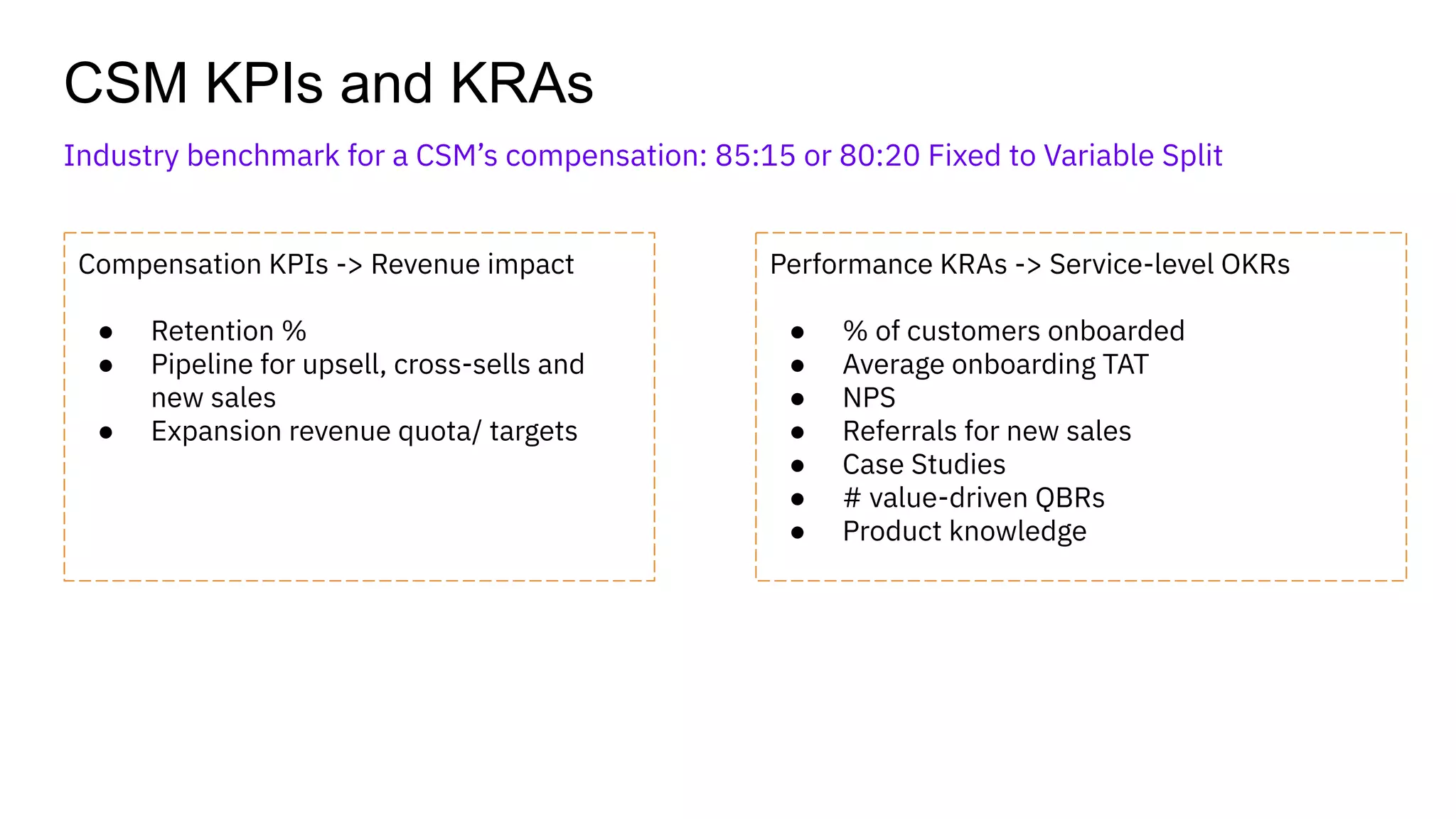
CSM KPIs and KRAs
Industry benchmark for a CSM’s compensation: 85:15 or 80:20 Fixed to Variable Split
Compensation KPIs -> Revenue impact
● Retention %
● Pipeline for upsell, cross-sells and
new sales
● Expansion revenue quota/ targets
Performance KRAs -> Service-level OKRs
● % of customers onboarded
● Average onboarding TAT
● NPS
● Referrals for new sales
● Case Studies
● # value-driven QBRs
● Product knowledge
COVID 19 Monitoring & Mitigation
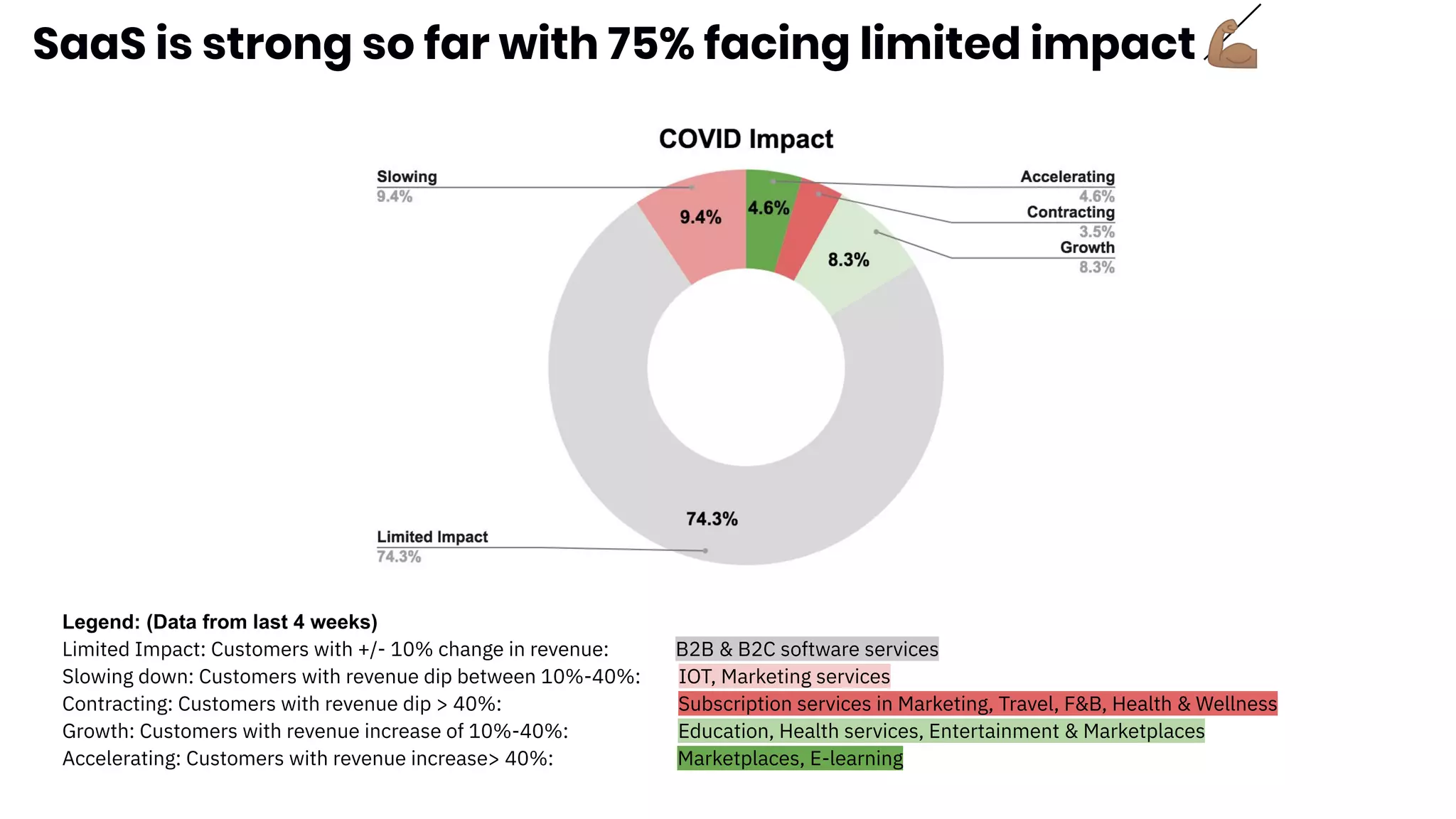
SaaS is strong so far with 75% facing limited impact 💪🏽
Legend: (Data from last 4 weeks)
Limited Impact: Customers with +/- 10% change in revenue: B2B & B2C software services
Slowing down: Customers with revenue dip between 10%-40%: IOT, Marketing services
Contracting: Customers with revenue dip > 40%: Subscription services in Marketing, Travel, F&B, Health & Wellness
Growth: Customers with revenue increase of 10%-40%: Education, Health services, Entertainment & Marketplaces
Accelerating: Customers with revenue increase> 40%: Marketplaces, E-learning
Retention is your strongest pillar
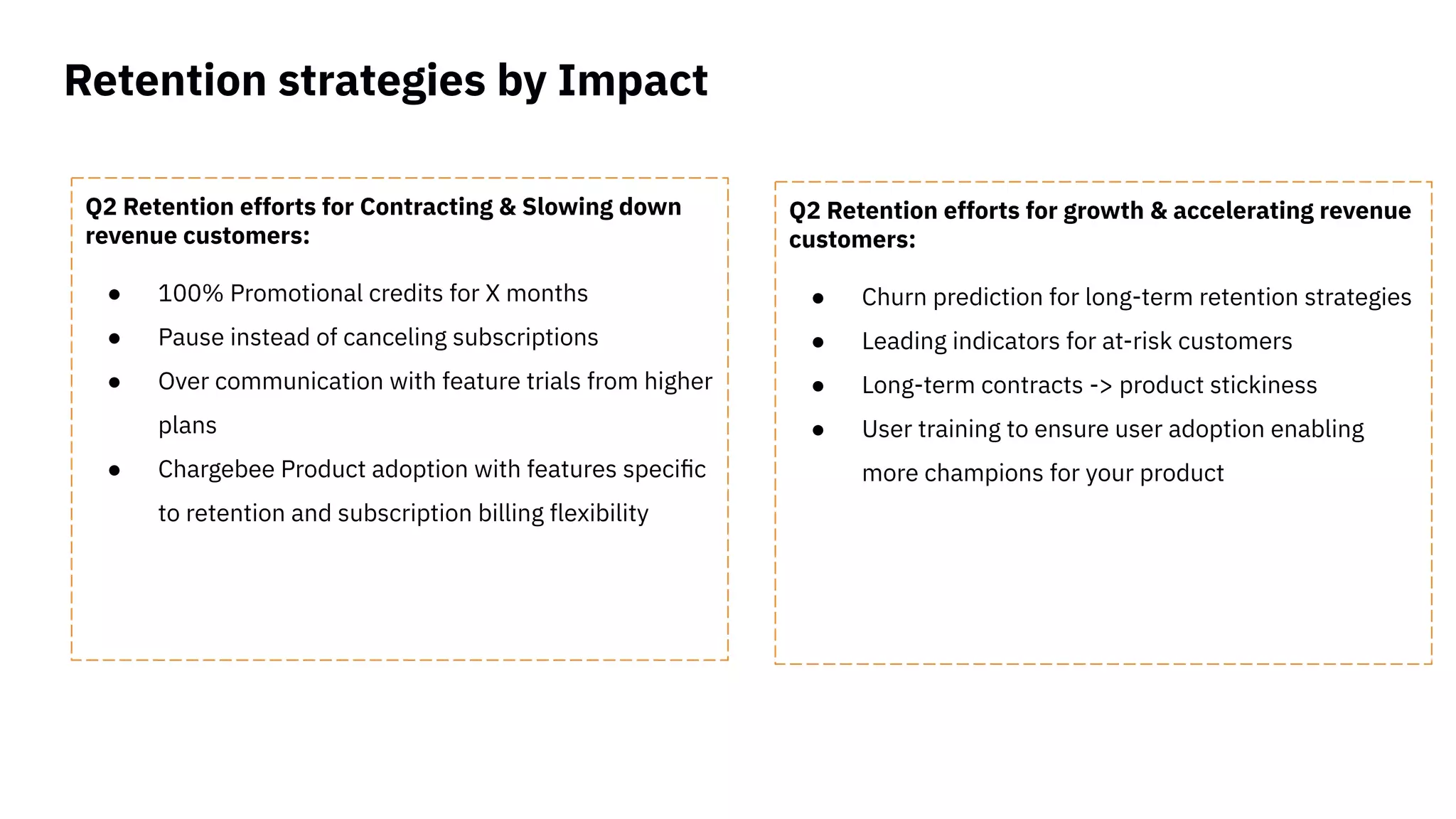
Retention strategies by Impact
Q2 Retention efforts for Contracting & Slowing down
revenue customers:
● 100% Promotional credits for X months
● Pause instead of canceling subscriptions
● Over communication with feature trials from higher
plans
● Chargebee Product adoption with features specific
to retention and subscription billing flexibility
Q2 Retention efforts for growth & accelerating revenue
customers:
● Churn prediction for long-term retention strategies
● Leading indicators for at-risk customers
● Long-term contracts -> product stickiness
● User training to ensure user adoption enabling
more champions for your product
● Customer Success is a revenue org.
● Customer Success should be data-driven
● Invest in Customer Success operations
● Monitor leading indicators to stay ahead of the customer
● Hire accountable CSMs with a bias to action
● Retention is your strongest pillar during these unprecedented times
Closing Remarks

"Best Practices/Process/Tools for Setting Customer Success Process" with Arundhati Balachandran - Chargebee

  • 1.
    Building and scalinga data-driven Customer Success team Speakers Arundhati Balachandran - Sr. Dir., Customer Success, Chargebee Twitter handle: @abalachSession moderated by Vivek Khandelwal, Founder, iZooto Time: 10:00 AM – 11:30 PM
  • 2.
    Introductions Speaker: Arundhati Balachandran SeniorDirector, Customer Success @ Chargebee - 14+ years experience in the GTM space for services and B2B SaaS - Bachelors in Engineering, SVCE, Chennai - Double Masters in Computer Science & Advanced Analytics, NC State, USA
  • 3.
    Busting some CustomerSuccess myths What Customer Success is NOT: Customer Success is NOT Customer Support ++ Customer Success is NOT a Cost Center but is a Revenue Org. Customer Success is NOT a set of disparate initiatives for retention, advocacy and expansion. These are simply lagging indicators of the effectiveness of your CS team What Customer Success SHOULD BE: Customer Success is all about knowing your customers i.e. a 360 deg view Customer Success is about anticipating your customers’ needs even before they do Customer Success is being a trusted partner and the VOC and working proactively together with customers to achieve their long-term goals
  • 4.
    Context Setting Data, peopleand processes towards Churn prediction and ultimately Net Negative Churn :) ❏ Data ----> Priorities ❏ Picking your battles ----> High impact vs low impact initiatives ❏ Initiatives ---> Experiment - Optimise - Scale -> Repeatable process framework
  • 5.
    Retention as thecore objective for Customer Success
  • 6.
    Data clean-up andchurn definitions for retention Highest Priority: Data ● Exit interviews with churning customers ● Defined categories for churn reasons ● Avoidable vs unavoidable for cancellations, downgrades, pause, discounts “Unavoidable” reasons included ● No longer an ICP ● Business closure ● Business not doing well Early Churn is the result of gaps in Sales Qualification Onboarding Handoff from Sales to CS Late Churn is accelerated by Lack of Engagement Support Issues Focus on Avoidable churn Product
  • 7.
    ● Customer segmentationis key to prioritization ● Rules of engagement between Sales <> Customer Success ● Onboarding playbook and leading indicators Addressing early churn
  • 8.
    Customer Segmentation tobuild a scalable engagement operating model Customers can be segmented in multiple ways: ● Revenue ● Customer Ageing (Lifecycle stage) ● Geography ● Industry ● Potential to grow ● Product ● Persona (decision maker, power user, etc.) High touch onboarding entails: ● Customer Kick-off call with Sales, CS, Onboarding ● Program management led onboarding ● Handover documents from Sales to CS, Onboarding to Support High-touch onboarding is not scalable for all customers
  • 9.
    Successful onboarding iskey for early retention Day 0 Day 30 Day 60 Day 90 (...) Categorized as “Lost after sale” to weed non ICPs Onboarding Playbook Leading indicators to track ● % of customers onboarded ● Onboarding TAT Success (Industry Benchmark) ● 80% of customers onboarded ● 90 days Onboarding time Process ● Feedback to sales on ICP Qualification ● RoE Playbook for Sales <> Success handoff ● Self or Assisted Onboarding process Handoff to Customer success
  • 10.
    ● Segmented engagementmodel post handoff ● Rules of engagement for Customer Success <> Support ● Healthscores to assess risk Addressing late churn
  • 11.
    Customer Segmentation tobuild a scalable engagement operating model Customers can be segmented in multiple ways: ● Revenue ● Customer Ageing (Lifecycle stage) ● Geography ● Industry ● Potential to grow ● Product ● Persona (decision maker, power user, etc.) High touch engagement with white glove services: ● Dedicated CSMs & TAMs ● User training & product adoption ● Customer visits ● Executive sponsorship ● Value-driven QBRs ● Influencing your product roadmap (CAB) High-touch engagement is not scalable for all customers
  • 12.
    Basics of Health-scoremodeling using leading indicators Qualitative leading indicators: ● Categorizing customer sentiment as Red, Amber, Green ● NPS ● CSAT ● Other surveys Quantitative leading indicators: ● Onboarding not complete (track by lifecycle stage) ● Product usage: login frequency, feature adoption ● Support tickets: Increase in high priority tickets, change in # of support tickets ● Customer growth: Decrease in number of users/ licences ● Customer engagement: Unresponsive, change in POC, # of power users
  • 13.
  • 14.
    Transforming a 5member CS team to 25 in 15 months @ Chargebee Lead - NAMER Lead - APACLead - EMEA Success Operations & Enablement [3/3] Pooled resources of SMB CSMs India CSM [2] Pooled resources of SMB CSMs India-CSM [2/2] Pooled resources of SMB CSMs India CSM [1/1] Account Management [2/2] TAM [1/1] TAM [2/2] TAM [2/3] US -CSM [2] Senior Director - Customer Success EU -CSM [0/1] Manager - NAMER Manager - APAC+EMEA Account Management [1/2] Director - Support & Success SMB CSMs Enterprise CSMs
  • 15.
    ● Reporting onfinancial and lagging indicators to provide org.level insights on the health of the business ● Metrics for compensation KPIs ● Tools & automation ● Onboarding new hires, training & enablement Why is the Customer Success Ops team critical?
  • 16.
    Reporting insights onCustomer Success Financial & Lagging Indicators Weekly, monthly, quarterly reports on • Churn • Renewals • Expansion • Lead Generation • Revenue/ARR & Growth • Customer (logo) retention • Gross Dollar retention (GRR) • Net Dollar retention (NRR) Key Considerations 1. Establish a consistent metric dashboard and common definitions to enable key stakeholders (i.e. CSMs, Finance, Founders, Product, Sales) 2. Leverage a single source of truth for CS metrics by aggregating data from different sources 3. Influence cross-functional priorities and key org. Level SaaS metrics with insights on growing customers, gaps in product, etc.
  • 17.
    Net Retention Ratevs Gross Retention Rate Customer carried ARR value at beg. of period, but now has ARR of $0 Customer reduces # of seats, ARR value decreases Customer maintains # of seats, but ARR value decreases Customer maintains # of seats, but ARR value increases Customer increases # of seats within a product family, ARR value increases Customer purchases seats within a new product family Customer did not carry any prior ARR value, new logo Customer Churn Rate C B Gross $ Retention Rate Net $ Retention RateA
  • 18.
    Tools & Automation 360View of Customer ● CRM or CS tool such as Churnzero, Natero, Gainsight, etc. ● Integrating CRM, Helpdesk, Billing with the CS tool ● Dashboards of leading and lagging indicators Customer Advocacy & Product Adoption ● NPS automation: Ask Nicely ● G2 Crowd reviews automation: Advocately ● User training with LMS tools such as Northpass, Lessonly Engagement ● Email automation tools: CS tool, CRM, Hubspot, Yesware, Klenty ● High-risk detection with health-score models and real-time news alerts: Intellizence Process Playbooks | Metrics | Reporting | Automation
  • 19.
    Traits of anideal CSM Inherent Traits ● Solid communication (written and verbal) ● Background research ● Organizational skills ● Positive attitude with a hint of paranoia ● Inclination to technology ● Entrepreneurial skills Experience ● Customer facing experience is a MUST ● Worked with cross-functional teams ● Domain expertise ● SaaS experience ● CS experience Training & Enablement ● Knowing when and how to say NO ● Challenging customers and earning their trust ● Sales driven without being in your face salesy ● Product expertise ● Data- driven
  • 20.
    Hiring process fora CSM Exploratory call Written assessment on CS fundamentals & competitor analysis In-person/ zoom panel interview by CS head, managers/leads In-person culture fit round by HR & founders
  • 21.
    CSM KPIs andKRAs Industry benchmark for a CSM’s compensation: 85:15 or 80:20 Fixed to Variable Split Compensation KPIs -> Revenue impact ● Retention % ● Pipeline for upsell, cross-sells and new sales ● Expansion revenue quota/ targets Performance KRAs -> Service-level OKRs ● % of customers onboarded ● Average onboarding TAT ● NPS ● Referrals for new sales ● Case Studies ● # value-driven QBRs ● Product knowledge
  • 22.
    COVID 19 Monitoring& Mitigation
  • 23.
    SaaS is strongso far with 75% facing limited impact 💪🏽 Legend: (Data from last 4 weeks) Limited Impact: Customers with +/- 10% change in revenue: B2B & B2C software services Slowing down: Customers with revenue dip between 10%-40%: IOT, Marketing services Contracting: Customers with revenue dip > 40%: Subscription services in Marketing, Travel, F&B, Health & Wellness Growth: Customers with revenue increase of 10%-40%: Education, Health services, Entertainment & Marketplaces Accelerating: Customers with revenue increase> 40%: Marketplaces, E-learning
  • 24.
    Retention is yourstrongest pillar
  • 25.
    Retention strategies byImpact Q2 Retention efforts for Contracting & Slowing down revenue customers: ● 100% Promotional credits for X months ● Pause instead of canceling subscriptions ● Over communication with feature trials from higher plans ● Chargebee Product adoption with features specific to retention and subscription billing flexibility Q2 Retention efforts for growth & accelerating revenue customers: ● Churn prediction for long-term retention strategies ● Leading indicators for at-risk customers ● Long-term contracts -> product stickiness ● User training to ensure user adoption enabling more champions for your product
  • 26.
    ● Customer Successis a revenue org. ● Customer Success should be data-driven ● Invest in Customer Success operations ● Monitor leading indicators to stay ahead of the customer ● Hire accountable CSMs with a bias to action ● Retention is your strongest pillar during these unprecedented times Closing Remarks