Camera Shots & Angles
By Kent Millard amended by Jesse Thompson
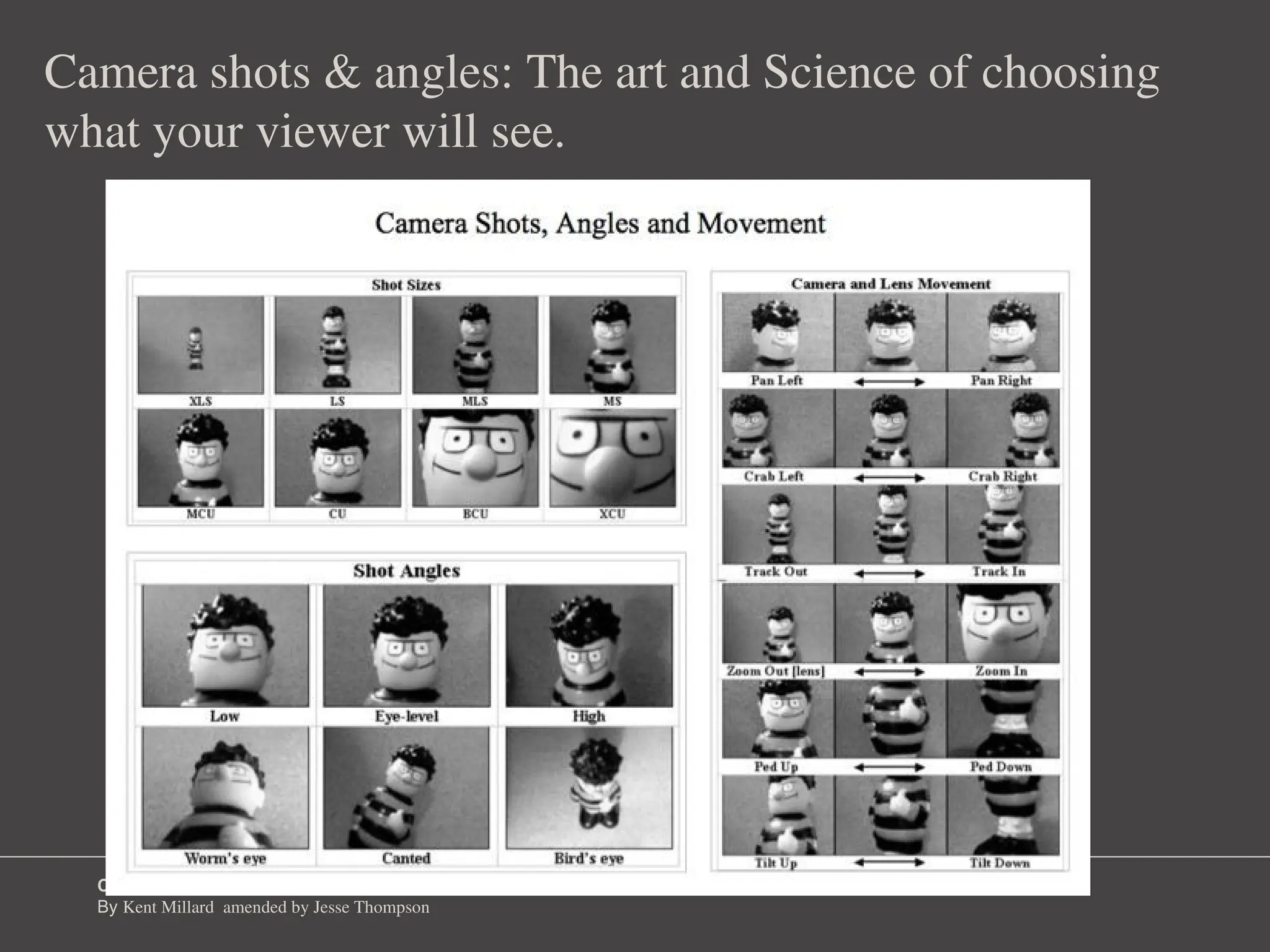
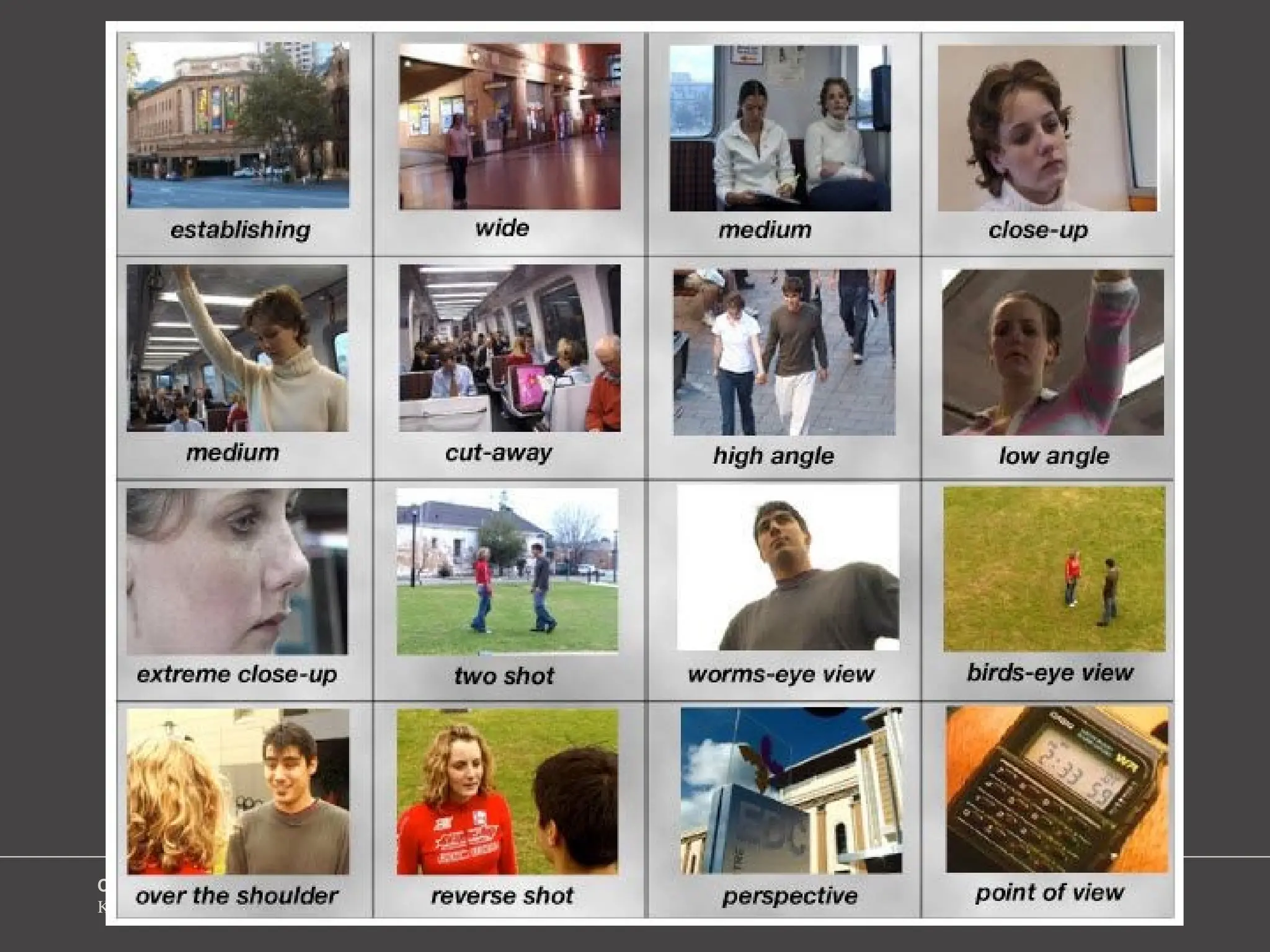
Camera shots & angles: The art and Science of choosing
what your viewer will see.
Camera Shots & Angles
Kent Millard
Camera Shots & Angles
amended from Kent Millard by Jesse Thompson
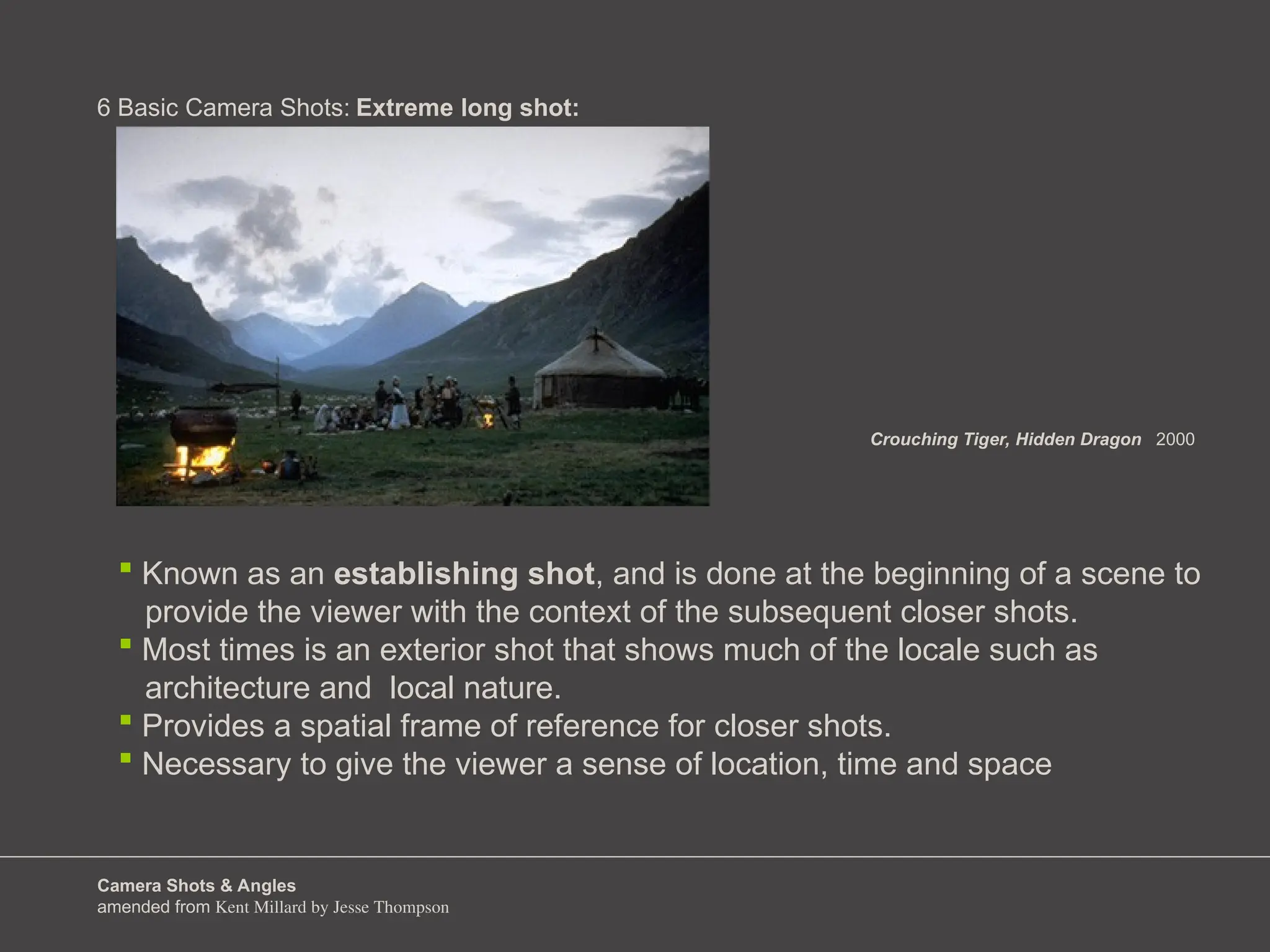
6 Basic Camera Shots:
 Known as an establishing shot, and is done at the beginning of a scene to
provide the viewer with the context of the subsequent closer shots.
 Most times is an exterior shot that shows much of the locale such as
architecture and local nature.
 Provides a spatial frame of reference for closer shots.
 Necessary to give the viewer a sense of location, time and space
Extreme long shot:
Crouching Tiger, Hidden Dragon 2000
Camera Shots & Angles
By Kent Millard amended by Jesse Thompson
6 Basic Camera Shots:
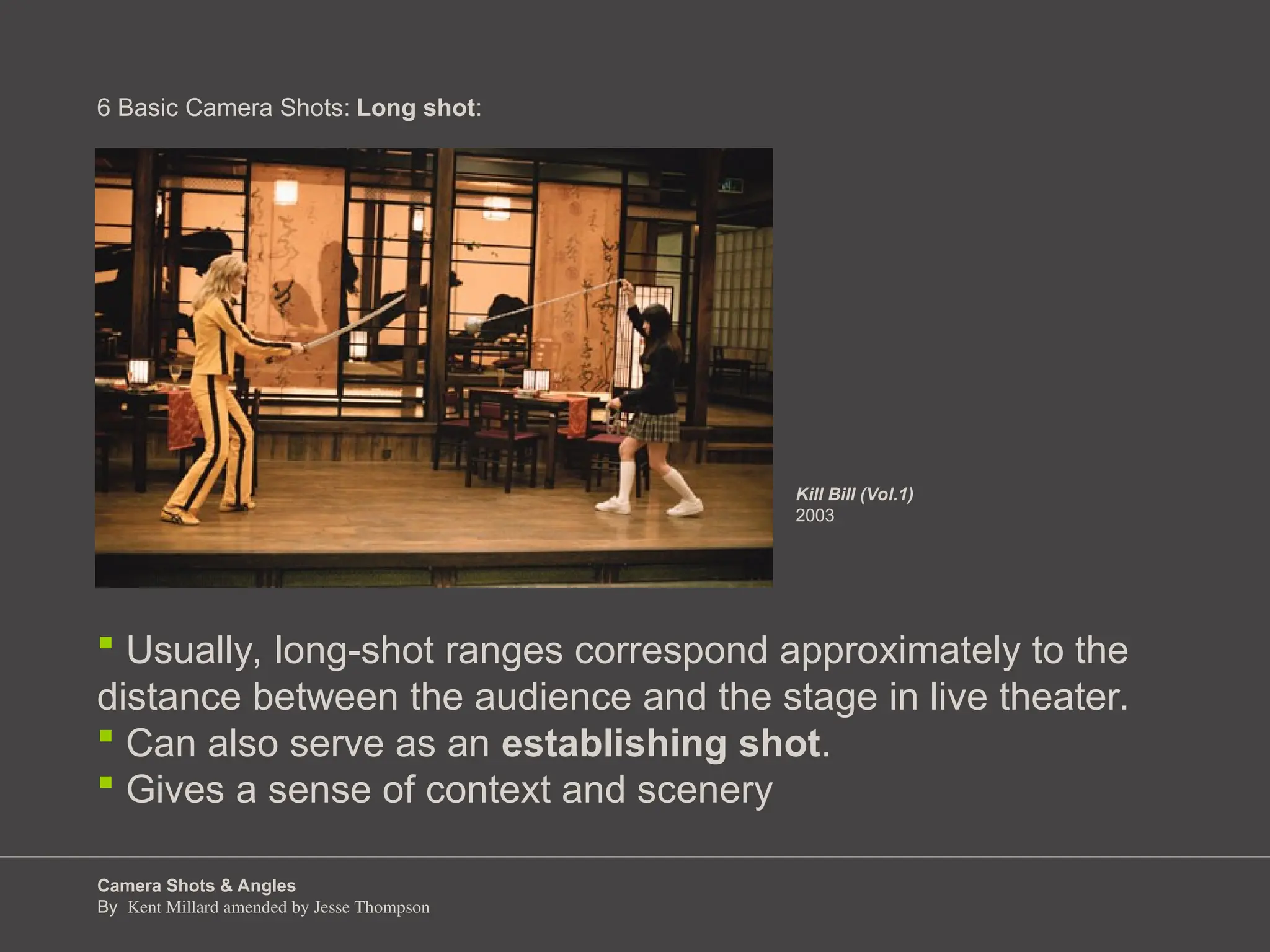
 Usually, long-shot ranges correspond approximately to the
distance between the audience and the stage in live theater.
 Can also serve as an establishing shot.
 Gives a sense of context and scenery
Long shot:
Kill Bill (Vol.1)
2003
Camera Shots & Angles
Kent Millard
6 Basic Camera Shots:
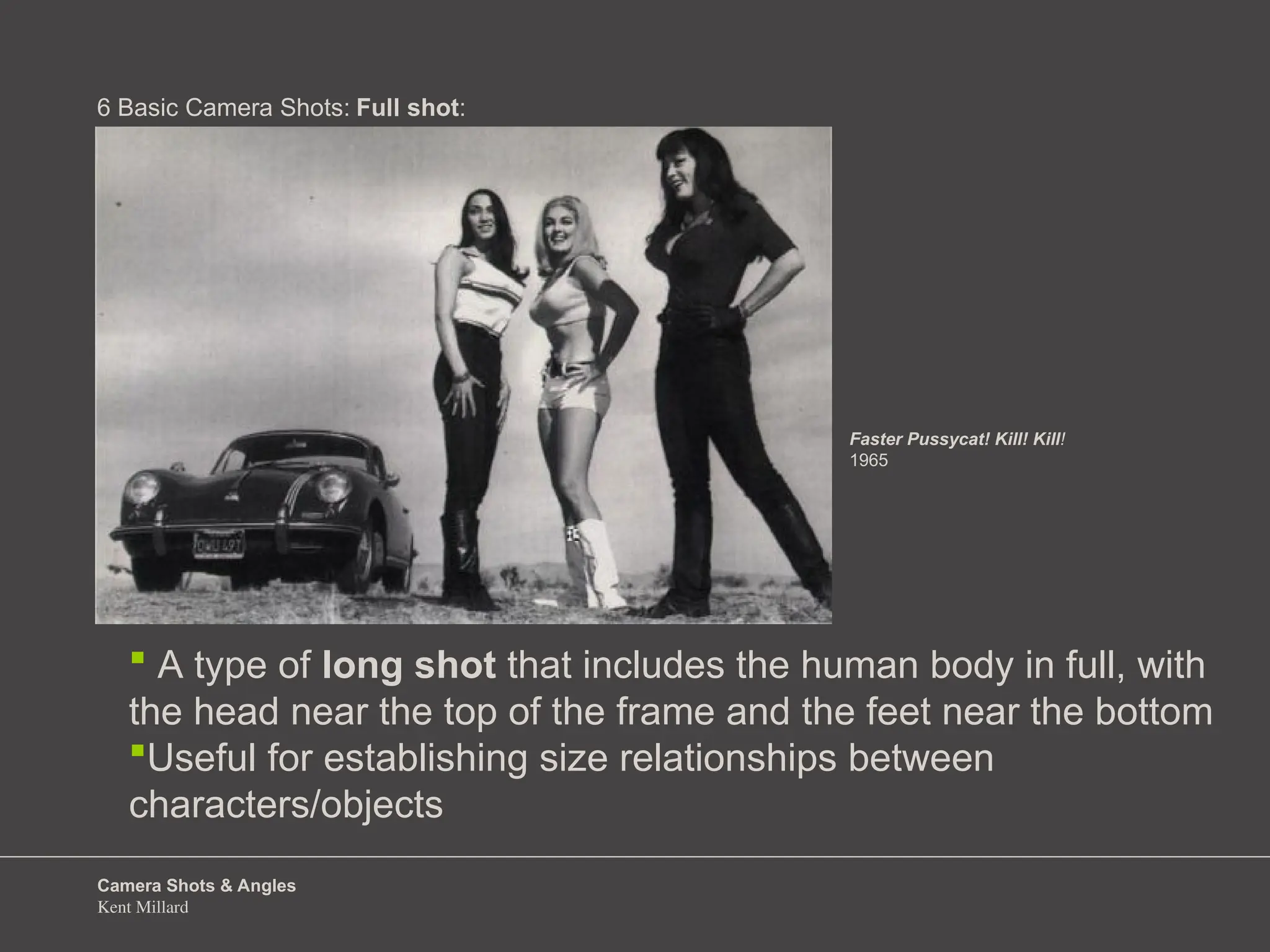
 A type of long shot that includes the human body in full, with
the head near the top of the frame and the feet near the bottom
Useful for establishing size relationships between
characters/objects
Full shot:
Faster Pussycat! Kill! Kill!
1965
Camera Shots & Angles
Kent Millard amended by Jesse Thompson
6 Basic Camera Shots:
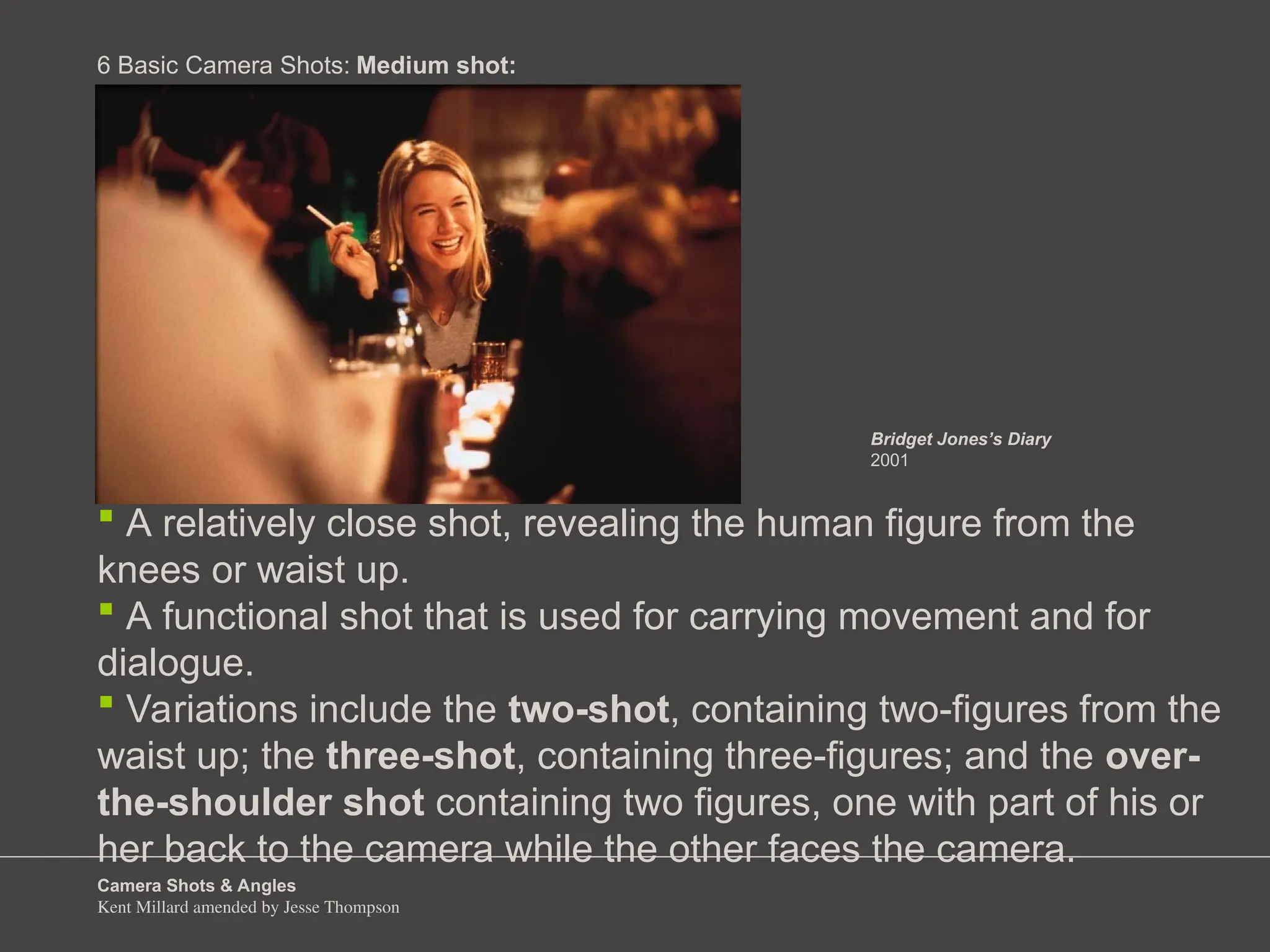
 A relatively close shot, revealing the human figure from the
knees or waist up.
 A functional shot that is used for carrying movement and for
dialogue.
 Variations include the two-shot, containing two-figures from the
waist up; the three-shot, containing three-figures; and the over-
the-shoulder shot containing two figures, one with part of his or
her back to the camera while the other faces the camera.
Medium shot:
Bridget Jones’s Diary
2001
Camera Shots & Angles
Kent Millard amended by Jesse Thompson
6 Basic Camera Shots:
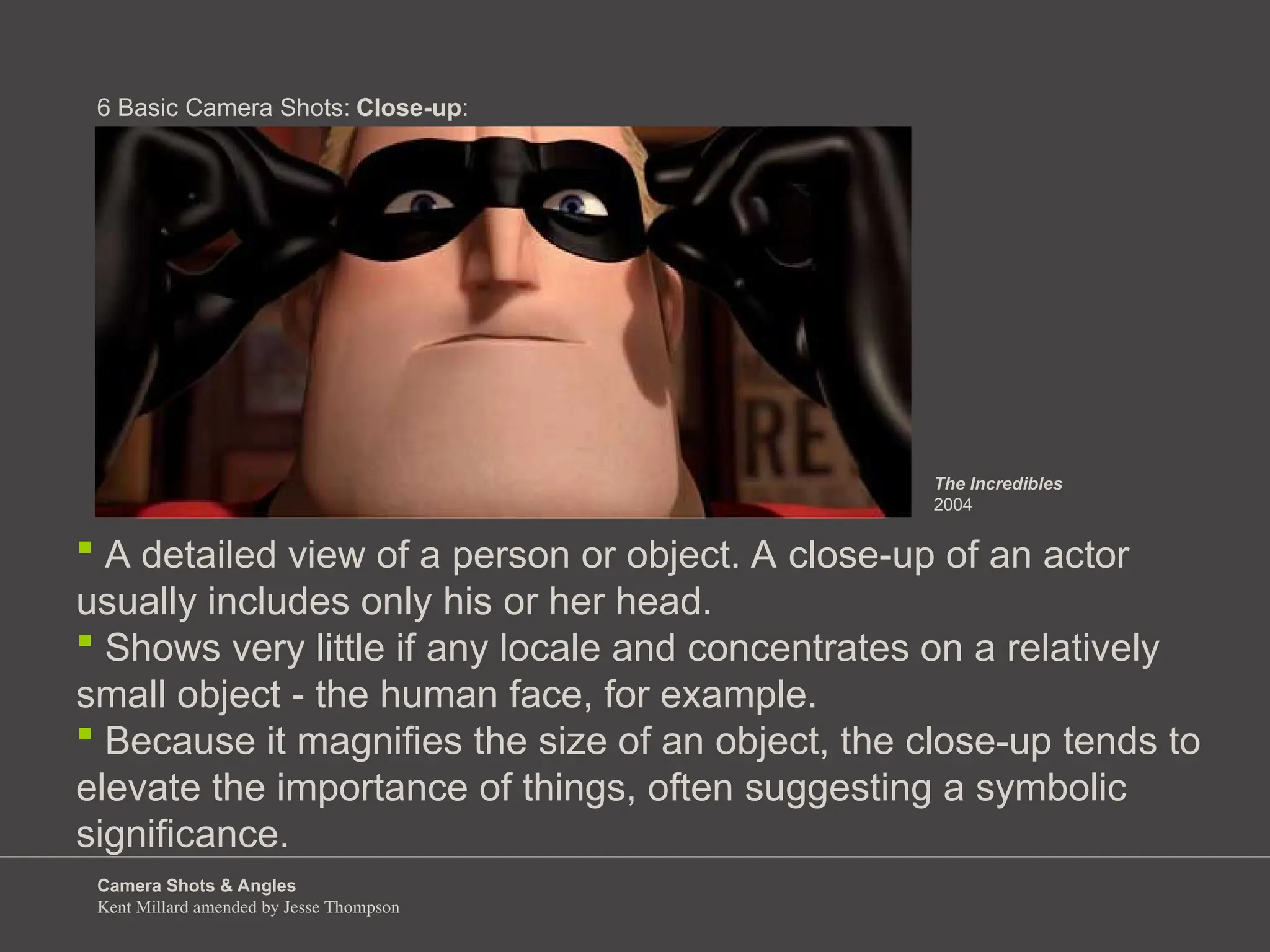
 A detailed view of a person or object. A close-up of an actor
usually includes only his or her head.
 Shows very little if any locale and concentrates on a relatively
small object - the human face, for example.
 Because it magnifies the size of an object, the close-up tends to
elevate the importance of things, often suggesting a symbolic
significance.
Close-up:
The Incredibles
2004
Camera Shots & Angles
Kent Millard amended by Jesse Thompson
6 Basic Camera Shots:
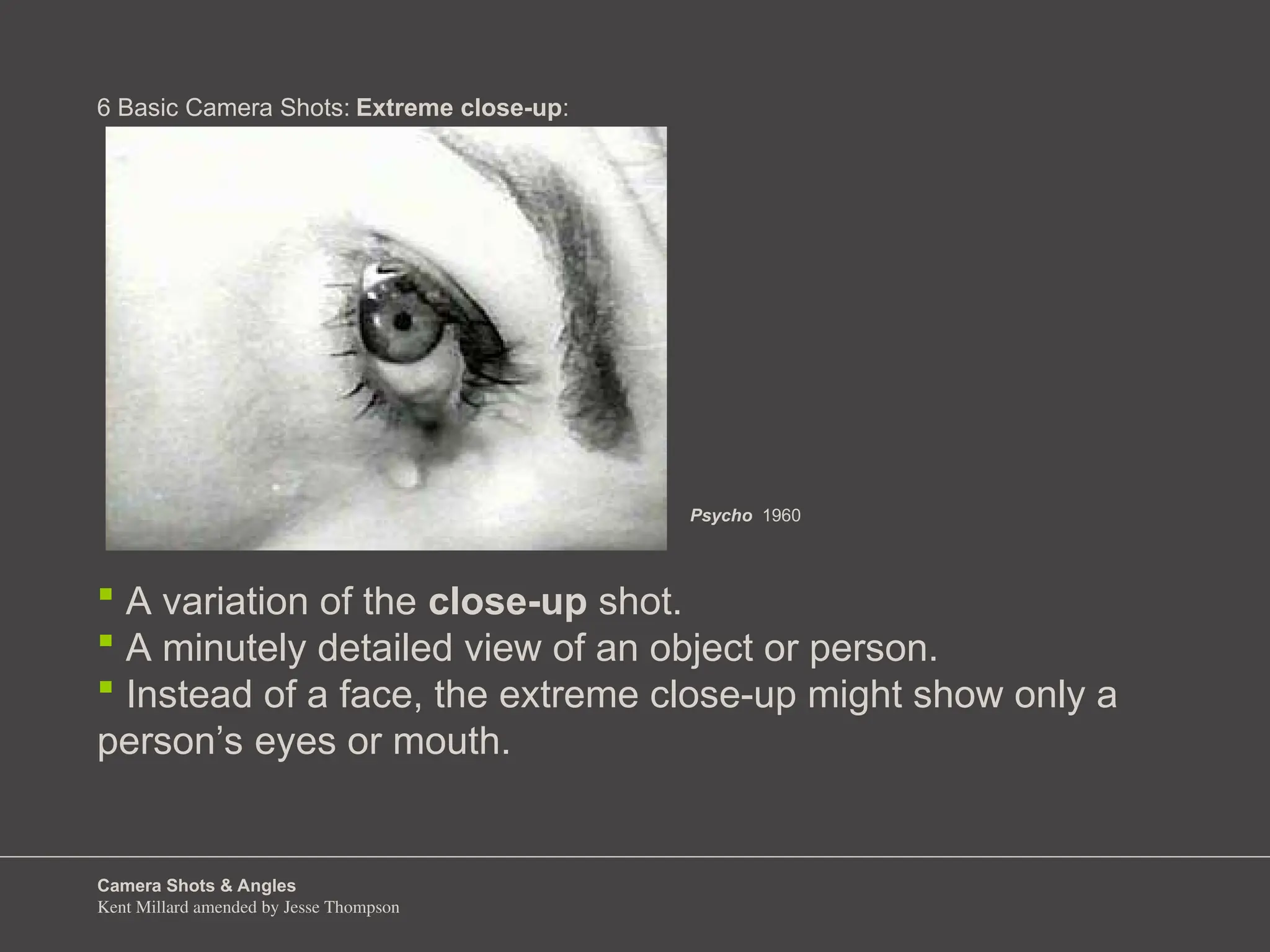
 A variation of the close-up shot.
 A minutely detailed view of an object or person.
 Instead of a face, the extreme close-up might show only a
person’s eyes or mouth.
Extreme close-up:
Psycho 1960
Camera Shots & Angles
Kent Millard amended by Jesse Thompson
5 Basic Camera Angles:
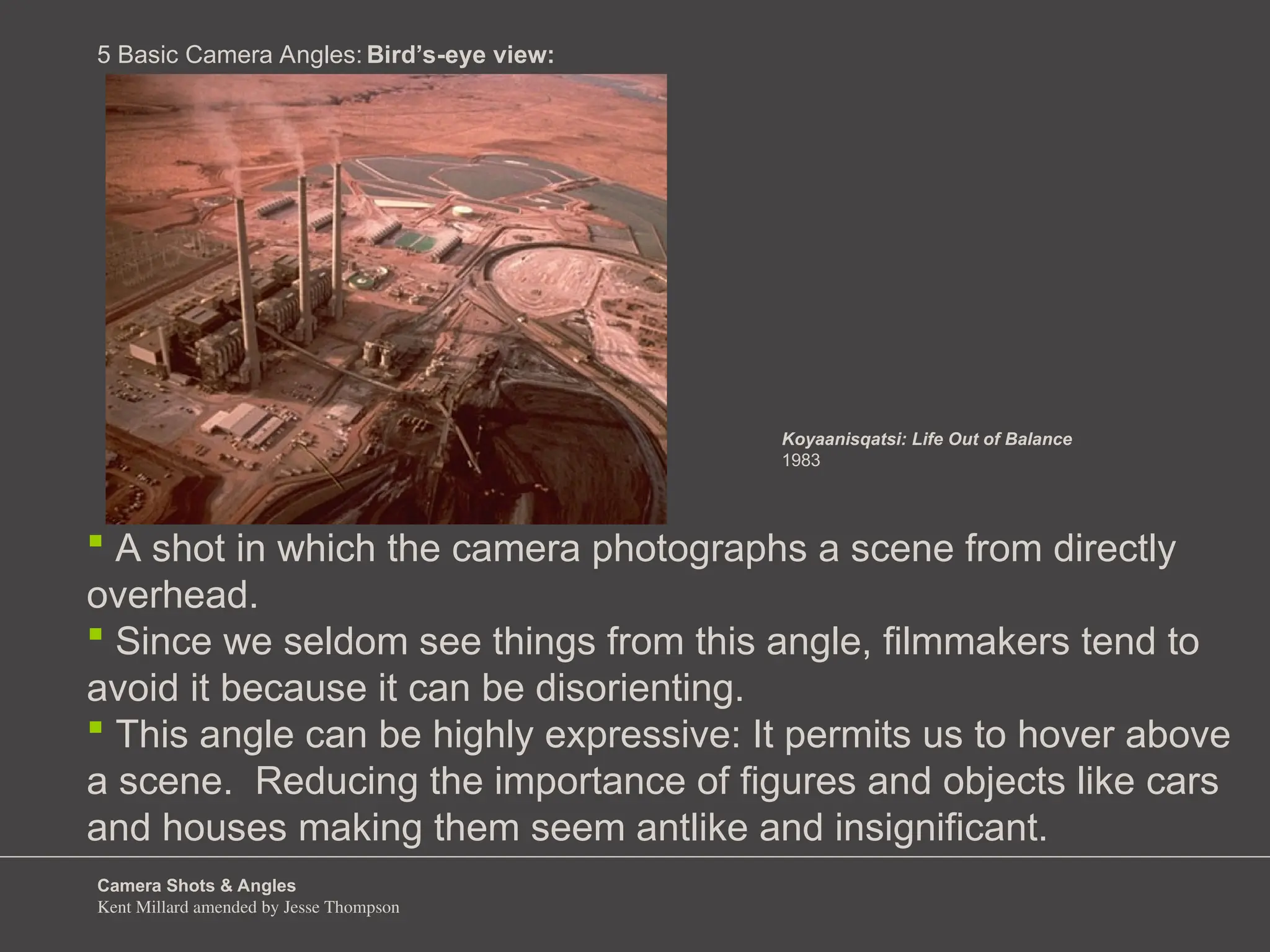
 A shot in which the camera photographs a scene from directly
overhead.
 Since we seldom see things from this angle, filmmakers tend to
avoid it because it can be disorienting.
 This angle can be highly expressive: It permits us to hover above
a scene. Reducing the importance of figures and objects like cars
and houses making them seem antlike and insignificant.
Bird’s-eye view:
Koyaanisqatsi: Life Out of Balance
1983
Camera Shots & Angles
Kent Millard amended by Jesse Thompson
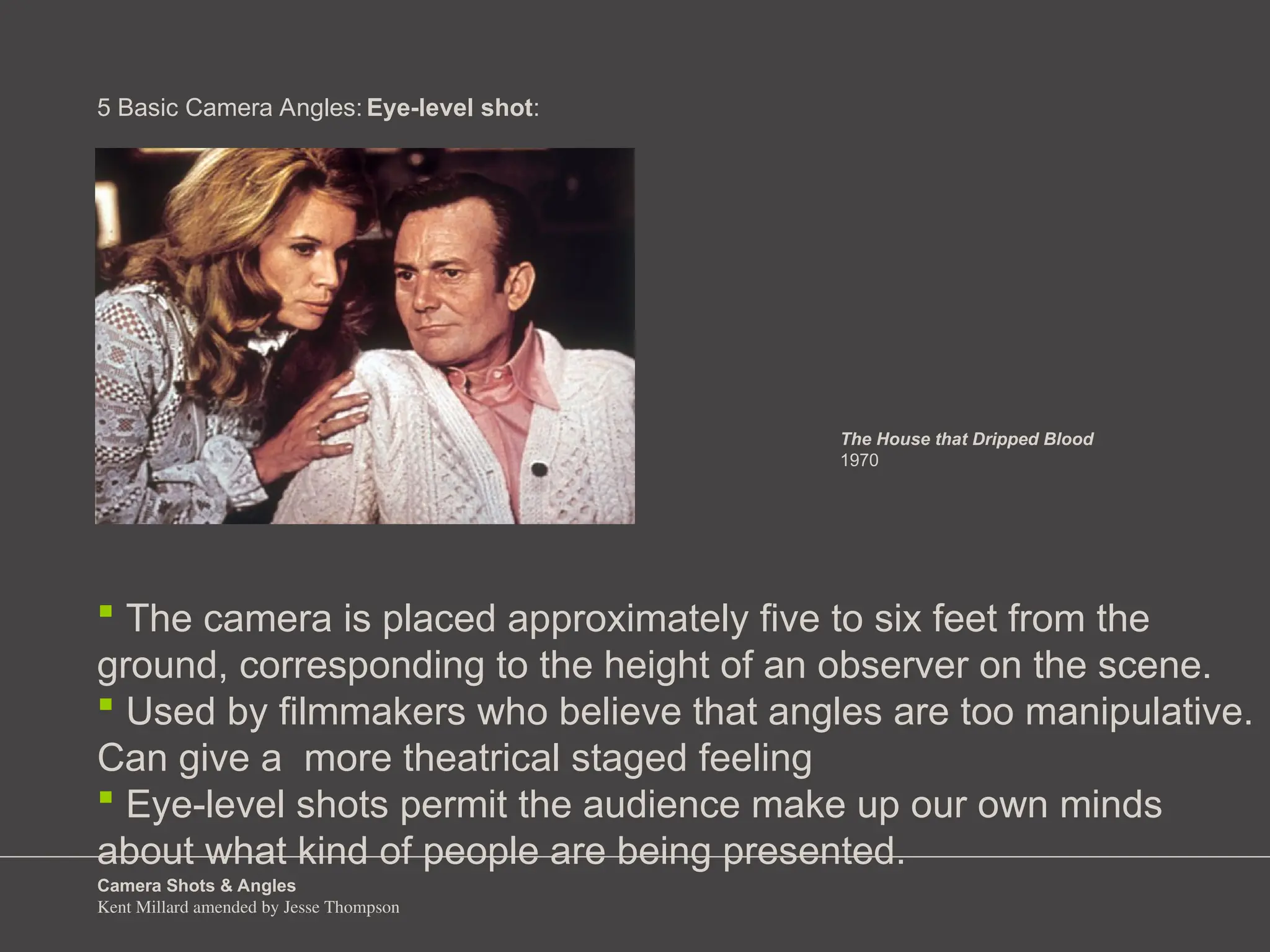
5 Basic Camera Angles: Eye-level shot:
The House that Dripped Blood
1970
 The camera is placed approximately five to six feet from the
ground, corresponding to the height of an observer on the scene.
 Used by filmmakers who believe that angles are too manipulative.
Can give a more theatrical staged feeling
 Eye-level shots permit the audience make up our own minds
about what kind of people are being presented.
Camera Shots & Angles
Kent Millard
5 Basic Camera Angles:
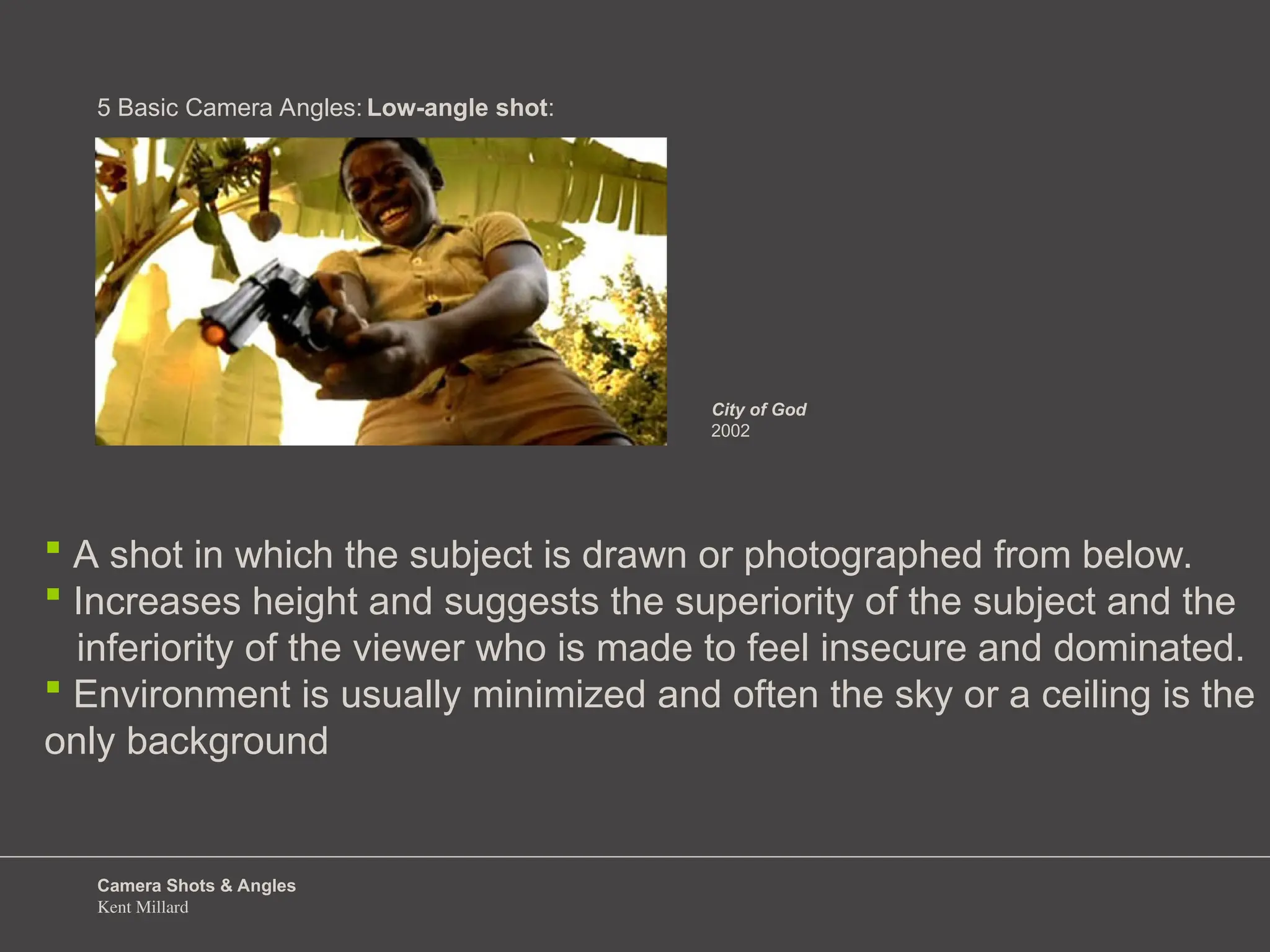
 A shot in which the subject is drawn or photographed from below.
 Increases height and suggests the superiority of the subject and the
inferiority of the viewer who is made to feel insecure and dominated.
 Environment is usually minimized and often the sky or a ceiling is the
only background
Low-angle shot:
City of God
2002
Camera Shots & Angles
Kent Millard amended by Jesse Thompson
5 Basic Camera Angles:
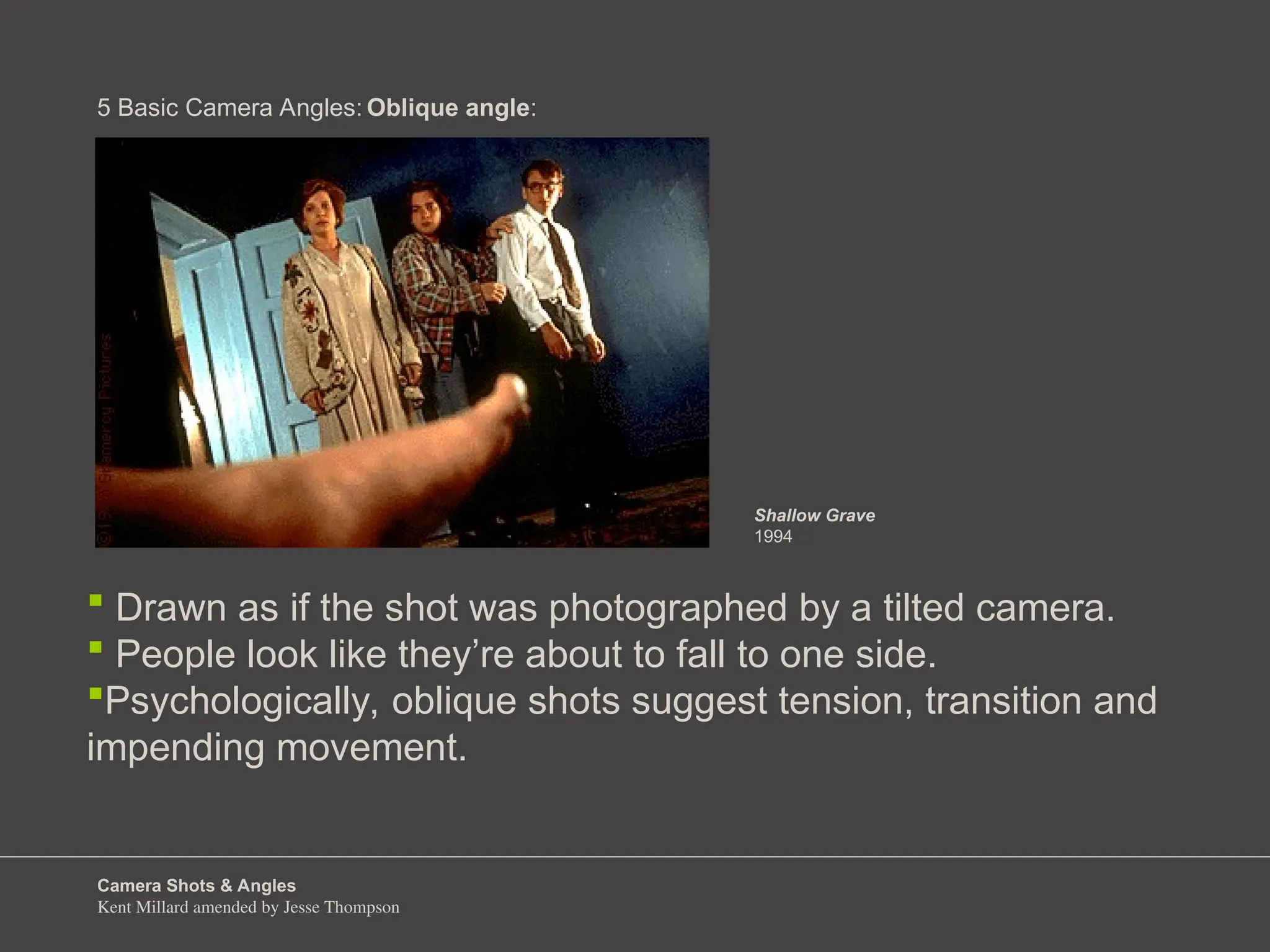
 Drawn as if the shot was photographed by a tilted camera.
 People look like they’re about to fall to one side.
Psychologically, oblique shots suggest tension, transition and
impending movement.
Oblique angle:
Shallow Grave
1994

Best angle for photo taking using a camera.ppt

  • 1.
    Camera Shots &Angles By Kent Millard amended by Jesse Thompson Camera shots & angles: The art and Science of choosing what your viewer will see.
  • 2.
    Camera Shots &Angles Kent Millard
  • 3.
    Camera Shots &Angles amended from Kent Millard by Jesse Thompson 6 Basic Camera Shots:  Known as an establishing shot, and is done at the beginning of a scene to provide the viewer with the context of the subsequent closer shots.  Most times is an exterior shot that shows much of the locale such as architecture and local nature.  Provides a spatial frame of reference for closer shots.  Necessary to give the viewer a sense of location, time and space Extreme long shot: Crouching Tiger, Hidden Dragon 2000
  • 4.
    Camera Shots &Angles By Kent Millard amended by Jesse Thompson 6 Basic Camera Shots:  Usually, long-shot ranges correspond approximately to the distance between the audience and the stage in live theater.  Can also serve as an establishing shot.  Gives a sense of context and scenery Long shot: Kill Bill (Vol.1) 2003
  • 5.
    Camera Shots &Angles Kent Millard 6 Basic Camera Shots:  A type of long shot that includes the human body in full, with the head near the top of the frame and the feet near the bottom Useful for establishing size relationships between characters/objects Full shot: Faster Pussycat! Kill! Kill! 1965
  • 6.
    Camera Shots &Angles Kent Millard amended by Jesse Thompson 6 Basic Camera Shots:  A relatively close shot, revealing the human figure from the knees or waist up.  A functional shot that is used for carrying movement and for dialogue.  Variations include the two-shot, containing two-figures from the waist up; the three-shot, containing three-figures; and the over- the-shoulder shot containing two figures, one with part of his or her back to the camera while the other faces the camera. Medium shot: Bridget Jones’s Diary 2001
  • 7.
    Camera Shots &Angles Kent Millard amended by Jesse Thompson 6 Basic Camera Shots:  A detailed view of a person or object. A close-up of an actor usually includes only his or her head.  Shows very little if any locale and concentrates on a relatively small object - the human face, for example.  Because it magnifies the size of an object, the close-up tends to elevate the importance of things, often suggesting a symbolic significance. Close-up: The Incredibles 2004
  • 8.
    Camera Shots &Angles Kent Millard amended by Jesse Thompson 6 Basic Camera Shots:  A variation of the close-up shot.  A minutely detailed view of an object or person.  Instead of a face, the extreme close-up might show only a person’s eyes or mouth. Extreme close-up: Psycho 1960
  • 9.
    Camera Shots &Angles Kent Millard amended by Jesse Thompson 5 Basic Camera Angles:  A shot in which the camera photographs a scene from directly overhead.  Since we seldom see things from this angle, filmmakers tend to avoid it because it can be disorienting.  This angle can be highly expressive: It permits us to hover above a scene. Reducing the importance of figures and objects like cars and houses making them seem antlike and insignificant. Bird’s-eye view: Koyaanisqatsi: Life Out of Balance 1983
  • 10.
    Camera Shots &Angles Kent Millard amended by Jesse Thompson 5 Basic Camera Angles: Eye-level shot: The House that Dripped Blood 1970  The camera is placed approximately five to six feet from the ground, corresponding to the height of an observer on the scene.  Used by filmmakers who believe that angles are too manipulative. Can give a more theatrical staged feeling  Eye-level shots permit the audience make up our own minds about what kind of people are being presented.
  • 11.
    Camera Shots &Angles Kent Millard 5 Basic Camera Angles:  A shot in which the subject is drawn or photographed from below.  Increases height and suggests the superiority of the subject and the inferiority of the viewer who is made to feel insecure and dominated.  Environment is usually minimized and often the sky or a ceiling is the only background Low-angle shot: City of God 2002
  • 12.
    Camera Shots &Angles Kent Millard amended by Jesse Thompson 5 Basic Camera Angles:  Drawn as if the shot was photographed by a tilted camera.  People look like they’re about to fall to one side. Psychologically, oblique shots suggest tension, transition and impending movement. Oblique angle: Shallow Grave 1994