BERT ALGORITHM
BERT ALGORITHM
• BERT is a deep learning framework, developed by Google, that can be
applied to NLP.
• This means that the NLP BERT framework learns information from
both the
• right and left side of a word (or token in NLP parlance).
• This makes it more efficient at understanding context.
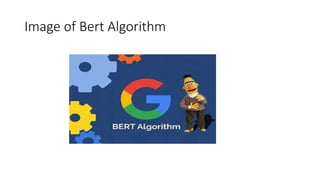
Image of Bert Algorithm
SUBJECT
On the subject of Google, their research department Google Brain has recently developed a
game-changing deep learning NLP algorithm called BERT. More on that later on.
This guide is an in-depth exploration of NLP, Deep Learning Algorithms and BERT for
beginners. First, we’ll cover what is meant by NLP, the practical applications of it, and
recent developments. We’ll then explore the revolutionary language model BERT, how it
has developed, and finally, what the future holds for NLP and Deep Learning.
IMPORTANT POINTS
• NLP stands for Natural Language Processing, and the clue is in the title.
• “Natural language” refers to the kind of typical conversational or informal language that we use every day, verbally or written.
Natural language conveys a lot of information, not just in the words we use, but also the tone, context, chosen topic and phrasing.
• We use our innate human intelligence to process the information being communicated, and we can infer meaning from it and
often even predict what people are saying, or trying to say, before they’ve said it.
• NLP began in the 1950’s by using a rule-based or heuristic approach, that set out a system of grammatical and language rules. This
was a limited approach as it didn’t allow for any nuance of language, such as the evolution of new words and phrases or the use of
informal phrasing and words.
• Everything changed in the 1980’s, when a statistical approach was developed for NLP. The aim of the statistical approach is to
mimic human-like processing of natural language. This is achieved by analyzing large chunks of conversational data and applying
machine learning to create flexible language models. That’s how machine learning natural language processing was introduced.
• Another breakthrough for NLP happened in 2006, when it was shown that a multi-layered neural network could be pre-trained a
layer at a time. This was a game-changer that opened the door to NLP deep learning algorithms.
• Over the past decade, the development of deep learning algorithms has enabled NLP systems to organize and analyze large
amounts of unstructured data such as conversational snippets, internet posts, tweets, etc., and apply a cognitive approach to
interpreting it all. This allows for a greater AI-understanding of conversational nuance such as irony, sarcasm and sentiment.
ARTIFICIAL INTELLIGENCE
Imagine this…
There you are, happily working away on a seriously cool data science project designed to recognize regional dialects, for instance.
You’ve been plugging away, working on some advanced methods, making progress.
Then suddenly, almost out of nowhere comes along a brand new framework that’s going to revolutionize your field and really
improve your model.
This is the reality of working in AI these days.
The world of AI progresses rapidly.
•Deep Learning is a subset of Machine Learning.
•Machine Learning is a branch of AI.
An example of NLP at work is predictive typing, which suggests phrases based on language patterns that have been lea
• The Google BERT algorithm (Bidirectional Encoder Representations
from Transformers) began rolling out in October 2019. The algorithm
helps Google understand natural language search queries. It does this
by understanding subtle changes in the meaning of words, depending
on context and where the words appear in a sentence.
THANK YOU
Bert algorithm  2

Bert algorithm 2

  • 1.
  • 2.
    BERT ALGORITHM • BERTis a deep learning framework, developed by Google, that can be applied to NLP. • This means that the NLP BERT framework learns information from both the • right and left side of a word (or token in NLP parlance). • This makes it more efficient at understanding context.
  • 3.
    Image of BertAlgorithm
  • 4.
    SUBJECT On the subjectof Google, their research department Google Brain has recently developed a game-changing deep learning NLP algorithm called BERT. More on that later on. This guide is an in-depth exploration of NLP, Deep Learning Algorithms and BERT for beginners. First, we’ll cover what is meant by NLP, the practical applications of it, and recent developments. We’ll then explore the revolutionary language model BERT, how it has developed, and finally, what the future holds for NLP and Deep Learning.
  • 5.
    IMPORTANT POINTS • NLPstands for Natural Language Processing, and the clue is in the title. • “Natural language” refers to the kind of typical conversational or informal language that we use every day, verbally or written. Natural language conveys a lot of information, not just in the words we use, but also the tone, context, chosen topic and phrasing. • We use our innate human intelligence to process the information being communicated, and we can infer meaning from it and often even predict what people are saying, or trying to say, before they’ve said it. • NLP began in the 1950’s by using a rule-based or heuristic approach, that set out a system of grammatical and language rules. This was a limited approach as it didn’t allow for any nuance of language, such as the evolution of new words and phrases or the use of informal phrasing and words. • Everything changed in the 1980’s, when a statistical approach was developed for NLP. The aim of the statistical approach is to mimic human-like processing of natural language. This is achieved by analyzing large chunks of conversational data and applying machine learning to create flexible language models. That’s how machine learning natural language processing was introduced. • Another breakthrough for NLP happened in 2006, when it was shown that a multi-layered neural network could be pre-trained a layer at a time. This was a game-changer that opened the door to NLP deep learning algorithms. • Over the past decade, the development of deep learning algorithms has enabled NLP systems to organize and analyze large amounts of unstructured data such as conversational snippets, internet posts, tweets, etc., and apply a cognitive approach to interpreting it all. This allows for a greater AI-understanding of conversational nuance such as irony, sarcasm and sentiment.
  • 6.
    ARTIFICIAL INTELLIGENCE Imagine this… Thereyou are, happily working away on a seriously cool data science project designed to recognize regional dialects, for instance. You’ve been plugging away, working on some advanced methods, making progress. Then suddenly, almost out of nowhere comes along a brand new framework that’s going to revolutionize your field and really improve your model. This is the reality of working in AI these days. The world of AI progresses rapidly.
  • 7.
    •Deep Learning isa subset of Machine Learning. •Machine Learning is a branch of AI. An example of NLP at work is predictive typing, which suggests phrases based on language patterns that have been lea
  • 8.
    • The GoogleBERT algorithm (Bidirectional Encoder Representations from Transformers) began rolling out in October 2019. The algorithm helps Google understand natural language search queries. It does this by understanding subtle changes in the meaning of words, depending on context and where the words appear in a sentence.
  • 9.