Bernoulli’s Equation
Contents:
•How to calculate
•Whiteboards
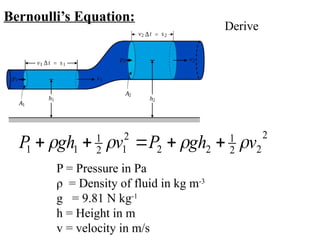
Bernoulli’s Equation:
P = Pressure in Pa
ρ = Density of fluid in kg m-3
g = 9.81 N kg-1
h = Height in m
v = velocity in m/s
2
2
2
1
2
2
2
1
2
1
1
1 v
gh
P
v
gh
P 


 




Derive
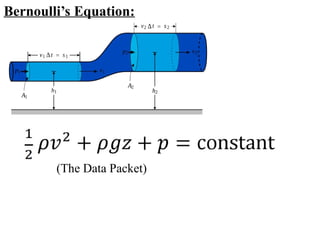
Bernoulli’s Equation:
(The Data Packet)
Example Water with a density of 1000. kg m-3
pours from a very large tank of
water from a pipe that is 34.0 m
below the surface of the water.
What is its velocity?
25.8 m/s
ρgh = ½ρv2
gh = ½v2
v = √(2gh)
Torricelli's Law!!! (demo – bucket with holes)
Example Air with a density of 1.29
kg m-3
flows at 2.00 m/s
where a duct is 48.0 cm in
diameter under a pressure
of 1.00x10⁵
Pa. What is the
a. velocity and b. pressure
when the pipe narrows to
12.0 cm?
32.0 m/s, 0.993E5Pa
(π(0.242
))(2) = (π(0.062
))(v), v = 32.0 m/s
P + ½ρv2
= P + ½ρv2
1.00E5 + .5(1.29)(22
) = P + .5(1.29)(322
), P = 99,342.1 Pa
How is it less? – It has to be....why does it speed up/slow down? What is the molecule spacing?
Standing waves in rivers
Demo – 2 papers, blowing over one paper, blower and water tube, blower and ball,
flapping flags, waves (Kelvin-Helmholz instability )
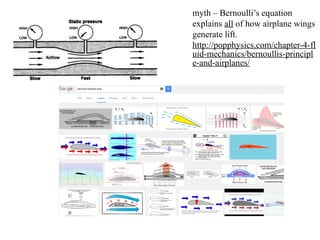
airplane wings??? – maybe not
myth – Bernoulli’s equation
explains all of how airplane wings
generate lift.
http://popphysics.com/chapter-4-fl
uid-mechanics/bernoullis-principl
e-and-airplanes/
Bernoulli
1-5
The wind is moving horizontally at 12.0 m/s over a level
rectangular roof that measures 4.50 m by 8.00 m.
A. What is the pressure difference between the bottom (still
air) and the top (moving air) of the roof surface? Use 1.29 kg
m-3
for the density of the air, neglect the change in height, and
assume (if you need to) that the pressure underneath is
1.013x10⁵
Pa.
B. What is the net upward force on the roof?
P = P + ½ρv2
so the difference is just ½ρv2
so the difference is .5(1.29)(122
) = 92.88 Pa
multiply this by the area of the roof to get the force.
92.9 Pa, 3340 N (751 lbs)
A very large Nitrogen tank is at 2000. PSI. If nitrogen at STP
has a density of 1.17 kg m-3
, how fast is the gas going if the
valve breaks off when the tank is horizontal
(assume P1 is 2000 PSI (convert), v1 is zero?, P2 is 1.013E5
Pa, solve for v2. Ignore change in height.) 1 atm = 14.7 PSI
EC – if the opening is 1.2 cm in diameter, what thrust does the tank develop? (??????)
https://www.youtube.com/watch?v=f-xmaPSZ6GM
https://www.youtube.com/watch?v=ejEJGNLTo84
P = P + ½ρv2
(2000/14.7)*1.013E5 = 1.013E5 + .5(1.17)v2
v = 4835.9 m/s ≈ 4840 m/s
F = Δp/t = m Δv/t = (Avρ)v = 3094.6 N ≈ 3090 N
4835.9 or roughly 4840 m/s, 3090 N (695 lbs)
What pressure is needed in a fountain if it is spraying water
straight up to a height of 23.2 m? What is the gauge pressure?
ρ = 1000. kg m-3
, P2 = 1.013E5 Pa
P = P + ρgh
P = 1.013E5 + (1000)(9.81)(23.2) = 328,892 Pa ≈ 3.29E5 Pa
328,892 Pa – 101,300 Pa = 2.28x10⁵
Pa
3.29x10⁵
Pa, 2.28x10⁵
Pa
A water faucet breaks in the Physics room, spraying water
upwards. If the gauge pressure in the water mains is 21.0 PSI,
(at v = 0) with what speed does the water hit the ceiling 4.80
m above the faucet? How much time does it take a custodian to come down and fix the leak?
ρ = 1000. kg m-3
, P2 = 1atm = 1.013E5 Pa. 1 atm = 14.7 PSI
P = P + ρgh + ½ρv2
(21.0+14.7)/14.7*1.013E5 = 1.013E5 + (1000)(9.81)(4.80) + .5(1000)v2
v = 13.973… m/s ≈ 14.0 m/s
14.0 m/s
Water flows at 2.00 m/s at an elevation of 1.50 m with a
pressure of 1.15x10⁵
Pa through a 10.0 cm diameter pipe.
What is the pressure if it is at an elevation of 5.00 m going
through a 6.00 cm diameter pipe? (Find the second speed first. ρ =
1000. kg m-3
)
v = (10/6)2
(2.00 m/s) = 5.55555 m/s
P + ρgh + ½ρv2
= P + ρgh + ½ρv2
1.15E5 + (1000)9.81(1.50) + .5(1000)(2.00)2
= P + (1000)9.81(5.00) + .5(1000)(5.5555)2
P = 67,232.9 Pa ≈ 6.72E4 Pa
6.72x10⁴
Pa

Bernoulli Equation and its appliactions.

  • 1.
  • 2.
    Bernoulli’s Equation: P =Pressure in Pa ρ = Density of fluid in kg m-3 g = 9.81 N kg-1 h = Height in m v = velocity in m/s 2 2 2 1 2 2 2 1 2 1 1 1 v gh P v gh P          Derive
  • 3.
  • 4.
    Example Water witha density of 1000. kg m-3 pours from a very large tank of water from a pipe that is 34.0 m below the surface of the water. What is its velocity? 25.8 m/s ρgh = ½ρv2 gh = ½v2 v = √(2gh) Torricelli's Law!!! (demo – bucket with holes)
  • 5.
    Example Air witha density of 1.29 kg m-3 flows at 2.00 m/s where a duct is 48.0 cm in diameter under a pressure of 1.00x10⁵ Pa. What is the a. velocity and b. pressure when the pipe narrows to 12.0 cm? 32.0 m/s, 0.993E5Pa (π(0.242 ))(2) = (π(0.062 ))(v), v = 32.0 m/s P + ½ρv2 = P + ½ρv2 1.00E5 + .5(1.29)(22 ) = P + .5(1.29)(322 ), P = 99,342.1 Pa How is it less? – It has to be....why does it speed up/slow down? What is the molecule spacing? Standing waves in rivers Demo – 2 papers, blowing over one paper, blower and water tube, blower and ball, flapping flags, waves (Kelvin-Helmholz instability ) airplane wings??? – maybe not
  • 6.
    myth – Bernoulli’sequation explains all of how airplane wings generate lift. http://popphysics.com/chapter-4-fl uid-mechanics/bernoullis-principl e-and-airplanes/
  • 7.
  • 8.
    The wind ismoving horizontally at 12.0 m/s over a level rectangular roof that measures 4.50 m by 8.00 m. A. What is the pressure difference between the bottom (still air) and the top (moving air) of the roof surface? Use 1.29 kg m-3 for the density of the air, neglect the change in height, and assume (if you need to) that the pressure underneath is 1.013x10⁵ Pa. B. What is the net upward force on the roof? P = P + ½ρv2 so the difference is just ½ρv2 so the difference is .5(1.29)(122 ) = 92.88 Pa multiply this by the area of the roof to get the force. 92.9 Pa, 3340 N (751 lbs)
  • 9.
    A very largeNitrogen tank is at 2000. PSI. If nitrogen at STP has a density of 1.17 kg m-3 , how fast is the gas going if the valve breaks off when the tank is horizontal (assume P1 is 2000 PSI (convert), v1 is zero?, P2 is 1.013E5 Pa, solve for v2. Ignore change in height.) 1 atm = 14.7 PSI EC – if the opening is 1.2 cm in diameter, what thrust does the tank develop? (??????) https://www.youtube.com/watch?v=f-xmaPSZ6GM https://www.youtube.com/watch?v=ejEJGNLTo84 P = P + ½ρv2 (2000/14.7)*1.013E5 = 1.013E5 + .5(1.17)v2 v = 4835.9 m/s ≈ 4840 m/s F = Δp/t = m Δv/t = (Avρ)v = 3094.6 N ≈ 3090 N 4835.9 or roughly 4840 m/s, 3090 N (695 lbs)
  • 10.
    What pressure isneeded in a fountain if it is spraying water straight up to a height of 23.2 m? What is the gauge pressure? ρ = 1000. kg m-3 , P2 = 1.013E5 Pa P = P + ρgh P = 1.013E5 + (1000)(9.81)(23.2) = 328,892 Pa ≈ 3.29E5 Pa 328,892 Pa – 101,300 Pa = 2.28x10⁵ Pa 3.29x10⁵ Pa, 2.28x10⁵ Pa
  • 11.
    A water faucetbreaks in the Physics room, spraying water upwards. If the gauge pressure in the water mains is 21.0 PSI, (at v = 0) with what speed does the water hit the ceiling 4.80 m above the faucet? How much time does it take a custodian to come down and fix the leak? ρ = 1000. kg m-3 , P2 = 1atm = 1.013E5 Pa. 1 atm = 14.7 PSI P = P + ρgh + ½ρv2 (21.0+14.7)/14.7*1.013E5 = 1.013E5 + (1000)(9.81)(4.80) + .5(1000)v2 v = 13.973… m/s ≈ 14.0 m/s 14.0 m/s
  • 12.
    Water flows at2.00 m/s at an elevation of 1.50 m with a pressure of 1.15x10⁵ Pa through a 10.0 cm diameter pipe. What is the pressure if it is at an elevation of 5.00 m going through a 6.00 cm diameter pipe? (Find the second speed first. ρ = 1000. kg m-3 ) v = (10/6)2 (2.00 m/s) = 5.55555 m/s P + ρgh + ½ρv2 = P + ρgh + ½ρv2 1.15E5 + (1000)9.81(1.50) + .5(1000)(2.00)2 = P + (1000)9.81(5.00) + .5(1000)(5.5555)2 P = 67,232.9 Pa ≈ 6.72E4 Pa 6.72x10⁴ Pa