PRINCIPLES OF DISCOURSE
ANALYSIS
COHESION AND COHERENCE
( Discourse Analysis )
( GROUP 4)
1.FLORES, CHARISH
2.FLORES, KETH MECHELL
3.LLANTO, CHRISTINE
4.TAPALLA, JOEJOHN
Introduction
• Cohesion and coherence are terms used in
discourse analysis and text linguistics to describe
the properties of written texts.
• Coherence and cohesion are essential for aiding
readability and idea communication.
Coherence is about the unity of the ideas
and
Cohesion is the unity of structural elements.
Definitions
Cohesion:
Cohesion is the grammatical and lexical relationship
between different elements of a text which hold it together.
Coherence:
Coherence is a Latin word, meaning “to stick together.” In a
composition, coherence is a literary technique that refers
to the ways a text makes sense to readers and writer
through the relevance and accessibility of its ideas and
theories.
Coherence
A semantic property of discourse formed through the interpretation
of each individual sentence related to the interpretation of other
sentences, with "interpretation" implying interaction between the
text, the reader and the writer.
A property that a reader will discern in the text.
Allows the reader to make sense of the text.
Coherence refers to the semantic unity created between the ideas,
sentences, paragraphs and sections in a piece of writing.
Coherence vs. Cohesion (features)
Coherence Cohesion
Very general principle of
interpretation of language in
context.
Fewer formal linguistic
features e.g. vocabulary
choice.
Relationships deal with text as
a whole.
Based on primarily semantic
relationships.
Errors much more obvious.
Formal linguistic elements
e.g. repetition, reference.
Semantic relationships
between sentences and
within sentences.
Determined by lexically
and grammatically overt
relationships.
More recognizable.
Cohesive Devices?
Cohesive devices, sometimes called linking words, linkers, connectors,
discourse markers or transitional words and these are words or phrases
that show the relationship between paragraphs or sections of
a text or speech.
Some examples of Cohesive Devices
There are many examples of cohesive devices, they can be grouped by
category.
If you want so show similarity, you can use; and, also, too, similarly,
equally, identically and important.
If you want to introduce an item in a series, you can use first, in the first
place, * in the second place, then, in addition, finally and last.
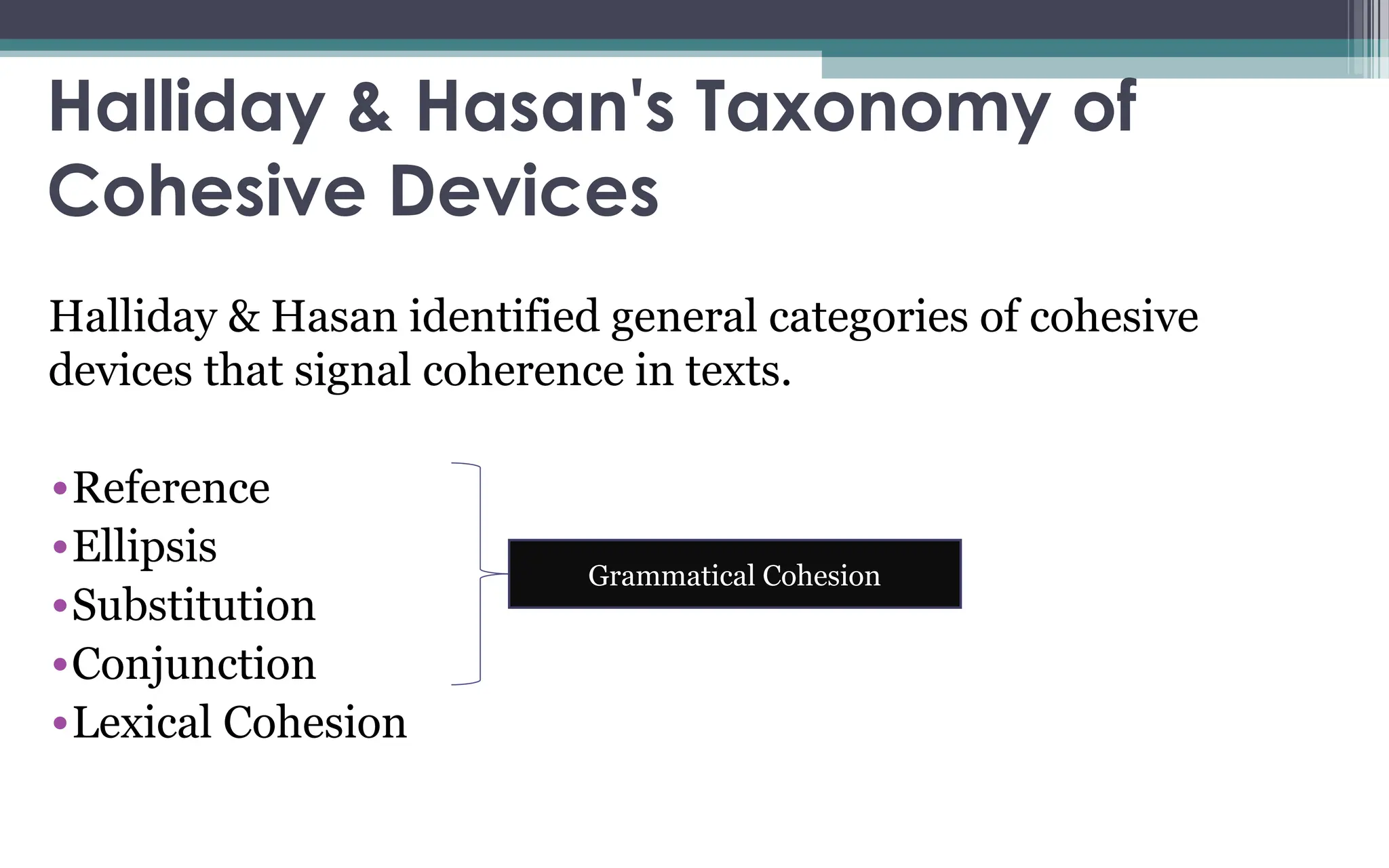
Halliday & Hasan's Taxonomy of
Cohesive Devices
Halliday & Hasan identified general categories of cohesive
devices that signal coherence in texts.
•Reference
•Ellipsis
•Substitution
•Conjunction
•Lexical Cohesion
Grammatical Cohesion
Conclusion
• Coherence: The property of unity in a written text that stems from the
relationship between its underlying ideas, and from the logical organization
and development of these ideas. A text has good coherence when ideas are
arranged in a logical order.
• Cohesion: The property of flow and connection in a written text that stems
from the linguistic links among its surface elements. A text has good
cohesion when each sentence is clearly linked to the next through language.
• Coherence and cohesion mean that all of the parts are connected
logically and linguistically to form a whole.
DISCOURSE ANALYSIS ON BARACK OBAMA’S
2008 VICTORY SPEECH: An example of
Discourse analysis on the Principle of
Cohesion and Coherence
DISCOURSE ANALYSIS ON BARACK OBAMA’S 2008
VICTORY SPEECH
• Barack Obama’s 2008 Victory Speech is a strong
example of how words can make a speech clear
and powerful by connecting ideas. Let’s break it
down:
1. Lexical Cohesion (Word Connections):
Obama repeats important words like “hope,” “change,” and
“America” throughout the speech. This repetition helps
emphasize key ideas. He also uses related words like “dream,”
“progress,” and “unity,” which keep the audience focused on the
main message of positive change for the future.
DISCOURSE ANALYSIS ON BARACK OBAMA’S 2008
VICTORY SPEECH
• Barack Obama’s 2008 Victory Speech is a strong
example of how words can make a speech clear
and powerful by connecting ideas. Let’s break it
down:
2. Cohesion (How Sentences Stick Together):
Obama uses pronouns like “we,” “our,” and “us” to create a sense
of unity with the audience. He also uses words like “and,” “but,”
and “because” to connect sentences, making the speech flow
smoothly from one point to the next.
DISCOURSE ANALYSIS ON BARACK OBAMA’S 2008
VICTORY SPEECH
• Barack Obama’s 2008 Victory Speech is a strong
example of how words can make a speech clear
and powerful by connecting ideas. Let’s break it
down:
3. Coherence (Overall Meaning and Structure):
The speech is easy to understand because it has a clear structure.
Obama starts by acknowledging his election victory, moves on to
talk about the challenges ahead, and ends by calling for unity and
collective effort. This logical order helps the audience follow his
message of hope and change.
DISCOURSE ANALYSIS ON BARACK OBAMA’S 2008
VICTORY SPEECH
• Barack Obama’s 2008 Victory Speech is a strong
example of how words can make a speech clear
and powerful by connecting ideas. Let’s break it
down:
In summary, Obama’s speech uses repeated words and
smooth sentence connections to create a clear, unified
message that resonates with the audience. The speech is
both easy to follow and emotionally impactful, making it
effective and inspiring.

COHESION AND COHERENCEFWERFQWFQWFWQDQW.ppt

  • 1.
    PRINCIPLES OF DISCOURSE ANALYSIS COHESIONAND COHERENCE ( Discourse Analysis ) ( GROUP 4) 1.FLORES, CHARISH 2.FLORES, KETH MECHELL 3.LLANTO, CHRISTINE 4.TAPALLA, JOEJOHN
  • 2.
    Introduction • Cohesion andcoherence are terms used in discourse analysis and text linguistics to describe the properties of written texts. • Coherence and cohesion are essential for aiding readability and idea communication. Coherence is about the unity of the ideas and Cohesion is the unity of structural elements.
  • 3.
    Definitions Cohesion: Cohesion is thegrammatical and lexical relationship between different elements of a text which hold it together. Coherence: Coherence is a Latin word, meaning “to stick together.” In a composition, coherence is a literary technique that refers to the ways a text makes sense to readers and writer through the relevance and accessibility of its ideas and theories.
  • 4.
    Coherence A semantic propertyof discourse formed through the interpretation of each individual sentence related to the interpretation of other sentences, with "interpretation" implying interaction between the text, the reader and the writer. A property that a reader will discern in the text. Allows the reader to make sense of the text. Coherence refers to the semantic unity created between the ideas, sentences, paragraphs and sections in a piece of writing.
  • 5.
    Coherence vs. Cohesion(features) Coherence Cohesion Very general principle of interpretation of language in context. Fewer formal linguistic features e.g. vocabulary choice. Relationships deal with text as a whole. Based on primarily semantic relationships. Errors much more obvious. Formal linguistic elements e.g. repetition, reference. Semantic relationships between sentences and within sentences. Determined by lexically and grammatically overt relationships. More recognizable.
  • 6.
    Cohesive Devices? Cohesive devices,sometimes called linking words, linkers, connectors, discourse markers or transitional words and these are words or phrases that show the relationship between paragraphs or sections of a text or speech. Some examples of Cohesive Devices There are many examples of cohesive devices, they can be grouped by category. If you want so show similarity, you can use; and, also, too, similarly, equally, identically and important. If you want to introduce an item in a series, you can use first, in the first place, * in the second place, then, in addition, finally and last.
  • 7.
    Halliday & Hasan'sTaxonomy of Cohesive Devices Halliday & Hasan identified general categories of cohesive devices that signal coherence in texts. •Reference •Ellipsis •Substitution •Conjunction •Lexical Cohesion Grammatical Cohesion
  • 8.
    Conclusion • Coherence: Theproperty of unity in a written text that stems from the relationship between its underlying ideas, and from the logical organization and development of these ideas. A text has good coherence when ideas are arranged in a logical order. • Cohesion: The property of flow and connection in a written text that stems from the linguistic links among its surface elements. A text has good cohesion when each sentence is clearly linked to the next through language. • Coherence and cohesion mean that all of the parts are connected logically and linguistically to form a whole.
  • 9.
    DISCOURSE ANALYSIS ONBARACK OBAMA’S 2008 VICTORY SPEECH: An example of Discourse analysis on the Principle of Cohesion and Coherence
  • 10.
    DISCOURSE ANALYSIS ONBARACK OBAMA’S 2008 VICTORY SPEECH • Barack Obama’s 2008 Victory Speech is a strong example of how words can make a speech clear and powerful by connecting ideas. Let’s break it down: 1. Lexical Cohesion (Word Connections): Obama repeats important words like “hope,” “change,” and “America” throughout the speech. This repetition helps emphasize key ideas. He also uses related words like “dream,” “progress,” and “unity,” which keep the audience focused on the main message of positive change for the future.
  • 11.
    DISCOURSE ANALYSIS ONBARACK OBAMA’S 2008 VICTORY SPEECH • Barack Obama’s 2008 Victory Speech is a strong example of how words can make a speech clear and powerful by connecting ideas. Let’s break it down: 2. Cohesion (How Sentences Stick Together): Obama uses pronouns like “we,” “our,” and “us” to create a sense of unity with the audience. He also uses words like “and,” “but,” and “because” to connect sentences, making the speech flow smoothly from one point to the next.
  • 12.
    DISCOURSE ANALYSIS ONBARACK OBAMA’S 2008 VICTORY SPEECH • Barack Obama’s 2008 Victory Speech is a strong example of how words can make a speech clear and powerful by connecting ideas. Let’s break it down: 3. Coherence (Overall Meaning and Structure): The speech is easy to understand because it has a clear structure. Obama starts by acknowledging his election victory, moves on to talk about the challenges ahead, and ends by calling for unity and collective effort. This logical order helps the audience follow his message of hope and change.
  • 13.
    DISCOURSE ANALYSIS ONBARACK OBAMA’S 2008 VICTORY SPEECH • Barack Obama’s 2008 Victory Speech is a strong example of how words can make a speech clear and powerful by connecting ideas. Let’s break it down: In summary, Obama’s speech uses repeated words and smooth sentence connections to create a clear, unified message that resonates with the audience. The speech is both easy to follow and emotionally impactful, making it effective and inspiring.