Download to read offline
![Benton on Public Land 7/14/13 10:31 AM
Thomas Hart Benton Springfield-Greene County History
Local History Website of the SMSU Department of History
Thomas Hart Benton, The Public Lands—Their Proper Dispositions
(excerpts)
I do not know how old, or rather, how young I was, when I first took up the
notion that sales of land by a government to its own citizens, and to the highest
bidder, was false policy; and that gratuitous grants to actual settlers was the
true policy, and their labor the true way of extracting national wealth and
strength from the soil. It might have been in childhood, when reading the Bible,
and seeing the division of the promised land among the children of Israel: it
might have been later, and in learning the operation of the feudal system in
giving lands to those who would defend them: it might have been in early life in
Tennessee, in seeing the fortunes and respectability of many families derived
from the 640 acre head-rights which the State of North Carolina had bestowed
upon the first settlers.
When I came to the Territory of Missouri in 1815, and saw land exposed to sale
to the highest bidder, and lead mines and salt springs reserved from sale, and
rented out for the profit of the federal treasury, I felt repugnance to the whole
system, and determined to make war upon it whenever I should have the power.
The time came round with my election to the Senate of the United States in
1820: and the years 1824, '26, and '28, found me doing battle for an
ameliorated system of disposing of our public lands; and with some success. I
resolved to move against the whole system, and especially in favor of graduated
prices, and donations to actual and destitute settlers: I did so in a bill, renewed
annually for a long time; and in speeches which had more effect upon the public
mind than upon the federal legislation counteracted as my plan was by schemes
of dividing the public lands, of the money arising from their sale, among the
States.
[When the settler cultivates the land,] ... the improved condition of the land
enables him to pay taxes, and consume durable goods, and to sell the products
which command the imports which pay duties to the government, and this is the
"well-regulated revenue" which comes through the course of circulation, and
through the "political secretions" of the State, and … commends [itself] above all
revenue derived from the sale of lands.
The whole annual receipts from land sales at this time (1850) are about two
millions of dollars: the annual receipts from customs, founded almost entirely
upon the direct productions of the earth, exceed fifty millions of dollars! giving a
comparative difference of twenty-five to one cultivation over sales …. I have
looked up respective amounts of federal revenue, into the treasury from these
http://clio.missouristate.edu/FTMiller/LocalHistory/Docs/Benton/30Years/BentonPublicLand.htm Page 1 of 3](https://image.slidesharecdn.com/benton-on-public-land-141107054648-conversion-gate02/85/Benton-on-public-land-1-320.jpg)
![Benton on Public Land 7/14/13 10:31 AM
two sources [since the] establishment of the federal government; and the
customs to have yielded, in that fraction over one thousand millions net--the
lands to have yielded a little less than a hundred and thirty millions gross, not 1
millions clear after paying all expenses of its sales and management. This is a
difference of twenty-five to one--with the further difference of endless future
production from one, and no future production from the land once that is to say,
the same acre of land is for ever through cultivation, and pays for itself in
purchase.
… These Atlantic States were donations from the British crown; and the great
proprietors distributed out of their possessions with a free and generous hand. A
few shillings for a hundred acres, a nominal quitrent, and gifts of a
hundred, five hundred, and a thousand acres, to actual settlers: such were the
terms on which they dealt out the soil which is now covered by a nation of
freemen. Provinces which now form sovereign States, were sold from hand to
hand, for a less sum than the federal government now demand for an area of
two miles square.
I quoted the example of all nations, ancient and modern, republican and
monarchical, in favor of giving lands, in parcels suitable to their wants, to
meritorious cultivators; and denied that there was an instance upon earth,
except that of our own federal government, which made merchandise of land to
its citizens--exacted the highest price it could obtain--and refused to suffer the
country to be settled until it was paid for. The "promised land " was divided
among the children or Israel--the women getting a share where there was no
man at the head of the family with the daughters of Manasseh. All the Atlantic
States, when British colonies, were settled upon gratuitous donations, or
nominal sales. Kentucky and Tennessee were chiefly settled in the same way.
The two Floridas, and Upper and Lower Louisiana, were gratuitously distributed
by the kings of Spain to settlers, in quantities adapted to their means of
cultivation--and with the whole vacant domain to select from according to their
pleasure. Land is now given to settlers in Canada; and £ 30,000 sterling, has
been voted at a single session of Parliament, to aid emigrants in their removal
to these homes, and commencing life upon them.
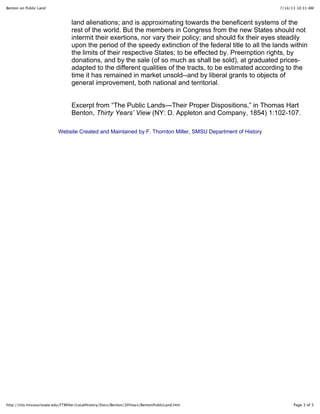
The new States of the West were the sufferers by this federal land policy. They
were in a different condition from other States. In these others, the local
legislatures held the primary disposal of the soil, so much as remained vacant
within their limits, and being of the same community, made equitable alienations
among their constituents. In the new States it was different. The federal
government held the primary disposition of the soil; and the majority of
Congress (being independent of the people of these States), was less heedful
of their wants and wishes. They were as a stepmother, instead of a natural
mother: and the federal government being sole purchaser from foreign nations,
and sole recipient of Indian cessions, it became the monopolizer of vacant lands
of the West: and this monopoly, like all monopolies, resulted in hardships to
those upon whom it acted. Few, or none of our public men, had raised their
voice against this hard policy before I came into the national councils. My own
was soon raised there against it: and it is certain that a great amelioration has
taken place in our federal land policy during my time: and that the sentiment of
Congress, and that of the public generally, has become much more liberal in
http://clio.missouristate.edu/FTMiller/LocalHistory/Docs/Benton/30Years/BentonPublicLand.htm Page 2 of 3](https://image.slidesharecdn.com/benton-on-public-land-141107054648-conversion-gate02/85/Benton-on-public-land-2-320.jpg)

Thomas Hart Benton believed that gratuitous land grants to actual settlers was better public policy than selling land to the highest bidder. As a senator from Missouri in the 1820s, he fought for a system of graduated land prices and donations to destitute settlers. Benton argued that cultivation of land generated far more revenue for the government through duties on imports than direct sales of land. He cited examples from other nations and colonies that had systems of generous land distribution to promote settlement. Benton worked to reform federal land policy to be more favorable to the interests of western states.


![4. launching the new nation [1789 1816]](https://cdn.slidesharecdn.com/ss_thumbnails/4-launchingthenewnation1789-1816-121009152412-phpapp01-thumbnail.jpg?width=640&height=640&fit=bounds)


