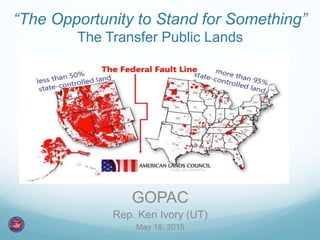
“The Opportunity to Stand for Something”
The Transfer Public Lands
GOPAC
Rep. Ken Ivory (UT)
May 18, 2015
“We don't propose, like
some people, to meet
today’s problems by
saying that they don't
exist, and tomorrow's
problems by wishing
that tomorrow wouldn't
come.
Harry S. Truman
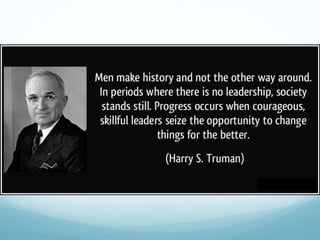
"Men make history, and
not the other way
around. In periods where
there is no leadership,
society stands still.
Progress occurs when
courageous, skillful
leaders seize the
opportunity to change
things for the better."
Harry S. Truman
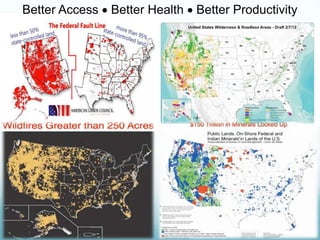
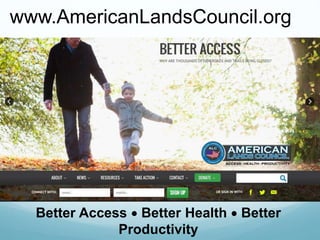
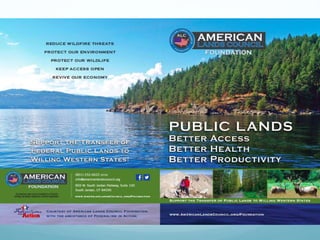
Better Access  Better Health  Better Productivity
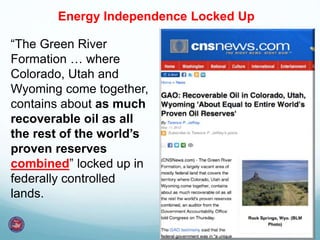
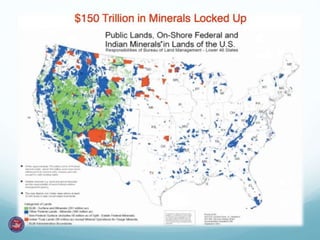
“The Green River
Formation … where
Colorado, Utah and
Wyoming come together,
contains about as much
recoverable oil as all
the rest of the world’s
proven reserves
combined” locked up in
federally controlled
lands.
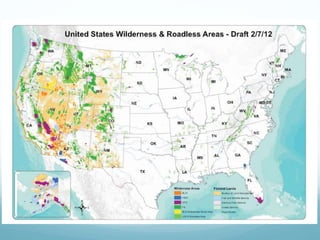
Energy Independence Locked Up
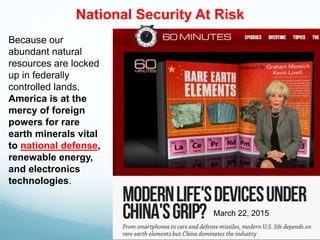
Because our
abundant natural
resources are locked
up in federally
controlled lands,
America is at the
mercy of foreign
powers for rare
earth minerals vital
to national defense,
renewable energy,
and electronics
technologies.
March 22, 2015
National Security At Risk
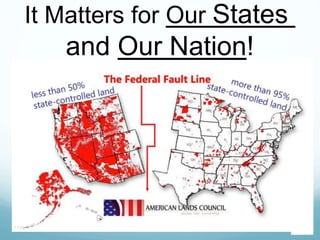
It Matters for Our States
and Our Nation!
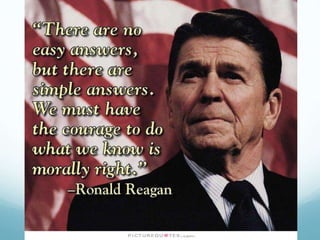
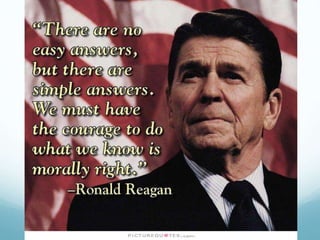
"This is a wonderful
time to be alive…
we're lucky not to live
in pale and timid
times. We've been
blessed with
the opportunity
to stand for
something.”
Ronald Reagan
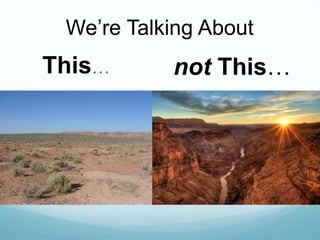
This… not This…
We’re Talking About
www.AmericanLandsCouncil.org
Better Access  Better Health  Better
Productivity
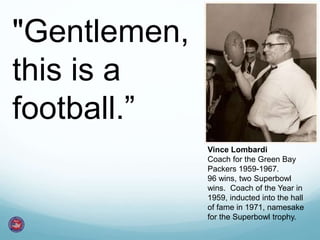
"Gentlemen,
this is a
football.”
Vince Lombardi
Coach for the Green Bay
Packers 1959-1967.
96 wins, two Superbowl
wins. Coach of the Year in
1959, inducted into the hall
of fame in 1971, namesake
for the Superbowl trophy.
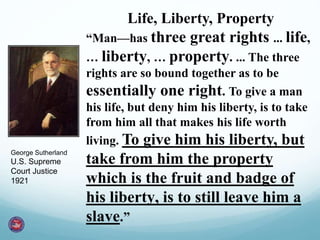
Life, Liberty, Property
“Man—has three great rights ... life,
… liberty, … property. ... The three
rights are so bound together as to be
essentially one right. To give a man
his life, but deny him his liberty, is to take
from him all that makes his life worth
living. To give him his liberty, but
take from him the property
which is the fruit and badge of
his liberty, is to still leave him a
slave.”
George Sutherland
U.S. Supreme
Court Justice
1921
“… powers which … concern the lives,
liberties, and properties of the people’
were held by governments more
local and more accountable
than a distant federal bureaucracy.”
U.S. Supreme Court
NFIB v. Sebelius (June, 2012)
“Basic Principles”
State Jurisdiction Checks
Federal Power
“The independent power of
the States also serves as a check
on the power of the Federal
Government.”
U.S. Supreme Court
NFIB v. Sebelius (June, 2012)
“Basic Principles”
State Jurisdiction Checks
Federal Power
“‘By denying any one government
complete jurisdiction over all the
concerns of public life, federalism
protects the liberty of the
individual from arbitrary power.’”
U.S. Supreme Court
NFIB v. Sebelius (June, 2012)
“Basic Principles”
State Jurisdiction Checks
Federal Power
“…we look to the States to defend their
prerogatives by adopting “the simple expedient
of not yielding” to federal blandishments
when they do not want to embrace the federal
policies as their own."
U.S. Supreme Court
NFIB v. Sebelius (June, 2012)
“Basic Principles”
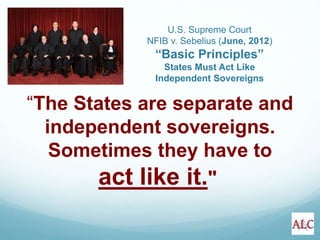
States Must Act Like
Independent Sovereigns
“The States are separate and
independent sovereigns.
Sometimes they have to
act like it."
U.S. Supreme Court
NFIB v. Sebelius (June, 2012)
“Basic Principles”
States Must Act Like
Independent Sovereigns
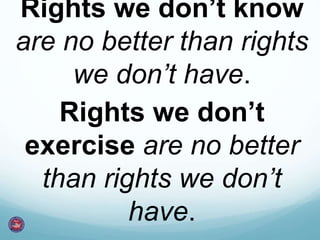
Rights we don’t know
are no better than rights
we don’t have.
Rights we don’t
exercise are no better
than rights we don’t
have.
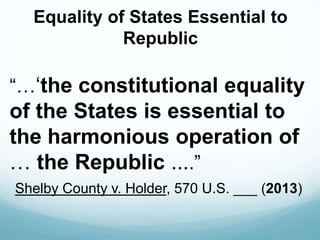
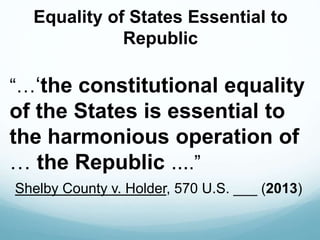
Equality of States Essential to
Republic
“…‘the constitutional equality
of the States is essential to
the harmonious operation of
… the Republic ....”
Shelby County v. Holder, 570 U.S. ___ (2013)
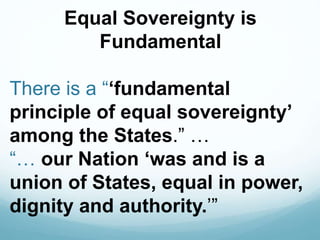
Equal Sovereignty is
Fundamental
There is a “‘fundamental principle
of equal sovereignty’ among the
States.” …
“… our Nation ‘was and is a
union of States, equal in
power, dignity and authority.’”
Shelby County v. Holder, 570 U.S. ___ (2013)
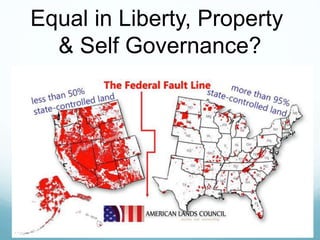
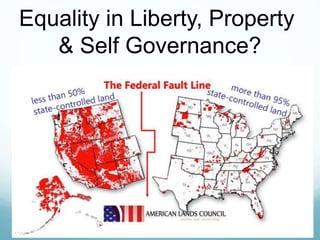
Equal in Liberty, Property
& Self Governance?
If you were the opposing
quarterback, What
Would You Do?
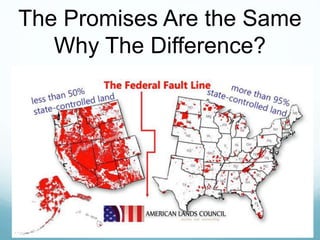
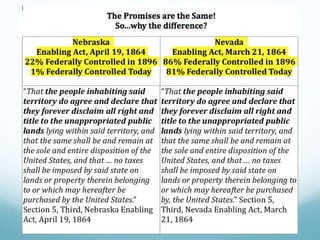
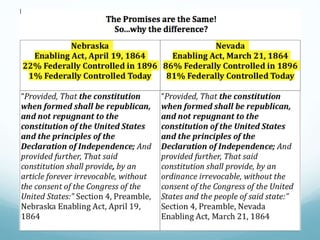
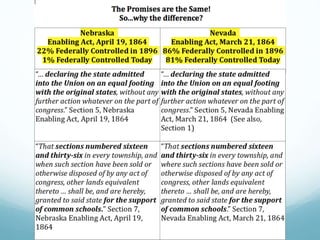
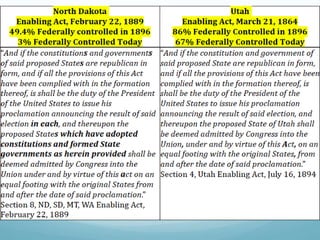
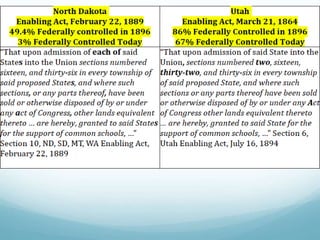
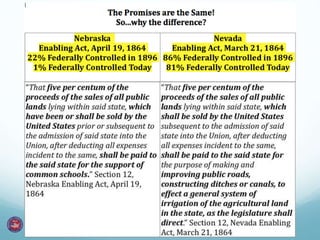
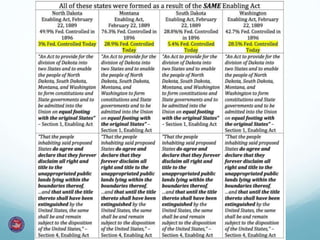
The Promises Are the Same
Why The Difference?
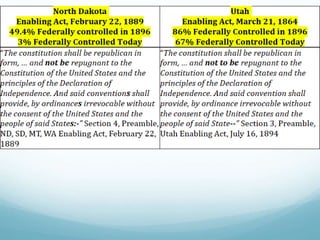
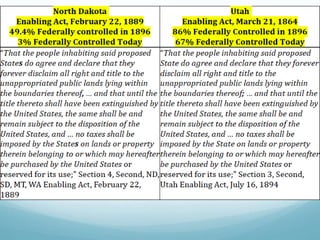
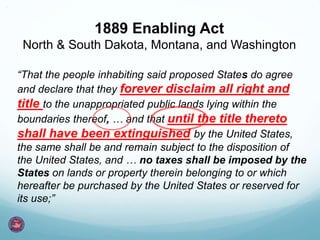
1889 Enabling Act
North & South Dakota, Montana, and Washington
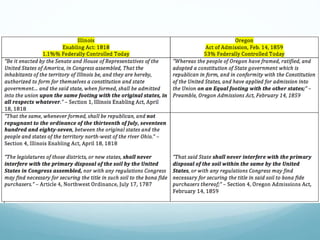
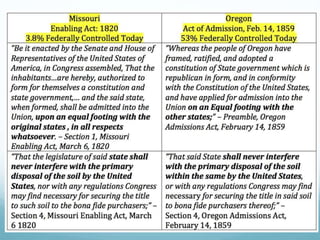
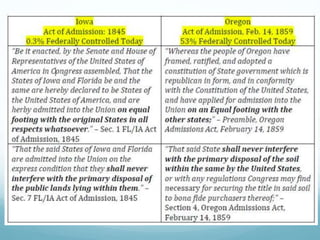
“That the people inhabiting said proposed States do agree
and declare that they forever disclaim all right and
title to the unappropriated public lands lying within the
boundaries thereof, … and that until the title thereto
shall have been extinguished by the United States,
the same shall be and remain subject to the disposition of
the United States, and … no taxes shall be imposed by the
States on lands or property therein belonging to or which
hereafter be purchased by the United States or reserved for
its use;”
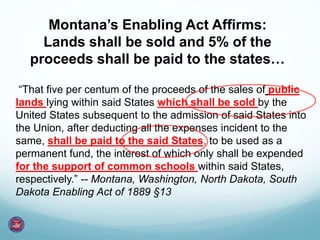
Montana’s Enabling Act Affirms:
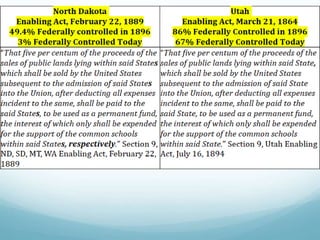
Lands shall be sold and 5% of the
proceeds shall be paid to the states…
“That five per centum of the proceeds of the sales of public
lands lying within said States which shall be sold by the
United States subsequent to the admission of said States into
the Union, after deducting all the expenses incident to the
same, shall be paid to the said States, to be used as a
permanent fund, the interest of which only shall be expended
for the support of common schools within said States,
respectively.” -- Montana, Washington, North Dakota, South
Dakota Enabling Act of 1889 §13
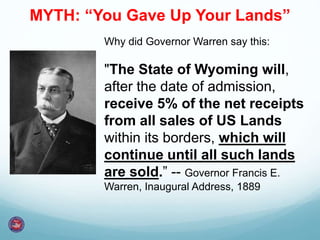
Why did Governor Warren say this:
"The State of Wyoming will,
after the date of admission,
receive 5% of the net receipts
from all sales of US Lands
within its borders, which will
continue until all such lands
are sold.” -- Governor Francis E.
Warren, Inaugural Address, 1889
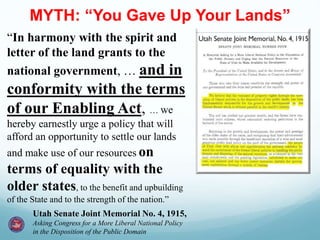
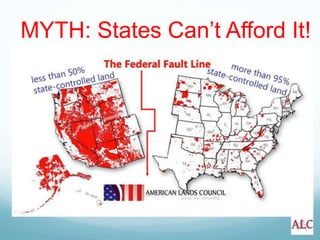
MYTH: “You Gave Up Your Lands”
“In harmony with the spirit and
letter of the land grants to the
national government, … and in
conformity with the terms
of our Enabling Act, … we
hereby earnestly urge a policy that will
afford an opportunity to settle our lands
and make use of our resources on
terms of equality with the
older states, to the benefit and upbuilding
of the State and to the strength of the nation.”
Utah Senate Joint Memorial No. 4, 1915,
Asking Congress for a More Liberal National Policy
in the Disposition of the Public Domain
• Enabling Acts are "solemn compacts" and "bi-
lateral [two-way] agreements" that are to be
performed "in a timely fashion" (Andrus v. Utah,
1980);
• The federal government holds territorial lands “in
trust for the several states to be ultimately created out
of the territory." (Shively v. Bowlby, 1894);
KEY SUPREME COURT DECISIONS
SOLEMN COMPACTS,
BI-LATERAL AGREEMENTS
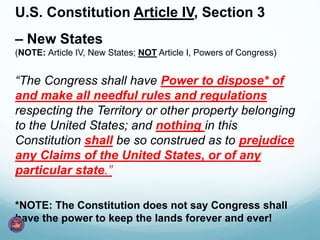
MYTH: “It’s Not Legal”
U.S. Constitution Article IV, Section 3
– New States
(NOTE: Article IV, New States; NOT Article I, Powers of Congress)
“The Congress shall have Power to dispose* of
and make all needful rules and regulations
respecting the Territory or other property belonging
to the United States; and nothing in this
Constitution shall be so construed as to prejudice
any Claims of the United States, or of any
particular state.”
*NOTE: The Constitution does not say Congress shall
have the power to keep the lands forever and ever!
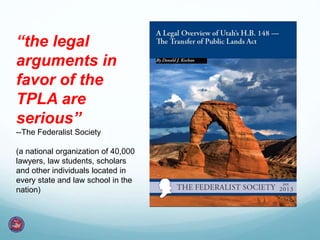
“the legal
arguments in
favor of the
TPLA are
serious”
--The Federalist Society
(a national organization of 40,000
lawyers, law students, scholars
and other individuals located in
every state and law school in the
nation)
“[T]he consequences of admission are instantaneous, and
it ignores the uniquely sovereign character of that
event … to suggest that subsequent events [acts of
Congress] somehow can diminish what has already
been bestowed.’ And that proposition applies a fortiori
[with even greater force] where virtually all of the
State’s public lands . . .are at stake.”
2009 U.S. Supreme Court
Hawaii v. Office of Hawaiian Affairs
(Unanimous Decision)
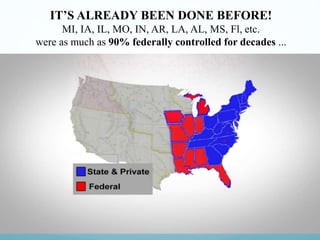
IT’S ALREADY BEEN DONE BEFORE!
MI, IA, IL, MO, IN, AR, LA, AL, MS, Fl, etc.
were as much as 90% federally controlled for decades ...
One Man...
One LEADER...
Refused To Be Silent or Take
“NO”
for an Answer
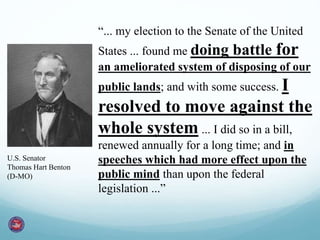
“... my election to the Senate of the United
States ... found me doing battle for
an ameliorated system of disposing of our
public lands; and with some success. I
resolved to move against the
whole system ... I did so in a bill,
renewed annually for a long time; and in
speeches which had more effect upon the
public mind than upon the federal
legislation ...”
U.S. Senator
Thomas Hart Benton
(D-MO)
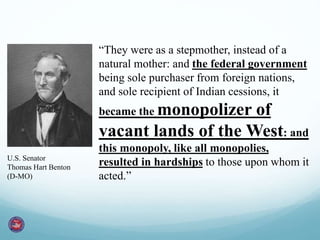
“They were as a stepmother, instead of a
natural mother: and the federal government
being sole purchaser from foreign nations,
and sole recipient of Indian cessions, it
became the monopolizer of
vacant lands of the West: and
this monopoly, like all monopolies,
resulted in hardships to those upon whom it
acted.”
U.S. Senator
Thomas Hart Benton
(D-MO)
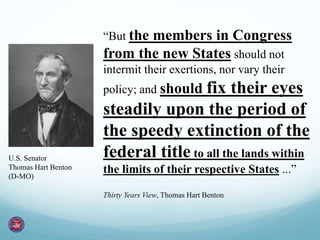
“But the members in Congress
from the new States should not
intermit their exertions, nor vary their
policy; and should fix their eyes
steadily upon the period of
the speedy extinction of the
federal title to all the lands within
the limits of their respective States ...”
Thirty Years View, Thomas Hart Benton
U.S. Senator
Thomas Hart Benton
(D-MO)
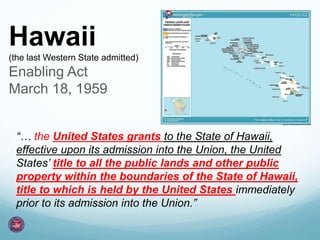
Hawaii
(the last Western State admitted)
Enabling Act
March 18, 1959
“… the United States grants to the State of Hawaii,
effective upon its admission into the Union, the United
States’ title to all the public lands and other public
property within the boundaries of the State of Hawaii,
title to which is held by the United States immediately
prior to its admission into the Union.”
MYTH: States Can’t Afford It!
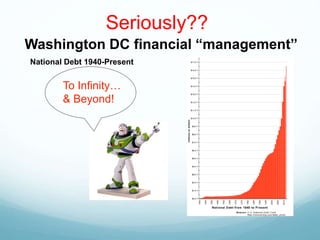
To Infinity…
& Beyond!
Washington DC financial “management”
National Debt 1940-Present
Seriously??
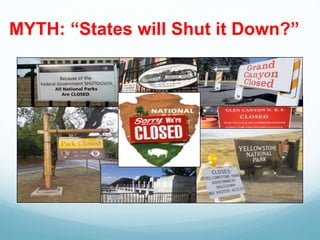
MYTH: “States will Shut it Down?”
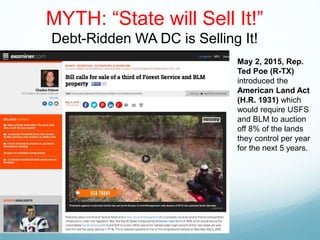
MYTH: “State will Sell It!”
Debt-Ridden WA DC is Selling It!
May 2, 2015, Rep.
Ted Poe (R-TX)
introduced the
American Land Act
(H.R. 1931) which
would require USFS
and BLM to auction
off 8% of the lands
they control per year
for the next 5 years.
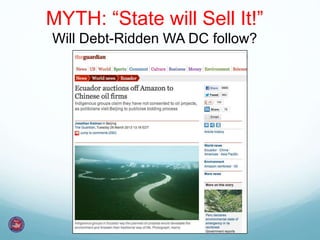
MYTH: “State will Sell It!”
Will Debt-Ridden WA DC follow?
Why The difference?
Why The difference?
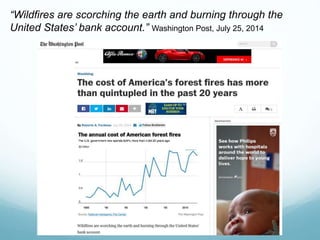
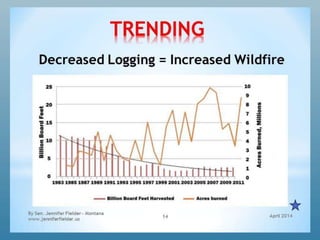
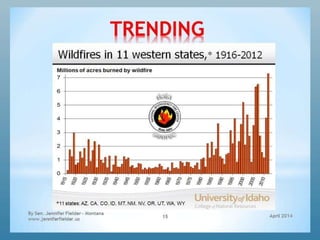
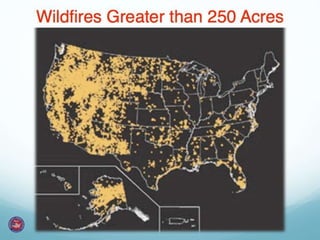
“Wildfires are scorching the earth and burning through the
United States’ bank account.” Washington Post, July 25, 2014
TRENDING
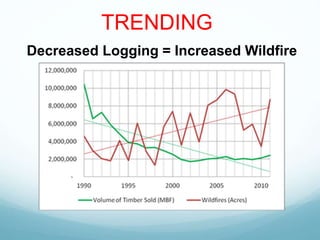
Decreased Logging = Increased Wildfire
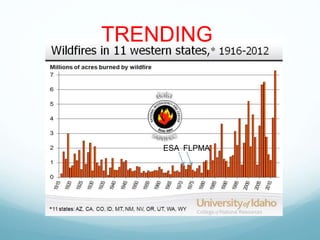
TRENDING
ESA FLPMA
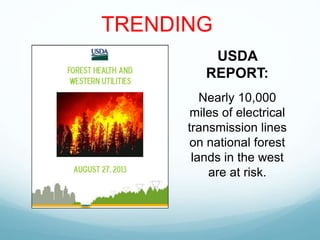
USDA
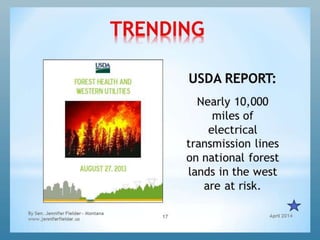
REPORT:
Nearly 10,000
miles of electrical
transmission lines
on national forest
lands in the west
are at risk.
TRENDING
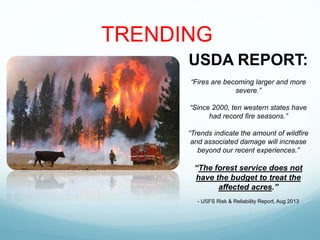
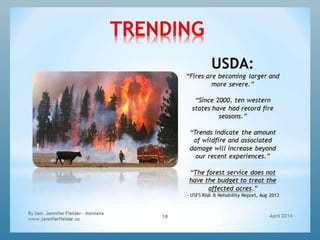
USDA REPORT:
“Fires are becoming larger and more
severe.”
“Since 2000, ten western states have
had record fire seasons.”
“Trends indicate the amount of wildfire
and associated damage will increase
beyond our recent experiences.”
“The forest service does not
have the budget to treat the
affected acres.”
- USFS Risk & Reliability Report, Aug 2013
TRENDING
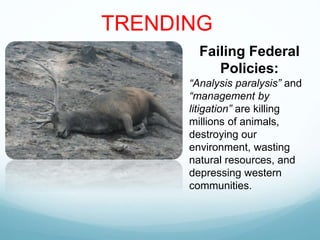
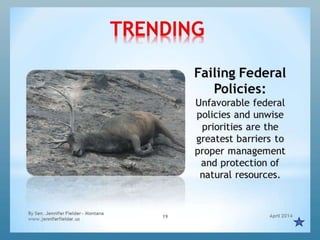
Failing Federal
Policies:
“Analysis paralysis” and
“management by
litigation” are killing
millions of animals,
destroying our
environment, wasting
natural resources, and
depressing western
communities.
TRENDING
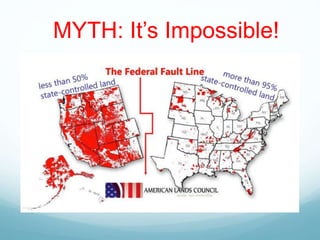
MYTH: It’s Impossible!
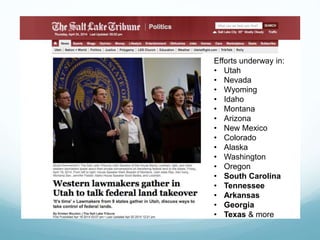
Efforts underway in:
• Utah
• Nevada
• Wyoming
• Idaho
• Montana
• Arizona
• New Mexico
• Colorado
• Alaska
• Washington
• Oregon
• South Carolina
• Tennessee
• Arkansas
• Georgia
• Texas & more
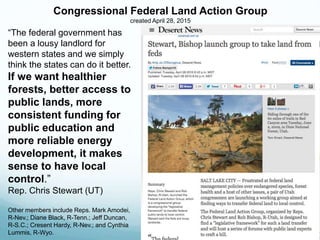
“The federal government has
been a lousy landlord for
western states and we simply
think the states can do it better.
If we want healthier
forests, better access to
public lands, more
consistent funding for
public education and
more reliable energy
development, it makes
sense to have local
control.”
Rep. Chris Stewart (UT)
Other members include Reps. Mark Amodei,
R-Nev.; Diane Black, R-Tenn.; Jeff Duncan,
R-S.C.; Cresent Hardy, R-Nev.; and Cynthia
Lummis, R-Wyo.
Congressional Federal Land Action Group
created April 28, 2015
rev April 2015
79
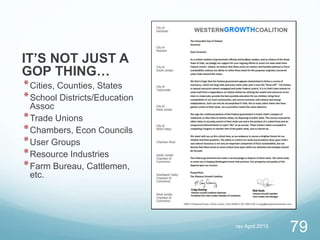
IT’S NOT JUST A
GOP THING…
*Cities, Counties, States
*School Districts/Education
Assoc
*Trade Unions
*Chambers, Econ Councils
*User Groups
*Resource Industries
*Farm Bureau, Cattlemen,
etc.
Why The difference?
“Our people look for a cause to believe in … a
banner of no pale pastels, but bold colors
which make it unmistakably clear where we
stand on all of the issues troubling the people.”
Ronald Reagan
What Can Your Constituents Do?
Sign the Petition:
www.americanlandscouncil.org
Tell Someone! Share News, Blogs and Resources from the
ALC Website on Social Media, Newsletters, Letters to the Editor,
Conferences, etc.
Tell Your Leaders! Persistently encourage local, state and
national leaders to stand with resolve and without shame like Sen.
Thomas Hart Benton
Open Doors! Many are looking for answers big enough to
secure better stewardship of our lands and greater opportunities for
our communities, states and nation. Introduce them to the only
solution big enough in the Transfer of Public Lands to local
stewardship.
What Can You Do Now?
Educate – Share the vision of TPL with constituents, colleagues,
leaders, organizations, conferences, speeches, articles, etc.
Negotiate – Communicate the unwavering expectation for TPL with
federal officials and agencies thru meetings, hearings, conferences, etc.
Legislate – Pass resolutions, ordinances, and legislation at the local,
state and national level supporting TPL and facilitating the transition (studies,
logistics, interstate compacts, federal devolution, etc.)
Litigate – Combine our common legal and financial resources, public
and private, in defense of the “constitutional equality of the States … essential
for the harmonious operation of … the Republic.”
www.AmericanLandsCouncil.org
Ken Ivory, UT State Rep.
American Lands Council
801.694.8380
Ken@AmericanLandsCouncil.org
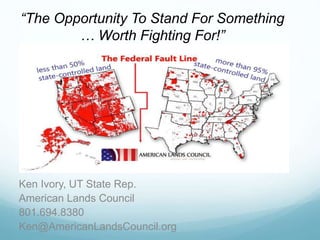
“The Opportunity To Stand For Something
… Worth Fighting For!”
Bonus Slides
Which western State
successfully compelled
the transfer of its public
lands with these
arguments?
Successful arguments for the transfer of
public lands:
First, Federal control of its lands
restricted the ability to
improve, protect, and manage
its resources, limiting its
opportunities to generate
revenue on terms of equality
with states to their east.
Successful arguments for the transfer of
public lands:
Second, Why should the State
be deprived of the ability to
protect the health, safety, and
welfare of its people exercised by
States to the east.
Successful arguments for the transfer of
public lands:
Third, The State should have the
same authority to improve and
regulate the growth and progress
of its lands within its boundaries
"according to its own views of
prosperity and happiness" as
exercised by states to the east.
Successful arguments for the transfer of
public lands:
Fourth, The State insisted that it
was unfair for eastern states to
be required to subsidize States
in the west due to federal control
of western lands.
Successful arguments for the transfer of
public lands:
Fifth, The State was adamant that
the statehood enabling act terms
were "obligatory upon the parties
to it" such that "any act on the part
of the [federal] government to
delay... would doubtless be an
infringement of the compact itself.”
Successful arguments for the transfer of public
lands:
Sixth, The State questioned why its citizens
should "be subject to the operation of the
laws of the United Sates," over such
matters as land use and planning regulations,
which are "confessedly purely municipal,
which have no existence in the older States,
and which they [the States] alone have the
right to pass.”
Successful arguments for the transfer of public
lands:
Seventh, The State contended that the
exercise of such "extraordinary powers"
by the federal government was not
consistent with "the rights reserved to
the States respectively by the
Constitution of the United States" and is
not expressly granted anywhere in the
statehood enabling act.
Which western State
successfully compelled
the transfer of its public
lands with these
arguments?
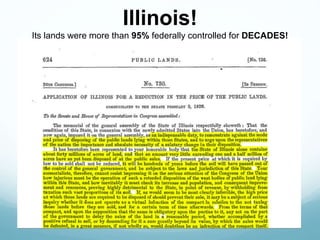
Illinois!
Its lands were more than 95% federally controlled for DECADES!
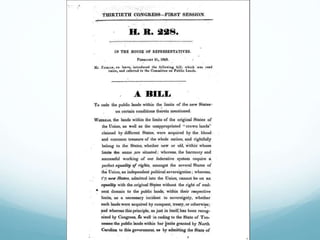
IN THE HOUSE OF REPRESENTATIVES.
February 21, 1848
Mr. Ficklin [Orlando B. Ficklin, D-IL], on leave, introduced the following bill: which
was read twice, and referred to the committee on Public Lands.
A Bill
To cede the public lands within the limits of the new States
on certain conditions therein mentioned.
Whereas, the land within the limits of the original
States of the Union, as well as the unappropriated
“crown lands” claimed by different States, were
acquired by the blood and common treasure of the
whole nation, and rightfully belong to the States,
whether new or old, within whose limits the same
are situated;
IN THE HOUSE OF REPRESENTATIVES.
February 21, 1848
Mr. Ficklin [Orlando B. Ficklin, D-IL], on leave, introduced the following bill: which
was read twice, and referred to the committee on Public Lands.
A Bill
To cede the public lands within the limits of the new States
on certain conditions therein mentioned.
… whereas, the harmony and successful
working of our federative system require a
perfect equality of rights amongst the
several States of the Union, as independent
political sovereignties;
IN THE HOUSE OF REPRESENTATIVES.
February 21, 1848
Mr. Ficklin [Orlando B. Ficklin, D-IL], on leave, introduced the following bill: which
was read twice, and referred to the committee on Public Lands.
A Bill
To cede the public lands within the limits of the new States
on certain conditions therein mentioned.
… whereas, the new States, admitted into the
Union, cannot be on an equality with the original
States without the right of eminent domain to the
public lands, within their respective limits, as a
necessary incident to sovereignty, whether such
lands were acquired by conquest, treaty, or
otherwise;
IN THE HOUSE OF REPRESENTATIVES.
February 21, 1848
Mr. Ficklin [Orlando B. Ficklin, D-IL], on leave, introduced the following bill: which
was read twice, and referred to the committee on Public Lands.
A Bill
To cede the public lands within the limits of the new States
on certain conditions therein mentioned.
… and whereas this principle, so just in itself, has
been recognized by Congress, as well in ceding to
the State of Tennessee the public lands within her
limits granted by North Carolina to this government,
as by admitting the State of Texas into the Union,
she retaining her public domain; therefore –
A Bill
To cede the public lands within the limits of the new States
on certain conditions therein mentioned.
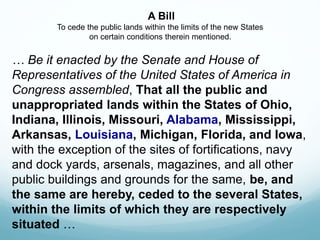
… Be it enacted by the Senate and House of
Representatives of the United States of America in
Congress assembled, That all the public and
unappropriated lands within the States of Ohio,
Indiana, Illinois, Missouri, Alabama, Mississippi,
Arkansas, Louisiana, Michigan, Florida, and Iowa,
with the exception of the sites of fortifications, navy
and dock yards, arsenals, magazines, and all other
public buildings and grounds for the same, be, and
the same are hereby, ceded to the several States,
within the limits of which they are respectively
situated …
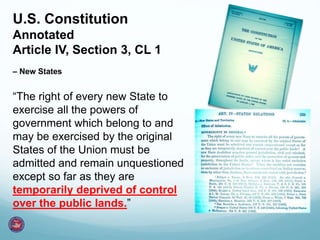
U.S. Constitution
Annotated
Article IV, Section 3, CL 1
– New States
“The right of every new State to
exercise all the powers of
government which belong to and
may be exercised by the original
States of the Union must be
admitted and remain unquestioned
except so far as they are
temporarily deprived of control
over the public lands.”
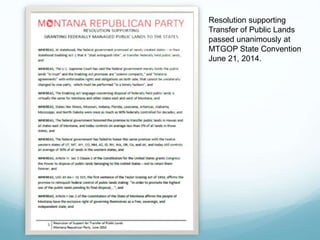
Resolution supporting
Transfer of Public Lands
passed unanimously at
MTGOP State Convention
June 21, 2014.
Equality in Liberty, Property
& Self Governance?
Rights we don’t know
are no better than rights
we don’t have.
Rights we don’t
exercise are no better
than rights we don’t
have.
“that the people inhabiting the said territory, do agree
and declare that they forever disclaim all right and
title to the waste or unappropriated lands lying within
the said territory; and that the same shall be and remain
at the sole and entire disposition of the United
States...”
ALABAMA
2.7% PUBLIC LANDS
Forever Disclaim All Right and Title ...?
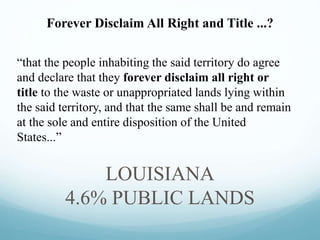
“that the people inhabiting the said territory do agree
and declare that they forever disclaim all right or
title to the waste or unappropriated lands lying within
the said territory, and that the same shall be and remain
at the sole and entire disposition of the United
States...”
LOUISIANA
4.6% PUBLIC LANDS
Forever Disclaim All Right and Title ...?
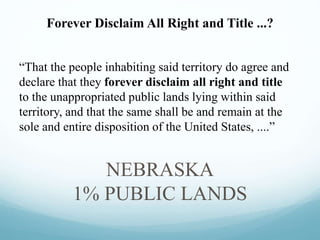
“That the people inhabiting said territory do agree and
declare that they forever disclaim all right and title
to the unappropriated public lands lying within said
territory, and that the same shall be and remain at the
sole and entire disposition of the United States, ....”
NEBRASKA
1% PUBLIC LANDS
Forever Disclaim All Right and Title ...?
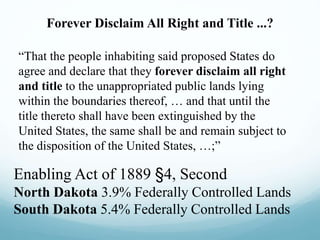
“That the people inhabiting said proposed States do
agree and declare that they forever disclaim all right
and title to the unappropriated public lands lying
within the boundaries thereof, … and that until the
title thereto shall have been extinguished by the
United States, the same shall be and remain subject to
the disposition of the United States, …;”
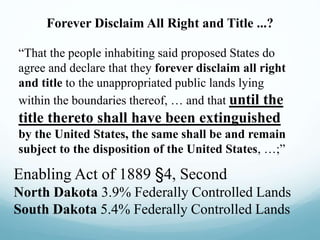
Enabling Act of 1889 §4, Second
North Dakota 3.9% Federally Controlled Lands
South Dakota 5.4% Federally Controlled Lands
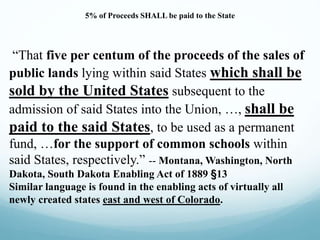
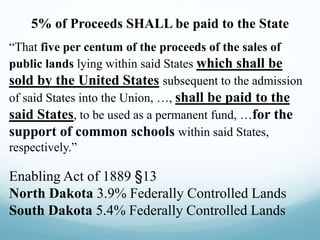
5% of Proceeds SHALL be paid to the State
“That five per centum of the proceeds of the sales of
public lands lying within said States which shall be
sold by the United States subsequent to the
admission of said States into the Union, …, shall be
paid to the said States, to be used as a permanent
fund, …for the support of common schools within
said States, respectively.” -- Montana, Washington, North
Dakota, South Dakota Enabling Act of 1889 §13
Similar language is found in the enabling acts of virtually all
newly created states east and west of Colorado.
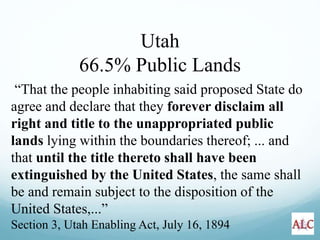
“That the people inhabiting said proposed State do
agree and declare that they forever disclaim all
right and title to the unappropriated public
lands lying within the boundaries thereof; ... and
that until the title thereto shall have been
extinguished by the United States, the same shall
be and remain subject to the disposition of the
United States,...”
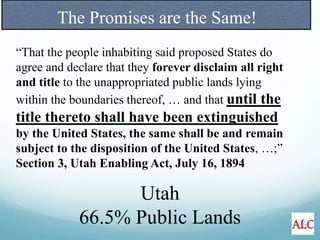
Section 3, Utah Enabling Act, July 16, 1894
Utah
66.5% Public Lands
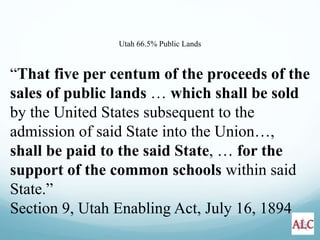
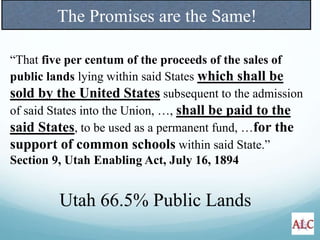
“That five per centum of the proceeds of the
sales of public lands … which shall be sold
by the United States subsequent to the
admission of said State into the Union…,
shall be paid to the said State, … for the
support of the common schools within said
State.”
Section 9, Utah Enabling Act, July 16, 1894
Utah 66.5% Public Lands
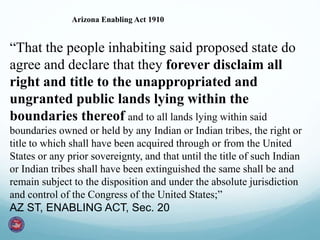
Arizona Enabling Act 1910
“That the people inhabiting said proposed state do
agree and declare that they forever disclaim all
right and title to the unappropriated and
ungranted public lands lying within the
boundaries thereof and to all lands lying within said
boundaries owned or held by any Indian or Indian tribes, the right or
title to which shall have been acquired through or from the United
States or any prior sovereignty, and that until the title of such Indian
or Indian tribes shall have been extinguished the same shall be and
remain subject to the disposition and under the absolute jurisdiction
and control of the Congress of the United States;”
AZ ST, ENABLING ACT, Sec. 20
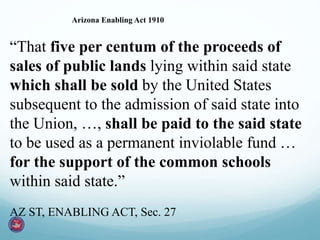
“That five per centum of the proceeds of
sales of public lands lying within said state
which shall be sold by the United States
subsequent to the admission of said state into
the Union, …, shall be paid to the said state
to be used as a permanent inviolable fund …
for the support of the common schools
within said state.”
AZ ST, ENABLING ACT, Sec. 27
Arizona Enabling Act 1910
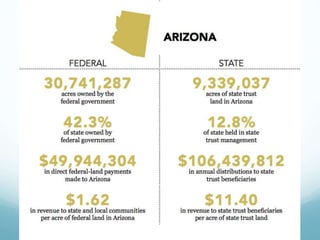
Why The difference?
Why The difference?
Why The difference?
Why The difference?
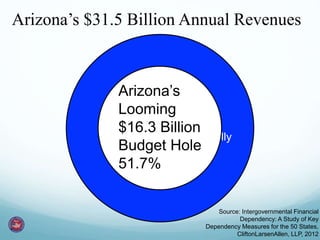
Arizona’s $31.5 Billion Annual Revenues
The $16.3 Billion
of “Federal Funds”
Arizona Spends Annually
Arizona’s
Looming
$16.3 Billion
Budget Hole
51.7%
Source: Intergovernmental Financial
Dependency: A Study of Key
Dependency Measures for the 50 States,
CliftonLarsenAllen, LLP, 2012
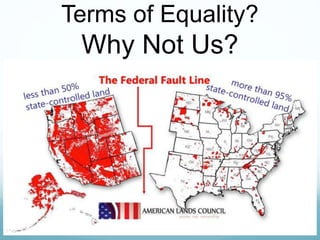
Terms of Equality?
Why Not Us?
Equality of States Essential to
Republic
“…‘the constitutional equality
of the States is essential to
the harmonious operation of
… the Republic ....”
Shelby County v. Holder, 570 U.S. ___ (2013)
Equal Sovereignty is
Fundamental
There is a “‘fundamental
principle of equal sovereignty’
among the States.” …
“… our Nation ‘was and is a
union of States, equal in power,
dignity and authority.’”
“‘[T]he consequences of admission are
instantaneous, and it ignores the uniquely
sovereign character of that event … to
suggest that subsequent events [acts of Congress]
somehow can diminish what has already been
bestowed.’ And that proposition applies a fortiori
[with even greater force] where virtually all
of the State’s public lands . . .are at
stake.”
2009 U.S. Supreme Court
Hawaii v. Office of Hawaiian Affairs
(Unanimous Decision)
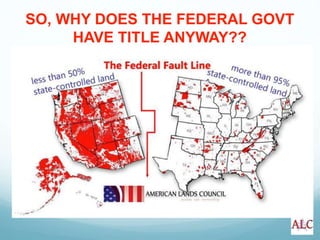
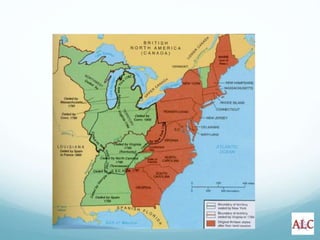
SO, WHY DOES THE FEDERAL GOVT
HAVE TITLE ANYWAY??
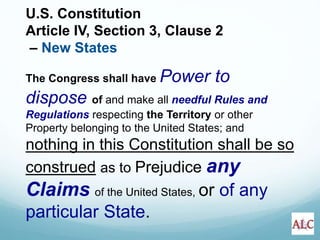
U.S. Constitution
Article IV, Section 3, Clause 2
– New States
The Congress shall have Power to
dispose of and make all needful Rules and
Regulations respecting the Territory or other
Property belonging to the United States; and
nothing in this Constitution shall be so
construed as to Prejudice any
Claims of the United States, or of any
particular State.
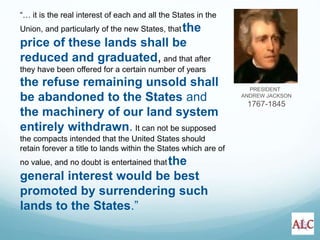
PRESIDENT
ANDREW JACKSON
1767-1845
“… it is the real interest of each and all the States in the
Union, and particularly of the new States, thatthe
price of these lands shall be
reduced and graduated, and that after
they have been offered for a certain number of years
the refuse remaining unsold shall
be abandoned to the States and
the machinery of our land system
entirely withdrawn. It can not be supposed
the compacts intended that the United States should
retain forever a title to lands within the States which are of
no value, and no doubt is entertained thatthe
general interest would be best
promoted by surrendering such
lands to the States.”
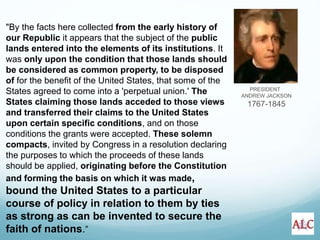
PRESIDENT
ANDREW JACKSON
1767-1845
"By the facts here collected from the early history of
our Republic it appears that the subject of the public
lands entered into the elements of its institutions. It
was only upon the condition that those lands should
be considered as common property, to be disposed
of for the benefit of the United States, that some of the
States agreed to come into a 'perpetual union.' The
States claiming those lands acceded to those views
and transferred their claims to the United States
upon certain specific conditions, and on those
conditions the grants were accepted. These solemn
compacts, invited by Congress in a resolution declaring
the purposes to which the proceeds of these lands
should be applied, originating before the Constitution
and forming the basis on which it was made,
bound the United States to a particular
course of policy in relation to them by ties
as strong as can be invented to secure the
faith of nations.”
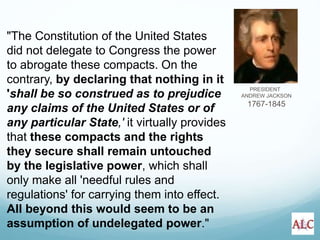
PRESIDENT
ANDREW JACKSON
1767-1845
"The Constitution of the United States
did not delegate to Congress the power
to abrogate these compacts. On the
contrary, by declaring that nothing in it
'shall be so construed as to prejudice
any claims of the United States or of
any particular State,' it virtually provides
that these compacts and the rights
they secure shall remain untouched
by the legislative power, which shall
only make all 'needful rules and
regulations' for carrying them into effect.
All beyond this would seem to be an
assumption of undelegated power."
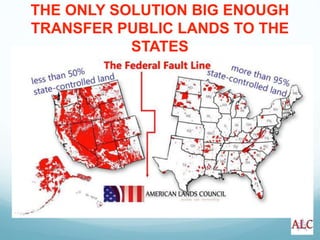
THE ONLY SOLUTION BIG ENOUGH
TRANSFER PUBLIC LANDS TO THE
STATES
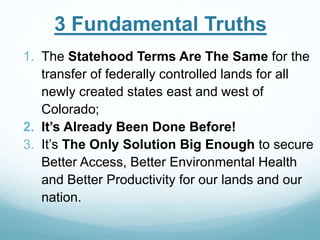
3 Fundamental Truths
1. The Statehood Terms Are The Same for the
transfer of federally controlled lands for all
newly created states east and west of
Colorado;
2. It’s Already Been Done Before!
3. It’s The Only Solution Big Enough to secure
Better Access, Better Environmental Health
and Better Productivity for our lands and our
nation.
Extra Slides
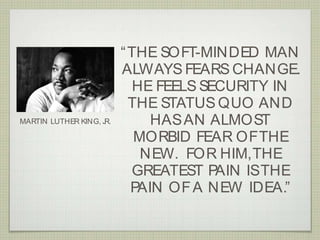
“THE SOFT-MINDED MAN
ALWAYS FEARS CHANGE.
HE FEELS SECURITY IN
THE STATUS QUO AND
HASAN ALMOST
MORBID FEAR OFTHE
NEW. FOR HIM,THE
GREATEST PAIN ISTHE
PAIN OFA NEW IDEA.”
MARTIN LUTHER KING, JR.
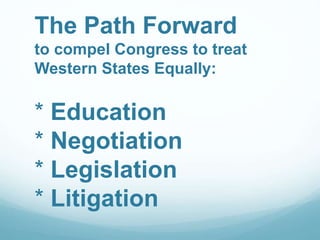
The Path Forward
to compel Congress to treat
Western States Equally:
* Education
* Negotiation
* Legislation
* Litigation
What Can I Do?
 Sign the Petition
 Tell Someone
 Tell Your Leaders
Secure Opportunity
through The Only
Solution Big
Enough
Why The difference?
U.S. Constitution
Article IV, Section 3, Clause 2
– New States
The Congress shall have Power to
dispose of and make all needful Rules and
Regulations respecting the Territory or other
Property belonging to the United States; and
nothing in this Constitution shall be so
construed as to Prejudice any
Claims of the United States, or of any
particular State.
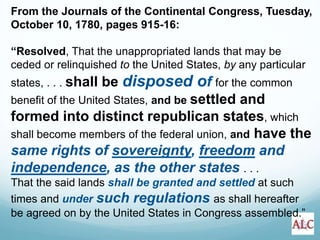
From the Journals of the Continental Congress, Tuesday,
October 10, 1780, pages 915-16:
“Resolved, That the unappropriated lands that may be
ceded or relinquished to the United States, by any particular
states, . . . shall be disposed of for the common
benefit of the United States, and be settled and
formed into distinct republican states, which
shall become members of the federal union, and have the
same rights of sovereignty, freedom and
independence, as the other states . . .
That the said lands shall be granted and settled at such
times and under such regulations as shall hereafter
be agreed on by the United States in Congress assembled.”
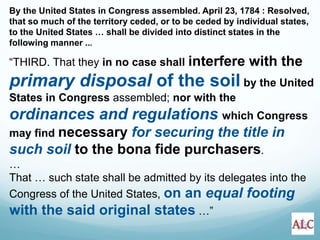
By the United States in Congress assembled. April 23, 1784 : Resolved,
that so much of the territory ceded, or to be ceded by individual states,
to the United States … shall be divided into distinct states in the
following manner ...
“THIRD. That they in no case shall interfere with the
primary disposal of the soil by the United
States in Congress assembled; nor with the
ordinances and regulations which Congress
may find necessary for securing the title in
such soil to the bona fide purchasers.
…
That … such state shall be admitted by its delegates into the
Congress of the United States, on an equal footing
with the said original states …”
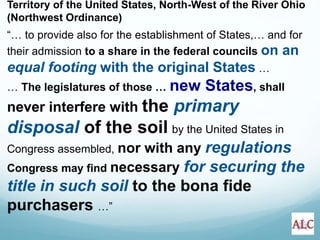
Territory of the United States, North-West of the River Ohio
(Northwest Ordinance)
“… to provide also for the establishment of States,… and for
their admission to a share in the federal councils on an
equal footing with the original States …
… The legislatures of those … new States, shall
never interfere with the primary
disposal of the soil by the United States in
Congress assembled, nor with any regulations
Congress may find necessary for securing the
title in such soil to the bona fide
purchasers …”
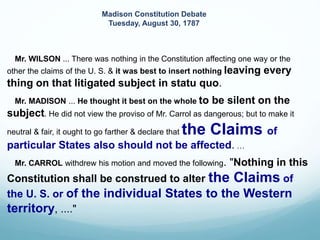
Mr. WILSON ... There was nothing in the Constitution affecting one way or the
other the claims of the U. S. & it was best to insert nothing leaving every
thing on that litigated subject in statu quo.
Mr. MADISON ... He thought it best on the whole to be silent on the
subject. He did not view the proviso of Mr. Carrol as dangerous; but to make it
neutral & fair, it ought to go farther & declare that the Claims of
particular States also should not be affected. …
Mr. CARROL withdrew his motion and moved the following. "Nothing in this
Constitution shall be construed to alter the Claims of
the U. S. or of the individual States to the Western
territory, ...."
Madison Constitution Debate
Tuesday, August 30, 1787
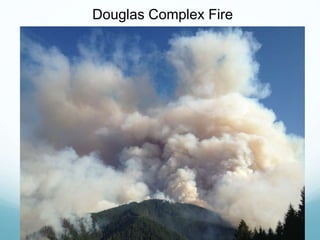
Douglas Complex Fire
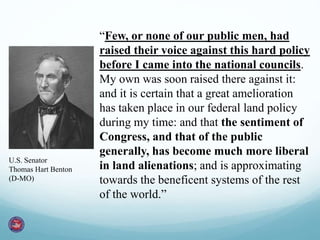
“Few, or none of our public men, had
raised their voice against this hard policy
before I came into the national councils.
My own was soon raised there against it:
and it is certain that a great amelioration
has taken place in our federal land policy
during my time: and that the sentiment of
Congress, and that of the public
generally, has become much more liberal
in land alienations; and is approximating
towards the beneficent systems of the rest
of the world.”
U.S. Senator
Thomas Hart Benton
(D-MO)
What Can I Do?
Sign the Petition
 Tell Someone
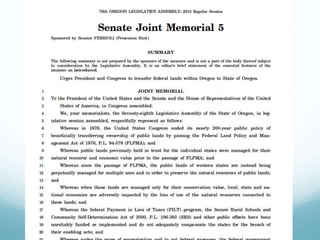
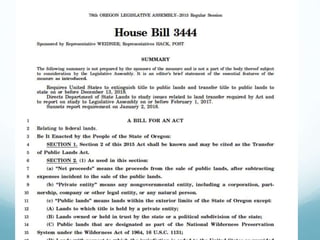
 Tell Your Leaders (AOC Resolution,
HB3444, SJM5)
 Be Part of The Only Solution Big
Enough
www.AmericanLandsCouncil.org
Text “Sign” to 801.416.2543
What Can I Do?
 Sign the Petition
Tell Someone
(Email, Facebook, Twitter, YouTube,
Carrier Pigeon, etc.)
 Tell Your Leaders (AOC Resolution, HB3444,
SJM5)
 Be Part of The Only Solution Big
Enough
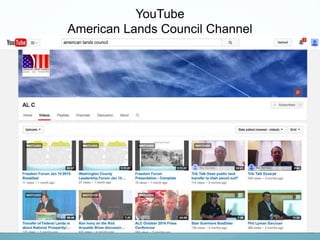
YouTube
American Lands Council Channel
What Can I Do?
 Sign the Petition
 Tell Someone
Tell Your Leaders
(AOC Resolution, HB3444,
SJM5)
 Be Part of The Only Solution Big
Enough
US Senator Lisa Murkowski
“We Can’t Afford to Pay Counties to NOT Utilize their Resources”
Liberty cannot exist –
depriving Life of real
meaning – without
the right and control
(i.e. self government)
of Property.
20th Congress, 1st Session, House of Reps., Rep. No. 125, Graduate
Price of Public Lands, February 5, 1828
Mr. Duncan, from the Committee on the Public Lands, to which the subject
had been referred, made the following
REPORT:
If these lands are to be withheld from sale, which is the effect of the present system,
in vain may the People of these States expect the advantages of well settled
neighborhoods, so essential to the education of youth, and to the pleasures of social
intercourse, and the advantages of religious instruction. Those States will, for many
generations, without some change, be retarded in endeavors to increase their comfort
and wealth, by means of works of internal improvements, because they have not the
power, incident to all sovereign States, of taxing the soil, to pay for the benefits
conferred upon its owner by roads and canals.
When these States stipulated not to tax the lands of the United States until they
were sold, they rested upon the implied engagement of Congress to cause them to be
sold, within a reasonable time. No just equivalent has been given those States for a
surrender of an attribute of sovereignty so important to their welfare, and to an equal
standing with the original States.
A remedy for such great evils may be found in carrying into effect the spirit of the
Federal Constitution, which knows of no inequality in the powers and rights of the
several States;
20th Congress No. 726.
2d Session
APPLICATION OF MISSOURI FOR A CHANGE IN THE SYSTEM OF
DISPOSING OF THE PUBLIC LANDS.
COMMUNICATED TO THE SENATE JANUARY 26, 1829.
To the Senate and House of Representatives of the United States:
The memorial of the general assembly of the State of Missouri
respectfully showeth: That the system of disposing of the public lands of the
United States now pursued is highly injurious, in many respects, to the
States in which those lands lie, . . . with the present condition of the
western States. But the general assembly will state that a perseverance in
the present system manifestly appears to them to be . . . an infringement of
the compact between the United States and this State; and that the State of
Missouri never could have been brought to consent not to tax the lands of
the United States whilst unsold; and not to tax the lands sold until five years
thereafter, if it had been understood by the contracting parties that a system
was to be pursued which would prevent nine-tenths of those lands from
ever becoming the property of persons in whose hands they might be taxed.
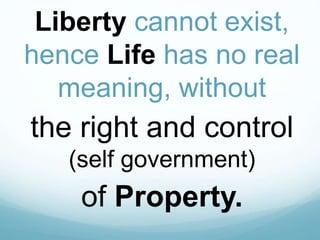
Liberty cannot exist,
hence Life has no real
meaning, without
the right and control
(self government)
of Property.
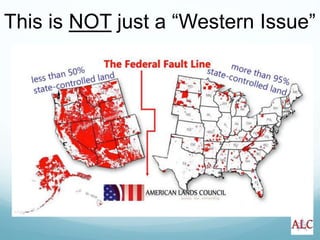
This is NOT just a “Western Issue”
Why The difference?
Why The difference?
Why The difference?
Why The difference?
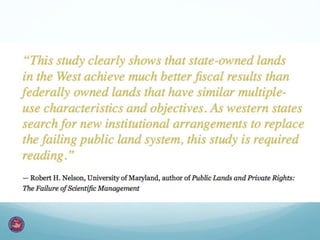
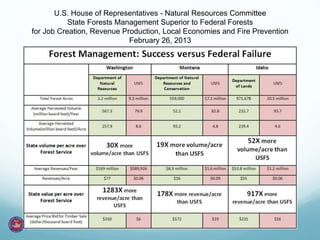
U.S. House of Representatives - Natural Resources Committee
State Forests Management Superior to Federal Forests
for Job Creation, Revenue Production, Local Economies and Fire Prevention
February 26, 2013
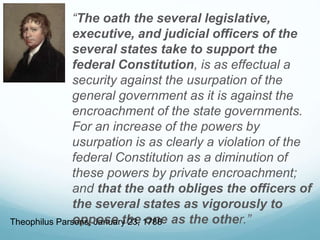
“The oath the several legislative,
executive, and judicial officers of the
several states take to support the
federal Constitution, is as effectual a
security against the usurpation of the
general government as it is against the
encroachment of the state governments.
For an increase of the powers by
usurpation is as clearly a violation of the
federal Constitution as a diminution of
these powers by private encroachment;
and that the oath obliges the officers of
the several states as vigorously to
oppose the one as the other.”Theophilus Parsons, January 23, 1788
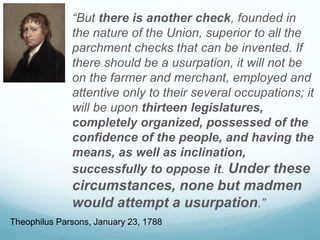
“But there is another check, founded in
the nature of the Union, superior to all the
parchment checks that can be invented. If
there should be a usurpation, it will not be
on the farmer and merchant, employed and
attentive only to their several occupations; it
will be upon thirteen legislatures,
completely organized, possessed of the
confidence of the people, and having the
means, as well as inclination,
successfully to oppose it. Under these
circumstances, none but madmen
would attempt a usurpation.”
Theophilus Parsons, January 23, 1788
"… it will be their own
FAULTS, if the several
states suffer the federal
sovereignty to interfere in
the things of
their respective
jurisdictions."
John Dickinson (Fabius), Letter III, 1788 (all caps in original)
So . . .
Forever Disclaim All Right and Title ...?
“That the people inhabiting said proposed States do
agree and declare that they forever disclaim all right
and title to the unappropriated public lands lying
within the boundaries thereof, … and that until the
title thereto shall have been extinguished
by the United States, the same shall be and remain
subject to the disposition of the United States, …;”
Enabling Act of 1889 §4, Second
North Dakota 3.9% Federally Controlled Lands
South Dakota 5.4% Federally Controlled Lands
The Promises are the Same!
“That the people inhabiting said proposed States do
agree and declare that they forever disclaim all right
and title to the unappropriated public lands lying
within the boundaries thereof, … and that until the
title thereto shall have been extinguished
by the United States, the same shall be and remain
subject to the disposition of the United States, …;”
Section 3, Utah Enabling Act, July 16, 1894
Utah
66.5% Public Lands
5% of Proceeds SHALL be paid to the State
“That five per centum of the proceeds of the sales of
public lands lying within said States which shall be
sold by the United States subsequent to the admission
of said States into the Union, …, shall be paid to the
said States, to be used as a permanent fund, …for the
support of common schools within said States,
respectively.”
Enabling Act of 1889 §13
North Dakota 3.9% Federally Controlled Lands
South Dakota 5.4% Federally Controlled Lands
“That five per centum of the proceeds of the sales of
public lands lying within said States which shall be
sold by the United States subsequent to the admission
of said States into the Union, …, shall be paid to the
said States, to be used as a permanent fund, …for the
support of common schools within said State.”
Section 9, Utah Enabling Act, July 16, 1894
Utah 66.5% Public Lands
The Promises are the Same!
“This separation of the two spheres is
one of the Constitution's structural
protections of liberty. … a healthy
balance of power between the
States and the Federal Government
will reduce the risk of tyranny and
abuse from either front.’”
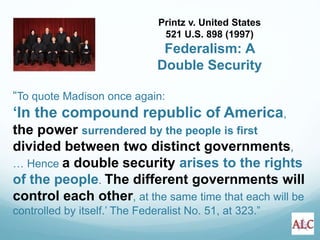
Printz v. United States
521 U.S. 898 (1997)
States Are Supreme
In Their Sphere
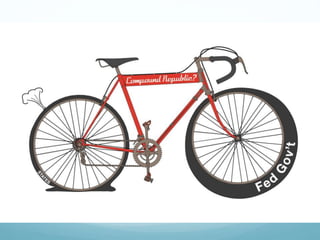
“To quote Madison once again:
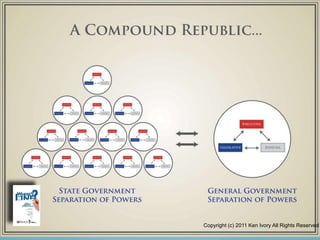
‘In the compound republic of America,
the power surrendered by the people is first
divided between two distinct governments,
… Hence a double security arises to the rights
of the people. The different governments will
control each other, at the same time that each will be
controlled by itself.’ The Federalist No. 51, at 323.”
Printz v. United States
521 U.S. 898 (1997)
States Are Supreme
In Their Sphere
“The Federal Government has
expanded dramatically over the past
two centuries, but it still must show
that a constitutional grant of power
authorizes each of its actions.”
U.S. Supreme Court Affordable
Care Act Decision (June, 2012)
Federal Govt Powers Limited
By Constitution
“The same does not apply to the States,
because the Constitution is not the source of
their power. … state governments do not need
constitutional authorization to act. ... Our cases refer to this
general power of governing, possessed
by the States but not by the Federal
Government, as the ‘police power.’”
U.S. Supreme Court Affordable
Care Act Decision (June, 2012)
States’ Powers NOT Limited
By Constitution
“The Framers thus ensured that powers
which ‘in the ordinary course of affairs,
concern the lives, liberties, and
properties of the people’ were held by
governments more local and more
accountable than a distant federal
bureaucracy.”
U.S. Supreme Court Affordable
Care Act Decision (June, 2012)
State Jurisdiction Checks
Federal Power
“The independent power of the
States also serves as a check on the power
of the Federal Government: ‘By denying any
one government complete jurisdiction
over all the concerns of public life, federalism
protects the liberty of the individual
from arbitrary power.’”
U.S. Supreme Court Affordable
Care Act Decision (June, 2012)
State Jurisdiction Checks
Federal Power
“In the typical case we look to the States to
defend their prerogatives by adopting “the
simple expedient of not yielding” to federal
blandishments when they do not want to
embrace the federal policies as their own."
U.S. Supreme Court Affordable
Care Act Decision (June, 2012)
States Must Act Like
Independent Sovereigns
“The States are separate and
independent sovereigns.
"Sometimes they have to act like
it."
U.S. Supreme Court Affordable
Care Act Decision (June, 2012)
States Must Act Like
Independent Sovereigns
The Constitution thus contemplates that a State's government
will represent and remain accountable to its own citizens. As
Madison expressed it: "[T]he local or municipal authorities
form distinct and independent portions of
the supremacy, no more subject, within their
respective spheres, to the general authority than the general
authority is subject to them, within its own sphere."
The Federalist No. 39, at 245.
Printz v. United States
521 U.S. 898 (1997)
States Are Supreme
In Their Sphere
The Line
“. . . this Constitution deserves
approbation [praise] . . . [for] the
accuracy with which the line is
drawn between the powers of
the general government and
those of the particular state
governments. . . . the powers are
as minutely enumerated and defined
as was possible . . .”
James Wilson, Pennsylvania Ratifying Convention, 4 Dec.
1787
Copyright (c) 2011 Ken Ivory All Rights Reserved
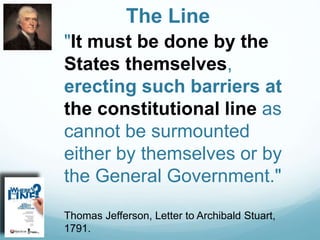
The Line
"It must be done by the
States themselves,
erecting such barriers at
the constitutional line as
cannot be surmounted
either by themselves or by
the General Government."
Thomas Jefferson, Letter to Archibald Stuart,
1791.
What Can I Do?
 Do you believe that the right and control of property,
liberty, and self-government are fundamental to our
unprecedented American experiment?
 Do you believe these are things worth sacrificing for to
pass on to our children and grandchildren just like our
ancestors secured them for us?
 Do you believe that if Illinois, etc. can do it there is no
reason besides a lack of (i) knowledge, (ii) commitment,

and (ii) effort why we shouldn’t be able to do the very same
thing?
 Why Not Us?
The Line as Understood for nearly 150 Years
Governor Franklin Delano Roosevelt (D-NY), March 2, 1930
“Congress has been given the right to legislate on . . .
particular subject[s], but this is not the case in the
matter of a great number of other vital problems of
government, such as the conduct of public utilities,
of banks, of insurance, of business, of agriculture,
of education, of social welfare and of a dozen other
important features. In these, Washington must not be
encouraged to interfere.”
“State Legislatures will
 jealously and closely watch the
operations of this Government, and
 be able to resist with more effect
[better] than any other power on earth
can do; and
 the greatest opponents to a Federal
Government admit the State Legislatures
to be sure guardians of the people's
liberty.”
James Madison, Introduction of the Bill of Rights, The Annals of Congress,
House of Representatives, First Congress
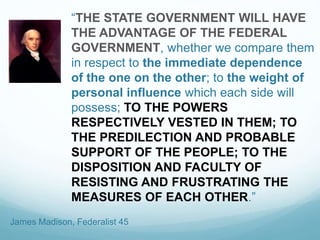
“THE STATE GOVERNMENT WILL HAVE
THE ADVANTAGE OF THE FEDERAL
GOVERNMENT, whether we compare them
in respect to the immediate dependence
of the one on the other; to the weight of
personal influence which each side will
possess; TO THE POWERS
RESPECTIVELY VESTED IN THEM; TO
THE PREDILECTION AND PROBABLE
SUPPORT OF THE PEOPLE; TO THE
DISPOSITION AND FACULTY OF
RESISTING AND FRUSTRATING THE
MEASURES OF EACH OTHER.”
James Madison, Federalist 45
Ambitious encroachments of the federal government,
on the authority of the State governments,
(i) WOULD NOT EXCITE THE OPPOSITION OF A
SINGLE STATE, OR OF A FEW STATES ONLY.
(ii) They would be SIGNALS OF GENERAL ALARM.
(iii) Every government would ESPOUSE THE COMMON
CAUSE.
(iv) A CORRESPONDENCE WOULD BE OPENED.
(v) PLANS OF RESISTANCE WOULD BE
CONCERTED.
(vi) ONE SPIRIT WOULD ANIMATE AND CONDUCT
THE WHOLE.
(vii) unless the projected innovations should be
voluntarily renounced, the same appeal to a trial
of force would be made in the one case [foreign
invasion] as was made in the other [federal
intrusion].
(viii) ONE SET OF REPRESENTATIVES WOULD BE
CONTENDING AGAINST THIRTEEN SETS OF
REPRESENTATIVES
James
Madison,
Federalist 46
“It may safely be received as an axiom in our political system,
that the State governments will, in all
possible contingencies, afford complete
security against invasions of the public
liberty by the national authority.
(i) The [State] legislatures will have BETTER MEANS OF
INFORMATION.
(ii) They can DISCOVER THE DANGER at a distance; and
(iii) POSSESSING ALL THE ORGANS OF CIVIL POWER,
and
(iv) the confidence of the people, they can at once
(v) ADOPT A REGULAR PLAN OF OPPOSITION, in which
they can
(vi) COMBINE ALL THE RESOURCES OF THE
COMMUNITY.
(vii)They can READILY COMMUNICATE WITH EACH OTHER
IN THE DIFFERENT STATES, and
(viii) UNITE THEIR COMMON FORCES FOR THE
PROTECTION OF THEIR COMMON LIBERTY.”
– Alexander Hamilton, Federalist 28
It Matters for Oregon’s Public Safety…
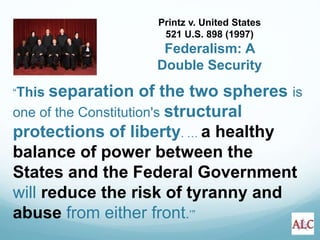
“This separation of the two spheres is
one of the Constitution's structural
protections of liberty. … a healthy
balance of power between the
States and the Federal Government
will reduce the risk of tyranny and
abuse from either front.’”
Printz v. United States
521 U.S. 898 (1997)
Federalism: A
Double Security
“To quote Madison once again:
‘In the compound republic of America,
the power surrendered by the people is first
divided between two distinct governments,
… Hence a double security arises to the rights
of the people. The different governments will
control each other, at the same time that each will be
controlled by itself.’ The Federalist No. 51, at 323.”
Printz v. United States
521 U.S. 898 (1997)
Federalism: A
Double Security
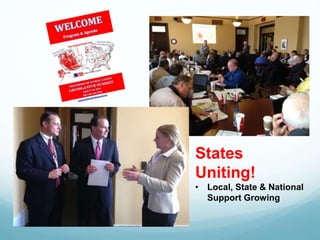
States
Uniting!
• Local, State & National
Support Growing

Opportunity to Stand for Something

  • 1.
    “The Opportunity toStand for Something” The Transfer Public Lands GOPAC Rep. Ken Ivory (UT) May 18, 2015
  • 2.
    “We don't propose,like some people, to meet today’s problems by saying that they don't exist, and tomorrow's problems by wishing that tomorrow wouldn't come. Harry S. Truman
  • 3.
    "Men make history,and not the other way around. In periods where there is no leadership, society stands still. Progress occurs when courageous, skillful leaders seize the opportunity to change things for the better." Harry S. Truman
  • 4.
    Better Access Better Health  Better Productivity
  • 5.
    “The Green River Formation… where Colorado, Utah and Wyoming come together, contains about as much recoverable oil as all the rest of the world’s proven reserves combined” locked up in federally controlled lands. Energy Independence Locked Up
  • 6.
    Because our abundant natural resourcesare locked up in federally controlled lands, America is at the mercy of foreign powers for rare earth minerals vital to national defense, renewable energy, and electronics technologies. March 22, 2015 National Security At Risk
  • 7.
    It Matters forOur States and Our Nation!
  • 8.
    "This is awonderful time to be alive… we're lucky not to live in pale and timid times. We've been blessed with the opportunity to stand for something.” Ronald Reagan
  • 9.
  • 11.
    www.AmericanLandsCouncil.org Better Access Better Health  Better Productivity
  • 12.
    "Gentlemen, this is a football.” VinceLombardi Coach for the Green Bay Packers 1959-1967. 96 wins, two Superbowl wins. Coach of the Year in 1959, inducted into the hall of fame in 1971, namesake for the Superbowl trophy.
  • 15.
    Life, Liberty, Property “Man—hasthree great rights ... life, … liberty, … property. ... The three rights are so bound together as to be essentially one right. To give a man his life, but deny him his liberty, is to take from him all that makes his life worth living. To give him his liberty, but take from him the property which is the fruit and badge of his liberty, is to still leave him a slave.” George Sutherland U.S. Supreme Court Justice 1921
  • 22.
    “… powers which… concern the lives, liberties, and properties of the people’ were held by governments more local and more accountable than a distant federal bureaucracy.” U.S. Supreme Court NFIB v. Sebelius (June, 2012) “Basic Principles” State Jurisdiction Checks Federal Power
  • 23.
    “The independent powerof the States also serves as a check on the power of the Federal Government.” U.S. Supreme Court NFIB v. Sebelius (June, 2012) “Basic Principles” State Jurisdiction Checks Federal Power
  • 24.
    “‘By denying anyone government complete jurisdiction over all the concerns of public life, federalism protects the liberty of the individual from arbitrary power.’” U.S. Supreme Court NFIB v. Sebelius (June, 2012) “Basic Principles” State Jurisdiction Checks Federal Power
  • 25.
    “…we look tothe States to defend their prerogatives by adopting “the simple expedient of not yielding” to federal blandishments when they do not want to embrace the federal policies as their own." U.S. Supreme Court NFIB v. Sebelius (June, 2012) “Basic Principles” States Must Act Like Independent Sovereigns
  • 26.
    “The States areseparate and independent sovereigns. Sometimes they have to act like it." U.S. Supreme Court NFIB v. Sebelius (June, 2012) “Basic Principles” States Must Act Like Independent Sovereigns
  • 28.
    Rights we don’tknow are no better than rights we don’t have. Rights we don’t exercise are no better than rights we don’t have.
  • 29.
    Equality of StatesEssential to Republic “…‘the constitutional equality of the States is essential to the harmonious operation of … the Republic ....” Shelby County v. Holder, 570 U.S. ___ (2013)
  • 30.
    Equal Sovereignty is Fundamental Thereis a “‘fundamental principle of equal sovereignty’ among the States.” … “… our Nation ‘was and is a union of States, equal in power, dignity and authority.’” Shelby County v. Holder, 570 U.S. ___ (2013)
  • 31.
    Equal in Liberty,Property & Self Governance?
  • 32.
    If you werethe opposing quarterback, What Would You Do?
  • 34.
    The Promises Arethe Same Why The Difference?
  • 38.
    1889 Enabling Act North& South Dakota, Montana, and Washington “That the people inhabiting said proposed States do agree and declare that they forever disclaim all right and title to the unappropriated public lands lying within the boundaries thereof, … and that until the title thereto shall have been extinguished by the United States, the same shall be and remain subject to the disposition of the United States, and … no taxes shall be imposed by the States on lands or property therein belonging to or which hereafter be purchased by the United States or reserved for its use;”
  • 39.
    Montana’s Enabling ActAffirms: Lands shall be sold and 5% of the proceeds shall be paid to the states… “That five per centum of the proceeds of the sales of public lands lying within said States which shall be sold by the United States subsequent to the admission of said States into the Union, after deducting all the expenses incident to the same, shall be paid to the said States, to be used as a permanent fund, the interest of which only shall be expended for the support of common schools within said States, respectively.” -- Montana, Washington, North Dakota, South Dakota Enabling Act of 1889 §13
  • 40.
    Why did GovernorWarren say this: "The State of Wyoming will, after the date of admission, receive 5% of the net receipts from all sales of US Lands within its borders, which will continue until all such lands are sold.” -- Governor Francis E. Warren, Inaugural Address, 1889 MYTH: “You Gave Up Your Lands”
  • 41.
    MYTH: “You GaveUp Your Lands” “In harmony with the spirit and letter of the land grants to the national government, … and in conformity with the terms of our Enabling Act, … we hereby earnestly urge a policy that will afford an opportunity to settle our lands and make use of our resources on terms of equality with the older states, to the benefit and upbuilding of the State and to the strength of the nation.” Utah Senate Joint Memorial No. 4, 1915, Asking Congress for a More Liberal National Policy in the Disposition of the Public Domain
  • 42.
    • Enabling Actsare "solemn compacts" and "bi- lateral [two-way] agreements" that are to be performed "in a timely fashion" (Andrus v. Utah, 1980); • The federal government holds territorial lands “in trust for the several states to be ultimately created out of the territory." (Shively v. Bowlby, 1894); KEY SUPREME COURT DECISIONS SOLEMN COMPACTS, BI-LATERAL AGREEMENTS MYTH: “It’s Not Legal”
  • 43.
    U.S. Constitution ArticleIV, Section 3 – New States (NOTE: Article IV, New States; NOT Article I, Powers of Congress) “The Congress shall have Power to dispose* of and make all needful rules and regulations respecting the Territory or other property belonging to the United States; and nothing in this Constitution shall be so construed as to prejudice any Claims of the United States, or of any particular state.” *NOTE: The Constitution does not say Congress shall have the power to keep the lands forever and ever!
  • 44.
    “the legal arguments in favorof the TPLA are serious” --The Federalist Society (a national organization of 40,000 lawyers, law students, scholars and other individuals located in every state and law school in the nation)
  • 46.
    “[T]he consequences ofadmission are instantaneous, and it ignores the uniquely sovereign character of that event … to suggest that subsequent events [acts of Congress] somehow can diminish what has already been bestowed.’ And that proposition applies a fortiori [with even greater force] where virtually all of the State’s public lands . . .are at stake.” 2009 U.S. Supreme Court Hawaii v. Office of Hawaiian Affairs (Unanimous Decision)
  • 47.
    IT’S ALREADY BEENDONE BEFORE! MI, IA, IL, MO, IN, AR, LA, AL, MS, Fl, etc. were as much as 90% federally controlled for decades ...
  • 48.
    One Man... One LEADER... RefusedTo Be Silent or Take “NO” for an Answer
  • 49.
    “... my electionto the Senate of the United States ... found me doing battle for an ameliorated system of disposing of our public lands; and with some success. I resolved to move against the whole system ... I did so in a bill, renewed annually for a long time; and in speeches which had more effect upon the public mind than upon the federal legislation ...” U.S. Senator Thomas Hart Benton (D-MO)
  • 50.
    “They were asa stepmother, instead of a natural mother: and the federal government being sole purchaser from foreign nations, and sole recipient of Indian cessions, it became the monopolizer of vacant lands of the West: and this monopoly, like all monopolies, resulted in hardships to those upon whom it acted.” U.S. Senator Thomas Hart Benton (D-MO)
  • 51.
    “But the membersin Congress from the new States should not intermit their exertions, nor vary their policy; and should fix their eyes steadily upon the period of the speedy extinction of the federal title to all the lands within the limits of their respective States ...” Thirty Years View, Thomas Hart Benton U.S. Senator Thomas Hart Benton (D-MO)
  • 52.
    Hawaii (the last WesternState admitted) Enabling Act March 18, 1959 “… the United States grants to the State of Hawaii, effective upon its admission into the Union, the United States’ title to all the public lands and other public property within the boundaries of the State of Hawaii, title to which is held by the United States immediately prior to its admission into the Union.”
  • 53.
  • 54.
    To Infinity… & Beyond! WashingtonDC financial “management” National Debt 1940-Present Seriously??
  • 60.
    MYTH: “States willShut it Down?”
  • 61.
    MYTH: “State willSell It!” Debt-Ridden WA DC is Selling It! May 2, 2015, Rep. Ted Poe (R-TX) introduced the American Land Act (H.R. 1931) which would require USFS and BLM to auction off 8% of the lands they control per year for the next 5 years.
  • 62.
    MYTH: “State willSell It!” Will Debt-Ridden WA DC follow?
  • 63.
  • 64.
  • 65.
    “Wildfires are scorchingthe earth and burning through the United States’ bank account.” Washington Post, July 25, 2014
  • 66.
    TRENDING Decreased Logging =Increased Wildfire
  • 67.
  • 68.
    USDA REPORT: Nearly 10,000 miles ofelectrical transmission lines on national forest lands in the west are at risk. TRENDING
  • 69.
    USDA REPORT: “Fires arebecoming larger and more severe.” “Since 2000, ten western states have had record fire seasons.” “Trends indicate the amount of wildfire and associated damage will increase beyond our recent experiences.” “The forest service does not have the budget to treat the affected acres.” - USFS Risk & Reliability Report, Aug 2013 TRENDING
  • 70.
    Failing Federal Policies: “Analysis paralysis”and “management by litigation” are killing millions of animals, destroying our environment, wasting natural resources, and depressing western communities. TRENDING
  • 72.
  • 75.
    Efforts underway in: •Utah • Nevada • Wyoming • Idaho • Montana • Arizona • New Mexico • Colorado • Alaska • Washington • Oregon • South Carolina • Tennessee • Arkansas • Georgia • Texas & more
  • 76.
    “The federal governmenthas been a lousy landlord for western states and we simply think the states can do it better. If we want healthier forests, better access to public lands, more consistent funding for public education and more reliable energy development, it makes sense to have local control.” Rep. Chris Stewart (UT) Other members include Reps. Mark Amodei, R-Nev.; Diane Black, R-Tenn.; Jeff Duncan, R-S.C.; Cresent Hardy, R-Nev.; and Cynthia Lummis, R-Wyo. Congressional Federal Land Action Group created April 28, 2015
  • 79.
    rev April 2015 79 IT’SNOT JUST A GOP THING… *Cities, Counties, States *School Districts/Education Assoc *Trade Unions *Chambers, Econ Councils *User Groups *Resource Industries *Farm Bureau, Cattlemen, etc.
  • 80.
  • 81.
    “Our people lookfor a cause to believe in … a banner of no pale pastels, but bold colors which make it unmistakably clear where we stand on all of the issues troubling the people.” Ronald Reagan
  • 82.
    What Can YourConstituents Do? Sign the Petition: www.americanlandscouncil.org Tell Someone! Share News, Blogs and Resources from the ALC Website on Social Media, Newsletters, Letters to the Editor, Conferences, etc. Tell Your Leaders! Persistently encourage local, state and national leaders to stand with resolve and without shame like Sen. Thomas Hart Benton Open Doors! Many are looking for answers big enough to secure better stewardship of our lands and greater opportunities for our communities, states and nation. Introduce them to the only solution big enough in the Transfer of Public Lands to local stewardship.
  • 83.
    What Can YouDo Now? Educate – Share the vision of TPL with constituents, colleagues, leaders, organizations, conferences, speeches, articles, etc. Negotiate – Communicate the unwavering expectation for TPL with federal officials and agencies thru meetings, hearings, conferences, etc. Legislate – Pass resolutions, ordinances, and legislation at the local, state and national level supporting TPL and facilitating the transition (studies, logistics, interstate compacts, federal devolution, etc.) Litigate – Combine our common legal and financial resources, public and private, in defense of the “constitutional equality of the States … essential for the harmonious operation of … the Republic.”
  • 85.
  • 86.
    Ken Ivory, UTState Rep. American Lands Council 801.694.8380 Ken@AmericanLandsCouncil.org “The Opportunity To Stand For Something … Worth Fighting For!”
  • 87.
  • 88.
    Which western State successfullycompelled the transfer of its public lands with these arguments?
  • 89.
    Successful arguments forthe transfer of public lands: First, Federal control of its lands restricted the ability to improve, protect, and manage its resources, limiting its opportunities to generate revenue on terms of equality with states to their east.
  • 90.
    Successful arguments forthe transfer of public lands: Second, Why should the State be deprived of the ability to protect the health, safety, and welfare of its people exercised by States to the east.
  • 91.
    Successful arguments forthe transfer of public lands: Third, The State should have the same authority to improve and regulate the growth and progress of its lands within its boundaries "according to its own views of prosperity and happiness" as exercised by states to the east.
  • 92.
    Successful arguments forthe transfer of public lands: Fourth, The State insisted that it was unfair for eastern states to be required to subsidize States in the west due to federal control of western lands.
  • 93.
    Successful arguments forthe transfer of public lands: Fifth, The State was adamant that the statehood enabling act terms were "obligatory upon the parties to it" such that "any act on the part of the [federal] government to delay... would doubtless be an infringement of the compact itself.”
  • 94.
    Successful arguments forthe transfer of public lands: Sixth, The State questioned why its citizens should "be subject to the operation of the laws of the United Sates," over such matters as land use and planning regulations, which are "confessedly purely municipal, which have no existence in the older States, and which they [the States] alone have the right to pass.”
  • 95.
    Successful arguments forthe transfer of public lands: Seventh, The State contended that the exercise of such "extraordinary powers" by the federal government was not consistent with "the rights reserved to the States respectively by the Constitution of the United States" and is not expressly granted anywhere in the statehood enabling act.
  • 96.
    Which western State successfullycompelled the transfer of its public lands with these arguments?
  • 97.
    Illinois! Its lands weremore than 95% federally controlled for DECADES!
  • 99.
    IN THE HOUSEOF REPRESENTATIVES. February 21, 1848 Mr. Ficklin [Orlando B. Ficklin, D-IL], on leave, introduced the following bill: which was read twice, and referred to the committee on Public Lands. A Bill To cede the public lands within the limits of the new States on certain conditions therein mentioned. Whereas, the land within the limits of the original States of the Union, as well as the unappropriated “crown lands” claimed by different States, were acquired by the blood and common treasure of the whole nation, and rightfully belong to the States, whether new or old, within whose limits the same are situated;
  • 100.
    IN THE HOUSEOF REPRESENTATIVES. February 21, 1848 Mr. Ficklin [Orlando B. Ficklin, D-IL], on leave, introduced the following bill: which was read twice, and referred to the committee on Public Lands. A Bill To cede the public lands within the limits of the new States on certain conditions therein mentioned. … whereas, the harmony and successful working of our federative system require a perfect equality of rights amongst the several States of the Union, as independent political sovereignties;
  • 101.
    IN THE HOUSEOF REPRESENTATIVES. February 21, 1848 Mr. Ficklin [Orlando B. Ficklin, D-IL], on leave, introduced the following bill: which was read twice, and referred to the committee on Public Lands. A Bill To cede the public lands within the limits of the new States on certain conditions therein mentioned. … whereas, the new States, admitted into the Union, cannot be on an equality with the original States without the right of eminent domain to the public lands, within their respective limits, as a necessary incident to sovereignty, whether such lands were acquired by conquest, treaty, or otherwise;
  • 102.
    IN THE HOUSEOF REPRESENTATIVES. February 21, 1848 Mr. Ficklin [Orlando B. Ficklin, D-IL], on leave, introduced the following bill: which was read twice, and referred to the committee on Public Lands. A Bill To cede the public lands within the limits of the new States on certain conditions therein mentioned. … and whereas this principle, so just in itself, has been recognized by Congress, as well in ceding to the State of Tennessee the public lands within her limits granted by North Carolina to this government, as by admitting the State of Texas into the Union, she retaining her public domain; therefore –
  • 103.
    A Bill To cedethe public lands within the limits of the new States on certain conditions therein mentioned. … Be it enacted by the Senate and House of Representatives of the United States of America in Congress assembled, That all the public and unappropriated lands within the States of Ohio, Indiana, Illinois, Missouri, Alabama, Mississippi, Arkansas, Louisiana, Michigan, Florida, and Iowa, with the exception of the sites of fortifications, navy and dock yards, arsenals, magazines, and all other public buildings and grounds for the same, be, and the same are hereby, ceded to the several States, within the limits of which they are respectively situated …
  • 104.
    U.S. Constitution Annotated Article IV,Section 3, CL 1 – New States “The right of every new State to exercise all the powers of government which belong to and may be exercised by the original States of the Union must be admitted and remain unquestioned except so far as they are temporarily deprived of control over the public lands.”
  • 105.
    Resolution supporting Transfer ofPublic Lands passed unanimously at MTGOP State Convention June 21, 2014.
  • 107.
    Equality in Liberty,Property & Self Governance?
  • 108.
    Rights we don’tknow are no better than rights we don’t have. Rights we don’t exercise are no better than rights we don’t have.
  • 109.
    “that the peopleinhabiting the said territory, do agree and declare that they forever disclaim all right and title to the waste or unappropriated lands lying within the said territory; and that the same shall be and remain at the sole and entire disposition of the United States...” ALABAMA 2.7% PUBLIC LANDS Forever Disclaim All Right and Title ...?
  • 110.
    “that the peopleinhabiting the said territory do agree and declare that they forever disclaim all right or title to the waste or unappropriated lands lying within the said territory, and that the same shall be and remain at the sole and entire disposition of the United States...” LOUISIANA 4.6% PUBLIC LANDS Forever Disclaim All Right and Title ...?
  • 111.
    “That the peopleinhabiting said territory do agree and declare that they forever disclaim all right and title to the unappropriated public lands lying within said territory, and that the same shall be and remain at the sole and entire disposition of the United States, ....” NEBRASKA 1% PUBLIC LANDS Forever Disclaim All Right and Title ...?
  • 112.
    Forever Disclaim AllRight and Title ...? “That the people inhabiting said proposed States do agree and declare that they forever disclaim all right and title to the unappropriated public lands lying within the boundaries thereof, … and that until the title thereto shall have been extinguished by the United States, the same shall be and remain subject to the disposition of the United States, …;” Enabling Act of 1889 §4, Second North Dakota 3.9% Federally Controlled Lands South Dakota 5.4% Federally Controlled Lands
  • 113.
    5% of ProceedsSHALL be paid to the State “That five per centum of the proceeds of the sales of public lands lying within said States which shall be sold by the United States subsequent to the admission of said States into the Union, …, shall be paid to the said States, to be used as a permanent fund, …for the support of common schools within said States, respectively.” -- Montana, Washington, North Dakota, South Dakota Enabling Act of 1889 §13 Similar language is found in the enabling acts of virtually all newly created states east and west of Colorado.
  • 114.
    “That the peopleinhabiting said proposed State do agree and declare that they forever disclaim all right and title to the unappropriated public lands lying within the boundaries thereof; ... and that until the title thereto shall have been extinguished by the United States, the same shall be and remain subject to the disposition of the United States,...” Section 3, Utah Enabling Act, July 16, 1894 Utah 66.5% Public Lands
  • 115.
    “That five percentum of the proceeds of the sales of public lands … which shall be sold by the United States subsequent to the admission of said State into the Union…, shall be paid to the said State, … for the support of the common schools within said State.” Section 9, Utah Enabling Act, July 16, 1894 Utah 66.5% Public Lands
  • 116.
    Arizona Enabling Act1910 “That the people inhabiting said proposed state do agree and declare that they forever disclaim all right and title to the unappropriated and ungranted public lands lying within the boundaries thereof and to all lands lying within said boundaries owned or held by any Indian or Indian tribes, the right or title to which shall have been acquired through or from the United States or any prior sovereignty, and that until the title of such Indian or Indian tribes shall have been extinguished the same shall be and remain subject to the disposition and under the absolute jurisdiction and control of the Congress of the United States;” AZ ST, ENABLING ACT, Sec. 20
  • 117.
    “That five percentum of the proceeds of sales of public lands lying within said state which shall be sold by the United States subsequent to the admission of said state into the Union, …, shall be paid to the said state to be used as a permanent inviolable fund … for the support of the common schools within said state.” AZ ST, ENABLING ACT, Sec. 27 Arizona Enabling Act 1910
  • 121.
  • 122.
  • 123.
  • 124.
  • 126.
    Arizona’s $31.5 BillionAnnual Revenues The $16.3 Billion of “Federal Funds” Arizona Spends Annually Arizona’s Looming $16.3 Billion Budget Hole 51.7% Source: Intergovernmental Financial Dependency: A Study of Key Dependency Measures for the 50 States, CliftonLarsenAllen, LLP, 2012
  • 128.
  • 129.
    Equality of StatesEssential to Republic “…‘the constitutional equality of the States is essential to the harmonious operation of … the Republic ....” Shelby County v. Holder, 570 U.S. ___ (2013)
  • 130.
    Equal Sovereignty is Fundamental Thereis a “‘fundamental principle of equal sovereignty’ among the States.” … “… our Nation ‘was and is a union of States, equal in power, dignity and authority.’”
  • 131.
    “‘[T]he consequences ofadmission are instantaneous, and it ignores the uniquely sovereign character of that event … to suggest that subsequent events [acts of Congress] somehow can diminish what has already been bestowed.’ And that proposition applies a fortiori [with even greater force] where virtually all of the State’s public lands . . .are at stake.” 2009 U.S. Supreme Court Hawaii v. Office of Hawaiian Affairs (Unanimous Decision)
  • 133.
    SO, WHY DOESTHE FEDERAL GOVT HAVE TITLE ANYWAY??
  • 135.
    U.S. Constitution Article IV,Section 3, Clause 2 – New States The Congress shall have Power to dispose of and make all needful Rules and Regulations respecting the Territory or other Property belonging to the United States; and nothing in this Constitution shall be so construed as to Prejudice any Claims of the United States, or of any particular State.
  • 136.
    PRESIDENT ANDREW JACKSON 1767-1845 “… itis the real interest of each and all the States in the Union, and particularly of the new States, thatthe price of these lands shall be reduced and graduated, and that after they have been offered for a certain number of years the refuse remaining unsold shall be abandoned to the States and the machinery of our land system entirely withdrawn. It can not be supposed the compacts intended that the United States should retain forever a title to lands within the States which are of no value, and no doubt is entertained thatthe general interest would be best promoted by surrendering such lands to the States.”
  • 137.
    PRESIDENT ANDREW JACKSON 1767-1845 "By thefacts here collected from the early history of our Republic it appears that the subject of the public lands entered into the elements of its institutions. It was only upon the condition that those lands should be considered as common property, to be disposed of for the benefit of the United States, that some of the States agreed to come into a 'perpetual union.' The States claiming those lands acceded to those views and transferred their claims to the United States upon certain specific conditions, and on those conditions the grants were accepted. These solemn compacts, invited by Congress in a resolution declaring the purposes to which the proceeds of these lands should be applied, originating before the Constitution and forming the basis on which it was made, bound the United States to a particular course of policy in relation to them by ties as strong as can be invented to secure the faith of nations.”
  • 138.
    PRESIDENT ANDREW JACKSON 1767-1845 "The Constitutionof the United States did not delegate to Congress the power to abrogate these compacts. On the contrary, by declaring that nothing in it 'shall be so construed as to prejudice any claims of the United States or of any particular State,' it virtually provides that these compacts and the rights they secure shall remain untouched by the legislative power, which shall only make all 'needful rules and regulations' for carrying them into effect. All beyond this would seem to be an assumption of undelegated power."
  • 139.
    THE ONLY SOLUTIONBIG ENOUGH TRANSFER PUBLIC LANDS TO THE STATES
  • 145.
    3 Fundamental Truths 1.The Statehood Terms Are The Same for the transfer of federally controlled lands for all newly created states east and west of Colorado; 2. It’s Already Been Done Before! 3. It’s The Only Solution Big Enough to secure Better Access, Better Environmental Health and Better Productivity for our lands and our nation.
  • 146.
    Extra Slides “THE SOFT-MINDEDMAN ALWAYS FEARS CHANGE. HE FEELS SECURITY IN THE STATUS QUO AND HASAN ALMOST MORBID FEAR OFTHE NEW. FOR HIM,THE GREATEST PAIN ISTHE PAIN OFA NEW IDEA.” MARTIN LUTHER KING, JR.
  • 147.
    The Path Forward tocompel Congress to treat Western States Equally: * Education * Negotiation * Legislation * Litigation
  • 148.
    What Can IDo?  Sign the Petition  Tell Someone  Tell Your Leaders Secure Opportunity through The Only Solution Big Enough
  • 151.
  • 152.
    U.S. Constitution Article IV,Section 3, Clause 2 – New States The Congress shall have Power to dispose of and make all needful Rules and Regulations respecting the Territory or other Property belonging to the United States; and nothing in this Constitution shall be so construed as to Prejudice any Claims of the United States, or of any particular State.
  • 153.
    From the Journalsof the Continental Congress, Tuesday, October 10, 1780, pages 915-16: “Resolved, That the unappropriated lands that may be ceded or relinquished to the United States, by any particular states, . . . shall be disposed of for the common benefit of the United States, and be settled and formed into distinct republican states, which shall become members of the federal union, and have the same rights of sovereignty, freedom and independence, as the other states . . . That the said lands shall be granted and settled at such times and under such regulations as shall hereafter be agreed on by the United States in Congress assembled.”
  • 154.
    By the UnitedStates in Congress assembled. April 23, 1784 : Resolved, that so much of the territory ceded, or to be ceded by individual states, to the United States … shall be divided into distinct states in the following manner ... “THIRD. That they in no case shall interfere with the primary disposal of the soil by the United States in Congress assembled; nor with the ordinances and regulations which Congress may find necessary for securing the title in such soil to the bona fide purchasers. … That … such state shall be admitted by its delegates into the Congress of the United States, on an equal footing with the said original states …”
  • 155.
    Territory of theUnited States, North-West of the River Ohio (Northwest Ordinance) “… to provide also for the establishment of States,… and for their admission to a share in the federal councils on an equal footing with the original States … … The legislatures of those … new States, shall never interfere with the primary disposal of the soil by the United States in Congress assembled, nor with any regulations Congress may find necessary for securing the title in such soil to the bona fide purchasers …”
  • 156.
    Mr. WILSON ...There was nothing in the Constitution affecting one way or the other the claims of the U. S. & it was best to insert nothing leaving every thing on that litigated subject in statu quo. Mr. MADISON ... He thought it best on the whole to be silent on the subject. He did not view the proviso of Mr. Carrol as dangerous; but to make it neutral & fair, it ought to go farther & declare that the Claims of particular States also should not be affected. … Mr. CARROL withdrew his motion and moved the following. "Nothing in this Constitution shall be construed to alter the Claims of the U. S. or of the individual States to the Western territory, ...." Madison Constitution Debate Tuesday, August 30, 1787
  • 157.
  • 158.
    “Few, or noneof our public men, had raised their voice against this hard policy before I came into the national councils. My own was soon raised there against it: and it is certain that a great amelioration has taken place in our federal land policy during my time: and that the sentiment of Congress, and that of the public generally, has become much more liberal in land alienations; and is approximating towards the beneficent systems of the rest of the world.” U.S. Senator Thomas Hart Benton (D-MO)
  • 161.
    What Can IDo? Sign the Petition  Tell Someone  Tell Your Leaders (AOC Resolution, HB3444, SJM5)  Be Part of The Only Solution Big Enough
  • 162.
  • 163.
    What Can IDo?  Sign the Petition Tell Someone (Email, Facebook, Twitter, YouTube, Carrier Pigeon, etc.)  Tell Your Leaders (AOC Resolution, HB3444, SJM5)  Be Part of The Only Solution Big Enough
  • 165.
  • 166.
    What Can IDo?  Sign the Petition  Tell Someone Tell Your Leaders (AOC Resolution, HB3444, SJM5)  Be Part of The Only Solution Big Enough
  • 174.
    US Senator LisaMurkowski “We Can’t Afford to Pay Counties to NOT Utilize their Resources”
  • 176.
    Liberty cannot exist– depriving Life of real meaning – without the right and control (i.e. self government) of Property.
  • 177.
    20th Congress, 1stSession, House of Reps., Rep. No. 125, Graduate Price of Public Lands, February 5, 1828 Mr. Duncan, from the Committee on the Public Lands, to which the subject had been referred, made the following REPORT: If these lands are to be withheld from sale, which is the effect of the present system, in vain may the People of these States expect the advantages of well settled neighborhoods, so essential to the education of youth, and to the pleasures of social intercourse, and the advantages of religious instruction. Those States will, for many generations, without some change, be retarded in endeavors to increase their comfort and wealth, by means of works of internal improvements, because they have not the power, incident to all sovereign States, of taxing the soil, to pay for the benefits conferred upon its owner by roads and canals. When these States stipulated not to tax the lands of the United States until they were sold, they rested upon the implied engagement of Congress to cause them to be sold, within a reasonable time. No just equivalent has been given those States for a surrender of an attribute of sovereignty so important to their welfare, and to an equal standing with the original States. A remedy for such great evils may be found in carrying into effect the spirit of the Federal Constitution, which knows of no inequality in the powers and rights of the several States;
  • 178.
    20th Congress No.726. 2d Session APPLICATION OF MISSOURI FOR A CHANGE IN THE SYSTEM OF DISPOSING OF THE PUBLIC LANDS. COMMUNICATED TO THE SENATE JANUARY 26, 1829. To the Senate and House of Representatives of the United States: The memorial of the general assembly of the State of Missouri respectfully showeth: That the system of disposing of the public lands of the United States now pursued is highly injurious, in many respects, to the States in which those lands lie, . . . with the present condition of the western States. But the general assembly will state that a perseverance in the present system manifestly appears to them to be . . . an infringement of the compact between the United States and this State; and that the State of Missouri never could have been brought to consent not to tax the lands of the United States whilst unsold; and not to tax the lands sold until five years thereafter, if it had been understood by the contracting parties that a system was to be pursued which would prevent nine-tenths of those lands from ever becoming the property of persons in whose hands they might be taxed.
  • 186.
    Liberty cannot exist, henceLife has no real meaning, without the right and control (self government) of Property.
  • 187.
    This is NOTjust a “Western Issue”
  • 193.
  • 194.
  • 195.
  • 196.
  • 198.
    U.S. House ofRepresentatives - Natural Resources Committee State Forests Management Superior to Federal Forests for Job Creation, Revenue Production, Local Economies and Fire Prevention February 26, 2013
  • 200.
    “The oath theseveral legislative, executive, and judicial officers of the several states take to support the federal Constitution, is as effectual a security against the usurpation of the general government as it is against the encroachment of the state governments. For an increase of the powers by usurpation is as clearly a violation of the federal Constitution as a diminution of these powers by private encroachment; and that the oath obliges the officers of the several states as vigorously to oppose the one as the other.”Theophilus Parsons, January 23, 1788
  • 201.
    “But there isanother check, founded in the nature of the Union, superior to all the parchment checks that can be invented. If there should be a usurpation, it will not be on the farmer and merchant, employed and attentive only to their several occupations; it will be upon thirteen legislatures, completely organized, possessed of the confidence of the people, and having the means, as well as inclination, successfully to oppose it. Under these circumstances, none but madmen would attempt a usurpation.” Theophilus Parsons, January 23, 1788
  • 202.
    "… it willbe their own FAULTS, if the several states suffer the federal sovereignty to interfere in the things of their respective jurisdictions." John Dickinson (Fabius), Letter III, 1788 (all caps in original)
  • 203.
  • 217.
    Forever Disclaim AllRight and Title ...? “That the people inhabiting said proposed States do agree and declare that they forever disclaim all right and title to the unappropriated public lands lying within the boundaries thereof, … and that until the title thereto shall have been extinguished by the United States, the same shall be and remain subject to the disposition of the United States, …;” Enabling Act of 1889 §4, Second North Dakota 3.9% Federally Controlled Lands South Dakota 5.4% Federally Controlled Lands
  • 218.
    The Promises arethe Same! “That the people inhabiting said proposed States do agree and declare that they forever disclaim all right and title to the unappropriated public lands lying within the boundaries thereof, … and that until the title thereto shall have been extinguished by the United States, the same shall be and remain subject to the disposition of the United States, …;” Section 3, Utah Enabling Act, July 16, 1894 Utah 66.5% Public Lands
  • 219.
    5% of ProceedsSHALL be paid to the State “That five per centum of the proceeds of the sales of public lands lying within said States which shall be sold by the United States subsequent to the admission of said States into the Union, …, shall be paid to the said States, to be used as a permanent fund, …for the support of common schools within said States, respectively.” Enabling Act of 1889 §13 North Dakota 3.9% Federally Controlled Lands South Dakota 5.4% Federally Controlled Lands
  • 220.
    “That five percentum of the proceeds of the sales of public lands lying within said States which shall be sold by the United States subsequent to the admission of said States into the Union, …, shall be paid to the said States, to be used as a permanent fund, …for the support of common schools within said State.” Section 9, Utah Enabling Act, July 16, 1894 Utah 66.5% Public Lands The Promises are the Same!
  • 221.
    “This separation ofthe two spheres is one of the Constitution's structural protections of liberty. … a healthy balance of power between the States and the Federal Government will reduce the risk of tyranny and abuse from either front.’” Printz v. United States 521 U.S. 898 (1997) States Are Supreme In Their Sphere
  • 222.
    “To quote Madisononce again: ‘In the compound republic of America, the power surrendered by the people is first divided between two distinct governments, … Hence a double security arises to the rights of the people. The different governments will control each other, at the same time that each will be controlled by itself.’ The Federalist No. 51, at 323.” Printz v. United States 521 U.S. 898 (1997) States Are Supreme In Their Sphere
  • 223.
    “The Federal Governmenthas expanded dramatically over the past two centuries, but it still must show that a constitutional grant of power authorizes each of its actions.” U.S. Supreme Court Affordable Care Act Decision (June, 2012) Federal Govt Powers Limited By Constitution
  • 224.
    “The same doesnot apply to the States, because the Constitution is not the source of their power. … state governments do not need constitutional authorization to act. ... Our cases refer to this general power of governing, possessed by the States but not by the Federal Government, as the ‘police power.’” U.S. Supreme Court Affordable Care Act Decision (June, 2012) States’ Powers NOT Limited By Constitution
  • 225.
    “The Framers thusensured that powers which ‘in the ordinary course of affairs, concern the lives, liberties, and properties of the people’ were held by governments more local and more accountable than a distant federal bureaucracy.” U.S. Supreme Court Affordable Care Act Decision (June, 2012) State Jurisdiction Checks Federal Power
  • 226.
    “The independent powerof the States also serves as a check on the power of the Federal Government: ‘By denying any one government complete jurisdiction over all the concerns of public life, federalism protects the liberty of the individual from arbitrary power.’” U.S. Supreme Court Affordable Care Act Decision (June, 2012) State Jurisdiction Checks Federal Power
  • 227.
    “In the typicalcase we look to the States to defend their prerogatives by adopting “the simple expedient of not yielding” to federal blandishments when they do not want to embrace the federal policies as their own." U.S. Supreme Court Affordable Care Act Decision (June, 2012) States Must Act Like Independent Sovereigns
  • 228.
    “The States areseparate and independent sovereigns. "Sometimes they have to act like it." U.S. Supreme Court Affordable Care Act Decision (June, 2012) States Must Act Like Independent Sovereigns
  • 229.
    The Constitution thuscontemplates that a State's government will represent and remain accountable to its own citizens. As Madison expressed it: "[T]he local or municipal authorities form distinct and independent portions of the supremacy, no more subject, within their respective spheres, to the general authority than the general authority is subject to them, within its own sphere." The Federalist No. 39, at 245. Printz v. United States 521 U.S. 898 (1997) States Are Supreme In Their Sphere
  • 230.
    The Line “. .. this Constitution deserves approbation [praise] . . . [for] the accuracy with which the line is drawn between the powers of the general government and those of the particular state governments. . . . the powers are as minutely enumerated and defined as was possible . . .” James Wilson, Pennsylvania Ratifying Convention, 4 Dec. 1787
  • 231.
    Copyright (c) 2011Ken Ivory All Rights Reserved
  • 232.
    Copyright (c) 2011Ken Ivory All Rights Reserved
  • 233.
    Copyright (c) 2011Ken Ivory All Rights Reserved
  • 234.
    Copyright (c) 2011Ken Ivory All Rights Reserved
  • 235.
    The Line "It mustbe done by the States themselves, erecting such barriers at the constitutional line as cannot be surmounted either by themselves or by the General Government." Thomas Jefferson, Letter to Archibald Stuart, 1791.
  • 236.
    What Can IDo?  Do you believe that the right and control of property, liberty, and self-government are fundamental to our unprecedented American experiment?  Do you believe these are things worth sacrificing for to pass on to our children and grandchildren just like our ancestors secured them for us?  Do you believe that if Illinois, etc. can do it there is no reason besides a lack of (i) knowledge, (ii) commitment, and (ii) effort why we shouldn’t be able to do the very same thing?  Why Not Us?
  • 237.
    The Line asUnderstood for nearly 150 Years Governor Franklin Delano Roosevelt (D-NY), March 2, 1930 “Congress has been given the right to legislate on . . . particular subject[s], but this is not the case in the matter of a great number of other vital problems of government, such as the conduct of public utilities, of banks, of insurance, of business, of agriculture, of education, of social welfare and of a dozen other important features. In these, Washington must not be encouraged to interfere.”
  • 238.
    “State Legislatures will jealously and closely watch the operations of this Government, and  be able to resist with more effect [better] than any other power on earth can do; and  the greatest opponents to a Federal Government admit the State Legislatures to be sure guardians of the people's liberty.” James Madison, Introduction of the Bill of Rights, The Annals of Congress, House of Representatives, First Congress
  • 239.
    “THE STATE GOVERNMENTWILL HAVE THE ADVANTAGE OF THE FEDERAL GOVERNMENT, whether we compare them in respect to the immediate dependence of the one on the other; to the weight of personal influence which each side will possess; TO THE POWERS RESPECTIVELY VESTED IN THEM; TO THE PREDILECTION AND PROBABLE SUPPORT OF THE PEOPLE; TO THE DISPOSITION AND FACULTY OF RESISTING AND FRUSTRATING THE MEASURES OF EACH OTHER.” James Madison, Federalist 45
  • 240.
    Ambitious encroachments ofthe federal government, on the authority of the State governments, (i) WOULD NOT EXCITE THE OPPOSITION OF A SINGLE STATE, OR OF A FEW STATES ONLY. (ii) They would be SIGNALS OF GENERAL ALARM. (iii) Every government would ESPOUSE THE COMMON CAUSE. (iv) A CORRESPONDENCE WOULD BE OPENED. (v) PLANS OF RESISTANCE WOULD BE CONCERTED. (vi) ONE SPIRIT WOULD ANIMATE AND CONDUCT THE WHOLE. (vii) unless the projected innovations should be voluntarily renounced, the same appeal to a trial of force would be made in the one case [foreign invasion] as was made in the other [federal intrusion]. (viii) ONE SET OF REPRESENTATIVES WOULD BE CONTENDING AGAINST THIRTEEN SETS OF REPRESENTATIVES James Madison, Federalist 46
  • 241.
    “It may safelybe received as an axiom in our political system, that the State governments will, in all possible contingencies, afford complete security against invasions of the public liberty by the national authority. (i) The [State] legislatures will have BETTER MEANS OF INFORMATION. (ii) They can DISCOVER THE DANGER at a distance; and (iii) POSSESSING ALL THE ORGANS OF CIVIL POWER, and (iv) the confidence of the people, they can at once (v) ADOPT A REGULAR PLAN OF OPPOSITION, in which they can (vi) COMBINE ALL THE RESOURCES OF THE COMMUNITY. (vii)They can READILY COMMUNICATE WITH EACH OTHER IN THE DIFFERENT STATES, and (viii) UNITE THEIR COMMON FORCES FOR THE PROTECTION OF THEIR COMMON LIBERTY.” – Alexander Hamilton, Federalist 28
  • 242.
    It Matters forOregon’s Public Safety…
  • 243.
    “This separation ofthe two spheres is one of the Constitution's structural protections of liberty. … a healthy balance of power between the States and the Federal Government will reduce the risk of tyranny and abuse from either front.’” Printz v. United States 521 U.S. 898 (1997) Federalism: A Double Security
  • 244.
    “To quote Madisononce again: ‘In the compound republic of America, the power surrendered by the people is first divided between two distinct governments, … Hence a double security arises to the rights of the people. The different governments will control each other, at the same time that each will be controlled by itself.’ The Federalist No. 51, at 323.” Printz v. United States 521 U.S. 898 (1997) Federalism: A Double Security
  • 245.
    States Uniting! • Local, State& National Support Growing

Editor's Notes

  • #5 Transferring federally controlled lands to willing western States is THE ONLY SOLUTION BIG ENOUGH to secure BETTER ACCESS, BETTER HEALTH, AND BETTER PRODUCTIVITY for our lands to the benefit of western communities and for the strength of our nation.
  • #8 This is about securing Better Access, Better Health AND Better Productivity for our lands FOR THE STRENGTH OF THE NATION
  • #12 More information, including these slides, available at the ALC website www.AmericanLandsCouncil.org
  • #13 Vince Lombardi was the legendary coach for the Green Bay Packers from 1959-1967 and then coached the Washington Redskins for one year.  His career stats included 96 wins to 34 losses, six Division championships, two conference championships, and two Superbowl wins.  He won Coach of the Year in 1959, was inducted into the hall of fame in 1971, and is the namesake for the current Superbowl trophy.  What was his recipe for success?  It included a good coaching staff, players who would work and give it their all, ingenuity and clever thinking, and a good fan base.  I personally feel that one of the key ingredients was the opening speech that Vince Lombardi gave his team the first day of pre-season training.  His legendary speech would always begin with the words, "Gentlemen, this is a football." Players who had played the game of football for years beyond counting, who knew the game and what it was about and their coach would begin with those five simple words, "Gentlemen, this is a football."  Vince Lombardi would then go over the basics of what a football is and its role in the game.  He would then take his team out and show them the field, explaining where the out-of-bounds lines and the end zones were.  He would go over the basics of the game, explaining rules and organization of players.
  • #17 Sacrificing to secure the blessings of Liberty, Property and Self-government “to our selves and our posterity” is the story of the West, it’s the story of America! They sacrificed all to come to the desert West for property and the liberty to govern themselves and secure opportunity for their posterity. We have received these blessings at no cost to ourselves.
  • #18 We have a system problem.
  • #19 Our Founders knew that it is the nature and disposition of men and government to amass unbridled power. They studied every experiment of government known to man and designed an unprecedented system of Checks and Balances. "It is important, likewise, that the habits of thinking in a free Country should inspire caution in those entrusted with its administration, to confine themselves within their respective Constitutional spheres; avoiding in the exercise of the Powers of one department to encroach upon another. The spirit of encroachment tends to consolidate the powers of all the departments in one, and thus to create whatever the form of government, a real despotism. A just estimate of that love of power, and proneness to abuse it, which predominates in the human heart is sufficient to satisfy us of the truth of this position. The necessity of reciprocal checks in the exercise of political power; by dividing and distributing it into different depositories, and constituting each the Guardian of the Public Weal against invasions by the others, has been evinced by experiments ancient and modern; some of them in our country and under our own eyes. To preserve them must be as necessary as to institute them." – George Washington Farewell Address.
  • #20 If Men were angels Madison Federalist 45, Compound Republic (Madison), Double Security (Madison, Hamilton)
  • #21 States are the Drive Wheel -- not minority or silent partners, but the senior partners.
  • #22 When all government, domestic and foreign, in little as in great things, shall be drawn to Washington as the center of all power, it will render powerless the checks provided of one government on another, and will become as venal and oppressive as the government from which we separated. – Thomas Jefferson (emphasis added)
  • #27 In our unique system of government to secure the rights of life, liberty, property and self-government requires a healthy tension between the States and the federal government to remain in the proper balance.
  • #28 We have a system problem. The answer is NOT to pedal harder!
  • #29 Liberty cannot exist -- such that life has no real meaning -- without the right and control of property!
  • #31 “The Framers concluded that allocation of powers between the National Government and the States (i.e. federalism) enhances freedom, first by protecting the integrity of the governments themselves, and second by protecting the people, from whom all governmental powers are derived. … ‘State sovereignty is not just an end in itself: ‘Rather, federalism secures to citizens the liberties that derive from the diffusion of sovereign power.’ … Federalism secures the freedom of the individual.’” Bond v. United States (US 2011, unanimous decision)   Justice Kennedy reminds us that the principle of federalism "was the unique contribution of the Framers to political science and political theory."
  • #32 We are leading the charge to secure the fair and equal right and control of property for all states and their people through the transfer of federal lands to willing western states
  • #35 We are leading the charge to secure the fair and equal right and control of property for all states and their people through the transfer of federal lands to willing western states
  • #38 All new States trusted the federal government with (i.e. “disclaimed”) clean, clear title to the public lands, as a trustee, to dispose of (grant or sell) the public lands pursuant to Article IV, Sec. 3, cl. 2 of the Constitution in a timely fashion, to the benefit of both the States and the federal government. If the federal government disposed of the public lands by sale, clear title enables it to generate the most money possible, which is contractually split between the States (5%) and the federal government (95%). If the federal government disposed of the public lands by grant, the lands become productive and the resulting tax revenues benefit both the States and the federal government.
  • #39 All new States trusted the federal government with (i.e. “disclaimed”) clean, clear title to the public lands, as a trustee, to dispose of (grant or sell) the public lands pursuant to Article IV, Sec. 3, cl. 2 of the Constitution in a timely fashion, to the benefit of both the States and the federal government. If the federal government disposed of the public lands by sale, clear title enables it to generate the most money possible, which is contractually split between the States (5%) and the federal government (95%). If the federal government disposed of the public lands by grant, the lands become productive and the resulting tax revenues benefit both the States and the federal government.
  • #40 All new States trusted the federal government with (i.e. “disclaimed”) clean, clear title to the public lands, as a trustee, to dispose of (grant or sell) the public lands pursuant to Article IV, Sec. 3, cl. 2 of the Constitution in a timely fashion, to the benefit of both the States and the federal government. If the federal government disposed of the public lands by sale, clear title enables it to generate the most money possible, which is contractually split between the States (5%) and the federal government (95%). If the federal government disposed of the public lands by grant, the lands become productive and the resulting tax revenues benefit both the States and the federal government.
  • #41 All new States trusted the federal government with (i.e. “disclaimed”) clean, clear title to the public lands, as a trustee, to dispose of (grant or sell) the public lands pursuant to Article IV, Sec. 3, cl. 2 of the Constitution in a timely fashion, to the benefit of both the States and the federal government. If the federal government disposed of the public lands by sale, clear title enables it to generate the most money possible, which is contractually split between the States (5%) and the federal government (95). If the federal government disposed of the public lands by grant, the lands become productive and the resulting tax revenues benefit both the States and the federal government.
  • #42 All new States trusted the federal government with (i.e. “disclaimed”) clean, clear title to the public lands, as a trustee, to dispose of (grant or sell) the public lands pursuant to Article IV, Sec. 3, cl. 2 of the Constitution in a timely fashion, to the benefit of both the States and the federal government. If the federal government disposed of the public lands by sale, clear title enables it to generate the most money possible, which is contractually split between the States (5%) and the federal government (95). If the federal government disposed of the public lands by grant, the lands become productive and the resulting tax revenues benefit both the States and the federal government.
  • #54 We are leading the charge to secure the fair and equal right and control of property for all states and their people through the transfer of federal lands to willing western states
  • #55 How long can it last? GAO says “unsustainable”.
  • #57 States can’t afford not to control their own lands – economically and environmentally!
  • #61 Tourism industry blacked out overnight; hunting camps evicted; logging ops halted, hikers kicked our of back country.
  • #62 Potentially about one-third of national forest and BLM property could be sold to finance transportation infrastructure, under new legislation. Rep. Ted Poe (R-Texas) introduced the American Land Act (H.R. 1931), which would require the United States Forest Service and BLM to auction off for sale to the highest bidder eight percent of their real estate per year over the next five years, starting in FY 16. The bill became available online on the congressional website on Saturday, May 2, 2015.
  • #63 No notice or input from legislature. No provision for the state’s 5% share per Enabling Act.
  • #71 We have the knowledge/science necessary to achieve balance; Suffering from politically driven management; Suppression vs prevention, lock out/inaction vs active responsible management.
  • #108 We are leading the charge to secure the fair and equal right and control of property for all states and their people through the transfer of federal lands to willing western states
  • #109 Liberty cannot exist, hence life has no real meaning, without the right and control of property!
  • #120 Pending further action on the disposal of the public lands, Congress enacted the Taylor Grazing Act in 1934 “In order to promote the highest use of the public lands pending final disposal...”
  • #127 What about Utah? Introduce Erskine Bowles (former Clinton White House Chief of Staff) and Fmr. Sen. Alan Simpson R-WY co-chairs appointed by Pres. Obama to the National Fiscal Responsibility Commission. This is about a 2 minute excerpt of their testimony to the Senate Finance Committee this past March
  • #129 This is about securing Better Access, Better Health AND Better Productivity for our lands FOR THE STRENGTH OF THE NATION
  • #146 In the Statehood Contracts, or Enabling Acts, the statehood terms are the same for the transfer of federally controlled lands for all newly created states east and west of Colorado It’s already been done before! It’s the Only Solution Big Enough to secure Better Access, Better Health AND Better Productivity for our lands and resources.
  • #163 It’s time to pick up the rope collecting on a matter so critical to the “Standards” of our nation as PROPERTY, essential to liberty, gives meaning to life! SIGN UP, JOIN THE TEAM! Remember Madison and Hamilton.
  • #177 Liberty cannot exist, hence life has no real meaning, without the right and control of property!
  • #181 Pending further action on the disposal of the public lands, Congress enacted the Taylor Grazing Act in 1934 “In order to promote the highest use of the public lands pending final disposal...”
  • #187 Liberty cannot exist, hence life has no real meaning, without the right and control of property!
  • #188 This is about securing Better Access, Better Health AND Better Productivity for our lands FOR THE STRENGTH OF THE NATION
  • #204 So, Let Us Go Forth With Good Cheer – Happy Warriors! Sign Up Today ALC Site, Text, etc.
  • #232 Our Founders knew that it is the nature and disposition of men and government to amass unbridled power. They studied every experiment of government known to man and designed an unprecedented system of Checks and Balances. "It is important, likewise, that the habits of thinking in a free Country should inspire caution in those entrusted with its administration, to confine themselves within their respective Constitutional spheres; avoiding in the exercise of the Powers of one department to encroach upon another. The spirit of encroachment tends to consolidate the powers of all the departments in one, and thus to create whatever the form of government, a real despotism. A just estimate of that love of power, and proneness to abuse it, which predominates in the human heart is sufficient to satisfy us of the truth of this position. The necessity of reciprocal checks in the exercise of political power; by dividing and distributing it into different depositories, and constituting each the Guardian of the Public Weal against invasions by the others, has been evinced by experiments ancient and modern; some of them in our country and under our own eyes. To preserve them must be as necessary as to institute them." – George Washington Farewell Address.
  • #233 If Men were angels Madison Federalist 45, Compound Republic (Madison), Double Security (Madison, Hamilton)
  • #234 States are the Drive Wheel -- not minority or silent partners, but the senior partners.
  • #235 When all government, domestic and foreign, in little as in great things, shall be drawn to Washington as the center of all power, it will render powerless the checks provided of one government on another, and will become as venal and oppressive as the government from which we separated. – Thomas Jefferson (emphasis added)