Nehal M. Ramadan
Lecturer of clinical pharmacology
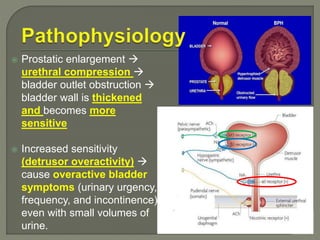
 Prostatic enlargement 
urethral compression 
bladder outlet obstruction 
bladder wall is thickened
and becomes more
sensitive
 Increased sensitivity
(detrusor overactivity) 
cause overactive bladder
symptoms (urinary urgency,
frequency, and incontinence)
even with small volumes of
urine.
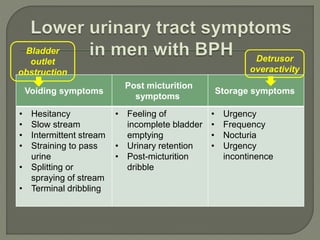
Storage symptoms
Post micturition
symptoms
Voiding symptoms
• Urgency
• Frequency
• Nocturia
• Urgency
incontinence
• Feeling of
incomplete bladder
emptying
• Urinary retention
• Post-micturition
dribble
• Hesitancy
• Slow stream
• Intermittent stream
• Straining to pass
urine
• Splitting or
spraying of stream
• Terminal dribbling
Detrusor
overactivity
Bladder
outlet
obstruction
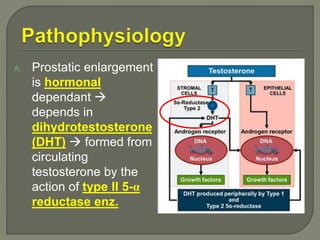
A. Prostatic enlargement
is hormonal
dependant 
depends in
dihydrotestosterone
(DHT)  formed from
circulating
testosterone by the
action of type II 5-α
reductase enz.
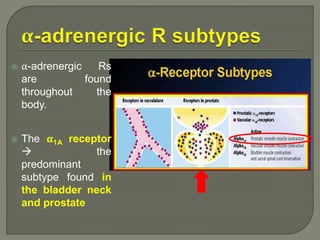
 α-adrenergic Rs
are found
throughout the
body.
 The α1A receptor
 the
predominant
subtype found in
the bladder neck
and prostate
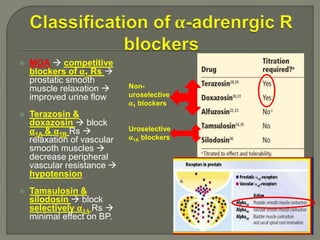
 MOA  competitive
blockers of α1 Rs 
prostatic smooth
muscle relaxation 
improved urine flow
 Terazosin &
doxazosin  block
α1A & α1B Rs 
relaxation of vascular
smooth muscles 
decrease peripheral
vascular resistance 
hypotension
 Tamsulosin &
silodosin  block
selectively α1A Rs 
minimal effect on BP.
Non-
uroselective
α1 blockers
Uroselective
α1A blockers
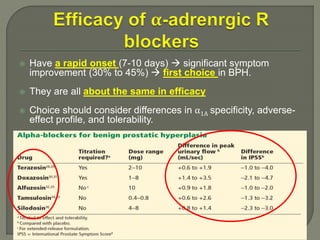
 Have a rapid onset (7-10 days)  significant symptom
improvement (30% to 45%)  first choice in BPH.
 They are all about the same in efficacy
 Choice should consider differences in α1A specificity, adverse-
effect profile, and tolerability.
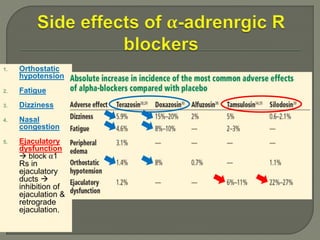
1. Orthostatic
hypotension
2. Fatigue
3. Dizziness
4. Nasal
congestion
5. Ejaculatory
dysfunction
 block α1
Rs in
ejaculatory
ducts 
inhibition of
ejaculation &
retrograde
ejaculation.
6. Intraoperative floppy iris syndrome: 
miosis & iris prolapse in patients
undergoing cataract surgery while on α1
blocking drugs (esp. tamsulosin)  surgery
complications.
Before initiating α-blocker  a physician must
ask patients about planned cataract surgery
 α-blocker therapy should be delayed in
patients planning to undergo cataract surgery.
 Absorption of tamsulosin &
silodosin  ↑ with food 
taken with supper
 Substrate for P-glycoprotein
(P-gp)
 Needs dose adjustment in
renal dysfunction.
 Inducers of CYP450 (carbamazepine
, phenytoin)  ↓ plasma conc.
 Inhibitors of CYP 450 (verapamil,
diltiazem)  ↑ plasma conc.
 Inhibitors of P-gp (cyclosporine)  ↑
silodosin conc.
 Alfuzosin  QT prolongation 
caution with other drugs causing QT
prolongation (class III antiarrhythmics).
Metabolized by
CYP450 system
 MOA both inhibit type II 5-α
reductase enzyme  inhibit
conversion of testosterone to the
more active form
(dihydrotestosterone; DHT)  reduce
prostate size by 30% improved
urine flow.
 Dutasteride  more potent than
finasteride.
 Uses
1. BPH  Slow onset of action (6-12
months)  used in combination with
α1 blockers.
2. Alopecia
Sexual  decreased libido, ejaculatory
dysfunction, erectile dysfunction,
oligospermia & gynecomastia.
Not given during pregnancy or lactation
 feminization of a male fetus.
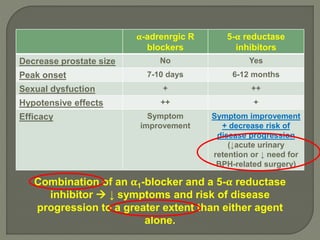
α-adrenrgic R
blockers
5-α reductase
inhibitors
Decrease prostate size No Yes
Peak onset 7-10 days 6-12 months
Sexual dysfuction + ++
Hypotensive effects ++ +
Efficacy Symptom
improvement
Symptom improvement
+ decrease risk of
disease progression
(↓acute urinary
retention or ↓ need for
BPH-related surgery)
Combination of an α1-blocker and a 5-α reductase
inhibitor  ↓ symptoms and risk of disease
progression to a greater extent than either agent
alone.
 PDE-5 inhibitors (-afil)  used mainly for
treatment of erectile dysfunction.
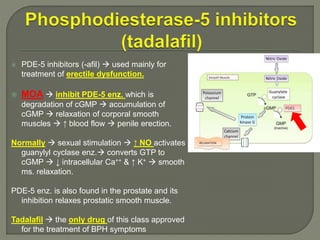
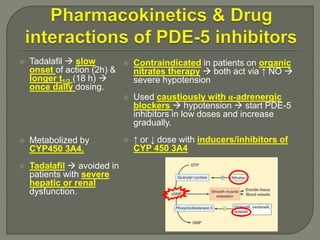
 MOA  inhibit PDE-5 enz. which is
degradation of cGMP  accumulation of
cGMP  relaxation of corporal smooth
muscles  ↑ blood flow  penile erection.
Normally  sexual stimulation  ↑ NO activates
guanylyl cyclase enz. converts GTP to
cGMP  ↓ intracellular Ca++ & ↑ K+  smooth
ms. relaxation.
PDE-5 enz. is also found in the prostate and its
inhibition relaxes prostatic smooth muscle.
Tadalafil  the only drug of this class approved
for the treatment of BPH symptoms
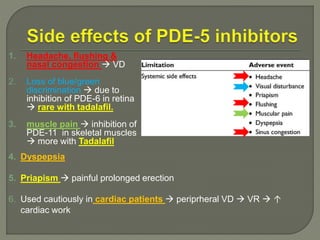
1. Headache, flushing &
nasal congestion  VD
2. Loss of blue/green
discrimination  due to
inhibition of PDE-6 in retina
 rare with tadalafil.
3. muscle pain  inhibition of
PDE-11 in skeletal muscles
 more with Tadalafil
4. Dyspepsia
5. Priapism  painful prolonged erection
6. Used cautiously in cardiac patients  periprheral VD  VR  ↑
cardiac work
 Tadalafil  slow
onset of action (2h) &
longer t1/2 (18 h) 
once daily dosing.
 Metabolized by
CYP450 3A4.
 Tadalafil  avoided in
patients with severe
hepatic or renal
dysfunction.
 Contraindicated in patients on organic
nitrates therapy  both act via ↑ NO 
severe hypotension
 Used caustiously with α-adrenergic
blockers  hypotension  start PDE-5
inhibitors in low doses and increase
gradually.
 ↑ or ↓ dose with inducers/inhibitors of
CYP 450 3A4
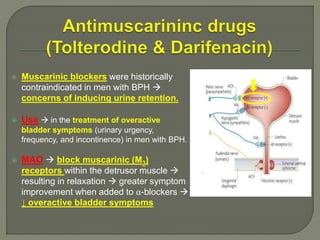
 Muscarinic blockers were historically
contraindicated in men with BPH 
concerns of inducing urine retention.
 Use  in the treatment of overactive
bladder symptoms (urinary urgency,
frequency, and incontinence) in men with BPH.
 MAO  block muscarinic (M3)
receptors within the detrusor muscle 
resulting in relaxation  greater symptom
improvement when added to α-blockers 
↓ overactive bladder symptoms
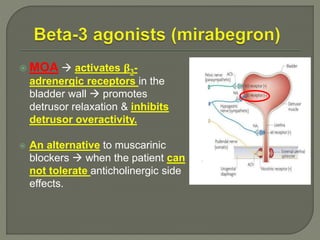
 MOA  activates β3-
adrenergic receptors in the
bladder wall  promotes
detrusor relaxation & inhibits
detrusor overactivity.
 An alternative to muscarinic
blockers  when the patient can
not tolerate anticholinergic side
effects.
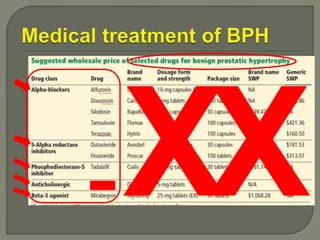
Benign prostatic hyperplasia

Benign prostatic hyperplasia

  • 1.
    Nehal M. Ramadan Lecturerof clinical pharmacology
  • 2.
     Prostatic enlargement urethral compression  bladder outlet obstruction  bladder wall is thickened and becomes more sensitive  Increased sensitivity (detrusor overactivity)  cause overactive bladder symptoms (urinary urgency, frequency, and incontinence) even with small volumes of urine.
  • 3.
    Storage symptoms Post micturition symptoms Voidingsymptoms • Urgency • Frequency • Nocturia • Urgency incontinence • Feeling of incomplete bladder emptying • Urinary retention • Post-micturition dribble • Hesitancy • Slow stream • Intermittent stream • Straining to pass urine • Splitting or spraying of stream • Terminal dribbling Detrusor overactivity Bladder outlet obstruction
  • 4.
    A. Prostatic enlargement ishormonal dependant  depends in dihydrotestosterone (DHT)  formed from circulating testosterone by the action of type II 5-α reductase enz.
  • 5.
     α-adrenergic Rs arefound throughout the body.  The α1A receptor  the predominant subtype found in the bladder neck and prostate
  • 7.
     MOA competitive blockers of α1 Rs  prostatic smooth muscle relaxation  improved urine flow  Terazosin & doxazosin  block α1A & α1B Rs  relaxation of vascular smooth muscles  decrease peripheral vascular resistance  hypotension  Tamsulosin & silodosin  block selectively α1A Rs  minimal effect on BP. Non- uroselective α1 blockers Uroselective α1A blockers
  • 8.
     Have arapid onset (7-10 days)  significant symptom improvement (30% to 45%)  first choice in BPH.  They are all about the same in efficacy  Choice should consider differences in α1A specificity, adverse- effect profile, and tolerability.
  • 9.
    1. Orthostatic hypotension 2. Fatigue 3.Dizziness 4. Nasal congestion 5. Ejaculatory dysfunction  block α1 Rs in ejaculatory ducts  inhibition of ejaculation & retrograde ejaculation.
  • 10.
    6. Intraoperative floppyiris syndrome:  miosis & iris prolapse in patients undergoing cataract surgery while on α1 blocking drugs (esp. tamsulosin)  surgery complications. Before initiating α-blocker  a physician must ask patients about planned cataract surgery  α-blocker therapy should be delayed in patients planning to undergo cataract surgery.
  • 11.
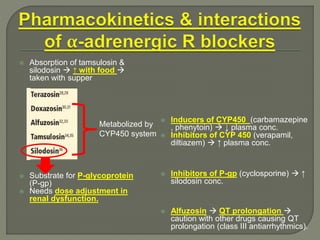
     Absorption oftamsulosin & silodosin  ↑ with food  taken with supper  Substrate for P-glycoprotein (P-gp)  Needs dose adjustment in renal dysfunction.  Inducers of CYP450 (carbamazepine , phenytoin)  ↓ plasma conc.  Inhibitors of CYP 450 (verapamil, diltiazem)  ↑ plasma conc.  Inhibitors of P-gp (cyclosporine)  ↑ silodosin conc.  Alfuzosin  QT prolongation  caution with other drugs causing QT prolongation (class III antiarrhythmics). Metabolized by CYP450 system
  • 12.
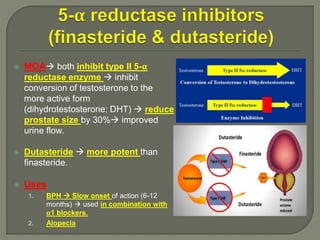
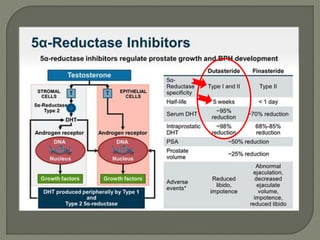
     MOA bothinhibit type II 5-α reductase enzyme  inhibit conversion of testosterone to the more active form (dihydrotestosterone; DHT)  reduce prostate size by 30% improved urine flow.  Dutasteride  more potent than finasteride.  Uses 1. BPH  Slow onset of action (6-12 months)  used in combination with α1 blockers. 2. Alopecia
  • 14.
    Sexual  decreasedlibido, ejaculatory dysfunction, erectile dysfunction, oligospermia & gynecomastia. Not given during pregnancy or lactation  feminization of a male fetus.
  • 15.
    α-adrenrgic R blockers 5-α reductase inhibitors Decreaseprostate size No Yes Peak onset 7-10 days 6-12 months Sexual dysfuction + ++ Hypotensive effects ++ + Efficacy Symptom improvement Symptom improvement + decrease risk of disease progression (↓acute urinary retention or ↓ need for BPH-related surgery) Combination of an α1-blocker and a 5-α reductase inhibitor  ↓ symptoms and risk of disease progression to a greater extent than either agent alone.
  • 16.
     PDE-5 inhibitors(-afil)  used mainly for treatment of erectile dysfunction.  MOA  inhibit PDE-5 enz. which is degradation of cGMP  accumulation of cGMP  relaxation of corporal smooth muscles  ↑ blood flow  penile erection. Normally  sexual stimulation  ↑ NO activates guanylyl cyclase enz. converts GTP to cGMP  ↓ intracellular Ca++ & ↑ K+  smooth ms. relaxation. PDE-5 enz. is also found in the prostate and its inhibition relaxes prostatic smooth muscle. Tadalafil  the only drug of this class approved for the treatment of BPH symptoms
  • 17.
    1. Headache, flushing& nasal congestion  VD 2. Loss of blue/green discrimination  due to inhibition of PDE-6 in retina  rare with tadalafil. 3. muscle pain  inhibition of PDE-11 in skeletal muscles  more with Tadalafil 4. Dyspepsia 5. Priapism  painful prolonged erection 6. Used cautiously in cardiac patients  periprheral VD  VR  ↑ cardiac work
  • 18.
     Tadalafil slow onset of action (2h) & longer t1/2 (18 h)  once daily dosing.  Metabolized by CYP450 3A4.  Tadalafil  avoided in patients with severe hepatic or renal dysfunction.  Contraindicated in patients on organic nitrates therapy  both act via ↑ NO  severe hypotension  Used caustiously with α-adrenergic blockers  hypotension  start PDE-5 inhibitors in low doses and increase gradually.  ↑ or ↓ dose with inducers/inhibitors of CYP 450 3A4
  • 19.
     Muscarinic blockerswere historically contraindicated in men with BPH  concerns of inducing urine retention.  Use  in the treatment of overactive bladder symptoms (urinary urgency, frequency, and incontinence) in men with BPH.  MAO  block muscarinic (M3) receptors within the detrusor muscle  resulting in relaxation  greater symptom improvement when added to α-blockers  ↓ overactive bladder symptoms
  • 20.
     MOA activates β3- adrenergic receptors in the bladder wall  promotes detrusor relaxation & inhibits detrusor overactivity.  An alternative to muscarinic blockers  when the patient can not tolerate anticholinergic side effects.