BENIGN PROSTATE
HYPERTROPHY/HYPERPLA
SIA
Gold Medalist Kiran Inam
MS Healthcare Management
BS Renal Dialysis
KMU IPMS
BENIGN
Benign refers to a condition, tumor or
growth that is not cancerous.
this mean that it does not spread to
other parts of the body.
It is not dangerous or serious.
PROSTATE
The prostate that form part of the male
reproductive system.
It is a conduit b/w the bladder and
urethra.
They are surrounding the proximal
urethra at the bladder apex.
The prostate is a walnut size gland.
Pear shape wt. 7 – 16gm
They help control urine flow
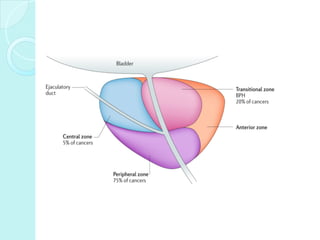
AREAS OF PROSTATE
It comprises several zones, enclosed in an
outer capsule and function to secret an
alkaline seminal fluid produce prostate
specific antigen(PSA).
4 areas of prostate
- transition zone
- peripheral zone
- anterior zone
- central zone
HYPERTROPHY/HYPERPLA
SIA
Hypertrophy: increase in the size of
cells
hyperplasia: increase in the no. of
cells
BPH
BPH is a non cancerous condition in
men in which the epithelial and
fibromuscular components of prostate
gland is enlarged.
Microscopic appearance of BPH is
present in 50% of men by age 60
Microscopic appearance of BPH is
present in 90% of men by age 85
WHAT CAUSES BPH?
RISK FACTORS
BPH is probably a normal part of the
aging process in men.
Changes in hormone balance.
Changes in cell-growth factors.
Genetics (may also play a role).
Obesity
Lack of physical activity
Erectile dysfunction
PATHOPHISIOLOGY
Prostatic enlargement depends on the
potent androgen dihydrotestosterone
(DHT).
In the prostate gland, type II 5-alpha-
reductase metabolizes circulating
testosterone into DHT, which works
locally, not systemically.
DHT binds to androgen receptors in
the cell nuclei, potentially resulting in
BPH.
CONTI….
vitro studies have shown that large numbers of alpha-1-
adrenergic receptors are located in the smooth muscle
of the stroma and capsule of the prostate. Stimulation of
these receptors causes an increase in smooth-muscle
tone, which can worsen LUTS.
Microscopically, BPH is characterized as a hyperplastic
process. The hyperplasia results in enlargement of the
prostate that may restrict the flow of urine from the
bladder, resulting in clinical manifestations of BPH.
The prostate enlarges with age in a hormonally
dependent manner.
Notably, castrated males (e.g. who are unable to make
testosterone) do not develop BPH.
COMPLICATIONS
Urinary frequency
Urgency
Nocturia
Hesitancy
Incomplete emptying of bladder
Straining
Dribbling
Urinary retention
Renal insufficiency
Recurrent UTI
Gross hematuria
Bladder calculi
Renal failure or Uremia
EVALUATION OF PATIENT
Medical history
Directed physical exam
Urinalysis
PSA testing
Symptom assessment
MEDICAL HISTORY
Nature and duration of symptoms
Fluid intake – amount and types of
fluid
Sexual history
Comorbid conditions
Prior and current illness
Prior surgery and trauma
Current medications
Any previous treatments.
TESTS THAT ARE NEEDED TO
BE DONE
DIGITAL RECTAL TEST: The doctor
inserts a finger into the rectum to check
your prostate for enlargement. Urine test
and urine culture. Analyzing a sample of
your urine can help identifying an
infection or other conditions that can
cause similar symptoms.
A PROSTATE SPECIFIC
ANTIGEN(PSA) TEST: helps check for
prostate cancer, which can cause the
same symptoms as BPH.
TESTS THAT ARE NEEDED TO
BE DONE
A BLOOD CRETININE TEST:
checks how well your kidneys are
working.
POST VOID RESIDUAL
(PVR)TEST: measures the amount
of urine left in the bladder after
urination using ultrasound or a small
tube (catheter) put into the bladder
through the urethra.
TESTS THAT ARE NEEDED TO
BE DONE
CYSTOMETROGRAM: measures
the bladder's pressure, compliance,
and capacity during urinary storage.
Like a uroflowmetry test, which
measures how fast the urine flows out
of the bladder.
TESTS THAT ARE NEEDED TO
BE DONE
URINALYSIS: result Possible
diagnosis Hematuria Kidney stones
Bladder cancer Pyuria or Proteinuria
Underlying renal disease Glucosuria
diabetes
ULTRASONOGRAPHY: Help
determine prostate and bladder size
and degree of hydronephrosis in
patients with urinary retention
IPSS
Severity and response to treatment can
be assessd with the IPSS
1-7 = mild
8-19 = moderate
20-35 = severe
TREATMENT
MEDICAL THERAPY
COMBINATION THERAPY
SURGICAL TREATMENT

BENIGN PROSTATE HYPERTROPHY.pdf

  • 1.
    BENIGN PROSTATE HYPERTROPHY/HYPERPLA SIA Gold MedalistKiran Inam MS Healthcare Management BS Renal Dialysis KMU IPMS
  • 2.
    BENIGN Benign refers toa condition, tumor or growth that is not cancerous. this mean that it does not spread to other parts of the body. It is not dangerous or serious.
  • 3.
    PROSTATE The prostate thatform part of the male reproductive system. It is a conduit b/w the bladder and urethra. They are surrounding the proximal urethra at the bladder apex. The prostate is a walnut size gland. Pear shape wt. 7 – 16gm They help control urine flow
  • 4.
    AREAS OF PROSTATE Itcomprises several zones, enclosed in an outer capsule and function to secret an alkaline seminal fluid produce prostate specific antigen(PSA). 4 areas of prostate - transition zone - peripheral zone - anterior zone - central zone
  • 6.
    HYPERTROPHY/HYPERPLA SIA Hypertrophy: increase inthe size of cells hyperplasia: increase in the no. of cells
  • 7.
    BPH BPH is anon cancerous condition in men in which the epithelial and fibromuscular components of prostate gland is enlarged. Microscopic appearance of BPH is present in 50% of men by age 60 Microscopic appearance of BPH is present in 90% of men by age 85
  • 8.
    WHAT CAUSES BPH? RISKFACTORS BPH is probably a normal part of the aging process in men. Changes in hormone balance. Changes in cell-growth factors. Genetics (may also play a role). Obesity Lack of physical activity Erectile dysfunction
  • 9.
    PATHOPHISIOLOGY Prostatic enlargement dependson the potent androgen dihydrotestosterone (DHT). In the prostate gland, type II 5-alpha- reductase metabolizes circulating testosterone into DHT, which works locally, not systemically. DHT binds to androgen receptors in the cell nuclei, potentially resulting in BPH.
  • 10.
    CONTI…. vitro studies haveshown that large numbers of alpha-1- adrenergic receptors are located in the smooth muscle of the stroma and capsule of the prostate. Stimulation of these receptors causes an increase in smooth-muscle tone, which can worsen LUTS. Microscopically, BPH is characterized as a hyperplastic process. The hyperplasia results in enlargement of the prostate that may restrict the flow of urine from the bladder, resulting in clinical manifestations of BPH. The prostate enlarges with age in a hormonally dependent manner. Notably, castrated males (e.g. who are unable to make testosterone) do not develop BPH.
  • 11.
    COMPLICATIONS Urinary frequency Urgency Nocturia Hesitancy Incomplete emptyingof bladder Straining Dribbling Urinary retention Renal insufficiency Recurrent UTI Gross hematuria Bladder calculi Renal failure or Uremia
  • 12.
    EVALUATION OF PATIENT Medicalhistory Directed physical exam Urinalysis PSA testing Symptom assessment
  • 13.
    MEDICAL HISTORY Nature andduration of symptoms Fluid intake – amount and types of fluid Sexual history Comorbid conditions Prior and current illness Prior surgery and trauma Current medications Any previous treatments.
  • 14.
    TESTS THAT ARENEEDED TO BE DONE DIGITAL RECTAL TEST: The doctor inserts a finger into the rectum to check your prostate for enlargement. Urine test and urine culture. Analyzing a sample of your urine can help identifying an infection or other conditions that can cause similar symptoms. A PROSTATE SPECIFIC ANTIGEN(PSA) TEST: helps check for prostate cancer, which can cause the same symptoms as BPH.
  • 15.
    TESTS THAT ARENEEDED TO BE DONE A BLOOD CRETININE TEST: checks how well your kidneys are working. POST VOID RESIDUAL (PVR)TEST: measures the amount of urine left in the bladder after urination using ultrasound or a small tube (catheter) put into the bladder through the urethra.
  • 16.
    TESTS THAT ARENEEDED TO BE DONE CYSTOMETROGRAM: measures the bladder's pressure, compliance, and capacity during urinary storage. Like a uroflowmetry test, which measures how fast the urine flows out of the bladder.
  • 17.
    TESTS THAT ARENEEDED TO BE DONE URINALYSIS: result Possible diagnosis Hematuria Kidney stones Bladder cancer Pyuria or Proteinuria Underlying renal disease Glucosuria diabetes ULTRASONOGRAPHY: Help determine prostate and bladder size and degree of hydronephrosis in patients with urinary retention
  • 18.
    IPSS Severity and responseto treatment can be assessd with the IPSS 1-7 = mild 8-19 = moderate 20-35 = severe
  • 19.