82 Aero Camino, Goleta, CA (805) 685-1029	 www.bell-everman.com
WHITE PAPER
An Introduction To Plug-and-
Play Motion Subsystems
Embedding mechanical motion subsystems into machines improves
performance and reduces cost.
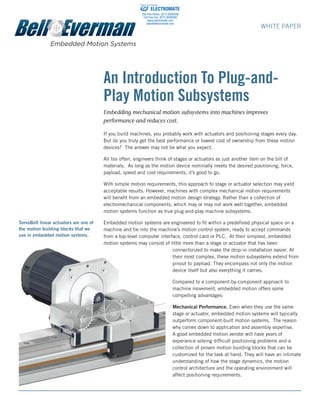
ServoBelt linear actuators are one of
the motion building blocks that we
use in embedded motion systems.
If you build machines, you probably work with actuators and positioning stages every day.
But do you truly get the best performance or lowest cost of ownership from these motion
devices? The answer may not be what you expect.
All too often, engineers think of stages or actuators as just another item on the bill of
materials. As long as the motion device nominally meets the desired positioning, force,
payload, speed and cost requirements, it’s good to go.
With simple motion requirements, this approach to stage or actuator selection may yield
acceptable results. However, machines with complex mechanical motion requirements
will benefit from an embedded motion design strategy. Rather than a collection of
electromechanical components, which may or may not work well together, embedded
motion systems function as true plug-and-play machine subsystems.
Embedded motion systems are engineered to fit within a predefined physical space on a
machine and tie into the machine’s motion control system, ready to accept commands
from a top-level computer interface, control card or PLC. At their simplest, embedded
motion systems may consist of little more than a stage or actuator that has been
connectorized to make the drop-in installation easier. At
their most complex, these motion subsystems extend from
pinout to payload. They encompass not only the motion
device itself but also everything it carries.
Compared to a component-by-component approach to
machine movement, embedded motion offers some
compelling advantages:
Mechanical Performance. Even when they use the same
stage or actuator, embedded motion systems will typically
outperform component-built motion systems. The reason
why comes down to application and assembly expertise.
A good embedded motion vendor will have years of
experience solving difficult positioning problems and a
collection of proven motion building blocks that can be
customized for the task at hand. They will have an intimate
understanding of how the stage dynamics, the motion
control architecture and the operating environment will
affect positioning requirements.
ELECTROMATE
Toll Free Phone (877) SERVO98
Toll Free Fax (877) SERV099
www.electromate.com
sales@electromate.com
Sold & Serviced By:
82 Aero Camino, Goleta, CA (805) 685-1029	 www.bell-everman.com
WHITE PAPER
As for assembly, many machine builders lack the skilled technicians, specialized fixtures,
laser interferometers and other metrology systems needed to align the most precise multi-
axis stages—which often have axis-to-axis alignment tolerances measured in microns.
Controls Expertise. Embedded motion systems may or may not ship with motion controls,
depending on the customer requirements. But a control strategy should always be part of
the embedded motion equation. A good embedded motion vendor will have an extensive
knowledge of how different motion control platforms and their kinematic capabilities will
interact with the mechanical motion systems. This knowledge can allow us to push the
envelope on what’s possible in terms of dynamic capabilities, such as acceptable inertia
mismatch ratios (see sidebar).
Reliability. When commissioning a new motion system, some of the most common problems
occur because individual, seemingly minor components fail to work properly—or fail to
work properly with one another. For instance, a single faulty connector or the wrong wire
can leave even the best motion stage motionless. Embedded motion systems avoid this
type of failure because they are assembled and tested as a system before integration on
the production machine. With motion systems composed of individual components, small
failures and incompatibilities can go undetected until the production machine comes
together.
Cost Reduction. Embedded motion systems typically cost 25 to 50% less than their
component-based counterparts. In part, this savings comes from the ability to reduce
parts count—for instance, by designing in brackets, connectors and other components.
The cost reduction can skyrocket well above 50% when you factor in all the hidden cost
components associated with building and installing a motion system. These include costs
related to design engineering, inventory, time-to-market and more (see sidebar).
Many types of applications can reap the benefits of embedded motion. We have
implemented this approach on dozens of semiconductor, wet bench, laser cutting,
packaging and lab automation machines. The case studies that follow highlight two
applications whose performance and cost requirements would have been impossible to
meet without an embedded motion solution. One is a linear embedded motion system for a
precision semiconductor singulation operation. The other is a rotary motion subsystem we
created for a unique type of CNC machine.
Linear Stage For Semiconductor Operation
Stacked stages of any kind can suffer from alignment
and control issues when you design and build them as
a collection of individual axes. If that stacked stage
has to meet challenging positioning accuracy or speed
requirements, it’s crucial that stage function as an
integrated system. We recently delivered just such a stage
for a semiconductor singulation operation.
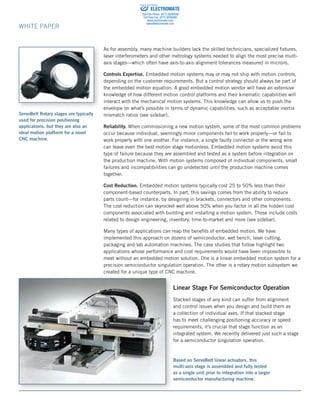
ServoBelt Rotary stages are typically
used for precision positioning
applications, but they are also an
ideal motion platform for a novel
CNC machine.
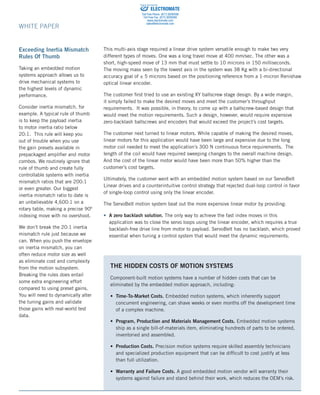
Based on ServoBelt linear actuators, this
multi-axis stage is assembled and fully tested
as a single unit prior to integration into a larger
semiconductor manufacturing machine.
ELECTROMATE
Toll Free Phone (877) SERVO98
Toll Free Fax (877) SERV099
www.electromate.com
sales@electromate.com
Sold & Serviced By:
82 Aero Camino, Goleta, CA (805) 685-1029	 www.bell-everman.com
WHITE PAPER
This multi-axis stage required a linear drive system versatile enough to make two very
different types of moves. One was a long travel move at 400 mm/sec. The other was a
short, high-speed move of 13 mm that must settle to 10 microns in 150 milliseconds.
The moving mass seen by the lowest axis in the system was 38 Kg with a bi-directional
accuracy goal of ± 5 microns based on the positioning reference from a 1-micron Renishaw
optical linear encoder.
The customer first tried to use an existing XY ballscrew stage design. By a wide margin,
it simply failed to make the desired moves and meet the customer’s throughput
requirements. It was possible, in theory, to come up with a ballscrew-based design that
would meet the motion requirements. Such a design, however, would require expensive
zero-backlash ballscrews and encoders that would exceed the project’s cost targets.
The customer next turned to linear motors. While capable of making the desired moves,
linear motors for this application would have been large and expensive due to the long
motor coil needed to meet the application’s 300 N continuous force requirements. The
length of the coil would have required sweeping changes to the overall machine design.
And the cost of the linear motor would have been more than 50% higher than the
customer’s cost targets.
Ultimately, the customer went with an embedded motion system based on our ServoBelt
Linear drives and a counterintuitive control strategy that rejected dual-loop control in favor
of single-loop control using only the linear encoder.
The ServoBelt motion system beat out the more expensive linear motor by providing:
• A zero backlash solution. The only way to achieve the fast index moves in this
application was to close the servo loops using the linear encoder, which requires a true
backlash-free drive line from motor to payload. ServoBelt has no backlash, which proved
essential when tuning a control system that would meet the dynamic requirements.
Exceeding Inertia Mismatch
Rules Of Thumb
Taking an embedded motion
systems approach allows us to
drive mechanical systems to
the highest levels of dynamic
performance.
Consider inertia mismatch, for
example. A typical rule of thumb
is to keep the payload inertia
to motor inertia ratio below
20:1. This rule will keep you
out of trouble when you use
the gain presets available in
prepackaged amplifier and motor
combos. We routinely ignore that
rule of thumb and create fully
controllable systems with inertia
mismatch ratios that are 200:1
or even greater. Our biggest
inertia mismatch ratio to date is
an unbelievable 4,600:1 on a
rotary table, making a precise 90º
indexing move with no overshoot.
We don’t break the 20:1 inertia
mismatch rule just because we
can. When you push the envelope
on inertia mismatch, you can
often reduce motor size as well
as eliminate cost and complexity
from the motion subsystem.
Breaking the rules does entail
some extra engineering effort
compared to using preset gains.
You will need to dynamically alter
the tuning gains and validate
those gains with real-world test
data.
THE HIDDEN COSTS OF MOTION SYSTEMS
Component-built motion systems have a number of hidden costs that can be
eliminated by the embedded motion approach, including:
• Time-To-Market Costs. Embedded motion systems, which inherently support
concurrent engineering, can shave weeks or even months off the development time
of a complex machine.
• Program, Production and Materials Management Costs. Embedded motion systems
ship as a single bill-of-materials item, eliminating hundreds of parts to be ordered,
inventoried and assembled.
• Production Costs. Precision motion systems require skilled assembly technicians
and specialized production equipment that can be difficult to cost justify at less
than full utilization.
• Warranty and Failure Costs. A good embedded motion vendor will warranty their
systems against failure and stand behind their work, which reduces the OEM’s risk.
ELECTROMATE
Toll Free Phone (877) SERVO98
Toll Free Fax (877) SERV099
www.electromate.com
sales@electromate.com
Sold  Serviced By:
82 Aero Camino, Goleta, CA (805) 685-1029	 www.bell-everman.com
WHITE PAPER
• Inherent damping. ServoBelt inherently offers excellent mechanical damping, which
allows for very high tuning gains—typically 4 times the velocity and positional gains—
which translates into extremely low settling times. Linear motors, by contrast, must
simulate this damping in the servo amplifier electronics, which inherently reduces the
possible positional gain.
• A compact, plug-and-play system. The stage was designed, assembled and delivered
as a single unit. We handle the crucial alignment, functional testing and burn in work.
Problems are identified on our shop floor, not our customers’ machine. Designing the
stage as an embedded motion system also allowed us to meet predefined physical space
requirements.
Rotary Motion Improves Machining Surface Finish
Three-axis CNC milling machines usually rely on linear motion systems to position the
cutting tool. We went down a different path with an embedded CNC platform that we
recently developed for the milling of medical ceramics.
In place of a traditional three-axis linear motion system, this new desktop-sized machine
combines rotary and linear positioning devices. The rotary devices, two of our ServoBelt
100 units, face each other. One of the rotary devices carries a 150,000 RPM air-driven
spindle. The other rotary holds the workpiece and can spin it 180 degrees to allow for two-
sided machining. The linear axis, driven by our ServoNut actuator, allows the rotary device
with the cutting heads to translate axially relative to the workpiece-holding rotary.
All three devices move in sync during machining operations. The linear axis handles
the Z-axis positioning, bringing the cutting tool to the face of the workpiece. The two
ServoBelts rotate relative to one another, so that the cutting tool can reach any point on
the surface of the workpiece in a volume of 40x40x40 mm.
The rotary design offered important technical advantages.
For one, the rotary stages exhibit an extremely high stiffness,
which is crucial in order to meet the application’s machining
tolerances. For another, the rotaries are lubed-for-life,
saving maintenance costs and reducing the possibility of
contamination. And finally, the rotary stages provided a simple
sealing solution that protects the motion components from
cutting fluid and flying ceramic dust. Both rotary stages extend
through simple rotary seals in the wall of the cutting chamber.
An XYZ motion system, by contrast, would have required less
elegant sealing scenarios, such as bellows and armadillo covers.
The coordinated motion on this system required a rethinking of
CNC kinematics—in large part because the rotary positioning
of the cutting tool and workpiece requires the use of polar
coordinates rather than Cartesian. The controller still takes in
XYZ G-code commands but converts them to polar coordinates
in real time, which is no easy task.
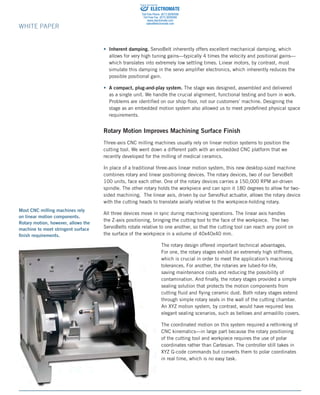
Most CNC milling machines rely
on linear motion components.
Rotary motion, however, allows the
machine to meet stringent surface
finish requirements.
ELECTROMATE
Toll Free Phone (877) SERVO98
Toll Free Fax (877) SERV099
www.electromate.com
sales@electromate.com
Sold  Serviced By:
82 Aero Camino, Goleta, CA (805) 685-1029	 www.bell-everman.com
WHITE PAPER
So why go through the effort? Rotary motion has an inherent advantage over linear in
producing a smooth surface finish on the ceramic parts. The reason boils down to the
“rumble” that even the best linear bearings and ballscrews can exhibit as the balls
recirculate in and out of a loaded state between bearing grooves. This ball rumble would
have reverberated through the motion system and transferred to the part as periodic
variations in surface quality. With their large diameter rotary bearings, ServoBelt Rotary
stages inherently avoid the ball rumble problem altogether.
This nontraditional CNC machine has all the hallmarks of an ideal embedded motion
application. It required:
• Both controls and mechanical expertise. Marrying the mechanical system with the
controls and amplifiers that support the complex kinematics for polar motion required
a systems approach and months of testing. We also had to develop a suite of alignment
techniques and tools to build this new CNC system.
• Compact design, easy integration. Space was at a premium on this desktop-sized CNC
machine. ServoBelt Rotary’s design, which features a large unobstructed through hole,
allowed us to use the available space efficiently. The 100-mm through holes made
it easy to bring the air supply right to the spindle, embed a material indexer on the
workpiece side and make all the required power connections.
• Cost containment. One interesting aspect of this embedded motion system is that it is
no more complex than it needs to be. The main functional requirement involved surface
finish, not positioning accuracy. The positioning needs are actually quite modest, at
least by our standards. So we were able to forego direct reading encoders and run the
entire system in open-loop mode. That saved our customer thousands of dollars per
machine.
Getting Started With Embedded Motion
The jump from component-by-component motion systems to embedded motion systems
may seem like a leap of faith. You will, after all, be outsourcing the motion control to a
vendor.
If you pick the right vendor, though, the outsourcing will pay off with improved
performance and reliability. Costs will fall too as motion subsystems arrive at your plant
fully-tested, warrantied and ready to drop into your machine.
ELECTROMATE
Toll Free Phone (877) SERVO98
Toll Free Fax (877) SERV099
www.electromate.com
sales@electromate.com
Sold  Serviced By:

Bell-Everman Plug and Play Motion Subsystems

  • 1.
    82 Aero Camino,Goleta, CA (805) 685-1029 www.bell-everman.com WHITE PAPER An Introduction To Plug-and- Play Motion Subsystems Embedding mechanical motion subsystems into machines improves performance and reduces cost. ServoBelt linear actuators are one of the motion building blocks that we use in embedded motion systems. If you build machines, you probably work with actuators and positioning stages every day. But do you truly get the best performance or lowest cost of ownership from these motion devices? The answer may not be what you expect. All too often, engineers think of stages or actuators as just another item on the bill of materials. As long as the motion device nominally meets the desired positioning, force, payload, speed and cost requirements, it’s good to go. With simple motion requirements, this approach to stage or actuator selection may yield acceptable results. However, machines with complex mechanical motion requirements will benefit from an embedded motion design strategy. Rather than a collection of electromechanical components, which may or may not work well together, embedded motion systems function as true plug-and-play machine subsystems. Embedded motion systems are engineered to fit within a predefined physical space on a machine and tie into the machine’s motion control system, ready to accept commands from a top-level computer interface, control card or PLC. At their simplest, embedded motion systems may consist of little more than a stage or actuator that has been connectorized to make the drop-in installation easier. At their most complex, these motion subsystems extend from pinout to payload. They encompass not only the motion device itself but also everything it carries. Compared to a component-by-component approach to machine movement, embedded motion offers some compelling advantages: Mechanical Performance. Even when they use the same stage or actuator, embedded motion systems will typically outperform component-built motion systems. The reason why comes down to application and assembly expertise. A good embedded motion vendor will have years of experience solving difficult positioning problems and a collection of proven motion building blocks that can be customized for the task at hand. They will have an intimate understanding of how the stage dynamics, the motion control architecture and the operating environment will affect positioning requirements. ELECTROMATE Toll Free Phone (877) SERVO98 Toll Free Fax (877) SERV099 www.electromate.com sales@electromate.com Sold & Serviced By:
  • 2.
    82 Aero Camino,Goleta, CA (805) 685-1029 www.bell-everman.com WHITE PAPER As for assembly, many machine builders lack the skilled technicians, specialized fixtures, laser interferometers and other metrology systems needed to align the most precise multi- axis stages—which often have axis-to-axis alignment tolerances measured in microns. Controls Expertise. Embedded motion systems may or may not ship with motion controls, depending on the customer requirements. But a control strategy should always be part of the embedded motion equation. A good embedded motion vendor will have an extensive knowledge of how different motion control platforms and their kinematic capabilities will interact with the mechanical motion systems. This knowledge can allow us to push the envelope on what’s possible in terms of dynamic capabilities, such as acceptable inertia mismatch ratios (see sidebar). Reliability. When commissioning a new motion system, some of the most common problems occur because individual, seemingly minor components fail to work properly—or fail to work properly with one another. For instance, a single faulty connector or the wrong wire can leave even the best motion stage motionless. Embedded motion systems avoid this type of failure because they are assembled and tested as a system before integration on the production machine. With motion systems composed of individual components, small failures and incompatibilities can go undetected until the production machine comes together. Cost Reduction. Embedded motion systems typically cost 25 to 50% less than their component-based counterparts. In part, this savings comes from the ability to reduce parts count—for instance, by designing in brackets, connectors and other components. The cost reduction can skyrocket well above 50% when you factor in all the hidden cost components associated with building and installing a motion system. These include costs related to design engineering, inventory, time-to-market and more (see sidebar). Many types of applications can reap the benefits of embedded motion. We have implemented this approach on dozens of semiconductor, wet bench, laser cutting, packaging and lab automation machines. The case studies that follow highlight two applications whose performance and cost requirements would have been impossible to meet without an embedded motion solution. One is a linear embedded motion system for a precision semiconductor singulation operation. The other is a rotary motion subsystem we created for a unique type of CNC machine. Linear Stage For Semiconductor Operation Stacked stages of any kind can suffer from alignment and control issues when you design and build them as a collection of individual axes. If that stacked stage has to meet challenging positioning accuracy or speed requirements, it’s crucial that stage function as an integrated system. We recently delivered just such a stage for a semiconductor singulation operation. ServoBelt Rotary stages are typically used for precision positioning applications, but they are also an ideal motion platform for a novel CNC machine. Based on ServoBelt linear actuators, this multi-axis stage is assembled and fully tested as a single unit prior to integration into a larger semiconductor manufacturing machine. ELECTROMATE Toll Free Phone (877) SERVO98 Toll Free Fax (877) SERV099 www.electromate.com sales@electromate.com Sold & Serviced By:
  • 3.
    82 Aero Camino,Goleta, CA (805) 685-1029 www.bell-everman.com WHITE PAPER This multi-axis stage required a linear drive system versatile enough to make two very different types of moves. One was a long travel move at 400 mm/sec. The other was a short, high-speed move of 13 mm that must settle to 10 microns in 150 milliseconds. The moving mass seen by the lowest axis in the system was 38 Kg with a bi-directional accuracy goal of ± 5 microns based on the positioning reference from a 1-micron Renishaw optical linear encoder. The customer first tried to use an existing XY ballscrew stage design. By a wide margin, it simply failed to make the desired moves and meet the customer’s throughput requirements. It was possible, in theory, to come up with a ballscrew-based design that would meet the motion requirements. Such a design, however, would require expensive zero-backlash ballscrews and encoders that would exceed the project’s cost targets. The customer next turned to linear motors. While capable of making the desired moves, linear motors for this application would have been large and expensive due to the long motor coil needed to meet the application’s 300 N continuous force requirements. The length of the coil would have required sweeping changes to the overall machine design. And the cost of the linear motor would have been more than 50% higher than the customer’s cost targets. Ultimately, the customer went with an embedded motion system based on our ServoBelt Linear drives and a counterintuitive control strategy that rejected dual-loop control in favor of single-loop control using only the linear encoder. The ServoBelt motion system beat out the more expensive linear motor by providing: • A zero backlash solution. The only way to achieve the fast index moves in this application was to close the servo loops using the linear encoder, which requires a true backlash-free drive line from motor to payload. ServoBelt has no backlash, which proved essential when tuning a control system that would meet the dynamic requirements. Exceeding Inertia Mismatch Rules Of Thumb Taking an embedded motion systems approach allows us to drive mechanical systems to the highest levels of dynamic performance. Consider inertia mismatch, for example. A typical rule of thumb is to keep the payload inertia to motor inertia ratio below 20:1. This rule will keep you out of trouble when you use the gain presets available in prepackaged amplifier and motor combos. We routinely ignore that rule of thumb and create fully controllable systems with inertia mismatch ratios that are 200:1 or even greater. Our biggest inertia mismatch ratio to date is an unbelievable 4,600:1 on a rotary table, making a precise 90º indexing move with no overshoot. We don’t break the 20:1 inertia mismatch rule just because we can. When you push the envelope on inertia mismatch, you can often reduce motor size as well as eliminate cost and complexity from the motion subsystem. Breaking the rules does entail some extra engineering effort compared to using preset gains. You will need to dynamically alter the tuning gains and validate those gains with real-world test data. THE HIDDEN COSTS OF MOTION SYSTEMS Component-built motion systems have a number of hidden costs that can be eliminated by the embedded motion approach, including: • Time-To-Market Costs. Embedded motion systems, which inherently support concurrent engineering, can shave weeks or even months off the development time of a complex machine. • Program, Production and Materials Management Costs. Embedded motion systems ship as a single bill-of-materials item, eliminating hundreds of parts to be ordered, inventoried and assembled. • Production Costs. Precision motion systems require skilled assembly technicians and specialized production equipment that can be difficult to cost justify at less than full utilization. • Warranty and Failure Costs. A good embedded motion vendor will warranty their systems against failure and stand behind their work, which reduces the OEM’s risk. ELECTROMATE Toll Free Phone (877) SERVO98 Toll Free Fax (877) SERV099 www.electromate.com sales@electromate.com Sold Serviced By:
  • 4.
    82 Aero Camino,Goleta, CA (805) 685-1029 www.bell-everman.com WHITE PAPER • Inherent damping. ServoBelt inherently offers excellent mechanical damping, which allows for very high tuning gains—typically 4 times the velocity and positional gains— which translates into extremely low settling times. Linear motors, by contrast, must simulate this damping in the servo amplifier electronics, which inherently reduces the possible positional gain. • A compact, plug-and-play system. The stage was designed, assembled and delivered as a single unit. We handle the crucial alignment, functional testing and burn in work. Problems are identified on our shop floor, not our customers’ machine. Designing the stage as an embedded motion system also allowed us to meet predefined physical space requirements. Rotary Motion Improves Machining Surface Finish Three-axis CNC milling machines usually rely on linear motion systems to position the cutting tool. We went down a different path with an embedded CNC platform that we recently developed for the milling of medical ceramics. In place of a traditional three-axis linear motion system, this new desktop-sized machine combines rotary and linear positioning devices. The rotary devices, two of our ServoBelt 100 units, face each other. One of the rotary devices carries a 150,000 RPM air-driven spindle. The other rotary holds the workpiece and can spin it 180 degrees to allow for two- sided machining. The linear axis, driven by our ServoNut actuator, allows the rotary device with the cutting heads to translate axially relative to the workpiece-holding rotary. All three devices move in sync during machining operations. The linear axis handles the Z-axis positioning, bringing the cutting tool to the face of the workpiece. The two ServoBelts rotate relative to one another, so that the cutting tool can reach any point on the surface of the workpiece in a volume of 40x40x40 mm. The rotary design offered important technical advantages. For one, the rotary stages exhibit an extremely high stiffness, which is crucial in order to meet the application’s machining tolerances. For another, the rotaries are lubed-for-life, saving maintenance costs and reducing the possibility of contamination. And finally, the rotary stages provided a simple sealing solution that protects the motion components from cutting fluid and flying ceramic dust. Both rotary stages extend through simple rotary seals in the wall of the cutting chamber. An XYZ motion system, by contrast, would have required less elegant sealing scenarios, such as bellows and armadillo covers. The coordinated motion on this system required a rethinking of CNC kinematics—in large part because the rotary positioning of the cutting tool and workpiece requires the use of polar coordinates rather than Cartesian. The controller still takes in XYZ G-code commands but converts them to polar coordinates in real time, which is no easy task. Most CNC milling machines rely on linear motion components. Rotary motion, however, allows the machine to meet stringent surface finish requirements. ELECTROMATE Toll Free Phone (877) SERVO98 Toll Free Fax (877) SERV099 www.electromate.com sales@electromate.com Sold Serviced By:
  • 5.
    82 Aero Camino,Goleta, CA (805) 685-1029 www.bell-everman.com WHITE PAPER So why go through the effort? Rotary motion has an inherent advantage over linear in producing a smooth surface finish on the ceramic parts. The reason boils down to the “rumble” that even the best linear bearings and ballscrews can exhibit as the balls recirculate in and out of a loaded state between bearing grooves. This ball rumble would have reverberated through the motion system and transferred to the part as periodic variations in surface quality. With their large diameter rotary bearings, ServoBelt Rotary stages inherently avoid the ball rumble problem altogether. This nontraditional CNC machine has all the hallmarks of an ideal embedded motion application. It required: • Both controls and mechanical expertise. Marrying the mechanical system with the controls and amplifiers that support the complex kinematics for polar motion required a systems approach and months of testing. We also had to develop a suite of alignment techniques and tools to build this new CNC system. • Compact design, easy integration. Space was at a premium on this desktop-sized CNC machine. ServoBelt Rotary’s design, which features a large unobstructed through hole, allowed us to use the available space efficiently. The 100-mm through holes made it easy to bring the air supply right to the spindle, embed a material indexer on the workpiece side and make all the required power connections. • Cost containment. One interesting aspect of this embedded motion system is that it is no more complex than it needs to be. The main functional requirement involved surface finish, not positioning accuracy. The positioning needs are actually quite modest, at least by our standards. So we were able to forego direct reading encoders and run the entire system in open-loop mode. That saved our customer thousands of dollars per machine. Getting Started With Embedded Motion The jump from component-by-component motion systems to embedded motion systems may seem like a leap of faith. You will, after all, be outsourcing the motion control to a vendor. If you pick the right vendor, though, the outsourcing will pay off with improved performance and reliability. Costs will fall too as motion subsystems arrive at your plant fully-tested, warrantied and ready to drop into your machine. ELECTROMATE Toll Free Phone (877) SERVO98 Toll Free Fax (877) SERV099 www.electromate.com sales@electromate.com Sold Serviced By: