+


    Be Your Best Self
    Ignite Your Professional Development
    Danielle Vegas Kuroski & Ryan Taughrin
+
              Learning Outcomes
    1.   Participants will gain knowledge of the
         ACPA/NASPA Competencies


    2.   Participants will gain knowledge of existing
         resources that will provide individuals with
         methods for enhancing professional development.


    3.   Participants will engage in process of creating a
         professional development plan.
+
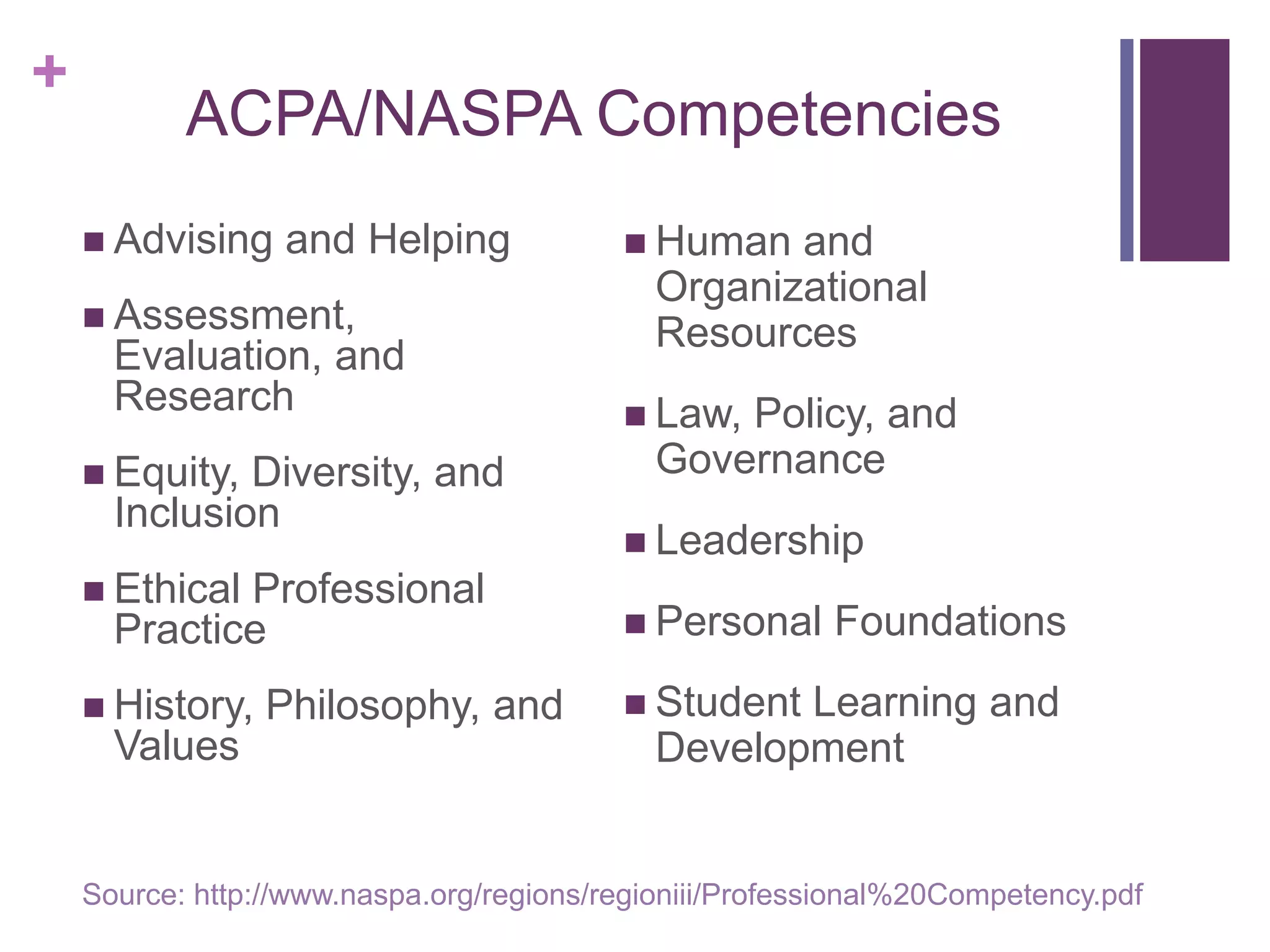
           ACPA/NASPA Competencies
     Advising    and Helping              Human   and
                                             Organizational
     Assessment,
                                             Resources
      Evaluation, and
      Research                             Law, Policy, and
     Equity, Diversity, and                 Governance
      Inclusion
                                           Leadership
     EthicalProfessional
      Practice                             Personal     Foundations
     History,   Philosophy, and           Student Learning and
      Values                                 Development


    Source: http://www.naspa.org/regions/regioniii/Professional%20Competency.pdf
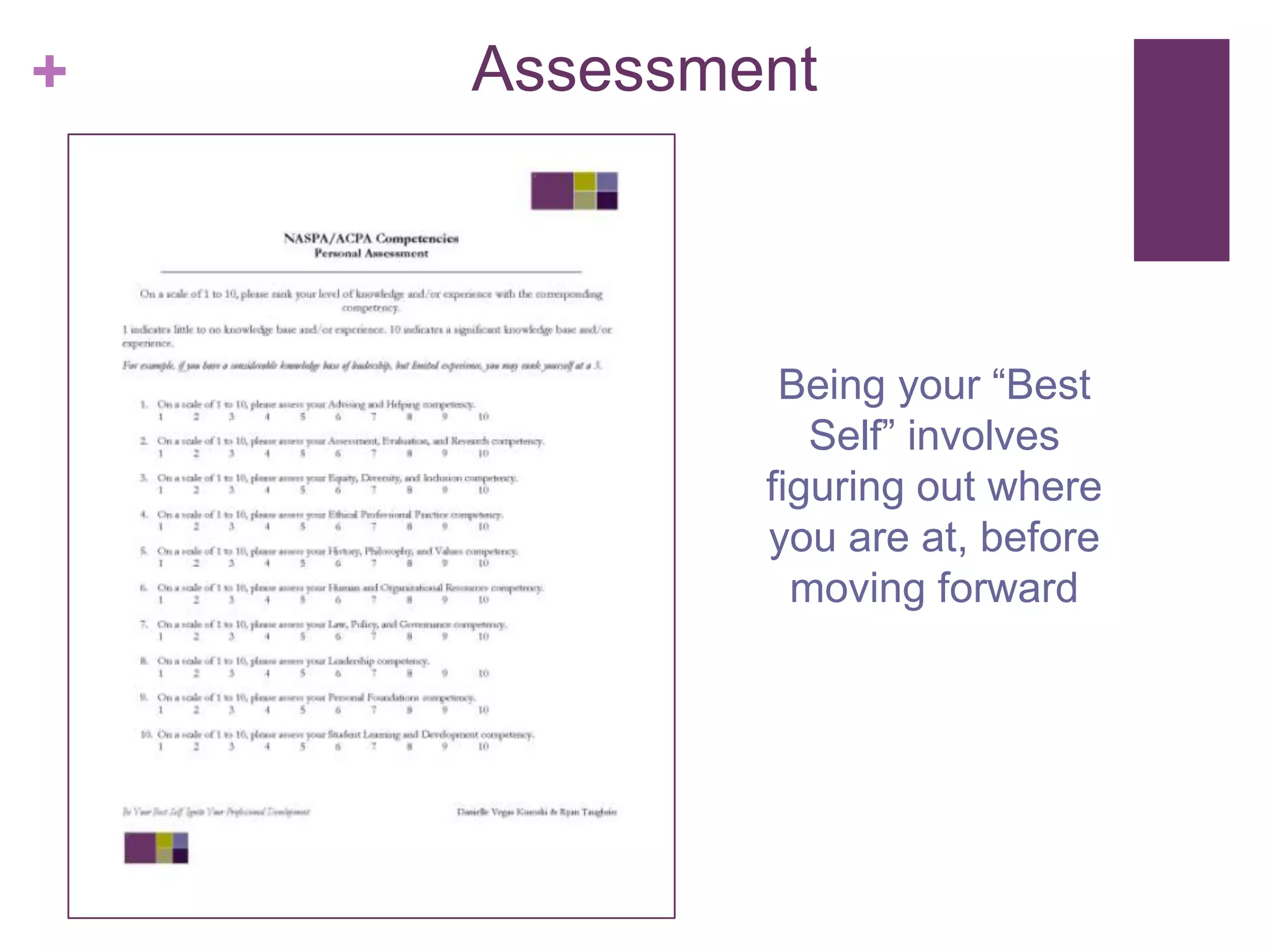
+   Assessment


             Being your “Best
               Self” involves
            figuring out where
            you are at, before
              moving forward
+
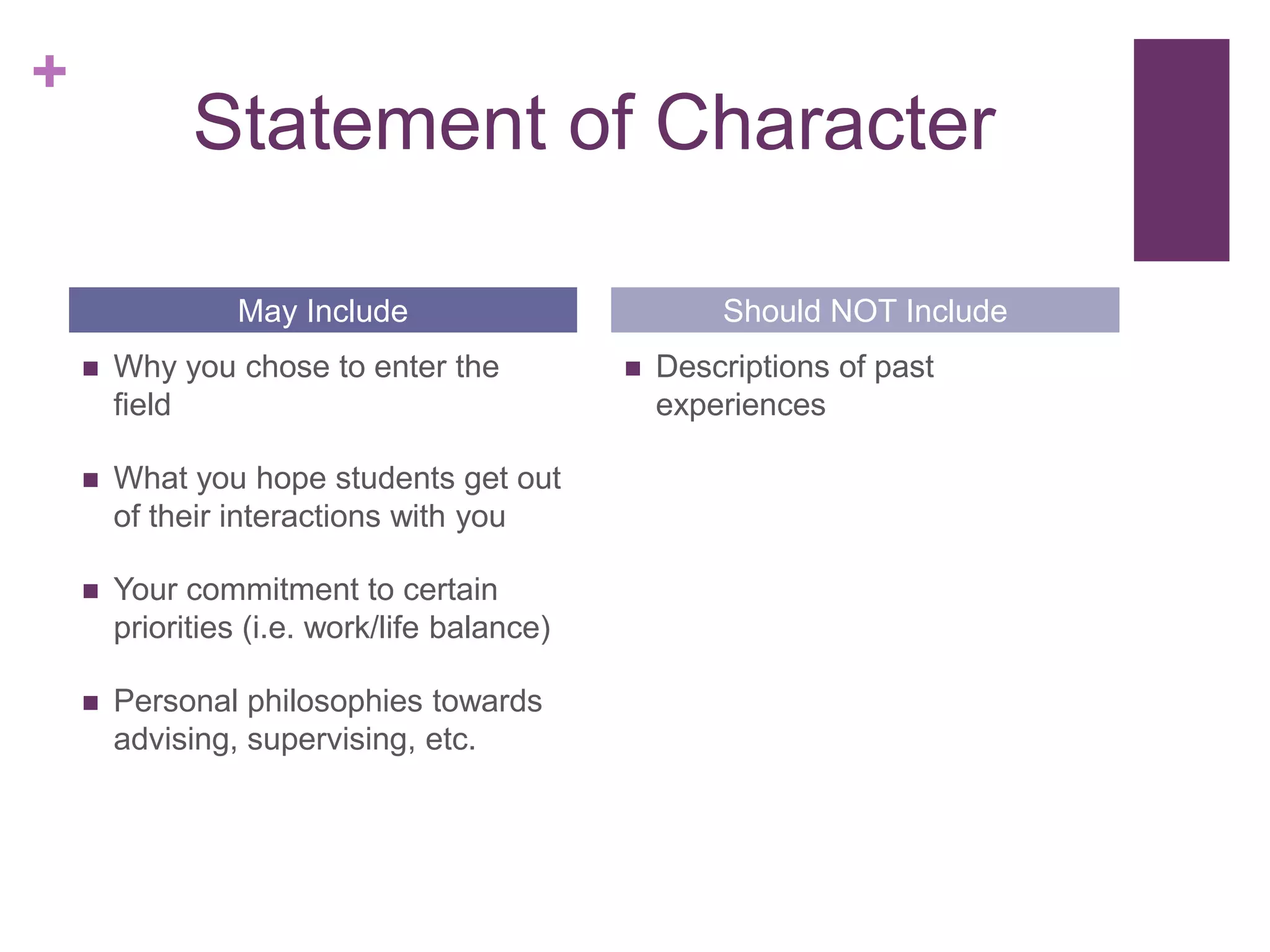
              Statement of Character

                 May Include                          Should NOT Include
       Why you chose to enter the               Descriptions of past
        field                                     experiences

       What you hope students get out
        of their interactions with you

       Your commitment to certain
        priorities (i.e. work/life balance)

       Personal philosophies towards
        advising, supervising, etc.
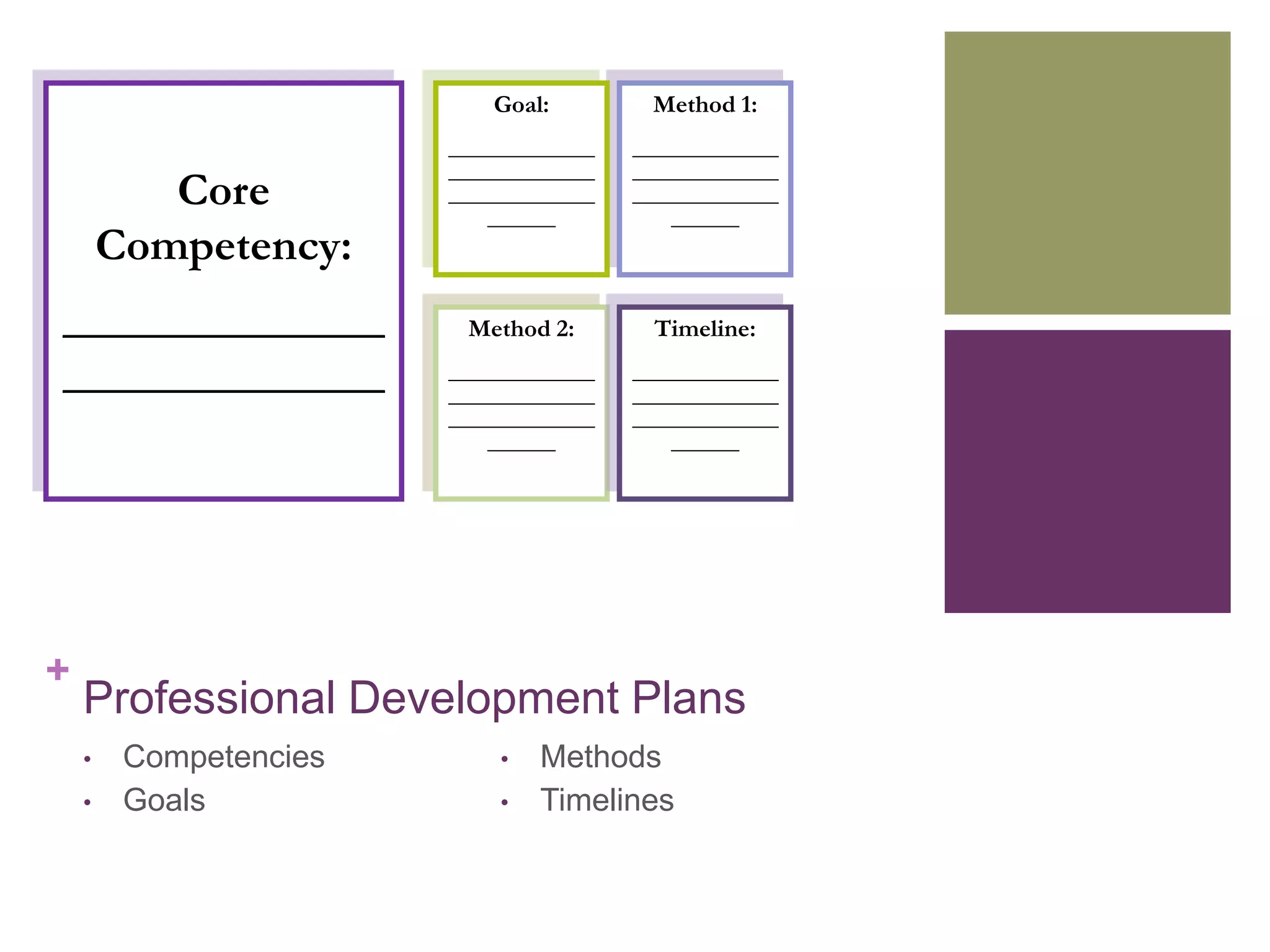
Goal:           Method 1:
                        _______________   _______________
                        _______________   _______________
           Core         _______________
                            _______
                                          _______________
                                              _______
        Competency:
______________            Method 2:         Timeline:

______________          _______________
                        _______________
                                          _______________
                                          _______________
                        _______________   _______________
                            _______           _______


+
    Professional Development Plans
    •    Competencies        •   Methods
    •    Goals               •   Timelines
+
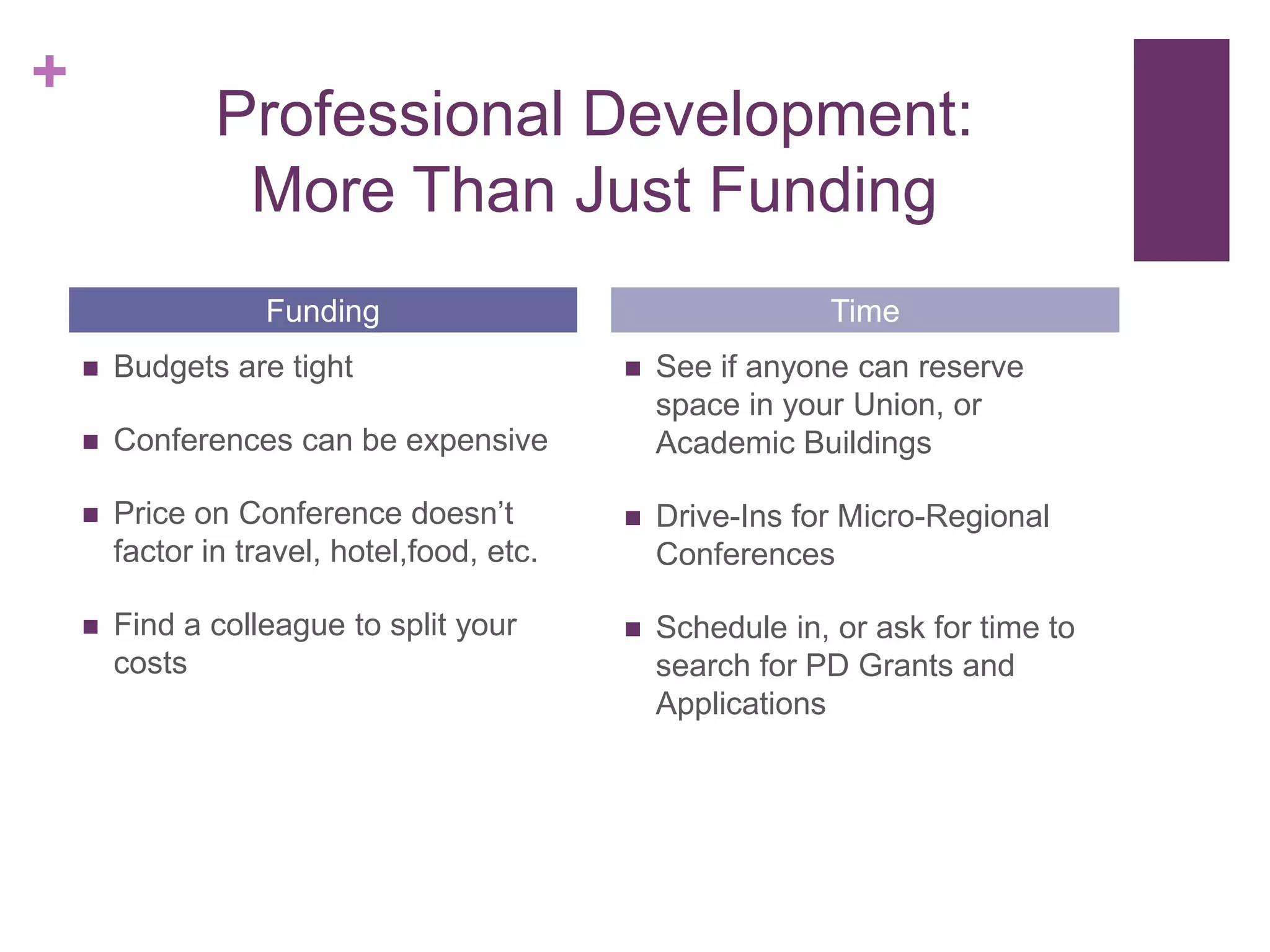
                Professional Development:
                 More Than Just Funding
                    Funding                                  Time
       Budgets are tight                       See if anyone can reserve
                                                 space in your Union, or
       Conferences can be expensive             Academic Buildings

       Price on Conference doesn’t             Drive-Ins for Micro-Regional
        factor in travel, hotel,food, etc.       Conferences

       Find a colleague to split your          Schedule in, or ask for time to
        costs                                    search for PD Grants and
                                                 Applications
+
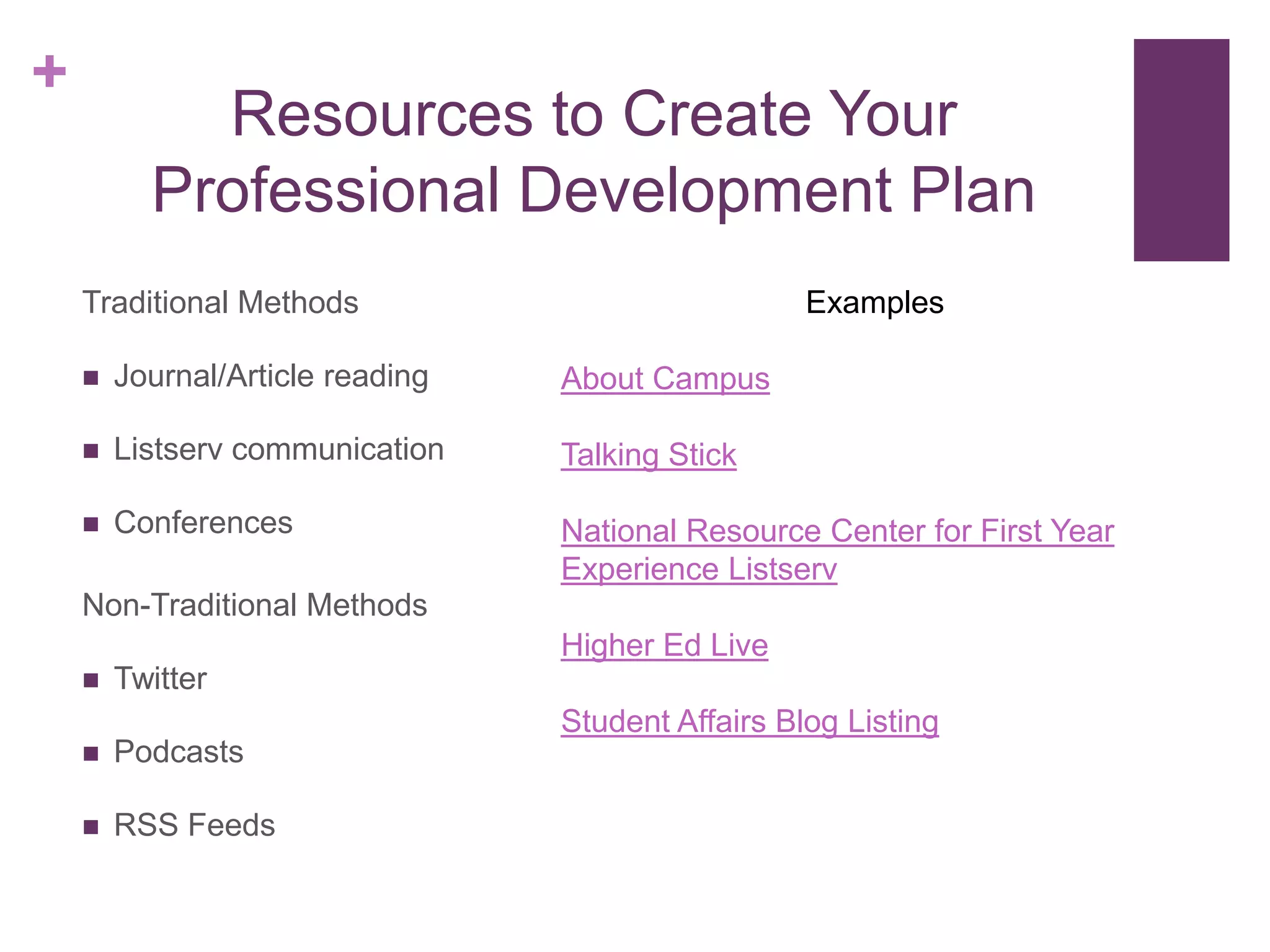
            Resources to Create Your
          Professional Development Plan
    Traditional Methods                             Examples

       Journal/Article reading   About Campus

       Listserv communication    Talking Stick

       Conferences               National Resource Center for First Year
                                  Experience Listserv
    Non-Traditional Methods
                                  Higher Ed Live
       Twitter
                                  Student Affairs Blog Listing
       Podcasts

       RSS Feeds
+
    Non-Traditional Methods
    A Walkthrough of Resources to Make Your
    Professional Development Plan Diverse, Well-
    Intended and Personalized
+
    Non-Traditional Professional
      Development Methods
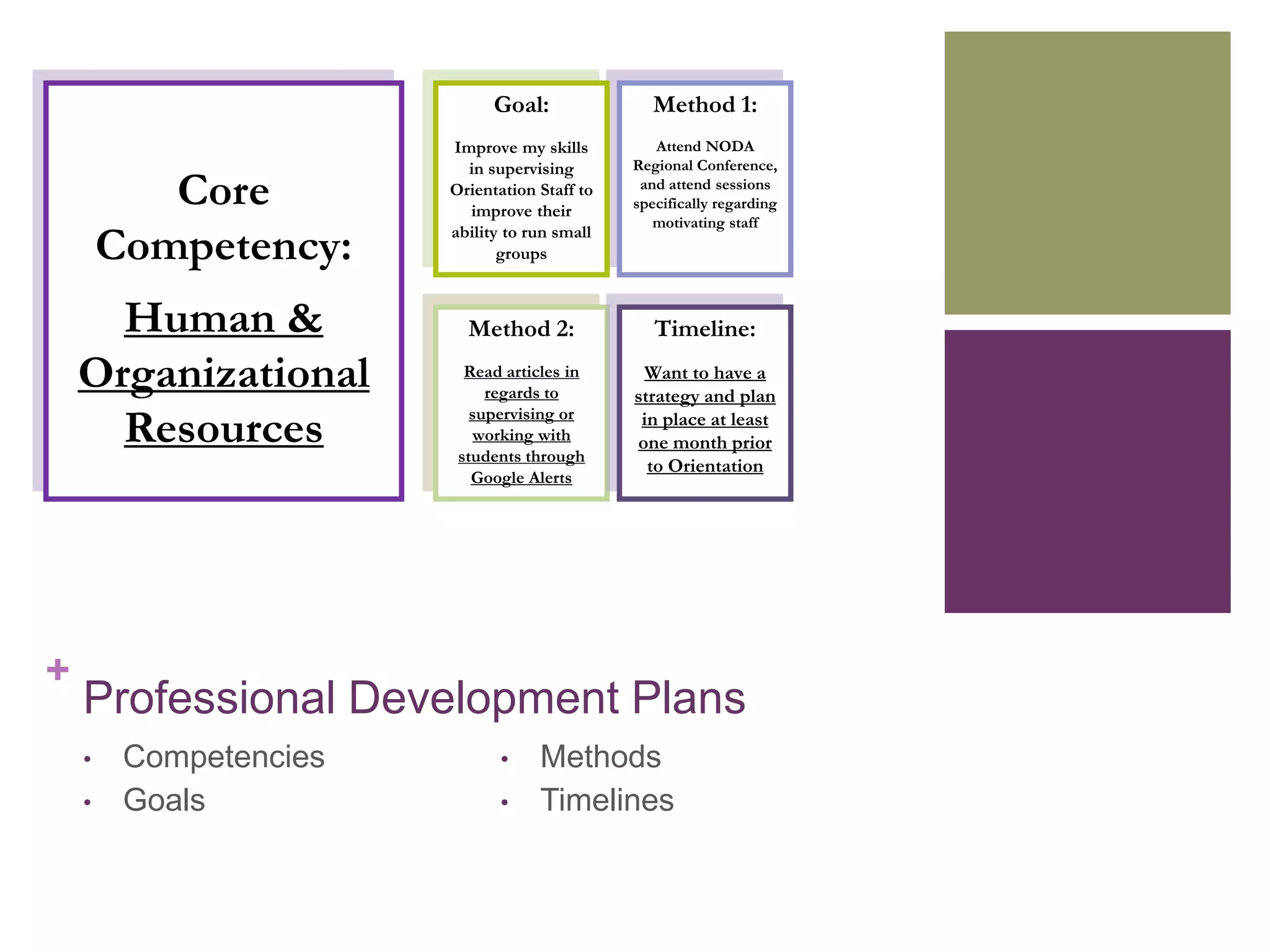
Goal:               Method 1:
                        Improve my skills         Attend NODA
                          in supervising       Regional Conference,

           Core         Orientation Staff to
                          improve their
                                                and attend sessions
                                               specifically regarding
                                                  motivating staff

        Competency:     ability to run small
                               groups


      Human &             Method 2:               Timeline:

    Organizational        Read articles in
                             regards to
                                                 Want to have a
                                               strategy and plan

      Resources            supervising or
                           working with
                         students through
                                                in place at least
                                               one month prior
                                                 to Orientation
                           Google Alerts


+
    Professional Development Plans
    •    Competencies          •    Methods
    •    Goals                 •    Timelines
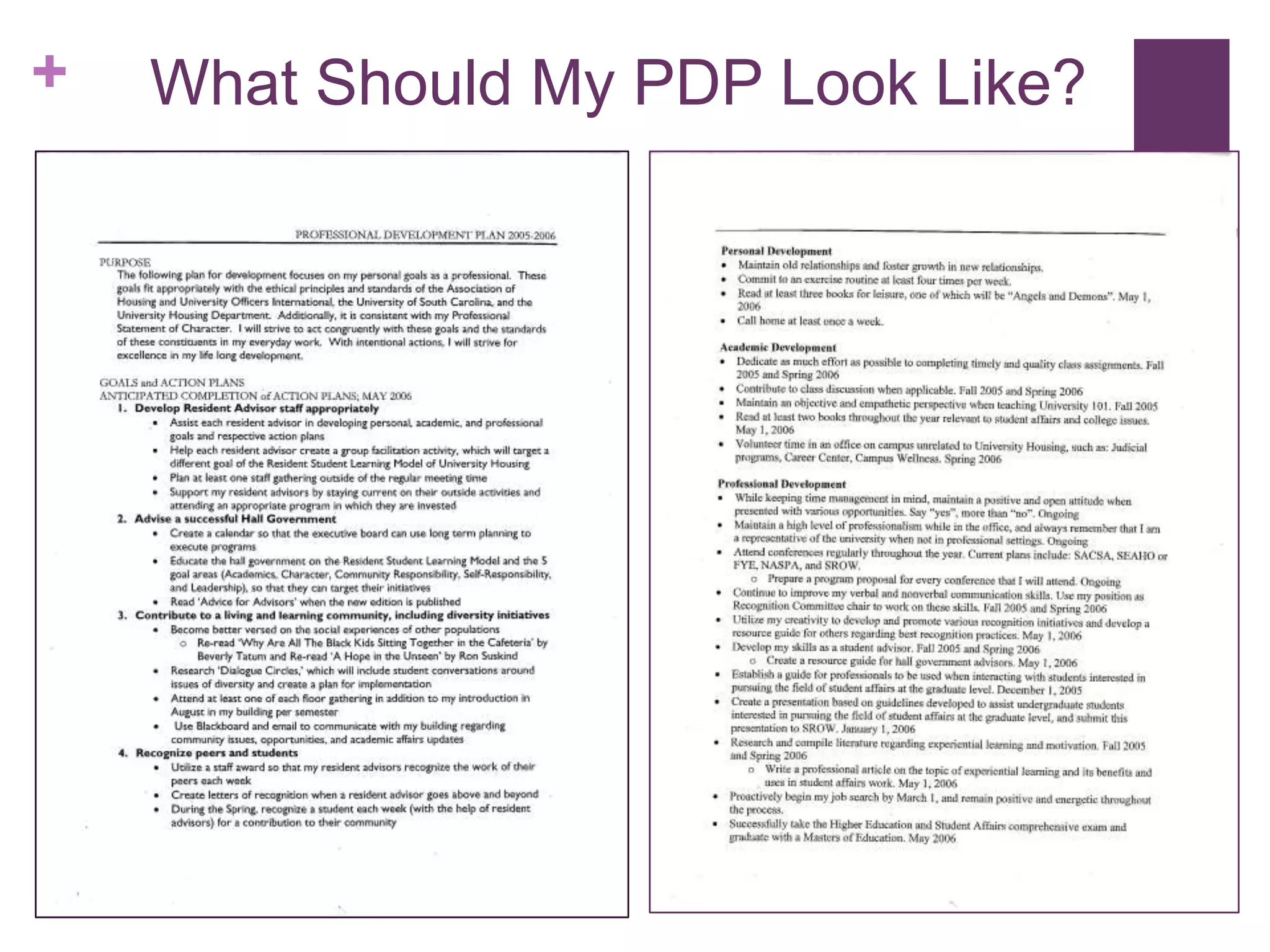
+   What Should My PDP Look Like?
+
                        So What’s Next?

    1.       Accountability partner
         •    Writing or reading groups

    2.       Schedule out time in your calendar to check
             in
    3.       Be realistic
    4.       Scheduling time to make intentional
             connections
+
    Thank You!
    Please Use The Following Slip of Paper
    to Access our PowerPoint, as well as
    direct links to Web Sites that can help
    you get started!
+
    Resources
       http://www.naspa.org/regions/regioniii/Professional%20Compet
        ency.pdf

       http://breakdrink.com/twitter-guide/

       http://thesabloggers.org/sachat/

       http://higheredlive.com/alternative-professional-development/

Being Your Best Self Presentation

  • 1.
    + Be Your Best Self Ignite Your Professional Development Danielle Vegas Kuroski & Ryan Taughrin
  • 2.
    + Learning Outcomes 1. Participants will gain knowledge of the ACPA/NASPA Competencies 2. Participants will gain knowledge of existing resources that will provide individuals with methods for enhancing professional development. 3. Participants will engage in process of creating a professional development plan.
  • 3.
    + ACPA/NASPA Competencies  Advising and Helping  Human and Organizational  Assessment, Resources Evaluation, and Research  Law, Policy, and  Equity, Diversity, and Governance Inclusion  Leadership  EthicalProfessional Practice  Personal Foundations  History, Philosophy, and  Student Learning and Values Development Source: http://www.naspa.org/regions/regioniii/Professional%20Competency.pdf
  • 4.
    + Assessment Being your “Best Self” involves figuring out where you are at, before moving forward
  • 5.
    + Statement of Character May Include Should NOT Include  Why you chose to enter the  Descriptions of past field experiences  What you hope students get out of their interactions with you  Your commitment to certain priorities (i.e. work/life balance)  Personal philosophies towards advising, supervising, etc.
  • 6.
    Goal: Method 1: _______________ _______________ _______________ _______________ Core _______________ _______ _______________ _______ Competency: ______________ Method 2: Timeline: ______________ _______________ _______________ _______________ _______________ _______________ _______________ _______ _______ + Professional Development Plans • Competencies • Methods • Goals • Timelines
  • 7.
    + Professional Development: More Than Just Funding Funding Time  Budgets are tight  See if anyone can reserve space in your Union, or  Conferences can be expensive Academic Buildings  Price on Conference doesn’t  Drive-Ins for Micro-Regional factor in travel, hotel,food, etc. Conferences  Find a colleague to split your  Schedule in, or ask for time to costs search for PD Grants and Applications
  • 8.
    + Resources to Create Your Professional Development Plan Traditional Methods Examples  Journal/Article reading About Campus  Listserv communication Talking Stick  Conferences National Resource Center for First Year Experience Listserv Non-Traditional Methods Higher Ed Live  Twitter Student Affairs Blog Listing  Podcasts  RSS Feeds
  • 9.
    + Non-Traditional Methods A Walkthrough of Resources to Make Your Professional Development Plan Diverse, Well- Intended and Personalized
  • 10.
    + Non-Traditional Professional Development Methods
  • 11.
    Goal: Method 1: Improve my skills Attend NODA in supervising Regional Conference, Core Orientation Staff to improve their and attend sessions specifically regarding motivating staff Competency: ability to run small groups Human & Method 2: Timeline: Organizational Read articles in regards to Want to have a strategy and plan Resources supervising or working with students through in place at least one month prior to Orientation Google Alerts + Professional Development Plans • Competencies • Methods • Goals • Timelines
  • 12.
    + What Should My PDP Look Like?
  • 13.
    + So What’s Next? 1. Accountability partner • Writing or reading groups 2. Schedule out time in your calendar to check in 3. Be realistic 4. Scheduling time to make intentional connections
  • 14.
    + Thank You! Please Use The Following Slip of Paper to Access our PowerPoint, as well as direct links to Web Sites that can help you get started!
  • 15.
    + Resources  http://www.naspa.org/regions/regioniii/Professional%20Compet ency.pdf  http://breakdrink.com/twitter-guide/  http://thesabloggers.org/sachat/  http://higheredlive.com/alternative-professional-development/

Editor's Notes

  • #3 RT – Mention why professional development is important (intentionality, staying current, improving yourself, etc.)
  • #4 DVK [Print and have one full ACPA/NASPA Competency report in a binder to pass around] Do we need to give a short description of each? PROBABLY…– Acknowledge that the Competencies are only one way to approach professional development. One could also use the CAS standards, which are more specific to functional areas.– List of knowledge areas, skills and attitudes as deemed important to the profession regardless of functional area by a Joint Task Force in 2010-practitioners should use this document to help guide their own choices about what they want to focus their professional development on-intended to inform the professional development agenda of all practitioners whose work pertains primarily to the development of college students-Acknowledge that there are three levels of competency: basic, intermediate, and advanced. Level should only reflect knowledge, skills, attitude, not years of service, number of experiences, etc.
  • #5 DVK Add screenshot and directions-Before we can move forward, we must assess where we currently are. [Hand out assessment] Acknowledge that while it is a simple document, we think it should be adequate enough to simply begin their thought process on what competencies they should strive towards strengthening. -When people conclude, perhaps ask how many have intentionally sat down and devoted time to think about their areas of improvement? Perhaps, how many people were surprised by their results/didn’t realize needed to strengthen a particular area?
  • #6 DVK-identifying what you value in your work goes hand in hand with acknowledging what your needs are. A truly beneficial PDP should take into account both what is personally important to you, as well as your areas of improvement. Revisiting or creating a statement of character can be a good place to get started in developing goals for yourself. Our thought process is you know what needs you have (you can choose to include or exclude specifically what areas/competencies you are working towards) and you know what you value, so documenting them in one place can serve as a good record for yourself. -This can look however you would like it to…I think of it as a personal mission statement (what do I stand for, who am I as a professional) If somebody doesn’t know my work and I give them this document, they should be able to develop a decent understanding of what is important to me as a professional. [Give personal examples: my Statement of Character focuses on intentionality in student interactions for effective student development]Note that this document should differ significantly from a resume
  • #7 Talk about worksheet – At this point, we are going to pass out a worksheet that could help you begin developing a PDP. We don’t want you to start filling it out just yet because we are going to spend some time sharing resources with you that we hope you might want to incorporate. We did want to share this though so that you can start thinking about what competencies you may want to focus on in your PDP and so you can incorporate some of the methods we’ll share directly into your working document for your PDP.
  • #8 RT – ExamplesImportant to begin with this preface as we enter a discussion on resources….there is a difference in a commitment to professional development funding and time. [Go on to share what they are]
  • #9 DVK-Traditional …. CSPA Journal RT-Non-Traditional
  • #10 DVK
  • #11 Note: With 2 presentations – can be the same presentation, but the 5 pictures can either link directly to the web sites, which we will navigate, or can link to documents, which will be screen shots/walk throughs of the various web sites and important points within each one!!Find free space to share document and powerpoint
  • #12 Talk about worksheet – At this point, we are going to pass out a worksheet that could help you begin developing a PDP. We don’t want you to start filling it out just yet because we are going to spend some time sharing resources with you that we hope you might want to incorporate. We did want to share this though so that you can start thinking about what competencies you may want to focus on in your PDP and so you can incorporate some of the methods we’ll share directly into your working document for your PDP.
  • #13 dvk
  • #14 Who is doing this slide?  Important to mention the importance of intentionality – this should be a balance – many people will use twitter/listen to podcasts because it is easy to get engaged, but having a sense of intentionalty behind these activities, and a connection to your own broader, personal goals is one takes these interactions to the next level. What is the point of bettering yourself, if it is not in some way going to make your ability to connect with students a richer experience?
  • #15 Will put this PPT, as well as the “walk-throughs”/web sites onto a common space/downloadable site – Need to figure out though, what is the most effecive way to provide this information. This could bePhysical handout with screen shots/text boxes on what to doPowerPoint online with links to these websites, and finding a few more helpful “how-tos”We are already providing a handout on how to make a professional development plan – is that enough?
  • #16 RT