About Beijing
Beijing, only eclipsed by Shanghai in terms of size, is not only the
political center of China - a position it has held for more than 800
years - it also plays an important role in the nation's cultural,
economic, scientific, and academic life. Located in the northwest of
the North China Plain, not far from the western slopes of the Yanshan
mountains, Beijing - still sometimes referred to as Peking - is a great
place from which to explore this dynamic country due to its dense
network of road, rail, and airline connections with other major cities.
The Imperial Palace and the Forbidden City
The Imperial Palace, also known as the
Forbidden City, is China's most significant
attraction and can trace its origins back to
the Yuan Dynasty of the 13th century. Its
immense size is the result of enlargements
made during the Ming Dynasty between
1406 and 1420, after the capital was
transferred here from Nanking.
The Great Wall of China
Beijing is only an hour away from what is
undoubtedly one of the country's most
famous historic structures: the Great Wall
of China. Here at Badaling Pass, the first
part of the Wall to be opened to tourists in
the 1950s, you can enjoy a walk along an
impressive section of the Great Wall
dating from the 16th century and standing
up to eight meters high.
Tiananmen Square
Tiananmen Square is the world's largest
inner-city square, designed to hold a million
people and built to celebrate the 10th
anniversary of the Chinese Republic in 1958.
Beihai Park
Just a short distance from the Imperial
Palace, Beihai Park is one of the oldest
surviving imperial gardens in Beijing. Laid
out at the beginning of the 10th century,
this beautiful open space takes its name
from nearby Lake Beihai (North Lake) and
offers many good reasons to visit.
The Summer Palace
Located an easy 30 minutes journey by
car, bus, or taxi from the center of
Beijing, the city's Summer Palace is a
must-visit. Dating back to the 12th
century and more than 700-acres in size,
it's a picture-perfect setting, which
certainly befits its royal status, boasting
a large 700-year-old man-made lake and
beautiful gardens.
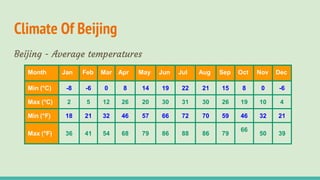
Climate Of Beijing
Beijing - Average temperatures
Month Jan Feb Mar Apr May Jun Jul Aug Sep Oct Nov Dec
Min (°C) -8 -6 0 8 14 19 22 21 15 8 0 -6
Max (°C) 2 5 12 26 20 30 31 30 26 19 10 4
Min (°F) 18 21 32 46 57 66 72 70 59 46 32 21
Max (°F) 36 41 54 68 79 86 88 86 79
66
50 39
Culture In Beijing
Beijing cuisine is the local style of cooking. Peking Roast Duck is
perhaps the best known dish. Fuling Jiabing, a traditional Beijing
snack food, is a pancake (bing) resembling a flat disk with a filling
made from fu ling, a fungus used in traditional Chinese medicine.
Teahouses are common in Beijing.
More About Beijing: Beijing
Nature and wildlife
Beijing Municipality has 20 nature reserves that have a total area of
1,339.7 km2 (517.3 sq mi). The mountains to the west and north of the
city are home to a number of protected wildlife species including
leopard, leopard cat, wolf, red fox, wild boar, masked palm civet,
raccoon dog, hog badger, Siberian weasel, Amur hedgehog, roe deer,
and mandarin rat snake.
Demographics
To know the population of Beijing in 2019, the population of the last 5
years needs to be checked. They are as follows.
http://populationof2019.com/population-of-beijing-2019.html
http://populationof2019.com

Beijng ppt

  • 2.
    About Beijing Beijing, onlyeclipsed by Shanghai in terms of size, is not only the political center of China - a position it has held for more than 800 years - it also plays an important role in the nation's cultural, economic, scientific, and academic life. Located in the northwest of the North China Plain, not far from the western slopes of the Yanshan mountains, Beijing - still sometimes referred to as Peking - is a great place from which to explore this dynamic country due to its dense network of road, rail, and airline connections with other major cities.
  • 3.
    The Imperial Palaceand the Forbidden City The Imperial Palace, also known as the Forbidden City, is China's most significant attraction and can trace its origins back to the Yuan Dynasty of the 13th century. Its immense size is the result of enlargements made during the Ming Dynasty between 1406 and 1420, after the capital was transferred here from Nanking.
  • 4.
    The Great Wallof China Beijing is only an hour away from what is undoubtedly one of the country's most famous historic structures: the Great Wall of China. Here at Badaling Pass, the first part of the Wall to be opened to tourists in the 1950s, you can enjoy a walk along an impressive section of the Great Wall dating from the 16th century and standing up to eight meters high.
  • 5.
    Tiananmen Square Tiananmen Squareis the world's largest inner-city square, designed to hold a million people and built to celebrate the 10th anniversary of the Chinese Republic in 1958.
  • 6.
    Beihai Park Just ashort distance from the Imperial Palace, Beihai Park is one of the oldest surviving imperial gardens in Beijing. Laid out at the beginning of the 10th century, this beautiful open space takes its name from nearby Lake Beihai (North Lake) and offers many good reasons to visit.
  • 7.
    The Summer Palace Locatedan easy 30 minutes journey by car, bus, or taxi from the center of Beijing, the city's Summer Palace is a must-visit. Dating back to the 12th century and more than 700-acres in size, it's a picture-perfect setting, which certainly befits its royal status, boasting a large 700-year-old man-made lake and beautiful gardens.
  • 8.
    Climate Of Beijing Beijing- Average temperatures Month Jan Feb Mar Apr May Jun Jul Aug Sep Oct Nov Dec Min (°C) -8 -6 0 8 14 19 22 21 15 8 0 -6 Max (°C) 2 5 12 26 20 30 31 30 26 19 10 4 Min (°F) 18 21 32 46 57 66 72 70 59 46 32 21 Max (°F) 36 41 54 68 79 86 88 86 79 66 50 39
  • 9.
    Culture In Beijing Beijingcuisine is the local style of cooking. Peking Roast Duck is perhaps the best known dish. Fuling Jiabing, a traditional Beijing snack food, is a pancake (bing) resembling a flat disk with a filling made from fu ling, a fungus used in traditional Chinese medicine. Teahouses are common in Beijing. More About Beijing: Beijing
  • 10.
    Nature and wildlife BeijingMunicipality has 20 nature reserves that have a total area of 1,339.7 km2 (517.3 sq mi). The mountains to the west and north of the city are home to a number of protected wildlife species including leopard, leopard cat, wolf, red fox, wild boar, masked palm civet, raccoon dog, hog badger, Siberian weasel, Amur hedgehog, roe deer, and mandarin rat snake.
  • 11.
    Demographics To know thepopulation of Beijing in 2019, the population of the last 5 years needs to be checked. They are as follows. http://populationof2019.com/population-of-beijing-2019.html http://populationof2019.com