Group:
Forerunners
Section-A, 10th Batch
Presentation on:
Evolution of Management
Practices
OurTopic:
Category-4: Behavioral School of Management
Thoughts
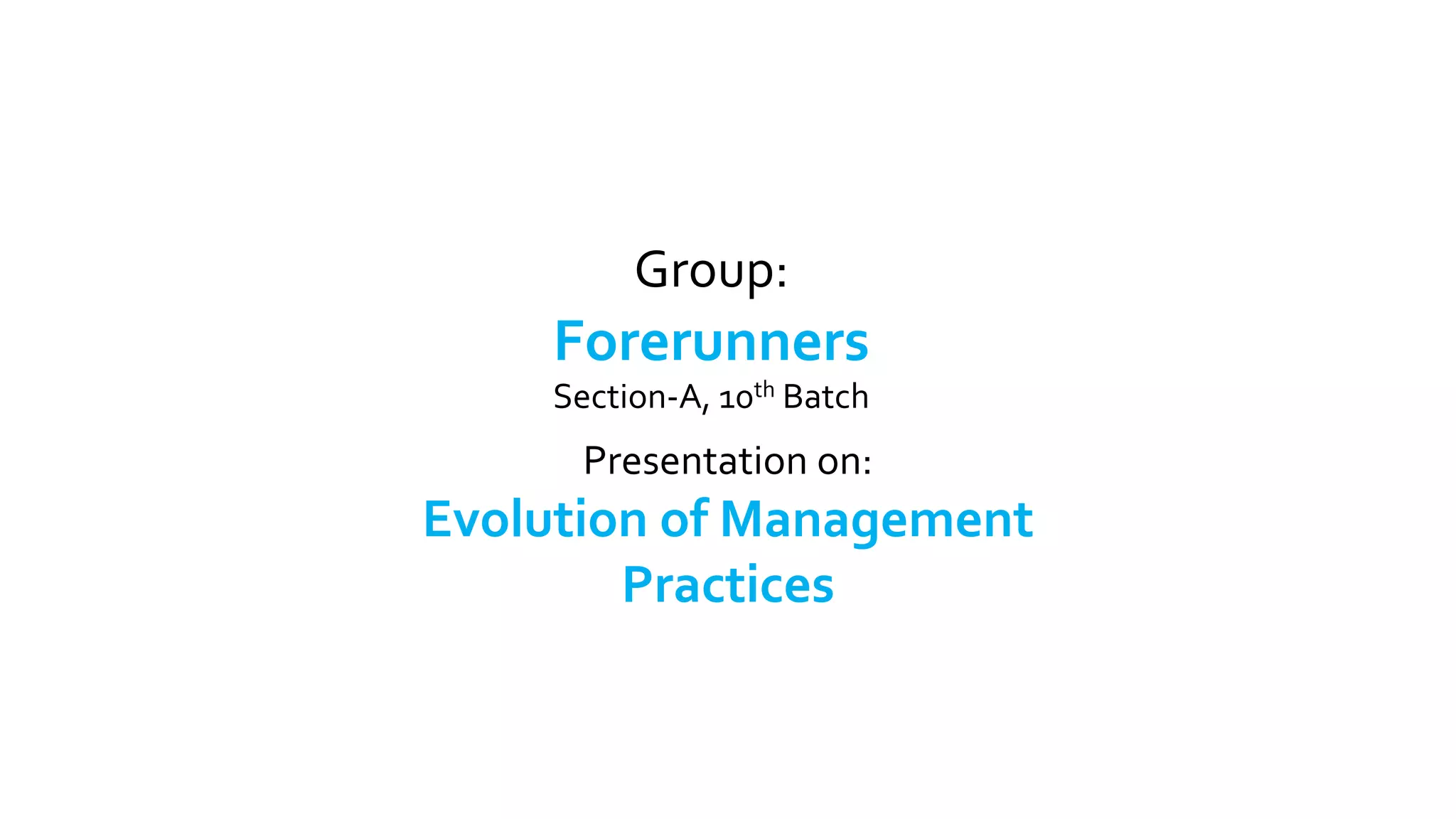
Oliver Sheldon
Book: The Philosophy of
Management
Emphasized on Human
Behavior through the
concept ‘men are first’
Mary Parker Follett
Discussed ‘The Group
Principle’
Added the words
‘togetherness’
And ‘group thinking’
Chester I. Barnard
Book: ‘The Functions of the
Executive’
Viewed organization as a
system of interactions
Elton Mayo
Introduced Human
Relations Approach
Book: ‘The Human
Problems of an Industrial
Civilization’
Contributors and Contribution
Forerunn
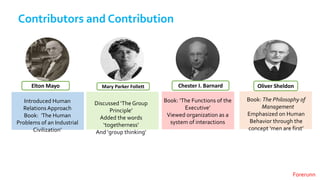
Hugo Munsterberg
Father of Industrial
Psychology Book:
Psychology and Industrial
Efficiency
Abraham Maslow
Paper: ATheory of Human
Motivation-1943
Developed Hierarchy of
Needs theory
Douglas McGregor
Book:The Human Side of
Enterprise
’ DevelopedTheory-X and
Theory-Y
Frederick Herzberg
Publication: One More
Time, How DoYou
Motivate Employees?
DevelopedTwo Factor
theory of motivation’
Contributors and Contribution
Forerunn
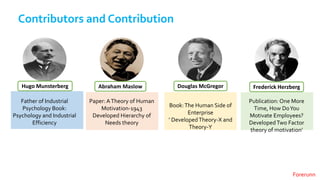
Vector Vroom
Article: ‘Towards a
Stochastic Model of
Managerial Careers’-1968
Developed Expectancy
Theory
David McClelland
Survey: A Review of
General Psychology-2002
Developed Needs for
AchievementTheory
Clayton Alderfer
Further developed
Maslow’s Need Hierarchy
Theory and introduced
ERGTheory
John Stacey Adams
Developed EquityTheory
of motivation
Contributors and Contribution
Forerunn
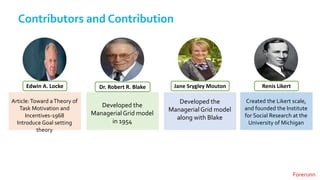
Edwin A. Locke
Article:Toward aTheory of
Task Motivation and
Incentives-1968
Introduce Goal setting
theory
Dr. Robert R. Blake
Developed the
ManagerialGrid model
in 1954
Jane Srygley Mouton
Developed the
ManagerialGrid model
along with Blake
Renis Likert
Created the Likert scale,
and founded the Institute
for Social Research at the
University of Michigan
Contributors and Contribution
Forerunn
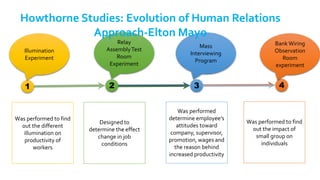
1 2 3 4
Illumination
Experiment
Mass
Interviewing
Program
Bank Wiring
Observation
Room
experiment
Relay
AssemblyTest
Room
Experiment
Designed to
determine the effect
change in job
conditions
Was performed
determine employee’s
attitudes toward
company, supervisor,
promotion, wages and
the reason behind
increased productivity
Was performed to find
out the impact of
small group on
individuals
Was performed to find
out the different
illumination on
productivity of
workers
Howthorne Studies: Evolution of Human Relations
Approach-Elton Mayo
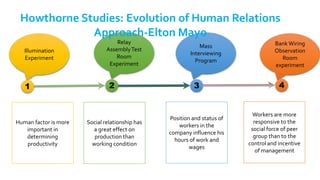
Illumination
Experiment
Mass
Interviewing
Program
Bank Wiring
Observation
Room
experiment
Relay
AssemblyTest
Room
Experiment
1 2 3 4
Workers are more
responsive to the
social force of peer
group than to the
control and incentive
of management
Social relationship has
a great effect on
production than
working condition
Position and status of
workers in the
company influence his
hours of work and
wages
Human factor is more
important in
determining
productivity
Howthorne Studies: Evolution of Human Relations
Approach-Elton Mayo
Forerunn
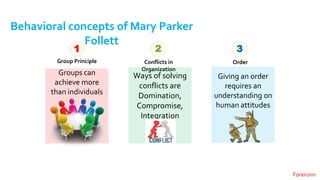
Behavioral concepts of Mary Parker
Follett
1
Group Principle
2
Conflicts in
Organization
3
Order
Groups can
achieve more
than individuals
Ways of solving
conflicts are
Domination,
Compromise,
Integration
Giving an order
requires an
understanding on
human attitudes
Forerunn
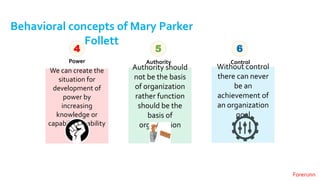
Behavioral concepts of Mary Parker
Follett
4
Power
5
Authority
6
Control
We can create the
situation for
development of
power by
increasing
knowledge or
capability or ability
Authority should
not be the basis
of organization
rather function
should be the
basis of
organization
Without control
there can never
be an
achievement of
an organization
goal
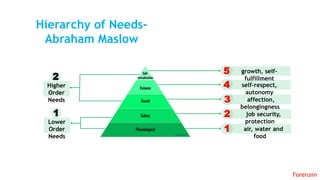
1
Lower
Order
Needs
2
Higher
Order
Needs
air, water and
food
1
job security,
protection
2
affection,
belongingness
3
self-respect,
autonomy
4
growth, self-
fulfillment
5
Hierarchy of Needs-
Abraham Maslow
Forerunn
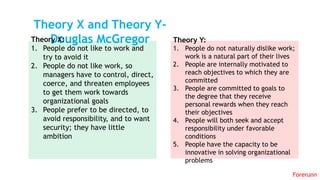
Theory X and Theory Y-
Douglas McGregor
Forerunn
Theory X:
1. People do not like to work and
try to avoid it
2. People do not like work, so
managers have to control, direct,
coerce, and threaten employees
to get them work towards
organizational goals
3. People prefer to be directed, to
avoid responsibility, and to want
security; they have little
ambition
Theory Y:
1. People do not naturally dislike work;
work is a natural part of their lives
2. People are internally motivated to
reach objectives to which they are
committed
3. People are committed to goals to
the degree that they receive
personal rewards when they reach
their objectives
4. People will both seek and accept
responsibility under favorable
conditions
5. People have the capacity to be
innovative in solving organizational
problems
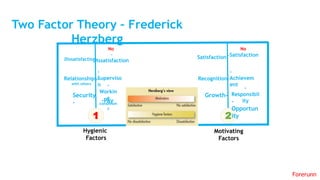
Two Factor Theory – Frederick
Herzberg
Forerunn
1
Hygienic
Factors
2
Motivating
Factors
-Pay
Security
-
-
Workin
g
condition
s
Relationships-
with others
-
Superviso
n
Dissatisfaction-
No
-
Dissatisfaction
-
Opportun
ity
Growth-
-
Responsibil
ity
Recognition-
-
Achievem
ent
Satisfaction-
No
-Satisfaction
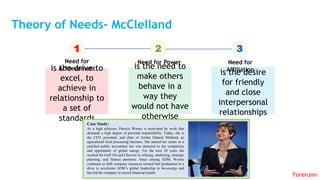
Theory of Needs- McClelland
Forerunn
1
Need for
Achievement
2
Need for Power
3
Need for
Affiliationis the drive to
excel, to
achieve in
relationship to
a set of
standards
is the need to
make others
behave in a
way they
would not have
otherwise
is the desire
for friendly
and close
interpersonal
relationships
Case Study:
As a high achiever, Patricia Woertz is motivated by work that
demands a high degree of personal responsibility. Today, she is
the CEO, president, and chair of Archer Daniels Midland, an
agricultural food processing business. She started her career as a
certified public accountant but was attracted to the complexity
and opportunity of global energy. For the next 30 years she
worked for Gulf Oil and Chevron in refining, marketing, strategic
planning, and finance positions. Since joining ADM, Woertz
continues to shift company resources toward fuel production in a
drive to accelerate ADM’s global leadership in bio-energy and
has led the company to record financial results.
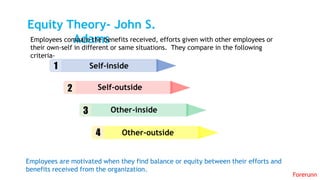
Equity Theory- John S.
Adams
Forerunn
Employees compare the benefits received, efforts given with other employees or
their own-self in different or same situations. They compare in the following
criteria-
Self-inside1
Self-outside2
Other-inside3
Other-outside4
Employees are motivated when they find balance or equity between their efforts and
benefits received from the organization.
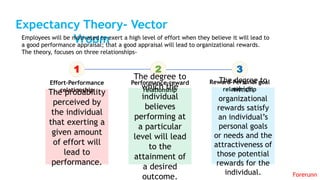
Expectancy Theory- Vector
Vroom
Forerunn
Employees will be motivated to exert a high level of effort when they believe it will lead to
a good performance appraisal; that a good appraisal will lead to organizational rewards.
The theory, focuses on three relationships-
1
Effort-Performance
relationship
2
Performance-reward
relationship
3
Reward-Personal goal
relationship
The probability
perceived by
the individual
that exerting a
given amount
of effort will
lead to
performance.
The degree to
which the
individual
believes
performing at
a particular
level will lead
to the
attainment of
a desired
outcome.
The degree to
which
organizational
rewards satisfy
an individual’s
personal goals
or needs and the
attractiveness of
those potential
rewards for the
individual.
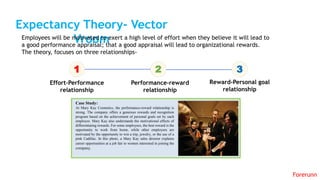
Expectancy Theory- Vector
VroomEmployees will be motivated to exert a high level of effort when they believe it will lead to
a good performance appraisal; that a good appraisal will lead to organizational rewards.
The theory, focuses on three relationships-
1
Effort-Performance
relationship
2
Performance-reward
relationship
3
Reward-Personal goal
relationship
Case Study:
At Mary Kay Cosmetics, the performance-reward relationship is
strong. The company offers a generous rewards and recognition
program based on the achievement of personal goals set by each
employee. Mary Kay also understands the motivational effects of
differentiating rewards. For some employees, the best reward is the
opportunity to work from home, while other employees are
motivated by the opportunity to win a trip, jewelry, or the use of a
pink Cadillac. In this photo, a Mary Kay sales director explains
career opportunities at a job fair to women interested in joining the
company.
Forerunn
SMA
RT
Forerunn
ers
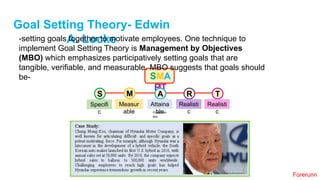
Goal Setting Theory- Edwin
A. Locke-setting goals together to motivate employees. One technique to
implement Goal Setting Theory is Management by Objectives
(MBO) which emphasizes participatively setting goals that are
tangible, verifiable, and measurable. MBO suggests that goals should
be-
S
Specifi
c
M
Measur
able
A
Attaina
ble
R
Realisti
c
T
Realisti
c
Forerunn
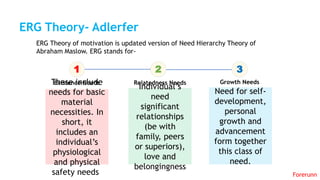
ERG Theory- Adlerfer
Forerunn
ERG Theory of motivation is updated version of Need Hierarchy Theory of
Abraham Maslow. ERG stands for-
1
Existence Needs
2
Relatedness Needs
3
Growth NeedsThese include
needs for basic
material
necessities. In
short, it
includes an
individual’s
physiological
and physical
safety needs.
Individual’s
need
significant
relationships
(be with
family, peers
or superiors),
love and
belongingness
Need for self-
development,
personal
growth and
advancement
form together
this class of
need.
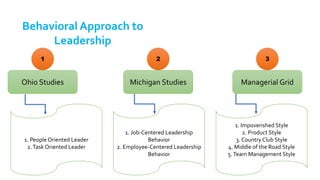
1 2 3
Ohio Studies Managerial GridMichigan Studies
1. Impoverished Style
2. Product Style
3. Country Club Style
4. Middle of the Road Style
5.Team Management Style
1. People Oriented Leader
2.Task Oriented Leader
1. Job-Centered Leadership
Behavior
2. Employee-Centered Leadership
Behavior
Behavioral Approach to
Leadership
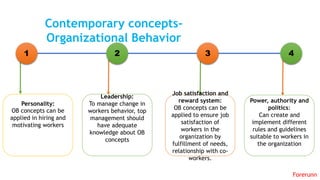
1 3 42
Personality:
OB concepts can be
applied in hiring and
motivating workers
Leadership:
To manage change in
workers behavior, top
management should
have adequate
knowledge about OB
concepts
Job satisfaction and
reward system:
OB concepts can be
applied to ensure job
satisfaction of
workers in the
organization by
fulfillment of needs,
relationship with co-
workers.
Power, authority and
politics:
Can create and
implement different
rules and guidelines
suitable to workers in
the organization
Contemporary concepts-
Organizational Behavior
Forerunn
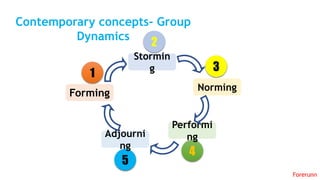
Contemporary concepts- Group
Dynamics
1
Forming
2
Stormin
g 3
Norming
4
Performi
ng
5
Adjourni
ng
Forerunn
Behavioral School Of Management Thoughts

Behavioral School Of Management Thoughts

  • 1.
    Group: Forerunners Section-A, 10th Batch Presentationon: Evolution of Management Practices
  • 2.
  • 3.
    Oliver Sheldon Book: ThePhilosophy of Management Emphasized on Human Behavior through the concept ‘men are first’ Mary Parker Follett Discussed ‘The Group Principle’ Added the words ‘togetherness’ And ‘group thinking’ Chester I. Barnard Book: ‘The Functions of the Executive’ Viewed organization as a system of interactions Elton Mayo Introduced Human Relations Approach Book: ‘The Human Problems of an Industrial Civilization’ Contributors and Contribution Forerunn
  • 4.
    Hugo Munsterberg Father ofIndustrial Psychology Book: Psychology and Industrial Efficiency Abraham Maslow Paper: ATheory of Human Motivation-1943 Developed Hierarchy of Needs theory Douglas McGregor Book:The Human Side of Enterprise ’ DevelopedTheory-X and Theory-Y Frederick Herzberg Publication: One More Time, How DoYou Motivate Employees? DevelopedTwo Factor theory of motivation’ Contributors and Contribution Forerunn
  • 5.
    Vector Vroom Article: ‘Towardsa Stochastic Model of Managerial Careers’-1968 Developed Expectancy Theory David McClelland Survey: A Review of General Psychology-2002 Developed Needs for AchievementTheory Clayton Alderfer Further developed Maslow’s Need Hierarchy Theory and introduced ERGTheory John Stacey Adams Developed EquityTheory of motivation Contributors and Contribution Forerunn
  • 6.
    Edwin A. Locke Article:TowardaTheory of Task Motivation and Incentives-1968 Introduce Goal setting theory Dr. Robert R. Blake Developed the ManagerialGrid model in 1954 Jane Srygley Mouton Developed the ManagerialGrid model along with Blake Renis Likert Created the Likert scale, and founded the Institute for Social Research at the University of Michigan Contributors and Contribution Forerunn
  • 7.
    1 2 34 Illumination Experiment Mass Interviewing Program Bank Wiring Observation Room experiment Relay AssemblyTest Room Experiment Designed to determine the effect change in job conditions Was performed determine employee’s attitudes toward company, supervisor, promotion, wages and the reason behind increased productivity Was performed to find out the impact of small group on individuals Was performed to find out the different illumination on productivity of workers Howthorne Studies: Evolution of Human Relations Approach-Elton Mayo
  • 8.
    Illumination Experiment Mass Interviewing Program Bank Wiring Observation Room experiment Relay AssemblyTest Room Experiment 1 23 4 Workers are more responsive to the social force of peer group than to the control and incentive of management Social relationship has a great effect on production than working condition Position and status of workers in the company influence his hours of work and wages Human factor is more important in determining productivity Howthorne Studies: Evolution of Human Relations Approach-Elton Mayo
  • 9.
    Forerunn Behavioral concepts ofMary Parker Follett 1 Group Principle 2 Conflicts in Organization 3 Order Groups can achieve more than individuals Ways of solving conflicts are Domination, Compromise, Integration Giving an order requires an understanding on human attitudes
  • 10.
    Forerunn Behavioral concepts ofMary Parker Follett 4 Power 5 Authority 6 Control We can create the situation for development of power by increasing knowledge or capability or ability Authority should not be the basis of organization rather function should be the basis of organization Without control there can never be an achievement of an organization goal
  • 11.
    1 Lower Order Needs 2 Higher Order Needs air, water and food 1 jobsecurity, protection 2 affection, belongingness 3 self-respect, autonomy 4 growth, self- fulfillment 5 Hierarchy of Needs- Abraham Maslow Forerunn
  • 12.
    Theory X andTheory Y- Douglas McGregor Forerunn Theory X: 1. People do not like to work and try to avoid it 2. People do not like work, so managers have to control, direct, coerce, and threaten employees to get them work towards organizational goals 3. People prefer to be directed, to avoid responsibility, and to want security; they have little ambition Theory Y: 1. People do not naturally dislike work; work is a natural part of their lives 2. People are internally motivated to reach objectives to which they are committed 3. People are committed to goals to the degree that they receive personal rewards when they reach their objectives 4. People will both seek and accept responsibility under favorable conditions 5. People have the capacity to be innovative in solving organizational problems
  • 13.
    Two Factor Theory– Frederick Herzberg Forerunn 1 Hygienic Factors 2 Motivating Factors -Pay Security - - Workin g condition s Relationships- with others - Superviso n Dissatisfaction- No - Dissatisfaction - Opportun ity Growth- - Responsibil ity Recognition- - Achievem ent Satisfaction- No -Satisfaction
  • 14.
    Theory of Needs-McClelland Forerunn 1 Need for Achievement 2 Need for Power 3 Need for Affiliationis the drive to excel, to achieve in relationship to a set of standards is the need to make others behave in a way they would not have otherwise is the desire for friendly and close interpersonal relationships Case Study: As a high achiever, Patricia Woertz is motivated by work that demands a high degree of personal responsibility. Today, she is the CEO, president, and chair of Archer Daniels Midland, an agricultural food processing business. She started her career as a certified public accountant but was attracted to the complexity and opportunity of global energy. For the next 30 years she worked for Gulf Oil and Chevron in refining, marketing, strategic planning, and finance positions. Since joining ADM, Woertz continues to shift company resources toward fuel production in a drive to accelerate ADM’s global leadership in bio-energy and has led the company to record financial results.
  • 15.
    Equity Theory- JohnS. Adams Forerunn Employees compare the benefits received, efforts given with other employees or their own-self in different or same situations. They compare in the following criteria- Self-inside1 Self-outside2 Other-inside3 Other-outside4 Employees are motivated when they find balance or equity between their efforts and benefits received from the organization.
  • 16.
    Expectancy Theory- Vector Vroom Forerunn Employeeswill be motivated to exert a high level of effort when they believe it will lead to a good performance appraisal; that a good appraisal will lead to organizational rewards. The theory, focuses on three relationships- 1 Effort-Performance relationship 2 Performance-reward relationship 3 Reward-Personal goal relationship The probability perceived by the individual that exerting a given amount of effort will lead to performance. The degree to which the individual believes performing at a particular level will lead to the attainment of a desired outcome. The degree to which organizational rewards satisfy an individual’s personal goals or needs and the attractiveness of those potential rewards for the individual.
  • 17.
    Expectancy Theory- Vector VroomEmployeeswill be motivated to exert a high level of effort when they believe it will lead to a good performance appraisal; that a good appraisal will lead to organizational rewards. The theory, focuses on three relationships- 1 Effort-Performance relationship 2 Performance-reward relationship 3 Reward-Personal goal relationship Case Study: At Mary Kay Cosmetics, the performance-reward relationship is strong. The company offers a generous rewards and recognition program based on the achievement of personal goals set by each employee. Mary Kay also understands the motivational effects of differentiating rewards. For some employees, the best reward is the opportunity to work from home, while other employees are motivated by the opportunity to win a trip, jewelry, or the use of a pink Cadillac. In this photo, a Mary Kay sales director explains career opportunities at a job fair to women interested in joining the company. Forerunn
  • 18.
    SMA RT Forerunn ers Goal Setting Theory-Edwin A. Locke-setting goals together to motivate employees. One technique to implement Goal Setting Theory is Management by Objectives (MBO) which emphasizes participatively setting goals that are tangible, verifiable, and measurable. MBO suggests that goals should be- S Specifi c M Measur able A Attaina ble R Realisti c T Realisti c Forerunn
  • 19.
    ERG Theory- Adlerfer Forerunn ERGTheory of motivation is updated version of Need Hierarchy Theory of Abraham Maslow. ERG stands for- 1 Existence Needs 2 Relatedness Needs 3 Growth NeedsThese include needs for basic material necessities. In short, it includes an individual’s physiological and physical safety needs. Individual’s need significant relationships (be with family, peers or superiors), love and belongingness Need for self- development, personal growth and advancement form together this class of need.
  • 20.
    1 2 3 OhioStudies Managerial GridMichigan Studies 1. Impoverished Style 2. Product Style 3. Country Club Style 4. Middle of the Road Style 5.Team Management Style 1. People Oriented Leader 2.Task Oriented Leader 1. Job-Centered Leadership Behavior 2. Employee-Centered Leadership Behavior Behavioral Approach to Leadership
  • 21.
    1 3 42 Personality: OBconcepts can be applied in hiring and motivating workers Leadership: To manage change in workers behavior, top management should have adequate knowledge about OB concepts Job satisfaction and reward system: OB concepts can be applied to ensure job satisfaction of workers in the organization by fulfillment of needs, relationship with co- workers. Power, authority and politics: Can create and implement different rules and guidelines suitable to workers in the organization Contemporary concepts- Organizational Behavior Forerunn
  • 22.
    Contemporary concepts- Group Dynamics 1 Forming 2 Stormin g3 Norming 4 Performi ng 5 Adjourni ng Forerunn