MVN ARAVALI HILLS
Name : Anmol Gupta
Class : XII
Subject : English project
Topic : Book Review (THE
PSYCHOLOGY OF MONEY)
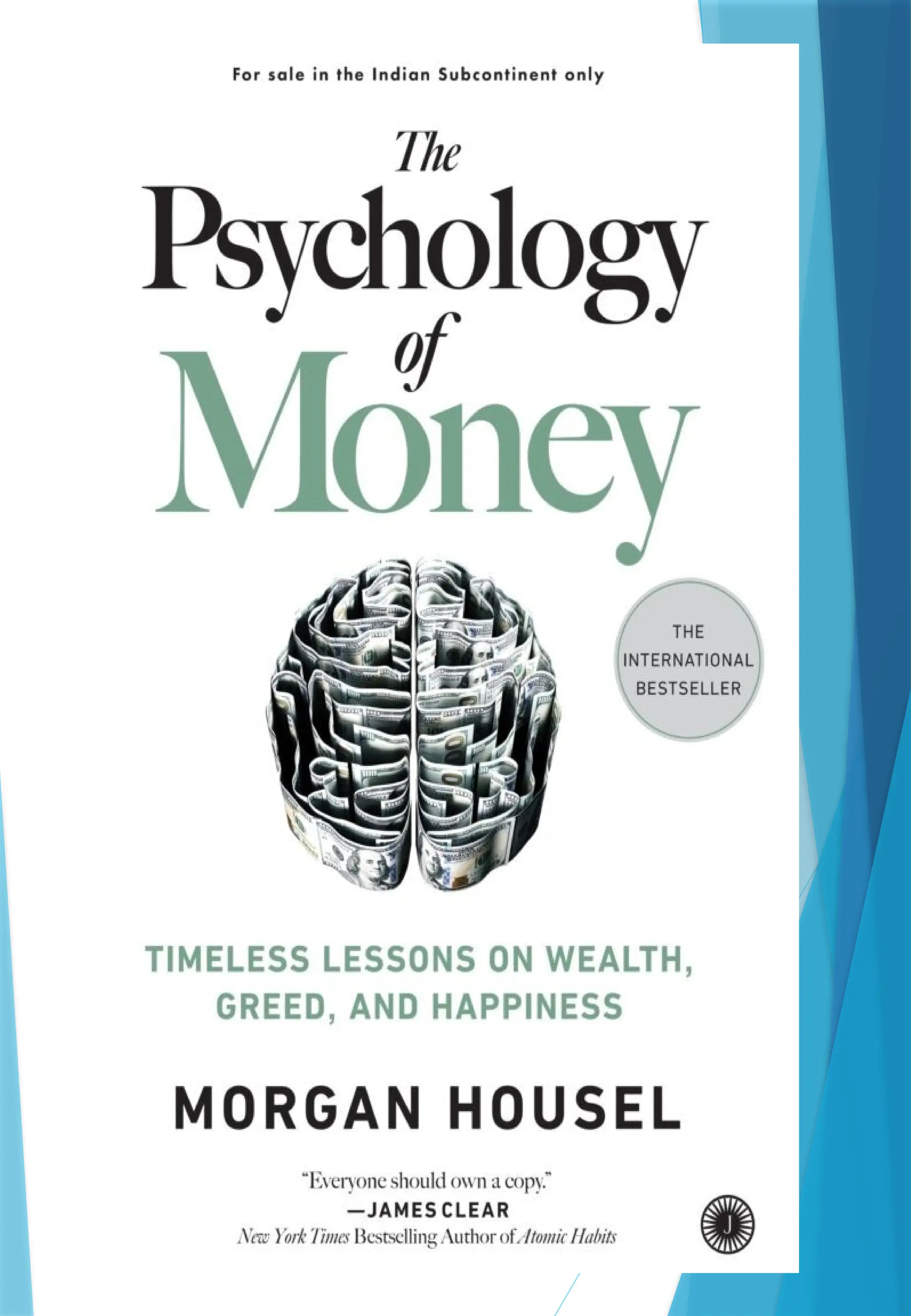
The Psychology of Money by Morgan Housel is a
book about investing, personal finance and
business decisions. Housel describes how financial
decisions are typically taught as a math-based
field, where data and formulas tell us exactly
what to do. But in the real world, people don’t
make financial decisions on a spreadsheet.
They make them at the dinner table, or in a
meeting room, where personal history, ego,
pride, marketing and odd incentives are
scrambled together. Housel provides examples
that explore the strange ways people think about
money and teaches you how to make better sense
of one of life’s most important topics.
Introduction
Theory isn’t
reality
We are not spreadsheets. As much as
reading can inform us about what has
happened in the past, like stock market
crashes or how stocks have trended up
and to the right over time, learning about
something in a book is very different from
actually experiencing the event.
“The challenge for us is that no
amount of studying or open-
mindedness can genuinely recreate
the power of fear and uncertainty.”
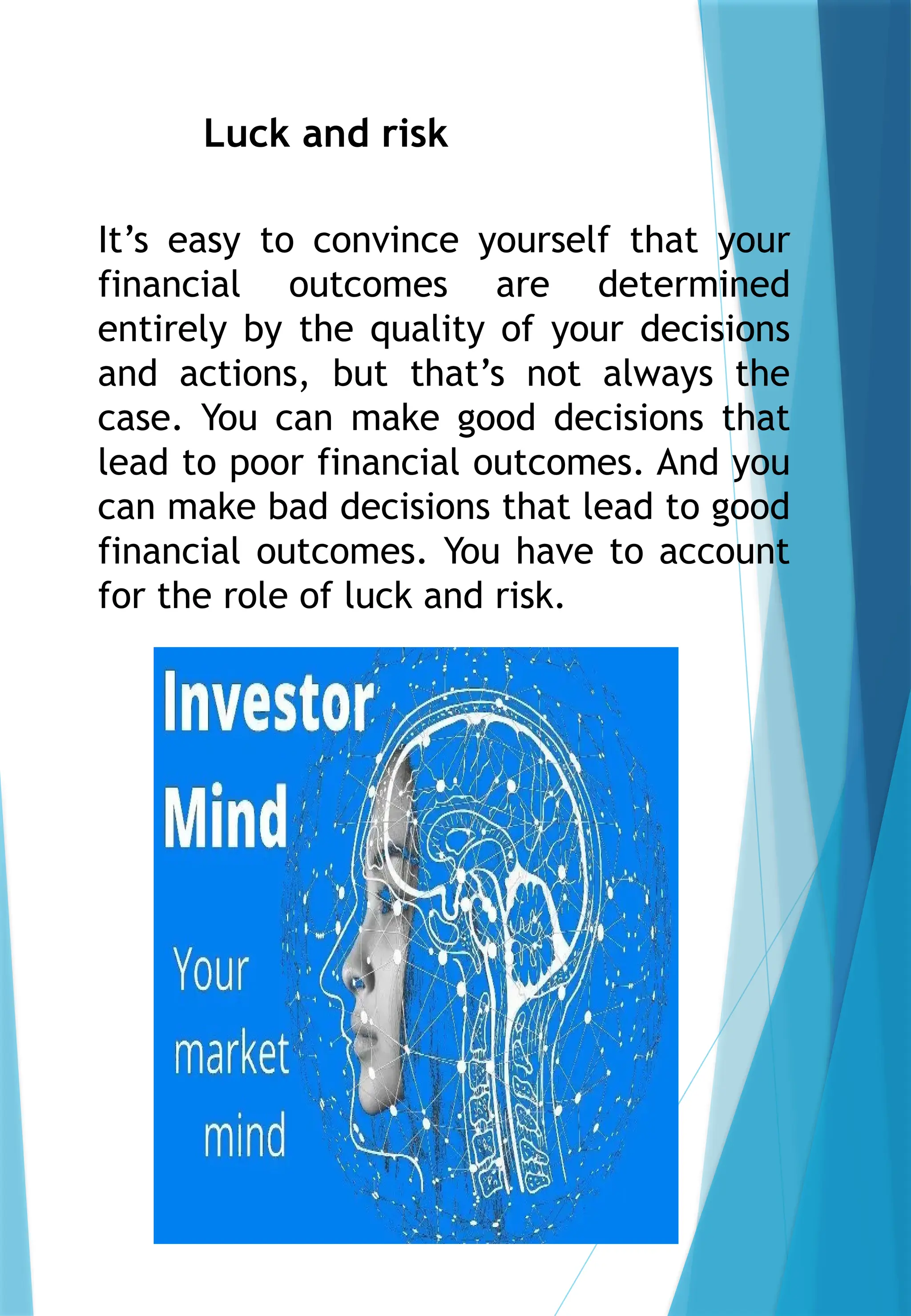
Luck and risk
It’s easy to convince yourself that your
financial outcomes are determined
entirely by the quality of your decisions
and actions, but that’s not always the
case. You can make good decisions that
lead to poor financial outcomes. And you
can make bad decisions that lead to good
financial outcomes. You have to account
for the role of luck and risk.
Lessons from Buffet
“There is no reason to risk what you have and
need for what you don’t have and don’t need.
– Warren Buffet
It’s easy to have a goalpost that keeps moving.
Once you achieve your goals, you look toward
the next goal. And the cycle never ends. This is
often driven by comparing yourself to others,
and you’re often comparing yourself to someone
who is above you in the ladder that you
benchmark yourself against.
When it comes to money, someone will always
have more of it than you. That’s okay. It’s fine
to pursue more money, but don’t start making
risky bets that put what you have at risk for
something that you don’t need.
Compounding is deceptively
powerful !!
(deceptively strong means he is actually strong but
doesn't appear to be )
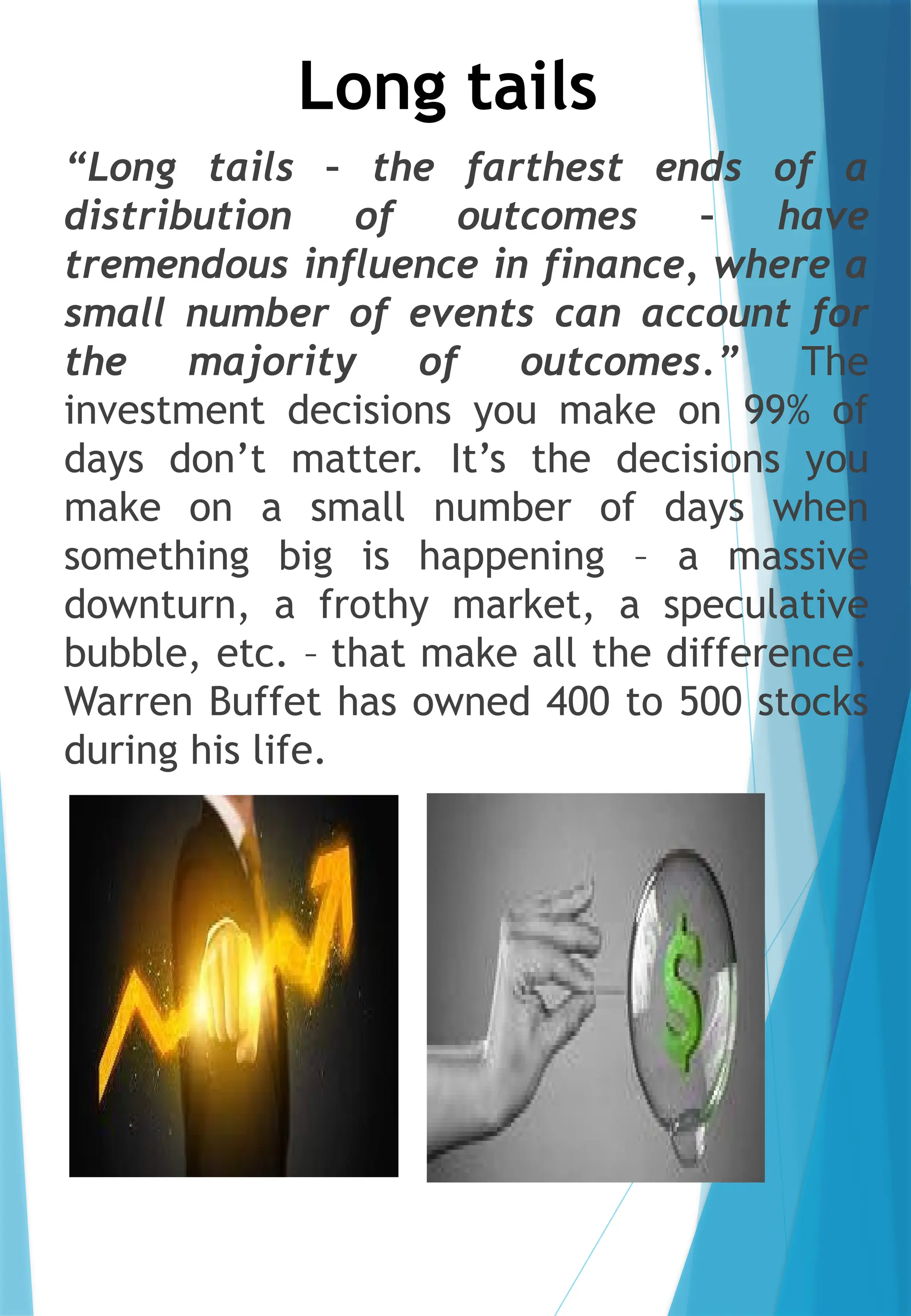
Long tails
“Long tails – the farthest ends of a
distribution of outcomes – have
tremendous influence in finance, where a
small number of events can account for
the majority of outcomes.” The
investment decisions you make on 99% of
days don’t matter. It’s the decisions you
make on a small number of days when
something big is happening – a massive
downturn, a frothy market, a speculative
bubble, etc. – that make all the difference.
Warren Buffet has owned 400 to 500 stocks
during his life.
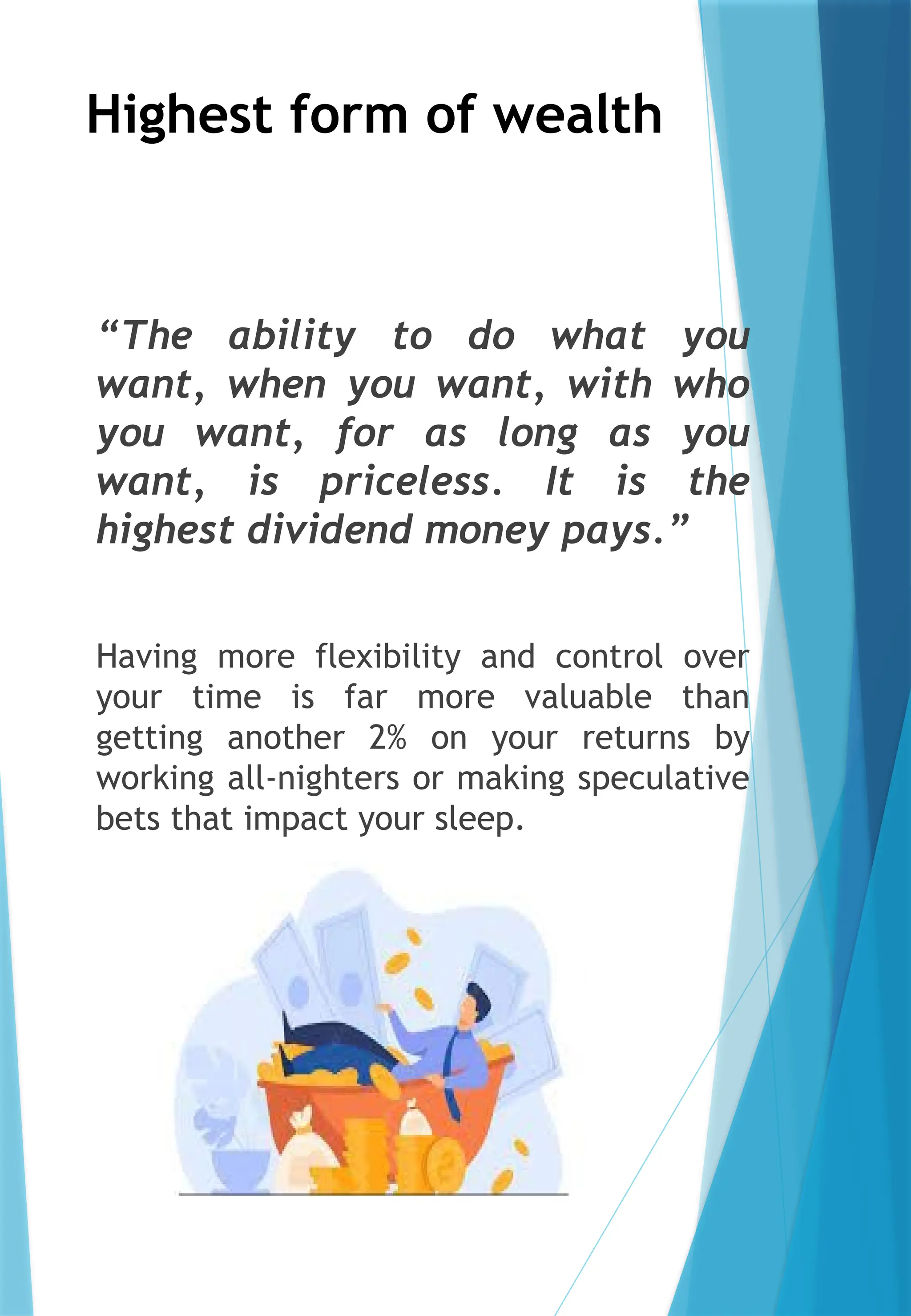
Highest form of wealth
“The ability to do what you
want, when you want, with who
you want, for as long as you
want, is priceless. It is the
highest dividend money pays.”
Having more flexibility and control over
your time is far more valuable than
getting another 2% on your returns by
working all-nighters or making speculative
bets that impact your sleep.
Ferraris Don’t
Generate Respect
People buy mansions and fancy cars because
they want respect and admiration from
others. What they don’t realize is that people
don’t admire the person with the fancy house
or car; they admire the object and think of
themselves having that object. So buying
impressive items to gain admiration and
respect from others is a fool’s pursuit – these
things can not be bought.
Being rich vs. wealthy
If you’re rich, you have a high current income.
But being wealthy is something different
– wealth is not visible. It’s the money that you
have that’s not spent. It’s the optionality to
buy or do something at a future time.
Being rich offers you opportunities in the short-
term, but being wealthy provides you the
flexibility of having more of the items you want
– freedom, time, possessions – in the future.
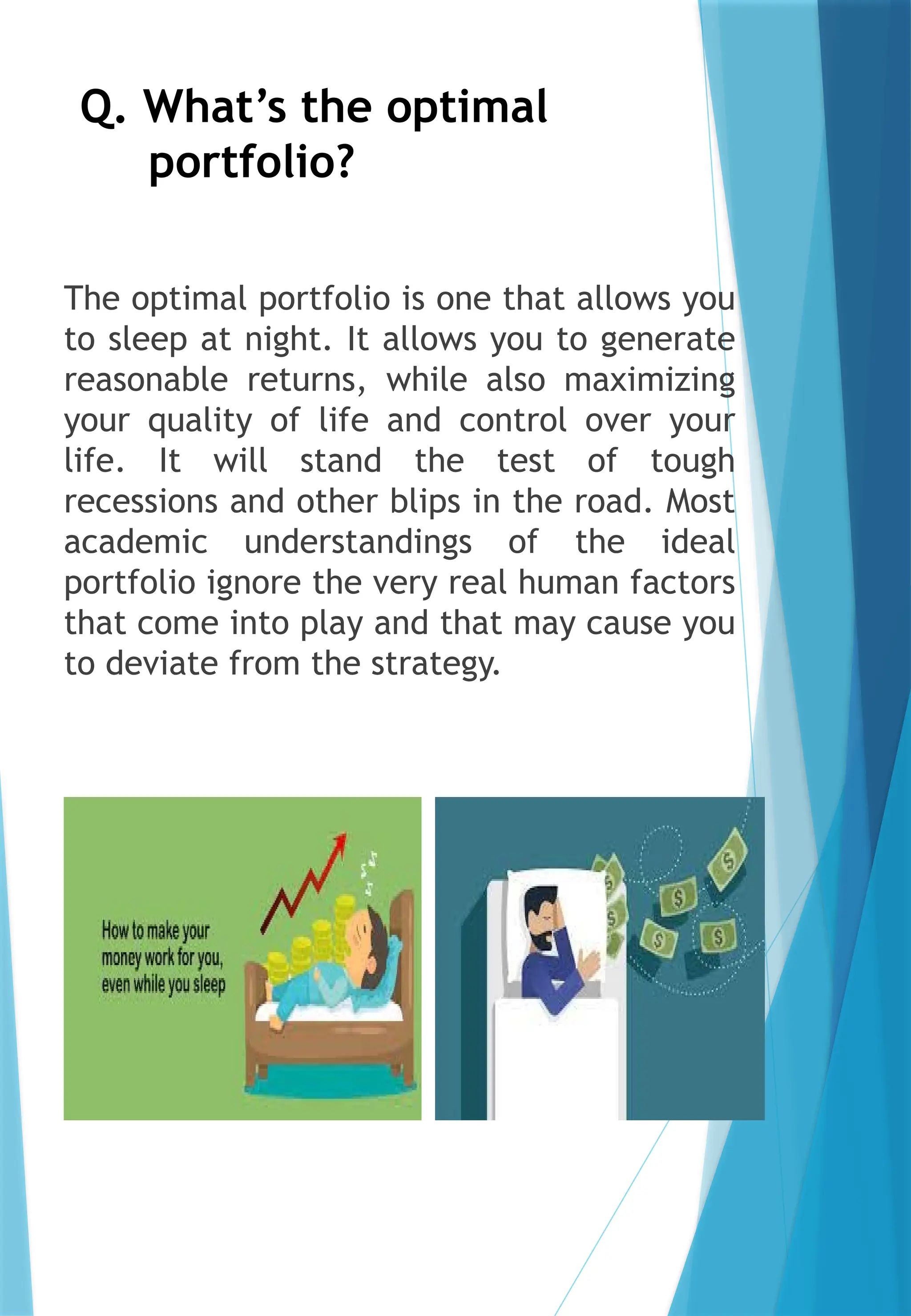
Q. What’s the optimal
portfolio?
The optimal portfolio is one that allows you
to sleep at night. It allows you to generate
reasonable returns, while also maximizing
your quality of life and control over your
life. It will stand the test of tough
recessions and other blips in the road. Most
academic understandings of the ideal
portfolio ignore the very real human factors
that come into play and that may cause you
to deviate from the strategy.
Q. What game are you
playing?
“Few things matter more with money than
understanding your own time horizon and not
being persuaded by the actions and behaviours
of people playing different games than you
are.”
If you have a buddy who’s making lots of money trading
short-term options and you start getting FOMO and want
to play that game, you really need to consider if that
aligns with your goals. If you have a 20-year time
horizon and like the simple nature of passive investing,
it would be stupid for you to start playing your buddy’s
game. You may be able to profit, but at what cost?
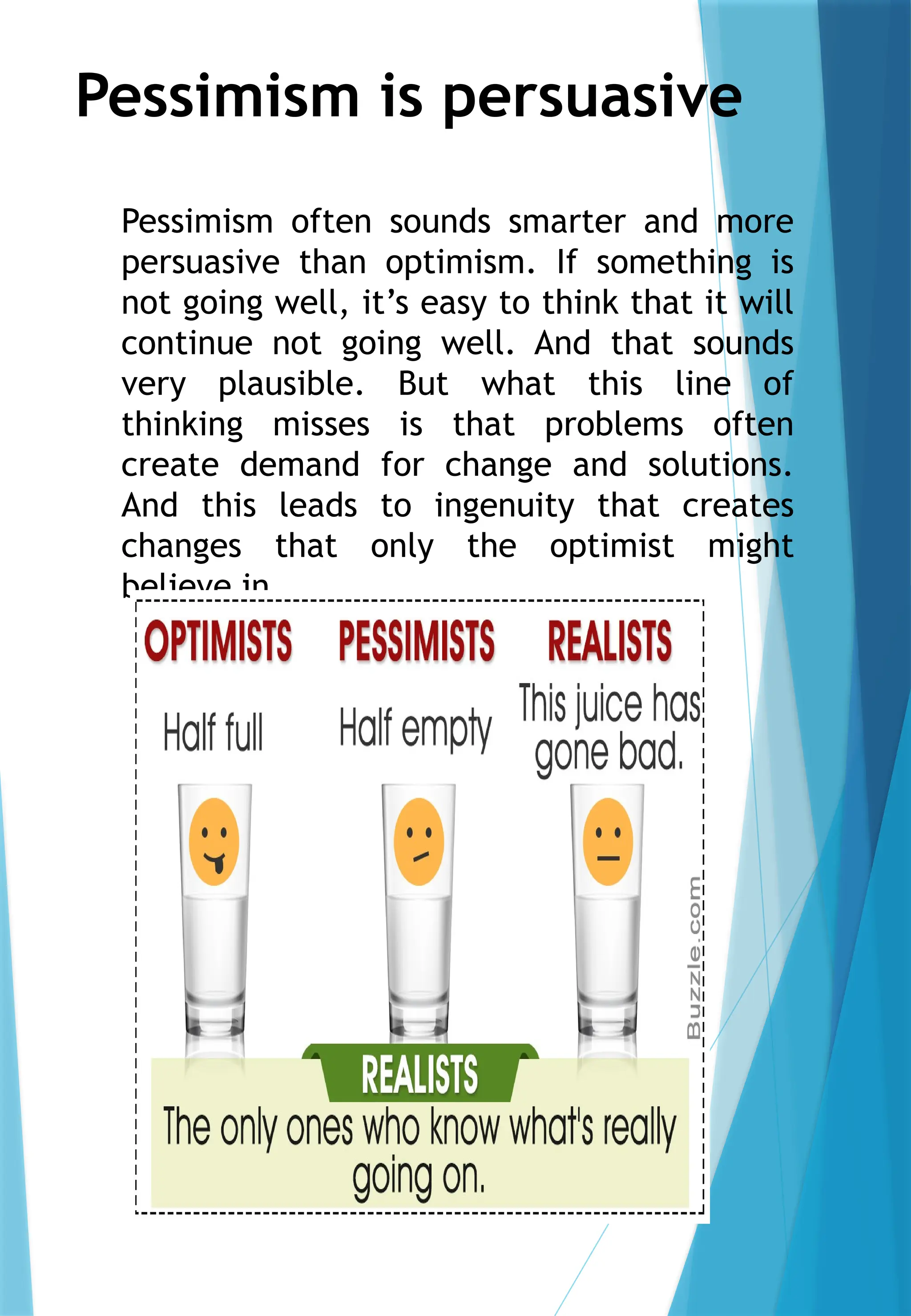
Pessimism is persuasive
Pessimism often sounds smarter and more
persuasive than optimism. If something is
not going well, it’s easy to think that it will
continue not going well. And that sounds
very plausible. But what this line of
thinking misses is that problems often
create demand for change and solutions.
And this leads to ingenuity that creates
changes that only the optimist might
believe in.
The problem with hindsight
When we look back at the past, we
create stories about why certain things
happened. And those stories make us
think that the world is understandable
and makes sense in some way.
The problem is that these stories may
be complete nonsense. What happened
may have been completely random, yet
our stories delude us into thinking that
there is some lesson we can learn to
better predict the future. Avoid the
illusion that you have full control in the
uncertain world in which we live.
Investment results
 If you evaluate how well you’ve done by
focusing on your individual investments,
versus your entire portfolio, you’ll
overestimate the brilliance of your
winners and feel too much regret about
your losers.
 Good decisions are not always rational.
Sometimes, you have to consider that
you’re an emotional creature that may
have different needs than an ROI-
optimizing model may suggest.
 If you can do everything you want
without trying to outperform the market,
then why try to outperform the market
and endure the price tag that this pursuit
requires?

ENGLSH PROJECT OF PSYCHOLOGY OF MONEY ABOUT INTRODUCTION

  • 1.
    MVN ARAVALI HILLS Name: Anmol Gupta Class : XII Subject : English project Topic : Book Review (THE PSYCHOLOGY OF MONEY)
  • 7.
    The Psychology ofMoney by Morgan Housel is a book about investing, personal finance and business decisions. Housel describes how financial decisions are typically taught as a math-based field, where data and formulas tell us exactly what to do. But in the real world, people don’t make financial decisions on a spreadsheet. They make them at the dinner table, or in a meeting room, where personal history, ego, pride, marketing and odd incentives are scrambled together. Housel provides examples that explore the strange ways people think about money and teaches you how to make better sense of one of life’s most important topics. Introduction
  • 8.
    Theory isn’t reality We arenot spreadsheets. As much as reading can inform us about what has happened in the past, like stock market crashes or how stocks have trended up and to the right over time, learning about something in a book is very different from actually experiencing the event. “The challenge for us is that no amount of studying or open- mindedness can genuinely recreate the power of fear and uncertainty.”
  • 9.
    Luck and risk It’seasy to convince yourself that your financial outcomes are determined entirely by the quality of your decisions and actions, but that’s not always the case. You can make good decisions that lead to poor financial outcomes. And you can make bad decisions that lead to good financial outcomes. You have to account for the role of luck and risk.
  • 10.
    Lessons from Buffet “Thereis no reason to risk what you have and need for what you don’t have and don’t need. – Warren Buffet It’s easy to have a goalpost that keeps moving. Once you achieve your goals, you look toward the next goal. And the cycle never ends. This is often driven by comparing yourself to others, and you’re often comparing yourself to someone who is above you in the ladder that you benchmark yourself against. When it comes to money, someone will always have more of it than you. That’s okay. It’s fine to pursue more money, but don’t start making risky bets that put what you have at risk for something that you don’t need. Compounding is deceptively powerful !! (deceptively strong means he is actually strong but doesn't appear to be )
  • 11.
    Long tails “Long tails– the farthest ends of a distribution of outcomes – have tremendous influence in finance, where a small number of events can account for the majority of outcomes.” The investment decisions you make on 99% of days don’t matter. It’s the decisions you make on a small number of days when something big is happening – a massive downturn, a frothy market, a speculative bubble, etc. – that make all the difference. Warren Buffet has owned 400 to 500 stocks during his life.
  • 12.
    Highest form ofwealth “The ability to do what you want, when you want, with who you want, for as long as you want, is priceless. It is the highest dividend money pays.” Having more flexibility and control over your time is far more valuable than getting another 2% on your returns by working all-nighters or making speculative bets that impact your sleep.
  • 13.
    Ferraris Don’t Generate Respect Peoplebuy mansions and fancy cars because they want respect and admiration from others. What they don’t realize is that people don’t admire the person with the fancy house or car; they admire the object and think of themselves having that object. So buying impressive items to gain admiration and respect from others is a fool’s pursuit – these things can not be bought.
  • 14.
    Being rich vs.wealthy If you’re rich, you have a high current income. But being wealthy is something different – wealth is not visible. It’s the money that you have that’s not spent. It’s the optionality to buy or do something at a future time. Being rich offers you opportunities in the short- term, but being wealthy provides you the flexibility of having more of the items you want – freedom, time, possessions – in the future.
  • 15.
    Q. What’s theoptimal portfolio? The optimal portfolio is one that allows you to sleep at night. It allows you to generate reasonable returns, while also maximizing your quality of life and control over your life. It will stand the test of tough recessions and other blips in the road. Most academic understandings of the ideal portfolio ignore the very real human factors that come into play and that may cause you to deviate from the strategy.
  • 16.
    Q. What gameare you playing? “Few things matter more with money than understanding your own time horizon and not being persuaded by the actions and behaviours of people playing different games than you are.” If you have a buddy who’s making lots of money trading short-term options and you start getting FOMO and want to play that game, you really need to consider if that aligns with your goals. If you have a 20-year time horizon and like the simple nature of passive investing, it would be stupid for you to start playing your buddy’s game. You may be able to profit, but at what cost?
  • 17.
    Pessimism is persuasive Pessimismoften sounds smarter and more persuasive than optimism. If something is not going well, it’s easy to think that it will continue not going well. And that sounds very plausible. But what this line of thinking misses is that problems often create demand for change and solutions. And this leads to ingenuity that creates changes that only the optimist might believe in.
  • 18.
    The problem withhindsight When we look back at the past, we create stories about why certain things happened. And those stories make us think that the world is understandable and makes sense in some way. The problem is that these stories may be complete nonsense. What happened may have been completely random, yet our stories delude us into thinking that there is some lesson we can learn to better predict the future. Avoid the illusion that you have full control in the uncertain world in which we live.
  • 19.
    Investment results  Ifyou evaluate how well you’ve done by focusing on your individual investments, versus your entire portfolio, you’ll overestimate the brilliance of your winners and feel too much regret about your losers.  Good decisions are not always rational. Sometimes, you have to consider that you’re an emotional creature that may have different needs than an ROI- optimizing model may suggest.  If you can do everything you want without trying to outperform the market, then why try to outperform the market and endure the price tag that this pursuit requires?