




BASC 2
Presented to : Madam Saira
Presented By: Anowra khan
Behavior Assessment System for Children-2
Authors
Cecil R. Reynolds & Randy W. Kamphaus
Cecil R. Reynolds is a professor of educational
psychology, neuroscience and a research scholar
at Texas A & M university.
Randy W. Kamphaus is a distinguished research
professor and HOD of educational psychology at
the university of Georgia.
INTRODUCTION
• BASC was conceptualized in 1985.
• Need for services for children with emotional and
behavioral difficulties had increased.
• The BASC was published in 1992.
• The BASC-2 was published in 2004.
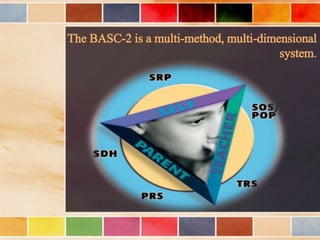
The BASC-2 is a multi-method, multi-dimensional
system.
The BASC-2 is multi-dimensional in that it measures
numerous aspects of behavior and personality, including
positive (Adaptive) as well as negative (Clinical) dimensions.
The BASC-2 is multi-method in that it has the
following five components which may be used
individually or in any combination:
•Two rating scales, one for teachers (Teacher Rating Scale or
TRS) and one for parents (Parent Rating Scale or PRS),
which gather descriptions of the child’s observable behavior,
each divided in to age appropriate forms.
• A self-report scale (self-report of personality or SRP), on
which the child or young adult can describe his or her
emotions and self-perceptions.
•A structured developmental history (SDH) form.
•A form for recording and classifying directly observed
classroom behavior (Student Observation System, or SOS).
STRUCTURED DEVELOPMENT
HISTORY
can be an important element of any
comprehensive evaluation
provides a thorough review of social,
psychological, developmental,
educational, and medical information
about the subject that may influence
diagnosis and treatment
 It can be used as :
Structured interview with a parent or a
person with similar role
questionnaire
STRUCTURED DEVELOPMENT HISTORY (SDH):
• 20 other history forms were reviewed in developing this
instrument.
• It can be used as a structured interview with parent or
guardian.
• It can be used as a questionnaire that can be filled out in the
clinician’s office or school or sent home for completion.
Theoretical Explanation
The content scales are based
on theories of behaviorism.
The BASC represents the
blend of traditional behavioral
methods and contemporary
cognitive approaches. The
scales are made on symptoms
of disorders addressed in DSM
criteria. According to authors,
the BASC-2 was developed
using content that came from
teachers, parents, children,
and psychologists.
Purpose of the test
The BASC was designed to facilitate the differential diagnosis
and educational classification of a variety of emotional and
behavioral disorders of children and to aid in the design of
treatment plans. The BASC uses in various settings:
Clinical Diagnosis:
•Helps in the diagnosis of disorders that are usually first appear
in childhood or adolescence.
• It assesses variety of symptoms that are noted in the DSM-IV-
TR.
It is highly desirable be linked clearly to intervention.
Educational setting:
It is designed to be sensitive to numerous presenting problems in
the classroom, including deficiencies in social skills, study skills,
or adaptive skills.
• The BASC is also useful for assessing severe emotional
disturbance.
• The rating scales can help to distinguish between children
with conduct disorders or social maladjustment.
• It can be used in forensic evaluation and to evaluate
behavioral status of children with sensory impairment.
• The SDH provides a thorough review of social,
psychological, developmental, educational, and medical
information about a child that may influence diagnosis and
treatment.
• Information on date of onset and chronicity is not
documented by rating scales, but is easily obtained from the
SDH in conjunction with follow-up questioning.
• The TRS assesses the broad domains of externalizing
problems, internalizing problems, and school problems, and
also measures adaptive skills.
Psychometrics Of The Test
Norms:
• Age ranges from 2 to 25 years.
• The representative sample was sample of children across United
states.
• The sample was designed to resemble the population with
respect to sex, SES, race/ ethnicity, geographic region, and
classification in special education or gifted/ talented programs.
• The general norm samples included a total more than 13,000
TRS, PRS and SRP cases from the ages of 2 through 18 years.
Bio- data of the subject:
Name: Z.A
Age: 8yrs
Gender: female
Education: Grade 2
Psychological history: nil
Procedure:
•Structured Developmental History
Results
Structured developmental history:
The SDH form gives following information about the subject
• parents
• family history
• pregnancy
• developmental history
• medical history
• social history
• personal history
• behavior / temperament
• educational history
References
Reynolds, C.R. & Kamphaus, R.W. (2003). Handbook of
psychological and educational assessment of children, 2/e:
personality, behavior, and context. Guilford press: New York
London.
Reynolds, C.R. & Kamphaus, R.W. (2004). Behavior Assessment
system for children: Manual (2nd ed.). Toronto, Canada :
Pearson.

Behavior assessment system for children (BASC)

  • 1.
    BASC 2 Presented to: Madam Saira Presented By: Anowra khan
  • 2.
    Behavior Assessment Systemfor Children-2 Authors Cecil R. Reynolds & Randy W. Kamphaus
  • 3.
    Cecil R. Reynoldsis a professor of educational psychology, neuroscience and a research scholar at Texas A & M university. Randy W. Kamphaus is a distinguished research professor and HOD of educational psychology at the university of Georgia. INTRODUCTION
  • 4.
    • BASC wasconceptualized in 1985. • Need for services for children with emotional and behavioral difficulties had increased. • The BASC was published in 1992. • The BASC-2 was published in 2004.
  • 5.
    The BASC-2 isa multi-method, multi-dimensional system.
  • 6.
    The BASC-2 ismulti-dimensional in that it measures numerous aspects of behavior and personality, including positive (Adaptive) as well as negative (Clinical) dimensions. The BASC-2 is multi-method in that it has the following five components which may be used individually or in any combination: •Two rating scales, one for teachers (Teacher Rating Scale or TRS) and one for parents (Parent Rating Scale or PRS), which gather descriptions of the child’s observable behavior, each divided in to age appropriate forms. • A self-report scale (self-report of personality or SRP), on which the child or young adult can describe his or her emotions and self-perceptions. •A structured developmental history (SDH) form. •A form for recording and classifying directly observed classroom behavior (Student Observation System, or SOS).
  • 7.
    STRUCTURED DEVELOPMENT HISTORY can bean important element of any comprehensive evaluation provides a thorough review of social, psychological, developmental, educational, and medical information about the subject that may influence diagnosis and treatment
  • 8.
     It canbe used as : Structured interview with a parent or a person with similar role questionnaire
  • 10.
    STRUCTURED DEVELOPMENT HISTORY(SDH): • 20 other history forms were reviewed in developing this instrument. • It can be used as a structured interview with parent or guardian. • It can be used as a questionnaire that can be filled out in the clinician’s office or school or sent home for completion.
  • 11.
    Theoretical Explanation The contentscales are based on theories of behaviorism. The BASC represents the blend of traditional behavioral methods and contemporary cognitive approaches. The scales are made on symptoms of disorders addressed in DSM criteria. According to authors, the BASC-2 was developed using content that came from teachers, parents, children, and psychologists.
  • 12.
    Purpose of thetest The BASC was designed to facilitate the differential diagnosis and educational classification of a variety of emotional and behavioral disorders of children and to aid in the design of treatment plans. The BASC uses in various settings: Clinical Diagnosis: •Helps in the diagnosis of disorders that are usually first appear in childhood or adolescence. • It assesses variety of symptoms that are noted in the DSM-IV- TR. It is highly desirable be linked clearly to intervention. Educational setting: It is designed to be sensitive to numerous presenting problems in the classroom, including deficiencies in social skills, study skills, or adaptive skills.
  • 13.
    • The BASCis also useful for assessing severe emotional disturbance. • The rating scales can help to distinguish between children with conduct disorders or social maladjustment. • It can be used in forensic evaluation and to evaluate behavioral status of children with sensory impairment. • The SDH provides a thorough review of social, psychological, developmental, educational, and medical information about a child that may influence diagnosis and treatment. • Information on date of onset and chronicity is not documented by rating scales, but is easily obtained from the SDH in conjunction with follow-up questioning. • The TRS assesses the broad domains of externalizing problems, internalizing problems, and school problems, and also measures adaptive skills.
  • 14.
    Psychometrics Of TheTest Norms: • Age ranges from 2 to 25 years. • The representative sample was sample of children across United states. • The sample was designed to resemble the population with respect to sex, SES, race/ ethnicity, geographic region, and classification in special education or gifted/ talented programs. • The general norm samples included a total more than 13,000 TRS, PRS and SRP cases from the ages of 2 through 18 years.
  • 15.
    Bio- data ofthe subject: Name: Z.A Age: 8yrs Gender: female Education: Grade 2 Psychological history: nil Procedure: •Structured Developmental History
  • 16.
    Results Structured developmental history: TheSDH form gives following information about the subject • parents • family history • pregnancy • developmental history • medical history • social history • personal history • behavior / temperament • educational history
  • 17.
    References Reynolds, C.R. &Kamphaus, R.W. (2003). Handbook of psychological and educational assessment of children, 2/e: personality, behavior, and context. Guilford press: New York London. Reynolds, C.R. & Kamphaus, R.W. (2004). Behavior Assessment system for children: Manual (2nd ed.). Toronto, Canada : Pearson.