Anglo-Saxon
and
Beowulf
Background
Background Information
• 30,000 lines of Anglo-Saxon poetry survive today
• 3, 182 (10%) of the lines are from Beowulf
• Setting - Denmark and Sweden
• Author - Unknown, probably a monk
• Composed in the 7th or 8th century
• Oldest surviving English poem
Anglo-Saxon Culture
• Belief in fate (Wyrd)
• Accumulated treasures amount to success
• Fame and fortune zealously sought after
• Loyalty to one’s leader crucial
• Importance of pagan, Germanic, and Christian ideals to people
whose lives were often hard and uncertain
Anglo-Saxon Culture
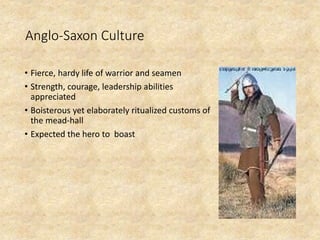
• Fierce, hardy life of warrior and seamen
• Strength, courage, leadership abilities
appreciated
• Boisterous yet elaborately ritualized customs of
the mead-hall
• Expected the hero to boast
Anglo-Saxon Ideals
Codes of Conduct
• Good defeats evil
• Wergild--restitution for murder or expect revenge from victim’s
relatives
• Boasts must be backed with actions.
• Fate is in control
• Fair fights are the only honorable fights
Epic Poem
• Long narrative poem that recounts the adventures of a hero.
• Elevated language
• Does not sermonize
• Invokes a muse
• Begins in media res
• Mysterious origin, super powers, vulnerability, rite of passage
The Epic Hero
•Actions consist of responses to catastrophic
situations in which the supernatural often
intervenes.
•Code of conduct forces him to challenge any threat
to society
•Destiny discovered through a series of episodes
punctuated by violent incidents interspersed with
idyllic descriptions.
Elements of Anglo-Saxon Poetry
•Chant-like effect of the four-beat line
•Alliteration (“Then the grim man in green gathers
his strength”)
•Caesura-pause or break in a line of poetry
(“Oft to the wanderer weary of exile”)
•Kenning-metaphorical phrase used instead of a
name (“battle-blade” and “ring-giver”)
•Epithet-description name to characterize
something (“keen-edge sword”)
•Hyperbole-exaggeration
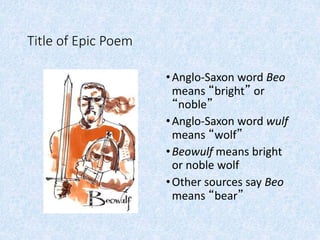
Title of Epic Poem
•Anglo-Saxon word Beo
means “bright” or
“noble”
•Anglo-Saxon word wulf
means “wolf”
•Beowulf means bright
or noble wolf
•Other sources say Beo
means “bear”
How we date Beowulf
Some Important Dates:
521 A.D. – death of Hygelac, who is
mentioned in the poem
680 A.D. – appearance of alliterative verse
835 A.D. – the Danish started raiding other
areas; after this, few poets would
consider them heroes
SO: This version was likely composed between
680 and 835, though it may be set earlier
The Poetry in Beowulf
1. Alliterative verse
a. Repetition of initial sounds of words
(occurs in every line)
b. Generally, four feet/beats per line
c. A caesura, or pause, between
beats two and four
d. No rhyme
The Poetry in Beowulf
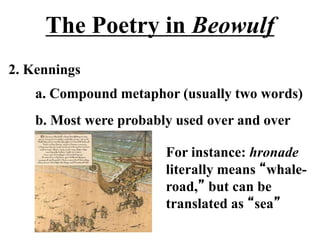
2. Kennings
a. Compound metaphor (usually two words)
b. Most were probably used over and over
For instance: hronade
literally means “whale-
road,” but can be
translated as “sea”
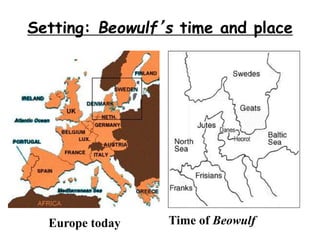
Setting: Beowulf’s time and place
Europe today Time of Beowulf
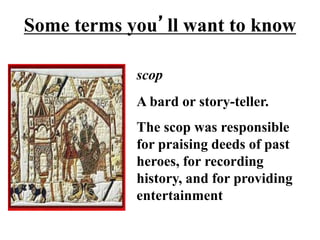
Some terms you’ll want to know
scop
A bard or story-teller.
The scop was responsible
for praising deeds of past
heroes, for recording
history, and for providing
entertainment
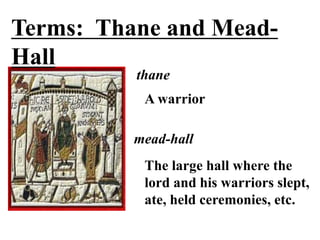
thane
A warrior
mead-hall
The large hall where the
lord and his warriors slept,
ate, held ceremonies, etc.
Terms: Thane and Mead-
Hall
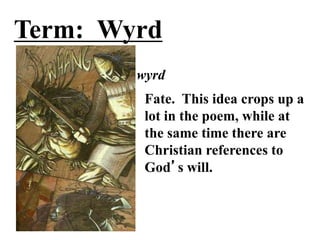
wyrd
Fate. This idea crops up a
lot in the poem, while at
the same time there are
Christian references to
God’s will.
Term: Wyrd
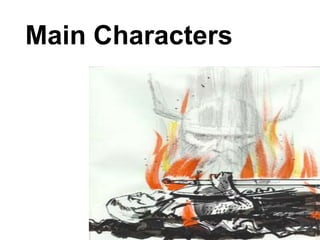
Main Characters
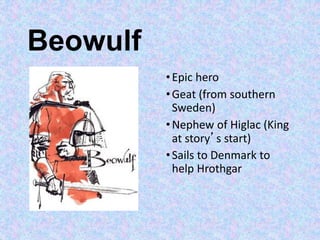
Beowulf
•Epic hero
•Geat (from southern
Sweden)
•Nephew of Higlac (King
at story’s start)
•Sails to Denmark to
help Hrothgar
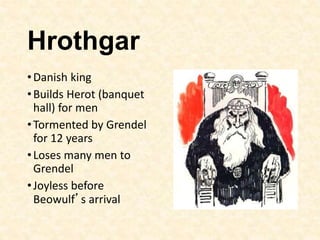
Hrothgar
•Danish king
•Builds Herot (banquet
hall) for men
•Tormented by Grendel
for 12 years
•Loses many men to
Grendel
•Joyless before
Beowulf’s arrival
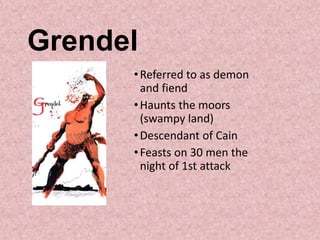
Grendel
•Referred to as demon
and fiend
•Haunts the moors
(swampy land)
•Descendant of Cain
•Feasts on 30 men the
night of 1st attack
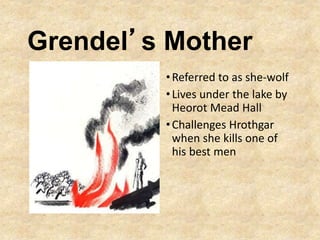
Grendel’s Mother
•Referred to as she-wolf
•Lives under the lake by
Heorot Mead Hall
•Challenges Hrothgar
when she kills one of
his best men
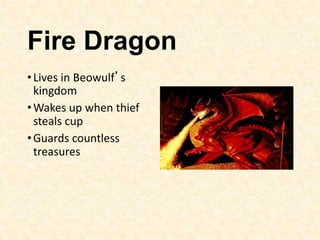
Fire Dragon
•Lives in Beowulf’s
kingdom
•Wakes up when thief
steals cup
•Guards countless
treasures
Anglo-Saxon word play
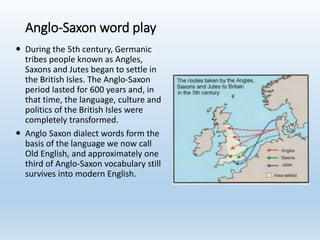
 During the 5th century, Germanic
tribes people known as Angles,
Saxons and Jutes began to settle in
the British Isles. The Anglo-Saxon
period lasted for 600 years and, in
that time, the language, culture and
politics of the British Isles were
completely transformed.
 Anglo Saxon dialect words form the
basis of the language we now call
Old English, and approximately one
third of Anglo-Saxon vocabulary still
survives into modern English.
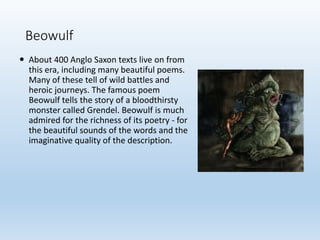
Beowulf
 About 400 Anglo Saxon texts live on from
this era, including many beautiful poems.
Many of these tell of wild battles and
heroic journeys. The famous poem
Beowulf tells the story of a bloodthirsty
monster called Grendel. Beowulf is much
admired for the richness of its poetry - for
the beautiful sounds of the words and the
imaginative quality of the description.
Kennings
• About a third of the words in Beowulf are words known as kennings.
Kennings are words that are in themselves metaphorical
descriptions, and were a typical feature of Anglo Saxon poetry.
• Kennings combine two words to create an evocative and imaginative
alternative word. By linking words in this way, the poets were able
to play and experiment with the rhythm, sounds and imagery of the
poetry. Beowulf contains over a thousand kennings.
In off the moors, down through the mist-bands
God-cursed Grendel came greedily loping.
The bane of the race of men roamed forth,
hunting for a prey in the high hall.
Under the cloud-murk he moved towards it
until it shone above him, a sheer keep
of fortified gold. Nor was that the first time
he had scouted the grounds of Hrothgar's dwelling -
although never in his life, before or since,
did he find harder fortune or hall-defenders.
Spurned and joyless, he journeyed on ahead
and arrived at the bawn. The iron-braced door
turned on its hinge when his hands touched it.
From Seamus Heaney’s translation of ‘Beowulf’
 Some well-known Anglo-Saxon kennings include:
 bone-house (banhus ) - the human body
 battle-light (beadoleoma) - sword
 wave-floater (wægflota) – ship
 Descriptions of the sea included:
 whale road (hronrad)
 fish home (fiscesethel)
 seal bath (seolbæp)
Kennings
• Try to create some kennings. See if you can describe yourself or your
home or school using this technique.
• Consider:
• How do the kennings help you describe what you're trying to say?
• Do they affect the rhythm and the sound of the language?
• Do you find this technique easier/ more creative/ harder/ more confusing or
more powerful than using everyday words?
Create your own

intro_to_beowulf-2.ppt

  • 1.
  • 2.
    Background Information • 30,000lines of Anglo-Saxon poetry survive today • 3, 182 (10%) of the lines are from Beowulf • Setting - Denmark and Sweden • Author - Unknown, probably a monk • Composed in the 7th or 8th century • Oldest surviving English poem
  • 3.
    Anglo-Saxon Culture • Beliefin fate (Wyrd) • Accumulated treasures amount to success • Fame and fortune zealously sought after • Loyalty to one’s leader crucial • Importance of pagan, Germanic, and Christian ideals to people whose lives were often hard and uncertain
  • 4.
    Anglo-Saxon Culture • Fierce,hardy life of warrior and seamen • Strength, courage, leadership abilities appreciated • Boisterous yet elaborately ritualized customs of the mead-hall • Expected the hero to boast
  • 5.
    Anglo-Saxon Ideals Codes ofConduct • Good defeats evil • Wergild--restitution for murder or expect revenge from victim’s relatives • Boasts must be backed with actions. • Fate is in control • Fair fights are the only honorable fights
  • 6.
    Epic Poem • Longnarrative poem that recounts the adventures of a hero. • Elevated language • Does not sermonize • Invokes a muse • Begins in media res • Mysterious origin, super powers, vulnerability, rite of passage
  • 7.
    The Epic Hero •Actionsconsist of responses to catastrophic situations in which the supernatural often intervenes. •Code of conduct forces him to challenge any threat to society •Destiny discovered through a series of episodes punctuated by violent incidents interspersed with idyllic descriptions.
  • 8.
    Elements of Anglo-SaxonPoetry •Chant-like effect of the four-beat line •Alliteration (“Then the grim man in green gathers his strength”) •Caesura-pause or break in a line of poetry (“Oft to the wanderer weary of exile”) •Kenning-metaphorical phrase used instead of a name (“battle-blade” and “ring-giver”) •Epithet-description name to characterize something (“keen-edge sword”) •Hyperbole-exaggeration
  • 9.
    Title of EpicPoem •Anglo-Saxon word Beo means “bright” or “noble” •Anglo-Saxon word wulf means “wolf” •Beowulf means bright or noble wolf •Other sources say Beo means “bear”
  • 10.
    How we dateBeowulf Some Important Dates: 521 A.D. – death of Hygelac, who is mentioned in the poem 680 A.D. – appearance of alliterative verse 835 A.D. – the Danish started raiding other areas; after this, few poets would consider them heroes SO: This version was likely composed between 680 and 835, though it may be set earlier
  • 11.
    The Poetry inBeowulf 1. Alliterative verse a. Repetition of initial sounds of words (occurs in every line) b. Generally, four feet/beats per line c. A caesura, or pause, between beats two and four d. No rhyme
  • 12.
    The Poetry inBeowulf 2. Kennings a. Compound metaphor (usually two words) b. Most were probably used over and over For instance: hronade literally means “whale- road,” but can be translated as “sea”
  • 13.
    Setting: Beowulf’s timeand place Europe today Time of Beowulf
  • 14.
    Some terms you’llwant to know scop A bard or story-teller. The scop was responsible for praising deeds of past heroes, for recording history, and for providing entertainment
  • 15.
    thane A warrior mead-hall The largehall where the lord and his warriors slept, ate, held ceremonies, etc. Terms: Thane and Mead- Hall
  • 16.
    wyrd Fate. This ideacrops up a lot in the poem, while at the same time there are Christian references to God’s will. Term: Wyrd
  • 17.
  • 18.
    Beowulf •Epic hero •Geat (fromsouthern Sweden) •Nephew of Higlac (King at story’s start) •Sails to Denmark to help Hrothgar
  • 19.
    Hrothgar •Danish king •Builds Herot(banquet hall) for men •Tormented by Grendel for 12 years •Loses many men to Grendel •Joyless before Beowulf’s arrival
  • 20.
    Grendel •Referred to asdemon and fiend •Haunts the moors (swampy land) •Descendant of Cain •Feasts on 30 men the night of 1st attack
  • 21.
    Grendel’s Mother •Referred toas she-wolf •Lives under the lake by Heorot Mead Hall •Challenges Hrothgar when she kills one of his best men
  • 22.
    Fire Dragon •Lives inBeowulf’s kingdom •Wakes up when thief steals cup •Guards countless treasures
  • 23.
    Anglo-Saxon word play During the 5th century, Germanic tribes people known as Angles, Saxons and Jutes began to settle in the British Isles. The Anglo-Saxon period lasted for 600 years and, in that time, the language, culture and politics of the British Isles were completely transformed.  Anglo Saxon dialect words form the basis of the language we now call Old English, and approximately one third of Anglo-Saxon vocabulary still survives into modern English.
  • 24.
    Beowulf  About 400Anglo Saxon texts live on from this era, including many beautiful poems. Many of these tell of wild battles and heroic journeys. The famous poem Beowulf tells the story of a bloodthirsty monster called Grendel. Beowulf is much admired for the richness of its poetry - for the beautiful sounds of the words and the imaginative quality of the description.
  • 25.
    Kennings • About athird of the words in Beowulf are words known as kennings. Kennings are words that are in themselves metaphorical descriptions, and were a typical feature of Anglo Saxon poetry. • Kennings combine two words to create an evocative and imaginative alternative word. By linking words in this way, the poets were able to play and experiment with the rhythm, sounds and imagery of the poetry. Beowulf contains over a thousand kennings.
  • 26.
    In off themoors, down through the mist-bands God-cursed Grendel came greedily loping. The bane of the race of men roamed forth, hunting for a prey in the high hall. Under the cloud-murk he moved towards it until it shone above him, a sheer keep of fortified gold. Nor was that the first time he had scouted the grounds of Hrothgar's dwelling - although never in his life, before or since, did he find harder fortune or hall-defenders. Spurned and joyless, he journeyed on ahead and arrived at the bawn. The iron-braced door turned on its hinge when his hands touched it. From Seamus Heaney’s translation of ‘Beowulf’
  • 27.
     Some well-knownAnglo-Saxon kennings include:  bone-house (banhus ) - the human body  battle-light (beadoleoma) - sword  wave-floater (wægflota) – ship  Descriptions of the sea included:  whale road (hronrad)  fish home (fiscesethel)  seal bath (seolbæp) Kennings
  • 28.
    • Try tocreate some kennings. See if you can describe yourself or your home or school using this technique. • Consider: • How do the kennings help you describe what you're trying to say? • Do they affect the rhythm and the sound of the language? • Do you find this technique easier/ more creative/ harder/ more confusing or more powerful than using everyday words? Create your own