A Simple C++Program
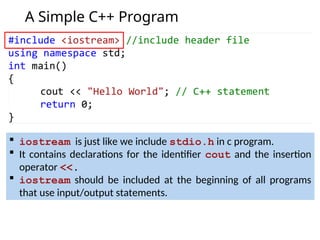
iostream is just like we include stdio.h in c program.
It contains declarations for the identifier cout and the insertion
operator <<.
iostream should be included at the beginning of all programs
that use input/output statements.
3.
A Simple C++Program (Cont…)
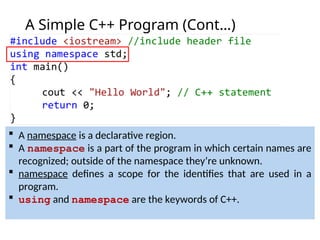
A namespace is a declarative region.
A namespace is a part of the program in which certain names are
recognized; outside of the namespace they’re unknown.
namespace defines a scope for the identifies that are used in a
program.
using and namespace are the keywords of C++.
4.
A Simple C++Program (Cont…)
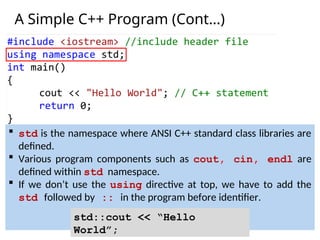
std is the namespace where ANSI C++ standard class libraries are
defined.
Various program components such as cout, cin, endl are
defined within std namespace.
If we don’t use the using directive at top, we have to add the
std followed by :: in the program before identifier.
std::cout << “Hello
World”;
5.
A Simple C++Program (Cont…)
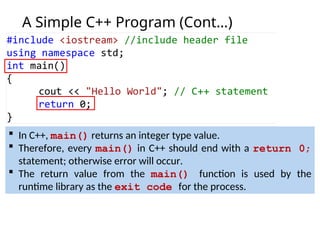
In C++, main() returns an integer type value.
Therefore, every main() in C++ should end with a return 0;
statement; otherwise error will occur.
The return value from the main() function is used by the
runtime library as the exit code for the process.
6.
Insertion Operator <<
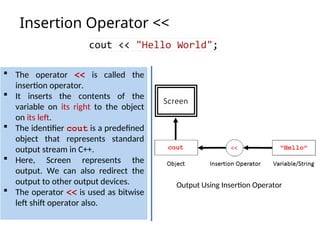
The operator << is called the
insertion operator.
It inserts the contents of the
variable on its right to the object
on its left.
The identifier cout is a predefined
object that represents standard
output stream in C++.
Here, Screen represents the
output. We can also redirect the
output to other output devices.
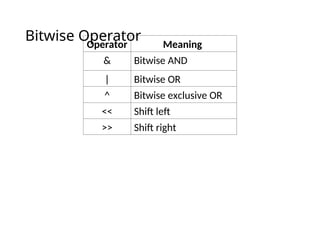
The operator << is used as bitwise
left shift operator also.
Output Using Insertion Operator
7.
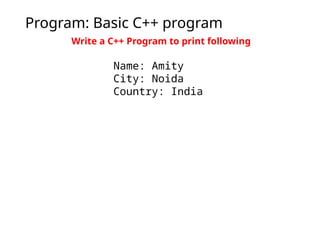
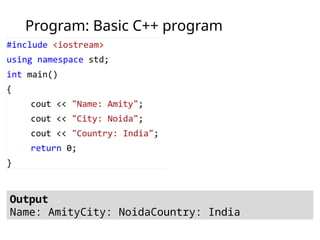
Program: Basic C++program
Write a C++ Program to print following
Name: Amity
City: Noida
Country: India
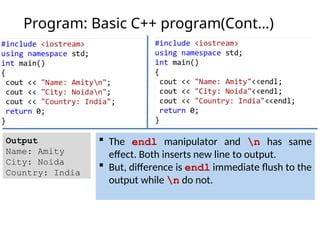
Program: Basic C++program(Cont…)
Output
Name: Amity
City: Noida
Country: India
The endl manipulator and n has same
effect. Both inserts new line to output.
But, difference is endl immediate flush to the
output while n do not.
10.
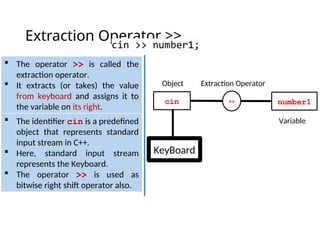
Extraction Operator >>
The identifier cin is a predefined
object that represents standard
input stream in C++.
Here, standard input stream
represents the Keyboard.
The operator >> is used as
bitwise right shift operator also.
The operator >> is called the
extraction operator.
It extracts (or takes) the value
from keyboard and assigns it to
the variable on its right.
KeyBoard
cin number1
Object Extraction Operator
Variable
>>
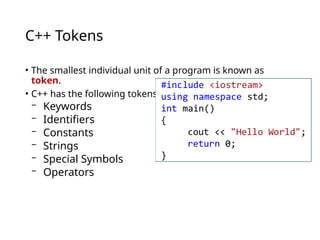
C++ Tokens
• Thesmallest individual unit of a program is known as
token.
• C++ has the following tokens:
− Keywords
− Identifiers
− Constants
− Strings
− Special Symbols
− Operators
14.
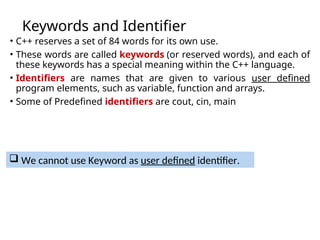
Keywords and Identifier
•C++ reserves a set of 84 words for its own use.
• These words are called keywords (or reserved words), and each of
these keywords has a special meaning within the C++ language.
• Identifiers are names that are given to various user defined
program elements, such as variable, function and arrays.
• Some of Predefined identifiers are cout, cin, main
We cannot use Keyword as user defined identifier.
15.
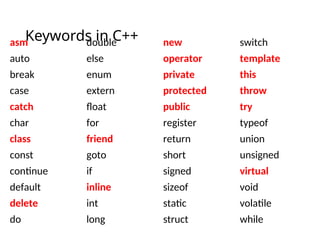
Keywords in C++
asmdouble new switch
auto else operator template
break enum private this
case extern protected throw
catch float public try
char for register typeof
class friend return union
const goto short unsigned
continue if signed virtual
default inline sizeof void
delete int static volatile
do long struct while
16.
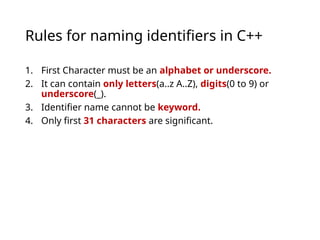
Rules for namingidentifiers in C++
1. First Character must be an alphabet or underscore.
2. It can contain only letters(a..z A..Z), digits(0 to 9) or
underscore(_).
3. Identifier name cannot be keyword.
4. Only first 31 characters are significant.
17.
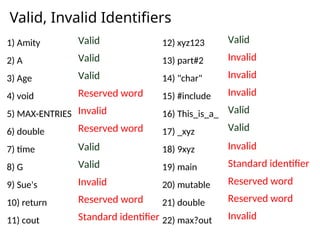
Valid, Invalid Identifiers
1)Amity
2) A
3) Age
4) void
5) MAX-ENTRIES
6) double
7) time
8) G
9) Sue's
10) return
11) cout
12) xyz123
13) part#2
14) "char"
15) #include
16) This_is_a_
17) _xyz
18) 9xyz
19) main
20) mutable
21) double
22) max?out
Valid
Valid
Valid
Reserved word
Invalid
Reserved word
Valid
Valid
Invalid
Reserved word
Standard identifier
Valid
Invalid
Invalid
Invalid
Valid
Valid
Invalid
Standard identifier
Reserved word
Reserved word
Invalid
18.
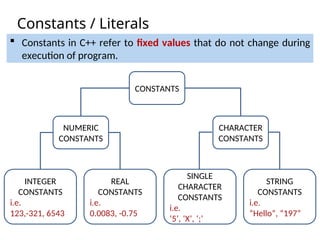
Constants / Literals
Constants in C++ refer to fixed values that do not change during
execution of program.
CONSTANTS
INTEGER
CONSTANTS
i.e.
123,-321, 6543
REAL
CONSTANTS
i.e.
0.0083, -0.75
NUMERIC
CONSTANTS
SINGLE
CHARACTER
CONSTANTS
i.e.
‘5’, ‘X’, ‘;’
STRING
CONSTANTS
i.e.
“Hello”, “197”
CHARACTER
CONSTANTS
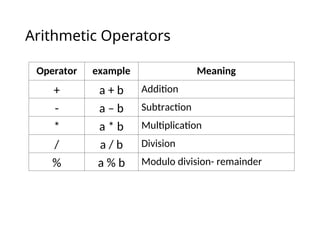
Arithmetic Operators
Operator exampleMeaning
+ a + b Addition
- a – b Subtraction
* a * b Multiplication
/ a / b Division
% a % b Modulo division- remainder
22.
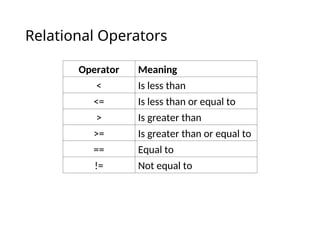
Relational Operators
Operator Meaning
<Is less than
<= Is less than or equal to
> Is greater than
>= Is greater than or equal to
== Equal to
!= Not equal to
23.
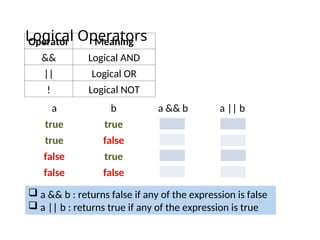
Logical Operators
Operator Meaning
&&Logical AND
|| Logical OR
! Logical NOT
a b a && b a || b
true true true true
true false false true
false true false true
false false false false
a && b : returns false if any of the expression is false
a || b : returns true if any of the expression is true
24.
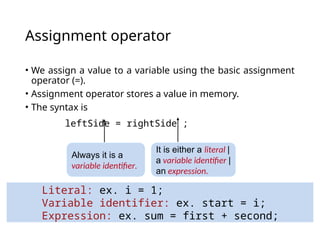
Assignment operator
• Weassign a value to a variable using the basic assignment
operator (=).
• Assignment operator stores a value in memory.
• The syntax is
leftSide = rightSide ;
Always it is a
variable identifier.
It is either a literal |
a variable identifier |
an expression.
Literal: ex. i = 1;
Variable identifier: ex. start = i;
Expression: ex. sum = first + second;
25.
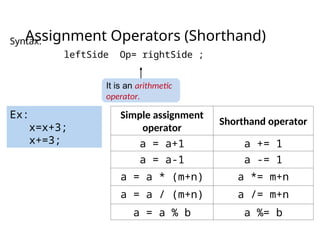
Assignment Operators (Shorthand)
Syntax:
leftSideOp= rightSide ;
Simple assignment
operator
Shorthand operator
a = a+1 a += 1
a = a-1 a -= 1
a = a * (m+n) a *= m+n
a = a / (m+n) a /= m+n
a = a % b a %= b
It is an arithmetic
operator.
Ex:
x=x+3;
x+=3;
26.
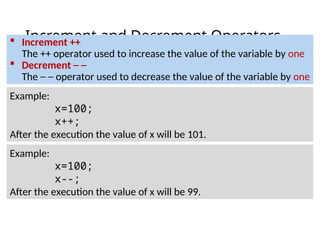
Increment and DecrementOperators
Increment ++
The ++ operator used to increase the value of the variable by one
Decrement ─ ─
The ─ ─ operator used to decrease the value of the variable by one
Example:
x=100;
x++;
After the execution the value of x will be 101.
Example:
x=100;
x--;
After the execution the value of x will be 99.
27.
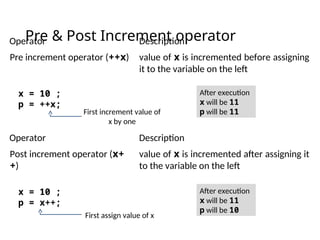
Pre & PostIncrement operator
Operator Description
Pre increment operator (++x) value of x is incremented before assigning
it to the variable on the left
x = 10 ;
p = ++x;
After execution
x will be 11
p will be 11
First increment value of
x by one
Operator Description
Post increment operator (x+
+)
value of x is incremented after assigning it
to the variable on the left
x = 10 ;
p = x++;
After execution
x will be 11
p will be 10
First assign value of x
28.
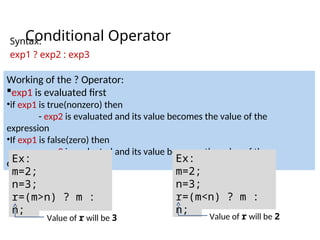
Conditional Operator
Syntax:
exp1 ?exp2 : exp3
Working of the ? Operator:
exp1 is evaluated first
•if exp1 is true(nonzero) then
- exp2 is evaluated and its value becomes the value of the
expression
•If exp1 is false(zero) then
- exp3 is evaluated and its value becomes the value of the
expression
Ex:
m=2;
n=3;
r=(m>n) ? m :
n;
Ex:
m=2;
n=3;
r=(m<n) ? m :
n;
Value of r will be 3 Value of r will be 2
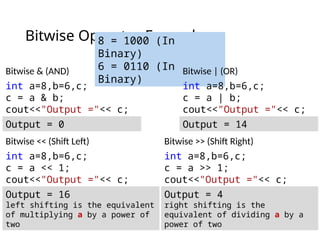
Bitwise Operator Examples
8= 1000 (In
Binary)
6 = 0110 (In
Binary)
Bitwise & (AND)
int a=8,b=6,c;
c = a & b;
cout<<"Output ="<< c;
Output = 0
Bitwise | (OR)
int a=8,b=6,c;
c = a | b;
cout<<"Output ="<< c;
Output = 14
Bitwise << (Shift Left)
int a=8,b=6,c;
c = a << 1;
cout<<"Output ="<< c;
Output = 16
left shifting is the equivalent
of multiplying a by a power of
two
Bitwise >> (Shift Right)
int a=8,b=6,c;
c = a >> 1;
cout<<"Output ="<< c;
Output = 4
right shifting is the
equivalent of dividing a by a
power of two
31.
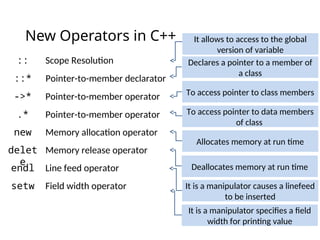
New Operators inC++
:: Scope Resolution
::* Pointer-to-member declarator
->* Pointer-to-member operator
.* Pointer-to-member operator
delet
e
Memory release operator
endl Line feed operator
new Memory allocation operator
setw Field width operator
It allows to access to the global
version of variable
Declares a pointer to a member of
a class
To access pointer to class members
To access pointer to data members
of class
Deallocates memory at run time
It is a manipulator causes a linefeed
to be inserted
Allocates memory at run time
It is a manipulator specifies a field
width for printing value
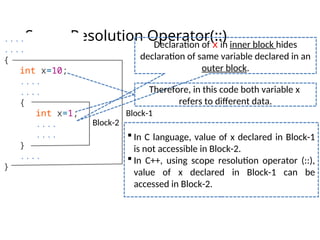
Scope Resolution Operator(::)
....
....
{
intx=10;
....
....
{
int x=1;
....
....
}
....
}
Block-2
Block-1
Declaration of x in inner block hides
declaration of same variable declared in an
outer block.
Therefore, in this code both variable x
refers to different data.
In C language, value of x declared in Block-1
is not accessible in Block-2.
In C++, using scope resolution operator (::),
value of x declared in Block-1 can be
accessed in Block-2.
34.
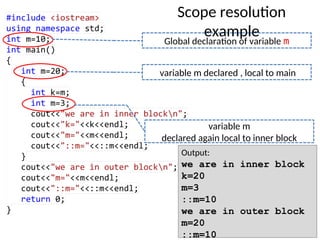
Global declaration ofvariable m
variable m declared , local to main
variable m
declared again local to inner block
Output:
we are in inner block
k=20
m=3
::m=10
we are in outer block
m=20
::m=10
Scope resolution
example
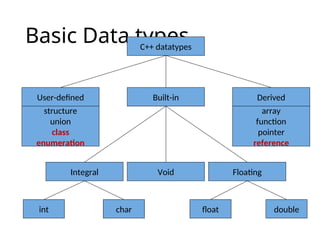
Basic Data types
C++datatypes
User-defined Built-in Derived
Integral Void Floating
structure
union
class
enumeration
array
function
pointer
reference
int char float double
37.
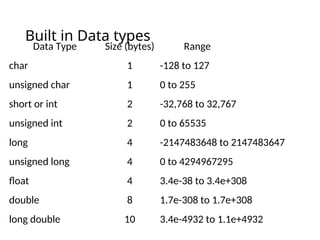
Built in Datatypes
Data Type Size (bytes) Range
char 1 -128 to 127
unsigned char 1 0 to 255
short or int 2 -32,768 to 32,767
unsigned int 2 0 to 65535
long 4 -2147483648 to 2147483647
unsigned long 4 0 to 4294967295
float 4 3.4e-38 to 3.4e+308
double 8 1.7e-308 to 1.7e+308
long double 10 3.4e-4932 to 1.1e+4932
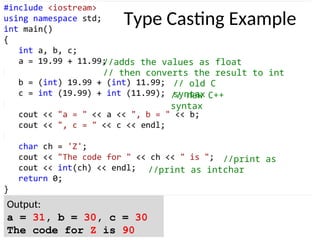
Output:
a = 31,b = 30, c = 30
The code for Z is 90
Type Casting Example
//adds the values as float
// then converts the result to int
// old C
syntax
// new C++
syntax
//print as
char
//print as int
Reference Variable
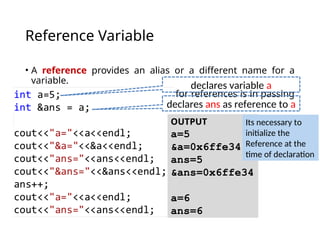
• Areference provides an alias or a different name for a
variable.
• One of the most important uses for references is in passing
arguments to functions.
declares variable a
declares ans as reference to a
OUTPUT
a=5
&a=0x6ffe34
ans=5
&ans=0x6ffe34
a=6
ans=6
Its necessary to
initialize the
Reference at the
time of declaration
47.
Reference Variable(Cont…)
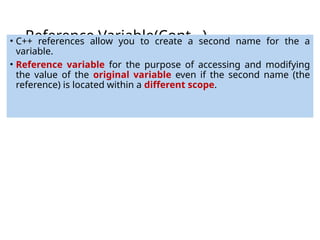
• C++references allow you to create a second name for the a
variable.
• Reference variable for the purpose of accessing and modifying
the value of the original variable even if the second name (the
reference) is located within a different scope.
48.
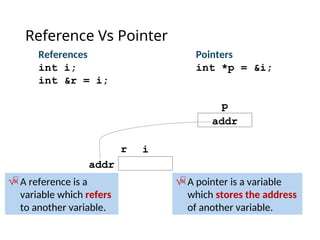
Reference Vs Pointer
Pointers
int*p = &i;
References
int i;
int &r = i;
i
r
addr
p
addr
A pointer is a variable
which stores the address
of another variable.
A reference is a
variable which refers
to another variable.
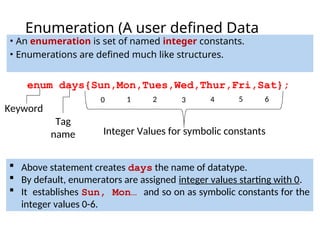
Enumeration (A userdefined Data
Type)
• An enumeration is set of named integer constants.
• Enumerations are defined much like structures.
enum days{Sun,Mon,Tues,Wed,Thur,Fri,Sat};
Keyword
Tag
name Integer Values for symbolic constants
0 1 2 3 4 5 6
Above statement creates days the name of datatype.
By default, enumerators are assigned integer values starting with 0.
It establishes Sun, Mon… and so on as symbolic constants for the
integer values 0-6.
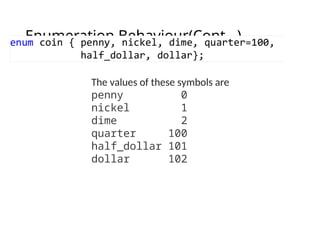
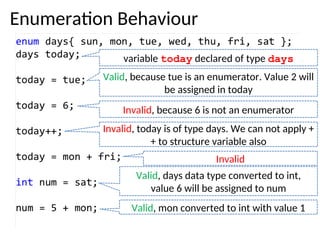
Enumeration Behaviour
variable todaydeclared of type days
Valid, because tue is an enumerator. Value 2 will
be assigned in today
Invalid, because 6 is not an enumerator
Invalid, today is of type days. We can not apply +
+ to structure variable also
Invalid
Valid, days data type converted to int,
value 6 will be assigned to num
Valid, mon converted to int with value 1
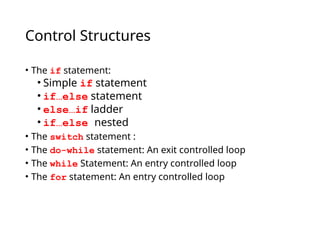
Control Structures
• Theif statement:
• Simple if statement
• if…else statement
• else…if ladder
• if…else nested
• The switch statement :
• The do-while statement: An exit controlled loop
• The while Statement: An entry controlled loop
• The for statement: An entry controlled loop
#2 On startup, control always start from main(). If there is no function called main() in your program, a linker error will be generated.
Majority of the Statements in c++ are identical to statements in c.
Iostream is morden style header which is defined by standard c++. Contains declarations for cout identifier and << operator.
#include tells compiler to ass the sourcefile iostream to first.cpp file before compiling.
#35 :: operator means to use the global version of that variable.
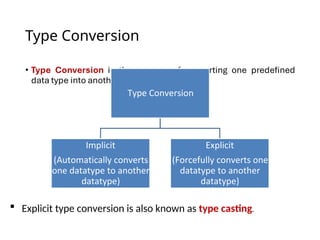
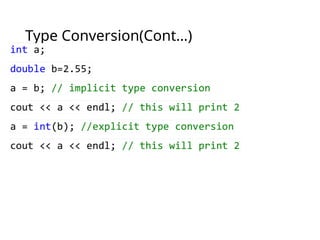
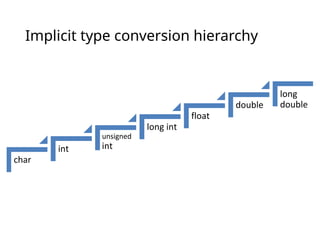
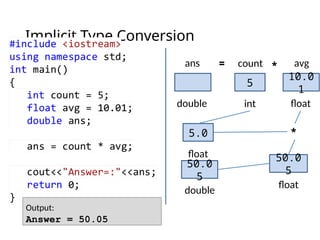
#40 Type conversion occurs when the expression has data of mixed data types.
Implicit Type Conversion is the conversion performed by the compiler without programmer’s intervention.
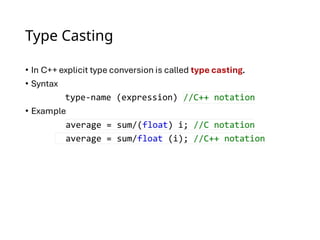
Type Conversion is the process of converting one predefined type into another type.
and type Casting is the converting one predefined type into another type forcefully.
#51 It is a way for attaching names to numbers
Enum keyword automatically enumerates a list of words by assigning the values 0,1,2 and so on
Here the tag name days become a new data type. By using this tag name you can declare new variables
#55 Used when control is transferred to one point to many possible points.