Dept. of Electrical & Electronics Engg.
Content
• Resistors, inductors, capacitors, rheostats
• Diodes, transistors
• Types of wires
• Measuring instruments
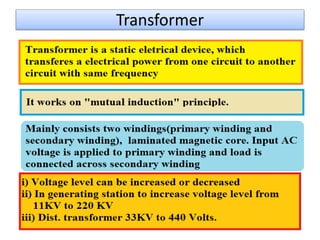
• Transformer
• Electrical Machines
1) RESISTORS
• The property of a substance which opposes
the flow of electric current (or electricity)
through it is called Resistance OR Resistance is
the ability of a circuit which opposes current.
• Mica, Glass, Rubber, Wood etc. are the
examples of resistive materials.
• The unit of resistance is OHM (Ω) where 1Ω =
1V/1A.
1) RESISTANCE
• Resistor:
• A resistor is a component or device designed
to have a value of resistance. or A resistor is a
component and device.
• which are specially designed to have a certain
amount of resistance and used to oppose or
limit the electric current are called resistors.
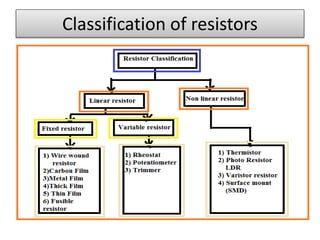
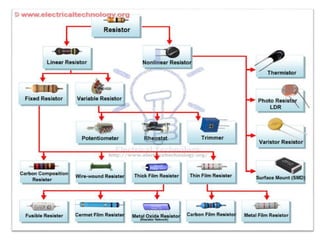
Classification of resistors
1) INDUCTOR
• Inductor:
• An inductor or coil or choke is a two terminal device which
is used to build various circuits. The main function of an
inductor is used to store energy in a magnetic field.
• It consist of a wire, generally twisted into a coil. When a
current flows through this coil, then temporarily stores the
in the coil. An absolute inductor is equivalent to a short
circuit for direct current, and grants an opposed force to
alternating current that depends on the current’s
frequency. The opposition to a flow of current of an
inductor is associated with the frequency of the flowing
current through it. Sometimes, these devices indicated to
as “coils” because the most of the inductor physical
construction is designed with coiled sections of wire.
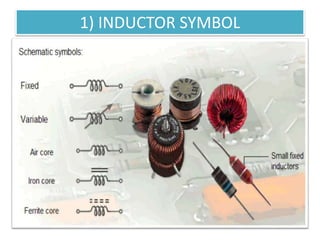
1) INDUCTOR SYMBOL
CAPACITOR
• A capacitor is a passive two-terminal electrical
component that stores potential energy in
an electric field.
• The effect of a capacitor is known
as capacitance. While some capacitance exists
between any two electrical conductors in
proximity in a circuit,
• A capacitor is a component designed to add
capacitance to a circuit.
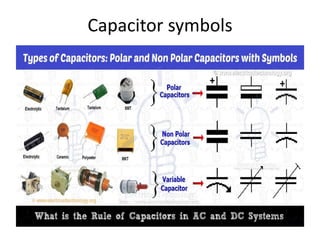
Capacitor symbols
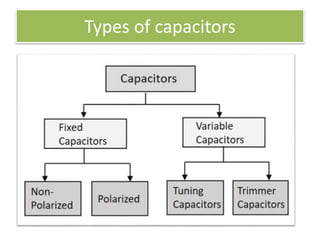
Types of capacitors
Capacitor applications
• High Voltage Electrolytic capacitor is used in power
supplies.
• An Axial Electrolytic capacitor is used in lower voltage
smaller size for general purpose where huge capacitance
principles are needed.
• High Voltage disk ceramic capacitor is a small size & the
value of capacitance and excellent tolerance
characteristics.
• The Metalised Polypropylene capacitor is a small size for
values up to 2µF and good reliability.
• Surface mount capacitor is relatively high capacitance for
size attained by several layers. In fact, numerous
capacitors in parallel.
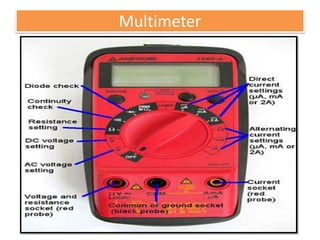
Multimeter
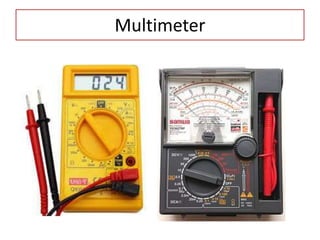
Multimeter
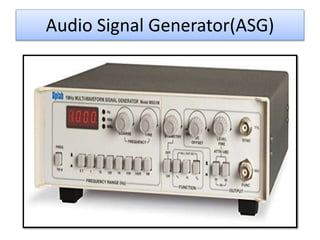
Audio Signal Generator(ASG)
Audio Signal Generator
• It is usually a piece of electronic test
equipment or software used to generate
different types of electrical waveforms over a
wide range of frequencies.
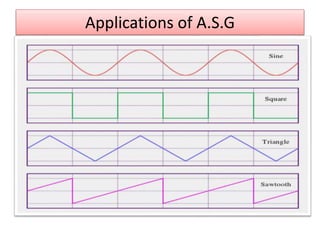
• Some of the most common waveforms
produced by the function generator are the
sine wave , square wave, triangular wave and
saw tooth shapes.
Applications of A.S.G
• It is generally used in designing, testing,
troubleshooting, and repairing electronic or
electroacoustic devices.
• RF and Microwave Signal Generators are used
for testing of components, receivers and test
systems in cellular communications, WiFi and
GPS systems.
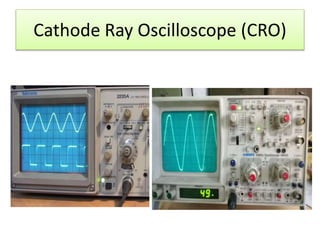
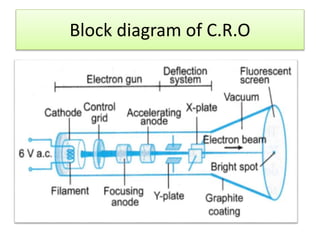
Cathode Ray Oscilloscope (CRO)
C.R.O Applications
• It can be used to visualize waveforms of electrical
& electronic circuits.
• To measure the Magnitude of waveforms ( i.e
voltage.)
• To measure the time period (T) for cycle of AC
quantities. Estimation of frequency (f) in Hz.
• To measure maximum value of AC quantity.
• To compare input and output waveforms.
• To know the “ON LINE” variation of input and out
put parameters.
Block diagram of C.R.O
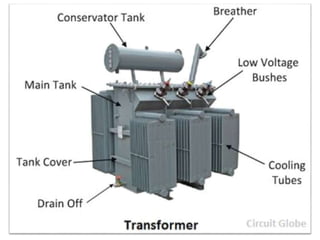
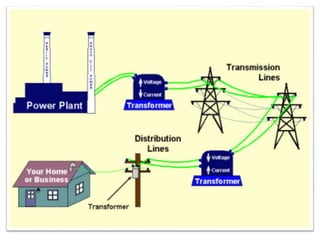
Transformer
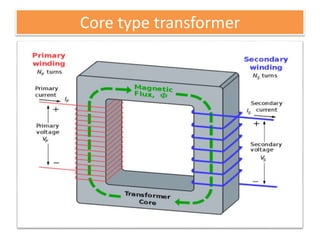
Core type transformer
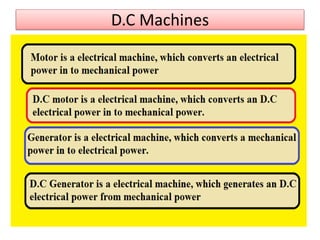
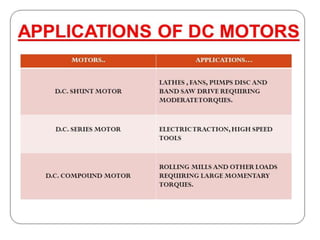
D.C Machines
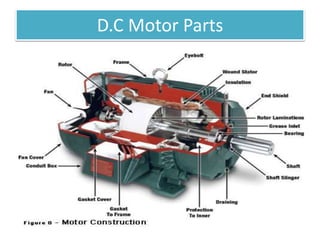
D.C Motor Parts
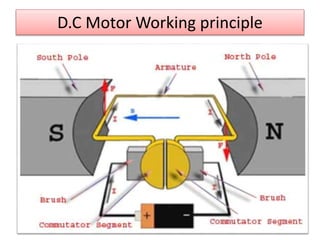
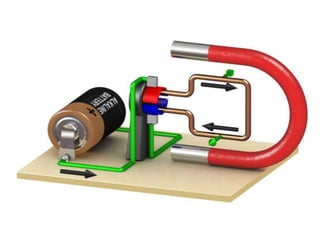
D.C Motor Working principle
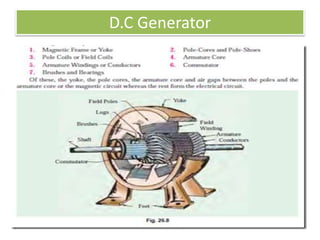
D.C Generator
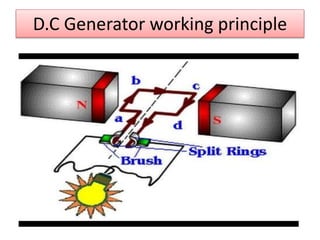
D.C Generator working principle
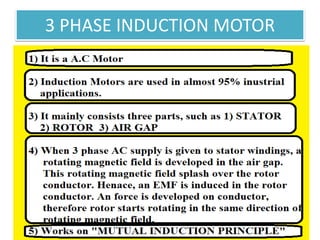
3 PHASE INDUCTION MOTOR
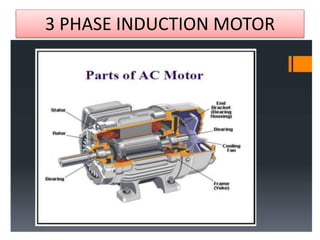
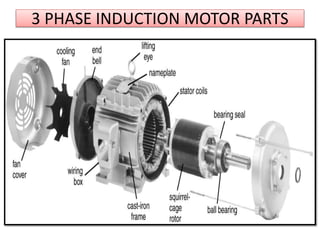
3 PHASE INDUCTION MOTOR PARTS
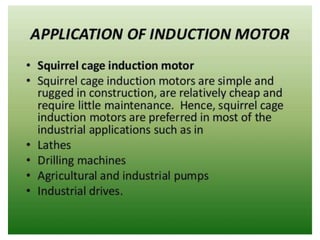
APPLICATIONS OF INDUCTION MOTOR
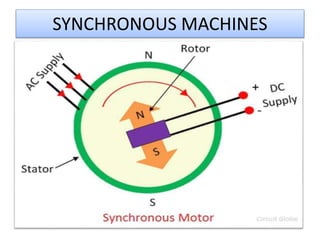
SYNCHRONOUS MACHINES
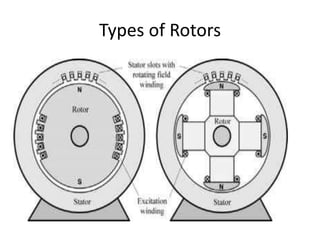
Types of Rotors
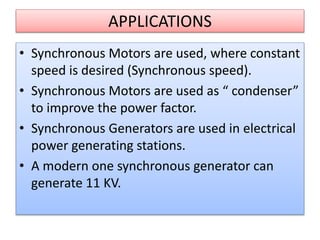
APPLICATIONS
• Synchronous Motors are used, where constant
speed is desired (Synchronous speed).
• Synchronous Motors are used as “ condenser”
to improve the power factor.
• Synchronous Generators are used in electrical
power generating stations.
• A modern one synchronous generator can
generate 11 KV.
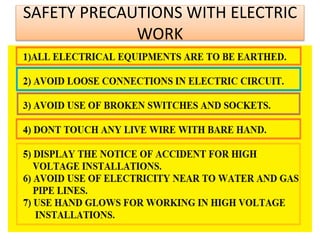
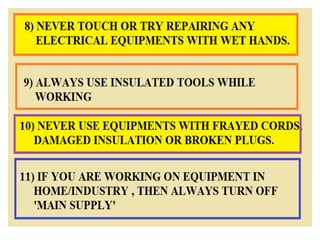
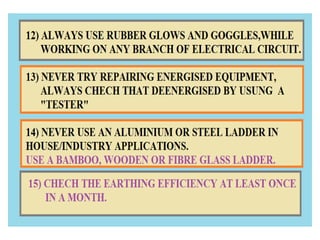
SAFETY PRECAUTIONS WITH ELECTRIC
WORK
BEE BLDE ORIENTATION programme for freshers.pptx

BEE BLDE ORIENTATION programme for freshers.pptx

  • 1.
    Dept. of Electrical& Electronics Engg.
  • 3.
    Content • Resistors, inductors,capacitors, rheostats • Diodes, transistors • Types of wires • Measuring instruments • Transformer • Electrical Machines
  • 4.
    1) RESISTORS • Theproperty of a substance which opposes the flow of electric current (or electricity) through it is called Resistance OR Resistance is the ability of a circuit which opposes current. • Mica, Glass, Rubber, Wood etc. are the examples of resistive materials. • The unit of resistance is OHM (Ω) where 1Ω = 1V/1A.
  • 5.
    1) RESISTANCE • Resistor: •A resistor is a component or device designed to have a value of resistance. or A resistor is a component and device. • which are specially designed to have a certain amount of resistance and used to oppose or limit the electric current are called resistors.
  • 6.
  • 9.
    1) INDUCTOR • Inductor: •An inductor or coil or choke is a two terminal device which is used to build various circuits. The main function of an inductor is used to store energy in a magnetic field. • It consist of a wire, generally twisted into a coil. When a current flows through this coil, then temporarily stores the in the coil. An absolute inductor is equivalent to a short circuit for direct current, and grants an opposed force to alternating current that depends on the current’s frequency. The opposition to a flow of current of an inductor is associated with the frequency of the flowing current through it. Sometimes, these devices indicated to as “coils” because the most of the inductor physical construction is designed with coiled sections of wire.
  • 10.
  • 13.
    CAPACITOR • A capacitoris a passive two-terminal electrical component that stores potential energy in an electric field. • The effect of a capacitor is known as capacitance. While some capacitance exists between any two electrical conductors in proximity in a circuit, • A capacitor is a component designed to add capacitance to a circuit.
  • 14.
  • 15.
  • 16.
    Capacitor applications • HighVoltage Electrolytic capacitor is used in power supplies. • An Axial Electrolytic capacitor is used in lower voltage smaller size for general purpose where huge capacitance principles are needed. • High Voltage disk ceramic capacitor is a small size & the value of capacitance and excellent tolerance characteristics. • The Metalised Polypropylene capacitor is a small size for values up to 2µF and good reliability. • Surface mount capacitor is relatively high capacitance for size attained by several layers. In fact, numerous capacitors in parallel.
  • 17.
  • 18.
  • 19.
  • 20.
    Audio Signal Generator •It is usually a piece of electronic test equipment or software used to generate different types of electrical waveforms over a wide range of frequencies. • Some of the most common waveforms produced by the function generator are the sine wave , square wave, triangular wave and saw tooth shapes.
  • 21.
  • 22.
    Applications of A.S.G •It is generally used in designing, testing, troubleshooting, and repairing electronic or electroacoustic devices. • RF and Microwave Signal Generators are used for testing of components, receivers and test systems in cellular communications, WiFi and GPS systems.
  • 23.
  • 24.
    C.R.O Applications • Itcan be used to visualize waveforms of electrical & electronic circuits. • To measure the Magnitude of waveforms ( i.e voltage.) • To measure the time period (T) for cycle of AC quantities. Estimation of frequency (f) in Hz. • To measure maximum value of AC quantity. • To compare input and output waveforms. • To know the “ON LINE” variation of input and out put parameters.
  • 25.
  • 26.
  • 27.
  • 30.
  • 31.
  • 32.
  • 34.
  • 35.
  • 37.
  • 38.
  • 39.
    3 PHASE INDUCTIONMOTOR PARTS
  • 40.
  • 42.
  • 43.
  • 44.
    APPLICATIONS • Synchronous Motorsare used, where constant speed is desired (Synchronous speed). • Synchronous Motors are used as “ condenser” to improve the power factor. • Synchronous Generators are used in electrical power generating stations. • A modern one synchronous generator can generate 11 KV.
  • 45.