COURSE 1
MODULE 3
Unit 6
Namrata Saxena, Asst Professor, PCER, New Panvel.
c) Interventions for life skills in the areas of interpersonal skills
What are Life Skills?
A skill is a learned ability to do something well. So Life Skills are the abilities
that individuals can develop to live a fruitful life.
DEFINITIONS
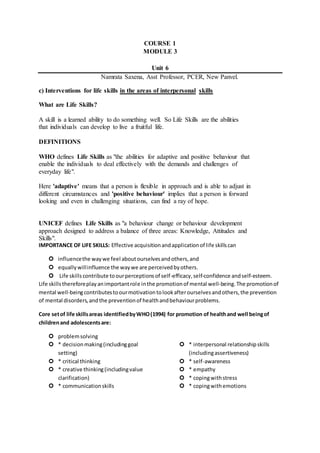
WHO defines Life Skills as "the abilities for adaptive and positive behaviour that
enable the individuals to deal effectively with the demands and challenges of
everyday life".
Here 'adaptive' means that a person is flexible in approach and is able to adjust in
different circumstances and 'positive behaviour' implies that a person is forward
looking and even in challenging situations, can find a ray of hope.
UNICEF defines Life Skills as "a behaviour change or behaviour development
approach designed to address a balance of three areas: Knowledge, Attitudes and
Skills".
IMPORTANCE OF LIFE SKILLS: Effective acquisitionandapplicationof life skillscan
 influencethe waywe feel aboutourselvesandothers,and
 equallywillinfluence the waywe are perceivedbyothers.
 Life skillscontribute toourperceptionsof self-efficacy,self-confidence andself-esteem.
Life skillsthereforeplayanimportantrole inthe promotionof mental well-being.The promotionof
mental well-beingcontributestoourmotivationtolookafterourselvesandothers,the prevention
of mental disorders,andthe preventionof healthandbehaviourproblems.
Core setof life skillsareas identifiedbyWHO(1994) for promotion of healthand well beingof
childrenand adolescentsare:
 problemsolving
 * decisionmaking(includinggoal
setting)
 * critical thinking
 * creative thinking(includingvalue
clarification)
 * communicationskills
 * interpersonal relationshipskills
(includingassertiveness)
 * self-awareness
 * empathy
 * copingwithstress
 * copingwithemotions
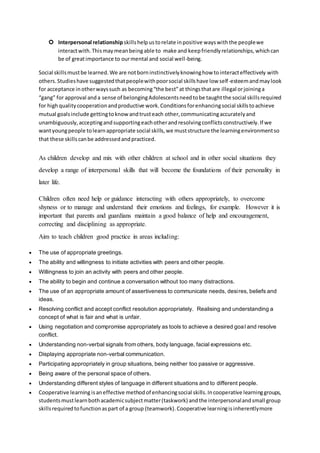
 Interpersonal relationship skillshelpustorelate inpositive wayswiththe peoplewe
interactwith.Thismaymeanbeingable to make and keepfriendlyrelationships,whichcan
be of greatimportance to ourmental and social well-being.
Social skillsmustbe learned.We are notborninstinctivelyknowinghow tointeracteffectively with
others.Studieshave suggestedthatpeoplewithpoorsocial skillshave low self-esteemandmaylook
for acceptance inotherwayssuch as becoming“the best”at thingsthatare illegal orjoininga
“gang” for approval anda sense of belongingAdolescentsneedtobe taughtthe social skillsrequired
for highqualitycooperationandproductive work.Conditionsforenhancingsocial skillstoachieve
mutual goalsinclude gettingtoknowandtrusteach other,communicatingaccuratelyand
unambiguously,acceptingandsupportingeachotherandresolvingconflictsconstructively.If we
wantyoungpeople tolearnappropriate social skills,we muststructure the learningenvironmentso
that these skillscanbe addressedandpracticed.
As children develop and mix with other children at school and in other social situations they
develop a range of interpersonal skills that will become the foundations of their personality in
later life.
Children often need help or guidance interacting with others appropriately, to overcome
shyness or to manage and understand their emotions and feelings, for example. However it is
important that parents and guardians maintain a good balance of help and encouragement,
correcting and disciplining as appropriate.
Aim to teach children good practice in areas including:
 The use of appropriate greetings.
 The ability and willingness to initiate activities with peers and other people.
 Willingness to join an activity with peers and other people.
 The ability to begin and continue a conversation without too many distractions.
 The use of an appropriate amount of assertiveness to communicate needs, desires, beliefs and
ideas.
 Resolving conflict and accept conflict resolution appropriately. Realising and understanding a
concept of what is fair and what is unfair.
 Using negotiation and compromise appropriately as tools to achieve a desired goal and resolve
conflict.
 Understanding non-verbal signals from others, body language, facial expressions etc.
 Displaying appropriate non-verbal communication.
 Participating appropriately in group situations, being neither too passive or aggressive.
 Being aware of the personal space of others.
 Understanding different styles of language in different situations and to different people.
 Cooperative learning isaneffective methodof enhancingsocial skills.Incooperative learninggroups,
studentsmustlearnbothacademicsubjectmatter(taskwork) andthe interpersonalandsmall group
skillsrequiredtofunctionaspart of a group (teamwork).Cooperative learningisinherentlymore
complex thancompetitive orindividualisticlearningbecause studentshave tosimultaneously
engage intaskworkandteamwork.
 Encourage healthcompetitions.

b.ed Course 1 interventions interpersonal skills

  • 1.
    COURSE 1 MODULE 3 Unit6 Namrata Saxena, Asst Professor, PCER, New Panvel. c) Interventions for life skills in the areas of interpersonal skills What are Life Skills? A skill is a learned ability to do something well. So Life Skills are the abilities that individuals can develop to live a fruitful life. DEFINITIONS WHO defines Life Skills as "the abilities for adaptive and positive behaviour that enable the individuals to deal effectively with the demands and challenges of everyday life". Here 'adaptive' means that a person is flexible in approach and is able to adjust in different circumstances and 'positive behaviour' implies that a person is forward looking and even in challenging situations, can find a ray of hope. UNICEF defines Life Skills as "a behaviour change or behaviour development approach designed to address a balance of three areas: Knowledge, Attitudes and Skills". IMPORTANCE OF LIFE SKILLS: Effective acquisitionandapplicationof life skillscan  influencethe waywe feel aboutourselvesandothers,and  equallywillinfluence the waywe are perceivedbyothers.  Life skillscontribute toourperceptionsof self-efficacy,self-confidence andself-esteem. Life skillsthereforeplayanimportantrole inthe promotionof mental well-being.The promotionof mental well-beingcontributestoourmotivationtolookafterourselvesandothers,the prevention of mental disorders,andthe preventionof healthandbehaviourproblems. Core setof life skillsareas identifiedbyWHO(1994) for promotion of healthand well beingof childrenand adolescentsare:  problemsolving  * decisionmaking(includinggoal setting)  * critical thinking  * creative thinking(includingvalue clarification)  * communicationskills  * interpersonal relationshipskills (includingassertiveness)  * self-awareness  * empathy  * copingwithstress  * copingwithemotions
  • 2.
     Interpersonal relationshipskillshelpustorelate inpositive wayswiththe peoplewe interactwith.Thismaymeanbeingable to make and keepfriendlyrelationships,whichcan be of greatimportance to ourmental and social well-being. Social skillsmustbe learned.We are notborninstinctivelyknowinghow tointeracteffectively with others.Studieshave suggestedthatpeoplewithpoorsocial skillshave low self-esteemandmaylook for acceptance inotherwayssuch as becoming“the best”at thingsthatare illegal orjoininga “gang” for approval anda sense of belongingAdolescentsneedtobe taughtthe social skillsrequired for highqualitycooperationandproductive work.Conditionsforenhancingsocial skillstoachieve mutual goalsinclude gettingtoknowandtrusteach other,communicatingaccuratelyand unambiguously,acceptingandsupportingeachotherandresolvingconflictsconstructively.If we wantyoungpeople tolearnappropriate social skills,we muststructure the learningenvironmentso that these skillscanbe addressedandpracticed. As children develop and mix with other children at school and in other social situations they develop a range of interpersonal skills that will become the foundations of their personality in later life. Children often need help or guidance interacting with others appropriately, to overcome shyness or to manage and understand their emotions and feelings, for example. However it is important that parents and guardians maintain a good balance of help and encouragement, correcting and disciplining as appropriate. Aim to teach children good practice in areas including:  The use of appropriate greetings.  The ability and willingness to initiate activities with peers and other people.  Willingness to join an activity with peers and other people.  The ability to begin and continue a conversation without too many distractions.  The use of an appropriate amount of assertiveness to communicate needs, desires, beliefs and ideas.  Resolving conflict and accept conflict resolution appropriately. Realising and understanding a concept of what is fair and what is unfair.  Using negotiation and compromise appropriately as tools to achieve a desired goal and resolve conflict.  Understanding non-verbal signals from others, body language, facial expressions etc.  Displaying appropriate non-verbal communication.  Participating appropriately in group situations, being neither too passive or aggressive.  Being aware of the personal space of others.  Understanding different styles of language in different situations and to different people.  Cooperative learning isaneffective methodof enhancingsocial skills.Incooperative learninggroups, studentsmustlearnbothacademicsubjectmatter(taskwork) andthe interpersonalandsmall group skillsrequiredtofunctionaspart of a group (teamwork).Cooperative learningisinherentlymore
  • 3.
    complex thancompetitive orindividualisticlearningbecausestudentshave tosimultaneously engage intaskworkandteamwork.  Encourage healthcompetitions.